EP0680700A1 - Granules de biopolymères comme additifs alimentaires - Google Patents
Granules de biopolymères comme additifs alimentaires Download PDFInfo
- Publication number
- EP0680700A1 EP0680700A1 EP95400970A EP95400970A EP0680700A1 EP 0680700 A1 EP0680700 A1 EP 0680700A1 EP 95400970 A EP95400970 A EP 95400970A EP 95400970 A EP95400970 A EP 95400970A EP 0680700 A1 EP0680700 A1 EP 0680700A1
- Authority
- EP
- European Patent Office
- Prior art keywords
- granules
- gum
- food
- biopolymers
- biopolymer
- Prior art date
- Legal status (The legal status is an assumption and is not a legal conclusion. Google has not performed a legal analysis and makes no representation as to the accuracy of the status listed.)
- Granted
Links
- 229920001222 biopolymer Polymers 0.000 title claims abstract description 22
- 235000013373 food additive Nutrition 0.000 title abstract description 4
- 239000002778 food additive Substances 0.000 title abstract description 4
- 239000008187 granular material Substances 0.000 claims abstract description 40
- 229920001285 xanthan gum Polymers 0.000 claims abstract description 15
- 235000013305 food Nutrition 0.000 claims abstract description 14
- 235000010493 xanthan gum Nutrition 0.000 claims abstract description 13
- 239000000230 xanthan gum Substances 0.000 claims abstract description 13
- 229940082509 xanthan gum Drugs 0.000 claims abstract description 13
- 229920002907 Guar gum Polymers 0.000 claims abstract description 8
- 235000010417 guar gum Nutrition 0.000 claims abstract description 8
- 239000000665 guar gum Substances 0.000 claims abstract description 8
- 229960002154 guar gum Drugs 0.000 claims abstract description 8
- 229920002678 cellulose Polymers 0.000 claims abstract description 5
- 239000001913 cellulose Substances 0.000 claims abstract description 5
- 235000010980 cellulose Nutrition 0.000 claims abstract description 5
- 229920000161 Locust bean gum Polymers 0.000 claims abstract description 4
- 235000010443 alginic acid Nutrition 0.000 claims abstract description 4
- 229920000615 alginic acid Polymers 0.000 claims abstract description 4
- 235000010418 carrageenan Nutrition 0.000 claims abstract description 4
- 239000000679 carrageenan Substances 0.000 claims abstract description 4
- 229920001525 carrageenan Polymers 0.000 claims abstract description 4
- 229940113118 carrageenan Drugs 0.000 claims abstract description 4
- 235000010420 locust bean gum Nutrition 0.000 claims abstract description 4
- 239000000711 locust bean gum Substances 0.000 claims abstract description 4
- 235000010987 pectin Nutrition 0.000 claims abstract description 4
- 229920001277 pectin Polymers 0.000 claims abstract description 4
- 239000001814 pectin Substances 0.000 claims abstract description 4
- 235000010491 tara gum Nutrition 0.000 claims abstract description 4
- 239000000213 tara gum Substances 0.000 claims abstract description 4
- UHVMMEOXYDMDKI-JKYCWFKZSA-L zinc;1-(5-cyanopyridin-2-yl)-3-[(1s,2s)-2-(6-fluoro-2-hydroxy-3-propanoylphenyl)cyclopropyl]urea;diacetate Chemical compound [Zn+2].CC([O-])=O.CC([O-])=O.CCC(=O)C1=CC=C(F)C([C@H]2[C@H](C2)NC(=O)NC=2N=CC(=CC=2)C#N)=C1O UHVMMEOXYDMDKI-JKYCWFKZSA-L 0.000 claims abstract description 4
- 230000008719 thickening Effects 0.000 claims abstract description 3
- 239000000843 powder Substances 0.000 claims description 13
- 235000014103 egg white Nutrition 0.000 claims description 11
- 210000000969 egg white Anatomy 0.000 claims description 11
- 235000013601 eggs Nutrition 0.000 claims description 9
- QCVGEOXPDFCNHA-UHFFFAOYSA-N 5,5-dimethyl-2,4-dioxo-1,3-oxazolidine-3-carboxamide Chemical compound CC1(C)OC(=O)N(C(N)=O)C1=O QCVGEOXPDFCNHA-UHFFFAOYSA-N 0.000 claims description 7
- 102000002322 Egg Proteins Human genes 0.000 claims description 7
- 108010000912 Egg Proteins Proteins 0.000 claims description 7
- XLYOFNOQVPJJNP-UHFFFAOYSA-N water Substances O XLYOFNOQVPJJNP-UHFFFAOYSA-N 0.000 claims description 6
- 239000007864 aqueous solution Substances 0.000 claims description 5
- 239000002245 particle Substances 0.000 claims description 5
- 239000007788 liquid Substances 0.000 claims description 4
- 239000000725 suspension Substances 0.000 claims description 4
- 241001465754 Metazoa Species 0.000 claims description 3
- 239000000839 emulsion Substances 0.000 claims description 3
- 239000008240 homogeneous mixture Substances 0.000 claims description 3
- 239000000654 additive Substances 0.000 claims 1
- 230000000996 additive effect Effects 0.000 claims 1
- 239000011343 solid material Substances 0.000 claims 1
- 238000005507 spraying Methods 0.000 claims 1
- FHVDTGUDJYJELY-UHFFFAOYSA-N 6-{[2-carboxy-4,5-dihydroxy-6-(phosphanyloxy)oxan-3-yl]oxy}-4,5-dihydroxy-3-phosphanyloxane-2-carboxylic acid Chemical compound O1C(C(O)=O)C(P)C(O)C(O)C1OC1C(C(O)=O)OC(OP)C(O)C1O FHVDTGUDJYJELY-UHFFFAOYSA-N 0.000 abstract 1
- 229940072056 alginate Drugs 0.000 abstract 1
- 235000019730 animal feed additive Nutrition 0.000 abstract 1
- 229960000292 pectin Drugs 0.000 abstract 1
- 239000000203 mixture Substances 0.000 description 13
- 244000303965 Cyamopsis psoralioides Species 0.000 description 5
- 238000005187 foaming Methods 0.000 description 5
- 238000002360 preparation method Methods 0.000 description 5
- 239000012530 fluid Substances 0.000 description 4
- 229920002134 Carboxymethyl cellulose Polymers 0.000 description 3
- 239000012141 concentrate Substances 0.000 description 3
- 239000006260 foam Substances 0.000 description 3
- 238000010438 heat treatment Methods 0.000 description 3
- 238000000034 method Methods 0.000 description 3
- 239000000047 product Substances 0.000 description 3
- 239000000243 solution Substances 0.000 description 3
- GJCOSYZMQJWQCA-UHFFFAOYSA-N 9H-xanthene Chemical compound C1=CC=C2CC3=CC=CC=C3OC2=C1 GJCOSYZMQJWQCA-UHFFFAOYSA-N 0.000 description 2
- 238000013019 agitation Methods 0.000 description 2
- 239000001768 carboxy methyl cellulose Substances 0.000 description 2
- 235000010948 carboxy methyl cellulose Nutrition 0.000 description 2
- 239000008112 carboxymethyl-cellulose Substances 0.000 description 2
- 239000003795 chemical substances by application Substances 0.000 description 2
- 230000000694 effects Effects 0.000 description 2
- 230000036571 hydration Effects 0.000 description 2
- 238000006703 hydration reaction Methods 0.000 description 2
- 235000015243 ice cream Nutrition 0.000 description 2
- 235000014438 salad dressings Nutrition 0.000 description 2
- 238000003756 stirring Methods 0.000 description 2
- 239000000080 wetting agent Substances 0.000 description 2
- 240000008886 Ceratonia siliqua Species 0.000 description 1
- 235000013912 Ceratonia siliqua Nutrition 0.000 description 1
- 240000006766 Cornus mas Species 0.000 description 1
- 235000003363 Cornus mas Nutrition 0.000 description 1
- 239000004354 Hydroxyethyl cellulose Substances 0.000 description 1
- 229920000663 Hydroxyethyl cellulose Polymers 0.000 description 1
- 229920002153 Hydroxypropyl cellulose Polymers 0.000 description 1
- 229920002472 Starch Polymers 0.000 description 1
- 229920001938 Vegetable gum Polymers 0.000 description 1
- 238000005273 aeration Methods 0.000 description 1
- 238000000889 atomisation Methods 0.000 description 1
- 244000052616 bacterial pathogen Species 0.000 description 1
- 230000015572 biosynthetic process Effects 0.000 description 1
- 244000309466 calf Species 0.000 description 1
- 230000000052 comparative effect Effects 0.000 description 1
- 235000014510 cooky Nutrition 0.000 description 1
- 230000008021 deposition Effects 0.000 description 1
- 235000005911 diet Nutrition 0.000 description 1
- 230000000378 dietary effect Effects 0.000 description 1
- 239000002270 dispersing agent Substances 0.000 description 1
- 239000006185 dispersion Substances 0.000 description 1
- 239000000428 dust Substances 0.000 description 1
- 238000010410 dusting Methods 0.000 description 1
- 235000013399 edible fruits Nutrition 0.000 description 1
- 235000013345 egg yolk Nutrition 0.000 description 1
- 210000002969 egg yolk Anatomy 0.000 description 1
- 238000005469 granulation Methods 0.000 description 1
- 230000003179 granulation Effects 0.000 description 1
- 235000019447 hydroxyethyl cellulose Nutrition 0.000 description 1
- 239000001863 hydroxypropyl cellulose Substances 0.000 description 1
- 235000010977 hydroxypropyl cellulose Nutrition 0.000 description 1
- 238000002347 injection Methods 0.000 description 1
- 239000007924 injection Substances 0.000 description 1
- 239000012263 liquid product Substances 0.000 description 1
- 238000004519 manufacturing process Methods 0.000 description 1
- 239000000463 material Substances 0.000 description 1
- 230000002906 microbiologic effect Effects 0.000 description 1
- 235000013336 milk Nutrition 0.000 description 1
- 210000004080 milk Anatomy 0.000 description 1
- 235000013379 molasses Nutrition 0.000 description 1
- 238000004806 packaging method and process Methods 0.000 description 1
- 238000009928 pasteurization Methods 0.000 description 1
- 230000001717 pathogenic effect Effects 0.000 description 1
- 229920000642 polymer Polymers 0.000 description 1
- 235000015504 ready meals Nutrition 0.000 description 1
- 238000010008 shearing Methods 0.000 description 1
- 239000002002 slurry Substances 0.000 description 1
- 239000002904 solvent Substances 0.000 description 1
- 235000014347 soups Nutrition 0.000 description 1
- 230000000087 stabilizing effect Effects 0.000 description 1
- 239000008107 starch Substances 0.000 description 1
- 235000019698 starch Nutrition 0.000 description 1
- 238000003860 storage Methods 0.000 description 1
- 238000009423 ventilation Methods 0.000 description 1
- 230000003313 weakening effect Effects 0.000 description 1
Classifications
-
- A—HUMAN NECESSITIES
- A23—FOODS OR FOODSTUFFS; TREATMENT THEREOF, NOT COVERED BY OTHER CLASSES
- A23K—FODDER
- A23K40/00—Shaping or working-up of animal feeding-stuffs
- A23K40/10—Shaping or working-up of animal feeding-stuffs by agglomeration; by granulation, e.g. making powders
-
- A—HUMAN NECESSITIES
- A23—FOODS OR FOODSTUFFS; TREATMENT THEREOF, NOT COVERED BY OTHER CLASSES
- A23L—FOODS, FOODSTUFFS OR NON-ALCOHOLIC BEVERAGES, NOT OTHERWISE PROVIDED FOR; PREPARATION OR TREATMENT THEREOF
- A23L15/00—Egg products; Preparation or treatment thereof
- A23L15/20—Addition of proteins, e.g. hydrolysates, fats, carbohydrates, natural plant hydrocolloids; Addition of animal or vegetable substances containing proteins, fats, or carbohydrates
-
- A—HUMAN NECESSITIES
- A23—FOODS OR FOODSTUFFS; TREATMENT THEREOF, NOT COVERED BY OTHER CLASSES
- A23L—FOODS, FOODSTUFFS OR NON-ALCOHOLIC BEVERAGES, NOT OTHERWISE PROVIDED FOR; PREPARATION OR TREATMENT THEREOF
- A23L29/00—Foods or foodstuffs containing additives; Preparation or treatment thereof
- A23L29/20—Foods or foodstuffs containing additives; Preparation or treatment thereof containing gelling or thickening agents
- A23L29/206—Foods or foodstuffs containing additives; Preparation or treatment thereof containing gelling or thickening agents of vegetable origin
- A23L29/231—Pectin; Derivatives thereof
-
- A—HUMAN NECESSITIES
- A23—FOODS OR FOODSTUFFS; TREATMENT THEREOF, NOT COVERED BY OTHER CLASSES
- A23L—FOODS, FOODSTUFFS OR NON-ALCOHOLIC BEVERAGES, NOT OTHERWISE PROVIDED FOR; PREPARATION OR TREATMENT THEREOF
- A23L29/00—Foods or foodstuffs containing additives; Preparation or treatment thereof
- A23L29/20—Foods or foodstuffs containing additives; Preparation or treatment thereof containing gelling or thickening agents
- A23L29/206—Foods or foodstuffs containing additives; Preparation or treatment thereof containing gelling or thickening agents of vegetable origin
- A23L29/238—Foods or foodstuffs containing additives; Preparation or treatment thereof containing gelling or thickening agents of vegetable origin from seeds, e.g. locust bean gum or guar gum
-
- A—HUMAN NECESSITIES
- A23—FOODS OR FOODSTUFFS; TREATMENT THEREOF, NOT COVERED BY OTHER CLASSES
- A23L—FOODS, FOODSTUFFS OR NON-ALCOHOLIC BEVERAGES, NOT OTHERWISE PROVIDED FOR; PREPARATION OR TREATMENT THEREOF
- A23L29/00—Foods or foodstuffs containing additives; Preparation or treatment thereof
- A23L29/20—Foods or foodstuffs containing additives; Preparation or treatment thereof containing gelling or thickening agents
- A23L29/206—Foods or foodstuffs containing additives; Preparation or treatment thereof containing gelling or thickening agents of vegetable origin
- A23L29/256—Foods or foodstuffs containing additives; Preparation or treatment thereof containing gelling or thickening agents of vegetable origin from seaweeds, e.g. alginates, agar or carrageenan
-
- A—HUMAN NECESSITIES
- A23—FOODS OR FOODSTUFFS; TREATMENT THEREOF, NOT COVERED BY OTHER CLASSES
- A23L—FOODS, FOODSTUFFS OR NON-ALCOHOLIC BEVERAGES, NOT OTHERWISE PROVIDED FOR; PREPARATION OR TREATMENT THEREOF
- A23L29/00—Foods or foodstuffs containing additives; Preparation or treatment thereof
- A23L29/20—Foods or foodstuffs containing additives; Preparation or treatment thereof containing gelling or thickening agents
- A23L29/206—Foods or foodstuffs containing additives; Preparation or treatment thereof containing gelling or thickening agents of vegetable origin
- A23L29/262—Cellulose; Derivatives thereof, e.g. ethers
-
- A—HUMAN NECESSITIES
- A23—FOODS OR FOODSTUFFS; TREATMENT THEREOF, NOT COVERED BY OTHER CLASSES
- A23L—FOODS, FOODSTUFFS OR NON-ALCOHOLIC BEVERAGES, NOT OTHERWISE PROVIDED FOR; PREPARATION OR TREATMENT THEREOF
- A23L29/00—Foods or foodstuffs containing additives; Preparation or treatment thereof
- A23L29/20—Foods or foodstuffs containing additives; Preparation or treatment thereof containing gelling or thickening agents
- A23L29/269—Foods or foodstuffs containing additives; Preparation or treatment thereof containing gelling or thickening agents of microbial origin, e.g. xanthan or dextran
- A23L29/27—Xanthan not combined with other microbial gums
-
- A—HUMAN NECESSITIES
- A23—FOODS OR FOODSTUFFS; TREATMENT THEREOF, NOT COVERED BY OTHER CLASSES
- A23P—SHAPING OR WORKING OF FOODSTUFFS, NOT FULLY COVERED BY A SINGLE OTHER SUBCLASS
- A23P10/00—Shaping or working of foodstuffs characterised by the products
- A23P10/20—Agglomerating; Granulating; Tabletting
- A23P10/22—Agglomeration or granulation with pulverisation of solid particles, e.g. in a free-falling curtain
-
- A—HUMAN NECESSITIES
- A23—FOODS OR FOODSTUFFS; TREATMENT THEREOF, NOT COVERED BY OTHER CLASSES
- A23V—INDEXING SCHEME RELATING TO FOODS, FOODSTUFFS OR NON-ALCOHOLIC BEVERAGES AND LACTIC OR PROPIONIC ACID BACTERIA USED IN FOODSTUFFS OR FOOD PREPARATION
- A23V2002/00—Food compositions, function of food ingredients or processes for food or foodstuffs
-
- A—HUMAN NECESSITIES
- A23—FOODS OR FOODSTUFFS; TREATMENT THEREOF, NOT COVERED BY OTHER CLASSES
- A23V—INDEXING SCHEME RELATING TO FOODS, FOODSTUFFS OR NON-ALCOHOLIC BEVERAGES AND LACTIC OR PROPIONIC ACID BACTERIA USED IN FOODSTUFFS OR FOOD PREPARATION
- A23V2250/00—Food ingredients
- A23V2250/50—Polysaccharides, gums
- A23V2250/502—Gums
- A23V2250/506—Guar
-
- A—HUMAN NECESSITIES
- A23—FOODS OR FOODSTUFFS; TREATMENT THEREOF, NOT COVERED BY OTHER CLASSES
- A23V—INDEXING SCHEME RELATING TO FOODS, FOODSTUFFS OR NON-ALCOHOLIC BEVERAGES AND LACTIC OR PROPIONIC ACID BACTERIA USED IN FOODSTUFFS OR FOOD PREPARATION
- A23V2250/00—Food ingredients
- A23V2250/50—Polysaccharides, gums
- A23V2250/502—Gums
- A23V2250/5086—Xanthan
Definitions
- Biopolymers such as xanthan gum, guar gum, locust bean gum, tara gum, carrageenan, pectin, cellulose derivatives and alginates are well known as food additives where they are generally used as a texture agent or a control agent. viscosity, for example in salad dressings or soup concentrates.
- biopolymer In many applications, it is necessary to put the biopolymer in the form of a weakly concentrated aqueous solution.
- biopolymer powders are their difficulty in dissolving quickly even under agitation with a high shearing effect. Under the effect of too rapid hydration, the grains in contact with water are surrounded by a thin gelled film and agglomerate into lumps which disintegrate and dissolve with difficulty.
- a first type of solution consists in preparing liquid compositions of biopolymers which are either suspensions in a non-solvent organic liquid of the polymer (EP-A-39128) or emulsions (FR-A-2,548,676).
- Another solution is to present the biopolymers in the form of granules.
- U.S.A. 4,557,938 describes the preparation, by means of a fluidized bed, of granules which are formed from a mixture of a vegetable gum such as xanthan gum, guar, carob, in mixture with starch.
- EP-A 254 603 describes the preparation of xanthan gum granules, also by the fluidized bed technique and in the presence of a wetting agent.
- egg flows means any fluid or liquid product based on eggs such as egg whites, egg yolks, whole eggs.
- the egg bank used for example in baking, must have as main functionality a significant foaming power allowing it to be used for the manufacture of products with a spongy texture such as sponge cakes, meringues and spoon cookies.
- these products are preferably heat treated.
- this heat treatment affects the foaming power and the stability of the foam. This weakening of the foaming power is responsible for example of the fallout of the whites mounted in snow.
- the present invention has solved the problems mentioned above.
- biopolymers which can be used as food additive for human or animal food, characterized in that they comprise from 95 to 50, preferably 85 to 75, parts of guar gum for 5 to 50, preferably 15 to 25, parts of xanthan gum.
- xanthan gum and / or up to 90% of guar gum can be replaced by a biopolymer chosen from locust bean gum, tara gum, carrageenan, pectin, alginates and food thickening derivatives of cellulose.
- a biopolymer chosen from locust bean gum, tara gum, carrageenan, pectin, alginates and food thickening derivatives of cellulose.
- These food derivatives of cellulose are for example carboxymethylcellulose, hydroxyethylcellulose, hydroxypropylcellulose, etc.
- the granules according to the invention are obtained by granulation of the biopolymer powder in a fluidized bed as taught by EP-A 254 603 or US-A 4 557 938 mentioned above.
- the use of a wetting agent and / or a dispersing agent, as taught by EP-A 254 603, is useful in certain cases but is not essential.
- a mixture of guar powder and xanthan gum is placed in a fluidized bed by atomization of the powder, then water or an aqueous solution is sprayed, possibly containing one or more biopolymers to be granulated, on the powder in suspension in the fluidized bed.
- each gum can be introduced into the reactor through separate openings. One can also then totally granulate one of the gums and then on these same granules, granulate the remaining gum.
- granules consisting of an intimate and substantially homogeneous mixture of the gums.
- the degree of aeration of the granules is preferably between 50 and 70%.
- the granules according to the invention flow freely and do not form dust during handling. They instantly disperse in water with gentle agitation, without requiring any special precautions and without the formation of lumps.
- the granules according to the invention can be used in all kinds of food, but preferably in food products which are in a more or less viscous liquid form, more particularly egg slurries and / or in the form of a suspension of materials. soluble and / or emulsion of oily products in an aqueous solution. Examples that may be mentioned are drinks based on fruit pulp, drink concentrates. salad dressings, ready meals, ice creams, sorbets and ice creams ... As examples of animal feeds or the granules according to the invention can be used, mention may be made of molasses or vinasses and replacement milks for calves.
- granule content may be higher in highly viscous and concentrated food media such as drink concentrates and dietetic preparations.
- Example 1 preparation of a xanthan gum / guar granule.
- the egg white from the breaking of the eggs is filtered to remove traces of shells and is then cooled to 4 ° C before being placed in a storage tank.
- the biopolymer granules are incorporated by dusting into the egg whites maintained with stirring to ensure the homogeneity of the mixture and a good dispersion and hydration of the gums.
- the egg white After having maintained stirring for 20 to 30 minutes, the egg white is pumped to a pasteurization device where it undergoes heat treatment at a temperature between 50 and 60 ° C for a few minutes and then it is cooled to 4 ° C before packaging.
- Foaming power rating :
- the whites are beaten for 4 minutes using a MOULINEX® single speed mixer with 2 arms and the volume V. of foam is read on the beaker.
- Example 1 The procedure of Example 1 is exactly repeated except that the guar is replaced by carboxymethyl cellulose (CMC) (mixture M1) or by albuvir (mixture M2) or by xanthan (X1). We also replace all the xanthan with CMC (mixture M3).
- CMC carboxymethyl cellulose
- X1 xanthan
- Granules M1, M2, M3 and X1 are then obtained, the foaming power of which is changed under the experimental conditions of Example 2 above.
Landscapes
- Chemical & Material Sciences (AREA)
- Life Sciences & Earth Sciences (AREA)
- Polymers & Plastics (AREA)
- Engineering & Computer Science (AREA)
- Food Science & Technology (AREA)
- Health & Medical Sciences (AREA)
- Nutrition Science (AREA)
- Dispersion Chemistry (AREA)
- Botany (AREA)
- Molecular Biology (AREA)
- Zoology (AREA)
- Jellies, Jams, And Syrups (AREA)
- General Preparation And Processing Of Foods (AREA)
- Seasonings (AREA)
- Seeds, Soups, And Other Foods (AREA)
- Tires In General (AREA)
- Heterocyclic Carbon Compounds Containing A Hetero Ring Having Oxygen Or Sulfur (AREA)
- Meat, Egg Or Seafood Products (AREA)
- Coloring Foods And Improving Nutritive Qualities (AREA)
Abstract
Description
- Les biopolymères du type gomme xanthane, gomme de guar, gomme de caroube, gomme de tara, carraghenane, pectine, les dérivés de la cellulose et les alginates sont bien connus comme additifs alimentaires où ils sont généralement utilisés comme agent de texture ou agent de contrôle de la viscosité par exemple dans les sauces salades où les concentrés de soupes.
- Dans de nombreuses applications, il est nécessaire de mettre le biopolymère sous la forme d'une solution aqueuse faiblement concentrée.
- Or, il est bien connu que l'inconvénient principal des poudres de biopolymères est leur difficulté à se dissoudre rapidement même sous une agitation à effet de cisaillement élevé.
Sous l'effet d'une hydratation trop rapide, les grains au contact de l'eau s'entourent d'un mince film gélifié et s'agglomèrent en grumeaux qui se désagrègent et se dissolvent difficilement. - On a déjà proposé des solutions techniques à ce problème.
- Un premier type de solution consiste à préparer des compositions liquides de biopolymères qui sont soit des suspensions dans un liquide organique non solvant du polymère (EP-A- 39128) soit des émulsions (FR-A-2.548.676).
- Une autre solution est de présenter les biopolymères sous forme de granulés.
- Une telle technique visant la granulation de mélanges de biopolymères au moyen d'un extracteur/granulateur est décrite dans GB-A 2.086.204.
- U.S.A. 4.557.938 décrit la préparation, au moyen d'un lit fluidisé, de granules qui sont formés d'un mélange d'une gomme végétale telle qu'une gomme xanthane, guar, caroube, en mélange avec de l'amidon.
- EP-A 254 603 décrit la préparation de granulés de gomme xanthane, également par la technique du lit fluidisé et en présence d'un agent mouillant.
- Ces granulés ont permis de réaliser un progrès technique important mais qui s'avère ne pas donner entière satisfaction lors de leur utilisation dans des produits alimentaires très visqueux tels que plus particulièrement les coules d'oeufs. Selon l'invention, on entend par coules d'oeufs tout produit fluide ou liquide à base d'oeufs tels que les blancs d'oeufs, les jaunes d'oeufs, les oeufs entiers.
- Le banc d'oeufs, utilisé par exemple en pâtisserie, doit avoir comme principale fonctionnalité un pouvoir moussant significatif permettant de l'utiliser pour la fabrication de produits à texture spongieuse tels que des génoises, des meringues et des biscuits à la cuillère.
- Toutefois, de façon à ce que ces blanc d'oeufs et plus généralement les coules d'oeufs, respectent les normes microbiologiques et soient exempts de germes patogènes, ces produits sont de préférence traités par voie thermique.
Cependant ce traitement thermique affecte le pouvoir moussan et la stabilité de la mousse.
Cet affaiblissement du pouvoir moussant est responsable par exemple de la retombée des blancs montés en neige. - La présente invention a permis de résoudre les problèmes mentionnés ci-dessus.
- Elle concerne en effet des granulés de biopolymères utilisables comme additif alimentaire pour l'alimentation humaine ou animale, caractérisé en ce qu'ils comportent de 95 à 50, de préférence 85 à 75, parties de gomme guar pour 5 à 50, de préférence 15 à 25, parties de gomme xanthane.
- Jusqu'à 90 % en poids de la gomme xanthane et/ou jusqu'à 90 % de la gomme guar peuvent être remplacés par un biopolymère choisi parmi la gomme de caroube, la gomme tara, la carraghenane, la pectine, les alginates et les dérivés épaississants alimentaires de la cellulose. Ces dérivés alimentaires de la cellulose sont par exemple la carboxyméthylcellulose, les hydroxyéthylcellulose, les hydroxypropylcellulose etc....
- Les granulés selon l'invention sont obtenus par granulation de la poudre de biopolymère en lit fluidisé telle qu'enseignée par EP-A 254 603 ou US-A 4 557 938 précités. L'utilisation d'un agent mouillant et/ou d'un agent dispersant, comme enseigné par EP-A 254 603, est utile dans certain cas mais n'est pas indispensable.
- Selon l'invention un mélange de poudre de guar et de gomme xanthane est mis en lit fluidisé par atomisation de la poudre, puis on pulvérise de l'eau ou une solution aqueuse pouvant contenir éventuellement un ou les biopolymères à granuler, sur la poudre en suspension dans le lit fluidisé.
- Selon une variante, au lieu d'introduire directement le mélange de poudre dans le réacteur à lit fluidisé, on peut introduire dans le réacteur chaque gomme par des ouvertures séparées.
On peut également alors granuler totalement une des gommes puis sur ces mêmes granulés, granuler la gomme restante. - On peut également utiliser un mélange de granulés de chacune des gommes.
- Selon l'invention, on recommande d'utiliser des granulés constitués d'un mélange intime et sensiblement homogène des gommes.
- On recommande également d'utiliser des granulés présentant une granulométrie moyenne comprise entre 0,3 et 2 mm et ayant une densité apparente comprise entre 0,3 et 0,7.
De plus le degré d'aération des granulés, exprimé par le rapport: 1 - (densité apparente granulés/ densité apparente de la poudre de dépôt) est de préférence compris entre 50 et 70 %. - Les granulés selon l'invention s'écoulent librement et ne forment pas de poussière pendant la manutention. Ils se dispersent instantanément dans l'eau sous faible agitation, sans nécessiter de précautions particulières et sans formation de grumaux.
- Les granulés selon l'invention sont utilisables dans toutes sortes d'aliments, mais de préférence dans les produits alimentaires se présentant sous une forme liquide plus ou moins visqueuse, plus particulièrement les coules d'oeuf et/ou sous une forme de suspension de matières solubles et/ou d'émulsion de produits huileux dans une solution aqueuse. On peut citer comme exemples les boissons à base de pulpe de fruits, les concentrés de boissons. les sauces salades, les plats cuisinés, les glaces, sorbets et crèmes glacées ...
Comme exemples d'aliments pour animaux ou les granulés selon l'invention sont utilisables, on peut citer les mélasses ou vinasses et les laits de remplacement pour veaux. - On recommande d'utiliser dans les aliments de 0,01 à 3 %, de préférence de 0,02 à 1 % de façon encore plus préféré de 0,05 à 0, 60 % en poids de granulés selon l'invention. La teneur en granulés peut être plus forte dans les milieux alimentaires très visqueux et concentrés tels que les concentrés de boisson et les préparations diététiques.
- Les exemples suivants illustrent l'invention sans en limiter la portée. Dans ce qui suit ou ce qui précède les pourcentages et parties sont en poids sauf mentions contraires expresses.
- On part d'une gomme xanthane en poudre dont les caractéristiques sont les suivantes :
- densité apparente : 0,7 à 0,8 g/cm³
- humidité : inférieure à 12 %
- granulométrie : au moins 95 % inférieure à 175 µm et 100 % inférieure à 250 µm
- On part également d'une poudre de guar ayant les caractéristiques suivantes :
- densité apparente : 0,45 à 0,60 g/cm³
- humidité inférieure à 12 %
- granulométrie au moins 90 % inférieure à 175 µm et 100 % inférieure à 275 µm
- On effectue un mélange homogène des 2 poudres suivant un rapport massique gomme xanthane/gomme guar = 80/20.
- On introduit 200 g d'un mélange de poudre dans un granulateur de laboratoire à lit fluide AEROMATIC® ayant un volume de 16,5 litres.
- La poudre est mise en lit fluidisé par injection d'air chauffé à 30°C avec un débit de 30 m³/h. On pulvérise également de l'eau suivant un débit de 20 ml/minute pendant 5 minutes au moyen d'une buse bifluide. On sèche les granulés obtenus jusqu'à un contenu en humidité résiduelle de 8 %. Les granulés obtenus sont fluides non collants, se dispersent instantanément dans l'eau et présentent les caractéristiques suivantes :
- granulométrie au plus 1 % supérieure à 850 µm et au plus 5 % inférieure à 75 µm
- densité 0,4 à 0,45
- degré d'aération 55 à 80 %
- Le blanc d'oeuf issu du cassage des oeufs est filtré pour éliminer les traces de coquilles puis est refroidi à 4°C avant d'être placé dans un réservoir de stockage.
- On incorpore par saupoudrage les granulés de biopolymère dans les blancs d'oeufs maintenus sous agitation pour assurer l'homogénéité du mélange et une bonne dispersion et hydratation des gommes.
- Après avoir maintenu l'agitation pendant 20 à 30 minutes, on pompe le blanc d'oeuf vers un appareil à pasteurisation où il subit un traitement thermique à une température comprise entre 50 et 60°C pendant quelques minutes puis il est refroidi à 4°C avant son conditionnement.
- On prélève pour chaque essai 100 g de blanc d'oeuf préparé ci-dessus que l'on introduit dans un bêcher gradué dont le diamètre est de 120 mm.
- On bat les blancs pendant 4 minutes à l'aide d'un batteur type MOULINEX® monovitesse à 2 bras et on lit sur le bêcher le volume V. de mousse.
- Les résultats obtenus sont rassemblés dans le tableau 1 ci-après où l'on a utilisé des teneurs croissantes de granulés dans le blanc d'oeufs.
- Du tableau 1, il ressort que l'efficacité maximale des granulés est obtenue à une teneur comprise entre 0,15 et 0,25 % dans la mesure où l'on considère qu'une viscosité maximale de 30 mPa.s est la viscosité maximale acceptable pour blanc d'oeufs cru avant traitement thermique.
- On répète exactement le mode opératoire de l'exemple 1 sauf que l'on remplace la guar par de la carboxyméthyl cellulose (CMC) (mélange M1) ou par de l'albuvir (mélange M2) ou par de la xanthane (X1). On remplace également toute la xanthane par du CMC (mélange M3).
- On obtient alors des granulés M1, M2, M3 et X1 dont on évolue le pouvoir moussant dans les conditions expérimentales de l'exemple 2 ci-dessus.
- Les résultats obtenus sont rassemblés dans le tableau 2 ci-après.
- Du tableau 2 il apparaît que le mélange selon l'invention a le meilleur pouvoir stabilisant à une teneur comprise entre 0,15 et 0,25 %.
TABLEAU 1 ESSAI TENEUR EN GRANULE (%) VOLUME DE MOUSSE (en ml) VISCOSITE DU BLANC (en mPa.S) 1 0 750 20 2 0,05 750 21 3 0,1 750 25 4 0,15 875 27 5 0,2 875 29 6 0,25 900 31 7 0,3 900 45 8 0,35 930 51 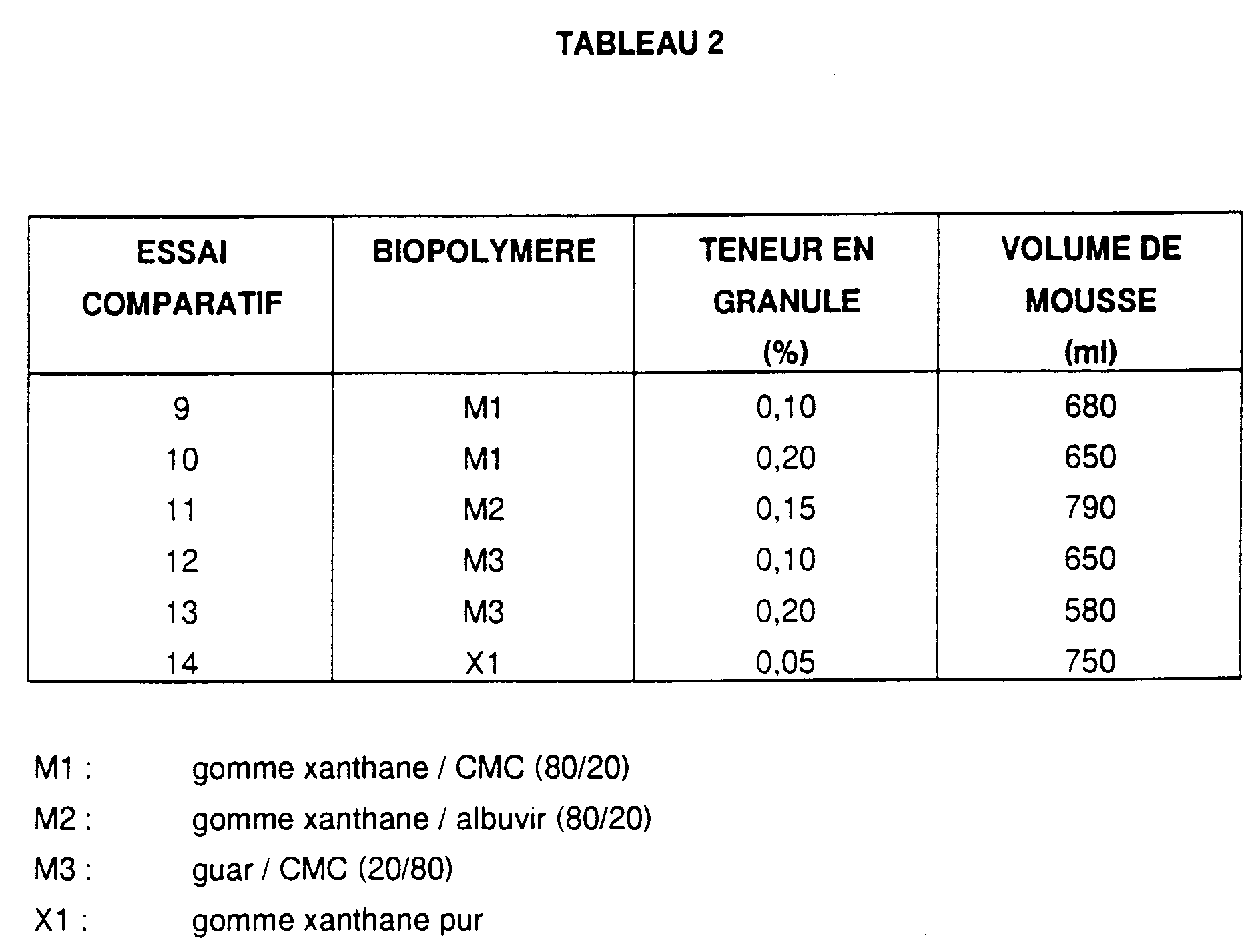
Claims (9)
Applications Claiming Priority (2)
| Application Number | Priority Date | Filing Date | Title |
|---|---|---|---|
| FR9405587A FR2719452B1 (fr) | 1994-05-06 | 1994-05-06 | Granulés de biopolymères comme additifs alimentaires. |
| FR9405587 | 1994-05-06 |
Publications (2)
| Publication Number | Publication Date |
|---|---|
| EP0680700A1 true EP0680700A1 (fr) | 1995-11-08 |
| EP0680700B1 EP0680700B1 (fr) | 2001-11-07 |
Family
ID=9462958
Family Applications (1)
| Application Number | Title | Priority Date | Filing Date |
|---|---|---|---|
| EP95400970A Expired - Lifetime EP0680700B1 (fr) | 1994-05-06 | 1995-04-28 | Granules de biopolymères comme additifs alimentaires |
Country Status (12)
| Country | Link |
|---|---|
| EP (1) | EP0680700B1 (fr) |
| JP (1) | JPH0856591A (fr) |
| KR (1) | KR950030839A (fr) |
| AT (1) | ATE208140T1 (fr) |
| AU (1) | AU1780995A (fr) |
| BR (1) | BR9501931A (fr) |
| CA (1) | CA2148779C (fr) |
| DE (1) | DE69523659T2 (fr) |
| DK (1) | DK0680700T3 (fr) |
| ES (1) | ES2169110T3 (fr) |
| FR (1) | FR2719452B1 (fr) |
| PT (1) | PT680700E (fr) |
Cited By (3)
| Publication number | Priority date | Publication date | Assignee | Title |
|---|---|---|---|---|
| FR2830415A1 (fr) * | 2001-10-09 | 2003-04-11 | Rhodia Chimie Sa | Utilisation d'une composition a base de gomme xanthane en tant que stabilisant de mousses molles, et les mousses a base de cette composition |
| US8287210B2 (en) | 2010-11-17 | 2012-10-16 | Amcol International Corporation | Sub-aqueous placement of water-based suspensions and method of manufacture and use |
| WO2016032346A1 (fr) * | 2014-08-29 | 2016-03-03 | Johnson Peter Stuart | Produit alimentaire innovant et procédé d'utilisation |
Families Citing this family (1)
| Publication number | Priority date | Publication date | Assignee | Title |
|---|---|---|---|---|
| JP7863311B2 (ja) * | 2022-03-30 | 2026-05-21 | ユニテックフーズ株式会社 | 卵の破裂防止剤 |
Citations (5)
| Publication number | Priority date | Publication date | Assignee | Title |
|---|---|---|---|---|
| JPS5332161A (en) * | 1976-09-08 | 1978-03-27 | Nobuyuki Yamatani | Metod of producing liquid egg without cholesterol |
| FR2197529B1 (fr) * | 1972-09-01 | 1978-06-30 | Standard Brands Inc | |
| GB2086204A (en) * | 1980-10-29 | 1982-05-12 | Yamanouchi Pharma Co Ltd | Granular composition of difficulty digestible polysaccharides |
| EP0153206A1 (fr) * | 1984-01-31 | 1985-08-28 | Rhone-Poulenc Chimie | Suspensions aqueuses de particules solides |
| US4557938A (en) * | 1983-08-17 | 1985-12-10 | Eugene H. Sander | Product and process for improving the dispersion of a vegetable gum in water |
Family Cites Families (6)
| Publication number | Priority date | Publication date | Assignee | Title |
|---|---|---|---|---|
| JPS52128267A (en) * | 1976-04-16 | 1977-10-27 | Sanei Kagaku Kogyo Kk | Production of foodgrade instant solid drink |
| JPS52136932A (en) * | 1976-05-11 | 1977-11-16 | Sanei Kagaku Kogyo Kk | Material for cooked additive food |
| FR2600267A1 (fr) * | 1986-06-19 | 1987-12-24 | Rhone Poulenc Chimie | Granules de biopolymere a dispersabilite et dissolution rapides |
| JP2661690B2 (ja) * | 1987-09-30 | 1997-10-08 | オルガノ株式会社 | 粉末状の食品用増粘剤 |
| JP2612609B2 (ja) * | 1988-12-28 | 1997-05-21 | キユーピー株式会社 | 卵白組成物 |
| JPH03191759A (ja) * | 1989-12-20 | 1991-08-21 | Ina Shokuhin Kogyo Kk | 寒天組成物 |
-
1994
- 1994-05-06 FR FR9405587A patent/FR2719452B1/fr not_active Expired - Fee Related
-
1995
- 1995-04-28 DK DK95400970T patent/DK0680700T3/da active
- 1995-04-28 PT PT95400970T patent/PT680700E/pt unknown
- 1995-04-28 ES ES95400970T patent/ES2169110T3/es not_active Expired - Lifetime
- 1995-04-28 EP EP95400970A patent/EP0680700B1/fr not_active Expired - Lifetime
- 1995-04-28 DE DE69523659T patent/DE69523659T2/de not_active Expired - Fee Related
- 1995-04-28 AT AT95400970T patent/ATE208140T1/de not_active IP Right Cessation
- 1995-05-02 AU AU17809/95A patent/AU1780995A/en not_active Abandoned
- 1995-05-04 KR KR1019950011063A patent/KR950030839A/ko not_active Withdrawn
- 1995-05-05 CA CA002148779A patent/CA2148779C/fr not_active Expired - Fee Related
- 1995-05-05 BR BR9501931A patent/BR9501931A/pt not_active Application Discontinuation
- 1995-05-08 JP JP7109596A patent/JPH0856591A/ja active Pending
Patent Citations (5)
| Publication number | Priority date | Publication date | Assignee | Title |
|---|---|---|---|---|
| FR2197529B1 (fr) * | 1972-09-01 | 1978-06-30 | Standard Brands Inc | |
| JPS5332161A (en) * | 1976-09-08 | 1978-03-27 | Nobuyuki Yamatani | Metod of producing liquid egg without cholesterol |
| GB2086204A (en) * | 1980-10-29 | 1982-05-12 | Yamanouchi Pharma Co Ltd | Granular composition of difficulty digestible polysaccharides |
| US4557938A (en) * | 1983-08-17 | 1985-12-10 | Eugene H. Sander | Product and process for improving the dispersion of a vegetable gum in water |
| EP0153206A1 (fr) * | 1984-01-31 | 1985-08-28 | Rhone-Poulenc Chimie | Suspensions aqueuses de particules solides |
Non-Patent Citations (1)
| Title |
|---|
| DATABASE WPI Week 7819, Derwent World Patents Index; AN 78-33910A * |
Cited By (4)
| Publication number | Priority date | Publication date | Assignee | Title |
|---|---|---|---|---|
| FR2830415A1 (fr) * | 2001-10-09 | 2003-04-11 | Rhodia Chimie Sa | Utilisation d'une composition a base de gomme xanthane en tant que stabilisant de mousses molles, et les mousses a base de cette composition |
| WO2003030664A1 (fr) * | 2001-10-09 | 2003-04-17 | Rhodia Chimie | Utilisation d'une composition a base de gomme xanthane et de galacto- or glucomannan en tant que stabilisant de mousses molles, et les mousses a base de cette composition |
| US8287210B2 (en) | 2010-11-17 | 2012-10-16 | Amcol International Corporation | Sub-aqueous placement of water-based suspensions and method of manufacture and use |
| WO2016032346A1 (fr) * | 2014-08-29 | 2016-03-03 | Johnson Peter Stuart | Produit alimentaire innovant et procédé d'utilisation |
Also Published As
| Publication number | Publication date |
|---|---|
| CA2148779A1 (fr) | 1995-11-07 |
| CA2148779C (fr) | 1998-11-03 |
| DK0680700T3 (da) | 2001-12-27 |
| ES2169110T3 (es) | 2002-07-01 |
| PT680700E (pt) | 2002-04-29 |
| JPH0856591A (ja) | 1996-03-05 |
| FR2719452B1 (fr) | 1996-07-26 |
| DE69523659T2 (de) | 2002-08-01 |
| DE69523659D1 (de) | 2001-12-13 |
| ATE208140T1 (de) | 2001-11-15 |
| BR9501931A (pt) | 1996-03-05 |
| AU1780995A (en) | 1995-11-16 |
| FR2719452A1 (fr) | 1995-11-10 |
| KR950030839A (ko) | 1995-12-18 |
| EP0680700B1 (fr) | 2001-11-07 |
Similar Documents
| Publication | Publication Date | Title |
|---|---|---|
| EP0687149B1 (fr) | Composition agglomeree, procede pour son obtention et produits alimentaires contenant ladite composition | |
| EP1038916B1 (fr) | Additivation de nanofibrilles de cellulose essentiellement amorphes avec de la cellulose carboxylée à haut degré de substitution | |
| US4689235A (en) | Encapsulation matrix composition and encapsulate containing same | |
| WO1985003414A1 (fr) | Composition de matrice d'encapsulage et produit encapsule la contenant | |
| CA2261092A1 (fr) | Additivation de nanofibrilles de cellulose avec de la cellulose carboxylee a bas degre de substitution | |
| US12349702B2 (en) | Microcapsule comprising choline chloride and method for preparing the same | |
| EP1026960B1 (fr) | Utilisation de microfibrilles de cellulose sous forme seche dans des formulations alimentaires | |
| US20200045996A1 (en) | Pearl-like capsule and method of manufacturing the same | |
| CN107205455A (zh) | 黄原胶造粒物和增稠用组合物 | |
| FR2673511A1 (fr) | Additif alimentaire pour poisson et procede pour sa preparation. | |
| EP0130144B1 (fr) | Mélange effervescent à dégagement gazeux prolongé et son utilisation pour la préparation de boissons gazeuses | |
| EP0680700B1 (fr) | Granules de biopolymères comme additifs alimentaires | |
| FR2494090A1 (fr) | Procede pour eviter les separations dans des produits a base de jus de fruits, et produits contenant des jus de fruits avec des agents destines a empecher ces separations | |
| CA1314755C (fr) | Lait chocolate | |
| FR2557884A1 (fr) | Melange de poudres ayant une forte teneur en propylene glycol et procede pour les preparer | |
| JP2001211858A (ja) | クランベリー果汁粉末組成物及びそれを用いた健康食品 | |
| JP7285310B2 (ja) | 乳由来タンパク質含有顆粒状組成物、その製造方法及び乳由来タンパク質含有顆粒状組成物の分散性を改善する方法 | |
| WO2006062238A1 (fr) | Poudre fine d’acide amine et suspension la contenant | |
| CA1340757C (fr) | Produit edulcorant alimentaire a base de saccharose et d'edulcorant intense et procedes pour le preparer | |
| JP3616381B2 (ja) | 改良ローヤルゼリー粉末の製造方法、およびこれを含むローヤルゼリー食品 | |
| JPWO2018003965A1 (ja) | 粉末フマル酸製剤の製造方法 | |
| MXPA95002056A (en) | Biopolimer granules as alimentic additives | |
| BE627286A (fr) | ||
| JPS637748B2 (fr) | ||
| CH592733A5 (en) | Flowable water sol alcohol contg powder - based on hydrolysed starch |
Legal Events
| Date | Code | Title | Description |
|---|---|---|---|
| PUAI | Public reference made under article 153(3) epc to a published international application that has entered the european phase |
Free format text: ORIGINAL CODE: 0009012 |
|
| 17P | Request for examination filed |
Effective date: 19950504 |
|
| AK | Designated contracting states |
Kind code of ref document: A1 Designated state(s): AT BE CH DE DK ES FR GB GR IE IT LI LU MC NL PT SE |
|
| 17Q | First examination report despatched |
Effective date: 19981120 |
|
| GRAG | Despatch of communication of intention to grant |
Free format text: ORIGINAL CODE: EPIDOS AGRA |
|
| GRAG | Despatch of communication of intention to grant |
Free format text: ORIGINAL CODE: EPIDOS AGRA |
|
| GRAH | Despatch of communication of intention to grant a patent |
Free format text: ORIGINAL CODE: EPIDOS IGRA |
|
| GRAH | Despatch of communication of intention to grant a patent |
Free format text: ORIGINAL CODE: EPIDOS IGRA |
|
| GRAA | (expected) grant |
Free format text: ORIGINAL CODE: 0009210 |
|
| AK | Designated contracting states |
Kind code of ref document: B1 Designated state(s): AT BE CH DE DK ES FR GB GR IE IT LI LU MC NL PT SE |
|
| PG25 | Lapsed in a contracting state [announced via postgrant information from national office to epo] |
Ref country code: GR Free format text: LAPSE BECAUSE OF FAILURE TO SUBMIT A TRANSLATION OF THE DESCRIPTION OR TO PAY THE FEE WITHIN THE PRESCRIBED TIME-LIMIT Effective date: 20011107 |
|
| REF | Corresponds to: |
Ref document number: 208140 Country of ref document: AT Date of ref document: 20011115 Kind code of ref document: T |
|
| REG | Reference to a national code |
Ref country code: CH Ref legal event code: EP |
|
| REG | Reference to a national code |
Ref country code: IE Ref legal event code: FG4D Free format text: FRENCH |
|
| REF | Corresponds to: |
Ref document number: 69523659 Country of ref document: DE Date of ref document: 20011213 |
|
| REG | Reference to a national code |
Ref country code: GB Ref legal event code: IF02 |
|
| GBT | Gb: translation of ep patent filed (gb section 77(6)(a)/1977) |
Effective date: 20020207 |
|
| REG | Reference to a national code |
Ref country code: PT Ref legal event code: SC4A Free format text: AVAILABILITY OF NATIONAL TRANSLATION Effective date: 20020204 |
|
| REG | Reference to a national code |
Ref country code: CH Ref legal event code: NV Representative=s name: KIRKER & CIE SA |
|
| REG | Reference to a national code |
Ref country code: GR Ref legal event code: EP Ref document number: 20020400495 Country of ref document: GR |
|
| REG | Reference to a national code |
Ref country code: ES Ref legal event code: FG2A Ref document number: 2169110 Country of ref document: ES Kind code of ref document: T3 |
|
| PLBE | No opposition filed within time limit |
Free format text: ORIGINAL CODE: 0009261 |
|
| STAA | Information on the status of an ep patent application or granted ep patent |
Free format text: STATUS: NO OPPOSITION FILED WITHIN TIME LIMIT |
|
| 26N | No opposition filed | ||
| PGFP | Annual fee paid to national office [announced via postgrant information from national office to epo] |
Ref country code: LU Payment date: 20030429 Year of fee payment: 9 |
|
| PGFP | Annual fee paid to national office [announced via postgrant information from national office to epo] |
Ref country code: MC Payment date: 20030430 Year of fee payment: 9 |
|
| PG25 | Lapsed in a contracting state [announced via postgrant information from national office to epo] |
Ref country code: LU Free format text: LAPSE BECAUSE OF NON-PAYMENT OF DUE FEES Effective date: 20040428 |
|
| PG25 | Lapsed in a contracting state [announced via postgrant information from national office to epo] |
Ref country code: MC Free format text: LAPSE BECAUSE OF NON-PAYMENT OF DUE FEES Effective date: 20040430 |
|
| PGFP | Annual fee paid to national office [announced via postgrant information from national office to epo] |
Ref country code: NL Payment date: 20050329 Year of fee payment: 11 |
|
| PGFP | Annual fee paid to national office [announced via postgrant information from national office to epo] |
Ref country code: AT Payment date: 20050401 Year of fee payment: 11 |
|
| PGFP | Annual fee paid to national office [announced via postgrant information from national office to epo] |
Ref country code: PT Payment date: 20050406 Year of fee payment: 11 |
|
| PGFP | Annual fee paid to national office [announced via postgrant information from national office to epo] |
Ref country code: FR Payment date: 20050418 Year of fee payment: 11 |
|
| PGFP | Annual fee paid to national office [announced via postgrant information from national office to epo] |
Ref country code: SE Payment date: 20050420 Year of fee payment: 11 Ref country code: GB Payment date: 20050420 Year of fee payment: 11 |
|
| PGFP | Annual fee paid to national office [announced via postgrant information from national office to epo] |
Ref country code: GR Payment date: 20050421 Year of fee payment: 11 Ref country code: CH Payment date: 20050421 Year of fee payment: 11 |
|
| PGFP | Annual fee paid to national office [announced via postgrant information from national office to epo] |
Ref country code: IE Payment date: 20050425 Year of fee payment: 11 Ref country code: DK Payment date: 20050425 Year of fee payment: 11 |
|
| PGFP | Annual fee paid to national office [announced via postgrant information from national office to epo] |
Ref country code: ES Payment date: 20050512 Year of fee payment: 11 |
|
| PGFP | Annual fee paid to national office [announced via postgrant information from national office to epo] |
Ref country code: BE Payment date: 20050520 Year of fee payment: 11 |
|
| PGFP | Annual fee paid to national office [announced via postgrant information from national office to epo] |
Ref country code: DE Payment date: 20050531 Year of fee payment: 11 |
|
| PG25 | Lapsed in a contracting state [announced via postgrant information from national office to epo] |
Ref country code: IE Free format text: LAPSE BECAUSE OF NON-PAYMENT OF DUE FEES Effective date: 20060428 Ref country code: GB Free format text: LAPSE BECAUSE OF NON-PAYMENT OF DUE FEES Effective date: 20060428 Ref country code: AT Free format text: LAPSE BECAUSE OF NON-PAYMENT OF DUE FEES Effective date: 20060428 |
|
| PG25 | Lapsed in a contracting state [announced via postgrant information from national office to epo] |
Ref country code: SE Free format text: LAPSE BECAUSE OF NON-PAYMENT OF DUE FEES Effective date: 20060429 Ref country code: ES Free format text: LAPSE BECAUSE OF NON-PAYMENT OF DUE FEES Effective date: 20060429 |
|
| PG25 | Lapsed in a contracting state [announced via postgrant information from national office to epo] |
Ref country code: LI Free format text: LAPSE BECAUSE OF NON-PAYMENT OF DUE FEES Effective date: 20060430 Ref country code: CH Free format text: LAPSE BECAUSE OF NON-PAYMENT OF DUE FEES Effective date: 20060430 Ref country code: BE Free format text: LAPSE BECAUSE OF NON-PAYMENT OF DUE FEES Effective date: 20060430 |
|
| PGFP | Annual fee paid to national office [announced via postgrant information from national office to epo] |
Ref country code: IT Payment date: 20060430 Year of fee payment: 12 |
|
| PG25 | Lapsed in a contracting state [announced via postgrant information from national office to epo] |
Ref country code: DK Free format text: LAPSE BECAUSE OF NON-PAYMENT OF DUE FEES Effective date: 20060501 |
|
| PG25 | Lapsed in a contracting state [announced via postgrant information from national office to epo] |
Ref country code: PT Free format text: LAPSE BECAUSE OF NON-PAYMENT OF DUE FEES Effective date: 20061030 |
|
| PG25 | Lapsed in a contracting state [announced via postgrant information from national office to epo] |
Ref country code: NL Free format text: LAPSE BECAUSE OF NON-PAYMENT OF DUE FEES Effective date: 20061101 Ref country code: DE Free format text: LAPSE BECAUSE OF NON-PAYMENT OF DUE FEES Effective date: 20061101 |
|
| REG | Reference to a national code |
Ref country code: DK Ref legal event code: EBP |
|
| REG | Reference to a national code |
Ref country code: CH Ref legal event code: PL |
|
| EUG | Se: european patent has lapsed | ||
| GBPC | Gb: european patent ceased through non-payment of renewal fee |
Effective date: 20060428 |
|
| REG | Reference to a national code |
Ref country code: PT Ref legal event code: MM4A Free format text: LAPSE DUE TO NON-PAYMENT OF FEES Effective date: 20061030 |
|
| NLV4 | Nl: lapsed or anulled due to non-payment of the annual fee |
Effective date: 20061101 |
|
| REG | Reference to a national code |
Ref country code: IE Ref legal event code: MM4A |
|
| REG | Reference to a national code |
Ref country code: FR Ref legal event code: ST Effective date: 20061230 |
|
| REG | Reference to a national code |
Ref country code: ES Ref legal event code: FD2A Effective date: 20060429 |
|
| BERE | Be: lapsed |
Owner name: *MEYHALL CHEMICAL A.G. Effective date: 20060430 |
|
| PG25 | Lapsed in a contracting state [announced via postgrant information from national office to epo] |
Ref country code: FR Free format text: LAPSE BECAUSE OF NON-PAYMENT OF DUE FEES Effective date: 20060502 |
|
| PG25 | Lapsed in a contracting state [announced via postgrant information from national office to epo] |
Ref country code: IT Free format text: LAPSE BECAUSE OF NON-PAYMENT OF DUE FEES Effective date: 20070428 |