EP0682236A1 - Appareil et procédé pour choisir des couleurs compatibles individuelles - Google Patents
Appareil et procédé pour choisir des couleurs compatibles individuelles Download PDFInfo
- Publication number
- EP0682236A1 EP0682236A1 EP94303320A EP94303320A EP0682236A1 EP 0682236 A1 EP0682236 A1 EP 0682236A1 EP 94303320 A EP94303320 A EP 94303320A EP 94303320 A EP94303320 A EP 94303320A EP 0682236 A1 EP0682236 A1 EP 0682236A1
- Authority
- EP
- European Patent Office
- Prior art keywords
- hunter
- color
- skin
- less
- categories
- Prior art date
- Legal status (The legal status is an assumption and is not a legal conclusion. Google has not performed a legal analysis and makes no representation as to the accuracy of the status listed.)
- Granted
Links
- 239000003086 colorant Substances 0.000 title claims abstract description 155
- 238000000034 method Methods 0.000 title claims abstract description 48
- 238000012545 processing Methods 0.000 claims abstract description 9
- 230000000694 effects Effects 0.000 claims abstract description 6
- 230000006870 function Effects 0.000 claims description 58
- 239000002537 cosmetic Substances 0.000 claims description 46
- 238000001228 spectrum Methods 0.000 claims description 39
- 239000004744 fabric Substances 0.000 claims description 32
- 238000005259 measurement Methods 0.000 claims description 30
- 239000000203 mixture Substances 0.000 claims description 27
- 238000009472 formulation Methods 0.000 claims description 20
- 230000008569 process Effects 0.000 claims description 19
- 239000000463 material Substances 0.000 claims description 14
- 230000007423 decrease Effects 0.000 claims description 13
- 238000004040 coloring Methods 0.000 claims description 12
- 239000000470 constituent Substances 0.000 claims description 9
- 241000872198 Serjania polyphylla Species 0.000 claims description 4
- 230000001419 dependent effect Effects 0.000 claims description 4
- 238000004519 manufacturing process Methods 0.000 claims description 2
- 238000004364 calculation method Methods 0.000 description 10
- 230000003595 spectral effect Effects 0.000 description 5
- 241000219321 Caryophyllaceae Species 0.000 description 4
- 235000002845 Dianthus plumarius Nutrition 0.000 description 4
- 238000012937 correction Methods 0.000 description 4
- 238000011161 development Methods 0.000 description 4
- 238000010586 diagram Methods 0.000 description 3
- PCHJSUWPFVWCPO-UHFFFAOYSA-N gold Chemical compound [Au] PCHJSUWPFVWCPO-UHFFFAOYSA-N 0.000 description 3
- 239000010931 gold Substances 0.000 description 3
- 229910052737 gold Inorganic materials 0.000 description 3
- 238000005286 illumination Methods 0.000 description 3
- 244000144730 Amygdalus persica Species 0.000 description 2
- 235000006040 Prunus persica var persica Nutrition 0.000 description 2
- 238000013459 approach Methods 0.000 description 2
- 210000004204 blood vessel Anatomy 0.000 description 2
- 230000037308 hair color Effects 0.000 description 2
- 239000000118 hair dye Substances 0.000 description 2
- 238000012360 testing method Methods 0.000 description 2
- 230000000007 visual effect Effects 0.000 description 2
- 244000178870 Lavandula angustifolia Species 0.000 description 1
- 235000010663 Lavandula angustifolia Nutrition 0.000 description 1
- 241001465805 Nymphalidae Species 0.000 description 1
- 206010033546 Pallor Diseases 0.000 description 1
- 238000004458 analytical method Methods 0.000 description 1
- 230000004456 color vision Effects 0.000 description 1
- 238000004737 colorimetric analysis Methods 0.000 description 1
- 230000003247 decreasing effect Effects 0.000 description 1
- 230000004069 differentiation Effects 0.000 description 1
- 239000000975 dye Substances 0.000 description 1
- 238000011156 evaluation Methods 0.000 description 1
- 230000007717 exclusion Effects 0.000 description 1
- 235000021384 green leafy vegetables Nutrition 0.000 description 1
- 230000006872 improvement Effects 0.000 description 1
- 239000001102 lavandula vera Substances 0.000 description 1
- 235000018219 lavender Nutrition 0.000 description 1
- 238000012986 modification Methods 0.000 description 1
- 230000004048 modification Effects 0.000 description 1
- 230000008447 perception Effects 0.000 description 1
- 239000000049 pigment Substances 0.000 description 1
- 239000000126 substance Substances 0.000 description 1
- 238000011179 visual inspection Methods 0.000 description 1
- 230000016776 visual perception Effects 0.000 description 1
Images

Classifications
-
- A—HUMAN NECESSITIES
- A61—MEDICAL OR VETERINARY SCIENCE; HYGIENE
- A61B—DIAGNOSIS; SURGERY; IDENTIFICATION
- A61B5/00—Measuring for diagnostic purposes; Identification of persons
- A61B5/44—Detecting, measuring or recording for evaluating the integumentary system, e.g. skin, hair or nails
- A61B5/448—Hair evaluation, e.g. for hair disorder diagnosis
-
- A—HUMAN NECESSITIES
- A45—HAND OR TRAVELLING ARTICLES
- A45D—HAIRDRESSING OR SHAVING EQUIPMENT; EQUIPMENT FOR COSMETICS OR COSMETIC TREATMENTS, e.g. FOR MANICURING OR PEDICURING
- A45D44/00—Other cosmetic or toiletry articles, e.g. for hairdressers' rooms
- A45D44/005—Other cosmetic or toiletry articles, e.g. for hairdressers' rooms for selecting or displaying personal cosmetic colours or hairstyle
-
- A—HUMAN NECESSITIES
- A61—MEDICAL OR VETERINARY SCIENCE; HYGIENE
- A61B—DIAGNOSIS; SURGERY; IDENTIFICATION
- A61B5/00—Measuring for diagnostic purposes; Identification of persons
- A61B5/103—Measuring devices for testing the shape, pattern, colour, size or movement of the body or parts thereof, for diagnostic purposes
- A61B5/1032—Determining colour of tissue for diagnostic purposes
- A61B5/1034—Determining colour of tissue for diagnostic purposes by means of colour cards
-
- A—HUMAN NECESSITIES
- A61—MEDICAL OR VETERINARY SCIENCE; HYGIENE
- A61B—DIAGNOSIS; SURGERY; IDENTIFICATION
- A61B5/00—Measuring for diagnostic purposes; Identification of persons
- A61B5/72—Signal processing specially adapted for physiological signals or for diagnostic purposes
- A61B5/7235—Details of waveform analysis
- A61B5/7264—Classification of physiological signals or data, e.g. using neural networks, statistical classifiers, expert systems or fuzzy systems
-
- G—PHYSICS
- G01—MEASURING; TESTING
- G01J—MEASUREMENT OF INTENSITY, VELOCITY, SPECTRAL CONTENT, POLARISATION, PHASE OR PULSE CHARACTERISTICS OF INFRARED, VISIBLE OR ULTRAVIOLET LIGHT; COLORIMETRY; RADIATION PYROMETRY
- G01J3/00—Spectrometry; Spectrophotometry; Monochromators; Measuring colours
- G01J3/46—Measurement of colour; Colour measuring devices, e.g. colorimeters
- G01J3/52—Measurement of colour; Colour measuring devices, e.g. colorimeters using colour charts
-
- G—PHYSICS
- G01—MEASURING; TESTING
- G01J—MEASUREMENT OF INTENSITY, VELOCITY, SPECTRAL CONTENT, POLARISATION, PHASE OR PULSE CHARACTERISTICS OF INFRARED, VISIBLE OR ULTRAVIOLET LIGHT; COLORIMETRY; RADIATION PYROMETRY
- G01J3/00—Spectrometry; Spectrophotometry; Monochromators; Measuring colours
- G01J3/46—Measurement of colour; Colour measuring devices, e.g. colorimeters
- G01J3/52—Measurement of colour; Colour measuring devices, e.g. colorimeters using colour charts
- G01J3/524—Calibration of colorimeters
-
- G—PHYSICS
- G01—MEASURING; TESTING
- G01J—MEASUREMENT OF INTENSITY, VELOCITY, SPECTRAL CONTENT, POLARISATION, PHASE OR PULSE CHARACTERISTICS OF INFRARED, VISIBLE OR ULTRAVIOLET LIGHT; COLORIMETRY; RADIATION PYROMETRY
- G01J3/00—Spectrometry; Spectrophotometry; Monochromators; Measuring colours
- G01J3/46—Measurement of colour; Colour measuring devices, e.g. colorimeters
- G01J3/52—Measurement of colour; Colour measuring devices, e.g. colorimeters using colour charts
- G01J3/526—Measurement of colour; Colour measuring devices, e.g. colorimeters using colour charts for choosing a combination of different colours, e.g. to produce a pleasing effect for an observer
- G01J3/528—Measurement of colour; Colour measuring devices, e.g. colorimeters using colour charts for choosing a combination of different colours, e.g. to produce a pleasing effect for an observer using colour harmony theory
-
- G—PHYSICS
- G01—MEASURING; TESTING
- G01J—MEASUREMENT OF INTENSITY, VELOCITY, SPECTRAL CONTENT, POLARISATION, PHASE OR PULSE CHARACTERISTICS OF INFRARED, VISIBLE OR ULTRAVIOLET LIGHT; COLORIMETRY; RADIATION PYROMETRY
- G01J3/00—Spectrometry; Spectrophotometry; Monochromators; Measuring colours
- G01J3/46—Measurement of colour; Colour measuring devices, e.g. colorimeters
- G01J3/463—Colour matching
-
- G—PHYSICS
- G01—MEASURING; TESTING
- G01J—MEASUREMENT OF INTENSITY, VELOCITY, SPECTRAL CONTENT, POLARISATION, PHASE OR PULSE CHARACTERISTICS OF INFRARED, VISIBLE OR ULTRAVIOLET LIGHT; COLORIMETRY; RADIATION PYROMETRY
- G01J3/00—Spectrometry; Spectrophotometry; Monochromators; Measuring colours
- G01J3/46—Measurement of colour; Colour measuring devices, e.g. colorimeters
- G01J3/465—Measurement of colour; Colour measuring devices, e.g. colorimeters taking into account the colour perception of the eye; using tristimulus detection
-
- G—PHYSICS
- G16—INFORMATION AND COMMUNICATION TECHNOLOGY [ICT] SPECIALLY ADAPTED FOR SPECIFIC APPLICATION FIELDS
- G16H—HEALTHCARE INFORMATICS, i.e. INFORMATION AND COMMUNICATION TECHNOLOGY [ICT] SPECIALLY ADAPTED FOR THE HANDLING OR PROCESSING OF MEDICAL OR HEALTHCARE DATA
- G16H50/00—ICT specially adapted for medical diagnosis, medical simulation or medical data mining; ICT specially adapted for detecting, monitoring or modelling epidemics or pandemics
- G16H50/20—ICT specially adapted for medical diagnosis, medical simulation or medical data mining; ICT specially adapted for detecting, monitoring or modelling epidemics or pandemics for computer-aided diagnosis, e.g. based on medical expert systems
Definitions
- This invention relates to a method and instrument for identifying categories of skin coloration for compatibility with colors of clothing, makeup, etc., and more particularly to methods and apparatus for classifying skin color based upon its blue and yellow undertones and for assigning one of a plurality of basic categories for which compatible colors have been selected.
- Draping techniques whereby drapes of a series of colors are placed adjacent an individual's face for an assessment of compatibility, have been in widespread use. The purpose has been to better enable the evaluated individual to choose clothing and other items of a harmonious color. These draping techniques have had some success. Being subjective, they depend, however, upon the observational skills of the one who conducts the assessment and cannot be relied upon for consistent accuracy.
- the process of identifying skin color categories for compatibility with colors of non-skin materials based on skin color undertones of an individual person including the steps of determining the value of a yellow-blue factor of the skin color of the individual person using a color measuring device, the yellow-blue factor comprising a first function weighted in a first portion of the spectrum, a second function weighted in a second portion of the spectrum, and a weighting term that is a function of the lightness of the color and that decreases the value of the yellow-blue factor with increasing lightness, classifying the skin color of the individual person into one of plural categories of skin color in dependence upon the location of the determined value in one of plural value numerical ranges defining said categories; and selecting as compatible with the skin color of the individual person one or more preselected colors assigned to said categories.
- the first function has maximum weighting in the yellow to red region of the spectrum
- the second function has maximum weighting in substantially the blue region of the spectrum.
- the yellow-blue factor is the difference between the first function and the second function, weighted by the term that is the function of the lightness of the skin color.
- the yellow-blue factor is Hunter b.
- the step of determining the Hunter b value includes measuring first Y and Z, then calculating said Hunter b value using a tristimulus calorimeter.
- the step of classifying the skin color comprises storing the Hunter b value numerical ranges in computer memory, generating a signal representative of the Hunter b value of the individual person's skin color, electrically comparing the signal representative of the Hunter b value of the individual person's skin color with the ranges stored in memory and generating an output representative of the category into which the individual person's skin color falls.
- the step of determining the Hunter b value of the skin color of the individual person comprises calculating an average value from a number of determinations of the person's skin color Hunter b value.
- the step of determining includes measuring skin color characteristics at the person's cheek
- the step of classifying the skin color of the individual person into one of plural categories of skin color comprises comparing the Hunter b value of the person's skin at the cheek with four ranges of values having boundary values substantially as follows: 11.2, 12.7 and 14.3, said ranges corresponding to four categories of skin color.
- the step of determining includes measuring skin color characteristics at the back of the person's hand
- the step of classifying the skin color of the individual person into one of the plural categories of skin color comprises comparing the Hunter b value of the person's skin color at the back of the hand with four ranges of values having boundary values substantially as follows: 9.8, 11.0 and 12.1, said ranges corresponding to four categories of skin color.
- the process of identifying skin color categories for compatibility with colors of non-skin materials including the steps of determining at least one boundary between at least one category greater in yellow content and at least one category greater in blue content of skin coloration, storing in computer memory a color measurement factor value defining the boundary, measuring the value of said factor for skin coloration of an individual person based at least in part on yellow and blue content of said coloration, assigning to the individual person a skin color category in dependence upon the relationship of the measured value of skin coloration with respect to the boundary defining value.
- increasing values of skin coloration above the value defining at least one boundary are representative of colors of increasingly yellow content
- decreasing values of skin coloration below the value defining the boundary are representative of colors of increasingly blue content.
- the value defining the boundary is the value of a yellow-blue factor comprising a first function weighted in the yellow portion of the spectrum, a second function weighted in the blue portion of the spectrum, and a weighting term that is a function of the lightness of the color and that decreases the value of the yellow-blue factor with increasing lightness.
- the yellow-blue factor is Hunter b.
- the value defining the boundary is a Hunter b value of substantially 12.7 for measurements at the cheek of an individual.
- the value of the at least one boundary is a Hunter b value of substantially 11.0 for measurements at the hand of an individual.
- further comprising the steps of determining further boundaries dividing in two the regions of coloration on either side of the at least one boundary, storing in memory the further boundaries, and the step of assigning to the individual person a skin color category further including determining the location of the measured value of skin coloration with respect to said further boundaries.
- the process of identifying the skin color categories of an individual comprising the steps of measuring and establishing skin coloration categories based on blue and yellow content, including providing at least one boundary dividing an increasingly yellow content of skin coloration region from an increasing blue content region, measuring by instrument at least one skin coloration characteristic value of an individual person sufficient to locate the skin coloration of the individual in one of the categories thus established.
- the step of providing at least one boundary includes providing a central boundary measure between yellower and bluer regions of skin coloration, the boundary having a color value corresponding to a particular, predetermined value of Hunter b.
- the particular value of Hunter b varies with the location of measurement of skin coloration on the individual person and is in the range of Hunter b from substantially 11.0 to substantially 12.7.
- the process of identifying the skin color categories of an individual comprising the steps of measuring and establishing skin coloration categories based on content of a first color and a second color, including providing at least one boundary dividing a region of increased first color content of skin coloration from a region of increased second color content of skin coloration, measuring by instrument at least one skin coloration characteristic value of an individual person sufficient to locate the skin coloration of the individual in one of the categories thus established.
- the first and second colors are opponent colors.
- the process of identifying skin color categories based on skin color undertones of an individual person comprising the steps of determining at least the value of a color factor dependent on the relative content of two colors in the skin color of an individual person using a color measuring device, the color factor comprising a first function weighted in a first portion of the spectrum, a second function weighted in a second portion of the spectrum, and a weighting term that is a function of the lightness of the color and that decreases the value of the color factor with increasing lightness, classifying the skin color of the individual person into one of plural categories of skin color in dependence upon the location of the determined value in one of plural numerical value ranges defining said categories.
- the two colors are opponent colors.
- the process of identifying skin color categories based on skin color undertones of an individual person comprising steps of determining at least the value of a yellow-blue factor of the skin color of an individual person using a color measuring device, the yellow-blue factor comprising a first function weighted in a first portion of the spectrum, a second function weighted in a second portion of the spectrum, and a weighting term that is a function of the lightness of the color and that decreases the value of the yellow-blue factor with increasing lightness, classifying the skin color of the individual person into one of plural categories of skin color in dependence upon the location of the determined value in one of plural numerical value ranges defining said categories.
- the step of determining includes measuring the value of Hunter b in the skin color of the individual person.
- the process of categorizing the color of a non-skin material, composition or item including the steps of determining at least the value of a yellow-blue factor of the color of the material, composition or item using a color measuring device, the yellow-blue factor comprising a first function weighted in a first portion of the spectrum, a second function weighted in a second portion of the spectrum, and a term that is a function of the lightness of the color and that decreases the value of the yellow-blue factor with increasing lightness, classifying the color of the non-skin material, composition, or item into one of plural categories of color in dependance upon the location of the determined value in one of plural value numerical ranges defining said categories.
- the step of determining includes measuring the value of Hunter b in the color of the non-skin material, compositions or item.
- the process of determining color compatibility in non-skin matter with one or more categories of skin color including identifying the color family of the matter, selecting at least one color characteristic predetermined to determine compatibility in the identified color family of the non-skin matter, measuring color values of the non-skin matter, calculating the at least one characteristic from the measured values, comparing the at least one characteristic with predetermined ranges of that characteristic corresponding to colors in that family of colors compatible with one or more of the categories of skin color.
- the color of the non-skin matter is in one of the color families yellow, orange, red and white and the characteristic establishing compatibility with skin color categories is Hunter b.
- the non-skin matter is other than a cosmetic
- the color of the non-skin matter is in one of the color families beige and gray and the characteristic establishing compatibility with skin color categories is Hunter saturation s H .
- the non-skin matter is other than a cosmetic
- the color of the non-skin matter is in the color family brown
- the characteristic establishing compatibility with skin color categories is Hunter chroma C H .
- the non-skin matter is other than a cosmetic
- the color of the non-skin matter is in the color family pink
- the characteristics establishing compatibility with skin color categories are Hunter b and Hunter saturation s H for a first two of four skin color categories, and Hunter b and lightness coordinate L for a second two of the four skin color categories.
- the non-skin matter is other than a cosmetic
- the color of the non-skin matter is in the color family purple and the characteristics establishing compatibility with skin color categories are Hunter saturation s H and Hunter hue angle h H .
- the non-skin matter is other than a cosmetic
- the color of the non-skin matter is in the color family blue and the characteristics establishing compatibility with skin color categories are Hunter b and Hunter hue angle h H .
- the non-skin matter is other than a cosmetic
- the color of the non-skin matter is in the color family green
- the characteristics establishing compatibility with skin color categories is Hunter hue angle h H for a first of four skin color categories
- the non-skin matter is other than a cosmetic
- the color of the non-skin matter is in the color family black and is assigned compatibility to a first skin color category based on Hunter saturation s H and lightness L.
- the non-skin matter is a cosmetic and the characteristic establishing compatibility with skin color is Hunter b.
- non-skin matter is a beige or brown foundation cosmetic, further comprising the steps of providing a number of the predetermined ranges of the characteristic dependent on skin darkness categories, and assigning to the non-skin matter at least one of the skin darkness categories and at least one of the categories of skin color based on the predetermined ranges.
- non-skin matter color characteristic whose ranges determine compatibility with skin color is Hunter b.
- a method of identifying compatible skin and non-skin matter colors including assigning categories of skin coloration based on ranges of values of a yellow-blue factor of skin color, the yellow-blue factor comprising a first function weighted in a first portion of the spectrum, a second function weighted in a second portion of the spectrum and a weighting function of the lightness of the color that decreases the value of the yellow-blue factor with increasing lightness, determining skin coloration ranges based upon the yellow-blue factor for compatibility with non-skin matter, and assigning non-skin matters to categories of colors of non-skin matter, each compatible to one of the skin coloration categories, based on ranges of at least one objectively ascertainable color factor.
- the non-skin matter is a representation of a product color.
- An instrument for identifying skin color categories compatible with particular sets of colors including means for determining the value of a yellow-blue factor of an individual person's skin color, the yellow-blue factor comprising a first function weighted in a first portion of the spectrum, a second function weighted in a second portion of the spectrum, and a weighting term that is a function of the lightness of the color and that decreases the value of the yellow-blue factor with increasing lightness, means for storing plural predetermined ranges of the yellow-blue factor values corresponding to plural skin color categories, means for comparing the determined yellow-blue factor value of the individual person's skin color to the stored ranges, and means for producing an output indicative of the category corresponding to the stored range wherein the determined value lies.
- the first function has maximum weighting in substantially the yellow to red region of the spectrum
- the second function has maximum weighting in substantially the blue region of the spectrum.
- the yellow-blue factor is the difference between the first function and the second function, weighted by the term that is the function of the lightness of the skin color.
- the yellow-blue factor is hunter b.
- the means for determining the Hunter b value is a tristimulus colorimeter.
- the stored ranges of Hunter b values are the four ranges of values having boundaries substantially as follows: 11.2, 12.7 and 14.3, representing the boundaries of categories of skin color measured at the cheek.
- the stored ranges of Hunter b values are the four ranges of values having boundaries substantially as follows: 9.8, 11.0, and 12.1, representing the boundaries of categories of skin color measured at the back of the hand.
- An instrument for identifying skin coloration categories based on first color and second color content comprising means for retaining identification of at least one boundary between skin coloration categories dividing regions increasingly of the first color in skin color content and increasingly of the second color in skin color content, means for measuring an individual person's skin coloration based on the first and second color content, and means for assigning the measured coloration of an individual person's skin to a category defined by the means for retaining boundary identification.
- the first and second colors are opponent colors.
- An instrument for determining color compatibility in non-skin matter with one or more categories of skin color including a color measuring device, a central processing unit, memory, output means for indicating the one or more compatible categories of skin color, and means for identifying the family of colors of the object, said central processing unit including means for selecting at least one characteristic of the matter's color in dependence upon the family identified by the color family identifying means, means for calculating the at least one selected characteristic, and means for comparing the calculated selected characteristic with ranges of that characteristic corresponding to one or more compatible skin color categories.
- the process of providing color compatibility in non-skin matter with one or more categories of skin color including identifying the color family desired for the matter, selecting at least one color characteristic predetermined to determine compatibility in the identified color family of the non-skin matter, measuring color values of a coloring formulation of the non-skin matter, calculating the at least one characteristic from the measured values, comparing the at least one characteristic with a predetermined range of that characteristic corresponding to colors in that family of colors compatible with one or more of the categories of skin color, and when the at least one characteristic is outside of the predetermined range, adjusting the content of a blue or yellow color adjusting constituent in the coloring formulation until the at least one color characteristic is in the predetermined range.
- the method of determining a coloring formulation for a non-skin matter including providing color compatibility categories exclusively on the basis of skin color content in the bluer and yellower regions of the spectrum, providing in the formulation an amount of at least one of a constituent colorant sufficient to place non-skin matter colored by the coloring formulation in a range of at least one characteristic predetermined to effect compatibility of the non-skin matter color and at least one desired category of skin color.
- the constituent colorant is a blue content contributing constituent of the coloring formulation.
- the constituent colorant is a yellow content contributing constituent of the coloring formulation.
- the non-skin matter is a printed color representation.
- the printed color representation is a color chart representative of a line of product colors.
- the non-skin matter is a cosmetic.
- the non-skin matter is a fabric.
- a method of making a color chart having representations of colors assigned for compatibility to several categories of skin coloration encompassing the entire human community, including providing said several categories of skin coloration based exclusively upon skin color content in the bluer to yellower regions of the spectrum, and assigning each color representation to one of said categories based upon a measured color characteristic predetermined to establish compatibility of the color representation in one of the categories.
- the step of providing categories of skin coloration includes providing a plurality of categories having at least a central boundary measure between yellower and bluer regions of skin coloration.
- the central boundary is established in a range of Hunter b from substantially 11.0 to 12.7, in dependence upon the location on a individual person where skin color measurement is made.
- the step of providing categories includes establishing four categories of skin coloration having boundaries at Hunter b values substantially as follows: 11.2, 12.7, and 14.3, representing the boundaries of categories of skin color measured at the cheek.
- the step of providing categories includes establishing four categories of skin coloration having boundaries at Hunter b values substantially as follows: 9.8, 11.0, and 12.1, representing the boundaries of categories of skin color measured at the back of the hand.
- An instrument for identifying skin coloration categories based on blue and yellow content comprising means for retaining identification of at least one boundary between skin coloration categories dividing regions increasingly yellow in skin color content and increasingly blue in skin color content, means for measuring an individual person's skin coloration based on blue and yellow content, and means for assigning the measured coloration of an individual person's skin to a category defined by the means for retaining boundary identification.
- the means for retaining boundary identification comprises means storing at least a color value central between yellower and bluer regions of skin coloration and corresponding to a particular, predetermined value of Hunter b.
- the value of Hunter b is a value in the range from substantially 11.0 to substantially 12.7, and that resides at a single value in said range in dependence on the location of the measurement on the individual person.
- the means for retaining boundary identification comprises means storing at least two further boundaries to establish on the basis of blue and yellow content at least four ranges of measurable values of skin coloration, and said means for assigning the measured coloration of an individual person's skin to a category being a means for assigning the measured coloration to one of at least four categories delineated by the boundaries.
- a cosmetic color chart having a region associated with one category of skin coloration and including representations of at least a plurality of the following colors: yellow with a Hunter b less or equal to 12.5, red with a Hunter b less than or equal to 9.5, orange with a Hunter b less than or equal to 9.5, beige with a Hunter b less than or equal to 7.6, brown with a Hunter b less than or equal to 7.6, pink with a Hunter b less than or equal to 9.5, purple with a Hunter b less than or equal to 5.6, blue with a Hunter b less than or equal to -14.5, green with a Hunter b less than or equal to -1.8, white with a Hunter b less than or equal to 6.0, grey with a Hunter b less than 1.0 and black with a Hunter b less than 0.
- a cosmetic color chart having a region associated with one category of skin coloration and including representations of at least a plurality of the following colors: yellow with a Hunter b less than or equal to 12.5, red with a Hunter b greater than 5.0 and less than or equal to 9.5, orange with a Hunter b greater than 5.0 and lean than or equal to 9.5, beige with a Hunter b greater than 4.6 and less than or equal to 7.6, brown with a Hunter b greater than 4.6 and less than or equal to 7.6, pink with a Hunter b greater than -2.4 and less than or equal to 9.5, purple with a Hunter b greater than -14.5 and less than or equal to 5.6, blue with a Hunter b greater than -18.8 and less than or equal to -14.5, green with a Hunter b greater than -3.1 and less than or equal to -1.8, white with a Hunter b less than or equal to 6.0, grey with a Hunter b less than 1.0, and black with a Hunter b less than 0.
- a cosmetic color chart having a region associated with one category of skin coloration and including representations of at least a plurality of the following colors: yellow with a Hunter b greater than or equal to 12.5, red with a Hunter b greater than 9.5, orange with a Hunter b greater than 9.5, beige with a Hunter b greater than 7.6, brown with a Hunter b greater than 7.6, pink with a Hunter b greater than 9.5, purple with a Hunter L less than or equal to 30, a Hunter a less than or equal to 10 and a Hunter b less than or equal to -25, blue with a Hunter b greater than -14.5, green with a Hunter b greater than 1.8, and white with a Hunter b greater than 6.0.
- a cosmetic color chart having a region associated with one category of skin coloration and including representations of at least a plurality of the following colors: yellow with a Hunter b greater than or equal to 12.5, red with a Hunter b greater than or equal to 12.8, orange with a Hunter b greater than or equal to 12.8, beige with a Hunter b greater than or equal to 9.6, brown with a Hunter b greater than or equal to 9.6, pink with a Hunter b greater than or equal to 11.8, blue with a Hunter b greater than or equal to -1.8, green with a Hunter b greater than or equal to 4.9 and white with a Hunter b greater than or equal to 6.
- a brown or beige foundation color with a Hunter b less than or equal to 12.0 and designated for dark skin a brown or beige foundation color with a Hunter b less than or equal to 12.3 designated for medium dark skin
- dark skin is skin with a Hunter L less than 40
- medium dark skin is skin with a Hunter L less than 50
- medium skin is skin with a Hunter L less than 59
- light skin is skin with a Hunter L greater than or equal to 59.
- a brown or beige foundation color with a Hunter b less than or equal to 12.0 and designated for dark skin a brown or beige foundation color with a Hunter b less than or equal to 12.3 designated for medium dark skin
- dark skin is skin with a Hunter L less than 40
- medium dark skin is skin with a Hunter L less than 50
- medium skin is skin with a Hunter L less than 59
- light skin is skin with a Hunter L greater than or equal to 59.
- a brown or beige foundation color with a Hunter b greater than 12.0 and designated for dark skin a brown or beige foundation color with a Hunter b greater than 12.3 designated for medium dark skin
- a brown or beige foundation color with a Hunter b greater than 12.5 designated for medium skin and a brown or beige foundation color with a Hunter b greater than 12.8 designated for light skin
- dark skin is skin with a Hunter L less than 40
- medium dark skin is skin with a Hunter L less than 50
- medium skin is skin with a Hunter L less than 59
- light skin is skin with a Hunter L greater than or equal to 59.
- a brown or beige foundation color with a Hunter b greater than 12.0 and designated for dark skin a brown or beige foundation color with a Hunter b greater than 12.3 designated for medium dark skin
- a brown or beige foundation color with a Hunter b greater than 12.5 designated for medium skin and a brown or beige foundation color with a Hunter b greater than 12.8 designated for light skin
- dark skin is skin with a Hunter L less than 40
- medium dark skin is skin with a Hunter L less than 50
- medium skin is skin with a Hunter L less than 59
- light skin is skin with a Hunter L greater than or equal to 59.
- a cosmetic foundation color chart having at least two regions associated with at least two skin color classification and skin darkness designations based upon Hunter L values less than 40 for a dark skin designation, less than 50 for a medium dark skin designation, less than 59 for a medium skin designation, and greater than or equal to 59 for a light skin designation, and brown and beige color representations having Hunter b less than or equal to 12 for dark skin in one of the regions and Hunter b greater than 12 for the dark skin designation in another of the regions, Hunter b less than or equal to 12.3 for the medium dark skin designation in the one region, and Hunter b greater than 12.3 for the medium dark skin designation in the other region, Hunter b less than or equal to 12.5 for the medium skin designation in the one region and Hunter b greater than 12.5 for the medium skin designation in the other region, and Hunter b less than or equal to 12.8 for the light skin designation in the one region and Hunter b greater than 12.8 for the light skin designation in the other region.
- skin coloration is accurately measured in a consistent, repeatable fashion on the basis of blue and yellow undertones in any person's skin color, utilizing a known color evaluation device and calculating a single parameter dependent on the blue and yellow content.
- a color measuring device is used to develop the necessary measurements to calculate the Hunter b value. That calculation is effected, and the value thus determined is compared with preselected ranges of this b value that have been established empirically on the basis of analyses of thousands of test subjects to arrive at one of several categories of skin coloration corresponding to one of the preselected b value ranges.
- the instrument according to the invention incorporates the color measuring device, a microprocessor or other central processing unit (CPU), and memory storing the preselected ranges of b values that correspond to skin color categories.
- the central processing unit calculates the Hunter b value using the color coordinates or values measured by the measuring device.
- the CPU compares the derived Hunter b value with the stored ranges to produce an output indicative of a particular category.
- the categories are four in number and preselected colors of fabric, cosmetics, hair colorants, and the like are assigned to each based upon its predetermined harmonious or aesthetically pleasing appearance when used in relation to a skin color in the particular category.
- the invention can be practiced with many more or fewer categories of skin color. As the invention is practiced with more numerous skin color categories, very narrow ranges of skin coloration can be identified as compatible with products of a particular color.
- the Hunter b value utilized to arrive at skin color categories that are repeatable and useful in like is one of three Hunter values, L, a, and b. Like other sets of color values, these are used, always in conjunction with one another, to define a color. Many other color character defining coordinates and values are known and are in use. These have been evaluated in the attempt to identify or develop a measurement or calculated value that will enable competent, reproducible, and scientifically valid assignment of categories.
- the tri-stimulus calorimeter is used as the color measuring device in preferred embodiments of the method and instrument according to this invention.
- multiple tri-stimulus calorimeter readings are taken and averaged by the CPU for a more accurate Hunter b value calculation.
- an individual person's cheek, free of makeup is the site of the measurement.
- the back of the person's hand or another area can be measured, but some shifting of the categories then may result.
- the presence and clear visibility of numerous blood vessels shifts the ranges of Hunter b values that correspond to the skin color categories.
- Cosmetic colors differ from other non-skin matter in their skin color compatibility characteristics.
- particular colors in the various color families can be categorized for skin color compatibility based on their Hunter b values.
- Hunter b values the number of ranges of this characteristic can be identified, necessary to accommodate varying degrees of skin darkness.
- Beige and brown foundation cosmetics need to take into account skin darkness as well as the yellow and blue content and a system for achieving this is presented below.
- the color characteristics of non-skin matter that establish compatibility categories of skin coloration can also be used to formulate new colors for products such as cosmetics, fabrics, etc.
- the color of non-skin matter can be adjusted to be compatible with a desired skin color category. This is done by altering the formulation sufficiently for an item or substance of a particular color family to bring the relevant characteristic or characteristics into a range previously identified as defining colors of that family compatible with the desired skin color category, without changing other characteristics of the color.
- Figure 1 is a block diagram illustration of an instrument for determining Hunter b value based on tri-stimulus calorimeter development of Y, x, y and determination of one of several skin coloration categories having b value ranges held in memory.
- Figure 2 is a schematic illustration in block diagram form illustrating the steps in the method of arriving at skin color category.
- Figure 3 is a schematic illustration in block diagram form illustrating the steps in the method of arriving at compatibility with skin color category or categories of the color of non-skin objects.
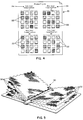
- Figure 4 is an illustration of a product color chart with product color representations brought together into regions associated with designations of skin color compatibility.
- Figure 5 is a perspective view illustrating a swatch pack of fabric samples that are assembled together for their compatibility with one of a number of skin color classifications.
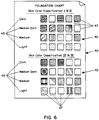
- Figure 6 is an illustration of a foundation cosmetic product color chart with beige and brown product color representations arranged for skin color compatibility as well as for skin darkness that must be taken into account.
- any modern version of two general types of color-measuring instruments is suitable for the skin color measurement according to this invention.
- the basic components of either type of instrument are a light source, a sample illumination and viewing arrangement, a means of selecting certain wavelengths of light for the measurement, a detector of the light reflected from the sample, and some relatively simple computing capacity.
- the main purposes of the computing capacity are to store and apply calibration information and to calculate various color coordinates for later use.
- a color measuring instrument 10 is illustrated. An individual person's skin 11 is illuminated by the instrument as generally indicated by the broken line arrow 12 and the instrument receives illumination reflected from the skin 11 as generally indicated by the broken line arrow 13. Based on the illumination received by reflection from the skin the instrument 10 develops the coordinates Y, x and y.
- the instrument 10 is a calorimeter, commercially available and suitable for development of the values Y, x, and y.
- the other type of instrument that can be used in the skin color categorization method according to this invention is the spectrophotometer that derives tri-stimulus values, from which can be computed the color values used to establish category of skin color as discussed below.
- the skin of a subject whose skin color measurements were highly reproducible and in the approximate center of the range of skin colors of the human population was selected.
- the spectral reflectance factors of the skin of this subject were carefully measured on a Macbeth 1500 Plus spectrophotometer (Macbeth, Newburgh, New York); these data are given in column 2 of Table II at the wavelengths listed in column 1.
- a colorant formulation matching this skin color was developed.
- the spectral reflectance factors for this match are given in column 3 of Table II.
- calibration is carried out by forcing the calorimeter 10 to give the desired color coordinates Y, x and y mentioned above, while utilizing the calorimeter with the standard tile chosen.
- the method of calibration is known for particular instruments and follows a series of steps prescribed by the manufacturer that need not be detailed here.
- the measuring head or instrument orifice is placed against the specimen to be measured.
- the instrument head is pressed against the makeup-free cheek of assessed.
- the instrument has an internal microprocessor or other computing capability so that it is able to develop the color coordinates Y, x and y from the measured values X, Y and Z (Y being the same in each case).
- Certain calorimeters develop the Hunter color coordinates L, a, b, of which the coordinate b figures prominently in the skin color categorization of the invention as explained below. Since the degree of computation that the color measuring device 10 (i.e.
- L is a lightness coordinate whose values correlate better with the visual perceptions of the lightness of object colors than do values of Y
- a is a coordinate denoting redness or greenness, for which positive values denote that the color is red rather than green, and negative values the opposite
- b is a yellowness-blueness coordinate, for which positive values denote that the color is yellow rather than blue, and negative values the opposite.
- Y is a function, well known in the science of color, that measures the yellow content, as well as the lightness, of a color. It has maximum weighting in the yellow to red region of the spectrum (i.e., the region extending from the green side of purest yellow in the spectrum into red).
- Z is a function, also well known in the science of color, that measures the blue content of the color, with maximum weighting in the blue region of the spectrum. Together these factors, or others like them, can be used to calculate a yellow-blue factor as typified by equation (7) defining Hunter's b.
- L the Hunter lightness coordinate
- Y 10 (Y) 1/2 and is a measure of the lightness of color, i.e., luminous reflectance.
- Hunter's b is weighted by this coordinate, as follows: So the Hunter value b can be described as a yellow-blue factor consisting of the difference between (1) a function measuring the yellow content of the color and (2) a function measuring the blue content of the color, the difference being suitably weighted by (3) a term that is a function of the lightness (luminous reflectance) of the color, the function measuring the yellow content having maximum weighting in what is substantially the yellow to red region of the spectrum and the function measuring the blue content of the color having maximum weighting in what is substantially the blue region of the spectrum.
- Y, x and y readings can be made with the calorimeter 10 as suggested in the steps of the method outlined in Figure 2, in which case the computer 15 simply averages the values Y, x, y for greater accuracy in the calculation of b.
- the CPU 15 compares that with predetermined ranges of b values empirically identified with categories of skin coloration and stored in memory 17. This division of the total range of b values into individual ranges that define skin color categories was quite different from the use of multiple values to define color and proved surprisingly repeatable and accurate. Assignments of category based on measurement and b value calculation agree with visual assessments.
- the ranges of b values corresponding to, for example, four skin color categories are stored in the memory 17. For cheek measurement, based on assessments of thousands of individuals, the boundaries between the four ranges appear to be at substantially 11.2, 12.7 and 14.3.
- ranges of b value occurs in dependence on the location of the skin where assessment occurs. For example, utilizing the back of the subject's hand, boundaries between the exemplary four ranges appear to occur at 9.8, 11.0 and 12.1. This is believed to be a function of the number and visibility of blood vessels at that location. In either case the lowermost range, that of category I, consists of b values below the lowest boundary value. The next higher range, that of category II, is between that lowest boundary value and the next higher boundary value, which is the middle value. The next range, that of category III, is from the middle value to the highest boundary value, and the fourth and highest range, that of category IV, consists of all b values above the highest dividing value.
- color category I is the category compatible with skin category I, corresponding to the lowest Hunter b value range of skin measurement (i.e. below about 11.2, cheek measurement)
- color category II represents compatibility with the next higher skin color category II (from about 11.2 to 12.7, cheek measurement)
- color category III represents colors compatible with the to 14.3, cheek measurement)
- color category IV represents compatibility with the highest category IV of skin color (above about 14.3, cheek measurement).
- Hue angle is a measure, in degrees, of the position of the color in the familiar hue circle, whose major color families are, in order, red, orange, yellow, green, blue, and purple.
- Hue angle is a measure, in degrees, of the position of the color in the familiar hue circle, whose major color families are, in order, red, orange, yellow, green, blue, and purple.
- these are arranged in counterclockwise order starting with red on the right, with Hunter hue angles from near zero to about 30°.
- Oranges have h H between 30 and 60°, yellows up to about 120°, greens to about 180°, blues to about 300°, and purples between 300 and 360° (which is the same as 0°).
- Chroma is a measure of the "intensity" of a color that is valid for any color family in the same way that Hunter b is for the pure yellow colors described above. Chroma can be thought of as the distance, on a color chart, between the color in question and a grey of the same lightness.
- Saturation is similar to chroma in that it describes the "intensity" of color, but it is modified to account for the effect of changing lightness on this perception. Purists in colorimetry would say that saturation should not be defined in the Hunter system, but it has been found to be a useful concept even if it does not meet the strict mathematical criteria of the CIE definition.
- the family of yellow colors, including golds, is categorized by use of the Hunter coordinate b.
- the limits on b for the various categories are: I - b less than 19 II - b between 19 and 25 III - b between 25 and 40 IV - b greater than 40.
- the orange family is limited to light colors of relatively high chroma, as lower chroma colors are recognized as beige, if light, or brown, if dark.
- This family includes light colors with lower saturation or chroma than the yellows. Their hue angles are near 95°. There are no category I colors in this family.
- the beiges are categorized by Hunter saturation s H as follows: II - s H less than 25 III - s H between 25 and 28 IV - s H greater than 28.
- the brown family is slightly redder and significantly darker than the beige. Its hue angle is near 60°. It is best categorized by Hunter chroma C H , as follows: I - c H less than 5 II - c H between 5 and 9.5 III - c H between 9.5 and 12 IV - c H greater than 12.
- This color family is difficult to categorize because it includes both yellowish pinks (peaches) and purplish pinks. These two may be distinguished by different ranges of Hunter b.
- the yellowish pinks include the category III and category IV colors, and these are separated by their different lightness levels.
- the purplish pinks include the category II and category I colors, and these are separated I - b less than 15 and s H greater than 60 II - b less than 15 and s H less than 60 III - b greater than 15 and L less than 60 IV - b greater than 15 and L greater than 60.
- This color family encompasses a wide range of hue angles. Both this quantity and the saturation s H must be considered to define the categories involved.
- the rules are: I - s H less than 70 and h H less than 320° II - s H between 50 and 70 and h H less than 320° III - s H between 50 and 60 if h H less than 320° and s H greater than 50 if h H greater than 320° IV - s H less than 50, with no restriction on h H .
- the colors in the blue family cover a wide range of hue angles, and this quantity has a major effect on their category. Together with restrictions on Hunter b, they can be categorized as follows. Note that values of Hunter b are negative, characteristic of blue rather than yellow colors. In this context, “less than” means more negative and “greater than” means less negative.
- the rules are: I - b less than -10 and h H greater than 270° II - b greater than -10 for h H greater than 270° and b less than - 8.5 for h H between 270° and 230° III - b less than -8 and h H between 230° and 210° IV - b greater than -8 and h H less than 210°.
- the green family is also complex, including both this family, a variety of color coordinates must be specified: I - h H greater than 170° II - h H between 140° and 170° and s H less than 70 III - s H greater than 70 for h H greater than 140°; no restriction on s H for h H less than 140° IV - b greater than 30.
- This family consists of relatively light greys, all falling in categories I or II. They are best differentiated by saturation, which is always quite small for these near-neutral colors: I - s H less than 8 II - s H greater than 8.
- All blacks, which include very dark greys, are in the category I.
- the family can be defined by upper limits on its saturation and lightness: I - s H less than 30 and L less than 25.
- This color family includes such colors as peach.
- the categories are described by the following values of Hunter b: I - b ⁇ 9.5 II - -2.4 ⁇ b ⁇ 9.5 III - b > 9.5 IV - b ⁇ 11.8.
- Grey cosmetics are all in categories I or II, with Hunter b ⁇ 1.0. It is not possible to define the boundary between these categories.
- the black cosmetics are all in categories I and II, with Hunter b ⁇ 0. It is not possible to establish the boundary between these categories.
- An instrument having the same general configuration as that of Figure 1, for carrying out this process can make the initial choice of family (via software) based on measurement, or can have family designation input by the operator to control the subsequent measuring, calculating, comparing and assigning steps effected by easily accomplished programming choosing comparison subroutines based on color family either input manually or measured. The necessary measurements are made and calculations of the appropriate characteristics are carried out by the CPU. Comparison with stored ranges of characteristics for the identified family are made and a category (or categories) I - IV is assigned signifying compatibility with a like-identified skin color category.
- the foregoing measurable characteristics can be used to arrive at colors compatible with each category of skin coloration.
- a particular color family can thus be represented for each category of skin coloration.
- each prospective consumer can be assured of a Similar product colors can also be made available to persons of differing skin color categories.
- the correction of a particular color to bring it into one or another of the categories that correspond to skin color categories can be achieved by altering the formulation. In other words, adding or subtracting blue or yellow can move a product's classification to a desired category.
- correction of blue or yellow is achieved by appropriate adjustment of a blue or yellow content adjusting colorant of the original formulation.
- Color charts can be accurately assembled for other than cosmetics and for cosmetics.
- product colors gathered together in association with their compatible skin color categories can be accurately assembled by adjusting color representations 22 associated with each skin color category designation 24 in conformance with the ranges described above for each color family.
- each product color representation 22 can be labeled by a color designating product color name or number.
- swatch packs 30 of colored fabric samples 32, correctly colored for a particular skin coloration should gather together samples with fabric colorings as established above.
- beige and brown foundation colors are assembled and classified, either on the same cosmetic color charts, or on separate charts, based on skin darkness as well as skin color classification, again as described above.
- two regions 40 and 42 of a foundation cosmetic color chart 44 are broken down by skin darkness categories 45 based on the Hunter L values described above.
- the chips or representations 47 accurately portraying the brown and beige foundation colors are then formulated and arranged to accurately identify the classifications of these products.
Landscapes
- Health & Medical Sciences (AREA)
- Physics & Mathematics (AREA)
- Life Sciences & Earth Sciences (AREA)
- Engineering & Computer Science (AREA)
- Spectroscopy & Molecular Physics (AREA)
- Heart & Thoracic Surgery (AREA)
- Pathology (AREA)
- Biomedical Technology (AREA)
- Biophysics (AREA)
- Medical Informatics (AREA)
- Molecular Biology (AREA)
- Surgery (AREA)
- Animal Behavior & Ethology (AREA)
- General Health & Medical Sciences (AREA)
- Public Health (AREA)
- Veterinary Medicine (AREA)
- General Physics & Mathematics (AREA)
- Artificial Intelligence (AREA)
- Theoretical Computer Science (AREA)
- Computer Vision & Pattern Recognition (AREA)
- Dentistry (AREA)
- Dermatology (AREA)
- Evolutionary Computation (AREA)
- Fuzzy Systems (AREA)
- Mathematical Physics (AREA)
- Oral & Maxillofacial Surgery (AREA)
- Physiology (AREA)
- Psychiatry (AREA)
- Signal Processing (AREA)
- Spectrometry And Color Measurement (AREA)
- Color Image Communication Systems (AREA)
- Measuring And Recording Apparatus For Diagnosis (AREA)
- Liquid Crystal Display Device Control (AREA)
- Facsimile Image Signal Circuits (AREA)
Priority Applications (13)
| Application Number | Priority Date | Filing Date | Title |
|---|---|---|---|
| US08/013,200 US5311293A (en) | 1983-07-18 | 1993-01-29 | Method and instrument for selecting personal compatible colors |
| US08/021,657 US5313267A (en) | 1983-07-18 | 1993-02-22 | Method and instrument for selecting personal compatible colors |
| CO94018973A CO4230146A1 (es) | 1983-07-18 | 1994-05-06 | Metodo e instrumento para seleccionar colores personales compatibles |
| PCT/US1994/004810 WO1995030885A1 (fr) | 1983-07-18 | 1994-05-09 | Procede et dispositif de selection de couleurs personnelles compatibles |
| BR9408579A BR9408579A (pt) | 1983-07-18 | 1994-05-09 | Método e instrumento para selecionar cores compativeis pessoais |
| EP94303320A EP0682236B1 (fr) | 1983-07-18 | 1994-05-09 | Appareil et procédé pour choisir des couleurs compatibles individuelles |
| CA002188656A CA2188656C (fr) | 1983-07-18 | 1994-05-09 | Procede et dispositif de selection de couleurs personnelles compatibles |
| AU70923/94A AU705197B2 (en) | 1983-07-18 | 1994-05-09 | Method and instrument for selecting personal compatible colors |
| DE69429248T DE69429248D1 (de) | 1983-07-18 | 1994-05-09 | Vorrichtung und Verfahren zur Auswahl individueller kompatibler Farben |
| EP01109004A EP1118845A3 (fr) | 1983-07-18 | 1994-05-09 | Appareil et procédé pour choisir des couleurs compatibles individuelles |
| AT94303320T ATE209777T1 (de) | 1983-07-18 | 1994-05-09 | Vorrichtung und verfahren zur auswahl individueller kompatibler farben |
| JP7528903A JPH10502729A (ja) | 1983-07-18 | 1994-05-09 | 個人の調和色を選ぶ方法および装置 |
| EP01109121A EP1118846A3 (fr) | 1983-07-18 | 1994-05-09 | Appareil et procédé pour choisir des couleurs compatibles individuelles |
Applications Claiming Priority (11)
| Application Number | Priority Date | Filing Date | Title |
|---|---|---|---|
| US51461883A | 1983-07-18 | 1983-07-18 | |
| US83366186A | 1986-02-21 | 1986-02-21 | |
| US90436986A | 1986-09-08 | 1986-09-08 | |
| US20493888A | 1988-06-06 | 1988-06-06 | |
| US30628689A | 1989-02-02 | 1989-02-02 | |
| US81844891A | 1991-12-30 | 1991-12-30 | |
| US81603391A | 1991-12-30 | 1991-12-30 | |
| US08/013,200 US5311293A (en) | 1983-07-18 | 1993-01-29 | Method and instrument for selecting personal compatible colors |
| US08/021,657 US5313267A (en) | 1983-07-18 | 1993-02-22 | Method and instrument for selecting personal compatible colors |
| EP94303320A EP0682236B1 (fr) | 1983-07-18 | 1994-05-09 | Appareil et procédé pour choisir des couleurs compatibles individuelles |
| PCT/US1994/004810 WO1995030885A1 (fr) | 1983-07-18 | 1994-05-09 | Procede et dispositif de selection de couleurs personnelles compatibles |
Related Child Applications (2)
| Application Number | Title | Priority Date | Filing Date |
|---|---|---|---|
| EP01109121A Division EP1118846A3 (fr) | 1983-07-18 | 1994-05-09 | Appareil et procédé pour choisir des couleurs compatibles individuelles |
| EP01109004A Division EP1118845A3 (fr) | 1983-07-18 | 1994-05-09 | Appareil et procédé pour choisir des couleurs compatibles individuelles |
Publications (2)
| Publication Number | Publication Date |
|---|---|
| EP0682236A1 true EP0682236A1 (fr) | 1995-11-15 |
| EP0682236B1 EP0682236B1 (fr) | 2001-11-28 |
Family
ID=37309808
Family Applications (3)
| Application Number | Title | Priority Date | Filing Date |
|---|---|---|---|
| EP01109121A Withdrawn EP1118846A3 (fr) | 1983-07-18 | 1994-05-09 | Appareil et procédé pour choisir des couleurs compatibles individuelles |
| EP01109004A Withdrawn EP1118845A3 (fr) | 1983-07-18 | 1994-05-09 | Appareil et procédé pour choisir des couleurs compatibles individuelles |
| EP94303320A Expired - Lifetime EP0682236B1 (fr) | 1983-07-18 | 1994-05-09 | Appareil et procédé pour choisir des couleurs compatibles individuelles |
Family Applications Before (2)
| Application Number | Title | Priority Date | Filing Date |
|---|---|---|---|
| EP01109121A Withdrawn EP1118846A3 (fr) | 1983-07-18 | 1994-05-09 | Appareil et procédé pour choisir des couleurs compatibles individuelles |
| EP01109004A Withdrawn EP1118845A3 (fr) | 1983-07-18 | 1994-05-09 | Appareil et procédé pour choisir des couleurs compatibles individuelles |
Country Status (10)
| Country | Link |
|---|---|
| US (2) | US5311293A (fr) |
| EP (3) | EP1118846A3 (fr) |
| JP (1) | JPH10502729A (fr) |
| AT (1) | ATE209777T1 (fr) |
| AU (1) | AU705197B2 (fr) |
| BR (1) | BR9408579A (fr) |
| CA (1) | CA2188656C (fr) |
| CO (1) | CO4230146A1 (fr) |
| DE (1) | DE69429248D1 (fr) |
| WO (1) | WO1995030885A1 (fr) |
Cited By (15)
| Publication number | Priority date | Publication date | Assignee | Title |
|---|---|---|---|---|
| AT980U1 (de) * | 1995-09-20 | 1996-08-26 | Krista Theuerman | Verfahren und vorrichtung zur ermittlung des farbtyps eines probanden |
| US5959736A (en) * | 1995-09-20 | 1999-09-28 | Theuerman; Krista | Method and arrangement for determining the color-type of a test subject |
| US6516245B1 (en) | 2000-05-31 | 2003-02-04 | The Procter & Gamble Company | Method for providing personalized cosmetics |
| EP1314308A4 (fr) * | 1997-03-03 | 2003-05-28 | Meat And Livestock Australia L | Etalonnage de systemes d'imagerie |
| EP1523937A1 (fr) * | 2003-10-16 | 2005-04-20 | L'oreal | Ensemble comportant un système d'analyse du niveau de clarté de la peau et des gammes de produits cosmétiques |
| FR2861883A1 (fr) * | 2004-12-17 | 2005-05-06 | Oreal | Compositions cosmetiques et cartes de contraste permettant de les caracteriser. |
| US6907193B2 (en) | 2001-11-08 | 2005-06-14 | Johnson & Johnson Consumer Companies, Inc. | Method of taking polarized images of the skin and the use thereof |
| US6922523B2 (en) | 2001-11-08 | 2005-07-26 | Johnson & Johnson Consumer Companies, Inc. | Method of promoting skin care products |
| US6961517B2 (en) | 2001-11-08 | 2005-11-01 | Johnson & Johnson Consumer Companies, Inc. | Method of promoting skin care products |
| US7558416B2 (en) | 2006-10-02 | 2009-07-07 | Johnson & Johnson Consumer Companies, Inc. | Apparatus and method for measuring photodamage to skin |
| US7738032B2 (en) | 2001-11-08 | 2010-06-15 | Johnson & Johnson Consumer Companies, Inc. | Apparatus for and method of taking and viewing images of the skin |
| US7764303B2 (en) | 2006-10-02 | 2010-07-27 | Johnson & Johnson Consumer Companies, Inc. | Imaging apparatus and methods for capturing and analyzing digital images of the skin |
| US8026942B2 (en) | 2004-10-29 | 2011-09-27 | Johnson & Johnson Consumer Companies, Inc. | Skin imaging system with probe |
| US8107696B2 (en) | 2006-10-02 | 2012-01-31 | Johnson & Johnson Consumer Companies, Inc. | Calibration apparatus and method for fluorescent imaging |
| US8189887B2 (en) | 2006-10-02 | 2012-05-29 | Johnson & Johnson Consumer Companies, Inc. | Imaging standard apparatus and method |
Families Citing this family (94)
| Publication number | Priority date | Publication date | Assignee | Title |
|---|---|---|---|---|
| US5671735A (en) * | 1983-07-18 | 1997-09-30 | Chromatics Color Sciences International, Inc. | Method and apparatus for detecting and measuring conditions affecting color |
| US6067504A (en) * | 1983-07-18 | 2000-05-23 | Chromatics Color Sciences International, Inc. | Method for correctly identifying hair color |
| US6128516A (en) * | 1994-05-09 | 2000-10-03 | Chromatics Color Sciences International Inc. | Method and apparatus for detecting and measuring conditions affecting color |
| US6129664A (en) * | 1992-01-07 | 2000-10-10 | Chromatics Color Sciences International, Inc. | Method and apparatus for detecting and measuring conditions affecting color |
| US6308088B1 (en) | 1992-01-07 | 2001-10-23 | Chromatics Color Sciences International, Inc. | Method and apparatus for detecting and measuring conditions affecting color |
| FR2690822B1 (fr) * | 1992-05-06 | 1994-08-05 | Dior Christian Parfums | Procede de maquillage du visage, en particulier des yeux, et dispositif pour sa mise en óoeuvre. |
| US5915075A (en) * | 1992-07-27 | 1999-06-22 | Canon Kabushiki Kaisha | Image processing apparatus for converting input color chart data into color data for an output device |
| ES2085741T3 (es) * | 1993-08-03 | 1996-06-01 | Dior Christian Parfums | Procedimiento de determinacion del color de un maquillaje de fondo que restituye sensiblemente el color de la piel de una persona y aparato que incluye la aplicacion. |
| JP2751144B2 (ja) * | 1993-10-21 | 1998-05-18 | 株式会社三城 | 眼鏡レンズ色の選択方法 |
| US5528339A (en) * | 1994-08-26 | 1996-06-18 | Eastman Kodak Company | Color image reproduction of scenes with color enhancement and preferential tone mapping |
| US5537211A (en) * | 1995-01-13 | 1996-07-16 | Triliance Corporation | Method and apparatus for selecting a wearable to match an object |
| US5688125A (en) * | 1995-04-14 | 1997-11-18 | Birdsong-Raffo; Jennifer | System and method for selecting fabrics |
| ATE229174T1 (de) * | 1995-06-07 | 2002-12-15 | Chromatics Color Sciences Int | Verfahren und vorrichtung zum nachweis und messen von zuständen,welche die farbe beeinflussen |
| US5766006A (en) * | 1995-06-26 | 1998-06-16 | Murljacic; Maryann Lehmann | Tooth shade analyzer system and methods |
| US5967562A (en) * | 1996-06-06 | 1999-10-19 | Tubbs; Macie Jeanette | Manufacturer's indicator and method for color coordination and style |
| US5924426A (en) * | 1997-04-17 | 1999-07-20 | Galazin; Norma | Cosmetic personal color analysis method and kit using value scale, colors and charts |
| USD420701S (en) * | 1997-10-02 | 2000-02-15 | Phyllis Denise Stith | Transparent color guide |
| WO1999026057A1 (fr) * | 1997-11-12 | 1999-05-27 | Yalcin Ozbey | Porte-specimen pour colorimetrie et procede d'utilisation |
| US6178341B1 (en) | 1997-12-18 | 2001-01-23 | Chromatics Color Sciences International, Inc. | Color measurement system with color index for skin, teeth, hair and material substances |
| US6271920B1 (en) | 1997-12-19 | 2001-08-07 | Chromatics Color Sciences International, Inc. | Methods and apparatus for color calibration and verification |
| US6065969A (en) * | 1998-08-10 | 2000-05-23 | Mattel, Inc. | Computer game for designing and printing nail coverings |
| EP1043959A4 (fr) * | 1998-11-03 | 2003-07-02 | Shade Analyzing Technologies Inc | Reseau de restauration dentaire interactif |
| US8790118B2 (en) * | 1998-11-03 | 2014-07-29 | Shade Analyzing Technologies, Inc. | Interactive dental restorative network |
| EP2133820A3 (fr) | 1998-11-03 | 2010-02-10 | Shade Analyzing Technologies, Inc. | Système et procédés d'analyse des nuances de coloris des dents |
| US6338349B1 (en) * | 1998-12-18 | 2002-01-15 | L'oreal | Method and system for providing customized color cosmetics |
| JP4274632B2 (ja) * | 1999-05-25 | 2009-06-10 | オリンパス株式会社 | 色再現システム |
| US6421125B1 (en) | 1999-06-11 | 2002-07-16 | Masahiro Tarumoto | Device and method for determining compatible colors |
| JP4396873B2 (ja) * | 1999-10-01 | 2010-01-13 | 株式会社資生堂 | 口紅又はアイシャドーの選択方法 |
| US7050168B2 (en) | 1999-12-08 | 2006-05-23 | X-Rite, Incorporated | Optical measurement device and related process |
| WO2001055956A1 (fr) * | 2000-01-28 | 2001-08-02 | Aevora Beauty Concepts, Inc. | Systeme de determination de couleurs a usage cosmetologique |
| US6563510B1 (en) * | 2000-03-30 | 2003-05-13 | Behr Process Corporation | Paint color matching and coordinating system |
| US6632093B1 (en) * | 2000-03-30 | 2003-10-14 | Behr Process Corporation | Display system facilitating paint color selection and coordination |
| US6491750B1 (en) | 2000-03-30 | 2002-12-10 | Behr Process Corporation | Paint colorant product and method |
| US7106474B1 (en) * | 2000-03-31 | 2006-09-12 | Canon Kabushiki Kaisha | Color management system using measured device data |
| CA2400748C (fr) | 2000-03-31 | 2009-10-20 | Imx Labs, Inc. | Systeme et procede de selection de la couleur d'un vernis a ongles |
| US7088386B2 (en) * | 2000-04-21 | 2006-08-08 | Shiseido Company, Ltd. | Makeup counseling apparatus |
| JP2002016818A (ja) * | 2000-04-28 | 2002-01-18 | Fuji Photo Film Co Ltd | 色補正方法および装置並びに記録媒体 |
| US20020059248A1 (en) * | 2000-07-20 | 2002-05-16 | Samuel Farchione | Method for determining proper color for makeup and clothing |
| US6573917B2 (en) | 2000-08-11 | 2003-06-03 | Energia, Inc. | Calendar with self-help messaging based upon color preferences |
| US6549213B1 (en) | 2000-08-11 | 2003-04-15 | Energia, Inc. | Color harmonizing device and method for using the same |
| FR2817746B1 (fr) | 2000-12-08 | 2005-03-11 | Oreal | Nuancier reproduisant une caracteristique d'apparence autre que la couleur |
| FR2817745B1 (fr) * | 2000-12-08 | 2003-03-28 | Oreal | Nuancier et procede de fabrication |
| US6937749B2 (en) * | 2001-03-02 | 2005-08-30 | L'oreal | Process, system, and kit for evaluating the relief of the skin with a substrate |
| US7046347B1 (en) * | 2001-03-30 | 2006-05-16 | Amend John R | Instrument with colorimeter and sensor inputs for interfacing with a computer |
| US8636173B2 (en) * | 2001-06-01 | 2014-01-28 | Cosmetic Technologies, L.L.C. | Point-of-sale body powder dispensing system |
| US6412658B1 (en) | 2001-06-01 | 2002-07-02 | Imx Labs, Inc. | Point-of-sale body powder dispensing system |
| FR2826856B1 (fr) * | 2001-07-09 | 2004-03-12 | Oreal | Dispositif permettant de determiner le degre d'une carecteristique de la typologie corporelle |
| FR2826857B1 (fr) * | 2001-07-09 | 2004-03-12 | Oreal | Instrument pour observer la peau ou les cheveux |
| FR2829344B1 (fr) * | 2001-08-29 | 2004-10-01 | Oreal | Dispositif d'acquisition d'au moins une image d'au moins une partie du visage ou de la chevelure d'une personne |
| EP1429640B1 (fr) | 2001-09-24 | 2007-03-07 | Cosmetic Technologies LLC | Appareil et procede de distribution a la demande de cosmetiques |
| US6615881B2 (en) | 2001-09-24 | 2003-09-09 | Imx Labs, Inc. | Apparatus and method for custom cosmetic dispensing |
| US8573263B2 (en) | 2001-09-24 | 2013-11-05 | Cosmetic Technologies, Llc | Apparatus and method for custom cosmetic dispensing |
| US7129038B2 (en) * | 2002-06-21 | 2006-10-31 | Lifescan, Inc. | Method for selectively combining multiple membranes for assembly into test strips |
| JP4849761B2 (ja) * | 2002-09-02 | 2012-01-11 | 株式会社 資生堂 | 質感に基づく化粧方法及び質感イメージマップ |
| US20050025728A1 (en) * | 2002-12-24 | 2005-02-03 | L'oreal | Cosmetic compositions and contrast cards for characterizing them |
| US7118374B2 (en) | 2003-06-09 | 2006-10-10 | Ivoclar Vivadent Ag | Enhanced tooth shade guide |
| US6945431B2 (en) * | 2003-07-24 | 2005-09-20 | Fluid Management, Inc. | Sanitizable piston pumps and dispensing systems incorporating the same |
| US20050045160A1 (en) * | 2003-09-03 | 2005-03-03 | Alicia Peterson | Evaporative emissions canister with incorporated liquid fuel trap |
| US7341450B2 (en) * | 2003-10-03 | 2008-03-11 | Shade Analyzing Technologies, Inc. | Tooth shade scan system and method |
| US7347344B2 (en) * | 2003-10-27 | 2008-03-25 | Fluid Management Operation Llc | Apparatus for dispensing a plurality of fluids and container for use in the same |
| US6935386B2 (en) | 2003-10-30 | 2005-08-30 | Fluid Management, Inc. | Automated cosmetics dispenser for point of sale cosmetics products |
| CA2574486C (fr) * | 2004-07-19 | 2014-12-02 | Julie R. Bartholomew | Procedes de distribution personnalises concernant des points de vente au detail |
| US20060085274A1 (en) * | 2004-10-14 | 2006-04-20 | The Procter & Gamble Company | Methods and apparatus for selecting a color for use by a personal care product recommendation system |
| US7274453B2 (en) * | 2004-10-14 | 2007-09-25 | The Procter & Gamble Company | Methods and apparatus for calibrating an electromagnetic measurement device |
| ES2443097T3 (es) | 2004-11-08 | 2014-02-17 | Cosmetic Technologies Llc | Distribuidor de cosmético a la medida automatizado |
| US20060169783A1 (en) * | 2005-01-31 | 2006-08-03 | Gagne Todd K | Color identification system |
| US7301627B2 (en) * | 2005-04-05 | 2007-11-27 | X-Rite, Inc. | Systems and methods for monitoring a process output with a highly abridged spectrophotometer |
| WO2006110842A2 (fr) * | 2005-04-12 | 2006-10-19 | X-Rite, Incorporated | Systemes et procedes permettant de mesurer une zone de meme couleur sur un objet |
| US20070033140A1 (en) * | 2005-08-01 | 2007-02-08 | Slattery Patricia K | Systems and methods for selecting hair dye products and method for marketing hair dye products |
| EP1938063B1 (fr) * | 2005-08-15 | 2011-12-21 | X-Rite Incorporated | Spectrophotometre comprenant un element de guidage de lumiere |
| WO2007022212A2 (fr) * | 2005-08-15 | 2007-02-22 | X-Rite, Incorporated | Instrument optique ameliore |
| US7522768B2 (en) * | 2005-09-09 | 2009-04-21 | Hewlett-Packard Development Company, L.P. | Capture and systematic use of expert color analysis |
| US8860748B2 (en) * | 2005-10-03 | 2014-10-14 | Gary Lynn Campbell | Computerized, personal-color analysis system |
| AU2007201987B2 (en) * | 2006-05-05 | 2010-07-08 | Chris Rewell Pty Limited | A method and kit for assisting in the selection of an adornment |
| EP1862089A1 (fr) * | 2006-06-01 | 2007-12-05 | Carlo Guidi | Procédé de selection d'une coloration de cheveux en harmonie avec l'individu |
| US20080149279A1 (en) * | 2006-12-21 | 2008-06-26 | Patricia Marlin Leighty | Apparatus for displaying window covering samples |
| JP2010520551A (ja) * | 2007-03-08 | 2010-06-10 | ヒューレット−パッカード デベロップメント カンパニー エル.ピー. | 画像から推定される皮膚色に基づいて製品を推奨するための方法及びシステム |
| WO2008108771A1 (fr) * | 2007-03-08 | 2008-09-12 | Hewlett-Packard Development Company, L.P. | Capture et utilisation systématique d'une analyse de couleur par des experts |
| EP2043038A1 (fr) | 2007-05-08 | 2009-04-01 | Ruben Pais | Procédé et instruments pour la vente de produits de soins personnels |
| US7856118B2 (en) * | 2007-07-20 | 2010-12-21 | The Procter & Gamble Company | Methods for recommending a personal care product and tools therefor |
| US8068676B2 (en) * | 2007-11-07 | 2011-11-29 | Palo Alto Research Center Incorporated | Intelligent fashion exploration based on clothes recognition |
| WO2012064893A2 (fr) | 2010-11-10 | 2012-05-18 | Google Inc. | Sélection d'attribut de produit automatisée |
| US8935264B2 (en) | 2012-05-14 | 2015-01-13 | International Business Machines Corporation | Characteristic-based selection in a networked computing environment |
| US9189703B2 (en) * | 2012-07-09 | 2015-11-17 | Canon Kabushiki Kaisha | Systems and methods for colorimetric and spectral material estimation |
| US9103728B2 (en) | 2013-06-08 | 2015-08-11 | Thia Spearing | System and method of a personal enhancing color selection |
| US20150030243A1 (en) * | 2013-07-24 | 2015-01-29 | Di Qu | Chart for evaluating skin color and its application to efficacy evaluation of anti-aging and skin lightening products |
| JP6375557B2 (ja) * | 2013-09-19 | 2018-08-22 | ロレアル ソシエテ アノニム | 面の色及びスペクトルを測定しカテゴリ分類するためのシステム及び方法 |
| GB201413047D0 (en) * | 2014-07-23 | 2014-09-03 | Boots Co Plc | Method of selecting colour cosmetics |
| EP3302169B1 (fr) | 2015-06-08 | 2021-07-21 | Cosmetic Technologies, LLC | Système de distribution automatisé d'un échantillon de produit cosmétique |
| CN107787439B (zh) * | 2015-06-30 | 2020-07-14 | 荷兰联合利华有限公司 | 用于评估毛发的粗糙度和光泽度的装置 |
| US10231531B2 (en) | 2015-11-04 | 2019-03-19 | ColorCulture Network, LLC | System, method and device for analysis of hair and skin and providing formulated hair and skin products |
| JP6525921B2 (ja) * | 2016-05-13 | 2019-06-05 | キヤノン株式会社 | 画像処理装置、画像処理方法、検索装置 |
| WO2023245404A1 (fr) * | 2022-06-21 | 2023-12-28 | L'oreal | Procédé de classification d'une couleur d'un produit de maquillage et outil pour l'assistance au développement de couleurs de produits de maquillage |
| US20240020745A1 (en) * | 2022-07-12 | 2024-01-18 | Irene ARENA | Method and system for artistic imagery consultation |
Citations (3)
| Publication number | Priority date | Publication date | Assignee | Title |
|---|---|---|---|---|
| US4561850A (en) * | 1983-11-14 | 1985-12-31 | Fabbri Vittorio E | Color coordinator device |
| US4681546A (en) * | 1984-07-20 | 1987-07-21 | Charlavan Hart | Personal color analysis method |
| EP0446512A1 (fr) * | 1990-03-16 | 1991-09-18 | Darby S. Macfarlane | Procédé de sélection de couleurs compatibles à une personne |
Family Cites Families (7)
| Publication number | Priority date | Publication date | Assignee | Title |
|---|---|---|---|---|
| US1582122A (en) * | 1924-03-03 | 1926-04-27 | Dentists Supply Co | Method and means for determining color characteristics |
| US3003388A (en) * | 1958-05-09 | 1961-10-10 | Hunter Associates Lab Inc | Color difference measuring instrument |
| DE2726606A1 (de) * | 1977-06-13 | 1978-12-21 | Max Planck Gesellschaft | Medizinisches spektralfotometer |
| US4654794A (en) * | 1984-02-18 | 1987-03-31 | Colorgen, Inc. | Methods for determining the proper coloring for a tooth replica |
| JPS60257328A (ja) * | 1984-06-04 | 1985-12-19 | Toyobo Co Ltd | 色差判定装置 |
| US4688178A (en) * | 1985-09-06 | 1987-08-18 | Burlington Industries, Inc. | Method and apparatus for inventory control to optimize usage of colored fabric |
| US4909632A (en) * | 1988-08-29 | 1990-03-20 | Darby Simpson | Method for selecting personal compatible colors |
-
1993
- 1993-01-29 US US08/013,200 patent/US5311293A/en not_active Expired - Fee Related
- 1993-02-22 US US08/021,657 patent/US5313267A/en not_active Expired - Fee Related
-
1994
- 1994-05-06 CO CO94018973A patent/CO4230146A1/es unknown
- 1994-05-09 CA CA002188656A patent/CA2188656C/fr not_active Expired - Fee Related
- 1994-05-09 DE DE69429248T patent/DE69429248D1/de not_active Expired - Lifetime
- 1994-05-09 AU AU70923/94A patent/AU705197B2/en not_active Ceased
- 1994-05-09 EP EP01109121A patent/EP1118846A3/fr not_active Withdrawn
- 1994-05-09 EP EP01109004A patent/EP1118845A3/fr not_active Withdrawn
- 1994-05-09 BR BR9408579A patent/BR9408579A/pt not_active Application Discontinuation
- 1994-05-09 JP JP7528903A patent/JPH10502729A/ja active Pending
- 1994-05-09 EP EP94303320A patent/EP0682236B1/fr not_active Expired - Lifetime
- 1994-05-09 WO PCT/US1994/004810 patent/WO1995030885A1/fr not_active Ceased
- 1994-05-09 AT AT94303320T patent/ATE209777T1/de active
Patent Citations (3)
| Publication number | Priority date | Publication date | Assignee | Title |
|---|---|---|---|---|
| US4561850A (en) * | 1983-11-14 | 1985-12-31 | Fabbri Vittorio E | Color coordinator device |
| US4681546A (en) * | 1984-07-20 | 1987-07-21 | Charlavan Hart | Personal color analysis method |
| EP0446512A1 (fr) * | 1990-03-16 | 1991-09-18 | Darby S. Macfarlane | Procédé de sélection de couleurs compatibles à une personne |
Cited By (19)
| Publication number | Priority date | Publication date | Assignee | Title |
|---|---|---|---|---|
| AT980U1 (de) * | 1995-09-20 | 1996-08-26 | Krista Theuerman | Verfahren und vorrichtung zur ermittlung des farbtyps eines probanden |
| WO1997011339A1 (fr) * | 1995-09-20 | 1997-03-27 | Krista Theuerman | Procede et systeme permettant de determiner le type de couleur d'une personne se pretant a des tests |
| US5959736A (en) * | 1995-09-20 | 1999-09-28 | Theuerman; Krista | Method and arrangement for determining the color-type of a test subject |
| EP1314308A4 (fr) * | 1997-03-03 | 2003-05-28 | Meat And Livestock Australia L | Etalonnage de systemes d'imagerie |
| US6654048B1 (en) | 1997-03-03 | 2003-11-25 | Meat & Livestock Australia Limited | Calibration of imaging systems |
| US6516245B1 (en) | 2000-05-31 | 2003-02-04 | The Procter & Gamble Company | Method for providing personalized cosmetics |
| US7376346B2 (en) | 2001-11-08 | 2008-05-20 | J&J Consumer Companies, Inc. | Method of promoting skin care products |
| US6907193B2 (en) | 2001-11-08 | 2005-06-14 | Johnson & Johnson Consumer Companies, Inc. | Method of taking polarized images of the skin and the use thereof |
| US6922523B2 (en) | 2001-11-08 | 2005-07-26 | Johnson & Johnson Consumer Companies, Inc. | Method of promoting skin care products |
| US6961517B2 (en) | 2001-11-08 | 2005-11-01 | Johnson & Johnson Consumer Companies, Inc. | Method of promoting skin care products |
| US7738032B2 (en) | 2001-11-08 | 2010-06-15 | Johnson & Johnson Consumer Companies, Inc. | Apparatus for and method of taking and viewing images of the skin |
| FR2861177A1 (fr) * | 2003-10-16 | 2005-04-22 | Oreal | Ensemble comportant un systeme d'analyse du niveau de clarte de la peau et des gammes de produits cosmetiques |
| EP1523937A1 (fr) * | 2003-10-16 | 2005-04-20 | L'oreal | Ensemble comportant un système d'analyse du niveau de clarté de la peau et des gammes de produits cosmétiques |
| US8026942B2 (en) | 2004-10-29 | 2011-09-27 | Johnson & Johnson Consumer Companies, Inc. | Skin imaging system with probe |
| FR2861883A1 (fr) * | 2004-12-17 | 2005-05-06 | Oreal | Compositions cosmetiques et cartes de contraste permettant de les caracteriser. |
| US7558416B2 (en) | 2006-10-02 | 2009-07-07 | Johnson & Johnson Consumer Companies, Inc. | Apparatus and method for measuring photodamage to skin |
| US7764303B2 (en) | 2006-10-02 | 2010-07-27 | Johnson & Johnson Consumer Companies, Inc. | Imaging apparatus and methods for capturing and analyzing digital images of the skin |
| US8107696B2 (en) | 2006-10-02 | 2012-01-31 | Johnson & Johnson Consumer Companies, Inc. | Calibration apparatus and method for fluorescent imaging |
| US8189887B2 (en) | 2006-10-02 | 2012-05-29 | Johnson & Johnson Consumer Companies, Inc. | Imaging standard apparatus and method |
Also Published As
| Publication number | Publication date |
|---|---|
| EP0682236B1 (fr) | 2001-11-28 |
| CA2188656A1 (fr) | 1995-11-16 |
| EP1118846A2 (fr) | 2001-07-25 |
| WO1995030885A1 (fr) | 1995-11-16 |
| BR9408579A (pt) | 1997-05-06 |
| DE69429248D1 (de) | 2002-01-10 |
| ATE209777T1 (de) | 2001-12-15 |
| EP1118845A2 (fr) | 2001-07-25 |
| CA2188656C (fr) | 2001-10-30 |
| AU7092394A (en) | 1995-11-29 |
| JPH10502729A (ja) | 1998-03-10 |
| AU705197B2 (en) | 1999-05-20 |
| EP1118846A3 (fr) | 2004-08-25 |
| EP1118845A3 (fr) | 2004-08-25 |
| US5313267A (en) | 1994-05-17 |
| CO4230146A1 (es) | 1995-10-19 |
| US5311293A (en) | 1994-05-10 |
Similar Documents
| Publication | Publication Date | Title |
|---|---|---|
| US5313267A (en) | Method and instrument for selecting personal compatible colors | |
| US6314372B1 (en) | Method and apparatus for hair color characterization and treatment | |
| US4909632A (en) | Method for selecting personal compatible colors | |
| Weatherall et al. | Skin color measurements in terms of CIELAB color space values | |
| Post et al. | Correlations between field and laboratory measurements of soil color | |
| US6992277B2 (en) | Method for classifying and arranging metallic paint colors | |
| US6437863B1 (en) | Method and apparatus for detecting and measuring conditions affecting color | |
| US4681546A (en) | Personal color analysis method | |
| US6308088B1 (en) | Method and apparatus for detecting and measuring conditions affecting color | |
| EP0446512B1 (fr) | Procédé de sélection de couleurs compatibles à une personne | |
| HK1006520B (en) | Method for selecting personal compatible colors | |
| KR100220769B1 (ko) | 개인에게 적합한 색의 선택 방법 및 이에 사용되는 장치 | |
| MacAdam | The physical basis of color specification | |
| CN109282899B (zh) | 基于三刺激值的视觉等深的颜色深度表征方法 | |
| HK1011408A (en) | Method and instrument for selecting personal compatible colors | |
| Billmeyer Jr | Metrology, documentary standards, and color specifications for fluorescent materials | |
| Loughrey | The measurement of color | |
| Mangine | Variability in experimental color matching conditions: effects of observers, daylight simulators, and color inconstancy | |
| DEN BESTE et al. | An Instrumental Description and | |
| Lee et al. | Skin Tone Analysis with the Use of Visual Colorimetry | |
| Brown | Colour and colour matching | |
| Burns | How to control color appearance with instrumentation | |
| Crack et al. | Measurement of cured tobacco leaf colour | |
| MXPA97009591A (en) | Method and apparatus for characterization of color and treatment of the cabe |
Legal Events
| Date | Code | Title | Description |
|---|---|---|---|
| PUAI | Public reference made under article 153(3) epc to a published international application that has entered the european phase |
Free format text: ORIGINAL CODE: 0009012 |
|
| AK | Designated contracting states |
Kind code of ref document: A1 Designated state(s): AT BE CH DE DK ES FR GB GR IE IT LI LU MC NL PT SE |
|
| RAX | Requested extension states of the european patent have changed |
Free format text: SI PAYMENT 940518 |
|
| 17P | Request for examination filed |
Effective date: 19960228 |
|
| 17Q | First examination report despatched |
Effective date: 19970214 |
|
| GRAG | Despatch of communication of intention to grant |
Free format text: ORIGINAL CODE: EPIDOS AGRA |
|
| GRAG | Despatch of communication of intention to grant |
Free format text: ORIGINAL CODE: EPIDOS AGRA |
|
| GRAH | Despatch of communication of intention to grant a patent |
Free format text: ORIGINAL CODE: EPIDOS IGRA |
|
| GRAH | Despatch of communication of intention to grant a patent |
Free format text: ORIGINAL CODE: EPIDOS IGRA |
|
| GRAA | (expected) grant |
Free format text: ORIGINAL CODE: 0009210 |
|
| AK | Designated contracting states |
Kind code of ref document: B1 Designated state(s): AT BE CH DE DK ES FR GB GR IE IT LI LU MC NL PT SE |
|
| AX | Request for extension of the european patent |
Free format text: SI PAYMENT 19940518 |
|
| PG25 | Lapsed in a contracting state [announced via postgrant information from national office to epo] |
Ref country code: NL Free format text: LAPSE BECAUSE OF FAILURE TO SUBMIT A TRANSLATION OF THE DESCRIPTION OR TO PAY THE FEE WITHIN THE PRESCRIBED TIME-LIMIT Effective date: 20011128 Ref country code: LI Free format text: LAPSE BECAUSE OF FAILURE TO SUBMIT A TRANSLATION OF THE DESCRIPTION OR TO PAY THE FEE WITHIN THE PRESCRIBED TIME-LIMIT Effective date: 20011128 Ref country code: IT Free format text: LAPSE BECAUSE OF FAILURE TO SUBMIT A TRANSLATION OF THE DESCRIPTION OR TO PAY THE FEE WITHIN THE PRE;WARNING: LAPSES OF ITALIAN PATENTS WITH EFFECTIVE DATE BEFORE 2007 MAY HAVE OCCURRED AT ANY TIME BEFORE 2007. THE CORRECT EFFECTIVE DATE MAY BE DIFFERENT FROM THE ONE RECORDED.SCRIBED TIME-LIMIT Effective date: 20011128 Ref country code: GR Free format text: LAPSE BECAUSE OF FAILURE TO SUBMIT A TRANSLATION OF THE DESCRIPTION OR TO PAY THE FEE WITHIN THE PRESCRIBED TIME-LIMIT Effective date: 20011128 Ref country code: FR Free format text: LAPSE BECAUSE OF FAILURE TO SUBMIT A TRANSLATION OF THE DESCRIPTION OR TO PAY THE FEE WITHIN THE PRESCRIBED TIME-LIMIT Effective date: 20011128 Ref country code: CH Free format text: LAPSE BECAUSE OF FAILURE TO SUBMIT A TRANSLATION OF THE DESCRIPTION OR TO PAY THE FEE WITHIN THE PRESCRIBED TIME-LIMIT Effective date: 20011128 Ref country code: BE Free format text: LAPSE BECAUSE OF FAILURE TO SUBMIT A TRANSLATION OF THE DESCRIPTION OR TO PAY THE FEE WITHIN THE PRESCRIBED TIME-LIMIT Effective date: 20011128 Ref country code: AT Free format text: LAPSE BECAUSE OF FAILURE TO SUBMIT A TRANSLATION OF THE DESCRIPTION OR TO PAY THE FEE WITHIN THE PRESCRIBED TIME-LIMIT Effective date: 20011128 |
|
| REF | Corresponds to: |
Ref document number: 209777 Country of ref document: AT Date of ref document: 20011215 Kind code of ref document: T |
|
| REG | Reference to a national code |
Ref country code: CH Ref legal event code: EP |
|
| REG | Reference to a national code |
Ref country code: IE Ref legal event code: FG4D |
|
| REG | Reference to a national code |
Ref country code: GB Ref legal event code: IF02 |
|
| REF | Corresponds to: |
Ref document number: 69429248 Country of ref document: DE Date of ref document: 20020110 |
|
| PG25 | Lapsed in a contracting state [announced via postgrant information from national office to epo] |
Ref country code: SE Free format text: LAPSE BECAUSE OF FAILURE TO SUBMIT A TRANSLATION OF THE DESCRIPTION OR TO PAY THE FEE WITHIN THE PRESCRIBED TIME-LIMIT Effective date: 20020228 Ref country code: PT Free format text: LAPSE BECAUSE OF FAILURE TO SUBMIT A TRANSLATION OF THE DESCRIPTION OR TO PAY THE FEE WITHIN THE PRESCRIBED TIME-LIMIT Effective date: 20020228 Ref country code: DK Free format text: LAPSE BECAUSE OF FAILURE TO SUBMIT A TRANSLATION OF THE DESCRIPTION OR TO PAY THE FEE WITHIN THE PRESCRIBED TIME-LIMIT Effective date: 20020228 |
|
| PG25 | Lapsed in a contracting state [announced via postgrant information from national office to epo] |
Ref country code: DE Free format text: LAPSE BECAUSE OF FAILURE TO SUBMIT A TRANSLATION OF THE DESCRIPTION OR TO PAY THE FEE WITHIN THE PRESCRIBED TIME-LIMIT Effective date: 20020301 |
|
| NLV1 | Nl: lapsed or annulled due to failure to fulfill the requirements of art. 29p and 29m of the patents act | ||
| PG25 | Lapsed in a contracting state [announced via postgrant information from national office to epo] |
Ref country code: MC Free format text: LAPSE BECAUSE OF NON-PAYMENT OF DUE FEES Effective date: 20020509 Ref country code: LU Free format text: LAPSE BECAUSE OF NON-PAYMENT OF DUE FEES Effective date: 20020509 Ref country code: IE Free format text: LAPSE BECAUSE OF NON-PAYMENT OF DUE FEES Effective date: 20020509 Ref country code: GB Free format text: LAPSE BECAUSE OF NON-PAYMENT OF DUE FEES Effective date: 20020509 |
|
| PG25 | Lapsed in a contracting state [announced via postgrant information from national office to epo] |
Ref country code: ES Free format text: LAPSE BECAUSE OF FAILURE TO SUBMIT A TRANSLATION OF THE DESCRIPTION OR TO PAY THE FEE WITHIN THE PRESCRIBED TIME-LIMIT Effective date: 20020530 |
|
| REG | Reference to a national code |
Ref country code: CH Ref legal event code: PL |
|
| EN | Fr: translation not filed | ||
| PLBE | No opposition filed within time limit |
Free format text: ORIGINAL CODE: 0009261 |
|
| STAA | Information on the status of an ep patent application or granted ep patent |
Free format text: STATUS: NO OPPOSITION FILED WITHIN TIME LIMIT |
|
| 26N | No opposition filed | ||
| GBPC | Gb: european patent ceased through non-payment of renewal fee |
Effective date: 20020509 |
|
| REG | Reference to a national code |
Ref country code: IE Ref legal event code: MM4A |
|
| REG | Reference to a national code |
Ref country code: HK Ref legal event code: WD Ref document number: 1011408 Country of ref document: HK |