EP0682268A2 - Feststoffstrahlungsumwandler für Neutronenbildgebungsdetektoren - Google Patents
Feststoffstrahlungsumwandler für Neutronenbildgebungsdetektoren Download PDFInfo
- Publication number
- EP0682268A2 EP0682268A2 EP95107085A EP95107085A EP0682268A2 EP 0682268 A2 EP0682268 A2 EP 0682268A2 EP 95107085 A EP95107085 A EP 95107085A EP 95107085 A EP95107085 A EP 95107085A EP 0682268 A2 EP0682268 A2 EP 0682268A2
- Authority
- EP
- European Patent Office
- Prior art keywords
- neutron
- convertor
- electron
- csi
- multiplier
- Prior art date
- Legal status (The legal status is an assumption and is not a legal conclusion. Google has not performed a legal analysis and makes no representation as to the accuracy of the status listed.)
- Withdrawn
Links
- 238000003384 imaging method Methods 0.000 title claims abstract description 47
- 230000005855 radiation Effects 0.000 title abstract description 20
- 239000007787 solid Substances 0.000 title description 11
- 239000002131 composite material Substances 0.000 claims abstract description 22
- 239000002245 particle Substances 0.000 claims abstract description 21
- 238000006243 chemical reaction Methods 0.000 claims abstract description 19
- 239000003513 alkali Substances 0.000 claims abstract description 10
- 150000004820 halides Chemical class 0.000 claims abstract description 10
- 239000011888 foil Substances 0.000 claims description 26
- 239000000463 material Substances 0.000 claims description 20
- 239000004005 microsphere Substances 0.000 abstract description 3
- 239000007789 gas Substances 0.000 description 26
- 238000000034 method Methods 0.000 description 22
- 238000001514 detection method Methods 0.000 description 21
- 230000004807 localization Effects 0.000 description 17
- 238000009826 distribution Methods 0.000 description 15
- 230000008569 process Effects 0.000 description 10
- 238000002601 radiography Methods 0.000 description 10
- 230000003993 interaction Effects 0.000 description 9
- 230000006870 function Effects 0.000 description 8
- 238000010521 absorption reaction Methods 0.000 description 7
- 229910052751 metal Inorganic materials 0.000 description 7
- 239000002184 metal Substances 0.000 description 7
- 238000004364 calculation method Methods 0.000 description 6
- 238000005259 measurement Methods 0.000 description 6
- 238000001704 evaporation Methods 0.000 description 5
- 238000001228 spectrum Methods 0.000 description 5
- GPRLSGONYQIRFK-MNYXATJNSA-N triton Chemical compound [3H+] GPRLSGONYQIRFK-MNYXATJNSA-N 0.000 description 5
- 230000008901 benefit Effects 0.000 description 4
- 230000008020 evaporation Effects 0.000 description 4
- NNPPMTNAJDCUHE-UHFFFAOYSA-N isobutane Chemical compound CC(C)C NNPPMTNAJDCUHE-UHFFFAOYSA-N 0.000 description 4
- 238000001683 neutron diffraction Methods 0.000 description 4
- 239000000523 sample Substances 0.000 description 4
- 230000003321 amplification Effects 0.000 description 3
- 230000005540 biological transmission Effects 0.000 description 3
- 238000000576 coating method Methods 0.000 description 3
- 230000000694 effects Effects 0.000 description 3
- SIAPCJWMELPYOE-UHFFFAOYSA-N lithium hydride Chemical compound [LiH] SIAPCJWMELPYOE-UHFFFAOYSA-N 0.000 description 3
- 229910000103 lithium hydride Inorganic materials 0.000 description 3
- 238000003199 nucleic acid amplification method Methods 0.000 description 3
- 230000035945 sensitivity Effects 0.000 description 3
- ZOXJGFHDIHLPTG-UHFFFAOYSA-N Boron Chemical compound [B] ZOXJGFHDIHLPTG-UHFFFAOYSA-N 0.000 description 2
- YZCKVEUIGOORGS-OUBTZVSYSA-N Deuterium Chemical compound [2H] YZCKVEUIGOORGS-OUBTZVSYSA-N 0.000 description 2
- UFHFLCQGNIYNRP-UHFFFAOYSA-N Hydrogen Chemical compound [H][H] UFHFLCQGNIYNRP-UHFFFAOYSA-N 0.000 description 2
- 239000006096 absorbing agent Substances 0.000 description 2
- 229910052782 aluminium Inorganic materials 0.000 description 2
- XAGFODPZIPBFFR-UHFFFAOYSA-N aluminium Chemical compound [Al] XAGFODPZIPBFFR-UHFFFAOYSA-N 0.000 description 2
- 229910052796 boron Inorganic materials 0.000 description 2
- LYQFWZFBNBDLEO-UHFFFAOYSA-M caesium bromide Chemical compound [Br-].[Cs+] LYQFWZFBNBDLEO-UHFFFAOYSA-M 0.000 description 2
- 239000011248 coating agent Substances 0.000 description 2
- 230000000052 comparative effect Effects 0.000 description 2
- 150000001875 compounds Chemical class 0.000 description 2
- 230000008878 coupling Effects 0.000 description 2
- 238000010168 coupling process Methods 0.000 description 2
- 238000005859 coupling reaction Methods 0.000 description 2
- 229910052805 deuterium Inorganic materials 0.000 description 2
- 230000004907 flux Effects 0.000 description 2
- 239000004519 grease Substances 0.000 description 2
- 229910052739 hydrogen Inorganic materials 0.000 description 2
- 239000001257 hydrogen Substances 0.000 description 2
- 230000001965 increasing effect Effects 0.000 description 2
- 230000001678 irradiating effect Effects 0.000 description 2
- 239000001282 iso-butane Substances 0.000 description 2
- 230000033001 locomotion Effects 0.000 description 2
- 239000000203 mixture Substances 0.000 description 2
- 239000011164 primary particle Substances 0.000 description 2
- 239000000700 radioactive tracer Substances 0.000 description 2
- 238000001998 small-angle neutron scattering Methods 0.000 description 2
- 229910001220 stainless steel Inorganic materials 0.000 description 2
- 239000010935 stainless steel Substances 0.000 description 2
- 238000004154 testing of material Methods 0.000 description 2
- 241000669298 Pseudaulacaspis pentagona Species 0.000 description 1
- 241000316887 Saissetia oleae Species 0.000 description 1
- 229910000831 Steel Inorganic materials 0.000 description 1
- 238000002441 X-ray diffraction Methods 0.000 description 1
- 230000004075 alteration Effects 0.000 description 1
- 238000004458 analytical method Methods 0.000 description 1
- 239000012472 biological sample Substances 0.000 description 1
- 239000011449 brick Substances 0.000 description 1
- 239000013590 bulk material Substances 0.000 description 1
- 229910052793 cadmium Inorganic materials 0.000 description 1
- 239000007795 chemical reaction product Substances 0.000 description 1
- 230000005492 condensed matter physics Effects 0.000 description 1
- 230000007797 corrosion Effects 0.000 description 1
- 238000005260 corrosion Methods 0.000 description 1
- 239000013078 crystal Substances 0.000 description 1
- 230000007812 deficiency Effects 0.000 description 1
- 230000006866 deterioration Effects 0.000 description 1
- 238000011161 development Methods 0.000 description 1
- 238000002059 diagnostic imaging Methods 0.000 description 1
- 238000009792 diffusion process Methods 0.000 description 1
- -1 e.g. Substances 0.000 description 1
- 230000005684 electric field Effects 0.000 description 1
- 230000002708 enhancing effect Effects 0.000 description 1
- 238000002474 experimental method Methods 0.000 description 1
- 239000011521 glass Substances 0.000 description 1
- 230000001939 inductive effect Effects 0.000 description 1
- 238000011835 investigation Methods 0.000 description 1
- 238000002372 labelling Methods 0.000 description 1
- 229910052744 lithium Inorganic materials 0.000 description 1
- 230000007774 longterm Effects 0.000 description 1
- 230000005381 magnetic domain Effects 0.000 description 1
- 238000004519 manufacturing process Methods 0.000 description 1
- 238000012986 modification Methods 0.000 description 1
- 230000004048 modification Effects 0.000 description 1
- 230000003287 optical effect Effects 0.000 description 1
- 238000009304 pastoral farming Methods 0.000 description 1
- 230000035515 penetration Effects 0.000 description 1
- 230000000704 physical effect Effects 0.000 description 1
- 230000010399 physical interaction Effects 0.000 description 1
- 239000011148 porous material Substances 0.000 description 1
- 230000009467 reduction Effects 0.000 description 1
- 238000011160 research Methods 0.000 description 1
- 230000004044 response Effects 0.000 description 1
- 239000011163 secondary particle Substances 0.000 description 1
- 238000004088 simulation Methods 0.000 description 1
- 239000010959 steel Substances 0.000 description 1
- 230000036962 time dependent Effects 0.000 description 1
- 238000003325 tomography Methods 0.000 description 1
- 238000001771 vacuum deposition Methods 0.000 description 1
- 238000007738 vacuum evaporation Methods 0.000 description 1
- 210000000707 wrist Anatomy 0.000 description 1
Images








Classifications
-
- G—PHYSICS
- G01—MEASURING; TESTING
- G01T—MEASUREMENT OF NUCLEAR OR X-RADIATION
- G01T3/00—Measuring neutron radiation
-
- G—PHYSICS
- G01—MEASURING; TESTING
- G01N—INVESTIGATING OR ANALYSING MATERIALS BY DETERMINING THEIR CHEMICAL OR PHYSICAL PROPERTIES
- G01N23/00—Investigating or analysing materials by the use of wave or particle radiation, e.g. X-rays or neutrons, not covered by groups G01N3/00 – G01N17/00, G01N21/00 or G01N22/00
- G01N23/02—Investigating or analysing materials by the use of wave or particle radiation, e.g. X-rays or neutrons, not covered by groups G01N3/00 – G01N17/00, G01N21/00 or G01N22/00 by transmitting the radiation through the material
- G01N23/04—Investigating or analysing materials by the use of wave or particle radiation, e.g. X-rays or neutrons, not covered by groups G01N3/00 – G01N17/00, G01N21/00 or G01N22/00 by transmitting the radiation through the material and forming images of the material
- G01N23/05—Investigating or analysing materials by the use of wave or particle radiation, e.g. X-rays or neutrons, not covered by groups G01N3/00 – G01N17/00, G01N21/00 or G01N22/00 by transmitting the radiation through the material and forming images of the material using neutrons
Definitions
- the invention relates to neutron imaging and radiography and in particular to neutron imaging detectors and a solid radiation convertor for use in high accuracy thermal and epithermal neutron imaging detectors.
- Thermal neutrons are widely used to study material properties, ranging from basic research in condensed matter physics to practical applications, e.g., for nondestructive material testing. Position sensitive thermal or epithermal neutron detection is often required.
- neutron diffractometry where a collimated neutron beam is elastically scattered in a sample and the resulting scattering pattern contains the information on the atomic or molecular structure of the sample.
- the related neutron diffraction has several advantages:
- Neutron radiography plays an important role as a method of nondestructive material testing. Neutron radiography can sense the variation of neutron absorption by different materials and produces images of the average neutron absorption along a well defined trajectory. In contrast to the more known X-ray radiography, thermal neutrons show certain advantages due to their different physical interaction with matter.
- neutrons show stronger attenuation variations between different light elements. Thus, much better contrast may be achieved in radiography, even if elements of similar Z are present in the object. For high Z materials, the neutron penetration depth is much larger than for X-rays. This allows radiography of very large and/or heavy objects, made of steel, lead, etc.
- Several materials and isotopes have distinguished resonances in their neutron absorption. This allows to separate different isotopes of an element or enhance the contrast for specific absorbers. This may especially be applied in conjunction with tracer techniques to study flow processes. An important application in this field is the scanning of aircrafts in search for corrosion. Another important application is the study of materials in flow, in particular the study of lubrification processes.
- Neutron radiography is applied quite sparsely, as compared to similar X-ray techniques, due to the high cost of producing thermal neutron beams.
- neutron radiography complements the radiographic methods and extends its field of application.
- Thermal neutrons have been imaged by coupling a radiation convertor to a position sensing device.
- the most useful convertors are 6Li, 3He, 10B and 157Gd having respective capture cross sections of 0.52, 3, 2.1 and 250 Kb for neutrons of 0.18 nm wavelength.
- Scintillators doped with the convertor materials can be used in which the secondary particles (electrons, alphas, tritons) induce scintillation photons which are localized by various optical means.
- Another technique consists of coupling a neutron-convertor to a regular scintillator. Most common are 6Li-based crystals, and glass scintillators.
- the low neutron-capture cross section implies the use of thick convertor-scintillators, which seriously affects the localization resolution.
- Gaseous scintillation in Xe-3He mixtures has been proposed but has the inherent disadvantages like low convertor density and bad imaging properties due to parallax problems.
- Neutron sensitive high pressure avalanche chambers mainly use 3He and BF3.
- the position resolution in this type of detector is limited by two effects. Firstly, the low density of the gaseous convertor necessitates several centimeters long absorber layers. When non-parallel or inclined neutron beams are used, the lateral coordinate of the neutron absorption point vary with the absorption depth, leading to the aberration known as parallax error.
- the range of the neutron induced charged particles escaping the nuclear reaction in the wake of the neutron capture is in the range of 1 cm per bar of He. This leads to a broad charge distribution of the primary ionization, which seriously affects the localization.
- avalanche chambers coupled to foil convertors, having a very defined interaction surface.
- the nuclear reaction following a neutron interaction in the foil produces charged particles. These produce secondary ionization electrons in the gas of the avalanche chamber.
- the avalanche chamber is designed for the registration and imaging of the origin of the neutron induced charged particle track in the gas volume. The performance of such a detector is determined by the following parameters:
- the detection efficiency of thermal neutrons (about 1.8 ⁇ ) was measured in the three proposed solid convertor detectors described above. It is of the order of 20% in the two solid convertor-gas detectors, which measure a large fraction of the escaping electrons (E ⁇ 70 keV) and of the order of 3% in the MCP-based detector, due to the poor fast-electron detection efficiency of this device.
- the combination of a Gd convertor with a gas detector provided a localization resolution of the order of 1 mm, limited by the ability to accurately trace the origin of the escaping electrons.
- the MCP detector very limited in area, provided a resolution of the same order.
- Foil convertors also considerably reduce the time spread of neutron conversion and improve the time resolution of the detectors.
- Gas detectors comprising convertor foils usually provide timing of a few tens of ns.
- the various deficiencies of the prior art are overcome by the present invention.
- the radiation convertor includes apparatus for conversion of energetic charged particles resulting from neutron capture into low energy (eV) secondary electrons.
- the radiation convertor includes efficient secondary electron emitters which are preferably alkali halide secondary electron emitters, which are preferably CsI secondary electron emitters.
- the radiation convertor preferably combines at least one layer of an efficient neutron convertor and an efficient secondary electron emitter.
- the layer of the neutron convertor may be at least one metallic layer selected from natural Gd and 157Gd and this is used in combination with a layer of CsI.
- the metal alternatively may be 6Li or 177Hf.
- the radiation convertor may be a layer of 157Gd, natural Gd, a combination of both, 6Li or LiH or 177Hf having CsI deposited on each of its front and back faces.
- the secondary electron emitter may comprise materials such as KCl, CsBr, or CuI.
- the secondary electron emitter may be in the form of bulk or porous material.
- the novel neutron imaging detector of the invention combines a secondary emission composite neutron convertor (CNC) including secondary electron emitters with an electron multiplier which is sensitive to low energy secondary electrons emitted from the CNC.
- the electron multiplier may be a vacuum micro channel plate (MCP) multiplier, or another type of vacuum multiplier like a microsphere plate (MSP), or a gaseous electron imaging multiplier.
- a neutron imaging detector of the invention may include a multilaminar device for generating secondary electrons in which the multilaminar device includes a composite neutron convertor having a metallic neutron capture layer selected from natural Gd, 157Gd, 6Li or 177Hf combined with a secondary electron emission material layer of preferably alkali halide, preferably CsI.
- eV low energy
- Other objects of the invention are to provide efficient neutron conversion and detection due to the good single electron detection capability of vacuum and gas multipliers; good two dimensional localization properties over large surfaces without parallax errors or errors due to the considerable range of neutron induced particles in usual detectors; high rate capability of detectors based on CNC's combined with low-pressure gaseous electron multipliers; and low-pressure gaseous multipliers which make such neutron detectors almost insensitive to radiation background, or atmospheric-pressure low-density gaseous multipliers which similarly make such neutron detectors almost insensitive to radiation background.
- MCP Micro Channel Plates
- MSP Micro Sphere Plates
- the novel thermal and epithermal neutron detector consists of a solid convertor coupled to an efficient electron multiplier. Either vacuum (small area) or gaseous (large area) electron imaging multipliers may be used.
- the major problems solved by the invention are the efficiency of detecting the neutron induced charged particles and the localization and timing properties.
- the energetic neutron induced charged particles emerging from the neutron convertor are further inducing a multitude of secondary low-energy electrons, thus enhancing their detection efficiency and the localization and timing resolution.
- CNC Compposite Neutron Convertors
- the neutron induced charged particles electrons, tritons, alphas
- eV very low energy
- the invention is a new development of theoretical and experimental work in the related field of high resolution X-ray imaging detectors based on solid convertors combined with gas avalanche electron multipliers.
- Certain classes of materials e.g., alkali halides, show very high secondary electron emission yields due to efficient low-energy electron transport properties in the solid and low work functions.
- CsI is a reasonably stable material in air and is well suited for exposure to normal detector gases.
- CsI can release up to several tens of slow secondary electrons (SE) per single fast incident primary electron (PE) of a few keV energy. Several secondary electrons are induced by higher energy incident electrons (10-100 keV). Similar materials, other than CsI, can be used in combination with thermal and epithermal neutron convertors.
- the composite neutron convertors can be formulated as follows:
- the secondary emission CNC's are used with electron multipliers sensitive mostly to low energy secondary electrons. Best are vacuum electron multipliers (e.g. MCP'S) and multistage gaseous avalanche multipliers operating at pressures of a few Torr. The latter benefit from the "active" collimation technique and, therefore, will sense the secondary electrons emitted from the CNC and, with some low probability, single ionization electrons deposited in the low-density gas by the primary particles. This is due to the exponential behavior of the primary avalanche process.
- vacuum electron multipliers e.g. MCP'S
- multistage gaseous avalanche multipliers operating at pressures of a few Torr.
- the latter benefit from the "active" collimation technique and, therefore, will sense the secondary electrons emitted from the CNC and, with some low probability, single ionization electrons deposited in the low-density gas by the primary particles. This is due to the exponential behavior of the primary avalanche process.
- FIG. 1 A detector set-up is shown in Fig. 1
- the detector illustrated in Fig. 1a combines a composite neutron convertor with two-stage gaseous avalanche imaging multipliers placed at both sides of the convertor. Most detected “events” are due to the secondary electron “clouds” emitted from the convertor. Ionization electrons released in the low-density gas along the particle path mostly induce “small” avalanches (small pulses), due to the exponential nature of the multiplication process.
- the detector illustrated in Fig. 1b combines a composite neutron convertor with a vacuum operated MCP electron multiplier equipped with an imaging anode readout on its back.
- the secondary electrons emitted from the composite convertor are accelerated under an electric field and detected by the MCP.
- the primary charged particles are also detected by the MCP, possibly at a location which is shifted from the neutron conversion point, due to the angular emission.
- the physical properties of the convertor that are significant are: neutron conversion efficiency, secondary emission efficiency into vacuum, using vacuum multipliers (e.g., MCP's) and into gas at low pressure and at atmospheric pressure.
- the surface emission is of great significance for the timing and localization properties.
- the fact that the secondary electrons start to be multiplied at their emission location eliminates the deterioration of the localization and timing properties due to electrons drift in the gas. It also is responsible to the lower efficiency of the detector to avalanches originating from gas ionization, induced either by the primary charged particles or by background radiation.
- the low-pressure operation (a few Torr) of the gaseous multipliers provides, on the one hand very high gains (106 - 108), high rate capability and fast timing, and on the other makes the multiplier almost insensitive to background radiation and even to the energetic primary charged particles escaping from the CNC as discussed above.
- the efficiency and localization properties of detectors equipped with the CNC's are superior to that of normal neutron convertors, under normal and angular incidence. The latter was found to provide superior efficiency and localization properties using X-ray detectors based on secondary emission from CsI convertors.
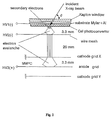
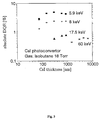
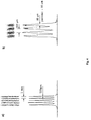
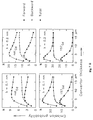
- Fig. 2 shows a novel secondary emission X-ray imaging detector. Secondary electrons emitted from the solid photoconvertor are preamplified at their emission location, transferred and localized in the MWPC by a two-dimensional cathode readout system. Detectors combining CsI convertors and gaseous imaging SE multipliers as developed for X-ray imaging (Fig. 2) provide very interesting results in terms of detection efficiency (Fig. 3) and localization properties (Figs. 4a and 4b and Fig. 5). It has been demonstrated that the cloud of secondary electrons, emitted at the impact location of the incident X-ray photon, can be efficiently multiplied and imaged with an accuracy of 200 ⁇ m.
- Models describing the secondary emission process were developed for alkali-halides. Simulation codes developed enable the calculation of the interaction process between the incident radiation and the convertor material and the prediction of conversion and SE emission efficiencies, SE yields and energy distributions of these secondary electrons.
- Fig. 6 shows, for example, the expected average SE yield emitted in one cluster following the absorption of X-ray photons, for various X-ray energies, as function of the CsI thickness.
- Fig. 7a shows calculated data on the neutron-induced electron emission efficiency, from Gd convertors. It includes the neutron conversion efficiency and the electron energy-loss and escape probability. It is shown that maximum escape efficiencies for 2 ⁇ (20 meV) neutrons are of 20% for natural Gd and about 43% for 157Gd, for electrons escaping from both sides of the convertor.
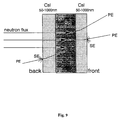
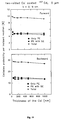
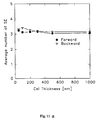
- the calculations indicate the following: Almost independent of the CsI thickness, for 100 incident neutrons of 1.8 ⁇ on a 157Gd-based CNC, on the average 9.5 neutron induced electrons (NIE) in the forward direction and 29.8 NIE in the backward direction are emitted from the Gd. After interactions in the CsI layers, 9.5 NIE escape the CNC in the forward direction and 28.1 NIE in the backward direction. About half of the NIE are accompanied by SEs, in the forward and in the backward directions. Namely, there are 4.6 and 14.2 NIE in the forward and the backward direction, respectively, which are accompanied by low-energy secondary electron (SE). The average number of SE per event is about 3. The results of these calculations are shown in Figs. 10, Fig. 11a and Fig. 11b.
- Vacuum electron multipliers e.g. MCP's
- high gain, low-pressure, multistage gaseous electron multipliers developed by the inventors, have close to 100% efficiency in detecting and imaging single electrons and are a preferred embodiment of the invention.
- Such devices are efficiently used for the imaging of single UV-photons and for counting single electrons (see Fig. 12).
- each pulse corresponds to a single ionization electron collected from a "conversion" volume and individually amplified in a multistage gaseous avalanche multiplier of the type proposed here.
- the device has excellent sensitivity to single electrons.
- the detector consists of a multilayer convertor foil coupled to a multistep avalanche chamber.
- Neutrons enter the detector volume through a 0.5 mm thick and 75 mm in diameter Al-window, traverse the gas and the electrode-structure of the avalanche chamber and finally hit the convertor foil.
- Charged particles are detected in the backward direction (with respect to the neutron beam).
- the active elements are mounted in a vacuum vessel made of stainless steel.
- the detector was operated with isobutane in a differential flow mode at various controlled pressures in the range of 5-40 mbar.
- the neutron convertor foil material was deposited on a 5 mm thick, 75 mm in diameter aluminum disk. Two different convertor materials were used: natural Gd and natural Li.
- a 300 ⁇ m thick natural Gd foil was glued onto the Al disk.
- the Gd-surface was coated with CsI layers of various thicknesses, deposited by standard vacuum evaporation.
- a low density CsI film of spongy structure was produced by evaporating in a 7.5 mbar Ar atmosphere in the evaporation jar. Under this evaporation condition it is known that the deposited layer has the structure of a sponge where the average density is only a few percent of the natural bulk density of solid CsI. It is expected that this structure, with its large surface to volume ratio, leads to an enhanced secondary electron emission. We did not have any control on the effective mass of CsI deposited on the Gd since the thickness monitor did not function under these evaporation conditions.
- Li-convertors were prepared by vacuum deposition of natural Li on a polished aluminum disk. Layers of 30 ⁇ m and 60 ⁇ m thickness were produced. In a second evaporation step, without breaking the vacuum, a 1 ⁇ m thick CsI layer was deposited on the Li film. Since both, Li and CsI, are hygroscopic, special care was taken to keep the exposure of the convertor to air during the mounting procedure below 1 minute. The purity of the CsI was 99.5%. Table I presents a list of the convertor foils and secondary emission coatings produced and investigated within the framework of this study.
- Fig. 13 A detailed description of low-pressure multistep avalanche chambers and their operation is known in the art. See for example Ref. 4, herein incorporated by reference. A scheme of the set up used in this measurement is presented in Fig. 13.
- the preamplification gap is defined by the conversion foil and an 81% transmission grid made of stainless steel. The width of the gap is 2 mm and it is operated in a proportional amplification mode. After preamplification avalanche electrons are transferred to the second multiplication region through a 20 mm long drift and diffusion gap which improves the operation stability at high gains.
- the second amplification stage a multiwire proportional counter, consists of a 20 ⁇ m in diameter, 1 mm spaced wire anode plane placed between two 50 ⁇ m in diameter, 1 mm spaced wired cathode planes.
- the localization of the center of the avalanche, corresponding to the neutron capture location in the convertor foil, is obtained by analyzing the induced signals on the cathode wires, applying the well known delay-line readout technique.
- the anode wire signal processed by a low noise charge sensitive preamplifier and a linear amplifier provides the avalanche size.
- the anode and cathode signals are processed by fast linear amplifiers, constant fraction discriminators (CFD) and CAMAC driven time-to-digital convertors (TDC).
- CFD constant fraction discriminators
- TDC time-to-digital convertors
- the fast anode signal is branched to a charge integrating ADC.
- the two dimensional position and the pulse-height information could be recorded and stored in list-mode files. Data acquisition and analysis was controlled by a PC and a CAMAC-based data acquisition system.
- the goals of the measurements were the determination of the neutron detection efficiency, the study of the influence of the CsI secondary electron emissive layers on the pulse-height spectra and the investigation of the imaging properties of the detector.
- Fig. 14a shows the beam set-up as it was used to measure detection efficiency and pulse-height spectra.
- a 96% transmission 3He-proportional chamber (TM) served as monitor of the beam intensity during all the measurements.
- BM calibrated 3He-proportional chamber
- Fig. 14b shows the set up used for measuring the position resolution.
- Most of the data were obtained with the full beams of 17.5 mrad divergence. However, this beam divergence leads already to a geometric broadening of 1.2 mm (total width) at the position of the convertor foil, which obscures the superior detector performance.
- SS 2.9 mrad soller-slit
- Slits of 1 and 0.4 mm width, made of Cd and Gd were mounted directly on the detector entrance window and were radiographically imaged by the detector.
- Additional collimators of 50 mm thick lead (PB) and 50 mm thick plastic bricks containing boron (B) were inserted in the beam to reduce the background by neutron-induced gamma rays from the Cd slit.
- the avalanche chamber must be capable of detecting events originating from down to only one slow secondary electron in the vicinity of the convertor surface within the preamplification gap. Therefore, to achieve a counting rate plateau the chamber must be operated at high gas amplifications of several times 106.
- the neutron convertor foil was replaced by a polished A1 photocathode and irradiated with W-light from a Hg (Ar) lamp.
- the avalanches were initiated by single photo-electrons from the photocathode. Close to 100% of the signals are clearly separated from the noise.
- the detector operates in a stable way over long periods of time even in the neutron beam.
- Table II lists the measured neutron detection efficiencies obtained with natural Gd- and Li- based convertors at different operating pressures of the avalanche chamber. Note that the high values at 40 mbar are due to an increased background sensitivity of the detector and not to a true neutron-sensitivity.
- the detection efficiency of about 8% measured with natural Gd convertor is in good agreement with the calculations, as seen in Fig. 7a.
- the results obtained with natural Li are also in good agreement with theoretical calculations of Fig. 7b, taking into account the thickness of Li and the abundance of 6Li in the natural Li foil used.
- the localization resolution was measured by irradiating the detector of Fig. 13 equipped with Gd/CsI and Li/CsI convertors, through various slits.
- the neutron beam divergence was 2.9 mrad.
- the data recorded with a 0.4 mm wide slit and a Soller collimator resulted in measured 0.73 mm (fwhm) and 0.59 mm (fwhm) resolutions for the Gd/CsI and Li/CsI convertors, respectively (Figs. 16a, 16b).
- the intrinsic resolutions are 0.65 (fwhm) and 0.4 mm (fwhm) for Gd/CsI and Li/CsI, respectively.
- the superior imaging performance of the Li/CsI convertors is apparent in Fig. 16b, also as a much narrower width of the distribution at 1% full maximum. It is due on one hand to a larger yield of triton-induced secondary electrons compared to electron-induced secondary electrons in Gd/CsI. On the other hand, the broad shoulders in Gd/CsI may be due to the larger sensitivity to gamma radiation.
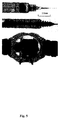
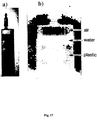
- the 2D imaging performance with the Li/CsI convertor are shown in Figs. 17 and 18, representing a neutron radiographic image of a plastic syringe and of a metal ball-bearing with and without grease.
- thermal and epithermal neutron detectors described include industrial neutron radiography and tomography and neutron diffractometry. There are possible applications in medical imaging as well.
Landscapes
- Physics & Mathematics (AREA)
- Health & Medical Sciences (AREA)
- Life Sciences & Earth Sciences (AREA)
- General Physics & Mathematics (AREA)
- General Health & Medical Sciences (AREA)
- Biochemistry (AREA)
- Analytical Chemistry (AREA)
- Chemical & Material Sciences (AREA)
- Immunology (AREA)
- Pathology (AREA)
- High Energy & Nuclear Physics (AREA)
- Molecular Biology (AREA)
- Spectroscopy & Molecular Physics (AREA)
- Measurement Of Radiation (AREA)
Applications Claiming Priority (2)
| Application Number | Priority Date | Filing Date | Title |
|---|---|---|---|
| US24058794A | 1994-05-10 | 1994-05-10 | |
| US240587 | 1994-05-10 |
Publications (2)
| Publication Number | Publication Date |
|---|---|
| EP0682268A2 true EP0682268A2 (de) | 1995-11-15 |
| EP0682268A3 EP0682268A3 (de) | 1998-03-18 |
Family
ID=22907140
Family Applications (1)
| Application Number | Title | Priority Date | Filing Date |
|---|---|---|---|
| EP95107085A Withdrawn EP0682268A3 (de) | 1994-05-10 | 1995-05-10 | Feststoffstrahlungsumwandler für Neutronenbildgebungsdetektoren |
Country Status (2)
| Country | Link |
|---|---|
| EP (1) | EP0682268A3 (de) |
| IL (1) | IL113663A0 (de) |
Cited By (12)
| Publication number | Priority date | Publication date | Assignee | Title |
|---|---|---|---|---|
| WO1999023460A3 (de) * | 1997-10-31 | 1999-08-26 | Forschungszentrum Juelich Gmbh | Spektrometeranlage mit vakuum-ultraviolett-spektrometer und detektorvorrichtung mit mikrosphärenplatte zur spektroskopischen partialdruckmessung in einer umgebung mit hohen magnetfeldern |
| RU2138833C1 (ru) * | 1999-02-08 | 1999-09-27 | Мительман Михаил Григорьевич | Детектор нейтронов прямого заряда |
| WO2002025313A1 (en) * | 2000-09-22 | 2002-03-28 | Xcounter Ab | Parallax-free detection of ionizing radiation |
| EP1531344A1 (de) * | 2003-11-13 | 2005-05-18 | Paul Scherrer Institut | Bildelementdetektor für Neutronen-Röntgenaufnahme und Verfahren zur Detektion von auftreffenden Neutronen |
| WO2012000158A1 (zh) * | 2010-06-30 | 2012-01-05 | 清华大学 | 热中子探测器及其制造方法 |
| ITRM20130254A1 (it) * | 2013-04-29 | 2014-10-30 | Infn Istituto Naz Di Fisica N Ucleare | "rivelatori di neutroni termici non facenti uso di 3he e metodo per la loro realizzazione" |
| JP2016017901A (ja) * | 2014-07-10 | 2016-02-01 | 国立大学法人北海道大学 | 診断装置、及び診断方法 |
| CN107202807A (zh) * | 2017-04-10 | 2017-09-26 | 中国矿业大学(北京) | 一种基于中子照相实验台的加载装置 |
| CN109187663A (zh) * | 2018-09-04 | 2019-01-11 | 中国科学院大学 | 一种栅型气体电子倍增探测器 |
| CN112255666A (zh) * | 2020-10-23 | 2021-01-22 | 中国工程物理研究院激光聚变研究中心 | 中子灵敏微通道板 |
| JP2022535251A (ja) * | 2019-06-07 | 2022-08-05 | アダプタス ソリューションズ プロプライエタリー リミテッド | 透過型二次電子放出手段を有する検出器 |
| CN114966871A (zh) * | 2022-05-11 | 2022-08-30 | 山东大学 | 适于多种地形的瞬变电磁接收线圈搭载车及其使用方法 |
Family Cites Families (4)
| Publication number | Priority date | Publication date | Assignee | Title |
|---|---|---|---|---|
| BE758334A (fr) * | 1969-11-04 | 1971-04-01 | Eastman Kodak Co | Produit pour la neutrographie |
| US3891852A (en) * | 1972-11-03 | 1975-06-24 | Agfa Gevaert Nv | Neutron detection and radiography |
| CA992671A (en) * | 1974-04-11 | 1976-07-06 | Her Majesty The Queen In Right Of Canada As Represented By The Minister Of National Defence | Neutron radiographic camera incorporating electron multiplication |
| FR2492159A1 (fr) * | 1980-10-14 | 1982-04-16 | Thomson Csf | Ecran convertisseur de neutrons, intensificateur d'images comprenant un tel ecran |
-
1995
- 1995-05-09 IL IL11366395A patent/IL113663A0/xx unknown
- 1995-05-10 EP EP95107085A patent/EP0682268A3/de not_active Withdrawn
Cited By (15)
| Publication number | Priority date | Publication date | Assignee | Title |
|---|---|---|---|---|
| WO1999023460A3 (de) * | 1997-10-31 | 1999-08-26 | Forschungszentrum Juelich Gmbh | Spektrometeranlage mit vakuum-ultraviolett-spektrometer und detektorvorrichtung mit mikrosphärenplatte zur spektroskopischen partialdruckmessung in einer umgebung mit hohen magnetfeldern |
| RU2138833C1 (ru) * | 1999-02-08 | 1999-09-27 | Мительман Михаил Григорьевич | Детектор нейтронов прямого заряда |
| WO2002025313A1 (en) * | 2000-09-22 | 2002-03-28 | Xcounter Ab | Parallax-free detection of ionizing radiation |
| EP1531344A1 (de) * | 2003-11-13 | 2005-05-18 | Paul Scherrer Institut | Bildelementdetektor für Neutronen-Röntgenaufnahme und Verfahren zur Detektion von auftreffenden Neutronen |
| WO2012000158A1 (zh) * | 2010-06-30 | 2012-01-05 | 清华大学 | 热中子探测器及其制造方法 |
| CN102313898A (zh) * | 2010-06-30 | 2012-01-11 | 清华大学 | 热中子探测器及其制造方法 |
| ITRM20130254A1 (it) * | 2013-04-29 | 2014-10-30 | Infn Istituto Naz Di Fisica N Ucleare | "rivelatori di neutroni termici non facenti uso di 3he e metodo per la loro realizzazione" |
| WO2014188458A1 (en) * | 2013-04-29 | 2014-11-27 | Infn - Istituto Nazionale Di Fisica Nucleare | Thermal-neutron detectors not making use of he-3, and method for their manufacturing |
| JP2016017901A (ja) * | 2014-07-10 | 2016-02-01 | 国立大学法人北海道大学 | 診断装置、及び診断方法 |
| CN107202807A (zh) * | 2017-04-10 | 2017-09-26 | 中国矿业大学(北京) | 一种基于中子照相实验台的加载装置 |
| CN109187663A (zh) * | 2018-09-04 | 2019-01-11 | 中国科学院大学 | 一种栅型气体电子倍增探测器 |
| JP2022535251A (ja) * | 2019-06-07 | 2022-08-05 | アダプタス ソリューションズ プロプライエタリー リミテッド | 透過型二次電子放出手段を有する検出器 |
| CN112255666A (zh) * | 2020-10-23 | 2021-01-22 | 中国工程物理研究院激光聚变研究中心 | 中子灵敏微通道板 |
| CN112255666B (zh) * | 2020-10-23 | 2022-11-18 | 中国工程物理研究院激光聚变研究中心 | 中子灵敏微通道板 |
| CN114966871A (zh) * | 2022-05-11 | 2022-08-30 | 山东大学 | 适于多种地形的瞬变电磁接收线圈搭载车及其使用方法 |
Also Published As
| Publication number | Publication date |
|---|---|
| EP0682268A3 (de) | 1998-03-18 |
| IL113663A0 (en) | 1995-08-31 |
Similar Documents
| Publication | Publication Date | Title |
|---|---|---|
| Torii et al. | The energy spectrum of cosmic-ray electrons from 10 to 100 GeV observed with a highly granulated imaging calorimeter | |
| Crane et al. | Neutron detectors | |
| Hughes et al. | Characteristics of the telescope for high energy γ-ray astronomy selected for definition studies on the gamma ray observatory | |
| Piscitelli et al. | The Multi-Blade Boron-10-based neutron detector for high intensity neutron reflectometry at ESS | |
| US20220342097A1 (en) | Neutron imaging system having neutron shield | |
| Calviani et al. | A fast ionization chamber for fission cross-section measurements at n_TOF | |
| Dangendorf et al. | Thermal neutron imaging detectors combining novel composite foil convertors and gaseous electron multipiers | |
| EP0682268A2 (de) | Feststoffstrahlungsumwandler für Neutronenbildgebungsdetektoren | |
| Bollinger et al. | Boron‐loaded liquid scintillation neutron detectors | |
| JPS62194481A (ja) | 無電荷粒子を検出し、位置を決定する装置 | |
| JP2000509154A (ja) | シンチレータ装置 | |
| Oed | Detectors for thermal neutrons | |
| Kaplan et al. | Multiwire proportional chambers for biomedical application | |
| Feller et al. | Neutron field imaging with microchannel plates | |
| Henzlova et al. | Neutron Detectors | |
| Bannerman et al. | CXII. Electron and gamma ray spectroscopy with scintillation detectors | |
| Nagaslaev et al. | Beam tests of a thin dual-readout calorimeter for detecting cosmic rays outside the Earth's atmosphere | |
| Pinto | GEM applications outside high energy physics | |
| Alkhazov et al. | Coulomb Excitation of Separated Tin Isotopes | |
| Berry et al. | Neutron Detection Materials, Detector Properties, and Selection | |
| Tremsin et al. | High efficiency angular selective detection of thermal and cold neutrons | |
| Block et al. | High-resolution and High-rate boron-lined Detectors for Neutron Science | |
| EP3270186A1 (de) | Neutronendetektor mit einer trackingeinheit | |
| Chyzh et al. | Characterization of the BOLDPET optical prototype, an innovative Cherenkov detector for 511 keV γ radiation | |
| Barschall | Detection of neutrons |
Legal Events
| Date | Code | Title | Description |
|---|---|---|---|
| PUAI | Public reference made under article 153(3) epc to a published international application that has entered the european phase |
Free format text: ORIGINAL CODE: 0009012 |
|
| AK | Designated contracting states |
Kind code of ref document: A2 Designated state(s): CH DE FR GB IT LI SE |
|
| PUAL | Search report despatched |
Free format text: ORIGINAL CODE: 0009013 |
|
| AK | Designated contracting states |
Kind code of ref document: A3 Designated state(s): CH DE FR GB IT LI SE |
|
| STAA | Information on the status of an ep patent application or granted ep patent |
Free format text: STATUS: THE APPLICATION IS DEEMED TO BE WITHDRAWN |
|
| 18D | Application deemed to be withdrawn |
Effective date: 19981201 |