EP0683192B1 - Durch ihre Endgruppen UV-stabilisierte aromatische Polycarbonate - Google Patents
Durch ihre Endgruppen UV-stabilisierte aromatische Polycarbonate Download PDFInfo
- Publication number
- EP0683192B1 EP0683192B1 EP95106923A EP95106923A EP0683192B1 EP 0683192 B1 EP0683192 B1 EP 0683192B1 EP 95106923 A EP95106923 A EP 95106923A EP 95106923 A EP95106923 A EP 95106923A EP 0683192 B1 EP0683192 B1 EP 0683192B1
- Authority
- EP
- European Patent Office
- Prior art keywords
- bis
- hydroxyphenyl
- mol
- polycarbonate
- polycarbonates
- Prior art date
- Legal status (The legal status is an assumption and is not a legal conclusion. Google has not performed a legal analysis and makes no representation as to the accuracy of the status listed.)
- Expired - Lifetime
Links
- 239000004417 polycarbonate Substances 0.000 title claims description 74
- 229920000515 polycarbonate Polymers 0.000 title claims description 71
- 125000003118 aryl group Chemical group 0.000 title claims description 9
- 238000000034 method Methods 0.000 claims description 35
- -1 chain terminators Chemical compound 0.000 claims description 17
- 238000004519 manufacturing process Methods 0.000 claims description 13
- 238000006243 chemical reaction Methods 0.000 claims description 12
- XKZQKPRCPNGNFR-UHFFFAOYSA-N 2-(3-hydroxyphenyl)phenol Chemical compound OC1=CC=CC(C=2C(=CC=CC=2)O)=C1 XKZQKPRCPNGNFR-UHFFFAOYSA-N 0.000 claims description 9
- 239000006096 absorbing agent Substances 0.000 claims description 9
- 238000005809 transesterification reaction Methods 0.000 claims description 7
- 239000000155 melt Substances 0.000 claims description 6
- 238000000149 argon plasma sintering Methods 0.000 claims description 5
- 239000006085 branching agent Substances 0.000 claims description 4
- 229910052801 chlorine Inorganic materials 0.000 claims description 4
- 229910052739 hydrogen Inorganic materials 0.000 claims description 4
- 230000005501 phase interface Effects 0.000 claims description 4
- 238000003786 synthesis reaction Methods 0.000 claims description 4
- 125000005913 (C3-C6) cycloalkyl group Chemical group 0.000 claims description 3
- 230000015572 biosynthetic process Effects 0.000 claims description 3
- BVKZGUZCCUSVTD-UHFFFAOYSA-N carbonic acid Chemical compound OC(O)=O BVKZGUZCCUSVTD-UHFFFAOYSA-N 0.000 claims description 3
- 239000012456 homogeneous solution Substances 0.000 claims description 3
- 125000004400 (C1-C12) alkyl group Chemical group 0.000 claims description 2
- 125000006702 (C1-C18) alkyl group Chemical group 0.000 claims description 2
- 125000000041 C6-C10 aryl group Chemical group 0.000 claims description 2
- 125000000732 arylene group Chemical group 0.000 claims description 2
- 125000002993 cycloalkylene group Chemical group 0.000 claims 1
- YMWUJEATGCHHMB-UHFFFAOYSA-N Dichloromethane Chemical compound ClCCl YMWUJEATGCHHMB-UHFFFAOYSA-N 0.000 description 23
- MVPPADPHJFYWMZ-UHFFFAOYSA-N chlorobenzene Chemical compound ClC1=CC=CC=C1 MVPPADPHJFYWMZ-UHFFFAOYSA-N 0.000 description 18
- 239000000203 mixture Substances 0.000 description 17
- HEMHJVSKTPXQMS-UHFFFAOYSA-M Sodium hydroxide Chemical compound [OH-].[Na+] HEMHJVSKTPXQMS-UHFFFAOYSA-M 0.000 description 15
- YXFVVABEGXRONW-UHFFFAOYSA-N Toluene Chemical compound CC1=CC=CC=C1 YXFVVABEGXRONW-UHFFFAOYSA-N 0.000 description 15
- JUJWROOIHBZHMG-UHFFFAOYSA-N Pyridine Chemical compound C1=CC=NC=C1 JUJWROOIHBZHMG-UHFFFAOYSA-N 0.000 description 12
- IISBACLAFKSPIT-UHFFFAOYSA-N bisphenol A Chemical compound C=1C=C(O)C=CC=1C(C)(C)C1=CC=C(O)C=C1 IISBACLAFKSPIT-UHFFFAOYSA-N 0.000 description 12
- 239000000243 solution Substances 0.000 description 12
- ISWSIDIOOBJBQZ-UHFFFAOYSA-N Phenol Chemical compound OC1=CC=CC=C1 ISWSIDIOOBJBQZ-UHFFFAOYSA-N 0.000 description 11
- 239000003054 catalyst Substances 0.000 description 11
- 150000001875 compounds Chemical class 0.000 description 10
- 239000012071 phase Substances 0.000 description 10
- YGYAWVDWMABLBF-UHFFFAOYSA-N Phosgene Chemical compound ClC(Cl)=O YGYAWVDWMABLBF-UHFFFAOYSA-N 0.000 description 8
- ZMANZCXQSJIPKH-UHFFFAOYSA-N Triethylamine Chemical compound CCN(CC)CC ZMANZCXQSJIPKH-UHFFFAOYSA-N 0.000 description 8
- 125000002887 hydroxy group Chemical group [H]O* 0.000 description 7
- 238000002360 preparation method Methods 0.000 description 7
- 125000000217 alkyl group Chemical group 0.000 description 6
- 239000010410 layer Substances 0.000 description 6
- XLYOFNOQVPJJNP-UHFFFAOYSA-N water Chemical compound O XLYOFNOQVPJJNP-UHFFFAOYSA-N 0.000 description 6
- UMPGNGRIGSEMTC-UHFFFAOYSA-N 4-[1-(4-hydroxyphenyl)-3,3,5-trimethylcyclohexyl]phenol Chemical compound C1C(C)CC(C)(C)CC1(C=1C=CC(O)=CC=1)C1=CC=C(O)C=C1 UMPGNGRIGSEMTC-UHFFFAOYSA-N 0.000 description 5
- XDTMQSROBMDMFD-UHFFFAOYSA-N Cyclohexane Chemical compound C1CCCCC1 XDTMQSROBMDMFD-UHFFFAOYSA-N 0.000 description 5
- CDBYLPFSWZWCQE-UHFFFAOYSA-L Sodium Carbonate Chemical compound [Na+].[Na+].[O-]C([O-])=O CDBYLPFSWZWCQE-UHFFFAOYSA-L 0.000 description 5
- 229920000642 polymer Polymers 0.000 description 5
- UMJSCPRVCHMLSP-UHFFFAOYSA-N pyridine Natural products COC1=CC=CN=C1 UMJSCPRVCHMLSP-UHFFFAOYSA-N 0.000 description 5
- VEORPZCZECFIRK-UHFFFAOYSA-N 3,3',5,5'-tetrabromobisphenol A Chemical compound C=1C(Br)=C(O)C(Br)=CC=1C(C)(C)C1=CC(Br)=C(O)C(Br)=C1 VEORPZCZECFIRK-UHFFFAOYSA-N 0.000 description 4
- GYLZMVYMSPSPDA-UHFFFAOYSA-N 4-[1-(4-hydroxyphenyl)-3-methylcyclohexyl]phenol Chemical compound C1C(C)CCCC1(C=1C=CC(O)=CC=1)C1=CC=C(O)C=C1 GYLZMVYMSPSPDA-UHFFFAOYSA-N 0.000 description 4
- ODJUOZPKKHIEOZ-UHFFFAOYSA-N 4-[2-(4-hydroxy-3,5-dimethylphenyl)propan-2-yl]-2,6-dimethylphenol Chemical compound CC1=C(O)C(C)=CC(C(C)(C)C=2C=C(C)C(O)=C(C)C=2)=C1 ODJUOZPKKHIEOZ-UHFFFAOYSA-N 0.000 description 4
- FBMPWJWZZAAOHP-UHFFFAOYSA-N 4-[3-(benzotriazol-2-yl)-5-cyclohexyl-4-hydroxyphenyl]butanoic acid Chemical compound OC=1C(N2N=C3C=CC=CC3=N2)=CC(CCCC(=O)O)=CC=1C1CCCCC1 FBMPWJWZZAAOHP-UHFFFAOYSA-N 0.000 description 4
- CSCPPACGZOOCGX-UHFFFAOYSA-N Acetone Chemical compound CC(C)=O CSCPPACGZOOCGX-UHFFFAOYSA-N 0.000 description 4
- WEVYAHXRMPXWCK-UHFFFAOYSA-N Acetonitrile Chemical compound CC#N WEVYAHXRMPXWCK-UHFFFAOYSA-N 0.000 description 4
- IJGRMHOSHXDMSA-UHFFFAOYSA-N Atomic nitrogen Chemical compound N#N IJGRMHOSHXDMSA-UHFFFAOYSA-N 0.000 description 4
- SDDLEVPIDBLVHC-UHFFFAOYSA-N Bisphenol Z Chemical compound C1=CC(O)=CC=C1C1(C=2C=CC(O)=CC=2)CCCCC1 SDDLEVPIDBLVHC-UHFFFAOYSA-N 0.000 description 4
- KYPYTERUKNKOLP-UHFFFAOYSA-N Tetrachlorobisphenol A Chemical compound C=1C(Cl)=C(O)C(Cl)=CC=1C(C)(C)C1=CC(Cl)=C(O)C(Cl)=C1 KYPYTERUKNKOLP-UHFFFAOYSA-N 0.000 description 4
- 125000001931 aliphatic group Chemical group 0.000 description 4
- 239000003513 alkali Substances 0.000 description 4
- ROORDVPLFPIABK-UHFFFAOYSA-N diphenyl carbonate Chemical compound C=1C=CC=CC=1OC(=O)OC1=CC=CC=C1 ROORDVPLFPIABK-UHFFFAOYSA-N 0.000 description 4
- 150000003839 salts Chemical class 0.000 description 4
- 239000002904 solvent Substances 0.000 description 4
- IMFACGCPASFAPR-UHFFFAOYSA-N tributylamine Chemical compound CCCCN(CCCC)CCCC IMFACGCPASFAPR-UHFFFAOYSA-N 0.000 description 4
- KFJDQPJLANOOOB-UHFFFAOYSA-N 2h-benzotriazole-4-carboxylic acid Chemical compound OC(=O)C1=CC=CC2=NNN=C12 KFJDQPJLANOOOB-UHFFFAOYSA-N 0.000 description 3
- ZCILGMFPJBRCNO-UHFFFAOYSA-N 4-phenyl-2H-benzotriazol-5-ol Chemical compound OC1=CC=C2NN=NC2=C1C1=CC=CC=C1 ZCILGMFPJBRCNO-UHFFFAOYSA-N 0.000 description 3
- UHOVQNZJYSORNB-UHFFFAOYSA-N Benzene Chemical compound C1=CC=CC=C1 UHOVQNZJYSORNB-UHFFFAOYSA-N 0.000 description 3
- DGAQECJNVWCQMB-PUAWFVPOSA-M Ilexoside XXIX Chemical compound C[C@@H]1CC[C@@]2(CC[C@@]3(C(=CC[C@H]4[C@]3(CC[C@@H]5[C@@]4(CC[C@@H](C5(C)C)OS(=O)(=O)[O-])C)C)[C@@H]2[C@]1(C)O)C)C(=O)O[C@H]6[C@@H]([C@H]([C@@H]([C@H](O6)CO)O)O)O.[Na+] DGAQECJNVWCQMB-PUAWFVPOSA-M 0.000 description 3
- WMFOQBRAJBCJND-UHFFFAOYSA-M Lithium hydroxide Chemical compound [Li+].[OH-] WMFOQBRAJBCJND-UHFFFAOYSA-M 0.000 description 3
- KWYUFKZDYYNOTN-UHFFFAOYSA-M Potassium hydroxide Chemical compound [OH-].[K+] KWYUFKZDYYNOTN-UHFFFAOYSA-M 0.000 description 3
- 150000001565 benzotriazoles Chemical class 0.000 description 3
- VTYYLEPIZMXCLO-UHFFFAOYSA-L calcium carbonate Substances [Ca+2].[O-]C([O-])=O VTYYLEPIZMXCLO-UHFFFAOYSA-L 0.000 description 3
- 125000003178 carboxy group Chemical group [H]OC(*)=O 0.000 description 3
- 150000001732 carboxylic acid derivatives Chemical class 0.000 description 3
- 239000012792 core layer Substances 0.000 description 3
- 150000002148 esters Chemical group 0.000 description 3
- 239000003960 organic solvent Substances 0.000 description 3
- 229910052708 sodium Inorganic materials 0.000 description 3
- 239000011734 sodium Substances 0.000 description 3
- LPXPTNMVRIOKMN-UHFFFAOYSA-M sodium nitrite Chemical compound [Na+].[O-]N=O LPXPTNMVRIOKMN-UHFFFAOYSA-M 0.000 description 3
- UIAFKZKHHVMJGS-UHFFFAOYSA-N 2,4-dihydroxybenzoic acid Chemical compound OC(=O)C1=CC=C(O)C=C1O UIAFKZKHHVMJGS-UHFFFAOYSA-N 0.000 description 2
- NXXYKOUNUYWIHA-UHFFFAOYSA-N 2,6-Dimethylphenol Chemical compound CC1=CC=CC(C)=C1O NXXYKOUNUYWIHA-UHFFFAOYSA-N 0.000 description 2
- XBQRPFBBTWXIFI-UHFFFAOYSA-N 2-chloro-4-[2-(3-chloro-4-hydroxyphenyl)propan-2-yl]phenol Chemical compound C=1C=C(O)C(Cl)=CC=1C(C)(C)C1=CC=C(O)C(Cl)=C1 XBQRPFBBTWXIFI-UHFFFAOYSA-N 0.000 description 2
- MVRPPTGLVPEMPI-UHFFFAOYSA-N 2-cyclohexylphenol Chemical compound OC1=CC=CC=C1C1CCCCC1 MVRPPTGLVPEMPI-UHFFFAOYSA-N 0.000 description 2
- DPJCXCZTLWNFOH-UHFFFAOYSA-N 2-nitroaniline Chemical compound NC1=CC=CC=C1[N+]([O-])=O DPJCXCZTLWNFOH-UHFFFAOYSA-N 0.000 description 2
- YMTYZTXUZLQUSF-UHFFFAOYSA-N 3,3'-Dimethylbisphenol A Chemical compound C1=C(O)C(C)=CC(C(C)(C)C=2C=C(C)C(O)=CC=2)=C1 YMTYZTXUZLQUSF-UHFFFAOYSA-N 0.000 description 2
- VPWNQTHUCYMVMZ-UHFFFAOYSA-N 4,4'-sulfonyldiphenol Chemical class C1=CC(O)=CC=C1S(=O)(=O)C1=CC=C(O)C=C1 VPWNQTHUCYMVMZ-UHFFFAOYSA-N 0.000 description 2
- SUCTVKDVODFXFX-UHFFFAOYSA-N 4-(4-hydroxy-3,5-dimethylphenyl)sulfonyl-2,6-dimethylphenol Chemical compound CC1=C(O)C(C)=CC(S(=O)(=O)C=2C=C(C)C(O)=C(C)C=2)=C1 SUCTVKDVODFXFX-UHFFFAOYSA-N 0.000 description 2
- AZZWZMUXHALBCQ-UHFFFAOYSA-N 4-[(4-hydroxy-3,5-dimethylphenyl)methyl]-2,6-dimethylphenol Chemical compound CC1=C(O)C(C)=CC(CC=2C=C(C)C(O)=C(C)C=2)=C1 AZZWZMUXHALBCQ-UHFFFAOYSA-N 0.000 description 2
- BBQUJOSOZADWEP-UHFFFAOYSA-N 4-[1-(4-hydroxy-3,5-dimethylphenyl)-4-methylcyclohexyl]-2,6-dimethylphenol Chemical compound C1CC(C)CCC1(C=1C=C(C)C(O)=C(C)C=1)C1=CC(C)=C(O)C(C)=C1 BBQUJOSOZADWEP-UHFFFAOYSA-N 0.000 description 2
- BWCAVNWKMVHLFW-UHFFFAOYSA-N 4-[1-(4-hydroxy-3,5-dimethylphenyl)cyclohexyl]-2,6-dimethylphenol Chemical compound CC1=C(O)C(C)=CC(C2(CCCCC2)C=2C=C(C)C(O)=C(C)C=2)=C1 BWCAVNWKMVHLFW-UHFFFAOYSA-N 0.000 description 2
- IIQVXZZBIGSGIL-UHFFFAOYSA-N 4-[1-(4-hydroxyphenyl)-3,3-dimethylcyclohexyl]phenol Chemical compound C1C(C)(C)CCCC1(C=1C=CC(O)=CC=1)C1=CC=C(O)C=C1 IIQVXZZBIGSGIL-UHFFFAOYSA-N 0.000 description 2
- IPHDZYSMEITSBA-UHFFFAOYSA-N 4-[1-(4-hydroxyphenyl)-4-methylcyclohexyl]phenol Chemical compound C1CC(C)CCC1(C=1C=CC(O)=CC=1)C1=CC=C(O)C=C1 IPHDZYSMEITSBA-UHFFFAOYSA-N 0.000 description 2
- OBZFGWBLZXIBII-UHFFFAOYSA-N 4-[3-(4-hydroxy-3,5-dimethylphenyl)-3-methylbutyl]-2,6-dimethylphenol Chemical compound CC1=C(O)C(C)=CC(CCC(C)(C)C=2C=C(C)C(O)=C(C)C=2)=C1 OBZFGWBLZXIBII-UHFFFAOYSA-N 0.000 description 2
- NIRYBKWMEWFDPM-UHFFFAOYSA-N 4-[3-(4-hydroxyphenyl)-3-methylbutyl]phenol Chemical compound C=1C=C(O)C=CC=1C(C)(C)CCC1=CC=C(O)C=C1 NIRYBKWMEWFDPM-UHFFFAOYSA-N 0.000 description 2
- 229930185605 Bisphenol Natural products 0.000 description 2
- BTBUEUYNUDRHOZ-UHFFFAOYSA-N Borate Chemical compound [O-]B([O-])[O-] BTBUEUYNUDRHOZ-UHFFFAOYSA-N 0.000 description 2
- QIGBRXMKCJKVMJ-UHFFFAOYSA-N Hydroquinone Chemical compound OC1=CC=C(O)C=C1 QIGBRXMKCJKVMJ-UHFFFAOYSA-N 0.000 description 2
- 239000012448 Lithium borohydride Substances 0.000 description 2
- FZNCGRZWXLXZSZ-CIQUZCHMSA-N Voglibose Chemical compound OCC(CO)N[C@H]1C[C@](O)(CO)[C@@H](O)[C@H](O)[C@H]1O FZNCGRZWXLXZSZ-CIQUZCHMSA-N 0.000 description 2
- 239000002253 acid Substances 0.000 description 2
- 229910052784 alkaline earth metal Inorganic materials 0.000 description 2
- 125000003545 alkoxy group Chemical group 0.000 description 2
- 229920000180 alkyd Polymers 0.000 description 2
- VSCWAEJMTAWNJL-UHFFFAOYSA-K aluminium trichloride Chemical compound Cl[Al](Cl)Cl VSCWAEJMTAWNJL-UHFFFAOYSA-K 0.000 description 2
- QMKYBPDZANOJGF-UHFFFAOYSA-N benzene-1,3,5-tricarboxylic acid Chemical compound OC(=O)C1=CC(C(O)=O)=CC(C(O)=O)=C1 QMKYBPDZANOJGF-UHFFFAOYSA-N 0.000 description 2
- QRUDEWIWKLJBPS-UHFFFAOYSA-N benzotriazole Chemical compound C1=CC=C2N[N][N]C2=C1 QRUDEWIWKLJBPS-UHFFFAOYSA-N 0.000 description 2
- VCCBEIPGXKNHFW-UHFFFAOYSA-N biphenyl-4,4'-diol Chemical group C1=CC(O)=CC=C1C1=CC=C(O)C=C1 VCCBEIPGXKNHFW-UHFFFAOYSA-N 0.000 description 2
- KGBXLFKZBHKPEV-UHFFFAOYSA-N boric acid Chemical compound OB(O)O KGBXLFKZBHKPEV-UHFFFAOYSA-N 0.000 description 2
- 235000010216 calcium carbonate Nutrition 0.000 description 2
- 229910052799 carbon Inorganic materials 0.000 description 2
- 125000004432 carbon atom Chemical group C* 0.000 description 2
- 239000013078 crystal Substances 0.000 description 2
- 230000000694 effects Effects 0.000 description 2
- 239000011521 glass Substances 0.000 description 2
- 229910052736 halogen Inorganic materials 0.000 description 2
- 150000002367 halogens Chemical class 0.000 description 2
- 125000004464 hydroxyphenyl group Chemical group 0.000 description 2
- 229910052744 lithium Inorganic materials 0.000 description 2
- 230000008018 melting Effects 0.000 description 2
- 238000002844 melting Methods 0.000 description 2
- 229910052757 nitrogen Inorganic materials 0.000 description 2
- 150000007530 organic bases Chemical class 0.000 description 2
- 239000004033 plastic Substances 0.000 description 2
- 229920003023 plastic Polymers 0.000 description 2
- 239000002985 plastic film Substances 0.000 description 2
- 229920000139 polyethylene terephthalate Polymers 0.000 description 2
- 238000006116 polymerization reaction Methods 0.000 description 2
- SCVFZCLFOSHCOH-UHFFFAOYSA-M potassium acetate Chemical compound [K+].CC([O-])=O SCVFZCLFOSHCOH-UHFFFAOYSA-M 0.000 description 2
- BWHMMNNQKKPAPP-UHFFFAOYSA-L potassium carbonate Chemical compound [K+].[K+].[O-]C([O-])=O BWHMMNNQKKPAPP-UHFFFAOYSA-L 0.000 description 2
- 159000000001 potassium salts Chemical class 0.000 description 2
- 150000003254 radicals Chemical class 0.000 description 2
- GHMLBKRAJCXXBS-UHFFFAOYSA-N resorcinol Chemical compound OC1=CC=CC(O)=C1 GHMLBKRAJCXXBS-UHFFFAOYSA-N 0.000 description 2
- 239000012279 sodium borohydride Substances 0.000 description 2
- 229910000033 sodium borohydride Inorganic materials 0.000 description 2
- 229910000029 sodium carbonate Inorganic materials 0.000 description 2
- 239000007787 solid Substances 0.000 description 2
- VDZOOKBUILJEDG-UHFFFAOYSA-M tetrabutylammonium hydroxide Chemical compound [OH-].CCCC[N+](CCCC)(CCCC)CCCC VDZOOKBUILJEDG-UHFFFAOYSA-M 0.000 description 2
- WGTYBPLFGIVFAS-UHFFFAOYSA-M tetramethylammonium hydroxide Chemical compound [OH-].C[N+](C)(C)C WGTYBPLFGIVFAS-UHFFFAOYSA-M 0.000 description 2
- KGRVJHAUYBGFFP-UHFFFAOYSA-N 2,2'-Methylenebis(4-methyl-6-tert-butylphenol) Chemical compound CC(C)(C)C1=CC(C)=CC(CC=2C(=C(C=C(C)C=2)C(C)(C)C)O)=C1O KGRVJHAUYBGFFP-UHFFFAOYSA-N 0.000 description 1
- MAQOZOILPAMFSW-UHFFFAOYSA-N 2,6-bis[(2-hydroxy-5-methylphenyl)methyl]-4-methylphenol Chemical compound CC1=CC=C(O)C(CC=2C(=C(CC=3C(=CC=C(C)C=3)O)C=C(C)C=2)O)=C1 MAQOZOILPAMFSW-UHFFFAOYSA-N 0.000 description 1
- BLDLRWQLBOJPEB-UHFFFAOYSA-N 2-(2-hydroxyphenyl)sulfanylphenol Chemical class OC1=CC=CC=C1SC1=CC=CC=C1O BLDLRWQLBOJPEB-UHFFFAOYSA-N 0.000 description 1
- KYGLCUAXJICESS-UHFFFAOYSA-N 2-[2,3-di(propan-2-yl)phenyl]phenol Chemical class CC(C)C1=CC=CC(C=2C(=CC=CC=2)O)=C1C(C)C KYGLCUAXJICESS-UHFFFAOYSA-N 0.000 description 1
- ZEKCYPANSOJWDH-UHFFFAOYSA-N 3,3-bis(4-hydroxy-3-methylphenyl)-1H-indol-2-one Chemical compound C1=C(O)C(C)=CC(C2(C3=CC=CC=C3NC2=O)C=2C=C(C)C(O)=CC=2)=C1 ZEKCYPANSOJWDH-UHFFFAOYSA-N 0.000 description 1
- OYGYNUPKLMDVHM-UHFFFAOYSA-N 3-[3-(benzotriazol-2-yl)-5-tert-butyl-4-hydroxyphenyl]propanoic acid Chemical compound CC(C)(C)C1=CC(CCC(O)=O)=CC(N2N=C3C=CC=CC3=N2)=C1O OYGYNUPKLMDVHM-UHFFFAOYSA-N 0.000 description 1
- HVXRCAWUNAOCTA-UHFFFAOYSA-N 4-(6-methylheptyl)phenol Chemical compound CC(C)CCCCCC1=CC=C(O)C=C1 HVXRCAWUNAOCTA-UHFFFAOYSA-N 0.000 description 1
- BRPSWMCDEYMRPE-UHFFFAOYSA-N 4-[1,1-bis(4-hydroxyphenyl)ethyl]phenol Chemical compound C=1C=C(O)C=CC=1C(C=1C=CC(O)=CC=1)(C)C1=CC=C(O)C=C1 BRPSWMCDEYMRPE-UHFFFAOYSA-N 0.000 description 1
- RIBPTGQSXYJRBQ-UHFFFAOYSA-N 4-[2,5-di(propan-2-yl)phenyl]phenol Chemical compound CC(C)C1=CC=C(C(C)C)C(C=2C=CC(O)=CC=2)=C1 RIBPTGQSXYJRBQ-UHFFFAOYSA-N 0.000 description 1
- XJGTVJRTDRARGO-UHFFFAOYSA-N 4-[2-(4-hydroxyphenyl)propan-2-yl]benzene-1,3-diol Chemical compound C=1C=C(O)C=C(O)C=1C(C)(C)C1=CC=C(O)C=C1 XJGTVJRTDRARGO-UHFFFAOYSA-N 0.000 description 1
- RQTDWDATSAVLOR-UHFFFAOYSA-N 4-[3,5-bis(4-hydroxyphenyl)phenyl]phenol Chemical compound C1=CC(O)=CC=C1C1=CC(C=2C=CC(O)=CC=2)=CC(C=2C=CC(O)=CC=2)=C1 RQTDWDATSAVLOR-UHFFFAOYSA-N 0.000 description 1
- BOCLKUCIZOXUEY-UHFFFAOYSA-N 4-[tris(4-hydroxyphenyl)methyl]phenol Chemical compound C1=CC(O)=CC=C1C(C=1C=CC(O)=CC=1)(C=1C=CC(O)=CC=1)C1=CC=C(O)C=C1 BOCLKUCIZOXUEY-UHFFFAOYSA-N 0.000 description 1
- QHPQWRBYOIRBIT-UHFFFAOYSA-N 4-tert-butylphenol Chemical compound CC(C)(C)C1=CC=C(O)C=C1 QHPQWRBYOIRBIT-UHFFFAOYSA-N 0.000 description 1
- WHXSMMKQMYFTQS-UHFFFAOYSA-N Lithium Chemical compound [Li] WHXSMMKQMYFTQS-UHFFFAOYSA-N 0.000 description 1
- 239000004425 Makrolon Substances 0.000 description 1
- 239000004793 Polystyrene Substances 0.000 description 1
- ZLMJMSJWJFRBEC-UHFFFAOYSA-N Potassium Chemical compound [K] ZLMJMSJWJFRBEC-UHFFFAOYSA-N 0.000 description 1
- VMHLLURERBWHNL-UHFFFAOYSA-M Sodium acetate Chemical compound [Na+].CC([O-])=O VMHLLURERBWHNL-UHFFFAOYSA-M 0.000 description 1
- 230000006750 UV protection Effects 0.000 description 1
- HCHKCACWOHOZIP-UHFFFAOYSA-N Zinc Chemical compound [Zn] HCHKCACWOHOZIP-UHFFFAOYSA-N 0.000 description 1
- NBPNLFQRKVSROV-UHFFFAOYSA-N [NH4+].[OH-].C=C.C=C.C=C.C=C Chemical compound [NH4+].[OH-].C=C.C=C.C=C.C=C NBPNLFQRKVSROV-UHFFFAOYSA-N 0.000 description 1
- 238000010521 absorption reaction Methods 0.000 description 1
- WETWJCDKMRHUPV-UHFFFAOYSA-N acetyl chloride Chemical compound CC(Cl)=O WETWJCDKMRHUPV-UHFFFAOYSA-N 0.000 description 1
- 239000012346 acetyl chloride Substances 0.000 description 1
- 239000000654 additive Substances 0.000 description 1
- 230000002411 adverse Effects 0.000 description 1
- 150000001335 aliphatic alkanes Chemical class 0.000 description 1
- 150000001341 alkaline earth metal compounds Chemical class 0.000 description 1
- 125000002947 alkylene group Chemical group 0.000 description 1
- 150000001412 amines Chemical class 0.000 description 1
- 239000003963 antioxidant agent Substances 0.000 description 1
- 150000005840 aryl radicals Chemical class 0.000 description 1
- 239000000987 azo dye Substances 0.000 description 1
- ITHZDDVSAWDQPZ-UHFFFAOYSA-L barium acetate Chemical compound [Ba+2].CC([O-])=O.CC([O-])=O ITHZDDVSAWDQPZ-UHFFFAOYSA-L 0.000 description 1
- RQPZNWPYLFFXCP-UHFFFAOYSA-L barium dihydroxide Chemical compound [OH-].[OH-].[Ba+2] RQPZNWPYLFFXCP-UHFFFAOYSA-L 0.000 description 1
- 229910001863 barium hydroxide Inorganic materials 0.000 description 1
- 239000002585 base Substances 0.000 description 1
- 239000012964 benzotriazole Substances 0.000 description 1
- 125000003354 benzotriazolyl group Chemical group N1N=NC2=C1C=CC=C2* 0.000 description 1
- PASDCCFISLVPSO-UHFFFAOYSA-N benzoyl chloride Chemical compound ClC(=O)C1=CC=CC=C1 PASDCCFISLVPSO-UHFFFAOYSA-N 0.000 description 1
- NDKBVBUGCNGSJJ-UHFFFAOYSA-M benzyltrimethylammonium hydroxide Chemical compound [OH-].C[N+](C)(C)CC1=CC=CC=C1 NDKBVBUGCNGSJJ-UHFFFAOYSA-M 0.000 description 1
- 229940114055 beta-resorcylic acid Drugs 0.000 description 1
- 239000004305 biphenyl Substances 0.000 description 1
- 235000010290 biphenyl Nutrition 0.000 description 1
- 125000006267 biphenyl group Chemical group 0.000 description 1
- 239000004327 boric acid Substances 0.000 description 1
- 150000001642 boronic acid derivatives Chemical class 0.000 description 1
- 238000009435 building construction Methods 0.000 description 1
- VSGNNIFQASZAOI-UHFFFAOYSA-L calcium acetate Chemical compound [Ca+2].CC([O-])=O.CC([O-])=O VSGNNIFQASZAOI-UHFFFAOYSA-L 0.000 description 1
- 239000001639 calcium acetate Substances 0.000 description 1
- 235000011092 calcium acetate Nutrition 0.000 description 1
- 229960005147 calcium acetate Drugs 0.000 description 1
- NKWPZUCBCARRDP-UHFFFAOYSA-L calcium bicarbonate Chemical compound [Ca+2].OC([O-])=O.OC([O-])=O NKWPZUCBCARRDP-UHFFFAOYSA-L 0.000 description 1
- 229910000020 calcium bicarbonate Inorganic materials 0.000 description 1
- 229910000019 calcium carbonate Inorganic materials 0.000 description 1
- AXCZMVOFGPJBDE-UHFFFAOYSA-L calcium dihydroxide Chemical compound [OH-].[OH-].[Ca+2] AXCZMVOFGPJBDE-UHFFFAOYSA-L 0.000 description 1
- 239000000920 calcium hydroxide Substances 0.000 description 1
- 229910001861 calcium hydroxide Inorganic materials 0.000 description 1
- 125000005587 carbonate group Chemical group 0.000 description 1
- 239000003795 chemical substances by application Substances 0.000 description 1
- AOGYCOYQMAVAFD-UHFFFAOYSA-N chlorocarbonic acid Chemical class OC(Cl)=O AOGYCOYQMAVAFD-UHFFFAOYSA-N 0.000 description 1
- 239000011248 coating agent Substances 0.000 description 1
- 238000000576 coating method Methods 0.000 description 1
- 238000010276 construction Methods 0.000 description 1
- MGNCLNQXLYJVJD-UHFFFAOYSA-N cyanuric chloride Chemical compound ClC1=NC(Cl)=NC(Cl)=N1 MGNCLNQXLYJVJD-UHFFFAOYSA-N 0.000 description 1
- 150000001924 cycloalkanes Chemical class 0.000 description 1
- 238000001514 detection method Methods 0.000 description 1
- BNIILDVGGAEEIG-UHFFFAOYSA-L disodium hydrogen phosphate Chemical compound [Na+].[Na+].OP([O-])([O-])=O BNIILDVGGAEEIG-UHFFFAOYSA-L 0.000 description 1
- CGTFJFMQVDMOQB-UHFFFAOYSA-N disodium;dioxido(phenoxy)borane Chemical compound [Na+].[Na+].[O-]B([O-])OC1=CC=CC=C1 CGTFJFMQVDMOQB-UHFFFAOYSA-N 0.000 description 1
- 238000004821 distillation Methods 0.000 description 1
- 239000000975 dye Substances 0.000 description 1
- 150000002170 ethers Chemical class 0.000 description 1
- 238000001704 evaporation Methods 0.000 description 1
- 230000008020 evaporation Effects 0.000 description 1
- 238000002474 experimental method Methods 0.000 description 1
- 238000001125 extrusion Methods 0.000 description 1
- 239000000835 fiber Substances 0.000 description 1
- 239000000706 filtrate Substances 0.000 description 1
- 239000003063 flame retardant Substances 0.000 description 1
- 239000011888 foil Substances 0.000 description 1
- 238000005227 gel permeation chromatography Methods 0.000 description 1
- 125000005842 heteroatom Chemical group 0.000 description 1
- 239000005457 ice water Substances 0.000 description 1
- 238000010348 incorporation Methods 0.000 description 1
- 238000001746 injection moulding Methods 0.000 description 1
- 238000009434 installation Methods 0.000 description 1
- 239000004611 light stabiliser Substances 0.000 description 1
- XIXADJRWDQXREU-UHFFFAOYSA-M lithium acetate Chemical compound [Li+].CC([O-])=O XIXADJRWDQXREU-UHFFFAOYSA-M 0.000 description 1
- 229940031993 lithium benzoate Drugs 0.000 description 1
- XGZVUEUWXADBQD-UHFFFAOYSA-L lithium carbonate Chemical compound [Li+].[Li+].[O-]C([O-])=O XGZVUEUWXADBQD-UHFFFAOYSA-L 0.000 description 1
- 229910052808 lithium carbonate Inorganic materials 0.000 description 1
- LDJNSLOKTFFLSL-UHFFFAOYSA-M lithium;benzoate Chemical compound [Li+].[O-]C(=O)C1=CC=CC=C1 LDJNSLOKTFFLSL-UHFFFAOYSA-M 0.000 description 1
- 239000000314 lubricant Substances 0.000 description 1
- QWDJLDTYWNBUKE-UHFFFAOYSA-L magnesium bicarbonate Chemical compound [Mg+2].OC([O-])=O.OC([O-])=O QWDJLDTYWNBUKE-UHFFFAOYSA-L 0.000 description 1
- 239000002370 magnesium bicarbonate Substances 0.000 description 1
- 235000014824 magnesium bicarbonate Nutrition 0.000 description 1
- 229910000022 magnesium bicarbonate Inorganic materials 0.000 description 1
- ZLNQQNXFFQJAID-UHFFFAOYSA-L magnesium carbonate Chemical compound [Mg+2].[O-]C([O-])=O ZLNQQNXFFQJAID-UHFFFAOYSA-L 0.000 description 1
- 239000001095 magnesium carbonate Substances 0.000 description 1
- 229910000021 magnesium carbonate Inorganic materials 0.000 description 1
- 235000014380 magnesium carbonate Nutrition 0.000 description 1
- VTHJTEIRLNZDEV-UHFFFAOYSA-L magnesium dihydroxide Chemical compound [OH-].[OH-].[Mg+2] VTHJTEIRLNZDEV-UHFFFAOYSA-L 0.000 description 1
- 239000000347 magnesium hydroxide Substances 0.000 description 1
- 229910001862 magnesium hydroxide Inorganic materials 0.000 description 1
- FPYJFEHAWHCUMM-UHFFFAOYSA-N maleic anhydride Chemical compound O=C1OC(=O)C=C1 FPYJFEHAWHCUMM-UHFFFAOYSA-N 0.000 description 1
- 229910052751 metal Inorganic materials 0.000 description 1
- 239000002184 metal Substances 0.000 description 1
- 125000002496 methyl group Chemical group [H]C([H])([H])* 0.000 description 1
- 239000006082 mold release agent Substances 0.000 description 1
- 239000000178 monomer Substances 0.000 description 1
- QJGQUHMNIGDVPM-UHFFFAOYSA-N nitrogen group Chemical group [N] QJGQUHMNIGDVPM-UHFFFAOYSA-N 0.000 description 1
- 239000012074 organic phase Substances 0.000 description 1
- 239000003444 phase transfer catalyst Substances 0.000 description 1
- 150000002989 phenols Chemical class 0.000 description 1
- JMIAKNHGHMNMQV-UHFFFAOYSA-N phenyl 3-[3-(benzotriazol-2-yl)-5-tert-butyl-4-hydroxyphenyl]propanoate Chemical compound C=1C(N2N=C3C=CC=CC3=N2)=C(O)C(C(C)(C)C)=CC=1CCC(=O)OC1=CC=CC=C1 JMIAKNHGHMNMQV-UHFFFAOYSA-N 0.000 description 1
- ZUOUZKKEUPVFJK-UHFFFAOYSA-N phenylbenzene Natural products C1=CC=CC=C1C1=CC=CC=C1 ZUOUZKKEUPVFJK-UHFFFAOYSA-N 0.000 description 1
- 125000005543 phthalimide group Chemical group 0.000 description 1
- 239000000049 pigment Substances 0.000 description 1
- 229920000728 polyester Polymers 0.000 description 1
- 229920002223 polystyrene Polymers 0.000 description 1
- 229910052700 potassium Inorganic materials 0.000 description 1
- 239000011591 potassium Substances 0.000 description 1
- 235000011056 potassium acetate Nutrition 0.000 description 1
- XAEFZNCEHLXOMS-UHFFFAOYSA-M potassium benzoate Chemical compound [K+].[O-]C(=O)C1=CC=CC=C1 XAEFZNCEHLXOMS-UHFFFAOYSA-M 0.000 description 1
- 239000004300 potassium benzoate Substances 0.000 description 1
- 235000010235 potassium benzoate Nutrition 0.000 description 1
- 229940103091 potassium benzoate Drugs 0.000 description 1
- 229910000027 potassium carbonate Inorganic materials 0.000 description 1
- 229940114930 potassium stearate Drugs 0.000 description 1
- ANBFRLKBEIFNQU-UHFFFAOYSA-M potassium;octadecanoate Chemical compound [K+].CCCCCCCCCCCCCCCCCC([O-])=O ANBFRLKBEIFNQU-UHFFFAOYSA-M 0.000 description 1
- 239000004540 pour-on Substances 0.000 description 1
- 239000000843 powder Substances 0.000 description 1
- 238000001556 precipitation Methods 0.000 description 1
- 125000002924 primary amino group Chemical group [H]N([H])* 0.000 description 1
- 238000012545 processing Methods 0.000 description 1
- 239000000047 product Substances 0.000 description 1
- 230000005855 radiation Effects 0.000 description 1
- 239000002994 raw material Substances 0.000 description 1
- 239000011541 reaction mixture Substances 0.000 description 1
- 238000001953 recrystallisation Methods 0.000 description 1
- 239000012744 reinforcing agent Substances 0.000 description 1
- 239000012763 reinforcing filler Substances 0.000 description 1
- 238000012552 review Methods 0.000 description 1
- 239000001632 sodium acetate Substances 0.000 description 1
- 235000017281 sodium acetate Nutrition 0.000 description 1
- WXMKPNITSTVMEF-UHFFFAOYSA-M sodium benzoate Chemical compound [Na+].[O-]C(=O)C1=CC=CC=C1 WXMKPNITSTVMEF-UHFFFAOYSA-M 0.000 description 1
- 239000004299 sodium benzoate Substances 0.000 description 1
- 235000010234 sodium benzoate Nutrition 0.000 description 1
- 229960003885 sodium benzoate Drugs 0.000 description 1
- 235000010288 sodium nitrite Nutrition 0.000 description 1
- RYYKJJJTJZKILX-UHFFFAOYSA-M sodium octadecanoate Chemical compound [Na+].CCCCCCCCCCCCCCCCCC([O-])=O RYYKJJJTJZKILX-UHFFFAOYSA-M 0.000 description 1
- 238000001694 spray drying Methods 0.000 description 1
- 238000003756 stirring Methods 0.000 description 1
- UUCCCPNEFXQJEL-UHFFFAOYSA-L strontium dihydroxide Chemical compound [OH-].[OH-].[Sr+2] UUCCCPNEFXQJEL-UHFFFAOYSA-L 0.000 description 1
- 229910001866 strontium hydroxide Inorganic materials 0.000 description 1
- 239000000126 substance Substances 0.000 description 1
- 125000001424 substituent group Chemical group 0.000 description 1
- 150000003457 sulfones Chemical class 0.000 description 1
- 150000003462 sulfoxides Chemical class 0.000 description 1
- 230000037072 sun protection Effects 0.000 description 1
- DZLFLBLQUQXARW-UHFFFAOYSA-N tetrabutylammonium Chemical compound CCCC[N+](CCCC)(CCCC)CCCC DZLFLBLQUQXARW-UHFFFAOYSA-N 0.000 description 1
- 238000007669 thermal treatment Methods 0.000 description 1
- 238000012546 transfer Methods 0.000 description 1
- LGQXXHMEBUOXRP-UHFFFAOYSA-N tributyl borate Chemical compound CCCCOB(OCCCC)OCCCC LGQXXHMEBUOXRP-UHFFFAOYSA-N 0.000 description 1
- AJSTXXYNEIHPMD-UHFFFAOYSA-N triethyl borate Chemical compound CCOB(OCC)OCC AJSTXXYNEIHPMD-UHFFFAOYSA-N 0.000 description 1
- WRECIMRULFAWHA-UHFFFAOYSA-N trimethyl borate Chemical compound COB(OC)OC WRECIMRULFAWHA-UHFFFAOYSA-N 0.000 description 1
- GBXQPDCOMJJCMJ-UHFFFAOYSA-M trimethyl-[6-(trimethylazaniumyl)hexyl]azanium;bromide Chemical compound [Br-].C[N+](C)(C)CCCCCC[N+](C)(C)C GBXQPDCOMJJCMJ-UHFFFAOYSA-M 0.000 description 1
- 238000010626 work up procedure Methods 0.000 description 1
Classifications
-
- C—CHEMISTRY; METALLURGY
- C08—ORGANIC MACROMOLECULAR COMPOUNDS; THEIR PREPARATION OR CHEMICAL WORKING-UP; COMPOSITIONS BASED THEREON
- C08G—MACROMOLECULAR COMPOUNDS OBTAINED OTHERWISE THAN BY REACTIONS ONLY INVOLVING UNSATURATED CARBON-TO-CARBON BONDS
- C08G64/00—Macromolecular compounds obtained by reactions forming a carbonic ester link in the main chain of the macromolecule
- C08G64/04—Aromatic polycarbonates
- C08G64/06—Aromatic polycarbonates not containing aliphatic unsaturation
- C08G64/14—Aromatic polycarbonates not containing aliphatic unsaturation containing a chain-terminating or -crosslinking agent
Definitions
- Y is OH, Cl, O- (alkali), O-ammonium or O-1/2 (alkaline earth), i.e. (I) is therefore as carboxylic acid, as carboxylic acid chloride, as Carboxylic acid alkali salt, as carbonium ammonium salt or as carboxylic acid alkaline earth salt used.
- Y has the same meaning as above for the Phase boundary process.
- Y also has the same meaning as above for the phase interface process and additionally the meaning of -OC 6 -C 10 aryl, and of C 1 -C 6 alkyl-substituted -OC 6 -C 10 - aryl.
- chain terminators to be used in the method according to the invention are, for example, phenols, carboxylic acid halides, sulfonic acid chlorides or chlorocarbonic acid ester.
- chain terminators to be used examples include phenol, p-tert-butylphenol, 2,6-dimethylphenol, p-isooctylphenol, acetyl chloride and benzoyl chloride.
- the proportions by weight of the end groups of the formula (Ia) in those according to the invention are between 40% by weight and 0.1% by weight, preferably between 0.2% by weight and 10% by weight.
- polycarbonates or polycarbonate mixtures obtainable according to the invention have good resistance to the effects of UV radiation; they are thus for example for the manufacture of lamp covers and in the form of Sheets for roofs, especially for outdoor applications, for example for Greenhouses well suited.
- DE-OS 3 903 487 describes polycarbonates in which special phthalimide substituents are used Hydroxyphenylbenztriazole can be used as chain terminators.
- the Connections used here as chain terminators in contrast to the Compounds of the present application other than the phenolic hydroxyl group no further built-in function. So this is in the polycarbonate molecule built-in.
- the phenolic hydroxyl group is the chain terminator (I) not in the polycarbonate molecule according to the inventive method built-in.
- benzotriazoles to be used according to the invention act as Chain terminators in polycarbonate synthesis.
- EP 57.160 describes i.a. the installation of a benzotriazole carboxylic acid in an alkyd resin:
- a polyester system made of aliphatic monomer units, such as an alkyd resin is the use of another monofunctional aliphatic building block, such as the Benztriazolecarboxylic acid in application example IV / page 27-31 no special feature.
- the use of an aliphatic benzotriazole carboxylic acid is new and not obvious since it is known that aromatic OH groups are significantly worse are to be esterified as aliphatic. With the sharper ones to be used here Reaction conditions, it is surprising that the hydroxyl group on the benzotriazole is not condensed, but the carboxyl group.
- JP-A 6 107 805 discloses polycarbonates with UV-absorbing end groups which produced by subsequent transesterification of polycarbonate with UV absorbers be, which carry a carboxyl, - hydroxyl, amino or ester functions.
- the after Polycarbonates with UV-absorbing end groups obtained by this process have the disadvantage that they have an increased content of free phenolic OH end groups wear. This is due to the reaction of the carboxyl, hydroxy, amino ester functions of the UV absorber with the carbonate group of the polymer.
- the method mentioned according to JP-A 6 107 805 has the disadvantage that that the average molar mass of the polycarbonate used in the preparation of the Polycarbonates with UV-absorbing end groups is broken down.
- the UV absorbers in the presently claimed process already installed as a chain terminator during polycarbonate production.
- JP-A 6 107 779 discloses copolycarbonates from dimeric hydroxyphenylbenzotriazoles and other bisphenols. So it's not about UV absorbing End group modified polycarbonates such as this according to the present invention the case is.
- the copolycarbonates obtained according to JP-A 6 107 779 are thereby characterized in that the hydroxy group of the dimeric hydroxyphenylbenzotriazole reacted from the polymerization. As a result, the benzotriazole function loses a large one Part of their sun protection effect.
- EP-A 338 355 describes soiling-resistant polycarbonate sheets, the one Have coating, which contains UV-absorbing substances. It is about low molecular weight UV absorbers that are not attached to polycarbonate molecules are bound.
- Preferred carbonic acid donors are COCl 2 in the case of the phase boundary process and the process in homogeneous solution, and diphenyl carbonate in the case of the melt transesterification process.
- Diphenols of the formula (V) suitable for the preparation of the polycarbonates according to the invention HO-Z-OH with preferably 6 to 30 carbon atoms are both mononuclear and multinuclear diphenols, which can contain heteroatoms and can have inert substituents under the conditions of polycarbonate production and their thermal treatment.
- Examples include hydroquinone, resorcinol, dihydroxydiphenyl, bis (hydroxyphenyl) alkanes, Bis (hydroxyphenyl) cycloalkanes, bis (hydroxyphenyl) sulfides, ethers, - ketones, sulfoxides, sulfones and ⁇ , ⁇ -bis (hydroxyphenyl) diisopropylbenzenes and their nuclear alkylated and nuclear halogenated compounds called.
- Suitable diphenols are described, for example, in US Pat. Nos. 3,028,365, 2,999,835, 3,062,781, 3,148,172 and 4,982,014, in German Offenlegungsschriften 1 570 703 and 2 063 050 and in the monograph "H. Schnell, Chemistry and Physics of Polycarbonates, Interscience Publishers, New York, 1964 ".
- Amounts between 0.05 and 2.0 mol% (based on moles of Diphenols), on tri- or more than trifunctional compounds, especially those with three or more than three phenolic hydroxyl groups in a known manner can also be used.
- Some of the usable compounds with three or more than three phenolic hydroxyl groups are, for example, 1,3,5-tri- (4-hydroxyphenyl) benzene, 1,1,1-tri- (4-hydroxyphenyl) ethane, 2,6-bis (2-hydroxy-5'-methylbenzyl) -4-methylphenol, 2- (4-hydroxyphenyl) -2- (2,4-dihydroxyphenyl) propane, hexa- (4- (4-hydroxyphenylisopropyl) phenyl) orthoterephthalic acid ester, Tetra (4-hydroxyphenyl) -methane and 1,4-bis (4 ', 4 "-dihydroxytriphenyl) methyl) benzene.
- trifunctional compounds are 2,4-dihydroxybenzoic acid, trimesic acid, Cyanuric chloride and 3,3-bis (4-hydroxy-3-methylphenyl) -2-oxo-2,3-dihydroindole.
- the production of the polycarbonates or polycarbonate mixtures according to the invention after the melt transesterification process can be, for example, as follows be performed:
- Diphenols, chain terminators, diphenyl carbonate and optionally branching agents melted and mixed and at temperatures from 140 ° C to 200 ° C Normal pressure heated. After adding catalysts, you increase for a while from 1 to 3 hours the temperature to 240 ° C and reduces the pressure to 10 mbar, while phenol distilled off. Finally, the temperature is increased to 240 ° C 320 ° C and reduces the pressure to ⁇ 1 mbar and leaves 1-2 hours polycondensed. After the reaction has ended, the melt is cooled and the negative pressure is released.
- the polycarbonate obtained is isolated in the usual way drawn off and granulated, for example via an extruder.
- Suitable transesterification catalysts are the known alkali and alkaline earth bases or salts, which are used in amounts of 5 ⁇ 10 -8 mol to 8 ⁇ 10 -7 mol per mol of diphenol, the catalyst addition being added in one portion or in two portions can.
- catalysts are sodium hydroxide, potassium hydroxide, lithium hydroxide, Sodium carbonate, potassium carbonate, lithium carbonate, sodium acetate, potassium acetate, Lithium acetate, sodium stearate, potassium stearate, sodium borohydride, lithium borohydride, Sodium phenyl borate, sodium benzoate, potassium benzoate, lithium benzoate, Sodium borohydride, potassium borohydride, lithium borohydride, disodium hydrogen phosphate, Di-lithium, sodium, potassium salts of bisphenol A and the lithium, sodium, Potassium salts of phenol.
- alkaline earth metal compounds are Calcium hydroxide, barium hydroxide, magnesium hydroxide, strontium hydroxide, Calcium acetate, barium acetate, calcium hydrogen carbonate, Magnesium bicarbonate, calcium carbonate, magnesium carbonate.
- the Catalysts can be used alone or in a mixture.
- nitrogenous basic compounds are added, which are found at higher Decompose or evaporate temperatures. Examples include tetramethylammonium hydroxide, Tetraethylene ammonium hydroxide, tetrabutylammonium hydroxide, Trimethylbenzylammonium hydroxide, tetrabutylammonium borohydride and tetrabutylammonium tetraphenylborate. These nitrogenous compounds will preferably used in amounts of 1 x 10⁻⁶ - 1 x 10⁻¹ mol per mol of diphenol.
- Examples include trimethyl borate, triethyl borate, tributyl borate and trinaphthyl borate. These catalysts are used in amounts of 1 x 10⁻⁸ - 1 x 10⁻¹ mol per mol Diphenol used.
- the three catalysts mentioned can be used alone or can be used in combination.
- polycarbonates or polycarbonate mixtures obtainable according to the invention can be used as such or in a mixture with others Polycarbonates that do not contain any end groups of the formula (Ia). You can also go to Production of polycarbonate blends can be used.
- Preferred polycarbonate blends are for example PC / ABS, PC / ASA, PC / PBT or PC / PET blends. such Blends are, for example, in Becker, Braun, Kunststoff Handbuch Vol 3/2, pages 149 ff, Carl Hanser Verlag, Kunststoff 1993.
- polycarbonates obtainable according to the invention can be further Standard additives such as reinforcing agents and fillers, flame retardants, Dyes, pigments, lubricants and mold release agents, antioxidants or others, Contain unbound light stabilizers.
- the polycarbonates obtainable according to the invention can be converted into fibers, foils, plates, Injection molding and extrusion articles are processed in a known manner.
- Extrusison for example, can be made from solid panels that work as before mentioned, are used as glazing in high-rise and greenhouse construction.
- the polycarbonates according to the invention are preferably 0.05 to 1 wt .-% end groups of formula (Ia) used.
- An application of the polycarbonates stabilized according to the invention against UV light with end groups of the formula (Ia) is also the production of multilayered Plastic sheets according to the (multiple) coextrusion process, in which the load-bearing Core layer, for example made of ABS, linear or branched polystyrene, preferably linear or branched polycarbonate and on one or both sides of the core layer which contain the end groups of the formula (Ia) according to the invention containing polycarbonates are applied.
- the polycarbonates between 1 wt .-% to 15 wt .-% end groups of Formula (Ia), preferably 5 to 10% by weight.
- the layer thickness of the UV absorption layer should be between 10 ⁇ and 50 ⁇ m.
- UV-protected polycarbonates or polycarbonate mixtures according to the invention show through their unchanged high glass temperature and melt viscosity special processing advantages in the latter application (Coextrusion) compared to polycarbonates with additively added UV absorbers, the Glass temperature and melt viscosity due to increasing content of UV absorber can be adversely affected.
- the polycarbonates with end groups of the formula (Ia) obtainable according to the invention are also for the production of multilayer plastic sheets using the coextrusion process, wherein at least one of the outer layers of these plastic panels consists of the polycarbonates according to the invention with end groups of the formulas (Ia), a content of end groups of the formula (Ia) of 1% by weight to 15% by weight, preferably has from 5% by weight to 10% by weight and a thickness of 10 ⁇ m to 50 ⁇ m, preferably from 20 ⁇ m to 40 ⁇ m.
- Such multilayer plastic panels are also found as glazing in the Building construction and greenhouse application.
- the reaction mixture was heated to 180 ° C. under nitrogen. Within The temperature was raised to 300 ° C. for 2 hours, starting from approx. 240 ° C. Phenol distilled off. After 45 minutes at 300 ° C gradually became Vacuum of ⁇ 1 mbar and condensed at 310 ° C for a further 30 minutes.
- the resulting polycarbonate has a relative solution viscosity ( ⁇ rel 0.5% in CH 2 Cl 2 ) of 1.193.
- Gel permeation chromatography proves by detection at 254 nm and 330 nm that the UV light-absorbing compound A1 is evenly incorporated as an end group in the polymer.
- the polycarbonate with UV-absorbing end groups according to Example B was using methylene chloride as solvent to a 60 ⁇ m warped thick film and on a 4 mm thick plate made of polycarbonate (Makrolon 1143, Bayer AG).
- methylene-bis - ((2-hydroxy-5-tert.octyl-phenyl) -2H-benzotriazole) manufactured as a UV absorber and in the same layer thickness on a polycarbonate sheet of the same type pressed.
- the panels were weathered in a Xenotest 150 weathering device: Plate with polycarbonate top layer according to Example B. comparison Yellowness index 0 h 4.1 5.2 352 h 9.4 9.3 Turbidity (%) 0 h 2.6 2.7 352 h 15.9 24.8
Landscapes
- Chemical & Material Sciences (AREA)
- Health & Medical Sciences (AREA)
- Chemical Kinetics & Catalysis (AREA)
- Medicinal Chemistry (AREA)
- Polymers & Plastics (AREA)
- Organic Chemistry (AREA)
- Polyesters Or Polycarbonates (AREA)
- Compositions Of Macromolecular Compounds (AREA)
- Manufacture Of Macromolecular Shaped Articles (AREA)
Description

- R1
- H, C1-C18-Alkyl, C3-C6-Cycloalkyl und C6-C10-Aryl bedeutet,
- R2
- H, Cl und C1-C12-Alkyl bedeutet,
- X
- eine Einfachbindung, C1-C12-Alkylen, C5-C6-Cycloalkylen und C6-C10-Arylen bedeutet und
- Y
- ein unter den Reaktionsbedingungen der Polycarbonatherstellungsverfahren reaktiver Rest ist,

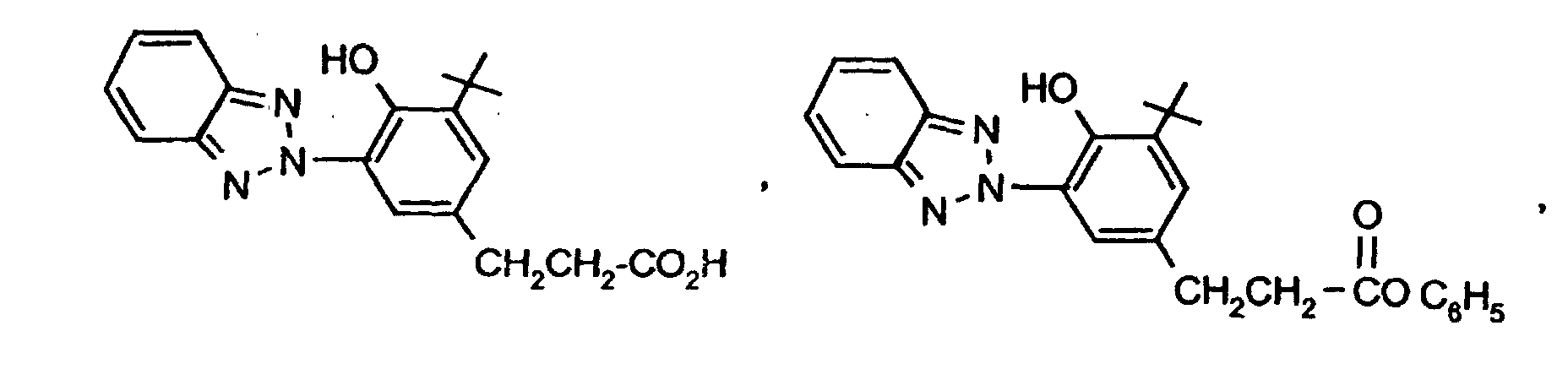
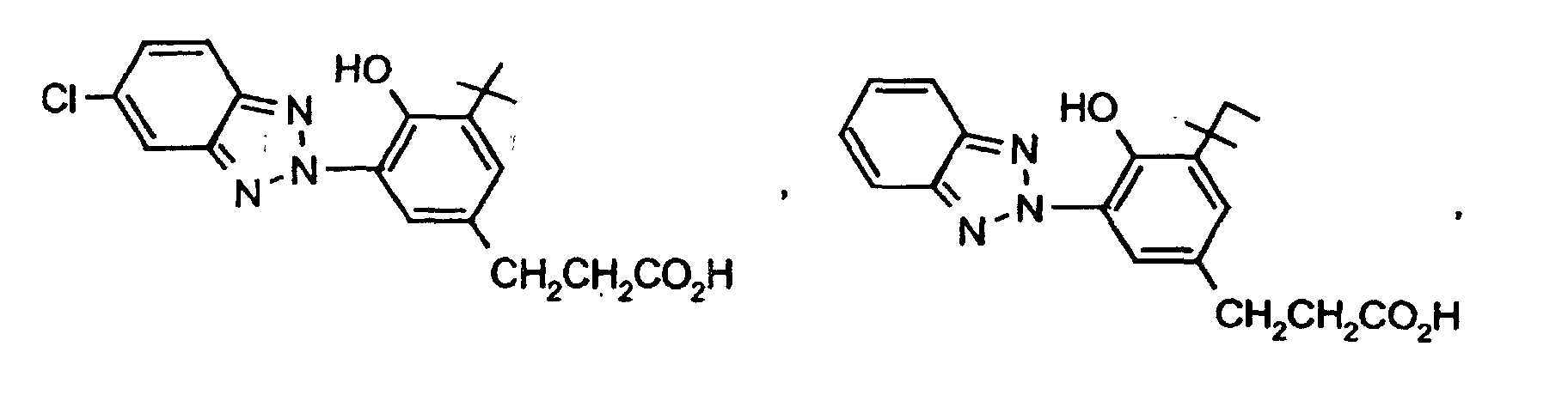
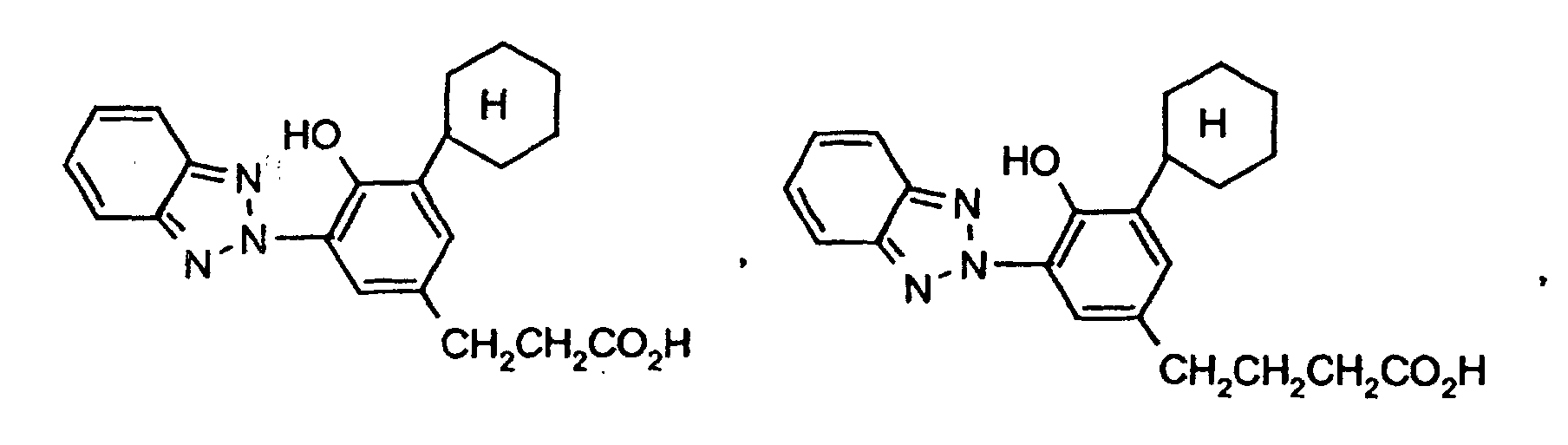


- -O-Z-O-
- ein Diphenolatrest mit 6 bis 30 C-Atomen ist,
- E und E'
- gleich oder verschieden sind und wobei mindestens einer der Reste E
und E' einem Rest der Formel (Ia)
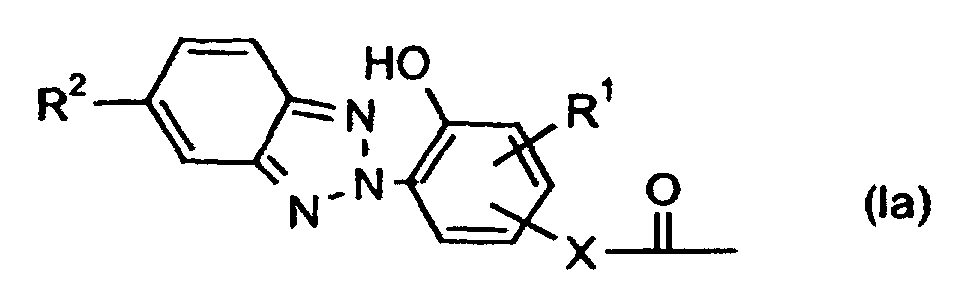
und wobei die übrigen Endgruppen E und E' aus der Reaktion mit den anderen, bekannten Kettenabbrechern, gegebenenfalls unter Einbeziehung von Phosgen resultieren und wobei "p" der Polymerisationsgrad ist, der aus den Molekulargewichten w von 1 500 bis 150 000 resultiert.

- R
- H, Halogen, niedriges Alkyl oder Alkoxy ist und ein Index "n" oder "m" 0 bis 16 und der andere jeweils 2 bis 16 ist,
- 1,1-Bis-(4-hydroxyphenyl)-3,3,5-trimethylcyclohexan,
- 1,1-Bis-(4-hydroxyphenyl)-3-methylcyclohexan,
- 1,1-Bis-(3,5-dimethyl-4-hydroxyphenyl)-4-methylcyclohexan.
- R
- für einen Alkyl oder Arylrest steht und
- n
- für eine ganze Zahl von 1-3.
- A1:
- 2-(2'-Hydroxy-3'-tert.-butyl-5'-(2-carboxyethyl)-phenyl)-benztriazol
Fp. 195°C (Herstellung analog EP 57.160, Bsp. 1) - A2:
- 2-(2'-Hydroxy-3'-tert.-butyl-5'-(2-phenoxycarbonylethyl)-phenyl)-benztriazol
- A3:
- 2-(2'-Hydroxy-3'-cyclohexyl-5'(3-carboxypropyl)-phenyl)-benztriazol
- (a) 132 g (0,75 mol) 2-Cyclohexylphenol werden in 800 ml trockenem Chlorbenzol gelöst. Dann gibt man bei 5-10°C 200 g (1,5 mol) AlCl3 hinzu und anschließend bei 0-10°C eine Lösung von 73,5 g (0,75 mol) Maleinsäureanhydrid in 400 ml Chlorbenzol. Nach 12 Stunden bei Raumtemperatur gießt man auf Eiswasser und säuert mit konz. HCl an. Man erhält 85 g eines gelben Pulvers mit dem Fp. 187-190°C.
- (b) 34,5 g (0,25 mol) o-Nitroanilin werden in 300 ml Wasser und 69 ml konz. HCl verrührt. Dann tropft man bei 5°C eine Lösung von 17,3 g (0,25 mol) Natriumnitrit in 155 ml Wasser hinzu. Diese Lösung wird anschließend bei 5°C zu einer Lösung von 68,5 g (0,25 mol) der Verbindung aus Stufe A3 (a) und 79,5 g (0,75 mol) Natriumcarbonat in 11 Wasser getropft. Man erhält 117 g eines braunen Feststoffs mit dem Fp. 155°C.
- (c) 42,5 g (0,1 mol) des Azofarbstoffes aus Stufe A 3 (b) werden mit 200 ml 2 n NaOH versetzt. Dann fügt man 50 g Zinkstaub hinzu und läßt innerhalb einer Stunde 80 ml 10 n NaOH zufließend, so dass die Temperatur unter 45°C bleibt. Anschließend erhitzt man vier Stunden auf 90°C, filtriert und säuert das Filtrat mit HCl an. Nach dem Umkristallisieren aus Cyclohexan resultieren 31 g 2-(2'-Hydroxy-3'-cyclohexyl-5'-(3-carboxypropyl)-phenyl)benztriazol als farblose Kristalle vom Fp. 165°C.
| 114,1 g | Bisphenol A |
| 5,12g | Verbindung A1 |
| 112,46 g | Diphenylcarbonat |
| 6,35 mg | Natriumphenolat |
| Platte mit Deckschicht aus Polycarbonat gemäß Beispiel B | Vergleich | ||
| Yellowness - Index | 0 h | 4,1 | 5,2 |
| 352 h | 9,4 | 9,3 | |
| Trübung (%) | 0 h | 2,6 | 2,7 |
| 352 h | 15,9 | 24,8 |
Claims (1)
- Verfahren zur Herstellung von aromatischen Polycarbonaten mit UV-Absorberendgruppen und mit mittleren Molekulargewichten Mw (Gewichtsmittel, ermittelt durch Lichtstreuung) zwischen 1 500 und 150 000, gegebenenfalls im Gemisch mit bekannten aromatischen Polycarbonaten mit Mw (Gewichtsmittel, ermittelt durch Lichtstreuung) zwischen 1 500 und 150 000 aus Diphenolen, 0,001 bis 1 Mol, pro Mol Diphenol, Kettenabbrecher, Kohlensäurespender und gegegebenenfalls Verzweiger nach den bekannten Polycarbonatherstellungsmethoden des Phasengrenzflächenverfahrens, des Verfahrens in homogener Lösung oder des Umesterungsverfahrens in der Schmelze, dadurch gekennzeichnet, dass man Kettenabbrecher der Formel (I)worin
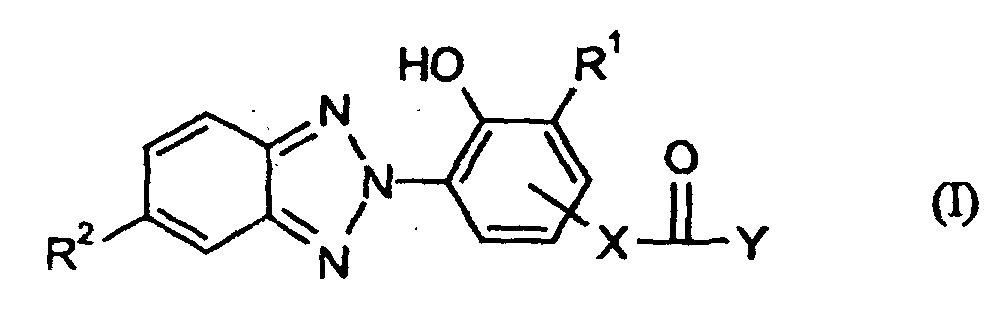
- R1
- H, C1-C18-Alkyl, C3-C6-Cycloalkyl und C6-C10-Aryl bedeutet,
- R2
- H, Cl und C1-C12-Alkyl bedeutet,
- X
- eine Einfachbindung, C1-C12-Alkylen, C5-C6-Cycloalkylen und C6-C10-Arylen bedeutet und
- Y
- ein unter den Reaktionsbedingungen der Polycarbonatherstellungsverfahren reaktiver Rest ist,
Applications Claiming Priority (2)
| Application Number | Priority Date | Filing Date | Title |
|---|---|---|---|
| DE4417748A DE4417748A1 (de) | 1994-05-20 | 1994-05-20 | UV-stabile Polycarbonate gegebenenfalls im Gemisch mit bekannten aromatischen Polycarbonaten, ihre Herstellung und ihre Verwendung |
| DE4417748 | 1994-05-20 |
Publications (3)
| Publication Number | Publication Date |
|---|---|
| EP0683192A2 EP0683192A2 (de) | 1995-11-22 |
| EP0683192A3 EP0683192A3 (de) | 1996-03-20 |
| EP0683192B1 true EP0683192B1 (de) | 2003-11-26 |
Family
ID=6518613
Family Applications (1)
| Application Number | Title | Priority Date | Filing Date |
|---|---|---|---|
| EP95106923A Expired - Lifetime EP0683192B1 (de) | 1994-05-20 | 1995-05-08 | Durch ihre Endgruppen UV-stabilisierte aromatische Polycarbonate |
Country Status (4)
| Country | Link |
|---|---|
| US (1) | US6831147B1 (de) |
| EP (1) | EP0683192B1 (de) |
| JP (1) | JP3329422B2 (de) |
| DE (2) | DE4417748A1 (de) |
Families Citing this family (8)
| Publication number | Priority date | Publication date | Assignee | Title |
|---|---|---|---|---|
| DE4444868A1 (de) * | 1994-12-16 | 1996-06-20 | Bayer Ag | UV-geschützte, mehrschichtige Polycarbonatplatten |
| US5523379A (en) * | 1994-12-21 | 1996-06-04 | General Electric Plastics | High molecular weight stabilizer compounds for stabilizing polymers |
| US20020086743A1 (en) * | 2000-10-06 | 2002-07-04 | Bulpett David A. | Urethane elastomers with improved color stability |
| JP4606660B2 (ja) * | 2001-07-17 | 2011-01-05 | Sabicイノベーティブプラスチックスジャパン合同会社 | ポリカーボネートの製造方法およびポリカーボネート製造装置 |
| WO2009027312A1 (de) * | 2007-08-28 | 2009-03-05 | Basf Se | Uv-stabilisierte polyalkylenterephtalate |
| US8669314B2 (en) | 2012-02-03 | 2014-03-11 | Sabic Innovative Plastics Ip B.V. | Hydrolytic stability in polycarbonate compositions |
| KR101690835B1 (ko) * | 2014-08-29 | 2016-12-28 | 주식회사 엘지화학 | 디올 단량체, 이의 폴리카보네이트 및 이를 포함하는 물품 |
| WO2025037568A1 (ja) * | 2023-08-15 | 2025-02-20 | 三菱瓦斯化学株式会社 | ポリカーボネート樹脂 |
Family Cites Families (13)
| Publication number | Priority date | Publication date | Assignee | Title |
|---|---|---|---|---|
| US3214436A (en) * | 1960-12-19 | 1965-10-26 | American Cyanamid Co | Benzotriazole compounds |
| JPS4999596A (de) * | 1973-01-25 | 1974-09-20 | ||
| US4260719A (en) * | 1980-03-17 | 1981-04-07 | General Electric Company | UV stabilized polycarbonate resins |
| DE3264154D1 (en) * | 1981-01-23 | 1985-07-25 | Ciba Geigy Ag | 2-(2-hydroxyphenyl)-benzotriazoles, their use as ultraviolet stabilizers and their preparation |
| JPH01201330A (ja) * | 1988-02-08 | 1989-08-14 | Mitsubishi Gas Chem Co Inc | 耐候性ポリカーボネート樹脂の製法 |
| US4948666A (en) * | 1988-04-22 | 1990-08-14 | Mobay Corporation | Stain resistant polycarbonate panels |
| JPH045291A (ja) * | 1990-04-23 | 1992-01-09 | Kuraray Co Ltd | ベンゾトリアゾール系化合物およびその用途 |
| US5086097A (en) * | 1991-01-07 | 1992-02-04 | Mobay Corporation | Ultraviolet stabilizer for polycarbonate compositions |
| US5503888A (en) * | 1992-06-19 | 1996-04-02 | Canon Kabushiki Kaisha | Optical recording medium, substrate for optical recording medium, and method for preparing substrate for optical recording medium |
| JP3263796B2 (ja) * | 1992-08-11 | 2002-03-11 | タキロン株式会社 | 樹脂成形品 |
| JP3324614B2 (ja) * | 1992-09-29 | 2002-09-17 | 三菱瓦斯化学株式会社 | コーポリカーボネート樹脂及びその製造法 |
| JP3166799B2 (ja) * | 1992-11-04 | 2001-05-14 | 出光石油化学株式会社 | ポリカーボネートの製造方法 |
| US5523379A (en) * | 1994-12-21 | 1996-06-04 | General Electric Plastics | High molecular weight stabilizer compounds for stabilizing polymers |
-
1994
- 1994-05-20 DE DE4417748A patent/DE4417748A1/de not_active Withdrawn
-
1995
- 1995-05-08 EP EP95106923A patent/EP0683192B1/de not_active Expired - Lifetime
- 1995-05-08 DE DE59510833T patent/DE59510833D1/de not_active Expired - Fee Related
- 1995-05-10 US US08/438,516 patent/US6831147B1/en not_active Expired - Fee Related
- 1995-05-16 JP JP14012195A patent/JP3329422B2/ja not_active Expired - Fee Related
Also Published As
| Publication number | Publication date |
|---|---|
| JPH08169946A (ja) | 1996-07-02 |
| DE59510833D1 (de) | 2004-01-08 |
| JP3329422B2 (ja) | 2002-09-30 |
| US6831147B1 (en) | 2004-12-14 |
| EP0683192A3 (de) | 1996-03-20 |
| EP0683192A2 (de) | 1995-11-22 |
| DE4417748A1 (de) | 1995-11-23 |
Similar Documents
| Publication | Publication Date | Title |
|---|---|---|
| EP0402678B1 (de) | Verwendung von Polycarbonatmischungen in der Optik | |
| DE69509952T2 (de) | Beschichtungen geeignet zur Absorption von Ultraviolettlicht | |
| EP1203042B1 (de) | Polycarbonat und dessen formkörper | |
| DE69914352T2 (de) | Witterungsbeständige blockcopolyestercarbonate und diese enthaltende polymerlegierungen | |
| DE3002762A1 (de) | Verfahren zur herstellung von heterocyclisch-aromatischen oligocarbonaten mit diphenolcarbonat-endgruppen und ihre verwendung zur herstellung von thermoplastischen, hochmolekularen heterocyclisch-aromatischen copolycarbonaten | |
| WO2008037364A1 (de) | Polycarbonate und copolycarbonate mit verbesserter metallhaftung | |
| EP0010602A1 (de) | Polycarbonate mit Alkylphenyl-Endgruppen und ihre Herstellung | |
| EP0006516A1 (de) | Verfahren zur Herstellung von aliphatisch-aromatischen Polycarbonaten mit Diphenolcarbonat-Endruppen, die nach dem Verfahren erhaltenen Polycarbonate und ihre Verwendung zur Herstellung von thermoplastisch verarbeitbaren, hochmolekularen, segmentierten, aliphatisch-aromatischen Polycarbonat-Elastomeren | |
| DE69515620T2 (de) | Hochmolekulare Stabilisatorzusammensetzungen zur Polymer-Stabilisation | |
| EP0709442B1 (de) | UV-geschützte, beschichtete Polycarbonatformkörper | |
| EP0683192A2 (de) | Durch ihre Endgruppen UV-stabilisierte aromatische Polycarbonate | |
| DE3308691A1 (de) | Willkuerlich verzweigtes polycarbonat aus einem bisphenol und einem polyolchlorformiat und verfahren zu seiner herstellung | |
| EP0201830A2 (de) | Verfahren zur Herstellung von Copolyphosphonaten mit hoher Kerbschlagzähigkeit | |
| EP0347682A2 (de) | Polycarbonate mit mesogenen Verbindungen als Endgruppen, ihre Herstellung und Verwendung | |
| DE4429697A1 (de) | Verfahren zur Herstellung von UV-stabilen Polycarbonaten | |
| EP0102573B1 (de) | Polycarbonate mit konjugierte Doppelbindungen enthaltenden Endgruppen, gegebenenfalls im Gemisch mit bekannten aromatischen Polycarbonaten, ihre Herstellung und ihre Verwendung | |
| EP0566952B1 (de) | Thermostabilisierung von aromatischen Polycarbonaten | |
| EP0432580B1 (de) | Zweistufen-Verfahren zur Herstellung von Polycarbonaten auf Basis von speziellen Dihydroxydiphenylalkanen | |
| EP0423562B1 (de) | Polycarbonate mit verbesserter Wärmeformbeständigkeit | |
| EP0327951B1 (de) | Polycarbonate mit Aralkylphenylendgruppen, ihre Herstellung und Verwendung | |
| DE3513715A1 (de) | Polycarbonate mit dichlormaleinimid-endgruppen, ihre herstellung und modifizierung | |
| EP0457102A2 (de) | tert.-Alkylester-Bisphenole, Verfahren zu ihrer Herstellung und ihre Verwendung | |
| EP0416404B1 (de) | UV-Absorberhaltige Polycarbonate | |
| DE60005169T2 (de) | Polycarbonatzusammensetzung mit verminderter streifenbildungstendenz | |
| DE3443091A1 (de) | Polycarbonate mit dimethylmaleinimid-endgruppen, gegebenenfalls im gemisch mit bekannten aromatischen polycarbonaten, ihre herstellung und modifizierung |
Legal Events
| Date | Code | Title | Description |
|---|---|---|---|
| PUAI | Public reference made under article 153(3) epc to a published international application that has entered the european phase |
Free format text: ORIGINAL CODE: 0009012 |
|
| AK | Designated contracting states |
Kind code of ref document: A2 Designated state(s): BE CH DE FR GB IT LI NL |
|
| PUAL | Search report despatched |
Free format text: ORIGINAL CODE: 0009013 |
|
| AK | Designated contracting states |
Kind code of ref document: A3 Designated state(s): BE CH DE FR GB IT LI NL |
|
| 17P | Request for examination filed |
Effective date: 19960823 |
|
| 17Q | First examination report despatched |
Effective date: 19970901 |
|
| APAB | Appeal dossier modified |
Free format text: ORIGINAL CODE: EPIDOS NOAPE |
|
| APAD | Appeal reference recorded |
Free format text: ORIGINAL CODE: EPIDOS REFNE |
|
| APCB | Communication from the board of appeal sent |
Free format text: ORIGINAL CODE: EPIDOS OBAPE |
|
| APCB | Communication from the board of appeal sent |
Free format text: ORIGINAL CODE: EPIDOS OBAPE |
|
| APAB | Appeal dossier modified |
Free format text: ORIGINAL CODE: EPIDOS NOAPE |
|
| GRAH | Despatch of communication of intention to grant a patent |
Free format text: ORIGINAL CODE: EPIDOS IGRA |
|
| GRAS | Grant fee paid |
Free format text: ORIGINAL CODE: EPIDOSNIGR3 |
|
| GRAA | (expected) grant |
Free format text: ORIGINAL CODE: 0009210 |
|
| AK | Designated contracting states |
Kind code of ref document: B1 Designated state(s): BE CH DE FR GB IT LI NL |
|
| PG25 | Lapsed in a contracting state [announced via postgrant information from national office to epo] |
Ref country code: IT Free format text: LAPSE BECAUSE OF FAILURE TO SUBMIT A TRANSLATION OF THE DESCRIPTION OR TO PAY THE FEE WITHIN THE PRE;WARNING: LAPSES OF ITALIAN PATENTS WITH EFFECTIVE DATE BEFORE 2007 MAY HAVE OCCURRED AT ANY TIME BEFORE 2007. THE CORRECT EFFECTIVE DATE MAY BE DIFFERENT FROM THE ONE RECORDED.SCRIBED TIME-LIMIT Effective date: 20031126 Ref country code: GB Free format text: LAPSE BECAUSE OF FAILURE TO SUBMIT A TRANSLATION OF THE DESCRIPTION OR TO PAY THE FEE WITHIN THE PRESCRIBED TIME-LIMIT Effective date: 20031126 Ref country code: FR Free format text: LAPSE BECAUSE OF FAILURE TO SUBMIT A TRANSLATION OF THE DESCRIPTION OR TO PAY THE FEE WITHIN THE PRESCRIBED TIME-LIMIT Effective date: 20031126 |
|
| REG | Reference to a national code |
Ref country code: GB Ref legal event code: FG4D Free format text: NOT ENGLISH |
|
| REG | Reference to a national code |
Ref country code: CH Ref legal event code: EP |
|
| REG | Reference to a national code |
Ref country code: CH Ref legal event code: NV Representative=s name: DR. R.C. SALGO EUROPEAN PATENT ATTORNEY |
|
| REF | Corresponds to: |
Ref document number: 59510833 Country of ref document: DE Date of ref document: 20040108 Kind code of ref document: P |
|
| PGFP | Annual fee paid to national office [announced via postgrant information from national office to epo] |
Ref country code: CH Payment date: 20040505 Year of fee payment: 10 |
|
| GBV | Gb: ep patent (uk) treated as always having been void in accordance with gb section 77(7)/1977 [no translation filed] |
Effective date: 20031126 |
|
| PGFP | Annual fee paid to national office [announced via postgrant information from national office to epo] |
Ref country code: BE Payment date: 20040526 Year of fee payment: 10 |
|
| PGFP | Annual fee paid to national office [announced via postgrant information from national office to epo] |
Ref country code: NL Payment date: 20040528 Year of fee payment: 10 |
|
| PLBE | No opposition filed within time limit |
Free format text: ORIGINAL CODE: 0009261 |
|
| STAA | Information on the status of an ep patent application or granted ep patent |
Free format text: STATUS: NO OPPOSITION FILED WITHIN TIME LIMIT |
|
| 26N | No opposition filed |
Effective date: 20040827 |
|
| EN | Fr: translation not filed | ||
| PG25 | Lapsed in a contracting state [announced via postgrant information from national office to epo] |
Ref country code: LI Free format text: LAPSE BECAUSE OF NON-PAYMENT OF DUE FEES Effective date: 20050531 Ref country code: CH Free format text: LAPSE BECAUSE OF NON-PAYMENT OF DUE FEES Effective date: 20050531 Ref country code: BE Free format text: LAPSE BECAUSE OF NON-PAYMENT OF DUE FEES Effective date: 20050531 |
|
| APAH | Appeal reference modified |
Free format text: ORIGINAL CODE: EPIDOSCREFNO |
|
| BERE | Be: lapsed |
Owner name: *BAYER A.G. Effective date: 20050531 |
|
| PG25 | Lapsed in a contracting state [announced via postgrant information from national office to epo] |
Ref country code: NL Free format text: LAPSE BECAUSE OF NON-PAYMENT OF DUE FEES Effective date: 20051201 |
|
| REG | Reference to a national code |
Ref country code: CH Ref legal event code: PL |
|
| NLV4 | Nl: lapsed or anulled due to non-payment of the annual fee |
Effective date: 20051201 |
|
| PGFP | Annual fee paid to national office [announced via postgrant information from national office to epo] |
Ref country code: DE Payment date: 20060428 Year of fee payment: 12 |
|
| BERE | Be: lapsed |
Owner name: *BAYER A.G. Effective date: 20050531 |
|
| PG25 | Lapsed in a contracting state [announced via postgrant information from national office to epo] |
Ref country code: DE Free format text: LAPSE BECAUSE OF NON-PAYMENT OF DUE FEES Effective date: 20071201 |