EP0685580B1 - Procédé et dispositif pour déterminer les causes de défauts des fils, mèches et rubans de fibres - Google Patents
Procédé et dispositif pour déterminer les causes de défauts des fils, mèches et rubans de fibres Download PDFInfo
- Publication number
- EP0685580B1 EP0685580B1 EP95107638A EP95107638A EP0685580B1 EP 0685580 B1 EP0685580 B1 EP 0685580B1 EP 95107638 A EP95107638 A EP 95107638A EP 95107638 A EP95107638 A EP 95107638A EP 0685580 B1 EP0685580 B1 EP 0685580B1
- Authority
- EP
- European Patent Office
- Prior art keywords
- pattern
- faults
- fault
- determined
- errors
- Prior art date
- Legal status (The legal status is an assumption and is not a legal conclusion. Google has not performed a legal analysis and makes no representation as to the accuracy of the status listed.)
- Revoked
Links
- 238000000034 method Methods 0.000 title claims description 26
- 238000004519 manufacturing process Methods 0.000 claims description 41
- 238000003909 pattern recognition Methods 0.000 claims description 4
- 239000000463 material Substances 0.000 claims description 2
- 238000009987 spinning Methods 0.000 description 22
- 230000007547 defect Effects 0.000 description 12
- 238000011156 evaluation Methods 0.000 description 10
- 238000009826 distribution Methods 0.000 description 9
- 239000002994 raw material Substances 0.000 description 4
- 238000012360 testing method Methods 0.000 description 4
- 238000003745 diagnosis Methods 0.000 description 3
- 238000007383 open-end spinning Methods 0.000 description 3
- 239000004753 textile Substances 0.000 description 3
- 239000003086 colorant Substances 0.000 description 2
- 230000000694 effects Effects 0.000 description 2
- 230000000737 periodic effect Effects 0.000 description 2
- 229920000742 Cotton Polymers 0.000 description 1
- 244000299507 Gossypium hirsutum Species 0.000 description 1
- 238000013528 artificial neural network Methods 0.000 description 1
- 230000000712 assembly Effects 0.000 description 1
- 238000000429 assembly Methods 0.000 description 1
- 230000015556 catabolic process Effects 0.000 description 1
- 238000004140 cleaning Methods 0.000 description 1
- 238000005520 cutting process Methods 0.000 description 1
- 238000013500 data storage Methods 0.000 description 1
- 230000007812 deficiency Effects 0.000 description 1
- 238000013461 design Methods 0.000 description 1
- 238000001514 detection method Methods 0.000 description 1
- 238000010586 diagram Methods 0.000 description 1
- 238000007689 inspection Methods 0.000 description 1
- 239000000543 intermediate Substances 0.000 description 1
- 238000011835 investigation Methods 0.000 description 1
- 230000007257 malfunction Effects 0.000 description 1
- 238000012544 monitoring process Methods 0.000 description 1
- 230000001151 other effect Effects 0.000 description 1
- 238000012545 processing Methods 0.000 description 1
- 238000007378 ring spinning Methods 0.000 description 1
- 239000000523 sample Substances 0.000 description 1
- 239000007858 starting material Substances 0.000 description 1
- 230000008719 thickening Effects 0.000 description 1
- 238000011144 upstream manufacturing Methods 0.000 description 1
Images


Classifications
-
- G—PHYSICS
- G01—MEASURING; TESTING
- G01N—INVESTIGATING OR ANALYSING MATERIALS BY DETERMINING THEIR CHEMICAL OR PHYSICAL PROPERTIES
- G01N33/00—Investigating or analysing materials by specific methods not covered by groups G01N1/00 - G01N31/00
- G01N33/36—Textiles
- G01N33/365—Filiform textiles, e.g. yarns
-
- D—TEXTILES; PAPER
- D01—NATURAL OR MAN-MADE THREADS OR FIBRES; SPINNING
- D01H—SPINNING OR TWISTING
- D01H13/00—Other common constructional features, details or accessories
- D01H13/14—Warning or safety devices, e.g. automatic fault detectors, stop motions ; Monitoring the entanglement of slivers in drafting arrangements
- D01H13/22—Warning or safety devices, e.g. automatic fault detectors, stop motions ; Monitoring the entanglement of slivers in drafting arrangements responsive to presence of irregularities in running material
-
- D—TEXTILES; PAPER
- D01—NATURAL OR MAN-MADE THREADS OR FIBRES; SPINNING
- D01H—SPINNING OR TWISTING
- D01H13/00—Other common constructional features, details or accessories
- D01H13/32—Counting, measuring, recording or registering devices
-
- B—PERFORMING OPERATIONS; TRANSPORTING
- B65—CONVEYING; PACKING; STORING; HANDLING THIN OR FILAMENTARY MATERIAL
- B65H—HANDLING THIN OR FILAMENTARY MATERIAL, e.g. SHEETS, WEBS, CABLES
- B65H2557/00—Means for control not provided for in groups B65H2551/00 - B65H2555/00
- B65H2557/60—Details of processes or procedures
- B65H2557/65—Details of processes or procedures for diagnosing
Definitions
- the invention relates to a method and an apparatus for Determination of production-related causes for defects in yarns Rovings and tapes.
- the invention thus has aiming to remedy the deficiencies mentioned and a procedure and to create a device that allows errors in the products mentioned, the causes of which are particularly simple Art to determine if these causes in the production process lie.
- the invention thus consists in that
- the first step is to detect the defects in the product with a sensor, which means it is recognized become. They are recognized by the measured values of the product exceed one or more threshold values.
- a parameter pair e.g. in the case of a yarn, the cross-section and the length of an error are decisive.
- the values for these two parameters can be in one rectangular coordinate system with defect length and defect cross section are entered as the abscissa or ordinate. This way "Classification field" formed can be divided into a grid of length or Cross-sectional classes can be divided.
- the determined values of the detected errors are automatically assigned to the specified classes, resulting in an error pattern or characteristic results.
- This error pattern is modeled with predefined Comparing reference patterns that point to causes for the let recorded errors close.
- the specified reference patterns can be determined by previous investigations or come from experience.
- the errors are recorded in a manner known per se for Yarn for example in a yarn cleaning system, which is preferred "on-line" works and several spinning stations, for example a rotor spinning machine, monitored.
- An example a classification system for errors is from the Swiss patent No. 477,573 known. Reference values or threshold values, the limits for the identification and classification of Specifying errors are empirically based on special user needs determined.
- the errors are automatically assigned to the individual classes in a manner known per se assigned and counted for the individual classes. That included
- the resulting error pattern can be displayed graphically and also be interpreted graphically to indicate a cause of error conclude.
- the error pattern can also be found in a digital Memory from which a computer obtains the values and relate to each other accordingly can, as can be done through human interpretation on the basis of graphically represented patterns.
- the method according to the invention and the device according to the invention have significant advantages. This can cause errors both in a laboratory, by examining samples or directly in the production process by examining the entire production quantity be determined.
- the source of the error can be without disturbing Intervention in the production of the product are sought, which means that even small, otherwise neglected causes of errors can be recognized or that the gradual emergence of such causes of error from an early stage and can be tracked.
- Relative are sufficient as reference values few reference values.
- the comparison between the determined values from the production and the reference values done by humans or by a computer for what even simple computers are sufficient.
- the invention also allows it to record non-periodic defects in a product and their To find causes.
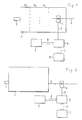
- Figure 1 shows a production device 1 for a product such as a yarn, roving or ribbon.
- the production device 1 can be used as a spinning machine, flyer, card, Route, combing machine, etc., in the starting from known intermediates 3, such as. B. cotton fibers etc. yarn, or a yarn is made from a ribbon.
- the production device 1 has a sensor 4 known per se, which here, for example, as a means of detecting errors in serves a yarn. This allows certain properties of the yarn 2 are recorded.
- the sensor 4 outputs a line 5 electrical signals to an evaluation unit 6 known per se from.
- Sensor 4 and evaluation unit 6 are part of one, for example known yarn cleaner and thus form both a part a means for detecting the errors as well as a means for Classify the mistakes.
- the evaluation unit 6 and the computing unit 9 form together a means of counting and classifying the errors, as well as a Means for deriving and creating an error pattern or reference pattern.
- the arithmetic unit 9 has a program for this provided, which is created according to the information given below can be.
- the data input and output unit 7 can also Include means for displaying images such as a screen. It is also to be understood in such a way that the computing unit 9 has a memory comprises, in which predetermined reference patterns can be stored.
- Figure 2 shows a device as in principle from the Figure 1 shows, but with the difference that the sensor 4th outside the production machine 1 and not necessarily is arranged in the production line.
- the same elements are therefore provided with the same reference numerals as in Figure 1.
- the arrangement according to FIG. 2 is therefore also suitable for implementation a production process in which the product from the Process removed and examined in a separate laboratory becomes. This can be done in particular by taking samples happen.
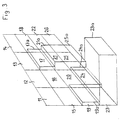
- Figure 3 shows a simplified representation of a so-called well known USTER CLASSIMAT table like the one in the above Swiss Patent No. 477,573 (Fig. 5) in more detail is shown.
- a simplification here is that only sixteen fields are shown, with reference numerals 11 to 26 are provided. Each of these sixteen fields defines for a yarn a type of error, which is determined by a certain length and characterized a certain deviation from the mean cross-section is. Each of the fields mentioned corresponds to a class of possible yarn defects and all fields together result in this Classification field. Above those labeled 17, 19, 21, 23, 24 and 25 Fields are bars 17a, 19a, 21a, 23a, 24a and 25a plotted, the height or length of each measured a number Corresponds to errors in the relevant class.
- FIG. 4a shows a class division as shown in FIG. 3 is already known, but with the counts instead of bars are represented by patterns or colors.
- Figure 4b shows an associated table that specifies which counter values which Patterns or colors can be assigned. This for the same error pattern, which is already shown in Figure 3.
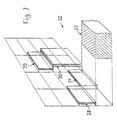
- FIG. 6 shows count values for the fields or classes 19, 23 and 26 in the known representation. These in turn point to one other cause of the errors.
- Figure 7 shows an illustration corresponding to that of Figure 3 where ranges 27, 28, 29, 30 and 31 are given for indicate a specific cause of failure in which areas the count values of the individual classes must be on this particular expected cause can be inferred.
- Figures 3, 5 and 6 show three different Characteristics or error patterns with surveys and Reduce.
- the three-dimensional error pattern is off Figure 3 implemented in a two-dimensional error pattern or image.
- Figure 6 shows an error pattern that is typical arises when a take-off roller is faulty.
- Figure 5 shows an error pattern that occurs from a yarn comes that is considered to be error-free, or just such errors contains that indicate no error in the production process.
- the characteristic shown here consists of the count values which are assigned to the fields forms a reference for the characteristics shown in Figures 3, 6 and 7 are. Because there are always several spinning positions in one spinning machine the others can also work in parallel with each other Spinning stations give the desired reference sizes or it can even average values from waiting at all spinning positions to derive the reference values for error-free yarn. This can be seen, for example, from FIG. 9.
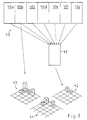
- Figure 9 shows a schematic representation of a production machine 40, which is designed here, for example, as a spinning machine is, and the many working in parallel and among themselves same elements, here having spinning positions 40a to 40g, which are fed with the same type of material.
- Any spinning station provides a yarn with as possible in a manner known per se same properties as for example an average spinning station 41 could be delivered, which is representative here for the sum of the real spinning positions 40a and so on is.
- the average spinning station 41 provides yarn that an error pattern results from the error check, as is the case with 42 is designated. Error pattern 42 shows permissible number of errors in the classes and corresponds approximately to that of Fig. 5.
- Zu a spinning station also has this average error pattern 40b contributed that produces yarn with more defects like this is to be indicated with the error pattern 43.
- the difference or the difference between the two error patterns 43 and 42 results in a further error pattern 44.
- the cause of the error in the spinning station 40b can now be thought of Error pattern 43 or proceed from the further error pattern 44 and one of these error patterns 43, 44 with a predetermined reference pattern to compare.
- the reference pattern is these error patterns very similar, ideally identical. So it shows in the same fields a comparable or in the error patterns 43, 44 exceeded number of errors.
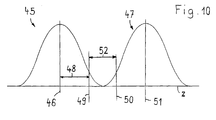
- FIG. 10 shows a representation of frequency distributions, such as they can occur for count values of errors.
- Z is one Axis on which count values are plotted. Perpendicular the numbers for such count values are plotted above them indicate how often such counts have been counted.
- a distribution 45 which is placed around a count value 46, thus indicates that the count 46 is the most common count, but next to it other larger and smaller counts can also be counted could.
- the distribution 45 belongs to the classification field of a reference pattern, while 47 denotes a distribution which is related to belongs to the same classification field of the error pattern.
- At a distance 48 from the count towards increasing values is a limit specified, determined according to certain and selectable criteria and is referred to below as the upper confidence limit 49 becomes.
- a production apparatus is first used for the method according to the invention mentally divided into parts 1a, 1b, 1c etc., in which there are errors, signs of wear, pollution or want to track down other effects that lead to loss of quality result in product 2. Then through a series of tests determines which characteristic fault patterns or fault patterns arise if one of the relevant parts 1a, 1b, 1c, etc. has undergone undesirable changes. To do this the sensor 4 detects the defects in the product 2 and in the Evaluation unit 6 compared with limit values or with value ranges, that correspond to the classification. For every class of Classification, i.e. for each field 11 to 26 from FIGS. 3, 4, 5, 6 or 7, those errors in the produced product are now counted, which are classified as errors according to the classification.
- a first option is to count such error patterns subtract from the count values of the other error patterns, as described for FIG. 9. This procedure is then justified, if such insignificant mistakes already with the Creating the reference pattern deducted from the significant errors were. The error patterns thus obtained always concern significant mistakes.
- count values 51 now becomes the lower confidence limit 50 determined. This lies in a more or less large one Distance (measured in counts) below the actual count.
- a method for this is for example from EP-A-03659-01 known.
- the limit values as shown in FIG. 6, for example, with lines 19b, 23b and 26b are shown as lower confidence limits in the sense of Fig. 10 are understood. To these lower limits of trust then the count values mentioned can also be used with a tolerance range be supplemented. This creates areas 27 to 31 like they are shown in Figure 7 and thus also a characteristic Error pattern that is displayed in unit 7 or in Computer 9 can be saved.
- All evaluations associated with the above procedure are carried out in the computing unit 9 in the program memory contains corresponding programs and the measured values from the evaluation unit 6 or its data storage.
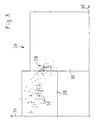
- FIG. 8 shows a classification with infinity fine resolution, i.e. the individual fields that make up a class form are infinitely small, or, in other words, it there are an infinite number of classes here.
- On an axis 33 for example Values for the length of the errors plotted while on an axis 34 the increases in the cross section of a yarn, that make up the mistake are plotted.
- the single ones Points 35 thus give a measured error with its length and its cross section. Because from the individual points 35 not shows whether one or more errors with these parameters the errors are not counted.
- Such a similarity analysis between an error pattern and a reference pattern can either be with binary information only or can also be carried out with discrete values.
- any error pattern and each reference pattern can be seen as a symbol.
- the Error pattern should now be with the reference pattern by known Compared means of symbol recognition, i.e. for agreement being checked. There are many known methods for this.
- the method according to the invention can also be carried out in a subsequent one Production stage to be carried out to errors in the previous Find production level. For example, for Yarns are carried out in the bobbin to address the causes of Find errors in the upstream ring spinning stages.
- errors can be caused by the raw material used caused and errors caused by the production process caused to occur together. This can be done with the help of the present invention are kept apart because the Machine errors always produce characteristic error patterns. These can be distorted by the raw material errors Machine errors always result in recognizable error patterns. At It can therefore be advantageous to run production processes in parallel his error pattern, which indicate inadmissible errors, in a first selection step by separating them with an average error pattern that compares permissible errors averaged across all production processes. Only deviating error patterns have to be included specified reference pattern are compared.
Landscapes
- Engineering & Computer Science (AREA)
- Textile Engineering (AREA)
- Mechanical Engineering (AREA)
- Health & Medical Sciences (AREA)
- Life Sciences & Earth Sciences (AREA)
- Chemical & Material Sciences (AREA)
- Physics & Mathematics (AREA)
- Medicinal Chemistry (AREA)
- Food Science & Technology (AREA)
- Analytical Chemistry (AREA)
- Biochemistry (AREA)
- General Health & Medical Sciences (AREA)
- General Physics & Mathematics (AREA)
- Immunology (AREA)
- Pathology (AREA)
- Treatment Of Fiber Materials (AREA)
- Spinning Or Twisting Of Yarns (AREA)
- Filamentary Materials, Packages, And Safety Devices Therefor (AREA)
Claims (10)
- Procédé pour la mise à disposition de donnée pour déterminer les causes dues à la production de défauts dans des fils, mèches de préparation et rubans (2), caractérisé en ce que les défauts sont détectés selon au moins un paramètre avec un capteur (4), que les paramètres sont utilisés pour l'attribution automatique des défauts à des classes et en ce qu'il est déduit des défauts détectés et attribués aux classes un dessin défectueux (32) qui établit un rapport à la cause du défaut dû à la production.
- Procédé selon la revendication 1, caractérisé en ce que le dessin défectueux représente une quantité de défauts comptés et attribués aux classes, sur plusieurs classes (23, 24).
- Procédé selon la revendication 1, caractérisé en ce qu'on obtient dans des dispositifs de production de même type travaillant parallèlement les uns aux autres (40a, 40b, 40c), qui sont alimentés avec le même matériau, respectivement un modèle de défaut (32, 43) pour chaque dispositif de production, en ce que chaque modèle de défaut est comparé avec un modèle de référence commun et en ce qu'il est déterminé à partir de cette comparaison une cause de défaut.
- Procédé selon la revendication 3, caractérisé en ce qu'il est établi à partir des modèles de défaut de chaque dispositif de production un modèle de défaut moyen (42), en ce que chaque modèle de défaut individuel est comparé avec le modèle de défaut moyen, que dans chaque modèle de défaut, un écart significatif relativement au modèle de défaut moyen est recherché et en ce que, à partir du modèle de défaut (44) présentant un écart significative il est déterminé la cause du défaut.
- Procédé selon la revendication 1 ou 3, caractérisé en ce que le rapport à la cause est établi à l'aide d'un procédé de détection de modèle.
- Procédé selon la revendication 3, caractérisé en ce que pour chaque classe on donne des consignes (19b, 23b, 26b) qui mettent les valeurs comptées en rapport avec la quantité du fil examiné.
- Dispositif pour la mise à disposition de données pour déterminer des causes dues à la production de défauts dama des fils, mèches de préparation et rubans, caractérisé par un capteur (4) pour détecter l'étendue de défauts individuels, par un moyen (7, 8) pour classer automatiquement les défauts détectés et par un moyen (8, 9) pour en déduire et établir un modèle de défauts à partir des défauts comptés et classés.
- Dispositif selon la revendication 7, caractérisé par un moyen (6, 9) pour compter les défauts détectée.
- Dispositif selon la revendication 7, caractérisé en outre par un moyen pour le stockage (9) de modèles de défauts prédéterminés et pour la comparaison (6) d'un modèle de référence prédéterminé avec un modèle de defauts déterminé actuellement.
- Dispositif selon la revendication 7, caractérisé en ce qu'il est prévu une installation pour la détection des modèles, comme moyen (6, 7, 8, 9, 10) pour la dérivation et l'établissement d'un modèle de défauts à partir des défauts comptés et classifiés.
Applications Claiming Priority (3)
| Application Number | Priority Date | Filing Date | Title |
|---|---|---|---|
| CH1727/94 | 1994-06-02 | ||
| CH172794 | 1994-06-02 | ||
| CH172794 | 1994-06-02 |
Publications (2)
| Publication Number | Publication Date |
|---|---|
| EP0685580A1 EP0685580A1 (fr) | 1995-12-06 |
| EP0685580B1 true EP0685580B1 (fr) | 2000-03-15 |
Family
ID=4217194
Family Applications (1)
| Application Number | Title | Priority Date | Filing Date |
|---|---|---|---|
| EP95107638A Revoked EP0685580B1 (fr) | 1994-06-02 | 1995-05-19 | Procédé et dispositif pour déterminer les causes de défauts des fils, mèches et rubans de fibres |
Country Status (4)
| Country | Link |
|---|---|
| US (1) | US5834639A (fr) |
| EP (1) | EP0685580B1 (fr) |
| JP (1) | JPH0881841A (fr) |
| DE (1) | DE59507981D1 (fr) |
Cited By (3)
| Publication number | Priority date | Publication date | Assignee | Title |
|---|---|---|---|---|
| WO2012022441A1 (fr) | 2010-08-20 | 2012-02-23 | Oerlikon Textile Gmbh & Co. Kg | Machine textile |
| DE102021001348A1 (de) | 2021-03-13 | 2022-09-15 | Oerlikon Textile Gmbh & Co. Kg | Verfahren zur Überwachung eines Herstellungsprozesses eines synthetischen Fadens |
| WO2025054744A1 (fr) * | 2023-09-11 | 2025-03-20 | Uster Technologies Ag | Procédé et dispositif de classification d'un événement dans une éprouvette textile allongée |
Families Citing this family (20)
| Publication number | Priority date | Publication date | Assignee | Title |
|---|---|---|---|---|
| CN1080334C (zh) * | 1996-03-27 | 2002-03-06 | 泽韦格路瓦有限公司 | 用于纱线的质量监控的方法和装置 |
| EP0877108B1 (fr) * | 1997-04-23 | 2003-07-16 | Uster Technologies AG | Procédé et dispositif pour nettoyer des fils |
| DE59805881D1 (de) * | 1997-07-25 | 2002-11-14 | Zellweger Luwa Ag Uster | Verfahren zur Darstellung von Eigenschaften von langgestreckten textilen Prüfkörpern |
| US6987867B1 (en) * | 1997-09-15 | 2006-01-17 | Uster Technologies Ag | Process for evaluating data from textile fabrics |
| DE19855588A1 (de) * | 1998-12-02 | 2000-06-08 | Schlafhorst & Co W | Verfahren und Vorrichtung zur Auswertung der Wirkung von Garneigenschaften auf das Aussehen textiler Flächengebilde |
| DE10118660A1 (de) † | 2001-04-14 | 2002-10-17 | Schlafhorst & Co W | Garnreinigungseinrichtung an der Spulstelle einer Textilmaschine |
| DE102007028651A1 (de) * | 2007-06-21 | 2008-12-24 | Oerlikon Textile Gmbh & Co. Kg | Verfahren zur Visualisierung der Häufigkeitsverteilung von Garnfehlern |
| CH700209A1 (de) * | 2009-01-07 | 2010-07-15 | Uster Technologies Ag | Verfahren und vorrichtung zur charakterisierung eines länglichen textilen prüfguts. |
| CH703067A1 (de) * | 2010-04-28 | 2011-10-31 | Uster Technologies Ag | Verfahren und vorrichtung zur prüfung von regelmässigen ereignissen in einem länglichen textilen prüfgut. |
| US20130346007A1 (en) * | 2011-03-06 | 2013-12-26 | Uster Technologies, Ag | Characterizing an Elongated Textile Test Material |
| DE102012102576A1 (de) * | 2012-03-26 | 2013-09-26 | Maschinenfabrik Rieter Ag | Verfahren zur Garnüberwachung |
| JP2015525347A (ja) * | 2012-06-11 | 2015-09-03 | ウステル・テヒノロジーズ・アクチエンゲゼルシヤフト | 長繊維の試験材の品質の比較 |
| WO2013185245A1 (fr) | 2012-06-11 | 2013-12-19 | Uster Technologies Ag | Caractérisation d'événements survenant à intervalles réguliers dans un produit textile de forme allongée soumis à un essai |
| WO2016033328A1 (fr) * | 2014-08-27 | 2016-03-03 | North Carolina State University | Codage binaire de capteurs dans des structures textiles |
| CN113396252B (zh) * | 2019-01-31 | 2024-03-15 | 乌斯特技术股份公司 | 针对异物优化纺纱过程 |
| FR3097565B1 (fr) * | 2019-06-19 | 2022-08-12 | Staubli Sa Ets | Machine textile, métier à tisser comportant une telle machine textile et procédés associés |
| ES2917375T3 (es) | 2020-04-30 | 2022-07-08 | Rieter Ag Maschf | Dispositivo y método para detectar una falla en una hiladora y para estimar una o más fuentes de la falla |
| CN117966313B (zh) * | 2024-03-28 | 2024-06-07 | 四川中兴纺织有限责任公司 | 一种纺织设备监控系统及方法 |
| CN118505068B (zh) * | 2024-07-18 | 2024-10-01 | 徐州美亚纺织有限公司 | 一种纺织纱线生产监测调控方法 |
| CN120352606A (zh) * | 2025-04-03 | 2025-07-22 | 高邮市经纬纺织有限公司 | 一种新材料纱线质量检测系统 |
Family Cites Families (7)
| Publication number | Priority date | Publication date | Assignee | Title |
|---|---|---|---|---|
| CH477573A (de) | 1967-10-03 | 1969-08-31 | Zellweger Uster Ag | Vorrichtung für Garnreiniger |
| DE2605736C3 (de) * | 1976-02-13 | 1981-07-30 | Schubert & Salzer Maschinenfabrik Ag, 8070 Ingolstadt | Verfahren und Vorrichtung zum Erkennen des fehlerhaften Arbeitens von Spinnaggregaten von Offen-End-Spinnmaschinen |
| CH598374A5 (fr) * | 1976-03-22 | 1978-04-28 | Zellweger Uster Ag | |
| US5119308A (en) * | 1988-08-26 | 1992-06-02 | Murata Kikai Kabushiki Kaisha | Control system for spinning machine |
| CH681077A5 (fr) | 1988-10-25 | 1993-01-15 | Zellweger Uster Ag | |
| CH687110A5 (de) * | 1991-09-10 | 1996-09-13 | Luwa Ag Zellweger | Verfahren zur Erstellung einer Stoerungsdiagnose an Produktionsmaschinen und Anwendung des Verfahrens an Textilmaschinen. |
| JP2611611B2 (ja) * | 1992-10-16 | 1997-05-21 | 村田機械株式会社 | 糸ムラ情報解析装置 |
-
1995
- 1995-04-20 JP JP7130935A patent/JPH0881841A/ja active Pending
- 1995-05-19 EP EP95107638A patent/EP0685580B1/fr not_active Revoked
- 1995-05-19 DE DE59507981T patent/DE59507981D1/de not_active Revoked
- 1995-06-02 US US08/460,822 patent/US5834639A/en not_active Expired - Fee Related
Cited By (4)
| Publication number | Priority date | Publication date | Assignee | Title |
|---|---|---|---|---|
| WO2012022441A1 (fr) | 2010-08-20 | 2012-02-23 | Oerlikon Textile Gmbh & Co. Kg | Machine textile |
| DE102021001348A1 (de) | 2021-03-13 | 2022-09-15 | Oerlikon Textile Gmbh & Co. Kg | Verfahren zur Überwachung eines Herstellungsprozesses eines synthetischen Fadens |
| WO2025054744A1 (fr) * | 2023-09-11 | 2025-03-20 | Uster Technologies Ag | Procédé et dispositif de classification d'un événement dans une éprouvette textile allongée |
| CH721119A1 (de) * | 2023-09-11 | 2025-03-31 | Uster Technologies Ag | Verfahren und Vorrichtung zum Klassieren eines Ereignisses in einem länglichen textilen Prüfgut |
Also Published As
| Publication number | Publication date |
|---|---|
| US5834639A (en) | 1998-11-10 |
| DE59507981D1 (de) | 2000-04-20 |
| JPH0881841A (ja) | 1996-03-26 |
| EP0685580A1 (fr) | 1995-12-06 |
Similar Documents
| Publication | Publication Date | Title |
|---|---|---|
| EP0685580A1 (fr) | Procédé et dispositif pour déterminer les causes de défauts des fils, mèches et rubans de fibres | |
| EP0531894B1 (fr) | Méthode et appareil pour la classification et le nettoyage des fils | |
| DE69124495T2 (de) | Verfahren und vorrichtung zum erkennen der sauberkeit einer oberfläche | |
| DE3237371C2 (de) | Vorrichtung zur Ermittlung von Fehlerorten an einem Riemchenstreckwerk einer Spinnmaschine | |
| EP0891436B1 (fr) | Procede et dispositif pour surveiller la qualite de fils | |
| DE69205260T2 (de) | Verfahren und Vorrichtung zur Bestimmung von synthetischen Fasern und/oder defekten Fasern und/oder anderen Fremdstoffen in der Aufbereitung von Seide-Abfällen. | |
| DE69818438T2 (de) | Verfahren zur kontrolle der oberfläche einer laufenden materialbahn mit bildsegmentierung zur umgrenzung von defektbereichen | |
| EP2331441B1 (fr) | Surveillance de la qualité d'épissures dans un article textile allongé à contrôler | |
| WO1995014805A1 (fr) | Procede permettant d'identitier des defauts dans des nappes de tissu | |
| DE2141830A1 (de) | Vorrichtung zum Erfassen von Infor mation über die Garnqualitat | |
| DE19939711B4 (de) | Verfahren und Vorrichtung zur Detektierung von Fremdkörpern in einem längsbewegten Faden | |
| EP0365901A2 (fr) | Système de contrôle d'une pluralité de postes de travail des machines textiles | |
| EP3757262A1 (fr) | Procédé de surveillance optique d'une machine textile, ainsi qu'un dispositif de surveillance et programme informatique | |
| EP1006225B1 (fr) | Méthode et dispositif pour évaluer l'effet des charactéristiques du fil sur l'aspect des surfaces textiles | |
| EP1015874B2 (fr) | Procede permettant d'exploiter de defauts des produits textiles plans | |
| DE69413876T2 (de) | Diagnoseverfahren für Garnwächter und Vorrichtung dazu | |
| DE69405734T2 (de) | Herstellung von aus celluloselösungen gesponnenen fasern und mitteln zur qualitätskontrolle | |
| EP3672895A1 (fr) | Procédé et dispositif de texturation d'un fil synthétique | |
| CH668438A5 (de) | Verfahren und vorrichtung zum feststellen von garnnummern- oder -dickenabweichungen. | |
| WO2001023869A1 (fr) | Procede et dispositif pour inspecter la surface d'un feuillard circulant en continu | |
| EP0606615A1 (fr) | Procédé et appareil pour le contrôle continu de la qualité dans le travail préparatoire à la filature | |
| EP2564189A1 (fr) | Contrôle de variations régulières de la valeur théorique d'un paramètre dans une matière d'essai textile allongée | |
| CH692388A5 (de) | Verfahren zur Beurteilung der Qualität eines Faserbandes in einer Textilmaschine. | |
| DE2820097B2 (de) | Verfahren zur Bestimmung der Häufigkeit von Garnfehlern | |
| WO2019173929A1 (fr) | Optimisation d'un procédé de filage par rapport à des substances étrangères |
Legal Events
| Date | Code | Title | Description |
|---|---|---|---|
| PUAI | Public reference made under article 153(3) epc to a published international application that has entered the european phase |
Free format text: ORIGINAL CODE: 0009012 |
|
| AK | Designated contracting states |
Kind code of ref document: A1 Designated state(s): BE CH DE GB IT LI |
|
| 17P | Request for examination filed |
Effective date: 19960514 |
|
| 17Q | First examination report despatched |
Effective date: 19971007 |
|
| GRAG | Despatch of communication of intention to grant |
Free format text: ORIGINAL CODE: EPIDOS AGRA |
|
| GRAG | Despatch of communication of intention to grant |
Free format text: ORIGINAL CODE: EPIDOS AGRA |
|
| GRAH | Despatch of communication of intention to grant a patent |
Free format text: ORIGINAL CODE: EPIDOS IGRA |
|
| GRAH | Despatch of communication of intention to grant a patent |
Free format text: ORIGINAL CODE: EPIDOS IGRA |
|
| GRAA | (expected) grant |
Free format text: ORIGINAL CODE: 0009210 |
|
| AK | Designated contracting states |
Kind code of ref document: B1 Designated state(s): BE CH DE GB IT LI |
|
| REG | Reference to a national code |
Ref country code: CH Ref legal event code: EP |
|
| GBT | Gb: translation of ep patent filed (gb section 77(6)(a)/1977) |
Effective date: 20000315 |
|
| REF | Corresponds to: |
Ref document number: 59507981 Country of ref document: DE Date of ref document: 20000420 |
|
| ITF | It: translation for a ep patent filed | ||
| EN | Fr: translation not filed | ||
| PLBI | Opposition filed |
Free format text: ORIGINAL CODE: 0009260 |
|
| PLBQ | Unpublished change to opponent data |
Free format text: ORIGINAL CODE: EPIDOS OPPO |
|
| PLBI | Opposition filed |
Free format text: ORIGINAL CODE: 0009260 |
|
| PLBQ | Unpublished change to opponent data |
Free format text: ORIGINAL CODE: EPIDOS OPPO |
|
| PLBI | Opposition filed |
Free format text: ORIGINAL CODE: 0009260 |
|
| 26 | Opposition filed |
Opponent name: TRUETZSCHLER GMBH & CO.KG TEXTILMASCHINENFABRIK Effective date: 20001110 |
|
| 26 | Opposition filed |
Opponent name: W. SCHLAFHORST AG & CO Effective date: 20001201 Opponent name: TRUETZSCHLER GMBH & CO.KG TEXTILMASCHINENFABRIK Effective date: 20001110 |
|
| PLBF | Reply of patent proprietor to notice(s) of opposition |
Free format text: ORIGINAL CODE: EPIDOS OBSO |
|
| 26 | Opposition filed |
Opponent name: RIETER INGOLSTADT SPINNEREIMASCHINENBAU AG Effective date: 20001215 Opponent name: W. SCHLAFHORST AG & CO Effective date: 20001201 Opponent name: TRUETZSCHLER GMBH & CO.KG TEXTILMASCHINENFABRIK Effective date: 20001110 |
|
| PLBF | Reply of patent proprietor to notice(s) of opposition |
Free format text: ORIGINAL CODE: EPIDOS OBSO |
|
| PGFP | Annual fee paid to national office [announced via postgrant information from national office to epo] |
Ref country code: CH Payment date: 20010511 Year of fee payment: 7 |
|
| PGFP | Annual fee paid to national office [announced via postgrant information from national office to epo] |
Ref country code: DE Payment date: 20010514 Year of fee payment: 7 |
|
| REG | Reference to a national code |
Ref country code: GB Ref legal event code: IF02 |
|
| PGFP | Annual fee paid to national office [announced via postgrant information from national office to epo] |
Ref country code: GB Payment date: 20020515 Year of fee payment: 8 |
|
| RDAH | Patent revoked |
Free format text: ORIGINAL CODE: EPIDOS REVO |
|
| PGFP | Annual fee paid to national office [announced via postgrant information from national office to epo] |
Ref country code: BE Payment date: 20020717 Year of fee payment: 8 |
|
| RDAG | Patent revoked |
Free format text: ORIGINAL CODE: 0009271 |
|
| STAA | Information on the status of an ep patent application or granted ep patent |
Free format text: STATUS: PATENT REVOKED |
|
| REG | Reference to a national code |
Ref country code: CH Ref legal event code: PL |
|
| 27W | Patent revoked |
Effective date: 20020613 |
|
| GBPR | Gb: patent revoked under art. 102 of the ep convention designating the uk as contracting state |
Free format text: 20020613 |