EP0687137A2 - Moyen de soudure pour interconnexion de circuit - Google Patents
Moyen de soudure pour interconnexion de circuit Download PDFInfo
- Publication number
- EP0687137A2 EP0687137A2 EP95303635A EP95303635A EP0687137A2 EP 0687137 A2 EP0687137 A2 EP 0687137A2 EP 95303635 A EP95303635 A EP 95303635A EP 95303635 A EP95303635 A EP 95303635A EP 0687137 A2 EP0687137 A2 EP 0687137A2
- Authority
- EP
- European Patent Office
- Prior art keywords
- solder
- wires
- matrix
- medium
- mating
- Prior art date
- Legal status (The legal status is an assumption and is not a legal conclusion. Google has not performed a legal analysis and makes no representation as to the accuracy of the status listed.)
- Withdrawn
Links
Images



Classifications
-
- B—PERFORMING OPERATIONS; TRANSPORTING
- B23—MACHINE TOOLS; METAL-WORKING NOT OTHERWISE PROVIDED FOR
- B23K—SOLDERING OR UNSOLDERING; WELDING; CLADDING OR PLATING BY SOLDERING OR WELDING; CUTTING BY APPLYING HEAT LOCALLY, e.g. FLAME CUTTING; WORKING BY LASER BEAM
- B23K35/00—Rods, electrodes, materials, or media, for use in soldering, welding, or cutting
- B23K35/02—Rods, electrodes, materials, or media, for use in soldering, welding, or cutting characterised by mechanical features, e.g. shape
- B23K35/0222—Rods, electrodes, materials, or media, for use in soldering, welding, or cutting characterised by mechanical features, e.g. shape for use in soldering or brazing
-
- H—ELECTRICITY
- H05—ELECTRIC TECHNIQUES NOT OTHERWISE PROVIDED FOR
- H05K—PRINTED CIRCUITS; CASINGS OR CONSTRUCTIONAL DETAILS OF ELECTRIC APPARATUS; MANUFACTURE OF ASSEMBLAGES OF ELECTRICAL COMPONENTS
- H05K3/00—Apparatus or processes for manufacturing printed circuits
- H05K3/30—Assembling printed circuits with electric components, e.g. with resistors
- H05K3/32—Assembling printed circuits with electric components, e.g. with resistors electrically connecting electric components or wires to printed circuits
- H05K3/34—Assembling printed circuits with electric components, e.g. with resistors electrically connecting electric components or wires to printed circuits by soldering
-
- H—ELECTRICITY
- H05—ELECTRIC TECHNIQUES NOT OTHERWISE PROVIDED FOR
- H05K—PRINTED CIRCUITS; CASINGS OR CONSTRUCTIONAL DETAILS OF ELECTRIC APPARATUS; MANUFACTURE OF ASSEMBLAGES OF ELECTRICAL COMPONENTS
- H05K3/00—Apparatus or processes for manufacturing printed circuits
- H05K3/30—Assembling printed circuits with electric components, e.g. with resistors
- H05K3/32—Assembling printed circuits with electric components, e.g. with resistors electrically connecting electric components or wires to printed circuits
- H05K3/34—Assembling printed circuits with electric components, e.g. with resistors electrically connecting electric components or wires to printed circuits by soldering
- H05K3/341—Surface mounted components
- H05K3/3431—Leadless components
- H05K3/3436—Leadless components having an array of bottom contacts, e.g. pad grid array or ball grid array components
-
- B—PERFORMING OPERATIONS; TRANSPORTING
- B23—MACHINE TOOLS; METAL-WORKING NOT OTHERWISE PROVIDED FOR
- B23K—SOLDERING OR UNSOLDERING; WELDING; CLADDING OR PLATING BY SOLDERING OR WELDING; CUTTING BY APPLYING HEAT LOCALLY, e.g. FLAME CUTTING; WORKING BY LASER BEAM
- B23K35/00—Rods, electrodes, materials, or media, for use in soldering, welding, or cutting
- B23K35/02—Rods, electrodes, materials, or media, for use in soldering, welding, or cutting characterised by mechanical features, e.g. shape
- B23K35/0222—Rods, electrodes, materials, or media, for use in soldering, welding, or cutting characterised by mechanical features, e.g. shape for use in soldering or brazing
- B23K35/0227—Rods or wires
-
- B—PERFORMING OPERATIONS; TRANSPORTING
- B23—MACHINE TOOLS; METAL-WORKING NOT OTHERWISE PROVIDED FOR
- B23K—SOLDERING OR UNSOLDERING; WELDING; CLADDING OR PLATING BY SOLDERING OR WELDING; CUTTING BY APPLYING HEAT LOCALLY, e.g. FLAME CUTTING; WORKING BY LASER BEAM
- B23K35/00—Rods, electrodes, materials, or media, for use in soldering, welding, or cutting
- B23K35/02—Rods, electrodes, materials, or media, for use in soldering, welding, or cutting characterised by mechanical features, e.g. shape
- B23K35/0222—Rods, electrodes, materials, or media, for use in soldering, welding, or cutting characterised by mechanical features, e.g. shape for use in soldering or brazing
- B23K35/0244—Powders, particles or spheres; Preforms made therefrom
-
- B—PERFORMING OPERATIONS; TRANSPORTING
- B82—NANOTECHNOLOGY
- B82Y—SPECIFIC USES OR APPLICATIONS OF NANOSTRUCTURES; MEASUREMENT OR ANALYSIS OF NANOSTRUCTURES; MANUFACTURE OR TREATMENT OF NANOSTRUCTURES
- B82Y30/00—Nanotechnology for materials or surface science, e.g. nanocomposites
-
- H—ELECTRICITY
- H05—ELECTRIC TECHNIQUES NOT OTHERWISE PROVIDED FOR
- H05K—PRINTED CIRCUITS; CASINGS OR CONSTRUCTIONAL DETAILS OF ELECTRIC APPARATUS; MANUFACTURE OF ASSEMBLAGES OF ELECTRICAL COMPONENTS
- H05K2201/00—Indexing scheme relating to printed circuits covered by H05K1/00
- H05K2201/02—Fillers; Particles; Fibers; Reinforcement materials
- H05K2201/0203—Fillers and particles
- H05K2201/0206—Materials
- H05K2201/0215—Metallic fillers
-
- H—ELECTRICITY
- H05—ELECTRIC TECHNIQUES NOT OTHERWISE PROVIDED FOR
- H05K—PRINTED CIRCUITS; CASINGS OR CONSTRUCTIONAL DETAILS OF ELECTRIC APPARATUS; MANUFACTURE OF ASSEMBLAGES OF ELECTRICAL COMPONENTS
- H05K2201/00—Indexing scheme relating to printed circuits covered by H05K1/00
- H05K2201/08—Magnetic details
- H05K2201/083—Magnetic materials
-
- H—ELECTRICITY
- H05—ELECTRIC TECHNIQUES NOT OTHERWISE PROVIDED FOR
- H05K—PRINTED CIRCUITS; CASINGS OR CONSTRUCTIONAL DETAILS OF ELECTRIC APPARATUS; MANUFACTURE OF ASSEMBLAGES OF ELECTRICAL COMPONENTS
- H05K2201/00—Indexing scheme relating to printed circuits covered by H05K1/00
- H05K2201/09—Shape and layout
- H05K2201/09818—Shape or layout details not covered by a single group of H05K2201/09009 - H05K2201/09809
- H05K2201/09945—Universal aspects, e.g. universal inner layers or via grid, or anisotropic interposer
-
- H—ELECTRICITY
- H05—ELECTRIC TECHNIQUES NOT OTHERWISE PROVIDED FOR
- H05K—PRINTED CIRCUITS; CASINGS OR CONSTRUCTIONAL DETAILS OF ELECTRIC APPARATUS; MANUFACTURE OF ASSEMBLAGES OF ELECTRICAL COMPONENTS
- H05K2201/00—Indexing scheme relating to printed circuits covered by H05K1/00
- H05K2201/10—Details of components or other objects attached to or integrated in a printed circuit board
- H05K2201/10227—Other objects, e.g. metallic pieces
- H05K2201/10378—Interposers
-
- H—ELECTRICITY
- H05—ELECTRIC TECHNIQUES NOT OTHERWISE PROVIDED FOR
- H05K—PRINTED CIRCUITS; CASINGS OR CONSTRUCTIONAL DETAILS OF ELECTRIC APPARATUS; MANUFACTURE OF ASSEMBLAGES OF ELECTRICAL COMPONENTS
- H05K2201/00—Indexing scheme relating to printed circuits covered by H05K1/00
- H05K2201/10—Details of components or other objects attached to or integrated in a printed circuit board
- H05K2201/10227—Other objects, e.g. metallic pieces
- H05K2201/10424—Frame holders
-
- H—ELECTRICITY
- H05—ELECTRIC TECHNIQUES NOT OTHERWISE PROVIDED FOR
- H05K—PRINTED CIRCUITS; CASINGS OR CONSTRUCTIONAL DETAILS OF ELECTRIC APPARATUS; MANUFACTURE OF ASSEMBLAGES OF ELECTRICAL COMPONENTS
- H05K2203/00—Indexing scheme relating to apparatus or processes for manufacturing printed circuits covered by H05K3/00
- H05K2203/02—Details related to mechanical or acoustic processing, e.g. drilling, punching, cutting, using ultrasound
- H05K2203/0235—Laminating followed by cutting or slicing perpendicular to plane of the laminate; Embedding wires in an object and cutting or slicing the object perpendicular to direction of the wires
-
- H—ELECTRICITY
- H05—ELECTRIC TECHNIQUES NOT OTHERWISE PROVIDED FOR
- H05K—PRINTED CIRCUITS; CASINGS OR CONSTRUCTIONAL DETAILS OF ELECTRIC APPARATUS; MANUFACTURE OF ASSEMBLAGES OF ELECTRICAL COMPONENTS
- H05K2203/00—Indexing scheme relating to apparatus or processes for manufacturing printed circuits covered by H05K3/00
- H05K2203/07—Treatments involving liquids, e.g. plating, rinsing
- H05K2203/0756—Uses of liquids, e.g. rinsing, coating, dissolving
- H05K2203/0769—Dissolving insulating materials, e.g. coatings, not used for developing resist after exposure
-
- H—ELECTRICITY
- H05—ELECTRIC TECHNIQUES NOT OTHERWISE PROVIDED FOR
- H05K—PRINTED CIRCUITS; CASINGS OR CONSTRUCTIONAL DETAILS OF ELECTRIC APPARATUS; MANUFACTURE OF ASSEMBLAGES OF ELECTRICAL COMPONENTS
- H05K2203/00—Indexing scheme relating to apparatus or processes for manufacturing printed circuits covered by H05K3/00
- H05K2203/10—Using electric, magnetic and electromagnetic fields; Using laser light
- H05K2203/104—Using magnetic force, e.g. to align particles or for a temporary connection during processing
-
- Y—GENERAL TAGGING OF NEW TECHNOLOGICAL DEVELOPMENTS; GENERAL TAGGING OF CROSS-SECTIONAL TECHNOLOGIES SPANNING OVER SEVERAL SECTIONS OF THE IPC; TECHNICAL SUBJECTS COVERED BY FORMER USPC CROSS-REFERENCE ART COLLECTIONS [XRACs] AND DIGESTS
- Y02—TECHNOLOGIES OR APPLICATIONS FOR MITIGATION OR ADAPTATION AGAINST CLIMATE CHANGE
- Y02P—CLIMATE CHANGE MITIGATION TECHNOLOGIES IN THE PRODUCTION OR PROCESSING OF GOODS
- Y02P70/00—Climate change mitigation technologies in the production process for final industrial or consumer products
- Y02P70/50—Manufacturing or production processes characterised by the final manufactured product
Definitions
- This invention relates to solder medium for connecting electronic circuits and devices.
- circuit interconnection Modern electronic products including computers, telecommunication equipment, automobile electronics, and consumer electronics require circuit interconnection.
- the off-chip circuit interconnection and packaging is typically made with solder joints, either by wave soldering or surface mounting technique, as is well known in the art.
- An increase in circuit interconnection density is desirable for lowering the device cost as well as for miniaturizing the electronic products, which has been the general trend in recent years.
- solder joints had high-aspect ratios and were elastically compliant, their elastic bending could have accommodated some of the strain and minimized the amount of plastic strain on solder.
- most present-day solder joints are relatively short (e.g. spherical segment geometry) and, hence, deform plastically with little elastic compliance. In view of these considerations, there is a need for improved solder joint geometry to reduce the shear strain and to enhance the joint reliability during the service of electronic products.
- Electronic devices having at least two components with mating contact pads are provided with high-aspect-ratio solder joints between the mating pads. These joints ar formed by placing a composite solder medium containing solder wires in an electrically insulating matrix such that at least two solder wires are in contact with the mating pads, and fusing the wires to the pads. The insulating matrix with remainder of solder wires is then optionally removed from between the said at least two components.
- the composite solder medium is formed by preparing an elongated body of solder wires in an insulating matrix and cutting off slices of the composite solder medium, the solder wires having a high-aspect-ratio of length to their diameter.
- sheets of the composite solder medium are prepared by magnetically aligning solder coated magnetic particles into columns arranged transverse of an insulating matrix and heating sufficiently to fuse the solder in each column into a continuously conducting solder path.
- This invention concerns solder-containing composite medium and soldering method using the composite medium that will allow formation in electronic devices of high-aspect-ratio solder joints for improved reliability.
- One exemplary embodiment of the invention is to create a high-aspect-ratio solder-containing composite medium by embedding solder wires, rods or ribbons in an electrically insulating plastically deformable matrix and then slicing the composite medium cross-sectionally to obtain the high-aspect-ratio interconnection medium with desirable height.
- the matrix is of a material which is either elastically compliant or can be dissolved away after interconnection.
- a bunch of wires, 11, is coated with an electrically insulating medium, 12, e.g., by dip coating or continuously pulling through a bath of an insulating medium in a liquid form, and curing, semicuring or drying the medium forming a coated bunch, 10, as schematically shown in FIG. 1. Thereafter coated bunch 10 is drawn out into an elongated form, 20, to reduce the diameter of the wires to a desired solder wire diameter. Alternatively, a number of individual coated wires or coated bunches 10 are bundled together with additional matrix liquid, and cured or dryed to obtain a large cross-section composite medium.
- This large composite medium is then drawn out into elongated form 20 having wires, 21, with a desired solder wire diameter within a matrix material, 22. This procedure may be repeated until the diameter of wires 21 is reduced to a size of 50 ⁇ m or less, preferably less than 10 ⁇ m.
- the drawn-out composite 20 is then sliced, e.g. by razor-sharp blade or knife. or any other cutting instruments, into thin wafers or sheets, 23, as shown in FIG. 2.
- Solder wires are typically mechanically soft and are easily cut by razor blade.
- the cutting can be optionally carried out at a slightly elevated temperature (e.g. 50-150°C) to utilize the extreme softness of solders at these temperatures.
- the insulating medium in the composite is desirably mechanically much more softer elastically and plastically than the solder so that the presence of the medium does not exert any excessive stresses on solder during device service, e.g., by thermal expansion mismatch.
- exemplary compliant media include elastomers and plastics, such as polyurethanes.
- a dissolvable medium can be used, for example, gelatine-,glucose-,fructose-, or honey-based materials, or polyvinyl alcohol, polyacrylamide, polyvinyl pyrrolidinone type organic polymers that are water soluble, or buthylvinyl alcohol, polyvinyl acetate type materials that are soluble in solvent such as toluene or acetone.
- optional additional materials and fillers may be added for various purposes such as viscosity control, plasticizing, etc., for example fine silica or alumina particles.
- the dissolvable medium is maintained as a solid throughout the stages of slicing of the composite, and subsequent soldering interconnection process, but is dissolved away after soldering is completed, as shown in FIG. 6, so that each of the vertical columns of high-aspect-ratio solder in the joint can be flexible without mechanical constraints between them.
- solder particles, 31, dispersed in a plastically deformable matrix, 32 e.g. thermoplastic polymer, plasticized rubber, clay type material with appropriate mechanical strength forming a composite structure, 33.
- Heat-softenable glass, salt or ceramic material may also be used, but these rigid materials are less preferable unless they are easily dissolvable.
- Composite structure, 33, shown schematically in FIG. 3 is then extruded (or rolled), into an elongated structure, 43, so that the embedded solder particles become elongated into "wires" (or ribbons), 41, as shown in FIG. 4.
- the mechanical strengths of the solder and the matrix medium are properly matched by choice of materials and/or the choice of processing temperatures, for example, so that the matrix is mechanically comparable to or slightly stronger than the embedded solder in order to achieve the elongation effect during extrusion.
- the mechanical softness of the solder can be significantly increased if necessary by carrying out the deformation at a higher temperature, e.g., close to or even above the solder melting temperature which is typically in the range of 100-250°C depending on the solder alloys.
- the extruded composite with the elongated solder is then sliced to a thin slice or sheet configuration, 44, for interconnection use.
- the final diameter and density of the elongated solder wires in the composite depend on the initial size and volume fraction of the particles in the precursor composite of FIG. 3 as well as the amount of deformation by extrusion or rod drawing.
- the use of the particle-shaped solder in the precursor is more advantageous than the use of wire-shaped solder since fine solder particles of 20-40 ⁇ m diameter are commercially available more easily than the wire-shaped solder of similar diameter, and can also be present in a random distribution manner without the need for wire alignment, thus, allowing the production of small diameter wire structure by deformation with less complicated processing.
- the average elongated particle diameter is about 2.5 ⁇ m and its length ⁇ 1670 ⁇ m.
- the number of parallel conduction paths is more than 30.
- the length to diameter aspect ratio of the solder wires in the slice is about 100:1.
- the preferred range of the slice thickness is 1-500 mil and more preferably 5-100 mil.
- the preferred aspect-ratio of the solder wires on the interconnected devices is at least 2 and preferably at least 4 and even more preferably at least 8.
- the number of parallel conduction paths in the solder joints is at least 2 per contact pad and preferably at least 4.
- the diameter of each of the elongated solder wires is preferably less than 50 ⁇ m and most preferably less than 10 ⁇ m. This is accomplished by repeated elongation deformation of the composite containing solder particles or wires and bundling the resultant wires or rods followed by additional deformation. This process may continue until the final composite form includes wires only a few nanometers thick. The processing or handling of fine wires with diameter less than about 100 nanometers has to be conducted very carefully, desirably in an oxygen-free atmosphere, as they could be pyrophoric.
- the slices of the composite medium are then placed between the mating pad surfaces of devices to be interconnected, and soldered, as shown in FIGs. 5 and 6.
- a slice, 51, of the composite solder medium such as slice 23 or 44 shown in FIGS. 2 and 4, respectively, is placed between contact pads, 52, of circuit component, 53, and contact pads, 54, of another circuit component or mother board, 55.
- Solder slice 51 includes solder wires, 56, embedded in the compliant medium or matrix, 57. Appropriate flux may be used to improve the solder wetting.
- the as-sliced composite solder of FIG. 2 or FIG. 4 has its matrix surface flush with the cut ends of solder wires, rods, or ribbons. This configuration is not always amenable to easy soldering operation. Therefore, it is desirable to make the ends of the solder wires to protrude, e.g., by slight dissolution of the surface of the matrix if it is made up of dissolvable material, or by addition of solder material onto the exposed ends of the solder wires in the sliced sheet, e.g. by electroplating, electroless plating of solder. or dip-coating in a molten solder bath similarly as in wave soldering, so that the ends of wires, 56, protrude above the surface of the compliant medium or matrix.
- the protruding solder will melt and either completely wet the mating surfaces of contact pads, 52 and 54, if the molten solder wetting contact angle is low (e.g., 37Pb-63Sn eutectic solder on Cu surface or 87Sn-8Zn-SIn solder on Au-finish surface) or only partially wet the surfaces of these pads if the contact angle is high (e.g., Sn-Zn-In solder on Cu surface).
- the degree of desired wetting is adjustable by proper choice of solder, pad surface, flux and other parameters.
- solder material on each soldering pad is an added beneficial feature.
- the thin elongated solder geometry allows easier elastic bending than thicker solder joint, and induces a stress state close to plain-stress condition than a plain-strain condition so that higher fracture toughness is exhibited by the solder material.
- the fact that there are multiple paths for electrical conduction is an added advantage in that the chance of catastrophic failure (no electrical conduction) by the mechanical fracture of the solder joint is minimized. This is especially important for area-array solder interconnection of mating devices where the inspection or repair of solder joints is rather difficult.
- This structure provides an anisotropic, z-direction-only electrical conductivity with in-plane isolation.
- the volume fraction of the particles in the matrix is kept preferably less than 40% and even more preferably less than 25%.
- the solder coating is applied to magnetic particles, such as iron, nickel, cobalt, iron-nickel alloys, or conductor-coated soft ferrite particles, such as to produce a solder-to-iron volume ratio sufficient upon fusion to form a self-supporting solder column.
- magnetic particles such as iron, nickel, cobalt, iron-nickel alloys, or conductor-coated soft ferrite particles, such as to produce a solder-to-iron volume ratio sufficient upon fusion to form a self-supporting solder column.
- 5 ⁇ m thick electroless coating of solder on 7 ⁇ m diameter iron particles gives a solder-to-iron volume ratio of about 4:1.
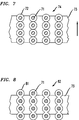
- the composite structure of FIG. 7 does not provide continuous high-aspect-ratio solder conduits since the vertically arranged solder particles are only in physical contact. Therefore, the composite structure is heated to either melt or diffusionally sinter the solder particles so that they are fused into a high-aspect-ratio configuration, 81, as illustrated in FIG. 8.
- This process of fusion can be accelerated by optionally applying compressive pressure (e.g. by weight) or high vertical magnetic field that will try to bring the core magnetic particles closer.
- compressive pressure e.g. by weight
- high vertical magnetic field that will try to bring the core magnetic particles closer.
- optionally part of the matrix material may be dissolved away forming a fused structure, 82, or alternatively more solder may be added to the ends of each vertical column to make them protrude beyond the matrix surface for easier soldering onto the devices, as discussed earlier.
- Electroplating or dip-coating in a molten solder bath can be utilized for this purpose.
- the density of individual magnetically aligned solder paths is selected similarly to that in the case of solder wires. Namely, there should be at least two solder paths per pad.
- Fused structure 82 is then placed between pads, 91 and 92, of mating devices, 93 and 94, respectively, and solder interconnected as illustrated in FIGs. 9 and 10, using a flux if desired to promote surface wetting.
- the matrix material can be left on if compliant (such as elastomer), or can be removed if it is dissolvable (such as gelatine), leaving a high-aspect-ratio solder structure shown in FIG. 10.
- the high-aspect ratio interconnections may be used for construction of multilayer or multi-step interconnected structures utilizing various heights of the inventive medium. For example. chips may be attached in a mother board with a 20 mil solder joint height and then the mother board may be interconnected to another board by a higher, e.g. 100 mil high, solder joints.
Landscapes
- Engineering & Computer Science (AREA)
- Manufacturing & Machinery (AREA)
- Microelectronics & Electronic Packaging (AREA)
- Mechanical Engineering (AREA)
- Manufacturing Of Electrical Connectors (AREA)
- Electric Connection Of Electric Components To Printed Circuits (AREA)
- Combinations Of Printed Boards (AREA)
Applications Claiming Priority (2)
| Application Number | Priority Date | Filing Date | Title |
|---|---|---|---|
| US255687 | 1994-06-08 | ||
| US08/255,687 US5509815A (en) | 1994-06-08 | 1994-06-08 | Solder medium for circuit interconnection |
Publications (2)
| Publication Number | Publication Date |
|---|---|
| EP0687137A2 true EP0687137A2 (fr) | 1995-12-13 |
| EP0687137A3 EP0687137A3 (fr) | 1996-09-11 |
Family
ID=22969462
Family Applications (1)
| Application Number | Title | Priority Date | Filing Date |
|---|---|---|---|
| EP95303635A Withdrawn EP0687137A3 (fr) | 1994-06-08 | 1995-05-30 | Moyen de soudure pour interconnexion de circuit |
Country Status (6)
| Country | Link |
|---|---|
| US (2) | US5509815A (fr) |
| EP (1) | EP0687137A3 (fr) |
| JP (1) | JPH07336044A (fr) |
| KR (1) | KR960003518A (fr) |
| CA (1) | CA2147398C (fr) |
| TW (1) | TW265481B (fr) |
Families Citing this family (49)
| Publication number | Priority date | Publication date | Assignee | Title |
|---|---|---|---|---|
| US5661042A (en) * | 1995-08-28 | 1997-08-26 | Motorola, Inc. | Process for electrically connecting electrical devices using a conductive anisotropic material |
| US5807766A (en) * | 1995-09-21 | 1998-09-15 | Mcbride; Donald G. | Process for attaching a silicon chip to a circuit board using a block of encapsulated wires and the block of wires manufactured by the process |
| US6043990A (en) * | 1997-06-09 | 2000-03-28 | Prototype Solutions Corporation | Multiple board package employing solder balis and fabrication method and apparatus |
| US6025649A (en) * | 1997-07-22 | 2000-02-15 | International Business Machines Corporation | Pb-In-Sn tall C-4 for fatigue enhancement |
| US5975922A (en) * | 1998-03-09 | 1999-11-02 | Lucent Technologies Inc. | Device containing directionally conductive composite medium |
| US6050832A (en) * | 1998-08-07 | 2000-04-18 | Fujitsu Limited | Chip and board stress relief interposer |
| US6019610A (en) * | 1998-11-23 | 2000-02-01 | Glatts, Iii; George F. | Elastomeric connector |
| US6854985B1 (en) * | 1998-12-16 | 2005-02-15 | Paricon Technologies Corporation | Elastomeric interconnection device and methods for making same |
| US6270363B1 (en) * | 1999-05-18 | 2001-08-07 | International Business Machines Corporation | Z-axis compressible polymer with fine metal matrix suspension |
| JP3515479B2 (ja) * | 2000-04-05 | 2004-04-05 | 北川工業株式会社 | 導電部材及びその製造方法 |
| CN1330014C (zh) | 2000-04-27 | 2007-08-01 | 恩德莱斯和豪瑟尔两合公司 | 用于测量装置的压电陶瓷多层元件及其制造方法 |
| US7064432B2 (en) * | 2000-07-26 | 2006-06-20 | The Research Foundation Of State University Of New York | Method and system for bonding a semiconductor chip onto a carrier using micro-pins |
| US6447308B1 (en) * | 2000-10-31 | 2002-09-10 | Paricon Technologies Corporation | Method and device for increasing elastomeric interconnection robustness |
| US20020086566A1 (en) * | 2000-12-06 | 2002-07-04 | Simons Everett F. | Robust, low-resistance elastomeric conductive polymer interconnect |
| DE10164799B4 (de) * | 2001-03-21 | 2006-03-30 | Audioton Kabelwerk Gmbh | Mobiltelefoneinrichtung mit mehradrigen elektrischen Verbindungseinrichtungen |
| US6818155B2 (en) * | 2002-01-02 | 2004-11-16 | Intel Corporation | Attaching components to a printed circuit card |
| US7249954B2 (en) | 2002-02-26 | 2007-07-31 | Paricon Technologies Corporation | Separable electrical interconnect with anisotropic conductive elastomer for translating footprint |
| US20030199181A1 (en) * | 2002-04-17 | 2003-10-23 | Akira Technology Co., Ltd. | Pliable connector and manufacturing method thereof |
| US20040050911A1 (en) * | 2002-09-18 | 2004-03-18 | Ho-Young Lee | Solder-fill and its manufacturing method for using semiconductor package and its application for mounting semiconductor chip on PCB |
| DE602004018720D1 (de) * | 2003-09-09 | 2009-02-12 | Nitto Denko Corp | Anisotrop-leitender Film , Herstellungs- und Gebrauchsverfahren |
| US7293995B2 (en) * | 2005-11-08 | 2007-11-13 | Che-Yu Li & Company, Llc | Electrical contact and connector system |
| US20080003778A1 (en) * | 2006-06-13 | 2008-01-03 | Rensselaer Polytechnic Institute | Low-temperature welding with nano structures |
| US9615463B2 (en) * | 2006-09-22 | 2017-04-04 | Oscar Khaselev | Method for producing a high-aspect ratio conductive pattern on a substrate |
| WO2008097571A1 (fr) * | 2007-02-06 | 2008-08-14 | World Properties, Inc. | Mousses polymères conductrices, procédé de fabrication et utilisations de celles-ci |
| US8623265B2 (en) * | 2007-02-06 | 2014-01-07 | World Properties, Inc. | Conductive polymer foams, method of manufacture, and articles thereof |
| US20090226696A1 (en) * | 2008-02-06 | 2009-09-10 | World Properties, Inc. | Conductive Polymer Foams, Method of Manufacture, And Uses Thereof |
| DE102008060862B4 (de) * | 2008-12-09 | 2010-10-28 | Werthschützky, Roland, Prof. Dr.-Ing.habil. | Verfahren zur miniaturisierbaren Kontaktierung isolierter Drähte |
| WO2010101125A1 (fr) * | 2009-03-05 | 2010-09-10 | ポリマテック株式会社 | Connecteur élastique et son procédé de fabrication et connecteur conducteur |
| US20110079630A1 (en) * | 2009-10-07 | 2011-04-07 | Babcock & Wilcox Technical Services Y-12, Llc | System for reducing metallic whisker formation |
| JP5409242B2 (ja) * | 2009-10-07 | 2014-02-05 | 新光電気工業株式会社 | インダクタ及びインダクタの製造方法 |
| EP2519568A1 (fr) * | 2009-12-29 | 2012-11-07 | Rogers Corporation | Mousses de polymère conductrices, procédé de fabrication, et utilisations de celles-ci |
| WO2011106421A2 (fr) * | 2010-02-24 | 2011-09-01 | Ramirez Ainissa G | Alliages à basse température de fusion contenant des dispersions magnétiques |
| US8939347B2 (en) | 2010-04-28 | 2015-01-27 | Intel Corporation | Magnetic intermetallic compound interconnect |
| US9847308B2 (en) | 2010-04-28 | 2017-12-19 | Intel Corporation | Magnetic intermetallic compound interconnect |
| US8434668B2 (en) * | 2010-05-12 | 2013-05-07 | Intel Corporation | Magnetic attachment structure |
| US8609532B2 (en) * | 2010-05-26 | 2013-12-17 | Intel Corporation | Magnetically sintered conductive via |
| US8988895B2 (en) * | 2011-08-23 | 2015-03-24 | Tessera, Inc. | Interconnection elements with encased interconnects |
| JP5912741B2 (ja) * | 2012-03-27 | 2016-04-27 | 日東電工株式会社 | 接合シート、電子部品およびその製造方法 |
| CN102922071B (zh) * | 2012-10-25 | 2014-10-08 | 哈尔滨工业大学 | 一种采用纳米金属间化合物颗粒制备低温互连高温服役接头的方法 |
| US9142475B2 (en) * | 2013-08-13 | 2015-09-22 | Intel Corporation | Magnetic contacts |
| US9282649B2 (en) * | 2013-10-08 | 2016-03-08 | Cisco Technology, Inc. | Stand-off block |
| EP2947662A1 (fr) | 2014-05-21 | 2015-11-25 | Condalign AS | Procédé pour disposer des particules au niveau d'une interface |
| US10104772B2 (en) * | 2014-08-19 | 2018-10-16 | International Business Machines Incorporated | Metallized particle interconnect with solder components |
| RU2623697C2 (ru) | 2014-09-26 | 2017-06-28 | Интел Корпорейшн | Архитектура создания гибких корпусов |
| KR101721667B1 (ko) * | 2016-03-08 | 2017-04-10 | 엘에스전선 주식회사 | 태양전지 모듈용 연선 도체 와이어 |
| MY192082A (en) | 2016-12-27 | 2022-07-26 | Intel Corp | Interconnect core |
| WO2020128976A1 (fr) * | 2018-12-19 | 2020-06-25 | Oqab Dietrich Induction Inc. | Systèmes et procédés basés sur l'induction pour l'assemblage de substrats |
| DE102020202025B4 (de) | 2020-02-18 | 2022-01-20 | Continental Automotive Gmbh | Verbindungssystem zur elektrischen Verbindung von Leiterplatten und Verwendung eines Verbindungssystems |
| US20220052012A1 (en) * | 2020-07-28 | 2022-02-17 | Paricon Technologies Corporation | Compliant Electronic Component Interconnection |
Family Cites Families (14)
| Publication number | Priority date | Publication date | Assignee | Title |
|---|---|---|---|---|
| US4003621A (en) * | 1975-06-16 | 1977-01-18 | Technical Wire Products, Inc. | Electrical connector employing conductive rectilinear elements |
| US4705205A (en) * | 1983-06-30 | 1987-11-10 | Raychem Corporation | Chip carrier mounting device |
| US4644101A (en) * | 1985-12-11 | 1987-02-17 | At&T Bell Laboratories | Pressure-responsive position sensor |
| US4737112A (en) * | 1986-09-05 | 1988-04-12 | American Telephone And Telegraph Company, At&T Bell Laboratories | Anisotropically conductive composite medium |
| EP0265077A3 (fr) * | 1986-09-25 | 1989-03-08 | Sheldahl, Inc. | Une colle anisotropique pour lier des composants électriques |
| US5045249A (en) * | 1986-12-04 | 1991-09-03 | At&T Bell Laboratories | Electrical interconnection by a composite medium |
| JPH07120688B2 (ja) * | 1987-06-12 | 1995-12-20 | 株式会社日立製作所 | マイクロ継手構造 |
| JPS6422048A (en) * | 1987-07-17 | 1989-01-25 | Fujitsu Ltd | Method for forming solder bump |
| US4820376A (en) * | 1987-11-05 | 1989-04-11 | American Telephone And Telegraph Company At&T Bell Laboratories | Fabrication of CPI layers |
| JP2573016B2 (ja) * | 1988-02-27 | 1997-01-16 | アンプ インコーポレーテッド | マイクロ入出力ピンおよびその製造方法 |
| EP0396522A3 (fr) * | 1989-05-05 | 1992-01-22 | International Business Machines Corporation | Système universel d'interconnexion et sa méthode de production |
| JP2788755B2 (ja) * | 1989-06-05 | 1998-08-20 | 古河電気工業株式会社 | 電子部品実装用パッドの製造方法 |
| JPH0311388A (ja) * | 1989-06-09 | 1991-01-18 | Komatsu Ltd | 電子ディスプレイデバイスのコネクト構造 |
| JPH0318094A (ja) * | 1989-06-14 | 1991-01-25 | Fujitsu Ltd | プリント基板への電子部品実装方法 |
-
1994
- 1994-06-08 US US08/255,687 patent/US5509815A/en not_active Expired - Lifetime
-
1995
- 1995-04-20 CA CA002147398A patent/CA2147398C/fr not_active Expired - Fee Related
- 1995-05-03 TW TW084104444A patent/TW265481B/zh active
- 1995-05-30 EP EP95303635A patent/EP0687137A3/fr not_active Withdrawn
- 1995-06-07 JP JP7163067A patent/JPH07336044A/ja active Pending
- 1995-06-08 KR KR1019950014996A patent/KR960003518A/ko not_active Ceased
-
1996
- 1996-01-18 US US08/588,193 patent/US5618189A/en not_active Expired - Lifetime
Non-Patent Citations (1)
| Title |
|---|
| S. JIN ET AL., J. APPL. PHYSICS, vol. 64, 1988, pages 6008 |
Also Published As
| Publication number | Publication date |
|---|---|
| JPH07336044A (ja) | 1995-12-22 |
| CA2147398A1 (fr) | 1995-12-09 |
| EP0687137A3 (fr) | 1996-09-11 |
| US5618189A (en) | 1997-04-08 |
| CA2147398C (fr) | 2000-02-15 |
| KR960003518A (ko) | 1996-01-26 |
| US5509815A (en) | 1996-04-23 |
| TW265481B (fr) | 1995-12-11 |
Similar Documents
| Publication | Publication Date | Title |
|---|---|---|
| CA2147398C (fr) | Points de soudure pour interconnection de circuits | |
| US4664309A (en) | Chip mounting device | |
| US6583354B2 (en) | Method of reforming reformable members of an electronic package and the resultant electronic package | |
| US4914814A (en) | Process of fabricating a circuit package | |
| US6117694A (en) | Flexible lead structures and methods of making same | |
| DE69026188T2 (de) | Elektrischer Verbinder | |
| DE69535629T2 (de) | Montage von elektronischen komponenten auf einer leiterplatte | |
| EP0133752A2 (fr) | Eléments et appareils pour l'assemblage de composants électroniques | |
| EP0265077A2 (fr) | Une colle anisotropique pour lier des composants électriques | |
| US20030071346A1 (en) | Flexible lead structures and methods of making same | |
| EP0613332A1 (fr) | Interconnexion pour support de micropuce | |
| KR20020083485A (ko) | 다층 배선 기판 및 그 제조 방법 | |
| US7248482B2 (en) | Module with built-in circuit component and method for producing the same | |
| WO1990008616A1 (fr) | Connexion de liaison amelioree pour composants | |
| US20040134976A1 (en) | Method and system for solder connecting electrical devices | |
| US5807766A (en) | Process for attaching a silicon chip to a circuit board using a block of encapsulated wires and the block of wires manufactured by the process | |
| HK1004885A (en) | Solder medium for circuit interconnection | |
| JP4097310B2 (ja) | 多層回路基板の製造方法 | |
| CN111618540B (zh) | 用于柱栅阵列的焊接金属柱的制备方法 | |
| JPH10190190A (ja) | 基板およびその製造方法 | |
| KR102423487B1 (ko) | 플렉시블 플랫 케이블의 제조방법 및 이를 통해 제조된 플렉시블 플랫 케이블 | |
| JPH0566037B2 (fr) | ||
| CN210405775U (zh) | 一种用于光器件的柔性电路板 | |
| CA1269596A (fr) | Dispositif de montage de puces et dispositif de montage de supports de puce | |
| JPH0831873A (ja) | スーパーマイクロコネクタ及びその製造方法 |
Legal Events
| Date | Code | Title | Description |
|---|---|---|---|
| PUAI | Public reference made under article 153(3) epc to a published international application that has entered the european phase |
Free format text: ORIGINAL CODE: 0009012 |
|
| AK | Designated contracting states |
Kind code of ref document: A2 Designated state(s): DE FR GB NL |
|
| PUAL | Search report despatched |
Free format text: ORIGINAL CODE: 0009013 |
|
| AK | Designated contracting states |
Kind code of ref document: A3 Designated state(s): DE FR GB NL |
|
| 17P | Request for examination filed |
Effective date: 19970226 |
|
| STAA | Information on the status of an ep patent application or granted ep patent |
Free format text: STATUS: THE APPLICATION HAS BEEN WITHDRAWN |
|
| 18W | Application withdrawn |
Withdrawal date: 20001211 |
|
| REG | Reference to a national code |
Ref country code: HK Ref legal event code: WD Ref document number: 1004885 Country of ref document: HK |