EP0692123B1 - Horloges synchronisees et lecteurs de supports d'informations - Google Patents
Horloges synchronisees et lecteurs de supports d'informationsInfo
- Publication number
- EP0692123B1 EP0692123B1 EP94911751A EP94911751A EP0692123B1 EP 0692123 B1 EP0692123 B1 EP 0692123B1 EP 94911751 A EP94911751 A EP 94911751A EP 94911751 A EP94911751 A EP 94911751A EP 0692123 B1 EP0692123 B1 EP 0692123B1
- Authority
- EP
- European Patent Office
- Prior art keywords
- clock
- player
- time
- class
- media stream
- Prior art date
- Legal status (The legal status is an assumption and is not a legal conclusion. Google has not performed a legal analysis and makes no representation as to the accuracy of the status listed.)
- Expired - Lifetime
Links
Images



Classifications
-
- H—ELECTRICITY
- H04—ELECTRIC COMMUNICATION TECHNIQUE
- H04N—PICTORIAL COMMUNICATION, e.g. TELEVISION
- H04N21/00—Selective content distribution, e.g. interactive television or video on demand [VOD]
- H04N21/20—Servers specifically adapted for the distribution of content, e.g. VOD servers; Operations thereof
- H04N21/23—Processing of content or additional data; Elementary server operations; Server middleware
- H04N21/234—Processing of video elementary streams, e.g. splicing of video streams or manipulating encoded video stream scene graphs
- H04N21/2343—Processing of video elementary streams, e.g. splicing of video streams or manipulating encoded video stream scene graphs involving reformatting operations of video signals for distribution or compliance with end-user requests or end-user device requirements
- H04N21/234318—Processing of video elementary streams, e.g. splicing of video streams or manipulating encoded video stream scene graphs involving reformatting operations of video signals for distribution or compliance with end-user requests or end-user device requirements by decomposing into objects, e.g. MPEG-4 objects
-
- G—PHYSICS
- G06—COMPUTING OR CALCULATING; COUNTING
- G06F—ELECTRIC DIGITAL DATA PROCESSING
- G06F16/00—Information retrieval; Database structures therefor; File system structures therefor
- G06F16/40—Information retrieval; Database structures therefor; File system structures therefor of multimedia data, e.g. slideshows comprising image and additional audio data
-
- G—PHYSICS
- G11—INFORMATION STORAGE
- G11B—INFORMATION STORAGE BASED ON RELATIVE MOVEMENT BETWEEN RECORD CARRIER AND TRANSDUCER
- G11B27/00—Editing; Indexing; Addressing; Timing or synchronising; Monitoring; Measuring tape travel
- G11B27/02—Editing, e.g. varying the order of information signals recorded on, or reproduced from, record carriers
- G11B27/031—Electronic editing of digitised analogue information signals, e.g. audio or video signals
-
- G—PHYSICS
- G11—INFORMATION STORAGE
- G11B—INFORMATION STORAGE BASED ON RELATIVE MOVEMENT BETWEEN RECORD CARRIER AND TRANSDUCER
- G11B27/00—Editing; Indexing; Addressing; Timing or synchronising; Monitoring; Measuring tape travel
- G11B27/10—Indexing; Addressing; Timing or synchronising; Measuring tape travel
-
- H—ELECTRICITY
- H04—ELECTRIC COMMUNICATION TECHNIQUE
- H04N—PICTORIAL COMMUNICATION, e.g. TELEVISION
- H04N21/00—Selective content distribution, e.g. interactive television or video on demand [VOD]
- H04N21/40—Client devices specifically adapted for the reception of or interaction with content, e.g. set-top-box [STB]; Operations thereof
- H04N21/43—Processing of content or additional data, e.g. demultiplexing additional data from a digital video stream; Elementary client operations, e.g. monitoring of home network or synchronising decoder's clock; Client middleware
- H04N21/4302—Content synchronisation processes, e.g. decoder synchronisation
- H04N21/4307—Synchronising the rendering of multiple content streams or additional data on devices, e.g. synchronisation of audio on a mobile phone with the video output on the TV screen
- H04N21/43072—Synchronising the rendering of multiple content streams or additional data on devices, e.g. synchronisation of audio on a mobile phone with the video output on the TV screen of multiple content streams on the same device
Definitions
- the present invention is related to copending, commonly assigned U.S. patent application serial no. WO 9423365A entitled “Event Qualification and Notification” (Attorney Docket no. 55378.0026), and copending, commonly assigned U.S. patent application serial no. US 5475811A entitled “Time-Based Script Sequences” (Attorney Docket no. 55378.0027), both of which are incorporated by reference herein.
- the present invention relates to the field of multimedia methods and apparatus, and more particularly to methods and apparatus allowing for synchronization and control of time-based media in a multimedia computer environment.
- multimedia is often used in referring to software for processing (e.g., creating, editing, displaying, synchronizing, etc.) one or more files of time-based data.
- time-based data include video sequences, audio sequences, time-recorded events such as data from measuring devices, etc.
- Devices (hardware or software) capable of processing multimedia data are commonly referred to as multimedia players. Typical examples include personal computers and custom CD ROM-based devices designed for such a purpose.
- the time-based data is typically stored in (or on) a hardware memory device, for example the read-only memory (ROM) of a computer, a computer's magnetic disk drive, an audio or ROM compact disk (CD), video tape devices, etc.
- ROM read-only memory
- CD compact disk
- the time-based data may also be generated for processing in real time.
- computer-generated animation image data may be generated for display from animation control data, without having previously been stored.
- the type of data is its "media.” That is, media defines the data. For example, digital data is comprised of the binary values 0 or 1. In order to interpret that data, a player must know which media is represented by that data. Hence, devices (principally software) capable of processing the data provided by these hardware memory devices are commonly referred to as media players.
- a movie is a common metaphor used in the discussion of multimedia software and hardware. While the traditional "movie” (e.g., of the type shown in a theater) is a stream of discrete data, in time order, stored in a single format such as film, tape, optical disk, etc., multimedia "movies" need not be so organized. Rather, multimedia movies may be made up of a number of sequences whose data may be stored on disparate devices in non-sequential order. Thus, one important role for multimedia players is to organize and coordinate the processing of data.
- QuickTime essentially allows a multimedia player to process time-based data. Since the data are time based, QuickTime provides for the description of "time” (called time basis) for the data as well as a definition of the context for evaluating that "time.” In QuickTime, a movie's or media's time basis is called its "timebase.”
- a timebase is essentially a vector that defines the direction and velocity of time for a movie or media.
- the context for a timebase is called its time coordinate system.
- a time coordinate system provides an axis for measuring time.
- the time coordinate system like a geometrical axis, is divided into units of measurement by a measurement system, called a time scale.
- a timebase defines a current time value and the rate at which time passes for the movie or the media, but does not define the scale. Rather, the scale is obtained from the media itself.
- the product of rate and the time scale is called the absolute rate, and is measured for example in units per second.
- a clock which provides the timing for the timebase.
- QuickTime clocks are implemented as components that are managed by a part of the QuickTime architecture referred to as the Component Manager.
- Clock components provide two basic services: generating time information and scheduling time-based events, called CallBack events.
- CallBack events For a description of event management, see, e.g., the copending commonly assigned U.S. Patent Application, serial number WO 9423365A entitled "Event Qualification and Notification,” which is incorporated by reference herein.
- Clock components themselves receive information from other elements, which they use to produce and to provide their timing information.
- a clock component may use the Macintosh "tick" count to provide its basic timing information.
- a clock component could use some special hardware installed in the computer to provide its basic timing information.
- a hardware clock is generally a signal generator of the type known in the art, which emits pulses or clock "ticks" many times per second (e.g., a 1 MHz clock ticks one million times per second).
- Hardware clocks are frequently associated with "counters” that keep track of units of time by incrementing their value after each clock tick of a given rate. While hardware clocks generally emit a predetermined, fixed number of ticks per second, software clocks such as clock components allow for the manipulation of various aspects or values of the clock, allowing control of rate, etc.
- Root clock and an associated counter
- these software clocks must convert the time units of the RootClock (e.g., 60 ticks/sec) to their desired time units (e.g., 44,100 ticks/sec for CD-quality audio).
- Both media and movies have timebases.
- QuickTime multimedia movies are comprised of one or more "tracks" which are organized references to the media from which the time-based data are obtained. Each track is associated with a single media.
- a movie's timebase allows the tracks to be synchronized.
- every track begins at the same time, at the beginning of the movie.
- the data are "offset” from the start of the movie.
- Each track or media has its own timebase. Every timebase contains a rate, a start time, a stop time, a current time, and some status information. Although ultimately each timebase obtains its time values from a clock component, it may do so indirectly.
- a timebase may obtain its time values directly from another timebase.
- the timebase obtaining its time values from another timebase is referred to as a slave timebase, and the timebase providing time values to other timebases is referred to as a master timebase.
- a master timebase may have multiple slave timebases, but a slave timebase may have only a single master timebase. (That is, a clock can be synchronized to only one clock, but can have any number of clocks synchronized to it.)
- a first media may be a stream of digitized video data
- a second media may be a stream of digitized sound data. It may be desirable to "play" the sound at a specific time in the video data stream, such as 10 seconds into the video data stream. Thus, it is useful to be able to tie one media's timebase to another media's timebase.
- QuickTime provides for the creation, use, and editing of timebase values.
- changes made to master timebases may ripple through to slave timebases. For example, if the current time of a master timebase is changed, the current time of the slave timebases are changed appropriately.
- QuickTime provides an effective mechanism for controlling and synchronizing different media, despite each media having its own timebase with its own rate and offset.
- the mechanism provided by QuickTime for the synchronization of the various media is also quite complex, principally because the media and its associated timebase are conceptually different.
- the timebase for the media In order to access or change the time values associated with a particular media, the timebase for the media, not the media itself, must be addressed. For example, to find out at what point in time the media is currently playing, it is necessary to obtain a reference to the media's timebase, then examine the timebase itself. This problem, of requiring indirect access to a player's time parameters, is compounded as the number of players synchronized to one another increases.
- QuickTime requires that a movie start at time zero. This makes the task of synchronizing two movies that start at different times (i.e., each having a different zero time relative to each other) complex. For example, since a multimedia movie must start at time zero, no negative start times are allowed. While it is possible to achieve the effect of a negative start time in QuickTime, for example by creating a fictitious start time and using offsets from that start time, this is an unnecessary burden in the creation of multimedia movies. Not only must the offset between the two movies be maintained, possible different rates between the two movies must also be synchronized. These same complexities also occur when a movie is synchronized with some external media.
- timebases discussed above do not include scale.
- the values of time returned by a timebase are meaningless without a scale.
- To determine the value of time returned by a timebase reference must be made to the media. This two-step process of getting a timebases' time imposes an arbitrary complexity upon an author of a title.
- the scheduling of future events is frequently inaccurate. If, as is often the case, the root clock does not operate as fast as a clock associated with a particular media player, then the system cannot accurately determine when the audio passage is at a particular point in time.
- the system cannot determine when the audio playback reaches audio time unit 100.
- a total of 735 audio time units pass between every tick of the root clock.
- such systems access a faster clock on the computer and approximate the point at which the desired time unit is reached. The problem is that this faster clock is not synchronized to the media player, and therefore is not necessarily accurate (due to the "drift" caused by the time taken to write to a counter).
- the present invention addresses the problems noted above by integrating, both physically and conceptually, media players and the clocks that control them.
- This system-level integration of clocks and media players provides more accurate synchronization among different media and relieves the author of having to communicate indirectly with multiple clocks and media players, and having to maintain artificial intermediate constructs to facilitate such peripheral activities.
- clocks and media players are integrated by creating a class of media player objects that inherits from a class of clock objects.
- object oriented parlance instead of a player "has a" clock relationship between a player object and a clock object, a player "is a" clock.
- RootClock which operates at the speed of the fastest media player in the system (e.g., 44.1 KHz CD-quality audio), thereby facilitating the scheduling of future events at a particular point in time (e.g., corresponding to any individual media sample). Since the speed of the RootClock is equal to the fastest media player in the system, time units for any other media player in the system can be "down-converted" from the rate of the RootClock. Moreover, the speed of the hardware portion of the RootClock is still relatively slow, slow enough to permit sufficient processing between hardware ticks. In another embodiment, separate RootClocks can be employed for the different speeds of each desired media player.
- the RootClock includes a counter which maintains a time value.
- This counter may be entirely hardware, entirely software, or a combination of hardware and software. If a portion of the counter is in hardware, interrupts to the system may be reduced. In this case, it may also be desirable to associate with the hardware portion of the RootClock a compare register of equal size for the purpose of generating interrupts.
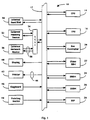
- Architecture 10 comprises a main bus 12, which serves to interconnect various components, including at least some of the following (and possibly other additional components): Central Processing Unit (CPU) 14, Floating Point Unit (FPU) 16, Bus Controller 20, Video RAM 22, Dynamic RAM (DRAM) 24, Static RAM (SRAM) 26, Digital Signal Processor (DSP) 28, Internal Hard Disk 30, External Memory Device 32 (connected for example via a SCSI port 34), External Network Devices 36 (communicating for example over an Ethernet Network 38, and connected via SCSI port 34), Display Device 40 (such as a CRT), Printer 42 (such as a PostScript device connected for example via a serial port 44), Keyboard 46, and Pointing Device 48 (such as a mouse, trackball, etc.)
- CPU Central Processing Unit
- FPU Floating Point Unit
- Bus Controller 20 Video RAM 22
- DRAM Dynamic RAM
- SRAM Static RAM
- DSP Digital Signal Processor
- DSP Digital Signal Processor
- Internal Hard Disk Internal Hard Disk
- External Memory Device 32 connected for example via a
- the fundamental data structures of the language are objects, programming elements that contain a specification of both data and actions.
- Data are specified in local variables, referred to as instance variables, contained within the object.
- Actions, or methods are subprograms that operate on the variables. Methods are invoked by messages sent from one object to itself or other objects.
- Classes have a set of variables and methods and can be thought of as templates for object types. Instances (or objects) are particular run-time instantiations of a class.
- An object provides storage for variables defined in its class. Each instance has its own version of those variables. When a message is sent to an object, the object looks to methods defined in its class to determine how the message is to be executed.
- Classes are defined in terms of a class hierarchy.
- a class inherits all variables and methods from classes higher in the hierarchy, referred to as superclasses.
- the inheriting class may be referred to as a subclass or child of the superclass.
- the variables and methods inherited from a superclass are available to the inheriting class as if they were defined within the inheriting class. Note that if a subclass has multiple superclasses, all the variables and methods from each superclass are inherited. This is often referred to as multiple inheritance.
- class variables There are two types of variables that may be defined within a class.
- the first are class variables, whose storage is shared by all instances of the defining class. Class variables are typically used for coordination between classes and instances.
- instance variables which are variables specific to each particular instance. That is, separate storage space is allocated for each instance variable of each instance.
- Methods specify the action to be performed when a message is sent to an object.
- the message name is matched against method names defined for that object.
- the method actually executed is the method with the same name as the message that is defined lowest in that object's class hierarchy.
- Messages can have parameters. When a message is sent, all actual parameters are fully evaluated before a method is located for that message. Methods have formal parameters, corresponding to the actual parameters in the message, and temporary variables. Temporary variables may be created when a message is executed, and are available only with the scope of that method while the method is executing.
- Programs perform by sending messages to objects which invoke a method in an object's class or class hierarchy. Often, methods send messages to other objects, invoking other methods. Typically, each method returns a result to the sender.
- object oriented language is a program segment for interpreting and evaluating messages and keeping track of where to return when methods call other methods.
- Object oriented programming environments can be implemented with many programming languages.
- One common example of an object oriented environment is the C++ environment, described in further detail in Ellis, Margaret and Bjarne Stroustrup, THE ANNOTATED C++ REFERENCE MANUAL (Addison-Wesley 1990) and Coplien, James O., ADVANCED C++ PROGRAMMING STYLES AND IDIOMS (Addison-Wesley 1992).
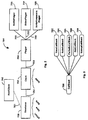
- FIG. 2 there is shown therein an illustration of the class hierarchy 764 of various classes according to one embodiment of the present invention.
- Fig. 2 illustrates the inheritance relationship between the various classes of hierarchy 764.
- Timebase class 750 is the base class from which Clock class 752 inherits, as shown by the line 751 connecting Timebase class 750 and Clock class 752.
- Player class 754 inherits from Clock class 752 as illustrated by line 753.
- AudioPlayer class 756, VideoPlayer class 758, and ScriptSequencePlayer class 760 inherit from Player class 754, as illustrated by lines 755, 757, and 759, respectively.
- these classes will be described, followed by an example of their usage.
- Timebase class 750 Shown in Fig. 2 is the relationship between the Timebase class 750 and a RootClock class 762.
- An instance of RootClock 762 i.e., a RootClock object
- Each instance of the classes of hierarchy 764 must be synchronized directly or indirectly to a RootClock.
- Each object gets its time from an object which either directly or indirectly gets time from a RootClock.
- Timebase class 750 includes a method for getting time from the RootClock.
- the hardware clock portion of a RootClock object may be, for example, a hardware device that emits ticks at a specific rate together with a register which keeps track of those ticks, as discussed above.
- a RootClock object which represents that hardware device. That is, a RootClock represents a hardware timing resource. However, there may be within a single system multiple hardware timing resources, and thus multiple RootClocks, one for each hardware timing resource.
- Timebase object 750 is the top-level class of hierarchy 764.
- a Clock object, a Player object, an AudioPlayer, VideoPlayer, or ScriptSequencePlayer object When instantiated, it includes all methods and variables inherited from the Timebase class 750. This motivates the lexical statement that a Clock "is a" Timebase.
- the class methods for the Timebase class 750 are listed in Appendix 1.
- the instance methods for the Timebase class 750 are listed in Appendix 2.
- a Clock object (an instance of Clock class 752) is principally capable of returning the time (hence the motivation for its name).
- a Clock object records time by keeping track of the offset between itself and its master clock. When a Clock object receives a request for the time, it gets the time of the master clock, subtracts the offset, and returns the result.
- Each Clock object has associated with it a time scale that defines the number of time units that pass each second (when rate is 1). Therefore, a Clock object that has a time scale of 1 measures time in seconds. Similarly, a Clock object that has a time scale of 60 measures sixtieths of a second.
- a particular point in time in a Clock object is represented by a time value.
- a time value is expressed in the time scale of the Clock object. For example, for a Clock with a time scale of 60, a time value of 180 translates into 3 seconds of elapsed time.
- the rate of a Clock object is the speed at which time passes for that object.
- the absolute value of a time unit in seconds depends on both the rate and scale of the Clock object.
- the number of time units that passes each second for a Clock object can be determined by multiplying its rate by its scale.
- Instances of Clock class 752 may be created for the purpose of establishing a time source which does not play media. Instances of the AudioPlayer class 756, VideoPlayer class 758, and ScriptSequencePlayer class 760 may be created to obtain a time source which also plays specific media, as described below.
- a prototype for the method called on Clock class 752 to create a Clock object is as follows: method object new (class self object master object scale) The arguments of this method are:
- the Clock class 752 inherits all of the methods and variables from the Timebase class 750. For example, the following methods inherited from the Timebase class 750 may be useful to Clock objects (see Table 2 for further descriptions of these methods):
- the Player class 754 provides methods for playing media.
- a Player object is responsible for facilitating the data transfer between a media stream object (representing, for example, digitally captured audio or video) and a media system resource (e.g., drivers for audio or video presentation devices that convert digital data to analog sound or images).
- a media system resource e.g., drivers for audio or video presentation devices that convert digital data to analog sound or images.
- Such protocols include the information necessary to interpret the data stream.
- an AudioPlayer object would be responsible for determining that an audio channel driver object (the methods for which are listed in Appendix 8) is capable of processing the data at an appropriate rate - e.g., one corresponding to the sampling rate for a particular audio media stream.
- an appropriate rate e.g., one corresponding to the sampling rate for a particular audio media stream.
- a Player object may assist in the identification and selection of an appropriate system resource for a particular data stream.
- the Player class 754 defines a protocol which is generic for all players.
- a Player object may also be employed as a high level controller of AudioPlayer, VideoPlayer, or ScriptSequencePlayer objects synchronized to that Player object.
- Player objects are also Clock objects (or in the parlance, a Player "is a" Clock). Therefore, Player objects themselves contain methods involving time, such as methods for controlling the start and stop time, setting rate of play, etc.
- Player class 754 contains general methods common to all players, each of the specific player subclasses, AudioPlayer class 756, VideoPlayer class 758, and ScriptSequencePlayer class 760, contains methods that are specific to its associated media.
- AudioPlayer class 756 will contain methods for adjusting the play volume, etc., in addition to methods for controlling the start and stop time, setting rate of play, etc.
- Appendix 5 presents a detailed discussion of a number of specific Player subclasses.
- ClockC whose rate is 2
- ClockB whose rate is 6
- ClockA whose rate is 3
- ClockB's effective rate is 18
- ClockC's effective rate is 36.
- CallBack objects may also be used in conjunction with a Clock object to schedule the occurrence of activities at particular times. For example, a Player could be scheduled to start playing at a particular time. Thus, to schedule an activity, a CallBack object is created and associated with a Clock object. As illustrated in Fig. 5, the CallBack class 780 has the following subclasses:
- CallBack objects are created by first ensuring that the clock which it will be attached to exists. Next, a new CallBack object is created by calling the new method on the appropriate CallBack subclass. In creating the new CallBack object, the clock which it will be attached to is specified. A function is then specified, with a single argument of type void*, for the CallBack to perform.
- the callMeWhen method of the CallBack object is used to specify when the CallBack is to be activated.
- the prototype for callMeWhen is: method void callMeWhen( object self, CallBackProc CallBackProc, void *CallBackParam, long flags, long rateORline, TimeRecord *timerecord, CallBackPriority queueID)
- the arguments of callMeWhen are:
- the CallBack class is an abstract class, so the user does not typically create instances of it. Instead, a user would create an instance of the appropriate subclass (TimeCallBack, RateCallBack, PeriodicCallBack, TickCallBack, and TJumpCallBack).
- Each of these subclasses has a "new" method with the following prototype: method object new (object self, object clock) where the arguments are:
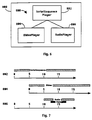
- a network 800 of media player objects hierarchically arranged, according to one embodiment of the present invention, for the "playing" of a multimedia title.
- the hierarchy indicates the master-slave relationship between these player objects.
- the network 800 of Fig. 6 will be used in the following example to illustrate various aspects and features of the present invention. Initially, each of the players must be created. This step may be performed by invoking the "new" method on each of the subclasses ScriptSequencePlayer, AudioPlayer, and VideoPlayer. The "new" method for each of these particular subclasses is described in detail in Appendix 5.
- Each of the player objects must be associated with an existing data stream object, the playing of which is controlled by the player object.
- Appendix 7 contains a list of methods for an Audio Stream object, as an example of methods for such data stream objects.
- Creation and storage of digitized streams of audio, video and other media data is well known in the art.
- the data stream objects are associated with the player objects by way of the arguments of the "new" method. Specifically, this results in the creation of ScriptSequencePlayer object 802, VideoPlayer object 804, and AudioPlayer object 806, within the context of computer 808.
- These objects must next be associated with one another, for example to establish the relative timing among them, for the purpose of playing the title.
- Fig. 7 illustrates a synchronization scheme by which network 800 may play a title.
- the ScriptSequencePlayer 802 begins playing animation. Its master clock is the RootClock.
- the VideoPlayer 804 has its master clock set to the ScriptSequencePlayer 802. This may be accomplished by the setMasterClock method (Appendix 2). After 5 units of the ScriptSequencePlayer's time have passed, the VideoPlayer 804 begins playing a video data stream at its own time 0. This is established by the setScaledClockZero method (Appendix 2). Thus, the VideoPlayer 804 has an "offset" of 5. That is, its "0" time is 5 units after the "0" time of its master clock (in the master clock's units). Furthermore, the VideoPlayer's origin is at 0. That is, the VideoPlayer begins playing at its own time 0.
- the AudioPlayer 806 also has its master clock set to the ScriptSequencePlayer 802. After 10 units of the ScriptSequencePlayer's time has passed, the AudioPlayer 806 begins playing an audio data stream. However, the start of the AudioPlayer's time corresponds to the start of the ScriptSequencePlayer's time. Thus, the AudioPlayer has an offset of 0, with its origin at 10 (by invoking the setOrigin method). Importantly, it is the fact that each player inherits the Clock class methods (i.e., a player "is a" clock) which allow a player to have its master clock set to another player -- it is not necessary to separately address clock objects.
- Clock class methods i.e., a player "is a" clock
- a player hierarchy has thereby been established, with the players associated with data stream objects and with the various players synchronized.
- the play method may then be invoked on the ScriptSequencePlayer. This results in setting the rate of the ScriptSequencePlayer to 1.0 (wherein a rate of 1.0 corresponds to "play,” a rate of 0.0 corresponds to "stop,” a rate of -1.0 corresponds to play in reverse, a rate of 0.5 corresponds to play at half speed, etc.).
- Each Player object by way of methods inherited from the Timebase class, maintains a list of CallBacks which contain objects to be called and the event upon which they are to be called.
- a player which is "interested” in (e.g., affected by) a time or rate change overrides the timeChanged or rateChanged methods of the superclass.
- any CallBacks associated with a time change or rate change are dispatched, respectively.
- a Player issues a timeChanged or rateChanged message directly to itself and all players synchronized to it.
- TimeCallBack will dispatch a play message at the appropriate time. If it is determined by the player that it is at a time at which it should play, no CallBack is registered, and play is invoked immediately.
- a rateChanged method is called on each of the slaved players, VideoPlayer 804 and AudioPlayer 806. This results in CallBacks being scheduled, as discussed above.
- the first TimeCallBack is set for VideoPlayer 804 at time 5 of ScriptSequencePlayer 802, and the second is set for AudioPlayer 806 at time 10 of ScriptSequencePlayer 802.
- the RootClock Upon determining that time 5 has been reached, the RootClock sends a play message to VideoPlayer 804 via the CallBack. Likewise, the play method of AudioPlayer 806 is invoked upon reaching time 10.
- VideoPlayer 804 and AudioPlayer 806 receive a timeChanged message from the ScriptSequencePlayer 902 indicating that time has been changed, and the players accommodate the message as discussed above (e.g., VideoPlayer 804 starts at its time 0, and AudioPlayer 806 starts at its time 5). It will be appreciated that again it is the inheritance hierarchy (i.e., a player "is a" clock) which facilitates this simple compensation for time changes.
- VideoPlayer 804 receives a call to set its own time to 10, essentially skipping forward. This is shown graphically in Fig. 8. The result of this call is to change the offset of VideoPlayer 804 relative to ScriptSequencePlayer 802 from 5 to 2. It should be noted that the change only affects VideoPlayer 804; ScriptSequencePlayer 802 and AudioPlayer 806 are unaffected by the change.
- CallBack objects associated with Timebase objects are registered with the RootClock of the Timebase object. These CallBack objects are maintained in a time-ordered list in the RootClock. CallBack objects can be registered according to (i.e., an object may request notification of setting or changes to) time or rate.
- CallBacks which return a message at a particular time must be scheduled differently.
- the time of the CallBack is specified in the scale of the associated Clock. This time is converted to the scale of the RootClock, added to the current tick count of the counter, and inserted in the timeordered list in the RootClock. The manner in which the RootClock object determines when to dispatch a CallBack will now be discussed.
- RootClock 762 With regard to the hardware portion of the RootClock 762 to which timebases must ultimately be synchronized, most computer systems rely on the only readily available and feasible constant hardware tick - the vertical synchronization signal (VBL), which typically oscillates at 60 Hertz.
- VBL vertical synchronization signal
- a software counter is generally employed to maintain a count of ticks, e.g., in a 64-bit integer. In this manner, the system is interrupted every 1/60 second, whereupon the software counter is incremented.
- the resolution of 1/60 second is not sufficient.
- the standard sound sampling rate is 44.1 KHz.
- few (if any) computer platforms are capable of sustaining interrupts at a rate of 44.1 KHz.
- the players (and thus clocks) in the network hierarchy of Fig. 6 are ultimately synchronized to a root clock which operates at 44.1 KHz (the rate of the fastest media in the system - CD-quality audio - which can be converted to the slower rates of other media, such as the 30 frames/second of full motion video).
- 44.1 KHz the rate of the fastest media in the system - CD-quality audio - which can be converted to the slower rates of other media, such as the 30 frames/second of full motion video.
- the RootClock object to which ScriptSequencePlayer 802 is synchronized is provided with a 16-bit hardware counter portion which generates an interrupt when it wraps around (overflows), approximately once every 1.5 seconds, and a 48-bit software counter portion.
- the interrupt signal from the RootClock's 16-bit hardware counter portion is used to increment its 48-bit software counter portion.
- the RootClock is provided with one or more 16-bit compare registers used for low order bit comparisons of CallBacks. For each increment of the software counter, the first CallBack in the time-ordered list is checked. To determine if a CallBack should be scheduled the current value of the 64-bit RootClock counter is subtracted from the 64-bit CallBack value. If the result of the subtraction is less than the bit-resolution of the hardware counter (i.e., 65,536 for 16 bits) then the low-order 16 bits of the CallBack's value are placed in the hardware compare register (unless the result is less than or equal to zero, in which case the CallBack is immediately dispatched).
- the hardware counter i.e., 65,536 for 16 bits
- the hardware counter is allowed to roll-over, and the subtraction is performed again.
- the CallBack interrupt is enabled.
- the CallBack interrupt is generated.
- the RootClock disables the interrupt and dispatches the CallBack (as discussed above). As well understood by those skilled in the art, this dispatch may come in the form of enabling a task to handle the CallBack, since interrupt routines should be minimized where possible.
Landscapes
- Engineering & Computer Science (AREA)
- Multimedia (AREA)
- Signal Processing (AREA)
- Theoretical Computer Science (AREA)
- General Engineering & Computer Science (AREA)
- Physics & Mathematics (AREA)
- Databases & Information Systems (AREA)
- General Physics & Mathematics (AREA)
- Data Mining & Analysis (AREA)
- Signal Processing For Digital Recording And Reproducing (AREA)
- Television Signal Processing For Recording (AREA)
- Synchronisation In Digital Transmission Systems (AREA)
- Digital Computer Display Output (AREA)
Claims (14)
- Méthode pour assurer la reproduction synchronisée par horloge d'un flot d'informations, destinée à être utilisée dans un environnement orienté objet dans un ordinateur numérique (808), ladite méthode comprenant les étapes suivantes :spécifier une classe d'horloge (752) comprenant au moins une méthode d'horloge pour générer une suite de valeurs de temps,spécifier une classe de reproduction (754) comprenant au moins une méthode de reproduction pour assurer la reproduction du flot d'informations, et dans laquelle ladite classe de reproduction hérite de ladite classe d'horloge (753),instancier au moins un objet de reproduction (802, 804, 806) appartenant à la classe de reproduction (754),générer la suite de valeurs de temps en utilisant la méthode héritée de l'objet de reproduction, etassurer la reproduction du flot d'informations en synchronisation avec la suite de valeurs en utilisant la méthode de reproduction de l'objet de reproduction,instancier un objet d'horloge maítresse appartenant à ladite classe d'horloge (752),associer l'objet d'horloge maítresse à l'objet de reproduction (802, 804, 806),
dans laquelle ladite suite de valeurs de temps générée par chaque objet de reproduction est dérivée d'une suite maítresse de valeurs de temps générée par l'objet d'horloge maítresse associé. - Méthode selon la revendication 1, dans laquelle la suite maítresse des valeurs de temps générée par l'horloge maítresse est elle-même hiérarchiquement dérivée d'une autre suite maítresse dérivée d'une autre horloge maítresse.
- Méthode selon la revendication 1, comprenant en outre l'étape de transmettre un ou plusieurs messages à chaque objet de classe d'horloge associée annonçant une modification d'une fréquence ou échelle de la suite maítresse.
- Méthode selon la revendication 1, comprenant en outre l'étape de programmer, en avance, l'étape de reproduire le flot d'informations
- Méthode selon la revendication 4, dans laquelle l'étape de programmer en avance comprend en outre les étapes de :créer un objet de rappel (788) spécifiant un instant de départ pour la reproduction du flot d'informations, ettransmettre, à l'instant de départ spécifié, un message à partir de l'objet de rappel vers l'objet de reproduction (802, 804, 806) demandant la reproduction du flot d'informations.
- Méthode selon la revendication 1, dans laquelle le flot d'informations comprend des données vidéo, et dans laquelle l'étape de reproduire le flot d'informations comprend l'affichage des données vidéo sur un moniteur vidéo (40).
- Méthode selon la revendication 1, dans laquelle le flot d'informations comprend des données audio, et dans laquelle l'étape de reproduire le flot d'informations comprend la sortie des données audio sur un haut-parleur.
- Appareil pour assurer la reproduction synchronisée par horloge d'un flot d'informations, destiné à être utilisé dans un environnement orienté objet dans un ordinateur numérique (808), ledit appareil comprenant:des moyens pour spécifier une classe d'horloge (752) comprenant au moins une méthode d'horloge pour générer une suite de valeurs de temps,des moyens pour spécifier une classe de reproduction (754) qui hérite de ladite classe d'horloge (752) et comprenant au moins une méthode de reproduction pour assurer la reproduction du flot d'informations,des moyens pour instancier au moins un ou plusieurs objets de reproduction (802, 804, 806) appartenant à la classe de reproduction (754),des moyens pour générer la suite de valeurs de temps en utilisant la méthode héritée de l'objet de reproduction,des moyens pour assurer la reproduction du flot d'informations en synchronisation avec la suite de valeurs en utilisant la méthode de reproduction de l'objet de reproduction, etcomprenant en outre des moyens pour instancier un objet d'horloge maítresse appartenant à ladite classe d'horloge (752), et des moyens pour associer l'objet d'horloge maítresse à l'objet de reproduction (802, 804, 806), et dans lequel lesdits moyens pour générer ladite suite de valeurs de temps servent à dériver la suite de valeurs de temps à partir de l'objet d'horloge maítresse associé.
- Appareil selon la revendication 8, dans lequel l'objet d'horloge maítresse associé est lui-même hiérarchiquement lié à une autre objet d'horloge maítresse.
- Appareil selon la revendication 8, comprenant en outre des moyens pour transmettre un ou plusieurs messages à chaque objet de reproduction associé annonçant une modification d'une fréquence ou échelle de l'objet d'horloge maítresse.
- Appareil selon la revendication 8, comprenant en outre des moyens de programmation couplés de façon opérationnelle aux moyens (802, 804, 806) de reproduction du flot d'informations
- Appareil selon la revendication 11, dans lequel les moyens pour programmer en avance comprennent :au moins un objet de rappel (788) spécifiant un instant de départ pour la reproduction du flot d'informations, etdes moyens pour transmettre, à l'instant de départ spécifié, un message à partir de l'objet de rappel vers les moyens de reproduction (802, 804, 806), lesdits moyens demandant la reproduction du flot d'informations.
- Appareil selon la revendication 8, dans lequel le flot d'informations comprend des données vidéo, et dans laquelle les moyens (804) de reproduction du flot d'informations comprennent des moyens d'affichage des données vidéo sur un moniteur vidéo (40).
- Appareil selon la revendication 8, dans lequel. le flot d'informations comprend des données audio, et dans lequel les moyens (806) de reproduction du flot d'informations comprennent des moyens pour la sortie des données audio sur un haut-parleur.
Applications Claiming Priority (3)
| Application Number | Priority Date | Filing Date | Title |
|---|---|---|---|
| US41395 | 1993-03-31 | ||
| US08/041,395 US5452435A (en) | 1993-03-31 | 1993-03-31 | Synchronized clocks and media players |
| PCT/US1994/003582 WO1994023387A1 (fr) | 1993-03-31 | 1994-03-31 | Horloges synchronisees et lecteurs de supports d'informations |
Publications (2)
| Publication Number | Publication Date |
|---|---|
| EP0692123A1 EP0692123A1 (fr) | 1996-01-17 |
| EP0692123B1 true EP0692123B1 (fr) | 2000-06-28 |
Family
ID=21916294
Family Applications (1)
| Application Number | Title | Priority Date | Filing Date |
|---|---|---|---|
| EP94911751A Expired - Lifetime EP0692123B1 (fr) | 1993-03-31 | 1994-03-31 | Horloges synchronisees et lecteurs de supports d'informations |
Country Status (7)
| Country | Link |
|---|---|
| US (1) | US5452435A (fr) |
| EP (1) | EP0692123B1 (fr) |
| JP (1) | JP3476462B2 (fr) |
| AU (1) | AU680488B2 (fr) |
| CA (1) | CA2159466C (fr) |
| DE (1) | DE69425054T2 (fr) |
| WO (1) | WO1994023387A1 (fr) |
Families Citing this family (57)
| Publication number | Priority date | Publication date | Assignee | Title |
|---|---|---|---|---|
| US5596696A (en) * | 1993-05-10 | 1997-01-21 | Object Technology Licensing Corp. | Method and apparatus for synchronizing graphical presentations |
| US5680639A (en) * | 1993-05-10 | 1997-10-21 | Object Technology Licensing Corp. | Multimedia control system |
| US5530846A (en) * | 1993-12-29 | 1996-06-25 | International Business Machines Corporation | System for decoupling clock amortization from clock synchronization |
| US5526515A (en) * | 1994-06-30 | 1996-06-11 | Taligent, Inc. | Hardware-driven clock with object-oriented interface |
| KR0138845B1 (ko) * | 1994-12-13 | 1998-06-01 | 양승택 | 엠핵(mheg)엔진에서의 멀티미디어 정보 동기 제어기 및 그 제어방법 |
| US5642497A (en) * | 1995-01-30 | 1997-06-24 | Tektronix, Inc. | Digital disk recorder using a port clock having parallel tracks along a timeline with each track representing an independently accessible media stream |
| GB2298951B (en) * | 1995-03-17 | 1999-10-27 | Olivetti Res Ltd | Addition of time information |
| US5875354A (en) * | 1996-03-01 | 1999-02-23 | Apple Computer, Inc. | System for synchronization by modifying the rate of conversion by difference of rate between first clock and audio clock during a second time period |
| US6041345A (en) * | 1996-03-08 | 2000-03-21 | Microsoft Corporation | Active stream format for holding multiple media streams |
| US5867175A (en) * | 1996-05-24 | 1999-02-02 | Microsoft Corporation | Method and apparatus for scriping animation |
| US6084979A (en) * | 1996-06-20 | 2000-07-04 | Carnegie Mellon University | Method for creating virtual reality |
| US6105145A (en) * | 1997-02-27 | 2000-08-15 | Masterpiece Software, Ltd. | System and method for generating high resolution clockticks in a computer system |
| US5815689A (en) * | 1997-04-04 | 1998-09-29 | Microsoft Corporation | Method and computer program product for synchronizing the processing of multiple data streams and matching disparate processing rates using a standardized clock mechanism |
| JPH1133230A (ja) * | 1997-07-16 | 1999-02-09 | Sega Enterp Ltd | 通信ゲームシステム |
| US6701383B1 (en) * | 1999-06-22 | 2004-03-02 | Interactive Video Technologies, Inc. | Cross-platform framework-independent synchronization abstraction layer |
| US6545586B1 (en) * | 1999-11-17 | 2003-04-08 | Richard S. Belliveau | Method and apparatus for establishing and using hierarchy among remotely controllable theatre devices |
| FR2812957B1 (fr) * | 2000-08-14 | 2003-01-31 | Cit Alcatel | Procede de memorisation de donnees dans un fichier multimedia utilisant des bases de temps relatives |
| US6907570B2 (en) * | 2001-03-29 | 2005-06-14 | International Business Machines Corporation | Video and multimedia browsing while switching between views |
| US7391791B2 (en) | 2001-12-17 | 2008-06-24 | Implicit Networks, Inc. | Method and system for synchronization of content rendering |
| US7627808B2 (en) * | 2003-06-13 | 2009-12-01 | Microsoft Corporation | Computer media synchronization player |
| US20060184949A1 (en) * | 2005-02-15 | 2006-08-17 | International Business Machines Corporation | Methods, systems, and storage mediums for timing work requests and completion processing |
| WO2006129815A1 (fr) | 2005-05-31 | 2006-12-07 | Matsushita Electric Industrial Co., Ltd. | Dispositif d'enregistrement et de reproduction et procede d'enregistrement et de reproduction |
| US8305398B2 (en) | 2005-07-01 | 2012-11-06 | Microsoft Corporation | Rendering and compositing multiple applications in an interactive media environment |
| US7721308B2 (en) | 2005-07-01 | 2010-05-18 | Microsoft Corproation | Synchronization aspects of interactive multimedia presentation management |
| US8799757B2 (en) * | 2005-07-01 | 2014-08-05 | Microsoft Corporation | Synchronization aspects of interactive multimedia presentation management |
| US8108787B2 (en) * | 2005-07-01 | 2012-01-31 | Microsoft Corporation | Distributing input events to multiple applications in an interactive media environment |
| US20070006065A1 (en) * | 2005-07-01 | 2007-01-04 | Microsoft Corporation | Conditional event timing for interactive multimedia presentations |
| US20070006062A1 (en) * | 2005-07-01 | 2007-01-04 | Microsoft Corporation | Synchronization aspects of interactive multimedia presentation management |
| US8656268B2 (en) * | 2005-07-01 | 2014-02-18 | Microsoft Corporation | Queueing events in an interactive media environment |
| US7941522B2 (en) * | 2005-07-01 | 2011-05-10 | Microsoft Corporation | Application security in an interactive media environment |
| US8020084B2 (en) | 2005-07-01 | 2011-09-13 | Microsoft Corporation | Synchronization aspects of interactive multimedia presentation management |
| JP4830419B2 (ja) * | 2005-09-20 | 2011-12-07 | 富士ゼロックス株式会社 | 動画像視聴システム、動画像視聴装置、その制御方法、及びプログラム |
| US20080005025A1 (en) * | 2006-06-15 | 2008-01-03 | Henry Joseph Legere | Method and apparatus for renting electronic media content without requiring returns or physical inventory |
| US20080076972A1 (en) * | 2006-09-21 | 2008-03-27 | Apple Inc. | Integrated sensors for tracking performance metrics |
| US20080077489A1 (en) * | 2006-09-21 | 2008-03-27 | Apple Inc. | Rewards systems |
| US8001472B2 (en) | 2006-09-21 | 2011-08-16 | Apple Inc. | Systems and methods for providing audio and visual cues via a portable electronic device |
| US8745496B2 (en) | 2006-09-21 | 2014-06-03 | Apple Inc. | Variable I/O interface for portable media device |
| US8429223B2 (en) * | 2006-09-21 | 2013-04-23 | Apple Inc. | Systems and methods for facilitating group activities |
| US8235724B2 (en) * | 2006-09-21 | 2012-08-07 | Apple Inc. | Dynamically adaptive scheduling system |
| US8956290B2 (en) * | 2006-09-21 | 2015-02-17 | Apple Inc. | Lifestyle companion system |
| JP4983233B2 (ja) * | 2006-12-01 | 2012-07-25 | 船井電機株式会社 | コンテンツ再生システム |
| US7949890B2 (en) | 2007-01-31 | 2011-05-24 | Net Power And Light, Inc. | Method and system for precise synchronization of audio and video streams during a distributed communication session with multiple participants |
| US8576922B2 (en) * | 2007-06-10 | 2013-11-05 | Apple Inc. | Capturing media in synchronized fashion |
| US8433812B2 (en) * | 2008-04-01 | 2013-04-30 | Microsoft Corporation | Systems and methods for managing multimedia operations in remote sessions |
| US20090322760A1 (en) * | 2008-06-26 | 2009-12-31 | Microsoft Corporation | Dynamic animation scheduling |
| US20120191724A1 (en) * | 2011-01-26 | 2012-07-26 | Tucek Joseph A | Storage of data objects based on a time of creation |
| US8856212B1 (en) | 2011-02-08 | 2014-10-07 | Google Inc. | Web-based configurable pipeline for media processing |
| US8681866B1 (en) | 2011-04-28 | 2014-03-25 | Google Inc. | Method and apparatus for encoding video by downsampling frame resolution |
| US9106787B1 (en) | 2011-05-09 | 2015-08-11 | Google Inc. | Apparatus and method for media transmission bandwidth control using bandwidth estimation |
| US9185429B1 (en) | 2012-04-30 | 2015-11-10 | Google Inc. | Video encoding and decoding using un-equal error protection |
| US9172740B1 (en) | 2013-01-15 | 2015-10-27 | Google Inc. | Adjustable buffer remote access |
| US9311692B1 (en) | 2013-01-25 | 2016-04-12 | Google Inc. | Scalable buffer remote access |
| US9225979B1 (en) | 2013-01-30 | 2015-12-29 | Google Inc. | Remote access encoding |
| US10776739B2 (en) | 2014-09-30 | 2020-09-15 | Apple Inc. | Fitness challenge E-awards |
| CN109446040B (zh) * | 2018-09-21 | 2021-01-22 | 网宿科技股份有限公司 | 一种应用界面启动时长的获取方法、装置及终端设备 |
| US10631047B1 (en) * | 2019-03-29 | 2020-04-21 | Pond5 Inc. | Online video editor |
| CN114339353B (zh) * | 2021-12-31 | 2023-09-29 | 晶晨半导体科技(北京)有限公司 | 音视频同步方法和装置及电子设备和计算机可读存储介质 |
Family Cites Families (10)
| Publication number | Priority date | Publication date | Assignee | Title |
|---|---|---|---|---|
| US5261041A (en) * | 1990-12-28 | 1993-11-09 | Apple Computer, Inc. | Computer controlled animation system based on definitional animated objects and methods of manipulating same |
| JP2861619B2 (ja) * | 1991-07-12 | 1999-02-24 | 松下電器産業株式会社 | 情報提示装置及び提示情報作成装置 |
| JP3287476B2 (ja) * | 1992-04-09 | 2002-06-04 | 日本電信電話株式会社 | マルチメディア情報同期方式 |
| JPH0752440B2 (ja) * | 1992-09-25 | 1995-06-05 | 日本電気株式会社 | 複合マルチメディアオブジェクト構成方法 |
| US5251369A (en) * | 1992-09-28 | 1993-10-12 | General Electric Company | Alignment assembly jig for a modular face-pumped laser |
| JP3590639B2 (ja) * | 1993-01-14 | 2004-11-17 | ソニー株式会社 | 情報同期制御方法、情報伝送装置および情報出力装置 |
| EP0682833B1 (fr) * | 1993-02-03 | 1997-10-01 | Novell, Inc. | Regulation du flux de donnees sur la base de l'evaluation de la charge du reseau |
| JPH077730A (ja) * | 1993-02-26 | 1995-01-10 | Toshiba Corp | 同期制御装置および方法 |
| US5390138A (en) * | 1993-09-13 | 1995-02-14 | Taligent, Inc. | Object-oriented audio system |
| US5388264A (en) * | 1993-09-13 | 1995-02-07 | Taligent, Inc. | Object oriented framework system for routing, editing, and synchronizing MIDI multimedia information using graphically represented connection object |
-
1993
- 1993-03-31 US US08/041,395 patent/US5452435A/en not_active Expired - Lifetime
-
1994
- 1994-03-31 JP JP52240394A patent/JP3476462B2/ja not_active Expired - Lifetime
- 1994-03-31 WO PCT/US1994/003582 patent/WO1994023387A1/fr not_active Ceased
- 1994-03-31 CA CA002159466A patent/CA2159466C/fr not_active Expired - Lifetime
- 1994-03-31 DE DE69425054T patent/DE69425054T2/de not_active Expired - Lifetime
- 1994-03-31 EP EP94911751A patent/EP0692123B1/fr not_active Expired - Lifetime
- 1994-03-31 AU AU64189/94A patent/AU680488B2/en not_active Expired
Also Published As
| Publication number | Publication date |
|---|---|
| CA2159466A1 (fr) | 1994-10-13 |
| AU6418994A (en) | 1994-10-24 |
| CA2159466C (fr) | 2005-03-22 |
| JPH08511891A (ja) | 1996-12-10 |
| EP0692123A1 (fr) | 1996-01-17 |
| DE69425054D1 (de) | 2000-08-03 |
| DE69425054T2 (de) | 2001-03-08 |
| AU680488B2 (en) | 1997-07-31 |
| JP3476462B2 (ja) | 2003-12-10 |
| WO1994023387A1 (fr) | 1994-10-13 |
| US5452435A (en) | 1995-09-19 |
Similar Documents
| Publication | Publication Date | Title |
|---|---|---|
| EP0692123B1 (fr) | Horloges synchronisees et lecteurs de supports d'informations | |
| JP3599738B2 (ja) | マルチメディア同期システム | |
| US5655144A (en) | Audio synchronization system | |
| US5596696A (en) | Method and apparatus for synchronizing graphical presentations | |
| US5680639A (en) | Multimedia control system | |
| US5530859A (en) | System for synchronizing a midi presentation with presentations generated by other multimedia streams by means of clock objects | |
| RU2327218C2 (ru) | Создание и выполнение режима анимации для графического пользовательского интерфейса | |
| JP3943636B2 (ja) | コンピュータ制御型ディスプレイシステム | |
| US8589871B2 (en) | Metadata plug-in application programming interface | |
| US5333299A (en) | Synchronization techniques for multimedia data streams | |
| EP0643850A1 (fr) | Qualification et notification d'evenements | |
| CN101223555A (zh) | 动画间的平滑过渡 | |
| JPH09179709A (ja) | コンピュータ制御型ディスプレイシステム | |
| JPH09171448A (ja) | コンピュータ制御型ディスプレイシステム | |
| Dannenberg et al. | Tactus: toolkit-level support for synchronized interactive multimedia | |
| Herman et al. | A standard model for multimedia synchronization: PREMO synchronization objects | |
| Gibbs et al. | An object-oriented framework for multimedia composition and synchronisation | |
| Chen et al. | MultiSync: a synchronization model for multimedia systems | |
| US20040163045A1 (en) | Synchronized multimedia integration language extensions | |
| US20090006966A1 (en) | Creating A Usability Observation Video For A Computing Device Being Studied For Usability | |
| Ackermann | Design and implementation of an object-oriented Media Composition Framework | |
| JP2853732B2 (ja) | マルチメディアデータ提示方法およびその装置 | |
| Pope et al. | Metamodels and design patterns in CSL4 | |
| Robbins | A model for multimedia orchestration | |
| Jordanoski et al. | Creation and presentation of continuous multimedia streams on PC |
Legal Events
| Date | Code | Title | Description |
|---|---|---|---|
| PUAI | Public reference made under article 153(3) epc to a published international application that has entered the european phase |
Free format text: ORIGINAL CODE: 0009012 |
|
| 17P | Request for examination filed |
Effective date: 19951024 |
|
| AK | Designated contracting states |
Kind code of ref document: A1 Designated state(s): DE FR GB |
|
| RAP1 | Party data changed (applicant data changed or rights of an application transferred) |
Owner name: OBJECT TECHNOLOGY LICENSING CORP. |
|
| 17Q | First examination report despatched |
Effective date: 19990407 |
|
| GRAG | Despatch of communication of intention to grant |
Free format text: ORIGINAL CODE: EPIDOS AGRA |
|
| RIC1 | Information provided on ipc code assigned before grant |
Free format text: 6G 06F 17/30 A, 6G 11B 27/031 B, 6G 11B 27/10 B |
|
| RIC1 | Information provided on ipc code assigned before grant |
Free format text: 6G 06F 17/30 A, 6G 11B 27/031 B, 6G 11B 27/10 B |
|
| GRAG | Despatch of communication of intention to grant |
Free format text: ORIGINAL CODE: EPIDOS AGRA |
|
| GRAH | Despatch of communication of intention to grant a patent |
Free format text: ORIGINAL CODE: EPIDOS IGRA |
|
| GRAH | Despatch of communication of intention to grant a patent |
Free format text: ORIGINAL CODE: EPIDOS IGRA |
|
| GRAA | (expected) grant |
Free format text: ORIGINAL CODE: 0009210 |
|
| AK | Designated contracting states |
Kind code of ref document: B1 Designated state(s): DE FR GB |
|
| REF | Corresponds to: |
Ref document number: 69425054 Country of ref document: DE Date of ref document: 20000803 |
|
| ET | Fr: translation filed | ||
| PLBE | No opposition filed within time limit |
Free format text: ORIGINAL CODE: 0009261 |
|
| STAA | Information on the status of an ep patent application or granted ep patent |
Free format text: STATUS: NO OPPOSITION FILED WITHIN TIME LIMIT |
|
| 26N | No opposition filed | ||
| REG | Reference to a national code |
Ref country code: GB Ref legal event code: IF02 |
|
| REG | Reference to a national code |
Ref country code: GB Ref legal event code: 732E Free format text: REGISTERED BETWEEN 20100603 AND 20100609 |
|
| REG | Reference to a national code |
Ref country code: FR Ref legal event code: TP Ref country code: FR Ref legal event code: CA |
|
| PGFP | Annual fee paid to national office [announced via postgrant information from national office to epo] |
Ref country code: FR Payment date: 20130325 Year of fee payment: 20 Ref country code: GB Payment date: 20130327 Year of fee payment: 20 Ref country code: DE Payment date: 20130327 Year of fee payment: 20 |
|
| REG | Reference to a national code |
Ref country code: DE Ref legal event code: R071 Ref document number: 69425054 Country of ref document: DE |
|
| REG | Reference to a national code |
Ref country code: GB Ref legal event code: PE20 Expiry date: 20140330 |
|
| PG25 | Lapsed in a contracting state [announced via postgrant information from national office to epo] |
Ref country code: GB Free format text: LAPSE BECAUSE OF EXPIRATION OF PROTECTION Effective date: 20140330 |
|
| PG25 | Lapsed in a contracting state [announced via postgrant information from national office to epo] |
Ref country code: DE Free format text: LAPSE BECAUSE OF EXPIRATION OF PROTECTION Effective date: 20140401 |