EP0692393A2 - Procédé pour le revêtement d'un mur utilisant une feuille composite adhésive qui est susceptible d'être peinte - Google Patents
Procédé pour le revêtement d'un mur utilisant une feuille composite adhésive qui est susceptible d'être peinte Download PDFInfo
- Publication number
- EP0692393A2 EP0692393A2 EP95830303A EP95830303A EP0692393A2 EP 0692393 A2 EP0692393 A2 EP 0692393A2 EP 95830303 A EP95830303 A EP 95830303A EP 95830303 A EP95830303 A EP 95830303A EP 0692393 A2 EP0692393 A2 EP 0692393A2
- Authority
- EP
- European Patent Office
- Prior art keywords
- wall
- sheet
- powder
- relief
- tonality
- Prior art date
- Legal status (The legal status is an assumption and is not a legal conclusion. Google has not performed a legal analysis and makes no representation as to the accuracy of the status listed.)
- Withdrawn
Links
Images
Classifications
-
- B—PERFORMING OPERATIONS; TRANSPORTING
- B44—DECORATIVE ARTS
- B44C—PRODUCING DECORATIVE EFFECTS; MOSAICS; TARSIA WORK; PAPERHANGING
- B44C5/00—Processes for producing special ornamental bodies
- B44C5/04—Ornamental plaques, e.g. decorative panels, decorative veneers
- B44C5/0461—Ornamental plaques, e.g. decorative panels, decorative veneers used as wall coverings
-
- B—PERFORMING OPERATIONS; TRANSPORTING
- B44—DECORATIVE ARTS
- B44D—PAINTING OR ARTISTIC DRAWING, NOT OTHERWISE PROVIDED FOR; PRESERVING PAINTINGS; SURFACE TREATMENT TO OBTAIN SPECIAL ARTISTIC SURFACE EFFECTS OR FINISHES
- B44D2/00—Special techniques in artistic painting or drawing, e.g. oil painting, water painting, pastel painting, relief painting
Definitions
- the present invention relates to an improved system for covering, decorating interiors' walls by painting the surface of a substrate sheet material formerly glued to the wall.
- a system of precovering the wall with a fiberglass cloth has been proposed.
- the fiberglass cloth is glued to the wall and thereafter a first priming coat and a finishing coat may be normally applied.
- Gluing of the fiberglass cloth to the wall before painting it helps in hiding small crevices, cracks and irregularities of the surface without requiring costly plastering and levelling work.
- the obtained aesthetic result is primarily tied to the type of fiberglass cloth that has been used as a substrate (pre-covering of the wall). This greatly limits the decor choices and the possibility of enriching the decor of the treated walls.
- paintable embossed wall papers are known. These special papers may be produced with ornamental features in relief (by embossing) for creating visible ornamental patterns upon the application of a finishing coat. This technique has had limited application because of the relative weakness of the embossed substrate which is too easily torn or deformed by compression.
- Wall papers having an outer surface constituted by tinted grains permanently adhered onto the paper support for producing a peculiar decor are also known. These papers are not destined to be painted, do not hide more than some the irregularities of the underlying wall surface thus "betraying" their being and typically provide a nonpatterned decor.
- a wall covering material that may be glued to the wall as a common fiberglass cloth, that is by applying a coat of liquid glue on the wall and laying directly the covering material in sheet without the need of preventively wet it or condition it in any way, and which will permit the application of a finishing coat of paint and in so doing effectively hide small irregularities of the underlying wall surface beside having an unlimited ability to create decorative patterns that will remain highly resistant to compression and to rubbing wear.
- the composite substrate sheet of the invention has a cellulosic support (typically a paper) on which is screen-printed or similarly defined, a patterned layer of an aggregate of particles of an inert material forming ornamental designs in relief on a paintable face of the composite covering material.
- a cellulosic support typically a paper
- a patterned layer of an aggregate of particles of an inert material forming ornamental designs in relief on a paintable face of the composite covering material.
- the presence of a patterned layer of inert material in powder form which may be defined by a screen printing process so as to form pattern areas covered by a relief layer of aggregate on the substrate paper sheet, has an outstanding ability to hide the presence of minor crevices, asperities, irregularities of the underlying surface of the wall to be decorated, thus greatly reducing the extents of preparation work to be eventually performed.
- the substrate is preferably an unwoven cloth of cellulose fibers having sufficient dimensional stability so as to be able to lay the sheets onto a liquid glue pre-coated wall without any pretreatments.
- the wall covering composite sheet will receive a single finishing coat of paint without the need of applying a primer as is necessary by contrast in the case of a fiberglass cloth substrate of the known technique.
- a primer coat on the composite covering sheet, or a primer may even be applied during the fabrication process of the composite sheet, that is after having bonded the defined layer of powdery material aggregate.
- the portions in relief of the patterned surface of the composite substrate sheet, constituted by the defined portions of the powder aggregate layer bonded thereon, define visible ornamental designs.
- the inert powdery material of the screen printed layer has a sufficiently different tonality from the background tonality of the substrate paper sheet that, upon the application of a finishing coat of paint, the patterning remains in evidence not only because of the relief but even of the effect of the difference of tonality deriving from the pre-existent difference of tonalities on the surface of the composite covering material that constitutes the substrate of the finishing coat of paint.
- the finishing coat is such as not to blank off completely the difference of tonalities of the pattern substitute.
- the composite paintable covering of the invention offers a highly sophisticated decor, comparable to the one that is normally obtained with wall papers, while rendering a finish typical of a paint decoration.
- the composite covering may be repainted several times even moderately varying the tonality and/or the tint of the finishing coat. This aspect concurs to further reduce prospected costs of decoration and of future redecoration wall. After two or three repaintings, the covering sheet may be easily peeled off the wall.
- the cellulosic substrate sheet preferably contains randomly oriented cellulosic fibers.
- a nonwoven (pressed) cloth of randomly oriented cellulose fibers is particularly suited because it provides a superior dimensional stability when the sheet is being glued to the wall. Imbibition by the wet glue previously applied on the wall does not induce elongations along preferential directions or swellings.
- the dimensional stability promoted by the presence of randomly oriented fibers permits to apply the glue directly on the wall to be treated without subjecting the composite sheet to any pre-inhibition treatment. This greatly simplifies the decoration work.
- the cellulosic substrate sheet may have a consistency comprised between about 70 gr/m and about 180 gr/m. Beside the dimensional stability at the moment of being glued to the wall, the substrate sheet based on a nonwoven cloth of cellulose fibers may be easily stripped off the wall for future redecorations.
- a cellulose substrate sheet in rolls may be conventionally patterned by a screen printing, lithographic, flexographic process or by a doctor blade process, or by any other suitable high definition printing process. Ornamental designs of any complexity may be defined at a relatively low cost with liquid glue or with a sufficiently fluid aggregate.
- the printed sheet while the glue or fluid aggregate is still wet and tacky, is passed through a chamber where it is "contacted” with powder of inert material which adheres onto the tacky printed portions of the surface forming an adherent aggregate layer.
- the powder does not adhere to the nontacky areas of the glue patterned sheet.
- the sheet passes through a fixing station, for example a heated drying chamber, wherein hardening of the glue takes place thus permanently fixing the relief patterns constituted by the areas covered by the aggregate layer.
- the granulometry and the type of powder material may be different for realizing ornamental patterns of different aspects and consistency.
- the materials used in granular form would be quartz, marble, mica, silicic sands and mixtures of these materials and may have a granulometry comprised between 20 and 2500 micrometers ( ⁇ m).
- the adhesion of the powder on the wet glue carrying areas defined by the printing process may be promoted by exposing the painted surface to a "rainfall" of powder or by passing the printed sheet (while the defined pattemings are still tacky) in a fluidized bed of powder in a fluidification chamber, or with similar systems.
- the sheet may be lightly rolled to promote the adhesion of an adequately uniform thickness of powder aggregate over the glue patterned areas.
- the granulometry of the powder material may be purposely designed for producing a certain "consistency" and visual effect. Larger grains may be admixed with finer grains for realizing peculiar ornamental effects. It is even possible to pre-mix a certain amount of powder with the glue (the finest granulometry portion thereof) to form a substantially fluid aggregate which can be screen printed or otherwise defined on the substrate sheet.
- the inert material in powder form that is eventually adhered on the areas printed with glue or otherwise defined on the substrate sheet may have a certain tonality.
- This tonality may be imparted either by employing inert materials of such a particular tonality or by subjecting the inert material in powder form to a dyeing treatment and/or by pigmenting the binder glue.
- the difference of tonality between the background constituted by the paper substrate and the screen printed or otherwise defined patterns on which a relief layer of bonded powder is present remains visually evident (though in a more less attenuated manner) through the finishing film of paint applied on the face of the composite covering material.
- This renders the ornamental designs predefined by the printing process on the face of the covering sheet visible by virtue of their relief as well as of an appreciable difference of tonality as compared with the background tonality (of the areas free of aggregate layer).
- the cellulosic sheet may even be coated with a first, uniform (unpatterned) layer of an aggregate of inert powder, and thereafter be screen printed for defining relief patterns of aggregate thereon, according to the present invention.
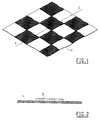
- Figure 1 is a partial view of the face of a composite covering sheet of the invention on which are visible in a purely illustrative arrangement areas provided with a screen printed or otherwise defined relief layer of an aggregate of an inert material powder bonded to the surface of the substrate sheet by a binder (glue).
- a binder glue
- Figure 2 shows a cross section of the composite sheet of Fig. 1 in the plain I-I.
- an adherent layer 2 of powder of a inert material and of a binder for example a vinilic glue, is formed in areas of the surface of a cellulosic sheet 1 defined by a screen printing (or flexographic or lithographic or doctor-blade) process.
- a screen printing (or flexographic or lithographic or doctor-blade) process is formed in areas of the surface of a cellulosic sheet 1 defined by a screen printing (or flexographic or lithographic or doctor-blade) process.
- the adhered powder may be slightly rolled before subjecting the sheet to a fixing treatment which by producing the polymerization of the binder fixes in a permanent manner the layer 2 of an aggregate of inert material powder over the areas that were precisely defined by the process used for applying the fluid binder.
- the thickness of the screen printed or otherwise defined layer of an aggregate of powder and binder may vary from 100 to 2500 micrometers ( ⁇ m).
- the peculiar nature of the wall covering material of the invention characterized by patterns in relief, effectively hide eventual irregularities of the underlying surface of the wall onto which is glued the composite sheet and such a masking function is enhanced upon applying a finishing coat of paint.
- the structure of the composite covering sheet of the invention and the way it may be fabricated permit to create any graphic design in relief.
- Outstanding aesthetic results may be obtained in a decoration or redecoration work, that could hardly be achieved by the known technique of pregluing a fiberglass cloth on the wall to be used as a painting substrate.
- the highly decorative results may be achieved with intrinsically contained costs when compared with the costs of alternative wall decoration processes of comparable effects.
Landscapes
- Laminated Bodies (AREA)
- Finishing Walls (AREA)
Applications Claiming Priority (2)
| Application Number | Priority Date | Filing Date | Title |
|---|---|---|---|
| ITVA940023A IT1274185B (it) | 1994-07-15 | 1994-07-15 | Sistema di rivestimento murale impiegante un foglio composito incollabile a parete e pitturabile in superficie |
| ITVA940023 | 1994-07-15 |
Publications (2)
| Publication Number | Publication Date |
|---|---|
| EP0692393A2 true EP0692393A2 (fr) | 1996-01-17 |
| EP0692393A3 EP0692393A3 (fr) | 1996-06-12 |
Family
ID=11423306
Family Applications (1)
| Application Number | Title | Priority Date | Filing Date |
|---|---|---|---|
| EP95830303A Withdrawn EP0692393A3 (fr) | 1994-07-15 | 1995-07-14 | Procédé pour le revêtement d'un mur utilisant une feuille composite adhésive qui est susceptible d'être peinte |
Country Status (2)
| Country | Link |
|---|---|
| EP (1) | EP0692393A3 (fr) |
| IT (1) | IT1274185B (fr) |
Cited By (3)
| Publication number | Priority date | Publication date | Assignee | Title |
|---|---|---|---|---|
| DE29707270U1 (de) * | 1997-04-23 | 1997-08-14 | FEDDEMA Furniertechnik GmbH, 32108 Bad Salzuflen | Möbel und Bauelemente mit ebener Oberflächengestaltung |
| EP0764550A3 (fr) * | 1995-09-20 | 1998-07-01 | Dai Nippon Printing Co., Ltd. | Feuille décorative et objet comprenant la feuille décorative |
| WO2001075246A1 (fr) | 2000-03-31 | 2001-10-11 | Neupert, Heiko | Mode operatoire pour produire des couches de sable consolidees presentant des structures, dispositif permettant de mettre en oeuvre ledit procede et couche de sable consolidee, produite selon ledit procede |
Family Cites Families (6)
| Publication number | Priority date | Publication date | Assignee | Title |
|---|---|---|---|---|
| DE847120C (de) * | 1945-11-16 | 1952-08-21 | Karl Loenne Moeller Nielsen | Verfahren zur Herstellung mehrfarbiger Reliefmuster auf einer Unterlage mittels einer koerniges Material enthaltenden fluessigen Grundfarbe |
| US3963847A (en) * | 1972-04-05 | 1976-06-15 | Johns-Manville Corporation | Surface texture for fibrous boards |
| US4163813A (en) * | 1976-04-26 | 1979-08-07 | Sheets James R | Method of preparing and applying artistic, decorative compositions |
| US4353949A (en) * | 1981-04-08 | 1982-10-12 | The Celotex Corporation | Embossable coating and method of producing embossed coated substrate |
| US4983443A (en) * | 1988-08-12 | 1991-01-08 | Armstrong World Industries, Inc. | Embossed and wiped decorative surface coverings |
| FI88136C (fi) * | 1991-02-08 | 1993-04-13 | Suomen Kuitulevy Oy | Foerfarande foer maolning av en skiva, ett massaark eller ett band |
-
1994
- 1994-07-15 IT ITVA940023A patent/IT1274185B/it active IP Right Grant
-
1995
- 1995-07-14 EP EP95830303A patent/EP0692393A3/fr not_active Withdrawn
Non-Patent Citations (1)
| Title |
|---|
| None |
Cited By (3)
| Publication number | Priority date | Publication date | Assignee | Title |
|---|---|---|---|---|
| EP0764550A3 (fr) * | 1995-09-20 | 1998-07-01 | Dai Nippon Printing Co., Ltd. | Feuille décorative et objet comprenant la feuille décorative |
| DE29707270U1 (de) * | 1997-04-23 | 1997-08-14 | FEDDEMA Furniertechnik GmbH, 32108 Bad Salzuflen | Möbel und Bauelemente mit ebener Oberflächengestaltung |
| WO2001075246A1 (fr) | 2000-03-31 | 2001-10-11 | Neupert, Heiko | Mode operatoire pour produire des couches de sable consolidees presentant des structures, dispositif permettant de mettre en oeuvre ledit procede et couche de sable consolidee, produite selon ledit procede |
Also Published As
| Publication number | Publication date |
|---|---|
| ITVA940023A1 (it) | 1996-01-15 |
| IT1274185B (it) | 1997-07-15 |
| ITVA940023A0 (it) | 1994-07-15 |
| EP0692393A3 (fr) | 1996-06-12 |
Similar Documents
| Publication | Publication Date | Title |
|---|---|---|
| JP4268261B2 (ja) | 化粧材およびその製造方法 | |
| US4164598A (en) | Veneer wall covering and method of assembly | |
| US6110317A (en) | Decorative design method and products | |
| BG65622B1 (bg) | Метод за производство на покрития с неравномерен гланцов декориращ ефект | |
| CA2233900A1 (fr) | Procede et dispositif servant a effectuer le revetement d'une bande de papier ou de carton en deplacement | |
| JP2001315286A (ja) | 化粧材 | |
| CA2182560A1 (fr) | Methode et dispositif pour le revetement d'un materiau en bande; le materiau decoratif ainsi obtenu | |
| DE60235831D1 (de) | Verfahren und vorrichtung zur herstellung einer mehrschichtigen beschichtung | |
| EP0692393A2 (fr) | Procédé pour le revêtement d'un mur utilisant une feuille composite adhésive qui est susceptible d'être peinte | |
| JP2003172009A (ja) | 壁装工法 | |
| JP3809702B2 (ja) | 無機系化粧板の製造方法 | |
| EP0390409A1 (fr) | Papier mural et procédé de préparation | |
| CN1249243A (zh) | 门板表面立体雕饰方法 | |
| CA2288031A1 (fr) | Procede et appareil de couchage du papier carton | |
| JPS621548B2 (fr) | ||
| JPS5848347B2 (ja) | 化粧材の製造法 | |
| JP2685913B2 (ja) | 建築用板の製造方法 | |
| JP2869595B2 (ja) | 仕上げ方法 | |
| JPS61211040A (ja) | 光干渉性模様を有する化粧シ−ト | |
| JPH0416813Y2 (fr) | ||
| JP4482512B2 (ja) | 建築物構成要素の加飾方法 | |
| AU2706497A (en) | A method for applying paint to a surface | |
| EP0753417A1 (fr) | Revêtement mural apprêté en vue d'un traitement ultérieur séparé avec un glacis, et nécessaire pour sa mise en oeuvre | |
| JPH09174789A (ja) | 内層にエンボスを有する化粧板とその製造方法 | |
| JPH0427353B2 (fr) |
Legal Events
| Date | Code | Title | Description |
|---|---|---|---|
| PUAI | Public reference made under article 153(3) epc to a published international application that has entered the european phase |
Free format text: ORIGINAL CODE: 0009012 |
|
| AK | Designated contracting states |
Kind code of ref document: A2 Designated state(s): BE DE FR GB LU NL SE |
|
| PUAL | Search report despatched |
Free format text: ORIGINAL CODE: 0009013 |
|
| AK | Designated contracting states |
Kind code of ref document: A3 Designated state(s): BE DE FR GB LU NL SE |
|
| 17P | Request for examination filed |
Effective date: 19961120 |
|
| STAA | Information on the status of an ep patent application or granted ep patent |
Free format text: STATUS: THE APPLICATION HAS BEEN WITHDRAWN |
|
| 18W | Application withdrawn |
Withdrawal date: 19970923 |