EP0693073B1 - Bicyclische ansamycine und ihre verwendung als antitumormittel - Google Patents
Bicyclische ansamycine und ihre verwendung als antitumormittel Download PDFInfo
- Publication number
- EP0693073B1 EP0693073B1 EP94913896A EP94913896A EP0693073B1 EP 0693073 B1 EP0693073 B1 EP 0693073B1 EP 94913896 A EP94913896 A EP 94913896A EP 94913896 A EP94913896 A EP 94913896A EP 0693073 B1 EP0693073 B1 EP 0693073B1
- Authority
- EP
- European Patent Office
- Prior art keywords
- alkyl
- geldanamycin
- demethoxy
- imidazo
- formula
- Prior art date
- Legal status (The legal status is an assumption and is not a legal conclusion. Google has not performed a legal analysis and makes no representation as to the accuracy of the status listed.)
- Expired - Lifetime
Links
Classifications
-
- C—CHEMISTRY; METALLURGY
- C07—ORGANIC CHEMISTRY
- C07D—HETEROCYCLIC COMPOUNDS
- C07D487/00—Heterocyclic compounds containing nitrogen atoms as the only ring hetero atoms in the condensed system, not provided for by groups C07D451/00 - C07D477/00
- C07D487/02—Heterocyclic compounds containing nitrogen atoms as the only ring hetero atoms in the condensed system, not provided for by groups C07D451/00 - C07D477/00 in which the condensed system contains two hetero rings
- C07D487/08—Bridged systems
-
- A—HUMAN NECESSITIES
- A61—MEDICAL OR VETERINARY SCIENCE; HYGIENE
- A61P—SPECIFIC THERAPEUTIC ACTIVITY OF CHEMICAL COMPOUNDS OR MEDICINAL PREPARATIONS
- A61P35/00—Antineoplastic agents
Definitions
- This invention relates to novel bicyclic ansamycins, pharmaceutical compositions comprising such compounds and the use of such compounds for the manufacture of oncogene product inhibitors and antitumor agents.
- the bicyclic ansamycins of this invention are derivatives of the antibiotic geldanamycin, which is known to be useful against certain microorganisms, primarily yeast and fungi.
- Geldanamycin is referred to in U.S. Patent 3,595,955.
- Semisynthetic derivatives of geldanamycin and their use as antitumor agents are described in Japanese Patent Application JP 88041885, which was published on August 19, 1988, Japanese Patent Application JP 56100766, which was published on August 12, 1981 and Japanese Patent Application JP 89002593, which was published on January 18, 1989.
- Bioorganic Chemistry, 6 (3), 353-69 (1977) discloses phenazine and phenoxazinone derivatives of geldanamycin as potential polymerase inhibitors.
- U.S. Patent No. 3,987,035 relates to various biologically active geldanamycin derivatives.
- This invention relates to compounds of the formula wherein the dotted lines between the carbon atoms at positions "4" and "5" and between X and the carbon at position "11" represent optional double bonds;
- the present invention also relates to the pharmaceutically acceptable acid addition salts of compounds of the formula I.
- the acids that may be used to prepare the pharmaceutically acceptable acid addition salts of the aforementioned base compounds of this invention are those that form non-toxic acid addition salts, i.e., salts containing pharmacologically acceptable anions, such as the hydrochloride, hydrobromide, hydroiodide, nitrate, sulfate or bisulfate, phosphate or acid phosphate, acetate, lactate, citrate or acid citrate, tartrate or bitartrate, succinate, maleate, fumarate, gluconate, saccharate, benzoate, methanesulfonate, ethanesutfonate, benzenesulfonate, p-toluene sulfonate and pamoate [i.e., 1,1'-methylene-bis-(2-hydroxy-3-naphthoate)]salts.
- halo as used herein, unless otherwise indicated, includes chloro, fluoro, bromo and iodo.
- alkyl as used herein, unless otherwise indicated, includes saturated monovalent hydrocarbon radicals having straight, branched or cyclic moieties or combinations thereof.
- one or more substituents includes from one to the maximum number of substituents possible based on the number of available bonding sites.
- Preferred compounds of the formula I include those wherein: (a) each of R 1 and R 2 is methyl and X is hydroxy; (b) R 1 is methyl, R 2 is benzyl and X is hydroxy, or (c) R 1 and R 2 , together with the nitrogen to which they are attached, form a 4-methylpiperidine ring, and X is hydroxy.
- This invention also relates to a pharmaceutical composition
- a pharmaceutical composition comprising an oncogene product inhibiting or an antitumor effective amount of a compound of the formula I, or a pharmaceutically acceptable salt thereof, and a pharmaceutically acceptable carrier.
- This invention also relates to:
- Scheme 1 above illustrates a method of preparing compounds of the formula I wherein R 3 is hydrogen and X is hydroxy. These compounds are hereinafter referred to as “compounds of the formula IA”. Scheme 1 also illustrates the preparation of compounds of the formula I wherein R 3 is other than hydrogen and X is hydroxy. These compounds are hereinafter referred to (and depicted in Scheme 1) as "compounds of the formula IB".
- the appropriate 1,1-disubstituted guanidinium salt for example a hydrobromide, hydrochloride or sulfate (e.g. 1,1-dimethyl guanidine hydrochloride)
- a strong base such as sodium hydride or an alkoxide like potassium tert-butoxide
- a polar aprotic solvent such as dimethylformamide (DMF), dimethylacetamide (DMAC) or N-methyl pyrrolidone (NMP)
- a compound of the formula II which is geldanamycin when there is a double bond between the carbons at positions "4" and "5" and 4,5-dihydro-geldanamycin when there is a single bond between these carbons
- a compound of the formula II which is geldanamycin when there is a double bond between the carbons at positions "4" and "5" and 4,5-dihydro-geldanamycin when there is a single bond between these carbons
- This reaction is typically conducted at a temperature from about 0°C to about 40°C for a period of about 1 hour to about 50 hours. Usually, it is sufficient and preferable, as a matter of convenience, for the reaction to be carried out at room temperature for about 24 hours.
- the compounds of the formula IA produced by the above reaction can be alkylated at the nitrogen at position "22" to form the corresponding compounds of the formula I wherein X is hydroxy and R 3 is other than hydrogen.
- Such compounds are hereinafter referred to (and depicted in Scheme 1) as "compounds of the formula IB".
- the alkylation is generally accomplished by treatment with base, such as lower alkoxide, in a polar solvent, for example, DMF, dimethylsulfoxide (DMSO), NMP or DMAC, followed by reaction with an appropriate alkylating agent such as a compound of the formula R 3 X wherein X is chloro, bromo or iodo.
- Reaction temperatures are usually maintained between 5 and 65°C., and are preferably between about 5-25°C.
- alkylations can be accomplished by reacting the compounds of formula IA with an alkyl halide of formula R 3 X in acetone with anhydrous potassium carbonate at the reflux temperature.
- Scheme 2 illustrates the preparation of compounds of the formula I wherein R 3 is hydrogen and X is other than hydroxy from the corresponding compounds of the formula IA.
- compounds of the formula IA can be converted into the corresponding compounds of the formula I wherein X is fluorine (hereinafter referred to and depicted in Scheme 2 as "compounds of the formula IC") by reacting them with diethylaminosulfurtrifluoride (DAST).
- DAST diethylaminosulfurtrifluoride
- This reaction is generally performed in an inert solvent (e.g., methylene chloride, chloroform or dichloroethane) at a temperature from about -78 to 0°C, preferably from about -78 to -50°C.
- an inert solvent e.g., methylene chloride, chloroform or dichloroethane
- halogen derivatives of compounds of the formula IA i.e., those derivatives wherein X is chloro, bromo or iodo, may be prepared by reacting the corresponding hydroxy compounds with a conventional halogenating agent (e.g., sulfuryl chloride, a boron trihalide, phosphorous tribromide or another phosphorous halide) using methods that are well known in the art.
- a conventional halogenating agent e.g., sulfuryl chloride, a boron trihalide, phosphorous tribromide or another phosphorous halide
- Solvents suitable for use in these reactions include a wide variety of aprotic polar and non-polar media, for example acetone, chloroform, ethyl acetate, dimethylformamide (DMF), pyridine, tetrahydrofuran.
- Bases that may be used include 1,8-diazabicyclo[5.4.0]undec-7-ene (DBU), triethylamine and 4-dimethylaminopyridine.
- compounds of the formula IA can be converted into the corresponding compounds of the formula I wherein R 3 is hydrogen and X is oxo or oximo (hereinafter referred to and depicted in Scheme 2 as "compounds of the formula IE") as follows.
- the oxo derivatives may be prepared by treating the compounds of formula IA with a standard oxidizing reagent such as pyridinium chlorochromate, pyridinium dichromate, oxalyl chloride/dimethylsulfoxide, Dess-Martin periodinane or Jones reagent in inert solvent such as methylene chloride, chloroform or acetone, at temperatures ranging from about -60°C to about 100°C.
- a standard oxidizing reagent such as pyridinium chlorochromate, pyridinium dichromate, oxalyl chloride/dimethylsulfoxide, Dess-Martin periodinane or Jones reagent in inert solvent such as m
- ketones may be converted to the corresponding oximes by treating them with hydroxylamine hydrochloride in the presence of base (e.g. sodium acetate, pyridine, sodium carbonate, sodium hydroxide, potassium carbonate or triethylamine) in water or a lower alcohol solvent at a temperature from about 0°C to about 100°C.
- base e.g. sodium acetate, pyridine, sodium carbonate, sodium hydroxide, potassium carbonate or triethylamine
- the oxime is formed at room temperature in ethanol with triethylamine.
- the compounds of the formula I that are basic in nature are capable of forming a wide variety of different salts with various inorganic and organic acids. Although such salts must be pharmaceutically acceptable for administration to mammals, it is often desirable in practice to initially isolate a compound of the formula I from the reaction mixture as a pharmaceutically acceptable salt and then simply convert the latter back to the free base compound by treatment with an alkaline reagent, and subsequently convert the free base to a pharmaceutically acceptable acid addition salt.
- the acid additions salts of the base compounds of this invention are readily prepared by treating the base compound with a substantially equivalent amount of the chosen mineral or organic acid in an aqueous solvent medium or in a suitable organic solvent such as methanol or ethanol. Upon careful evaporation of the solvent, the desired solid salt is obtained.
- the compounds of formula I and their pharmaceutically acceptable salts are useful as antitumor agents (including, but not limited to anticancer agents) and oncogene product inhibitors. They are useful, for example, in inhibiting the ErbB-2, src and abl oncogene products. They are also useful in inhibiting certain growth factors that play an important role in uncontrolled cell proliferation such as the epidermal growth factor (EGF) receptor, the nerve growth factor (NGF) receptor, the platelet derived growth factor (PDGF) receptor and the insulin receptor.
- EGF epidermal growth factor
- NGF nerve growth factor
- PDGF platelet derived growth factor
- the ability of compounds of the formula I to inhibit the ErbB-2 oncogene product may be determined by the following method for determining the p185 concentrations in SKBr3 cells.
- SKBr3 human breast cancer cells obtained from the ATTC, Rockville, Maryland were seeded in 8 well tissue culture plates (9.5 cm 2 /well, Falcon, Becton Dickenson, Lincoln Park, NJ) at 5 x 10 5 cells/well in 2 ml McCoys medium, supplemented with 10% fetal calf serum and glutamine. Cells were allowed to attach ovemight at 37°C in a 5% CO 2 atmosphere.
- the compounds are dissolved in DMSO and tested over a range of concentrations by addition to the medium, followed by incubation at 37°C for 6 hours. At the end of the incubation, the medium is aspirated from the well, and the cells are washed twice with 2 ml of TNK buffer (50 mM tris (hydroxymethyl)aminomethane HCI, 140 mM NaCI, 3.3 mM KCI, 0.5 mM sodium orthovanadate, adjusted to pH 7.4).
- TNK buffer 50 mM tris (hydroxymethyl)aminomethane HCI, 140 mM NaCI, 3.3 mM KCI, 0.5 mM sodium orthovanadate, adjusted to pH 7.4
- the cells are then lysed by addition of 250 ⁇ l boiling Laemmli sample buffer (140 mM tris(hydroxymethyl)aminomethane HCl, pH 6.8, 5.7% sodium dodecyl sulfate, 29% glycerol) with shaking.
- the cell lysate is transferred to a tube and then placed in a boiling water bath for 5 mins.
- the lysates are then sonicated with a probe sonicator and stored at -70°C until analysis.
- the p185 concentration of each sample may be determined by standard immunoblotting procedures essentially as described by Harlow and Lane ( Antibodies: A Laboratory Manual , Cold Spring Harbor Laboratory, 1988). A standard portion of each sample is mixed with dithiothreitol (10% added of a 1M solution), and then a portion corresponding to - 10 ⁇ g of protein is blotted onto a nitrocellulose membrane (BA-S, Schleicher and Schuell, Keene, New Hampshire) equilibrated with rinse buffer (10 mM Tris HCl pH 7.4, 150 mM NaCI) by use of a dot blot apparatus (Mini-fold, Schleicher and Schuell, Keene, New Hampshire) with an underlayer of filter paper.
- rinse buffer 10 mM Tris HCl pH 7.4, 150 mM NaCI
- the wells are rinsed with 200 ⁇ l of a rinse buffer, blocked by incubation with a blocking buffer (5% bovine serum albumin, 1% ovalbumin in rinse buffer), and then incubated for 4 to 12 hours with a 1:1000 dilution of NT1, an affinity purified rabbit polyclonal antibody raised by standard methods (Harlow and Lane, Antibodies, A Laboratory Manual , Cold Spring Harbor Laboratory, 1988) against a peptide representing the C-terminal domain of human p185 (sequence, TAENPEYLGLDVPV, by the standard 1 letter amino acid code).
- the membrane is then rinsed twice for 10 minutes with rinse buffer and once for 10 minutes in rinse buffer with 0.05% Triton X-100, and then twice more for 10 minutes in rinse buffer.
- the membrane is then incubated with a 1:3000 dilution of horseradish peroxidase labeled donkey anti-rabbit antibody (Amersham, Arlington Heights, Illinois) in a rinse buffer with shaking for 2045 minutes.
- the membrane is then again rinsed twice for 10 minutes in the rinse buffer, once for 10 minutes in the rinse buffer with 0.05% Triton X-100, and then twice more for 10 minutes in the rinse buffer.
- the p185 is then visualized with the ECL Detection Kit (Amersham, Arlington Heights, Illinois) and recorded with Hyperfilm-ECL (Amersham, Arlington Heights, Illinois).
- the p185 is then estimated by densitometric analysis of the film. IC 50 values are determined by reference to the p185 content of samples of cells exposed only to vehicle (DMSO) and measured as described.
- the ability of compounds of the formula I to inhibit the ErbB-2 oncogene product may also be determined by the method of Kamps et al ., Oncogene, 2 , 305-315 (1988) for determining the phosphorylation of p185 in SKBR3 and other ErbB-2 transformed cell lines.
- the compounds of the formula I and their pharmaceutically acceptable salts are used as antiproliferative agents, such as anticancer agents, they can be administered to a mammalian subject, including a human subject, either alone, or, preferably, in combination with pharmaceutically-acceptable carriers or diluents in a pharmaceutical composition according to standard pharmaceutical practice.
- the compounds can be administered orally or parenterally.
- Parenteral administration includes intravenous, intramuscular, intraperitoneal, subcutaneous and topical administration.
- the compound can be administered, for example, in the form of tablets or capsules, or as an aqueous solution or suspension.
- carriers which are commonly used include lactose and com starch, and lubricating agents, such as magnesium stearate, are commonly added.
- useful diluents are lactose and dried com starch.
- aqueous suspensions are required for oral use, the active ingredient is combined with emulsifying and suspending agents. If desired, certain sweetening and/or flavoring agents can be added.
- sterile solutions of the active ingredient are usually prepared, and the pH of the solutions should be suitably adjusted and buffered.
- the total concentration of solutes should be controlled to render the preparation isotonic.
- the weight ratio of carrier to active ingredient will normally be in the range from 1:10 to 10:1. However, in any given case, the ratio chosen will depend on such factors as the solubility of the active component, the dosage contemplated and the precise route of administration.
- the daily dosage will normally be determined by the prescribing physician. Moreover, the dosage will vary according to the age, weight and response of the individual patient, as well as the severity of the patient's symptoms and the potency of the particular compound being administered. However, the effective dose in most instances will be 0.01 to 1.0 g as needed (e.g, every four to six hours). For chronic administration, in most instances an effective dose will be from 0.01 to 1.0 g per day in single or divided doses. On the other hand, it may be necessary to use dosages outside these limits in some cases.
- 1,1-Dimethylguanidinium sulfate (Aldrich, 0.7314 g, 2.676 mmol) was ground to a fine powder with mortar and pestle, added to a flame dried flask under nitrogen and slurried in 10 mL dimethylformamide. Potassium tert-butoxide (Aldrich, 0.600 g, 5.35 mmol) was added and the reaction was stirred at room temperature for 10 minutes.
- Geldanamycin (0.500 g, 0.892 mmol) was added and the reaction immediately tumed purple. The reaction was stirred ovemight and the color changed from purple to dark green.
- the reaction was diluted with 100 mL ethyl acetate and washed with 0.36 mL acetic acid in 50 mL water, followed by brine (3 x 50 mL), and water (2 x 50 mL). The organic layer was dried over magnesium sulfate, filtered, and evaporated to dryness.
- the green residue was purified by flash column chromatography on 400 g of silica gel using 3% methanol/97% chloroform as eluent to afford a green residue which was dissolved in a minimal amount of chloroform and precipitated with hexane, filtered and dried in vacuo; 0.384 g, (72%), m.p. 231°C (dec).
- Example 2-11 were prepared by the method of Example 1 starting with the appropriate guanidinium salt and the appropriate geldanamycin.
- Example 2 The title compound was obtained by the method of Example 1 starting with 1-amidino-2'-hydroxymethyl-azetidine (Giannis et al , Angew . Chem . Int . Ed. , 28 , 218 (1989)) and geldanamycin and was purified by flash column chromatography using 200 g silica gel eluting with 5% methanol/95% chloroform. The green residue was dissolved in a minimal amount of chloroform and precipitated with hexane, filtered and dried in vacuo; 0.539 g, (24%), m.p. 214°C (dec).
- the title compound was prepared from the guanidine of Example 1 and 4,5-dihydrogeldanamycin; 0.32 g, (15%) m.p. 208°C (dec).
- the reaction was diluted with 100 mL ethyl acetate and washed with 0.356 mL acetic acid in 50 ml water, followed by brine (3 x 50 mL) and water (2 x 50 mL). The organic layer was dried over magnesium sulfate, filtered and evaporated to dryness. The green residue was dissolved in a minimal amount of chloroform and precipitated with hexane, filtered and dried in vacuo; 0.45 g, (19%) m.p. 235°C (dec).
- the reaction was stirred for 36 hours, diluted with 100 mL of ethyl acetate, and washed with water (3 x 50 mL) containing 0.146 mL of acetic acid and then washed with brine (3 x 50 mL).
- the organic layer was dried over magnesium sulfate, filtered and evaporated to a gray/blue solid, 0.85 g (42%), m.p. >270°C.
- the title compound was obtained by following Example 5 using 1,1 diethylguanidinium sulfate (Pant et al ., Z. Pysiolgishe Chemie , 335 , 272 (1964)); 0.12 g, (5%), m.p. 225°C (dec).
- the organic layer was dried over magnesium sulfate, filtered, and evaporated to dryness.
- the green residue was purified by flash column chromatography on 60 gm of silica gel with 3% methanol/97% chloroform to afford a green residue.
- the green residue was dissolved in a minimal amount of chloroform, precipitated with hexane, filtered and dried in vacuo; 0.028 gm, (11%), m.p. 190°C (dec).
- 1-Amidino-azetidine was prepared by reaction of 3,5 dimethylpyrazole-1-carboxamidine (Aldrich, 0.704 g, 3.50 mmol) in 7 mL isoamyl alcohol with azetidine (0.20 g 3.5 mmol). After stirring at room temperature for 7 days, the reaction mixture was evaporated to a cream colored solid. The solid was washed with diethyl ether (3 x 25 mL) dried in vacuo; 0.491 g (86%), m.p. 155-157°C. New title compound was obtained by the method of Example 1; 0.048 gm, (22%), m.p. 230°C (dec).
- Example 9 The product of Example 9 (0.100 g, 0 164 mmol) was acetylated by treatment with acetic anhydride (0.033 g, 0.328 mmol, 0.030 mL) 4-dimethylaminopyridine (0.020 g, 0.164 mmol) and triethylamine (0.050 g, 0.492 mmol, 0.069 mL) at room temperature in 3 mL of methylene chloride for 24 hours. An additional equivalent each of acetic anhydride and triethylamine were added and stirring was continued for 54 hours. The reaction was poured into 150 mL of water and extracted with 2 x 150 mL of ethyl acetate.
- the title compound was prepared by the method of Example 1 from 1-amidino-azetidine hydrochloride and 4,5-dihydrogeldanamycin.
Landscapes
- Organic Chemistry (AREA)
- Chemical & Material Sciences (AREA)
- Health & Medical Sciences (AREA)
- Life Sciences & Earth Sciences (AREA)
- Medicinal Chemistry (AREA)
- Nuclear Medicine, Radiotherapy & Molecular Imaging (AREA)
- General Chemical & Material Sciences (AREA)
- Pharmacology & Pharmacy (AREA)
- Chemical Kinetics & Catalysis (AREA)
- Animal Behavior & Ethology (AREA)
- General Health & Medical Sciences (AREA)
- Public Health (AREA)
- Veterinary Medicine (AREA)
- Pharmaceuticals Containing Other Organic And Inorganic Compounds (AREA)
- Nitrogen Condensed Heterocyclic Rings (AREA)
- Heterocyclic Carbon Compounds Containing A Hetero Ring Having Oxygen Or Sulfur (AREA)
Claims (10)
- Verbindung der Formelworin die gepunkteten Linien zwischen den Kohlenstoffatomen in Stellungen "4" und "5" und zwischen X und dem Kohlenstoffatom in Stellung "11" gegebenenfalls vorliegende Doppelbindungen wiedergeben;
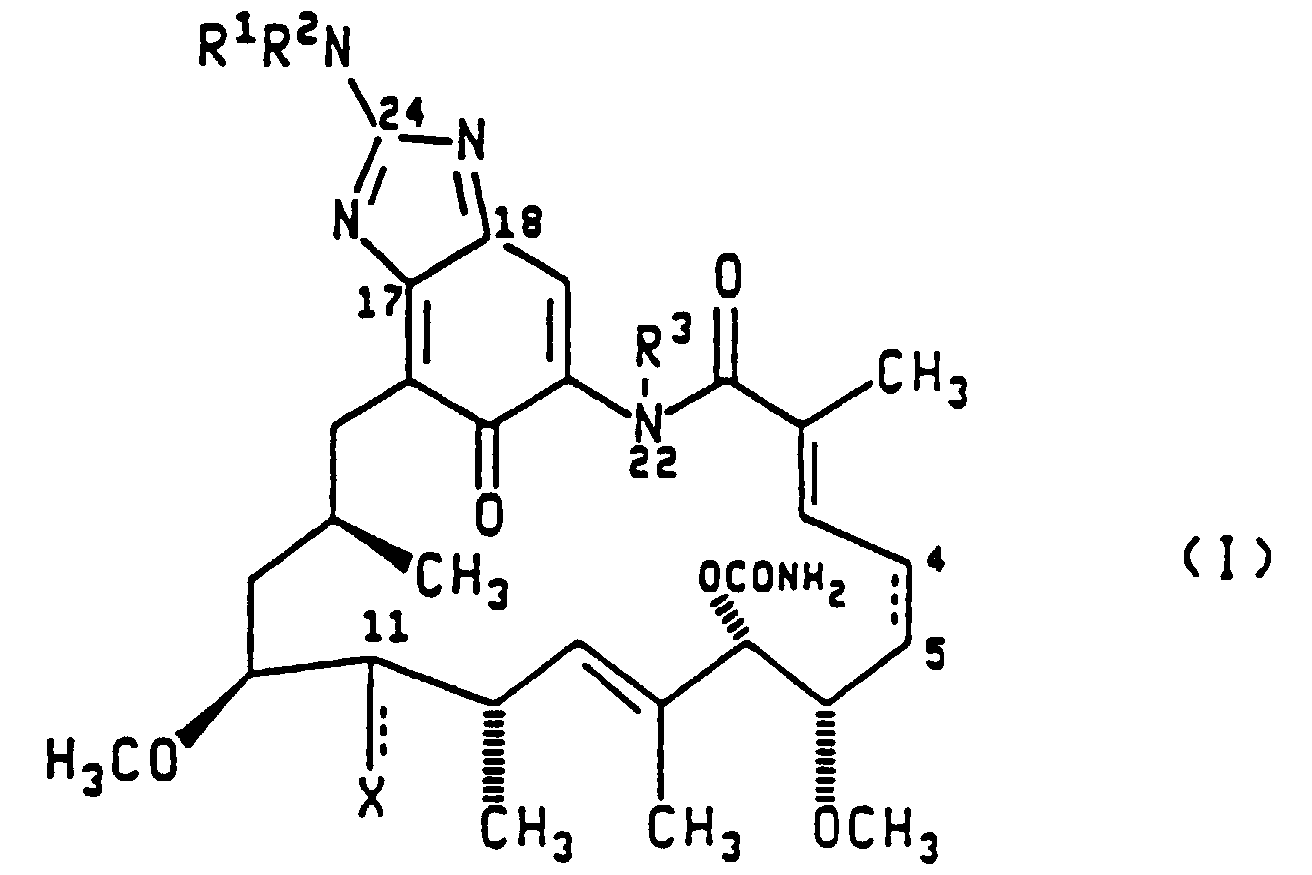 oder ein pharmazeutisch verträgliches Salz davon.und worin R1 und R2 unabhängig ausgewählt sind aus Wasserstoff, (C1-C8)-Alkyl, (C1-C8)-Alkenyl, (C1-C8)-Alkinyl, (C3-C7)-Cycloalkyl und Phenyl-(C1-C3)-alkyl, wobei die Phenyleinheit der Phenyl-(C1-C3)-alkylgruppe gegebenenfalls mit einem bis drei Substituenten, unabhängig ausgewählt aus Halogen, Azido, Nitro, (C1-C6)-Alkyl, (C1-C6)-Alkoxy, Aryl, Cyano und NR4R5R6, worin R4, R5 und R6 unabhängig ausgewählt sind aus Wasserstoff und (C1-C6)-Alkyl, substituiert sein kann;oder R1 und R2 zusammen mit dem Stickstoffatom, an das sie gebunden sind, einen heterocyclischen Ring, ausgewählt aus Aziridin, Azetidin, Pyrrolidin, Thiazolidin, Oxazolidin, Piperidin, Morpholin, Piperazin, 4-(C1-C4)-Alkylpiperidin, N-(C1-C6)-Alkylpiperazin und N-Benzylpiperazin, bilden können;R3 Wasserstoff oder eine Gruppe der Formelworin R7, R8 und R9 unabhängig ausgewählt sind aus Wasserstoff, Halogen, Azido, Nitro, (C1-C8)-Alkyl, (C1-C8)-Alkoxy, Aryl, Cyano und NR10R11R12, worin R10, R11 und R12 unabhängig ausgewählt sind aus Wasserstoff und (C1-C3)-Alkyl, darstellt;
 X Halogen oder OR13 darstellt, wenn eine Einfachbindung zwischen X und dem Kohlenstoffatom in Stellung "11" vorliegt, und X Oxo(=O) oder Oximino(=NOH) darstellt, wenn eine Doppelbindung zwischen X und dem Kohlenstoffatom in Stellung "11" vorliegt;R13 ausgewählt ist aus der Gruppe, bestehend aus Wasserstoff, R14C(=O), R14SO2 und R15R16NSO2NHC(=O);R14 ausgewählt ist aus der Gruppe, bestehend aus Wasserstoff, (C1-C8)-Alkyl, Amino(C1-C8)-alkyl, Hydroxy(C1-C8)-alkyl und Aryl, worin der Arylrest ausgewählt ist aus Phenyl und Naphthyl und worin der Aryl-, (C1-C8)-Alkylrest und die Alkyleinheiten des Amino(C1-C8)-alkyl- und Hydroxy(C1-C8)-alkylrestes mit einem oder mehreren Substituenten, vorzugsweise mit null bis drei Substituenten, unabhängig ausgewählt aus (C1-C8)-Alkyl, Halogen, Amino, Nitro, Azido, Hydroxy und (C1-C8)-Alkoxy, substituiert sein können; undR15 und R16 unabhängig ausgewählt sind aus Wasserstoff, (C1-C8)-Alkyl, (C1-C8)-Alkenyl, (C3-C7)-Cycloalkyl, Amino-(C1-C8)-alkyl, Hydroxy-(C1-C8)-alkyl und Methoxy-(C1-C8)-alkyl;oder R15 und R16 zusammen mit dem Stickstoffatom, an das sie gebunden sind, einen heterocyclischen Ring, ausgewählt aus Aziridin, Azetidin, Pyrrolidin, Thiazolidin, Oxazolidin, Piperidin, Morpholin, Piperazin, 4-(C1-C4)-Alkylpiperidin, N-(C1-C6)-Alkylpiperazin und N-Benzylpiperazin, bilden;
 - Verbindung nach Anspruch 1, worin: (a) jeder der Reste R1 und R2 Methyl darstellt und X Hydroxy darstellt; (b) R1 Methyl darstellt, R2 Benzyl darstellt und X Hydroxy darstellt, oder (c) R1 und R2 zusammen mit dem Stickstoffatom, an das sie gebunden sind, einen 4-Methylpiperidinring bilden und X Hydroxy darstellt.
- Verbindung nach Anspruch 1, worin die Verbindung ausgewählt ist aus der Gruppe, bestehend aus:17-Desmethoxy-24-dimethylamino-17,18-imidazo-geldanamycin;17-Desmethoxy-24-(2'-hydroxymethylazetidin)-17,18-imidazo-geldanamycin;17-Desmethoxy-4,5-dihydro-24-dimethylamino-17,18-imidazo-geldanamycin;17-Desmethoxy-17,18-imidazo-24-morpholin-geldanamycin;24-Amino-17-desmethoxy-17,18-imidazo-geldanamycin;17-Desmethoxy-24-diethylamino-17,18-imidazo-geldanamycin;17-Desmethoxy-17,18-imidazo-24-(4-methyl-piperidin)-geldanamycin;24-Benzylmethylamino-17-desmethoxy-17,18-imidazo-geldanamycin;24-Azetidin-17-desmethoxy-17,18-imidazo-geldanamycin;11-Acetyl-24-azetidin-17-desmethoxy-17,18-imidazogeldanamycin; und24-Azetidin-17-desmethoxy-4,5-dihydro-17,18-imidazogeldanamycin.
- Pharmazeutische Zusammensetzung, umfassend eine Oncogenprodukt-inhibierende oder eine gegen Tumor wirksame Menge einer Verbindung der Formel (I) oder ein pharmazeutisch verträgliches Salz davon nach Anspruch 1, 2 oder 3 und einen pharmazeutisch verträglichen Träger oder ein pharmazeutisch verträgliches Verdünnungsmittel.
- Verbindung der Formel (I) oder ein pharmazeutisch verträgliches Salz davon nach Anspruch 1, 2 oder 3 zur Verwendung als Arzneimittel.
- Verwendung einer Verbindung der Formel (I) oder eines pharmazeutisch verträglichen Salzes davon nach Anspruch 1, 2 oder 3 zur Herstellung eines Arzneimittels zur Inhibierung eines Oncogenprodukts in einem Säuger, einschließlich einem Menschen.
- Verwendung nach Anspruch 6, wobei das Oncogenprodukt das ErbB-2-Oncogenprodukt ist.
- Verwendung einer Verbindung der Formel (I) oder eines pharmazeutisch verträglichen Salzes davon nach Anspruch 1, 2 oder 3 zur Herstellung eines Arzneimittels zur Behandlung oder Verhinderung von Krebs in einem Säuger, einschließlich einem Menschen.
- Verwendung nach Anspruch 8, wobei der Krebs menschlicher Brust-, Eierstock- oder Pankreaskrebs ist.
- Verwendung einer Verbindung der Formel (I) oder eines pharmazeutisch verträglichen Salzes davon nach Anspruch 1, 2 oder 3 zur Herstellung eines Arzneimittels zur Verhinderung oder Inhibierung des Wachstums eines Tumors in einem Säuger, einschließlich einem Menschen.
Applications Claiming Priority (3)
| Application Number | Priority Date | Filing Date | Title |
|---|---|---|---|
| US44521 | 1993-04-07 | ||
| US08/044,521 US5387584A (en) | 1993-04-07 | 1993-04-07 | Bicyclic ansamycins |
| PCT/US1994/002546 WO1994022867A1 (en) | 1993-04-07 | 1994-03-14 | Bicyclic ansamycins and their use as antitumor agents |
Publications (2)
| Publication Number | Publication Date |
|---|---|
| EP0693073A1 EP0693073A1 (de) | 1996-01-24 |
| EP0693073B1 true EP0693073B1 (de) | 1998-06-03 |
Family
ID=21932854
Family Applications (1)
| Application Number | Title | Priority Date | Filing Date |
|---|---|---|---|
| EP94913896A Expired - Lifetime EP0693073B1 (de) | 1993-04-07 | 1994-03-14 | Bicyclische ansamycine und ihre verwendung als antitumormittel |
Country Status (10)
| Country | Link |
|---|---|
| US (1) | US5387584A (de) |
| EP (1) | EP0693073B1 (de) |
| JP (1) | JP2722280B2 (de) |
| AT (1) | ATE166877T1 (de) |
| CA (1) | CA2160137C (de) |
| DE (1) | DE69410790T2 (de) |
| DK (1) | DK0693073T3 (de) |
| ES (1) | ES2116594T3 (de) |
| FI (1) | FI106028B (de) |
| WO (1) | WO1994022867A1 (de) |
Families Citing this family (65)
| Publication number | Priority date | Publication date | Assignee | Title |
|---|---|---|---|---|
| US6852496B1 (en) * | 1997-08-12 | 2005-02-08 | Oregon Health And Science University | Methods of screening for agents that promote nerve cell growth |
| US5968921A (en) * | 1997-10-24 | 1999-10-19 | Orgegon Health Sciences University | Compositions and methods for promoting nerve regeneration |
| US6747055B1 (en) * | 1998-07-17 | 2004-06-08 | The United States Of America As Represented By The Department Of Health And Human Services | Water-soluble drugs and methods for their production |
| WO2000003737A2 (en) | 1998-07-17 | 2000-01-27 | The United States Of America, Represented By The Secretary, Department Of Health And Human Services | Water-soluble drugs and methods for their production |
| US20020182268A1 (en) * | 1998-12-07 | 2002-12-05 | Bessette Steven M. | Cancer treatment compositions and method using natural plant essential oils |
| ATE526019T1 (de) * | 2000-07-28 | 2011-10-15 | Sloan Kettering Inst Cancer | Verfahren zur behandlung von zellproliferationen störungen und virusinfektionen |
| US7439359B2 (en) * | 2000-11-02 | 2008-10-21 | Sloan-Kettering Institute For Cancer Research | Small molecule compositions for binding to hsp90 |
| AU2002228772B2 (en) | 2000-11-02 | 2005-12-08 | Sloan Kettering Institute For Cancer Research | Methods for enhancing the efficacy of cytotoxic agents through the use of HSP90 inhibitors |
| CA2440809A1 (en) * | 2001-03-01 | 2002-09-12 | Conforma Therapeutics Corp. | Methods for treating genetically-defined proliferative disorders with hsp90 inhibitors |
| WO2002094196A2 (en) * | 2001-05-23 | 2002-11-28 | Sloan Kettering Institute For Cancer Research | Method of treatment for cancers associated with elevated |
| US20090197852A9 (en) * | 2001-08-06 | 2009-08-06 | Johnson Robert G Jr | Method of treating breast cancer using 17-AAG or 17-AG or a prodrug of either in combination with a HER2 inhibitor |
| US6872715B2 (en) | 2001-08-06 | 2005-03-29 | Kosan Biosciences, Inc. | Benzoquinone ansamycins |
| EP1923061A1 (de) | 2001-09-24 | 2008-05-21 | Conforma Therapeutic Corporation | Verfahren zur Herstellung eines 17-Allyl-amino-Geldanamycins (17-AAG) und anderer Ansamycine |
| CA2460498A1 (en) * | 2001-09-24 | 2003-04-03 | Conforma Therapeutics Corporation | Process for preparing 17-allyl amino geldanamycin (17-aag) and other ansamycins |
| US7261875B2 (en) | 2001-12-21 | 2007-08-28 | Board Of Regents, The University Of Texas System | Dendritic poly (amino acid) carriers and methods of use |
| WO2003066005A2 (en) * | 2002-02-08 | 2003-08-14 | Conforma Therapeutics Corporation | Ansamycins having improved pharmacological and biological properties |
| CA2481683A1 (en) * | 2002-04-10 | 2003-10-23 | Conforma Therapeutics Corporation | Ansamycin formulations and methods for producing and using same |
| US20060148776A1 (en) * | 2003-03-13 | 2006-07-06 | Conforma Therapeutics Corporation | Drug formulations having long and medium chain triglycerides |
| US20050020534A1 (en) * | 2003-05-30 | 2005-01-27 | Kosan Biosciences, Inc. | Method for treating diseases using HSP90-inhibiting agents in combination with antimetabolites |
| US20050026893A1 (en) * | 2003-05-30 | 2005-02-03 | Kosan Biosciences, Inc. | Method for treating diseases using HSP90-inhibiting agents in combination with immunosuppressants |
| US20050020557A1 (en) * | 2003-05-30 | 2005-01-27 | Kosan Biosciences, Inc. | Method for treating diseases using HSP90-inhibiting agents in combination with enzyme inhibitors |
| US20050054625A1 (en) * | 2003-05-30 | 2005-03-10 | Kosan Biosciences, Inc. | Method for treating diseases using HSP90-inhibiting agents in combination with nuclear export inhibitors |
| US7691838B2 (en) * | 2003-05-30 | 2010-04-06 | Kosan Biosciences Incorporated | Method for treating diseases using HSP90-inhibiting agents in combination with antimitotics |
| US20050020556A1 (en) * | 2003-05-30 | 2005-01-27 | Kosan Biosciences, Inc. | Method for treating diseases using HSP90-inhibiting agents in combination with platinum coordination complexes |
| US20050054589A1 (en) * | 2003-05-30 | 2005-03-10 | Kosan Biosciences, Inc. | Method for treating diseases using HSP90-inhibiting agents in combination with antibiotics |
| US7241754B2 (en) * | 2003-06-13 | 2007-07-10 | Kosan Biosciences, Inc. | 2-Desmethyl ansamycin compounds |
| CN100404029C (zh) * | 2003-09-25 | 2008-07-23 | 中国医学科学院医药生物技术研究所 | 格尔德霉素(c-3559)在制备疱疹病毒生殖道感染药物中的应用 |
| US6855705B1 (en) | 2003-11-12 | 2005-02-15 | Kosan Biosciences, Inc. | 11-O-methylgeldanamycin compounds |
| US6875863B1 (en) | 2003-11-12 | 2005-04-05 | Kosan Biosciences, Inc. | 11-O-methylgeldanamycin compounds |
| US6887993B1 (en) | 2003-11-12 | 2005-05-03 | Kosan Biosciences, Inc. | 11-O-methylgeldanamycin compounds |
| US6870049B1 (en) | 2003-11-12 | 2005-03-22 | Kosan Biosciences, Inc. | 11-O-methylgeldanamycin compounds |
| US20060019941A1 (en) * | 2003-12-23 | 2006-01-26 | Infinity Pharmaceuticals, Inc. | Analogs of benzoquinone-containing ansamycins and methods of use thereof |
| AU2004309395C1 (en) * | 2003-12-23 | 2012-10-04 | Infinity Discovery, Inc. | Analogs of benzoquinone-containing ansamycins for the treatment of cancer |
| WO2005072766A2 (en) * | 2004-01-27 | 2005-08-11 | Boys Town National Research Hospital | Peptides that bind to hsp90 proteins |
| US20080171687A1 (en) * | 2004-09-16 | 2008-07-17 | Abraxis Bioscience, Inc. | Compositions And Methods For The Preparation And Administration Of Poorly Water Soluble Drugs |
| US20060067953A1 (en) * | 2004-09-29 | 2006-03-30 | Conforma Therapeutics Corporation | Oral pharmaceutical formulations and methods for producing and using same |
| AU2006230447A1 (en) * | 2005-03-30 | 2006-10-05 | Conforma Therapeutics Corporation | Alkynyl pyrrolopyrimidines and related analogs as HSP90-inhibitors |
| BRPI0608661A2 (pt) * | 2005-04-07 | 2010-01-19 | Conforma Therapeutics Corp | formulaÇço farmacÊutica, uso de formulaÇço farmacÊutica, e, mÉtodo de preparaÇço de uma formulaÇço farmacÊutica |
| MX2007013494A (es) * | 2005-04-29 | 2008-01-24 | Kosan Biosciences Inc | Metodo para tratar mieloma multiple utilizando 17-aag o 17-ag o un profarmaco de ya sea 17-aag o 17-ag. |
| KR20080007642A (ko) * | 2005-04-29 | 2008-01-22 | 코산 바이오사이언시즈, 인코포레이티드 | 프로테아좀 억제제와 함께 17-aag 또는 17-ag 또는 둘중 하나의 전구약물을 사용하여 다발성 골수종을 치료하는방법 |
| US20080032719A1 (en) * | 2005-10-01 | 2008-02-07 | Outland Research, Llc | Centralized establishment-based tracking and messaging service |
| US20100279994A1 (en) * | 2005-06-21 | 2010-11-04 | Inifinity Discovery, Inc. | Ansamycin Formulations and Methods of Use Thereof |
| WO2008020815A1 (en) | 2006-08-15 | 2008-02-21 | Agency For Science, Technology And Research | Mesenchymal stem cell conditioned medium |
| WO2007035963A2 (en) * | 2005-09-23 | 2007-03-29 | Conforma Therapeutics Corporation | Anti-tumor methods using multi drug resistance independent synthetic hsp90 inhibitors |
| JP2009518302A (ja) * | 2005-12-01 | 2009-05-07 | コンフォーマ・セラピューティクス・コーポレイション | アンサマイシン含有組成物 |
| PE20081506A1 (es) | 2006-12-12 | 2008-12-09 | Infinity Discovery Inc | Formulaciones de ansamicina |
| EP2121957A4 (de) * | 2007-01-26 | 2010-11-10 | Kosan Biosciences Inc | Durch industrielle biosynthese gewonnene makrolactame |
| WO2008128063A1 (en) * | 2007-04-12 | 2008-10-23 | Infinity Discovery, Inc. | Hydroquinone ansamycin formulations |
| JP5454943B2 (ja) * | 2007-04-12 | 2014-03-26 | ジョイアント ファーマスーティカルズ、インク. | 抗癌剤として有用なsmac模倣二量体及び三量体 |
| JP2011501731A (ja) * | 2007-09-10 | 2011-01-13 | ユニバーシティ オブ マサチューセッツ | ミトコンドリア標的化抗腫瘍剤 |
| WO2009086170A1 (en) * | 2007-12-21 | 2009-07-09 | Joyant Pharmaceuticals, Inc. | Diazonamide analogs with improved solubility |
| EP2254586B1 (de) | 2008-02-22 | 2015-04-08 | Agency For Science, Technology And Research (A*star) | Mesenchym-stammzellenteilchen |
| JP2011514169A (ja) | 2008-03-17 | 2011-05-06 | エージェンシー フォー サイエンス,テクノロジー アンド リサーチ | 幹細胞培養のためのマイクロキャリア |
| CN102014632B (zh) * | 2008-04-29 | 2014-05-28 | 焦阳特制药股份有限公司 | 吲哚啉抗癌剂 |
| US8153619B2 (en) * | 2008-05-22 | 2012-04-10 | Joyant Pharmaceuticals, Inc. | Diazonamide analogs |
| KR20110090925A (ko) | 2008-10-15 | 2011-08-10 | 인피니티 파마슈티컬스, 인코포레이티드 | 안사마이신 하이드로퀴논 조성물 |
| WO2011040421A1 (ja) | 2009-09-29 | 2011-04-07 | 武田薬品工業株式会社 | スクリーニング方法 |
| US8551955B2 (en) | 2009-10-28 | 2013-10-08 | Joyant Pharmaceuticals, Inc. | Dimeric Smac mimetics |
| WO2011053257A2 (en) | 2009-11-02 | 2011-05-05 | Agency For Science, Technology And Research (A*Star) | Methods of monitoring cellular states |
| SG183579A1 (en) | 2011-02-11 | 2012-09-27 | Agency Science Tech & Res | Methods of detecting therapeutic exosomes |
| CN103582645B (zh) | 2011-04-22 | 2016-02-24 | 焦阳特制药股份有限公司 | 二氢氧茚吲哚类似物 |
| WO2014055624A1 (en) | 2012-10-02 | 2014-04-10 | The General Hospital Corporation D/B/A Massachusetts General Hospital | Methods relating to dna-sensing pathway related conditions |
| CN112472699A (zh) | 2013-07-26 | 2021-03-12 | 种族肿瘤学公司 | 改善比生群及衍生物的治疗益处的组合方法 |
| WO2015140005A1 (en) | 2014-03-19 | 2015-09-24 | Ifom Fondazione Istituto Firc Di Oncologia Molecolare | Method of generation of pluripotent cells |
| US20190231694A1 (en) | 2016-10-12 | 2019-08-01 | Agency For Science, Technology And Research | Method for lyophilising an exosome |
Family Cites Families (2)
| Publication number | Priority date | Publication date | Assignee | Title |
|---|---|---|---|---|
| US3987035A (en) * | 1974-04-05 | 1976-10-19 | University Of Illinois Foundation | Biologically active compounds |
| US4261989A (en) * | 1979-02-19 | 1981-04-14 | Kaken Chemical Co. Ltd. | Geldanamycin derivatives and antitumor drug |
-
1993
- 1993-04-07 US US08/044,521 patent/US5387584A/en not_active Expired - Fee Related
-
1994
- 1994-03-14 CA CA002160137A patent/CA2160137C/en not_active Expired - Fee Related
- 1994-03-14 JP JP6522084A patent/JP2722280B2/ja not_active Expired - Fee Related
- 1994-03-14 WO PCT/US1994/002546 patent/WO1994022867A1/en not_active Ceased
- 1994-03-14 ES ES94913896T patent/ES2116594T3/es not_active Expired - Lifetime
- 1994-03-14 DK DK94913896T patent/DK0693073T3/da active
- 1994-03-14 DE DE69410790T patent/DE69410790T2/de not_active Expired - Fee Related
- 1994-03-14 EP EP94913896A patent/EP0693073B1/de not_active Expired - Lifetime
- 1994-03-14 AT AT94913896T patent/ATE166877T1/de not_active IP Right Cessation
- 1994-04-06 FI FI941580A patent/FI106028B/fi not_active IP Right Cessation
Also Published As
| Publication number | Publication date |
|---|---|
| WO1994022867A1 (en) | 1994-10-13 |
| DE69410790D1 (de) | 1998-07-09 |
| CA2160137C (en) | 1999-02-09 |
| US5387584A (en) | 1995-02-07 |
| JPH08503960A (ja) | 1996-04-30 |
| FI941580L (fi) | 1994-10-08 |
| DE69410790T2 (de) | 1998-10-01 |
| ES2116594T3 (es) | 1998-07-16 |
| DK0693073T3 (da) | 1998-10-12 |
| ATE166877T1 (de) | 1998-06-15 |
| FI106028B (fi) | 2000-11-15 |
| CA2160137A1 (en) | 1994-10-13 |
| EP0693073A1 (de) | 1996-01-24 |
| FI941580A0 (fi) | 1994-04-06 |
| JP2722280B2 (ja) | 1998-03-04 |
Similar Documents
| Publication | Publication Date | Title |
|---|---|---|
| EP0693073B1 (de) | Bicyclische ansamycine und ihre verwendung als antitumormittel | |
| EP3924058B1 (de) | 5-alkyl-pyrrolidinorexinrezeptor-agonisten | |
| US5932566A (en) | Ansamycin derivatives as antioncogene and anticancer agents | |
| EP1572113B1 (de) | Calcium-rezeptor-modulierende verbindung und ihre verwendung | |
| EP1637521B1 (de) | Neue tricyclische heterocyclusverbindung | |
| EP3923933A1 (de) | Pyrrolidinorexin-rezeptor-agonisten | |
| KR19990022572A (ko) | 약제로서의 (r)-(z)-1-아자비시클로[2.2.1]헵탄-3-온,o-[3-(3-메톡시페닐)-2-프로피닐]옥심 말레산염 | |
| EP0706516A1 (de) | Ansamycin-derivate als antionkogene und antikrebsmittel | |
| EP3774781B1 (de) | Neuartige albicidinderivate, deren verwendung und synthese | |
| EP0776891A1 (de) | Pyrrolylbenzimidazol-Derivate | |
| EP3356361B1 (de) | Hydroxyalkylthiadiazolderivate | |
| EP0417751A2 (de) | Thiazolderivate, Verfahren zu deren Herstellung und pharmazeutische Zusammensetzungen, die sie enthalten | |
| US10647725B2 (en) | Anti-infective 2-aminothiophenes | |
| JP7257697B2 (ja) | 新規アルビシジン誘導体、それらの使用および合成 | |
| EP0520435A2 (de) | Derivate der Verbindung DC 89 | |
| TWI275588B (en) | 1-trifluoromethyl-4-hydroxy-7-piperidinylaminomethylchroman derivatives | |
| JP2011511811A (ja) | 抗菌性フルオロキノロンのアナログ | |
| EP1457492B1 (de) | Kristalle von taxanderivaten und verfahren zu deren herstellung | |
| CA2319032C (en) | New cytotoxic tris(oxazole)-containing macrolides | |
| EP1381591A2 (de) | Bestimmte salze von discodermolid?säure, diese enthaltende pharmazeutische zusammensetzungen und deren verwendung bei der behandlung von tumoren | |
| US5321035A (en) | Piperidine derivatives and process for preparation thereof | |
| EP4249486A1 (de) | Albicidinderivate, deren verwendung und synthese | |
| CZ229595A3 (en) | Bicyclic oxazole and thiazole substituted ethers | |
| EP0499130A1 (de) | Derivate der Verbindung DC-89 | |
| HK1252275B (en) | Hydroxyalkyl thiadiazole derivatives |
Legal Events
| Date | Code | Title | Description |
|---|---|---|---|
| PUAI | Public reference made under article 153(3) epc to a published international application that has entered the european phase |
Free format text: ORIGINAL CODE: 0009012 |
|
| 17P | Request for examination filed |
Effective date: 19951003 |
|
| AK | Designated contracting states |
Kind code of ref document: A1 Designated state(s): AT BE CH DE DK ES FR GB GR IE IT LI LU NL PT SE |
|
| 17Q | First examination report despatched |
Effective date: 19960412 |
|
| GRAG | Despatch of communication of intention to grant |
Free format text: ORIGINAL CODE: EPIDOS AGRA |
|
| GRAG | Despatch of communication of intention to grant |
Free format text: ORIGINAL CODE: EPIDOS AGRA |
|
| GRAH | Despatch of communication of intention to grant a patent |
Free format text: ORIGINAL CODE: EPIDOS IGRA |
|
| GRAH | Despatch of communication of intention to grant a patent |
Free format text: ORIGINAL CODE: EPIDOS IGRA |
|
| GRAA | (expected) grant |
Free format text: ORIGINAL CODE: 0009210 |
|
| AK | Designated contracting states |
Kind code of ref document: B1 Designated state(s): AT BE CH DE DK ES FR GB GR IE IT LI LU NL PT SE |
|
| REF | Corresponds to: |
Ref document number: 166877 Country of ref document: AT Date of ref document: 19980615 Kind code of ref document: T |
|
| REG | Reference to a national code |
Ref country code: CH Ref legal event code: EP |
|
| REG | Reference to a national code |
Ref country code: CH Ref legal event code: NV Representative=s name: E. BLUM & CO. PATENTANWAELTE |
|
| REF | Corresponds to: |
Ref document number: 69410790 Country of ref document: DE Date of ref document: 19980709 |
|
| REG | Reference to a national code |
Ref country code: ES Ref legal event code: FG2A Ref document number: 2116594 Country of ref document: ES Kind code of ref document: T3 |
|
| ITF | It: translation for a ep patent filed | ||
| ET | Fr: translation filed | ||
| REG | Reference to a national code |
Ref country code: IE Ref legal event code: FG4D |
|
| REG | Reference to a national code |
Ref country code: DK Ref legal event code: T3 |
|
| REG | Reference to a national code |
Ref country code: PT Ref legal event code: SC4A Free format text: AVAILABILITY OF NATIONAL TRANSLATION Effective date: 19980731 |
|
| PLBE | No opposition filed within time limit |
Free format text: ORIGINAL CODE: 0009261 |
|
| STAA | Information on the status of an ep patent application or granted ep patent |
Free format text: STATUS: NO OPPOSITION FILED WITHIN TIME LIMIT |
|
| 26N | No opposition filed | ||
| REG | Reference to a national code |
Ref country code: GB Ref legal event code: IF02 |
|
| PGFP | Annual fee paid to national office [announced via postgrant information from national office to epo] |
Ref country code: PT Payment date: 20050127 Year of fee payment: 12 |
|
| PGFP | Annual fee paid to national office [announced via postgrant information from national office to epo] |
Ref country code: GR Payment date: 20050128 Year of fee payment: 12 |
|
| PGFP | Annual fee paid to national office [announced via postgrant information from national office to epo] |
Ref country code: DK Payment date: 20050207 Year of fee payment: 12 Ref country code: AT Payment date: 20050207 Year of fee payment: 12 |
|
| PGFP | Annual fee paid to national office [announced via postgrant information from national office to epo] |
Ref country code: NL Payment date: 20050209 Year of fee payment: 12 |
|
| PGFP | Annual fee paid to national office [announced via postgrant information from national office to epo] |
Ref country code: LU Payment date: 20050223 Year of fee payment: 12 |
|
| PGFP | Annual fee paid to national office [announced via postgrant information from national office to epo] |
Ref country code: FR Payment date: 20050302 Year of fee payment: 12 |
|
| PGFP | Annual fee paid to national office [announced via postgrant information from national office to epo] |
Ref country code: SE Payment date: 20050303 Year of fee payment: 12 Ref country code: CH Payment date: 20050303 Year of fee payment: 12 |
|
| PGFP | Annual fee paid to national office [announced via postgrant information from national office to epo] |
Ref country code: BE Payment date: 20050412 Year of fee payment: 12 |
|
| PGFP | Annual fee paid to national office [announced via postgrant information from national office to epo] |
Ref country code: IE Payment date: 20060125 Year of fee payment: 13 |
|
| PGFP | Annual fee paid to national office [announced via postgrant information from national office to epo] |
Ref country code: GB Payment date: 20060206 Year of fee payment: 13 |
|
| PG25 | Lapsed in a contracting state [announced via postgrant information from national office to epo] |
Ref country code: AT Free format text: LAPSE BECAUSE OF NON-PAYMENT OF DUE FEES Effective date: 20060314 |
|
| PG25 | Lapsed in a contracting state [announced via postgrant information from national office to epo] |
Ref country code: SE Free format text: LAPSE BECAUSE OF NON-PAYMENT OF DUE FEES Effective date: 20060315 |
|
| PGFP | Annual fee paid to national office [announced via postgrant information from national office to epo] |
Ref country code: ES Payment date: 20060321 Year of fee payment: 13 |
|
| PGFP | Annual fee paid to national office [announced via postgrant information from national office to epo] |
Ref country code: DE Payment date: 20060330 Year of fee payment: 13 |
|
| PG25 | Lapsed in a contracting state [announced via postgrant information from national office to epo] |
Ref country code: LU Free format text: LAPSE BECAUSE OF NON-PAYMENT OF DUE FEES Effective date: 20060331 Ref country code: LI Free format text: LAPSE BECAUSE OF NON-PAYMENT OF DUE FEES Effective date: 20060331 Ref country code: DK Free format text: LAPSE BECAUSE OF NON-PAYMENT OF DUE FEES Effective date: 20060331 Ref country code: CH Free format text: LAPSE BECAUSE OF NON-PAYMENT OF DUE FEES Effective date: 20060331 Ref country code: BE Free format text: LAPSE BECAUSE OF NON-PAYMENT OF DUE FEES Effective date: 20060331 |
|
| PGFP | Annual fee paid to national office [announced via postgrant information from national office to epo] |
Ref country code: IT Payment date: 20060331 Year of fee payment: 13 |
|
| PG25 | Lapsed in a contracting state [announced via postgrant information from national office to epo] |
Ref country code: PT Free format text: LAPSE BECAUSE OF NON-PAYMENT OF DUE FEES Effective date: 20060914 |
|
| PG25 | Lapsed in a contracting state [announced via postgrant information from national office to epo] |
Ref country code: NL Free format text: LAPSE BECAUSE OF NON-PAYMENT OF DUE FEES Effective date: 20061001 |
|
| REG | Reference to a national code |
Ref country code: DK Ref legal event code: EBP |
|
| REG | Reference to a national code |
Ref country code: CH Ref legal event code: PL |
|
| EUG | Se: european patent has lapsed | ||
| REG | Reference to a national code |
Ref country code: PT Ref legal event code: MM4A Free format text: LAPSE DUE TO NON-PAYMENT OF FEES Effective date: 20060914 |
|
| NLV4 | Nl: lapsed or anulled due to non-payment of the annual fee |
Effective date: 20061001 |
|
| GBPC | Gb: european patent ceased through non-payment of renewal fee |
Effective date: 20070314 |
|
| REG | Reference to a national code |
Ref country code: IE Ref legal event code: MM4A |
|
| BERE | Be: lapsed |
Owner name: *PFIZER INC. Effective date: 20060331 |
|
| REG | Reference to a national code |
Ref country code: FR Ref legal event code: ST Effective date: 20071130 |
|
| PG25 | Lapsed in a contracting state [announced via postgrant information from national office to epo] |
Ref country code: IE Free format text: LAPSE BECAUSE OF NON-PAYMENT OF DUE FEES Effective date: 20070314 Ref country code: DE Free format text: LAPSE BECAUSE OF NON-PAYMENT OF DUE FEES Effective date: 20071002 |
|
| PG25 | Lapsed in a contracting state [announced via postgrant information from national office to epo] |
Ref country code: GB Free format text: LAPSE BECAUSE OF NON-PAYMENT OF DUE FEES Effective date: 20070314 |
|
| REG | Reference to a national code |
Ref country code: ES Ref legal event code: FD2A Effective date: 20070315 |
|
| PG25 | Lapsed in a contracting state [announced via postgrant information from national office to epo] |
Ref country code: FR Free format text: LAPSE BECAUSE OF NON-PAYMENT OF DUE FEES Effective date: 20070402 Ref country code: ES Free format text: LAPSE BECAUSE OF NON-PAYMENT OF DUE FEES Effective date: 20070315 |
|
| PG25 | Lapsed in a contracting state [announced via postgrant information from national office to epo] |
Ref country code: FR Free format text: LAPSE BECAUSE OF NON-PAYMENT OF DUE FEES Effective date: 20060331 |
|
| PG25 | Lapsed in a contracting state [announced via postgrant information from national office to epo] |
Ref country code: GR Free format text: LAPSE BECAUSE OF NON-PAYMENT OF DUE FEES Effective date: 20061002 |
|
| PG25 | Lapsed in a contracting state [announced via postgrant information from national office to epo] |
Ref country code: IT Free format text: LAPSE BECAUSE OF NON-PAYMENT OF DUE FEES Effective date: 20070314 |