EP0694877A2 - Système et méthode de compression irréversible de données pour images en mode point - Google Patents
Système et méthode de compression irréversible de données pour images en mode point Download PDFInfo
- Publication number
- EP0694877A2 EP0694877A2 EP95305310A EP95305310A EP0694877A2 EP 0694877 A2 EP0694877 A2 EP 0694877A2 EP 95305310 A EP95305310 A EP 95305310A EP 95305310 A EP95305310 A EP 95305310A EP 0694877 A2 EP0694877 A2 EP 0694877A2
- Authority
- EP
- European Patent Office
- Prior art keywords
- block
- size
- cell
- cells
- image
- Prior art date
- Legal status (The legal status is an assumption and is not a legal conclusion. Google has not performed a legal analysis and makes no representation as to the accuracy of the status listed.)
- Granted
Links
Images





Classifications
-
- G—PHYSICS
- G06—COMPUTING OR CALCULATING; COUNTING
- G06T—IMAGE DATA PROCESSING OR GENERATION, IN GENERAL
- G06T9/00—Image coding
- G06T9/005—Statistical coding, e.g. Huffman, run length coding
Definitions
- the present invention generally relates to an irreversible compression system and method for a bit map image, and more particularly, but not exclusively, to an irreversible compression system and method for obtaining uniform picture quality.
- bit map image data processing using printers or the like there is a known method employing irreversible compression for storing data of an entire image in a memory by reducing the size of bit map data when the quantity of the bit map data of the entire image exceeds the capacity of the memory.
- the method involves dividing a bit map into small cells, each having a fixed size, for example, 4 x 4 pixels, and converting the dot pattern of each cell into compressed data.
- a host computer transmits one page of bit map data to a printer
- the data for the entire page are not necessarily transmitted together.
- a one page image comprises a large volume of data, such as a graphics image
- the data is divided into blocks according to the quantity of data that the host computer can process at one time, and the image data are transmitted block by block to the printer.
- the host computer determines the method of dividing the data into blocks, making it possible for the printer to control the division.
- bit map image data are sent in blocks to the printer, if it becomes necessary for the printer to perform irreversible compression of the transmitted bit map image data, cells will be separated one after the other from the end of the received block, and the thus separated cells will then be converted into a compressed code in the conventional printer.
- each block may have a slightly different tone in a printed image if the irreversibly compressed data are restored to the original bit map in accordance with the conventional irreversible compression method. Since the block usually has a long narrow band shape, a band-shaped uneven tone eventually appears in the printed image when each block has a different tone.
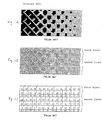
- bit map image is similar to that shown in Fig. 1A.
- a ruled line in each direction shows a boundary between pixels.
- a black pixel is represented by a printed dot, while a white pixel is represented by a non-printed dot.
- an external device transmitted this image to a printer after having divided the image into two blocks as shown in Fig. 1B.
- the printer has divided each of the first and second blocks into cells as indicated by a bold solid line, each cell consisting of 4 x 4 pixels, beginning from the upper left corner of each block.
- each cell consisting of 4 x 4 pixels, beginning from the upper left corner of each block.
- the number of pixels in the vertical direction of each block is indivisible by four, and hence cells having incomplete sizes, i.e., less than 4 x 4 pixels, will arise in the bottom row of each block.
- the printer then converts each cell into a compressed code (sixteen stages in this example), as shown in Fig. 1C.
- the compressed codes are next restored to dot patterns, whereby the bit map image is printed.
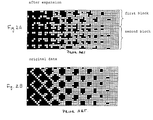
- Fig. 2A shows a print obtained as a result of restoring the compressed codes of Fig. 1C
- Fig. 2B shows a print obtained as a result of directly printing the original image shown in Fig. 1A.
- the image of Fig. 2A i.e., the image obtained as a result of restoring the compressed codes of Fig. 1C
- the image of Fig. 2A is slightly deformed with respect to the direct printing of the original image as shown in Fig. 2B. This is a result of the irreversible compression.
- each of the first and second blocks of Fig. 2A has differently deformed dot patterns.
- the original image shown in Fig. 2B has the repetition of the same dot patterns in the vertical direction of the image, namely, a continuous even tone in the vertical direction.
- such a vertical continuity disappears along the border between the first and second blocks in the expanded image shown in Fig. 2A, thereby resulting in different tones.
- the previously mentioned band-shaped uneven tones appear in the image of Fig. 2A.
- phase difference is attributed to the fact that the starting position of the cells in the second block is shifted with respect to the original dot patterns by the number of incomplete cells produced in the bottom row of the first block (two pixels in this example).
- the deformation of the original dot patterns resulting from the compression and expansion differs from block to block, so that each block has a different tone.
- An object of the present invention is to make it possible to obtain even picture quality throughout the entire image by preventing each block from having different picture quality in an expanded image when blocked bit map image data are subjected to irreversible compression block by block and the thus compressed data are again expanded.
- Another object of the present invention is to provide a printer for carrying out irreversible compression of blocked image data block by block upon receipt of the blocked image data, which provides even picture quality throughout the entire image by preventing a difference in picture quality in each block of a printed image when the compressed data are expanded to print.
- an irreversible compression system comprising fetching means for fetching cells of bit map data from first and second adjacent blocks of bit map data, each of the fetched cells having a predetermined cell size, and converting means for converting each of the fetched cells to compressed code, wherein, when the size of the first block of bit map data is indivisible by the predetermined cell size, the fetching means fetches from the first block a first incomplete cell having a first reduced size and fetches from the second block a second incomplete cell, the second incomplete cell being adjacent the first incomplete cell and having a second reduced size such that the sum of the first reduced size and the second reduced size is equal to the predetermined cell size.
- a data compression device comprising: means for receiving data divided into blocks; means for dividing each block into cells; and means for providing a compressed representation of the data in each cell; characterised in that: the means for dividing each block into cells is such that complete cells are divided from the data at regular intervals.
- the fetching means includes means for calculating horizontal and vertical offsets when the size of the first block of bit map data is indivisible by the predetermined cell size, and means for calculating the second reduced size in accordance with the horizontal and vertical offsets.
- the means for calculating the second reduced size includes means for calculating a leading address of the second reduced cell by subtracting the vertical and horizontal offsets from an address of a leading end pixel of the second block.
- an irreversible compression method comprising the steps of fetching cells of bit map data from first and second adjacent blocks of bit map data, each of the fetched cells having a predetermined cell size, and converting each of the fetched cells to compressed code, wherein when the size of the first block of bit map data is indivisible by the predetermined cell size, a first incomplete cell having a first reduced size is fetched from the first block and a second incomplete cell is fetched from the second block, the second incomplete cell being adjacent the first incomplete cell and having a second reduced size such that the sum of the first reduced size and the second reduced size is equal to the predetermined cell size.
- the fetching step includes the steps of calculating horizontal and vertical offsets when the size of the first block of bit map data is indivisible by the predetermined cell size, and calculating the second reduced size in accordance with the horizontal and vertical offsets.
- the step of calculating the second reduced size includes the step of calculating a leading address of the second reduced cell by subtracting the vertical and horizontal offsets from an address of a leading end pixel of the second block.
- each block has a different cell array. Therefore, the cells are not positioned only in one way with respect to the entire image. As a result of this, each block has a different phase between the original dot patterns and the cells, and therefore each block has a different tone. Because in an embodiment of the present invention the cells are positioned only in one way with respect to the entire image, the phase between the original dot patterns and the cells becomes the same. Hence, the original identical tone is reproduced as the same tone.
- a printer upon receipt of one block of blocked image data from a host computer, divides coordinates X and Y of the leading end pixel of that block on print paper by the number of pixels in one side of a cell, i.e., four, the cell serving as a unit of irreversible compression.
- the resultant remainders RX and RY are taken as horizontal and vertical offsets of that block B.
- An address obtained by subtracting the offsets RX and RY from an address ADD of the leading end pixel of that block, is set to become the leading address of the first cell, and then cells are fetched from the block.
- a dot pattern of each cell is converted into a compressed code. In other words, each block is divided into cells relative to the position of the block on print paper, and each cell is subjected to irreversible compression.
- Fig. 3 shows one embodiment of a page printer 1 employing an irreversible compression system and method according to the present invention.
- the printer 1 comprises an interface 5 for receiving image data from a host computer 3; a CPU 7 for processing the received image data; a ROM 9 for storing an operation program 91 of the CPU 7, dot patterns 93 for use in expanding compressed data (which will be described later), and font data 95, such as characters and symbols; a RAM 11 having an image storage area 111 for storing bit map image data (hereinafter referred to as a bit image) for one page, an image management area 113 for storing parameters (which will be described later) for the management of images, and a work area 115; a print engine 15 having a mechanism for carrying out a printing process; and an image output circuit 13 for outputting a bit image to the print engine 15.
- a bit map image data hereinafter referred to as a bit image
- a print engine 15 having a mechanism for carrying out a printing process
- an image output circuit 13 for outputting
- a printer driver included within the host computer 3 determines the size of an image block to be processed at one time based on the capacity of the host computer's RAM (S1).
- a bit image of the image block is produced by the host computer 3 and stored in an image expansion memory located within the host computer 3 (S2).
- the bit image of the image block, the position of the image block on print paper, and the size of the image block are transferred to the printer 1 by the host computer 3 (S3).
- the foregoing steps are repeated for all data to be processed (S4).
- the printer 1 Upon receipt of data from the host computer 3 (S11), the printer 1 analyzes a command included in the data (S12), and determines whether or not the command is a page break command (S13). If the command is not a page break command, the printer 1 determines whether or not the received data are bit image data (S14). If the received data are not bit image data, the printer 1 processes commands other than the bit image, prepares intermediate codes relating to characters and symbols, or executes other processes (S15), and continues to receive additional data from the host computer 3.
- the printer 1 determines whether or not both the image management area 113 and the image storage area 111 of the RAM 11 have sufficient capacity to handle the processing of the data, i.e., whether or not the image management area 113 and the image storage area 111 can be "ensured” (S16 and S17). If these areas are ensured, parameters (which will be described later) are generated based on the data received from the host computer 3 and are stored in the image management area 113 (S18). In addition, the received bit image data are stored in the image storage area 111 (S19).
- the bit image data stored in the image storage area 111 will be subjected to irreversible compression (S22).
- S22 irreversible compression
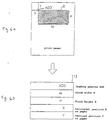
- Figs. 6A and 6B show the generation of parameters executed in step S18 of Fig. 5.
- the host computer 3 transmits a bit image to the printer 1 in blocks
- information relating to the position of the block on paper as well as the size of the block is also transmitted, together with the bit image.
- the printer 1 obtains an address ADD (leading address) of the upper left pixel (head end) of the block B, a horizontal position X and a vertical position Y of the head end of the block B with respect to the upper left edge of the paper, and a horizontal width W and a vertical height H of the block B.
- ADD leading address
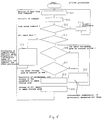
- Fig. 7 shows the steps performed during execution of the irreversible compression processing executed in step S22 of Fig. 5.
- the horizontal position X and the vertical position Y of the block to be compressed are read out from the image management area 113, and the positions are divided by the selected number of pixels (four in this embodiment) in both the vertical and horizontal directions. Each group of pixels thus divided constitutes a cell serving as a unit of compression. Remainders RX and RY are obtained when the positions are not divisible by the selected number of pixels, and these remainders are set as horizontal and vertical offsets (S31).
- the positional relationship (phase) between the first cell and the block is determined such that an address obtained as a result of the subtraction of the offsets RX and RY from the leading address ADD of the block matches the leading address of the first cell of that block.
- Each cell is fetched from the bit image of that block within the image storage area 111 (S32).
- the horizontal offset RX of the block B is one pixel
- the vertical offset RY is three pixels
- the horizontal width W is 26 pixels
- the vertical height H is 14 pixels.
- the sizes of the cells located along the upper, lower, left, and right edges of the block B do not form complete 4 x 4 pixels cells and are, therefore, incomplete. If there is another block adjoining any one of the upper, lower, left, and right sides of the block B, however, cells within the block B and cells within the adjoining block will be matched in position with each other to complete any incomplete cells. In other words, the cell arrangement positioned only in one way with respect to the entire image is applied to all of the blocks.
- each cell is converted into a compressed code.
- the compressed code is again stored in the image storage area 111 (S33).
- the cell is then converted into the compressed code by directly using the number of black pixels in the cell as a compressed code. For example, if the number of black pixels within the cell is zero, its compressed code (decimal notation) is 0. In this way, a compressed code of 1 is obtained for one black pixel, a compressed code of 2 is obtained for two black pixels, ..., a compressed code of 15 is obtained for fifteen black pixels and for sixteen black pixels.
- the number of black pixels is obtained by proportional calculation on the assumption that the size of the cells is 4 x 4 pixels. The thus obtained number of black pixels is used as a compressed code.
- Fig. 9 shows the steps executed during the output processing executed in step S20 of Fig. 5.
- the image data are in the form of intermediate codes, a bit image, or the foregoing compressed codes. Even if there is a partially uncompressed bit image in the image data, the uncompressed image is once subjected to irreversible compression to be matched with compressed portions when the bit image includes the compressed and coded portions.
- the image data are expanded to a bit image for one page or for each band while the intermediate codes of these portions are interpreted (S42). At this time, when the image is a compressed code, the compressed code is restored to a dot pattern using the dot pattern for expansion 93 located within the ROM 9. The dot image obtained through expansion and restoration is output to the print engine 15 (S43), and the dot image is then printed (S44).
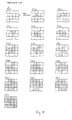
- Fig. 10 shows several examples of the expansion dot pattern 93 used in restoring the compressed code to a dot pattern.
- 16 types of dot patterns each consisting of 4 x 4 pixels and each having a different number of black pixels, are set with respect to a compressed code of 16 stages (hexadecimal notation). These dot patterns are not necessarily matched with the original dot patterns before compression in terms of the arrangement of black pixels, but they are set to be matched with each other in terms of the number of black pixels. If the sizes of the cells obtained after compression are not 4 x 4 pixels, the pixels within the dot patterns corresponding to the incomplete cells will be used.
- Figs. 11A and 11B show the irreversible compression carried out in the above embodiment.
- a printer receives a dot pattern, which is the same as that shown in Fig. 1A, as an original dot pattern.
- the upper left end (top end) of the first block corresponds to the top end of the paper on which the image is to be printed.
- the horizontal and vertical offsets RX and RY of the first block are zero and the leading end of the first cell is positioned at the head end of this block.
- Cells, each having a size of 4 x 4 pixels, are fetched one after the other from the first block.
- incomplete cells of 4 x 2 pixels are fetched from the bottom row of the first block.
- the horizontal and vertical offsets RX and RY are respectively set to 0 and 2, and hence the leading end of the first cell of the second block is positioned at the position shifted by only two pixels from the head end of the second block. Thereafter, cells are fetched one after the other from the second block. Namely, the cells of the second block are positioned so as to be matched with the incomplete cells of the first block.
- Fig. 11B shows a compressed code (in decimal notation) obtained as a result of irreversible compression of each of the cells fetched in the manner as previously mentioned.
- the number of black pixels may, for example, be represented in compressed codes as: the no. of black pixels in the incomplete cell x the no. of pixels in a complete cell the no. of pixels in the incomplete cell
- the data may be expanded such that the number of black pixels in the relevant part of the reproduced image corresponds to the average value of the compressed codes corresponding to two adjacent incomplete cells.
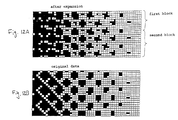
- Fig. 12A shows a print result obtained by the expansion of the compressed code
- Fig. 12B shows the original image.
- the print result shown in Fig. 12A has deformations resulting from compression and expansion when compared with a dot pattern of the original image shown in Fig. 12B.
- the first and second blocks have similar deformations, and there is no difference in deformation between the blocks.
- the tone of the original image remains vertically even in the print result, and there is no uneven tone due to the division of the image into blocks.
- the present invention is applicable not only to printers, but also to computers and various other devices which process bit map images.
- the invention may be particularly advantageous when used with a data compression system in which the encoded data, when expanded, produces a pattern of pixels of each cell which does not necessarily correspond to the original pattern of the pixels, but which gives an indication of the tone thereof.
- the invention may be particularly advantageous when applied to irreversibly compressed data. However, it may be applied to data of other types.
Landscapes
- Engineering & Computer Science (AREA)
- Multimedia (AREA)
- Physics & Mathematics (AREA)
- General Physics & Mathematics (AREA)
- Theoretical Computer Science (AREA)
- Compression Of Band Width Or Redundancy In Fax (AREA)
- Image Processing (AREA)
- Compression, Expansion, Code Conversion, And Decoders (AREA)
- Editing Of Facsimile Originals (AREA)
- Dot-Matrix Printers And Others (AREA)
Applications Claiming Priority (3)
| Application Number | Priority Date | Filing Date | Title |
|---|---|---|---|
| JP175737/94 | 1994-07-27 | ||
| JP17573794 | 1994-07-27 | ||
| JP06175737A JP3116732B2 (ja) | 1994-07-27 | 1994-07-27 | ビットマップ画像の非可逆圧縮方式、および方法 |
Publications (3)
| Publication Number | Publication Date |
|---|---|
| EP0694877A2 true EP0694877A2 (fr) | 1996-01-31 |
| EP0694877A3 EP0694877A3 (fr) | 1996-05-08 |
| EP0694877B1 EP0694877B1 (fr) | 2001-10-17 |
Family
ID=16001372
Family Applications (1)
| Application Number | Title | Priority Date | Filing Date |
|---|---|---|---|
| EP95305310A Expired - Lifetime EP0694877B1 (fr) | 1994-07-27 | 1995-07-27 | Système et méthode de compression irréversible de données pour images en mode point |
Country Status (4)
| Country | Link |
|---|---|
| US (1) | US5815599A (fr) |
| EP (1) | EP0694877B1 (fr) |
| JP (1) | JP3116732B2 (fr) |
| DE (1) | DE69523230T2 (fr) |
Families Citing this family (2)
| Publication number | Priority date | Publication date | Assignee | Title |
|---|---|---|---|---|
| JP3490873B2 (ja) | 1997-10-03 | 2004-01-26 | フーリエ有限会社 | 印刷装置 |
| US7145668B2 (en) * | 2000-12-22 | 2006-12-05 | Canon Kabushiki Kaisha | Print system, printing method, information processing apparatus, printing apparatus, printer driver, and memory medium |
Family Cites Families (10)
| Publication number | Priority date | Publication date | Assignee | Title |
|---|---|---|---|---|
| US4663729A (en) * | 1984-06-01 | 1987-05-05 | International Business Machines Corp. | Display architecture having variable data width |
| US4660029A (en) * | 1984-07-06 | 1987-04-21 | Tektronix, Inc. | Method of providing raster information for a graphics display employing linked lists |
| US4924301A (en) * | 1988-11-08 | 1990-05-08 | Seecolor Corporation | Apparatus and methods for digital halftoning |
| DE3904809A1 (de) * | 1989-02-17 | 1990-08-23 | Philips Patentverwaltung | Verfahren zum verkleinern eines pseudo-halbtonbildes sowie anordnung zur durchfuehrung des verfahrens |
| US5267054A (en) * | 1991-06-26 | 1993-11-30 | Sun Microsystems, Inc. | Method and apparatus for the reduction of memory space required for a digital halftone system |
| JPH05130585A (ja) * | 1991-11-06 | 1993-05-25 | Matsushita Electric Ind Co Ltd | 符号化装置 |
| JPH05316494A (ja) * | 1992-05-06 | 1993-11-26 | Ikegami Tsushinki Co Ltd | 画像データ符号化装置 |
| US5363213A (en) * | 1992-06-08 | 1994-11-08 | Xerox Corporation | Unquantized resolution conversion of bitmap images using error diffusion |
| JP2986292B2 (ja) * | 1992-07-10 | 1999-12-06 | 大日本スクリーン製造株式会社 | 網点形成方法および装置 |
| US5394430A (en) * | 1994-05-03 | 1995-02-28 | Quarton Inc. | Laser module |
-
1994
- 1994-07-27 JP JP06175737A patent/JP3116732B2/ja not_active Expired - Fee Related
-
1995
- 1995-07-12 US US08/501,464 patent/US5815599A/en not_active Expired - Fee Related
- 1995-07-27 EP EP95305310A patent/EP0694877B1/fr not_active Expired - Lifetime
- 1995-07-27 DE DE69523230T patent/DE69523230T2/de not_active Expired - Fee Related
Non-Patent Citations (1)
| Title |
|---|
| None |
Also Published As
| Publication number | Publication date |
|---|---|
| US5815599A (en) | 1998-09-29 |
| EP0694877A3 (fr) | 1996-05-08 |
| EP0694877B1 (fr) | 2001-10-17 |
| JP3116732B2 (ja) | 2000-12-11 |
| DE69523230D1 (de) | 2001-11-22 |
| JPH0839864A (ja) | 1996-02-13 |
| DE69523230T2 (de) | 2002-07-11 |
Similar Documents
| Publication | Publication Date | Title |
|---|---|---|
| EP0422793B1 (fr) | Méthode de changement de taille de graphique pour des imprimantes haute-résolution | |
| US5367620A (en) | Character output device | |
| US8477988B2 (en) | Image processing apparatus, image forming apparatus and computer readable medium | |
| EP0467598B1 (fr) | Système de traitement d'images | |
| US5450096A (en) | Character generating method and apparatus | |
| US5815599A (en) | Irreversible compression system and method for bit map images | |
| JP2007241356A (ja) | 画像処理装置および画像処理プログラム | |
| RU2198430C2 (ru) | Совмещение машиночитаемых кодов с пикселями печатающего устройства | |
| EP0461832B1 (fr) | Procédé et dispositif pour engendrer une configuration de caractère | |
| US7359071B2 (en) | Image data processing device | |
| JPH10313410A (ja) | 画像太線化処理方法および装置 | |
| US5291308A (en) | Image processing apparatus using tonal degree conversion | |
| JPH09167222A (ja) | 画像処理装置 | |
| JP3636891B2 (ja) | カラー画像出力方法 | |
| JP2782752B2 (ja) | 文字パターン出力装置 | |
| JPH11268368A (ja) | 画像処理装置及び方法及び記憶媒体 | |
| JPH03275371A (ja) | 画像処理装置 | |
| JP3294249B2 (ja) | 画像処理装置 | |
| JPH11275357A (ja) | 画像処理方法、画像形成装置および記録媒体 | |
| JP2738189B2 (ja) | 座標変換方法及び座標変換装置 | |
| JP3591096B2 (ja) | ページプリンタの制御方法 | |
| JPH11268369A (ja) | 画像処理装置及び方法及び記憶媒体 | |
| JP3254657B2 (ja) | データ変換装置 | |
| JP2000295459A (ja) | 画像処理装置、画像処理方法、及び、記憶媒体 | |
| JPH10294864A (ja) | 画像分離処理装置 |
Legal Events
| Date | Code | Title | Description |
|---|---|---|---|
| PUAI | Public reference made under article 153(3) epc to a published international application that has entered the european phase |
Free format text: ORIGINAL CODE: 0009012 |
|
| AK | Designated contracting states |
Kind code of ref document: A2 Designated state(s): DE FR GB |
|
| PUAL | Search report despatched |
Free format text: ORIGINAL CODE: 0009013 |
|
| AK | Designated contracting states |
Kind code of ref document: A3 Designated state(s): DE FR GB |
|
| 17P | Request for examination filed |
Effective date: 19961015 |
|
| 17Q | First examination report despatched |
Effective date: 20000127 |
|
| GRAG | Despatch of communication of intention to grant |
Free format text: ORIGINAL CODE: EPIDOS AGRA |
|
| GRAG | Despatch of communication of intention to grant |
Free format text: ORIGINAL CODE: EPIDOS AGRA |
|
| GRAH | Despatch of communication of intention to grant a patent |
Free format text: ORIGINAL CODE: EPIDOS IGRA |
|
| GRAH | Despatch of communication of intention to grant a patent |
Free format text: ORIGINAL CODE: EPIDOS IGRA |
|
| GRAA | (expected) grant |
Free format text: ORIGINAL CODE: 0009210 |
|
| AK | Designated contracting states |
Kind code of ref document: B1 Designated state(s): DE FR GB |
|
| REF | Corresponds to: |
Ref document number: 69523230 Country of ref document: DE Date of ref document: 20011122 |
|
| REG | Reference to a national code |
Ref country code: GB Ref legal event code: IF02 |
|
| ET | Fr: translation filed | ||
| PLBE | No opposition filed within time limit |
Free format text: ORIGINAL CODE: 0009261 |
|
| STAA | Information on the status of an ep patent application or granted ep patent |
Free format text: STATUS: NO OPPOSITION FILED WITHIN TIME LIMIT |
|
| 26N | No opposition filed | ||
| PGFP | Annual fee paid to national office [announced via postgrant information from national office to epo] |
Ref country code: DE Payment date: 20070719 Year of fee payment: 13 |
|
| PGFP | Annual fee paid to national office [announced via postgrant information from national office to epo] |
Ref country code: GB Payment date: 20070725 Year of fee payment: 13 |
|
| PGFP | Annual fee paid to national office [announced via postgrant information from national office to epo] |
Ref country code: FR Payment date: 20070710 Year of fee payment: 13 |
|
| GBPC | Gb: european patent ceased through non-payment of renewal fee |
Effective date: 20080727 |
|
| PG25 | Lapsed in a contracting state [announced via postgrant information from national office to epo] |
Ref country code: DE Free format text: LAPSE BECAUSE OF NON-PAYMENT OF DUE FEES Effective date: 20090203 |
|
| REG | Reference to a national code |
Ref country code: FR Ref legal event code: ST Effective date: 20090331 |
|
| PG25 | Lapsed in a contracting state [announced via postgrant information from national office to epo] |
Ref country code: GB Free format text: LAPSE BECAUSE OF NON-PAYMENT OF DUE FEES Effective date: 20080727 |
|
| PG25 | Lapsed in a contracting state [announced via postgrant information from national office to epo] |
Ref country code: FR Free format text: LAPSE BECAUSE OF NON-PAYMENT OF DUE FEES Effective date: 20080731 |