EP0694977A2 - Dispositif semi-conducteur de type SOI avec suppression de l'extension de la région de depletion - Google Patents
Dispositif semi-conducteur de type SOI avec suppression de l'extension de la région de depletion Download PDFInfo
- Publication number
- EP0694977A2 EP0694977A2 EP95111059A EP95111059A EP0694977A2 EP 0694977 A2 EP0694977 A2 EP 0694977A2 EP 95111059 A EP95111059 A EP 95111059A EP 95111059 A EP95111059 A EP 95111059A EP 0694977 A2 EP0694977 A2 EP 0694977A2
- Authority
- EP
- European Patent Office
- Prior art keywords
- region
- impurity
- layer
- conductivity type
- mis transistor
- Prior art date
- Legal status (The legal status is an assumption and is not a legal conclusion. Google has not performed a legal analysis and makes no representation as to the accuracy of the status listed.)
- Withdrawn
Links
Images

























Classifications
-
- H—ELECTRICITY
- H10—SEMICONDUCTOR DEVICES; ELECTRIC SOLID-STATE DEVICES NOT OTHERWISE PROVIDED FOR
- H10D—INORGANIC ELECTRIC SEMICONDUCTOR DEVICES
- H10D30/00—Field-effect transistors [FET]
- H10D30/01—Manufacture or treatment
- H10D30/021—Manufacture or treatment of FETs having insulated gates [IGFET]
- H10D30/031—Manufacture or treatment of FETs having insulated gates [IGFET] of thin-film transistors [TFT]
- H10D30/0321—Manufacture or treatment of FETs having insulated gates [IGFET] of thin-film transistors [TFT] comprising silicon, e.g. amorphous silicon or polysilicon
- H10D30/0323—Manufacture or treatment of FETs having insulated gates [IGFET] of thin-film transistors [TFT] comprising silicon, e.g. amorphous silicon or polysilicon comprising monocrystalline silicon
-
- H—ELECTRICITY
- H10—SEMICONDUCTOR DEVICES; ELECTRIC SOLID-STATE DEVICES NOT OTHERWISE PROVIDED FOR
- H10D—INORGANIC ELECTRIC SEMICONDUCTOR DEVICES
- H10D30/00—Field-effect transistors [FET]
- H10D30/60—Insulated-gate field-effect transistors [IGFET]
- H10D30/67—Thin-film transistors [TFT]
- H10D30/6704—Thin-film transistors [TFT] having supplementary regions or layers in the thin films or in the insulated bulk substrates for controlling properties of the device
-
- H—ELECTRICITY
- H10—SEMICONDUCTOR DEVICES; ELECTRIC SOLID-STATE DEVICES NOT OTHERWISE PROVIDED FOR
- H10D—INORGANIC ELECTRIC SEMICONDUCTOR DEVICES
- H10D30/00—Field-effect transistors [FET]
- H10D30/60—Insulated-gate field-effect transistors [IGFET]
- H10D30/67—Thin-film transistors [TFT]
- H10D30/6729—Thin-film transistors [TFT] characterised by the electrodes
- H10D30/673—Thin-film transistors [TFT] characterised by the electrodes characterised by the shapes, relative sizes or dispositions of the gate electrodes
- H10D30/6733—Multi-gate TFTs
-
- H—ELECTRICITY
- H10—SEMICONDUCTOR DEVICES; ELECTRIC SOLID-STATE DEVICES NOT OTHERWISE PROVIDED FOR
- H10D—INORGANIC ELECTRIC SEMICONDUCTOR DEVICES
- H10D30/00—Field-effect transistors [FET]
- H10D30/60—Insulated-gate field-effect transistors [IGFET]
- H10D30/67—Thin-film transistors [TFT]
- H10D30/674—Thin-film transistors [TFT] characterised by the active materials
-
- H—ELECTRICITY
- H10—SEMICONDUCTOR DEVICES; ELECTRIC SOLID-STATE DEVICES NOT OTHERWISE PROVIDED FOR
- H10D—INORGANIC ELECTRIC SEMICONDUCTOR DEVICES
- H10D84/00—Integrated devices formed in or on semiconductor substrates that comprise only semiconducting layers, e.g. on Si wafers or on GaAs-on-Si wafers
- H10D84/80—Integrated devices formed in or on semiconductor substrates that comprise only semiconducting layers, e.g. on Si wafers or on GaAs-on-Si wafers characterised by the integration of at least one component covered by groups H10D12/00 or H10D30/00, e.g. integration of IGFETs
- H10D84/82—Integrated devices formed in or on semiconductor substrates that comprise only semiconducting layers, e.g. on Si wafers or on GaAs-on-Si wafers characterised by the integration of at least one component covered by groups H10D12/00 or H10D30/00, e.g. integration of IGFETs of only field-effect components
- H10D84/83—Integrated devices formed in or on semiconductor substrates that comprise only semiconducting layers, e.g. on Si wafers or on GaAs-on-Si wafers characterised by the integration of at least one component covered by groups H10D12/00 or H10D30/00, e.g. integration of IGFETs of only field-effect components of only insulated-gate FETs [IGFET]
- H10D84/85—Complementary IGFETs, e.g. CMOS
-
- H—ELECTRICITY
- H10—SEMICONDUCTOR DEVICES; ELECTRIC SOLID-STATE DEVICES NOT OTHERWISE PROVIDED FOR
- H10D—INORGANIC ELECTRIC SEMICONDUCTOR DEVICES
- H10D86/00—Integrated devices formed in or on insulating or conducting substrates, e.g. formed in silicon-on-insulator [SOI] substrates or on stainless steel or glass substrates
- H10D86/201—Integrated devices formed in or on insulating or conducting substrates, e.g. formed in silicon-on-insulator [SOI] substrates or on stainless steel or glass substrates the substrates comprising an insulating layer on a semiconductor body, e.g. SOI
Definitions
- the present invention relates to a silicon-on-insulator (SOI)-type semiconductor device.
- MOS metal oxide semiconductor
- MIS metal insulator semiconductor
- the gate length has to be reduced; however, in this case, short channel effects are exhibited. That is, the threshold voltage is reduced, a duration between the source-drain is reduced, and the sub threshold current is increased.
- the impurity concentration of a channel region has to be increased. In this case, however, a p-n junction capacitance between a drain region and a substrate is increased, so that a time for charging and discharging the p-n junction capacitance is increased, thus reducing the operation speed.
- SOI-type semiconductor devices have been broadly developed to reduce the above-described p-n junction capacitance.
- a prior art SOI-type semiconductor device includes a monocrystalline silicon substrate of a P-type, for example, having a low impurity concentration, a silicon oxide layer formed on the silicon substrate, and a semiconductor layer including a source region, a drain region and a channel region therebetween. This will be explained later in detail.
- an insulating layer is formed on the semiconductor substrate and a semiconductor layer formed on the insulating layer, and the impurity concentration of at least one part of the semiconductor substrate in the proximity of the insulating layer is rich, i.e., higher than that of the other part of the semiconductor substrate.
- the rich impurity part of the semiconductor substrate prevents the growth of a depletion region toward a region of the semiconductor substrate beneath a channel region of the semiconductor layer.
- reference numeral 1 designates a P ⁇ -type monocrystalline silicon substrate having an impurity concentration of about 1 ⁇ 1015/cm3 on which a silicon oxide layer 2 is formed. Also, formed on the silicon oxide layer 2 is a monocrystalline silicon layer 3. In this case, the silicon oxide layer 2 is about 100 to 500 nm thick, and the monocrystalline silicon layer 3 is about 30 to 150 nm thick.
- Transistor elements such as a MOS transistor are formed in the monocrystalline silicon layer 3 as illustrated in Fig. 2. That is, a source region 3S, a drain region 3D and a channel region 3C therebetween are formed in the monocrystalline silicon layer 3. In this case, the source regions 3S and 3D are of an N+-type. Also, a gate silicon oxide layer 4 is formed on the channel region 3C, and a gate electrode 5 made of N-type impurity doped polycrystalline silicon is formed on the gate silicon oxide layer 4.
- the source region 3S and the drain region 3D reach the silicon oxide layer 2. Therefore, the p-n junction capacitance between the drain region and substrate of a conventional MOS transistor is replaced by the very small capacitance of the silicon oxide layer 2, thus increasing the operation speed simultaneously with reducing the power dissipation as compared with the conventional MOS transistor.
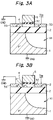
- the channel region 3C is fully depleted in an ON state as illustrated in Fig.3A, and accordingly, this SOI transistor is called a "fully-depleted SOI transistor".
- the maximum thickness of a depletion region in the channel region 3C is smaller than that of the monocrystalline silicon layer 3, the channel region 3C is partially depleted, i.e., a P ⁇ -type neutral region is left in the channel region 3C in an ON state, and accordingly, this SOI transistor is called a "partially-depleted SOI transistor".
- a fully depleted SOI transistor having a thin monocrystalline silicon layer less than approximately 100 nm can effectively suppress the short channel effect (see: Y.Omura et al., "0.1- ⁇ m-gate, Ultrathin-Film CMOS Devices Using SIMOX Substrate with 80-nm-Thick Buried Oxide layer", Technical Digest of IEDM, pp.675-678, 1991).
- the distribution of the depletion region X1 depends upon the thickness of the silicon oxide layer 2, the flat band voltage V FB , the impurity concentration, and the power supply voltage V DD .
- the thinner silicon oxide layer 2 and the lower impurity concentration of the silicon substrate 1 are required to obtain higher performance and higher operation speed of the transistor (see: the Y.Ohmura document).
- a depletion region as indicated by X1 in Figs. 3A and 3B is grown in the substrate 1 beneath the drain region D.
- the thickness of a depletion region in the semiconductor substrate 1 is dependent upon the impurity concentration thereof.
- the thickness of the depletion region X1 is minumum, i.e., the parasitic capacitance between the drain region 3D and the silicon substrate 1 is maximum.
- the maximum parasitic capacitance depends on the thickness of the silicon oxide layer 2.
- the depletion region X1 is grown to reduce the parasitic capacitance between the drain region 3D and the silicon substrate 1.
- the voltage at the gate electrode 5 is increased, a depletion region is grown in the channel region 3C, and finally reaches the silicon oxide layer 2.
- the total capacitance of the transistor is made up of a series of a gate capacitance, a capacitance of the depletion region of the channel region 3C, and a capacitance of the silicon oxide layer 2. Therefore, the threshold voltage of the transistor is strongly influenced by the potential of the silicon substrate 1 beneath the channel region 3C.
- the threshold voltage V th of an N-channel MOS transistor is increased (see: Hyung-Kyu Lim et al., "Threshold voltage of Thin-film Silicon-on-Insulator (SOI) MOSFET's" , IEEE Trans. on Electron Devices, Vol.ED-30, No.10, pp.1244-1251, Oct. 1983), and the carrier mobiliby within the channel region 3C is reduced (see: Donald C. Mayer, "Mode of Operation and Radiation Sensitivity of Ultrathin SOI Transistors", IEEE Trans. on Electron Devices, Vol.37, No.5, pp.1280-1288, May 1990).
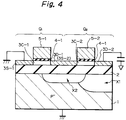
- Figs. 4 which illustrates two MOS transistors Q1 and Q2 connected in series
- the transistors Q1 and Q2 are turned ON.
- the voltage at the drain region 3D-2 of the transistor Q2 which is connected to a parasitic capacitor by a wiring (not shown)
- a depletion region as indicated by X1 is grown in a similar way to that shown in Figs. 3A and 3B.
- a source region 3S-2 of the transistor Q2 i.e., a drain region 3D-1 of the transistor Q1 is charged by a current flowing through the transistor Q2, so that the voltage at the source region 3S-2 (the drain region 3D-1) is increased. Therefore, a depletion region is grown as indicated by X2. This depletion region X2 also reaches beneath the channel regions 3C-1 and 3C-2 of the transistors Q1 and Q2. Thus, the threshold voltages of both the transistors Q 1 and Q2 are reduced, and accordingly, the current drivability thereof is reduced.
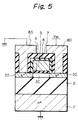
- a P+-type monocrystalline silicon substrate 1' having a high impurity concentration of more than 1 ⁇ 1019/cm3 is provided instead of the P ⁇ -type monocrystalline silicon substrate 1 of Fig. 2.
- the silicon oxide layer 2 is about 400 nm thick
- the monocrystalline silicon layer 3 is about 100 nm thick.
- formed on the gate silicon layer 5 are a thermal silicon oxide layer 6 and a chemical vapor deposition (CVD) silicon oxide layer 7.
- the silicon oxide layers 6 and 7 are perforated, and then an aluminum layer is deposited and patterned to form aluminum wirings 8S and 8D.
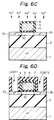
- a silicon oxide layer 2 is formed by thermally oxidizing a impurity lightly doped monocrystalline silicon substrate 3a.
- an impurity highly doped monocrystalline silicon substrate 1' is prepared.
- the silicon oxide layer 2 is adhered to the monocrystalline silicon substrate 1'. Then, the monocrystalline silicon substrate 3a is polished by a chemical mechanical polishing (CMP) or the like, to complete a thin monocrystalline silicon layer 3.
- CMP chemical mechanical polishing
- a gate silicon oxide layer 4 is formed by thermally oxidizing the silicon layer 3, and an N-type impurity doped polycrystalline silicon layer is formed on the entire surface. Then the polycrystalline silicon layer is patterned by a photolithography and dry etching process to form a gate electrode 5. Further, an about 50 nm thick silicon oxide layer 6 is formed by thermally oxidizing the gate electrode 5. Then, N-type impurities such as arsenic are ion-implanted with a mask of the gate electrode 5 into the silicon layer 3 to form a source region 3S and a drain region 3D. In this case, a region the silicon layer 3 sandwiched by the source region 3S and 3D is a channel region 3C.
- an about 500 nm thick silicon oxide layer 7 is formed by a CVD process, and contact holes CONT1 and CONT2 are perforated in the silicon oxide layer 7.
- an aluminum layer is deposited by a sputtering process and is patterned to form aluminum wirings 8S and 8D, thus completing the device of Fig. 5.
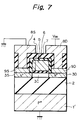
- Fig. 7 which illustrates a second embodiment of the present invention
- monocrystalline silicon layers 9S and 9D are inserted between the aluminum wiring 8S and the source region 3S and between the aluminum wiring 8D and the drain region 3D of Fig. 5. Note that if the silicon layer 3 is made thinner, for example, about 50 nm thick, the parasitic resistance of the source and drain is remarkably increased to reduce the current drivability.
- the monocrystalline silicon layer 9S is provided, so that a current I2 in addition to a current I1 flows from the channel region 3C to the aluminum wiring 9D (9S). Therefore, the parasitic resistance of the source region 3S is reduced, and hence, the parasitic resistance of the source and drain is substantially reduced.
- a silicon oxide layer 2 is formed by thermally oxidizing an impurity lightly doped silicon substrate 3a.
- an impurity highly doped monocrystalline silicon substrate 1' is prepared.
- the silicon oxide layer 2 is adhered to the monocrystalline silicon substrate 1'. Then, the monocrystalline silicon substrate 3a is polished by a CMP process or the like, to complete a thin monocrystalline silicon layer 3.
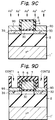
- a gate silicon oxide layer 4 is formed by thermally oxidizing the silicon layer 3, and an N-type impurity doped polycrystalline silicon layer is formed on the entire surface. Then, the silicon oxide layer is patterned by a photolithography and dry etching process to form a gate electrode 5. Further, an about 50 nm thick silicon oxide layer 6 is formed by thermally oxidizing the gate electrode 5. In this case, only the silicon oride layer on the source region 35 and the drain region 3D is removed. Then, about 100 nm thick monocrystalline silicon layers 9S and 9D are grown by a selective epitaxial growth technology.
- N-type impurities such as arsenic are ion-implanted with a mask of the gate electrode 5 into the silicon layer 3 to form a source region 3S and a drain region 3D.
- a region of the silicon layer 3 sandwiched by the source region 3S and the drain region 3D is a channel region 3C.
- Fig. 9D in the same way as shown in Fig. 6D, an about 500 nm thick silicon oxide layer 7 is formed by a CVD process, and contact holes CONT1 and CONT2 are perforated in the silicon oxide layer 7.
- an aluminum layer is deposited by a sputtering process and is patterned to form aluminum wirings 8S and 8D, thus completing the device of Fig. 7.
- Fig. 10 which illustrates a third embodiment of the present invention
- an impurity lightly doped monocrystalline silicon substrate 1 and an about 500 nm thick highly doped monocrystalline silicon layer la are provided instead of the P+-type monocrystalline silicon substrate 1' of Fig. 5.
- the silicon substrate 1 has an impurity concentration of about 1 ⁇ 1015/cm3, while the silicon layer 1a has an impurity concentration higher than 1 ⁇ 1019/cm3.
- the silicon oxide layer 2 is about 100 nm thick, and the monocrystalline silicon layer 3 is about 50 nm thick.
- a SOI substrate formed by an impurity lightly doped P-type monocrystalline silicon substrate 1, a silicon oxide layer 2 and an impurity lightly doped silicon layer 3 is prepared.
- about 4 ⁇ 1017 oxygen ions/cm are implanted at an acceleration energy of about 180 keV into an impurity lightly-doped P-type (100) monocrystalline silicon substrate whose temperature is about 550°C, and thereafter, a heat operation at about 1350°C is performed thereupon for about six hours.
- the SOI substrate of Fig. 11A is obtained.
- P-type impurities such as boron are ion-implanted into the P ⁇ -type silicon substrate 1, to create a impurity highly doped monocrystalline silicon layer 1a in the P ⁇ -type monocrystalline silicon substrate 1.
- the acceleration energy of the P-type impurities is determined in view of the thickness of the monocrystalline silicon layer 3 and the silicon oxide layer 2.
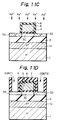
- a gate silicon oxide layer 4 is formed by thermally oxidizing the silicon layer 3, and an N-type impurity doped polycrystalline silicon layer is formed on the entire surface. Then, the polycrystalline silicon layer is patterned by a photolithography and dry etching process to form a gate electrode 5. Further, an about 50 nm thick silicon oxide layer 6 is formed by thermally oxidizing the gate electrode 5. Then, N-type impurities such as arsenic are ion-implanted with a mask of the gate electrode 5 into the silicon layer 3 to form a source region 3S and a drain region 3D. In this case, a region of the silicon layer 3 sandwiched by the source region 3S and the drain region 3D is a channel region 3C.
- Fig. 11D in the same way as shown in Fig. 6D, an about 500 nm thick silicon oxide layer 7 is formed by a CVD process, and contact holes CONT1 and CONT2 are perforated in the in the silicon oxide layer 7.
- an aluminum layer is deposited by a sputtering process and is patterned to form aluminum wirings 8S and 8D, thus completing the device of Fig. 10.
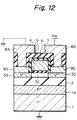
- Fig. 12 which illustrates a fourth embodiment of the present invention
- monocrystalline silicon layers 9S and 9D are inserted between the aluminum wiring 3S and the source region 3S and between the aluminum wiring 8D and the drain region 3D of Fig. 10.
- the parasitic resistance of the source and drain is remarkably decreased to increase the current drivability.
- a SOI substrate formed by an impurity lightly doped P-type monocrystalline silicon substrate 1, a silicon oxide layer 2 and an about 500 nm thick impurity lightly doped silicon layer 3 is prepared.
- about 4 ⁇ 1017 oxygen ions/cm are implanted at an acceleration energy of about 180 keV into an impurity lightly-doped P-type (100) monocrystalline silicon substrate whose temperature is about 550°C, and thereafter, a heat operation at about 1350°C is performed thereupon for about six hours.
- the SOI substrate of Fig. 11A is obtained.
- P-type impurities such as boron are ion-implanted into the P ⁇ -type silicon substrate 1, to create a impurity highly doped monocrystalline silicon layer la in the P ⁇ -type monocrystalline silicon substrate 1.
- the acceleration energy of the P-type impurities is determined in view of the thickness of the monocrystalline silicon layer 3 and the silicon oxide layer 2.
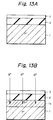
- a gate silicon oxide layer 4 is formed by thermally oxidizing the silicon layer 3, and an N-type impurity doped polycrystalline silicon layer is formed on the entire surface. Then, the polycrystalline silicon layer is patterned by a photolithography and dry etching process to form a gate electrode 5. Further, an about 50 nm thick silicon oxide layer 6 is formed by thermally oxidizing the gate electrode 5. In this case, only the silicon oxide layer on the source region 3S and the drain region 3D are removed. Then, about 100 nm thick monocrystalline silicon layers 9S and 9D are grown by a selective epitaxial growth technology.
- N-type impurities such as arsenic are ion-implanted with a mask of the gate electrode 5 into the silicon layer 3 to form a source region 3S and a drain region 3D.
- a region of the silicon layer 3 sandwiched by the source region 3S and the drain region 3D is a channel region 3C.
- Fig. 13D in the same way as shown in Fig. 11D, an about 500 nm thick silicon oxide layer 7 is formed by a CVD process, and contact holes CONT1 and CONT2 are perforated in the silicon oxide layer 7.
- an aluminum layer is deposited by a sputtering process and is patterned to form aluminum wirings 8S and 8D, thus completing the device of Fig. 12.
- Fig. 14 which illustrates a fifth embodiment of the present invention
- impurity highly doped regions 1S and 1D beneath the source region 3S and the drain region 3D, respectively are provided instead of the impurity highly doped region 1a of Fig. 10.
- the impurity highly doped regions 1S and 1D are about 500 nm thick and have an impurity concentration of more than 1 ⁇ 1019/ cm3.
- a SOI substrate formed by an impurity lightly doped P-type monocrystalline silicon substrate 1, a silicon oxide layer 2 and an impurity lightly doped silicon layer 3 is prepared.
- about 4 ⁇ 1017 oxygen ions/cm are implanted at an acceleration energy of about 180 keV into an impurity lightly-doped P-type (100) monocrystalline silicon substrate whose temperature is about 550°C, and thereafter, a heat operation at about 1350°C is performed thereupon for about six hours.
- the SOI substrate of Fig. 15A is obtained.
- a gate silicon oxide layer 4 is formed by thermally oxidizing the silicon layer 3, and an N-type impurity doped polycrystalline silicon layer is formed on the entire surface. Then, the polycrystalline silicon layer is patterned by a photolithography and dry etching process to form a gate electrode 5. Next, about 3 ⁇ 1015 P-type impurities such as boron/cm are ion-implanted at an acceleration energy of about 80 to 100 keV into the P--type silicon substrate 1 with a mask of the gate electrode 5, to thereby form P+-type impurity regions 1S and 1D.
- an about 50 nm thick silicon oxide layer 6 is formed by thermally oxidizing the gate electrode 5. Then, N-type impurities such as arsenic are ion-implanted with a mask of the gate electrode 5 into the silicon layer 3 to form a source region 3S and a drain region 3D. In this case, a region of the silicon layer 3 sandwiched by the source region 3S and the drain region 3D is a channel region 3C.
- Fig. 15D in the same way as shown in Fig. 11D, an about 500 nm thick silicon oxide layer 7 is formed by a CVD process, and contact holes CONT1 and CONT2 are perforated in the silicon oxide layer 7.
- an aluminum layer is deposited by a sputtering process and is patterned to form aluminum wirings 8S and 8D, thus completing the device of Fig. 14.
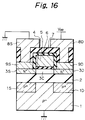
- Fig. 16 which illustrates a sixth embodiment of the present invention
- monocrystalline silicon layers 9S and 9D are inserted between the aluminum wiring 8S and the source region 3S and between the aluminum wiring 8D and the drain region 3D of Fig. 14.
- the parasitic resistance of the source and drain is remarkably decreased to increase the current drivability.
- a SOI substrate formed by an impurity lightly doped P-type monocrystalline silicon substrate 1, a silicon oxide layer 2 and an impurity lightly doped silicon layer 3 is prepared.
- about 4 ⁇ 1017 oxygen ions/cm are implanted at an acceleration energy of about 180 keV into an impurity lightly-doped P-type (100) monocrystalline silicon substrate whose temperature is about 550°C, and thereafter, a heat operation at about 1350°C is performed thereupon for about six hours.
- the SOI substrate of Fig. 11A is obtained.
- a gate silicon oxide layer 4 is formed by thermally oxidizing the silicon layer 3, and an N-type impurity doped polycrystalline silicon layer is formed on the entire surface. Then, the polycrystalline silicon layer is patterned by a photolithography and dry etching process to form a gate electrode 5. Next, about 3 ⁇ 1015 P-type impurities such as boron/cm are ion-implanted at an acceleration energy of about 80 to 100 keV into the P ⁇ -type silicon substrate 1 with a mask of the gate electrode 5, to thereby form a P+-type impurity regions 1S and 1D.
- an about 50 nm thick silicon oxide layer 6 is formed by thermally oxidizing the gate electrode 5.
- the silicon oxidelayer on the source region 3S and the drain region 3D is removed.
- about 100 nm thick monocrystalline silicon layers 9S and 9D are grown by a selective epitaxial growth technology.
- N-type impurities such as arsenic are ion-implanted with a mask of the gate electrode 5 into the silicon layer 3 to form a source region 3S and a drain region 3D.
- a region of the silicon layer 3 sandwiched by the source region 3S and the drain region 3D is a channel region 3C.
- Fig. 17D in the same way as shown in Fig. 15D, an about 500 nm thick silicon oxide layer 7 is formed by a CVD process, and contact holes CONT1 and CONT2 are perforated in the in the silicon oxide layer 7.
- an aluminum layer is deposited by a sputtering process and is patterned to form aluminum wirings 8S and 8D, thus completing the device of Fig. 16.
- Fig. 18 which illustrates a seventh embodiment of the present invention, an impurity highly doped region 1C beneath the channel region 3C is provided instead of the impurity highly doped region 1a of Fig. 10.
- the impurity highly doped region is about 500 nm thick and 1C has an impurity concentration higher than 1 ⁇ 1019/cm3.
- the impurity concentration of the impurity doped region 1C is high, even when the power supply voltage V DD applied to the drain region 3D is increased, so that although a depletion region is grown as indicated by Y1, such a depletion region is hardly grown in the silicon substrate 1 beneath the channel region 3C.
- a SOI substrate formed by an impurity lightly doped P-type monocrystalline silicon substrate 1, a silicon oxide layer 2 and an impurity lightly doped silicon layer 3 is prepared.
- about 4 ⁇ 1017 oxygen ions/cm are implanted at an acceleration energy of about 180 keV into an impurity lightly-doped P-type (100) monocrystalline silicon substrate whose temperature is about 550°C, and thereafter, a heat operation at about 1350°C is performed thereupon for about six hours.
- the SOI substrate of Fig. 11A is obtained.
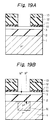
- an about 10 nm thick silicon oxide layer 10 is formed by thermally oxidizing the silicon layer 3, an about 10 nm thick silicon nitride layer 11 is deposited by a CVD process, and an about 300 nm thick silicon oxide layer 12 is deposited by a CVD process. Then, a photoresist pattern 13 is coated thereon. Then, the silicon oxide layer 12, the silicon nitride layer 11 and the silicon oxide layer 10 are removed with a mask of the photoresist pattern 13 by a photolithography and dry etching process, to expose the silicon layer 3.
- P-type impurities such as boron are ion-implated at different acceleration energies into the silicon layer 3 and the silicon substrate 1 with a mask of the photoresist pattern 13 and the silicon oxide layer 12.
- the acceleration energy of the impurity ions is relatively small to adjust the threshold voltage of the transistor.
- the acceleration energy of the impurity ions is relatively large to form a P+-type impurity region 1C. Then, the photoresist pattern 13 is removed.
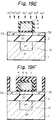
- an about 10 nm thick gate silicon oxide layer 4 is formed by thermally oxidizing the silicon layer 3. Subsequently, an N-type impurity doped polycrystalline silicon layer is formed on the entire surface. Then, the polycrystalline silicon layer is patterned by a photolithography and dry etching process to form a gate electrode 5.
- the silicon oxide layer 12 is removed by diluted fluoric acid, and the silicon nitride layer 11 is removed by hot phosphoric acid.
- an about 50 nm thick silicon oxide layer 6 is formed by thermally oxidizing the gate electrode 5. Then N-type impurities such as arsenic are ion-implanted with a mask of the gate electrode 5 into the silicon layer 3 to form a source region 3S and a drain region 3D. In this case, a region of the silicon layer 3 sandwiched by the source region 3S and the drain region 3D is a channel region 3C.
- Fig. 19F in the same way as shown in Fig. 15D, an about 500 nm thick silicon oxide layer 7 is formed by a CVD process, and contact holes CONT1 and CONT2 are perforated in the silicon oxide layer 7.
- an aluminum layer is deposited by a sputtering process and is patterned to form aluminum wirings 8S and 8D, thus completing the device of Fig. 18.
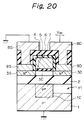
- Fig. 20 which illustrates an eighth embodiment of the present invention
- monocrystalline silicon layers 9S and 9D are inserted between the aluminum wiring 8S and the source region 3S and between the aluminum wiring 8D and the drain region 3D of Fig. 18.
- the parasitic resistance of the source and drain is remarkably decreased to increase the current drivability.
- an SOI substrate formed by an impurity lightly doped P-type monocrystalline silicon substrate 1, a silicon oxide layer 2 and an impurity lightly doped silicon layer 3 is prepared.
- about 4 ⁇ 1017 oxygen ions/cm are implanted at an acceleration energy of about 180 keV into an impurity lightly-doped P-type (100) monocrystalline silicon substrate whose temperature is about 550°C, and thereafter, a heat operation at about 1350°C is performed thereupon for about six hours.
- the SOI substrate of Fig. 11A is obtained.
- an about 10 nm thick silicon oxide layer 10 is formed by thermally oxidizing the silicon layer 3, an about 10 nm thick silicon nitride layer 11 is deposited by a CVD process, and an about 300 nm thick silicon oxide layer 12 is deposited by a CVD process. Then, a photoresist pattern 13 is coated thereon. Then, the silicon oxide layer 12, the silicon nitride layer 11 and the silicon oxide layer 10 are removed with a mask of the photoresist pattern 13 by a photolithography and dry etching process, to expose the silicon layer 3.
- P-type impurities such as boron are ion-implated at different acceleration energies into the silicon layer 3 and the silicon substrate 1 with a mask of the photoresist pattern 13 and the silicon oxide layer 12.
- the acceleration energy of the impurity ions is relatively small to adjust the threshold voltage of the transistor.
- the acceleration energy of the impurity ions is relatively large to form a P+-type impurity region 1C. Then, the photoresist pattern 13 is removed.
- an about 10 nm thick gate silicon oxide layer 4 is formed by thermally oxidizing the silicon layer 3.
- an N-type impurity doped polycrystalline silicon layer is formed on the entire surface.
- the polycrystalline silicon layer is patterned by a photolithography and dry etching process to form a gate electrode 5.
- the silicon oxide layer 12 is removed by diluted fluoric acid, and the silicon nitride layer 11 is removed by hot phosphoric acid.
- an about 50 nm thick silicon oxide layer 6 is formed by thermally oxidizing the gate electrode 5.
- the silicon oxide layer on the source region 3S and the drain region 3D are removed.
- about 100 nm thick monocrystalline silicon layers 9S and 9D are grown by a selective epitaxial growth technology.
- N-type impurities such as arsenic are ion-implanted with a mask of the gate electrode 5 into the silicon layer 3 to form a source region 3S and a drain region 3D.
- a region of the silicon layer 3 sandwiched by the source region 3S and the train region 3D is a channel region 3C.
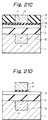
- Fig. 21F in the same way as shown in Fig. 19F, an about 500 nm thick silicon oxide layer 7 is formed by a CVD process, and contact holes CONT1 and CONT2 are perforated in the in the silicon oxide layer 7.
- an aluminum layer is deposited by a sputtering process and is patterned to form aluminum wirings 8S and 8D, thus completing the device of Fig. 20.
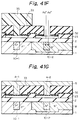
- Figs. 22 through 29 are cross-sectional views illustrating ninth, tenth, eleventh, twelfth, thirteenth, fourteenth, fifteenth and sixteenth embodiments, vespectively, of the SOI-type semiconductor device according to the present invention, and correspond to the first, second, third, fourth, fifth, sixth, seventh and eighth embodiments, respectively, of the present invention.
- two N-channel MOS transistors Q1 and Q2 are connected in series, and also in this case, a depletion region is hardly grown in the silicon substrate 1 (1') beneath the channel regions 3C-1 and 3C-2, in the same way as in the first through eighth embodiments.
- Figs. 30 and 31 which illustrate seventeenth and eighteenth embodiments, respectively, of the present invention
- the ninth and tenth embodiments as illustrated in Figs. 22 and 23 are applied to a CMOS circuit formed by a P-channel transistor Q p and an N-channel transistor Q n . That is, formed within a P+-type monocrystalline silicon substrate 1' is an N+-type well region W' which has an impurity concentration of more than 1 ⁇ 1019/ cm3. Also, the P+-type monocrystalline silicon substrate 1' is grounded, while the N+-type well region W' is connected to a source region 3S-2 of the transistor Q p .
- Figs. 30 and 31 which illustrate seventeenth and eighteenth embodiments, respectively, of the present invention
- the CMOS device of Fig. 30 can be manufactured by the steps as illustrated in Figs. 6A to 6D in combination with a conventional CMOS manufacturing process. Also, the CMOS device of Fig. 31 can be manufactured by the steps as illustrated in Figs. 8A to 8D in combination with a conventional CMOS manufacturing process.
- Figs. 32 and 33 which illustrate nineteenth and twentieth embodiments, respectively, of the present invention
- the eleventh and twelfth embodiments as illustrated in Figs. 24 and 25 are applied to a CMOS circuit formed by a P-channel transistor Q p and an N-channel transistor Q n . That is, formed within a P ⁇ -type monocrystalline silicon substrate 1 is an N ⁇ -type well region W which has an impurity concentration of about 1 ⁇ 1015/cm3.
- a P+-type impurity region 1' having an impurity concentration of more than 1x10¹⁹/cm3 is formed within the P ⁇ -type silicon substrate 1
- an N+-type impurity region W' having an impurity concentration of more than 1 ⁇ 1019/cm3 is formed within the N ⁇ -type well region W.
- the CMOS device of Fig. 32 can be manufactured by the steps as illustrated in Figs. 11A to 11D in combination with a conventional CMOS manufacturing process. Also, the CMOS device of Fig. 33 can be manufactured by the steps as illustrated in Figs. 13A to 13D in combination with a conventional CMOS manufacturing process.
- Fig. 34 which illustrates a twenty first embodiment of the present invention
- the thirteenth embodiment as illustrated in Fig. 26 is applied to a CMOS circuit formed by a P-channel transistor Q p and an N-channel transistor Q n . That is, impurity highly doped P +-type regions 1S-1 and 1D-1 beneath the source region 3S-1 and the drain region 3D-1, respectively, of the N-channel transistor Q n are provided, and impurity highly doped N+-type regions 1S-2 and 1D-2 beneath the source region 3S-2 and the drain region 3D-2, respectively, of the P-channel transistor Q p are provided.
- the impurity highly doped regions are about 500 nm thick and have an impurity concentration of more than 1 ⁇ 1019/ cm3.
- a SOI substrate formed by an impurity lightly doped P-type monocrystalline silicon substrate 1, an about 90 nm thick silicon oxide layer 2 and an about 500 nm thick impurity lightly doped silicon layer 3 is prepared.
- about 4 ⁇ 1017 oxygen ions/cm are implanted at an acceleration energy of about 180 keV into an impurity lightly-doped P-type (100) monocrystalline silicon substrate whose temperature is about 550°C, and thereafter, a heat operation at about 1350°C is performed thereupon for about six hours.
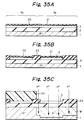
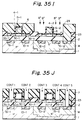
- the SOI substrate of Fig. 35A is obtained.
- the thickness of the silicon layer 3 can be arbitrarily and precisely adjusted by thermally oxidizing it and etching the resulting silicon oxide.
- an about 30 nm thick silicon oxide layer 21 is formed by thermally oxidizing the silicon layer 3, and subsequently, a silicon nitride layer 22 is deposited thereon by a CVD process.
- the silicon oxide layer 21 is patterned by a photolithography and dry etching process, so that a part of the silicon nitride layer 22 corresponding to element isolation areas is removed. Then, a thermal heat operation is performed upon the silicon layer 3 with a mask of the silicon nitride layer 22, to form a field thick silicon oxide layer 23.
- This silicon oxide layer 23 is about 200 nm thick, and reaches the silicon oxide layer 3. Then, the silicon nitride layer 22 is removed by hot phosphoric acid, and the silicon oxide layer 21 is removed by diluted fluoric acid.
- a photoresist pattern 24 is formed by a photolithography process to cover the N-channel transistor Q n area. Then, 1 ⁇ 101 phosphorous ions/cm are implanted at an acceleration energy of about 300 keV into the silicon substrate 1 with a mask of the photoresist pattern 24. Thus, an N+-type well region W is formed in the silicon substrate 1. Then, the photoresist pattern 24 is removed.
- gate silicon oxide layer 4-1 and 4-2 are formed by thermally oxidizing the silicon layer 3, and an N-type impurity doped polycrystalline silicon layer is formed on the entire surface. Then, the polycrystalline silicon layer is patterned by a photolithography and dry etching process to form gate electrodes 5-1 and 5-2.
- a photoresist pattern 25 is coated by a photolithography process to cover the P-channel transistor Q p area.
- P-type impurities such as boron/cm are ion-implanted at an acceleration energy of about 80 to 100 keV into the P ⁇ -type silicon substrate 1 with a mask of the gate electrode 5-1 and the photoresist pattern 25, to thereby form P+-type impurity regions 1S-1 and 1D-1.
- the photoresist pattern 25 is removed.
- a photoresist pattern 26 is coated by a photolithography process to cover the N-channel transistor Q n area.
- N-type impurities such as arsenic/cm are ion-implanted at an acceleration energy of about 80 to 100 keV into the N ⁇ -type well region W with a mask of the gate electrode 5-2 and the photoresist pattern 26, to thereby form N+-type impurity regions 1S-2 and 1D-2.
- the photoresist pattern 26 is removed.
- a photoresist pattern 27 is coated by a photolithography process. Then, the silicon oxide layers 23 and 2 are etched by a dry etching process with a mask of the photoresist pattern 27, to form a contact hole 27a. Then, the photoresist pattern 27 is removed.
- a photoresist pattern 28 is coated by a photolithography process. Then, 5 ⁇ 1015 N-type impurities such as arsenic/cm are ion-implanted at an acceleration energy of about 50 keV with a mask of the gate electrode 5-1 and the photoresist pattern 28 into the silicon layer 3 and the P ⁇ -type well region W to form a source region 3S-1 and a drain region 3D-1 and a contact region 27b. In this case, a region of the silicon layer 3 sandwiched by the source region 3S-1 and the drain region 3D-1 is a channel region 3C-1. Then, the photoresist pattern 28 is removed.
- a photoresist pattern 29 is coated by a photolithography process. Then, 5 ⁇ 1015 P-type impurities such as boron/cm are ion-implanted at an acceleration energy of about 50 keV with a mask of the gate electrode 5-2 and the photoresist pattern 29 into the silicon layer 3 to form a source region 3S-2 and a drain region 3D-2. In this case, a region of the silicon layer 3 sandwiched by the source region 3S-2 and the drain region 3D-2 is a channel region 3C-2. Then, the photoresist pattern 29 is removed.
- P-type impurities such as boron/cm
- an about 500 nm thick silicon oxide layer 7 is formed by a CVD process, and contact holes CONT1 to CONT5 are perforated in the silicon oxide layer 7.
- an aluminum layer is deposited by a sputtering process and is patterned to form aluminum wirings 8S -1, 8D-1 (8D-2) and 8S-2, thus completing the device of Fig. 34.
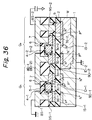
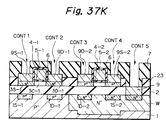
- Fig. 36 which illustrates a twenty second embodiment of the present invention
- monocrystalline silicon layers 9S-1, 9D-1, 9D-2, 9S-2 and 9 are inserted between the aluminum wiring 8S-1 and the source region 3S-1, between the aluminum wiring 8D-1 and the drain region 3D-1, between the aluminum wiring 9D-2 and the drain region 3D-2, between the aluminum wiring 9S-2 and the source region 3S-2, and between the aluminum wiring 8S-2 and the contact region 27b.
- the parasitic resistance of the source and drain is remarkably decreased to increase the current drivability.
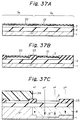
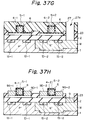
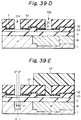
- Fig. 38 which illustrates a twenty third embodiment of the present invention
- the fifteenth embodiment as illustrated in Fig. 28 is applied to a CMOS circuit formed by a P-channel transistor Q p and an N-channel transistor Q n . That is, an impurity highly doped P+-type region 1C-1 beneath the channel region 3C-1 of the N-channel transistor Q n is provided, and an impurity highly doped N+-type region 1C-2 beneath the an channel region 3C-2 of the P-channel transistor Q p is provided.
- the impurity highly doped regions is about 500 nm thick and have an impurity concentration of more than 1 ⁇ 1019/ cm3.
- a SOI substrate formed by an impurity lightly doped P-type monocrystalline silicon substrate 1, an about 90 nm thick silicon oxide layer 2 and an about 50 nm thick impurity lightly doped silicon layer 3 is prepared.
- about 4 ⁇ 1017 oxygen ions/cm are implanted at an acceleration energy of about 180 keV into an impurity lightly-doped P-type (100) monocrystalline silicon substrate whose temperature is about 550°C, and thereafter, a heat operation at about 1350°C is performed thereupon for about six hours.
- the SOI substrate of Fig. 39A is obtained.
- the thickness of the silicon layer 3 can be arbitrarily and precisely adjusted by thermally oxidizing it and etching the resulting silicon oxide.
- an about 30 nm thick silicon oxide layer 21 is formed by thermally oxidizing the silicon layer 3, and subsequently, a silicon nitride layer 22 is deposited thereon by a CVD process.
- the silicon oxide layer 21 is patterned by a photolithography and dry etching process, so that a part of the silicon nitride layer 22 corresponding to element isolation areas is removed. Then, a thermal heat operation is performed upon the silicon layer 3 with a mask of the silicon nitride layer 22, to form a field thick silicon oxide layer 23.
- This silicon oxide layer 23 is about 200 nm thick, and reaches the silicon oxide layer 3. Then, the silicon nitride layer 22 is removed by hot phosphoric acid, and the silicon oxide layer 21 is removed by diluted fluoric acid.
- a photoresist pattern 24 is formed by a photolithography process to cover the N-channel transistor Q n area. Then, 1 ⁇ 101 phosphorous ions/cm are implanted at an acceleration energy of about 300 keV into the silicon substrate 1 with a mask of the photoresist pattern 24. Thus, an N+-type well region W is formed in the silicon substrate 1. Then, the photoresist pattern 24 is removed.
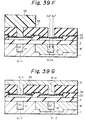
- an about 10 nm thick silicon oxide layer 31 is formed by thermally oxidizing the silicon layer 3, and a silicon nitride layer 32 is deposited thereon by a CVD process. Further, an about 300 nm thick silicon oxide layer 33 is formed thereon by a CVD process. Then, a heat operation is carried out to anneal the N ⁇ -type well region W.
- contact holes 33a and 33b are perforated in the silicon oxide layer 33, the silicon nitride layer 32 and the silicon oxide layer 31, to expose the silicon layer 3.
- a photoresist pattern 34 is coated by a photolithography process to cover the P-channel transistor Q p area.
- P-type impurities such as boron/cm are ion-implanted at an acceleration energy of about 80 to 100 keV into the P ⁇ -type silicon substrate 1 with a mask of the photoresist pattern 34, to thereby form a P+-type impurity region 1C-1.
- the photoresist pattern 34 is removed.
- a photoresist pattern 35 is coated by a photolithography process to cover the N-channel transistor Q n area.
- about 3 ⁇ 1015 N-type impurities such as arsenic/cm are ion-implanted at an acceleration energy of about 80 to 100 keV into the N ⁇ -type well region W with a mask of the photoresist pattern 35, to thereby form a N+-type impurity region 1C-2.
- the photoresist pattern 35 is removed.
- gate silicon oxide layers 4-1 and 4-2 are formed by thermally oxidizing the silicon layer 3. Then, an N-type impurity highly doped polycrystalline silicon layer 5 is deposited by a CVD process.
- the polycrystalline silicon layer 5 is etched back by a dry etching process, to form gate electrodes 5-1 and 5-2. Then, the silicon oxide layer 33 is removed by diluted fluoric acid, and the silicon nitride layer 32 is removed by hot phosphoric acid.
- a silicon oxide layer 6 is formed by thermally oxidizing the silicon layer 3 and the gate electrodes 5-1 and 5-2.
- a photoresist pattern 27 is coated by a photolithography process. Then, the silicon oxide layers 23 and 2 are etched by a dry etching process with a mask of the photoresist pattern 27, to form a contact hole 27a. Then, the photoresist pattern 27 is removed.
- a photoresist pattern 28 is coated by a photolithography process. Then, 5 ⁇ 1015 N-type impurities such as arsenic/cm are ion-implanted at an acceleration energy of about 50 keV with a mask of the gate electrode 5-1 and the photoresist pattern 28 into the silicon layer 3 and the P ⁇ -type well region W to form a source region 3S-1 and a drain region 3D-1 and a contact region 27b. In this case, a region of the silicon layer 3 sandwiched by the source region 3S-1 and the drain region 3D-1 is a channel region 3C-1. Then, the photoresist pattern 28 is removed.
- a photoresist pattern 29 is coated by a photolithography process. Then, 5 ⁇ 1015 P-type impurities such as boron/cm are ion-implanted at an acceleration energy of about 50 keV with a mask of the gate electrode 5-2 and the photoresist pattern 29 into the silicon layer 3 to form a source region 3S-2 and a drain region 3D-2. In this case, a region of the silicon layer 3 sandwiched by the source region 3S-2 and the drain region 3D-2 is a channel region 3C-2. Then, the photoresist pattern 29 is removed.
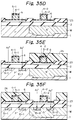
- Fig. 39M in the same way as shown in Fig. 35J, an about 500 nm thick silicon oxide layer 7 is formed by a CVD process, and contact holes CONT1 to CONT5 are perforated in the silicon oxide layer 7.
- an aluminum layer is deposited by a sputtering process and is patterned to form aluminum wirings 8S -1, 8D-1 (8D-2) and 8S-2, thus completing the device of Fig. 34.
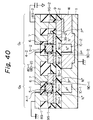
- Fig. 40 which illustrates a twenty fourth embodiment of the present invention
- monocrystalline silicon layers 9S-1, 9D-1, 9D-2, 9S-2 and 9 are inserted between the aluminum wiring 8S-1 and the source region 3S-1, between the aluminum wiring 8D-1 and the drain region 3D-1, between the aluminum wiring 9D-2 and the drain region 3D-2, between the aluminum wiring 9S-2 and the source region 3S-2, and between the aluminum wiring 8S-2 and the contact region 27b.
- the parasitic resistance of the source and drain is remarkably decreased to increase the current drivability.
- metal silicide such as titanium silicide or cobalt silicide on the gate electrode 5 (5-1, 5-2).
- tungsten or other metal can be used for the monocrystalline silicon layer 9S, 9S-1 and the like.
- a high impurity concentration of at least one part of the semiconductor is more than 1 ⁇ 1019/cm3, in the above-described embodiments, such a high impurity concentration can be more than 1x10¹⁶/cm3, preferably, more than 1 ⁇ 1018/cm3.
- the absolute value of the threshold voltage can be decreased, and accordingly, the channel mobility can be increased to increase the operation speed.
Landscapes
- Thin Film Transistor (AREA)
- Metal-Oxide And Bipolar Metal-Oxide Semiconductor Integrated Circuits (AREA)
Applications Claiming Priority (2)
| Application Number | Priority Date | Filing Date | Title |
|---|---|---|---|
| JP162316/94 | 1994-07-14 | ||
| JP6162316A JPH0832040A (ja) | 1994-07-14 | 1994-07-14 | 半導体装置 |
Publications (2)
| Publication Number | Publication Date |
|---|---|
| EP0694977A2 true EP0694977A2 (fr) | 1996-01-31 |
| EP0694977A3 EP0694977A3 (fr) | 1996-11-06 |
Family
ID=15752213
Family Applications (1)
| Application Number | Title | Priority Date | Filing Date |
|---|---|---|---|
| EP95111059A Withdrawn EP0694977A3 (fr) | 1994-07-14 | 1995-07-14 | Dispositif semi-conducteur de type SOI avec suppression de l'extension de la région de depletion |
Country Status (2)
| Country | Link |
|---|---|
| EP (1) | EP0694977A3 (fr) |
| JP (1) | JPH0832040A (fr) |
Cited By (30)
| Publication number | Priority date | Publication date | Assignee | Title |
|---|---|---|---|---|
| EP0749165A3 (fr) * | 1995-06-16 | 1997-09-24 | Mitsubishi Electric Corp | Transitor à couche mince sur un substrat semi-conducteur isolé et méthode de fabrication |
| WO1999033115A1 (fr) * | 1997-12-19 | 1999-07-01 | Advanced Micro Devices, Inc. | Configuration silicium sur isolant compatible avec l'architecture cmos sur silicium |
| FR2779869A1 (fr) * | 1998-06-15 | 1999-12-17 | Commissariat Energie Atomique | Circuit integre de type soi a capacite de decouplage, et procede de realisation d'un tel circuit |
| US6558998B2 (en) | 1998-06-15 | 2003-05-06 | Marc Belleville | SOI type integrated circuit with a decoupling capacity and process for embodiment of such a circuit |
| WO2003001604A3 (fr) * | 2001-06-21 | 2003-09-04 | Ibm | Transistor a double grille et son procede de production |
| WO2003081677A1 (fr) * | 2002-03-21 | 2003-10-02 | Advanced Micro Devices, Inc. | Structure soi totalement appauvrie, a triple puits, polarisee et procedes divers de fabrication et d'exploitation de ladite structure |
| EP1355357A1 (fr) * | 2002-04-18 | 2003-10-22 | Innovative Silicon SA | Dispositif semi-conducteur porteur d'une charge électrique |
| WO2003096430A1 (fr) * | 2002-05-06 | 2003-11-20 | Advanced Micro Devices, Inc. | Transistors a tensions de seuil controlables, et divers procedes de fabrication et d'utilisation de tels transistors |
| WO2003105232A1 (fr) * | 2002-06-11 | 2003-12-18 | Advanced Micro Devices, Inc. | Region dopee dans un substrat soi |
| EP1231645A3 (fr) * | 2001-02-12 | 2004-12-08 | eupec Europäische Gesellschaft für Leistungshalbleiter mbH | Dispositif semiconducteur SOI à couche mince |
| EP1588418A1 (fr) * | 2003-01-30 | 2005-10-26 | X-FAB Semiconductor Foundries AG | Structure de type silicium sur isolant (soi) comportant des contacts au substrat de part et d'autre de l'oxyde enterre, et procede de production correspondant |
| EP1624486A1 (fr) * | 1998-10-02 | 2006-02-08 | Intel Corporation | Transistor à effet de champ isolé avec une plaque de champ électrique |
| US8861247B2 (en) | 2009-04-27 | 2014-10-14 | Micron Technology, Inc. | Techniques for providing a direct injection semiconductor memory device |
| US8947965B2 (en) | 2009-07-27 | 2015-02-03 | Micron Technology Inc. | Techniques for providing a direct injection semiconductor memory device |
| US8964479B2 (en) | 2010-03-04 | 2015-02-24 | Micron Technology, Inc. | Techniques for sensing a semiconductor memory device |
| US8982633B2 (en) | 2009-05-22 | 2015-03-17 | Micron Technology, Inc. | Techniques for providing a direct injection semiconductor memory device |
| US9019788B2 (en) | 2008-01-24 | 2015-04-28 | Micron Technology, Inc. | Techniques for accessing memory cells |
| US9019759B2 (en) | 2010-03-15 | 2015-04-28 | Micron Technology, Inc. | Techniques for providing a semiconductor memory device |
| US9064730B2 (en) | 2009-03-04 | 2015-06-23 | Micron Technology, Inc. | Techniques for forming a contact to a buried diffusion layer in a semiconductor memory device |
| US9093311B2 (en) | 2009-03-31 | 2015-07-28 | Micron Technology, Inc. | Techniques for providing a semiconductor memory device |
| US9142264B2 (en) | 2010-05-06 | 2015-09-22 | Micron Technology, Inc. | Techniques for refreshing a semiconductor memory device |
| US9240496B2 (en) | 2009-04-30 | 2016-01-19 | Micron Technology, Inc. | Semiconductor device with floating gate and electrically floating body |
| US9257155B2 (en) | 2007-05-30 | 2016-02-09 | Micron Technology, Inc. | Integrated circuit having voltage generation circuitry for memory cell array, and method of operating and/or controlling same |
| US9263133B2 (en) | 2011-05-17 | 2016-02-16 | Micron Technology, Inc. | Techniques for providing a semiconductor memory device |
| US9276000B2 (en) | 2007-03-29 | 2016-03-01 | Micron Technology, Inc. | Manufacturing process for zero-capacitor random access memory circuits |
| US9331083B2 (en) | 2009-07-10 | 2016-05-03 | Micron Technology, Inc. | Techniques for providing a semiconductor memory device |
| US9553186B2 (en) | 2008-09-25 | 2017-01-24 | Micron Technology, Inc. | Recessed gate silicon-on-insulator floating body device with self-aligned lateral isolation |
| US9812179B2 (en) | 2009-11-24 | 2017-11-07 | Ovonyx Memory Technology, Llc | Techniques for reducing disturbance in a semiconductor memory device |
| US10304837B2 (en) | 2007-11-29 | 2019-05-28 | Ovonyx Memory Technology, Llc | Integrated circuit having memory cell array including barriers, and method of manufacturing same |
| US10418091B2 (en) | 2005-09-07 | 2019-09-17 | Ovonyx Memory Technology, Llc | Memory cell and memory cell array having an electrically floating body transistor, and methods of operating same |
Families Citing this family (48)
| Publication number | Priority date | Publication date | Assignee | Title |
|---|---|---|---|---|
| JP3437132B2 (ja) | 1999-09-14 | 2003-08-18 | シャープ株式会社 | 半導体装置 |
| JP4828682B2 (ja) * | 2000-06-30 | 2011-11-30 | 白土 猛英 | 半導体装置 |
| TWI230392B (en) | 2001-06-18 | 2005-04-01 | Innovative Silicon Sa | Semiconductor device |
| EP1355316B1 (fr) | 2002-04-18 | 2007-02-21 | Innovative Silicon SA | Dispositif de mémoire et méthode de rafraîchissement d'un tel dispositif |
| EP1357603A3 (fr) | 2002-04-18 | 2004-01-14 | Innovative Silicon SA | Dispositif semiconducteur |
| JP2004153081A (ja) * | 2002-10-31 | 2004-05-27 | Shin Etsu Handotai Co Ltd | Soiウエーハ及びsoiウエーハの製造方法 |
| DE10248722A1 (de) * | 2002-10-18 | 2004-05-06 | Infineon Technologies Ag | Integrierte Schaltungsanordnung mit Kondensator und Herstellungsverfahren |
| US7085153B2 (en) | 2003-05-13 | 2006-08-01 | Innovative Silicon S.A. | Semiconductor memory cell, array, architecture and device, and method of operating same |
| US6912150B2 (en) | 2003-05-13 | 2005-06-28 | Lionel Portman | Reference current generator, and method of programming, adjusting and/or operating same |
| US20040228168A1 (en) | 2003-05-13 | 2004-11-18 | Richard Ferrant | Semiconductor memory device and method of operating same |
| US7335934B2 (en) | 2003-07-22 | 2008-02-26 | Innovative Silicon S.A. | Integrated circuit device, and method of fabricating same |
| US7184298B2 (en) | 2003-09-24 | 2007-02-27 | Innovative Silicon S.A. | Low power programming technique for a floating body memory transistor, memory cell, and memory array |
| US7476939B2 (en) | 2004-11-04 | 2009-01-13 | Innovative Silicon Isi Sa | Memory cell having an electrically floating body transistor and programming technique therefor |
| US7251164B2 (en) | 2004-11-10 | 2007-07-31 | Innovative Silicon S.A. | Circuitry for and method of improving statistical distribution of integrated circuits |
| WO2006065698A2 (fr) | 2004-12-13 | 2006-06-22 | William Kenneth Waller | Circuits amplificateurs de detection et architecture servant a ecrire des donnees dans des cellules memoire et/ou lire des donnees de cellules memoire |
| US7301803B2 (en) | 2004-12-22 | 2007-11-27 | Innovative Silicon S.A. | Bipolar reading technique for a memory cell having an electrically floating body transistor |
| JP4797495B2 (ja) * | 2005-08-02 | 2011-10-19 | セイコーエプソン株式会社 | 半導体装置の製造方法 |
| US7355916B2 (en) | 2005-09-19 | 2008-04-08 | Innovative Silicon S.A. | Method and circuitry to generate a reference current for reading a memory cell, and device implementing same |
| JP2007165568A (ja) * | 2005-12-14 | 2007-06-28 | Oki Electric Ind Co Ltd | 半導体装置の製造方法 |
| US7683430B2 (en) | 2005-12-19 | 2010-03-23 | Innovative Silicon Isi Sa | Electrically floating body memory cell and array, and method of operating or controlling same |
| US7542345B2 (en) | 2006-02-16 | 2009-06-02 | Innovative Silicon Isi Sa | Multi-bit memory cell having electrically floating body transistor, and method of programming and reading same |
| US7492632B2 (en) | 2006-04-07 | 2009-02-17 | Innovative Silicon Isi Sa | Memory array having a programmable word length, and method of operating same |
| US7606098B2 (en) | 2006-04-18 | 2009-10-20 | Innovative Silicon Isi Sa | Semiconductor memory array architecture with grouped memory cells, and method of controlling same |
| US7933142B2 (en) | 2006-05-02 | 2011-04-26 | Micron Technology, Inc. | Semiconductor memory cell and array using punch-through to program and read same |
| US8069377B2 (en) | 2006-06-26 | 2011-11-29 | Micron Technology, Inc. | Integrated circuit having memory array including ECC and column redundancy and method of operating the same |
| US7542340B2 (en) | 2006-07-11 | 2009-06-02 | Innovative Silicon Isi Sa | Integrated circuit including memory array having a segmented bit line architecture and method of controlling and/or operating same |
| US8264041B2 (en) | 2007-01-26 | 2012-09-11 | Micron Technology, Inc. | Semiconductor device with electrically floating body |
| US8085594B2 (en) | 2007-06-01 | 2011-12-27 | Micron Technology, Inc. | Reading technique for memory cell with electrically floating body transistor |
| WO2009039169A1 (fr) | 2007-09-17 | 2009-03-26 | Innovative Silicon S.A. | Rafraîchissement de données de cellules de mémoire avec des transistors à corps électriquement flottant |
| US8349662B2 (en) | 2007-12-11 | 2013-01-08 | Micron Technology, Inc. | Integrated circuit having memory cell array, and method of manufacturing same |
| US8014195B2 (en) | 2008-02-06 | 2011-09-06 | Micron Technology, Inc. | Single transistor memory cell |
| US8189376B2 (en) | 2008-02-08 | 2012-05-29 | Micron Technology, Inc. | Integrated circuit having memory cells including gate material having high work function, and method of manufacturing same |
| US7957206B2 (en) | 2008-04-04 | 2011-06-07 | Micron Technology, Inc. | Read circuitry for an integrated circuit having memory cells and/or a memory cell array, and method of operating same |
| US7933140B2 (en) | 2008-10-02 | 2011-04-26 | Micron Technology, Inc. | Techniques for reducing a voltage swing |
| US7924630B2 (en) | 2008-10-15 | 2011-04-12 | Micron Technology, Inc. | Techniques for simultaneously driving a plurality of source lines |
| US8223574B2 (en) | 2008-11-05 | 2012-07-17 | Micron Technology, Inc. | Techniques for block refreshing a semiconductor memory device |
| US8213226B2 (en) | 2008-12-05 | 2012-07-03 | Micron Technology, Inc. | Vertical transistor memory cell and array |
| US8319294B2 (en) | 2009-02-18 | 2012-11-27 | Micron Technology, Inc. | Techniques for providing a source line plane |
| US8199595B2 (en) | 2009-09-04 | 2012-06-12 | Micron Technology, Inc. | Techniques for sensing a semiconductor memory device |
| US8310893B2 (en) | 2009-12-16 | 2012-11-13 | Micron Technology, Inc. | Techniques for reducing impact of array disturbs in a semiconductor memory device |
| US8416636B2 (en) | 2010-02-12 | 2013-04-09 | Micron Technology, Inc. | Techniques for controlling a semiconductor memory device |
| US8411513B2 (en) | 2010-03-04 | 2013-04-02 | Micron Technology, Inc. | Techniques for providing a semiconductor memory device having hierarchical bit lines |
| US8369177B2 (en) | 2010-03-05 | 2013-02-05 | Micron Technology, Inc. | Techniques for reading from and/or writing to a semiconductor memory device |
| US9559216B2 (en) | 2011-06-06 | 2017-01-31 | Micron Technology, Inc. | Semiconductor memory device and method for biasing same |
| JP5968708B2 (ja) | 2012-01-23 | 2016-08-10 | ルネサスエレクトロニクス株式会社 | 半導体装置 |
| JP6169222B2 (ja) * | 2012-01-23 | 2017-07-26 | ルネサスエレクトロニクス株式会社 | 半導体装置の製造方法 |
| JP2015164214A (ja) * | 2015-04-30 | 2015-09-10 | ルネサスエレクトロニクス株式会社 | 半導体装置および半導体装置の制御方法 |
| JP6947685B2 (ja) * | 2018-05-09 | 2021-10-13 | ルネサスエレクトロニクス株式会社 | 半導体装置及び半導体装置の製造方法 |
Family Cites Families (11)
| Publication number | Priority date | Publication date | Assignee | Title |
|---|---|---|---|---|
| JPH0620130B2 (ja) * | 1983-02-16 | 1994-03-16 | 日本電気株式会社 | Misトランジスタ及びその製造方法 |
| JPH02102569A (ja) * | 1988-10-12 | 1990-04-16 | Nippon Telegr & Teleph Corp <Ntt> | 半導体装置 |
| US4996575A (en) * | 1989-08-29 | 1991-02-26 | David Sarnoff Research Center, Inc. | Low leakage silicon-on-insulator CMOS structure and method of making same |
| JP2888878B2 (ja) * | 1989-10-02 | 1999-05-10 | 株式会社東芝 | 半導体装置 |
| KR920008834A (ko) * | 1990-10-09 | 1992-05-28 | 아이자와 스스무 | 박막 반도체 장치 |
| JPH05235029A (ja) * | 1992-02-21 | 1993-09-10 | Fujitsu Ltd | 半導体装置の製造方法 |
| JPH05343686A (ja) * | 1992-06-04 | 1993-12-24 | Mitsubishi Electric Corp | 半導体装置およびその製造方法 |
| JPH06120458A (ja) * | 1992-10-09 | 1994-04-28 | Fujitsu Ltd | 半導体装置とその製造方法 |
| US5359219A (en) * | 1992-12-04 | 1994-10-25 | Texas Instruments Incorporated | Silicon on insulator device comprising improved substrate doping |
| JPH0729911A (ja) * | 1993-07-07 | 1995-01-31 | Toshiba Corp | 半導体基板とその製造方法 |
| JP3488730B2 (ja) * | 1993-11-05 | 2004-01-19 | 株式会社ルネサステクノロジ | 半導体集積回路装置 |
-
1994
- 1994-07-14 JP JP6162316A patent/JPH0832040A/ja active Pending
-
1995
- 1995-07-14 EP EP95111059A patent/EP0694977A3/fr not_active Withdrawn
Non-Patent Citations (3)
| Title |
|---|
| DONALD C. MAYER: "Mode of Operation and Radiation Sensitivity of Ultrathin SOI Transistors", IEEE TRANS. ON ELECTRON DEVICES, vol. 37, no. 5, May 1990 (1990-05-01), pages 1280 - 1288 |
| HYUNG-KYU LIM ET AL.: "Threshold voltage of Thin-Film Silicon-on-Insulator (SOI) MOSFET's", IEEE TRANS. ON ELECTRON DEVICES, vol. ED-30, no. 10, October 1983 (1983-10-01), pages 1244 - 1251, XP000579751 |
| Y. OMURA ET AL.: "Technical Digest of International Electron Devices Meeting", 1991, article "0.1-mumgate, Ultrathin-Film CMOS Devices Using SIMOX Substrate with 80-nmThick Buried Oxide layer", pages: 675 - 678 |
Cited By (50)
| Publication number | Priority date | Publication date | Assignee | Title |
|---|---|---|---|---|
| EP0749165A3 (fr) * | 1995-06-16 | 1997-09-24 | Mitsubishi Electric Corp | Transitor à couche mince sur un substrat semi-conducteur isolé et méthode de fabrication |
| US5926703A (en) * | 1995-06-16 | 1999-07-20 | Mitsubishi Denki Kabushiki Kaisha | LDD device having a high concentration region under the channel |
| WO1999033115A1 (fr) * | 1997-12-19 | 1999-07-01 | Advanced Micro Devices, Inc. | Configuration silicium sur isolant compatible avec l'architecture cmos sur silicium |
| US6215155B1 (en) | 1997-12-19 | 2001-04-10 | Advanced Micro Devices, Inc. | Silicon-on-insulator configuration which is compatible with bulk CMOS architecture |
| FR2779869A1 (fr) * | 1998-06-15 | 1999-12-17 | Commissariat Energie Atomique | Circuit integre de type soi a capacite de decouplage, et procede de realisation d'un tel circuit |
| WO1999066559A1 (fr) * | 1998-06-15 | 1999-12-23 | Commissariat A L'energie Atomique | Circuit integre de type soi a capacite de decouplage, et procede de realisation d'un tel circuit |
| US6558998B2 (en) | 1998-06-15 | 2003-05-06 | Marc Belleville | SOI type integrated circuit with a decoupling capacity and process for embodiment of such a circuit |
| EP1624486A1 (fr) * | 1998-10-02 | 2006-02-08 | Intel Corporation | Transistor à effet de champ isolé avec une plaque de champ électrique |
| EP1231645A3 (fr) * | 2001-02-12 | 2004-12-08 | eupec Europäische Gesellschaft für Leistungshalbleiter mbH | Dispositif semiconducteur SOI à couche mince |
| US6960806B2 (en) | 2001-06-21 | 2005-11-01 | International Business Machines Corporation | Double gated vertical transistor with different first and second gate materials |
| US7645650B2 (en) | 2001-06-21 | 2010-01-12 | International Business Machines Corporation | Double gated transistor and method of fabrication |
| WO2003001604A3 (fr) * | 2001-06-21 | 2003-09-04 | Ibm | Transistor a double grille et son procede de production |
| US7288445B2 (en) | 2001-06-21 | 2007-10-30 | International Business Machines Corporation | Double gated transistor and method of fabrication |
| WO2003081677A1 (fr) * | 2002-03-21 | 2003-10-02 | Advanced Micro Devices, Inc. | Structure soi totalement appauvrie, a triple puits, polarisee et procedes divers de fabrication et d'exploitation de ladite structure |
| US6919236B2 (en) | 2002-03-21 | 2005-07-19 | Advanced Micro Devices, Inc. | Biased, triple-well fully depleted SOI structure, and various methods of making and operating same |
| CN100346484C (zh) * | 2002-03-21 | 2007-10-31 | 先进微装置公司 | 偏置型三阱完全耗尽绝缘体上硅(soi)结构及其制造和运用的各种方法 |
| US7180136B2 (en) | 2002-03-21 | 2007-02-20 | Advanced Micro Devices, Inc. | Biased, triple-well fully depleted SOI structure |
| EP1355357A1 (fr) * | 2002-04-18 | 2003-10-22 | Innovative Silicon SA | Dispositif semi-conducteur porteur d'une charge électrique |
| WO2003096430A1 (fr) * | 2002-05-06 | 2003-11-20 | Advanced Micro Devices, Inc. | Transistors a tensions de seuil controlables, et divers procedes de fabrication et d'utilisation de tels transistors |
| US7432136B2 (en) | 2002-05-06 | 2008-10-07 | Advanced Micro Devices, Inc. | Transistors with controllable threshold voltages, and various methods of making and operating same |
| CN1659710B (zh) * | 2002-06-11 | 2011-11-30 | 格罗方德半导体公司 | 在绝缘层上覆硅基板中的掺杂区域 |
| US7335568B2 (en) | 2002-06-11 | 2008-02-26 | Advanced Micro Devices, Inc. | Method of forming doped regions in the bulk substrate of an SOI substrate to control the operational characteristics of transistors formed thereabove, and an integrated circuit device comprising same |
| US7129142B2 (en) | 2002-06-11 | 2006-10-31 | Advanced Micro Devices, Inc. | Method of forming doped regions in the bulk substrate of an SOI substrate to control the operational characteristics of transistors formed thereabove, and an integrated circuit device comprising same |
| WO2003105232A1 (fr) * | 2002-06-11 | 2003-12-18 | Advanced Micro Devices, Inc. | Region dopee dans un substrat soi |
| EP1588418A1 (fr) * | 2003-01-30 | 2005-10-26 | X-FAB Semiconductor Foundries AG | Structure de type silicium sur isolant (soi) comportant des contacts au substrat de part et d'autre de l'oxyde enterre, et procede de production correspondant |
| US11031069B2 (en) | 2005-09-07 | 2021-06-08 | Ovonyx Memory Technology, Llc | Memory cell and memory cell array having an electrically floating body transistor, and methods of operating same |
| US10418091B2 (en) | 2005-09-07 | 2019-09-17 | Ovonyx Memory Technology, Llc | Memory cell and memory cell array having an electrically floating body transistor, and methods of operating same |
| US9276000B2 (en) | 2007-03-29 | 2016-03-01 | Micron Technology, Inc. | Manufacturing process for zero-capacitor random access memory circuits |
| US9257155B2 (en) | 2007-05-30 | 2016-02-09 | Micron Technology, Inc. | Integrated circuit having voltage generation circuitry for memory cell array, and method of operating and/or controlling same |
| US11081486B2 (en) | 2007-11-29 | 2021-08-03 | Ovonyx Memory Technology, Llc | Integrated circuit having memory cell array including barriers, and method of manufacturing same |
| US10304837B2 (en) | 2007-11-29 | 2019-05-28 | Ovonyx Memory Technology, Llc | Integrated circuit having memory cell array including barriers, and method of manufacturing same |
| US9019788B2 (en) | 2008-01-24 | 2015-04-28 | Micron Technology, Inc. | Techniques for accessing memory cells |
| US9553186B2 (en) | 2008-09-25 | 2017-01-24 | Micron Technology, Inc. | Recessed gate silicon-on-insulator floating body device with self-aligned lateral isolation |
| US9064730B2 (en) | 2009-03-04 | 2015-06-23 | Micron Technology, Inc. | Techniques for forming a contact to a buried diffusion layer in a semiconductor memory device |
| US9093311B2 (en) | 2009-03-31 | 2015-07-28 | Micron Technology, Inc. | Techniques for providing a semiconductor memory device |
| US8861247B2 (en) | 2009-04-27 | 2014-10-14 | Micron Technology, Inc. | Techniques for providing a direct injection semiconductor memory device |
| US9425190B2 (en) | 2009-04-27 | 2016-08-23 | Micron Technology, Inc. | Techniques for providing a direct injection semiconductor memory device |
| US9240496B2 (en) | 2009-04-30 | 2016-01-19 | Micron Technology, Inc. | Semiconductor device with floating gate and electrically floating body |
| US8982633B2 (en) | 2009-05-22 | 2015-03-17 | Micron Technology, Inc. | Techniques for providing a direct injection semiconductor memory device |
| US9331083B2 (en) | 2009-07-10 | 2016-05-03 | Micron Technology, Inc. | Techniques for providing a semiconductor memory device |
| US9076543B2 (en) | 2009-07-27 | 2015-07-07 | Micron Technology, Inc. | Techniques for providing a direct injection semiconductor memory device |
| US8964461B2 (en) | 2009-07-27 | 2015-02-24 | Micron Technology, Inc. | Techniques for providing a direct injection semiconductor memory device |
| US8947965B2 (en) | 2009-07-27 | 2015-02-03 | Micron Technology Inc. | Techniques for providing a direct injection semiconductor memory device |
| US9679612B2 (en) | 2009-07-27 | 2017-06-13 | Micron Technology, Inc. | Techniques for providing a direct injection semiconductor memory device |
| US9812179B2 (en) | 2009-11-24 | 2017-11-07 | Ovonyx Memory Technology, Llc | Techniques for reducing disturbance in a semiconductor memory device |
| US8964479B2 (en) | 2010-03-04 | 2015-02-24 | Micron Technology, Inc. | Techniques for sensing a semiconductor memory device |
| US9524971B2 (en) | 2010-03-15 | 2016-12-20 | Micron Technology, Inc. | Techniques for providing a semiconductor memory device |
| US9019759B2 (en) | 2010-03-15 | 2015-04-28 | Micron Technology, Inc. | Techniques for providing a semiconductor memory device |
| US9142264B2 (en) | 2010-05-06 | 2015-09-22 | Micron Technology, Inc. | Techniques for refreshing a semiconductor memory device |
| US9263133B2 (en) | 2011-05-17 | 2016-02-16 | Micron Technology, Inc. | Techniques for providing a semiconductor memory device |
Also Published As
| Publication number | Publication date |
|---|---|
| EP0694977A3 (fr) | 1996-11-06 |
| JPH0832040A (ja) | 1996-02-02 |
Similar Documents
| Publication | Publication Date | Title |
|---|---|---|
| US5489792A (en) | Silicon-on-insulator transistors having improved current characteristics and reduced electrostatic discharge susceptibility | |
| US5113236A (en) | Integrated circuit device particularly adapted for high voltage applications | |
| JP3437132B2 (ja) | 半導体装置 | |
| KR100350575B1 (ko) | 소오스-바디-기판이 접촉된 이중막 실리콘 소자 및 제조방법 | |
| US5047358A (en) | Process for forming high and low voltage CMOS transistors on a single integrated circuit chip | |
| TWI433305B (zh) | Soi裝置及其製造之方法 | |
| US7265421B2 (en) | Insulated-gate field-effect thin film transistors | |
| US7804132B2 (en) | Semiconductor device | |
| US6638807B2 (en) | Technique for gated lateral bipolar transistors | |
| US20080248615A1 (en) | Cmos structure for body ties in ultra-thin soi (utsoi) substrates | |
| US9997607B2 (en) | Mirrored contact CMOS with self-aligned source, drain, and back-gate | |
| US9064972B2 (en) | Method of forming a gated diode structure for eliminating RIE damage from cap removal | |
| US6462379B2 (en) | SOI semiconductor device and method for manufacturing the same | |
| JPH0832040A (ja) | 半導体装置 | |
| US6159778A (en) | Methods of forming semiconductor-on-insulator field effect transistors with reduced floating body parasitics | |
| US7898033B2 (en) | Semiconductor device | |
| JP2004519861A (ja) | 電界効果トランジスタの構造体及び製造方法 | |
| US6348714B1 (en) | Soi structure with a body contact | |
| JPWO1997002602A1 (ja) | 半導体集積回路装置およびその製造方法 | |
| JPH1154758A (ja) | 半導体集積回路装置およびその製造方法 | |
| WO1997002602A1 (fr) | Circuit integre a semi-conducteur et son procede de fabrication | |
| JPS62136867A (ja) | 半導体装置 | |
| US20100117125A1 (en) | Semiconductor structures incorporating multiple crystallographic planes and methods for fabrication thereof | |
| JPH10135348A (ja) | 電界効果型半導体装置 | |
| JPH06181312A (ja) | 半導体装置及びその製造方法 |
Legal Events
| Date | Code | Title | Description |
|---|---|---|---|
| PUAI | Public reference made under article 153(3) epc to a published international application that has entered the european phase |
Free format text: ORIGINAL CODE: 0009012 |
|
| AK | Designated contracting states |
Kind code of ref document: A2 Designated state(s): DE FR GB NL |
|
| PUAL | Search report despatched |
Free format text: ORIGINAL CODE: 0009013 |
|
| AK | Designated contracting states |
Kind code of ref document: A3 Designated state(s): DE FR GB NL |
|
| 17P | Request for examination filed |
Effective date: 19970206 |
|
| 17Q | First examination report despatched |
Effective date: 19970731 |
|
| STAA | Information on the status of an ep patent application or granted ep patent |
Free format text: STATUS: THE APPLICATION IS DEEMED TO BE WITHDRAWN |
|
| 18D | Application deemed to be withdrawn |
Effective date: 19971211 |