EP0695628A1 - Blattförmiger Sauerstoff-Absorber und Verfahren zur Herstellung - Google Patents
Blattförmiger Sauerstoff-Absorber und Verfahren zur Herstellung Download PDFInfo
- Publication number
- EP0695628A1 EP0695628A1 EP19950305442 EP95305442A EP0695628A1 EP 0695628 A1 EP0695628 A1 EP 0695628A1 EP 19950305442 EP19950305442 EP 19950305442 EP 95305442 A EP95305442 A EP 95305442A EP 0695628 A1 EP0695628 A1 EP 0695628A1
- Authority
- EP
- European Patent Office
- Prior art keywords
- sheet
- oxygen
- heat
- resin
- absorbing
- Prior art date
- Legal status (The legal status is an assumption and is not a legal conclusion. Google has not performed a legal analysis and makes no representation as to the accuracy of the status listed.)
- Granted
Links
- 239000006096 absorbing agent Substances 0.000 title claims abstract description 102
- 239000001301 oxygen Substances 0.000 title claims abstract description 102
- 229910052760 oxygen Inorganic materials 0.000 title claims abstract description 102
- QVGXLLKOCUKJST-UHFFFAOYSA-N atomic oxygen Chemical compound [O] QVGXLLKOCUKJST-UHFFFAOYSA-N 0.000 title claims abstract description 101
- 238000004519 manufacturing process Methods 0.000 title claims description 11
- 229920005989 resin Polymers 0.000 claims abstract description 193
- 239000011347 resin Substances 0.000 claims abstract description 193
- 238000005520 cutting process Methods 0.000 claims abstract description 41
- 238000007789 sealing Methods 0.000 claims abstract description 40
- 239000000203 mixture Substances 0.000 claims abstract description 34
- 238000000034 method Methods 0.000 claims abstract description 27
- 229920005992 thermoplastic resin Polymers 0.000 claims abstract description 18
- XEEYBQQBJWHFJM-UHFFFAOYSA-N Iron Chemical compound [Fe] XEEYBQQBJWHFJM-UHFFFAOYSA-N 0.000 claims description 15
- 238000010030 laminating Methods 0.000 claims description 7
- 239000004744 fabric Substances 0.000 claims description 6
- 238000002156 mixing Methods 0.000 claims description 6
- CIWBSHSKHKDKBQ-JLAZNSOCSA-N Ascorbic acid Chemical compound OC[C@H](O)[C@H]1OC(=O)C(O)=C1O CIWBSHSKHKDKBQ-JLAZNSOCSA-N 0.000 claims description 4
- YCIMNLLNPGFGHC-UHFFFAOYSA-N catechol Chemical compound OC1=CC=CC=C1O YCIMNLLNPGFGHC-UHFFFAOYSA-N 0.000 claims description 4
- 239000012982 microporous membrane Substances 0.000 claims description 4
- 229920000098 polyolefin Polymers 0.000 claims description 4
- 229920013716 polyethylene resin Polymers 0.000 claims description 3
- RGYAVZGBAJFMIZ-UHFFFAOYSA-N 2,3-dimethylhex-2-ene Chemical compound CCCC(C)=C(C)C RGYAVZGBAJFMIZ-UHFFFAOYSA-N 0.000 claims description 2
- YOZLIRXGGCQRQT-UHFFFAOYSA-M [Fe]Cl Chemical compound [Fe]Cl YOZLIRXGGCQRQT-UHFFFAOYSA-M 0.000 claims description 2
- 229960005070 ascorbic acid Drugs 0.000 claims description 2
- 235000010323 ascorbic acid Nutrition 0.000 claims description 2
- 239000011668 ascorbic acid Substances 0.000 claims description 2
- 238000004898 kneading Methods 0.000 claims description 2
- 150000003839 salts Chemical class 0.000 claims description 2
- 229920002379 silicone rubber Polymers 0.000 claims description 2
- 229920006122 polyamide resin Polymers 0.000 claims 2
- 229920001225 polyester resin Polymers 0.000 claims 2
- 239000004645 polyester resin Substances 0.000 claims 2
- OEPOKWHJYJXUGD-UHFFFAOYSA-N 2-(3-phenylmethoxyphenyl)-1,3-thiazole-4-carbaldehyde Chemical compound O=CC1=CSC(C=2C=C(OCC=3C=CC=CC=3)C=CC=2)=N1 OEPOKWHJYJXUGD-UHFFFAOYSA-N 0.000 claims 1
- 239000004372 Polyvinyl alcohol Substances 0.000 claims 1
- 229920001328 Polyvinylidene chloride Polymers 0.000 claims 1
- 229910052742 iron Inorganic materials 0.000 claims 1
- 229910001507 metal halide Inorganic materials 0.000 claims 1
- 150000005309 metal halides Chemical class 0.000 claims 1
- 229920000306 polymethylpentene Polymers 0.000 claims 1
- 239000011116 polymethylpentene Substances 0.000 claims 1
- 229920002451 polyvinyl alcohol Polymers 0.000 claims 1
- 229920000915 polyvinyl chloride Polymers 0.000 claims 1
- 239000004800 polyvinyl chloride Substances 0.000 claims 1
- 239000005033 polyvinylidene chloride Substances 0.000 claims 1
- 239000010410 layer Substances 0.000 description 85
- 239000000126 substance Substances 0.000 description 12
- 230000000052 comparative effect Effects 0.000 description 10
- FAPWRFPIFSIZLT-UHFFFAOYSA-M Sodium chloride Chemical compound [Na+].[Cl-] FAPWRFPIFSIZLT-UHFFFAOYSA-M 0.000 description 6
- JEIPFZHSYJVQDO-UHFFFAOYSA-N iron(III) oxide Inorganic materials O=[Fe]O[Fe]=O JEIPFZHSYJVQDO-UHFFFAOYSA-N 0.000 description 6
- -1 polyethylene Polymers 0.000 description 5
- 238000002844 melting Methods 0.000 description 4
- 230000008018 melting Effects 0.000 description 4
- UXVMQQNJUSDDNG-UHFFFAOYSA-L Calcium chloride Chemical compound [Cl-].[Cl-].[Ca+2] UXVMQQNJUSDDNG-UHFFFAOYSA-L 0.000 description 3
- 239000004698 Polyethylene Substances 0.000 description 3
- 239000001110 calcium chloride Substances 0.000 description 3
- 229910001628 calcium chloride Inorganic materials 0.000 description 3
- 238000010276 construction Methods 0.000 description 3
- 238000011109 contamination Methods 0.000 description 3
- 239000000463 material Substances 0.000 description 3
- 229920000573 polyethylene Polymers 0.000 description 3
- 238000004321 preservation Methods 0.000 description 3
- 239000011780 sodium chloride Substances 0.000 description 3
- 239000005038 ethylene vinyl acetate Substances 0.000 description 2
- 230000001747 exhibiting effect Effects 0.000 description 2
- 238000003475 lamination Methods 0.000 description 2
- 229920003023 plastic Polymers 0.000 description 2
- 239000004033 plastic Substances 0.000 description 2
- 239000002985 plastic film Substances 0.000 description 2
- 229920006255 plastic film Polymers 0.000 description 2
- 229920001200 poly(ethylene-vinyl acetate) Polymers 0.000 description 2
- 239000002356 single layer Substances 0.000 description 2
- XLYOFNOQVPJJNP-UHFFFAOYSA-N water Substances O XLYOFNOQVPJJNP-UHFFFAOYSA-N 0.000 description 2
- 229910001868 water Inorganic materials 0.000 description 2
- 241000894006 Bacteria Species 0.000 description 1
- 229920013683 Celanese Polymers 0.000 description 1
- 229920000089 Cyclic olefin copolymer Polymers 0.000 description 1
- 239000004677 Nylon Substances 0.000 description 1
- 229920000690 Tyvek Polymers 0.000 description 1
- 239000004775 Tyvek Substances 0.000 description 1
- 239000012790 adhesive layer Substances 0.000 description 1
- 239000007864 aqueous solution Substances 0.000 description 1
- 239000011248 coating agent Substances 0.000 description 1
- 238000000576 coating method Methods 0.000 description 1
- 238000005034 decoration Methods 0.000 description 1
- 230000006866 deterioration Effects 0.000 description 1
- 238000002845 discoloration Methods 0.000 description 1
- 239000003814 drug Substances 0.000 description 1
- 238000005516 engineering process Methods 0.000 description 1
- 239000012847 fine chemical Substances 0.000 description 1
- 239000007789 gas Substances 0.000 description 1
- 239000012943 hotmelt Substances 0.000 description 1
- 229920001778 nylon Polymers 0.000 description 1
- 229920006284 nylon film Polymers 0.000 description 1
- 230000010355 oscillation Effects 0.000 description 1
- 230000003647 oxidation Effects 0.000 description 1
- 238000007254 oxidation reaction Methods 0.000 description 1
- 150000002926 oxygen Chemical class 0.000 description 1
- 238000012856 packing Methods 0.000 description 1
- 229920000139 polyethylene terephthalate Polymers 0.000 description 1
- 239000005020 polyethylene terephthalate Substances 0.000 description 1
- 239000011148 porous material Substances 0.000 description 1
- 239000004711 α-olefin Substances 0.000 description 1
Images

Classifications
-
- B—PERFORMING OPERATIONS; TRANSPORTING
- B29—WORKING OF PLASTICS; WORKING OF SUBSTANCES IN A PLASTIC STATE IN GENERAL
- B29C—SHAPING OR JOINING OF PLASTICS; SHAPING OF MATERIAL IN A PLASTIC STATE, NOT OTHERWISE PROVIDED FOR; AFTER-TREATMENT OF THE SHAPED PRODUCTS, e.g. REPAIRING
- B29C65/00—Joining or sealing of preformed parts, e.g. welding of plastics materials; Apparatus therefor
- B29C65/02—Joining or sealing of preformed parts, e.g. welding of plastics materials; Apparatus therefor by heating, with or without pressure
- B29C65/08—Joining or sealing of preformed parts, e.g. welding of plastics materials; Apparatus therefor by heating, with or without pressure using ultrasonic vibrations
-
- B—PERFORMING OPERATIONS; TRANSPORTING
- B32—LAYERED PRODUCTS
- B32B—LAYERED PRODUCTS, i.e. PRODUCTS BUILT-UP OF STRATA OF FLAT OR NON-FLAT, e.g. CELLULAR OR HONEYCOMB, FORM
- B32B27/00—Layered products comprising a layer of synthetic resin
- B32B27/06—Layered products comprising a layer of synthetic resin as the main or only constituent of a layer, which is next to another layer of the same or of a different material
- B32B27/08—Layered products comprising a layer of synthetic resin as the main or only constituent of a layer, which is next to another layer of the same or of a different material of synthetic resin
-
- B—PERFORMING OPERATIONS; TRANSPORTING
- B29—WORKING OF PLASTICS; WORKING OF SUBSTANCES IN A PLASTIC STATE IN GENERAL
- B29C—SHAPING OR JOINING OF PLASTICS; SHAPING OF MATERIAL IN A PLASTIC STATE, NOT OTHERWISE PROVIDED FOR; AFTER-TREATMENT OF THE SHAPED PRODUCTS, e.g. REPAIRING
- B29C65/00—Joining or sealing of preformed parts, e.g. welding of plastics materials; Apparatus therefor
- B29C65/02—Joining or sealing of preformed parts, e.g. welding of plastics materials; Apparatus therefor by heating, with or without pressure
- B29C65/18—Joining or sealing of preformed parts, e.g. welding of plastics materials; Apparatus therefor by heating, with or without pressure using heated tools
-
- B—PERFORMING OPERATIONS; TRANSPORTING
- B29—WORKING OF PLASTICS; WORKING OF SUBSTANCES IN A PLASTIC STATE IN GENERAL
- B29C—SHAPING OR JOINING OF PLASTICS; SHAPING OF MATERIAL IN A PLASTIC STATE, NOT OTHERWISE PROVIDED FOR; AFTER-TREATMENT OF THE SHAPED PRODUCTS, e.g. REPAIRING
- B29C66/00—General aspects of processes or apparatus for joining preformed parts
- B29C66/01—General aspects dealing with the joint area or with the area to be joined
- B29C66/05—Particular design of joint configurations
- B29C66/10—Particular design of joint configurations particular design of the joint cross-sections
- B29C66/11—Joint cross-sections comprising a single joint-segment, i.e. one of the parts to be joined comprising a single joint-segment in the joint cross-section
- B29C66/112—Single lapped joints
- B29C66/1122—Single lap to lap joints, i.e. overlap joints
-
- B—PERFORMING OPERATIONS; TRANSPORTING
- B29—WORKING OF PLASTICS; WORKING OF SUBSTANCES IN A PLASTIC STATE IN GENERAL
- B29C—SHAPING OR JOINING OF PLASTICS; SHAPING OF MATERIAL IN A PLASTIC STATE, NOT OTHERWISE PROVIDED FOR; AFTER-TREATMENT OF THE SHAPED PRODUCTS, e.g. REPAIRING
- B29C66/00—General aspects of processes or apparatus for joining preformed parts
- B29C66/40—General aspects of joining substantially flat articles, e.g. plates, sheets or web-like materials; Making flat seams in tubular or hollow articles; Joining single elements to substantially flat surfaces
- B29C66/41—Joining substantially flat articles ; Making flat seams in tubular or hollow articles
- B29C66/43—Joining a relatively small portion of the surface of said articles
- B29C66/436—Joining sheets for making articles comprising cushioning or padding materials, the weld being performed through the cushioning material, e.g. car seats
-
- B—PERFORMING OPERATIONS; TRANSPORTING
- B29—WORKING OF PLASTICS; WORKING OF SUBSTANCES IN A PLASTIC STATE IN GENERAL
- B29C—SHAPING OR JOINING OF PLASTICS; SHAPING OF MATERIAL IN A PLASTIC STATE, NOT OTHERWISE PROVIDED FOR; AFTER-TREATMENT OF THE SHAPED PRODUCTS, e.g. REPAIRING
- B29C66/00—General aspects of processes or apparatus for joining preformed parts
- B29C66/70—General aspects of processes or apparatus for joining preformed parts characterised by the composition, physical properties or the structure of the material of the parts to be joined; Joining with non-plastics material
- B29C66/73—General aspects of processes or apparatus for joining preformed parts characterised by the composition, physical properties or the structure of the material of the parts to be joined; Joining with non-plastics material characterised by the intensive physical properties of the material of the parts to be joined, by the optical properties of the material of the parts to be joined, by the extensive physical properties of the parts to be joined, by the state of the material of the parts to be joined or by the material of the parts to be joined being a thermoplastic or a thermoset
- B29C66/739—General aspects of processes or apparatus for joining preformed parts characterised by the composition, physical properties or the structure of the material of the parts to be joined; Joining with non-plastics material characterised by the intensive physical properties of the material of the parts to be joined, by the optical properties of the material of the parts to be joined, by the extensive physical properties of the parts to be joined, by the state of the material of the parts to be joined or by the material of the parts to be joined being a thermoplastic or a thermoset characterised by the material of the parts to be joined being a thermoplastic or a thermoset
- B29C66/7392—General aspects of processes or apparatus for joining preformed parts characterised by the composition, physical properties or the structure of the material of the parts to be joined; Joining with non-plastics material characterised by the intensive physical properties of the material of the parts to be joined, by the optical properties of the material of the parts to be joined, by the extensive physical properties of the parts to be joined, by the state of the material of the parts to be joined or by the material of the parts to be joined being a thermoplastic or a thermoset characterised by the material of the parts to be joined being a thermoplastic or a thermoset characterised by the material of at least one of the parts being a thermoplastic
-
- B—PERFORMING OPERATIONS; TRANSPORTING
- B29—WORKING OF PLASTICS; WORKING OF SUBSTANCES IN A PLASTIC STATE IN GENERAL
- B29C—SHAPING OR JOINING OF PLASTICS; SHAPING OF MATERIAL IN A PLASTIC STATE, NOT OTHERWISE PROVIDED FOR; AFTER-TREATMENT OF THE SHAPED PRODUCTS, e.g. REPAIRING
- B29C66/00—General aspects of processes or apparatus for joining preformed parts
- B29C66/80—General aspects of machine operations or constructions and parts thereof
- B29C66/83—General aspects of machine operations or constructions and parts thereof characterised by the movement of the joining or pressing tools
- B29C66/832—Reciprocating joining or pressing tools
- B29C66/8322—Joining or pressing tools reciprocating along one axis
-
- B—PERFORMING OPERATIONS; TRANSPORTING
- B32—LAYERED PRODUCTS
- B32B—LAYERED PRODUCTS, i.e. PRODUCTS BUILT-UP OF STRATA OF FLAT OR NON-FLAT, e.g. CELLULAR OR HONEYCOMB, FORM
- B32B27/00—Layered products comprising a layer of synthetic resin
- B32B27/18—Layered products comprising a layer of synthetic resin characterised by the use of special additives
-
- B—PERFORMING OPERATIONS; TRANSPORTING
- B32—LAYERED PRODUCTS
- B32B—LAYERED PRODUCTS, i.e. PRODUCTS BUILT-UP OF STRATA OF FLAT OR NON-FLAT, e.g. CELLULAR OR HONEYCOMB, FORM
- B32B38/00—Ancillary operations in connection with laminating processes
- B32B38/0004—Cutting, tearing or severing, e.g. bursting; Cutter details
-
- B—PERFORMING OPERATIONS; TRANSPORTING
- B32—LAYERED PRODUCTS
- B32B—LAYERED PRODUCTS, i.e. PRODUCTS BUILT-UP OF STRATA OF FLAT OR NON-FLAT, e.g. CELLULAR OR HONEYCOMB, FORM
- B32B5/00—Layered products characterised by the non- homogeneity or physical structure, i.e. comprising a fibrous, filamentary, particulate or foam layer; Layered products characterised by having a layer differing constitutionally or physically in different parts
- B32B5/02—Layered products characterised by the non- homogeneity or physical structure, i.e. comprising a fibrous, filamentary, particulate or foam layer; Layered products characterised by having a layer differing constitutionally or physically in different parts characterised by structural features of a fibrous or filamentary layer
- B32B5/022—Non-woven fabric
-
- B—PERFORMING OPERATIONS; TRANSPORTING
- B65—CONVEYING; PACKING; STORING; HANDLING THIN OR FILAMENTARY MATERIAL
- B65D—CONTAINERS FOR STORAGE OR TRANSPORT OF ARTICLES OR MATERIALS, e.g. BAGS, BARRELS, BOTTLES, BOXES, CANS, CARTONS, CRATES, DRUMS, JARS, TANKS, HOPPERS, FORWARDING CONTAINERS; ACCESSORIES, CLOSURES, OR FITTINGS THEREFOR; PACKAGING ELEMENTS; PACKAGES
- B65D81/00—Containers, packaging elements, or packages, for contents presenting particular transport or storage problems, or adapted to be used for non-packaging purposes after removal of contents
- B65D81/24—Adaptations for preventing deterioration or decay of contents; Applications to the container or packaging material of food preservatives, fungicides, pesticides or animal repellants
- B65D81/26—Adaptations for preventing deterioration or decay of contents; Applications to the container or packaging material of food preservatives, fungicides, pesticides or animal repellants with provision for draining away, or absorbing, or removing by ventilation, fluids, e.g. exuded by contents; Applications of corrosion inhibitors or desiccators
- B65D81/266—Adaptations for preventing deterioration or decay of contents; Applications to the container or packaging material of food preservatives, fungicides, pesticides or animal repellants with provision for draining away, or absorbing, or removing by ventilation, fluids, e.g. exuded by contents; Applications of corrosion inhibitors or desiccators for absorbing gases, e.g. oxygen absorbers or desiccants
- B65D81/267—Adaptations for preventing deterioration or decay of contents; Applications to the container or packaging material of food preservatives, fungicides, pesticides or animal repellants with provision for draining away, or absorbing, or removing by ventilation, fluids, e.g. exuded by contents; Applications of corrosion inhibitors or desiccators for absorbing gases, e.g. oxygen absorbers or desiccants the absorber being in sheet form
-
- B—PERFORMING OPERATIONS; TRANSPORTING
- B29—WORKING OF PLASTICS; WORKING OF SUBSTANCES IN A PLASTIC STATE IN GENERAL
- B29C—SHAPING OR JOINING OF PLASTICS; SHAPING OF MATERIAL IN A PLASTIC STATE, NOT OTHERWISE PROVIDED FOR; AFTER-TREATMENT OF THE SHAPED PRODUCTS, e.g. REPAIRING
- B29C66/00—General aspects of processes or apparatus for joining preformed parts
- B29C66/70—General aspects of processes or apparatus for joining preformed parts characterised by the composition, physical properties or the structure of the material of the parts to be joined; Joining with non-plastics material
- B29C66/71—General aspects of processes or apparatus for joining preformed parts characterised by the composition, physical properties or the structure of the material of the parts to be joined; Joining with non-plastics material characterised by the composition of the plastics material of the parts to be joined
-
- B—PERFORMING OPERATIONS; TRANSPORTING
- B29—WORKING OF PLASTICS; WORKING OF SUBSTANCES IN A PLASTIC STATE IN GENERAL
- B29C—SHAPING OR JOINING OF PLASTICS; SHAPING OF MATERIAL IN A PLASTIC STATE, NOT OTHERWISE PROVIDED FOR; AFTER-TREATMENT OF THE SHAPED PRODUCTS, e.g. REPAIRING
- B29C66/00—General aspects of processes or apparatus for joining preformed parts
- B29C66/70—General aspects of processes or apparatus for joining preformed parts characterised by the composition, physical properties or the structure of the material of the parts to be joined; Joining with non-plastics material
- B29C66/72—General aspects of processes or apparatus for joining preformed parts characterised by the composition, physical properties or the structure of the material of the parts to be joined; Joining with non-plastics material characterised by the structure of the material of the parts to be joined
- B29C66/723—General aspects of processes or apparatus for joining preformed parts characterised by the composition, physical properties or the structure of the material of the parts to be joined; Joining with non-plastics material characterised by the structure of the material of the parts to be joined being multi-layered
-
- B—PERFORMING OPERATIONS; TRANSPORTING
- B29—WORKING OF PLASTICS; WORKING OF SUBSTANCES IN A PLASTIC STATE IN GENERAL
- B29C—SHAPING OR JOINING OF PLASTICS; SHAPING OF MATERIAL IN A PLASTIC STATE, NOT OTHERWISE PROVIDED FOR; AFTER-TREATMENT OF THE SHAPED PRODUCTS, e.g. REPAIRING
- B29C66/00—General aspects of processes or apparatus for joining preformed parts
- B29C66/70—General aspects of processes or apparatus for joining preformed parts characterised by the composition, physical properties or the structure of the material of the parts to be joined; Joining with non-plastics material
- B29C66/72—General aspects of processes or apparatus for joining preformed parts characterised by the composition, physical properties or the structure of the material of the parts to be joined; Joining with non-plastics material characterised by the structure of the material of the parts to be joined
- B29C66/727—General aspects of processes or apparatus for joining preformed parts characterised by the composition, physical properties or the structure of the material of the parts to be joined; Joining with non-plastics material characterised by the structure of the material of the parts to be joined being porous, e.g. foam
-
- B—PERFORMING OPERATIONS; TRANSPORTING
- B29—WORKING OF PLASTICS; WORKING OF SUBSTANCES IN A PLASTIC STATE IN GENERAL
- B29L—INDEXING SCHEME ASSOCIATED WITH SUBCLASS B29C, RELATING TO PARTICULAR ARTICLES
- B29L2009/00—Layered products
-
- B—PERFORMING OPERATIONS; TRANSPORTING
- B32—LAYERED PRODUCTS
- B32B—LAYERED PRODUCTS, i.e. PRODUCTS BUILT-UP OF STRATA OF FLAT OR NON-FLAT, e.g. CELLULAR OR HONEYCOMB, FORM
- B32B2305/00—Condition, form or state of the layers or laminate
- B32B2305/02—Cellular or porous
- B32B2305/026—Porous
-
- B—PERFORMING OPERATIONS; TRANSPORTING
- B32—LAYERED PRODUCTS
- B32B—LAYERED PRODUCTS, i.e. PRODUCTS BUILT-UP OF STRATA OF FLAT OR NON-FLAT, e.g. CELLULAR OR HONEYCOMB, FORM
- B32B2307/00—Properties of the layers or laminate
- B32B2307/30—Properties of the layers or laminate having particular thermal properties
- B32B2307/31—Heat sealable
-
- B—PERFORMING OPERATIONS; TRANSPORTING
- B32—LAYERED PRODUCTS
- B32B—LAYERED PRODUCTS, i.e. PRODUCTS BUILT-UP OF STRATA OF FLAT OR NON-FLAT, e.g. CELLULAR OR HONEYCOMB, FORM
- B32B2307/00—Properties of the layers or laminate
- B32B2307/70—Other properties
- B32B2307/724—Permeability to gases, adsorption
-
- B—PERFORMING OPERATIONS; TRANSPORTING
- B32—LAYERED PRODUCTS
- B32B—LAYERED PRODUCTS, i.e. PRODUCTS BUILT-UP OF STRATA OF FLAT OR NON-FLAT, e.g. CELLULAR OR HONEYCOMB, FORM
- B32B2309/00—Parameters for the laminating or treatment process; Apparatus details
- B32B2309/08—Dimensions, e.g. volume
- B32B2309/10—Dimensions, e.g. volume linear, e.g. length, distance, width
- B32B2309/105—Thickness
-
- Y—GENERAL TAGGING OF NEW TECHNOLOGICAL DEVELOPMENTS; GENERAL TAGGING OF CROSS-SECTIONAL TECHNOLOGIES SPANNING OVER SEVERAL SECTIONS OF THE IPC; TECHNICAL SUBJECTS COVERED BY FORMER USPC CROSS-REFERENCE ART COLLECTIONS [XRACs] AND DIGESTS
- Y10—TECHNICAL SUBJECTS COVERED BY FORMER USPC
- Y10T—TECHNICAL SUBJECTS COVERED BY FORMER US CLASSIFICATION
- Y10T156/00—Adhesive bonding and miscellaneous chemical manufacture
- Y10T156/10—Methods of surface bonding and/or assembly therefor
- Y10T156/1052—Methods of surface bonding and/or assembly therefor with cutting, punching, tearing or severing
- Y10T156/1054—Methods of surface bonding and/or assembly therefor with cutting, punching, tearing or severing and simultaneously bonding [e.g., cut-seaming]
-
- Y—GENERAL TAGGING OF NEW TECHNOLOGICAL DEVELOPMENTS; GENERAL TAGGING OF CROSS-SECTIONAL TECHNOLOGIES SPANNING OVER SEVERAL SECTIONS OF THE IPC; TECHNICAL SUBJECTS COVERED BY FORMER USPC CROSS-REFERENCE ART COLLECTIONS [XRACs] AND DIGESTS
- Y10—TECHNICAL SUBJECTS COVERED BY FORMER USPC
- Y10T—TECHNICAL SUBJECTS COVERED BY FORMER US CLASSIFICATION
- Y10T428/00—Stock material or miscellaneous articles
- Y10T428/13—Hollow or container type article [e.g., tube, vase, etc.]
- Y10T428/1334—Nonself-supporting tubular film or bag [e.g., pouch, envelope, packet, etc.]
-
- Y—GENERAL TAGGING OF NEW TECHNOLOGICAL DEVELOPMENTS; GENERAL TAGGING OF CROSS-SECTIONAL TECHNOLOGIES SPANNING OVER SEVERAL SECTIONS OF THE IPC; TECHNICAL SUBJECTS COVERED BY FORMER USPC CROSS-REFERENCE ART COLLECTIONS [XRACs] AND DIGESTS
- Y10—TECHNICAL SUBJECTS COVERED BY FORMER USPC
- Y10T—TECHNICAL SUBJECTS COVERED BY FORMER US CLASSIFICATION
- Y10T428/00—Stock material or miscellaneous articles
- Y10T428/13—Hollow or container type article [e.g., tube, vase, etc.]
- Y10T428/1334—Nonself-supporting tubular film or bag [e.g., pouch, envelope, packet, etc.]
- Y10T428/1341—Contains vapor or gas barrier, polymer derived from vinyl chloride or vinylidene chloride, or polymer containing a vinyl alcohol unit
-
- Y—GENERAL TAGGING OF NEW TECHNOLOGICAL DEVELOPMENTS; GENERAL TAGGING OF CROSS-SECTIONAL TECHNOLOGIES SPANNING OVER SEVERAL SECTIONS OF THE IPC; TECHNICAL SUBJECTS COVERED BY FORMER USPC CROSS-REFERENCE ART COLLECTIONS [XRACs] AND DIGESTS
- Y10—TECHNICAL SUBJECTS COVERED BY FORMER USPC
- Y10T—TECHNICAL SUBJECTS COVERED BY FORMER US CLASSIFICATION
- Y10T428/00—Stock material or miscellaneous articles
- Y10T428/31504—Composite [nonstructural laminate]
- Y10T428/31786—Of polyester [e.g., alkyd, etc.]
-
- Y—GENERAL TAGGING OF NEW TECHNOLOGICAL DEVELOPMENTS; GENERAL TAGGING OF CROSS-SECTIONAL TECHNOLOGIES SPANNING OVER SEVERAL SECTIONS OF THE IPC; TECHNICAL SUBJECTS COVERED BY FORMER USPC CROSS-REFERENCE ART COLLECTIONS [XRACs] AND DIGESTS
- Y10—TECHNICAL SUBJECTS COVERED BY FORMER USPC
- Y10T—TECHNICAL SUBJECTS COVERED BY FORMER US CLASSIFICATION
- Y10T428/00—Stock material or miscellaneous articles
- Y10T428/31504—Composite [nonstructural laminate]
- Y10T428/31855—Of addition polymer from unsaturated monomers
- Y10T428/31909—Next to second addition polymer from unsaturated monomers
- Y10T428/31913—Monoolefin polymer
Definitions
- the present invention relates to a sheet-shaped oxygen absorber and a method for manufacturing such sheet-shaped oxygen absorber. More particularly, the present invention relates to a sheet-shaped oxygen absorber which is made by laminating plastic films or covering members in a sheet form over an oxygen-absorbing resin sheet, and which is cut into a desirable shape by ultrasonic heat sealing.
- the technology for preventing a substance to be preserved, such as food and medicine, from suffering, for example, oxidation, deterioration, discoloration, generation of molds, propagation of aerobic bacterium, and vermin damages has consisted of the method of placing the substance to be preserved, together with an oxygen absorber, in a package which is resistant to gas permeation.
- Oxygen absorbers currently on the market are normally of the type consisting of an air-permeable small bag containing a granular oxygen absorber, the so-called "small-bag-shaped oxygen absorber. " However, if the small-bag-shaped oxygen absorber is placed in a package together with a substance to be preserved, the oxygen absorber will become mixed with the preserved substance. If the small-bag-shaped oxygen absorber is mixed with the preserved substance, there is a possibility that the small-bag-shaped ozygen absorber may be mistakenly cooked with the preserved substance.
- the small-bag-shaped oxygen absorber when placing the small-bag-shaped oxygen absorber together with food in a gas-permeation-resistant package such as a bag, since the thickness of the small-bag-shaped oxygen absorber is not uniform, the surfaces of the package may become uneven and other problems in the wrapping or appearance of the product sometimes occur. Furthermore, if the small bag is broken by mishandling, it is possible that an oxygen-absorbing composition leaking out of the small bag may mix with the preserved substance.
- an oxygen absorber which is different from the above-described small-bag-shaped oxygen absorber
- various types of sheet-shaped oxygen absorbers have been suggested, which are made by dispersing an oxygen-absorbing composition in a thermoplastic resin and forming it into a sheet shape.
- the official gazette of the Japanese Patent Laid-Open (Kokai) Publication No. SHO 55-44344 discloses a sheet-shaped oxygen absorber which is made by blending an oxygen-absorbing composition in a thermoplastic resin and forming the obtained mixture into a sheet shape.
- SHO 56-26524 suggests a sheet-shaped oxygen absorber which is made by mixing an oxygen-absorbing composition in an expandable resin layer, forming the obtained mixture in a sheet form, and then making the expandable resin expand or bubble.
- each of the sheet-shaped oxygen absorbers described in the above-mentioned official gazettes is covered with air-permeable covering members on its top and bottom surfaces, but no treatment is given to the remaining portions (hereinafter referred to as the "periphery") of the oxygen absorber. Accordingly, since the periphery of these conventional sheet-shaped oxygen absorbers is exposed, there are problems such as leakage of the oxygen-absorbing composition or contamination of food due to contact with the oxygen-absorbing composition.
- the applicant of this invention also discloses a film- shaped oxygen absorber in the official gazette of the Japanese Patent Laid-Open (Kokai) Publication No. HEI 2-72851 and a sheet-shaped oxygen absorber in the official gazette of the Japanese Patent Laid-Open (Kokai) Publication No. HEI 2-86758.
- An objective of the invention is to provide a sheet-shaped oxygen absorber in which all of its surfaces can be completely covered, and which is safe since the oxygen absorber does not contact food or leak, has superior productivity and can be freely produced in various shapes, and to provide a method for manufacturing such sheet-shaped oxygen absorber.
- the Applicant resolved the conventional problems by laminating covering members, which respectively comprise heat-sealable resin layers which can be fused and sealed together by heat, on an oxygen-absorbing resin sheet, and by cutting the laminated sheet by an ultrasonic heat sealing and cutting method.
- the present invention provides a sheet-shaped oxygen absorber consisting of a multi-layer structural body which comprises; an oxygen-absorbing resin sheet in which an oxygen-absorbing composition is dispersed in a thermoplastic resin; a first covering member placed over one surface of the oxygen-absorbing resin sheet; and a second covering member placed over the other surface of the oxygen-absorbing resin sheet.
- a sheet-shaped oxygen absorber at least one or both of the first or second covering members are permeable to air, and the periphery of the multi-layer structural body is sealed by ultrasonic heat sealing.
- the first covering member comprises at least a first heat-sealable resin layer and is placed over the oxygen-absorbing resin sheet so that the first heat-sealable resin layer directly contacts the oxygen-absorbing resin sheet.
- the second covering member comprises at least a second heat-sealable resin layer and is placed over the oxygen-absorbing resin sheet so that the second heat-sealable resin layer directly contacts the oxygen-absorbing resin sheet.
- the present invention provides a sheet-shaped oxygen absorber in which its first and second heat-sealable resin layers are fused and sealed together along the periphery.
- the present invention also provides a method for manufacturing a sheet-shaped oxygen absorber, comprising: the step of laminating an air-permeable covering member, which comprises a first heat-sealable resin layer at least on one surface, over one surface of an oxygen-absorbing resin sheet in which an oxygen-absorbing composition is dispersed in a thermoplastic resin in a manner such that the first heat-sealable resin layer directly contacts the oxygen-absorbing resin sheet; the step of laminating an air-permeable or air-permeation-resistant covering member, which comprises a second heat-sealable resin layer at least on one surface, over the other surface of the oxygen-absorbing resin sheet in a manner such that the second heat-sealable resin layer directly contacts the oxygen-absorbing resin sheet; and the step of cutting a multi-layer structural body into a desirable shape by an ultrasonic heat sealing and cutting method, the multilayer structural body consisting of the air-permeable covering member, the oxygen-absorbing resin sheet, and the air-permeation-resistant covering member.
- the sheet-shaped oxygen absorber of the present invention is cut into a desirable shape by the ultrasonic heat sealing and cutting method, the first and second heat-sealable resin layers are fused and sealed by heat at the cut portions, and the cut surfaces, that is, the periphery of the oxygen-absorbing resin sheet is covered. Therefore, not only the top and bottom surfaces of the oxygen-absorbing resin sheet, but also its periphery is not substantially exposed.
- Exposure of the periphery of the oxygen-absorbing resin sheet is substantially eliminated by utilizing the ultrasonic heat sealing and cutting method because of the following reasons:
- the ultrasonic heat sealing and cutting method When the ultrasonic heat sealing and cutting method is performed, firstly the oxygen-absorbing resin sheet within the multi-layer structural body is heated, the thermoplastic resin then softens and simultaneously a cutting blade is pressed to the multi-layer structural body from outside, thereby the softened resin is moved away from the portions on which pressure is applied. Accordingly, at these pressure-applied portions, the first and second heat-sealable resin layers are fused and sealed by heat. Then the heat-sealed portions are cut by the cutting blade with pressure.
- the periphery of the oxygen-absorbing resin sheet is covered with the heat-sealable resin, in other words, the periphery of the oxygen-absorbing resin sheet becomes such that it has no substantial exposure.
- thermoplastic resin softens faster than both the heat-sealable resin layers. It is also desirable that the softening points of the heat-sealable resin layers are higher than the softening point of the thermoplastic resin.
- the total thickness of an air-permeable covering member, which comprises the first heat-sealable resin layer, and an air-permeable or air-permeation-resistant covering member, which comprises the second heat-sealable resin layer can be made 10% or more of the thickness of the oxygen-absorbing resin sheet.
- the oxygen-absorbing resin sheet itself has oxygen absorbing capability and is made by dispersing the oxygen-absorbing composition in the thermoplastic resin and forming it into a sheet shape.
- a composition capable of exhibiting its oxygen-absorbing performance when dispersed in the thermoplastic resin is used.
- the type of oxygen-absorbing composition is not specifically limited as long as it can achieve the objective of the present invention.
- an oxygen-absorbing composition containing any one of iron powder, iron (I) chloride, ascorbic acid and salt thereof, or catechol as its main component can be used.
- a composition containing iron powder as its main component is preferably used.
- the oxygen-absorbing resin sheet a sheet obtained by mixing and kneading an iron-group oxygen absorber in polyolefine resin, and the same sheet further stretched to enhance its oxygen-absorbing performance (disclosed in the official gazette of the Japanese Patent Laid-Open (Kokai) Publication No. HEI 2-72851) can preferably be used.
- the thickness of oxygen-absorbing resin sheet should preferably be 0.01-5 mm.
- An appropriate thickness should be selected within the above range in accordance with the nature or processibility of the oxygen-absorbing composition.
- thermoplastic resin is not specifically limited as long as it is capable of exhibiting its oxygen-absorbing performance when the oxygen-absorbing composition is compounded.
- an appropriate resin from, for example, polyolefine-group resin, polymethylpentene-group resin, polyester-group resin, polyvinyl-alcohol-group resin, polyvinyl-chloride-group resin, polyvinylidene-chloride-group resin, or polyamide-group resin.
- the first heat-sealable resin can be selected from, for example: polyolefine-group resin such as various kinds of polyethylene, ethylene-vinyl-acetate copolymer, polypropylene, propylene-ethylene copolymer, or propylene- ⁇ -olefin copolymer; polyester-group resin; polyvinylidene-chloride-group resin, or polyamide-group resin.
- polyolefine-group resin such as various kinds of polyethylene, ethylene-vinyl-acetate copolymer, polypropylene, propylene-ethylene copolymer, or propylene- ⁇ -olefin copolymer
- polyester-group resin polyvinylidene-chloride-group resin, or polyamide-group resin.
- the air-permeable covering member comprising the first heat-sealable resin layer may utilize either a single layer or multiple layer construction.
- the air-permeable covering member are: nonwoven cloth of polyethylene-group resin; microporous membrane of polyethylene-group resin; laminated layers of the above-described nonwoven cloth and a porous film; or laminated layers of the above-described microporous membrane and a porous film.
- the air-permeable covering member itself is the first heat-sealable resin layer.
- the nonwoven cloth are "Tyvek” (made by Dupont Japan Inc.) and “LUXER” (made by ASAHI CHEMICAL INDUSTRY Co., LTD).
- the microporous film are "Duraguard” (made by Celanese Corp.), "NF sheet” (made by Tokuyama Soda Co., Ltd.), and “Nitto Flon” (by NITTO DENKO CORP).
- the first heat-sealable resin layer can be formed on one surface of a paper sheet, silicon rubber film, or trimethylpentene film.
- the covering member comprising the second heat-sealable resin layer is permeable to air
- an air-permeable covering member similar to that mentioned above can be used, and the same air-permeable covering member as that comprising the first heat-sealable resin layer may be used.
- a gas-permeation-resistant plastic film which is made from heat-sealable resin is used, which may consist of either a single layer or multiple layers.
- This gas-permeation-resistant covering member may be a gas-permeation-resistant film formed by coating thermoplastic resin over the oxygen-absorbing resin sheet or may be a gas-permeation-resistant film which is adhered by a hot melt adhesive-layer.
- the air-permeation covering member which comprises the first heat-sealable resin layer
- the air-permeable or air-permeation-resistant covering member which comprises the second heat-sealable resin layer
- the air-permeation covering member which comprises the first heat-sealable resin layer
- the air-permeable or air-permeation-resistant covering member which comprises the second heat-sealable resin layer
- the thickness of the air-permeable covering member comprising the first heat-sealable resin layer and of the air-permeable or air-permeation-resistant covering member can be respectively selected within the range of 0.01-5 mm. However, it is desirable that the total thickness of these covering members should be no less than one tenth (1/10), more preferably no less than one eighth (1/8), of the thickness of the oxygen-absorbing resin sheet. If the thickness of each covering member becomes thinner than 0.01 mm, the covering members can hardly cover the cut periphery of the oxygen-absorbing resin sheet when the ultrasonic heat sealing and cutting is performed.
- the multi-layer structural body of the present invention may be constructed in a manner such that: the air-permeable covering member comprising the first heat-sealable resin layer and the air-permeable or air-permeation-resistant covering member comprising the second heat-sealable resin layer are simply laid respectively on the top and bottom surfaces of the oxygen-absorbing resin sheet in a manner such that the heat-sealable resin layers directly contact the oxygen-absorbing resin sheet; or the oxygen-absorbing resin sheet is previously adhered to either or both of the covering members by heat lamination or other methods.
- the oxygen-absorbing resin sheet which is not laid over and secured with the covering member(s) is more preferable for the purpose of ultrasonic heat sealing and cutting, because the periphery (heat sealed portions) of such oxygen-absorbing resin sheet can more easily be covered with the covering members and it is easier to produce the sheet-shaped oxygen absorber with no exposure of the periphery of the oxygen-absorbing resin sheet.
- Each component member of the multi-layer structural body to be cut by ultrasonic heat sealing is mainly comprised of heat-sealable plastic.
- materials other then plastic, such as paper may be included as long as they can be cut by the ultrasonic heat sealing and cutting method.
- the multi-layer structural body is placed between an ultrasonic generating source which generates an ultrasonic wave and a jig placed at a position opposite to the ultrasonic generating source, and then the ultrasonic generating source generates an ultrasonic wave toward the multi-layer structural body and simultaneously the ultrasonic generating source and the jig hold the multi-layer structural body between them, thereby being capable of cutting the multi-layer structural body.
- a tip portion of at least either the ultrasonic wave source or the jig is formed in a blade shape. It is possible to select a desirable shape of the blade, such as a circle or polygon, corresponding to the shape of the sheet-shaped oxygen absorber to be cut out from the multi-layer structural body by ultrasonic heat sealing.
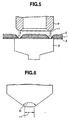
- the blade angle shown with the arrows of Numeral 10 in Figure 6 of the blade of the ultrasonic generating source or the jig within the range of 5-175 degrees, or more preferably 15-160 degrees. If the blade angle is less than 5 degrees, the periphery of the cut oxygen-absorbing resin sheet cannot be sufficiently covered with the covering members and the oxygen-absorbing resin sheet will be exposed, causing leakage and other problems to easily occur. On the other hand, if the blade angle exceeds 175 degrees, vibrations caused by ultrasonic waves transmitted to portions other than those to be cut by ultrasonic heat sealing, and these vibrated portions are sealed by heat. thereby lowering the oxygen-absorbing performance of the oxygen-absorbing resin sheet and causing the shape of the oxygen absorber to become easily distorted.
- the tip portion of the blade should be 0.01-3 mm wide, or more preferably 0.5-2 mm (as shown by arrows of Numeral 11 in Figure 6) and should be substantially flat. If the tip portion of the blade is not flat, when the ultrasonic heat sealing and cutting is conducted, both the covering members will be pressed by the tip portion of the blade and then cut, heaving the first and second heat-sealable resin layers unsealed by heat. As a result, the periphery of the oxygen-absorbing resin sheet will be exposed and problems of contamination and leakage will occur. If the width of the flat tip portion of the blade exceeds 3 mm, flashes are formed at the cut surfaces, lowering the appearance of the oxygen absorber. Also, a larger output is required for the ultrasonic heat sealing and cutting. The blade of the above-mentioned width is not desirable because it takes more time to conduct the ultrasonic heat sealing and cutting and therefore productivity is lowered.
- Figure 1 is a sectional view of the sheet-shaped oxygen absorber of the present invention.
- Figure 2 shows the step of performing the ultrasonic heat sealing and cutting on the multi-layer structural body of the present invention.
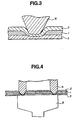
- Figure 3 is a partial sectional view showing the step of performing the ultrasonic heat sealing and cutting on the multi-layer structural body of the present invention.
- Figure 4 shows the step of performing the ultrasonic heat sealing and cutting on the multi-layer structural body of the present invention.
- Figure 5 shows the step of performing the ultrasonic heat sealing and cutting on the multi-layer structural body of the present invention.
- Figure 6 is a sectional view of the blade portion of the cutting tool used for ultrasonic heat sealing and cutting.
- the sheet-shaped oxygen absorber 100 of the present invention has a multi-layer construction in which the air-permeable covering member 2, consisting of the first heat-sealable resin layer 6 and a porous film 4, is placed over one surface of the oxygen-absorbing resin sheet 1 in which the oxygen-absorbing composition is dispersed in the thermoplastic resin in a manner such that the first heat-sealable resin layer directly contacts the oxygen-absorbing resin sheet 1, while the air-permeation-resistant covering member 3, consisting of the second heat-sealable resin layer 5 and an air-permeation-resistant film 7, is placed over the other surface of the oxygen-absorbing resin sheet 1 in a manner such that the second heat-sealable resin layer 5 directly contacts the oxygen-absorbing resin sheet 1.
- the first heat-sealable resin layer 6 and the second heat-sealable resin layer 5 are fused and sealed by heat. Accordingly, the periphery of the oxygen-absorbing resin sheet 1 is covered with the first heat-sealable resin layer 6 and the second heat-sealable resin layer 5 and, therefore, the oxygen-absorbing resin sheet 1 is never exposed.
- This sheet-shaped oxygen absorber 100 was manufactured in the following steps:
- a porous film 4 (pore diameter: 0, 8 mm; and percentage of porous area to the entire surface area: 7%), which is a perforated two-layer structural film made of oriented nylon (film thickness: 15 ⁇ m) and polyethylene (film thickness: 15 ⁇ m), and waterproof nonwoven cloth "LUXER” (made by ASAHI CHEMICAL INDUSTRY CO., LTD.) (film thickness: about 200 ⁇ m), which is the first heat-sealable resin layer 6, were laminated by heat, thereby producing the air-permeable covering member 2.
- ethylene-vinyl acetate copolymer (film thickness: 15 ⁇ m), which is the second heat-sealable resin layer 4, was placed on one side of an air-permeation-resistant film 7, which is made of polyethylene terephthalate (film thickness: 15 ⁇ m) and polyethylene (film thickness: 15 ⁇ m), thereby producing the air-permeation-resistant covering member 3.
- the air-permeable covering member 2 was then laid over one surface of the oxygen-absorbing resin sheet 1 so that the first heat-sealable resin layer 6 of the air-permeable covering member 2 would directly contact the oxygen-absorbing resin sheet 1.
- the air-permeation-resistant covering member 3 was also laid over the other surface of the oxygen-absorbing resin sheet 1 so that the second heat-sealable resin layer 5 of the air-permeation-resistant covering member 3 would directly contact the oxygen-absorbing resin sheet 1. Accordingly, a multi-layer structural body was obtained.
- This multi-layer structural body was then cut into a desirable shape by the ultrasonic heat sealing and cutting method by using an ultrasonic heat sealing and cutting device which has the construction described below.
- the ultrasonic wave frequency was set at 10,000 - 70,000 Hz.
- the ultrasonic heat sealing and cutting device (output: 1.2 KW; and oscillation frequency: 20 KHz) is constructed in a manner such that it comprises: an ultrasonic vibration horn 8 on which the multi-layer structural body is set, and which generates an ultrasonic wave from below the multi-structural body in an upward direction; and a jig 9 which is placed opposite to and above the ultrasonic vibration horn 8 and which is movable up and down.
- an ultrasonic heat sealing and cutting device made by NIPPON FUTURE Co., Ltd, with an ultrasonic vibration horn (diameter: 45 mm) attached was used.
- the jig 9 has a hollow cylindrical shape, and the tip portion of the jig 9 opposite the ultrasonic vibration horn 8 is formed in a blade shape 11 (outside diameter: 40 mm) (blade angle (angle of the portion shown as Numeral 10 in Figure 6): 120 degrees; and width of the flat tip portion (length of the portion shown as Numeral 11 in Figure 6): 0.1 mm).
- This ultrasonic heat sealing and cutting device is designed to hold the sheet-shaped oxygen absorber, which is placed on the ultrasonic vibration horn 8, between the ultrasonic vibration horn 8 and the jig 9, thereby allowing the heat sealing and cutting of the multi-layer structural body.
- the multi-layer structural body was placed on the ultrasonic vibration horn 8, as shown in Figure 2.
- the multi-layer structural body was then held between the ultrasonic vibration horn 8 and the jig 9, as shown in Figure 3, and simultaneously received an ultrasonic wave from the ultrasonic vibration horn 8.
- the ultrasonic vibration horn 8 and the jig 9 were pressed toward each other with the power of 150 Kg for 0.2 seconds.
- the multi-layer structural body generated heat from inside and the oxygen-absorbing resin sheet 1 softened.
- the portions of the multi-layer structural body facing the blade 11 of the jig 9 which was moving down were held between and pressed by the ultrasonic vibration horn 8 and the blade 11, causing the softened oxygen-absorbing resin sheet 1 to move away from such pressed portions.
- the first heat-sealable resin layer 6 and the second heat-sealable resin layer 5 were pressed and sealed together by heat and, as shown in Figure 4, were finally pressed and cut by the flat tip portion of the blade 11. Then, as shown in Figure 5, the jig 9 was moved upward. Consequently, the sheet-shaped oxygen absorber (diameter: 40 mm) was obtained.
- the air-permeable covering member 2 or the air-permeation-resistant covering member 3 may be placed to contact the blade 11.
- the ultrasonic heat sealing and cutting method By utilizing the ultrasonic heat sealing and cutting method, it is possible to cut a plurality of sheet-shaped oxygen absorbers at once. It is also possible to move the multi-layer structural body or the ultrasonic heat sealing and cutting device in a horizontal direction in order to cut the multi-layer structural body successively in a desirable shape. Furthermore, it is possible to combine these methods.
- Example 2 the same air-permeable covering member 2, oxygen-absorbing resin sheet 1 and air-permeation-resistant covering member 3 as those used in Example 1 were laid one over another in the order listed above. These layers were laminated by heat by using a heat roller at a temperature of 120° C, thereby obtaining a multi-layer structural body. Then, two jigs 9, the same ones as that used in Example 1, were prepared and heated up to a temperature of 200° C. These jigs 9 were made to press the multi-layer structural body from both sides and to cut it by heat sealing, thereby obtaining a sheet-shaped oxygen absorber (40 mm ⁇ ) (Comparative Example 2).
- Comparative Example 2 was not as bad as Comparative Example 1, but again a slight iron powder smell was generated and also the generation of rust was observed.
- the sheet-shaped oxygen absorber of the present invention is manufactured by being cut by ultrasonic heat sealing and, therefore, the first and second heat-sealable resin layers are fused and sealed together by heat. Accordingly, it is possible to prevent the oxygen-absorbing resin sheet from being exposed at the periphery of the sheet-shaped oxygen absorber. Consequently, the present invention can provide a sheet-shaped oxygen absorber which is superior in safety with no leakage of the oxygen-absorbing composition or contamination of the preserved substance due to contact with the oxygen-absorbing resin sheet.
- the sheet-shaped oxygen absorber of the present invention can be produced freely in various shapes. For example, it can be used as a mat for food or a cover sheet found inside of a can or box containing food. If the sheet-shaped oxygen absorber is cut in a desirable shape by heat sealing, it is also possible to use it as a part of decorations for food. Therefore, the sheet-shaped oxygen absorber of the present invention not only eliminates a sense of incompatibility that a conventional small-bag-shaped oxygen absorber brings about, but also can be used as a packing material which enhances the product value. Furthermore, the sheet-shaped oxygen absorber of the present invention is superior in its productivity and, therefore, productivity for commercial use can be promoted.
Landscapes
- Engineering & Computer Science (AREA)
- Mechanical Engineering (AREA)
- Food Science & Technology (AREA)
- Textile Engineering (AREA)
- Laminated Bodies (AREA)
- Packages (AREA)
- Food Preservation Except Freezing, Refrigeration, And Drying (AREA)
Applications Claiming Priority (3)
| Application Number | Priority Date | Filing Date | Title |
|---|---|---|---|
| JP18241294 | 1994-08-03 | ||
| JP18241294 | 1994-08-03 | ||
| JP182412/94 | 1994-08-03 |
Publications (2)
| Publication Number | Publication Date |
|---|---|
| EP0695628A1 true EP0695628A1 (de) | 1996-02-07 |
| EP0695628B1 EP0695628B1 (de) | 2003-06-25 |
Family
ID=16117844
Family Applications (1)
| Application Number | Title | Priority Date | Filing Date |
|---|---|---|---|
| EP19950305442 Expired - Lifetime EP0695628B1 (de) | 1994-08-03 | 1995-08-03 | Blattförmiger Sauerstoff-Absorber und Verfahren zur Herstellung |
Country Status (3)
| Country | Link |
|---|---|
| US (1) | US6066226A (de) |
| EP (1) | EP0695628B1 (de) |
| DE (1) | DE69531132T2 (de) |
Cited By (9)
| Publication number | Priority date | Publication date | Assignee | Title |
|---|---|---|---|---|
| US5896994A (en) * | 1994-08-23 | 1999-04-27 | W. R. Grace & Co.-Conn. | Sealed article |
| FR2770224A1 (fr) * | 1997-10-03 | 1999-04-30 | Akio Usui | Desoxydant liquide visqueux, feuille desoxydante constituee de celui-ci et procede de fabrication de la feuille desoxydante |
| EP0781649A3 (de) * | 1995-12-28 | 1999-07-21 | Mitsubishi Gas Chemical Company, Inc. | Sauerstoffabsorbierende Mehrschichtfolie und deren Herstellungsverfahren |
| EP0884173A3 (de) * | 1997-06-12 | 1999-07-28 | Mitsubishi Gas Chemical Company, Inc. | Sauerstoffabsorbierender Mehrschichtfilm und sauerstoffabsorbierender Verpackungsbehälter |
| WO2002085512A1 (fr) * | 2001-04-24 | 2002-10-31 | Atmosphere Controle | Procede de fabrication d'un dispositif apte a modifier l'atmosphere gazeuse regnant dans une enceinte hermetique ou a permeabilite controlee |
| FR2824497A1 (fr) * | 2001-04-24 | 2002-11-15 | Atmosphere Controle | Procede de fabrication d'un dispositif apte a modifier l'atmosphere gazeuse regnant dans une enceinte hermetique ou a permeabilite controlee |
| EP1344641A3 (de) * | 2002-03-13 | 2004-02-04 | Mitsubishi Gas Chemical Company, Inc. | Sauerstoffabsorbierendes Etikett |
| EP1243524A3 (de) * | 2001-03-16 | 2004-04-07 | Pfizer Products Inc. | Pharmazeutisches Kit fÜr sauerstoffempfindliche Medikamente |
| WO2005097474A1 (en) * | 2004-04-07 | 2005-10-20 | Otto Bock Scandinavia Ab | Method and device for cutting a laminate and a laminated product |
Families Citing this family (6)
| Publication number | Priority date | Publication date | Assignee | Title |
|---|---|---|---|---|
| US6502302B2 (en) * | 2000-07-19 | 2003-01-07 | Ngk Insulators, Ltd. | Process for producing an industrial member having throughholes of high aspect ratio |
| US6637102B2 (en) | 2000-07-19 | 2003-10-28 | Ngk Insulators, Ltd. | Process for producing an industrial member having throughholes of high aspect ratio |
| JP4503220B2 (ja) * | 2002-07-25 | 2010-07-14 | 東洋製罐株式会社 | 多層体の切断方法および多層成型品 |
| WO2013019695A2 (en) | 2011-08-04 | 2013-02-07 | 3M Innovative Properties Company | Edge protected barrier assemblies |
| KR20140051990A (ko) * | 2011-08-04 | 2014-05-02 | 쓰리엠 이노베이티브 프로퍼티즈 컴파니 | 에지 보호된 배리어 조립체 |
| JP5146591B1 (ja) * | 2011-12-22 | 2013-02-20 | 横浜ゴム株式会社 | 空気入りタイヤの製造方法 |
Citations (6)
| Publication number | Priority date | Publication date | Assignee | Title |
|---|---|---|---|---|
| GB2020605A (en) * | 1978-05-02 | 1979-11-21 | Tetra Pak Int | Closure of an opening in the wall of a container |
| JPS5544344A (en) | 1978-09-25 | 1980-03-28 | Dainippon Printing Co Ltd | Oxygen absorbing sheet |
| JPS5626524A (en) | 1979-08-09 | 1981-03-14 | Dainippon Printing Co Ltd | Oxygen absorption sheet |
| JPH0272851A (ja) | 1988-09-08 | 1990-03-13 | Mitsubishi Gas Chem Co Inc | フィルム状脱酸素剤 |
| JPH0286758A (ja) | 1988-09-22 | 1990-03-27 | Mitsubishi Gas Chem Co Inc | シート状脱酸素剤 |
| WO1992012004A1 (en) * | 1991-01-07 | 1992-07-23 | Multiform Desiccants, Inc. | Oxygen-absorbing label |
Family Cites Families (2)
| Publication number | Priority date | Publication date | Assignee | Title |
|---|---|---|---|---|
| JP2893808B2 (ja) * | 1990-03-12 | 1999-05-24 | ソニー株式会社 | プラスチックシートの連続溶着・切断の方法 |
| JP2948647B2 (ja) * | 1990-10-05 | 1999-09-13 | 勝彦 大谷 | フイルムの接合方法、それにより得られる接合フイルム及びエンドレスフイルム |
-
1995
- 1995-08-02 US US08/510,412 patent/US6066226A/en not_active Expired - Lifetime
- 1995-08-03 EP EP19950305442 patent/EP0695628B1/de not_active Expired - Lifetime
- 1995-08-03 DE DE1995631132 patent/DE69531132T2/de not_active Expired - Lifetime
Patent Citations (7)
| Publication number | Priority date | Publication date | Assignee | Title |
|---|---|---|---|---|
| GB2020605A (en) * | 1978-05-02 | 1979-11-21 | Tetra Pak Int | Closure of an opening in the wall of a container |
| JPS5544344A (en) | 1978-09-25 | 1980-03-28 | Dainippon Printing Co Ltd | Oxygen absorbing sheet |
| JPS5626524A (en) | 1979-08-09 | 1981-03-14 | Dainippon Printing Co Ltd | Oxygen absorption sheet |
| JPH0272851A (ja) | 1988-09-08 | 1990-03-13 | Mitsubishi Gas Chem Co Inc | フィルム状脱酸素剤 |
| JPH0286758A (ja) | 1988-09-22 | 1990-03-27 | Mitsubishi Gas Chem Co Inc | シート状脱酸素剤 |
| EP0366254A1 (de) * | 1988-09-22 | 1990-05-02 | Mitsubishi Gas Chemical Company, Inc. | Sauerstoffabsorptionsblatt |
| WO1992012004A1 (en) * | 1991-01-07 | 1992-07-23 | Multiform Desiccants, Inc. | Oxygen-absorbing label |
Cited By (13)
| Publication number | Priority date | Publication date | Assignee | Title |
|---|---|---|---|---|
| US5896994A (en) * | 1994-08-23 | 1999-04-27 | W. R. Grace & Co.-Conn. | Sealed article |
| EP0781649A3 (de) * | 1995-12-28 | 1999-07-21 | Mitsubishi Gas Chemical Company, Inc. | Sauerstoffabsorbierende Mehrschichtfolie und deren Herstellungsverfahren |
| US6063503A (en) * | 1995-12-28 | 2000-05-16 | Mitsubishi Gas Chemical Company, Inc. | Oxygen-absorbing multi-layer film and method for preparing same |
| EP0884173A3 (de) * | 1997-06-12 | 1999-07-28 | Mitsubishi Gas Chemical Company, Inc. | Sauerstoffabsorbierender Mehrschichtfilm und sauerstoffabsorbierender Verpackungsbehälter |
| US6391407B1 (en) | 1997-06-12 | 2002-05-21 | Mitsubishi Gas Chemical Company, Inc. | Oxygen absorbing multi-layer film and oxygen absorbing packaging container |
| FR2770224A1 (fr) * | 1997-10-03 | 1999-04-30 | Akio Usui | Desoxydant liquide visqueux, feuille desoxydante constituee de celui-ci et procede de fabrication de la feuille desoxydante |
| EP1243524A3 (de) * | 2001-03-16 | 2004-04-07 | Pfizer Products Inc. | Pharmazeutisches Kit fÜr sauerstoffempfindliche Medikamente |
| WO2002085512A1 (fr) * | 2001-04-24 | 2002-10-31 | Atmosphere Controle | Procede de fabrication d'un dispositif apte a modifier l'atmosphere gazeuse regnant dans une enceinte hermetique ou a permeabilite controlee |
| FR2824496A1 (fr) * | 2001-04-24 | 2002-11-15 | Atmosphere Controle | Procede de fabrication d'un dispositif apte a modifier l'atmosphere gazeuse regnant dans une enceinte hermetique ou a permeabilite controlee |
| FR2824497A1 (fr) * | 2001-04-24 | 2002-11-15 | Atmosphere Controle | Procede de fabrication d'un dispositif apte a modifier l'atmosphere gazeuse regnant dans une enceinte hermetique ou a permeabilite controlee |
| EP1344641A3 (de) * | 2002-03-13 | 2004-02-04 | Mitsubishi Gas Chemical Company, Inc. | Sauerstoffabsorbierendes Etikett |
| WO2005097474A1 (en) * | 2004-04-07 | 2005-10-20 | Otto Bock Scandinavia Ab | Method and device for cutting a laminate and a laminated product |
| US8110053B2 (en) | 2004-04-07 | 2012-02-07 | Otto Bock Scandinavia Ab | Method and device for cutting a laminate and laminate product |
Also Published As
| Publication number | Publication date |
|---|---|
| EP0695628B1 (de) | 2003-06-25 |
| DE69531132T2 (de) | 2004-05-06 |
| DE69531132D1 (de) | 2003-07-31 |
| US6066226A (en) | 2000-05-23 |
Similar Documents
| Publication | Publication Date | Title |
|---|---|---|
| EP0695628B1 (de) | Blattförmiger Sauerstoff-Absorber und Verfahren zur Herstellung | |
| US4485133A (en) | Oxygen absorbent packaging | |
| EP0366254B1 (de) | Sauerstoffabsorptionsblatt | |
| JPS6330223B2 (de) | ||
| KR19980024591A (ko) | 건조제 용기 | |
| EP0475608B1 (de) | Membran und deren Verwendung in einem Ileostomiebeutel | |
| JPH02128676A (ja) | 酸素吸収体収納袋及びその切断方法 | |
| KR850001957B1 (ko) | 산소흡수제 포장체 | |
| JPH06340036A (ja) | 食品容器用包装材料及びその製造方法 | |
| JPH0899013A (ja) | シート状脱酸素剤及びその製造方法 | |
| JPH0640464A (ja) | 耐液通気性包装材料 | |
| JP3246538B2 (ja) | 蓋用パッキング | |
| EP0595442B1 (de) | Leicht zu öffnende Verpackung | |
| JP3246537B2 (ja) | 蓋用パッキング | |
| JP2508617B2 (ja) | 脱酸素剤二重包装体 | |
| JPS6254704B2 (de) | ||
| JPH0648471A (ja) | 品質保持剤包装体 | |
| JPH04279468A (ja) | 脱酸素剤包装体 | |
| JPH026129A (ja) | 脱酸素剤用包装フィルム | |
| JP3633651B2 (ja) | 脱酸素剤包装材料 | |
| JP3075573B2 (ja) | 吸水性シート装着パウチ及びその製造方法 | |
| JPH06125751A (ja) | 食品包装用多孔質シート | |
| JPH08217128A (ja) | 蓋用パッキング | |
| JPH0648472A (ja) | 耐水性品質保持剤包装体 | |
| JPS6239099B2 (de) |
Legal Events
| Date | Code | Title | Description |
|---|---|---|---|
| PUAI | Public reference made under article 153(3) epc to a published international application that has entered the european phase |
Free format text: ORIGINAL CODE: 0009012 |
|
| AK | Designated contracting states |
Kind code of ref document: A1 Designated state(s): DE FR GB |
|
| 17P | Request for examination filed |
Effective date: 19960429 |
|
| 17Q | First examination report despatched |
Effective date: 19980216 |
|
| GRAH | Despatch of communication of intention to grant a patent |
Free format text: ORIGINAL CODE: EPIDOS IGRA |
|
| GRAH | Despatch of communication of intention to grant a patent |
Free format text: ORIGINAL CODE: EPIDOS IGRA |
|
| GRAA | (expected) grant |
Free format text: ORIGINAL CODE: 0009210 |
|
| AK | Designated contracting states |
Designated state(s): DE FR GB |
|
| REG | Reference to a national code |
Ref country code: GB Ref legal event code: FG4D |
|
| REF | Corresponds to: |
Ref document number: 69531132 Country of ref document: DE Date of ref document: 20030731 Kind code of ref document: P |
|
| PLBE | No opposition filed within time limit |
Free format text: ORIGINAL CODE: 0009261 |
|
| STAA | Information on the status of an ep patent application or granted ep patent |
Free format text: STATUS: NO OPPOSITION FILED WITHIN TIME LIMIT |
|
| ET | Fr: translation filed | ||
| 26N | No opposition filed |
Effective date: 20040326 |
|
| PGFP | Annual fee paid to national office [announced via postgrant information from national office to epo] |
Ref country code: GB Payment date: 20120821 Year of fee payment: 18 |
|
| PGFP | Annual fee paid to national office [announced via postgrant information from national office to epo] |
Ref country code: DE Payment date: 20120822 Year of fee payment: 18 Ref country code: FR Payment date: 20120906 Year of fee payment: 18 |
|
| GBPC | Gb: european patent ceased through non-payment of renewal fee |
Effective date: 20130803 |
|
| PG25 | Lapsed in a contracting state [announced via postgrant information from national office to epo] |
Ref country code: DE Free format text: LAPSE BECAUSE OF NON-PAYMENT OF DUE FEES Effective date: 20140301 |
|
| REG | Reference to a national code |
Ref country code: DE Ref legal event code: R119 Ref document number: 69531132 Country of ref document: DE Effective date: 20140301 |
|
| REG | Reference to a national code |
Ref country code: FR Ref legal event code: ST Effective date: 20140430 |
|
| PG25 | Lapsed in a contracting state [announced via postgrant information from national office to epo] |
Ref country code: GB Free format text: LAPSE BECAUSE OF NON-PAYMENT OF DUE FEES Effective date: 20130803 |
|
| PG25 | Lapsed in a contracting state [announced via postgrant information from national office to epo] |
Ref country code: FR Free format text: LAPSE BECAUSE OF NON-PAYMENT OF DUE FEES Effective date: 20130902 |