EP0698112B1 - Synthese d'oligosaccharides en cuve unique, au moyen d'enzymes multiples et d'un systeme de regeneration d'acide cmp-sialique - Google Patents
Synthese d'oligosaccharides en cuve unique, au moyen d'enzymes multiples et d'un systeme de regeneration d'acide cmp-sialique Download PDFInfo
- Publication number
- EP0698112B1 EP0698112B1 EP94916687A EP94916687A EP0698112B1 EP 0698112 B1 EP0698112 B1 EP 0698112B1 EP 94916687 A EP94916687 A EP 94916687A EP 94916687 A EP94916687 A EP 94916687A EP 0698112 B1 EP0698112 B1 EP 0698112B1
- Authority
- EP
- European Patent Office
- Prior art keywords
- sialyltransferase
- galactosidase
- sialic acid
- cmp
- substrate
- Prior art date
- Legal status (The legal status is an assumption and is not a legal conclusion. Google has not performed a legal analysis and makes no representation as to the accuracy of the status listed.)
- Expired - Lifetime
Links
- TXCIAUNLDRJGJZ-UHFFFAOYSA-N CMP-N-acetyl neuraminic acid Natural products O1C(C(O)C(O)CO)C(NC(=O)C)C(O)CC1(C(O)=O)OP(O)(=O)OCC1C(O)C(O)C(N2C(N=C(N)C=C2)=O)O1 TXCIAUNLDRJGJZ-UHFFFAOYSA-N 0.000 title claims abstract description 31
- TXCIAUNLDRJGJZ-BILDWYJOSA-N CMP-N-acetyl-beta-neuraminic acid Chemical compound O1[C@@H]([C@H](O)[C@H](O)CO)[C@H](NC(=O)C)[C@@H](O)C[C@]1(C(O)=O)OP(O)(=O)OC[C@@H]1[C@@H](O)[C@@H](O)[C@H](N2C(N=C(N)C=C2)=O)O1 TXCIAUNLDRJGJZ-BILDWYJOSA-N 0.000 title claims abstract description 31
- 102000004190 Enzymes Human genes 0.000 title claims description 52
- 108090000790 Enzymes Proteins 0.000 title claims description 52
- 230000001172 regenerating effect Effects 0.000 title claims description 13
- 229920001542 oligosaccharide Polymers 0.000 title description 8
- 150000002482 oligosaccharides Chemical class 0.000 title description 7
- 238000005580 one pot reaction Methods 0.000 title description 5
- 239000000758 substrate Substances 0.000 claims abstract description 64
- -1 galactosyl glycoside Chemical class 0.000 claims abstract description 55
- 229930182470 glycoside Natural products 0.000 claims abstract description 43
- 108010005774 beta-Galactosidase Proteins 0.000 claims abstract description 42
- 238000000034 method Methods 0.000 claims abstract description 42
- 238000006243 chemical reaction Methods 0.000 claims abstract description 38
- 229930182830 galactose Natural products 0.000 claims abstract description 10
- 102000005936 beta-Galactosidase Human genes 0.000 claims abstract 6
- SQVRNKJHWKZAKO-UHFFFAOYSA-N beta-N-Acetyl-D-neuraminic acid Natural products CC(=O)NC1C(O)CC(O)(C(O)=O)OC1C(O)C(O)CO SQVRNKJHWKZAKO-UHFFFAOYSA-N 0.000 claims description 54
- 102000003838 Sialyltransferases Human genes 0.000 claims description 37
- 108090000141 Sialyltransferases Proteins 0.000 claims description 37
- SQVRNKJHWKZAKO-OQPLDHBCSA-N sialic acid Chemical compound CC(=O)N[C@@H]1[C@@H](O)C[C@@](O)(C(O)=O)OC1[C@H](O)[C@H](O)CO SQVRNKJHWKZAKO-OQPLDHBCSA-N 0.000 claims description 34
- OVRNDRQMDRJTHS-UHFFFAOYSA-N N-acelyl-D-glucosamine Natural products CC(=O)NC1C(O)OC(CO)C(O)C1O OVRNDRQMDRJTHS-UHFFFAOYSA-N 0.000 claims description 23
- MBLBDJOUHNCFQT-LXGUWJNJSA-N N-acetylglucosamine Natural products CC(=O)N[C@@H](C=O)[C@@H](O)[C@H](O)[C@H](O)CO MBLBDJOUHNCFQT-LXGUWJNJSA-N 0.000 claims description 23
- OVRNDRQMDRJTHS-RTRLPJTCSA-N N-acetyl-D-glucosamine Chemical group CC(=O)N[C@H]1C(O)O[C@H](CO)[C@@H](O)[C@@H]1O OVRNDRQMDRJTHS-RTRLPJTCSA-N 0.000 claims description 21
- IERHLVCPSMICTF-XVFCMESISA-N cytidine 5'-monophosphate Chemical compound O=C1N=C(N)C=CN1[C@H]1[C@H](O)[C@H](O)[C@@H](COP(O)(O)=O)O1 IERHLVCPSMICTF-XVFCMESISA-N 0.000 claims description 20
- IERHLVCPSMICTF-UHFFFAOYSA-N cytidine monophosphate Natural products O=C1N=C(N)C=CN1C1C(O)C(O)C(COP(O)(O)=O)O1 IERHLVCPSMICTF-UHFFFAOYSA-N 0.000 claims description 20
- 230000003197 catalytic effect Effects 0.000 claims description 19
- WQZGKKKJIJFFOK-FPRJBGLDSA-N beta-D-galactose Chemical compound OC[C@H]1O[C@@H](O)[C@H](O)[C@@H](O)[C@H]1O WQZGKKKJIJFFOK-FPRJBGLDSA-N 0.000 claims description 17
- ZKHQWZAMYRWXGA-KQYNXXCUSA-J ATP(4-) Chemical compound C1=NC=2C(N)=NC=NC=2N1[C@@H]1O[C@H](COP([O-])(=O)OP([O-])(=O)OP([O-])([O-])=O)[C@@H](O)[C@H]1O ZKHQWZAMYRWXGA-KQYNXXCUSA-J 0.000 claims description 14
- ZKHQWZAMYRWXGA-UHFFFAOYSA-N Adenosine triphosphate Natural products C1=NC=2C(N)=NC=NC=2N1C1OC(COP(O)(=O)OP(O)(=O)OP(O)(O)=O)C(O)C1O ZKHQWZAMYRWXGA-UHFFFAOYSA-N 0.000 claims description 14
- 102000013009 Pyruvate Kinase Human genes 0.000 claims description 14
- 108020005115 Pyruvate Kinase Proteins 0.000 claims description 14
- GUBGYTABKSRVRQ-QKKXKWKRSA-N Lactose Natural products OC[C@H]1O[C@@H](O[C@H]2[C@H](O)[C@@H](O)C(O)O[C@@H]2CO)[C@H](O)[C@@H](O)[C@H]1O GUBGYTABKSRVRQ-QKKXKWKRSA-N 0.000 claims description 13
- 239000008101 lactose Substances 0.000 claims description 13
- 239000011541 reaction mixture Substances 0.000 claims description 13
- 108010009595 Inorganic Pyrophosphatase Proteins 0.000 claims description 11
- 229930029653 phosphoenolpyruvate Natural products 0.000 claims description 10
- 108010081778 N-acylneuraminate cytidylyltransferase Proteins 0.000 claims description 9
- 102000002281 Adenylate kinase Human genes 0.000 claims description 8
- 108020000543 Adenylate kinase Proteins 0.000 claims description 8
- 241000193752 Bacillus circulans Species 0.000 claims description 7
- 102000002464 Galactosidases Human genes 0.000 claims description 6
- 108010093031 Galactosidases Proteins 0.000 claims description 6
- 239000000243 solution Substances 0.000 claims description 6
- 239000012062 aqueous buffer Substances 0.000 claims description 5
- 238000006555 catalytic reaction Methods 0.000 claims description 5
- 229910021645 metal ion Inorganic materials 0.000 claims description 4
- KFEUJDWYNGMDBV-UHFFFAOYSA-N (N-Acetyl)-glucosamin-4-beta-galaktosid Natural products OC1C(NC(=O)C)C(O)OC(CO)C1OC1C(O)C(O)C(O)C(CO)O1 KFEUJDWYNGMDBV-UHFFFAOYSA-N 0.000 claims description 3
- HESSGHHCXGBPAJ-UHFFFAOYSA-N N-acetyllactosamine Natural products CC(=O)NC(C=O)C(O)C(C(O)CO)OC1OC(CO)C(O)C(O)C1O HESSGHHCXGBPAJ-UHFFFAOYSA-N 0.000 claims description 3
- KFEUJDWYNGMDBV-LODBTCKLSA-N N-acetyllactosamine Chemical compound O[C@@H]1[C@@H](NC(=O)C)[C@H](O)O[C@H](CO)[C@H]1O[C@H]1[C@H](O)[C@@H](O)[C@@H](O)[C@@H](CO)O1 KFEUJDWYNGMDBV-LODBTCKLSA-N 0.000 claims description 2
- 102000009617 Inorganic Pyrophosphatase Human genes 0.000 claims 2
- 229950006780 n-acetylglucosamine Drugs 0.000 claims 2
- DTBNBXWJWCWCIK-UHFFFAOYSA-N phosphoenolpyruvic acid Chemical compound OC(=O)C(=C)OP(O)(O)=O DTBNBXWJWCWCIK-UHFFFAOYSA-N 0.000 claims 2
- OVRNDRQMDRJTHS-FMDGEEDCSA-N N-acetyl-beta-D-glucosamine Chemical compound CC(=O)N[C@H]1[C@H](O)O[C@H](CO)[C@@H](O)[C@@H]1O OVRNDRQMDRJTHS-FMDGEEDCSA-N 0.000 claims 1
- 230000015572 biosynthetic process Effects 0.000 abstract description 20
- 238000003786 synthesis reaction Methods 0.000 abstract description 15
- 150000008195 galaktosides Chemical class 0.000 abstract description 5
- 125000004122 cyclic group Chemical group 0.000 abstract description 3
- 102100026189 Beta-galactosidase Human genes 0.000 description 35
- 239000000370 acceptor Substances 0.000 description 27
- 229910019142 PO4 Inorganic materials 0.000 description 21
- 239000010452 phosphate Substances 0.000 description 21
- SQVRNKJHWKZAKO-LUWBGTNYSA-N N-acetylneuraminic acid Chemical compound CC(=O)N[C@@H]1[C@@H](O)CC(O)(C(O)=O)O[C@H]1[C@H](O)[C@H](O)CO SQVRNKJHWKZAKO-LUWBGTNYSA-N 0.000 description 20
- NBIIXXVUZAFLBC-UHFFFAOYSA-K phosphate Chemical compound [O-]P([O-])([O-])=O NBIIXXVUZAFLBC-UHFFFAOYSA-K 0.000 description 19
- 150000001875 compounds Chemical class 0.000 description 18
- 239000000047 product Substances 0.000 description 15
- 150000001720 carbohydrates Chemical class 0.000 description 14
- 108091000080 Phosphotransferase Proteins 0.000 description 13
- 102000020233 phosphotransferase Human genes 0.000 description 13
- 239000002777 nucleoside Substances 0.000 description 12
- DTBNBXWJWCWCIK-UHFFFAOYSA-K phosphonatoenolpyruvate Chemical compound [O-]C(=O)C(=C)OP([O-])([O-])=O DTBNBXWJWCWCIK-UHFFFAOYSA-K 0.000 description 10
- 102100027050 Inorganic pyrophosphatase Human genes 0.000 description 9
- 229940060155 neuac Drugs 0.000 description 8
- 239000000376 reactant Substances 0.000 description 8
- 125000005630 sialyl group Chemical group 0.000 description 8
- PCDQPRRSZKQHHS-CCXZUQQUSA-N Cytarabine Triphosphate Chemical compound O=C1N=C(N)C=CN1[C@H]1[C@@H](O)[C@H](O)[C@@H](COP(O)(=O)OP(O)(=O)OP(O)(O)=O)O1 PCDQPRRSZKQHHS-CCXZUQQUSA-N 0.000 description 7
- 102000005744 Glycoside Hydrolases Human genes 0.000 description 7
- 108010031186 Glycoside Hydrolases Proteins 0.000 description 7
- 235000011180 diphosphates Nutrition 0.000 description 7
- CERZMXAJYMMUDR-UHFFFAOYSA-N neuraminic acid Natural products NC1C(O)CC(O)(C(O)=O)OC1C(O)C(O)CO CERZMXAJYMMUDR-UHFFFAOYSA-N 0.000 description 7
- 230000009450 sialylation Effects 0.000 description 7
- WQZGKKKJIJFFOK-GASJEMHNSA-N Glucose Chemical compound OC[C@H]1OC(O)[C@H](O)[C@@H](O)[C@@H]1O WQZGKKKJIJFFOK-GASJEMHNSA-N 0.000 description 6
- 239000006227 byproduct Substances 0.000 description 6
- 210000004027 cell Anatomy 0.000 description 6
- 239000003153 chemical reaction reagent Substances 0.000 description 6
- XPPKVPWEQAFLFU-UHFFFAOYSA-N diphosphoric acid Chemical compound OP(O)(=O)OP(O)(O)=O XPPKVPWEQAFLFU-UHFFFAOYSA-N 0.000 description 6
- 238000012546 transfer Methods 0.000 description 6
- 125000003903 2-propenyl group Chemical group [H]C([*])([H])C([H])=C([H])[H] 0.000 description 5
- 102100029962 CMP-N-acetylneuraminate-beta-1,4-galactoside alpha-2,3-sialyltransferase Human genes 0.000 description 5
- OVRNDRQMDRJTHS-OZRXBMAMSA-N N-acetyl-beta-D-mannosamine Chemical compound CC(=O)N[C@@H]1[C@H](O)O[C@H](CO)[C@@H](O)[C@@H]1O OVRNDRQMDRJTHS-OZRXBMAMSA-N 0.000 description 5
- 108010015197 N-acetyllactosaminide alpha-2,3-sialyltransferase Proteins 0.000 description 5
- LCTONWCANYUPML-UHFFFAOYSA-M Pyruvate Chemical compound CC(=O)C([O-])=O LCTONWCANYUPML-UHFFFAOYSA-M 0.000 description 5
- 230000002255 enzymatic effect Effects 0.000 description 5
- 239000001226 triphosphate Substances 0.000 description 5
- 235000011178 triphosphate Nutrition 0.000 description 5
- 102100029945 Beta-galactoside alpha-2,6-sialyltransferase 1 Human genes 0.000 description 4
- 241000283690 Bos taurus Species 0.000 description 4
- 102000001390 Fructose-Bisphosphate Aldolase Human genes 0.000 description 4
- 108010068561 Fructose-Bisphosphate Aldolase Proteins 0.000 description 4
- TWRXJAOTZQYOKJ-UHFFFAOYSA-L Magnesium chloride Chemical compound [Mg+2].[Cl-].[Cl-] TWRXJAOTZQYOKJ-UHFFFAOYSA-L 0.000 description 4
- OVRNDRQMDRJTHS-ZTVVOAFPSA-N N-acetyl-D-mannosamine Chemical compound CC(=O)N[C@@H]1C(O)O[C@H](CO)[C@@H](O)[C@@H]1O OVRNDRQMDRJTHS-ZTVVOAFPSA-N 0.000 description 4
- 125000000738 acetamido group Chemical group [H]C([H])([H])C(=O)N([H])[*] 0.000 description 4
- 239000000872 buffer Substances 0.000 description 4
- 229940125773 compound 10 Drugs 0.000 description 4
- ZLVXBBHTMQJRSX-VMGNSXQWSA-N jdtic Chemical compound C1([C@]2(C)CCN(C[C@@H]2C)C[C@H](C(C)C)NC(=O)[C@@H]2NCC3=CC(O)=CC=C3C2)=CC=CC(O)=C1 ZLVXBBHTMQJRSX-VMGNSXQWSA-N 0.000 description 4
- 239000002773 nucleotide Substances 0.000 description 4
- 125000003729 nucleotide group Chemical group 0.000 description 4
- 239000002243 precursor Substances 0.000 description 4
- 238000004064 recycling Methods 0.000 description 4
- 230000008929 regeneration Effects 0.000 description 4
- 238000011069 regeneration method Methods 0.000 description 4
- 230000006098 transglycosylation Effects 0.000 description 4
- 238000005918 transglycosylation reaction Methods 0.000 description 4
- JKMHFZQWWAIEOD-UHFFFAOYSA-N 2-[4-(2-hydroxyethyl)piperazin-1-yl]ethanesulfonic acid Chemical group OCC[NH+]1CCN(CCS([O-])(=O)=O)CC1 JKMHFZQWWAIEOD-UHFFFAOYSA-N 0.000 description 3
- GUBGYTABKSRVRQ-XLOQQCSPSA-N Alpha-Lactose Chemical compound O[C@@H]1[C@@H](O)[C@@H](O)[C@@H](CO)O[C@H]1O[C@@H]1[C@@H](CO)O[C@H](O)[C@H](O)[C@H]1O GUBGYTABKSRVRQ-XLOQQCSPSA-N 0.000 description 3
- 0 CCC(C)=CCC(C[U][C@@](C(*C)C1O)N*(CO)[C@]1O)=C Chemical compound CCC(C)=CCC(C[U][C@@](C(*C)C1O)N*(CO)[C@]1O)=C 0.000 description 3
- ZWIADYZPOWUWEW-XVFCMESISA-N CDP Chemical compound O=C1N=C(N)C=CN1[C@H]1[C@H](O)[C@H](O)[C@@H](COP(O)(=O)OP(O)(O)=O)O1 ZWIADYZPOWUWEW-XVFCMESISA-N 0.000 description 3
- 102100031973 CMP-N-acetylneuraminate-beta-galactosamide-alpha-2,3-sialyltransferase 2 Human genes 0.000 description 3
- LFQSCWFLJHTTHZ-UHFFFAOYSA-N Ethanol Chemical compound CCO LFQSCWFLJHTTHZ-UHFFFAOYSA-N 0.000 description 3
- 239000007995 HEPES buffer Substances 0.000 description 3
- OKKJLVBELUTLKV-UHFFFAOYSA-N Methanol Chemical compound OC OKKJLVBELUTLKV-UHFFFAOYSA-N 0.000 description 3
- OVRNDRQMDRJTHS-KEWYIRBNSA-N N-acetyl-D-galactosamine Chemical compound CC(=O)N[C@H]1C(O)O[C@H](CO)[C@H](O)[C@@H]1O OVRNDRQMDRJTHS-KEWYIRBNSA-N 0.000 description 3
- MBLBDJOUHNCFQT-UHFFFAOYSA-N N-acetyl-D-galactosamine Natural products CC(=O)NC(C=O)C(O)C(O)C(O)CO MBLBDJOUHNCFQT-UHFFFAOYSA-N 0.000 description 3
- 108010009413 Pyrophosphatases Proteins 0.000 description 3
- 102000009609 Pyrophosphatases Human genes 0.000 description 3
- HEMHJVSKTPXQMS-UHFFFAOYSA-M Sodium hydroxide Chemical compound [OH-].[Na+] HEMHJVSKTPXQMS-UHFFFAOYSA-M 0.000 description 3
- AXQLFFDZXPOFPO-UHFFFAOYSA-N UNPD216 Natural products O1C(CO)C(O)C(OC2C(C(O)C(O)C(CO)O2)O)C(NC(=O)C)C1OC(C1O)C(O)C(CO)OC1OC1C(O)C(O)C(O)OC1CO AXQLFFDZXPOFPO-UHFFFAOYSA-N 0.000 description 3
- 230000003213 activating effect Effects 0.000 description 3
- AXQLFFDZXPOFPO-UNTPKZLMSA-N beta-D-Galp-(1->3)-beta-D-GlcpNAc-(1->3)-beta-D-Galp-(1->4)-beta-D-Glcp Chemical compound O([C@@H]1O[C@H](CO)[C@H](O)[C@@H]([C@H]1O)O[C@H]1[C@@H]([C@H]([C@H](O)[C@@H](CO)O1)O[C@H]1[C@@H]([C@@H](O)[C@@H](O)[C@@H](CO)O1)O)NC(=O)C)[C@H]1[C@H](O)[C@@H](O)[C@H](O)O[C@@H]1CO AXQLFFDZXPOFPO-UNTPKZLMSA-N 0.000 description 3
- 108010057005 beta-galactoside alpha-2,3-sialyltransferase Proteins 0.000 description 3
- 229940125904 compound 1 Drugs 0.000 description 3
- 229940125782 compound 2 Drugs 0.000 description 3
- 229940126214 compound 3 Drugs 0.000 description 3
- 238000005859 coupling reaction Methods 0.000 description 3
- 230000033581 fucosylation Effects 0.000 description 3
- 125000002519 galactosyl group Chemical group C1([C@H](O)[C@@H](O)[C@@H](O)[C@H](O1)CO)* 0.000 description 3
- 150000002338 glycosides Chemical class 0.000 description 3
- 230000013595 glycosylation Effects 0.000 description 3
- 238000006206 glycosylation reaction Methods 0.000 description 3
- 238000011065 in-situ storage Methods 0.000 description 3
- USIPEGYTBGEPJN-UHFFFAOYSA-N lacto-N-tetraose Natural products O1C(CO)C(O)C(OC2C(C(O)C(O)C(CO)O2)O)C(NC(=O)C)C1OC1C(O)C(CO)OC(OC(C(O)CO)C(O)C(O)C=O)C1O USIPEGYTBGEPJN-UHFFFAOYSA-N 0.000 description 3
- 239000003446 ligand Substances 0.000 description 3
- 210000004185 liver Anatomy 0.000 description 3
- 239000000463 material Substances 0.000 description 3
- 238000000425 proton nuclear magnetic resonance spectrum Methods 0.000 description 3
- 239000012429 reaction media Substances 0.000 description 3
- 230000002441 reversible effect Effects 0.000 description 3
- 239000000126 substance Substances 0.000 description 3
- 238000012360 testing method Methods 0.000 description 3
- 210000001550 testis Anatomy 0.000 description 3
- 150000004043 trisaccharides Chemical class 0.000 description 3
- 238000005160 1H NMR spectroscopy Methods 0.000 description 2
- VHUUQVKOLVNVRT-UHFFFAOYSA-N Ammonium hydroxide Chemical compound [NH4+].[OH-] VHUUQVKOLVNVRT-UHFFFAOYSA-N 0.000 description 2
- XKRFYHLGVUSROY-UHFFFAOYSA-N Argon Chemical compound [Ar] XKRFYHLGVUSROY-UHFFFAOYSA-N 0.000 description 2
- WQZGKKKJIJFFOK-QTVWNMPRSA-N D-mannopyranose Chemical compound OC[C@H]1OC(O)[C@@H](O)[C@@H](O)[C@@H]1O WQZGKKKJIJFFOK-QTVWNMPRSA-N 0.000 description 2
- 108010024212 E-Selectin Proteins 0.000 description 2
- 102000003886 Glycoproteins Human genes 0.000 description 2
- 108090000288 Glycoproteins Proteins 0.000 description 2
- 108700023372 Glycosyltransferases Proteins 0.000 description 2
- XKMLYUALXHKNFT-UUOKFMHZSA-N Guanosine-5'-triphosphate Chemical compound C1=2NC(N)=NC(=O)C=2N=CN1[C@@H]1O[C@H](COP(O)(=O)OP(O)(=O)OP(O)(O)=O)[C@@H](O)[C@H]1O XKMLYUALXHKNFT-UUOKFMHZSA-N 0.000 description 2
- 101000588377 Homo sapiens N-acylneuraminate cytidylyltransferase Proteins 0.000 description 2
- HAEJPQIATWHALX-KQYNXXCUSA-N ITP Chemical compound O[C@@H]1[C@H](O)[C@@H](COP(O)(=O)OP(O)(=O)OP(O)(O)=O)O[C@H]1N1C(N=CNC2=O)=C2N=C1 HAEJPQIATWHALX-KQYNXXCUSA-N 0.000 description 2
- KFZMGEQAYNKOFK-UHFFFAOYSA-N Isopropanol Chemical compound CC(C)O KFZMGEQAYNKOFK-UHFFFAOYSA-N 0.000 description 2
- 102000003960 Ligases Human genes 0.000 description 2
- 108090000364 Ligases Proteins 0.000 description 2
- 229910021380 Manganese Chloride Inorganic materials 0.000 description 2
- GLFNIEUTAYBVOC-UHFFFAOYSA-L Manganese chloride Chemical compound Cl[Mn]Cl GLFNIEUTAYBVOC-UHFFFAOYSA-L 0.000 description 2
- SQVRNKJHWKZAKO-PFQGKNLYSA-N N-acetyl-beta-neuraminic acid Chemical compound CC(=O)N[C@@H]1[C@@H](O)C[C@@](O)(C(O)=O)O[C@H]1[C@H](O)[C@H](O)CO SQVRNKJHWKZAKO-PFQGKNLYSA-N 0.000 description 2
- 102100031349 N-acylneuraminate cytidylyltransferase Human genes 0.000 description 2
- 108010044790 Nucleoside-Phosphate Kinase Proteins 0.000 description 2
- 102000005811 Nucleoside-phosphate kinase Human genes 0.000 description 2
- RZCIEJXAILMSQK-JXOAFFINSA-N TTP Chemical compound O=C1NC(=O)C(C)=CN1[C@H]1[C@H](O)[C@H](O)[C@@H](COP(O)(=O)OP(O)(=O)OP(O)(O)=O)O1 RZCIEJXAILMSQK-JXOAFFINSA-N 0.000 description 2
- LIPOUNRJVLNBCD-UHFFFAOYSA-N acetyl dihydrogen phosphate Chemical compound CC(=O)OP(O)(O)=O LIPOUNRJVLNBCD-UHFFFAOYSA-N 0.000 description 2
- GVXWGQLSDZJHFY-DIZWBPKDSA-N alpha-Neup5Ac-(2->3)-beta-D-Galp-(1->4)-D-GlcpNAc Chemical compound O[C@@H]1[C@@H](NC(=O)C)C(O)O[C@H](CO)[C@H]1O[C@H]1[C@H](O)[C@@H](O[C@]2(O[C@H]([C@H](NC(C)=O)[C@@H](O)C2)[C@H](O)[C@H](O)CO)C(O)=O)[C@@H](O)[C@@H](CO)O1 GVXWGQLSDZJHFY-DIZWBPKDSA-N 0.000 description 2
- NIGUVXFURDGQKZ-UQTBNESHSA-N alpha-Neup5Ac-(2->3)-beta-D-Galp-(1->4)-[alpha-L-Fucp-(1->3)]-beta-D-GlcpNAc Chemical class O[C@H]1[C@H](O)[C@H](O)[C@H](C)O[C@H]1O[C@H]1[C@H](O[C@H]2[C@@H]([C@@H](O[C@]3(O[C@H]([C@H](NC(C)=O)[C@@H](O)C3)[C@H](O)[C@H](O)CO)C(O)=O)[C@@H](O)[C@@H](CO)O2)O)[C@@H](CO)O[C@@H](O)[C@@H]1NC(C)=O NIGUVXFURDGQKZ-UQTBNESHSA-N 0.000 description 2
- 239000007864 aqueous solution Substances 0.000 description 2
- 238000004587 chromatography analysis Methods 0.000 description 2
- 125000003147 glycosyl group Chemical group 0.000 description 2
- 229910001629 magnesium chloride Inorganic materials 0.000 description 2
- 239000011565 manganese chloride Substances 0.000 description 2
- 125000002467 phosphate group Chemical group [H]OP(=O)(O[H])O[*] 0.000 description 2
- 230000026731 phosphorylation Effects 0.000 description 2
- 238000006366 phosphorylation reaction Methods 0.000 description 2
- 108090000623 proteins and genes Proteins 0.000 description 2
- 239000002516 radical scavenger Substances 0.000 description 2
- 238000011084 recovery Methods 0.000 description 2
- HRXKRNGNAMMEHJ-UHFFFAOYSA-K trisodium citrate Chemical compound [Na+].[Na+].[Na+].[O-]C(=O)CC(O)(CC([O-])=O)C([O-])=O HRXKRNGNAMMEHJ-UHFFFAOYSA-K 0.000 description 2
- KUWPCJHYPSUOFW-SCWFEDMQSA-N (2r,3r,4s,5r)-2-(hydroxymethyl)-6-(2-nitrophenoxy)oxane-3,4,5-triol Chemical compound O[C@@H]1[C@@H](O)[C@@H](O)[C@@H](CO)OC1OC1=CC=CC=C1[N+]([O-])=O KUWPCJHYPSUOFW-SCWFEDMQSA-N 0.000 description 1
- KVLBXIOFJUWSJQ-UHFFFAOYSA-N 2,3,5,6-tetrafluorobenzoic acid Chemical compound OC(=O)C1=C(F)C(F)=CC(F)=C1F KVLBXIOFJUWSJQ-UHFFFAOYSA-N 0.000 description 1
- DCXYFEDJOCDNAF-UHFFFAOYSA-N Asparagine Natural products OC(=O)C(N)CC(N)=O DCXYFEDJOCDNAF-UHFFFAOYSA-N 0.000 description 1
- 102000015689 E-Selectin Human genes 0.000 description 1
- 102100023471 E-selectin Human genes 0.000 description 1
- 241000588724 Escherichia coli Species 0.000 description 1
- 102000030902 Galactosyltransferase Human genes 0.000 description 1
- 108060003306 Galactosyltransferase Proteins 0.000 description 1
- 102000051366 Glycosyltransferases Human genes 0.000 description 1
- DCXYFEDJOCDNAF-REOHCLBHSA-N L-asparagine Chemical compound OC(=O)[C@@H](N)CC(N)=O DCXYFEDJOCDNAF-REOHCLBHSA-N 0.000 description 1
- 238000005481 NMR spectroscopy Methods 0.000 description 1
- 206010028980 Neoplasm Diseases 0.000 description 1
- 102000008212 P-Selectin Human genes 0.000 description 1
- 108010035766 P-Selectin Proteins 0.000 description 1
- 108090000184 Selectins Proteins 0.000 description 1
- 102000003800 Selectins Human genes 0.000 description 1
- AYFVYJQAPQTCCC-UHFFFAOYSA-N Threonine Natural products CC(O)C(N)C(O)=O AYFVYJQAPQTCCC-UHFFFAOYSA-N 0.000 description 1
- 239000004473 Threonine Substances 0.000 description 1
- 102000004357 Transferases Human genes 0.000 description 1
- 108090000992 Transferases Proteins 0.000 description 1
- PGAVKCOVUIYSFO-UHFFFAOYSA-N [[5-(2,4-dioxopyrimidin-1-yl)-3,4-dihydroxyoxolan-2-yl]methoxy-hydroxyphosphoryl] phosphono hydrogen phosphate Chemical compound OC1C(O)C(COP(O)(=O)OP(O)(=O)OP(O)(O)=O)OC1N1C(=O)NC(=O)C=C1 PGAVKCOVUIYSFO-UHFFFAOYSA-N 0.000 description 1
- 125000000218 acetic acid group Chemical group C(C)(=O)* 0.000 description 1
- 239000002253 acid Substances 0.000 description 1
- 238000013459 approach Methods 0.000 description 1
- 239000012431 aqueous reaction media Substances 0.000 description 1
- 229910052786 argon Inorganic materials 0.000 description 1
- 239000012300 argon atmosphere Substances 0.000 description 1
- 229960001230 asparagine Drugs 0.000 description 1
- 235000009582 asparagine Nutrition 0.000 description 1
- 230000000903 blocking effect Effects 0.000 description 1
- 238000010504 bond cleavage reaction Methods 0.000 description 1
- 238000006664 bond formation reaction Methods 0.000 description 1
- 201000011510 cancer Diseases 0.000 description 1
- 230000001925 catabolic effect Effects 0.000 description 1
- 230000021164 cell adhesion Effects 0.000 description 1
- 239000002738 chelating agent Substances 0.000 description 1
- 239000007795 chemical reaction product Substances 0.000 description 1
- 238000003776 cleavage reaction Methods 0.000 description 1
- 210000003022 colostrum Anatomy 0.000 description 1
- 235000021277 colostrum Nutrition 0.000 description 1
- 229940125898 compound 5 Drugs 0.000 description 1
- 238000000354 decomposition reaction Methods 0.000 description 1
- 239000003599 detergent Substances 0.000 description 1
- IJKVHSBPTUYDLN-UHFFFAOYSA-N dihydroxy(oxo)silane Chemical compound O[Si](O)=O IJKVHSBPTUYDLN-UHFFFAOYSA-N 0.000 description 1
- 239000001177 diphosphate Substances 0.000 description 1
- 230000000694 effects Effects 0.000 description 1
- 239000003480 eluent Substances 0.000 description 1
- 210000002889 endothelial cell Anatomy 0.000 description 1
- 150000002085 enols Chemical class 0.000 description 1
- 230000008014 freezing Effects 0.000 description 1
- 238000007710 freezing Methods 0.000 description 1
- 239000008103 glucose Substances 0.000 description 1
- 125000002791 glucosyl group Chemical group C1([C@H](O)[C@@H](O)[C@H](O)[C@H](O1)CO)* 0.000 description 1
- 230000034659 glycolysis Effects 0.000 description 1
- 102000045442 glycosyltransferase activity proteins Human genes 0.000 description 1
- 108700014210 glycosyltransferase activity proteins Proteins 0.000 description 1
- 238000010493 gram-scale synthesis Methods 0.000 description 1
- 239000012456 homogeneous solution Substances 0.000 description 1
- 239000000413 hydrolysate Substances 0.000 description 1
- 230000007062 hydrolysis Effects 0.000 description 1
- 238000006460 hydrolysis reaction Methods 0.000 description 1
- 125000002887 hydroxy group Chemical group [H]O* 0.000 description 1
- 239000004615 ingredient Substances 0.000 description 1
- 230000005764 inhibitory process Effects 0.000 description 1
- 229910052816 inorganic phosphate Inorganic materials 0.000 description 1
- 230000005732 intercellular adhesion Effects 0.000 description 1
- 238000004255 ion exchange chromatography Methods 0.000 description 1
- 230000002427 irreversible effect Effects 0.000 description 1
- 238000012423 maintenance Methods 0.000 description 1
- 125000000956 methoxy group Chemical group [H]C([H])([H])O* 0.000 description 1
- HOVAGTYPODGVJG-VOQCIKJUSA-N methyl beta-D-galactoside Chemical compound CO[C@@H]1O[C@H](CO)[C@H](O)[C@H](O)[C@H]1O HOVAGTYPODGVJG-VOQCIKJUSA-N 0.000 description 1
- HOVAGTYPODGVJG-UHFFFAOYSA-N methyl beta-galactoside Natural products COC1OC(CO)C(O)C(O)C1O HOVAGTYPODGVJG-UHFFFAOYSA-N 0.000 description 1
- 230000004048 modification Effects 0.000 description 1
- 238000012986 modification Methods 0.000 description 1
- 210000000440 neutrophil Anatomy 0.000 description 1
- 230000002018 overexpression Effects 0.000 description 1
- AICOOMRHRUFYCM-ZRRPKQBOSA-N oxazine, 1 Chemical compound C([C@@H]1[C@H](C(C[C@]2(C)[C@@H]([C@H](C)N(C)C)[C@H](O)C[C@]21C)=O)CC1=CC2)C[C@H]1[C@@]1(C)[C@H]2N=C(C(C)C)OC1 AICOOMRHRUFYCM-ZRRPKQBOSA-N 0.000 description 1
- 125000000636 p-nitrophenyl group Chemical group [H]C1=C([H])C(=C([H])C([H])=C1*)[N+]([O-])=O 0.000 description 1
- 229920000642 polymer Polymers 0.000 description 1
- 239000002244 precipitate Substances 0.000 description 1
- 238000002360 preparation method Methods 0.000 description 1
- 238000000746 purification Methods 0.000 description 1
- 150000003214 pyranose derivatives Chemical group 0.000 description 1
- 230000002000 scavenging effect Effects 0.000 description 1
- 230000007017 scission Effects 0.000 description 1
- 230000009919 sequestration Effects 0.000 description 1
- 125000005629 sialic acid group Chemical class 0.000 description 1
- 238000006884 silylation reaction Methods 0.000 description 1
- 239000002904 solvent Substances 0.000 description 1
- 239000007858 starting material Substances 0.000 description 1
- 210000001913 submandibular gland Anatomy 0.000 description 1
- 239000006228 supernatant Substances 0.000 description 1
- 238000006276 transfer reaction Methods 0.000 description 1
- 230000009466 transformation Effects 0.000 description 1
- XLYOFNOQVPJJNP-UHFFFAOYSA-N water Substances O XLYOFNOQVPJJNP-UHFFFAOYSA-N 0.000 description 1
Images

Classifications
-
- C—CHEMISTRY; METALLURGY
- C12—BIOCHEMISTRY; BEER; SPIRITS; WINE; VINEGAR; MICROBIOLOGY; ENZYMOLOGY; MUTATION OR GENETIC ENGINEERING
- C12P—FERMENTATION OR ENZYME-USING PROCESSES TO SYNTHESISE A DESIRED CHEMICAL COMPOUND OR COMPOSITION OR TO SEPARATE OPTICAL ISOMERS FROM A RACEMIC MIXTURE
- C12P19/00—Preparation of compounds containing saccharide radicals
- C12P19/26—Preparation of nitrogen-containing carbohydrates
-
- C—CHEMISTRY; METALLURGY
- C12—BIOCHEMISTRY; BEER; SPIRITS; WINE; VINEGAR; MICROBIOLOGY; ENZYMOLOGY; MUTATION OR GENETIC ENGINEERING
- C12N—MICROORGANISMS OR ENZYMES; COMPOSITIONS THEREOF; PROPAGATING, PRESERVING, OR MAINTAINING MICROORGANISMS; MUTATION OR GENETIC ENGINEERING; CULTURE MEDIA
- C12N9/00—Enzymes; Proenzymes; Compositions thereof; Processes for preparing, activating, inhibiting, separating or purifying enzymes
- C12N9/10—Transferases (2.)
- C12N9/1048—Glycosyltransferases (2.4)
- C12N9/1081—Glycosyltransferases (2.4) transferring other glycosyl groups (2.4.99)
-
- C—CHEMISTRY; METALLURGY
- C12—BIOCHEMISTRY; BEER; SPIRITS; WINE; VINEGAR; MICROBIOLOGY; ENZYMOLOGY; MUTATION OR GENETIC ENGINEERING
- C12N—MICROORGANISMS OR ENZYMES; COMPOSITIONS THEREOF; PROPAGATING, PRESERVING, OR MAINTAINING MICROORGANISMS; MUTATION OR GENETIC ENGINEERING; CULTURE MEDIA
- C12N9/00—Enzymes; Proenzymes; Compositions thereof; Processes for preparing, activating, inhibiting, separating or purifying enzymes
- C12N9/10—Transferases (2.)
- C12N9/12—Transferases (2.) transferring phosphorus containing groups, e.g. kinases (2.7)
- C12N9/1205—Phosphotransferases with an alcohol group as acceptor (2.7.1), e.g. protein kinases
-
- C—CHEMISTRY; METALLURGY
- C12—BIOCHEMISTRY; BEER; SPIRITS; WINE; VINEGAR; MICROBIOLOGY; ENZYMOLOGY; MUTATION OR GENETIC ENGINEERING
- C12N—MICROORGANISMS OR ENZYMES; COMPOSITIONS THEREOF; PROPAGATING, PRESERVING, OR MAINTAINING MICROORGANISMS; MUTATION OR GENETIC ENGINEERING; CULTURE MEDIA
- C12N9/00—Enzymes; Proenzymes; Compositions thereof; Processes for preparing, activating, inhibiting, separating or purifying enzymes
- C12N9/10—Transferases (2.)
- C12N9/12—Transferases (2.) transferring phosphorus containing groups, e.g. kinases (2.7)
- C12N9/1229—Phosphotransferases with a phosphate group as acceptor (2.7.4)
-
- C—CHEMISTRY; METALLURGY
- C12—BIOCHEMISTRY; BEER; SPIRITS; WINE; VINEGAR; MICROBIOLOGY; ENZYMOLOGY; MUTATION OR GENETIC ENGINEERING
- C12N—MICROORGANISMS OR ENZYMES; COMPOSITIONS THEREOF; PROPAGATING, PRESERVING, OR MAINTAINING MICROORGANISMS; MUTATION OR GENETIC ENGINEERING; CULTURE MEDIA
- C12N9/00—Enzymes; Proenzymes; Compositions thereof; Processes for preparing, activating, inhibiting, separating or purifying enzymes
- C12N9/14—Hydrolases (3)
-
- C—CHEMISTRY; METALLURGY
- C12—BIOCHEMISTRY; BEER; SPIRITS; WINE; VINEGAR; MICROBIOLOGY; ENZYMOLOGY; MUTATION OR GENETIC ENGINEERING
- C12N—MICROORGANISMS OR ENZYMES; COMPOSITIONS THEREOF; PROPAGATING, PRESERVING, OR MAINTAINING MICROORGANISMS; MUTATION OR GENETIC ENGINEERING; CULTURE MEDIA
- C12N9/00—Enzymes; Proenzymes; Compositions thereof; Processes for preparing, activating, inhibiting, separating or purifying enzymes
- C12N9/14—Hydrolases (3)
- C12N9/24—Hydrolases (3) acting on glycosyl compounds (3.2)
- C12N9/2402—Hydrolases (3) acting on glycosyl compounds (3.2) hydrolysing O- and S- glycosyl compounds (3.2.1)
- C12N9/2468—Hydrolases (3) acting on glycosyl compounds (3.2) hydrolysing O- and S- glycosyl compounds (3.2.1) acting on beta-galactose-glycoside bonds, e.g. carrageenases (3.2.1.83; 3.2.1.157); beta-agarase (3.2.1.81)
- C12N9/2471—Beta-galactosidase (3.2.1.23), i.e. exo-(1-->4)-beta-D-galactanase
-
- C—CHEMISTRY; METALLURGY
- C12—BIOCHEMISTRY; BEER; SPIRITS; WINE; VINEGAR; MICROBIOLOGY; ENZYMOLOGY; MUTATION OR GENETIC ENGINEERING
- C12Y—ENZYMES
- C12Y204/00—Glycosyltransferases (2.4)
- C12Y204/99—Glycosyltransferases (2.4) transferring other glycosyl groups (2.4.99)
- C12Y204/99001—Beta-galactoside alpha-2,6-sialyltransferase (2.4.99.1)
-
- C—CHEMISTRY; METALLURGY
- C12—BIOCHEMISTRY; BEER; SPIRITS; WINE; VINEGAR; MICROBIOLOGY; ENZYMOLOGY; MUTATION OR GENETIC ENGINEERING
- C12Y—ENZYMES
- C12Y207/00—Transferases transferring phosphorus-containing groups (2.7)
- C12Y207/01—Phosphotransferases with an alcohol group as acceptor (2.7.1)
- C12Y207/0104—Pyruvate kinase (2.7.1.40)
-
- C—CHEMISTRY; METALLURGY
- C12—BIOCHEMISTRY; BEER; SPIRITS; WINE; VINEGAR; MICROBIOLOGY; ENZYMOLOGY; MUTATION OR GENETIC ENGINEERING
- C12Y—ENZYMES
- C12Y207/00—Transferases transferring phosphorus-containing groups (2.7)
- C12Y207/04—Phosphotransferases with a phosphate group as acceptor (2.7.4)
- C12Y207/04003—Adenylate kinase (2.7.4.3)
-
- C—CHEMISTRY; METALLURGY
- C12—BIOCHEMISTRY; BEER; SPIRITS; WINE; VINEGAR; MICROBIOLOGY; ENZYMOLOGY; MUTATION OR GENETIC ENGINEERING
- C12Y—ENZYMES
- C12Y302/00—Hydrolases acting on glycosyl compounds, i.e. glycosylases (3.2)
- C12Y302/01—Glycosidases, i.e. enzymes hydrolysing O- and S-glycosyl compounds (3.2.1)
- C12Y302/01023—Beta-galactosidase (3.2.1.23), i.e. exo-(1-->4)-beta-D-galactanase
-
- C—CHEMISTRY; METALLURGY
- C12—BIOCHEMISTRY; BEER; SPIRITS; WINE; VINEGAR; MICROBIOLOGY; ENZYMOLOGY; MUTATION OR GENETIC ENGINEERING
- C12Y—ENZYMES
- C12Y306/00—Hydrolases acting on acid anhydrides (3.6)
- C12Y306/01—Hydrolases acting on acid anhydrides (3.6) in phosphorus-containing anhydrides (3.6.1)
- C12Y306/01001—Inorganic diphosphatase (3.6.1.1)
Definitions
- the present invention relates to synthesis of sialylated glycosides, and particularly to the one pot synthesis of such materials using multiple enzymes, including ⁇ -galactosidase and sialyltransferase in coupled, cyclic reactions.
- Sialyl-oligosaccharides are of growing importance due to their function as ligands of selectins [(a) Phillips et al., Science, 250 :1130 (1990); (b) Lowe et al., Cell, 63 :475 (1990); (c) Lasky, Science , 258: 964 (1992)] and as important recognition elements on the surface of a variety of cells, [Magnani et al., Cancer Res. , 46 :5489 (1983)]. Enzymatic approaches to the synthesis of these compounds have proven to be useful, [(a) Ichikawa et al., Anal. Biochem.
- Glycosidases have also been utilized in glycosylation. The yields, however, are relatively low and the regioselectivity is often difficult to control, [(a) Nilsson et al., TIBTECH; 6 :256 (1988); (b) Kobayashi et al., J. Am. Chem. Soc. , 113 :3079 (1991); (c) Chaplin et al., J. Chem. Soc. Perkin Trans. , 1 :235 (1992); (d) Look et al., Tetrahedron Lett. , 33 :4253 (1992); (e) Sakai et al., J. Carbohyd. Chem.
- glycosidases Another problem with the use of glycosidases is that the product of the reaction is subject to the enzymatic cleavage, making the process difficult to control. Thus, the product for the glycosyl transfer reaction is itself a substrate for the enzyme and is cleaved.
- Nilsson, Carbohyd. Res. , 188 :9-17 (1989) reported yields of only about 10-35 percent using a ⁇ -galactosidase in a transglycosylation.
- Some isolated products made by such transglycosylations were also separately sialylated using CMP-Neu5Ac and a ⁇ (2,3)sialyltransferase.
- a process for forming an ⁇ -sialylated galactosyl glycoside comprises the steps of:
- Oligosaccharides are considered to have a reducing end and a non-reducing end, whether or not the saccharide at the reducing end is in fact a reducing sugar. In accordance with accepted nomenclature, oligosaccharides are depicted herein with the non-reducing end on the left and the reducing end on the right.
- oligosaccharides described herein are, thus, described with the name or abbreviation for the non-reducing saccharide (i.e., Gal), followed by the configuration of the glycosidic bond ( ⁇ or ⁇ ), the ring bond (1 or 2), the ring position of the reducing saccharide involved in the bond (2, 3, 4, 6 or 8), and then the name or abbreviation of the reducing saccharide (i.e., GlcNAc). Bonding positions of glycosidic linkages are illustrated with an arrow separating the respective ring positions. Each saccharide unit is a pyranose.
- trisaccharide precursors to cell adhesion ligands such as sialyl Le x and sialyl Le a , as well as analogs to such precursors.
- Exemplary trisaccharide precursors are illustrated below as Compounds 5 (sialyl Le x ), 6 (sialyl Le a ) and 7 (analog). Fucosylation by well known enzymatic or chemical synthesis means, after appropriate blocking, provides the sialylated Lewis ligands and the corresponding analog.
- a ⁇ -galactose-containing donor substrate and an acceptor substrate are reacted in the presence of the ⁇ -galactosidase to form a new ⁇ -galactosyl glycoside.containing the acceptor.
- a hydrolysate is also formed by galactosyl bond cleavage of the donor.
- the ⁇ -galactosyl glycoside so formed reacts with a CMP-sialic acid in the presence of the ⁇ -sialyl transferase to form the ⁇ -sialylated- ⁇ -galactosyl glycoside product and CMP.
- the CMP is recycled using CMP-Neu5Ac recycling enzymes to reform CMP-sialic acid that can react with more of the ⁇ -galactosyl glycoside.
- sialylated Compound 2 that was similarly prepared using GlcNAc ⁇ Oallyl instead of the GlcNAc as the acceptor substrate, as well as Compounds 3 and 4 that were prepared via the ⁇ (1,4)galactosidase using (5-thioGlc) and (2-N 3 )Glc in place of GlcNAc as the acceptor substrate.
- Compound 3 was not sialylated in the reaction, and Compound 4 was sialylated, but poorly.
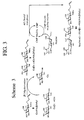
- Scheme 3 (Fig. 3), which follows Scheme 2 (Fig. 2), again utilizes GlcNAc ⁇ Oallyl (Compound 8 ) as a galactosyl acceptor to form Gal ⁇ 1 ⁇ 4GlcNAc ⁇ Oallyl, Compound 9 .
- Compound 9 was then similarly sialylated using ⁇ (2,3)sialylgransferase to form Compound 10 , Neu5Ac ⁇ 2 ⁇ 3Gal ⁇ 1 ⁇ 4GlcNAc ⁇ Oallyl.
- a process contemplated is carried out in a single reaction vessel and such a process is often referred to in the art as a "one pot" process.
- all of the reagents, including the enzymes, and starting chemicals are admixed together at substantially the same time and in a single reaction medium.
- a process for forming a sialyl ⁇ (2 ⁇ 3/6) ⁇ -galactoside comprises the steps of:
- K m is the Michaelis constant in units of moles/liter.
- V max is the maximum reaction velocity at a constant concentration of enzyme, and is in units of enzyme units/milligram, one enzyme unit being that amount of enzyme that will catalyze the transformation of one micromole of substrate per minute under optimal conditions.
- the value of K m /V max is the slope of the line obtained from a Lineweaver-Burk plot.
- ⁇ -sialyltransferase is one of the three principal enzymes utilized herein. This enzyme transfers sialic acid to Gal with the formation of an ⁇ -linkage between the two saccharides. Bonding (linkage) between the saccharides is between the 2-position of NeuSAc and the 3- or 6-position of Gal.
- the ⁇ -sialyltransferase is therefore sometimes referred to generally as an ⁇ (2,3/6)sialyltransferase or a galactosyl ⁇ (2,3/6)sialyltransferase to indicate that either type of enzyme can be used and the moiety to which the sialyl group is transferred.
- ⁇ (2,3)sialyltransferase (EC 2.4.99.6) and transfers sialic acid to the Gal of a Gal ⁇ 1 ⁇ 3GlcNAc or Gal ⁇ 1 ⁇ 4GlcNAc glycoside [Wen et al., J. Biol. Chem. , 267 :21011 (1992)].
- This enzyme is thought to be responsible for sialylations of asparagine-linked oligosaccharides in glycoproteins, and can be isolated from rat liver. [Weinstein et al., J. Biol. Chem.
- Another exemplary ⁇ -2,3-dialyltransferase (EC 2.4.99.4) transfers sialic acid to the Gal of a Gal ⁇ 1 ⁇ 3GalNAc glycoside [Gillespie et al., J. Biol. Chem. , 267 :21004 (1992)].
- This enzyme is thought to be responsible for sialylation of serine- or threonine-linked oligosaccharides in glycoproteins, and can be isolated from porcine submaxillary glands. [Rearick et al., J. Biol. Chem.
- CMP-Sialic acid synthetase is an enzyme that is utilized in the CMP-sialic acid regenerating system that is discussed in detail hereinafter.
- CMP-sialic acid synthetase can be isolated and purified from cells and tissues containing the synthetase enzyme by procedures well known in the art. See, e.g. , Gross et al., Eur. J. Biochem ., 168 :595 (1987); Vijay et al., J. Biol. Chem. , 250(1) :164 (1975); Zapata et al., J. Biol. Chem., 264(25) :14769 (1989) and Higa et al., J.
- a contemplated ⁇ -galactosidase cleaves a ⁇ -bonded Gal unit from the non-reducing terminus of a galactoside and is capable of forming a new ⁇ (1 ⁇ 3) - or ⁇ (1 ⁇ 4) - or ⁇ (1 ⁇ 6) galactoside. Formation of a ⁇ (1 ⁇ 3)- ⁇ (1 ⁇ 4) bond is preferred, and a preferred enzyme is often referred to as a ⁇ (1 ⁇ 3/4)galactosidase.
- An exemplary ⁇ (1 ⁇ 4)galactosidase is that produced by Bacillus circulans (EC 3.2.1.23) [Sakai et al., J. Carbohyd. Chem. , 11 :553 (1992)].
- This enzyme utilized illustratively herein cleaves the glycosidyl bond in lactose, and in the presence of GlcNAc can be used to form Gal ⁇ (1 ⁇ 4)GlcNAc (LacNAc).
- This ⁇ -galactosidase is particularly preferred because of its high regioselectivity in the formation of a ⁇ (1 ⁇ 4) bond.
- Another exemplary ⁇ -galactosidase is the ⁇ (1 ⁇ 3)galactosidase from bovine testes. This enzyme can provide high regioselectivity for ⁇ (1 ⁇ 3) bond formation using GlcNAc ⁇ -OMe as the acceptor [Nilsson, Carbohydr. Res. , 188 :9-17 (1989)].
- the ⁇ -galactosidase of E. coli almost exclusively forms Gal ⁇ (1 ⁇ 6)GlcNAc. Use of this enzyme is therefore not preferred herein.
- a ⁇ -galactose-containing donor substrate for the ⁇ -galactosidase is one of the reactants used herein.
- This material contains a galactosyl saccharide unit ⁇ -bonded to a leaving group such as another saccharide such as glucose as is used here illustratively, or a p -nitrophenyl group.
- lactose is a particularly preferred galactose-containing donor substrate.
- acceptor substrate for the ⁇ -galactosidase is another reactant of this process.
- This acceptor is also a substrate for the ⁇ -galactosidase when used for transglycosylation but not glycolysis, and therefore must contain a hydroxyl group at the 3-, 4- or 6-position appropriate to the ⁇ -galactosidase utilized, as does the GalNAc used illustratively herein.
- K m /V max for the ⁇ -galactosyl glycoside formed by the ⁇ -galactoside reaction on the ⁇ -galactose-containing donor and acceptor substrates be less than one-third, preferably less than about one-tenth, more preferably less than about one-fiftieth, and most preferably less than about one-hundredth, that of the K m /V max value of the ⁇ -galactose-containing donor for the sialylation reaction catalyzed by the ⁇ -sialyltransferase.
- both the ⁇ -galactose-containing donor substrate and formed galactosyl glycoside are present in the same vessel at the same time, and the former is usually present at a higher concentration, that former donor substrate could be sialylated in preference to its reaction product.
- Selection of appropriate donor and acceptor substrates and their concentrations, coupled with selection of an appropriate ⁇ -sialylating enzyme help to assure that the desired sialylated product is prepared.
- K m and V max for several galactosyl glycosides are available in the published literature and can be obtained using well known enzymatic techniques. Exemplary values for several donor/galactosyl glycosides are listed below in Table 1 whose data are taken from Beyer et al., Adv. Enzymol. , 52 :23-175 (1981) and Weinstein et al., J. Biol. Chem. , 257 :13845 (1982), wherein both types of galactosides are referred to as "acceptors" for the ⁇ -sialyltransferase.
- lacto-N-tetraose as donor can be used with GalNAc as acceptor, bovine testes ⁇ -galactosidase and ⁇ (2, 3)sialyltransferase (EC 2.4.99.4) to form Gal ⁇ 1 ⁇ 3GalNAc as the galactosyl glycoside that is sialylated to form Neu5Ac ⁇ 2 ⁇ 3Gal ⁇ GalNAc (Compound 7).
- Lactose can similarly be used as donor with bovine testes ⁇ -galactosidase and GlcNAc as acceptor with ⁇ (2,3)sialyltransferase (2.4.99.4) to form Gal ⁇ 1 ⁇ 3GlcNAc and then Neu5Ac ⁇ 2 ⁇ 3Gal ⁇ 1 ⁇ 3GalNAc (Compound 6 ).
- Lactose and GlcNAc can also be used as donor and acceptor with either of the above-mentioned ⁇ galactosidase enzymes and ⁇ (2,3)sialyltransferase (EC 2.4.99.6) that exhibits a preference for sialylation of a substrate containing the Gal ⁇ 1 ⁇ 3/4GlcNAc group.
- ⁇ galactosidase enzymes and ⁇ (2,3)sialyltransferase EC 2.4.99.6
- Use of the B. circulans ⁇ -galacosidase with lactose, GlcNAc and EC 2.4.99.6 provides Neu5Ac ⁇ 2 ⁇ 3Gal ⁇ 1 ⁇ 4GlcNAc (Compound 5 ).
- a useful galactose-containing substrate for a particular ⁇ -galactosidase may not be bound by the ⁇ -sialyltransferase or be bound very poorly, and if bound may not be sialylated or be sialylated very slowly.
- the K m /V max values for that compound and the formed glycosyl glycoside can indicate an almost infinite difference.
- Sialic acid (Neu5Ac, and sometimes also abbreviated AcNeu, NeuAc or NANA) is also required.
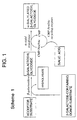
- sialic acid to regenerate the sialyl donor of Scheme 1 (Fig. 1) drives the trans-sialidase-catalyzed equilibrium reaction toward making the desired sialylated product.
- a contemplated sialic acid includes not only sialic acid itself (5-N-acetylamino-3,5-dideoxy-D-glycero-D-galacto-2-nonulosonic acid; Neu5Ac), but also 9-substituted sialic acids such as a 9-0-C 1 -C 6 acyl-Neu5Ac like 9-0-lactyl-Neu5Ac or 9-0-acetyl-Neu5Ac, 9-deoxy-9-fluoro-NeuSAc and 9-azido-9-deoxy-Neu5Ac.
- Use of sialic acid analogs having changes at other positions impairs the activity of one or more of the enzymes utilized herein. The synthesis and use of these compounds in a silylation procedure is disclosed in international application WO 92/16640, published October 1, 1992.
- the CM?-sialic acid recycling system utilizes CMP-sialic acid synthetase as noted previously.
- CMP-sialic acid shown in the scheme as CMF-Neu5Ac
- Gal ⁇ 1 ⁇ 4GlcNAc galactosyl glycoside
- ⁇ (2,6)sialyltransferase shown in the scheme as ⁇ (2,6)sialyltransferase
- the CMP-sialic acid regenerating system used in the present process comprises cytidine monophosphate (CMP), a nucleoside triphosphate, a phosphate donor, a kinase capable of transferring phosphate from the phosphate donor to nucleoside diphosphates and a nucleoside monophosphate kinase capable of transferring the terminal phosphate from a nucleoside triphosphate to CMP.
- CMP cytidine monophosphate
- CMP cytidine monophosphate
- nucleoside triphosphate a nucleoside triphosphate
- a phosphate donor a kinase capable of transferring phosphate from the phosphate donor to nucleoside diphosphates
- a nucleoside monophosphate kinase capable of transferring the terminal phosphate from a nucleoside triphosphate to CMP.
- Nucleoside triphosphates suitable for use in accordance with the CMP-sialic acid regenerating system are adenosine triphosphate (ATP), cytidine triphosphate (CTP), uridine triphosphate (UTP), guanosine triphosphate (GTP), inosine triphosphate (ITP) and thymidine triphosphate (TTP).
- ATP adenosine triphosphate
- CTP cytidine triphosphate
- UTP uridine triphosphate
- GTP guanosine triphosphate
- ITP inosine triphosphate
- TTP thymidine triphosphate
- a preferred nucleoside triphosphate is ATP.
- Nucleoside monophosphate kinases are enzymes that catalyze the phosphorylation of nucleoside monophosphates.
- Nucleoside monophosphate kinase (NMK) or myokinase (MK; EC 2.7.4.3) used in accordance with the CMP-sialic acid regenerating system of the present invention are used to catalyze the phosphorylation of CMP.
- NMK's are commercially available (Sigma Chem. Co., St. Louis, MO; Boehringer Mannheim, Indianapolis, IN).
- a phosphate donor and a catalytic amount of a kinase that catalyzes the transfer of phosphate from the phosphate donor to an activating nucleotide are also part of the CMP-sialic acid regenerating system.
- the phosphate donor of the regenerating system is a phosphorylated compound, the phosphate group of which can be used to phosphorylate the nucleoside phosphate.
- the only limitation on the selection of a phosphate donor is that neither the phosphorylated nor the dephosphorylated forms of the phosphate donor can substantially interfere with any of the reactions involved in the formation of the sialylated galactosyl glycoside.
- Preferred phosphate donors are phosphoenolpyruvate (PEP) and acetyl phosphate.
- a particularly preferred phosphate donor is PEP.
- kinase for use in accordance with the present invention depends upon the phosphate donor employed.
- the kinase is acetyl kinase.
- PEP pyruvate kinase
- Other kinases can be employed with other phosphate donors as is well known to those of skill in the art. Kinases are commercially available (Sigma Chem. Co., St. Louis, MO; Boehringer Mannheim, Indianapolis, IN).
- CMP is converted to CDP, whose conversion is catalyzed by nucleoside monophosphate kinase in the presence of added ATP.
- ATP is catalytically regenerated from its byproduct, ADP, by pyruvate kinase (PK) in the presence of added phosphoenolpyruvate (PEP).
- CDP is further converted to CTP, which conversion is catalyzed by ?K in the presence of PEP.
- CTP reacts with sialic acid to form inorganic pyrophosphate (PPi) and CMP-sialic acid, the latter reaction being catalyzed by CMP-sialic acid synthetase.
- the released CMP re-enters the regenerating system to reform CDP, CTP and CMP-sialic acid.
- the formed PPi is scavenged as discussed below, and forms inorganic phosphate (Pi) as a byproduct. Pyruvate is also a byproduct.
- the byproduct pyruvate can also be made use of in another reaction in which N-acetylmannosamine (ManNAc) and pyruvate are reacted in the presence of NeuAc aldolase (EC 4.1.3.3) to form sialic acid.
- the sialic acid can be replaced by ManNAc and a catalytic amount of NeuAc aldolase.
- NeuAc aldolase also catalyzes the reverse reaction (NeuAc to ManNAc and pyruvate)
- the produced NeuAc is irreversibly incorporated into the reaction cycle via CMP-NeuAc catalyzed by CMP-sialic acid synthetase coupled with inorganic pyrophosphatase (PPase)-catalyzed decomposition of the released inorganic pyrophosphate.
- PPase inorganic pyrophosphatase
- pyrophosphate scavenger refers to substances that serve to remove inorganic pyrophosphate from a reaction mixture of the present invention.
- Inorganic pyrophosphate (PPi) is a byproduct of the preparation of CMP-Neu5Ac.
- Produced PPi can feed back to inhibit other enzymes such that glycosylation is reduced.
- PPi can be degraded enzymatically or by physical means such as sequestration by a PPi binding substance.
- PPi is removed by hydrolysis using inorganic pyrophosphatase (PPase; EC 3.6.1.1), a commercially available PPi catabolic enzyme (Sigma Chem. Co., St. Louis, MO; Boehringer Mannheim, Indianapolis, IN), and that or a similar enzyme serves as the pyrophosphate scavenger.
- CMP-sialic acid regenerating system provides at least two advantages over the use of preformed CMP-sialic acid.
- CMP-sialic acid is an expensive reagent that is relatively difficult to prepare.
- CMP-sialic acid has a half-life in aqueous buffers as are used here of only a few hours. As a consequence, large quantities of that reagent are required to be used, and even then, the CMP-sialic acid often has to be added to the reaction mixture more than one time during the reaction.
- a before-mentioned ⁇ (2,3/6)sialyltransferase can also be formally included in the CMP-sialic acid recycling system. However, as that enzyme has already been discussed, it is not included here.
- the concentrations or amounts of the various reactants used in this process depend upon numerous factors including reaction conditions such as temperature and pH value, and the choice and amount of donor or acceptor saccharides. However, so long as the donor concentration is not so great that the difference in K m /V max values is not swamped by the donor concentration, the relative amounts of donor and acceptor do not appear to be critical. The larger the difference in K m /V max values for the donor and galactosyl glycoside as to the ⁇ -sialyltransferase, the greater can be the concentration of the donor substrate.
- this process permits regeneration of activating nucleotides, activated donor Neu5Ac and scavenging of produced PPi in the presence of catalytic amounts of the enzymes, the process is limited by the concentrations or amounts of the stoichiometric substrates discussed before.
- the upper limit for the concentrations of reactants that can be used in accordance with the method of the present invention is determined by the solubility of such reactants.
- the concentrations of activating nucleotides, phosphate donor, acceptor saccharide and enzymes are selected such that the process proceeds until the sialic acid is consumed.
- concentration of a sialic acid is about 20 mM
- preferred concentrations of the other non-enzyme reactants are about 250 mM for the ⁇ -galactose-containing donor substrate, about 600 mM for the acceptor substrate, about 2 mM for CMP, about 0.2 mM for the nucleoside triphosphate (ATP) and about 40 mM for the phosphate donor (PEP).
- the ratio of the concentration of the three saccharides (sialic acid:donor substrate:acceptor substrate) acceptor is about 20:250:600.
- the CMP is present at about one-tenth amount of the sialic acid, and ATP is present at about one-tenth the amount of CMP.
- the phosphate donor is present at at least about twice the concentration of the sialic acid. So long as the phosphate donor is present at at least twice the concentration of the sialic acid, the sialic acid provides the stoichiometric limitation. Otherwise, the relative concentrations do not appear critical, as discussed before. Where the sialic acid is prepared in situ from an N-acetylmannosamine, as discussed before, the relative amount of the sialic acid can be based on the N-acetylmannosamine utilized.
- catalytic amount means that amount of an enzyme at least sufficient to catalyze, in a non-rate limiting manner, the conversion of that enzyme's substrate to product.
- the catalytic amount of a particular enzyme varies according to the concentration of that enzyme's substrate as well as to reaction conditions such as temperature, time and pH value. Means for determining the catalytic amount for a given enzyme under preselected substrate concentrations and reaction conditions are well known to those of skill in the art.
- CMP and CTP as well as the sialic acid and CMP-sialic acid are recycled in a contemplated process.
- the above ratio is for the total concentration of these materials.
- the choice of which to use is mostly a question of cost and availability, with the least expensive, most available reagent typically being the reagent of choice.
- CMP and sialic acid are the least expensive and most readily available of those pairs, chose reagents are used to start the reaction, with the amount discussed before being those for the total amount of each pair used.
- the above ingredients are combined by admixture in a buffered aqueous solution (reaction medium).
- That buffered medium has a pH value of about 6 to about 8.
- the buffer is devoid of chelators that bind enzyme cofactors such as Mg +2 or Mn +2 , which are present as needed by particular enzymes.
- the selection of a buffer is based on the ability of the buffer to maintain pH value at the desired level. Where the pH value is about 7.5, a preferred buffer is HEPES.
- the buffered aqueous solution or reaction medium utilized is preferably free of detergents or other organic solubilizing agents such as ethanol or methanol.
- the enzymes particularly the ⁇ -galactosidase and ⁇ -sialyltransferase, are preferably utilized in free form and not linked to a support such as a polymer, so that the reaction medium is substantially homogeneous, at least initially, as some precipitates can form during the reaction.
- the temperature at which an above process is carried out can range from just above freezing to the temperature at which the most sensitive enzyme denatures. That temperature range is preferably about zero degrees C to about 45°C, and more preferably at about 20°C to about 30°C.
- the reaction mixture so formed is maintained for a period of time sufficient for the ⁇ -galactosyl glycoside to be formed by the ⁇ -galactosidase-catalyzed reaction of the ⁇ -galactose-containing donor substrate and the acceptor substrate. Some of that product can often be detached after a few hours, with recoverable amounts usually being obtained within 24 hours. It is preferred to optimize the yield of the process, and the maintenance time is usually about 36 to about 120 hours.
- the produced ⁇ -sialyl ⁇ -galactosyl glycoside can be used without purification. However, it is usually preferred to recover the product. Standard, well known techniques for recovery of sialylated saccharides such as thin or thick layer chromatography or ion exchange chromatography can be used. It is preferred to use one or more column chromatographic techniques for the recovery as is discussed hereinafter and in the literature cited herein.
- reaction was conducted for 91 hours under argon at room temperature and monitored by TLC on silica gel 60 (R f : Lac, 0.16; LacNAc, 0.27; Gal, 0.29; Glc, 0.37; ⁇ (2,6)sialyl-LacNAc, 0.45; Neu5Ac, 0.54; GlcNAc, 0.54 in 7:2:1 (v/v/v) iPrOH/H 2 O/NH 4 OH).
- Lac one of the starting materials, nor Gal ⁇ 1 ⁇ 6GlcNAc, a by-product of the ⁇ -galactosidase reaction [Sakai et al., J. Carbohydr. Chem. , 11 :553 (1992)] is a substrate for ⁇ (2,6)sialyltransferase [for detailed kinetic study of ⁇ (2,6)sialyltransferase, see Paulson et al., J. Biol. Chem.
- K m /V max for the ⁇ -galactosyl glycoside used here [Gal ⁇ 1 ⁇ 4GlcNAc] of 12 mM is less than one-tenth that of the K m /V max values for the other two possible ⁇ -galactosyl glycoside [Gal ⁇ 1 ⁇ 6GlcNAc and Gal ⁇ 1 ⁇ 4Glc] of about 4667 mM and 390 mM, respectively.
- lactose was found to be the best substrate for the B. circulans ⁇ -galactosidase. That ⁇ -galactosidase accepts the following substrates with the indicated, parenthesized relative rates: Lac (100), o -nitrophenyl ⁇ -galactoside (10.6), methyl ⁇ -galactoside (1).
- sialylated saccharide (Compound 2 ) was also prepared.
- Compounds 3 and 4 were prepared separately in about 20 percent yield with the galactosidase; however, Compound 3 was not a substrate for the sialyltransferase, and Compound 4 was a very weak substrate.
- Compound 10 was prepared as follows.
- pyruvate kinase (EC 2.7.1.40; 500 U), nucleoside monophosphate kinase (EC 2.7.4.4; 5 U), inorganic pyrophosphatase (EC 3.6.1.1; 10 U) , ⁇ -galactosidase (EC 3.2.1.23; from Bacillus circulans ; 1.0 mg), CMP-Neu5Ac synthetase (EC 2.7.743; 0.3 U), and ⁇ 2,3sialyltransferase (EC 2.4.99.6; 1 U), and the reaction mixture was gently stirred at room temperature under an argon atmosphere for two days and resulted in a yield of Compound 10 of about 10-15 percent.
- the product was isolated in a similar manner described in Ichikawa et al., J. Am. Chem. Soc. , 114 :9283 (1992).
Landscapes
- Chemical & Material Sciences (AREA)
- Life Sciences & Earth Sciences (AREA)
- Organic Chemistry (AREA)
- Health & Medical Sciences (AREA)
- Engineering & Computer Science (AREA)
- Zoology (AREA)
- Wood Science & Technology (AREA)
- Genetics & Genomics (AREA)
- Bioinformatics & Cheminformatics (AREA)
- General Health & Medical Sciences (AREA)
- Biochemistry (AREA)
- General Engineering & Computer Science (AREA)
- Molecular Biology (AREA)
- Biotechnology (AREA)
- Microbiology (AREA)
- Medicinal Chemistry (AREA)
- Biomedical Technology (AREA)
- Chemical Kinetics & Catalysis (AREA)
- General Chemical & Material Sciences (AREA)
- Preparation Of Compounds By Using Micro-Organisms (AREA)
- Saccharide Compounds (AREA)
- Enzymes And Modification Thereof (AREA)
- Immobilizing And Processing Of Enzymes And Microorganisms (AREA)
Claims (11)
- Procédé pour former un galactosylglycoside α-sialylé qui comprend les étapes consistant à :mélanger dans une cuve unique les composants suivants pour former un mélange réactionnel :(i) une quantité catalytique de β-galactosidase ;(ii) une quantité catalytique d'α(2,6)- ou d'a(2,3)sialyltransférase ;(iii) un substrat donneur contenant du β-galactose pour ladite β-galactosidase ;(iv) un substrat accepteur pour ladite β-galactosidase ;(v) un acide sialique ;(vi) un système de régénération d'acide cytidine monophosphate (CMP)-sialique, comprenant au moins deux moles de phosphoénolpyruvate par mole dudit acide sialique, et des quantités catalytiques d'adénosine triphosphate (ATP), de myokinase, de pyruvate kinase, de pyrophosphatase inorganique et d'acide CMP-sialique synthétase ; et(vii) une solution tampon aqueuse contenant des quantités enzymatiquement suffisantes de cofacteurs ions métalliques pour lesdites enzymes et ayant une valeur de pH d'environ 6 à environ 8 ;et maintenir ledit mélange réactionnel à une température d'environ 0°C à environ 45°C pendant une durée suffisante pour qu'un β-galactosylglycoside formé par la réaction, catalysée par la β-galactosidase, dudit substrat donneur contenant du galactose et dudit substrat accepteur soit sialylé, ledit galactosylglycoside ayant une valeur de Km/Vmax en tant que substrat pour ladite sialyltransférase qui vaut moins d'un tiers de la valeur de Km/Vmax dudit substrat donneur contenant du galactose pour ladite sialyltransférase, où Km représente la constante de Michaelis et Vmax représente la vitesse de réaction maximale à une concentration constante d'enzyme.
- Procédé selon la revendication 1 comprenant l'étape supplémentaire consistant à récupérer ledit galactosylglycoside sialylé formé.
- Procédé selon la revendication 1 dans lequel ledit galactosylglycoside sialylé est le Neu5Acα2→6Galβ1→4GlcNAc ou le Neu5Acα2-6Galβ1→4GlcNAc-O-allyle.
- Procédé selon la revendication 1 dans lequel ledit substrat donneur contenant du galactose (iii) est le lactose.
- Procédé selon la revendication 1 dans lequel ledit substrat accepteur pour ladite β-galactosidase est GlcNAc.
- Procédé selon la revendication 1 dans lequel ladite β-galactosidase est la β(1,4)galactosidase de Bacillus circulans.
- Procédé selon la revendication 1 dans lequel ladite sialyltransférase est l'α(2,6)sialyltransférase.
- Procédé selon la revendication 1 dans lequel ladite sialyltransférase est l'α(2,3)sialyltransférase.
- Procédé selon la revendication 1 dans lequel ledit galactosylglycoside a une valeur de Km/Vmax en tant que substrat pour ladite sialyltransférase qui vaut moins d'un dixième de la valeur de Km/Vmax dudit substrat donneur contenant du galactose pour ladite sialyltransférase.
- Procédé pour former un galactosylglycoside α-sialylé qui comprend les étapes consistant à :mélanger dans une cuve unique les composants suivants pour former un mélange réactionnel :(i) une quantité catalytique de β(1,4)-galactosidase de Bacillus circulans ;(ii) une quantité catalytique d'α(2,3)sialyltransférase ou d'α(2,6)sialyltransférase ;(iii) du lactose en tant que substrat donneur pour ladite β(1,4)-galactosidase ;(iv) du N-acétylglucosamine glycoside ou de l'allyl-N-acétylglucosamine glycoside en tant que substrat accepteur pour ladite β(1,4)-galactosidase ;(v) de l'acide sialique ;(vi) un système de régénération d'acide CMP-sialique, comprenant au moins deux moles de phosphoénolpyruvate par mole dudit acide sialique, et des quantités catalytiques d'ATP, de myokinase, de pyruvate kinase, de pyrophosphatase inorganique et d'acide CMP-sialique synthétase ; et(vii) une solution tampon aqueuse contenant des quantités enzymatiquement suffisantes de cofacteurs ions métalliques pour lesdites enzymes et ayant une valeur de pH d'environ 6 à environ 8 ;et maintenir ledit mélange réactionnel à une température d'environ 0°C à environ 45°C pendant une durée suffisante pour que le N-acétyllactosamine glycoside ou l'allyl-N-acétyllactosamine glycoside formé par la réaction, catalysée par la β-galactosidase, dudit substrat donneur et dudit substrat accepteur soit sialylé, pour former un galactosylglycoside α-sialylé.
- Procédé selon la revendication 10 comprenant l'étape supplémentaire consistant à récupérer ledit galactosylglycoside sialylé formé.
Applications Claiming Priority (3)
| Application Number | Priority Date | Filing Date | Title |
|---|---|---|---|
| US08/057,526 US5374541A (en) | 1993-05-04 | 1993-05-04 | Combined use of β-galactosidase and sialyltransferase coupled with in situ regeneration of CMP-sialic acid for one pot synthesis of oligosaccharides |
| PCT/US1994/005067 WO1994025614A1 (fr) | 1993-05-04 | 1994-05-04 | Synthese d'oligosaccharides en cuve unique, au moyen d'enzymes multiples et d'un systeme de regeneration d'acide cmp-sialique |
| US57526 | 1998-04-09 |
Publications (3)
| Publication Number | Publication Date |
|---|---|
| EP0698112A1 EP0698112A1 (fr) | 1996-02-28 |
| EP0698112A4 EP0698112A4 (fr) | 1998-09-30 |
| EP0698112B1 true EP0698112B1 (fr) | 2002-03-27 |
Family
ID=22011116
Family Applications (1)
| Application Number | Title | Priority Date | Filing Date |
|---|---|---|---|
| EP94916687A Expired - Lifetime EP0698112B1 (fr) | 1993-05-04 | 1994-05-04 | Synthese d'oligosaccharides en cuve unique, au moyen d'enzymes multiples et d'un systeme de regeneration d'acide cmp-sialique |
Country Status (7)
| Country | Link |
|---|---|
| US (1) | US5374541A (fr) |
| EP (1) | EP0698112B1 (fr) |
| JP (1) | JP3759603B2 (fr) |
| AT (1) | ATE215127T1 (fr) |
| AU (1) | AU6827694A (fr) |
| DE (1) | DE69430241D1 (fr) |
| WO (1) | WO1994025614A1 (fr) |
Families Citing this family (111)
| Publication number | Priority date | Publication date | Assignee | Title |
|---|---|---|---|---|
| US5545553A (en) * | 1994-09-26 | 1996-08-13 | The Rockefeller University | Glycosyltransferases for biosynthesis of oligosaccharides, and genes encoding them |
| JP3124199B2 (ja) * | 1994-12-28 | 2001-01-15 | 日本たばこ産業株式会社 | シアル酸を含む糖類の製造方法 |
| US6030815A (en) * | 1995-04-11 | 2000-02-29 | Neose Technologies, Inc. | Enzymatic synthesis of oligosaccharides |
| US5728554A (en) * | 1995-04-11 | 1998-03-17 | Cytel Corporation | Enzymatic synthesis of glycosidic linkages |
| ES2180757T3 (es) * | 1995-04-11 | 2003-02-16 | Neose Technologies Inc | Sintesis enzimatica mejorada de oligosacaridos. |
| US5922577A (en) * | 1995-04-11 | 1999-07-13 | Cytel Corporation | Enzymatic synthesis of glycosidic linkages |
| CZ89098A3 (cs) * | 1995-09-29 | 1998-09-16 | Glycim Oy | Syntetické polylaktosaminy obsahující až multivalentní sLEX a metody pro jejich použití |
| JP4023848B2 (ja) * | 1996-03-29 | 2007-12-19 | 生化学工業株式会社 | 硫酸化ラクトサミンオリゴ糖の製造方法 |
| WO1997037682A1 (fr) * | 1996-04-10 | 1997-10-16 | Cytel Corporation | Acides nucleiques codant une guanosine diphospho-fucose pyrophosphorylase |
| US6096529A (en) * | 1996-06-10 | 2000-08-01 | National Research Council Of Canada | Recombinant α-2,3-sialyltransferases and their uses |
| US6454946B1 (en) | 1996-10-10 | 2002-09-24 | Neose Technologies, Inc. | Carbohydrate purification using ultrafiltration, reverse osmosis and nanofiltration |
| JP2001507215A (ja) * | 1997-01-16 | 2001-06-05 | サイテル コーポレイション | 組換え糖タンパク質のインビトロでの実用的なシアリル化 |
| US6323008B1 (en) * | 1997-08-14 | 2001-11-27 | Neose Technologies, Inc. | Methods for producing sialyloligosaccharides in a dairy source |
| PL339773A1 (en) | 1997-09-05 | 2001-01-02 | Glycim Oy | Synthetic bivalent polylactose amines containing slex and method of using them |
| EP1903114A3 (fr) | 1997-12-01 | 2008-07-23 | Neose Technologies, Inc. | Synthèse enzymatique de gangliosides |
| US7244601B2 (en) * | 1997-12-15 | 2007-07-17 | National Research Council Of Canada | Fusion proteins for use in enzymatic synthesis of oligosaccharides |
| US6500661B1 (en) | 1998-01-15 | 2002-12-31 | Neose Technologies, Inc. | Enzymatic conversion of GDP-mannose to GDP-fucose |
| US6689604B1 (en) * | 1998-03-20 | 2004-02-10 | National Research Council Of Canada | Lipopolysaccharide α-2,3 sialyltransferase of Campylobacter jejuni and its uses |
| US6503744B1 (en) * | 1999-02-01 | 2003-01-07 | National Research Council Of Canada | Campylobacter glycosyltransferases for biosynthesis of gangliosides and ganglioside mimics |
| US6699705B2 (en) * | 1999-02-01 | 2004-03-02 | National Research Council Of Canada | Campylobacter glycosyltransferases for biosynthesis of gangliosides and ganglioside mimics |
| US6239088B1 (en) | 1999-03-19 | 2001-05-29 | Color Access, Inc. | Nonirritating cleansing composition |
| AU2002330968B2 (en) | 2001-08-17 | 2007-03-22 | Neose Technologies, Inc. | Chemo-enzymatic synthesis of sialylated oligosaccharides |
| US8008252B2 (en) | 2001-10-10 | 2011-08-30 | Novo Nordisk A/S | Factor VII: remodeling and glycoconjugation of Factor VII |
| US7214660B2 (en) * | 2001-10-10 | 2007-05-08 | Neose Technologies, Inc. | Erythropoietin: remodeling and glycoconjugation of erythropoietin |
| US7179617B2 (en) | 2001-10-10 | 2007-02-20 | Neose Technologies, Inc. | Factor IX: remolding and glycoconjugation of Factor IX |
| US7439043B2 (en) * | 2001-10-10 | 2008-10-21 | Neose Technologies, Inc. | Galactosyl nucleotide sugars |
| US7696163B2 (en) | 2001-10-10 | 2010-04-13 | Novo Nordisk A/S | Erythropoietin: remodeling and glycoconjugation of erythropoietin |
| US7125843B2 (en) * | 2001-10-19 | 2006-10-24 | Neose Technologies, Inc. | Glycoconjugates including more than one peptide |
| US7265085B2 (en) * | 2001-10-10 | 2007-09-04 | Neose Technologies, Inc. | Glycoconjugation methods and proteins/peptides produced by the methods |
| ES2411007T3 (es) * | 2001-10-10 | 2013-07-04 | Novo Nordisk A/S | Remodelación y glicoconjugación de péptidos |
| US7297511B2 (en) * | 2001-10-10 | 2007-11-20 | Neose Technologies, Inc. | Interferon alpha: remodeling and glycoconjugation of interferon alpha |
| US7157277B2 (en) * | 2001-11-28 | 2007-01-02 | Neose Technologies, Inc. | Factor VIII remodeling and glycoconjugation of Factor VIII |
| US7265084B2 (en) * | 2001-10-10 | 2007-09-04 | Neose Technologies, Inc. | Glycopegylation methods and proteins/peptides produced by the methods |
| US7795210B2 (en) | 2001-10-10 | 2010-09-14 | Novo Nordisk A/S | Protein remodeling methods and proteins/peptides produced by the methods |
| US7226903B2 (en) * | 2001-10-10 | 2007-06-05 | Neose Technologies, Inc. | Interferon beta: remodeling and glycoconjugation of interferon beta |
| US7399613B2 (en) * | 2001-10-10 | 2008-07-15 | Neose Technologies, Inc. | Sialic acid nucleotide sugars |
| US7173003B2 (en) | 2001-10-10 | 2007-02-06 | Neose Technologies, Inc. | Granulocyte colony stimulating factor: remodeling and glycoconjugation of G-CSF |
| US7473680B2 (en) * | 2001-11-28 | 2009-01-06 | Neose Technologies, Inc. | Remodeling and glycoconjugation of peptides |
| UA86744C2 (en) | 2002-06-21 | 2009-05-25 | Ново Нордиск Хэлс Кеа Аг | Pegylated factor vii glycoforms |
| DE60336555D1 (de) | 2002-06-21 | 2011-05-12 | Novo Nordisk Healthcare Ag | Pegylierte glykoformen von faktor vii |
| ATE506450T1 (de) | 2002-07-23 | 2011-05-15 | Biogenerix Ag | Synthese von oligosacchariden, glykolipiden und glykoproteinen unter verwendung bakterieller glykosyltransferasen |
| WO2004080960A2 (fr) | 2003-03-06 | 2004-09-23 | Neose Technologies Inc. | Procedes et compositions pour la synthese enzymatique de gangliosides |
| NZ542094A (en) | 2003-03-14 | 2008-12-24 | Neose Technologies Inc | Branched polymer conjugates comprising a peptide and water-soluble polymer chains |
| US8791070B2 (en) | 2003-04-09 | 2014-07-29 | Novo Nordisk A/S | Glycopegylated factor IX |
| PL1615945T3 (pl) | 2003-04-09 | 2012-03-30 | Ratiopharm Gmbh | Sposoby glikopegylacji i białka/peptydy wytwarzane tymi sposobami |
| EP1613261A4 (fr) * | 2003-04-09 | 2011-01-26 | Novo Nordisk As | Formation intracellulaire de conjugues de peptides |
| JP2007523630A (ja) | 2003-05-09 | 2007-08-23 | ネオス テクノロジーズ インコーポレイテッド | ヒト成長ホルモングリコシル化突然変異体の組成と調合法 |
| US9005625B2 (en) | 2003-07-25 | 2015-04-14 | Novo Nordisk A/S | Antibody toxin conjugates |
| EP1694347B1 (fr) * | 2003-11-24 | 2013-11-20 | BioGeneriX AG | Erythropoiétine glycopegylée |
| US8633157B2 (en) | 2003-11-24 | 2014-01-21 | Novo Nordisk A/S | Glycopegylated erythropoietin |
| US7842661B2 (en) | 2003-11-24 | 2010-11-30 | Novo Nordisk A/S | Glycopegylated erythropoietin formulations |
| US20080305992A1 (en) | 2003-11-24 | 2008-12-11 | Neose Technologies, Inc. | Glycopegylated erythropoietin |
| US20060040856A1 (en) * | 2003-12-03 | 2006-02-23 | Neose Technologies, Inc. | Glycopegylated factor IX |
| US7956032B2 (en) * | 2003-12-03 | 2011-06-07 | Novo Nordisk A/S | Glycopegylated granulocyte colony stimulating factor |
| US20080318850A1 (en) * | 2003-12-03 | 2008-12-25 | Neose Technologies, Inc. | Glycopegylated Factor Ix |
| NZ548123A (en) | 2004-01-08 | 2010-05-28 | Novo Nordisk As | O-linked glycosylation of peptides |
| AU2005222782B2 (en) | 2004-02-04 | 2010-06-17 | Ratiopharm Gmbh | Methods of refolding mammalian glycosyltransferases |
| KR20070008645A (ko) * | 2004-05-04 | 2007-01-17 | 노보 노르디스크 헬스 케어 악티엔게젤샤프트 | 폴리펩티드의 o-연결된 단백당형 및 그들의 제조 방법 |
| US20080300173A1 (en) | 2004-07-13 | 2008-12-04 | Defrees Shawn | Branched Peg Remodeling and Glycosylation of Glucagon-Like Peptides-1 [Glp-1] |
| WO2006031811A2 (fr) | 2004-09-10 | 2006-03-23 | Neose Technologies, Inc. | Interferon alpha glycopegyle |
| EP1797192A1 (fr) * | 2004-09-29 | 2007-06-20 | Novo Nordisk Health Care AG | Proteines modifiees |
| WO2006050247A2 (fr) | 2004-10-29 | 2006-05-11 | Neose Technologies, Inc. | Remodelage et glycopegylation du facteur de croissance des fibroblastes (fgf) |
| US9029331B2 (en) | 2005-01-10 | 2015-05-12 | Novo Nordisk A/S | Glycopegylated granulocyte colony stimulating factor |
| JP2006271372A (ja) * | 2005-03-01 | 2006-10-12 | Yamasa Shoyu Co Ltd | 糖鎖の製造法 |
| JP2008538181A (ja) * | 2005-03-30 | 2008-10-16 | ネオス テクノロジーズ インコーポレイテッド | 昆虫細胞系において増殖させたペプチドを生産するための製造方法 |
| WO2006121569A2 (fr) | 2005-04-08 | 2006-11-16 | Neose Technologies, Inc. | Compositions et methodes utilisees pour la preparation de mutants par glycosylation de l'hormone de croissance humaine resistant a la protease |
| EP2975135A1 (fr) | 2005-05-25 | 2016-01-20 | Novo Nordisk A/S | Facteur IX glycopégylé |
| US20070105755A1 (en) * | 2005-10-26 | 2007-05-10 | Neose Technologies, Inc. | One pot desialylation and glycopegylation of therapeutic peptides |
| MX2008002395A (es) * | 2005-08-19 | 2008-03-18 | Neose Technologies Inc | Factor vii y factor viia glicopegilados. |
| WO2007056191A2 (fr) | 2005-11-03 | 2007-05-18 | Neose Technologies, Inc. | Purification de sucre de nucleotide en utilisant des membranes |
| EP2049144B8 (fr) * | 2006-07-21 | 2015-02-18 | ratiopharm GmbH | Glycosylation de peptides par l'intermédiaire de séquences de glycosylation à liaison o |
| EP2054521A4 (fr) | 2006-10-03 | 2012-12-19 | Novo Nordisk As | Méthodes de purification de conjugués de polypeptides |
| ES2655734T3 (es) | 2006-10-04 | 2018-02-21 | Novo Nordisk A/S | Glicopéptidos y azúcares pegilados unidos a glicerol |
| US20080207487A1 (en) * | 2006-11-02 | 2008-08-28 | Neose Technologies, Inc. | Manufacturing process for the production of polypeptides expressed in insect cell-lines |
| US7960139B2 (en) | 2007-03-23 | 2011-06-14 | Academia Sinica | Alkynyl sugar analogs for the labeling and visualization of glycoconjugates in cells |
| HRP20130382T1 (hr) | 2007-04-03 | 2013-05-31 | Biogenerix Ag | Postupci lijeäśenja pomoä†u glikopegiliranog g-csf |
| US20090053167A1 (en) * | 2007-05-14 | 2009-02-26 | Neose Technologies, Inc. | C-, S- and N-glycosylation of peptides |
| CA2690611C (fr) | 2007-06-12 | 2015-12-08 | Novo Nordisk A/S | Procede ameliore pour la production de sucres de nucleotide |
| US8207112B2 (en) | 2007-08-29 | 2012-06-26 | Biogenerix Ag | Liquid formulation of G-CSF conjugate |
| PL2257311T3 (pl) | 2008-02-27 | 2014-09-30 | Novo Nordisk As | Koniugaty cząsteczek czynnika VIII |
| ES2442024T3 (es) | 2008-07-15 | 2014-02-07 | Academia Sinica | Matrices de glucano sobre portaobjetos de vidrio revestidos con aluminio de tipo PTFE y métodos relacionados |
| US11377485B2 (en) | 2009-12-02 | 2022-07-05 | Academia Sinica | Methods for modifying human antibodies by glycan engineering |
| US10087236B2 (en) * | 2009-12-02 | 2018-10-02 | Academia Sinica | Methods for modifying human antibodies by glycan engineering |
| US10338069B2 (en) | 2010-04-12 | 2019-07-02 | Academia Sinica | Glycan arrays for high throughput screening of viruses |
| WO2013022836A2 (fr) | 2011-08-05 | 2013-02-14 | The Regents Of The University Of California | Mutants de pmst1 pour la synthèse chimioenzymatique de composés de sialyl lewis x |
| WO2013070677A1 (fr) * | 2011-11-07 | 2013-05-16 | The Regents Of The University Of California | Enzyme pmst3 pour synthèse chimioenzymatique d'alpha-2-3-sialosides |
| US9102967B2 (en) | 2012-01-11 | 2015-08-11 | The Regents Of The University Of California | PmST2 enzyme for chemoenzymatic synthesis of α-2-3-sialylglycolipids |
| US10130714B2 (en) | 2012-04-14 | 2018-11-20 | Academia Sinica | Enhanced anti-influenza agents conjugated with anti-inflammatory activity |
| WO2014031498A1 (fr) | 2012-08-18 | 2014-02-27 | Academia Sinica | Sondes perméables aux cellules pour l'identification et l'imagerie de sialidases |
| EP3013365B1 (fr) | 2013-06-26 | 2019-06-05 | Academia Sinica | Antigènes rm2 et leur utilisation |
| EP3013347B1 (fr) | 2013-06-27 | 2019-12-11 | Academia Sinica | Conjugués de glycane et leur utilisation |
| JP6486368B2 (ja) | 2013-09-06 | 2019-03-20 | アカデミア シニカAcademia Sinica | 改変されたグリコシル基を含む糖脂質を用いたヒトiNKT細胞の活性化 |
| US10150818B2 (en) | 2014-01-16 | 2018-12-11 | Academia Sinica | Compositions and methods for treatment and detection of cancers |
| AU2015206370A1 (en) | 2014-01-16 | 2016-07-07 | Academia Sinica | Compositions and methods for treatment and detection of cancers |
| CN106415244B (zh) | 2014-03-27 | 2020-04-24 | 中央研究院 | 反应性标记化合物及其用途 |
| CN106661099A (zh) | 2014-05-27 | 2017-05-10 | 中央研究院 | 抗her2醣抗体及其用途 |
| US10118969B2 (en) | 2014-05-27 | 2018-11-06 | Academia Sinica | Compositions and methods relating to universal glycoforms for enhanced antibody efficacy |
| JP7093612B2 (ja) | 2014-05-27 | 2022-06-30 | アカデミア シニカ | Bacteroides由来のフコシダーゼおよびそれを使用する方法 |
| CA2950415A1 (fr) | 2014-05-27 | 2015-12-03 | Academia Sinica | Glycoanticorps anti-cd20 et leurs utilisations |
| WO2015184001A1 (fr) | 2014-05-28 | 2015-12-03 | Academia Sinica | Glycoanticorps anti-thf-alpha et leurs utilisations |
| TWI745275B (zh) | 2014-09-08 | 2021-11-11 | 中央研究院 | 使用醣脂激活人類iNKT細胞 |
| US9975965B2 (en) | 2015-01-16 | 2018-05-22 | Academia Sinica | Compositions and methods for treatment and detection of cancers |
| US10495645B2 (en) | 2015-01-16 | 2019-12-03 | Academia Sinica | Cancer markers and methods of use thereof |
| JP6779887B2 (ja) | 2015-01-24 | 2020-11-04 | アカデミア シニカAcademia Sinica | 新規なグリカンコンジュゲートおよびその使用方法 |
| EP3426693A4 (fr) | 2016-03-08 | 2019-11-13 | Academia Sinica | Procédés de synthèse modulaire de n-glycanes et de puces à n-glycanes |
| CA3034057A1 (fr) | 2016-08-22 | 2018-03-01 | CHO Pharma Inc. | Anticorps, fragments de liaison, et procedes d'utilisation |
| US20200332335A1 (en) * | 2019-04-09 | 2020-10-22 | Morgan State University | Microbial polysaccharides and methods of use |
| CN115094104B (zh) * | 2022-07-12 | 2025-10-14 | 华中科技大学 | 一种利用固定化细胞以单糖为糖基供体合成烷基半乳糖苷的方法 |
| CN121620596A (zh) * | 2023-08-07 | 2026-03-06 | 碳码股份公司 | 糖鞘脂的唾液酸化 |
| CN121712904A (zh) * | 2023-08-07 | 2026-03-20 | 碳码股份公司 | 唾液酸化方法 |
| CN121022815B (zh) * | 2025-10-30 | 2026-04-28 | 中国海洋大学 | 一种固定化酶的制备方法与应用 |
Family Cites Families (4)
| Publication number | Priority date | Publication date | Assignee | Title |
|---|---|---|---|---|
| SE451849B (sv) * | 1985-12-11 | 1987-11-02 | Svenska Sockerfabriks Ab | Sett att syntetisera glykosidiska bindningar samt anvendning av pa detta sett erhallna produkter |
| SE466403B (sv) * | 1988-03-24 | 1992-02-10 | Kurt G I Nilsson | Saett att syntetisera oligosackarider |
| WO1991016449A1 (fr) * | 1990-04-16 | 1991-10-31 | The Trustees Of The University Of Pennsylvania | Compositions saccharides et procedes et appareil servant a les synthetiser |
| US5278299A (en) * | 1991-03-18 | 1994-01-11 | Scripps Clinic And Research Foundation | Method and composition for synthesizing sialylated glycosyl compounds |
-
1993
- 1993-05-04 US US08/057,526 patent/US5374541A/en not_active Expired - Lifetime
-
1994
- 1994-05-04 JP JP52466794A patent/JP3759603B2/ja not_active Expired - Lifetime
- 1994-05-04 WO PCT/US1994/005067 patent/WO1994025614A1/fr not_active Ceased
- 1994-05-04 DE DE69430241T patent/DE69430241D1/de not_active Expired - Lifetime
- 1994-05-04 AT AT94916687T patent/ATE215127T1/de not_active IP Right Cessation
- 1994-05-04 AU AU68276/94A patent/AU6827694A/en not_active Abandoned
- 1994-05-04 EP EP94916687A patent/EP0698112B1/fr not_active Expired - Lifetime
Also Published As
| Publication number | Publication date |
|---|---|
| DE69430241D1 (de) | 2002-05-02 |
| JP3759603B2 (ja) | 2006-03-29 |
| EP0698112A4 (fr) | 1998-09-30 |
| ATE215127T1 (de) | 2002-04-15 |
| EP0698112A1 (fr) | 1996-02-28 |
| AU6827694A (en) | 1994-11-21 |
| JPH08509619A (ja) | 1996-10-15 |
| WO1994025614A1 (fr) | 1994-11-10 |
| US5374541A (en) | 1994-12-20 |
Similar Documents
| Publication | Publication Date | Title |
|---|---|---|
| EP0698112B1 (fr) | Synthese d'oligosaccharides en cuve unique, au moyen d'enzymes multiples et d'un systeme de regeneration d'acide cmp-sialique | |
| US5409817A (en) | Use of trans-sialidase and sialyltransferase for synthesis of sialylα2→3βgalactosides | |
| Ichikawa et al. | Enzyme-catalyzed oligosaccharide synthesis | |
| AU736993B2 (en) | Practical in vitro sialylation of recombinant glycoproteins | |
| EP0820519B1 (fr) | Synthese enzymatique de liaisons glycosidiques | |
| Wong et al. | Enzymes in organic synthesis: Application to the problems of carbohydrate recognition (part 2) | |
| US6168934B1 (en) | Oligosaccharide enzyme substrates and inhibitors: methods and compositions | |
| Ichikawa et al. | [7] Regeneration of sugar nucleotide for enzymatic oligosaccharide synthesis | |
| US5246840A (en) | Method for synthesis of oligosaccharides | |
| US20030119090A1 (en) | Mannosyl transfer with regeneration of GDP-mannose | |
| JP3545424B2 (ja) | ヌクレオシド5’−トリリン酸の製造法及びその応用 | |
| JP2001519669A (ja) | 活性化されたグリコシド誘導体を用いてのオリゴ糖類の改良された合成 | |
| JP3545785B2 (ja) | N−アセチルガラクトサミニル又はn−アセチルグルコサミニルの転移法 | |
| Thiem et al. | Synthesis of galactose-terminated oligosaccharides by use of galactosyltransferase | |
| Qian et al. | Glycosyltransferases in oligosaccharide synthesis | |
| Toone et al. | Enzymes as catalysts in carbohydrate synthesis | |
| Crawley et al. | Use Of Glycosylteansferases In The Synthesis Of Unnatural Oligosaccharide Analogues | |
| AU771407B2 (en) | Practical in vitro sialylation of recombinant glycoproteins | |
| AU2004202707B2 (en) | Practical in vitro sialylation of recombinant glycoproteins | |
| CN120989038A (zh) | 一种用于合成功能聚糖的多酶催化系统及方法 | |
| EP1445326A2 (fr) | Sialylation in vitro efficace de glycoprotéines recombinantes | |
| MXPA99006639A (en) | Practical in vitro |
Legal Events
| Date | Code | Title | Description |
|---|---|---|---|
| PUAI | Public reference made under article 153(3) epc to a published international application that has entered the european phase |
Free format text: ORIGINAL CODE: 0009012 |
|
| 17P | Request for examination filed |
Effective date: 19951116 |
|
| AK | Designated contracting states |
Kind code of ref document: A1 Designated state(s): AT BE CH DE DK ES FR GB GR IE IT LI LU MC NL PT SE |
|
| RIN1 | Information on inventor provided before grant (corrected) |
Inventor name: GAETA, FEDERICO C.A. Inventor name: WONG, CHI-HUEY |
|
| A4 | Supplementary search report drawn up and despatched |
Effective date: 19980815 |
|
| AK | Designated contracting states |
Kind code of ref document: A4 Designated state(s): AT BE CH DE DK ES FR GB GR IE IT LI LU MC NL PT SE |
|
| RAP1 | Party data changed (applicant data changed or rights of an application transferred) |
Owner name: CYTEL CORPORATION Owner name: THE SCRIPPS RESEARCH INSTITUTE |
|
| 17Q | First examination report despatched |
Effective date: 20000124 |
|
| GRAG | Despatch of communication of intention to grant |
Free format text: ORIGINAL CODE: EPIDOS AGRA |
|
| GRAG | Despatch of communication of intention to grant |
Free format text: ORIGINAL CODE: EPIDOS AGRA |
|
| GRAH | Despatch of communication of intention to grant a patent |
Free format text: ORIGINAL CODE: EPIDOS IGRA |
|
| GRAH | Despatch of communication of intention to grant a patent |
Free format text: ORIGINAL CODE: EPIDOS IGRA |
|
| REG | Reference to a national code |
Ref country code: GB Ref legal event code: IF02 |
|
| GRAA | (expected) grant |
Free format text: ORIGINAL CODE: 0009210 |
|
| AK | Designated contracting states |
Kind code of ref document: B1 Designated state(s): AT BE CH DE DK ES FR GB GR IE IT LI LU MC NL PT SE |
|
| PG25 | Lapsed in a contracting state [announced via postgrant information from national office to epo] |
Ref country code: NL Free format text: LAPSE BECAUSE OF FAILURE TO SUBMIT A TRANSLATION OF THE DESCRIPTION OR TO PAY THE FEE WITHIN THE PRESCRIBED TIME-LIMIT Effective date: 20020327 Ref country code: LI Free format text: LAPSE BECAUSE OF FAILURE TO SUBMIT A TRANSLATION OF THE DESCRIPTION OR TO PAY THE FEE WITHIN THE PRESCRIBED TIME-LIMIT Effective date: 20020327 Ref country code: IT Free format text: LAPSE BECAUSE OF FAILURE TO SUBMIT A TRANSLATION OF THE DESCRIPTION OR TO PAY THE FEE WITHIN THE PRE;WARNING: LAPSES OF ITALIAN PATENTS WITH EFFECTIVE DATE BEFORE 2007 MAY HAVE OCCURRED AT ANY TIME BEFORE 2007. THE CORRECT EFFECTIVE DATE MAY BE DIFFERENT FROM THE ONE RECORDED.SCRIBED TIME-LIMIT Effective date: 20020327 Ref country code: GR Free format text: LAPSE BECAUSE OF FAILURE TO SUBMIT A TRANSLATION OF THE DESCRIPTION OR TO PAY THE FEE WITHIN THE PRESCRIBED TIME-LIMIT Effective date: 20020327 Ref country code: FR Free format text: LAPSE BECAUSE OF FAILURE TO SUBMIT A TRANSLATION OF THE DESCRIPTION OR TO PAY THE FEE WITHIN THE PRESCRIBED TIME-LIMIT Effective date: 20020327 Ref country code: CH Free format text: LAPSE BECAUSE OF FAILURE TO SUBMIT A TRANSLATION OF THE DESCRIPTION OR TO PAY THE FEE WITHIN THE PRESCRIBED TIME-LIMIT Effective date: 20020327 Ref country code: BE Free format text: LAPSE BECAUSE OF FAILURE TO SUBMIT A TRANSLATION OF THE DESCRIPTION OR TO PAY THE FEE WITHIN THE PRESCRIBED TIME-LIMIT Effective date: 20020327 Ref country code: AT Free format text: LAPSE BECAUSE OF FAILURE TO SUBMIT A TRANSLATION OF THE DESCRIPTION OR TO PAY THE FEE WITHIN THE PRESCRIBED TIME-LIMIT Effective date: 20020327 |
|
| REF | Corresponds to: |
Ref document number: 215127 Country of ref document: AT Date of ref document: 20020415 Kind code of ref document: T |
|
| REG | Reference to a national code |
Ref country code: CH Ref legal event code: EP |
|
| REF | Corresponds to: |
Ref document number: 69430241 Country of ref document: DE Date of ref document: 20020502 |
|
| PG25 | Lapsed in a contracting state [announced via postgrant information from national office to epo] |
Ref country code: MC Free format text: LAPSE BECAUSE OF NON-PAYMENT OF DUE FEES Effective date: 20020504 Ref country code: LU Free format text: LAPSE BECAUSE OF NON-PAYMENT OF DUE FEES Effective date: 20020504 |
|
| PG25 | Lapsed in a contracting state [announced via postgrant information from national office to epo] |
Ref country code: IE Free format text: LAPSE BECAUSE OF NON-PAYMENT OF DUE FEES Effective date: 20020506 |
|
| REG | Reference to a national code |
Ref country code: IE Ref legal event code: FG4D |
|
| PGFP | Annual fee paid to national office [announced via postgrant information from national office to epo] |
Ref country code: GB Payment date: 20020522 Year of fee payment: 9 |
|
| PG25 | Lapsed in a contracting state [announced via postgrant information from national office to epo] |
Ref country code: SE Free format text: LAPSE BECAUSE OF FAILURE TO SUBMIT A TRANSLATION OF THE DESCRIPTION OR TO PAY THE FEE WITHIN THE PRESCRIBED TIME-LIMIT Effective date: 20020627 Ref country code: PT Free format text: LAPSE BECAUSE OF FAILURE TO SUBMIT A TRANSLATION OF THE DESCRIPTION OR TO PAY THE FEE WITHIN THE PRESCRIBED TIME-LIMIT Effective date: 20020627 Ref country code: DK Free format text: LAPSE BECAUSE OF FAILURE TO SUBMIT A TRANSLATION OF THE DESCRIPTION OR TO PAY THE FEE WITHIN THE PRESCRIBED TIME-LIMIT Effective date: 20020627 |
|
| PG25 | Lapsed in a contracting state [announced via postgrant information from national office to epo] |
Ref country code: DE Free format text: LAPSE BECAUSE OF FAILURE TO SUBMIT A TRANSLATION OF THE DESCRIPTION OR TO PAY THE FEE WITHIN THE PRESCRIBED TIME-LIMIT Effective date: 20020628 |
|
| NLV1 | Nl: lapsed or annulled due to failure to fulfill the requirements of art. 29p and 29m of the patents act | ||
| PG25 | Lapsed in a contracting state [announced via postgrant information from national office to epo] |
Ref country code: ES Free format text: LAPSE BECAUSE OF FAILURE TO SUBMIT A TRANSLATION OF THE DESCRIPTION OR TO PAY THE FEE WITHIN THE PRESCRIBED TIME-LIMIT Effective date: 20020925 |
|
| REG | Reference to a national code |
Ref country code: CH Ref legal event code: PL |
|
| EN | Fr: translation not filed | ||
| PLBE | No opposition filed within time limit |
Free format text: ORIGINAL CODE: 0009261 |
|
| STAA | Information on the status of an ep patent application or granted ep patent |
Free format text: STATUS: NO OPPOSITION FILED WITHIN TIME LIMIT |
|
| 26N | No opposition filed |
Effective date: 20021230 |
|
| REG | Reference to a national code |
Ref country code: IE Ref legal event code: MM4A |
|
| PG25 | Lapsed in a contracting state [announced via postgrant information from national office to epo] |
Ref country code: GB Free format text: LAPSE BECAUSE OF NON-PAYMENT OF DUE FEES Effective date: 20030504 |
|
| GBPC | Gb: european patent ceased through non-payment of renewal fee |
Effective date: 20030504 |