EP0701178A1 - Procédé de formation d'images - Google Patents
Procédé de formation d'images Download PDFInfo
- Publication number
- EP0701178A1 EP0701178A1 EP95306127A EP95306127A EP0701178A1 EP 0701178 A1 EP0701178 A1 EP 0701178A1 EP 95306127 A EP95306127 A EP 95306127A EP 95306127 A EP95306127 A EP 95306127A EP 0701178 A1 EP0701178 A1 EP 0701178A1
- Authority
- EP
- European Patent Office
- Prior art keywords
- toner
- particles
- particle
- carrier
- control agent
- Prior art date
- Legal status (The legal status is an assumption and is not a legal conclusion. Google has not performed a legal analysis and makes no representation as to the accuracy of the status listed.)
- Withdrawn
Links
- 238000000034 method Methods 0.000 title claims abstract description 38
- 239000002245 particle Substances 0.000 claims abstract description 160
- 229920005989 resin Polymers 0.000 claims abstract description 52
- 239000011347 resin Substances 0.000 claims abstract description 52
- OKKJLVBELUTLKV-UHFFFAOYSA-N Methanol Chemical compound OC OKKJLVBELUTLKV-UHFFFAOYSA-N 0.000 claims abstract description 48
- 239000006247 magnetic powder Substances 0.000 claims abstract description 31
- 125000000129 anionic group Chemical group 0.000 claims abstract description 28
- 238000002835 absorbance Methods 0.000 claims abstract description 14
- 238000010521 absorption reaction Methods 0.000 claims abstract description 13
- 239000000203 mixture Substances 0.000 claims abstract description 13
- 125000006850 spacer group Chemical group 0.000 claims description 19
- 239000003795 chemical substances by application Substances 0.000 description 58
- 239000011230 binding agent Substances 0.000 description 26
- 238000012546 transfer Methods 0.000 description 24
- 239000000178 monomer Substances 0.000 description 20
- VYPSYNLAJGMNEJ-UHFFFAOYSA-N Silicium dioxide Chemical compound O=[Si]=O VYPSYNLAJGMNEJ-UHFFFAOYSA-N 0.000 description 13
- 230000000052 comparative effect Effects 0.000 description 13
- YXFVVABEGXRONW-UHFFFAOYSA-N Toluene Chemical compound CC1=CC=CC=C1 YXFVVABEGXRONW-UHFFFAOYSA-N 0.000 description 12
- 125000000217 alkyl group Chemical group 0.000 description 9
- 239000003623 enhancer Substances 0.000 description 9
- 229920000642 polymer Polymers 0.000 description 9
- 239000002253 acid Substances 0.000 description 8
- 229920001577 copolymer Polymers 0.000 description 8
- -1 azo compound Chemical class 0.000 description 7
- 239000000654 additive Substances 0.000 description 6
- 239000000987 azo dye Substances 0.000 description 6
- 238000004140 cleaning Methods 0.000 description 6
- 125000004435 hydrogen atom Chemical group [H]* 0.000 description 6
- YGSDEFSMJLZEOE-UHFFFAOYSA-N salicylic acid Chemical compound OC(=O)C1=CC=CC=C1O YGSDEFSMJLZEOE-UHFFFAOYSA-N 0.000 description 6
- 239000000975 dye Substances 0.000 description 5
- 239000000377 silicon dioxide Substances 0.000 description 5
- 238000002371 ultraviolet--visible spectrum Methods 0.000 description 5
- VZCYOOQTPOCHFL-OWOJBTEDSA-N Fumaric acid Chemical compound OC(=O)\C=C\C(O)=O VZCYOOQTPOCHFL-OWOJBTEDSA-N 0.000 description 4
- UQSXHKLRYXJYBZ-UHFFFAOYSA-N Iron oxide Chemical compound [Fe]=O UQSXHKLRYXJYBZ-UHFFFAOYSA-N 0.000 description 4
- PXHVJJICTQNCMI-UHFFFAOYSA-N Nickel Chemical compound [Ni] PXHVJJICTQNCMI-UHFFFAOYSA-N 0.000 description 4
- PPBRXRYQALVLMV-UHFFFAOYSA-N Styrene Chemical compound C=CC1=CC=CC=C1 PPBRXRYQALVLMV-UHFFFAOYSA-N 0.000 description 4
- 230000000996 additive effect Effects 0.000 description 4
- 125000004432 carbon atom Chemical group C* 0.000 description 4
- 150000001733 carboxylic acid esters Chemical class 0.000 description 4
- 125000002843 carboxylic acid group Chemical group 0.000 description 4
- 230000003247 decreasing effect Effects 0.000 description 4
- 238000011156 evaluation Methods 0.000 description 4
- 239000010419 fine particle Substances 0.000 description 4
- SZVJSHCCFOBDDC-UHFFFAOYSA-N iron(II,III) oxide Inorganic materials O=[Fe]O[Fe]O[Fe]=O SZVJSHCCFOBDDC-UHFFFAOYSA-N 0.000 description 4
- 239000000843 powder Substances 0.000 description 4
- VZCYOOQTPOCHFL-UHFFFAOYSA-N trans-butenedioic acid Natural products OC(=O)C=CC(O)=O VZCYOOQTPOCHFL-UHFFFAOYSA-N 0.000 description 4
- 239000004925 Acrylic resin Substances 0.000 description 3
- 229920000178 Acrylic resin Polymers 0.000 description 3
- OFOBLEOULBTSOW-UHFFFAOYSA-N Propanedioic acid Natural products OC(=O)CC(O)=O OFOBLEOULBTSOW-UHFFFAOYSA-N 0.000 description 3
- QYKIQEUNHZKYBP-UHFFFAOYSA-N Vinyl ether Chemical compound C=COC=C QYKIQEUNHZKYBP-UHFFFAOYSA-N 0.000 description 3
- 150000004945 aromatic hydrocarbons Chemical class 0.000 description 3
- 239000006229 carbon black Substances 0.000 description 3
- 239000003086 colorant Substances 0.000 description 3
- 150000001875 compounds Chemical class 0.000 description 3
- 238000011161 development Methods 0.000 description 3
- 150000001993 dienes Chemical class 0.000 description 3
- 125000005843 halogen group Chemical group 0.000 description 3
- 230000002209 hydrophobic effect Effects 0.000 description 3
- 239000000463 material Substances 0.000 description 3
- 229910052751 metal Inorganic materials 0.000 description 3
- 239000002184 metal Substances 0.000 description 3
- 238000002156 mixing Methods 0.000 description 3
- 150000005673 monoalkenes Chemical class 0.000 description 3
- FJKROLUGYXJWQN-UHFFFAOYSA-N papa-hydroxy-benzoic acid Natural products OC(=O)C1=CC=C(O)C=C1 FJKROLUGYXJWQN-UHFFFAOYSA-N 0.000 description 3
- 239000000049 pigment Substances 0.000 description 3
- 229960004889 salicylic acid Drugs 0.000 description 3
- 150000003839 salts Chemical class 0.000 description 3
- 238000001228 spectrum Methods 0.000 description 3
- 229920001567 vinyl ester resin Polymers 0.000 description 3
- 229910000859 α-Fe Inorganic materials 0.000 description 3
- VXNZUUAINFGPBY-UHFFFAOYSA-N 1-Butene Chemical compound CCC=C VXNZUUAINFGPBY-UHFFFAOYSA-N 0.000 description 2
- WSSSPWUEQFSQQG-UHFFFAOYSA-N 4-methyl-1-pentene Chemical compound CC(C)CC=C WSSSPWUEQFSQQG-UHFFFAOYSA-N 0.000 description 2
- KAKZBPTYRLMSJV-UHFFFAOYSA-N Butadiene Chemical compound C=CC=C KAKZBPTYRLMSJV-UHFFFAOYSA-N 0.000 description 2
- XEEYBQQBJWHFJM-UHFFFAOYSA-N Iron Chemical compound [Fe] XEEYBQQBJWHFJM-UHFFFAOYSA-N 0.000 description 2
- RRHGJUQNOFWUDK-UHFFFAOYSA-N Isoprene Chemical compound CC(=C)C=C RRHGJUQNOFWUDK-UHFFFAOYSA-N 0.000 description 2
- BAPJBEWLBFYGME-UHFFFAOYSA-N Methyl acrylate Chemical compound COC(=O)C=C BAPJBEWLBFYGME-UHFFFAOYSA-N 0.000 description 2
- NBIIXXVUZAFLBC-UHFFFAOYSA-N Phosphoric acid Chemical group OP(O)(O)=O NBIIXXVUZAFLBC-UHFFFAOYSA-N 0.000 description 2
- 239000004743 Polypropylene Substances 0.000 description 2
- PNEYBMLMFCGWSK-UHFFFAOYSA-N aluminium oxide Inorganic materials [O-2].[O-2].[O-2].[Al+3].[Al+3] PNEYBMLMFCGWSK-UHFFFAOYSA-N 0.000 description 2
- 229910052804 chromium Inorganic materials 0.000 description 2
- 239000011651 chromium Substances 0.000 description 2
- 230000008878 coupling Effects 0.000 description 2
- 238000010168 coupling process Methods 0.000 description 2
- 238000005859 coupling reaction Methods 0.000 description 2
- FJKIXWOMBXYWOQ-UHFFFAOYSA-N ethenoxyethane Chemical compound CCOC=C FJKIXWOMBXYWOQ-UHFFFAOYSA-N 0.000 description 2
- 239000001530 fumaric acid Substances 0.000 description 2
- 238000005469 granulation Methods 0.000 description 2
- 230000003179 granulation Effects 0.000 description 2
- 150000002430 hydrocarbons Chemical group 0.000 description 2
- NNGHIEIYUJKFQS-UHFFFAOYSA-L hydroxy(oxo)iron;zinc Chemical compound [Zn].O[Fe]=O.O[Fe]=O NNGHIEIYUJKFQS-UHFFFAOYSA-L 0.000 description 2
- 229910052749 magnesium Inorganic materials 0.000 description 2
- 239000011777 magnesium Substances 0.000 description 2
- VZCYOOQTPOCHFL-UPHRSURJSA-N maleic acid Chemical compound OC(=O)\C=C/C(O)=O VZCYOOQTPOCHFL-UPHRSURJSA-N 0.000 description 2
- 239000011976 maleic acid Substances 0.000 description 2
- 229910052759 nickel Inorganic materials 0.000 description 2
- 230000003287 optical effect Effects 0.000 description 2
- 239000003960 organic solvent Substances 0.000 description 2
- YWAKXRMUMFPDSH-UHFFFAOYSA-N pentene Chemical compound CCCC=C YWAKXRMUMFPDSH-UHFFFAOYSA-N 0.000 description 2
- 238000006116 polymerization reaction Methods 0.000 description 2
- 229920005672 polyolefin resin Polymers 0.000 description 2
- 229920001155 polypropylene Polymers 0.000 description 2
- NHARPDSAXCBDDR-UHFFFAOYSA-N propyl 2-methylprop-2-enoate Chemical compound CCCOC(=O)C(C)=C NHARPDSAXCBDDR-UHFFFAOYSA-N 0.000 description 2
- 239000011369 resultant mixture Substances 0.000 description 2
- 238000005070 sampling Methods 0.000 description 2
- 239000007787 solid Substances 0.000 description 2
- 125000000542 sulfonic acid group Chemical group 0.000 description 2
- 125000000391 vinyl group Chemical group [H]C([*])=C([H])[H] 0.000 description 2
- BOVQCIDBZXNFEJ-UHFFFAOYSA-N 1-chloro-3-ethenylbenzene Chemical compound ClC1=CC=CC(C=C)=C1 BOVQCIDBZXNFEJ-UHFFFAOYSA-N 0.000 description 1
- KTZVZZJJVJQZHV-UHFFFAOYSA-N 1-chloro-4-ethenylbenzene Chemical compound ClC1=CC=C(C=C)C=C1 KTZVZZJJVJQZHV-UHFFFAOYSA-N 0.000 description 1
- XHAFIUUYXQFJEW-UHFFFAOYSA-N 1-chloroethenylbenzene Chemical compound ClC(=C)C1=CC=CC=C1 XHAFIUUYXQFJEW-UHFFFAOYSA-N 0.000 description 1
- UZKWTJUDCOPSNM-UHFFFAOYSA-N 1-ethenoxybutane Chemical compound CCCCOC=C UZKWTJUDCOPSNM-UHFFFAOYSA-N 0.000 description 1
- WHFHDVDXYKOSKI-UHFFFAOYSA-N 1-ethenyl-4-ethylbenzene Chemical compound CCC1=CC=C(C=C)C=C1 WHFHDVDXYKOSKI-UHFFFAOYSA-N 0.000 description 1
- SMZOUWXMTYCWNB-UHFFFAOYSA-N 2-(2-methoxy-5-methylphenyl)ethanamine Chemical compound COC1=CC=C(C)C=C1CCN SMZOUWXMTYCWNB-UHFFFAOYSA-N 0.000 description 1
- 229920000536 2-Acrylamido-2-methylpropane sulfonic acid Polymers 0.000 description 1
- GOXQRTZXKQZDDN-UHFFFAOYSA-N 2-Ethylhexyl acrylate Chemical compound CCCCC(CC)COC(=O)C=C GOXQRTZXKQZDDN-UHFFFAOYSA-N 0.000 description 1
- XHZPRMZZQOIPDS-UHFFFAOYSA-N 2-Methyl-2-[(1-oxo-2-propenyl)amino]-1-propanesulfonic acid Chemical compound OS(=O)(=O)CC(C)(C)NC(=O)C=C XHZPRMZZQOIPDS-UHFFFAOYSA-N 0.000 description 1
- FWLHAQYOFMQTHQ-UHFFFAOYSA-N 2-N-[8-[[8-(4-aminoanilino)-10-phenylphenazin-10-ium-2-yl]amino]-10-phenylphenazin-10-ium-2-yl]-8-N,10-diphenylphenazin-10-ium-2,8-diamine hydroxy-oxido-dioxochromium Chemical compound O[Cr]([O-])(=O)=O.O[Cr]([O-])(=O)=O.O[Cr]([O-])(=O)=O.Nc1ccc(Nc2ccc3nc4ccc(Nc5ccc6nc7ccc(Nc8ccc9nc%10ccc(Nc%11ccccc%11)cc%10[n+](-c%10ccccc%10)c9c8)cc7[n+](-c7ccccc7)c6c5)cc4[n+](-c4ccccc4)c3c2)cc1 FWLHAQYOFMQTHQ-UHFFFAOYSA-N 0.000 description 1
- NIXOWILDQLNWCW-UHFFFAOYSA-N 2-Propenoic acid Natural products OC(=O)C=C NIXOWILDQLNWCW-UHFFFAOYSA-N 0.000 description 1
- ISRGONDNXBCDBM-UHFFFAOYSA-N 2-chlorostyrene Chemical compound ClC1=CC=CC=C1C=C ISRGONDNXBCDBM-UHFFFAOYSA-N 0.000 description 1
- WDQMWEYDKDCEHT-UHFFFAOYSA-N 2-ethylhexyl 2-methylprop-2-enoate Chemical compound CCCCC(CC)COC(=O)C(C)=C WDQMWEYDKDCEHT-UHFFFAOYSA-N 0.000 description 1
- OMIGHNLMNHATMP-UHFFFAOYSA-N 2-hydroxyethyl prop-2-enoate Chemical compound OCCOC(=O)C=C OMIGHNLMNHATMP-UHFFFAOYSA-N 0.000 description 1
- AGBXYHCHUYARJY-UHFFFAOYSA-N 2-phenylethenesulfonic acid Chemical compound OS(=O)(=O)C=CC1=CC=CC=C1 AGBXYHCHUYARJY-UHFFFAOYSA-N 0.000 description 1
- QZPSOSOOLFHYRR-UHFFFAOYSA-N 3-hydroxypropyl prop-2-enoate Chemical compound OCCCOC(=O)C=C QZPSOSOOLFHYRR-UHFFFAOYSA-N 0.000 description 1
- NDWUBGAGUCISDV-UHFFFAOYSA-N 4-hydroxybutyl prop-2-enoate Chemical compound OCCCCOC(=O)C=C NDWUBGAGUCISDV-UHFFFAOYSA-N 0.000 description 1
- 241001120493 Arene Species 0.000 description 1
- OYPRJOBELJOOCE-UHFFFAOYSA-N Calcium Chemical compound [Ca] OYPRJOBELJOOCE-UHFFFAOYSA-N 0.000 description 1
- OKTJSMMVPCPJKN-UHFFFAOYSA-N Carbon Chemical group [C] OKTJSMMVPCPJKN-UHFFFAOYSA-N 0.000 description 1
- VYZAMTAEIAYCRO-UHFFFAOYSA-N Chromium Chemical compound [Cr] VYZAMTAEIAYCRO-UHFFFAOYSA-N 0.000 description 1
- JIGUQPWFLRLWPJ-UHFFFAOYSA-N Ethyl acrylate Chemical compound CCOC(=O)C=C JIGUQPWFLRLWPJ-UHFFFAOYSA-N 0.000 description 1
- 239000004606 Fillers/Extenders Substances 0.000 description 1
- YCKRFDGAMUMZLT-UHFFFAOYSA-N Fluorine atom Chemical compound [F] YCKRFDGAMUMZLT-UHFFFAOYSA-N 0.000 description 1
- 229910002608 Gd3Fe5O12 Inorganic materials 0.000 description 1
- WOBHKFSMXKNTIM-UHFFFAOYSA-N Hydroxyethyl methacrylate Chemical compound CC(=C)C(=O)OCCO WOBHKFSMXKNTIM-UHFFFAOYSA-N 0.000 description 1
- DGAQECJNVWCQMB-PUAWFVPOSA-M Ilexoside XXIX Chemical compound C[C@@H]1CC[C@@]2(CC[C@@]3(C(=CC[C@H]4[C@]3(CC[C@@H]5[C@@]4(CC[C@@H](C5(C)C)OS(=O)(=O)[O-])C)C)[C@@H]2[C@]1(C)O)C)C(=O)O[C@H]6[C@@H]([C@H]([C@@H]([C@H](O6)CO)O)O)O.[Na+] DGAQECJNVWCQMB-PUAWFVPOSA-M 0.000 description 1
- 229910002321 LaFeO3 Inorganic materials 0.000 description 1
- FYYHWMGAXLPEAU-UHFFFAOYSA-N Magnesium Chemical compound [Mg] FYYHWMGAXLPEAU-UHFFFAOYSA-N 0.000 description 1
- CERQOIWHTDAKMF-UHFFFAOYSA-N Methacrylic acid Chemical compound CC(=C)C(O)=O CERQOIWHTDAKMF-UHFFFAOYSA-N 0.000 description 1
- VVQNEPGJFQJSBK-UHFFFAOYSA-N Methyl methacrylate Chemical compound COC(=O)C(C)=C VVQNEPGJFQJSBK-UHFFFAOYSA-N 0.000 description 1
- 229910003264 NiFe2O4 Inorganic materials 0.000 description 1
- 239000004698 Polyethylene Substances 0.000 description 1
- ZLMJMSJWJFRBEC-UHFFFAOYSA-N Potassium Chemical compound [K] ZLMJMSJWJFRBEC-UHFFFAOYSA-N 0.000 description 1
- 241000872198 Serjania polyphylla Species 0.000 description 1
- 239000006087 Silane Coupling Agent Substances 0.000 description 1
- 229910001035 Soft ferrite Inorganic materials 0.000 description 1
- GWEVSGVZZGPLCZ-UHFFFAOYSA-N Titan oxide Chemical compound O=[Ti]=O GWEVSGVZZGPLCZ-UHFFFAOYSA-N 0.000 description 1
- RTAQQCXQSZGOHL-UHFFFAOYSA-N Titanium Chemical compound [Ti] RTAQQCXQSZGOHL-UHFFFAOYSA-N 0.000 description 1
- XTXRWKRVRITETP-UHFFFAOYSA-N Vinyl acetate Chemical compound CC(=O)OC=C XTXRWKRVRITETP-UHFFFAOYSA-N 0.000 description 1
- 229910009493 Y3Fe5O12 Inorganic materials 0.000 description 1
- HCHKCACWOHOZIP-UHFFFAOYSA-N Zinc Chemical compound [Zn] HCHKCACWOHOZIP-UHFFFAOYSA-N 0.000 description 1
- 229910001308 Zinc ferrite Inorganic materials 0.000 description 1
- NEKNPTMOEUCRLW-UHFFFAOYSA-N [O-2].[Fe+2].[Gd+3] Chemical compound [O-2].[Fe+2].[Gd+3] NEKNPTMOEUCRLW-UHFFFAOYSA-N 0.000 description 1
- GZHZIMFFZGAOGY-UHFFFAOYSA-N [O-2].[Fe+2].[La+3] Chemical compound [O-2].[Fe+2].[La+3] GZHZIMFFZGAOGY-UHFFFAOYSA-N 0.000 description 1
- 239000006230 acetylene black Substances 0.000 description 1
- 229910052784 alkaline earth metal Inorganic materials 0.000 description 1
- 150000001342 alkaline earth metals Chemical class 0.000 description 1
- 125000003545 alkoxy group Chemical group 0.000 description 1
- XYLMUPLGERFSHI-UHFFFAOYSA-N alpha-Methylstyrene Chemical compound CC(=C)C1=CC=CC=C1 XYLMUPLGERFSHI-UHFFFAOYSA-N 0.000 description 1
- 125000003277 amino group Chemical group 0.000 description 1
- 229920003180 amino resin Polymers 0.000 description 1
- TZCXTZWJZNENPQ-UHFFFAOYSA-L barium sulfate Chemical compound [Ba+2].[O-]S([O-])(=O)=O TZCXTZWJZNENPQ-UHFFFAOYSA-L 0.000 description 1
- HPYIMVBXZPJVBV-UHFFFAOYSA-N barium(2+);iron(3+);oxygen(2-) Chemical compound [O-2].[O-2].[O-2].[O-2].[O-2].[O-2].[O-2].[O-2].[O-2].[O-2].[O-2].[O-2].[O-2].[O-2].[O-2].[O-2].[O-2].[O-2].[O-2].[Fe+3].[Fe+3].[Fe+3].[Fe+3].[Fe+3].[Fe+3].[Fe+3].[Fe+3].[Fe+3].[Fe+3].[Fe+3].[Fe+3].[Ba+2] HPYIMVBXZPJVBV-UHFFFAOYSA-N 0.000 description 1
- AYJRCSIUFZENHW-DEQYMQKBSA-L barium(2+);oxomethanediolate Chemical compound [Ba+2].[O-][14C]([O-])=O AYJRCSIUFZENHW-DEQYMQKBSA-L 0.000 description 1
- 230000015572 biosynthetic process Effects 0.000 description 1
- 229920001400 block copolymer Polymers 0.000 description 1
- CQEYYJKEWSMYFG-UHFFFAOYSA-N butyl acrylate Chemical compound CCCCOC(=O)C=C CQEYYJKEWSMYFG-UHFFFAOYSA-N 0.000 description 1
- BAXLMRUQFAMMQC-UHFFFAOYSA-N cadmium(2+) iron(2+) oxygen(2-) Chemical compound [Cd+2].[O-2].[Fe+2].[O-2] BAXLMRUQFAMMQC-UHFFFAOYSA-N 0.000 description 1
- 229910052791 calcium Inorganic materials 0.000 description 1
- 239000011575 calcium Substances 0.000 description 1
- 150000001735 carboxylic acids Chemical class 0.000 description 1
- 238000006243 chemical reaction Methods 0.000 description 1
- YACLQRRMGMJLJV-UHFFFAOYSA-N chloroprene Chemical compound ClC(=C)C=C YACLQRRMGMJLJV-UHFFFAOYSA-N 0.000 description 1
- 239000004927 clay Substances 0.000 description 1
- 229910052570 clay Inorganic materials 0.000 description 1
- 229910017052 cobalt Inorganic materials 0.000 description 1
- 239000010941 cobalt Substances 0.000 description 1
- GUTLYIVDDKVIGB-UHFFFAOYSA-N cobalt atom Chemical compound [Co] GUTLYIVDDKVIGB-UHFFFAOYSA-N 0.000 description 1
- 150000004696 coordination complex Chemical class 0.000 description 1
- 229910052802 copper Inorganic materials 0.000 description 1
- 239000010949 copper Substances 0.000 description 1
- GRLMDYKYQBNMID-UHFFFAOYSA-N copper iron(3+) oxygen(2-) Chemical compound [O-2].[O-2].[O-2].[O-2].[Fe+3].[Fe+3].[Cu+2] GRLMDYKYQBNMID-UHFFFAOYSA-N 0.000 description 1
- 239000007822 coupling agent Substances 0.000 description 1
- LDHQCZJRKDOVOX-NSCUHMNNSA-N crotonic acid Chemical compound C\C=C\C(O)=O LDHQCZJRKDOVOX-NSCUHMNNSA-N 0.000 description 1
- KBLWLMPSVYBVDK-UHFFFAOYSA-N cyclohexyl prop-2-enoate Chemical compound C=CC(=O)OC1CCCCC1 KBLWLMPSVYBVDK-UHFFFAOYSA-N 0.000 description 1
- 230000007812 deficiency Effects 0.000 description 1
- 230000006866 deterioration Effects 0.000 description 1
- 239000003822 epoxy resin Substances 0.000 description 1
- NHOGGUYTANYCGQ-UHFFFAOYSA-N ethenoxybenzene Chemical compound C=COC1=CC=CC=C1 NHOGGUYTANYCGQ-UHFFFAOYSA-N 0.000 description 1
- VGIYPVFBQRUBDD-UHFFFAOYSA-N ethenoxycyclohexane Chemical compound C=COC1CCCCC1 VGIYPVFBQRUBDD-UHFFFAOYSA-N 0.000 description 1
- GFJVXXWOPWLRNU-UHFFFAOYSA-N ethenyl formate Chemical compound C=COC=O GFJVXXWOPWLRNU-UHFFFAOYSA-N 0.000 description 1
- UIWXSTHGICQLQT-UHFFFAOYSA-N ethenyl propanoate Chemical compound CCC(=O)OC=C UIWXSTHGICQLQT-UHFFFAOYSA-N 0.000 description 1
- SUPCQIBBMFXVTL-UHFFFAOYSA-N ethyl 2-methylprop-2-enoate Chemical compound CCOC(=O)C(C)=C SUPCQIBBMFXVTL-UHFFFAOYSA-N 0.000 description 1
- 238000001704 evaporation Methods 0.000 description 1
- 238000002474 experimental method Methods 0.000 description 1
- 229910052731 fluorine Inorganic materials 0.000 description 1
- 239000011737 fluorine Substances 0.000 description 1
- ZZUFCTLCJUWOSV-UHFFFAOYSA-N furosemide Chemical compound C1=C(Cl)C(S(=O)(=O)N)=CC(C(O)=O)=C1NCC1=CC=CO1 ZZUFCTLCJUWOSV-UHFFFAOYSA-N 0.000 description 1
- 238000010438 heat treatment Methods 0.000 description 1
- 229910001385 heavy metal Inorganic materials 0.000 description 1
- LNCPIMCVTKXXOY-UHFFFAOYSA-N hexyl 2-methylprop-2-enoate Chemical compound CCCCCCOC(=O)C(C)=C LNCPIMCVTKXXOY-UHFFFAOYSA-N 0.000 description 1
- 229920006158 high molecular weight polymer Polymers 0.000 description 1
- 229920001519 homopolymer Polymers 0.000 description 1
- 125000002768 hydroxyalkyl group Chemical group 0.000 description 1
- 229920000554 ionomer Polymers 0.000 description 1
- DMTIXTXDJGWVCO-UHFFFAOYSA-N iron(2+) nickel(2+) oxygen(2-) Chemical compound [O--].[O--].[Fe++].[Ni++] DMTIXTXDJGWVCO-UHFFFAOYSA-N 0.000 description 1
- ADCBYGNHJOLWLB-UHFFFAOYSA-N iron(2+) oxygen(2-) yttrium(3+) Chemical compound [Y+3].[O-2].[Fe+2] ADCBYGNHJOLWLB-UHFFFAOYSA-N 0.000 description 1
- CUSDLVIPMHDAFT-UHFFFAOYSA-N iron(3+);manganese(2+);oxygen(2-) Chemical compound [O-2].[O-2].[O-2].[O-2].[Mn+2].[Fe+3].[Fe+3] CUSDLVIPMHDAFT-UHFFFAOYSA-N 0.000 description 1
- JEIPFZHSYJVQDO-UHFFFAOYSA-N iron(III) oxide Inorganic materials O=[Fe]O[Fe]=O JEIPFZHSYJVQDO-UHFFFAOYSA-N 0.000 description 1
- 239000006233 lamp black Substances 0.000 description 1
- ZLNQQNXFFQJAID-UHFFFAOYSA-L magnesium carbonate Chemical compound [Mg+2].[O-]C([O-])=O ZLNQQNXFFQJAID-UHFFFAOYSA-L 0.000 description 1
- 239000001095 magnesium carbonate Substances 0.000 description 1
- 229910000021 magnesium carbonate Inorganic materials 0.000 description 1
- ZTERWYZERRBKHF-UHFFFAOYSA-N magnesium iron(2+) oxygen(2-) Chemical compound [Mg+2].[O-2].[Fe+2].[O-2] ZTERWYZERRBKHF-UHFFFAOYSA-N 0.000 description 1
- 239000000696 magnetic material Substances 0.000 description 1
- 230000005415 magnetization Effects 0.000 description 1
- FPYJFEHAWHCUMM-UHFFFAOYSA-N maleic anhydride Chemical compound O=C1OC(=O)C=C1 FPYJFEHAWHCUMM-UHFFFAOYSA-N 0.000 description 1
- 229910052748 manganese Inorganic materials 0.000 description 1
- 239000011572 manganese Substances 0.000 description 1
- 238000004519 manufacturing process Methods 0.000 description 1
- 230000007246 mechanism Effects 0.000 description 1
- XJRBAMWJDBPFIM-UHFFFAOYSA-N methyl vinyl ether Chemical compound COC=C XJRBAMWJDBPFIM-UHFFFAOYSA-N 0.000 description 1
- 238000012986 modification Methods 0.000 description 1
- 230000004048 modification Effects 0.000 description 1
- NQNBVCBUOCNRFZ-UHFFFAOYSA-N nickel ferrite Chemical compound [Ni]=O.O=[Fe]O[Fe]=O NQNBVCBUOCNRFZ-UHFFFAOYSA-N 0.000 description 1
- 125000000449 nitro group Chemical group [O-][N+](*)=O 0.000 description 1
- 239000011368 organic material Substances 0.000 description 1
- PNJWIWWMYCMZRO-UHFFFAOYSA-N pent‐4‐en‐2‐one Natural products CC(=O)CC=C PNJWIWWMYCMZRO-UHFFFAOYSA-N 0.000 description 1
- WRAQQYDMVSCOTE-UHFFFAOYSA-N phenyl prop-2-enoate Chemical compound C=CC(=O)OC1=CC=CC=C1 WRAQQYDMVSCOTE-UHFFFAOYSA-N 0.000 description 1
- 125000000843 phenylene group Chemical group C1(=C(C=CC=C1)*)* 0.000 description 1
- 238000000053 physical method Methods 0.000 description 1
- 229920000767 polyaniline Polymers 0.000 description 1
- 229920000647 polyepoxide Polymers 0.000 description 1
- 229920001225 polyester resin Polymers 0.000 description 1
- 239000004645 polyester resin Substances 0.000 description 1
- 229920000573 polyethylene Polymers 0.000 description 1
- 230000000379 polymerizing effect Effects 0.000 description 1
- 229920001296 polysiloxane Polymers 0.000 description 1
- 239000011591 potassium Substances 0.000 description 1
- 229910052700 potassium Inorganic materials 0.000 description 1
- 238000002360 preparation method Methods 0.000 description 1
- 239000011164 primary particle Substances 0.000 description 1
- HJWLCRVIBGQPNF-UHFFFAOYSA-N prop-2-enylbenzene Chemical compound C=CCC1=CC=CC=C1 HJWLCRVIBGQPNF-UHFFFAOYSA-N 0.000 description 1
- 229920005653 propylene-ethylene copolymer Polymers 0.000 description 1
- 238000004064 recycling Methods 0.000 description 1
- 230000009467 reduction Effects 0.000 description 1
- 238000012552 review Methods 0.000 description 1
- 238000007790 scraping Methods 0.000 description 1
- 238000000926 separation method Methods 0.000 description 1
- 229920002050 silicone resin Polymers 0.000 description 1
- 239000011734 sodium Substances 0.000 description 1
- 229910052708 sodium Inorganic materials 0.000 description 1
- 239000007921 spray Substances 0.000 description 1
- 239000000126 substance Substances 0.000 description 1
- 238000004381 surface treatment Methods 0.000 description 1
- 239000000454 talc Substances 0.000 description 1
- 229910052623 talc Inorganic materials 0.000 description 1
- 238000012360 testing method Methods 0.000 description 1
- 239000010936 titanium Substances 0.000 description 1
- 229910052719 titanium Inorganic materials 0.000 description 1
- OGIDPMRJRNCKJF-UHFFFAOYSA-N titanium oxide Inorganic materials [Ti]=O OGIDPMRJRNCKJF-UHFFFAOYSA-N 0.000 description 1
- 125000003944 tolyl group Chemical group 0.000 description 1
- LDHQCZJRKDOVOX-UHFFFAOYSA-N trans-crotonic acid Natural products CC=CC(O)=O LDHQCZJRKDOVOX-UHFFFAOYSA-N 0.000 description 1
- 229910052725 zinc Inorganic materials 0.000 description 1
- 239000011701 zinc Substances 0.000 description 1
- 229910006297 γ-Fe2O3 Inorganic materials 0.000 description 1
Images




Classifications
-
- G—PHYSICS
- G03—PHOTOGRAPHY; CINEMATOGRAPHY; ANALOGOUS TECHNIQUES USING WAVES OTHER THAN OPTICAL WAVES; ELECTROGRAPHY; HOLOGRAPHY
- G03G—ELECTROGRAPHY; ELECTROPHOTOGRAPHY; MAGNETOGRAPHY
- G03G21/00—Arrangements not provided for by groups G03G13/00 - G03G19/00, e.g. cleaning, elimination of residual charge
- G03G21/10—Collecting or recycling waste developer
-
- G—PHYSICS
- G03—PHOTOGRAPHY; CINEMATOGRAPHY; ANALOGOUS TECHNIQUES USING WAVES OTHER THAN OPTICAL WAVES; ELECTROGRAPHY; HOLOGRAPHY
- G03G—ELECTROGRAPHY; ELECTROPHOTOGRAPHY; MAGNETOGRAPHY
- G03G21/00—Arrangements not provided for by groups G03G13/00 - G03G19/00, e.g. cleaning, elimination of residual charge
-
- G—PHYSICS
- G03—PHOTOGRAPHY; CINEMATOGRAPHY; ANALOGOUS TECHNIQUES USING WAVES OTHER THAN OPTICAL WAVES; ELECTROGRAPHY; HOLOGRAPHY
- G03G—ELECTROGRAPHY; ELECTROPHOTOGRAPHY; MAGNETOGRAPHY
- G03G9/00—Developers
- G03G9/08—Developers with toner particles
- G03G9/0821—Developers with toner particles characterised by physical parameters
-
- G—PHYSICS
- G03—PHOTOGRAPHY; CINEMATOGRAPHY; ANALOGOUS TECHNIQUES USING WAVES OTHER THAN OPTICAL WAVES; ELECTROGRAPHY; HOLOGRAPHY
- G03G—ELECTROGRAPHY; ELECTROPHOTOGRAPHY; MAGNETOGRAPHY
- G03G9/00—Developers
- G03G9/08—Developers with toner particles
- G03G9/083—Magnetic toner particles
-
- G—PHYSICS
- G03—PHOTOGRAPHY; CINEMATOGRAPHY; ANALOGOUS TECHNIQUES USING WAVES OTHER THAN OPTICAL WAVES; ELECTROGRAPHY; HOLOGRAPHY
- G03G—ELECTROGRAPHY; ELECTROPHOTOGRAPHY; MAGNETOGRAPHY
- G03G9/00—Developers
- G03G9/08—Developers with toner particles
- G03G9/087—Binders for toner particles
- G03G9/08784—Macromolecular material not specially provided for in a single one of groups G03G9/08702 - G03G9/08775
- G03G9/08791—Macromolecular material not specially provided for in a single one of groups G03G9/08702 - G03G9/08775 characterised by the presence of specified groups or side chains
Definitions
- the present invention relates to an image forming method which allows toner to be recycled.
- the present invention relates to an image forming method which uses toner having a satisfactory transfer efficiency and providing a long life to the developer to reproduce images at a desired density for a long period of time despite absence of a charge control agent, and is preferably used for an electrophotographic image forming apparatus such as an electrostatic copying machine and a laser beam printer.
- the present invention relates to an image forming method for stably forming high quality images even in the state where such toner is recycled.
- an image is generally formed in the following manner.
- An electrostatic charge is applied uniformly to a photosensitive body having a photoconductive layer formed of a photoconductive material, and thus an electrostatic latent image corresponding to an original image is formed on a surface of the photosensitive body by light reflected by the original image.
- the electrostatic latent image is developed into a toner image.
- the toner image is transferred to a transfer medium such as a transfer paper sheet, and the resultant image is bound by applying heat or pressure to the transfer paper sheet.
- the toner forming the toner image is not entirely transferred to the transfer medium, instead, a part of the toner remains on the photosensitive body. Accordingly, it is economically advantageous to recover and recycle the residual toner after the transfer step.
- An image forming apparatus for recovering such toner during the cleaning step after the transfer step and re-supplying the recovered toner to the developing device has been proposed.
- Toner to be recycled is required to have a satisfactory chargeability.
- Conventional toner generally contains a charge control agent such as a metal complex in order to stabilize the chargeability of the toner.
- a part of the charge control agent situated on the surfaces of the toner particles and the vicinity thereof contributes to the generation of a charge by friction.
- Toner of a type to be negatively charged contains a negative charge control agent such as a dye of a complex containing a metal such as chromium (for example, an dye of an azo compound -chromium complex.) or an oxycarboxylic acid - metal complex (for example, a salicylic acid - metal complex) as described in Japanese Laid-Open Patent Publication No. 3-67268.
- Toner of a type to be positively charged contains a positive charge control agent such as an oil soluble dye such as nigrosine or an amine-type control agent as described in Japanese Laid-Open Patent Publication No. 56-106249.
- the charge control agent situated on the surfaces of the toner particles and the vicinity thereof generally comes off easily from the surfaces of the toner particles due to friction with, for example, the carrier particles.
- the recycled toner is easily affected by various external forces applied in the cleaning step of scraping off the residual toner from the surface of the photosensitive body by a blade and in the transportation step of transporting the recovered toner to the developing device as well as by friction caused while the toner is mixed and stirred with the carrier.
- the charge control agent is removed from the toner particles at an excessively high frequency.
- the developer is formed of unused toner having a sufficient amount of charge control agent on the surfaces of the toner particles and recycled toner without the charge control agent. Since toner without the charge control agent does not have a sufficient charge control function, the entire developer does not have a stable chargeability. As the content of the recycled toner with respect to the developer increases, the quality of the reproduced image is deteriorated.
- toner includes toner particles which contain a binding resin and particles of a magnetic powder dispersed in the binding resin, the magnetic powder being contained in a ratio of 0.1 to 5 parts by weight with respect to 100 parts of the binding resin;
- the binding resin is formed of a composition containing a resin having an anionic group; and an extracted solution obtained by extracting the toner with methanol has substantially no absorption peak in the range of 280 to 350 nm, and has a substantially zero absorbance in the range of 400 to 700 nm.
- the magnetic powder is contained in a ratio of 0.5 to 3 parts by weight with respect to 100 parts of the binding resin.
- the toner particles have a volume-based average particle diameter of 5 through 15 ⁇ m, and spacer particles having a volume-based average particle diameter of 0.05 through 1.0 ⁇ m are attached onto surfaces of the toner particles.
- the invention described herein makes possible the advantages of (1) providing an image forming method which maintains the developing characteristic of the developer even when the toner is recycled; (2) providing an image forming method for stably forming a satisfactory image even when the content of the recycled toner with respect to the developer increases; (3) providing an image forming method for extending the life of the developer; and (4) providing an image forming method for stably forming images having no fog with a sufficient density and a satisfactory transfer efficiency for a long period of time.
- Toner used in the present invention has no charge control agent, such as a dye of an azo compound - metal complex and an oxycarboxylic acid - metal complex, at all. Therefore, a spent caused by a charge control agent, which will be described in detail below, scarcely occurs in the toner used in the method of the present invention, resulting in realizing a high quality copied image for a long period of time.
- a charge control agent such as a dye of an azo compound - metal complex and an oxycarboxylic acid - metal complex
- the toner used in the method of the present invention has no charge control agent, it is impossible to detect any charge control agent, i.e., a dye type compound, from the toner by any chemical or physical method.
- a charge control agent i.e., a dye type compound
- such a compound cannot be detected in the toner used in the method of the present invention by any chemical reaction.
- absorption peaks owing to such a compound cannot be detected in an organic solvent extracted solution of the toner used in the method of the present invention.
- the extracted solution has substantially no absorption peak in the range of 280 to 350 nm, and has substantially zero absorbance in the range of 400 to 700 nm.
- to have substantially no absorption peak means, in an extracted solution obtained by extracting 0.1 g of the toner used in the method of the present invention with 50 ml of methanol, absorption peaks are not detected at all, or if detected, values of the absorbance peaks are 0.05 or less.
- to have substantially zero absorbance means that values of the absorbance of the extracted solution obtained by extracting 0.1 g of the toner used in the method of the present invention with 50 ml of methanol are 0.05 or less.
- the binder resin is made of a composition containing a resin including a low molecular weight polymer and a high molecular weight polymer, and both the polymers have an anionic group. This results in further decreasing charge failure of the toner. Furthermore, spacer particles having a desired particle diameter are attached on the surfaces of the toner particles, if necessary, thereby increasing the transfer efficiency of the toner.
- Figure 1 shows an UV-visible spectrum of a methanol extracted solution of the toner used in the method of the present invention in the range of 200 to 700 nm.
- the extracted solution has no peak, which is otherwise formed because of a charge control agent.
- the solution has substantially no absorption peak in the range of 280 to 350 nm, and the absorbance in the range of 400 to 700 nm is substantially zero.
- absorption peaks are found in the range of 400 to 700 nm, in particular, 550 to 570 nm.
- an absorption peak is found in the range of 280 to 350 nm.
- the charge control agent is present on the surfaces of the toner particles at a rather high concentration that the methanol extracted solution of the toner having the charge control agent has absorption peaks due to the charge control agent.
- a carrier included in a developer which has insufficient chargeability owing to occurrence of a spent is extracted with methanol, and then the UV-visible spectrum of the extracted solution is measured to find absorption peaks in the range of 400 to 700 nm derived from a charge control agent.
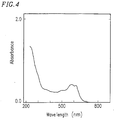
- the developer comprising the toner having an azo dye - chrome complex, whose UV-visible spectrum is shown in Figure 2 , was used for a long period of time to cause a spent therein.
- UV-visible spectrum of a methanol extracted solution of the carrier in this developer was measured to give the spectrum shown in Figure 4 .
- absorption peaks are found at the same position as the spectrum in Figure 2 .
- toner comprising toner particles containing 1.5 wt% of the azo dye - chrome complex was mixed with a carrier to obtain a developer.
- the toner and the carrier was shaken for a predetermined period of time.
- Figure 5 shows a relationship between the shaking time and amount of an attachment on the surfaces of the carrier particles.
- the amount of attachment is indicated as a spent ratio, that is, a percentage based on a total weight of the carrier particles bearing the attachment.
- Figure 6 shows the relationship between the shaking time and the amount of charge of the toner. The same procedure was repeated with regard to a developer comprising toner having no charge control agent and carrier.
- the present inventors measured the weight of the attachment on the surfaces of the carrier particles resulting from mixing the carrier with each of the toner components, that is, a charge control agent, a binder resin, carbon black as a coloring agent and wax, so as to find out the relationships between the respective toner components and the spent.
- the results are shown in Figure 8 as a variation with time in the amount of the attachment (i.e., amount of the spent), wherein the results obtained from the mixture with the charge control agent is plotted with white circles, those from the carbon black with black circles, those from the binder resin with squares, and those from the wax with triangles. It is apparent from Figure 8 that the charge control agent causes the largest amount of attachment due to the spent.
- the toner does not have a charge control agent not only because the agent can include a heavy metal but also because the agent is the main cause of the spent, scatter of the toner and of a decrease in the transfer efficiency of the toner. Accordingly, the toner used in the method of the present invention has no charge control agent at all.
- the instability of charge of the toner due to the lack of the charge control agent, in particular, the insufficiency in charge amount of the toner is compensated by using a binder resin having an anionic group as mentioned above.
- the insufficiency in charge amount of the toner particles can be supplemented because the binder resin has a negative charge in itself owing to the anionic group included therein. Since the anionic group is bonded to the main chain of the binder resin, it would never move onto the surface of the carrier particle as the charge control agent does, and hence it never causes the spent.
- the toner used in the method of the present invention includes magnetic powder at a predetermined proportion, that is, 0.1 to 5 parts by weight on the basis of 100 parts by weight of the binder resin.
- the insufficiency in the charge amount of the toner particles can be thus compensated for.
- the magnetic powder contained in the toner particle causes magnetic attraction between the toner particle and the carrier particle. This magnetic attraction between the toner particle and the carrier particle together with electrostatic attraction prevents the toner from scattering.
- the content of the magnetic powder in toner particles is in the range of 0.1 to 5 parts by weight per 100 parts by weight of the binder resin as described above.
- the content is less than 0.1 parts by weight, the magnetic attraction between the toner particle and the carrier particle is insufficient, resulting in insufficient coupling with the carrier particle and causing toner scattering or fog forming on a copied image.
- the density of the copied image is low because of the insufficient charge amount.
- the contents exceeds 5 parts by weight, the magnetic attraction between the carrier particle and the toner particle becomes so strong that the toner is not sufficiently attached onto an electrostatic latent image, resulting in decreasing the density of the copied image.
- Japanese Laid-Open Patent Publication No. 56-106249 discloses a toner particle including 10 wt% of ferrite
- Japanese Laid-Open Patent Publication No. 59-162563 discloses a toner particle including 5 through 35 wt% of a magnetic fine particle. In either case, however, the content of the magnetic powder is excessive, and hence, the density of the copied image is low.
- Japanese Laid-Open Patent Publication No. 3-67268 discloses toner to which 0.05 to 2 wt% of magnetic powder is externally added.
- the magnetic powder since the magnetic powder is not included in the toner particle, the powder is likely to be ununiformly attached onto the surface of the toner particle, resulting in insufficient magnetic attraction between the toner particle and the carrier particle. Furthermore, in either of the above-mentioned toners, the spent can be disadvantageously caused because a charge control agent is contained therein.
- the toner used in the present invention has a stable chargeability although containing no charge control agent.
- separation of the charge control agent from the toner particles by an external force or the like is avoided.
- the deterioration in quality of the recycled toner is minimized; namely, the recycled toner has substantially no difference in quality from the unused toner. Accordingly, a satisfactory image quality can be maintained even when a mixture of the recycled toner and the unused toner is used.
- spacer:particles having a particle diameter of 0.05 through 1.0 ⁇ m are attached preferably onto the surfaces of the toner particles in order to increase the transfer efficiency of the toner image.
- the spacer particles can work to enhance fluidity of the toner, and in addition, form a gap between the photosensitive body and the toner particles when the toner is attached onto the electrostatic latent image formed on the photosensitive body. Therefore, the toner can be transferred from the photosensitive body onto the transfer paper with ease even when the toner attains a large quantity of charge through a long copying operation, resulting in a high transfer efficiency of the toner.
- the spacer particle is similar to the particle of the magnetic powder included in the toner particle, the magnetic attraction between the toner particle and the carrier particle can be further enhanced, thereby further preventing toner scattering and a fog.
- a fine particle having a particle diameter of approximately 0.015 ⁇ m is used to enhance fluidity of a conventional toner. Such a small particle cannot form a sufficient gap between the photosensitive body and the toner particles, and cannot work as the spacer particle for the aforementioned purposes.
- a "lower alkyl group” indicates alkyl having 1 to 5 carbon atoms.
- Binder resin of a toner particle included in the present depeloper Binder resin of a toner particle included in the present depeloper
- the binder resin of the toner particle used in the present invention comprises a composition including a polymer having an anionic group.
- a binder resin is obtained by polymerizing a monomer having an anionic group or a mixture of the monomer having an anionic group with other monomers.
- the obtained resin can be a homopolymer or a copolymer.
- the binder resin used in the toner is preferably a copolymer, such as a randam copolymer, a block copolymer and a grafted copolymer, obtained from a monomer having an anionic group and other monomers.
- Examples of the monomer having an anionic group include monomers having a carboxylic acid group, a sulfonic acid group or a phosphoric acid group, and a monomer having a carboxylic acid group is generally used.
- Examples of the monomer having a carboxylic acid group include ethylenically unsaturated carboxylic acids such as acrylic acid, methacrylic acid, crotonic acid, maleic acid and fumaric acid; monomers that can form a carboxylic acid group such as maleic anhydride; and lower alkyl halfester of dicarboxylic acid such as maleic acid and fumaric acid.
- Examples of the monomer having a sulfonic acid group include styrene sulfonic acid and 2-acrylamido-2-methylpropane sulfonic acid.
- Examples of the monomer having a phosphoric acid group include 2-phosphono(oxy)propylmethacrylate, 2-phosphono(oxy) ethylmethacrylate, 3-chloro-2-phosphono(oxy) propylmethacrylate.
- Such a monomer having an anionic group can be a free acid, a salt of an alkaline metal such as sodium and potassium, a salt of an alkaline earth metal such as calcium and magnesium, and a salt such as zinc.
- the monomer having no anionic group used to prepare the binder resin is selected so that the resultant binder resin has a sufficient fixability and chargeability required of toner, and is one or a combination of an ethylenically unsaturated monomer.
- a monomer include ethylenically unsaturated carboxylic acid ester, monovinyl arene, vinyl ester, vinyl ether, diolefin and monoolefin.
- the ethylenically unsaturated carboxylic acid esters are represented by the following Formula (I): wherein R1 is a hydrogen atom or a lower alkyl group; and R is a hydrocarbon group having 11 or less carbon atoms or a hydroxyalkyl group having 11 or less carbon atoms.
- Examples of such ethylenically unsaturated carboxylic acid esters include methyl acrylate, ethyl acrylate, butyl acrylate, 2-ethylhexyl acrylate, cyclohexyl acrylate, phenyl acrylate, methyl methacrylate, hexyl methacrylate, 2-ethylhexyl methacrylate, ⁇ -hydroxyethylacrylate, ⁇ -hydroxypropylacrylate, ⁇ -hydroxybutylacrylate and ⁇ -hydroxyethylmethacrylate.
- the monovinyl arenes are represented by the following Formula (II): wherein R3 is a hydrogen atom, a lower alkyl group or a halogen atom; R4 is a hydrogen atom, a lower alkyl group, a halogen atom, an alkoxy group, an amino group or a nitro group; and ⁇ is a phenylene group.
- Examples of such monovinyl arene include styrene, ⁇ -methylstyrene, vinyltoluene, ⁇ -chlorostyrene, o-chlorostyrene, m-chlorostyrene, p-chlorostyrene and p-ethylstyrene.
- the vinyl esters are represented by the following Formula (III): wherein R5 is a hydrogen atom or a lower alkyl group.
- vinyl esters examples include vinyl formate, vinyl acetate and vinyl propionate.
- vinyl ethers examples include vinyl methyl ether, vinyl ethyl ether, vinyl n-butyl ether, vinyl phenyl ether and vinyl cyclohexyl ether.
- the diolefins are represented by the following Formula (V): wherein R7, R8 and R9 are independently a hydrogen atom, a lower alkyl group or a halogen atom.
- diolefins examples include butadiene, isoprene and chloroprene.
- the monoolefins are represented by the following Formula (VI): wherein R10 and R11 are independently a hydrogen atom or a lower alkyl group.
- Examples of such monoolefins include ethylene, propylene, isobutylene, 1-butene, 1-pentene and 4-methyl-1-pentene.
- the polymer having an anionic group that is, a (co)polymer obtained through the polymerization of the aforementioned monomers, include styrene-acrylic acid copolymers, styrene-maleic acid copolymers and ionomer resins. Furthermore, a polyester resin having an anionic group can be also used.
- the polymer having an anionic group preferably includes the anionic group at a proportion for attaining an acid value of 2 through 30, and preferably 5 through 15, when the anionic group is present as a free acid. When part or the entire anionic group is neutralized, the anionic group is preferably contained at such a proportion that the acid value would be in the aforementioned range in assuming that it is present as a free acid.
- a preferable binder resin is a copolymer obtained from the monomer having an anionic group and at least one of the ethylenically unsaturated carboxylic acid ester represented by Formula (I) as an indispensable components, and any of the monomers represented by Formulae (II) through (VI) as an optional component to be used if necessary.
- One or a combination of two or more of the aforementioned monomers is used for preparing the binder resin.
- the binder resin used in the invention is made of the composition including the aforementioned polymers, and the composition can further include a polymer having no anionic group as well.
- the proportion of the anionic group in the entire composition is preferably within the aforementioned range.
- the magnetic powder contained in (inclusively added to) the toner particles can be any magnetic powder used in a conventional one-component type .developer.
- the material for the magnetic powder include triiron tetroxide (Fe3O4), maghemite ( ⁇ -Fe2O3), zinc iron oxide (ZnFe2O4), yttrium iron oxide (Y3Fe5O12), cadmium iron oxide (CdFe2O4), gadolinium iron oxide (Gd3Fe5O12), copper iron oxide (CuFe2O4), lead iron oxide (PbFe12O19), nickel iron oxide (NiFe2O4), neodyum iron oxide (NdFeO3), barium iron oxide (BaFe12O19), magnesium iron oxide (MgFe2O4), manganese iron oxide (MnFe2O4), lanthanum iron oxide (LaFeO3), iron (Fe), cobalt (Co) and Nickel (Ni).
- Particularly preferable magnetic powder is made from triiron tetroxide (magnetite) in the shape of fine particles.
- the particle of preferable magnetite is in the shape of a regular octahedron with a particle diameter of 0.05 through 1.0 ⁇ m.
- Such a magnetite particle can be subjected to a surface treatment with a silane coupling agent or a titanium coupling agent.
- the particle diameter of the magnetic powder contained in the toner particle is generally 1.0 ⁇ m or smaller, and preferably in the range between 0.05 and 1.0 ⁇ m.
- the content of the magnetic powder in the toner particle is in the range of 0.1 to 5 parts by weight, more preferably 0.5 to 4 parts by weight, and most preferably 0.5 to 3 parts by weight per 100 parts by weight of the binder resin.
- the toner can be scattered during the development or a fog can be formed on a copied image.
- the toner particle contains, as described above, the binder resin and the magnetic powder as indispensable components, and can optionally include some inner additive generally used for a toner, if necessary.
- additives examples include a coloring agent and a release agent.
- the following pigments can be used:
- Such a pigment is contained in the toner particle in the range of 2 to 20 parts by weight, and preferably 5 to 15 parts by weight per 100 parts by weight of the binder resin.
- various wax and olefin resins can be used as in a conventional toner.
- the olefin resin include polypropylene, polyethylene, and propylene-ethylene copolymers, and polypropylene is particularly preferred.
- the toner particles in the toner included in a two-component type developer of the present invention can be produced by any ordinary method for toner particles such as crushing and classification, fusing granulation, spray granulation and polymerization, and are generally produced by the crushing and classification method.
- the components for the toner particles are previously mixed in a mixer such as a Henschel mixer, kneaded with a kneader such as a biaxial extruder, and then cooled. The resultant is crushed and classified to give toner particles.
- the particle diameter of the toner particle is generally in the range between 5 and 15 ⁇ m and preferably between 7 and 12 ⁇ m in the volume-base averaged particle diameter (a medium size measured with a Coulter counter).
- a fluidity enhancer such as hydrophobic vapor depositioned silica particles onto the surfaces of the toner particles, if necessary.
- the primary particle diameter of the fluidity enhancer such as the silica particles is generally approximately 0.015 ⁇ m, and such a fluidity enhancer is added to the toner in the range of 0.1 to 2.0 percent by weight on the basis of the weight of the entire toner, i.e., the total weight of the toner particles and the fluidity enhancer.
- spacer particles having a larger particle diameter than that of the fluidity enhancer are preferably added in the present invention.
- any of organic and inorganic inactive particles with a particle diameter of 0.05 through 1.0 ⁇ m, more preferably 0.07 through 0.5 ⁇ m can be used.
- the material for such inactive particles include silica, alumina, titanium oxide, magnesium carbonate, an acrylic resin, a styrene resin and magnetic materials.
- the spacer particle can not only work as a fluidity enhancer but also increase the transfer efficiency as described above.
- the same type of magnetic powder as included in the toner particle in particular, triiron tetroxide (magnetite) in the shape of fine particle is preferably used.
- the magnetic powder when used as the spacer particles, effectively suppresses the scattering of the toner as described above.
- the content of the spacer particles is 10 percent by weight or less, more preferably in the range of 0.1 to 10 percent by weight, and most preferably 0.1 to 5 percent by weight on the basis of the total weight of the toner.
- the spacer particles are excessively included in toner, the density of a copied image is insufficient.
- the magnetic powder is used as the spacer particles, the total amount of the magnetic powder together with that contained in the toner particles is preferably 10 parts by weight or less per 100 parts by weight of the binder resin. When it is excessively included, the density of a copied image can be decreased.
- the fluidity enhancer and the spacer particles are added to the toner particles
- the following production method is preferred.
- the fluidity enhancer and the spacer particles are first sufficiently mixed with each other, and then the obtained mixture is added to the toner particles, and then is sufficiently unbound.
- the spacer particles can be attached onto the surfaces of the toner particles.
- To "be attached” herein means both to be held in contact with the surface of the toner particle and to be partly embedded in the toner particle. In this manner, the toner used in the method of the present invention is produced.
- a two-component type developer is prepared by mixing the above-mentioned toner and magnetic carrier.
- Ferrite particle in particular spherical soft ferrite particle which contains at least one metal selected from the group of Cu, Mg, Mn and Ni in addition to Fe, such as sintered Cu-Zn-Mg-ferrite particle, is preferably used as the magnetic carrier.
- a surface of the carrier particle may be coated or not coated with organic materials.
- the surface of the carrier is coated with silicone resin (polysiloxane), fluorine contained resin, epoxy resin, amino resin, uretane resin.
- the particle diameter of the carrier particle is in the range of 30 to 200 ⁇ m, and preferably 50 to 150 ⁇ m.
- the carrier particle has a saturation magnetization in the range between 30 and 70 emu/g, and preferably 45 and 65 emu/g.
- the mixing ratio of the carrier and the toner is generally 98:2 through 90:10, and preferably 97:3 through 94:6, by weight.
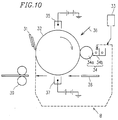
- Figure 10 is a schematic view of an image forming apparatus preferably used for effecting an image forming method according to the present invention.
- the image forming apparatus includes an image carrier (photosensitive body) 32 on which an electrostatic latent image is to be formed.
- the image carrier 32 is formed of a rotatable drum and is surrounded by a corona charger 35 , an exposure optical system 36 , a developing device 34 , an electrostatic transfer device 37 , and a cleaning device 31 having a blade provided in this order in the direction of arrow A .
- the image forming apparatus further includes a binding device 39 formed of a pair of heating rollers for binding the image by heat in contact with the transfer paper sheet.
- the image forming apparatus having the above-described structure operates in the following manner.
- a surface of the image carrier 32 is uniformly charged by the corona charger 35 and exposed by the exposure optical system 36 , thus forming an electrostatic latent image corresponding to an original document (not shown).
- the electrostatic latent image is developed into a toner image by the developing device 34 .
- the toner image is transferred on a transfer paper sheet 38 by the electrostatic transfer device 37 , and the image on the transfer paper sheet 38 is bound with heat by the binding device 39 .
- the blade of the cleaning device 31 slides on the surface of the image carrier 32 to scrape off the residual toner. Then, the surface of the image carrier 32 is again charged by the corona charger 35 .
- the image forming apparatus further includes a toner recycle system B for recycling the toner recovered by the cleaning device 31 .
- the toner recycle system B supplies the recovered toner to a tank 34b of the developing device 34 together with toner which is newly supplied from a toner tank 33 .
- the dashed line indicates the flow of the toner.
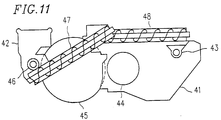
- FIG 11 shows an example of a toner recycle system.
- the toner recycle system includes a developing device 41 , a cleaning device 42 , a toner distributor 43 , a magnetic brush 44 , an image carrier 45 , a screw conveyor 46 , a first screw 47 , and a second screw 48 .
- toner from the screw conveyor 48 is supplied to the toner distributor 43 by the first screw 47 and the second screw 48 .
- the first and the second screws 47 and 48 each have a rotating shaft and a spiral blade provided along the shaft.
- the toner supplied by the screw conveyor 46 is sequentially pushed up by the blade in accordance with the rotation of the shaft and thus is sent to the second screw 48 .
- the second screw 48 horizontally conveys the toner sequentially to the toner distributor 43 by the same principle with the first screw 47 .
- the recovered toner is supplied to the developing device 41 and is used for the development of an electrostatic latent image on the image carrier 45 .
- toner particles were added 0.3 part by weight of hydrophobic silica fine powder with an average particle diameter of 0.015 ⁇ m as a fluidity enhancer on the basis of 100 parts by weight of the toner particles.
- the resultant mixture was mixed with a Henschel mixer for two minutes to give toner.
- Example 2 To the toner particle obtained in Example 1 were added 0.5 parts by weight of acrylic resin particles with an average particle diameter of 0.3 ⁇ m and 0.3 part by weight of hydrophobic silica fine powder with an average particle diameter of 0.015 ⁇ m on the basis of 100 parts by weight of the toner particles. The resultant mixture was mixed with a Henschel mixer for two minutes to give toner.
- Example 1 The same procedure was repeated as in Example 1 except that an azo dye - chrome complex was further added to components listed in Table 1 of Example 1.
- the toners produced in Examples 1 and 2 were stable in a satisfactory state in the image density, the fog density, and the charge amount, from the start of the copying until after 30,000 images were reproduced.
- generation of a spent, toner scattering due to the reduction in the charge amount, and increase of the fog occurred.
- Toner particles of the toner according to the present invention contain a binder resin having an anionic group and also contain a magnetic powder at a predetermined ratio. As necessary, spacer particles having a predetermined particle diameter are attached to the surfaces of the toner particles. Accordingly, the toner has a sufficient chargeability, does not scatter during copying, and has a sufficient transfer efficiency. Due to such advantages, images having a necessary density can be reproduced stably in a long period of time even when the toner is recycled.
- Such toner for a two-component developer is preferably used in an electrophotographic image forming apparatus including a toner recycle system such as an electrostatic copying machine and a laser printer.
Landscapes
- Physics & Mathematics (AREA)
- General Physics & Mathematics (AREA)
- Life Sciences & Earth Sciences (AREA)
- Engineering & Computer Science (AREA)
- Environmental & Geological Engineering (AREA)
- Sustainable Development (AREA)
- Spectroscopy & Molecular Physics (AREA)
- Developing Agents For Electrophotography (AREA)
- Magnetic Brush Developing In Electrophotography (AREA)
- Dry Development In Electrophotography (AREA)
- Cleaning In Electrography (AREA)
Applications Claiming Priority (2)
| Application Number | Priority Date | Filing Date | Title |
|---|---|---|---|
| JP6209461A JP3009825B2 (ja) | 1994-09-02 | 1994-09-02 | 画像形成方法 |
| JP209461/94 | 1994-09-02 |
Publications (1)
| Publication Number | Publication Date |
|---|---|
| EP0701178A1 true EP0701178A1 (fr) | 1996-03-13 |
Family
ID=16573262
Family Applications (1)
| Application Number | Title | Priority Date | Filing Date |
|---|---|---|---|
| EP95306127A Withdrawn EP0701178A1 (fr) | 1994-09-02 | 1995-09-01 | Procédé de formation d'images |
Country Status (3)
| Country | Link |
|---|---|
| EP (1) | EP0701178A1 (fr) |
| JP (1) | JP3009825B2 (fr) |
| KR (1) | KR960011593A (fr) |
Citations (8)
| Publication number | Priority date | Publication date | Assignee | Title |
|---|---|---|---|---|
| JPS56106249A (en) | 1980-01-28 | 1981-08-24 | Fujitsu Ltd | Developer |
| JPS59162563A (ja) | 1983-03-07 | 1984-09-13 | Minolta Camera Co Ltd | 静電潜像現像用磁性現像剤 |
| EP0357042A2 (fr) * | 1988-08-30 | 1990-03-07 | TDK Corporation | Composition et méthode de développement d'images latentes électrostatiques |
| EP0407604A1 (fr) * | 1988-12-28 | 1991-01-16 | Mita Industrial Co., Ltd. | Resine de regulation de la charge, toner contenant cette resine et procede de production du toner |
| JPH0367268A (ja) | 1989-03-28 | 1991-03-22 | Hitachi Chem Co Ltd | 乾式トナー,乾式現像剤及び画像形成方法 |
| EP0573933A1 (fr) * | 1992-06-08 | 1993-12-15 | Canon Kabushiki Kaisha | Procédé de formation d'image |
| JPH064950A (ja) * | 1992-06-22 | 1994-01-14 | Sharp Corp | 音響機器におけるカセット収納機構 |
| EP0643337A1 (fr) * | 1993-08-19 | 1995-03-15 | Mita Industrial Co., Ltd. | Révélateur pour un agent développateur magnétique du type à deux composants ayant une excellent "spent" résistance |
-
1994
- 1994-09-02 JP JP6209461A patent/JP3009825B2/ja not_active Expired - Lifetime
-
1995
- 1995-09-01 EP EP95306127A patent/EP0701178A1/fr not_active Withdrawn
- 1995-09-01 KR KR1019950028555A patent/KR960011593A/ko not_active Withdrawn
Patent Citations (8)
| Publication number | Priority date | Publication date | Assignee | Title |
|---|---|---|---|---|
| JPS56106249A (en) | 1980-01-28 | 1981-08-24 | Fujitsu Ltd | Developer |
| JPS59162563A (ja) | 1983-03-07 | 1984-09-13 | Minolta Camera Co Ltd | 静電潜像現像用磁性現像剤 |
| EP0357042A2 (fr) * | 1988-08-30 | 1990-03-07 | TDK Corporation | Composition et méthode de développement d'images latentes électrostatiques |
| EP0407604A1 (fr) * | 1988-12-28 | 1991-01-16 | Mita Industrial Co., Ltd. | Resine de regulation de la charge, toner contenant cette resine et procede de production du toner |
| JPH0367268A (ja) | 1989-03-28 | 1991-03-22 | Hitachi Chem Co Ltd | 乾式トナー,乾式現像剤及び画像形成方法 |
| EP0573933A1 (fr) * | 1992-06-08 | 1993-12-15 | Canon Kabushiki Kaisha | Procédé de formation d'image |
| JPH064950A (ja) * | 1992-06-22 | 1994-01-14 | Sharp Corp | 音響機器におけるカセット収納機構 |
| EP0643337A1 (fr) * | 1993-08-19 | 1995-03-15 | Mita Industrial Co., Ltd. | Révélateur pour un agent développateur magnétique du type à deux composants ayant une excellent "spent" résistance |
Non-Patent Citations (1)
| Title |
|---|
| PATENT ABSTRACTS OF JAPAN vol. 9, no. 120 (P - 358)<1843> 24 May 1985 (1985-05-24) * |
Also Published As
| Publication number | Publication date |
|---|---|
| JP3009825B2 (ja) | 2000-02-14 |
| JPH0876403A (ja) | 1996-03-22 |
| KR960011593A (ko) | 1996-04-20 |
Similar Documents
| Publication | Publication Date | Title |
|---|---|---|
| EP0701178A1 (fr) | Procédé de formation d'images | |
| EP0703504B1 (fr) | Révélateur pour agent de développement à deux composants | |
| EP0703507A1 (fr) | Procédé de formation d'images | |
| EP0703506A1 (fr) | Procédé de développement d'ions image latente électrostatique | |
| JP3105745B2 (ja) | 二成分系現像剤用トナー | |
| JPH0876485A (ja) | 二成分系現像剤 | |
| JPH0876413A (ja) | 二成分系現像剤用トナー | |
| JPH0876418A (ja) | 二成分系現像剤用トナー | |
| JPH0876430A (ja) | 二成分系現像剤 | |
| JPH0876482A (ja) | 二成分系現像剤 | |
| JPH0876421A (ja) | 二成分系現像剤用トナー | |
| JPH0876514A (ja) | 二成分系現像剤 | |
| JPH0876474A (ja) | 二成分系現像剤 | |
| JPH0876508A (ja) | 二成分系現像剤 | |
| JPH0876483A (ja) | 二成分系現像剤 | |
| JPH0876435A (ja) | 二成分系現像剤 | |
| JPH0876428A (ja) | 二成分系現像剤 | |
| JPH0876513A (ja) | 二成分系現像剤 | |
| JPH0876412A (ja) | 二成分系現像剤用トナー | |
| JPH0876427A (ja) | 二成分系現像剤 | |
| JPH0876419A (ja) | 二成分系現像剤用トナー | |
| JPH0876486A (ja) | 二成分系現像剤 | |
| JPH0876488A (ja) | 二成分系現像剤 | |
| JPH0876434A (ja) | 二成分系現像剤 | |
| JPH0876489A (ja) | 二成分系現像剤 |
Legal Events
| Date | Code | Title | Description |
|---|---|---|---|
| PUAI | Public reference made under article 153(3) epc to a published international application that has entered the european phase |
Free format text: ORIGINAL CODE: 0009012 |
|
| AK | Designated contracting states |
Kind code of ref document: A1 Designated state(s): DE FR GB IT |
|
| 17P | Request for examination filed |
Effective date: 19960910 |
|
| 17Q | First examination report despatched |
Effective date: 19971117 |
|
| STAA | Information on the status of an ep patent application or granted ep patent |
Free format text: STATUS: THE APPLICATION IS DEEMED TO BE WITHDRAWN |
|
| 18D | Application deemed to be withdrawn |
Effective date: 19980328 |