EP0702025A1 - Procédé de préparation d'un dérivé stéroide 17bêta-carboxy et nouveaux intermédiaires - Google Patents
Procédé de préparation d'un dérivé stéroide 17bêta-carboxy et nouveaux intermédiaires Download PDFInfo
- Publication number
- EP0702025A1 EP0702025A1 EP95402013A EP95402013A EP0702025A1 EP 0702025 A1 EP0702025 A1 EP 0702025A1 EP 95402013 A EP95402013 A EP 95402013A EP 95402013 A EP95402013 A EP 95402013A EP 0702025 A1 EP0702025 A1 EP 0702025A1
- Authority
- EP
- European Patent Office
- Prior art keywords
- formula
- compound
- wavy lines
- acid
- meaning indicated
- Prior art date
- Legal status (The legal status is an assumption and is not a legal conclusion. Google has not performed a legal analysis and makes no representation as to the accuracy of the status listed.)
- Granted
Links
- 238000000034 method Methods 0.000 title claims description 18
- 238000002360 preparation method Methods 0.000 title claims description 5
- 239000000543 intermediate Substances 0.000 title description 3
- XLYOFNOQVPJJNP-UHFFFAOYSA-N water Chemical compound O XLYOFNOQVPJJNP-UHFFFAOYSA-N 0.000 claims abstract description 23
- 239000002253 acid Substances 0.000 claims abstract description 15
- RTZKZFJDLAIYFH-UHFFFAOYSA-N ether Substances CCOCC RTZKZFJDLAIYFH-UHFFFAOYSA-N 0.000 claims abstract description 12
- 150000002148 esters Chemical group 0.000 claims abstract description 10
- 125000004356 hydroxy functional group Chemical group O* 0.000 claims abstract description 5
- 230000001681 protective effect Effects 0.000 claims abstract description 3
- 150000001875 compounds Chemical class 0.000 claims description 27
- 239000000203 mixture Substances 0.000 claims description 22
- VEXZGXHMUGYJMC-UHFFFAOYSA-N Hydrochloric acid Chemical compound Cl VEXZGXHMUGYJMC-UHFFFAOYSA-N 0.000 claims description 16
- 239000002585 base Substances 0.000 claims description 11
- 239000002904 solvent Substances 0.000 claims description 7
- 125000004432 carbon atom Chemical group C* 0.000 claims description 6
- 125000004185 ester group Chemical group 0.000 claims description 5
- 238000010306 acid treatment Methods 0.000 claims description 4
- 238000005904 alkaline hydrolysis reaction Methods 0.000 claims description 4
- 150000003512 tertiary amines Chemical class 0.000 claims description 4
- RENMDAKOXSCIGH-UHFFFAOYSA-N Chloroacetonitrile Chemical compound ClCC#N RENMDAKOXSCIGH-UHFFFAOYSA-N 0.000 claims description 3
- 239000003795 chemical substances by application Substances 0.000 claims description 3
- 238000006704 dehydrohalogenation reaction Methods 0.000 claims description 3
- WPYMKLBDIGXBTP-UHFFFAOYSA-N benzoic acid Chemical compound OC(=O)C1=CC=CC=C1 WPYMKLBDIGXBTP-UHFFFAOYSA-N 0.000 claims description 2
- 125000003700 epoxy group Chemical group 0.000 claims description 2
- 125000005843 halogen group Chemical group 0.000 claims description 2
- 125000004435 hydrogen atom Chemical group [H]* 0.000 claims description 2
- SYSQUGFVNFXIIT-UHFFFAOYSA-N n-[4-(1,3-benzoxazol-2-yl)phenyl]-4-nitrobenzenesulfonamide Chemical class C1=CC([N+](=O)[O-])=CC=C1S(=O)(=O)NC1=CC=C(C=2OC3=CC=CC=C3N=2)C=C1 SYSQUGFVNFXIIT-UHFFFAOYSA-N 0.000 claims description 2
- 229910052783 alkali metal Inorganic materials 0.000 claims 1
- 150000001340 alkali metals Chemical class 0.000 claims 1
- 125000000468 ketone group Chemical group 0.000 claims 1
- -1 keto epoxide Chemical class 0.000 abstract description 20
- 150000002118 epoxides Chemical class 0.000 abstract description 4
- 125000001033 ether group Chemical group 0.000 abstract description 2
- 229930194542 Keto Natural products 0.000 abstract 1
- 125000001475 halogen functional group Chemical group 0.000 abstract 1
- 229910000039 hydrogen halide Inorganic materials 0.000 abstract 1
- 239000012433 hydrogen halide Substances 0.000 abstract 1
- 230000003301 hydrolyzing effect Effects 0.000 abstract 1
- 150000002825 nitriles Chemical class 0.000 abstract 1
- YXFVVABEGXRONW-UHFFFAOYSA-N Toluene Chemical compound CC1=CC=CC=C1 YXFVVABEGXRONW-UHFFFAOYSA-N 0.000 description 31
- 125000002496 methyl group Chemical group [H]C([H])([H])* 0.000 description 29
- HEDRZPFGACZZDS-MICDWDOJSA-N Trichloro(2H)methane Chemical compound [2H]C(Cl)(Cl)Cl HEDRZPFGACZZDS-MICDWDOJSA-N 0.000 description 22
- YMWUJEATGCHHMB-UHFFFAOYSA-N Dichloromethane Chemical compound ClCCl YMWUJEATGCHHMB-UHFFFAOYSA-N 0.000 description 18
- JUJWROOIHBZHMG-UHFFFAOYSA-N Pyridine Chemical compound C1=CC=NC=C1 JUJWROOIHBZHMG-UHFFFAOYSA-N 0.000 description 18
- 239000000047 product Substances 0.000 description 14
- QTBSBXVTEAMEQO-UHFFFAOYSA-N Acetic acid Chemical compound CC(O)=O QTBSBXVTEAMEQO-UHFFFAOYSA-N 0.000 description 12
- WYURNTSHIVDZCO-UHFFFAOYSA-N Tetrahydrofuran Chemical compound C1CCOC1 WYURNTSHIVDZCO-UHFFFAOYSA-N 0.000 description 12
- ZMANZCXQSJIPKH-UHFFFAOYSA-N Triethylamine Chemical compound CCN(CC)CC ZMANZCXQSJIPKH-UHFFFAOYSA-N 0.000 description 12
- HEDRZPFGACZZDS-UHFFFAOYSA-N Chloroform Chemical compound ClC(Cl)Cl HEDRZPFGACZZDS-UHFFFAOYSA-N 0.000 description 10
- UMJSCPRVCHMLSP-UHFFFAOYSA-N pyridine Natural products COC1=CC=CN=C1 UMJSCPRVCHMLSP-UHFFFAOYSA-N 0.000 description 9
- QAOWNCQODCNURD-UHFFFAOYSA-N Sulfuric acid Chemical compound OS(O)(=O)=O QAOWNCQODCNURD-UHFFFAOYSA-N 0.000 description 8
- 239000012429 reaction media Substances 0.000 description 7
- WFDIJRYMOXRFFG-UHFFFAOYSA-N Acetic anhydride Chemical compound CC(=O)OC(C)=O WFDIJRYMOXRFFG-UHFFFAOYSA-N 0.000 description 6
- OKKJLVBELUTLKV-UHFFFAOYSA-N Methanol Chemical compound OC OKKJLVBELUTLKV-UHFFFAOYSA-N 0.000 description 6
- ZMXDDKWLCZADIW-UHFFFAOYSA-N N,N-Dimethylformamide Chemical compound CN(C)C=O ZMXDDKWLCZADIW-UHFFFAOYSA-N 0.000 description 6
- HEMHJVSKTPXQMS-UHFFFAOYSA-M Sodium hydroxide Chemical compound [OH-].[Na+] HEMHJVSKTPXQMS-UHFFFAOYSA-M 0.000 description 6
- 239000012298 atmosphere Substances 0.000 description 6
- 238000000655 nuclear magnetic resonance spectrum Methods 0.000 description 6
- YLQBMQCUIZJEEH-UHFFFAOYSA-N tetrahydrofuran Natural products C=1C=COC=1 YLQBMQCUIZJEEH-UHFFFAOYSA-N 0.000 description 6
- XTHFKEDIFFGKHM-UHFFFAOYSA-N Dimethoxyethane Chemical compound COCCOC XTHFKEDIFFGKHM-UHFFFAOYSA-N 0.000 description 5
- KWYUFKZDYYNOTN-UHFFFAOYSA-M Potassium hydroxide Chemical compound [OH-].[K+] KWYUFKZDYYNOTN-UHFFFAOYSA-M 0.000 description 5
- 239000011261 inert gas Substances 0.000 description 5
- 238000002329 infrared spectrum Methods 0.000 description 5
- 239000004593 Epoxy Substances 0.000 description 4
- CDBYLPFSWZWCQE-UHFFFAOYSA-L Sodium Carbonate Chemical compound [Na+].[Na+].[O-]C([O-])=O CDBYLPFSWZWCQE-UHFFFAOYSA-L 0.000 description 4
- 150000003839 salts Chemical class 0.000 description 4
- XEKOWRVHYACXOJ-UHFFFAOYSA-N Ethyl acetate Chemical compound CCOC(C)=O XEKOWRVHYACXOJ-UHFFFAOYSA-N 0.000 description 3
- MUBZPKHOEPUJKR-UHFFFAOYSA-N Oxalic acid Chemical compound OC(=O)C(O)=O MUBZPKHOEPUJKR-UHFFFAOYSA-N 0.000 description 3
- 238000006243 chemical reaction Methods 0.000 description 3
- 239000003960 organic solvent Substances 0.000 description 3
- 239000012071 phase Substances 0.000 description 3
- 239000002244 precipitate Substances 0.000 description 3
- 239000000243 solution Substances 0.000 description 3
- ZCYVEMRRCGMTRW-UHFFFAOYSA-N 7553-56-2 Chemical compound [I] ZCYVEMRRCGMTRW-UHFFFAOYSA-N 0.000 description 2
- NLXLAEXVIDQMFP-UHFFFAOYSA-N Ammonia chloride Chemical compound [NH4+].[Cl-] NLXLAEXVIDQMFP-UHFFFAOYSA-N 0.000 description 2
- IAZDPXIOMUYVGZ-UHFFFAOYSA-N Dimethylsulphoxide Chemical compound CS(C)=O IAZDPXIOMUYVGZ-UHFFFAOYSA-N 0.000 description 2
- LFQSCWFLJHTTHZ-UHFFFAOYSA-N Ethanol Chemical compound CCO LFQSCWFLJHTTHZ-UHFFFAOYSA-N 0.000 description 2
- MHAJPDPJQMAIIY-UHFFFAOYSA-N Hydrogen peroxide Chemical compound OO MHAJPDPJQMAIIY-UHFFFAOYSA-N 0.000 description 2
- DGAQECJNVWCQMB-PUAWFVPOSA-M Ilexoside XXIX Chemical compound C[C@@H]1CC[C@@]2(CC[C@@]3(C(=CC[C@H]4[C@]3(CC[C@@H]5[C@@]4(CC[C@@H](C5(C)C)OS(=O)(=O)[O-])C)C)[C@@H]2[C@]1(C)O)C)C(=O)O[C@H]6[C@@H]([C@H]([C@@H]([C@H](O6)CO)O)O)O.[Na+] DGAQECJNVWCQMB-PUAWFVPOSA-M 0.000 description 2
- ZLMJMSJWJFRBEC-UHFFFAOYSA-N Potassium Chemical compound [K] ZLMJMSJWJFRBEC-UHFFFAOYSA-N 0.000 description 2
- VYPSYNLAJGMNEJ-UHFFFAOYSA-N Silicium dioxide Chemical compound O=[Si]=O VYPSYNLAJGMNEJ-UHFFFAOYSA-N 0.000 description 2
- UIIMBOGNXHQVGW-UHFFFAOYSA-M Sodium bicarbonate Chemical compound [Na+].OC([O-])=O UIIMBOGNXHQVGW-UHFFFAOYSA-M 0.000 description 2
- DKGAVHZHDRPRBM-UHFFFAOYSA-N Tert-Butanol Chemical compound CC(C)(C)O DKGAVHZHDRPRBM-UHFFFAOYSA-N 0.000 description 2
- CIUQDSCDWFSTQR-UHFFFAOYSA-N [C]1=CC=CC=C1 Chemical group [C]1=CC=CC=C1 CIUQDSCDWFSTQR-UHFFFAOYSA-N 0.000 description 2
- 150000007513 acids Chemical class 0.000 description 2
- 239000008346 aqueous phase Substances 0.000 description 2
- 150000005840 aryl radicals Chemical class 0.000 description 2
- 230000000903 blocking effect Effects 0.000 description 2
- 238000010511 deprotection reaction Methods 0.000 description 2
- HHLFWLYXYJOTON-UHFFFAOYSA-N glyoxylic acid Chemical compound OC(=O)C=O HHLFWLYXYJOTON-UHFFFAOYSA-N 0.000 description 2
- LELOWRISYMNNSU-UHFFFAOYSA-N hydrogen cyanide Chemical compound N#C LELOWRISYMNNSU-UHFFFAOYSA-N 0.000 description 2
- 230000007062 hydrolysis Effects 0.000 description 2
- 238000006460 hydrolysis reaction Methods 0.000 description 2
- 229910052500 inorganic mineral Inorganic materials 0.000 description 2
- 229910052740 iodine Inorganic materials 0.000 description 2
- 239000011630 iodine Substances 0.000 description 2
- 150000002576 ketones Chemical group 0.000 description 2
- 239000011707 mineral Substances 0.000 description 2
- 235000010755 mineral Nutrition 0.000 description 2
- 230000000269 nucleophilic effect Effects 0.000 description 2
- 229940072033 potash Drugs 0.000 description 2
- 229910052700 potassium Inorganic materials 0.000 description 2
- 239000011591 potassium Substances 0.000 description 2
- SCVFZCLFOSHCOH-UHFFFAOYSA-M potassium acetate Chemical compound [K+].CC([O-])=O SCVFZCLFOSHCOH-UHFFFAOYSA-M 0.000 description 2
- BWHMMNNQKKPAPP-UHFFFAOYSA-L potassium carbonate Substances [K+].[K+].[O-]C([O-])=O BWHMMNNQKKPAPP-UHFFFAOYSA-L 0.000 description 2
- 235000015320 potassium carbonate Nutrition 0.000 description 2
- 238000010992 reflux Methods 0.000 description 2
- 239000011347 resin Substances 0.000 description 2
- 229920005989 resin Polymers 0.000 description 2
- 229910052708 sodium Inorganic materials 0.000 description 2
- 239000011734 sodium Substances 0.000 description 2
- 238000003756 stirring Methods 0.000 description 2
- 238000010408 sweeping Methods 0.000 description 2
- 125000000999 tert-butyl group Chemical group [H]C([H])([H])C(*)(C([H])([H])[H])C([H])([H])[H] 0.000 description 2
- WSIQEGIPGPEMTC-TXTPUJOMSA-N (8r,9s,10r,13s,14s)-3-methoxy-10,13-dimethyl-1,2,7,8,9,11,12,14,15,16-decahydrocyclopenta[a]phenanthren-17-one Chemical compound C1C[C@@H]2[C@](CCC(OC)=C3)(C)C3=CC[C@H]2[C@@H]2CCC(=O)[C@]21C WSIQEGIPGPEMTC-TXTPUJOMSA-N 0.000 description 1
- REXUYBKPWIPONM-UHFFFAOYSA-N 2-bromoacetonitrile Chemical compound BrCC#N REXUYBKPWIPONM-UHFFFAOYSA-N 0.000 description 1
- KRTGJZMJJVEKRX-UHFFFAOYSA-N 2-phenylethan-1-yl Chemical compound [CH2]CC1=CC=CC=C1 KRTGJZMJJVEKRX-UHFFFAOYSA-N 0.000 description 1
- BMYNFMYTOJXKLE-UHFFFAOYSA-N 3-azaniumyl-2-hydroxypropanoate Chemical compound NCC(O)C(O)=O BMYNFMYTOJXKLE-UHFFFAOYSA-N 0.000 description 1
- BVKZGUZCCUSVTD-UHFFFAOYSA-M Bicarbonate Chemical compound OC([O-])=O BVKZGUZCCUSVTD-UHFFFAOYSA-M 0.000 description 1
- WHXSMMKQMYFTQS-UHFFFAOYSA-N Lithium Chemical compound [Li] WHXSMMKQMYFTQS-UHFFFAOYSA-N 0.000 description 1
- 239000007868 Raney catalyst Substances 0.000 description 1
- NPXOKRUENSOPAO-UHFFFAOYSA-N Raney nickel Chemical compound [Al].[Ni] NPXOKRUENSOPAO-UHFFFAOYSA-N 0.000 description 1
- 229910000564 Raney nickel Inorganic materials 0.000 description 1
- PQGAHNJECSVDEI-UHFFFAOYSA-N [CH2]CCCCC Chemical compound [CH2]CCCCC PQGAHNJECSVDEI-UHFFFAOYSA-N 0.000 description 1
- 150000001242 acetic acid derivatives Chemical class 0.000 description 1
- WJGAPUXHSQQWQF-UHFFFAOYSA-N acetic acid;hydrochloride Chemical compound Cl.CC(O)=O WJGAPUXHSQQWQF-UHFFFAOYSA-N 0.000 description 1
- 230000021736 acetylation Effects 0.000 description 1
- 238000006640 acetylation reaction Methods 0.000 description 1
- 230000002378 acidificating effect Effects 0.000 description 1
- 238000013019 agitation Methods 0.000 description 1
- 150000008044 alkali metal hydroxides Chemical class 0.000 description 1
- 150000001408 amides Chemical class 0.000 description 1
- 235000019270 ammonium chloride Nutrition 0.000 description 1
- 150000008064 anhydrides Chemical class 0.000 description 1
- 125000003710 aryl alkyl group Chemical group 0.000 description 1
- 125000003118 aryl group Chemical group 0.000 description 1
- RQPZNWPYLFFXCP-UHFFFAOYSA-L barium dihydroxide Chemical compound [OH-].[OH-].[Ba+2] RQPZNWPYLFFXCP-UHFFFAOYSA-L 0.000 description 1
- 229910001863 barium hydroxide Inorganic materials 0.000 description 1
- HUMNYLRZRPPJDN-UHFFFAOYSA-N benzaldehyde Chemical compound O=CC1=CC=CC=C1 HUMNYLRZRPPJDN-UHFFFAOYSA-N 0.000 description 1
- 125000001797 benzyl group Chemical group [H]C1=C([H])C([H])=C(C([H])=C1[H])C([H])([H])* 0.000 description 1
- HTZCNXWZYVXIMZ-UHFFFAOYSA-M benzyl(triethyl)azanium;chloride Chemical compound [Cl-].CC[N+](CC)(CC)CC1=CC=CC=C1 HTZCNXWZYVXIMZ-UHFFFAOYSA-M 0.000 description 1
- 230000015572 biosynthetic process Effects 0.000 description 1
- 239000000872 buffer Substances 0.000 description 1
- 229910052793 cadmium Inorganic materials 0.000 description 1
- BDOSMKKIYDKNTQ-UHFFFAOYSA-N cadmium atom Chemical compound [Cd] BDOSMKKIYDKNTQ-UHFFFAOYSA-N 0.000 description 1
- 150000001732 carboxylic acid derivatives Chemical class 0.000 description 1
- 230000003197 catalytic effect Effects 0.000 description 1
- 239000003153 chemical reaction reagent Substances 0.000 description 1
- XENVCRGQTABGKY-ZHACJKMWSA-N chlorohydrin Chemical compound CC#CC#CC#CC#C\C=C\C(Cl)CO XENVCRGQTABGKY-ZHACJKMWSA-N 0.000 description 1
- MAZMPHFJWNZKEQ-UHFFFAOYSA-L dilithium hydrogen carbonate bromide Chemical compound C([O-])(O)=O.[Li+].[Br-].[Li+] MAZMPHFJWNZKEQ-UHFFFAOYSA-L 0.000 description 1
- 230000008030 elimination Effects 0.000 description 1
- 238000003379 elimination reaction Methods 0.000 description 1
- 239000003480 eluent Substances 0.000 description 1
- 125000003500 enol ether group Chemical group 0.000 description 1
- IDGUHHHQCWSQLU-UHFFFAOYSA-N ethanol;hydrate Chemical compound O.CCO IDGUHHHQCWSQLU-UHFFFAOYSA-N 0.000 description 1
- OAMZXMDZZWGPMH-UHFFFAOYSA-N ethyl acetate;toluene Chemical compound CCOC(C)=O.CC1=CC=CC=C1 OAMZXMDZZWGPMH-UHFFFAOYSA-N 0.000 description 1
- 125000001495 ethyl group Chemical group [H]C([H])([H])C([H])([H])* 0.000 description 1
- 239000007789 gas Substances 0.000 description 1
- 150000004820 halides Chemical class 0.000 description 1
- 150000004678 hydrides Chemical class 0.000 description 1
- INQOMBQAUSQDDS-UHFFFAOYSA-N iodomethane Chemical compound IC INQOMBQAUSQDDS-UHFFFAOYSA-N 0.000 description 1
- 238000002955 isolation Methods 0.000 description 1
- KFZMGEQAYNKOFK-UHFFFAOYSA-N isopropyl alcohol Natural products CC(C)O KFZMGEQAYNKOFK-UHFFFAOYSA-N 0.000 description 1
- 125000001449 isopropyl group Chemical group [H]C([H])([H])C([H])(*)C([H])([H])[H] 0.000 description 1
- 229910052744 lithium Inorganic materials 0.000 description 1
- 229960002523 mercuric chloride Drugs 0.000 description 1
- QSHDDOUJBYECFT-UHFFFAOYSA-N mercury Chemical compound [Hg] QSHDDOUJBYECFT-UHFFFAOYSA-N 0.000 description 1
- 229910052753 mercury Inorganic materials 0.000 description 1
- LWJROJCJINYWOX-UHFFFAOYSA-L mercury dichloride Chemical compound Cl[Hg]Cl LWJROJCJINYWOX-UHFFFAOYSA-L 0.000 description 1
- 229910052751 metal Inorganic materials 0.000 description 1
- 239000002184 metal Substances 0.000 description 1
- ZUZLIXGTXQBUDC-UHFFFAOYSA-N methyltrioctylammonium Chemical compound CCCCCCCC[N+](C)(CCCCCCCC)CCCCCCCC ZUZLIXGTXQBUDC-UHFFFAOYSA-N 0.000 description 1
- 150000007522 mineralic acids Chemical class 0.000 description 1
- 125000004108 n-butyl group Chemical group [H]C([H])([H])C([H])([H])C([H])([H])C([H])([H])* 0.000 description 1
- 239000012299 nitrogen atmosphere Substances 0.000 description 1
- QJGQUHMNIGDVPM-UHFFFAOYSA-N nitrogen group Chemical group [N] QJGQUHMNIGDVPM-UHFFFAOYSA-N 0.000 description 1
- 150000007524 organic acids Chemical class 0.000 description 1
- 125000001979 organolithium group Chemical group 0.000 description 1
- 235000006408 oxalic acid Nutrition 0.000 description 1
- 239000007800 oxidant agent Substances 0.000 description 1
- 230000020477 pH reduction Effects 0.000 description 1
- 125000001147 pentyl group Chemical group C(CCCC)* 0.000 description 1
- 239000003444 phase transfer catalyst Substances 0.000 description 1
- 150000004714 phosphonium salts Chemical class 0.000 description 1
- 235000011056 potassium acetate Nutrition 0.000 description 1
- LPNYRYFBWFDTMA-UHFFFAOYSA-N potassium tert-butoxide Chemical compound [K+].CC(C)(C)[O-] LPNYRYFBWFDTMA-UHFFFAOYSA-N 0.000 description 1
- 125000001436 propyl group Chemical group [H]C([*])([H])C([H])([H])C([H])([H])[H] 0.000 description 1
- 125000006239 protecting group Chemical group 0.000 description 1
- 150000003242 quaternary ammonium salts Chemical class 0.000 description 1
- 239000011541 reaction mixture Substances 0.000 description 1
- 125000002914 sec-butyl group Chemical group [H]C([H])([H])C([H])([H])C([H])(*)C([H])([H])[H] 0.000 description 1
- 239000000377 silicon dioxide Substances 0.000 description 1
- 125000003808 silyl group Chemical group [H][Si]([H])([H])[*] 0.000 description 1
- 229910000030 sodium bicarbonate Inorganic materials 0.000 description 1
- 235000017557 sodium bicarbonate Nutrition 0.000 description 1
- 229910000029 sodium carbonate Inorganic materials 0.000 description 1
- 159000000000 sodium salts Chemical class 0.000 description 1
- 239000000725 suspension Substances 0.000 description 1
- 238000003786 synthesis reaction Methods 0.000 description 1
- JRMUNVKIHCOMHV-UHFFFAOYSA-M tetrabutylammonium bromide Chemical compound [Br-].CCCC[N+](CCCC)(CCCC)CCCC JRMUNVKIHCOMHV-UHFFFAOYSA-M 0.000 description 1
- 125000004665 trialkylsilyl group Chemical group 0.000 description 1
- 125000005106 triarylsilyl group Chemical group 0.000 description 1
- 125000000026 trimethylsilyl group Chemical group [H]C([H])([H])[Si]([*])(C([H])([H])[H])C([H])([H])[H] 0.000 description 1
Classifications
-
- C—CHEMISTRY; METALLURGY
- C07—ORGANIC CHEMISTRY
- C07J—STEROIDS
- C07J3/00—Normal steroids containing carbon, hydrogen, halogen or oxygen, substituted in position 17 beta by one carbon atom
-
- C—CHEMISTRY; METALLURGY
- C07—ORGANIC CHEMISTRY
- C07J—STEROIDS
- C07J3/00—Normal steroids containing carbon, hydrogen, halogen or oxygen, substituted in position 17 beta by one carbon atom
- C07J3/005—Normal steroids containing carbon, hydrogen, halogen or oxygen, substituted in position 17 beta by one carbon atom the carbon atom being part of a carboxylic function
-
- C—CHEMISTRY; METALLURGY
- C07—ORGANIC CHEMISTRY
- C07J—STEROIDS
- C07J41/00—Normal steroids containing one or more nitrogen atoms not belonging to a hetero ring
- C07J41/0033—Normal steroids containing one or more nitrogen atoms not belonging to a hetero ring not covered by C07J41/0005
- C07J41/0094—Normal steroids containing one or more nitrogen atoms not belonging to a hetero ring not covered by C07J41/0005 containing nitrile radicals, including thiocyanide radicals
Definitions
- the present invention relates to a process for the preparation of a 17 ⁇ -carboxy steroid derivative and to the new intermediates obtained.
- the subject of the invention is a process for the preparation of the acid of formula (I): characterized in that a compound of formula (II) is subjected in which cycles A and B represents a remainder: or in which K represents a group protecting the oxo radical of formula: where n is equal to 2 or 3, and R1 represents an ether or ester residue, to the action of a halonitrile, in the presence of a base, to obtain a compound of formula (III): in which the cycles A and B have the meaning indicated above and the wavy lines symbolize a mixture of isomers, of which the ketone function is released in position 3 to obtain a compound of formula (IV): in which the wavy lines have the meaning indicated above, which is treated with a hydracid of formula HX in which X represents a halogen atom, in an anhydrous medium, to obtain a compound of formula (V): in which X and the wavy lines have the meaning indicated above, whose hydroxy function is protected in the form of
- R1 represents an ether
- it may be any residue known to a person skilled in the art for blocking position 3 in this form and in particular it may be an alkyl radical containing from 1 to 6 carbon atoms, an alkoxyalkoxyalkyl radical containing 3 to 8 carbon atoms, an aryl radical containing 6 to 10 carbon atoms or an aralkyl radical containing 7 to 12 carbon atoms.
- R1 represents an alkyl radical, it is for example a methyl, ethyl, propyl, isopropyl, n-butyl, sec-butyl, tert-butyl, pentyl or hexyl radical.
- R1 represents an alkoxyalkoxyalkyl radical, it is for example a methoxyethoxymethyl radical.
- R1 represents an aralkyl radical, it is for example a benzyl or phenethyl radical.
- R1 represents an aryl radical, it is for example a phenyl radical or a phenyl radical substituted, in particular by one or more alkyl radicals.
- R1 represents an ether residue
- it may also be a silyl group, for example a trialkylsilyl group such as trimethylsilyl, tert-butyl, dimethylsilyl or also for example a triarylsilyl group such as triphenylsilyl or diarylalkylsilyl such than diphenyl tert-butylsilyl.
- R1 represents an ester residue
- it may be any residue known to those skilled in the art for blocking position 3 in this form and in particular it may be a residue -COR1, R1 being an alkyl radical, aryl or aralkyl as defined above.
- the subject of the invention is in particular a process as defined above, characterized in that a compound of formula (II) is used at the start in which the rings A and B represent a residue in which R1 is defined as above and particularly an alkyl radical containing from 1 to 6 carbon atoms.
- the halonitrile which is made to act on the compound of formula (II) may be bromoacetonitrile or particularly chloroacetonitrile.
- the operation is carried out in the presence of a strong base, preferably non-nucleophilic, such as an alcoholate, a hydride, an amide or an alkali metal hydroxide, or else an organolithium, for example methylate, ethylate, terbutylate or sodium or potassium teramylate, lithium disisopropylamide, or even soda or potash.
- a strong base preferably non-nucleophilic, such as an alcoholate, a hydride, an amide or an alkali metal hydroxide, or else an organolithium, for example methylate, ethylate, terbutylate or sodium or potassium teramylate, lithium disisopropylamide, or even soda or potash.
- phase transfer catalyst which may in particular be a quaternary ammonium salt, for example tetrabutylammonium bromide, triethylbenzylammonium chloride or tricaprylmethylammonium choride, or a phosphonium salt.
- an alcoholate such as terbutylate or teramylate of potassium or sodium is used.
- the reaction is carried out on an organic solvent such as toluene, dichloromethane, dimethoxyethane, dimethylformamide, tetrahydrofuran or a mixture of these solvents, for example the toluene / tetrahydrofuran mixture or also a terbutanol mixture / tetrahydrofuran.
- organic solvent such as toluene, dichloromethane, dimethoxyethane, dimethylformamide, tetrahydrofuran or a mixture of these solvents, for example the toluene / tetrahydrofuran mixture or also a terbutanol mixture / tetrahydrofuran.
- the ketone function in position 3 is released by means appropriate to the nature of the protective group.
- An acid agent is used in the presence of water or a water-alkanol mixture, in the case of a ketal. It is for example a mineral or organic acid such as hydrochloric, hydrobromic, sulfuric, perchloric, nitric, paratoluene sulfonic, acetic, formic, oxalic acid or a mixture of acids, or a acidic resin, for example a sulfonic resin.
- the deprotection of the 3-oxo function is carried out by the action of iodine in the presence of a base, for example an alkaline bicarbonate, or by the action of iodine in catalytic amount, in the presence of an oxidizing agent, in particular hydrogen peroxide, by the action of methyl iodide, glyoxylic acid, or also of metal salts, such as mercury or cadmium.
- a solvent such as a lower alkanol, for example methanol or ethanol, as a mixture with a halogenated solvent, for example methylene chloride, in the presence of water.
- the deprotection is also carried out for example by a mercuric salt such as mercuric chloride in the presence of an acetic acid / potassium acetate buffer at approximately 100 ° C., by Raney nickel in the same conditions as above or by the hydrochloric acid-acetic acid mixture hot.
- a mercuric salt such as mercuric chloride in the presence of an acetic acid / potassium acetate buffer at approximately 100 ° C.
- Raney nickel in the same conditions as above or by the hydrochloric acid-acetic acid mixture hot.
- R1 represents an ether or ester residue
- an acid treatment is also used under the conditions described above for the ketal.
- Acetic or sulfuric acid or a mixture of these acids can be used, for example.
- the hydracid which is used for the opening of the epoxide function can be, for example hydrobromic acid or preferably, hydrochloric acid.
- the reaction is preferably carried out in an anhydrous medium in an organic solvent preferably not very polar or not polar such as for example dimethoxyethane, ethyl ether, ethyl acetate, dichloromethane or toluene, the latter two being preferred.
- the operation is advantageously carried out in the presence of a tertiary amine such as pyridine or triethylamine.
- the protection of the hydroxy function in position 20 in the form of an ester can be carried out according to the usual methods using a carboxylic acid derivative and in particular a halide or an anhydride of alkanoic or aromatic acid, preferably operating in the presence of 'a nitrogenous base.
- a carboxylic acid derivative and in particular a halide or an anhydride of alkanoic or aromatic acid preferably operating in the presence of 'a nitrogenous base.
- Acetic, propionic, valeric or benzoic hydride can be used, for example, in the presence of pyridine.
- Dehydrohologenation is carried out by the action of a base such as for example a tertiary amine such as triethylamine or pyridine, or also of a non-nucleophilic base such as lithium carbonate-lithium bromide, soda or potash.
- a base such as for example a tertiary amine such as triethylamine or pyridine
- a non-nucleophilic base such as lithium carbonate-lithium bromide, soda or potash.
- the reaction is carried out in a non-hydrophilic organic solvent such as, for example, dichloromethane, dimethylformamide, dimethyl sulfoxide or, preferably, toluene.
- the reaction medium is refluxed.
- the alkaline hydrolysis is carried out by means of a strong base, in particular barium hydroxide, potassium hydroxide, sodium carbonate, or preferably sodium hydroxide.
- the operation is carried out in the presence of water or a water-alcohol mixture which stabilizes the base salt formed, if necessary in a two-phase system, with the solvent in which the preceding step was carried out.
- oxoetiocholenic acid is carried out by acid treatment of the base salt according to the usual methods, for example by means of a mineral acid such as sulfuric acid or hydrochloric acid.
- the subject of the invention is in particular a process as defined above, characterized in that the operation is carried out without intermediately isolating the compounds of formula (IV) and following.
- the acid of formula (I) or oxoetiocholenic acid is a product known in particular as a synthesis intermediate and described, for example, in European application 562,849.
- Agitation is carried out for 1 hour and a half at room temperature, 64 cm3 of toluene and 64 cm3 of water are added over 10 minutes, decanted wash the toluene phase with water, then with a 2% aqueous sodium bicarbonate solution, and distill the toluene under 150/100 mbar to a volume of approximately 25 cm3.
- the temperature of the suspension prepared above is allowed to return to approximately + 10 ° C., then 7.8 cm3 of acetic anhydride and 6 cm3 of pyridine are added in 30 minutes.
- the mixture is stirred for 16 hours at ambient temperature, washed with water, decanted, the residue is distilled from 400 to 150 mbar until a crude crystallized product is obtained.
- a stream of gaseous hydrochloric acid is introduced slowly at approximately 20 ° C. for 1 hour and the excess hydrochloric acid is removed by sweeping with inert gas.
Landscapes
- Chemical & Material Sciences (AREA)
- Organic Chemistry (AREA)
- Health & Medical Sciences (AREA)
- General Health & Medical Sciences (AREA)
- Toxicology (AREA)
- Steroid Compounds (AREA)
Abstract
Description
- La présente invention concerne un procédé de préparation d'un dérivé stéroïde 17β-carboxy et les nouveaux intermédiaires obtenus.
- L'invention a pour objet un procédé de préparation de l'acide de formule (I) :
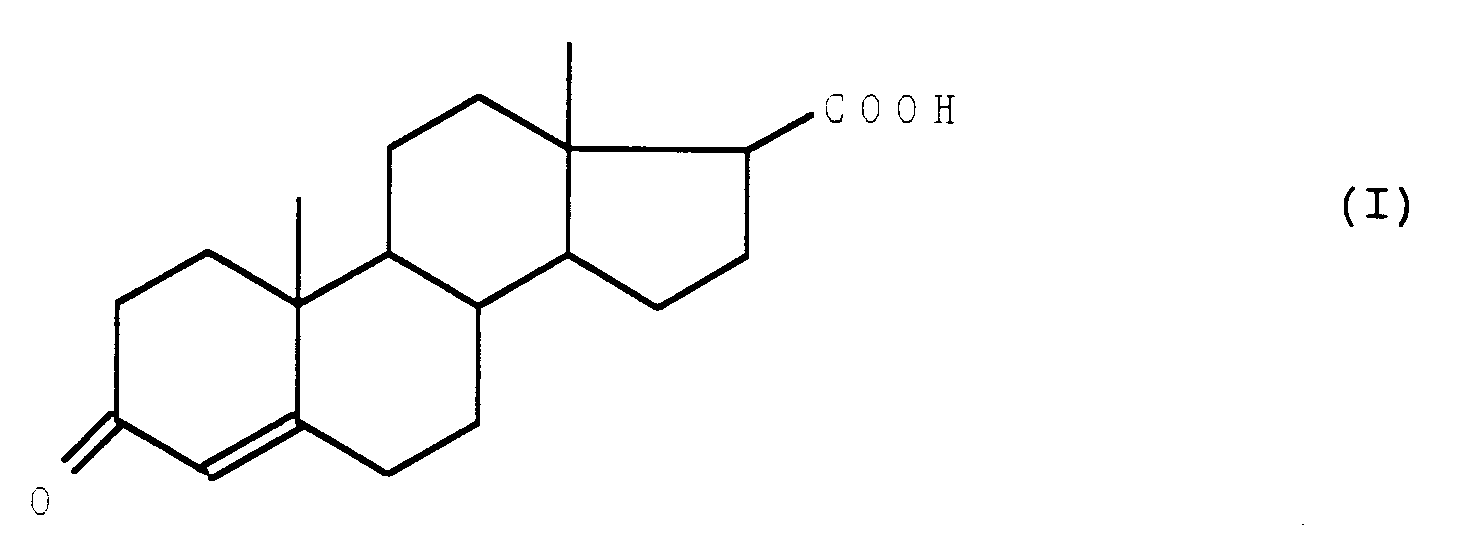
caractérisé en ce que l'on soumet un composé de formule (II)
dans laquelle les cycles A et B représente un reste :
ou
dans lequel K représente un groupement protecteur du radical oxo de formule :
où n est égal à 2 ou 3, et R₁ représente un reste éther ou ester, à l'action d'un halonitrile, en présence d'une base, pour obtenir un composé de formule (III) :
dans laquelle les cycles A et B ont la signification indiquée précédemment et les traits ondulés symbolisent un mélange d'isomères, dont on libère la fonction cétone en position 3 pour obtenir un composé de formule (IV) :
dans laquelle les traits ondulés ont la signification indiquée précédemment,
que l'on traite par un hydracide de formule HX dans lequel X représente un atome d'halogène, en milieu anhydre, pour obtenir un composé de formule (V) :
dans laquelle X et les traits ondulés ont la signification indiquée précédemment,
dont on protège la fonction hydroxy sous forme d'ester pour obtenir un composé de formule (VI) :
dans laquelle Z représente le reste d'un groupement ester protecteur du radical hydroxy et X et les traits ondulés ont la signification précédemment,
que l'on soumet à l'action d'un agent de déshydrohalogénation pour obtenir le composé de formule (VII) :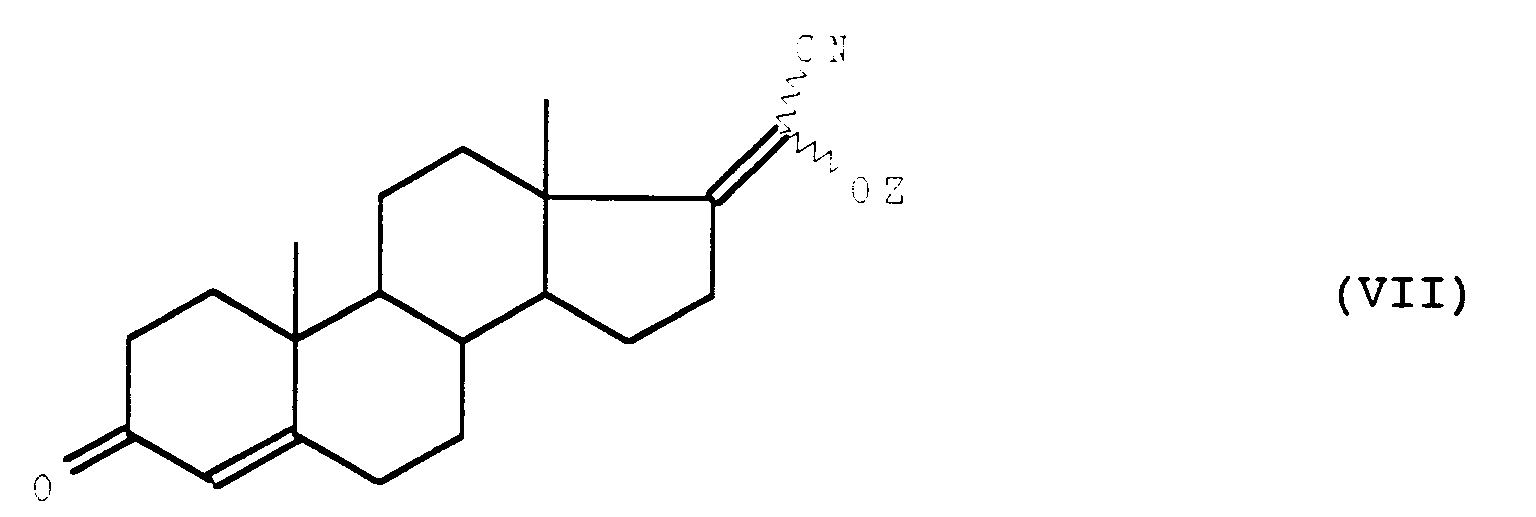
dans laquelle Z et les traits ondulés ont la signification indiquée précédémment, que l'on soumet à une hydrolyse alcaline puis à un traitement acide pour obtenir le composé de formule (I) attendu. - Lorsque R₁ représente un éther, il peut s'agir de tout reste connu de l'homme du métier pour bloquer la position 3 sous cette forme et notamment il peut s'agir d'un radical alkyle renfermant de 1 à 6 atomes de carbone, d'un radical alkoxyalkoxyalkyle renfermant de 3 à 8 atomes de carbone, d'un radical aryle renfermant de 6 à 10 atomes de carbone ou d'un radical aralkyle renfermant de 7 à 12 atomes de carbone.
- Lorsque R₁ représente un radical alkyle, il s'agit par exemple d'un radical méthyle, éthyle, propyle, isopropyle, n-butyle, sec-butyle, tert-butyle, pentyle ou hexyle.
- Lorsque R₁ représente un radical alkoxyalkoxyalkyle, il s'agit par exemple d'un radical méthoxyéthoxyméthyle.
- Lorsque R₁ représente un radical aralkyle, il s'agit par exemple d'un radical benzyle ou phénéthyle.
- Lorsque R₁ représente un radical aryle, il s'agit par exemple d'un radical phényle ou d'un radical phényl substitué, en particulier par un ou plusieurs radicaux alkyles.
- Lorsque R₁ représente un reste éther, il peut encore s'agir d'un groupement silylé, par exemple d'un groupement trialkylsilyle tel que triméthylsilyle, tert-butyl, diméthylsilyle ou encore par exemple d'un groupement triarylsilyle tel que triphénylsilyle ou diarylalkylsilyle tel que diphényl tert-butylsilyle.
- Lorsque R₁ représente un reste ester, il peut s'agir de tout reste connu de l'homme du métier pour bloquer la position 3 sous cette forme et notamment il peut s'agir d'un reste -COR₁, R₁ étant un radical alkyle, aryle ou aralkyle tel que défini ci-dessus.
- L'invention a notamment pour objet un procédé tel que défini précédemment caractérisé en ce que l'on utilise au départ un composé de formule (II) dans laquelle les cycles A et B représentent un reste

dans laquelle R₁ est défini comme précédemment et particulièrement un radical alkyle renfermant de 1 à 6 atomes de carbone. - L'halonitrile que l'on fait agir sur le composé de formule (II) peut être le bromoacétonitrile ou particulièrement le chloroacétonitrile. On opère en présence d'une base forte, de préférence non nucléophile, telle qu'un alcoolate, un hydrure, un amidure ou un hydroxyde de métal alcalin, ou encore un organolithien, par exemple le méthylate, l'éthylate, le terbutylate ou le teramylate de sodium ou potassium, le disisopropylamidure de lithium, ou encore la soude ou la potasse.
- Il peut être avantageux d'opérer en phases hétérogènes en présence d'un catalyseur de transfert de phase, lequel peut être notamment un sel d'ammonium quaternaire, par exemple le bromure de tétrabutylammonium, le chlorure de triéthylbenzylammonium ou le chorure de tricaprylméthylammonium, ou un sel de phosphonium.
- On utilise de préférence un alcoolate tel que le terbutylate ou le teramylate de potassium ou de sodium.
- La réaction est effectuée sur sein d'un solvant organique tel que le toluène, le dichlorométhane, le diméthoxyéthane, le diméthylformamide, le tétrahydrofuranne ou d'un mélange de ces solvants, par exemple le mélange toluène/ tétrahydrofuranne ou encore d'un mélange terbutanol/tétrahydrofuranne.
- La libération de la fonction cétone en position 3 est effectuée par des moyens appropriés à la nature du groupement protecteur. On utilise un agent acide en présence d'eau ou d'un mélange eau-alcanol, dans le cas d'un cétal. Il s'agit par exemple d'un acide minéral ou organique tel que l'acide chlorhydrique, bromhydrique, sulfurique, perchlorique, nitrique, paratoluène sulfonique, acétique, formique, oxalique ou d'un mélange d'acides, ou encore d'un résine acide, par exemple une résine sulfonique. Dans le cas d'un thiocétal ou d'un cétal mixte, la déprotection de la fonction 3-oxo est réalisée par action de l'iode en présence d'une base par exemple un bicarbonate alcalin, ou par action de l'iode en quantité catalytique, en présence d'un agent oxydant, notamment l'eau oxygénée, par action de l'iodure de méthyle, de l'acide glyoxylique, ou encore de sels de métaux, tels le mercure ou le cadmium. On peut, en général, opérer dans un i solvant tel qu'un alcanol inférieur, par exemple le méthanol ou l'éthanol, en mélange avec un solvant halogéné, par exemple le chlorure de méthylène, en présence d'eau. Dans le cas d'un cétal mixte, la déprotection est encore effectuée par exemple par un sel mercurique tel que le chlorure mercurique en présence d'un tampon acide acétique/acétate de potassium à 100°C environ, par le nickel de Raney dans les mêmes conditions que ci-dessus ou par le mélange acide chlorhydrique-acide acétique à chaud.
- Dans le cas où R₁ représente un reste éther ou ester, on utilise également un traitement acide dans les conditions décrites ci-dessus pour le cétal. On peut utiliser par exemple l'acide acétique ou sulfurique ou un mélange de ces acides.
- L'hydracide que l'on utilise pour l'ouverture de la fonction époxyde peut être par exemple l'acide bromhydrique ou de préférence, l'acide chlorhydrique. La réaction est effectuée de préférence en milieu anhydre au sein d'un solvant organique de préférence peu ou non polaire comme par exemple le diméthoxyéthane, l'éther éthylique, l'acétate d'éthyle, le dichlorométhane ou encore le toluène, ces deux derniers étant préférés.
- On opère avantageusement en présence d'une amine tertiaire telle que la pyridine ou la triéthylamine.
- La protection de la fonction hydroxy en position 20 sous forme d'ester peut être réalisée selon les méthodes usuelles en utilisant un dérivé d'acide carboxylique et notamment un halogénure ou un anhydride d'acide alcanoïque ou aromatique, en opérant de préférence en présence d'une base azotée. On peut utiliser par exemple l'ahydride acétique, propionique, valérique ou benzoïque, en présence de pyridine.
- La déshydrohologénation est effectuée par action d'une base telle que par exemple une amine tertiaire comme la triéthylamine ou la pyridine, ou encore d'une base non nucléophile telle que le carbonate de lithium-bromure de lithium, la soude ou la potasse. La réaction est effectuée au sein d'un solvant organique non hydrophile tel que par exemple le dichlorométhane, le diméthylformamide, le diméthylsulfoxyde ou, de préférence, le toluène. On opére avantageusement au reflux du milieu réactionnel.
- L'hydrolyse alcaline est effectuée au moyen d'une base forte notamment l'hydroxyde de baryum, l'hydroxyde de potassium, la carbonate de sodium, ou de préférence l'hydroxyde de sodium. On opére en présence d'eau ou d'un mélange eau-alcool qui stabilise le sel de base formé, le cas échéant en système double phase, avec le solvant dans lequel l'étape précédénte a été effectuée.
- L'isolement de l'acide oxoétiocholénique est réalisé par traitement acide du sel de base selon les méthodes usuelles, par exemple au moyen d'un acide minéral tel que l'acide sulfurique ou l'acide chlorhydrique.
- L'invention a notamment pour objet un procédé tel que défini précédemment, caractérisé en ce que l'on opère sans isoler intermédiairement les composés de formule (IV) et suivantes.
- L'invention a aussi pour objet à titre de produits industriels nouveaux et notamment à titre d'intermédiaires nécessaires à la mise en oeuvre du procédé de l'invention :
- les composés de formule (F1) :


- les composés de formule (F2) :

- les composés de formule (VII) :

- Le composé de formule (II) est décrit dans le brevet français 1.563.607.
- L'acide de formule (I) ou acide oxoétiocholénique est un produit connu notamment comme intermédiaire de synthèse et décrit, par exemple, dans la demande européenne 562.849.
- Les exemples suivants illustrent l'invention sans toutefois la limiter.
- On refroidit à -45°C, sous gaz inerte, 15 g de 3-méthoxy androsta-3,5-dièn-17-one dans 120 cm³ de tétrahydrofuranne et 5,5 g de terbutanol puis ajoute 9 g de terbutylate de potassium puis, en 4 heures à environ -45°C, 4,8 g de chloroacétonitrile en solution dans 30 cm³ de tétrahydrofuranne.
- On introduit le mélange réactionnel sous gaz inerte, dans une solution refroidie à 0°C comprenant 2 g de chlorure d'ammonium dans 300 cm³ d'eau puis maintient 30 minutes sous agitation. On filtre, lave au méthanol à 20 % d'eau, reprend le résidu dans 15 cm³ d'un mélange isopropanol/éther isopropylique 1-2, essore, lave de nouveau avec 30 cm³ du mélange ci-dessus. On essore, sèche sous pression réduite et obtient 13,4 g de produit attendu. F = 180°C.
Spectre IR (CHCl₃) - C=C conj.
- 1654-1629 cm⁻¹
- C≡N
- 2248 cm⁻¹
- 0,94
- CH₃ en 18
- 0,98
- CH₃ en 19
- 3,49
- CH en 20
- 3,58
- CH₃ en 3
- 5,14 (d)
- CH en 4
- 5,25 (d)
- CH en 6
- A 12,85 g de 17,20-époxy 3-méthoxy 17α-pregna 3,5-diène 21-nitrile préparé comme indiqué au stade A. On ajoute sous atmosphère inerte, 64 cm³ d'acide acétique, 13 cm³ d'eau et 13 cm³ d'acide sulfurique dilué (2N).
- On agite 1 heure et demie à température ambiante, ajoute en 10 minutes, 64 cm³ de toluène et 64 cm³ d'eau, décante, lave la phase toluénique à l'eau, puis avec une solution aqueuse de bicarbonate de sodium à 2 %, et distille le toluène sous 150/100 mbars jusqu'à un volume d'environ 25 cm³.
- On ajoute sous atmosphère inerte 100 cm³ de dichlorométhane et 6 cm³ de pyridine au milieu réactionnel ci-dessus, refroidit à -5°C, introduit de l'acide chlorhydrique gazeux pendant 3 heures environ, maintient sous agitation pendant 1 heure à -5°C et neutralise l'excès d'acide chlorhydrique par addition de 21,5 cm³ de pyridine.
- On laisse revenir la température de la suspension préparée ci-dessus à + 10°C environ, puis ajoute en 30 minutes 7,8 cm³ d'anhydride acétique et 6 cm³ de pyridine. On agite 16 heures à température ambiante, lave à l'eau, décante, distille le résidu de 400 à 150 mbars jusqu'à l'obtention d'un produit brut cristallisé.
- On ajoute sous atmosphère inerte 50 cm³ de toluène et 25 cm³ de triéthylamine au produit obtenu précédemment, chauffe au reflux pendant 3 heures et demie et laisse revenir à température ambiante.
- On ajoute sous atmosphère inerte 50 cm³ d'eau et 25 cm³ de soude au milieu réactionnel préparé précédemment et agite 20 heures, ajoute 250 cm³ d'eau et décante la phase aqueuse.
- On refroidit à +10°/+15°C sous atmosphère d'azote la phase aqueuse obtenue précédemment et ajoute 80 cm³ d'acide sulfurique dilué (4N) sous agitation. On chasse l'acide cyanhydrique gazeux par balayage de gaz inerte, essore le précipité formé, le lave à l'eau, le sèche sous pression réduite et obtient 9,33 g de produit attendu.
F = 255-256°C.
Spectre IR (CHCl₃) - C=O
- 1702 cm⁻¹
- Δ₄-3-one
- 1662-1615 cm⁻¹
- 0,79
- CH₃ en 18
- 1,19
- CH₃ en 19
- 5,74
- CH en 4
- On mélange 3 heures à 20°C sous gaz inerte 1,017 g du produit obtenu au stade A de l'exemple 1, dans 10 cm³ d'acide acétique et 5 cm³ d'eau, ajoute 4 cm³ de tétrahydrofuranne et agite 2 heures.
- On évapore les solvants sous pression réduite, chromatographie le résidu sur silice (éluant toluène-acétate d'éthyle 8-2) et obtient 691 mg de produit attendu.
Spectre IR (CHCl₃) - C≡N
- 2240 cm⁻¹
- C=O
- 1662 cm⁻¹
- C=C
- 1617 cm⁻¹
- 0,95
- CH₃ en 18
- 1,20
- CH₃ en 19
- 3,32-3,48
- CH en 20
- 5,75
- CH en 4.
- A 2 cm³ d'une solution 4,7 N d'acide chlorhydrique gazeux dans le diméthoxy éthane 4,7 N, refroidie à +5°/+10°C, on ajoute 1 g du produit obtenu comme indiqué au stade A, agite 3 heures, ajoute de nouveau 1 cm³ de réactif, agite 1 heure en maintenant la température à 10°C et utilise le milieu réactionnel tel quel pour le stade suivant.
- On agite sous atmosphère inerte 0,25 g d'époxyde préparé au stade A, en solution dans 10 cm³ de dichlorométhane et 0,1 cm³ de pyridine.
- On introduit lentement à 20°C environ pendant 1 heure, un courant d'acide chlorhydrique gazeux et élimine l'excès d'acide chlorhydrique par un balayage de gaz inerte.
- La moitié du milieu réactionnel est utilisé telle quelle pour le stade suivant.
- L'autre moitié du milieu réactionnel est lavée à l'eau ; on le sèche, évapore le solvant sous pression réduite, reprend le résidu dans 2 cm³ d'un mélange éthanol-eau (1-1), triture, essore, lave à l'eau, sèche sous pression réduite et obtient 0,1 g de produit attendu. F = 230°-240°C (décomp.).
Spectre RMN (CDCl₃ ppm) - 0,97-0,98
- CH₃ en 18
- 1,21
- CH₃ en 19
- 3,05-3,22
- OH en 20
- 4,56-4,77
- CH en 20
- 5,75
- CH en 4.
- On ajoute au milieu réactionnel obtenu au stade B1 (ou au cours du stade B), refroidi à 10°C, 3 cm³ de diméthoxyéthane puis ajoute en quelques minutes 1,7 cm³ de pyridine et 1 cm³ d'anhydride acétique. On laisse revenir à température ambiante en 1 heure, ajoute 0,8 cm³ de pyridine et 5 cm³ d'eau, abandonne à +4°C pendant 16 heures, essore le précipité formé, le lave au diméthoxyéthane, le sèche sous pression réduite et recueille 0,364 g de produit attendu. F = 238°C.
Spectre IR (CHCl₃) - OAc
- 1757 cm⁻¹
- Δ₄-3-one
- 1665-1616 cm⁻¹
- 1,04
- CH₃ en 18
- 1,21
- CH₃ en 19
- 2,22
- O-Ac
- 5,74
- CH en 4 et en 20.
- A 100 mg de produit obtenu au stade C, sous atmosphère inerte, on ajoute 0,5 cm³ de toluène et 0,2 cm³ de triéthylamine. On chauffe au reflux pendant 5 heures, refroidit vers 10°C, essore le précipité, le lave au toluène puis à l'eau, le sèche sous pression réduite et recueille 91 mg de produit attendu. F = 185-190°C.
Spectre IR (CHCl₃) - C≡N (conj)
- 2223 cm⁻¹
- OAc
- 1773 cm⁻¹
- Δ₄-3-one
- 1662-1616 cm⁻¹
- 0,97
- CH₃ en 18
- 1,19
- CH₃ en 19
- 2,20
- O-Ac
- 5,74
- CH₃ en 4.
- En opérant comme aux stades B5 et B6 de l'exemple 1, en utilisant au départ le produit obtenu au stade D ci-dessus, on obtient l'acide oxoetiocholénique attendu.
Spectre RMN (CDCl₃ ppm)
Spectre RMN (CDCl₃ ppm)
Spectre RMN (CDCl₃ ppm)
Spectre RMN (CDCl₃ ppm)
Spectre RMN (CDCl₃ ppm)
Claims (13)


que l'on traite par un hydracide de formule HX dans lequel X représente un atome d'halogène, en milieu anhydre, pour obtenir un composé de formule (V) :

dont on protège la fonction hydroxy sous forme d'ester pour obtenir un composé de formule (VI) :

que l'on soumet à l'action d'un agent de déshydrohalogénation pour obtenir le composé de formule (VII) :
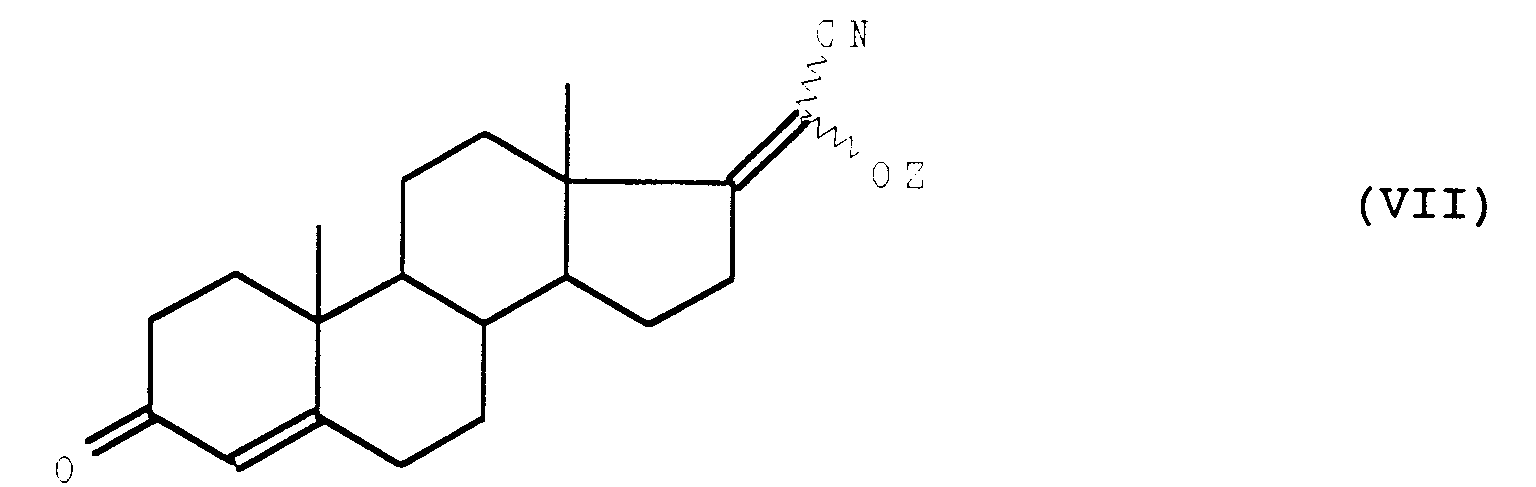
que l'on soumet à une hydrolyse alcaline puis à un traitement acide pour obtenir le composé de formule (I) attendu.


Applications Claiming Priority (2)
| Application Number | Priority Date | Filing Date | Title |
|---|---|---|---|
| FR9410661A FR2724174B1 (fr) | 1994-09-06 | 1994-09-06 | Procede de preparation d'un derive steroide 17beta-carboxy et nouveaux intermediaires |
| FR9410661 | 1994-09-06 |
Publications (2)
| Publication Number | Publication Date |
|---|---|
| EP0702025A1 true EP0702025A1 (fr) | 1996-03-20 |
| EP0702025B1 EP0702025B1 (fr) | 2001-12-19 |
Family
ID=9466727
Family Applications (1)
| Application Number | Title | Priority Date | Filing Date |
|---|---|---|---|
| EP95402013A Expired - Lifetime EP0702025B1 (fr) | 1994-09-06 | 1995-09-06 | Procédé de préparation d'un dérivé stéroide 17bêta-carboxy et nouveaux intermédiaires |
Country Status (12)
| Country | Link |
|---|---|
| US (4) | US5650526A (fr) |
| EP (1) | EP0702025B1 (fr) |
| JP (1) | JPH0881492A (fr) |
| KR (1) | KR100394203B1 (fr) |
| AT (1) | ATE211145T1 (fr) |
| CA (1) | CA2157550A1 (fr) |
| DE (1) | DE69524696T2 (fr) |
| DK (1) | DK0702025T3 (fr) |
| ES (1) | ES2169747T3 (fr) |
| FR (1) | FR2724174B1 (fr) |
| HU (2) | HU223949B1 (fr) |
| PT (1) | PT702025E (fr) |
Families Citing this family (2)
| Publication number | Priority date | Publication date | Assignee | Title |
|---|---|---|---|---|
| US6410760B1 (en) | 1999-10-13 | 2002-06-25 | Pharmacia & Upjohn Company | Process to prepare androst-4-en-17-carboxylic acid |
| WO2019054064A1 (fr) | 2017-09-12 | 2019-03-21 | ダイキン工業株式会社 | Polydifluoroacétylène, procédé de production de polydifluoroacétylène, polymère précurseur, article moulé et poudre |
Citations (4)
| Publication number | Priority date | Publication date | Assignee | Title |
|---|---|---|---|---|
| FR1563607A (fr) | 1960-11-07 | 1969-04-18 | ||
| EP0042606A1 (fr) * | 1980-06-24 | 1981-12-30 | Schering Aktiengesellschaft | Procédé de préparation d'acides 17-alpha hydroxy et 17a-alpha hydroxy-D-homo étio carboxyliques |
| EP0289327A2 (fr) * | 1987-04-29 | 1988-11-02 | Smithkline Beecham Corporation | Inhibiteurs de stéroides-5-alpha-réductase |
| EP0562849A2 (fr) | 1992-03-27 | 1993-09-29 | Eli Lilly And Company | Dérivés de steroides |
Family Cites Families (6)
| Publication number | Priority date | Publication date | Assignee | Title |
|---|---|---|---|---|
| DE42606C (de) * | O. MILSTER in Remscheid, Cronenstr | Ausrückvorrichtung des Schneckengetriebes von Lastwinden | ||
| US3118882A (en) * | 1961-02-16 | 1964-01-21 | American Home Prod | Preparation of 17alpha-fluoroprogesterone and intermediates therein |
| US4179453A (en) * | 1978-04-13 | 1979-12-18 | Merck & Co., Inc. | Process for preparing 17β-carboxy-5-androsten-3-ones |
| FR2486947A1 (fr) * | 1980-07-15 | 1982-01-22 | Roussel Uclaf | Nouveaux derives steroides 20-isonitriles 17(20) insatures, leur procede de preparation et leur application a la preparation des steroides 17a-hydroxy 20-ceto |
| US4389345A (en) * | 1981-10-09 | 1983-06-21 | G.D. Searle & Co. | 3-Oxoestra-17-acetonitrile and unsaturated analogs |
| FR2700339B1 (fr) * | 1993-01-14 | 1995-03-03 | Roussel Uclaf | Nouveaux dérivés 17,20-époxydes du pregnane, leur préparation, leur application à la préparation de dérivés cortisoniques et intermédiaires. |
-
1994
- 1994-09-06 FR FR9410661A patent/FR2724174B1/fr not_active Expired - Fee Related
-
1995
- 1995-08-28 US US08/519,772 patent/US5650526A/en not_active Expired - Fee Related
- 1995-09-01 JP JP7246994A patent/JPH0881492A/ja not_active Abandoned
- 1995-09-05 HU HU9801519A patent/HU223949B1/hu not_active IP Right Cessation
- 1995-09-05 CA CA002157550A patent/CA2157550A1/fr not_active Abandoned
- 1995-09-05 KR KR1019950028946A patent/KR100394203B1/ko not_active Expired - Fee Related
- 1995-09-05 HU HU9502601A patent/HU216343B/hu not_active IP Right Cessation
- 1995-09-06 ES ES95402013T patent/ES2169747T3/es not_active Expired - Lifetime
- 1995-09-06 DE DE69524696T patent/DE69524696T2/de not_active Expired - Fee Related
- 1995-09-06 PT PT95402013T patent/PT702025E/pt unknown
- 1995-09-06 EP EP95402013A patent/EP0702025B1/fr not_active Expired - Lifetime
- 1995-09-06 AT AT95402013T patent/ATE211145T1/de not_active IP Right Cessation
- 1995-09-06 DK DK95402013T patent/DK0702025T3/da active
-
1996
- 1996-12-02 US US08/758,951 patent/US5770748A/en not_active Expired - Fee Related
-
1997
- 1997-11-05 US US08/964,836 patent/US5945530A/en not_active Expired - Fee Related
-
1998
- 1998-08-04 US US09/130,531 patent/US5919957A/en not_active Expired - Fee Related
Patent Citations (4)
| Publication number | Priority date | Publication date | Assignee | Title |
|---|---|---|---|---|
| FR1563607A (fr) | 1960-11-07 | 1969-04-18 | ||
| EP0042606A1 (fr) * | 1980-06-24 | 1981-12-30 | Schering Aktiengesellschaft | Procédé de préparation d'acides 17-alpha hydroxy et 17a-alpha hydroxy-D-homo étio carboxyliques |
| EP0289327A2 (fr) * | 1987-04-29 | 1988-11-02 | Smithkline Beecham Corporation | Inhibiteurs de stéroides-5-alpha-réductase |
| EP0562849A2 (fr) | 1992-03-27 | 1993-09-29 | Eli Lilly And Company | Dérivés de steroides |
Non-Patent Citations (1)
| Title |
|---|
| A. KUREK ET AL: "Synthesis of 3beta-methoxy-5alpha,14alpha-card-20(22)-enolide from 3beta-methoxy-5alpha-androstan-17-one. A method for the construction of the cardenolide side-chain.", JOURNAL OF CHEMICAL SOCIETY, CHEMICAL COMMUNICATIONS, no. 1, pages 25 - 26 * |
Also Published As
| Publication number | Publication date |
|---|---|
| HU223949B1 (hu) | 2005-03-29 |
| FR2724174B1 (fr) | 1997-01-17 |
| US5945530A (en) | 1999-08-31 |
| DE69524696T2 (de) | 2002-08-22 |
| PT702025E (pt) | 2002-06-28 |
| US5650526A (en) | 1997-07-22 |
| ES2169747T3 (es) | 2002-07-16 |
| US5770748A (en) | 1998-06-23 |
| HU216343B (hu) | 1999-06-28 |
| ATE211145T1 (de) | 2002-01-15 |
| DK0702025T3 (da) | 2002-04-15 |
| JPH0881492A (ja) | 1996-03-26 |
| KR960010680A (ko) | 1996-04-20 |
| CA2157550A1 (fr) | 1996-03-07 |
| FR2724174A1 (fr) | 1996-03-08 |
| EP0702025B1 (fr) | 2001-12-19 |
| HU9502601D0 (en) | 1995-10-30 |
| KR100394203B1 (ko) | 2003-10-10 |
| DE69524696D1 (de) | 2002-01-31 |
| US5919957A (en) | 1999-07-06 |
| HUT71993A (en) | 1996-03-28 |
Similar Documents
| Publication | Publication Date | Title |
|---|---|---|
| EP0574318B1 (fr) | Nouveau procédé de préparation de stéroides 16 alpha-méthylés | |
| EP0610138B1 (fr) | Nouveau procédé de préparation de stéroides 6alpha,9alpha-difluorés et nouveaux intermédiaires obtenus | |
| EP0515264B1 (fr) | Nouveaux dérivés stéroides du pregna-4,9(11),17(20)-triène-3-one, leur préparation, leur préparation, leur application à la préparation de composés stéroides de type pregna-4,9(11),16-trièn-3,20-dione et nouveaux intermédiaires | |
| EP0607088B1 (fr) | Nouveaux dérivés 17,20-époxydes du pregnane, leur application à la préparation de dérivés cortisoniques et intermédiaires | |
| EP0685487B1 (fr) | Nouveau procédé de préparation d'un stéroide 16bêta-méthyl et nouveaux intermédiaires | |
| CH652726A5 (fr) | Derives steroides 17-oxazolines, leur procede de preparation et leur utilisation a la preparation de corticosteroides. | |
| EP0531212B1 (fr) | Nouveau procédé de préparation de l'hydrocortisone et nouveaux intermédiaires | |
| EP0702025B1 (fr) | Procédé de préparation d'un dérivé stéroide 17bêta-carboxy et nouveaux intermédiaires | |
| EP0608178B1 (fr) | Nouveau procédé de préparation de stéroides 16alpha-méthylés | |
| JPH0118919B2 (fr) | ||
| EP0275728B1 (fr) | Nouveaux produits stéroîdes comportant, en position 23, un radical sulfinyle, leur procédé de préparation, leur application à la préparation de produits de la série des 20-cétoprégnanes et des intermédiaires de cette application | |
| EP0574317A1 (fr) | Nouveau procédé de préparation de composés stéroides 20-céto 21alpha-hydroxy et intermédiaires | |
| EP0087359B1 (fr) | Nouveau réactif de nitrométhylation, son application à la préparation de composés nitrométhylénés et de certains de leurs dérivés et les composés nouveaux obtenus | |
| CA1305131C (fr) | Produits utiles pour la preparation de produits de la serie des 20-ceto p regnane | |
| FR2677029A1 (fr) | Nouveaux derives sterouides de l'andostra-4,9(11),16-trien-3-one. | |
| FR2677028A1 (fr) | Nouveaux derives sterouides du pregna-4,9(11),17(20)-trien-3-one. |
Legal Events
| Date | Code | Title | Description |
|---|---|---|---|
| PUAI | Public reference made under article 153(3) epc to a published international application that has entered the european phase |
Free format text: ORIGINAL CODE: 0009012 |
|
| AK | Designated contracting states |
Kind code of ref document: A1 Designated state(s): AT BE CH DE DK ES FR GB GR IE IT LI LU NL PT SE |
|
| 17P | Request for examination filed |
Effective date: 19960920 |
|
| RAP1 | Party data changed (applicant data changed or rights of an application transferred) |
Owner name: HOECHST MARION ROUSSEL |
|
| 17Q | First examination report despatched |
Effective date: 19991019 |
|
| GRAG | Despatch of communication of intention to grant |
Free format text: ORIGINAL CODE: EPIDOS AGRA |
|
| GRAG | Despatch of communication of intention to grant |
Free format text: ORIGINAL CODE: EPIDOS AGRA |
|
| GRAH | Despatch of communication of intention to grant a patent |
Free format text: ORIGINAL CODE: EPIDOS IGRA |
|
| RAP1 | Party data changed (applicant data changed or rights of an application transferred) |
Owner name: AVENTIS PHARMA S.A. |
|
| GRAH | Despatch of communication of intention to grant a patent |
Free format text: ORIGINAL CODE: EPIDOS IGRA |
|
| ITF | It: translation for a ep patent filed | ||
| GRAA | (expected) grant |
Free format text: ORIGINAL CODE: 0009210 |
|
| AK | Designated contracting states |
Kind code of ref document: B1 Designated state(s): AT BE CH DE DK ES FR GB GR IE IT LI LU NL PT SE |
|
| PG25 | Lapsed in a contracting state [announced via postgrant information from national office to epo] |
Ref country code: GR Free format text: LAPSE BECAUSE OF FAILURE TO SUBMIT A TRANSLATION OF THE DESCRIPTION OR TO PAY THE FEE WITHIN THE PRESCRIBED TIME-LIMIT Effective date: 20011219 |
|
| REF | Corresponds to: |
Ref document number: 211145 Country of ref document: AT Date of ref document: 20020115 Kind code of ref document: T |
|
| REG | Reference to a national code |
Ref country code: CH Ref legal event code: EP |
|
| REG | Reference to a national code |
Ref country code: GB Ref legal event code: IF02 |
|
| REG | Reference to a national code |
Ref country code: IE Ref legal event code: FG4D Free format text: FRENCH |
|
| REF | Corresponds to: |
Ref document number: 69524696 Country of ref document: DE Date of ref document: 20020131 |
|
| REG | Reference to a national code |
Ref country code: CH Ref legal event code: NV Representative=s name: A. BRAUN, BRAUN, HERITIER, ESCHMANN AG PATENTANWAE |
|
| GBT | Gb: translation of ep patent filed (gb section 77(6)(a)/1977) |
Effective date: 20020301 |
|
| REG | Reference to a national code |
Ref country code: DK Ref legal event code: T3 |
|
| REG | Reference to a national code |
Ref country code: GR Ref legal event code: EP Ref document number: 20020400525 Country of ref document: GR |
|
| REG | Reference to a national code |
Ref country code: PT Ref legal event code: SC4A Free format text: AVAILABILITY OF NATIONAL TRANSLATION Effective date: 20020312 |
|
| REG | Reference to a national code |
Ref country code: ES Ref legal event code: FG2A Ref document number: 2169747 Country of ref document: ES Kind code of ref document: T3 |
|
| PLBE | No opposition filed within time limit |
Free format text: ORIGINAL CODE: 0009261 |
|
| STAA | Information on the status of an ep patent application or granted ep patent |
Free format text: STATUS: NO OPPOSITION FILED WITHIN TIME LIMIT |
|
| 26N | No opposition filed | ||
| PGFP | Annual fee paid to national office [announced via postgrant information from national office to epo] |
Ref country code: PT Payment date: 20030805 Year of fee payment: 9 |
|
| PGFP | Annual fee paid to national office [announced via postgrant information from national office to epo] |
Ref country code: SE Payment date: 20030808 Year of fee payment: 9 |
|
| PGFP | Annual fee paid to national office [announced via postgrant information from national office to epo] |
Ref country code: IE Payment date: 20030825 Year of fee payment: 9 |
|
| PGFP | Annual fee paid to national office [announced via postgrant information from national office to epo] |
Ref country code: LU Payment date: 20030829 Year of fee payment: 9 Ref country code: GB Payment date: 20030829 Year of fee payment: 9 |
|
| PGFP | Annual fee paid to national office [announced via postgrant information from national office to epo] |
Ref country code: BE Payment date: 20030910 Year of fee payment: 9 |
|
| PGFP | Annual fee paid to national office [announced via postgrant information from national office to epo] |
Ref country code: FR Payment date: 20030929 Year of fee payment: 9 Ref country code: ES Payment date: 20030929 Year of fee payment: 9 Ref country code: AT Payment date: 20030929 Year of fee payment: 9 |
|
| PGFP | Annual fee paid to national office [announced via postgrant information from national office to epo] |
Ref country code: NL Payment date: 20030930 Year of fee payment: 9 Ref country code: GR Payment date: 20030930 Year of fee payment: 9 Ref country code: DK Payment date: 20030930 Year of fee payment: 9 Ref country code: CH Payment date: 20030930 Year of fee payment: 9 |
|
| PGFP | Annual fee paid to national office [announced via postgrant information from national office to epo] |
Ref country code: DE Payment date: 20031126 Year of fee payment: 9 |
|
| PG25 | Lapsed in a contracting state [announced via postgrant information from national office to epo] |
Ref country code: LU Free format text: LAPSE BECAUSE OF NON-PAYMENT OF DUE FEES Effective date: 20040906 Ref country code: IE Free format text: LAPSE BECAUSE OF NON-PAYMENT OF DUE FEES Effective date: 20040906 Ref country code: GB Free format text: LAPSE BECAUSE OF NON-PAYMENT OF DUE FEES Effective date: 20040906 Ref country code: AT Free format text: LAPSE BECAUSE OF NON-PAYMENT OF DUE FEES Effective date: 20040906 |
|
| PG25 | Lapsed in a contracting state [announced via postgrant information from national office to epo] |
Ref country code: SE Free format text: LAPSE BECAUSE OF NON-PAYMENT OF DUE FEES Effective date: 20040907 Ref country code: ES Free format text: LAPSE BECAUSE OF NON-PAYMENT OF DUE FEES Effective date: 20040907 |
|
| PG25 | Lapsed in a contracting state [announced via postgrant information from national office to epo] |
Ref country code: LI Free format text: LAPSE BECAUSE OF NON-PAYMENT OF DUE FEES Effective date: 20040930 Ref country code: DK Free format text: LAPSE BECAUSE OF NON-PAYMENT OF DUE FEES Effective date: 20040930 Ref country code: CH Free format text: LAPSE BECAUSE OF NON-PAYMENT OF DUE FEES Effective date: 20040930 Ref country code: BE Free format text: LAPSE BECAUSE OF NON-PAYMENT OF DUE FEES Effective date: 20040930 |
|
| PG25 | Lapsed in a contracting state [announced via postgrant information from national office to epo] |
Ref country code: PT Free format text: LAPSE BECAUSE OF NON-PAYMENT OF DUE FEES Effective date: 20050307 |
|
| BERE | Be: lapsed |
Owner name: S.A. *AVENTIS PHARMA Effective date: 20040930 |
|
| PG25 | Lapsed in a contracting state [announced via postgrant information from national office to epo] |
Ref country code: NL Free format text: LAPSE BECAUSE OF NON-PAYMENT OF DUE FEES Effective date: 20050401 Ref country code: DE Free format text: LAPSE BECAUSE OF NON-PAYMENT OF DUE FEES Effective date: 20050401 |
|
| GBPC | Gb: european patent ceased through non-payment of renewal fee |
Effective date: 20040906 |
|
| EUG | Se: european patent has lapsed | ||
| REG | Reference to a national code |
Ref country code: CH Ref legal event code: PL |
|
| PG25 | Lapsed in a contracting state [announced via postgrant information from national office to epo] |
Ref country code: FR Free format text: LAPSE BECAUSE OF NON-PAYMENT OF DUE FEES Effective date: 20050531 |
|
| REG | Reference to a national code |
Ref country code: PT Ref legal event code: MM4A Free format text: LAPSE DUE TO NON-PAYMENT OF FEES Effective date: 20050307 |
|
| NLV4 | Nl: lapsed or anulled due to non-payment of the annual fee |
Effective date: 20050401 |
|
| REG | Reference to a national code |
Ref country code: IE Ref legal event code: MM4A |
|
| REG | Reference to a national code |
Ref country code: DK Ref legal event code: EBP |
|
| REG | Reference to a national code |
Ref country code: FR Ref legal event code: ST |
|
| PG25 | Lapsed in a contracting state [announced via postgrant information from national office to epo] |
Ref country code: IT Free format text: LAPSE BECAUSE OF NON-PAYMENT OF DUE FEES;WARNING: LAPSES OF ITALIAN PATENTS WITH EFFECTIVE DATE BEFORE 2007 MAY HAVE OCCURRED AT ANY TIME BEFORE 2007. THE CORRECT EFFECTIVE DATE MAY BE DIFFERENT FROM THE ONE RECORDED. Effective date: 20050906 |
|
| REG | Reference to a national code |
Ref country code: ES Ref legal event code: FD2A Effective date: 20040907 |
|
| BERE | Be: lapsed |
Owner name: S.A. *AVENTIS PHARMA Effective date: 20040930 |