EP0702999B1 - Composition simultanément antimottante et hydrophobante pour sels, engrais simples et complexes et procédé de mise en oeuvre - Google Patents
Composition simultanément antimottante et hydrophobante pour sels, engrais simples et complexes et procédé de mise en oeuvre Download PDFInfo
- Publication number
- EP0702999B1 EP0702999B1 EP95402137A EP95402137A EP0702999B1 EP 0702999 B1 EP0702999 B1 EP 0702999B1 EP 95402137 A EP95402137 A EP 95402137A EP 95402137 A EP95402137 A EP 95402137A EP 0702999 B1 EP0702999 B1 EP 0702999B1
- Authority
- EP
- European Patent Office
- Prior art keywords
- salts
- amine
- fact
- carbon atoms
- composition according
- Prior art date
- Legal status (The legal status is an assumption and is not a legal conclusion. Google has not performed a legal analysis and makes no representation as to the accuracy of the status listed.)
- Revoked
Links
- 239000000203 mixture Substances 0.000 title claims abstract description 85
- 239000003337 fertilizer Substances 0.000 title claims abstract description 52
- 150000003839 salts Chemical class 0.000 title claims abstract description 23
- 238000000034 method Methods 0.000 title claims description 10
- -1 ester amine salt Chemical class 0.000 claims abstract description 36
- 150000001412 amines Chemical class 0.000 claims abstract description 26
- 125000004432 carbon atom Chemical group C* 0.000 claims abstract description 19
- 239000001993 wax Substances 0.000 claims abstract description 11
- 125000000217 alkyl group Chemical group 0.000 claims abstract description 10
- 150000008064 anhydrides Chemical class 0.000 claims abstract description 10
- LFQSCWFLJHTTHZ-UHFFFAOYSA-N Ethanol Chemical compound CCO LFQSCWFLJHTTHZ-UHFFFAOYSA-N 0.000 claims abstract description 8
- 125000002947 alkylene group Chemical group 0.000 claims abstract description 5
- 150000001732 carboxylic acid derivatives Chemical class 0.000 claims abstract description 4
- 239000003921 oil Substances 0.000 claims abstract description 4
- 125000001183 hydrocarbyl group Chemical group 0.000 claims abstract 4
- 238000009472 formulation Methods 0.000 claims abstract 2
- 239000002253 acid Substances 0.000 claims description 18
- 229920005652 polyisobutylene succinic anhydride Polymers 0.000 claims description 14
- 239000000126 substance Substances 0.000 claims description 13
- 150000007513 acids Chemical class 0.000 claims description 11
- 150000002148 esters Chemical class 0.000 claims description 11
- 239000000470 constituent Substances 0.000 claims description 10
- 150000001875 compounds Chemical class 0.000 claims description 7
- 230000015572 biosynthetic process Effects 0.000 claims description 5
- 238000006243 chemical reaction Methods 0.000 claims description 5
- 239000003795 chemical substances by application Substances 0.000 claims description 5
- 238000000576 coating method Methods 0.000 claims description 5
- 239000002245 particle Substances 0.000 claims description 5
- 125000002877 alkyl aryl group Chemical group 0.000 claims description 4
- 238000006467 substitution reaction Methods 0.000 claims description 4
- DLYUQMMRRRQYAE-UHFFFAOYSA-N tetraphosphorus decaoxide Chemical compound O1P(O2)(=O)OP3(=O)OP1(=O)OP2(=O)O3 DLYUQMMRRRQYAE-UHFFFAOYSA-N 0.000 claims description 4
- 239000011248 coating agent Substances 0.000 claims description 3
- 239000007788 liquid Substances 0.000 claims description 3
- 150000003014 phosphoric acid esters Chemical class 0.000 claims description 3
- 238000005507 spraying Methods 0.000 claims description 3
- 239000001384 succinic acid Substances 0.000 claims description 3
- 125000003118 aryl group Chemical group 0.000 claims description 2
- WPYMKLBDIGXBTP-UHFFFAOYSA-N benzoic acid group Chemical group C(C1=CC=CC=C1)(=O)O WPYMKLBDIGXBTP-UHFFFAOYSA-N 0.000 claims description 2
- 125000002887 hydroxy group Chemical group [H]O* 0.000 claims description 2
- 238000003786 synthesis reaction Methods 0.000 claims description 2
- 239000005871 repellent Substances 0.000 claims 1
- BDHFUVZGWQCTTF-UHFFFAOYSA-N sulfonic acid Chemical class OS(=O)=O BDHFUVZGWQCTTF-UHFFFAOYSA-N 0.000 claims 1
- 230000002209 hydrophobic effect Effects 0.000 abstract description 16
- 239000007795 chemical reaction product Substances 0.000 abstract description 3
- 239000003006 anti-agglomeration agent Substances 0.000 abstract 2
- 101100037762 Caenorhabditis elegans rnh-2 gene Proteins 0.000 abstract 1
- 238000011084 recovery Methods 0.000 description 15
- XLYOFNOQVPJJNP-UHFFFAOYSA-N water Substances O XLYOFNOQVPJJNP-UHFFFAOYSA-N 0.000 description 10
- IJGRMHOSHXDMSA-UHFFFAOYSA-N Atomic nitrogen Chemical compound N#N IJGRMHOSHXDMSA-UHFFFAOYSA-N 0.000 description 8
- 239000000047 product Substances 0.000 description 7
- 125000004429 atom Chemical group 0.000 description 5
- PAWQVTBBRAZDMG-UHFFFAOYSA-N 2-(3-bromo-2-fluorophenyl)acetic acid Chemical group OC(=O)CC1=CC=CC(Br)=C1F PAWQVTBBRAZDMG-UHFFFAOYSA-N 0.000 description 4
- UFWIBTONFRDIAS-UHFFFAOYSA-N Naphthalene Chemical compound C1=CC=CC2=CC=CC=C21 UFWIBTONFRDIAS-UHFFFAOYSA-N 0.000 description 4
- DIZPMCHEQGEION-UHFFFAOYSA-H aluminium sulfate (anhydrous) Chemical compound [Al+3].[Al+3].[O-]S([O-])(=O)=O.[O-]S([O-])(=O)=O.[O-]S([O-])(=O)=O DIZPMCHEQGEION-UHFFFAOYSA-H 0.000 description 4
- 150000002430 hydrocarbons Chemical class 0.000 description 4
- 238000002844 melting Methods 0.000 description 4
- 230000008018 melting Effects 0.000 description 4
- 239000002480 mineral oil Substances 0.000 description 4
- 229910052757 nitrogen Inorganic materials 0.000 description 4
- KDYFGRWQOYBRFD-UHFFFAOYSA-N succinic acid Chemical compound OC(=O)CCC(O)=O KDYFGRWQOYBRFD-UHFFFAOYSA-N 0.000 description 4
- 239000008187 granular material Substances 0.000 description 3
- 235000010446 mineral oil Nutrition 0.000 description 3
- 238000011282 treatment Methods 0.000 description 3
- VTYYLEPIZMXCLO-UHFFFAOYSA-L Calcium carbonate Chemical compound [Ca+2].[O-]C([O-])=O VTYYLEPIZMXCLO-UHFFFAOYSA-L 0.000 description 2
- 239000001692 EU approved anti-caking agent Substances 0.000 description 2
- 238000010521 absorption reaction Methods 0.000 description 2
- 239000000654 additive Substances 0.000 description 2
- 230000000996 additive effect Effects 0.000 description 2
- 150000008055 alkyl aryl sulfonates Chemical class 0.000 description 2
- 150000005690 diesters Chemical class 0.000 description 2
- 239000012188 paraffin wax Substances 0.000 description 2
- OYPRJOBELJOOCE-UHFFFAOYSA-N Calcium Chemical compound [Ca] OYPRJOBELJOOCE-UHFFFAOYSA-N 0.000 description 1
- 239000004215 Carbon black (E152) Substances 0.000 description 1
- VEXZGXHMUGYJMC-UHFFFAOYSA-M Chloride anion Chemical compound [Cl-] VEXZGXHMUGYJMC-UHFFFAOYSA-M 0.000 description 1
- REYJJPSVUYRZGE-UHFFFAOYSA-N Octadecylamine Chemical compound CCCCCCCCCCCCCCCCCCN REYJJPSVUYRZGE-UHFFFAOYSA-N 0.000 description 1
- 241000209504 Poaceae Species 0.000 description 1
- 239000004698 Polyethylene Substances 0.000 description 1
- ZLMJMSJWJFRBEC-UHFFFAOYSA-N Potassium Chemical compound [K] ZLMJMSJWJFRBEC-UHFFFAOYSA-N 0.000 description 1
- XSQUKJJJFZCRTK-UHFFFAOYSA-N Urea Chemical compound NC(N)=O XSQUKJJJFZCRTK-UHFFFAOYSA-N 0.000 description 1
- DVARTQFDIMZBAA-UHFFFAOYSA-O ammonium nitrate Chemical class [NH4+].[O-][N+]([O-])=O DVARTQFDIMZBAA-UHFFFAOYSA-O 0.000 description 1
- BFNBIHQBYMNNAN-UHFFFAOYSA-N ammonium sulfate Chemical compound N.N.OS(O)(=O)=O BFNBIHQBYMNNAN-UHFFFAOYSA-N 0.000 description 1
- 229910052921 ammonium sulfate Inorganic materials 0.000 description 1
- 235000011130 ammonium sulphate Nutrition 0.000 description 1
- 239000012914 anti-clumping agent Substances 0.000 description 1
- 239000011575 calcium Substances 0.000 description 1
- 229910052791 calcium Inorganic materials 0.000 description 1
- 229910000019 calcium carbonate Inorganic materials 0.000 description 1
- 239000001110 calcium chloride Substances 0.000 description 1
- 229910001628 calcium chloride Inorganic materials 0.000 description 1
- 239000001506 calcium phosphate Substances 0.000 description 1
- 229910000389 calcium phosphate Inorganic materials 0.000 description 1
- 235000011010 calcium phosphates Nutrition 0.000 description 1
- 239000004202 carbamide Substances 0.000 description 1
- 235000013877 carbamide Nutrition 0.000 description 1
- 230000000052 comparative effect Effects 0.000 description 1
- 239000000428 dust Substances 0.000 description 1
- 230000000694 effects Effects 0.000 description 1
- 229930195733 hydrocarbon Natural products 0.000 description 1
- 239000000463 material Substances 0.000 description 1
- ILIAORQHUPOTCA-UHFFFAOYSA-N octadecan-1-amine propan-2-yl naphthalene-1-sulfonate Chemical compound C1(=CC=CC2=CC=CC=C12)S(=O)(=O)OC(C)C.C(CCCCCCCCCCCCCCCCC)N ILIAORQHUPOTCA-UHFFFAOYSA-N 0.000 description 1
- 229920000573 polyethylene Polymers 0.000 description 1
- 239000011591 potassium Substances 0.000 description 1
- 229910052700 potassium Inorganic materials 0.000 description 1
- OTYBMLCTZGSZBG-UHFFFAOYSA-L potassium sulfate Chemical compound [K+].[K+].[O-]S([O-])(=O)=O OTYBMLCTZGSZBG-UHFFFAOYSA-L 0.000 description 1
- 229910052939 potassium sulfate Inorganic materials 0.000 description 1
- 235000011151 potassium sulphates Nutrition 0.000 description 1
- QORWJWZARLRLPR-UHFFFAOYSA-H tricalcium bis(phosphate) Chemical compound [Ca+2].[Ca+2].[Ca+2].[O-]P([O-])([O-])=O.[O-]P([O-])([O-])=O QORWJWZARLRLPR-UHFFFAOYSA-H 0.000 description 1
- 229940099259 vaseline Drugs 0.000 description 1
- 238000005303 weighing Methods 0.000 description 1
Classifications
-
- B—PERFORMING OPERATIONS; TRANSPORTING
- B01—PHYSICAL OR CHEMICAL PROCESSES OR APPARATUS IN GENERAL
- B01J—CHEMICAL OR PHYSICAL PROCESSES, e.g. CATALYSIS OR COLLOID CHEMISTRY; THEIR RELEVANT APPARATUS
- B01J2/00—Processes or devices for granulating materials, e.g. fertilisers in general; Rendering particulate materials free flowing in general, e.g. making them hydrophobic
- B01J2/30—Processes or devices for granulating materials, e.g. fertilisers in general; Rendering particulate materials free flowing in general, e.g. making them hydrophobic using agents to prevent the granules sticking together; Rendering particulate materials free flowing in general, e.g. making them hydrophobic
-
- C—CHEMISTRY; METALLURGY
- C05—FERTILISERS; MANUFACTURE THEREOF
- C05G—MIXTURES OF FERTILISERS COVERED INDIVIDUALLY BY DIFFERENT SUBCLASSES OF CLASS C05; MIXTURES OF ONE OR MORE FERTILISERS WITH MATERIALS NOT HAVING A SPECIFIC FERTILISING ACTIVITY, e.g. PESTICIDES, SOIL-CONDITIONERS, WETTING AGENTS; FERTILISERS CHARACTERISED BY THEIR FORM
- C05G3/00—Mixtures of one or more fertilisers with additives not having a specially fertilising activity
- C05G3/30—Anti-agglomerating additives; Anti-solidifying additives
-
- C—CHEMISTRY; METALLURGY
- C05—FERTILISERS; MANUFACTURE THEREOF
- C05G—MIXTURES OF FERTILISERS COVERED INDIVIDUALLY BY DIFFERENT SUBCLASSES OF CLASS C05; MIXTURES OF ONE OR MORE FERTILISERS WITH MATERIALS NOT HAVING A SPECIFIC FERTILISING ACTIVITY, e.g. PESTICIDES, SOIL-CONDITIONERS, WETTING AGENTS; FERTILISERS CHARACTERISED BY THEIR FORM
- C05G5/00—Fertilisers characterised by their form
- C05G5/30—Layered or coated, e.g. dust-preventing coatings
- C05G5/37—Layered or coated, e.g. dust-preventing coatings layered or coated with a polymer
Definitions
- the subject of the invention is a composition simultaneously anti-clumping and hydrophobic for salts, fertilizers simple and complex.
- the above salts, simple and complex fertilizers are chosen from the group comprising ammonium nitrates, potassium and calcium, mono- and diammonium, calcium phosphate, chloride and potassium sulfate, urea and ammonium sulfate.
- the object of the invention is therefore, above all, to remedy this disadvantage and to make available to the user means, that is to say a composition and a process not only to prevent products in question of moting but also of fighting against moisture uptake by these products when stored in a humid atmosphere, in other words to give them hydrophobic properties.
- compositions anti-caking agents in themselves known, a substance anti-caking agent capable of imparting hydrophobic properties, this anti-clumping substance being constituted by the reaction of an alcohol or an amine with a carboxylic acid or anhydride carrying a group hydrocarbon having 20 to 500 carbon atoms.
- This anti-clumping substance is described as anti-clumping in European patent application No. 0 202 753 which presents it as conferring on materials in the form particles with a tendency to lump, a anti-clumping coating whose external surface is, as that of the anti-clumping coatings obtained by treatment with fatty amines or with alkyl arylsulfonates, lipophilic in nature, in other words hydrophobic.
- the fatty amine is chosen from the group of those represented by the formula RNH 2 in which R is an alkyl or alkylene group, linear or branched, having from 10 to 24 carbon atoms and, preferably, in the group consisting of hydrogenated fatty amines having C 16 to C 22 alkyl chains.
- alkylarylsulfonic acid is chosen from the group comprising mono-, di- or trisulfonic acids of which the aromatic part, preferably benzoic or naphthalene, more particularly naphthalene, is substituted mono- or polyalkyl, the degree of substitution being an average degree corresponding to the molar ratios alkyl / aryl used for synthesis, it being understood that, for each of the degrees of substitution envisaged, generally know from 1 to 4 it is possible to find yourself in the presence of complex mixtures of acid isomers sulfonic, the total number of carbon atoms in the alkyl part preferably not exceeding 16 in the mixtures in question.
- the anti-clumping and hydrophobic composition in accordance with the invention comprises a combination of salts esters of acid phosphate esters and alkylaryl sulfonic acids according to French Patent No. 2,629,815 filed on April 7, 1988 by the Applicant, this combination being characterized by the fact that it comprises a or more amine salts of alkylaryl sulfonic acids and one or more amine salts of phosphate esters acids, possibly in the presence of an excess of amine.
- the anti-clumping and hydrophobic composition in accordance with the invention comprises from 5 to 35%, preferably from 5 to 20% and, more preferably still, from 5 to 15% by weight of the anti-clumping substance chosen from fatty amines, the amine salts of phosphoric esters, the amine salts of alkylarylsulfonic acids and their mixtures, and from 0.1 to 10%, preferably from 1 to 5% by weight of the anti-clumping substance constituted by the reaction product of an alcohol or an amine with a carboxylic acid or anhydride carrying a hydrocarbon group having 20 to 500 carbon atoms.
- the anti-clumping substance chosen from fatty amines, the amine salts of phosphoric esters, the amine salts of alkylarylsulfonic acids and their mixtures, and from 0.1 to 10%, preferably from 1 to 5% by weight of the anti-clumping substance constituted by the reaction product of an alcohol or an amine with a carboxylic acid or anhydride carrying a
- compositions according to the invention are advantageously formulated in oils and waxes.
- the mineral oils are preferably chosen from those of paraffinic or naphthenic nature, the viscosity of which at 40 ° C. is between 15 and 800 mm 2 / s and preferably between 20 and 150 mm 2 / s.
- the waxes are preferably chosen from macrocrystalline waxes or mixtures of waxes microcrystalline and macrocrystalline.
- the waxes being characterized by their point of melting, the wax or the mixture of waxes used in the compositions according to the invention at a melting point can be between 45 and 100 ° C, preferably from 48 to 80 ° C.
- the anti-clumping and hydrophobic composition in accordance with the invention comprises from 55 to 95%, preferably from 75 to 95% or, more preferably, from 80 to 92% by weight of formulating agents constituted by the oils and / or waxes identified above.
- the process according to the invention capable of imparting to salts, simple and complex fertilizers, properties anti-clumping and hydrophobic, is characterized by the fact that one applies by spraying on said salts, simple and complex fertilizers, an effective amount of the composition according to the invention.
- the composition is applied according to the invention at a temperature at which it is liquid in an amount of 200 to 4000 g per ton of salt, simple or complex fertilizer, preferably in one quantity of 300 to 2000 g per tonne of salt, simple fertilizer or complex and, more preferably still, in one 300 to 1500 g per tonne of salt, simple fertilizer or complex.
- composition and the process according to the invention also make it possible to fight against dust formation.
- the treated fertilizer is packaged in polyethylene bags at a rate of 10 kg per bag, then stored under pressure for a variable period at controlled temperature.
- the bags are kept at a temperature of 25 ° C under a load such that they undergo a pressure of 0.8 kg / cm 2 , which simulates storage of a stack of fertilizer about 12 meters high.
- the bags are opened and the clumping is assessed by weighing the clods and measuring their hardness.
- the treated fertilizer is an ammonium nitrate titrating 33.5% by weight of nitrogen.
- compositions are respectively prepared A, B, C and D (B and D being compositions in accordance with the invention), the constitution of which results from Table I: Nature of the constituents Compositions (percentage by weight of the constituents) AT B VS D Stearylamine 10 10 - - Oleylamine - - 10 10 Mineral oil with viscosity 20 mPa.s at 40 ° C 40 40 40 40 Paraffin wax melting point 50-52 ° C 50 47 50 47 Amine salt of a PIBSA derivative - 3 - 3 100 100 100 100 100 100 100 100 100 100 100 100 100
- the temperature of the fertilizer is raised to 35 ° C and that of compositions A to D at 80 ° C., temperature at which they are liquid.
- compositions A to D are sprayed with 20 g each on a fertilizer sample 20 kg (which corresponds to 1 kg per tonne of fertilizer), the spraying being carried out inside a concrete mixer.
- the four fertilizer samples thus treated are subject to caking and moisture recovery tests described above.
- the treated fertilizer is an ammonium nitrate titrating 33.5% by weight of nitrogen and containing 0.65% by weight of sulfate aluminum (aluminum sulfate is present at as a process additive).
- compositions respectively E, F, G and H, the compositions F and H being in accordance with the invention.
- Example 1 As in Example 1 and under the same conditions, four samples of 20 kg of fertilizer are processed respectively per 20 g of each of compositions E to H.
- the caking tests are carried out (duration: 7 days, pressure: 1 kg / cm 2 , temperature: 25 ° C) and moisture uptake (30 ° C, the relative humidity and the duration being respectively 75% and 24 hours for the crystallizer test which is the only one carried out).
- Table IV shows the improvement in humidity recovery level by the presence according to the invention of a derivative PIBSA in an anti-clumping composition based on salts amines of phosphoric esters.
- the treated fertilizer is an ammonium nitrate titrating 33.5% by weight of nitrogen and containing 0.65% by weight of sulfate aluminum (aluminum sulfate is present at as a process additive).
- compositions respectively I, J, K and L, the compositions J and L being in accordance with the invention.
- Example 1 As in Example 1 and under the same conditions, four samples of 20 kg of fertilizer are processed respectively per 20 g of each of compositions I to L.
- the caking tests are carried out (duration: 7 days, pressure: 1 kg / cm 2 , temperature: 25 ° C) and moisture uptake (30 ° C under a relative humidity of 70% for 24 hours for the test at 72 hours for the beaker test).
- Table VI shows the improvement in humidity recovery level by the presence according to the invention of a derivative PIBSA in an anti-clumping composition based on mixtures amine salts of phosphoric esters and amine salts of alkylarylsulfonic acids.
- Example 3 we study the influence of the presence of a PIBSA derivative according to the invention in an anti-clumping composition based on mixtures of salts amines of phosphoric esters and amine salts of acids alkylarylsulfonic.
- the treated fertilizer is a complex NPK fertilizer from formula 15-11-22.
- compositions M and N are respectively prepared (N being in accordance with the invention) the constitution of which results from Table VII.
- Example 1 we treat four 20 kg samples of the above fertilizer per 36 g (dose 1.8 kg per tonne of fertilizer) of compositions M and N for the first two and per 24 g (dose of 1.2 kg per ton of fertilizer) of compositions M and N for both following.
- the duration of the caking test is 5 days under a pressure of 0.8 kg / cm 2 at 30 ° C.
- the humidity is taken up at 30 ° C under a 75% relative humidity for 24 hours (crystallizer test).
- Table VIII shows the improvement in humidity recovery level by the presence according to the invention of a derivative PIBSA in an anti-clumping composition based on mixtures amine salts of phosphoric esters and amine salts of alkylarylsulfonic acids.
- the 1.2 kg / tonne dose is significantly lower than the dose of 1.8 kg / tonne.
- the treated fertilizer is a calcareous ammonium nitrate (i.e. containing calcium carbonate so bring the nitrogen titer to 27%).
- Example 3 We proceed as in Example 3 by treating eight 20 kg samples of fertilizer respectively with doses of 1, then 0.8, then 0.6, then 0.4 kg of composition K per tonne of fertilizer for the first four, then respectively with doses of 1, then of 0.8, then 0.6, then 0.4 kg of composition L per ton of fertilizer.
Landscapes
- Chemical & Material Sciences (AREA)
- Organic Chemistry (AREA)
- Life Sciences & Earth Sciences (AREA)
- Pest Control & Pesticides (AREA)
- Chemical Kinetics & Catalysis (AREA)
- Fertilizers (AREA)
- Soy Sauces And Products Related Thereto (AREA)
- Enzymes And Modification Thereof (AREA)
Description
- d'une part, un produit antimottant choisi parmi les amines grasses, les sels d'amines d'esters phosphoriques, les sels d'amines d'acides alkylarylsulfoniques et leurs mélanges et
- d'autre part, une substance antimottante capable de
conférer aux sels, engrais simples et complexes traités
une résistance suffisante à la reprise d'humidité, cette
substance étant constituée par le produit de la réaction
d'un alcool, d'une amine ou d'une alcanolamine, avec un
acide polyalkényl-succinique ou son anhydride portant un
groupe hydrocarboné ayant de 20 à 500 atomes de carbone,
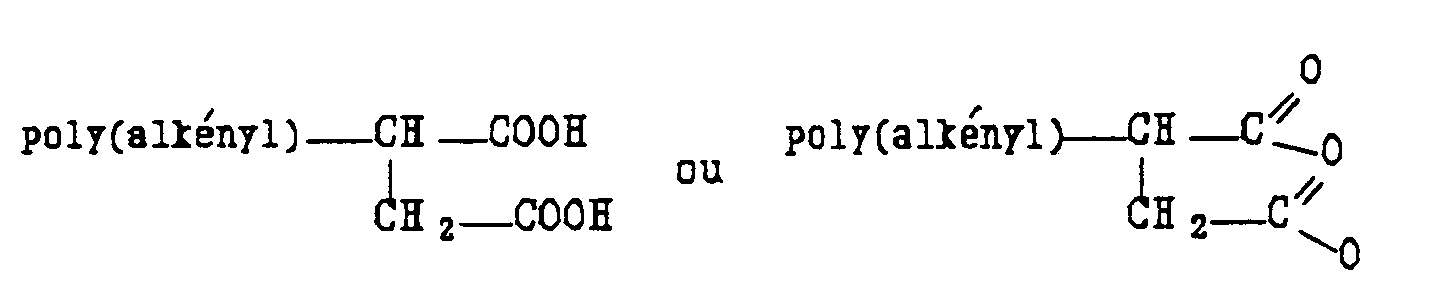
représentés respectivement par les formules suivantes:
de préférence avec l'acide polyisobutényl-succinique également connu sous l'appellation PIBSA ou son anhydride portant un groupe hydrocarboné ayant de 20 à 500 atomes de carbone.

- R1 représente un groupement alcoylène ayant de 2 à 4 atomes de carbone,
- R2, R3, R4 représentent chacun un groupe alcoyle ayant de 8 à 20 atomes de carbone ou un groupe alcoylaryle dont la partie alcoylée a de 8 à 12 atomes de carbone,
- n1, n2, n3 représentent un nombre de 0 à 15 et préférentiellement de 0 à 5.
- Humidité relative :
- 75%
- Température :
- 30°C.
- Humidité relative :
- 75%
- Température :
- 30°C.
| Nature des constituants | Compositions (pourcentage en poids des constituants) | |||
| A | B | C | D | |
| Stéarylamine | 10 | 10 | - | - |
| Oléylamine | - | - | 10 | 10 |
| Huile minérale de viscosité 20 mPa.s à 40°C | 40 | 40 | 40 | 40 |
| Cire de paraffine point de fusion 50-52°C | 50 | 47 | 50 | 47 |
| Sel d'amine d'un dérivé PIBSA | - | 3 | - | 3 |
| 100 | 100 | 100 | 100 |
| Composition | TEST DE MOTTAGE | Test cristallisoir % reprise d'eau | Test bécher % reprise d'eau | Observations | ||
| % mottage | Dureté (moyenne) en kg | IM | ||||
| Témoin non traité | 100 | >15 | >1500 | 50 | 10 | dégranulation importante |
| A | 20 | 5 | 100 | 19 | 4 | dégranulation moyenne |
| B | 20 | 5 | 100 | 15 | 3 | légère dégranulation |
| C | 50 | 7 | 350 | 16 | 3 | dégranulation moyenne |
| D | 30 | 7 | 12 | 12 | 2,5 | légère dégranulation |
| Nature des constituants | Compositions (pourcentage en poids des constituants) | |||
| E | F | G | H | |
| Ethylhexyl phosphate de stéarylamine (50% monoester et 50% diester) | 10 | 10 | - | - |
| Alkyl phosphate de stéarylamine mélange 50% monoester 50% diester alkyl = n.C16C18 | - | - | 10 | 10 |
| Huile minérale de viscosité 20 mPa.s à 40°C | 40 | 40 | 40 | 40 |
| Cire de paraffine point de fusion 50-52°C | 50 | 47 | 50 | 47 |
| Sel d'amine d'un dérivé PIBSA | - | 3 | - | 3 |
| 100 | 100 | 100 | 100 |
| Composition | TEST DE MOTTAGE | Test cristallisoir % reprise d'eau | ||
| % mottage | Dureté (moyenne) en kg | IM | ||
| Témoin non traité | 100 | >18 | >1500 | 52 |
| E | 90 | 3 | 270 | 12 |
| F | 90 | 3 | 270 | 8,1 |
| G | 60 | 3,5 | 210 | 15 |
| H | 60 | 3,8 | 228 | 9,8 |
| Nature des constituants | Compositions (pourcentage en poids des constituants) | |||
| I | J | K | L | |
| Alkyl phosphate de stéarylamine alkyl = n.C12C14 | - | - | 8 | 8 |
| Alkyl phosphate de stéarylamine mélange 50% monoester 50% diester alkyl = n.C16C18 | 8 | 8 | - | - |
| Isopropyl naphtalène sulfonate de stéarylamine | 2 | 2 | 2 | 2 |
| Huile minérale de viscosité 20 mPa.s à 40°C | 40 | 40 | 40 | 40 |
| Cire macrocristalline | 50 | 47 | 50 | 47 |
| Sel d'amine d'un dérivé PIBSA | - | 3 | - | 3 |
| 100 | 100 | 100 | 100 |
| Composition | TEST DE MOTTAGE | Test cristallisoir % reprise d'eau | Test bécher % reprise d'eau | Observations | ||
| % mottage | Dureté (moyenne) en kg | IM | ||||
| Témoin non traité | 100 | >15 | >100 | 55 | 10 | dégranulation importante |
| I | free flowing | - | - | 15 | 3 | légère dégranulation en surface |
| J | free flowing | - | - | 9,6 | 1,5 | surface non dégradée |
| K | free flowing | - | - | 14 | 3 | légère dégranulation en surface |
| L | free flowing | - | - | 8,5 | 1,5 | surface non dégradée |
| Nature des constituants | Composition (pourcentage en poids des constituants) | |
| M | N | |
| Alkyl phosphate de stéarylamine mélange 50% monoester 50% diester alkyl = n.C12C14 | 8 | 8 |
| Isopropyl naphtalène sulfonate de stéarylamine | 2 | 2 |
| Vaseline de point d'écoulement 40°C | 90 | 87 |
| Sel d'amine d'un dérivé PIBSA | - | 3 |
| Composition | Dosage kg/tonne | TEST DE MOTTAGE | Test cristallisoir % reprise d'eau | ||
| % mottage | Dureté (moyenne) en kg | IM | |||
| Témoin non traité | - | 100 | >15 | >1500 | 30 |
| M | 1,8 | 20 | 3 | 60 | 15 |
| N | 1,8 | 20 | 3 | 60 | 7 |
| M | 1,2 | 40 | 5 | 200 | 14 |
| N | 1,2 | 40 | 5 | 200 | 7,5 |
| Composition | Dosage kg/tonne | TEST DE MOTTAGE | Test cristallisoir % reprise d'eau | ||
| % mottage | Dureté (moyenne) en kg | IM | |||
| K | 1 | 23 | 2,5 | 57,5 | 14 |
| K | 0,8 | 25 | 2,5 | 62,5 | 12 |
| K | 0,6 | 30 | 3 | 90 | 14 |
| K | 0,4 | 75 | 6 | 450 | 18 |
| L | 1 | 25 | 2,6 | 65 | 8 |
| L | 0,8 | 23 | 2,5 | 57,5 | 6 |
| L | 0,6 | 30 | 3 | 93 | 8 |
| L | 0,4 | 80 | 6 | 480 | 13 |
| Témoin non traité | - | 100 | >15 | >1500 | 50 |
Claims (10)
- Composition simultanément antimottante et hydrophobante pour sels, engrais simples et complexes, caractérisée par le fait qu'elle comporte:d'une part, un produit antimottant choisi parmi les amines grasses, les sels d'amines d'esters phosphoriques, les sels d'amines d'acides alkylarylsulfoniques et leurs mélanges etd'autre part, une substance antimottante capable de conférer aux sels, engrais simples et complexes traités une résistance suffisante à la reprise d'humidité, cette substance étant constituée par le produit de la réaction d'un alcool, d'une amine ou d'une alcanolamine, avec un acide polyalkényl-succinique ou son anhydride portant un groupe hydrocarboné ayant de 20 à 500 atomes de carbone, représentés respectivement par les formules suivantes:de préférence avec l'acide polyisobutényl-succinique également connu sous l'appellation PIBSA ou son anhydride portant un groupe hydrocarboné ayant de 20 à 500 atomes de carbone.

- Composition selon la revendication 1, caractérisée par le fait que l'amine grasse est choisie dans le groupe de celles représentées par la formule RNH2 dans laquelle R est un groupe alkyle ou alkylène, linéaire ou ramifié, ayant de 10 à 24 atomes de carbone et, de préférence, dans le groupe constitué par les amines grasses hydrogénées ayant des chaínes alkyle en C16 à C22.
- Composition selon la revendication 1, caractérisée par le fait que l'acide ester phosphorique est un composé pouvant être préparé par réaction directe d'un composé à groupement hydroxyle tel qu'un alcool, un alcoylphénol ou un alcoylnaphtol avec par exemple l'anhydride phosphorique, ledit composé étant représenté par les formules générales:dans lesquelles
 R1 représente un groupement alcoylène ayant de 2 à 4 atomes de carbone,R2, R3, R4 représentent chacun un groupe alcoyle ayant de 8 à 20 atomes de carbone ou un groupe alcoylaryle dont la partie alcoylée a de 8 à 12 atomes de carbone,n1, n2, n3 représentent un nombre de 0 à 15 et préférentiellement de 0 à 5.
 - Composition selon la revendication 1, caractérisée par le fait que l'acide alkylarylsulfonique est choisi dans le groupe comprenant les acides mono-, di- ou trisulfoniques dont la partie aromatique, de préférence benzoïque ou naphtalénique, plus particulièrement naphtalénique, est mono- ou polyalcoyle substitué, le degré de substitution étant un degré moyen correspondant aux rapports molaires alcoyle/aryle utilisés pour la synthèse, étant entendu que, pour chacun des degrés de substitution envisagés, à savoir généralement de 1 à 4, il est possible de se trouver en présence de mélanges complexes d'isomères d'acides sulfoniques, le nombre total d'atomes de carbone de la partie alcoyle ne dépassant de préférence pas 16 dans les mélanges en question.
- Composition selon la revendication 1, caractérisée par le fait qu'elle comprend une combinaison d'un ou plusieurs sels d'amines d'acides alcoyl-aryl-sulfoniques et d'un ou plusieurs sels d'amines d'esters de phosphates acides, en présence éventuellement d'un excès d'amine.
- Composition selon l'une des revendications 1 à 5, caractérisée par le fait qu'elle comprend de 5 à 35%, de préférence de 5 à 20% et, plus préférentiellement encore, de 5 à 15% en poids de la substance antimottante choisie parmi les amines grasses, les sels d'amines d'esters phosphoriques, les sels d'amines d'acides alkylarylsulfoniques et leurs mélanges, et de 0,1 à 10%, de préférence de 1 à 5% en poids de la substance antimottante constituée par le produit de la réaction d'un alcool ou d'une amine avec un acide ou anhydride carboxylique portant un groupe hydrocarboné ayant de 20 à 500 atomes de carbone.
- Composition selon l'une des revendications 1 à 6, caractérisée par le fait qu'elle comporte de 55 à 95%, de préférence de 75 à 95%, ou encore plus préférentiellement de 80 à 92% en poids d'agents de formulation constitué par les huiles et/ou cires.
- Procédé propre à conférer à des sels, engrais simples et complexes, des propriétés antimottantes et une résistance suffisante à la reprise d'humidité, caractérisé par le fait que l'on applique par pulvérisation sur lesdits sels, engrais simples et complexes, une quantité efficace de la composition selon l'une des revendications 1 à 7.
- Procédé selon la revendication 8, caractérisé par le fait que l'on applique la composition selon l'une des revendications 1 à 7 à une température à laquelle elle est liquide en une quantité de 200 à 4000 g par tonne de sel, engrais simple ou complexe, de préférence en une quantité de 300 à 2000 g par tonne de sel, engrais simple ou complexe et, plus préférentiellement encore, en une quantité de 300 à 1500 g par tonne de sel, engrais simple ou complexe.
- Sels, engrais simples et complexes caractérisés par le fait que leurs particules constitutives comportent un revêtement qui est à base de la composition selon l'une des revendications 1 à 7.
Applications Claiming Priority (2)
| Application Number | Priority Date | Filing Date | Title |
|---|---|---|---|
| FR9411459 | 1994-09-26 | ||
| FR9411459A FR2724851B1 (fr) | 1994-09-26 | 1994-09-26 | Composition simultanement antimottante et hydrophobante pour sels, engrais simples et complexes et procede de mise en oeuvre |
Publications (2)
| Publication Number | Publication Date |
|---|---|
| EP0702999A1 EP0702999A1 (fr) | 1996-03-27 |
| EP0702999B1 true EP0702999B1 (fr) | 1998-04-29 |
Family
ID=9467270
Family Applications (1)
| Application Number | Title | Priority Date | Filing Date |
|---|---|---|---|
| EP95402137A Revoked EP0702999B1 (fr) | 1994-09-26 | 1995-09-22 | Composition simultanément antimottante et hydrophobante pour sels, engrais simples et complexes et procédé de mise en oeuvre |
Country Status (8)
| Country | Link |
|---|---|
| US (1) | US5698005A (fr) |
| EP (1) | EP0702999B1 (fr) |
| AT (1) | ATE165530T1 (fr) |
| CA (1) | CA2159065A1 (fr) |
| DE (1) | DE69502251T2 (fr) |
| ES (1) | ES2115330T3 (fr) |
| FR (1) | FR2724851B1 (fr) |
| NO (1) | NO314837B1 (fr) |
Families Citing this family (10)
| Publication number | Priority date | Publication date | Assignee | Title |
|---|---|---|---|---|
| AUPO068896A0 (en) * | 1996-06-27 | 1996-07-18 | Hydrocorp Pty Ltd | Plant nutrient formulations |
| US5968222A (en) * | 1997-02-07 | 1999-10-19 | Cargill, Incorporated | Dust reduction agents for granular inorganic substances |
| DE19943510C1 (de) * | 1999-09-10 | 2001-01-25 | Chemetall Ges Mbh Wien | Oberflächenmodifiziertes Mangansulfid, Verfahren zu dessen Herstellung sowie dessen Verwendung |
| US6475259B1 (en) * | 1999-10-29 | 2002-11-05 | Mississippi Chemical Corporation | Coating agent and coated particulate fertilizers |
| ES2179781B1 (es) | 2001-06-12 | 2003-11-16 | Kao Corp Sa | Aditivos que previenen el apelmazamiento y la humectacion de los fertilizantes nitrogenados. |
| ES2319367B1 (es) * | 2007-07-03 | 2010-01-12 | Kao Corporation, S.A. | Composiciones antiapelmazantes para fertilizantes. |
| US10081578B2 (en) * | 2015-05-22 | 2018-09-25 | Honeywell International Inc. | Wax-based fertilizer coatings with polyethylene- or polypropylene-based polymers |
| EP3440169B1 (fr) * | 2016-04-04 | 2021-05-26 | ChampionX USA Inc. | Élimination de dépôts organiques |
| CN111574292A (zh) * | 2020-04-16 | 2020-08-25 | 中国-阿拉伯化肥有限公司 | 一种油性尿基复合肥防结块剂及制备方法 |
| EP4267537A4 (fr) * | 2020-12-24 | 2024-11-20 | Incitec Fertilisers Operations Pty Ltd | Engrais davantage amélioré |
Citations (2)
| Publication number | Priority date | Publication date | Assignee | Title |
|---|---|---|---|---|
| EP0202753A2 (fr) * | 1985-04-24 | 1986-11-26 | Aeci Limited | Méthode pour combattre le mottage de matières particulaires |
| EP0692468A1 (fr) * | 1994-07-13 | 1996-01-17 | C F P I | Procédé de traitement d'engrais pour lutter contre la reprise d'humidité |
Family Cites Families (13)
| Publication number | Priority date | Publication date | Assignee | Title |
|---|---|---|---|---|
| NL293081A (fr) * | 1962-05-22 | |||
| JPS4917104B1 (fr) * | 1970-01-20 | 1974-04-26 | ||
| FR2214513A1 (en) * | 1973-01-22 | 1974-08-19 | Produits Ind Cie Fse | Anti-clumping compsns for fertilizers - comprising mixts of alkylarylsulphonates and sodium salts of condensates of naphthalenesulphonic acids with formaldehyde |
| FR2214515A1 (en) * | 1973-01-22 | 1974-08-19 | Produits Ind Cie Fse | Anti-clumping compsns for salts - comprising mixts. of alkylarylsulphonates and sodium salts of condensates of naphthalene sulphonic acids with formaldehyde |
| FR2221175A1 (en) * | 1973-03-12 | 1974-10-11 | Produits Ind Cie Fse | Amine and amide anti-agglomerating agents - for treatment of fertilisers and dried milk powder |
| FR2460706A1 (fr) * | 1979-07-13 | 1981-01-30 | Produits Ind Cie Fse | Produits et traitements antimottants a base de sels d'amine |
| DE3045131A1 (de) * | 1980-11-29 | 1982-09-09 | Henkel KGaA, 4000 Düsseldorf | Verwendung von alkylenoxidadditionsprodukten als anitbackmittel fuer duenger |
| FR2536300A1 (fr) * | 1982-11-23 | 1984-05-25 | Ceca Sa | Procede pour eviter la prise en masse de substances granuleuses ou pulverulentes |
| JPS6117486A (ja) * | 1984-07-04 | 1986-01-25 | 花王株式会社 | 肥料用固結防止剤 |
| FR2629815B1 (fr) | 1988-04-07 | 1991-10-18 | Produits Ind Cie Fse | Produits, compositions et traitements antimottants pour sels, engrais simples et complexes |
| FR2644780B1 (fr) * | 1989-03-22 | 1991-08-30 | Ceca Sa | Compositions perfectionnees pour eviter la prise en masse des engrais |
| FR2687933B1 (fr) * | 1992-02-28 | 1994-05-20 | Cfpi | Produits antimottants, compositions contenant ces produits et traitements mettant ces produits en óoeuvre. |
| FR2692166B1 (fr) * | 1992-06-11 | 1994-07-22 | Ceca Sa | Procede de traitement d'engrais par compositions hydrophobantes en vue de leur stockage en vrac. |
-
1994
- 1994-09-26 FR FR9411459A patent/FR2724851B1/fr not_active Expired - Fee Related
-
1995
- 1995-09-22 ES ES95402137T patent/ES2115330T3/es not_active Expired - Lifetime
- 1995-09-22 EP EP95402137A patent/EP0702999B1/fr not_active Revoked
- 1995-09-22 AT AT95402137T patent/ATE165530T1/de not_active IP Right Cessation
- 1995-09-22 DE DE69502251T patent/DE69502251T2/de not_active Revoked
- 1995-09-25 NO NO19953784A patent/NO314837B1/no not_active IP Right Cessation
- 1995-09-25 US US08/533,146 patent/US5698005A/en not_active Expired - Lifetime
- 1995-09-25 CA CA002159065A patent/CA2159065A1/fr not_active Abandoned
Patent Citations (2)
| Publication number | Priority date | Publication date | Assignee | Title |
|---|---|---|---|---|
| EP0202753A2 (fr) * | 1985-04-24 | 1986-11-26 | Aeci Limited | Méthode pour combattre le mottage de matières particulaires |
| EP0692468A1 (fr) * | 1994-07-13 | 1996-01-17 | C F P I | Procédé de traitement d'engrais pour lutter contre la reprise d'humidité |
Also Published As
| Publication number | Publication date |
|---|---|
| CA2159065A1 (fr) | 1996-03-27 |
| ES2115330T3 (es) | 1998-06-16 |
| FR2724851A1 (fr) | 1996-03-29 |
| DE69502251D1 (de) | 1998-06-04 |
| NO314837B1 (no) | 2003-06-02 |
| ATE165530T1 (de) | 1998-05-15 |
| FR2724851B1 (fr) | 1997-01-17 |
| NO953784D0 (no) | 1995-09-25 |
| DE69502251T2 (de) | 1998-12-17 |
| EP0702999A1 (fr) | 1996-03-27 |
| US5698005A (en) | 1997-12-16 |
| NO953784L (no) | 1996-03-27 |
Similar Documents
| Publication | Publication Date | Title |
|---|---|---|
| US10806706B2 (en) | Storage-stable formulations | |
| EP2225190B1 (fr) | Composition inhibitrice d'urease et de nitrification | |
| EP3541200B1 (fr) | Formulations pulvérulentes | |
| EP0071513A2 (fr) | Additifs azotes utilisables comme agents d'abaissement du point de trouble des distillats moyens d'hydrocarbures et compositions de distillats moyens d'hydrocarbures renfermant lesdits additifs | |
| EP0702999A1 (fr) | Composition simultanément antimottante et hydrophobante pour sels, engrais simples et complexes et procédé de mise en oeuvre | |
| EP0692468B1 (fr) | Procédé de traitement d'engrais pour lutter contre la reprise d'humidité | |
| US6475259B1 (en) | Coating agent and coated particulate fertilizers | |
| EP0341102B1 (fr) | Produits, compositions et traitements antimottants pour sels, engrais simples et complexes | |
| EP0586650B1 (fr) | Compositions antimottantes et traitments mettant ces compositions en oeuvre | |
| FR2460706A1 (fr) | Produits et traitements antimottants a base de sels d'amine | |
| FR2701942A1 (fr) | Additif interne et procédé pour la préparation de certaines formes cristallisées du nitrate d'ammonium et applications industrielles de celles-ci. | |
| EP0574306B1 (fr) | Utilisation de compositions hydrophobantes pour le traitement d'engrais stockés en vrac | |
| EP0188969B1 (fr) | Procédé et composition pour l'antimottage des sels ou des engrais non pulvérulents | |
| EP1399398B1 (fr) | Adjuvants de prevention du mottage et de l'humectation des engrais azotes | |
| EP0813902B1 (fr) | Procédé de traitement d'engrais par compositions hydrophobantes/antimottantes en vue de leur stockage en vrac | |
| CA1205624A (fr) | Produits et traitements antimottants a base de sels d'amines | |
| US5100583A (en) | Aqueous boron-containing compositions | |
| CA3052229C (fr) | Formulations stables au stockage | |
| EP3908399A1 (fr) | Composition d'huile végétale pour l'enrobage de particules | |
| FR2699551A1 (fr) | Formulations contenant un phosphate d'amine et un additif de germination des paraffines. | |
| BE732993A (fr) | ||
| JPS5929554B2 (ja) | 樹木用固型肥料 |
Legal Events
| Date | Code | Title | Description |
|---|---|---|---|
| PUAI | Public reference made under article 153(3) epc to a published international application that has entered the european phase |
Free format text: ORIGINAL CODE: 0009012 |
|
| AK | Designated contracting states |
Kind code of ref document: A1 Designated state(s): AT BE CH DE DK ES GB GR IE IT LI LU NL PT SE |
|
| 17P | Request for examination filed |
Effective date: 19960326 |
|
| RAP1 | Party data changed (applicant data changed or rights of an application transferred) |
Owner name: CFPI INDUSTRIES |
|
| 17Q | First examination report despatched |
Effective date: 19961230 |
|
| GRAG | Despatch of communication of intention to grant |
Free format text: ORIGINAL CODE: EPIDOS AGRA |
|
| GRAG | Despatch of communication of intention to grant |
Free format text: ORIGINAL CODE: EPIDOS AGRA |
|
| GRAG | Despatch of communication of intention to grant |
Free format text: ORIGINAL CODE: EPIDOS AGRA |
|
| GRAH | Despatch of communication of intention to grant a patent |
Free format text: ORIGINAL CODE: EPIDOS IGRA |
|
| GRAH | Despatch of communication of intention to grant a patent |
Free format text: ORIGINAL CODE: EPIDOS IGRA |
|
| GRAA | (expected) grant |
Free format text: ORIGINAL CODE: 0009210 |
|
| AK | Designated contracting states |
Kind code of ref document: B1 Designated state(s): AT BE CH DE DK ES GB GR IE IT LI LU NL PT SE |
|
| PG25 | Lapsed in a contracting state [announced via postgrant information from national office to epo] |
Ref country code: IT Free format text: LAPSE BECAUSE OF FAILURE TO SUBMIT A TRANSLATION OF THE DESCRIPTION OR TO PAY THE FEE WITHIN THE PRESCRIBED TIME-LIMIT;WARNING: LAPSES OF ITALIAN PATENTS WITH EFFECTIVE DATE BEFORE 2007 MAY HAVE OCCURRED AT ANY TIME BEFORE 2007. THE CORRECT EFFECTIVE DATE MAY BE DIFFERENT FROM THE ONE RECORDED. Effective date: 19980429 Ref country code: IE Free format text: LAPSE BECAUSE OF NON-PAYMENT OF DUE FEES Effective date: 19980429 Ref country code: GR Free format text: LAPSE BECAUSE OF FAILURE TO SUBMIT A TRANSLATION OF THE DESCRIPTION OR TO PAY THE FEE WITHIN THE PRESCRIBED TIME-LIMIT Effective date: 19980429 Ref country code: AT Free format text: LAPSE BECAUSE OF FAILURE TO SUBMIT A TRANSLATION OF THE DESCRIPTION OR TO PAY THE FEE WITHIN THE PRESCRIBED TIME-LIMIT Effective date: 19980429 |
|
| REF | Corresponds to: |
Ref document number: 165530 Country of ref document: AT Date of ref document: 19980515 Kind code of ref document: T |
|
| REG | Reference to a national code |
Ref country code: CH Ref legal event code: EP |
|
| GBT | Gb: translation of ep patent filed (gb section 77(6)(a)/1977) |
Effective date: 19980507 |
|
| REF | Corresponds to: |
Ref document number: 69502251 Country of ref document: DE Date of ref document: 19980604 |
|
| REG | Reference to a national code |
Ref country code: ES Ref legal event code: FG2A Ref document number: 2115330 Country of ref document: ES Kind code of ref document: T3 |
|
| PG25 | Lapsed in a contracting state [announced via postgrant information from national office to epo] |
Ref country code: SE Free format text: LAPSE BECAUSE OF FAILURE TO SUBMIT A TRANSLATION OF THE DESCRIPTION OR TO PAY THE FEE WITHIN THE PRESCRIBED TIME-LIMIT Effective date: 19980729 Ref country code: DK Free format text: LAPSE BECAUSE OF FAILURE TO SUBMIT A TRANSLATION OF THE DESCRIPTION OR TO PAY THE FEE WITHIN THE PRESCRIBED TIME-LIMIT Effective date: 19980729 |
|
| REG | Reference to a national code |
Ref country code: IE Ref legal event code: FG4D Free format text: 80109 |
|
| PG25 | Lapsed in a contracting state [announced via postgrant information from national office to epo] |
Ref country code: LU Free format text: LAPSE BECAUSE OF NON-PAYMENT OF DUE FEES Effective date: 19980930 |
|
| REG | Reference to a national code |
Ref country code: PT Ref legal event code: SC4A Free format text: AVAILABILITY OF NATIONAL TRANSLATION Effective date: 19980630 |
|
| PLBQ | Unpublished change to opponent data |
Free format text: ORIGINAL CODE: EPIDOS OPPO |
|
| PLBI | Opposition filed |
Free format text: ORIGINAL CODE: 0009260 |
|
| PLBF | Reply of patent proprietor to notice(s) of opposition |
Free format text: ORIGINAL CODE: EPIDOS OBSO |
|
| 26 | Opposition filed |
Opponent name: HOLLAND NOVOCHEM B.V. Effective date: 19990127 |
|
| NLR1 | Nl: opposition has been filed with the epo |
Opponent name: HOLLAND NOVOCHEM B.V. |
|
| PLBF | Reply of patent proprietor to notice(s) of opposition |
Free format text: ORIGINAL CODE: EPIDOS OBSO |
|
| PLBF | Reply of patent proprietor to notice(s) of opposition |
Free format text: ORIGINAL CODE: EPIDOS OBSO |
|
| PG25 | Lapsed in a contracting state [announced via postgrant information from national office to epo] |
Ref country code: LI Free format text: LAPSE BECAUSE OF NON-PAYMENT OF DUE FEES Effective date: 19990930 Ref country code: CH Free format text: LAPSE BECAUSE OF NON-PAYMENT OF DUE FEES Effective date: 19990930 |
|
| PLBF | Reply of patent proprietor to notice(s) of opposition |
Free format text: ORIGINAL CODE: EPIDOS OBSO |
|
| REG | Reference to a national code |
Ref country code: CH Ref legal event code: PL |
|
| REG | Reference to a national code |
Ref country code: GB Ref legal event code: 732E |
|
| PLBO | Opposition rejected |
Free format text: ORIGINAL CODE: EPIDOS REJO |
|
| APAC | Appeal dossier modified |
Free format text: ORIGINAL CODE: EPIDOS NOAPO |
|
| APAE | Appeal reference modified |
Free format text: ORIGINAL CODE: EPIDOS REFNO |
|
| APAC | Appeal dossier modified |
Free format text: ORIGINAL CODE: EPIDOS NOAPO |
|
| REG | Reference to a national code |
Ref country code: GB Ref legal event code: IF02 |
|
| NLS | Nl: assignments of ep-patents |
Owner name: CFPI |
|
| NLT1 | Nl: modifications of names registered in virtue of documents presented to the patent office pursuant to art. 16 a, paragraph 1 |
Owner name: CFPI NUFARM |
|
| REG | Reference to a national code |
Ref country code: PT Ref legal event code: PD4A Free format text: CFPI NUFARM FR Effective date: 20020910 Ref country code: PT Ref legal event code: PC4A Free format text: CFPI FR Effective date: 20020910 |
|
| BECN | Be: change of holder's name |
Effective date: 20020411 |
|
| PGFP | Annual fee paid to national office [announced via postgrant information from national office to epo] |
Ref country code: GB Payment date: 20030909 Year of fee payment: 9 |
|
| PGFP | Annual fee paid to national office [announced via postgrant information from national office to epo] |
Ref country code: PT Payment date: 20030915 Year of fee payment: 9 |
|
| PGFP | Annual fee paid to national office [announced via postgrant information from national office to epo] |
Ref country code: BE Payment date: 20030916 Year of fee payment: 9 |
|
| PGFP | Annual fee paid to national office [announced via postgrant information from national office to epo] |
Ref country code: ES Payment date: 20030922 Year of fee payment: 9 |
|
| PGFP | Annual fee paid to national office [announced via postgrant information from national office to epo] |
Ref country code: NL Payment date: 20030930 Year of fee payment: 9 |
|
| APBY | Invitation to file observations in appeal sent |
Free format text: ORIGINAL CODE: EPIDOSNOBA2O |
|
| PGFP | Annual fee paid to national office [announced via postgrant information from national office to epo] |
Ref country code: DE Payment date: 20031125 Year of fee payment: 9 |
|
| APCA | Receipt of observations in appeal recorded |
Free format text: ORIGINAL CODE: EPIDOSNOBA4O |
|
| APBU | Appeal procedure closed |
Free format text: ORIGINAL CODE: EPIDOSNNOA9O |
|
| RDAF | Communication despatched that patent is revoked |
Free format text: ORIGINAL CODE: EPIDOSNREV1 |
|
| RDAG | Patent revoked |
Free format text: ORIGINAL CODE: 0009271 |
|
| STAA | Information on the status of an ep patent application or granted ep patent |
Free format text: STATUS: PATENT REVOKED |
|
| 27W | Patent revoked |
Effective date: 20040331 |
|
| GBPR | Gb: patent revoked under art. 102 of the ep convention designating the uk as contracting state |
Free format text: 20040331 |
|
| NLR2 | Nl: decision of opposition |
Effective date: 20040331 |
|
| REG | Reference to a national code |
Ref country code: PT Ref legal event code: MF4A Effective date: 20040621 |
|
| APAH | Appeal reference modified |
Free format text: ORIGINAL CODE: EPIDOSCREFNO |
|
| PLAB | Opposition data, opponent's data or that of the opponent's representative modified |
Free format text: ORIGINAL CODE: 0009299OPPO |