EP0703079A2 - Verminderung der Leistungsschwankungen in thermischen Tintenstrahldruckköpfen - Google Patents
Verminderung der Leistungsschwankungen in thermischen Tintenstrahldruckköpfen Download PDFInfo
- Publication number
- EP0703079A2 EP0703079A2 EP95305701A EP95305701A EP0703079A2 EP 0703079 A2 EP0703079 A2 EP 0703079A2 EP 95305701 A EP95305701 A EP 95305701A EP 95305701 A EP95305701 A EP 95305701A EP 0703079 A2 EP0703079 A2 EP 0703079A2
- Authority
- EP
- European Patent Office
- Prior art keywords
- resistors
- printhead
- output
- pulse
- energy
- Prior art date
- Legal status (The legal status is an assumption and is not a legal conclusion. Google has not performed a legal analysis and makes no representation as to the accuracy of the status listed.)
- Granted
Links
Images

Classifications
-
- B—PERFORMING OPERATIONS; TRANSPORTING
- B41—PRINTING; LINING MACHINES; TYPEWRITERS; STAMPS
- B41J—TYPEWRITERS; SELECTIVE PRINTING MECHANISMS, i.e. MECHANISMS PRINTING OTHERWISE THAN FROM A FORME; CORRECTION OF TYPOGRAPHICAL ERRORS
- B41J2/00—Typewriters or selective printing mechanisms characterised by the printing or marking process for which they are designed
- B41J2/005—Typewriters or selective printing mechanisms characterised by the printing or marking process for which they are designed characterised by bringing liquid or particles selectively into contact with a printing material
- B41J2/01—Ink jet
- B41J2/015—Ink jet characterised by the jet generation process
- B41J2/04—Ink jet characterised by the jet generation process generating single droplets or particles on demand
- B41J2/045—Ink jet characterised by the jet generation process generating single droplets or particles on demand by pressure, e.g. electromechanical transducers
- B41J2/04501—Control methods or devices therefor, e.g. driver circuits, control circuits
- B41J2/04541—Specific driving circuit
-
- B—PERFORMING OPERATIONS; TRANSPORTING
- B41—PRINTING; LINING MACHINES; TYPEWRITERS; STAMPS
- B41J—TYPEWRITERS; SELECTIVE PRINTING MECHANISMS, i.e. MECHANISMS PRINTING OTHERWISE THAN FROM A FORME; CORRECTION OF TYPOGRAPHICAL ERRORS
- B41J2/00—Typewriters or selective printing mechanisms characterised by the printing or marking process for which they are designed
- B41J2/005—Typewriters or selective printing mechanisms characterised by the printing or marking process for which they are designed characterised by bringing liquid or particles selectively into contact with a printing material
- B41J2/01—Ink jet
- B41J2/015—Ink jet characterised by the jet generation process
- B41J2/04—Ink jet characterised by the jet generation process generating single droplets or particles on demand
- B41J2/045—Ink jet characterised by the jet generation process generating single droplets or particles on demand by pressure, e.g. electromechanical transducers
- B41J2/04501—Control methods or devices therefor, e.g. driver circuits, control circuits
- B41J2/04543—Block driving
-
- B—PERFORMING OPERATIONS; TRANSPORTING
- B41—PRINTING; LINING MACHINES; TYPEWRITERS; STAMPS
- B41J—TYPEWRITERS; SELECTIVE PRINTING MECHANISMS, i.e. MECHANISMS PRINTING OTHERWISE THAN FROM A FORME; CORRECTION OF TYPOGRAPHICAL ERRORS
- B41J2/00—Typewriters or selective printing mechanisms characterised by the printing or marking process for which they are designed
- B41J2/005—Typewriters or selective printing mechanisms characterised by the printing or marking process for which they are designed characterised by bringing liquid or particles selectively into contact with a printing material
- B41J2/01—Ink jet
- B41J2/015—Ink jet characterised by the jet generation process
- B41J2/04—Ink jet characterised by the jet generation process generating single droplets or particles on demand
- B41J2/045—Ink jet characterised by the jet generation process generating single droplets or particles on demand by pressure, e.g. electromechanical transducers
- B41J2/04501—Control methods or devices therefor, e.g. driver circuits, control circuits
- B41J2/04568—Control according to number of actuators used simultaneously
-
- B—PERFORMING OPERATIONS; TRANSPORTING
- B41—PRINTING; LINING MACHINES; TYPEWRITERS; STAMPS
- B41J—TYPEWRITERS; SELECTIVE PRINTING MECHANISMS, i.e. MECHANISMS PRINTING OTHERWISE THAN FROM A FORME; CORRECTION OF TYPOGRAPHICAL ERRORS
- B41J2/00—Typewriters or selective printing mechanisms characterised by the printing or marking process for which they are designed
- B41J2/005—Typewriters or selective printing mechanisms characterised by the printing or marking process for which they are designed characterised by bringing liquid or particles selectively into contact with a printing material
- B41J2/01—Ink jet
- B41J2/015—Ink jet characterised by the jet generation process
- B41J2/04—Ink jet characterised by the jet generation process generating single droplets or particles on demand
- B41J2/045—Ink jet characterised by the jet generation process generating single droplets or particles on demand by pressure, e.g. electromechanical transducers
- B41J2/04501—Control methods or devices therefor, e.g. driver circuits, control circuits
- B41J2/0458—Control methods or devices therefor, e.g. driver circuits, control circuits controlling heads based on heating elements forming bubbles
-
- B—PERFORMING OPERATIONS; TRANSPORTING
- B41—PRINTING; LINING MACHINES; TYPEWRITERS; STAMPS
- B41J—TYPEWRITERS; SELECTIVE PRINTING MECHANISMS, i.e. MECHANISMS PRINTING OTHERWISE THAN FROM A FORME; CORRECTION OF TYPOGRAPHICAL ERRORS
- B41J2/00—Typewriters or selective printing mechanisms characterised by the printing or marking process for which they are designed
- B41J2/005—Typewriters or selective printing mechanisms characterised by the printing or marking process for which they are designed characterised by bringing liquid or particles selectively into contact with a printing material
- B41J2/01—Ink jet
- B41J2/015—Ink jet characterised by the jet generation process
- B41J2/04—Ink jet characterised by the jet generation process generating single droplets or particles on demand
- B41J2/045—Ink jet characterised by the jet generation process generating single droplets or particles on demand by pressure, e.g. electromechanical transducers
- B41J2/04501—Control methods or devices therefor, e.g. driver circuits, control circuits
- B41J2/04591—Width of the driving signal being adjusted
Definitions
- This invention relates to thermal inkjet printing, and, in particular, to minimizing variations of the energy delivered to printhead resistive heaters.
- Thermal inkjet (TIJ) printing involves propelling minute, closely spaced jets of ink onto a printing surface, which is usually paper.
- a TIJ printhead contains a reservoir of ink connected with a series of nozzles which are used to form the jets. By controlling both the movement of the printhead across the paper and also which jets are activated at any given time, a printer can form alphabetic characters and graphic images.
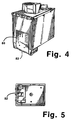
- a typical TIJ printhead is shown in Fig. 4. This is a disposable unit with its ink supply contained within its plastic housing. To form each jet, a tubular nozzle is mounted with its internal end communicating with the ink reservoir and its external end close to the paper. These nozzles are organized into banks or rows 82, two of which may be seen in the end view of the printhead in Fig. 5.
- a small resistor of a size comparable to the diameter of the nozzle, is mounted in the ink reservoir close to the internal end of each nozzle. When a pulse of electrical energy is sent to the resistor, its rapid heating boils the adjacent ink, forming a minute bubble. The growth of this bubble forces a small quantity of ink through the nozzle and onto the paper. Electrical pulses are supplied to the printhead via a collection of small conductive areas 80 which mate with corresponding contacts in the printer. The resistors in the printhead may thus be activated in any desired combination.
- a factor affecting the operation of a TIJ printhead is that not all available resistors in a resistor bank in the printhead are simultaneously energized. Only a subset - its composition dependent on the printable data - from the total set of resistors in the bank is "fired" during a particular pulse.
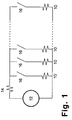
- the energy source supplying the printhead is modeled as a voltage source Vs (12) with a series impedance Zs (14), then the amount of energy supplied to any given resistor 10 will vary with the number of its neighbors which are also energized during that pulse.
- a typical bank might contain 20 resistors. Thus, from 1 to 20 of these may be pulsed by closing the respective switch(es) 16. This load variation puts stringent demands on the regulation of the energy source.
- an output capacitor provides low impedance at high frequencies. But the series resistance of this capacitor is not negligible; neither is that of the connecting cabling linking the printhead with its driver. These resistances, together with other parasitic resistances, limit the achievable reduction in output impedance.
- One embodiment of the present invention addresses the problem of delivering, from a common power supply, pulses of constant energy to a set of resistors which can be individually switched across the supply, as shown in Fig. 1. If subsets of resistors are switched on in a sequence according to some known schedule, such as occurs in TIJ printing, it is not necessary to use a feedback loop, with its attendant speed limitations, to compensate for load variations. The effect of load variations can be compensated instantaneously.
- the invention uses a practical and inexpensive method for doing this: adjusting the pulse width.
- all the resistors are nominally equal in value.
- the total conductance of the switched-on subset is determined by multiplying the number of resistors in the subset by the conductance of an individual resistor. The total conductance determines the pulse width through use of a compensation relation formula or lookup table.
- Different compensation relations may be used to determine the pulse width variation.
- the simplest is to vary the pulse width linearly with the load conductance.
- the energy absorbed by a pulsed resistor varies (a) as the square of the voltage across it, and (b) linearly with the pulse width.
- the load voltage varies approximately inversely with the load conductance.
- precise compensation can be obtained by determining exactly how the load voltage varies with load conductance and varying the pulse width inversely with the square of the load voltage.
- the set of resistors contains resistors of different values.
- the conductances of all the resistors in the set are stored in a lookup table. When a particular subset is chosen to be the load, the conductance values of all the subset members are retrieved from the table and added.
- the pulse width is then determined from the sum value by a compensation relation.
- Fig. 1 is a simplified TIJ printing arrangement, showing an energy source supplying individually switched printhead resistors.
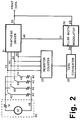
- Fig. 2 is a diagram of an apparatus according to a preferred embodiment of the invention.
- Fig. 3 is a diagram of an apparatus according to another embodiment of the invention having resistors of differing values.
- Fig. 4 is an isometric view of a replaceable TIJ printhead.
- Fig. 5 is an end view of the printhead of Fig. 4.
- An energy source 20 is modelled as a voltage source Vs (12) with a known series impedance Zs (14).
- the source is a regulated DC power supply of about 12 volts output, whose output impedance (at high frequencies; see previous discussion) is determined by the series resistance of a filter capacitor, about half an ohm. To this resistance is added that of a flexible cable used to connect to the moving printhead, plus other connectors.
- a set of nominally equal-valued printhead resistors 40 Connected to the source 20 is a set of nominally equal-valued printhead resistors 40, each having a switch 42 by which it can be connected across the source 20. These resistors share a common return path 48, so that those which are switched across the source are in parallel.
- the nominal value of the resistors is thirty ohms.
- the distribution of production values is Gaussian, but the distribution tails are truncated, as printheads with resistor values beyond about ⁇ 10% of the nominal are rejected.
- each resistor is submerged in an ink reservoir.
- a resistor When a resistor is energized by pulsing its switch, it boils the ink in contact with it, forming a minute bubble whose expansion forces liquid ink through an adjacent nozzle and onto a print medium such as paper.
- the resistors and nozzles are arranged in sets of columns called "primitives". Although 10 to 25 resistors would commonly comprise one primitive, only four resistors are shown in Fig. 2 for drawing simplicity. The principles of the invention remain the same for any number of resistors.
- Switches 42 are activated by control signals connected via lines 44.
- Control output lines 44 are energized by printhead driver circuit 21, whose input 22 is the data to be printed.
- Printhead driver circuit 21 determines, from the print data, just which subset of resistors is to be energized during a pulse. Depending on this print data, from 0 to 4 resistors may be chosen, in various combinations.
- Driver 21 also has an enable input 46 to govern when lines 44 may be activated.
- resistor counter 23 Also connected to control lines 40 is the resistor counter 23. Its circuitry determines the number of resistors being energized during a pulse. This number is supplied as an input to data converter 25, which uses a compensation relation formula to determine a corresponding pulse width. Data converter can compute the pulse width, or the proper pulse width for each possible number of energized resistors can be pre-computed, stored in a lookup table, and retrieved as needed. The latter method is often faster when the compensation relation is complex.
- Pulse width modulator (PWM) 26 generates a timing signal on its output 27. This timing signal is initiated by the print data on start input 28, and its width corresponds to the information supplied by data converter 25 to width control input 24. The timing signal is supplied as the enable signal to printhead driver circuit 21 to regulate the width that the selected switches are closed.
- a typical print cycle begins with the arrival of print data to input 22 of printhead driver 21 and to width control input 28 of PWM 26. This event initiates a timing signal on output 27 of PWM 26.
- printhead driver 21 chooses the proper subset of resistors, and the timing signal enables the corresponding control lines 44 to close their switches, thus supplying energy to the subset.
- Resistor counter 23 by monitoring the control lines 44, determines the number of activated resistors, and supplies this number to data converter 25.
- Data converter 25 according to its internal rule or algorithm (explained below) determines an appropriate timing signal duration and supplies this information to PWM 26 at its width control input 24.
- Data converter 25 can use table lookup means or computation to implement its internal algorithm.
- the function of data converter 25 is cooperating to counteract the variation in the pulsed energy supplied to a resistor, depending on whether it is selected alone, or has 1, 2, or 3 other resistors selected with it. As more resistors are switched on, the voltage across each one is reduced because of the increased voltage drop across Zs (14), which subtracts from the available voltage Vs (12). This reduces the power supplied to a resistor; the energy supplied is also reduced, since this is simply power times the pulse width.
- Data converter 25 operates to extend the pulse width as more resistors are selected. There are various choices of how to vary the pulse width as a function of the number of resistors selected. To make this choice, it is helpful to understand the energy variation in more detail.
- Equation (2) is exact.
- Equation (3) just as the exact Equation (2), describes the reduction of energy in a resistor as more resistors are added. However, it also suggests that there is a choice of algorithms that can be installed in data converter 25 for increasing pulse width T to compensate for this reduction.
- a linear compensation rule proves to be adequate for the desired print quality
- data converter 25 is a lookup table with pre-computed output values corresponding to all possible subset sizes.
- PWM 26 adjusts the pulse width in discrete steps.
- data converter 25 presets a counter. This counter, advanced by the system clock, terminates the pulse when it reaches its end count. The accuracy of this approach is quite adequate, with the clock allowing a time resolution of about 50 nanoseconds out of a pulse width of several microseconds.
- the load resistors have different values. Referring to Fig. 3, load resistors 50-53 are now presumed to differ in value. Although the problem is similiar to that already discussed for the case of nominally equal values of resistance, what is required here is more than knowing the number of resistors selected during a pulse cycle. Their individual values must also be known in order to compute the total load on the source, and, therefore, the voltage drop in Zs.
- a conductance table 30 stores the values of conductance for each resistor in the set.
- load driver 35 chooses a subset based on data at its input 22, control lines 70-73 inform table 30 which resistors comprise the subset.
- the conductance value of each member of the subset is looked up in table 30 and this data is passed to a data combiner (here called a conductance sum block 31), which adds the values to determine the total load (as a conductance) on the source.
- Values of conductance, rather than resistance, are stored because of the ease of calculating the total load by a simple summing operation. Alternatively, values of resistance can be stored, but calculating the total load resistance is more complicated.
- data combiner refers to the operation of summing conductances, or the invert-sum-invert operation needed if values of resistance are stored.
- the sum value is passed to data converter 36, which, in the same manner as in the previous embodiment, determines the increase in pulse width needed to maintain the pulsed energy constant, or nearly so.
- data converter 36 determines the increase in pulse width needed to maintain the pulsed energy constant, or nearly so.
- PWM 26 furnishes, via output 27, a variable-duration timing signal to enable input 37 of the load driver.
- PWM 26 receives start and pulse width information through its inputs 28 and 24, respectively.
Landscapes
- Particle Formation And Scattering Control In Inkjet Printers (AREA)
Applications Claiming Priority (2)
| Application Number | Priority Date | Filing Date | Title |
|---|---|---|---|
| US31137294A | 1994-09-23 | 1994-09-23 | |
| US311372 | 1994-09-23 |
Publications (3)
| Publication Number | Publication Date |
|---|---|
| EP0703079A2 true EP0703079A2 (de) | 1996-03-27 |
| EP0703079A3 EP0703079A3 (de) | 1996-05-29 |
| EP0703079B1 EP0703079B1 (de) | 1999-03-17 |
Family
ID=23206599
Family Applications (1)
| Application Number | Title | Priority Date | Filing Date |
|---|---|---|---|
| EP95305701A Expired - Lifetime EP0703079B1 (de) | 1994-09-23 | 1995-08-16 | Verminderung der Leistungsschwankungen in thermischen Tintenstrahldruckköpfen |
Country Status (4)
| Country | Link |
|---|---|
| US (1) | US5677577A (de) |
| EP (1) | EP0703079B1 (de) |
| JP (1) | JPH08197733A (de) |
| DE (1) | DE69508329T2 (de) |
Cited By (2)
| Publication number | Priority date | Publication date | Assignee | Title |
|---|---|---|---|---|
| EP1078750A3 (de) * | 1999-08-24 | 2001-09-05 | Canon Kabushiki Kaisha | Druckvorrichtung, Steuerverfahren für die Vorrichtung, und Computer lesbarer Aufzeichnungsträger |
| EP1193065A3 (de) * | 2000-09-29 | 2003-06-04 | Canon Kabushiki Kaisha | Tintenstrahldruckvorrichtung und Tintenstrahldruckverfahren |
Families Citing this family (17)
| Publication number | Priority date | Publication date | Assignee | Title |
|---|---|---|---|---|
| US6290333B1 (en) | 1997-10-28 | 2001-09-18 | Hewlett-Packard Company | Multiple power interconnect arrangement for inkjet printhead |
| US6334660B1 (en) * | 1998-10-31 | 2002-01-01 | Hewlett-Packard Company | Varying the operating energy applied to an inkjet print cartridge based upon the operating conditions |
| US6183056B1 (en) * | 1997-10-28 | 2001-02-06 | Hewlett-Packard Company | Thermal inkjet printhead and printer energy control apparatus and method |
| US6386674B1 (en) | 1997-10-28 | 2002-05-14 | Hewlett-Packard Company | Independent power supplies for color inkjet printers |
| US6461812B2 (en) | 1998-09-09 | 2002-10-08 | Agilent Technologies, Inc. | Method and multiple reservoir apparatus for fabrication of biomolecular arrays |
| US6729707B2 (en) * | 2002-04-30 | 2004-05-04 | Hewlett-Packard Development Company, L.P. | Self-calibration of power delivery control to firing resistors |
| US6203151B1 (en) * | 1999-06-08 | 2001-03-20 | Hewlett-Packard Company | Apparatus and method using ultrasonic energy to fix ink to print media |
| US6250732B1 (en) | 1999-06-30 | 2001-06-26 | Hewlett-Packard Company | Power droop compensation for an inkjet printhead |
| US6299272B1 (en) * | 1999-10-28 | 2001-10-09 | Xerox Corporation | Pulse width modulation for correcting non-uniformity of acoustic inkjet printhead |
| US6565176B2 (en) | 2001-05-25 | 2003-05-20 | Lexmark International, Inc. | Long-life stable-jetting thermal ink jet printer |
| US7215091B2 (en) * | 2003-01-03 | 2007-05-08 | Lexmark International, Inc. | Method for controlling a DC printer motor with a motor driver |
| US7249825B2 (en) * | 2003-05-09 | 2007-07-31 | Hewlett-Packard Development Company, L.P. | Fluid ejection device with data storage structure |
| US7719712B2 (en) * | 2003-09-24 | 2010-05-18 | Hewlett-Packard Development Company, L.P. | Variable drive for printhead |
| US6976752B2 (en) * | 2003-10-28 | 2005-12-20 | Lexmark International, Inc. | Ink jet printer with resistance compensation circuit |
| JP4147235B2 (ja) * | 2004-09-27 | 2008-09-10 | キヤノン株式会社 | 吐出用液体、吐出方法、液滴化方法、液体吐出カートリッジ及び吐出装置 |
| TWI246463B (en) * | 2005-05-13 | 2006-01-01 | Benq Corp | Apparatus and method for supplying voltage to nozzle in inkjet printer |
| WO2017180142A1 (en) | 2016-04-14 | 2017-10-19 | Hewlett-Packard Development Company, L.P. | Fire pulse width adjustment |
Family Cites Families (15)
| Publication number | Priority date | Publication date | Assignee | Title |
|---|---|---|---|---|
| JPS5497438A (en) * | 1978-01-18 | 1979-08-01 | Hitachi Ltd | Heat sensitive recording device |
| JPS5779761A (en) * | 1980-11-05 | 1982-05-19 | Sony Corp | Drive method for thermo-sensing picture display device |
| JPS585280A (ja) * | 1981-07-03 | 1983-01-12 | Canon Inc | 画像記録方法 |
| JPS6078769A (ja) * | 1983-10-05 | 1985-05-04 | Fujitsu Ltd | 感熱記録方式 |
| JPS6315768A (ja) * | 1986-07-07 | 1988-01-22 | Matsushita Electric Ind Co Ltd | サ−マルヘツドの通電制御回路 |
| JPS63114671A (ja) * | 1986-10-31 | 1988-05-19 | Kubota Ltd | サ−マルヘツド駆動装置 |
| JPS63209857A (ja) * | 1987-02-25 | 1988-08-31 | Mitsubishi Electric Corp | サ−マルヘツドの駆動回路 |
| JPS63296965A (ja) * | 1987-05-28 | 1988-12-05 | Fujitsu Ltd | サ−マルヘッドの駆動方式 |
| EP0318328B1 (de) * | 1987-11-27 | 1993-10-27 | Canon Kabushiki Kaisha | Tintenstrahlaufzeichnungsgerät |
| JPH02139258A (ja) * | 1988-08-18 | 1990-05-29 | Ricoh Co Ltd | 記録濃度補正装置 |
| JPH03216350A (ja) * | 1990-01-22 | 1991-09-24 | Oki Electric Ind Co Ltd | サーマルヘッドの駆動制御回路 |
| US5087923A (en) * | 1990-05-25 | 1992-02-11 | Hewlett-Packard Company | Method of adjusting a strobe pulse for a thermal line array printer |
| US5036337A (en) * | 1990-06-22 | 1991-07-30 | Xerox Corporation | Thermal ink jet printhead with droplet volume control |
| JP2635470B2 (ja) * | 1991-10-21 | 1997-07-30 | 日本ビクター株式会社 | 熱転写プリンタの補正回路 |
| JP3202331B2 (ja) * | 1992-06-19 | 2001-08-27 | 株式会社日立製作所 | 中間調記録装置 |
-
1995
- 1995-08-16 DE DE69508329T patent/DE69508329T2/de not_active Expired - Fee Related
- 1995-08-16 EP EP95305701A patent/EP0703079B1/de not_active Expired - Lifetime
- 1995-09-21 JP JP7267836A patent/JPH08197733A/ja active Pending
-
1996
- 1996-08-08 US US08/708,172 patent/US5677577A/en not_active Expired - Fee Related
Cited By (4)
| Publication number | Priority date | Publication date | Assignee | Title |
|---|---|---|---|---|
| EP1078750A3 (de) * | 1999-08-24 | 2001-09-05 | Canon Kabushiki Kaisha | Druckvorrichtung, Steuerverfahren für die Vorrichtung, und Computer lesbarer Aufzeichnungsträger |
| US6827413B1 (en) | 1999-08-24 | 2004-12-07 | Canon Kabushiki Kaisha | Printing apparatus, control method of the apparatus, and computer-readable memory |
| EP1193065A3 (de) * | 2000-09-29 | 2003-06-04 | Canon Kabushiki Kaisha | Tintenstrahldruckvorrichtung und Tintenstrahldruckverfahren |
| US6652055B2 (en) | 2000-09-29 | 2003-11-25 | Canon Kabushiki Kaisha | Ink jet printing apparatus and ink jet printing method |
Also Published As
| Publication number | Publication date |
|---|---|
| EP0703079B1 (de) | 1999-03-17 |
| DE69508329D1 (de) | 1999-04-22 |
| DE69508329T2 (de) | 1999-07-15 |
| EP0703079A3 (de) | 1996-05-29 |
| JPH08197733A (ja) | 1996-08-06 |
| US5677577A (en) | 1997-10-14 |
Similar Documents
| Publication | Publication Date | Title |
|---|---|---|
| EP0703079B1 (de) | Verminderung der Leistungsschwankungen in thermischen Tintenstrahldruckköpfen | |
| US4126867A (en) | Ink jet printer driving circuit | |
| KR0182631B1 (ko) | 프린팅 헤드 및 이를 보정하는 장치 및 방법 | |
| US5736995A (en) | Temperature control of thermal inkjet printheads by using synchronous non-nucleating pulses | |
| US5036337A (en) | Thermal ink jet printhead with droplet volume control | |
| JP3055567B2 (ja) | サーマルインクジェット印字ヘッド | |
| EP1004442B1 (de) | Auf dem angewandten Druckmodus basierende Variation der Steuerleistung, welche einer Tintenstrahlkassette zugeführt wird | |
| US7703872B2 (en) | Ink jet printing apparatus and ink jet printing method | |
| EP0208322B1 (de) | Tintenstrahldruckvorrichtung | |
| JPH08118645A (ja) | 記録ヘッド及び該記録ヘッドを用いた記録方法及び装置 | |
| KR960031147A (ko) | 프린트헤드 보정 장치, 프린트헤드 및 이를 사용한 프린팅 장치, 및 프린트헤드 보정방법 | |
| US5418561A (en) | Ink jet printer having hot melt ink supplying device | |
| JPH03227636A (ja) | 液体噴射記録装置 | |
| JPH10507698A (ja) | サーマルプリンタのための加熱制御 | |
| JPH07241992A (ja) | 記録ヘッド及び該記録ヘッドを用いた記録方法及び装置 | |
| US5638100A (en) | Ink jet and ink preliminary ejecting method | |
| JPH1120151A (ja) | 記録装置用ヘッド駆動装置 | |
| JPH04133743A (ja) | インクジェット記録装置 | |
| JP3795959B2 (ja) | 集積化された駆動構成要素を有するインクジェット・プリントヘッド及びそれを用いた印刷方法 | |
| JPH03277553A (ja) | 記録方法および装置 | |
| JPH11994A (ja) | 液体噴射記録装置およびその駆動方法 | |
| JP3170310B2 (ja) | インクジェット記録装置 | |
| JPH06344638A (ja) | 記録装置及び該装置における消費電力制御方法 | |
| JP3174208B2 (ja) | 記録装置 | |
| JP2887542B2 (ja) | インクジェット記録装置 |
Legal Events
| Date | Code | Title | Description |
|---|---|---|---|
| PUAI | Public reference made under article 153(3) epc to a published international application that has entered the european phase |
Free format text: ORIGINAL CODE: 0009012 |
|
| AK | Designated contracting states |
Kind code of ref document: A2 Designated state(s): DE FR GB IT |
|
| PUAL | Search report despatched |
Free format text: ORIGINAL CODE: 0009013 |
|
| AK | Designated contracting states |
Kind code of ref document: A3 Designated state(s): DE FR GB IT |
|
| 17P | Request for examination filed |
Effective date: 19961104 |
|
| 17Q | First examination report despatched |
Effective date: 19970512 |
|
| GRAG | Despatch of communication of intention to grant |
Free format text: ORIGINAL CODE: EPIDOS AGRA |
|
| GRAG | Despatch of communication of intention to grant |
Free format text: ORIGINAL CODE: EPIDOS AGRA |
|
| GRAH | Despatch of communication of intention to grant a patent |
Free format text: ORIGINAL CODE: EPIDOS IGRA |
|
| GRAH | Despatch of communication of intention to grant a patent |
Free format text: ORIGINAL CODE: EPIDOS IGRA |
|
| GRAA | (expected) grant |
Free format text: ORIGINAL CODE: 0009210 |
|
| AK | Designated contracting states |
Kind code of ref document: B1 Designated state(s): DE FR GB IT |
|
| REF | Corresponds to: |
Ref document number: 69508329 Country of ref document: DE Date of ref document: 19990422 |
|
| ITF | It: translation for a ep patent filed | ||
| ET | Fr: translation filed | ||
| PLBE | No opposition filed within time limit |
Free format text: ORIGINAL CODE: 0009261 |
|
| STAA | Information on the status of an ep patent application or granted ep patent |
Free format text: STATUS: NO OPPOSITION FILED WITHIN TIME LIMIT |
|
| 26N | No opposition filed | ||
| PGFP | Annual fee paid to national office [announced via postgrant information from national office to epo] |
Ref country code: FR Payment date: 20000801 Year of fee payment: 6 |
|
| PGFP | Annual fee paid to national office [announced via postgrant information from national office to epo] |
Ref country code: DE Payment date: 20000802 Year of fee payment: 6 |
|
| PGFP | Annual fee paid to national office [announced via postgrant information from national office to epo] |
Ref country code: GB Payment date: 20000803 Year of fee payment: 6 |
|
| REG | Reference to a national code |
Ref country code: GB Ref legal event code: 732E |
|
| REG | Reference to a national code |
Ref country code: FR Ref legal event code: TP |
|
| PG25 | Lapsed in a contracting state [announced via postgrant information from national office to epo] |
Ref country code: GB Free format text: LAPSE BECAUSE OF NON-PAYMENT OF DUE FEES Effective date: 20010816 |
|
| GBPC | Gb: european patent ceased through non-payment of renewal fee |
Effective date: 20010816 |
|
| PG25 | Lapsed in a contracting state [announced via postgrant information from national office to epo] |
Ref country code: FR Free format text: LAPSE BECAUSE OF NON-PAYMENT OF DUE FEES Effective date: 20020430 |
|
| PG25 | Lapsed in a contracting state [announced via postgrant information from national office to epo] |
Ref country code: DE Free format text: LAPSE BECAUSE OF NON-PAYMENT OF DUE FEES Effective date: 20020501 |
|
| REG | Reference to a national code |
Ref country code: FR Ref legal event code: ST |
|
| PG25 | Lapsed in a contracting state [announced via postgrant information from national office to epo] |
Ref country code: IT Free format text: LAPSE BECAUSE OF NON-PAYMENT OF DUE FEES;WARNING: LAPSES OF ITALIAN PATENTS WITH EFFECTIVE DATE BEFORE 2007 MAY HAVE OCCURRED AT ANY TIME BEFORE 2007. THE CORRECT EFFECTIVE DATE MAY BE DIFFERENT FROM THE ONE RECORDED. Effective date: 20050816 |