EP0703568B1 - System und Verfahren zur Spracherkennung mit verringerter Antwortzeit - Google Patents
System und Verfahren zur Spracherkennung mit verringerter Antwortzeit Download PDFInfo
- Publication number
- EP0703568B1 EP0703568B1 EP95114742A EP95114742A EP0703568B1 EP 0703568 B1 EP0703568 B1 EP 0703568B1 EP 95114742 A EP95114742 A EP 95114742A EP 95114742 A EP95114742 A EP 95114742A EP 0703568 B1 EP0703568 B1 EP 0703568B1
- Authority
- EP
- European Patent Office
- Prior art keywords
- cumulative
- input
- memory means
- stored
- speech
- Prior art date
- Legal status (The legal status is an assumption and is not a legal conclusion. Google has not performed a legal analysis and makes no representation as to the accuracy of the status listed.)
- Expired - Lifetime
Links
- 238000000034 method Methods 0.000 title claims description 28
- 230000004044 response Effects 0.000 title description 5
- 230000001186 cumulative effect Effects 0.000 claims description 77
- 230000015654 memory Effects 0.000 claims description 70
- 238000004364 calculation method Methods 0.000 claims description 42
- 230000008569 process Effects 0.000 claims description 13
- 230000002123 temporal effect Effects 0.000 claims description 5
- 238000012545 processing Methods 0.000 claims description 4
- 238000007796 conventional method Methods 0.000 description 18
- 239000013598 vector Substances 0.000 description 12
- 230000003247 decreasing effect Effects 0.000 description 2
- 238000010586 diagram Methods 0.000 description 2
- 230000000694 effects Effects 0.000 description 2
- 230000014509 gene expression Effects 0.000 description 2
- 230000008859 change Effects 0.000 description 1
- 238000006243 chemical reaction Methods 0.000 description 1
- 238000011161 development Methods 0.000 description 1
- 230000018109 developmental process Effects 0.000 description 1
- 230000007613 environmental effect Effects 0.000 description 1
- 230000006870 function Effects 0.000 description 1
- 238000013178 mathematical model Methods 0.000 description 1
- 238000013139 quantization Methods 0.000 description 1
Images

Classifications
-
- G—PHYSICS
- G10—MUSICAL INSTRUMENTS; ACOUSTICS
- G10L—SPEECH ANALYSIS TECHNIQUES OR SPEECH SYNTHESIS; SPEECH RECOGNITION; SPEECH OR VOICE PROCESSING TECHNIQUES; SPEECH OR AUDIO CODING OR DECODING
- G10L15/00—Speech recognition
- G10L15/08—Speech classification or search
- G10L15/12—Speech classification or search using dynamic programming techniques, e.g. dynamic time warping [DTW]
Definitions
- the present invention relates generally to a system and a method for recognizing an uttered speech, and particularly, to a speech recognition system and a speech recognition method for responding to a speech signal representative of an uttered speech to recognize the speech as a significant word or a sequence of continuous or discrete significant words, with a reduced response time.
- a typical example was a speech recognition method (hereafter “first conventional method") using a dynamic programming (DP) matching algorithm discussed in a paper by H. Sakoe, et al. : "A High Speed DP-Matching Algorithm Based on Frame Synchronization, Beam Search and Vector Quantization” in a paper report book by the Association of Electronic, Information and Communications Engineers of Japan (hereafter "AEICE”), Vol. J71-D No. 9, pp. 1650-1659 (Sep. 1988).
- DP dynamic programming
- D(A, B n ) g(I, K n )
- d(i, j) is a euclidean distance between vectors a i and b j
- the cumulative data memory has to be adapted for a high-speed access.
- the set ⁇ of reference words is increased in number (N) of elements, the number (J) of character vectors b j becomes larger, so that the cumulative data memory is needed to have an increased storage capacity, resulting in an extension of an expensive high-speed memory.
- Second conventional method based on a hidden Markov model (HMM) as a probability model discussed at pp. 29-50 of a book by S. Nakagawa: "Speech Recognition by Probability Model” published by the AEICE (Jul. 1988).
- HMM hidden Markov model
- the second conventional method employs some algorithms including a Viterbi algorithm, which has similar processes to the DP-matching algorithm of the first conventoinal method.
- the third conventional method employs a similar recurrence formula to the first conventional method, for calculating a cumulative value on an i-j plane.
- Like characters define like terms, for a brevity.
- Fig. 2 shows the i-j plane in the third conventional method, with a conceptual illustration of a process associated with the calculation in which a cumulation up to J by the recurrence formula is performed, not individually for each i, but collectively over a square block.
- a certain input pattern length Li is predetermined in terms a number of frames that is a number of character vectors a i .
- the third conventional method employs a cumulative data memory with an adequate capacity for a set of J cumulative data and a work memory with an adequate capacity for a cumulation along Li frames.
- the read distance g(s-1, q) is processed for a calculation to determine a first recursive distance g(s, q), which is stored in the work memory and read therefrom to be processed for a calculation to determine a second recursive distance g(s+1, q).
- a final recursive distance g(s+Li, q) which is written as an updated provisional distance in the cumulative data memory.
- the foregoing cumulation process is repeated every j from 1 to J.
- the cumulative data memory is accessed no more than once respectively for read and write, while the work memory is accessed Li-1 times respectively for read and write.
- the third conventional method divides an input pattern A into frame blocks each consisting of Li frames that inherently require for each j a total of Li accesses respectively for read and write to a certain memory, and shares out simply one of them to a cumulative data memory and all of the rest to a work memory, thereby permitting a speech recognition to be achieved in a short time with a reduced scale of an expensive high-speed memory, in comparison with the first conventional method.
- a work memory to be a high-speed memory in the third conventional method may have a capacity of about one hundredth relative to a cumulative data memory in the first conventional method.
- the calculation process is disabled to enter a cumulation over a square block Li ⁇ J, before a lapse of a time interval equivalent to an associated frame block (i.e. Li frames) from a start frame s thereof.
- a cumulation over a last block hatched in Fig. 2 a series of necessary calculation steps are to be executed after an utterence of a speech is over.
- Such conventional methods thus have a problem that a recognition is subjected to a long response time due to a collective post-cumulation of a frame block of speech.
- the present invention provides as claimed in claim 1 a speech recognition system for recognizing an input speech by determining a cumulative distance between an input pattern and a reference pattern.
- the distance calculation means processes a plurality of input patterns and a plurality of reference patterns to concurrently calculate a plurality of euclidean distances.
- the present invention as claimed in claim 3 provides a speech recognition method for recognizing an input speech by determining a cumulative distance between an input pattern and a reference pattern.
- a plurality of input patterns and a plurality of reference patterns are processed to concurrently calculate a plurality of euclidean distances.
- a euclidean distance between an input pattern and a reference pattern is determined, and a set of cumulative values threreof is determined by a recurrence calculation, to be used for a speech recognition.
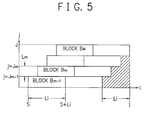
- the recurrence calculation is executed over one of division blocks obtained by collecting predetermined numbers of frames respectively in an i-direction and a j-direction. Then, a data shift is performed in the i-direction, in an increasing sense of i, to provide for a recurrence calculation on a subsequent block.
- a series of recurrence calculations are executed in parallel with an utterence of a speech, thus resulting in a decreased number of calculation steps remaining at the end of the utterence, permitting a reduced delay before the speech recognition.
- a plurality of distance calculations are executed concurrently or in parallel, permitting the more decreased number of remaining calculation steps and hence the more reduced delay.
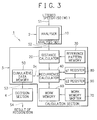
- Fig. 3 is a block diagram of a speech recognition system according to an embodiment of the invention.
- the recognition system 1 comprises an analysis section 2 for performing an analysis of an input accoustic or electric signal S1 representative of an uttered speech S0 including a phonetically significant original word W to output a set of results of the analysis as a signal S2, a calculation section 3 for processing the signal S2 to build up J cumulative data Dc representing respective degrees of likelihood of N reference words n to the uttered speech S0, and a decision section 4 for reading the data Dc as a signal S3 to make a decision thereon as to which reference word n is most likely to the speech S0 to thereby recognize the most likely word n as the original word W and for outputting a signal S4 representative of the most likely word n as a result of recognition.
- the analysis at the section 2 and the likelihood to the speech S0 will be limited to phonetic ones for a comprehensive description of the embodiment. It will be seen that they may be extended to cover statistic characters, linguistic characters and/or environmental characters, in particular in practical arrangments such as for a long or multi-word speech or conversation. Moreover, in applications such as to a stereo-sonic speech or an instrumental sound, a temporal derivative character of a first or second order and/or an echo character may be covered.
- the calculation section 3 comprises a distance calculator 20 provided with a reference pattern memory 30, and a recurrence calculator 40 provided with a cumulative data memory 50, a work memory 60, a work memory shifter 70, a g1 register 80 and a g2 register 90.
- the distance calculator 20 calculates a euclidean distance d(i, j) between pattern elements a i and b j in a below-described manner.
- the cumulative data memory 50 stores a set of final cumulative distances g(i, j) of each division block (Bm in Figa. 4).
- the recurrence calculator 40 accesses the memories 50 and 60 to read necessary data, processes the data to perform a recurrence calculation in accordance with the formula (5), and updates cumulative distances g(i, j) in the memory 50 by using results of the calculation.
- the work memory 60 temporarily stores cumulative distances g(i, j) calculated in a current division block (Bm in Fig. 4).
- the work memory shifter 70 shifts the data stored in the work memory 60 in a later-described manner.
- Calculations for like elements may be collectively executed in a single process to provide a result that may be stored to be read when necessary.
- the recurrence calculator 40 cooperates with the cumulative data memory 50, the work memory 60, the work memory shifter 70 and the g1 and g2 registers 80 and 90 to calculate a set of cumulative distances g(i, j) from the sequence of euclidean distances d(i, j) in a following manner having an initial setting process and a calculation process.
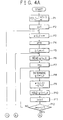
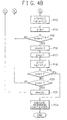
- Figs. 4A and 4B show a flow of associated steps.
- two initial setting steps P1 and P2 are executed as follows.
- Step P1 The cumulative data memory 50 is set so that addresses C(i, j) therein for storing cumulative distances g(i, j) have at C(1, j) the euclidean distance d(1, 1) or an initial value ⁇ in accordance with the expressions (7) and (8).
- Step P3 The work memory 60 is reset so that all addresses W(i, j) therein for storing cumulative distances g(i, j) have an initial value ⁇ .
- Step P5 The reference pattern element number j is set to an initial value 1 for the current cumulation. Likewise, a division block number m is set to 1.
- Step P6 A cumulative distance g(u, j) is read from the cumulative data memory 60, and held as g(i, j) in the g1 register 80.
- Step P8 A euclidean distance d(i+1, j) is input from the distance calculator 20. Cumulative distances g(i, j-1) and g(i, j) are read from the work memory 60 and the g1 register 80, respectively. Then, a recurrence calculation is performed in accordance with the formula (5) to obtain a cumulative distance g(i+1, j) , which is held in the g2 register 90.
- Step P9 The cumulative distance g(i, j) stored in the g1 register 80 is read, and written as a cumulative distance g(i, j-1) in the work memory 60.
- Step P10 The cumulative distance g(i+1, j) held in the g2 register 90 is read to be held in the g1 register 80.
- Step P13 A cumulative distance g(u+Li, j) is read from the g1 register 80, to be written at an address C(u+Li, j) in the cumulative data memory 50, where a g(u, j) is thus updated to the g(u+Li, j) .
- Step P14 The reference pattern element number j is incremented to j + 1.
- Step P18 The work memory shifter 70 shifts a cumulative distance g(i, j) stored at each address W(i, j) in the work memory 60 to a neighboring address W(i-1, j), so that at each W(i, j) the g(i, j) is updated to a g(i+1, j), whereby a cumulation area is shifted from a current division block B m to a subsequent division block B m+1 .
- the same effect may be obtained by generating a shifted address signal.
- Step P22 Upon reception of a final frame, necessary calculations are executed in accordance with the formula (5) to determine a number of remainnig cumulative distances.
- the delay from a real-time calculation is reduced from the conventional 1 sec. to a 0.5 sec. in the present embodiment.
- the embodiment may be modified for a calculation of a cumulative distance g(i, j), such that all euclidean distances d(i, j) between respective pattern elements a i and b j are calculated and stored in advance to be read as necessary for a recurrence calculation, that an input pattern A is held to be partially read as necessary for a calculation of a euclidean distance d(i, j) for a recurrence calculation, and/or that a primitive distance is calculated and stored in advance to be synthesized with a euclidean distance d(i, j) in a recurrence calculation.
- reference pattern elements b j are counted one by one may be modified so that a number of continuous pattern elements b j are employed in parallel for a collective recurrence calculation, or that a plurality of input patterns and a plurality of reference patterns are processed to concurrently calculate a plurality of euclidean distances.
- the cumulation in a current division block B m may be performed along a j-direction, before an i-direction.
- the distance calculator 20 which calculates a euclidean distance d(i, j) in the embodiment, may calculate any other known distance in a various manner such as by a weighting.
Landscapes
- Engineering & Computer Science (AREA)
- Computational Linguistics (AREA)
- Health & Medical Sciences (AREA)
- Audiology, Speech & Language Pathology (AREA)
- Human Computer Interaction (AREA)
- Physics & Mathematics (AREA)
- Acoustics & Sound (AREA)
- Multimedia (AREA)
- Image Analysis (AREA)
Claims (4)
- Spracherkennungssystem (1) zum Erkennen eines Eingangssprachsignals (S1) durch Bestimmung einer kumulativen Distanz (g (i, j)) zwischen einem Eingangsmuster und einem Bezugsmuster (B), wobei das Spracherkennungssystem aufweist:
Analysemittel (2) zum Aufteilen des Eingangssprachsignals (S1) in eine Anzahl von Rahmen (i) einer vorbestimmten Länge und zum Analysieren der Rahmen, um ein Eingangsmuster (A) zu bestimmen, welches aus einer temporären Sequenz von Eingangsmusterelementen (ai) zusammengesetzt ist, die die Zeichen des Rahmens repräsentieren;eine Distanzberechnungsvorrichtung (20, 30) zum sequentiellen Berechnen eines Satzes von Elementdistanzen (d (i, j)) zwischen den Eingangsmusterelementen (ai) und entsprechenden Musterelementen (bj) des Bezugsmusters (B), die für die Speicherung vorbestimmt sind;einen Arbeitsspeicher (60) zum temporären Speichern kumulierter Werte (g (i, j)) der Elementdistanzen (d, (i,j)), die einem Block (Bm) einer vorbestimmten Anzahl (Li) der Rahmen (i) des Eingangsmusters (A) entsprechen;einen kumulativen Datenspeicher (50) zum Speichern eines endgültigen kumulativen Wertes (g (i, j)) jedes Blocks (Bm) der vorbestimmten Anzahl von Rahmen (i) des Eingangsmusters (A);eine Rekursionsberechnungsvorrichtung (40, 80, 90) zum Zugreifen zu den gespeicherten kumulativen Werten (g (i, j)) im Arbeitsspeicher (60) und zu gespeicherten endgültigen kumulativen Werten (g (i, j)) im kumulativen Datenspeicher (50), zum Verarbeiten der zugegriffenen Daten (g (i, j)) mit den Elementdistanzen, um die kumulativen Werte (g (i, j)) zu berechnen, und zum Benutzen der kumulativen Werte (g (i, j)) zum Aktualisieren des gespeicherten endgültigen kumulativen Wertes (g (i, j)) im kumulativen Datenspeicher (50);eine Entscheidungsvorrichtung (4) zum Benutzen der endgültigen kumulativen Werte (g (i, j)), um eine Entscheidung zu treffen für die Erkennung des Eingangssprachsignals und zum Ausgeben eines Ergebnisses (S4) der Entscheidung; undeinen Arbeitsspeicherschieber (70) zum Verschieben des gespeicherten kumulativen Wertes (g (i, j)) im Arbeitsspeicher (60) durch eine vorbestimmte Verschiebung (i), wenn der gespeicherte endgültige kumulative Wert (g (i, j)) im kumulativen Datenspeicher (50) aktualisiert ist. - Spracherkennungssystem (1) nach Anspruch 1, wobei die Distanzberechnungsvorrichtung (20) eine Vielzahl von Eingangsmustern (A) und eine Vielzahl von Bezugsmustern (B) verarbeitet, um gleichzeitig eine Vielzahl von Elementabständen (d (i, j)) zu berechnen.
- Spracherkennungsverfahren zur Erkennung eines Eingangssprachsignals (S1) durch Bestimmung einer kumulativen Distanz (g (i, j)) zwischen einem Eingangsmuster und einem Bezugsmuster (B), wobei das Spracherkennungsverfahren die Schritte aufweist:Teilen des Eingangssprachsignals (S1) in eine Anzahl von Rahmen (i) einer vorbestimmten Länge und Analysieren der Rahmen, um ein Eingangsmuster (A) zu bestimmen, das aus einer temporären Sequenz von Eingangsmusterelementen (ai) zusammengesetzt ist, welche die Zeichen des Rahmens repräsentieren;sequentielle Berechnung eines Satzes von Elementdistanzen (d (i, j)) zwischen den Eingangsmusterelementen (ai) und entsprechenden Musterelementen (bj) des Bezugsmusters (B), die zur Speicherung vorbestimmt sind;temporäres Speichern kumulativer Werte (g (i, j)) der Elementdistanzen (d (i, j)), die einem Block (Bm) von vorbestimmten Anzahlen (Li) der Rahmen (i) des Eingangsmusters (A) entsprechen, in einem Arbeitsspeicher (60);Speicherung eines endgültigen kumulativen Wertes (g (i, j)) jedes Blocks (Bm) der vorbestimmten Anzahl von Rahmen (i) des Eingangsmusters (A) in einer kumulativen Datenspeichervorrichtung (50);Zugreifen des gespeicherten kumulativen Wertes (g (i, j)) im Arbeitsspeicher (60) und des gespeicherten endgültigen kumulativen Wertes (g (i, j)) im kumulativen Datenspeicher (50), Verarbeiten der zugegriffenen Daten (g (i, j)) mit den Elementdistanzen, um die kumulativen Werte (g (i, j)) zu berechnen, und Benutzen der kumulativen Werte (g (i, j)), um den gespeicherten endgültigen kumulativen Wert (g, (i, j)) im kumulativen Datenspeicher (50) zu aktualisieren;Benutzen des aktualisierten endgültigen kumulativen Wertes (g (i, j)), um eine Entscheidung zu treffen für die Erkennung des Eingangssprachsignals (S1) und Ausgeben des Ergebnisses (S4) der Entscheidung; undVerschieben des gespeicherten kumulativen Wertes im Arbeitsspeicher (60) um eine vorbestimmte Verschiebung (i), wenn der gespeicherte endgültige kumulative Werte im kumulativen Datenspeicher (50) aktualisiert ist.
- Spracherkennungsverfahren nach Anspruch 3, wobei eine Vielzahl von Eingangsmustern (A) und eine Vielzahl von Bezugsmustern (B) verarbeitet werden, um gleichzeitig eine Vielzahl von Elementdistanzen (d (i, j)) zu berechnen.
Applications Claiming Priority (3)
| Application Number | Priority Date | Filing Date | Title |
|---|---|---|---|
| JP224360/94 | 1994-09-20 | ||
| JP22436094 | 1994-09-20 | ||
| JP6224360A JP2964881B2 (ja) | 1994-09-20 | 1994-09-20 | 音声認識装置 |
Publications (3)
| Publication Number | Publication Date |
|---|---|
| EP0703568A2 EP0703568A2 (de) | 1996-03-27 |
| EP0703568A3 EP0703568A3 (de) | 1997-11-12 |
| EP0703568B1 true EP0703568B1 (de) | 2000-08-09 |
Family
ID=16812544
Family Applications (1)
| Application Number | Title | Priority Date | Filing Date |
|---|---|---|---|
| EP95114742A Expired - Lifetime EP0703568B1 (de) | 1994-09-20 | 1995-09-19 | System und Verfahren zur Spracherkennung mit verringerter Antwortzeit |
Country Status (4)
| Country | Link |
|---|---|
| US (1) | US5812739A (de) |
| EP (1) | EP0703568B1 (de) |
| JP (1) | JP2964881B2 (de) |
| DE (1) | DE69518291T2 (de) |
Families Citing this family (7)
| Publication number | Priority date | Publication date | Assignee | Title |
|---|---|---|---|---|
| CA2216224A1 (en) * | 1997-09-19 | 1999-03-19 | Peter R. Stubley | Block algorithm for pattern recognition |
| US6580814B1 (en) * | 1998-07-31 | 2003-06-17 | International Business Machines Corporation | System and method for compressing biometric models |
| DE10060937C1 (de) * | 2000-12-07 | 2002-07-25 | Siemens Ag | Verfahren zum Ermitteln eines Näherungswertes für den euklidischen Abstand zweier Punkte in einem Bezugssystem |
| US7379868B2 (en) * | 2002-07-18 | 2008-05-27 | Massachusetts Institute Of Technology | Method and apparatus for differential compression of speaker models |
| DE10305821A1 (de) * | 2003-02-12 | 2004-09-02 | Infineon Technologies Ag | Verfahren und Vorrichtung zum Vergleichen einer Vielzahl von Eingangsvektoren mit m Referenzvektoren, Computerprogramm-Element und Computerlesbares Speichermedium |
| WO2010105396A1 (en) * | 2009-03-16 | 2010-09-23 | Fujitsu Limited | Apparatus and method for recognizing speech emotion change |
| US9384729B2 (en) * | 2011-07-20 | 2016-07-05 | Tata Consultancy Services Limited | Method and system for detecting boundary of coarticulated units from isolated speech |
Family Cites Families (12)
| Publication number | Priority date | Publication date | Assignee | Title |
|---|---|---|---|---|
| US3816722A (en) * | 1970-09-29 | 1974-06-11 | Nippon Electric Co | Computer for calculating the similarity between patterns and pattern recognition system comprising the similarity computer |
| US4592086A (en) * | 1981-12-09 | 1986-05-27 | Nippon Electric Co., Ltd. | Continuous speech recognition system |
| JPS5998387A (ja) * | 1982-11-26 | 1984-06-06 | Nec Corp | メモリ回路 |
| JPS59172700A (ja) * | 1983-03-22 | 1984-09-29 | 中川 聖一 | パタ−ン比較装置 |
| JPS60179797A (ja) * | 1983-10-27 | 1985-09-13 | 日本電気株式会社 | パタンマツチング装置 |
| JPS60130799A (ja) * | 1983-12-19 | 1985-07-12 | 日本電気株式会社 | 連続音声認識装置 |
| US4868879A (en) * | 1984-03-27 | 1989-09-19 | Oki Electric Industry Co., Ltd. | Apparatus and method for recognizing speech |
| JPS60211498A (ja) * | 1984-04-05 | 1985-10-23 | 日本電気株式会社 | 連続音声認識装置 |
| EP0283902B1 (de) * | 1987-03-16 | 1993-06-30 | Nec Corporation | System zum Vergleichen von Mustern |
| JP2980420B2 (ja) * | 1991-07-26 | 1999-11-22 | 富士通株式会社 | 動的計画法照合装置 |
| JPH0561496A (ja) * | 1991-08-30 | 1993-03-12 | Sony Corp | 音声認識装置 |
| JP2891389B2 (ja) * | 1991-11-12 | 1999-05-17 | シャープ株式会社 | パターン類似度計算装置 |
-
1994
- 1994-09-20 JP JP6224360A patent/JP2964881B2/ja not_active Expired - Fee Related
-
1995
- 1995-09-19 EP EP95114742A patent/EP0703568B1/de not_active Expired - Lifetime
- 1995-09-19 DE DE69518291T patent/DE69518291T2/de not_active Expired - Fee Related
- 1995-09-20 US US08/530,995 patent/US5812739A/en not_active Expired - Fee Related
Also Published As
| Publication number | Publication date |
|---|---|
| EP0703568A2 (de) | 1996-03-27 |
| DE69518291T2 (de) | 2001-03-29 |
| DE69518291D1 (de) | 2000-09-14 |
| JP2964881B2 (ja) | 1999-10-18 |
| JPH0887294A (ja) | 1996-04-02 |
| US5812739A (en) | 1998-09-22 |
| EP0703568A3 (de) | 1997-11-12 |
Similar Documents
| Publication | Publication Date | Title |
|---|---|---|
| US5983180A (en) | Recognition of sequential data using finite state sequence models organized in a tree structure | |
| US7054810B2 (en) | Feature vector-based apparatus and method for robust pattern recognition | |
| US5267345A (en) | Speech recognition apparatus which predicts word classes from context and words from word classes | |
| EP0813735B1 (de) | Spracherkennung | |
| US5839105A (en) | Speaker-independent model generation apparatus and speech recognition apparatus each equipped with means for splitting state having maximum increase in likelihood | |
| EP0715298B1 (de) | Verminderung des Suchraumes bei Spracherkennung unter Verwendung von Phonemgrenzen und Phonemklassen | |
| EP0686965B1 (de) | Spracherkennung mit Sprecheradaptierung mittels Berechnung von Mittelwerten akustischer Kategorien | |
| US5680509A (en) | Method and apparatus for estimating phone class probabilities a-posteriori using a decision tree | |
| EP0617827A4 (en) | Composite expert. | |
| EP0703568B1 (de) | System und Verfahren zur Spracherkennung mit verringerter Antwortzeit | |
| US4901352A (en) | Pattern matching method using restricted matching paths and apparatus therefor | |
| EP0844601A2 (de) | Verminderung des Suchraumes bei Spracherkennung | |
| JP2980026B2 (ja) | 音声認識装置 | |
| US7493258B2 (en) | Method and apparatus for dynamic beam control in Viterbi search | |
| JP2841404B2 (ja) | 連続音声認識装置 | |
| CA2051602C (en) | Method and apparatus for generating models of spoken words based on a small number of utterances | |
| US6999929B2 (en) | Recognizing speech by selectively canceling model function mixture components | |
| EP0834858B1 (de) | Verfahren zur Berechnung der Unähnlichkeit von Mustern und Vorrichtung dafür | |
| JP3914709B2 (ja) | 音声認識方法およびシステム | |
| JP3513284B2 (ja) | 音声認識方法およびその装置 | |
| JP3348735B2 (ja) | パターン照合方式 | |
| JP2792720B2 (ja) | 音声認識装置 | |
| JPH1078793A (ja) | 音声認識装置 | |
| JP2577891B2 (ja) | 単語音声予備選択装置 | |
| JP3092384B2 (ja) | パターン照合装置 |
Legal Events
| Date | Code | Title | Description |
|---|---|---|---|
| PUAI | Public reference made under article 153(3) epc to a published international application that has entered the european phase |
Free format text: ORIGINAL CODE: 0009012 |
|
| AK | Designated contracting states |
Kind code of ref document: A2 Designated state(s): DE FR GB |
|
| PUAL | Search report despatched |
Free format text: ORIGINAL CODE: 0009013 |
|
| AK | Designated contracting states |
Kind code of ref document: A3 Designated state(s): DE FR GB |
|
| 17P | Request for examination filed |
Effective date: 19971001 |
|
| GRAG | Despatch of communication of intention to grant |
Free format text: ORIGINAL CODE: EPIDOS AGRA |
|
| 17Q | First examination report despatched |
Effective date: 19991109 |
|
| GRAG | Despatch of communication of intention to grant |
Free format text: ORIGINAL CODE: EPIDOS AGRA |
|
| GRAH | Despatch of communication of intention to grant a patent |
Free format text: ORIGINAL CODE: EPIDOS IGRA |
|
| RIC1 | Information provided on ipc code assigned before grant |
Free format text: 7G 10L 15/08 A |
|
| GRAH | Despatch of communication of intention to grant a patent |
Free format text: ORIGINAL CODE: EPIDOS IGRA |
|
| GRAA | (expected) grant |
Free format text: ORIGINAL CODE: 0009210 |
|
| AK | Designated contracting states |
Kind code of ref document: B1 Designated state(s): DE FR GB |
|
| REF | Corresponds to: |
Ref document number: 69518291 Country of ref document: DE Date of ref document: 20000914 |
|
| ET | Fr: translation filed | ||
| PLBE | No opposition filed within time limit |
Free format text: ORIGINAL CODE: 0009261 |
|
| STAA | Information on the status of an ep patent application or granted ep patent |
Free format text: STATUS: NO OPPOSITION FILED WITHIN TIME LIMIT |
|
| 26N | No opposition filed | ||
| REG | Reference to a national code |
Ref country code: GB Ref legal event code: IF02 |
|
| REG | Reference to a national code |
Ref country code: GB Ref legal event code: 732E |
|
| PGFP | Annual fee paid to national office [announced via postgrant information from national office to epo] |
Ref country code: FR Payment date: 20030909 Year of fee payment: 9 |
|
| PGFP | Annual fee paid to national office [announced via postgrant information from national office to epo] |
Ref country code: GB Payment date: 20030917 Year of fee payment: 9 |
|
| REG | Reference to a national code |
Ref country code: FR Ref legal event code: TP |
|
| PGFP | Annual fee paid to national office [announced via postgrant information from national office to epo] |
Ref country code: DE Payment date: 20031002 Year of fee payment: 9 |
|
| PG25 | Lapsed in a contracting state [announced via postgrant information from national office to epo] |
Ref country code: GB Free format text: LAPSE BECAUSE OF NON-PAYMENT OF DUE FEES Effective date: 20040919 |
|
| PG25 | Lapsed in a contracting state [announced via postgrant information from national office to epo] |
Ref country code: DE Free format text: LAPSE BECAUSE OF NON-PAYMENT OF DUE FEES Effective date: 20050401 |
|
| GBPC | Gb: european patent ceased through non-payment of renewal fee |
Effective date: 20040919 |
|
| PG25 | Lapsed in a contracting state [announced via postgrant information from national office to epo] |
Ref country code: FR Free format text: LAPSE BECAUSE OF NON-PAYMENT OF DUE FEES Effective date: 20050531 |
|
| REG | Reference to a national code |
Ref country code: FR Ref legal event code: ST |