EP0703930B1 - Constituants et catalyseurs destines a la polymerisation d'olefines - Google Patents
Constituants et catalyseurs destines a la polymerisation d'olefines Download PDFInfo
- Publication number
- EP0703930B1 EP0703930B1 EP95928876A EP95928876A EP0703930B1 EP 0703930 B1 EP0703930 B1 EP 0703930B1 EP 95928876 A EP95928876 A EP 95928876A EP 95928876 A EP95928876 A EP 95928876A EP 0703930 B1 EP0703930 B1 EP 0703930B1
- Authority
- EP
- European Patent Office
- Prior art keywords
- mcl
- ind
- mme
- catalyst
- compound
- Prior art date
- Legal status (The legal status is an assumption and is not a legal conclusion. Google has not performed a legal analysis and makes no representation as to the accuracy of the status listed.)
- Expired - Lifetime
Links
- 0 *N(*)CN(*)* Chemical compound *N(*)CN(*)* 0.000 description 1
Images

Classifications
-
- C—CHEMISTRY; METALLURGY
- C08—ORGANIC MACROMOLECULAR COMPOUNDS; THEIR PREPARATION OR CHEMICAL WORKING-UP; COMPOSITIONS BASED THEREON
- C08F—MACROMOLECULAR COMPOUNDS OBTAINED BY REACTIONS ONLY INVOLVING CARBON-TO-CARBON UNSATURATED BONDS
- C08F10/00—Homopolymers and copolymers of unsaturated aliphatic hydrocarbons having only one carbon-to-carbon double bond
-
- C—CHEMISTRY; METALLURGY
- C08—ORGANIC MACROMOLECULAR COMPOUNDS; THEIR PREPARATION OR CHEMICAL WORKING-UP; COMPOSITIONS BASED THEREON
- C08F—MACROMOLECULAR COMPOUNDS OBTAINED BY REACTIONS ONLY INVOLVING CARBON-TO-CARBON UNSATURATED BONDS
- C08F4/00—Polymerisation catalysts
- C08F4/42—Metals; Metal hydrides; Metallo-organic compounds; Use thereof as catalyst precursors
- C08F4/44—Metals; Metal hydrides; Metallo-organic compounds; Use thereof as catalyst precursors selected from light metals, zinc, cadmium, mercury, copper, silver, gold, boron, gallium, indium, thallium, rare earths or actinides
- C08F4/60—Metals; Metal hydrides; Metallo-organic compounds; Use thereof as catalyst precursors selected from light metals, zinc, cadmium, mercury, copper, silver, gold, boron, gallium, indium, thallium, rare earths or actinides together with refractory metals, iron group metals, platinum group metals, manganese, rhenium technetium or compounds thereof
- C08F4/62—Refractory metals or compounds thereof
- C08F4/63—Pretreating the metal or compound covered by group C08F4/62 before the final contacting with the metal or compound covered by group C08F4/44
- C08F4/632—Pretreating with metals or metal-containing compounds
- C08F4/634—Pretreating with metals or metal-containing compounds with magnesium or compounds thereof
-
- C—CHEMISTRY; METALLURGY
- C08—ORGANIC MACROMOLECULAR COMPOUNDS; THEIR PREPARATION OR CHEMICAL WORKING-UP; COMPOSITIONS BASED THEREON
- C08F—MACROMOLECULAR COMPOUNDS OBTAINED BY REACTIONS ONLY INVOLVING CARBON-TO-CARBON UNSATURATED BONDS
- C08F4/00—Polymerisation catalysts
- C08F4/42—Metals; Metal hydrides; Metallo-organic compounds; Use thereof as catalyst precursors
- C08F4/44—Metals; Metal hydrides; Metallo-organic compounds; Use thereof as catalyst precursors selected from light metals, zinc, cadmium, mercury, copper, silver, gold, boron, gallium, indium, thallium, rare earths or actinides
- C08F4/60—Metals; Metal hydrides; Metallo-organic compounds; Use thereof as catalyst precursors selected from light metals, zinc, cadmium, mercury, copper, silver, gold, boron, gallium, indium, thallium, rare earths or actinides together with refractory metals, iron group metals, platinum group metals, manganese, rhenium technetium or compounds thereof
- C08F4/62—Refractory metals or compounds thereof
- C08F4/639—Component covered by group C08F4/62 containing a transition metal-carbon bond
- C08F4/63904—Component covered by group C08F4/62 containing a transition metal-carbon bond in combination with another component of C08F4/62
-
- C—CHEMISTRY; METALLURGY
- C08—ORGANIC MACROMOLECULAR COMPOUNDS; THEIR PREPARATION OR CHEMICAL WORKING-UP; COMPOSITIONS BASED THEREON
- C08F—MACROMOLECULAR COMPOUNDS OBTAINED BY REACTIONS ONLY INVOLVING CARBON-TO-CARBON UNSATURATED BONDS
- C08F4/00—Polymerisation catalysts
- C08F4/42—Metals; Metal hydrides; Metallo-organic compounds; Use thereof as catalyst precursors
- C08F4/44—Metals; Metal hydrides; Metallo-organic compounds; Use thereof as catalyst precursors selected from light metals, zinc, cadmium, mercury, copper, silver, gold, boron, gallium, indium, thallium, rare earths or actinides
- C08F4/60—Metals; Metal hydrides; Metallo-organic compounds; Use thereof as catalyst precursors selected from light metals, zinc, cadmium, mercury, copper, silver, gold, boron, gallium, indium, thallium, rare earths or actinides together with refractory metals, iron group metals, platinum group metals, manganese, rhenium technetium or compounds thereof
- C08F4/62—Refractory metals or compounds thereof
- C08F4/639—Component covered by group C08F4/62 containing a transition metal-carbon bond
- C08F4/63912—Component covered by group C08F4/62 containing a transition metal-carbon bond in combination with an organoaluminium compound
-
- C—CHEMISTRY; METALLURGY
- C08—ORGANIC MACROMOLECULAR COMPOUNDS; THEIR PREPARATION OR CHEMICAL WORKING-UP; COMPOSITIONS BASED THEREON
- C08F—MACROMOLECULAR COMPOUNDS OBTAINED BY REACTIONS ONLY INVOLVING CARBON-TO-CARBON UNSATURATED BONDS
- C08F4/00—Polymerisation catalysts
- C08F4/42—Metals; Metal hydrides; Metallo-organic compounds; Use thereof as catalyst precursors
- C08F4/44—Metals; Metal hydrides; Metallo-organic compounds; Use thereof as catalyst precursors selected from light metals, zinc, cadmium, mercury, copper, silver, gold, boron, gallium, indium, thallium, rare earths or actinides
- C08F4/60—Metals; Metal hydrides; Metallo-organic compounds; Use thereof as catalyst precursors selected from light metals, zinc, cadmium, mercury, copper, silver, gold, boron, gallium, indium, thallium, rare earths or actinides together with refractory metals, iron group metals, platinum group metals, manganese, rhenium technetium or compounds thereof
- C08F4/62—Refractory metals or compounds thereof
- C08F4/639—Component covered by group C08F4/62 containing a transition metal-carbon bond
- C08F4/63916—Component covered by group C08F4/62 containing a transition metal-carbon bond supported on a carrier, e.g. silica, MgCl2, polymer
-
- C—CHEMISTRY; METALLURGY
- C08—ORGANIC MACROMOLECULAR COMPOUNDS; THEIR PREPARATION OR CHEMICAL WORKING-UP; COMPOSITIONS BASED THEREON
- C08F—MACROMOLECULAR COMPOUNDS OBTAINED BY REACTIONS ONLY INVOLVING CARBON-TO-CARBON UNSATURATED BONDS
- C08F4/00—Polymerisation catalysts
- C08F4/42—Metals; Metal hydrides; Metallo-organic compounds; Use thereof as catalyst precursors
- C08F4/44—Metals; Metal hydrides; Metallo-organic compounds; Use thereof as catalyst precursors selected from light metals, zinc, cadmium, mercury, copper, silver, gold, boron, gallium, indium, thallium, rare earths or actinides
- C08F4/60—Metals; Metal hydrides; Metallo-organic compounds; Use thereof as catalyst precursors selected from light metals, zinc, cadmium, mercury, copper, silver, gold, boron, gallium, indium, thallium, rare earths or actinides together with refractory metals, iron group metals, platinum group metals, manganese, rhenium technetium or compounds thereof
- C08F4/62—Refractory metals or compounds thereof
- C08F4/639—Component covered by group C08F4/62 containing a transition metal-carbon bond
- C08F4/6392—Component covered by group C08F4/62 containing a transition metal-carbon bond containing at least one cyclopentadienyl ring, condensed or not, e.g. an indenyl or a fluorenyl ring
-
- Y—GENERAL TAGGING OF NEW TECHNOLOGICAL DEVELOPMENTS; GENERAL TAGGING OF CROSS-SECTIONAL TECHNOLOGIES SPANNING OVER SEVERAL SECTIONS OF THE IPC; TECHNICAL SUBJECTS COVERED BY FORMER USPC CROSS-REFERENCE ART COLLECTIONS [XRACs] AND DIGESTS
- Y10—TECHNICAL SUBJECTS COVERED BY FORMER USPC
- Y10S—TECHNICAL SUBJECTS COVERED BY FORMER USPC CROSS-REFERENCE ART COLLECTIONS [XRACs] AND DIGESTS
- Y10S526/00—Synthetic resins or natural rubbers -- part of the class 520 series
- Y10S526/904—Monomer polymerized in presence of transition metal containing catalyst at least part of which is supported on a polymer, e.g. prepolymerized catalysts
-
- Y—GENERAL TAGGING OF NEW TECHNOLOGICAL DEVELOPMENTS; GENERAL TAGGING OF CROSS-SECTIONAL TECHNOLOGIES SPANNING OVER SEVERAL SECTIONS OF THE IPC; TECHNICAL SUBJECTS COVERED BY FORMER USPC CROSS-REFERENCE ART COLLECTIONS [XRACs] AND DIGESTS
- Y10—TECHNICAL SUBJECTS COVERED BY FORMER USPC
- Y10S—TECHNICAL SUBJECTS COVERED BY FORMER USPC CROSS-REFERENCE ART COLLECTIONS [XRACs] AND DIGESTS
- Y10S526/00—Synthetic resins or natural rubbers -- part of the class 520 series
- Y10S526/943—Polymerization with metallocene catalysts
Definitions
- Catalyse with very high activity are obtained from compounds Cp 2 ZrCl 2 or Cp 2 TiCl 2 and from their derivatives substituted in the cyclopentadienyl ring, in which the Cp ring can also be condensed with other rings, and from polyalumoxane compounds containing the repeating unit -(R)AlO-, in which R is lower alkyl, preferably methyl (USP 4542199 and EP-A-129368).
- Catalysts of the aforementioned type in which the metallocene compound contains two indenyl or tetrahydroindenyl rings bridge-bonded through lower alkylenes or through other divalent radicals are suitable for preparation of stereoregular polymers of propylene and of other alpha olefins (EP-A-185918).
- Stereospecific catalysts are also obtained from dicyclopentadienyl compounds in which the two rings are substituted in various ways with groups with steric hindrance so as to prevent rotation of the rings about the axis of coordination with the metal. Substitution of indenyl or tetrahydroindenyl at suitable positions of the pentadienyl ring gives catalysts that have very high stereospecificity (EP-A-485823, EP-A-485820, EP-A-519237, USP 5132262 and USP 5162278).
- the metallocene catalysts described above yield polymers with very narrow molecular weight distribution (Mw/Mn around 2).
- Some of these catalysts also have the property of forming copolymers of ethylene with alpha olefins of the LLDPE type or ethylene/propylene elastomeric copolymers with very uniform distribution of the comonomer units.
- the LLDPE polyethylene obtained is further characterized by low solubility in solvents such as xylene or n-decane.
- the polypropylene obtained with the more stereospecific catalysts mentioned above exhibits increased crystallinity and a higher deformation temperature compared with the polymer that can be obtained with conventional Ziegler-Natta catalysts.
- these metallocene catalysts present a notable difficulty with respect to the possibility of being used in industrial processes for production of polyolefins that are not carried out in solution, due to the fact that they are soluble in the reaction medium in which they are prepared and in the liquid polymerization medium.
- the catalysts In order to be able to use them in polymerization processes that are not performed in solution, the catalysts must be supported on suitable supports which endow the polymer with appropriate morphological properties.
- supports including, among others, porous metal oxides such as silica or porous polymeric supports such as polyethylene, polypropylene and polystyrene.
- Magnesium halides are also used as support. In some cases they are also used as counter-ions of an ion pair in which the metallocene compound supplies the cation and a compound of the Mg halide type supplies the anion.
- Japanese application No. 168408/88 (published 12.7.1988) describes the use of magnesium chloride as support of metallocene compounds of the type Cp 2 TiCl 2 , Cp 2 ZrCl 2 , Cp 2 Ti(CH 3 ) 2 for forming, with Al-trialkyl and/or polymethylalumoxane (MAO), catalysts for polymerization of ethylene.
- the component comprising the magnesium chloride is prepared by grinding it together with the metallocene compound, also working in the presence of electron-donor compounds or supporting the metallocene on a suitable liquid adduct of MgCl 2 with an alcohol and subsequent reaction with AlEt 2 Cl.
- the catalysts do not have sufficiently high activity with respect to MgCl 2 .
- Catalysts comprising a metallocene compound of the Cp 2 ZrCl 2 type supported on MgCl 2 in spherical form and partially complexed with an electron-donor compound are described in USP 5106804.
- the performance of these catalysts is better than that described in Japanese application No. 168408/88 but is still not such as to permit the production of polymers containing low enough catalyst residues.
- the quantity of Zr compound supported on MgCl 2 is relatively low (the Zr/Mg ratio in the catalyst is less than about 0.05).
- the catalysts require the use of polymethylalumoxane (MAO) and are not active with Al-alkyls of the Al-triethyl type.
- MAO polymethylalumoxane
- Application EP-A-318048 describes catalysts in which a solid component comprising a Ti compound supported on a magnesium chloride that has particular characteristics of surface area and porosity and if necessary an electron-donor compound, is used with benzylic compounds of Ti or Zr or with metallocene compounds of the type Cp 2 Ti(CH 3 ) 2 and bis-(indenyl)-Zr(CH 3 ) 2 to form catalysts for polymerization of ethylene and of propylene.
- the ratio by weight of metallocene to magnesium chloride is very high (greater than 1) so that it is necessary to remove the metallocene from the polymer that is obtained.
- the catalysts are used in processes carried out in the presence of a liquid polymerization medium.
- Application EP-A-439964 describes bimetallic catalysts suitable for preparation of ethylene polymers with wide molecular weight distribution (Mw/Mn between 4 and 14) obtained by supporting a metallocene on a solid component containing a Ti compound supported on magnesium chloride.
- MAO or its mixtures with Al-alkyl are used as cocatalyst.
- Al-trialkyls are also used on their own, but the catalytic activity is low.
- the yields of these mixed catalysts in which active centres are operative, derived both from the Ti compound supported on MgCl 2 and from the metallocene compound, are very high when the catalysts are used in a hydrocarbon medium; on the other hand they are low when polymerization is carried out in the gas phase.
- Application EP-A-522281 describes catalysts obtained from Cp 2 ZrCl 2 supported on magnesium chloride and from mixtures of Al-trialkyl and compounds supplying stable anions of the dimethylanilino-tetrakis- (pentafluorophenyl)borate type.
- the catalysts are prepared by grinding the components and are used in polymerization tests in the presence of a solvent (toluene) with yields of polyethylene relative to MgCl 2 of the order of 9000 g/g.
- Application EP-A-509944 describes catalysts using compounds of the anilino-tetrakis-(pentafluorophenyl)borate type or Lewis acids such as MgCl 2 together with metallocene halides pre-reacted with Al-alkyl compounds.
- the magnesium chloride is ground before it is brought into contact with the pre-reacted metallocene compound.
- the yields of polymer relative to the Mg halide are not high.
- Catalyst components have now been found that are able to form catalysts with particularly high activity and that are capable of producing polymers with controlled morphological properties so that the catalysts can also be used in gas-phase processes in a fluidized bed.
- the polymeric support is prepared in a quantity of from 0.5 to 2000 g per g of solid component, preferably in a quantity of from 5 to 500 g per g, and more preferably in a quantity of from 10 to 100 g per g of solid component.
- the compound of the transition metal M includes in particular at least one ligand L coordinated on the metal M possessing a mono- or polycyclic structure containing conjugated ⁇ electrons.
- Said compound of the transition metal M is preferably chosen from among compounds with the structure: - Cp I MR 1 a R 2 b R 3 c - Cp I Cp II MR 1 a R 2 b - (Cp I -A e -Cp II )M 1 R 1 a R 2 b in which M is Ti, V, Zr or Hf;
- Cp I and Cp II which may be identical or different from each other, are cyclopentadienyl groups which may be substituted; two or more substituents on the said cyclopentadienyl groups can form one or more rings having from 4 to 6 carbon atoms;
- R 1 , R 2 and R 3 which may be identical or different, are atoms of hydrogen, halogen, an alkyl or alkoxyl group with 1-20 carbon atoms, aryl, alkaryl, or aralkyl with 6-20 carbon atoms, an acyloxy group with 1-20 carbon atoms, an allyl
- Representative compounds possessing formula (I) include:
- Representative compounds possessing formula (II) include:
- Representative compounds possessing formula (III) include:
- the catalysts used for preparation of the prepolymer preferably comprise the product obtained by contacting a halide of Ti, V, Zr, Hf or mixture thereof, especially a chloride or a halogen-alcoholate of Ti or V, with a Mg chloride having average size of the crystallites below 30 nm (300 ⁇ ) and preferably below 15 nm (150 ⁇ ) and more preferably in the range from 3 (30) to 12 nm (120 ⁇ ).
- the chlorides and the halogen-alcoholates of Ti or V preferably include TiCl 4 , TiCl 3 , chloro-alcoholates of Ti such as Ti(OBu) 2 Cl 2 and Ti(OBu)Cl 3 , VCl 3 , VOCl 3 .
- catalysts of this type are described in patents USP 4495338, USP 4298718 and USP 4542198, the descriptions of which are included here by reference.
- Other examples of catalysts comprising the product obtained by contacting one or more compounds of Ti, V, Zr or Hf with a magnesium halide having the above specified features are given in Italian Patent Applications MI-94-A-001065 and MI-94-A-001421.
- the solid components of the catalysts are used in spherical form with particle size from approx.
- catalysts comprising components of this type and the method of preparation of the components are described in patents USP 4399054, EP-A-395083, EP-A-553805 and EP-A-553806.
- the content of titanium or vanadium in the said catalytic components is preferably greater than 1 % by weight and preferably between 2 and 10 % by weight.
- the catalysts preferably use as Al-alkyl compound, an Al-trialkyl such as AlEt 3 , Al-triisobutyl, Al-tri-n-butyl, and their mixtures with Al-dialkyl halides.
- Al-trialkyl such as AlEt 3
- Al-triisobutyl Al-tri-n-butyl
- Al-dialkyl halides Al-dialkyl halides.
- Alumoxane compounds can also be used.
- the olefins used in preparation of the prepolymer include ethylene, propylene, 1-butene, 4-methyl-1-pentene, 1-hexene, 1-octene and their mixtures.
- the prepolymer is made up of polyethylene, copolymers of ethylene with proportions less than 20 mol.% of an olefin selected from propylene, 1-butene, 1-hexene, 4-methyl-1-pentene, 1-octene, cyclopentene, cyclohexene; polypropylene with isotacticity index above 80%; crystalline copolymers of propylene with smaller amounts (5 mol.% or less) of ethylene and/or ⁇ -olefins such as 1-butene, 1-hexene.
- Prepolymers from dienes or conjugated polyenes can also be used.
- Prepolymerization is preferably carried out in liquid phase consisting of an inert hydrocarbon solvent such as propane, hexane, heptane, isobutane or of a monomer, or in gas phase working at temperatures generally below 100°C, and preferably between 20°C and 70°C.
- an inert hydrocarbon solvent such as propane, hexane, heptane, isobutane or of a monomer
- the prepolymer is produced in a quantity greater than 0.5 g per g of component and up to 2000 g/g. Preferably the amount is between 5 and 500 g per g of solid component, and more preferably between 10 and 100 g per gram of solid component.
- the porosity of the prepolymer, determined with the mercury method described hereinafter, is preferably greater than 0.3 cm 3 /g, more preferably greater than 0.4 cm 3 /g and expecially greater than 0.5 cm 3 /g.
- the above given porosity values refer to pores having radius up to 5 ⁇ m (50,000 ⁇ ).
- the quantity of magnesium halide present in the prepolymer is generally between 50 and 50000 ppm, preferably between 100 and 20000 ppm, and more preferably between 300 and 10000 ppm.
- the atomic ratio of the transition metal M containing at least one ⁇ bond with the magnesium of the halide is normally greater than 0.1, in particular greater than 0.2 and preferably between 0.3 and 3.
- Transition metal/magnesium atomic ratios above 0.1 have never before been accomplished in the components comprising an Mg halide and a metallocene compound of Zr, Ti, V or Hf.
- Catalytic components comprising a prepolymer containing dispersed fine particles of Mg halide and which contain, in a form at least partly combined with the Mg halide, a compound of a transition metal M chosen from among Ti, V, Zr or Hf containing at least one M- ⁇ bond, in an atomic ratio M/Mg greater than 0.1, have not been described previously in the literature.
- the reaction of the prepolymer containing the solid component of the prepolymerization catalyst with the transition metal compound is preferably carried out an inert hydrocarbon medium in which the metallocene compound is soluble (toluene, benzene and similar hydrocarbons), working at temperatures between -40°C and the melting point of the prepolymer, preferably between 0 and 100°C, and more preferably between 10 and 70°C.
- the reaction between the prepolymer and the transition metal compound containing at least one ⁇ bond can if necessary be effected in the presence of an electron-donor compound in such a way as to fix a quantity of electron-donor compound between 0.1 and 15 wt.% of the total.
- the solubility of the metallocene compound containing at least one M- ⁇ bond increases when the said compound is dissolved in toluene and similar hydrocarbons also containing dissolved therein Al-alkyl compound such as Al-triethyl, Al-triisobutyl or a polyalkylalumoxane, and in particular MAO or its mixtures with an Al-alkyl compound, using molar ratios of Al-alkyl compound/metallocene compound greater than 2, preferably between 5 and 100.
- the solutions that are obtained are particularly suitable as components of catalyst having very high activity. Such activity is greater than the activity that can be obtained when using solutions of the metallocene compound that have been obtained in the absence of the Al compound mentioned above.
- the components of the invention form, with Al-alkyl compounds or with polyalkylalumoxane compounds or their mixtures, catalysts that have very high activity relative to the Mg halide, by far greater than that of the catalysts containing Mg halide known up to now.
- the Al-alkyl compound is generally selected from among compounds of formula AlR 3 , in which R is an alkyl with 1-12 carbon atoms, and the alumoxane compounds containing the repeating unit -(R 4 )AlO-, in which R 4 is an alkyl radical containing from 1 to 6 carbon atoms, and said alumoxane compounds contain from 2 to 50 repeating units possessing the formula described above.
- Typical examples of compounds with the formula AlR 3 are Al-trimethyl, Al-triethyl, Al-triisobutyl, Al-tri-n-butyl, Al-trihexyl and Al-trioctyl.
- the alumoxane compounds use of MAO is preferred. Mixtures of Al-alkyl compounds, preferably Al-triisobutyl, and alumoxane compounds, preferably MAO, are also used advantageously.
- the transition metal compound containing at least one M- ⁇ bond is of the type described in formulae (II) and (III), the compounds obtained from reaction between AlR 3 and H 2 O in molar ratios between 0.01 and 0.5 can be used advantageously.
- Activities of at least 100 kg/g of MgCl 2 and which can even be greater than 1000 kg/g of MgCl 2 can normally be obtained even in gas-phase polymerization processes.
- prepolymers obtained with catalysts whose components are in the form of spherical particles it is possible to obtain polymers which replicate the morphology of the catalyst component and hence conduct processes in the gas phase in a fluidized bed in an easily controllable manner, avoiding difficulties such as local overheating of the bed, problems with heat exchange etc., which make it difficult to conduct processes in the gas phase.
- Fig. 1 shows a photograph of the catalyst reproduced at 12-times magnification
- Fig. 2 shows a photograph of the polymer obtained by polymerization in the gas phase, reproduced at 3.5 times magnification.
- the catalysts especially those obtained from compounds of the type C 2 H 4 (Ind) 2 ZrCl 2 , C 2 H 4 (H 4 Ind)ZrCl 2 and Me 2 Si(Me 4 Cp) 2 ZrCl 2 are suitable for producing LLPDE (copolymers of ethylene containing smaller proportions, generally less than 20 mol.%, of C 3 -C 12 alpha olefin) characterized by relatively low density values relative to the content of alpha olefin, with reduced solubility in xylene at room temperature (below approx. 10 wt.%) and with molecular weight distribution Mw/Mn between about 2.5 and 5.
- LLPDE copolymers of ethylene containing smaller proportions, generally less than 20 mol.%, of C 3 -C 12 alpha olefin
- Mw/Mn molecular weight distribution
- the Mw/Mn values are generally higher than those obtainable with the metallocene catalysts known hitherto, whether used in solution or supported, and endow the polymer with characteristics of processability that are superior to those of polymers that have a narrower molecular weight distribution.
- the polypropylenes that can be obtained with catalysts that use a chiral metallocene compound are characterized by high stereoregularity, with high molecular weights that are easily controllable and with high crystallinity.
- the chiral metallocene compounds that can be used are, for example, of the type described in European application EP-A-485823, EP-A- 485820, EP-A-519237, and USP 5,132,262, and 5,162,278.
- catalyst denotes the component obtained by bringing the transition metal compound into contact with the prepolymer.
- support denotes the prepolymer used in preparation of the catalyst.
- the intrinsic viscosity is expressed in dl/g.
- Ethylene was supplied at a partial pressure of 133.32 ⁇ 10 2 Pa (100 mmHg) at 35°C and polymerization was effected until a yield equal to 40 g of polymer per gram of solid catalyst component was obtained. Three washings were effected in hexane 100 g/litre at 20°C. After drying, 11.6 kg of spherical prepolymer was obtained, with the following characteristics:
- MAO polymethylalumoxane
- EBI ethylene-bis-(indenyl)-zirconium dichloride
- HDPE Polymerization
- the polymerization conditions were identical to example 2 but instead of 0.1 bar of H 2 and 100 g of butene, 0.5 bar of H 2 and 150 g of butene were used.
- polymerization was effected according to the procedure of example 2 but with the following changes: the catalyst prepared according to the procedure in example 5 was pre-contacted with 1.45 g of TIBAL instead of 0.42 g of MAO; in the autoclave the H 2 pressure was 1 bar instead of 0.1, and 200 g of butene was loaded instead of 100 grams. 35 g of spherical form ethylene-butene copolymer was obtained (yield 700 g copolymer/g cat; 127 kg/g MgCl 2 ), with the following characteristics:
- the support was prepared according to the procedure and conditions in example 1.
- the catalyst was prepared according to the procedure and conditions of example 7.
- the catalyst prepared as in example 1 was washed 3 times with toluene (100 g/litre) at approx. 20°C. The solvent was eliminated under vacuum at a maximum temperature of 40°C.
- the support was prepared according to the method described in example 1.
- the support was prepared according to the method in example 1.
- Polymerization was effected as in example 1, using the catalyst described above. 35 g of spherical form polyethylene was obtained at a yield equal to 700 g polyethylene/g catalyst and with ⁇ equal to 1.15.
- the solution was prepared according to the method in example 1.
- Polymerization was effected as in example 1 and 35 g of spherical form polyethylene was obtained with a yield equal to 700 g polyethylene/g of catalyst.
- the polymer had the following characteristics:
- HDPE Polymerization
- 0.05 g of catalyst of example 18 was precontacted with 0.5 g of TIBAL at 20°C for 5 minutes and then fed to a 4 litres stainless steel autoclave which contained 800 g of propane at 20°C. Ethylene was the fed at 40 ° C until 5 g of monomer was absorbed. 0.5 g of modified-MAO (20% solution in Isopar C) was fed and the temperature raised to 75 °C. Polymerization was carried out under an ethylene partial pressure of 7 bar for 1 hour. 395 g of spherical form polyethylene was obtained (yield 7452 g polyethylene/g cat.; 1552 Kg/g Zr) which had a bulk density of 0.3 g/cm 3 .
- 0.05 g of the catalyst of example 19 was precontacted with 0.42 g of MAO in 100 cm 3 of toluene for 5 minutes at 30 °C.
- the catalyst was fed into an autoclave previously purged with propylene (3 treatment with 5 bar of propylene). 1000 cm 3 of H 2 and 2300 cm 3 of propylene were fed and the temperature was set at 70 °C. Polymerization was carried out for 2 hours. About 330 g of spherical form propylene was obtained (yield 6521 g polypropylene/g cat.; 1976 Kg/g Zr) with the following characteristics:
Landscapes
- Chemical & Material Sciences (AREA)
- Health & Medical Sciences (AREA)
- Chemical Kinetics & Catalysis (AREA)
- Medicinal Chemistry (AREA)
- Polymers & Plastics (AREA)
- Organic Chemistry (AREA)
- Engineering & Computer Science (AREA)
- Materials Engineering (AREA)
- Transition And Organic Metals Composition Catalysts For Addition Polymerization (AREA)
- Organic Low-Molecular-Weight Compounds And Preparation Thereof (AREA)
- Addition Polymer Or Copolymer, Post-Treatments, Or Chemical Modifications (AREA)
Claims (25)
- Des constituants de catalyseurs pour la polymérisation des oléfines comprenant le produit susceptible d'être obtenu en mettant un dérivé de métal de transition M, choisi parmi Ti, V, Zr et Hf, comportant au moins une liaison M-π, en contact avec un prépolymère obtenu par la polymérisation d'une ou plusieurs oléfines CH2=CHR, où R est un hydrogène ou un alkyle, cycloalkyle ou aryle comportant 1 à 12 atomes de carbone et/ou un ou plusieurs di- ou polyènes, avec un catalyseur de coordination comprenant le produit obtenu par la mise en contact d'un dérivé de Ti, V, Zr ou Hf avec un halogénure de magnésium sous la forme de particules ayant une dimension moyenne de cristallites inférieure à 30 nm (300 Angstroems), ledit halogénure de magnésium étant présent dans ledit polymère en une quantité comprise entre 50 et 50 000 ppm, ledit prépolymère étant utilisé en une quantité de 0,5 à 2000 g par gramme de constituant solide.
- Les constituants de catalyseurs selon la revendication 1, dans lesquels le dérivé de métal de transition M contient au moins un ligand L coordonné avec le métal M, ledit ligand L possédant une structure mono- ou polycyclique comportant des électrons π conjugués.
- Les constituants de catalyseurs selon l'une quelconque des revendications précédentes, dans lesquels le rapport atomique M/Mg est supérieur à 0,1.
- Les constituants de catalyseurs selon la revendication 3, dans lesquels le rapport M/Mg est compris entre 0,3 et 3.
- Les constituants selon une ou plusieurs des revendications précédentes, dans lesquels les cristallites de l'halogénure de Mg ont une dimension inférieure à 15 nm (150 Angstroems).
- Les constituants selon une ou plusieurs des revendications précédentes, dans lesquels l'halogénure de Mg est MgCl2.
- Les constituants selon une ou plusieurs des revendications précédentes, dans lesquels le dérivé de métal de transition est choisi parmi les dérivés de structure:
- M
- représente Ti. V, Zr ou Hf;
- CpI et CpII,
- qui peuvent être identiques ou différents, sont des groupes cyclopentadiényles éventuellement substitués; deux ou plusieurs substituants desdits groupes cyclopentadiényles peuvent former un ou plusieurs cycles comportant de 4 à 6 atomes de carbone ;
- R1, R2 et R3,
- qui peuvent être identiques ou différents, sont des atomes d'hydrogène, d'halogène, des groupes alkyle ou alcoxy comportant 1 à 20 atomes de carbone, aryle, alkaryle ou aralkyle comportant de 6 à 20 atomes de carbone, acyloxy comprenant 1 à 20 atomes de carbone, un groupe allyle ou un substituant comportant un atome de silicium ;
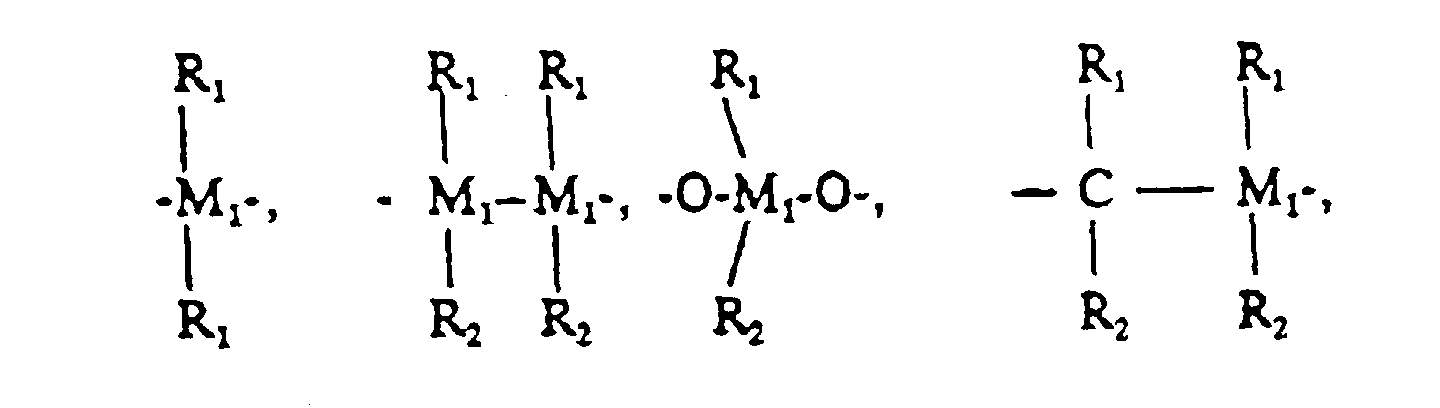
- A
- est un pont alkényle ou présente une structure choisie parmi:
BR1, = AlR1, -Ge-, -Sn-, -O-, =SO, =SO2, =NR1, =PR1 ou =P(O)R1, dans lesquelles M1 est Si, Ge ou Sn; R1 et R2, qui peuvent être identiques ou différents, sont des groupes alkyles comportant 1 à 4 atomes de carbone. ou des groupes aryles comportant 6 à 10 atomes de carbone; a, b, c sont, indépendamment, des nombres entiers de 0 à 4; e est un entier de 0 à 6 et deux ou plus des radicaux R1, R2 et R3 peuvent former un cycle.
- Les constituants selon la revendication 7, dans lesquels le dérivé de métal de transition est choisi parmi les dérivés suivants :
(Me5Cp)MMe3, (Me5Cp)M(OMe)3, (Me5Cp)MCl3, (Cp)MCl3, (Cp)MMe3, (MeCp)MMe3, (Me3Cp)MMe3, (Me4Cp)MCl3, (Ind)MBenz3, (H4Ind)MBenz3, (Cp)MBu3. - Les constituants selon la revendication 7, dans lesquels le dérivé de métal de transition est choisi parmi les dérivés suivants :
(Cp)2MMe2, (Cp)2MPh2, (Cp)2MEt2, (Cp)2MCl2, (Cp)2M(OMe)2, (Cp)2M(OMe)Cl, (MeCp)2MCl2, (Me5Cp)2MCl2, (Me5Cp)2MMe2, (Me5Cp)2MMeCl, (Cp)(Me5Cp)MCl2, (1-MeFlu)2MCl2, (BuCp)2MCl2, (Me3Cp)2MCl2, (Me4Cp)2MCl2, (Me5Cp)2M(OMe)2, (Me5Cp)2MOHCl, (Me5Cp)2M(OH)2, (Me5Cp)2M(C6H5)2, (Me5Cp)2M(CH3)Cl, (EtMe4Cp)2MCl2, [(C6H5)Me4Cp]2MCl2, (Et5Cp)2MCl2, (Me5Cp)2M(C6H5)Cl, (Ind)2MCl2, (Ind)2MMe2, (H4Ind)2MCl2, (H4Ind)2MMe2, {[Si(CH3)3]Cp}2MCl2, {[Si(CH3)3]2Cp}2MCl2, (Me4Cp)(Me5Cp)MCL2. - Les constituants selon la revendication 7, dans lesquels le dérivé de métal de transition est choisi parmi les dérivés suivants :
C2H4(Ind)2MCl2, C2H4(Ind)2MMe2, C2H4(H4Ind)2MCl2, C2H4(H4Ind)2MMe2, Me2Si(Me4Cp)2MCl2, Me2Si(Me4Cp)2MMe2, Me2SiCp2MCl2, Me9SiCp2MMe2, Me2Si(Me4Cp)2MMeOMe, Me2Si(Flu)2MCl2, Me2Si(2-Et-5-iPrCp)2MCl2, Me2Si(H4Ind)2MCl2, Me2Si(H4Flu)2MCl2, Me2SiCH2(Ind)2MCl2, Me2Si(2-Me-H4Ind)2MCl2, Me2Si(2-MeInd)2MCl2, Me2Si(2-Et-5-iPr-Cp)2MCl2, Me2Si(2-Me-5-EtCp)2MCl2, Me2Si(2-Me-5-Me-Cp)2MCl2, Me2Si(2-Me-4,5-benzoindényl)2MCl2, Me2Si(4,5-benzoindényl)2MCl2, Me2Si(EtInd)2MCl2, Me2Si(2-iPr-Ind)2MCl2, Me2Si(2-t-butyl-Ind)MCl2, Me2Si(3-t-butyl-5-MeCp)2MCl2, Me2Si(3-t-butyl-5-MeCp)2MMe2, Me2Si(2-MeInd)2MCl2, C2H4(2-Me-4,5-benzoindényl)2MCl2, Me2C(Flu)-CpMCl2, Ph2Si(Ind)2MCl2, Ph(Me)Si(Ind)2MCl2, C2H4-(H4Ind)M(NMe2)OMe, isopropylidène-(3-t-butylCp)(Flu)MCl2, Me2C(Me4Cp)(MeCp)MCl2, MeSI(Ind)2-MCl2, Me2Si(Ind)2MMe2, Me2Si(Me4Cp)2MC(OEt), C2H4(Ind)2M(NMe2)2, C2H4(Me4Cp)2MCl2, C2Me4(Ind)2MCl2, Me2Si(3-Me-Ind)2MCl2, C2H4(2-Me-Ind)2MCl2, C2H4(3-MeInd)2MCl2, C2H4(4,7-Me2Ind)2MCl2, C2H4(5,6-Me2Ind)2MCl2, C2H4(2,4,7-Me3Ind)2MCl2, C2H4(3,4,7-Me3Ind)2MCl2, C2H4(2-Me-H4Ind)2MCl2, C2H4(4,7-Me2H4Ind)2MCl2, C2H4(2,4,7-Me3H4Ind)2MCl2, Me2Si(4,7-Me2-Ind)2MCl2, Me2Si(5,6-Me2-Ind)2MCl2, Me2Si(2,4,7-Me3-H4Ind)2MCl2. - Les constituants selon une ou plusieurs des revendications précédentes, dans lesquels le prépolymère est obtenu à l'aide d'un catalyseur dont le constituant solide se trouve sous la forme de particules sphériques ayant une dimension inférieure à 100 microns. une porosité à l'azote supérieure à 0,3 cm3/g et une surface spécifique supérieure à 200 m2/g.
- Les constituants selon une ou plusieurs des revendications précédentes, dans lesquels on obtient le prépolymère à l'aide d'un catalyseur dont le constituant solide se trouve sous la forme de particules sphériques présentant une taille inférieure à 100 microns, une surface spécifique inférieure 200 m2/g et une porosité au mercure comprise entre 0,5 et 2 cm3/g.
- Les constituants selon une ou plusieurs des revendications précédentes, dans lesquels le prépolymère présente une porosité au mercure, correspondant à des pores d'un rayon pouvant atteindre jusqu'à 5 µm (50 000 Angstroems), supérieure à 0,3 cm3/g.
- Les constituants selon une ou plusieurs des revendications précédentes, dans lesquels le prépolymère présente une porosité au mercure, correspondant à des pores d'un rayon pouvant atteindre jusqu'à 5 µm (50 000 Angstroems), supérieure à 0,4 cm3/g.
- Les constituants selon une ou plusieurs des revendications précédentes, dans lesquels le prépolymère présente une porosité au mercure, correspondant à des pores d'un rayon pouvant atteindre jusqu'à 5 µm (50 000 Angstroems), supérieure à 0,5 cm3/g.
- Les constituants selon la revendication 11 ou 12, dans lesquels la teneur en titane du constituant solide est supérieure à 1 % en poids.
- Les constituants selon une ou plusieurs des revendications précédentes, susceptibles d'être obtenus en mettant le prépolymère oléfinique en contact avec une solution dans un solvant hydrocarboné d'un dérivé de métal de transition M et d'un dérivé alkyl-Al choisi parmi trialkyl-Al et polyalkylalumoxanes dans lesquels les rapports molaires Al/dérivé de métal de transition M est supérieur à 2.
- Les constituants de catalyseurs pour la polymérisation d'oléfines comprenant un prépolymère oléfinique contenant en dispersion un halogénure de magnésium sous la forme de particules ayant une dimension particulaire moyenne des cristallites inférieure à 30 nm (300 Angstroems) et un dérivé de métal de transition M, choisi parmi Ti, V, Zr et Hf, comportant au moins une liaison M-π, dans lesquels ledit dérivé dudit métal de transition M est présent sous une forme au moins partiellement combinée avec l'halogénure de magnésium et dans lequel le rapport atomique M/Mg est supérieur à 0,1.
- Les catalyseurs pour la polymérisation d'oléfines comprenant le produit de la réaction d'un constituant selon une ou plusieurs des revendications précédentes avec un dérivé alkyl-Al choisi parmi les trialkyl-Al dans lesquels le groupe alkyle comporte de 1 à 12 atomes de carbone, et les dérivés alumoxanes linéaires ou cycliques comportant le motif répétitif -(R4)AlO-, où R4 est un groupe alkyle comportant 1 à 6 atomes de carbone ou un groupe cycloalkyle ou aryle comportant 6 à 10 atomes de carbone, et contenant de 2 à 50 motifs répétitifs.
- Le catalyseur selon la revendication 19. dans lequel le dérivé alkyl-Al est un mélange de trialkyl-Al et d'un alumoxane.
- Le catalyseur selon l'une quelconque des revendications 19 ou 20, dans lequel l'alumoxane est un polyméthylalumoxane.
- Le catalyseur selon l'une quelconque des revendications 19 ou 20, dans lequel on fait réagir le dérivé trialkyl-Al avec 0,5 à 0,01 mole d'eau par mole de trialkyl-Al et dans lequel le dérivé de métal de transition M est choisi parmi :
C2H4(Ind)2MCl2, C2H4(Ind)2MMe2, C2H4(H4Ind)2MCl2, C2H4(H4Ind)2MMe2, Me2Si(Me4Cp)2MCl2, Me2Si(Me4Cp)2MMe2, Me2SiCp2MCl2, Me2SiCp2MMe2, Me2Si(Me4Cp)2MMeOMe, Me2Si(Flu)2MCl2, Me2Si(2-Et-5-iPrCp)2MCl2, Me2Si(H4Ind)2MCl2, Me2Si(H4Flu)2MCl2, Me2SiCH2(Ind)2MCl2, Me2Si(2-Me-H4Ind)2MCl2, Me2Si(2-MeInd)2MCl2, Me2Si(2-Et-5-iPr-Cp)2MCl2, Me2Si(2-Me-5-EtCp)2MCl2, Me2Si(2-Me-5-Me-Cp)2MCl2, Me2Si(2-Me-4,5-benzoindényl)2MCl2, Me2Si(4,5-benzoindényl)2MCl2, Me2Si(2-EtInd)2MCl2, Me2Si(2-iPr-Ind)2MCl2, Me2Si(2-t-butyl-Ind)MCl2, Me2Si(3-t-butyl-5-MeCp)2MCl2, Me2Si(3-t-butyl-5-MeCp)2MMe2, Me2Si(2-MeInd)2MCl2, C2H4(2-Me-4,5-benzoindényl)2MCl2, Me2C(Flu)Cp-MCl2, Ph2Si(Ind)2MCl2, Ph(Me)Si(Ind)2MCl2, C2H4-(H4Ind)M(NMe2)OMe, isopropylidène-(3-t-butylCp)(Flu)MCl2, Me2C(Me4Cp)(MeCp)MCl2, MeSi(Ind)2-MCl2, Me2Si(Ind)2MMe2, Me2Si(Me4Cp)2MC(OEt), C2H4(Ind)2M(NMe2)2, C2H4(Me4Cp)2MCl2, C2Me4(Ind)2MCl2, Me2Si(3-Me-Ind)2MCl2, C2H4(2-Me-Ind)2MCl2, C2H4(3-MeInd)2MCl2, C2H4(4,7-Me2Ind)2MCl2, C2H4(5,6-Me2Ind)2MCl2, C2H4(2,4,7-Me3Ind)2MCl2, C2H4(3,4,7-Me3Ind)2MCl2, C2H4(2-Me-H4Ind)2MCl2, C2H4(4,7-Me2H4Ind)2MCl2, C2H4(2,4,7-MeeH4Ind)2MCl2, Me2Si(4,7-Me2-Ind)2MCl2, Me2Si(5,6-Me2-Ind)2MCl2, Me2Si(2,4,7-Me3-H4Ind)2MCl2. - Un procédé de polymérisation d'oléfines CH3=CHR dans lesquelles R est un hydrogène ou un alkyle, cycloalkyle ou aryle comportant 1 à 10 atomes de carbone, dans lequel on utilise un catalyseur selon une ou plusieurs des revendications 19 à 22.
- Un procédé de polymérisation d'oléfines CH2=CHR dans lesquelles R est un radical alkyle, cycloalkyle ou aryle comportant 1 à 10 atomes de carbone, où le catalyseur utilisé est obtenu à partir d'un constituant selon la revendication 10.
- Un procédé de polymérisation de l'éthylène et de ses mélanges avec des oléfines CH2=CHR dans lesquelles R est un radical alkyle, cycloalkyle ou aryle comportant 1 à 10 atomes de carbone, dans lequel le catalyseur utilisé est obtenu à partir d'un constituant selon la revendication 10.
Applications Claiming Priority (3)
| Application Number | Priority Date | Filing Date | Title |
|---|---|---|---|
| ITMI940596 | 1994-03-29 | ||
| ITMI940596A IT1269931B (it) | 1994-03-29 | 1994-03-29 | Componenti e catalizzatori per la polimerizzazione di olefine |
| PCT/EP1995/001066 WO1995026369A1 (fr) | 1994-03-29 | 1995-03-22 | Constituants et catalyseurs destines a la polymerisation d'olefines |
Publications (2)
| Publication Number | Publication Date |
|---|---|
| EP0703930A1 EP0703930A1 (fr) | 1996-04-03 |
| EP0703930B1 true EP0703930B1 (fr) | 1998-06-03 |
Family
ID=11368402
Family Applications (1)
| Application Number | Title | Priority Date | Filing Date |
|---|---|---|---|
| EP95928876A Expired - Lifetime EP0703930B1 (fr) | 1994-03-29 | 1995-03-22 | Constituants et catalyseurs destines a la polymerisation d'olefines |
Country Status (22)
| Country | Link |
|---|---|
| US (2) | US5759940A (fr) |
| EP (1) | EP0703930B1 (fr) |
| JP (1) | JP3761571B2 (fr) |
| KR (1) | KR100357505B1 (fr) |
| CN (1) | CN1111549C (fr) |
| AT (1) | ATE166891T1 (fr) |
| AU (1) | AU694496B2 (fr) |
| BR (1) | BR9506039A (fr) |
| CA (1) | CA2163969A1 (fr) |
| DE (1) | DE69502785T2 (fr) |
| DK (1) | DK0703930T3 (fr) |
| ES (1) | ES2118614T3 (fr) |
| FI (1) | FI955734L (fr) |
| HU (1) | HU215172B (fr) |
| IL (1) | IL113136A (fr) |
| IT (1) | IT1269931B (fr) |
| NO (1) | NO309096B1 (fr) |
| PL (1) | PL181874B1 (fr) |
| RU (1) | RU2156261C2 (fr) |
| TR (1) | TR28968A (fr) |
| WO (1) | WO1995026369A1 (fr) |
| ZA (1) | ZA952491B (fr) |
Families Citing this family (70)
| Publication number | Priority date | Publication date | Assignee | Title |
|---|---|---|---|---|
| DE69428990T2 (de) * | 1993-03-31 | 2002-04-04 | Idemitsu Kosan Co. Ltd., Tokio/Tokyo | Katalysator zur herstellung von vinylpolymer und verfahren zur herstellung von vinylaromatischem polymer |
| FR2717816B1 (fr) | 1994-03-23 | 1996-04-26 | Atochem Elf Sa | Composante catalytique pour la polymérisation des oléfines obtenue par impregnation d'un prépolymère par une solution d'une composante catalytique. Prépolymère et polymère obtenus à partir de ladite composante catalytique. |
| IT1269837B (it) * | 1994-05-26 | 1997-04-15 | Spherilene Srl | Componenti e catalizzatori per la polimerizzazione delle olefine |
| EP0779837B1 (fr) * | 1994-09-08 | 2001-08-01 | Mobil Oil Corporation | Modulation catalytique de la repartition du poids moleculaire d'une resine large/bimodale dans un simple reacteur |
| US6417130B1 (en) * | 1996-03-25 | 2002-07-09 | Exxonmobil Oil Corporation | One pot preparation of bimetallic catalysts for ethylene 1-olefin copolymerization |
| EP1037931B1 (fr) | 1997-12-08 | 2004-02-04 | Albemarle Corporation | Compositions catalytiques a productivite amelioree |
| US6677265B1 (en) | 1997-12-08 | 2004-01-13 | Albemarle Corporation | Process of producing self-supported catalysts |
| US6551955B1 (en) | 1997-12-08 | 2003-04-22 | Albemarle Corporation | Particulate group 4 metallocene-aluminoxane catalyst compositions devoid of preformed support, and their preparation and their use |
| CA2294239A1 (fr) | 1998-04-21 | 1999-10-28 | Montell Technology Company B.V. | Procede de preparation de copolymeres d'ethylene a l'aide d'alpha-olefines |
| EP1015500A1 (fr) * | 1998-06-27 | 2000-07-05 | Montell Technology Company bv | Composants catalyseurs pour la polymerisation d'olefines et catalyseur ainsi obtenu |
| EP1017729B1 (fr) | 1998-07-02 | 2005-09-14 | Basell Polyolefine GmbH | Procede de preparation de polymeres d'alpha-olefine sensiblement amorphes, compositions les contenant et procede de preparation de ligand ponte |
| IT1301990B1 (it) | 1998-08-03 | 2000-07-20 | Licio Zambon | Catalizzatori per la polimerizzazione delle olefine. |
| GB9822123D0 (en) * | 1998-10-09 | 1998-12-02 | Borealis As | Catalyst |
| ATE252605T1 (de) * | 1999-03-09 | 2003-11-15 | Basell Polyolefine Gmbh | Mehrstufiges verfahren zur (co)polymersation von olefinen |
| US6265037B1 (en) | 1999-04-16 | 2001-07-24 | Andersen Corporation | Polyolefin wood fiber composite |
| KR100700393B1 (ko) * | 1999-06-17 | 2007-03-28 | 미쓰이 가가쿠 가부시키가이샤 | 에틸렌 (공)중합체 및 그 용도 |
| ITMI991552A1 (it) * | 1999-07-14 | 2001-01-14 | Licio Zambon | Componenti di catalizzatori per la polimerizzazione di olefine |
| US6194527B1 (en) * | 1999-09-22 | 2001-02-27 | Equistar Chemicals, L.P. | Process for making polyolefins |
| US6864333B2 (en) | 1999-12-28 | 2005-03-08 | Basel Polyolefine Gmbh | Process for the preparation of ethylene polymers |
| EP1157046B1 (fr) | 1999-12-28 | 2005-12-07 | Basell Polyolefine GmbH | Processus de preparation de polymeres d'ethylene |
| WO2001047939A1 (fr) | 1999-12-28 | 2001-07-05 | Basell Technology Company B.V. | Composes de metallocene heterocycliques et leur utilisation dans des systemes catalytiques pour produire des polymeres d'olefines |
| JP2004516340A (ja) | 2000-09-25 | 2004-06-03 | バセル テクノロジー カンパニー ビー.ブイ. | エチレンポリマーの製造方法 |
| US6720396B2 (en) * | 2000-11-30 | 2004-04-13 | Univation Technologies, Llc | Polymerization process |
| US20020137861A1 (en) * | 2000-12-04 | 2002-09-26 | Woo Min Song | Polymerization process |
| BR0214554A (pt) * | 2001-11-30 | 2004-11-09 | Exxonmobil Chemical Patentes I | Método de produção de catalisadores ziegler-natta/metalocenos mistos |
| WO2004022613A1 (fr) * | 2002-09-06 | 2004-03-18 | Basell Polyolefine Gmbh | Procede de copolymerisation d'ethylene |
| WO2004094487A1 (fr) | 2003-03-21 | 2004-11-04 | Dow Global Technologies, Inc. | Procede de polymerisation d'olefines avec controle de la morphologie |
| US20070004814A1 (en) * | 2003-04-17 | 2007-01-04 | Basell Polyolefine Gmbh | Process for preparing porous polymers and polymers thereof |
| US6953764B2 (en) | 2003-05-02 | 2005-10-11 | Dow Global Technologies Inc. | High activity olefin polymerization catalyst and process |
| EP1803747A1 (fr) | 2005-12-30 | 2007-07-04 | Borealis Technology Oy | Catalyseur de polymérisation à surface modifiée pour réduire la formation de gels dans des films |
| WO2007130305A2 (fr) | 2006-05-05 | 2007-11-15 | Dow Global Technologies Inc. | Complexes d'hafnium de ligands imidazoles à substitution carbazolyle |
| TW200932762A (en) | 2007-10-22 | 2009-08-01 | Univation Tech Llc | Polyethylene compositions having improved properties |
| TW200936619A (en) | 2007-11-15 | 2009-09-01 | Univation Tech Llc | Polymerization catalysts, methods of making, methods of using, and polyolefin products made therefrom |
| EP2196480A1 (fr) * | 2008-12-15 | 2010-06-16 | Max-Planck-Gesellschaft zur Förderung der Wissenschaften e.V. | Catalyseur supporté |
| US20110256632A1 (en) | 2009-01-08 | 2011-10-20 | Univation Technologies, Llc | Additive for Polyolefin Polymerization Processes |
| WO2010080871A1 (fr) | 2009-01-08 | 2010-07-15 | Univation Technologies, Llc | Additif pour procédés de polymérisation en phase gazeuse |
| WO2011011427A1 (fr) | 2009-07-23 | 2011-01-27 | Univation Technologies, Llc | Système réactionnel de polymérisation |
| EP2536767B1 (fr) | 2010-02-18 | 2015-05-06 | Univation Technologies, LLC | Procédés d'exploitation d'un réacteur de polymérisation |
| KR20130026531A (ko) | 2010-02-22 | 2013-03-13 | 유니베이션 테크놀로지즈, 엘엘씨 | 폴리올레핀 생산물을 생산하기 위한 촉매 시스템 및 이의 사용 방법 |
| BR112012025925B1 (pt) | 2010-04-13 | 2020-03-17 | Univation Technologies, Llc | Mistura polimérica e filme |
| EP2593217B1 (fr) | 2010-07-16 | 2014-07-02 | Univation Technologies, LLC | Systèmes et procédés de mesure d'accumulation de particules sur les surfaces d'un réacteur |
| WO2012009215A1 (fr) | 2010-07-16 | 2012-01-19 | Univation Technologies, Llc | Systèmes et procédés pour mesurer la charge statique portée par des particules |
| WO2012015898A1 (fr) | 2010-07-28 | 2012-02-02 | Univation Technologies, Llc | Systèmes et procédés pour mesurer la vitesse d'un mélange particule/fluide |
| CN103298842B (zh) | 2010-12-17 | 2016-08-31 | 尤尼威蒂恩技术有限责任公司 | 从聚烯烃吹扫气体产物回收烃的系统以及方法 |
| CN103347905B (zh) | 2010-12-22 | 2015-12-16 | 尤尼威蒂恩技术有限责任公司 | 用于聚烯烃聚合方法的添加剂 |
| WO2013028283A1 (fr) | 2011-08-19 | 2013-02-28 | Univation Technologies, Llc | Systèmes de catalyseur et leurs procédés d'utilisation pour la production de produits de polyoléfine |
| ES2729280T3 (es) | 2011-11-08 | 2019-10-31 | Univation Tech Llc | Métodos para producir poliolefinas con sistemas catalíticos |
| BR112014020839B1 (pt) | 2012-03-05 | 2020-09-29 | Univation Technologies, Llc | Processo para fabricação de um catalisador de polimerização de olefina, processo para fabricação de um polietileno, e polietileno |
| CA2800056A1 (fr) | 2012-12-24 | 2014-06-24 | Nova Chemicals Corporation | Compositions de melange de polyethylene |
| WO2014106143A1 (fr) | 2012-12-28 | 2014-07-03 | Univation Technologies, Llc | Catalyseur supporté doté d'une aptitude à l'écoulement améliorée |
| WO2014123598A1 (fr) | 2013-02-07 | 2014-08-14 | Univation Technologies, Llc | Préparation de polyoléfine |
| JP6360549B2 (ja) | 2013-03-15 | 2018-07-18 | ユニベーション・テクノロジーズ・エルエルシー | オレフィン重合触媒用の三座窒素系配位子 |
| CN105143280B (zh) | 2013-03-15 | 2017-06-13 | 尤尼威蒂恩技术有限责任公司 | 催化剂的配体 |
| EP3287473B1 (fr) | 2013-06-05 | 2019-10-16 | Univation Technologies, LLC | Protection de groupes phénol |
| CN106714967B (zh) | 2014-08-19 | 2020-07-17 | 尤尼威蒂恩技术有限责任公司 | 氟化催化剂载体和催化剂系统 |
| BR112017003170B1 (pt) | 2014-08-19 | 2022-02-15 | Univation Technologies, Llc | Método para fazer um suporte de catalisador de alumina-sílica fluorado e sistema de catalisador de alumina-sílica fluorado |
| WO2016028278A1 (fr) | 2014-08-19 | 2016-02-25 | Univation Technologies, Llc | Supports de catalyseurs fluorés et systèmes de catalyseurs |
| US10471641B2 (en) | 2015-01-21 | 2019-11-12 | Univation Technologies, Llc | Methods for controlling polymer chain scission |
| CA2974122C (fr) | 2015-01-21 | 2023-09-19 | Univation Technologies, Llc | Procedes de reduction de la teneur en gel des polyolefines |
| US10377841B2 (en) | 2015-05-08 | 2019-08-13 | Exxonmobil Chemical Patents Inc. | Polymerization process |
| CN106554440A (zh) * | 2015-09-30 | 2017-04-05 | 中国石油化工股份有限公司 | 用于制备聚乙烯树脂的催化剂及其制备的聚乙烯树脂 |
| WO2018063765A1 (fr) | 2016-09-27 | 2018-04-05 | Exxonmobil Chemical Patents Inc. | Procédé de polymérisation |
| WO2018063764A1 (fr) | 2016-09-27 | 2018-04-05 | Exxonmobil Chemical Patents Inc. | Procédé de polymérisation |
| WO2018064048A1 (fr) | 2016-09-27 | 2018-04-05 | Univation Technologies, Llc | Procédé de commande de ramification à longue chaîne dans la production de polyéthylène |
| WO2018063767A1 (fr) | 2016-09-27 | 2018-04-05 | Exxonmobil Chemical Patents Inc. | Processus de polymérisation |
| WO2018118155A1 (fr) | 2016-12-20 | 2018-06-28 | Exxonmobil Chemical Patents Inc. | Procédé de polymérisation |
| US11591417B2 (en) | 2017-12-13 | 2023-02-28 | Exxonmobil Chemical Patents Inc. | Deactivation methods for active components from gas phase polyolefin polymerization processes |
| WO2019173030A1 (fr) | 2018-03-08 | 2019-09-12 | Exxonmobil Chemical Patents Inc. | Procédés de préparation et de surveillance d'un lit de germination pour le démarrage d'un réacteur de polymérisation |
| CN112055720B (zh) | 2018-05-02 | 2022-11-22 | 埃克森美孚化学专利公司 | 从中试装置放大到较大生产设施的方法 |
| EP3788081B1 (fr) | 2018-05-02 | 2025-07-02 | ExxonMobil Chemical Patents Inc. | Des méthodes pour passer d'une unité pilote à une installation de production plus grande |
Citations (1)
| Publication number | Priority date | Publication date | Assignee | Title |
|---|---|---|---|---|
| EP0673950A1 (fr) * | 1994-03-23 | 1995-09-27 | Elf Atochem S.A. | Composante catalytique pour la polymérisation des oléfines obtenue par imprégnation d'un prépolymère par une solution d'une composante catalytique et polymère obtenue à partir de ladite composante catalytique |
Family Cites Families (32)
| Publication number | Priority date | Publication date | Assignee | Title |
|---|---|---|---|---|
| BE551283A (fr) * | 1955-09-27 | |||
| US2924593A (en) * | 1956-08-23 | 1960-02-09 | Hercules Powder Co Ltd | Polymerization of ethylene using as a catalyst the product formed by mixing a bis(cyclopentadienyl) zirconium salt with an alkyl metallic compound |
| SE363977B (fr) * | 1968-11-21 | 1974-02-11 | Montedison Spa | |
| YU35844B (en) * | 1968-11-25 | 1981-08-31 | Montedison Spa | Process for obtaining catalysts for the polymerization of olefines |
| SE367327B (fr) * | 1969-03-24 | 1974-05-27 | Montedison Spa | |
| GB1603724A (en) * | 1977-05-25 | 1981-11-25 | Montedison Spa | Components and catalysts for the polymerisation of alpha-olefins |
| IT1098272B (it) * | 1978-08-22 | 1985-09-07 | Montedison Spa | Componenti,di catalizzatori e catalizzatori per la polimerizzazione delle alfa-olefine |
| DE3127133A1 (de) * | 1981-07-09 | 1983-01-27 | Hoechst Ag, 6000 Frankfurt | Verfahren zur herstellung von polyolefinen und deren copolymerisaten |
| ZA844157B (en) * | 1983-06-06 | 1986-01-29 | Exxon Research Engineering Co | Process and catalyst for polyolefin density and molecular weight control |
| DE3443087A1 (de) * | 1984-11-27 | 1986-05-28 | Hoechst Ag, 6230 Frankfurt | Verfahren zur herstellung von polyolefinen |
| US4701432A (en) * | 1985-11-15 | 1987-10-20 | Exxon Chemical Patents Inc. | Supported polymerization catalyst |
| JPS63168408A (ja) * | 1986-12-29 | 1988-07-12 | Showa Denko Kk | ポリオレフインの製造方法 |
| IT1221654B (it) * | 1987-11-27 | 1990-07-12 | Ausimont Spa | Catalizzatori per la polimerizzazione delle olefine |
| US5162278A (en) * | 1988-07-15 | 1992-11-10 | Fina Technology, Inc. | Non-bridged syndiospecific metallocene catalysts and polymerization process |
| IT1230134B (it) * | 1989-04-28 | 1991-10-14 | Himont Inc | Componenti e catalizzatori per la polimerizzazione di olefine. |
| KR910011910A (ko) * | 1989-12-13 | 1991-08-07 | 사와무라 하루오 | α-올레핀의 중합방법 |
| FR2656314B1 (fr) * | 1989-12-22 | 1992-04-17 | Bp Chemicals Snc | Catalyseur a base de zirconium supporte sur du chlorure de magnesium, procede de preparation et utilisation du catalyseur dans la polymerisation des olefines. |
| TW198726B (fr) * | 1989-12-29 | 1993-01-21 | Mitsui Petroleum Chemicals Ind | |
| DE4005947A1 (de) * | 1990-02-26 | 1991-08-29 | Basf Ag | Loesliche katalysatorsysteme zur polymerisation von c(pfeil abwaerts)2(pfeil abwaerts)- bis c(pfeil abwaerts)1(pfeil abwaerts)(pfeil abwaerts)0(pfeil abwaerts)-alk-1-enen |
| FR2659337B1 (fr) * | 1990-03-12 | 1992-06-05 | Bp Chemicals Snc | Procede de preparation d'un catalyseur a base de zirconium, de titane et/ou de vanadium supporte sur du chlorure de magnesium, et utilisation du catalyseur dans la polymerisation des olefines. |
| JP2545006B2 (ja) * | 1990-07-03 | 1996-10-16 | ザ ダウ ケミカル カンパニー | 付加重合触媒 |
| ES2091273T3 (es) * | 1990-11-12 | 1996-11-01 | Hoechst Ag | Procedimiento para la preparacion de un polimero olefinico de alto peso molecular. |
| ES2071888T3 (es) * | 1990-11-12 | 1995-07-01 | Hoechst Ag | Bisindenilmetalocenos sustituidos en posicion 2, procedimiento para su preparacion y su utilizacion como catalizadores en la polimerizacion de olefinas. |
| EP0485820B1 (fr) * | 1990-11-12 | 1996-08-21 | Hoechst Aktiengesellschaft | Procédé de préparation de polymères oléfiniques |
| FR2675441B1 (fr) * | 1991-04-17 | 1997-07-18 | Gartiser Jean Paul | Dispositif de deversement lateral destine, notamment, a etre monte sur un camion ou un vehicule similaire. |
| DE4120009A1 (de) * | 1991-06-18 | 1992-12-24 | Basf Ag | Loesliche katalysatorsysteme zur herstellung von polyalk-1-enen mit hohen molmassen |
| DE4122452C2 (de) * | 1991-07-06 | 1993-10-28 | Schott Glaswerke | Verfahren und Vorrichtung zum Zünden von CVD-Plasmen |
| DE59206948D1 (de) * | 1991-11-30 | 1996-09-26 | Hoechst Ag | Metallocene mit benzokondensierten Indenylderivaten als Liganden, Verfahren zu ihrer Herstellung und ihre Verwendung als Katalysatoren |
| IT1262935B (it) * | 1992-01-31 | 1996-07-22 | Montecatini Tecnologie Srl | Componenti e catalizzatori per la polimerizzazione di olefine |
| IT1262934B (it) * | 1992-01-31 | 1996-07-22 | Montecatini Tecnologie Srl | Componenti e catalizzatori per la polimerizzazione di olefine |
| FI112233B (fi) * | 1992-04-01 | 2003-11-14 | Basell Polyolefine Gmbh | Katalyytti olefiinipolymerointia varten, menetelmä sen valmistamiseksi ja sen käyttö |
| IT1273660B (it) * | 1994-07-20 | 1997-07-09 | Spherilene Srl | Procedimento per la preparazione di polimeri amorfi del propilene |
-
1994
- 1994-03-29 IT ITMI940596A patent/IT1269931B/it active IP Right Grant
-
1995
- 1995-03-22 CA CA002163969A patent/CA2163969A1/fr not_active Abandoned
- 1995-03-22 BR BR9506039A patent/BR9506039A/pt not_active IP Right Cessation
- 1995-03-22 EP EP95928876A patent/EP0703930B1/fr not_active Expired - Lifetime
- 1995-03-22 CN CN95190239A patent/CN1111549C/zh not_active Expired - Fee Related
- 1995-03-22 FI FI955734A patent/FI955734L/fi not_active IP Right Cessation
- 1995-03-22 AT AT95928876T patent/ATE166891T1/de active
- 1995-03-22 ES ES95928876T patent/ES2118614T3/es not_active Expired - Lifetime
- 1995-03-22 KR KR1019950705350A patent/KR100357505B1/ko not_active Expired - Fee Related
- 1995-03-22 RU RU95122663/04A patent/RU2156261C2/ru not_active IP Right Cessation
- 1995-03-22 JP JP52494895A patent/JP3761571B2/ja not_active Expired - Fee Related
- 1995-03-22 DK DK95928876T patent/DK0703930T3/da active
- 1995-03-22 AU AU21108/95A patent/AU694496B2/en not_active Ceased
- 1995-03-22 PL PL95311762A patent/PL181874B1/pl not_active IP Right Cessation
- 1995-03-22 WO PCT/EP1995/001066 patent/WO1995026369A1/fr not_active Ceased
- 1995-03-22 HU HU9503837A patent/HU215172B/hu not_active IP Right Cessation
- 1995-03-22 DE DE69502785T patent/DE69502785T2/de not_active Expired - Fee Related
- 1995-03-27 US US08/409,846 patent/US5759940A/en not_active Expired - Lifetime
- 1995-03-27 ZA ZA952491A patent/ZA952491B/xx unknown
- 1995-03-27 IL IL11313695A patent/IL113136A/xx not_active IP Right Cessation
- 1995-03-29 TR TR00335/95A patent/TR28968A/xx unknown
- 1995-11-28 NO NO954831A patent/NO309096B1/no not_active IP Right Cessation
-
1997
- 1997-07-01 US US08/886,784 patent/US6096841A/en not_active Expired - Fee Related
Patent Citations (1)
| Publication number | Priority date | Publication date | Assignee | Title |
|---|---|---|---|---|
| EP0673950A1 (fr) * | 1994-03-23 | 1995-09-27 | Elf Atochem S.A. | Composante catalytique pour la polymérisation des oléfines obtenue par imprégnation d'un prépolymère par une solution d'une composante catalytique et polymère obtenue à partir de ladite composante catalytique |
Non-Patent Citations (1)
| Title |
|---|
| Introduzione all Chimica Analitica, Piccin Editore Padua Italia, 1970, page 14 * |
Also Published As
Similar Documents
| Publication | Publication Date | Title |
|---|---|---|
| EP0703930B1 (fr) | Constituants et catalyseurs destines a la polymerisation d'olefines | |
| EP0712416B1 (fr) | Constituants et catalyseurs destines a la polymerisation des olefines | |
| US6399533B2 (en) | Compounds and catalysts for the polymerization of olefins | |
| EP0717755B1 (fr) | Composants et catalyseurs pour la polymerisation d'olefines | |
| KR100375361B1 (ko) | 올레핀류의다단계(공)중합방법 | |
| JP4951351B2 (ja) | メタロセン触媒用の活性化担体 | |
| EP0874003A1 (fr) | Procédé pour la copolymérisation des oléfines | |
| CA2036767A1 (fr) | Catalyseur et prepolymere utilises pour la polymerisation d'olefines, et polymere (co-) d'ethylene qu'on peut obtenir ainsi | |
| JPH04220405A (ja) | オレフィン類の重合化に使用される触媒とプレポリマー、及びこれらから得られるエチレンの(共)重合体 | |
| US5654248A (en) | Catalyst for polymerizing alpha-olefins and process for polymerization | |
| US6063726A (en) | Catalyst for polymerizing alpha-olefins and process for polymerization | |
| JPH06345817A (ja) | 固体触媒成分およびこれを用いたオレフィンの重合方法 | |
| JPH06345816A (ja) | 固体触媒成分およびこれを用いたオレフィンの重合方法 | |
| MXPA95004939A (en) | Components and catalysts for olefi polymerization | |
| MXPA00003277A (en) | Pre-polymerized catalyst components for the polymerization of olefins |
Legal Events
| Date | Code | Title | Description |
|---|---|---|---|
| PUAI | Public reference made under article 153(3) epc to a published international application that has entered the european phase |
Free format text: ORIGINAL CODE: 0009012 |
|
| AK | Designated contracting states |
Kind code of ref document: A1 Designated state(s): AT BE CH DE DK ES FR GB IT LI NL SE |
|
| 17P | Request for examination filed |
Effective date: 19960329 |
|
| 17Q | First examination report despatched |
Effective date: 19970128 |
|
| GRAG | Despatch of communication of intention to grant |
Free format text: ORIGINAL CODE: EPIDOS AGRA |
|
| GRAG | Despatch of communication of intention to grant |
Free format text: ORIGINAL CODE: EPIDOS AGRA |
|
| GRAH | Despatch of communication of intention to grant a patent |
Free format text: ORIGINAL CODE: EPIDOS IGRA |
|
| RBV | Designated contracting states (corrected) |
Designated state(s): AT BE CH DE DK ES FR GB IT LI NL SE |
|
| GRAH | Despatch of communication of intention to grant a patent |
Free format text: ORIGINAL CODE: EPIDOS IGRA |
|
| GRAA | (expected) grant |
Free format text: ORIGINAL CODE: 0009210 |
|
| AK | Designated contracting states |
Kind code of ref document: B1 Designated state(s): AT BE CH DE DK ES FR GB IT LI NL SE |
|
| REF | Corresponds to: |
Ref document number: 166891 Country of ref document: AT Date of ref document: 19980615 Kind code of ref document: T |
|
| ITF | It: translation for a ep patent filed | ||
| REG | Reference to a national code |
Ref country code: CH Ref legal event code: NV Representative=s name: KEMIA S.A. Ref country code: CH Ref legal event code: EP |
|
| REF | Corresponds to: |
Ref document number: 69502785 Country of ref document: DE Date of ref document: 19980709 |
|
| ET | Fr: translation filed | ||
| REG | Reference to a national code |
Ref country code: ES Ref legal event code: FG2A Ref document number: 2118614 Country of ref document: ES Kind code of ref document: T3 |
|
| REG | Reference to a national code |
Ref country code: DK Ref legal event code: T3 |
|
| PLBI | Opposition filed |
Free format text: ORIGINAL CODE: 0009260 |
|
| PLBF | Reply of patent proprietor to notice(s) of opposition |
Free format text: ORIGINAL CODE: EPIDOS OBSO |
|
| 26 | Opposition filed |
Opponent name: TARGOR GMBH C/O BASF AG Effective date: 19990303 |
|
| NLR1 | Nl: opposition has been filed with the epo |
Opponent name: TARGOR GMBH C/O BASF AG |
|
| PLBF | Reply of patent proprietor to notice(s) of opposition |
Free format text: ORIGINAL CODE: EPIDOS OBSO |
|
| PLBF | Reply of patent proprietor to notice(s) of opposition |
Free format text: ORIGINAL CODE: EPIDOS OBSO |
|
| PLBL | Opposition procedure terminated |
Free format text: ORIGINAL CODE: EPIDOS OPPC |
|
| PLAB | Opposition data, opponent's data or that of the opponent's representative modified |
Free format text: ORIGINAL CODE: 0009299OPPO |
|
| PLBM | Termination of opposition procedure: date of legal effect published |
Free format text: ORIGINAL CODE: 0009276 |
|
| STAA | Information on the status of an ep patent application or granted ep patent |
Free format text: STATUS: OPPOSITION PROCEDURE CLOSED |
|
| PGFP | Annual fee paid to national office [announced via postgrant information from national office to epo] |
Ref country code: SE Payment date: 20010306 Year of fee payment: 7 |
|
| PGFP | Annual fee paid to national office [announced via postgrant information from national office to epo] |
Ref country code: DK Payment date: 20010313 Year of fee payment: 7 Ref country code: AT Payment date: 20010313 Year of fee payment: 7 |
|
| 27C | Opposition proceedings terminated |
Effective date: 20001102 |
|
| PGFP | Annual fee paid to national office [announced via postgrant information from national office to epo] |
Ref country code: CH Payment date: 20010327 Year of fee payment: 7 |
|
| NLR2 | Nl: decision of opposition | ||
| REG | Reference to a national code |
Ref country code: GB Ref legal event code: IF02 |
|
| PG25 | Lapsed in a contracting state [announced via postgrant information from national office to epo] |
Ref country code: AT Free format text: LAPSE BECAUSE OF NON-PAYMENT OF DUE FEES Effective date: 20020322 |
|
| PG25 | Lapsed in a contracting state [announced via postgrant information from national office to epo] |
Ref country code: SE Free format text: LAPSE BECAUSE OF NON-PAYMENT OF DUE FEES Effective date: 20020323 |
|
| PG25 | Lapsed in a contracting state [announced via postgrant information from national office to epo] |
Ref country code: LI Free format text: LAPSE BECAUSE OF NON-PAYMENT OF DUE FEES Effective date: 20020331 Ref country code: CH Free format text: LAPSE BECAUSE OF NON-PAYMENT OF DUE FEES Effective date: 20020331 |
|
| PG25 | Lapsed in a contracting state [announced via postgrant information from national office to epo] |
Ref country code: DK Free format text: LAPSE BECAUSE OF NON-PAYMENT OF DUE FEES Effective date: 20020402 |
|
| EUG | Se: european patent has lapsed |
Ref document number: 95928876.2 |
|
| REG | Reference to a national code |
Ref country code: CH Ref legal event code: PL |
|
| REG | Reference to a national code |
Ref country code: DK Ref legal event code: EBP |
|
| PLAB | Opposition data, opponent's data or that of the opponent's representative modified |
Free format text: ORIGINAL CODE: 0009299OPPO |
|
| PGFP | Annual fee paid to national office [announced via postgrant information from national office to epo] |
Ref country code: NL Payment date: 20050301 Year of fee payment: 11 |
|
| PGFP | Annual fee paid to national office [announced via postgrant information from national office to epo] |
Ref country code: ES Payment date: 20050407 Year of fee payment: 11 |
|
| PGFP | Annual fee paid to national office [announced via postgrant information from national office to epo] |
Ref country code: BE Payment date: 20050429 Year of fee payment: 11 |
|
| PG25 | Lapsed in a contracting state [announced via postgrant information from national office to epo] |
Ref country code: ES Free format text: LAPSE BECAUSE OF NON-PAYMENT OF DUE FEES Effective date: 20060323 |
|
| PG25 | Lapsed in a contracting state [announced via postgrant information from national office to epo] |
Ref country code: BE Free format text: LAPSE BECAUSE OF NON-PAYMENT OF DUE FEES Effective date: 20060331 |
|
| PG25 | Lapsed in a contracting state [announced via postgrant information from national office to epo] |
Ref country code: NL Free format text: LAPSE BECAUSE OF NON-PAYMENT OF DUE FEES Effective date: 20061001 |
|
| NLV4 | Nl: lapsed or anulled due to non-payment of the annual fee |
Effective date: 20061001 |
|
| REG | Reference to a national code |
Ref country code: ES Ref legal event code: FD2A Effective date: 20060323 |
|
| BERE | Be: lapsed |
Owner name: *MONTELL TECHNOLOGY CY B.V. Effective date: 20060331 |
|
| PGFP | Annual fee paid to national office [announced via postgrant information from national office to epo] |
Ref country code: IT Payment date: 20090331 Year of fee payment: 15 Ref country code: DE Payment date: 20090402 Year of fee payment: 15 |
|
| PGFP | Annual fee paid to national office [announced via postgrant information from national office to epo] |
Ref country code: FR Payment date: 20090317 Year of fee payment: 15 |
|
| PGFP | Annual fee paid to national office [announced via postgrant information from national office to epo] |
Ref country code: GB Payment date: 20090403 Year of fee payment: 15 |
|
| GBPC | Gb: european patent ceased through non-payment of renewal fee |
Effective date: 20100322 |
|
| REG | Reference to a national code |
Ref country code: FR Ref legal event code: ST Effective date: 20101130 |
|
| PG25 | Lapsed in a contracting state [announced via postgrant information from national office to epo] |
Ref country code: FR Free format text: LAPSE BECAUSE OF NON-PAYMENT OF DUE FEES Effective date: 20100331 |
|
| PG25 | Lapsed in a contracting state [announced via postgrant information from national office to epo] |
Ref country code: DE Free format text: LAPSE BECAUSE OF NON-PAYMENT OF DUE FEES Effective date: 20101001 |
|
| PG25 | Lapsed in a contracting state [announced via postgrant information from national office to epo] |
Ref country code: IT Free format text: LAPSE BECAUSE OF NON-PAYMENT OF DUE FEES Effective date: 20100322 Ref country code: GB Free format text: LAPSE BECAUSE OF NON-PAYMENT OF DUE FEES Effective date: 20100322 |