EP0704718A1 - Positiv arbeitende lichtempfindliche Zusammensetzungen zur Herstellung von Linsen - Google Patents
Positiv arbeitende lichtempfindliche Zusammensetzungen zur Herstellung von Linsen Download PDFInfo
- Publication number
- EP0704718A1 EP0704718A1 EP95118387A EP95118387A EP0704718A1 EP 0704718 A1 EP0704718 A1 EP 0704718A1 EP 95118387 A EP95118387 A EP 95118387A EP 95118387 A EP95118387 A EP 95118387A EP 0704718 A1 EP0704718 A1 EP 0704718A1
- Authority
- EP
- European Patent Office
- Prior art keywords
- resin
- group
- hydroxyl groups
- photosensitive
- naphthoquinone diazide
- Prior art date
- Legal status (The legal status is an assumption and is not a legal conclusion. Google has not performed a legal analysis and makes no representation as to the accuracy of the status listed.)
- Granted
Links
Images

Classifications
-
- G—PHYSICS
- G02—OPTICS
- G02B—OPTICAL ELEMENTS, SYSTEMS OR APPARATUS
- G02B1/00—Optical elements characterised by the material of which they are made; Optical coatings for optical elements
- G02B1/10—Optical coatings produced by application to, or surface treatment of, optical elements
-
- G—PHYSICS
- G03—PHOTOGRAPHY; CINEMATOGRAPHY; ANALOGOUS TECHNIQUES USING WAVES OTHER THAN OPTICAL WAVES; ELECTROGRAPHY; HOLOGRAPHY
- G03F—PHOTOMECHANICAL PRODUCTION OF TEXTURED OR PATTERNED SURFACES, e.g. FOR PRINTING, FOR PROCESSING OF SEMICONDUCTOR DEVICES; MATERIALS THEREFOR; ORIGINALS THEREFOR; APPARATUS SPECIALLY ADAPTED THEREFOR
- G03F7/00—Photomechanical, e.g. photolithographic, production of textured or patterned surfaces, e.g. printing surfaces; Materials therefor, e.g. comprising photoresists; Apparatus specially adapted therefor
- G03F7/004—Photosensitive materials
- G03F7/022—Quinonediazides
- G03F7/023—Macromolecular quinonediazides; Macromolecular additives, e.g. binders
- G03F7/0233—Macromolecular quinonediazides; Macromolecular additives, e.g. binders characterised by the polymeric binders or the macromolecular additives other than the macromolecular quinonediazides
- G03F7/0236—Condensation products of carbonyl compounds and phenolic compounds, e.g. novolak resins
-
- G—PHYSICS
- G02—OPTICS
- G02B—OPTICAL ELEMENTS, SYSTEMS OR APPARATUS
- G02B1/00—Optical elements characterised by the material of which they are made; Optical coatings for optical elements
- G02B1/04—Optical elements characterised by the material of which they are made; Optical coatings for optical elements made of organic materials, e.g. plastics
-
- G—PHYSICS
- G02—OPTICS
- G02B—OPTICAL ELEMENTS, SYSTEMS OR APPARATUS
- G02B3/00—Simple or compound lenses
-
- G—PHYSICS
- G02—OPTICS
- G02B—OPTICAL ELEMENTS, SYSTEMS OR APPARATUS
- G02B3/00—Simple or compound lenses
- G02B3/0006—Arrays
- G02B3/0012—Arrays characterised by the manufacturing method
- G02B3/0018—Reflow, i.e. characterized by the step of melting microstructures to form curved surfaces, e.g. manufacturing of moulds and surfaces for transfer etching
-
- G—PHYSICS
- G03—PHOTOGRAPHY; CINEMATOGRAPHY; ANALOGOUS TECHNIQUES USING WAVES OTHER THAN OPTICAL WAVES; ELECTROGRAPHY; HOLOGRAPHY
- G03F—PHOTOMECHANICAL PRODUCTION OF TEXTURED OR PATTERNED SURFACES, e.g. FOR PRINTING, FOR PROCESSING OF SEMICONDUCTOR DEVICES; MATERIALS THEREFOR; ORIGINALS THEREFOR; APPARATUS SPECIALLY ADAPTED THEREFOR
- G03F7/00—Photomechanical, e.g. photolithographic, production of textured or patterned surfaces, e.g. printing surfaces; Materials therefor, e.g. comprising photoresists; Apparatus specially adapted therefor
- G03F7/0005—Production of optical devices or components in so far as characterised by the lithographic processes or materials used therefor
- G03F7/001—Phase modulating patterns, e.g. refractive index patterns
-
- B—PERFORMING OPERATIONS; TRANSPORTING
- B29—WORKING OF PLASTICS; WORKING OF SUBSTANCES IN A PLASTIC STATE IN GENERAL
- B29L—INDEXING SCHEME ASSOCIATED WITH SUBCLASS B29C, RELATING TO PARTICULAR ARTICLES
- B29L2011/00—Optical elements, e.g. lenses, prisms
- B29L2011/0016—Lenses
Definitions
- the present invention relates to a positive photosensitive composition useful as a material for forming micro focussing lenses on a color filter for e.g. a color charge coupled device or a color liquid crystal display.
- the precision for lamination of the color filter and the CCD or MOS chip is required to be not more than 2 ⁇ m, and it is difficult to attain the requirement for high image quality. Further, if bubbles remain in the lamination plane, there will be various problems, and it has a problem that the yield can not be improved adequately. Therefore, this method is now being replaced by the on-chip method.
- color filter layers and interlayers are alternately laminated in two or three layers on the surface of a device having a photodiode formed on a silicon substrate.
- a photosensitive material having a dichromate incorporated to gelatin, casein, polyvinyl alcohol or glue, is employed.
- a photosensitive material is, after curing and patterning, dyed with a dyestuff having prescribed spectral characteristics.
- a heat or light curable polyglycidyl methacrylate (PGMA) type or a modified PGMA type is employed.
- PGMA heat or light curable polyglycidyl methacrylate
- a modified PGMA type is employed.
- a surface protecting layer is provided on the color filter layers and interlayers to make the surface flat.
- micro focussing lenses are provided as the top layer.
- there lenses are effective for improving the sensitivity of the device and reducing the returning strain of output signals of the device, and thus formation of such lenses has become an essential condition for a color charge coupled device.
- the lens-forming material With respect to the lens-forming material, there is no commercially available product, and a material for another purpose is usually employed.
- the properties required for the lens material include an excellent lens-forming ability and a resist function of high sensitivity with a high resolution in addition to a high refractive index, high transparency in a visible light range and excellent heat resistance, solvent resistance and light resistance after patterning.
- micro focussing lenses can be formed by coating, prebaking, exposure, development and heat treatment.
- the heat resistance, solvent resistance and light resistance after the patterning tend to be inadequate.
- the heat resistance there are serious problems such that when heated again after the formation of lenses, the lens pattern flows again, and the transparency deteriorates substantially. Therefore, such material can not be used as a lens material.
- Another object of this invention is to provide a process for producing the composition.
- a further object of this invention is to provide the use of the composition for forming micro lenses provided on a charge coupled device.
- the present inventors have conducted extensive researches with such back ground. As a result, it has been found that when an alkali-soluble polymer having an aromatic ring component and a carboxylic acid component, or a hydrogenation product and/or a resin having hydroxyl groups partially modified, of a vinylphenol polymer or a novolak resin which is a condensation product of a phenol with an aldehyde, is used as the base polymer, the transparency will not deteriorate when the lenses are heated again after being molded, and that the above object can be accomplished with a positive photosensitive composition comprising such as base polymer, a naphthoquinone diazide photosensitive agent, and a thermosetting agent capable of imparting heat resistance and solvent resistance to the lenses thereby formed.
- the present invention has been accomplished on the basis of such discoveries.
- the present invention provides a positive photosensitive composition for forming lenses, which comprises a polymer, a photosensitive agent, a thermosetting agent and a solvent, wherein said polymer is an alkali-soluble resin, said photosensitive agent is a 1,2-naphthoquinone diazide sulfonate, and said thermosetting agent is a thermosetting agent capable of imparting heat resistance and solvent resistance at the time of forming lenses by heat treatment.
- the present invention provides a positive photosensitive composition which comprises as said polymer, a resin comprising structural units of the following formula (1) or (2), or a hydrogenation product and/or a resin having hydroxyl groups partially modified, of a vinylphenol polymer or a novolak resin which is a polycondensation product of a phenol with an aldehyde, a 1,2-naphthoquinone diazide sulfonate of the formula (3), (4) or (5) and a thermosetting agent capable of imparting heat resistance and solvent resistance to the lenses thereby formed.
- a resin comprising structural units of the following formula (1) or (2), or a hydrogenation product and/or a resin having hydroxyl groups partially modified, of a vinylphenol polymer or a novolak resin which is a polycondensation product of a phenol with an aldehyde, a 1,2-naphthoquinone diazide sulfonate of the formula (3), (4) or (5) and a
- R1 is hydrogen or a methyl group
- A is OA1 or NA2A3 wherein each of A1, A2 and A3 is hydrogen, a C1-C6 alkyl group, a C6-C12 aryl group or a C7-C12 aralkyl group, each of k and m is an integer of at least l, and each of l and n is an integer inclusive of O.
- R1 is hydrogen or a methyl group
- each of R2 and R3 is hydrogen, a methyl group, chlorine or bromine
- A is OA1 or NA2A3 wherein each of A1, A2 and A3 is hydrogen, a C1-C6 alkyl group, a C6-C12 aryl group or a C7-C12 aralkyl group, each of x and y is an integer inclusive of O, and z is an integer of at least l.
- each of X1, X2 and X3 is hydrogen or OD
- each of X4, X5 and X6 is hydrogen, a C1-C6 alkyl group or OD
- B is a C1-C6 alkyl group, a C6-C12 aryl group, or C7-C12 aralkyl group
- D is hydrogen, a 1,2-naphthoquinone diazide-4-sulfonyl group or a 1,2-naphthoquinone diazide-5-sulfonyl group, provided at least one is a 1,2-naphthoquinone diazide-4-sulfonyl group or a 1,2-naphthoquinone diazide-5-sulfonyl group.
- reference numeral 11 designates a silicon wafer
- numeral 12 indicates a flattened layer
- numeral 13 indicates a color filter
- numeral 14 indicates a protecting interlayer
- numeral 15 indicates a surface protecting layer
- numeral 16 indicates a lens
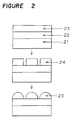
- numeral 21 indicates a color filter layer
- numeral 22 indicates a surface protecting layer
- numeral 24 indicates a patterning of lens-forming material
- numeral 25 indicates heat treatment after patterning.
- thermosetting agent having the above mentioned properties
- a melamine compound of the formula (6) is effective. wherein W is -NY5Y6 or a phenyl group, each of Y1 to Y6 is hydrogen or -CH2OZ wherein Z is hydrogen or a C1-C6 alkyl group.
- the alkyl group for A1-A3, B, X4-X6 and Z includes a methyl group, an ethyl group, a n-propyl group, an isopropyl group, a n-butyl group, an isobutyl group, a t-butyl group, a n-amyl group, an isoamyl group, a n-hexyl group or a cyclohexyl group
- the aryl group for A1-A3 and B includes a phenyl group, a tolyl group, a xylyl group, an ethylphenyl group and a naphthyl group, wherein the benzene ring may be substituted by a halogen such as chlorine or bromine, a nitro group, or a cyano group.
- the aralkyl group includes a benzyl group and phenethyl group, wherein the benzene ring may be substituted by a halogen such as chlorine or bromine, a nitro group, or a cyano group.
- preparation of alkali-soluble polymers is not particularly limited.
- they may be prepared by the following methods.
- a ( ⁇ -methyl)styrene/maleic anhydride copolymer is prepared by solution or bulk radical polymerization in accordance with a usual method, followed by esterification with an alcohol or an amide-forming reaction with an amine to obtain the desired resin. Otherwise, it may be prepared by subjecting a styrene/maleate copolymer to solution or bulk radical polymerization in accordance with a usual method.
- a ( ⁇ -methyl)styrene/(meth)acrylic acid or ( ⁇ -methyl)styrene/(meth)acrylate copolymer is prepared by solution radical polymerization or the like in accordance with a usual method, followed by esterification or an amide forming reaction, or by hydrolysis to obtain the desired resin. Otherwise, it may be prepared by a method wherein esterified or amide-modified monomers are subjected to multi-component copolymerization, or by a method wherein a poly(meth)acrylic acid is subjected to esterification or amide-forming reaction.
- the hydrogenation product can be prepared by the methods disclosed in e.g. Japanese Unexamined Patent Publications No. 103604/1989, No. 4254/1990, No. 29751/1990 and 29752/1990.
- the modification of hydroxyl groups of the vinylphenol polymer or the novolak resin may be conducted by a reaction such as alkylation, acylation or sulfonylation.
- the alkylation can be conducted by reacting a resin and an alkyl halide in the presence of a basic catalyst
- the acylation and sulfonylation can be conducted by reacting a resin with a carboxylic acid or sulfonic acid, or with a carbonyl halide or sulfonyl halide, in the presence of an acid catalyst or a basic catalyst.
- the photosensitive agent to be used in the present invention is a 1,2-naphthoquinone diazide sulfonate of the formula (3), (4) or (5), wherein the ester moiety includes, for example, 2,4-dihydroxybenzophenone, 2,3,4-trihydroxybenzophenone, 2,3,4,4'-tetrahydroxybenzophenone, 2,2'3,4,4'-pentahydroxybenzophenone, phenol, 1,3-dihydroxybenzene. 1,3,5-trihydroxybenzene, methyl gallate, ethyl gallate and phenyl gallate.
- thermosetting agent to be used in the present invention is not particularly limited, so long as it does not deteriorate the properties.
- the one having particularly excellent properties is a melamine compound of the formula (6). Specifically, it includes, hexamethylolmelamine, an alkylated hexamethylolmelaminer a partially methylol-modified melamine and an alkylated product thereof, tetramethylolbenzoguanamine, an alkylated tetramethylolbenzoguanamine, a partially methylol-modified benzoguanamine and an alkylated product thereof.
- the positive photosensitive composition of the present invention comprises the above mentioned alkali-soluble resin, the photosensitive agent and the thermosetting agent, and the present invention has features in the respective materials and the combination thereof. Namely, an alkali-soluble system having a high refractive index and excellent transparency can be realized by using as the base resin a polymer having a polystyrene backbone and carboxylic acid simultaneously, or a hydrogenation product and/or a resin having hydroxyl groups partially modified, of a vinylphenol polymer or a novolak resin. Besides, the transparency is free from change with time, as an additional feature. A polymer having a polystyrene backbone(s) and a carboxylic acid group(s) is especially excellent in transparency.
- the photosensitive agent By using a 1,2-naphthoquinone diazide sulfonate as the photosensitive agent and by mixing it with the above mentioned alkali-soluble resin, it is possible to realize a resist having a high resolution which does not swell in an alkaline developing solution. Further, a thermosetting agent is necessary to impart the heat resistance and the solvent resistance. Further, it is thereby possible to conduct heat curing at the same time as the formation of the lenses. This is very advantageous from the viewpoint of the process.
- the proportions of the alkali-soluble resin, the photosensitive agent and the thermosetting agent may be varied within a range where the desired properties can be maintained. However, the following range is, for example, preferred.
- the photosensitive agent is preferably from 10 to 30% by weight relative to the resin, and the thermosetting agent is preferably from 5 to 30% by weight relative to the solid content.
- the thermosetting agent is preferably from 5 to 30% by weight relative to the solid content.
- the positive photosensitive composition of the present invention can be obtained by dissolving the resin, the photosensitive agent and the thermosetting agent in a suitable solvent so that the solid content will be from 10 to 40% by weight based on the composition.
- the solvent may be, for example, an ethylene glycol monoalkylether or its acetate, a propylene glycol monoalkylether or its acetate, diethylene glycol mono- or di-alkyl ether, a ketone such as methyl ethyl ketone, methyl isobutyl ketone or cyclohexanone, an acetic acid ester such as ethyl acetate or butyl acetate, an aromatic hydrocarbon such as toluene or xylene, ethyl lactate, diacetone alcohol, dimethylacetamide, dimethylformamide or N-methylpyrrolidone.
- solvents may be used alone or in combination as a mixture of two or more. Further, as the case requires, it is possible to add a surfactant of nonionic type, fluorine type or silicon type in order to improve the coating properties. Further, if necessary, other compatible additives may be incorporated.
- the positive photosensitive composition of the present invention is useful for forming a resist pattern by e.g. ultraviolet rays, deep ultraviolet rays, electron beams or X-rays, and it is excellent in the sensitivity and the resolution. Particularly, it is possible to form focussing lenses by conducting baking treatment after formation of the pattern.
- the formed lenses have a high refractive index and are excellent in the transparency, the heat resistance and the solvent resistance.
- the method to be used for forming a resist pattern by irradiation with radiation using the positive photosensitive composition of the present invention there is no particular restriction as to the method to be used for forming a resist pattern by irradiation with radiation using the positive photosensitive composition of the present invention, and formation of the resist pattern can be conducted by a commonly employed method. Further, the lens pattern can be obtained by conducting baking treatment after forming the resist pattern.
- a photosensitive resin solution is prepared by dissolving the alkali-soluble resin of the present invention, the photosensitive agent and the thermosetting agent in a solvent and removing insoluble components by filtration (e.g. by means of a filter with an opening diameter of about 0.2 ⁇ m).
- the photosensitive resin solution is spin-coated on a substrate such as a silicon wafer or on a resin hard-baked on a solicon wafer, followed by prebaking to obtain a photosensitive resin layer.
- exposure is conducted by means of e.g. a stepper, a proximity alinger, a mirror projection or an electron beam exposure apparatus, followed by development and rinsing to form a resist pattern.
- an aqueous solution of an inorganic alkali such as sodium hydroxide, potassium hydroxide, sodium carbonate, sodium silicate, sodium methasilicate or aqueous ammonia, a primary amine such as ethylamine or n-propylamine, a secondary amine such as diethylamine or di-n-butylamine, a tertiary amine such as triethylamine or methyldiethylamine, an alcohol amine such as dimethylethanol amine or triethanol amine, tetramethyl ammonium hydroxide, tetraethyl ammonium hydroxide, or choline, can be used.
- an inorganic alkali such as sodium hydroxide, potassium hydroxide, sodium carbonate, sodium silicate, sodium methasilicate or aqueous ammonia
- a primary amine such as ethylamine or n-propylamine
- a secondary amine such as diethylamine or di-n
- an alcohol or a surfactant may be incorporated in a suitable amount to the above aqueous alkaline solution.
- the coating, the baking, the exposure, the development, the rinsing and other processings can be conducted by methods commonly employed for forming resist patterns for the production of integrated circuits, etc.
- a resist pattern can be formed.
- a lens pattern can be formed by firstly subjecting the formed resist pattern to entire surface exposure with ultraviolet rays to impart-transparency, followed by heat treatment on a hot plate or in a convection oven at a prescribed temperature within a range of from 100 to 160°C, preferably from 130 to 160°C, for a predetermined period of time within a range of from 1 to 30 minutes.
- the shape and the curvature of the lenses can optionally be selected by adjusting upon the presetting conditions.
- a white powder was recovered and vacuum-dried to obtain a partial benzyl ester of a styrene/methacrylic acid copolymer (esterification rate: 50% to methacrylic acid, as determined by potentiometric titration).
- the obtained amount was 32.5 g.
- a white powder was recovered and vacuum-dried to obtain a partial benzyl ester of a polymethacrylic acid (esterification rate: 80% as determined by potentiometric titration).
- the obtained amount was 35.0 g.
- the weight average molecular weight measured by GPC was 6,000 as calculated as polystyrene.
- the precipitate was collected by filtration, washed and then vacuum-dried to obtain 20.5 g of a methane sulfonyl-modified novolak resin (sulfonylation rate: 10 mol% as calculated from the elemental analytical values) as a white resin powder.
- the resist solution was spin-coated on a silicon substrate to form a resist layer having a thickness of 2.0 ⁇ m, followed by prebaking at 90°C for 90 seconds on a hot plate. Then, the resist layer was subjected to exposure with a g-line reduced projection exposure apparatus (DSW 6300A, GCA) and then developed with a 1% tetramethyl ammonium hydroxide aqueous solution. The patterning was able to resolve 1 ⁇ mL/S with 200 mJ/cm2.
- the refractive index of the lens patterns was 1.58, which is a satisfactory value for a lens material.
- the transparency of the lens patterns in the visible light range was excellent and, for example, was 98.0% (1 ⁇ m thickness) with 400 nm. Even after heat treatment at 200°C for one hour, no change was observed in the transparency. With respect to the solvent resistance, no surface roughening was observed when the product was immersed in a solvent such as water, isopropyl alcohol, trichloroethane or xylene.
- a solvent such as water, isopropyl alcohol, trichloroethane or xylene.
- Example 1 patterning and lens-forming were conducted in accordance with Example 1. Development was conducted with a 1.5% tetramethyl ammonium hydroxide aqueous solution, whereby it was possible to resolve 1 ⁇ mL/S with a sensitivity of 150 mJ/cm2. With respect to the lens-forming ability, it was possible to prepare lens patterns having various curvatures depending upon the respective temperatures, as in Example 1. No deformation of patterns was observed even when they were subjected to heat treatment at 200°C after formation of the lens patterns.
- the refractive index of the lens patterns was 1.58, which is a satisfactory value of a lens material.
- the transparency of the lens patterns in a visible light range was excellent and was, for example, 98.5% (1 ⁇ m thickness) with 400 nm. No change in the transparency was observed even after the heat treatment at 200°C for one hour. With respect to the solvent resistance, no surface roughening was observed when the product was immersed in a solvent such as water, isopropyl alcohol, trichloroethane or xylene.
- a solvent such as water, isopropyl alcohol, trichloroethane or xylene.
- Example 1 patterning and lens-forming were conducted in accordance with Example 1. Development was conducted with a 1.0% tetramethyl ammonium hydroxide aqueous solution, whereby it was possible to resolve 1 ⁇ mL/S with a sensitivity of 240 mJ/cm2. With respect to the lens-forming ability, it was possible to prepare lens patterns having various curvatures depending upon the respective temperatures, as in Example 1. No deformation of patterns was observed even when they were subjected to heat treatment at 200°C after formation of the lens patterns.
- the refractive index of the lens patterns was 1.58, which is a satisfactory value of a lens material.
- the transparency of the lens patterns in a visible light range was excellent and for example, was 97.0% (1 ⁇ m thickness) with 400 nm. No change in the transparency was observed even after the heat treatment at 200°C for one hour. With respect to the solvent resistance, no surface roughening was observed when the product was immersed in a solvent such as water, isopropyl alcohol, trichloroethane or xylene.
- a solvent such as water, isopropyl alcohol, trichloroethane or xylene.
- the refractive index of the lens patterns was 1.58, which is a satisfactory value for a lens material.
- the transparency of the lens patterns in a visible light range was excellent and for example, was 95.0% (1 ⁇ m thickness) with 400 nm. No change in the transparency was observed even after the heat treatment at 200°C for one hour. With respect to the solvent resistance, no surface roughening was observed when the product was immersed in a solvent such as water, isopropyl alcohol, trichloroethane or xylene.
- a solvent such as water, isopropyl alcohol, trichloroethane or xylene.
- Example 2 was repeated without adding the thermosetting agent (hexamethoxymethylol melamine).
- the patterning and lens-forming were good, but when heat treatment was conducted at 160°C after formation of the lens patterns, flow of the patterns was observed, and the lens shape could not be maintained. Further, also with respect to the solvent resistance, surface roughening, swelling and a change in the layer thickness were observed when the sample was immersed in a solvent such as isopropyl alcohol, trichloroethane or xylene.
- a solvent such as isopropyl alcohol, trichloroethane or xylene.
- the patterning and the lens-forming ability were good, but the transparency after treating at 200°C by an accelerated test, was very poor, and such is not useful as a lens material.
- the positive photosensitive composition of the present invention comprising an alkali-soluble resin, a photosensitive agent composed of a 1,2-naphthoquinone diazide sulfonate and a thermosetting agent, is a positive resist having high sensitivity and high resolution and is capable of forming lenses by heat treatment after formation of a pattern.
- the lenses thereby formed have a high refractive index and have excellent properties such as transparency in a visible light range, light resistance, heat resistance and solvent resistance. Therefore, it is suitable for use as a material for micro focussing lenses to be formed on a color filter for a color charge coupled device or a color liquid display.
Landscapes
- Physics & Mathematics (AREA)
- General Physics & Mathematics (AREA)
- Optics & Photonics (AREA)
- Spectroscopy & Molecular Physics (AREA)
- Engineering & Computer Science (AREA)
- Manufacturing & Machinery (AREA)
- Chemical & Material Sciences (AREA)
- Crystallography & Structural Chemistry (AREA)
- Materials For Photolithography (AREA)
- Photosensitive Polymer And Photoresist Processing (AREA)
- Compositions Of Macromolecular Compounds (AREA)
- Addition Polymer Or Copolymer, Post-Treatments, Or Chemical Modifications (AREA)
Applications Claiming Priority (4)
| Application Number | Priority Date | Filing Date | Title |
|---|---|---|---|
| JP31051289 | 1989-12-01 | ||
| JP310512/89 | 1989-12-01 | ||
| JP31051289 | 1989-12-01 | ||
| EP90123015A EP0430302B1 (de) | 1989-12-01 | 1990-11-30 | Positiv arbeitende lichtempfindliche Zusammensetzungen zur Herstellung von Linsen |
Related Parent Applications (2)
| Application Number | Title | Priority Date | Filing Date |
|---|---|---|---|
| EP90123015.1 Division | 1990-11-30 | ||
| EP90123015A Division EP0430302B1 (de) | 1989-12-01 | 1990-11-30 | Positiv arbeitende lichtempfindliche Zusammensetzungen zur Herstellung von Linsen |
Publications (2)
| Publication Number | Publication Date |
|---|---|
| EP0704718A1 true EP0704718A1 (de) | 1996-04-03 |
| EP0704718B1 EP0704718B1 (de) | 2002-03-20 |
Family
ID=18006120
Family Applications (2)
| Application Number | Title | Priority Date | Filing Date |
|---|---|---|---|
| EP90123015A Expired - Lifetime EP0430302B1 (de) | 1989-12-01 | 1990-11-30 | Positiv arbeitende lichtempfindliche Zusammensetzungen zur Herstellung von Linsen |
| EP95118387A Expired - Lifetime EP0704718B1 (de) | 1989-12-01 | 1990-11-30 | Positiv arbeitende lichtempfindliche Zusammensetzungen zur Herstellung von Linsen |
Family Applications Before (1)
| Application Number | Title | Priority Date | Filing Date |
|---|---|---|---|
| EP90123015A Expired - Lifetime EP0430302B1 (de) | 1989-12-01 | 1990-11-30 | Positiv arbeitende lichtempfindliche Zusammensetzungen zur Herstellung von Linsen |
Country Status (4)
| Country | Link |
|---|---|
| US (1) | US5183722A (de) |
| EP (2) | EP0430302B1 (de) |
| KR (1) | KR910012756A (de) |
| DE (2) | DE69033938T2 (de) |
Families Citing this family (14)
| Publication number | Priority date | Publication date | Assignee | Title |
|---|---|---|---|---|
| MX9201930A (es) * | 1991-04-26 | 1992-11-01 | Sumitomo Chemical Co | Composicion de capa protectora positiva (caso 516303). |
| US5332650A (en) * | 1991-09-06 | 1994-07-26 | Japan Synthetic Rubber Co., Ltd. | Radiation-sensitive composition |
| JP3114166B2 (ja) * | 1992-10-22 | 2000-12-04 | ジェイエスアール株式会社 | マイクロレンズ用感放射線性樹脂組成物 |
| EP0599779A1 (de) * | 1992-10-29 | 1994-06-01 | OCG Microelectronic Materials AG | Hochauflösender negativ arbeitender Photoresist mit grossem Prozessspielraum |
| US6280910B1 (en) | 1992-11-23 | 2001-08-28 | Pioneer Electronic Corporation | Photoresist for optical disc and method of preparing optical disc utilizing photoresist |
| DE19602736A1 (de) * | 1996-01-26 | 1997-07-31 | Inst Mikrotechnik Mainz Gmbh | Verfahren und Vorrichtung zur Herstellung von optischen Linsen und optischen Linsenarrays |
| KR19980087477A (ko) * | 1997-05-30 | 1998-12-05 | 마틴즈 길레모 | 방사선 민감성 중합체 조성물 |
| US6642963B1 (en) * | 1998-06-29 | 2003-11-04 | Intel Corporation | Silylation layer for optical devices |
| JP3743490B2 (ja) | 2000-02-16 | 2006-02-08 | 信越化学工業株式会社 | 熱硬化性感光材料 |
| TW594395B (en) * | 2000-09-29 | 2004-06-21 | Nippon Zeon Co | Photoresist composition for insulating film, insulating film for organic electroluminescent element, and process for producing the same |
| CN100582939C (zh) * | 2005-02-05 | 2010-01-20 | 明德国际仓储贸易(上海)有限公司 | 正型光阻剂组成物及其应用 |
| JP4588551B2 (ja) * | 2005-06-16 | 2010-12-01 | 富士通株式会社 | レジスト組成物、レジストパターンの形成方法、半導体装置及びその製造方法 |
| KR101062673B1 (ko) | 2008-04-14 | 2011-09-06 | 주식회사 엘지화학 | 액정표시소자의 유기절연막 형성용 포지티브형포토레지스트 조성물 |
| WO2012074057A1 (ja) * | 2010-12-02 | 2012-06-07 | 日産化学工業株式会社 | 膜形成材料 |
Citations (15)
| Publication number | Priority date | Publication date | Assignee | Title |
|---|---|---|---|---|
| FR2309896A1 (fr) * | 1975-04-29 | 1976-11-26 | Hoechst Co American | Matiere a copier photosensible |
| EP0133216A1 (de) * | 1983-07-11 | 1985-02-20 | Hoechst Aktiengesellschaft | Verfahren zur Herstellung negativer Kopien mittels eines Materials auf Basis von 1,2-Chinondiaziden |
| EP0164248A2 (de) * | 1984-06-01 | 1985-12-11 | Rohm And Haas Company | Lichtempfindliche Beschichtungszusammensetzung, aus diesem hergestellte thermisch stabile Beschichtungen und Verfahren zur Herstellung von thermisch stabilen Polymerbildern |
| EP0184804A2 (de) * | 1984-12-12 | 1986-06-18 | Hoechst Aktiengesellschaft | Lichtempfindliches Gemisch, daraus hergestelltes lichtempfindliches Aufzeichnungsmaterial und Verfahren zur Herstellung einer Flachdruckform |
| JPS641103A (en) | 1987-04-09 | 1989-01-05 | Deutsche Thomson Brandt Gmbh | Video recorder for standard operation and long time operation |
| EP0309682A2 (de) * | 1987-08-28 | 1989-04-05 | Shipley Company Inc. | Härtungsbeständige Photolackbeschichtung |
| JPH01103604A (ja) | 1987-07-17 | 1989-04-20 | Maruzen Petrochem Co Ltd | p−ビニルフェノール系重合体の特性を改善する方法 |
| JPH01132619A (ja) * | 1987-11-18 | 1989-05-25 | Hitachi Ltd | フエノール樹脂の精製方法 |
| JPH01246505A (ja) | 1988-03-29 | 1989-10-02 | Canon Inc | 固体撮像素子 |
| JPH01257901A (ja) | 1988-04-08 | 1989-10-16 | Dainippon Printing Co Ltd | 固体撮像素子におけるマイクロ集光レンズ形成方法 |
| JPH01263601A (ja) | 1988-04-15 | 1989-10-20 | Dainippon Printing Co Ltd | マイクロ集光レンズの形成方法 |
| JPH024254A (ja) | 1988-06-22 | 1990-01-09 | Nippon Zeon Co Ltd | レジスト組成物 |
| JPH0229751A (ja) | 1988-07-20 | 1990-01-31 | Nippon Zeon Co Ltd | レジスト組成物 |
| JPH0229752A (ja) | 1988-07-20 | 1990-01-31 | Nippon Zeon Co Ltd | レジスト組成物 |
| EP0401499A1 (de) * | 1989-05-22 | 1990-12-12 | Shipley Company Inc. | Copolymer-Bindemittel enthaltender Photolack |
Family Cites Families (1)
| Publication number | Priority date | Publication date | Assignee | Title |
|---|---|---|---|---|
| JPS5114042B2 (de) * | 1972-06-12 | 1976-05-06 |
-
1990
- 1990-11-30 DE DE69033938T patent/DE69033938T2/de not_active Expired - Fee Related
- 1990-11-30 US US07/620,002 patent/US5183722A/en not_active Expired - Lifetime
- 1990-11-30 EP EP90123015A patent/EP0430302B1/de not_active Expired - Lifetime
- 1990-11-30 DE DE69028834T patent/DE69028834T2/de not_active Expired - Fee Related
- 1990-11-30 EP EP95118387A patent/EP0704718B1/de not_active Expired - Lifetime
- 1990-12-01 KR KR1019900019709A patent/KR910012756A/ko not_active Withdrawn
Patent Citations (15)
| Publication number | Priority date | Publication date | Assignee | Title |
|---|---|---|---|---|
| FR2309896A1 (fr) * | 1975-04-29 | 1976-11-26 | Hoechst Co American | Matiere a copier photosensible |
| EP0133216A1 (de) * | 1983-07-11 | 1985-02-20 | Hoechst Aktiengesellschaft | Verfahren zur Herstellung negativer Kopien mittels eines Materials auf Basis von 1,2-Chinondiaziden |
| EP0164248A2 (de) * | 1984-06-01 | 1985-12-11 | Rohm And Haas Company | Lichtempfindliche Beschichtungszusammensetzung, aus diesem hergestellte thermisch stabile Beschichtungen und Verfahren zur Herstellung von thermisch stabilen Polymerbildern |
| EP0184804A2 (de) * | 1984-12-12 | 1986-06-18 | Hoechst Aktiengesellschaft | Lichtempfindliches Gemisch, daraus hergestelltes lichtempfindliches Aufzeichnungsmaterial und Verfahren zur Herstellung einer Flachdruckform |
| JPS641103A (en) | 1987-04-09 | 1989-01-05 | Deutsche Thomson Brandt Gmbh | Video recorder for standard operation and long time operation |
| JPH01103604A (ja) | 1987-07-17 | 1989-04-20 | Maruzen Petrochem Co Ltd | p−ビニルフェノール系重合体の特性を改善する方法 |
| EP0309682A2 (de) * | 1987-08-28 | 1989-04-05 | Shipley Company Inc. | Härtungsbeständige Photolackbeschichtung |
| JPH01132619A (ja) * | 1987-11-18 | 1989-05-25 | Hitachi Ltd | フエノール樹脂の精製方法 |
| JPH01246505A (ja) | 1988-03-29 | 1989-10-02 | Canon Inc | 固体撮像素子 |
| JPH01257901A (ja) | 1988-04-08 | 1989-10-16 | Dainippon Printing Co Ltd | 固体撮像素子におけるマイクロ集光レンズ形成方法 |
| JPH01263601A (ja) | 1988-04-15 | 1989-10-20 | Dainippon Printing Co Ltd | マイクロ集光レンズの形成方法 |
| JPH024254A (ja) | 1988-06-22 | 1990-01-09 | Nippon Zeon Co Ltd | レジスト組成物 |
| JPH0229751A (ja) | 1988-07-20 | 1990-01-31 | Nippon Zeon Co Ltd | レジスト組成物 |
| JPH0229752A (ja) | 1988-07-20 | 1990-01-31 | Nippon Zeon Co Ltd | レジスト組成物 |
| EP0401499A1 (de) * | 1989-05-22 | 1990-12-12 | Shipley Company Inc. | Copolymer-Bindemittel enthaltender Photolack |
Non-Patent Citations (3)
| Title |
|---|
| CHEMICAL ABSTRACTS, vol. 88, no. 22, 29 May 1978, Columbus, Ohio, US; abstract no. 161486, MISTR, ADOLF ET AL.: "Photosensitive composition for photomechanical reproduction" page 617; * |
| DATABASE WPI Section Ch Week 8927, Derwent World Patents Index; Class A21, AN 89-195672 * |
| K.N. CHIONG ET AL.: "Controlling dissolution rate of novolac resins in positive photoresists", IBM TECHNICAL DISCLOSURE BULLETIN, vol. 27, no. 8, NEW YORK US, pages 4785 * |
Also Published As
| Publication number | Publication date |
|---|---|
| KR910012756A (ko) | 1991-08-08 |
| DE69028834D1 (de) | 1996-11-14 |
| DE69028834T2 (de) | 1997-02-13 |
| EP0430302B1 (de) | 1996-10-09 |
| US5183722A (en) | 1993-02-02 |
| EP0430302A2 (de) | 1991-06-05 |
| EP0704718B1 (de) | 2002-03-20 |
| DE69033938D1 (de) | 2002-04-25 |
| EP0430302A3 (en) | 1991-12-18 |
| DE69033938T2 (de) | 2002-07-18 |
Similar Documents
| Publication | Publication Date | Title |
|---|---|---|
| US5183722A (en) | Positive photosensitive composition for forming lenses containing 1,2-naphthoquinone diazide sulfonate photosensitizer, alkali-soluble resin and thermosetting agent and process for producing the composition | |
| CN108027555B (zh) | 正型感光性树脂组合物 | |
| JP3114166B2 (ja) | マイクロレンズ用感放射線性樹脂組成物 | |
| KR100232372B1 (ko) | 감방사선성 수지 조성물 | |
| EP0634457B1 (de) | Azo-farbstoffe für farbfilter und verfahren zu deren herstellung | |
| JPS60115932A (ja) | ポジのホトレジスト組成物 | |
| KR100885094B1 (ko) | 할로겐화 반사방지 코팅제 | |
| CN107797384B (zh) | 一种感光树脂、正性光刻胶及应用 | |
| EP0823661A1 (de) | Zusammensetzung für Antireflexionsbeschichtung | |
| JP3387541B2 (ja) | カラーフィルター形成用レジスト組成物用色素 | |
| JP3092158B2 (ja) | レンズ形成用ポジ型感光材料 | |
| CN113039216A (zh) | 共聚物及包含该共聚物的树脂组合物 | |
| CN119805865B (zh) | 一种正性光刻胶组合物及其制备方法与应用 | |
| US5594086A (en) | Preparation and use of poly(3,5 disubstituted-4-hydroxystyrene/n-substituted maleimide) | |
| KR19980087522A (ko) | 신규한 중합체를 함유하는 방사선 감응성 조성물 | |
| JPH075302A (ja) | マイクロ集光レンズ形成用感光性組成物 | |
| US6756418B2 (en) | Photosensitive resin compositions for color filter applications | |
| US5645970A (en) | Weak base developable positive photoresist composition containing quinonediazide compound | |
| JP3082179B2 (ja) | レンズ用感光性樹脂組成物 | |
| JPH06194835A (ja) | カラーフィルター用レジスト組成物 | |
| JPH0798502A (ja) | ポジ型熱硬化感光材料 | |
| EP0629917A2 (de) | Positiv-arbeitende Fotolackzusammensetzung | |
| JPH07120926A (ja) | マイクロレンズ形成用ポジ型感光材料 | |
| KR930009524B1 (ko) | 포지형 감광성 수지 조성물 | |
| JPH07120925A (ja) | マイクロレンズ形成用感光材料 |
Legal Events
| Date | Code | Title | Description |
|---|---|---|---|
| PUAI | Public reference made under article 153(3) epc to a published international application that has entered the european phase |
Free format text: ORIGINAL CODE: 0009012 |
|
| 17P | Request for examination filed |
Effective date: 19951122 |
|
| AC | Divisional application: reference to earlier application |
Ref document number: 430302 Country of ref document: EP |
|
| AK | Designated contracting states |
Kind code of ref document: A1 Designated state(s): BE DE FR GB NL |
|
| RIN1 | Information on inventor provided before grant (corrected) |
Inventor name: HASEGAWA, MASAZUMI Inventor name: UEMURA, TERUHISA Inventor name: TSUTSUMI, YOSHITAKA |
|
| 17Q | First examination report despatched |
Effective date: 19990121 |
|
| GRAG | Despatch of communication of intention to grant |
Free format text: ORIGINAL CODE: EPIDOS AGRA |
|
| GRAG | Despatch of communication of intention to grant |
Free format text: ORIGINAL CODE: EPIDOS AGRA |
|
| GRAH | Despatch of communication of intention to grant a patent |
Free format text: ORIGINAL CODE: EPIDOS IGRA |
|
| GRAH | Despatch of communication of intention to grant a patent |
Free format text: ORIGINAL CODE: EPIDOS IGRA |
|
| REG | Reference to a national code |
Ref country code: GB Ref legal event code: IF02 |
|
| GRAA | (expected) grant |
Free format text: ORIGINAL CODE: 0009210 |
|
| AC | Divisional application: reference to earlier application |
Ref document number: 430302 Country of ref document: EP |
|
| AK | Designated contracting states |
Kind code of ref document: B1 Designated state(s): BE DE FR GB NL |
|
| REF | Corresponds to: |
Ref document number: 69033938 Country of ref document: DE Date of ref document: 20020425 |
|
| ET | Fr: translation filed | ||
| PGFP | Annual fee paid to national office [announced via postgrant information from national office to epo] |
Ref country code: BE Payment date: 20030117 Year of fee payment: 13 |
|
| PLBE | No opposition filed within time limit |
Free format text: ORIGINAL CODE: 0009261 |
|
| STAA | Information on the status of an ep patent application or granted ep patent |
Free format text: STATUS: NO OPPOSITION FILED WITHIN TIME LIMIT |
|
| 26N | No opposition filed |
Effective date: 20021223 |
|
| PGFP | Annual fee paid to national office [announced via postgrant information from national office to epo] |
Ref country code: NL Payment date: 20031105 Year of fee payment: 14 |
|
| PG25 | Lapsed in a contracting state [announced via postgrant information from national office to epo] |
Ref country code: BE Free format text: LAPSE BECAUSE OF NON-PAYMENT OF DUE FEES Effective date: 20031130 |
|
| BERE | Be: lapsed |
Owner name: *TOSOH CORP. Effective date: 20031130 |
|
| PG25 | Lapsed in a contracting state [announced via postgrant information from national office to epo] |
Ref country code: NL Free format text: LAPSE BECAUSE OF NON-PAYMENT OF DUE FEES Effective date: 20050601 |
|
| NLV4 | Nl: lapsed or anulled due to non-payment of the annual fee |
Effective date: 20050601 |
|
| PGFP | Annual fee paid to national office [announced via postgrant information from national office to epo] |
Ref country code: FR Payment date: 20061108 Year of fee payment: 17 |
|
| PGFP | Annual fee paid to national office [announced via postgrant information from national office to epo] |
Ref country code: DE Payment date: 20061123 Year of fee payment: 17 |
|
| PGFP | Annual fee paid to national office [announced via postgrant information from national office to epo] |
Ref country code: GB Payment date: 20061129 Year of fee payment: 17 |
|
| GBPC | Gb: european patent ceased through non-payment of renewal fee |
Effective date: 20071130 |
|
| PG25 | Lapsed in a contracting state [announced via postgrant information from national office to epo] |
Ref country code: DE Free format text: LAPSE BECAUSE OF NON-PAYMENT OF DUE FEES Effective date: 20080603 |
|
| REG | Reference to a national code |
Ref country code: FR Ref legal event code: ST Effective date: 20080930 |
|
| PG25 | Lapsed in a contracting state [announced via postgrant information from national office to epo] |
Ref country code: GB Free format text: LAPSE BECAUSE OF NON-PAYMENT OF DUE FEES Effective date: 20071130 |
|
| PG25 | Lapsed in a contracting state [announced via postgrant information from national office to epo] |
Ref country code: FR Free format text: LAPSE BECAUSE OF NON-PAYMENT OF DUE FEES Effective date: 20071130 |