EP0704894B1 - Procédé pour former un contact de faible valeur ohmique entre une couche de métallisation et un substrat semi-conducteur - Google Patents
Procédé pour former un contact de faible valeur ohmique entre une couche de métallisation et un substrat semi-conducteur Download PDFInfo
- Publication number
- EP0704894B1 EP0704894B1 EP95114958A EP95114958A EP0704894B1 EP 0704894 B1 EP0704894 B1 EP 0704894B1 EP 95114958 A EP95114958 A EP 95114958A EP 95114958 A EP95114958 A EP 95114958A EP 0704894 B1 EP0704894 B1 EP 0704894B1
- Authority
- EP
- European Patent Office
- Prior art keywords
- insulating layer
- layer
- semiconductor
- process according
- semiconductor material
- Prior art date
- Legal status (The legal status is an assumption and is not a legal conclusion. Google has not performed a legal analysis and makes no representation as to the accuracy of the status listed.)
- Expired - Lifetime
Links
Images



Classifications
-
- H—ELECTRICITY
- H10—SEMICONDUCTOR DEVICES; ELECTRIC SOLID-STATE DEVICES NOT OTHERWISE PROVIDED FOR
- H10D—INORGANIC ELECTRIC SEMICONDUCTOR DEVICES
- H10D64/00—Electrodes of devices having potential barriers
- H10D64/01—Manufacture or treatment
- H10D64/011—Manufacture or treatment of electrodes ohmically coupled to a semiconductor
- H10D64/0111—Manufacture or treatment of electrodes ohmically coupled to a semiconductor to Group IV semiconductors
Definitions
- the invention relates to a method for producing a low-resistance Contact between a metallization layer and a semiconductor material of a first conductivity type, an insulation layer over its semiconductor surface and a semiconductor layer is arranged.
- Such a contact is for example from the US-PS 4,898,835 known.
- the insulation layer and the semiconductor layer are through the gate oxide and the gate of a MOS power transistor given.
- the known structure is suitable mainly for individual components, but not for integrated ones Circuits with power elements.
- US Pat. No. 5,171,705 is a semiconductor structure described in which such a contact between a metallization layer and a front side of a semiconductor body is formed.
- the invention has for its object a method of Specify the type mentioned at the beginning, to a small contact area and leads to a low contact resistance.
- the invention has the advantage that there is a smaller contact opening results without a plurality of adjustment provisions must be taken into account. Because of the smaller area the contact area results in a lower switch-on resistance, so that the dissipated power or switching power to be dissipated allows a lower cooling effort. About that moreover, this invention enables the reduction of parasitic ones Effects, so that even in critical cases control the switching properties via the structured semiconductor layer or gate is possible. Because of the reduced resistance between the contact area and the channel area results a more stable breakthrough behavior of the arrangement. All Diffusions involved in the process are self-adjusted on the structured semiconductor layer.
- Embodiments of the inventive concept are in the subclaims characterized.
- the invention is based on a structure according to FIG. 1. about a semiconductor material 1 with boron doping and any Orientation is an n-doped well 3 z. B. epitaxial arranged.
- the tub 3 is through a zone 2 of high conductivity contacted with low resistance.
- the tub is insulated through p-doped regions 4a, 4b and 5a and 5b with each high conductivity.
- the low-resistance tub connection 2 is with the surface of the tub 3 through a deep diffusion area 7 connected to high conductivity.
- the deep diffusion area 7 is created by covering the surface of the assembly Insulation layer 6, for example made of silicon oxide is initially structured, then, for example, using Furnace occupancy is an n-doped layer with high conductivity the tub is generated, which is then driven. This creates a term on the structured surface generated oxide 8.
- the Semiconductor device a p-well are generated.
- the oxide layer 6 is first using a standard photo technique and wet chemical etching structured, the oxide angle with a preimplantation low dose can be set.
- This pre-implantation can be a full-surface argon implantation, for example his. This is followed by further steps known per se on.
- the threshold voltage of the transistors can by appropriate low-dose doping can be set.
- the next step is to create an insulation layer 11, for example as a thermally generated Silicon oxide.
- this layer fulfills that Function of gate insulation.
- a semiconductor layer 12 applied, for example a polysilicon layer.
- Layer 12 is made to have high conductivity Furnace allocation doped. This layer becomes the gate of a MOS transistor, a resistor or an interconnect generated.
- a first is applied to the semiconductor layer Insulating layer with a given dopant content applied.
- This first insulating layer serves as a getter layer.
- the content of dopants is chosen so that a gettering effect occurs, this first insulating layer should have low flow properties.
- the first insulating layer can be a borophosphosilicate glass layer (BPSG).
- BPSG borophosphosilicate glass layer
- a sandwich of two is also possible Layers 13 and 14, of which the lower layer is preferred Is doped with phosphorus or boron, while the upper layer 14 can be undoped. In extreme cases, the first insulating layer also be undoped if a later to be applied second insulating layer is doped.
- the preferred one Double layer of a doped oxide 13 and an undoped Oxide 14, typically TEOS, is then removed using structured and anisotropically etched using a standard photo technique.
- the semiconductor layer 12 is subsequently anisotropically etched. Subsequent thinning of the exposed is possible Insulation layer 11 by means of scatter oxide thickness 11a an anisotropic or isotropic etching.
- the next step is the implantation of a p-doped Dopant 15 medium conductivity in the semiconductor material.
- the resulting arrangement is shown in FIG. 2.
- this zone can be the Function of the base of an NPN transistor, the source or that Drain of a PMOS transistor, the emitter of a pnp transistor or fulfill a diffusion resistance as a function.
- the photo technique for implantation is one Standard Paint photography.
- n-doped zones 16 of high conductivity implanted and driven By means of another standard lacquer photo technique, in the semiconductor material n-doped zones 16 of high conductivity implanted and driven.
- the Source of a DMOS transistor but can also be the emitter an npn transistor or source and drain of an MMOS transistor be provided.
- a second layer is applied to layers 16 Insulation layer 17, FIG 3.
- the second insulation layer is preferably a phosphorus or boron oxide and has a thickness similar to that of the first insulating layer or like that Sum of sandwich layers 13 and 14.
- the second insulation layer can, for example, in turn a borophosphosilicate glass layer his. Subsequently, the layer 17 in one Kiln process are compacted, the layer not being strong should flow away.
- the next step in the process is structuring the second insulating layer with the help of another photo technique and an anisotropic etching down to the semiconductor surface intended. This means that the etching step on the semiconductor surface stops.
- the semiconductor material is then etched as a mask, FIG 4.
- the resulting trench 10 has due to the the layer 17 formed spacers 18 a fixed distance from structured semiconductor layer 12, i. H. to the polysilicon edge.
- a p-doping 25 is then used as the third insulating material higher: dose into the semiconductor material, i.e. in the bottom of the generated silicon trench implanted.
- the function of this The step is to reduce the contact resistance or at another arrangement of the emitters of a pnp transistor.
- the masking in this step is again carried out by the second insulating layer 17.
- a metallization layer 19 over the entire surface, for example made of aluminum. The function of this layer is the contacting of the semiconductor material or the function a track.
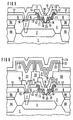
- oxide 17 may be applied prior to application the metallization layer 19 by means of a standard photo technique and wet chemical or anisotropic etching Generation of contacts without silicon trench 10 structured 5, after the application of the metallization layer this is structured, an insulation layer 20, typically TEOS, isolated and structured and a planarization performed on the surface of the resulting assembly. It this is followed by the application and structuring of a second conductive Layer 21 forming contacts between the first and second conductive layer. After that, another one Isolation layer 22 deposited and structured. A further insulation layer 23, typically a phosphorus-containing one Oxide is applied, over which a Silicon nitride layer 24 is provided, FIG. 6.
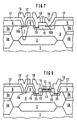
- FIGS. 1 to 6 The method explained in accordance with FIGS. 1 to 6 is suitable with the manufacture of integrated circuits different types of components. While Figures 1 to 6 using an n-channel DMOS transistor Drain or source contact on top of the semiconductor wafer 7 to 10 show the same the corresponding reference numerals other types of Components.
- the npn transistor according to FIG. 7 shows the collector contact as zone 16a, the one buried via deep collector diffusion Zone 2 contacts collector 3.
- Zone 15 represents the Base there, 16b the emitter.
- Figures 8 and 9 show low voltage CMOS transistors, wherein the zones 15 in the PMOS transistor in FIG. 8 and 16 in the NMOS transistor in FIG. 9 are the source and drain zones.
- zone 15 is provided as a p-well for the NMOS transistor.
- N-type silicon becomes higher as the base material Conductivity of certain orientation used.
- a conductive Apply layer on the back of the pane. A yourself resulting high blocking insulated lateral n-channel DMOS transistor shows FIG. 10.
- the inventive method is also suitable for Manufacture of single DMOS transistors, in which on the basis of Figures 1 to 6 described manufacturing process individual Steps can be modified or omitted without the core idea of the invention that is protected will be changed.
- the base material becomes n-type Silicon high conductivity with given orientation used, and at the end of the process there must be a conductive layer be applied to the back of the pane.
Landscapes
- Electrodes Of Semiconductors (AREA)
- Insulated Gate Type Field-Effect Transistor (AREA)
- Metal-Oxide And Bipolar Metal-Oxide Semiconductor Integrated Circuits (AREA)
Claims (8)
- Procédé de fabrication d'un contact faiblement ohmique entre une couche de métallisation (19) et une matière semi-conductrice (3) d'un premier type de conductivité dont la surface semi-conductrice porte une couche d'isolation (11) et par-dessus celle-ci une couche semi-conductrice (12), comprenant les étapes suivantes :sur la couche semi-conductrice (12), on applique une première couche d'isolation (13, 14) et par gravure anisotrope, on forme et on structure une première et une seconde ouvertures,en utilisant la première couche d'isolation (13, 14) comme masque, on effectue une gravure anisotrope de la couche semi-conductrice (12),on implante et on enfonce une première matière dopante (15) d'un second type de conductivité (p) à l'aide d'une première technique de photorésist à travers la première ouverture de la matière semi-conductrice, en formant une première zone (15) dans la matière semi-conductrice (3),on implante une seconde matière dopante (16) du premier type de conductivité (n) à l'aide d'une seconde opération de photorésist à travers la seconde ouverture dans la matière semi-conductrice (3),on applique une seconde couche d'isolation, dopée (17) sur toute la surface,on enlève par gravure la seconde couche d'isolation, de manière anisotrope jusqu'à la surface de la matière semi-conductrice et dans la première ouverture, on laisse subsister des nervures d'isolation 18 marginales,on grave la matière semi-conductrice (3) de matière auto-réglée en utilisant la seconde couche d'isolation (17, 18) comme masque anisotrope jusqu'à la première zone (15),on implante une troisième matière dopante (25) avec un dopage plus élevé que celui de la première matière dopante (15) et du second type de conductivité en utilisant la seconde couche isolante comme masque dans la première zone (15) et,on applique une couche de métallisation (19).
- Procédé selon la revendication 1,
caractérisé en ce qu'
en plus on applique une autre couche d'isolation (14) sur la première couche d'isolation (13) et on structure sensiblement de la même manière les deux couches. - Procédé selon la revendication 1 ou 2,
caractérisé en ce qu'
on amincit la couche d'isolation (11) avant l'implantation de la première matière dopante (15). - Procédé selon l'une quelconque des revendications 1 à 3,
caractérisé en ce que
par la première matière isolante (15), on développe une conductivité moyenne et par la seconde et la troisième matières isolantes, on développe chaque fois une conductivité élevée de la zone d'implantation. - Procédé selon l'une quelconque des revendications 1 à 4,
caractérisé en ce que
la seconde couche d'isolation dopée (17) a essentiellement la même épaisseur que la première couche d'isolation dopée (13, 14). - Procédé selon l'une quelconque des revendications 1 à 5,
caractérisé en ce qu'
on structure la seconde couche d'isolation dopée (17) en formant des nervures d'isolation (18) à côté sur la couche d'isolation (11), la couche semi-conductrice (12) et la première couche d'isolation (13, 14). - Procédé selon l'une quelconque des revendications 1 à 6,
caractérisé en ce que
l'on compacte la seconde couche d'isolation dopée (17) avant de la mettre en structure. - Procédé selon l'une quelconque des revendications 1 à 7,
caractérisé en ce que la première et la seconde ouvertures sont identiques.
Applications Claiming Priority (2)
| Application Number | Priority Date | Filing Date | Title |
|---|---|---|---|
| DE4434108A DE4434108A1 (de) | 1994-09-23 | 1994-09-23 | Verfahren zur Erzeugung eines niederohmigen Kontaktes zwischen einer Metallisierungsschicht und einem Halbleitermaterial |
| DE4434108 | 1994-09-23 |
Publications (3)
| Publication Number | Publication Date |
|---|---|
| EP0704894A2 EP0704894A2 (fr) | 1996-04-03 |
| EP0704894A3 EP0704894A3 (fr) | 1997-11-26 |
| EP0704894B1 true EP0704894B1 (fr) | 2002-12-04 |
Family
ID=6529064
Family Applications (1)
| Application Number | Title | Priority Date | Filing Date |
|---|---|---|---|
| EP95114958A Expired - Lifetime EP0704894B1 (fr) | 1994-09-23 | 1995-09-22 | Procédé pour former un contact de faible valeur ohmique entre une couche de métallisation et un substrat semi-conducteur |
Country Status (4)
| Country | Link |
|---|---|
| US (1) | US6146982A (fr) |
| EP (1) | EP0704894B1 (fr) |
| JP (1) | JPH0897170A (fr) |
| DE (2) | DE4434108A1 (fr) |
Cited By (1)
| Publication number | Priority date | Publication date | Assignee | Title |
|---|---|---|---|---|
| US8188482B2 (en) | 2008-12-22 | 2012-05-29 | Infineon Technologies Austria Ag | SiC semiconductor device with self-aligned contacts, integrated circuit and manufacturing method |
Families Citing this family (8)
| Publication number | Priority date | Publication date | Assignee | Title |
|---|---|---|---|---|
| DE19705351C2 (de) * | 1997-02-12 | 1998-12-03 | Siemens Ag | Verfahren zum Herstellen eines Halbleiterkörpers |
| DE19705530C2 (de) * | 1997-02-13 | 1999-03-11 | Siemens Ag | Verfahren zur Erzeugung eines Kontaktes und eines Kondensators in einem Halblieterbauelement |
| DE19706282A1 (de) * | 1997-02-18 | 1998-08-20 | Siemens Ag | Verfahren zur Erzeugung einer Transistorstruktur |
| US6939776B2 (en) * | 1998-09-29 | 2005-09-06 | Sanyo Electric Co., Ltd. | Semiconductor device and a method of fabricating the same |
| DE19944303C2 (de) * | 1999-09-15 | 2001-11-15 | Infineon Technologies Ag | Verfahren zur Herstellung selbstjustierter Niederohm-Wannenkontakte durch Nachbehandlung von Implantationsmasken |
| US6432809B1 (en) * | 2000-02-28 | 2002-08-13 | International Business Machines Corporation | Method for improved passive thermal flow in silicon on insulator devices |
| JP4482428B2 (ja) * | 2004-11-12 | 2010-06-16 | 川崎マイクロエレクトロニクス株式会社 | 半導体集積回路の製造方法および半導体集積回路 |
| JP6363541B2 (ja) * | 2015-03-16 | 2018-07-25 | 株式会社東芝 | 半導体装置及びその製造方法 |
Family Cites Families (14)
| Publication number | Priority date | Publication date | Assignee | Title |
|---|---|---|---|---|
| US4503598A (en) * | 1982-05-20 | 1985-03-12 | Fairchild Camera & Instrument Corporation | Method of fabricating power MOSFET structure utilizing self-aligned diffusion and etching techniques |
| JPH07112066B2 (ja) * | 1987-01-19 | 1995-11-29 | 日本電気株式会社 | 半導体集積回路装置およびその製造方法 |
| JPH0834311B2 (ja) * | 1987-06-10 | 1996-03-29 | 日本電装株式会社 | 半導体装置の製造方法 |
| US4772566A (en) * | 1987-07-01 | 1988-09-20 | Motorola Inc. | Single tub transistor means and method |
| US4853345A (en) * | 1988-08-22 | 1989-08-01 | Delco Electronics Corporation | Process for manufacture of a vertical DMOS transistor |
| US4898835A (en) * | 1988-10-12 | 1990-02-06 | Sgs-Thomson Microelectronics, Inc. | Single mask totally self-aligned power MOSFET cell fabrication process |
| JPH0783122B2 (ja) * | 1988-12-01 | 1995-09-06 | 富士電機株式会社 | 半導体装置の製造方法 |
| US5182222A (en) * | 1991-06-26 | 1993-01-26 | Texas Instruments Incorporated | Process for manufacturing a DMOS transistor |
| JPH05109643A (ja) * | 1991-10-18 | 1993-04-30 | Matsushita Electric Ind Co Ltd | 半導体装置およびその製造方法 |
| US5171705A (en) * | 1991-11-22 | 1992-12-15 | Supertex, Inc. | Self-aligned structure and process for DMOS transistor |
| US5223734A (en) * | 1991-12-18 | 1993-06-29 | Micron Technology, Inc. | Semiconductor gettering process using backside chemical mechanical planarization (CMP) and dopant diffusion |
| JPH05304297A (ja) * | 1992-01-29 | 1993-11-16 | Nec Corp | 電力用半導体装置およびその製造方法 |
| JPH0620995A (ja) * | 1992-06-30 | 1994-01-28 | Nec Corp | 半導体装置およびその製造方法 |
| US5523246A (en) * | 1995-06-14 | 1996-06-04 | United Microelectronics Corporation | Method of fabricating a high-voltage metal-gate CMOS device |
-
1994
- 1994-09-23 DE DE4434108A patent/DE4434108A1/de not_active Withdrawn
-
1995
- 1995-09-22 JP JP7269361A patent/JPH0897170A/ja active Pending
- 1995-09-22 DE DE59510489T patent/DE59510489D1/de not_active Expired - Lifetime
- 1995-09-22 EP EP95114958A patent/EP0704894B1/fr not_active Expired - Lifetime
-
1997
- 1997-05-08 US US08/853,158 patent/US6146982A/en not_active Expired - Lifetime
Cited By (2)
| Publication number | Priority date | Publication date | Assignee | Title |
|---|---|---|---|---|
| US8188482B2 (en) | 2008-12-22 | 2012-05-29 | Infineon Technologies Austria Ag | SiC semiconductor device with self-aligned contacts, integrated circuit and manufacturing method |
| DE102009058844B4 (de) * | 2008-12-22 | 2020-04-09 | Infineon Technologies Austria Ag | Sperrschicht-Feldeffekttransistor und Herstellungsverfahren |
Also Published As
| Publication number | Publication date |
|---|---|
| EP0704894A2 (fr) | 1996-04-03 |
| US6146982A (en) | 2000-11-14 |
| DE4434108A1 (de) | 1996-03-28 |
| EP0704894A3 (fr) | 1997-11-26 |
| JPH0897170A (ja) | 1996-04-12 |
| DE59510489D1 (de) | 2003-01-16 |
Similar Documents
| Publication | Publication Date | Title |
|---|---|---|
| DE69332753T2 (de) | Verfahren zur Herstellung von Zenerdioden und eines MOS Transistors | |
| DE69533869T2 (de) | BiCDMOS-Herstellungstechnologie. | |
| DE60019913T2 (de) | Halbleiterbauelement und Herstellungsverfahren | |
| DE3932621C2 (de) | Feldgesteuerte Halbleitervorrichtung und Verfahren zu deren Herstellung | |
| DE102011088638B3 (de) | Herstellverfahren für ein Hochvoltbauelement und Hochvoltbauelement | |
| DE4011276C2 (de) | Feldeffekttransistor mit isoliertem Gate (IGFET) und Verfahren zu seiner Herstellung | |
| DE3105118C2 (de) | Verfahren zur Herstellung einer integrierten Schaltung mit komplementären bipolaren Transistoren und komplementären Isolierschicht-Gate-Feldeffekttransistoren auf einem gemeinsamen Substrat | |
| DE69634764T2 (de) | Halbleiteranordnung und Verfahren zu ihrer Herstellung | |
| DE102011088584B4 (de) | Halbleiterbauelement und Verfahren zu seiner Herstellung | |
| DE4139490A1 (de) | Bicmos-vorrichtung und verfahren zur herstellung derselben | |
| DE69530441T2 (de) | Eine Methode zur Herstellung von BiCMOS-Halbleiterteilen | |
| DE69934360T2 (de) | Verfahren zur Herstellung von gegen elektrostatische Entladung geschützten Bauelementen mit selbstausgerichteter Silicidstruktur | |
| DE69224009T2 (de) | Verfahren zur Herstellung einer Halbleiterstruktur mit MOS- und Bipolar-Bauteilen | |
| EP0764982B1 (fr) | Procédé pour la fabrication d'un circuit CMOS intégré | |
| EP0704894B1 (fr) | Procédé pour former un contact de faible valeur ohmique entre une couche de métallisation et un substrat semi-conducteur | |
| DE60132129T2 (de) | Halbleiterbauelement mit LDD-Struktur und dessen Herstellungsverfahren | |
| DE3855252T2 (de) | Verfahren zum Herstellen eines Twin-well-BICMOS-Transistors | |
| DE10156442A1 (de) | Halbleitervorrichtung | |
| DE69430229T2 (de) | Verfahren zur Herstellung eines BICMOS-Bauteils | |
| DE69333098T2 (de) | Integriertes Halbleiterschaltkreisbauelement und dessen Herstellungsverfahren | |
| DE19836032B4 (de) | Verfahren zum Herstellen eines Bipolar-Transistors und eines MOS-Transistor-Gates | |
| EP0693775A2 (fr) | Procédé de fabrication de transistors MOS et transistors bipolaires sur une plaquette semi-conductrice | |
| DE102019219072B4 (de) | Dummy-Füllschema zur Verwendung mit passiven Vorrichtungen | |
| EP1670052B1 (fr) | Méthode de fabrication d'un dispositif semi-conducteur comportant une structure semi-conductrice à PMOSFET à tenue en tension et une structure semi-conductrice à NMOSFET | |
| EP0855747A1 (fr) | Transistor vertical du type pnp |
Legal Events
| Date | Code | Title | Description |
|---|---|---|---|
| PUAI | Public reference made under article 153(3) epc to a published international application that has entered the european phase |
Free format text: ORIGINAL CODE: 0009012 |
|
| AK | Designated contracting states |
Kind code of ref document: A2 Designated state(s): DE FR GB IE IT |
|
| K1C1 | Correction of patent application (title page) published |
Effective date: 19960403 |
|
| PUAL | Search report despatched |
Free format text: ORIGINAL CODE: 0009013 |
|
| AK | Designated contracting states |
Kind code of ref document: A3 Designated state(s): DE FR GB IE IT |
|
| 17P | Request for examination filed |
Effective date: 19980520 |
|
| RAP1 | Party data changed (applicant data changed or rights of an application transferred) |
Owner name: INFINEON TECHNOLOGIES AG |
|
| 17Q | First examination report despatched |
Effective date: 20011219 |
|
| GRAG | Despatch of communication of intention to grant |
Free format text: ORIGINAL CODE: EPIDOS AGRA |
|
| GRAG | Despatch of communication of intention to grant |
Free format text: ORIGINAL CODE: EPIDOS AGRA |
|
| GRAH | Despatch of communication of intention to grant a patent |
Free format text: ORIGINAL CODE: EPIDOS IGRA |
|
| GRAH | Despatch of communication of intention to grant a patent |
Free format text: ORIGINAL CODE: EPIDOS IGRA |
|
| GRAA | (expected) grant |
Free format text: ORIGINAL CODE: 0009210 |
|
| AK | Designated contracting states |
Kind code of ref document: B1 Designated state(s): DE FR GB IE IT |
|
| PG25 | Lapsed in a contracting state [announced via postgrant information from national office to epo] |
Ref country code: IE Free format text: LAPSE BECAUSE OF FAILURE TO SUBMIT A TRANSLATION OF THE DESCRIPTION OR TO PAY THE FEE WITHIN THE PRESCRIBED TIME-LIMIT Effective date: 20021204 Ref country code: GB Free format text: LAPSE BECAUSE OF FAILURE TO SUBMIT A TRANSLATION OF THE DESCRIPTION OR TO PAY THE FEE WITHIN THE PRESCRIBED TIME-LIMIT Effective date: 20021204 |
|
| REG | Reference to a national code |
Ref country code: GB Ref legal event code: FG4D Free format text: NOT ENGLISH |
|
| REG | Reference to a national code |
Ref country code: IE Ref legal event code: FG4D Free format text: GERMAN |
|
| REF | Corresponds to: |
Ref document number: 59510489 Country of ref document: DE Date of ref document: 20030116 |
|
| GBV | Gb: ep patent (uk) treated as always having been void in accordance with gb section 77(7)/1977 [no translation filed] |
Effective date: 20021204 |
|
| ET | Fr: translation filed | ||
| REG | Reference to a national code |
Ref country code: IE Ref legal event code: FD4D Ref document number: 0704894E Country of ref document: IE |
|
| PLBE | No opposition filed within time limit |
Free format text: ORIGINAL CODE: 0009261 |
|
| STAA | Information on the status of an ep patent application or granted ep patent |
Free format text: STATUS: NO OPPOSITION FILED WITHIN TIME LIMIT |
|
| 26N | No opposition filed |
Effective date: 20030905 |
|
| PGFP | Annual fee paid to national office [announced via postgrant information from national office to epo] |
Ref country code: FR Payment date: 20140919 Year of fee payment: 20 |
|
| PGFP | Annual fee paid to national office [announced via postgrant information from national office to epo] |
Ref country code: DE Payment date: 20141121 Year of fee payment: 20 |
|
| PGFP | Annual fee paid to national office [announced via postgrant information from national office to epo] |
Ref country code: IT Payment date: 20140929 Year of fee payment: 20 |
|
| REG | Reference to a national code |
Ref country code: DE Ref legal event code: R071 Ref document number: 59510489 Country of ref document: DE |