EP0705233B1 - Systemes liants - Google Patents
Systemes liants Download PDFInfo
- Publication number
- EP0705233B1 EP0705233B1 EP94918686A EP94918686A EP0705233B1 EP 0705233 B1 EP0705233 B1 EP 0705233B1 EP 94918686 A EP94918686 A EP 94918686A EP 94918686 A EP94918686 A EP 94918686A EP 0705233 B1 EP0705233 B1 EP 0705233B1
- Authority
- EP
- European Patent Office
- Prior art keywords
- binder phase
- resin
- particles
- binder
- acid
- Prior art date
- Legal status (The legal status is an assumption and is not a legal conclusion. Google has not performed a legal analysis and makes no representation as to the accuracy of the status listed.)
- Expired - Lifetime
Links
- 239000011230 binding agent Substances 0.000 title claims description 178
- 239000002245 particle Substances 0.000 claims description 114
- 239000000203 mixture Substances 0.000 claims description 98
- OKTJSMMVPCPJKN-UHFFFAOYSA-N Carbon Chemical compound [C] OKTJSMMVPCPJKN-UHFFFAOYSA-N 0.000 claims description 90
- 229910052799 carbon Inorganic materials 0.000 claims description 73
- 229920005989 resin Polymers 0.000 claims description 73
- 239000011347 resin Substances 0.000 claims description 73
- XPFVYQJUAUNWIW-UHFFFAOYSA-N furfuryl alcohol Chemical compound OCC1=CC=CO1 XPFVYQJUAUNWIW-UHFFFAOYSA-N 0.000 claims description 71
- 238000000034 method Methods 0.000 claims description 57
- 239000000463 material Substances 0.000 claims description 56
- 239000007787 solid Substances 0.000 claims description 54
- 229910052782 aluminium Inorganic materials 0.000 claims description 37
- 239000004411 aluminium Substances 0.000 claims description 36
- XAGFODPZIPBFFR-UHFFFAOYSA-N aluminium Chemical compound [Al] XAGFODPZIPBFFR-UHFFFAOYSA-N 0.000 claims description 35
- 229910052783 alkali metal Inorganic materials 0.000 claims description 33
- 150000001340 alkali metals Chemical class 0.000 claims description 33
- VKYKSIONXSXAKP-UHFFFAOYSA-N hexamethylenetetramine Chemical compound C1N(C2)CN3CN1CN2C3 VKYKSIONXSXAKP-UHFFFAOYSA-N 0.000 claims description 26
- 229920003986 novolac Polymers 0.000 claims description 25
- 239000004312 hexamethylene tetramine Substances 0.000 claims description 21
- 229920000642 polymer Polymers 0.000 claims description 21
- 235000010299 hexamethylene tetramine Nutrition 0.000 claims description 20
- 238000000197 pyrolysis Methods 0.000 claims description 19
- 239000000945 filler Substances 0.000 claims description 17
- IJGRMHOSHXDMSA-UHFFFAOYSA-N nitrogen Substances N#N IJGRMHOSHXDMSA-UHFFFAOYSA-N 0.000 claims description 17
- 238000002156 mixing Methods 0.000 claims description 16
- 229910002804 graphite Inorganic materials 0.000 claims description 15
- 239000010439 graphite Substances 0.000 claims description 15
- 238000010438 heat treatment Methods 0.000 claims description 15
- 238000001033 granulometry Methods 0.000 claims description 14
- 239000002904 solvent Substances 0.000 claims description 14
- -1 polyphenylene Polymers 0.000 claims description 13
- 229910052757 nitrogen Inorganic materials 0.000 claims description 12
- 125000004429 atom Chemical group 0.000 claims description 10
- 239000003575 carbonaceous material Substances 0.000 claims description 10
- 238000006243 chemical reaction Methods 0.000 claims description 10
- 239000011343 solid material Substances 0.000 claims description 9
- WNLRTRBMVRJNCN-UHFFFAOYSA-N adipic acid Chemical compound OC(=O)CCCCC(O)=O WNLRTRBMVRJNCN-UHFFFAOYSA-N 0.000 claims description 8
- RHZUVFJBSILHOK-UHFFFAOYSA-N anthracen-1-ylmethanolate Chemical compound C1=CC=C2C=C3C(C[O-])=CC=CC3=CC2=C1 RHZUVFJBSILHOK-UHFFFAOYSA-N 0.000 claims description 8
- 239000003830 anthracite Substances 0.000 claims description 8
- 229920001721 polyimide Polymers 0.000 claims description 8
- 239000002243 precursor Substances 0.000 claims description 8
- CYIDZMCFTVVTJO-UHFFFAOYSA-N pyromellitic acid Chemical compound OC(=O)C1=CC(C(O)=O)=C(C(O)=O)C=C1C(O)=O CYIDZMCFTVVTJO-UHFFFAOYSA-N 0.000 claims description 8
- 150000002825 nitriles Chemical class 0.000 claims description 7
- YLQBMQCUIZJEEH-UHFFFAOYSA-N Furan Chemical compound C=1C=COC=1 YLQBMQCUIZJEEH-UHFFFAOYSA-N 0.000 claims description 6
- 229920000265 Polyparaphenylene Polymers 0.000 claims description 6
- IISBACLAFKSPIT-UHFFFAOYSA-N bisphenol A Chemical compound C=1C=C(O)C=CC=1C(C)(C)C1=CC=C(O)C=C1 IISBACLAFKSPIT-UHFFFAOYSA-N 0.000 claims description 6
- GYZLOYUZLJXAJU-UHFFFAOYSA-N diglycidyl ether Chemical compound C1OC1COCC1CO1 GYZLOYUZLJXAJU-UHFFFAOYSA-N 0.000 claims description 6
- 238000009826 distribution Methods 0.000 claims description 6
- 238000005868 electrolysis reaction Methods 0.000 claims description 6
- 125000005842 heteroatom Chemical group 0.000 claims description 6
- 239000011159 matrix material Substances 0.000 claims description 6
- 230000003647 oxidation Effects 0.000 claims description 6
- 238000007254 oxidation reaction Methods 0.000 claims description 6
- 150000007519 polyprotic acids Polymers 0.000 claims description 6
- PEDCQBHIVMGVHV-UHFFFAOYSA-N Glycerine Chemical compound OCC(O)CO PEDCQBHIVMGVHV-UHFFFAOYSA-N 0.000 claims description 5
- 150000001412 amines Chemical class 0.000 claims description 5
- 125000003118 aryl group Chemical group 0.000 claims description 5
- 229920001568 phenolic resin Polymers 0.000 claims description 5
- 230000000717 retained effect Effects 0.000 claims description 5
- VOZKAJLKRJDJLL-UHFFFAOYSA-N 2,4-diaminotoluene Chemical compound CC1=CC=C(N)C=C1N VOZKAJLKRJDJLL-UHFFFAOYSA-N 0.000 claims description 4
- YBRVSVVVWCFQMG-UHFFFAOYSA-N 4,4'-diaminodiphenylmethane Chemical compound C1=CC(N)=CC=C1CC1=CC=C(N)C=C1 YBRVSVVVWCFQMG-UHFFFAOYSA-N 0.000 claims description 4
- PIICEJLVQHRZGT-UHFFFAOYSA-N Ethylenediamine Chemical compound NCCN PIICEJLVQHRZGT-UHFFFAOYSA-N 0.000 claims description 4
- GLUUGHFHXGJENI-UHFFFAOYSA-N Piperazine Chemical compound C1CNCCN1 GLUUGHFHXGJENI-UHFFFAOYSA-N 0.000 claims description 4
- KKEYFWRCBNTPAC-UHFFFAOYSA-N Terephthalic acid Chemical compound OC(=O)C1=CC=C(C(O)=O)C=C1 KKEYFWRCBNTPAC-UHFFFAOYSA-N 0.000 claims description 4
- 239000001361 adipic acid Substances 0.000 claims description 4
- 235000011037 adipic acid Nutrition 0.000 claims description 4
- 229920000180 alkyd Polymers 0.000 claims description 4
- QVGXLLKOCUKJST-UHFFFAOYSA-N atomic oxygen Chemical group [O] QVGXLLKOCUKJST-UHFFFAOYSA-N 0.000 claims description 4
- 235000014113 dietary fatty acids Nutrition 0.000 claims description 4
- 239000003822 epoxy resin Substances 0.000 claims description 4
- 239000000194 fatty acid Substances 0.000 claims description 4
- 229930195729 fatty acid Natural products 0.000 claims description 4
- 150000004665 fatty acids Chemical class 0.000 claims description 4
- 239000010419 fine particle Substances 0.000 claims description 4
- IPCSVZSSVZVIGE-UHFFFAOYSA-N hexadecanoic acid Chemical compound CCCCCCCCCCCCCCCC(O)=O IPCSVZSSVZVIGE-UHFFFAOYSA-N 0.000 claims description 4
- NAQMVNRVTILPCV-UHFFFAOYSA-N hexane-1,6-diamine Chemical compound NCCCCCCN NAQMVNRVTILPCV-UHFFFAOYSA-N 0.000 claims description 4
- QQVIHTHCMHWDBS-UHFFFAOYSA-N isophthalic acid Chemical compound OC(=O)C1=CC=CC(C(O)=O)=C1 QQVIHTHCMHWDBS-UHFFFAOYSA-N 0.000 claims description 4
- 239000001301 oxygen Substances 0.000 claims description 4
- 229910052760 oxygen Inorganic materials 0.000 claims description 4
- 230000000704 physical effect Effects 0.000 claims description 4
- WLJVNTCWHIRURA-UHFFFAOYSA-N pimelic acid Chemical compound OC(=O)CCCCCC(O)=O WLJVNTCWHIRURA-UHFFFAOYSA-N 0.000 claims description 4
- 229920006122 polyamide resin Polymers 0.000 claims description 4
- 229920000647 polyepoxide Polymers 0.000 claims description 4
- 150000005846 sugar alcohols Polymers 0.000 claims description 4
- 230000002902 bimodal effect Effects 0.000 claims description 3
- 150000002118 epoxides Chemical class 0.000 claims description 3
- XNGIFLGASWRNHJ-UHFFFAOYSA-N phthalic acid Chemical compound OC(=O)C1=CC=CC=C1C(O)=O XNGIFLGASWRNHJ-UHFFFAOYSA-N 0.000 claims description 3
- 239000009719 polyimide resin Substances 0.000 claims description 3
- 238000006467 substitution reaction Methods 0.000 claims description 3
- 239000011800 void material Substances 0.000 claims description 3
- WRIDQFICGBMAFQ-UHFFFAOYSA-N (E)-8-Octadecenoic acid Natural products CCCCCCCCCC=CCCCCCCC(O)=O WRIDQFICGBMAFQ-UHFFFAOYSA-N 0.000 claims description 2
- GEYOCULIXLDCMW-UHFFFAOYSA-N 1,2-phenylenediamine Chemical compound NC1=CC=CC=C1N GEYOCULIXLDCMW-UHFFFAOYSA-N 0.000 claims description 2
- CBCKQZAAMUWICA-UHFFFAOYSA-N 1,4-phenylenediamine Chemical compound NC1=CC=C(N)C=C1 CBCKQZAAMUWICA-UHFFFAOYSA-N 0.000 claims description 2
- RTBFRGCFXZNCOE-UHFFFAOYSA-N 1-methylsulfonylpiperidin-4-one Chemical compound CS(=O)(=O)N1CCC(=O)CC1 RTBFRGCFXZNCOE-UHFFFAOYSA-N 0.000 claims description 2
- KXGFMDJXCMQABM-UHFFFAOYSA-N 2-methoxy-6-methylphenol Chemical compound [CH]OC1=CC=CC([CH])=C1O KXGFMDJXCMQABM-UHFFFAOYSA-N 0.000 claims description 2
- LQJBNNIYVWPHFW-UHFFFAOYSA-N 20:1omega9c fatty acid Natural products CCCCCCCCCCC=CCCCCCCCC(O)=O LQJBNNIYVWPHFW-UHFFFAOYSA-N 0.000 claims description 2
- FAUAZXVRLVIARB-UHFFFAOYSA-N 4-[[4-[bis(oxiran-2-ylmethyl)amino]phenyl]methyl]-n,n-bis(oxiran-2-ylmethyl)aniline Chemical compound C1OC1CN(C=1C=CC(CC=2C=CC(=CC=2)N(CC2OC2)CC2OC2)=CC=1)CC1CO1 FAUAZXVRLVIARB-UHFFFAOYSA-N 0.000 claims description 2
- QSBYPNXLFMSGKH-UHFFFAOYSA-N 9-Heptadecensaeure Natural products CCCCCCCC=CCCCCCCCC(O)=O QSBYPNXLFMSGKH-UHFFFAOYSA-N 0.000 claims description 2
- FBPFZTCFMRRESA-FSIIMWSLSA-N D-Glucitol Natural products OC[C@H](O)[C@H](O)[C@@H](O)[C@H](O)CO FBPFZTCFMRRESA-FSIIMWSLSA-N 0.000 claims description 2
- FBPFZTCFMRRESA-JGWLITMVSA-N D-glucitol Chemical compound OC[C@H](O)[C@@H](O)[C@H](O)[C@H](O)CO FBPFZTCFMRRESA-JGWLITMVSA-N 0.000 claims description 2
- 239000005642 Oleic acid Substances 0.000 claims description 2
- ZQPPMHVWECSIRJ-UHFFFAOYSA-N Oleic acid Natural products CCCCCCCCC=CCCCCCCCC(O)=O ZQPPMHVWECSIRJ-UHFFFAOYSA-N 0.000 claims description 2
- 235000021314 Palmitic acid Nutrition 0.000 claims description 2
- 239000004721 Polyphenylene oxide Substances 0.000 claims description 2
- 239000004734 Polyphenylene sulfide Substances 0.000 claims description 2
- OFOBLEOULBTSOW-UHFFFAOYSA-N Propanedioic acid Natural products OC(=O)CC(O)=O OFOBLEOULBTSOW-UHFFFAOYSA-N 0.000 claims description 2
- 235000021355 Stearic acid Nutrition 0.000 claims description 2
- 150000008064 anhydrides Chemical class 0.000 claims description 2
- JFCQEDHGNNZCLN-UHFFFAOYSA-N anhydrous glutaric acid Natural products OC(=O)CCCC(O)=O JFCQEDHGNNZCLN-UHFFFAOYSA-N 0.000 claims description 2
- 229910010293 ceramic material Inorganic materials 0.000 claims description 2
- 239000000571 coke Substances 0.000 claims description 2
- 238000006356 dehydrogenation reaction Methods 0.000 claims description 2
- 125000000623 heterocyclic group Chemical group 0.000 claims description 2
- 125000002887 hydroxy group Chemical group [H]O* 0.000 claims description 2
- QXJSBBXBKPUZAA-UHFFFAOYSA-N isooleic acid Natural products CCCCCCCC=CCCCCCCCCC(O)=O QXJSBBXBKPUZAA-UHFFFAOYSA-N 0.000 claims description 2
- VZCYOOQTPOCHFL-UPHRSURJSA-N maleic acid Chemical compound OC(=O)\C=C/C(O)=O VZCYOOQTPOCHFL-UPHRSURJSA-N 0.000 claims description 2
- 239000011976 maleic acid Substances 0.000 claims description 2
- 238000002844 melting Methods 0.000 claims description 2
- 230000008018 melting Effects 0.000 claims description 2
- 125000002496 methyl group Chemical group [H]C([H])([H])* 0.000 claims description 2
- WQEPLUUGTLDZJY-UHFFFAOYSA-N n-Pentadecanoic acid Natural products CCCCCCCCCCCCCCC(O)=O WQEPLUUGTLDZJY-UHFFFAOYSA-N 0.000 claims description 2
- OQCDKBAXFALNLD-UHFFFAOYSA-N octadecanoic acid Natural products CCCCCCCC(C)CCCCCCCCC(O)=O OQCDKBAXFALNLD-UHFFFAOYSA-N 0.000 claims description 2
- ZQPPMHVWECSIRJ-KTKRTIGZSA-N oleic acid Chemical compound CCCCCCCC\C=C/CCCCCCCC(O)=O ZQPPMHVWECSIRJ-KTKRTIGZSA-N 0.000 claims description 2
- 235000021313 oleic acid Nutrition 0.000 claims description 2
- 229920000368 omega-hydroxypoly(furan-2,5-diylmethylene) polymer Polymers 0.000 claims description 2
- WXZMFSXDPGVJKK-UHFFFAOYSA-N pentaerythritol Chemical compound OCC(CO)(CO)CO WXZMFSXDPGVJKK-UHFFFAOYSA-N 0.000 claims description 2
- 239000005011 phenolic resin Substances 0.000 claims description 2
- 125000001997 phenyl group Chemical group [H]C1=C([H])C([H])=C(*)C([H])=C1[H] 0.000 claims description 2
- CTYRPMDGLDAWRQ-UHFFFAOYSA-N phenyl hydrogen sulfate Chemical compound OS(=O)(=O)OC1=CC=CC=C1 CTYRPMDGLDAWRQ-UHFFFAOYSA-N 0.000 claims description 2
- 229920006380 polyphenylene oxide Polymers 0.000 claims description 2
- 229920000069 polyphenylene sulfide Polymers 0.000 claims description 2
- AOHJOMMDDJHIJH-UHFFFAOYSA-N propylenediamine Chemical compound CC(N)CN AOHJOMMDDJHIJH-UHFFFAOYSA-N 0.000 claims description 2
- UGQZLDXDWSPAOM-UHFFFAOYSA-N pyrrolo[3,4-f]isoindole-1,3,5,7-tetrone Chemical compound C1=C2C(=O)NC(=O)C2=CC2=C1C(=O)NC2=O UGQZLDXDWSPAOM-UHFFFAOYSA-N 0.000 claims description 2
- 238000007493 shaping process Methods 0.000 claims description 2
- 239000000600 sorbitol Substances 0.000 claims description 2
- 239000008117 stearic acid Substances 0.000 claims description 2
- VZCYOOQTPOCHFL-UHFFFAOYSA-N trans-butenedioic acid Natural products OC(=O)C=CC(O)=O VZCYOOQTPOCHFL-UHFFFAOYSA-N 0.000 claims description 2
- OYHQOLUKZRVURQ-HZJYTTRNSA-N Linoleic acid Chemical compound CCCCC\C=C/C\C=C/CCCCCCCC(O)=O OYHQOLUKZRVURQ-HZJYTTRNSA-N 0.000 claims 1
- 125000004029 hydroxymethyl group Chemical group [H]OC([H])([H])* 0.000 claims 1
- 235000020778 linoleic acid Nutrition 0.000 claims 1
- OYHQOLUKZRVURQ-IXWMQOLASA-N linoleic acid Natural products CCCCC\C=C/C\C=C\CCCCCCCC(O)=O OYHQOLUKZRVURQ-IXWMQOLASA-N 0.000 claims 1
- QJGQUHMNIGDVPM-UHFFFAOYSA-N nitrogen group Chemical group [N] QJGQUHMNIGDVPM-UHFFFAOYSA-N 0.000 claims 1
- QIQXTHQIDYTFRH-UHFFFAOYSA-N octadecanoic acid Chemical compound CCCCCCCCCCCCCCCCCC(O)=O QIQXTHQIDYTFRH-UHFFFAOYSA-N 0.000 claims 1
- 229920000768 polyamine Polymers 0.000 claims 1
- 239000012071 phase Substances 0.000 description 83
- 239000011734 sodium Substances 0.000 description 28
- DGAQECJNVWCQMB-PUAWFVPOSA-M Ilexoside XXIX Chemical compound C[C@@H]1CC[C@@]2(CC[C@@]3(C(=CC[C@H]4[C@]3(CC[C@@H]5[C@@]4(CC[C@@H](C5(C)C)OS(=O)(=O)[O-])C)C)[C@@H]2[C@]1(C)O)C)C(=O)O[C@H]6[C@@H]([C@H]([C@@H]([C@H](O6)CO)O)O)O.[Na+] DGAQECJNVWCQMB-PUAWFVPOSA-M 0.000 description 27
- 229910052708 sodium Inorganic materials 0.000 description 27
- 239000010410 layer Substances 0.000 description 24
- 229960004011 methenamine Drugs 0.000 description 17
- 238000003723 Smelting Methods 0.000 description 16
- 230000015572 biosynthetic process Effects 0.000 description 15
- 238000004519 manufacturing process Methods 0.000 description 15
- 239000003292 glue Substances 0.000 description 11
- 239000000126 substance Substances 0.000 description 9
- 238000003763 carbonization Methods 0.000 description 8
- JKWMSGQKBLHBQQ-UHFFFAOYSA-N diboron trioxide Chemical compound O=BOB=O JKWMSGQKBLHBQQ-UHFFFAOYSA-N 0.000 description 8
- 238000012360 testing method Methods 0.000 description 8
- QYEXBYZXHDUPRC-UHFFFAOYSA-N B#[Ti]#B Chemical compound B#[Ti]#B QYEXBYZXHDUPRC-UHFFFAOYSA-N 0.000 description 7
- 229910033181 TiB2 Inorganic materials 0.000 description 7
- 239000000654 additive Substances 0.000 description 7
- 229910052810 boron oxide Inorganic materials 0.000 description 7
- 150000001875 compounds Chemical class 0.000 description 7
- 238000002474 experimental method Methods 0.000 description 7
- 239000011236 particulate material Substances 0.000 description 7
- 239000000047 product Substances 0.000 description 7
- 230000008961 swelling Effects 0.000 description 7
- 239000004952 Polyamide Substances 0.000 description 6
- 229910003481 amorphous carbon Inorganic materials 0.000 description 6
- 230000008901 benefit Effects 0.000 description 6
- 239000002131 composite material Substances 0.000 description 6
- 238000009830 intercalation Methods 0.000 description 6
- 230000002687 intercalation Effects 0.000 description 6
- 229920002647 polyamide Polymers 0.000 description 6
- 238000006116 polymerization reaction Methods 0.000 description 6
- 239000004642 Polyimide Substances 0.000 description 5
- 239000003054 catalyst Substances 0.000 description 5
- 238000010348 incorporation Methods 0.000 description 5
- 230000007246 mechanism Effects 0.000 description 5
- 229920003987 resole Polymers 0.000 description 5
- NBIIXXVUZAFLBC-UHFFFAOYSA-N Phosphoric acid Chemical compound OP(O)(O)=O NBIIXXVUZAFLBC-UHFFFAOYSA-N 0.000 description 4
- 238000002441 X-ray diffraction Methods 0.000 description 4
- 239000003513 alkali Substances 0.000 description 4
- 230000000694 effects Effects 0.000 description 4
- 238000005516 engineering process Methods 0.000 description 4
- 239000010408 film Substances 0.000 description 4
- 239000012467 final product Substances 0.000 description 4
- 239000007788 liquid Substances 0.000 description 4
- 229910052751 metal Inorganic materials 0.000 description 4
- 239000002184 metal Substances 0.000 description 4
- 239000011819 refractory material Substances 0.000 description 4
- 238000009736 wetting Methods 0.000 description 4
- VYPSYNLAJGMNEJ-UHFFFAOYSA-N Silicium dioxide Chemical compound O=[Si]=O VYPSYNLAJGMNEJ-UHFFFAOYSA-N 0.000 description 3
- 239000002253 acid Substances 0.000 description 3
- KGBXLFKZBHKPEV-UHFFFAOYSA-N boric acid Chemical compound OB(O)O KGBXLFKZBHKPEV-UHFFFAOYSA-N 0.000 description 3
- 239000004327 boric acid Substances 0.000 description 3
- 239000000919 ceramic Substances 0.000 description 3
- 230000006835 compression Effects 0.000 description 3
- 238000007906 compression Methods 0.000 description 3
- 230000001419 dependent effect Effects 0.000 description 3
- 238000011049 filling Methods 0.000 description 3
- 239000007791 liquid phase Substances 0.000 description 3
- 230000014759 maintenance of location Effects 0.000 description 3
- 238000012856 packing Methods 0.000 description 3
- 239000011148 porous material Substances 0.000 description 3
- 239000003039 volatile agent Substances 0.000 description 3
- DSLRVRBSNLHVBH-UHFFFAOYSA-N 2,5-furandimethanol Chemical compound OCC1=CC=C(CO)O1 DSLRVRBSNLHVBH-UHFFFAOYSA-N 0.000 description 2
- NLXLAEXVIDQMFP-UHFFFAOYSA-N Ammonia chloride Chemical compound [NH4+].[Cl-] NLXLAEXVIDQMFP-UHFFFAOYSA-N 0.000 description 2
- BTBUEUYNUDRHOZ-UHFFFAOYSA-N Borate Chemical compound [O-]B([O-])[O-] BTBUEUYNUDRHOZ-UHFFFAOYSA-N 0.000 description 2
- 241000773293 Rappaport Species 0.000 description 2
- 230000000996 additive effect Effects 0.000 description 2
- AZDRQVAHHNSJOQ-UHFFFAOYSA-N alumane Chemical compound [AlH3] AZDRQVAHHNSJOQ-UHFFFAOYSA-N 0.000 description 2
- PNEYBMLMFCGWSK-UHFFFAOYSA-N aluminium oxide Inorganic materials [O-2].[O-2].[O-2].[Al+3].[Al+3] PNEYBMLMFCGWSK-UHFFFAOYSA-N 0.000 description 2
- 229910000147 aluminium phosphate Inorganic materials 0.000 description 2
- 239000011203 carbon fibre reinforced carbon Substances 0.000 description 2
- 239000003795 chemical substances by application Substances 0.000 description 2
- 239000011248 coating agent Substances 0.000 description 2
- 238000000576 coating method Methods 0.000 description 2
- 238000009833 condensation Methods 0.000 description 2
- 238000004132 cross linking Methods 0.000 description 2
- 238000004070 electrodeposition Methods 0.000 description 2
- SLGWESQGEUXWJQ-UHFFFAOYSA-N formaldehyde;phenol Chemical compound O=C.OC1=CC=CC=C1 SLGWESQGEUXWJQ-UHFFFAOYSA-N 0.000 description 2
- HYBBIBNJHNGZAN-UHFFFAOYSA-N furfural Chemical compound O=CC1=CC=CO1 HYBBIBNJHNGZAN-UHFFFAOYSA-N 0.000 description 2
- 229910052739 hydrogen Inorganic materials 0.000 description 2
- 150000002739 metals Chemical class 0.000 description 2
- 238000002360 preparation method Methods 0.000 description 2
- 230000008569 process Effects 0.000 description 2
- 239000000376 reactant Substances 0.000 description 2
- 230000009467 reduction Effects 0.000 description 2
- 239000012260 resinous material Substances 0.000 description 2
- GHMLBKRAJCXXBS-UHFFFAOYSA-N resorcinol Chemical compound OC1=CC=CC(O)=C1 GHMLBKRAJCXXBS-UHFFFAOYSA-N 0.000 description 2
- 241000894007 species Species 0.000 description 2
- 238000011282 treatment Methods 0.000 description 2
- JIAARYAFYJHUJI-UHFFFAOYSA-L zinc dichloride Chemical compound [Cl-].[Cl-].[Zn+2] JIAARYAFYJHUJI-UHFFFAOYSA-L 0.000 description 2
- OYHQOLUKZRVURQ-NTGFUMLPSA-N (9Z,12Z)-9,10,12,13-tetratritiooctadeca-9,12-dienoic acid Chemical compound C(CCCCCCC\C(=C(/C\C(=C(/CCCCC)\[3H])\[3H])\[3H])\[3H])(=O)O OYHQOLUKZRVURQ-NTGFUMLPSA-N 0.000 description 1
- BGJSXRVXTHVRSN-UHFFFAOYSA-N 1,3,5-trioxane Chemical compound C1OCOCO1 BGJSXRVXTHVRSN-UHFFFAOYSA-N 0.000 description 1
- VILCJCGEZXAXTO-UHFFFAOYSA-N 2,2,2-tetramine Chemical compound NCCNCCNCCN VILCJCGEZXAXTO-UHFFFAOYSA-N 0.000 description 1
- NLHHRLWOUZZQLW-UHFFFAOYSA-N Acrylonitrile Chemical compound C=CC#N NLHHRLWOUZZQLW-UHFFFAOYSA-N 0.000 description 1
- 241000209761 Avena Species 0.000 description 1
- 235000007319 Avena orientalis Nutrition 0.000 description 1
- 241001012508 Carpiodes cyprinus Species 0.000 description 1
- 239000004593 Epoxy Substances 0.000 description 1
- UFHFLCQGNIYNRP-UHFFFAOYSA-N Hydrogen Chemical compound [H][H] UFHFLCQGNIYNRP-UHFFFAOYSA-N 0.000 description 1
- 229910021578 Iron(III) chloride Inorganic materials 0.000 description 1
- 229920000877 Melamine resin Polymers 0.000 description 1
- 229910000831 Steel Inorganic materials 0.000 description 1
- GSEJCLTVZPLZKY-UHFFFAOYSA-N Triethanolamine Chemical compound OCCN(CCO)CCO GSEJCLTVZPLZKY-UHFFFAOYSA-N 0.000 description 1
- 229920001807 Urea-formaldehyde Polymers 0.000 description 1
- 238000005299 abrasion Methods 0.000 description 1
- 238000010521 absorption reaction Methods 0.000 description 1
- 239000003377 acid catalyst Substances 0.000 description 1
- 150000007513 acids Chemical class 0.000 description 1
- 150000001408 amides Chemical class 0.000 description 1
- 235000019270 ammonium chloride Nutrition 0.000 description 1
- 239000012298 atmosphere Substances 0.000 description 1
- 150000007514 bases Chemical class 0.000 description 1
- 230000009286 beneficial effect Effects 0.000 description 1
- 239000011449 brick Substances 0.000 description 1
- 125000004432 carbon atom Chemical group C* 0.000 description 1
- 239000006229 carbon black Substances 0.000 description 1
- 239000003183 carcinogenic agent Substances 0.000 description 1
- 230000003197 catalytic effect Effects 0.000 description 1
- 239000010406 cathode material Substances 0.000 description 1
- 239000004568 cement Substances 0.000 description 1
- 230000008859 change Effects 0.000 description 1
- 150000003841 chloride salts Chemical class 0.000 description 1
- 239000011280 coal tar Substances 0.000 description 1
- 238000010276 construction Methods 0.000 description 1
- 238000010411 cooking Methods 0.000 description 1
- 239000003431 cross linking reagent Substances 0.000 description 1
- 229910001610 cryolite Inorganic materials 0.000 description 1
- 239000004643 cyanate ester Substances 0.000 description 1
- 238000013461 design Methods 0.000 description 1
- 238000011161 development Methods 0.000 description 1
- 239000003792 electrolyte Substances 0.000 description 1
- 230000007613 environmental effect Effects 0.000 description 1
- 238000010304 firing Methods 0.000 description 1
- 235000013312 flour Nutrition 0.000 description 1
- 239000012530 fluid Substances 0.000 description 1
- IVJISJACKSSFGE-UHFFFAOYSA-N formaldehyde;1,3,5-triazine-2,4,6-triamine Chemical compound O=C.NC1=NC(N)=NC(N)=N1 IVJISJACKSSFGE-UHFFFAOYSA-N 0.000 description 1
- 125000000524 functional group Chemical group 0.000 description 1
- 239000007849 furan resin Substances 0.000 description 1
- 150000002240 furans Chemical class 0.000 description 1
- 238000012812 general test Methods 0.000 description 1
- 229910021397 glassy carbon Inorganic materials 0.000 description 1
- 239000011174 green composite Substances 0.000 description 1
- LNEPOXFFQSENCJ-UHFFFAOYSA-N haloperidol Chemical compound C1CC(O)(C=2C=CC(Cl)=CC=2)CCN1CCCC(=O)C1=CC=C(F)C=C1 LNEPOXFFQSENCJ-UHFFFAOYSA-N 0.000 description 1
- 229910021385 hard carbon Inorganic materials 0.000 description 1
- 229930195733 hydrocarbon Natural products 0.000 description 1
- 150000002430 hydrocarbons Chemical class 0.000 description 1
- 239000001257 hydrogen Substances 0.000 description 1
- 238000005470 impregnation Methods 0.000 description 1
- 238000011065 in-situ storage Methods 0.000 description 1
- 238000001764 infiltration Methods 0.000 description 1
- 230000008595 infiltration Effects 0.000 description 1
- 239000003999 initiator Substances 0.000 description 1
- 238000009434 installation Methods 0.000 description 1
- 239000000543 intermediate Substances 0.000 description 1
- RBTARNINKXHZNM-UHFFFAOYSA-K iron trichloride Chemical compound Cl[Fe](Cl)Cl RBTARNINKXHZNM-UHFFFAOYSA-K 0.000 description 1
- 238000005304 joining Methods 0.000 description 1
- 230000007774 longterm Effects 0.000 description 1
- 238000003754 machining Methods 0.000 description 1
- 238000005259 measurement Methods 0.000 description 1
- 150000001247 metal acetylides Chemical class 0.000 description 1
- 238000005272 metallurgy Methods 0.000 description 1
- WSFSSNUMVMOOMR-NJFSPNSNSA-N methanone Chemical compound O=[14CH2] WSFSSNUMVMOOMR-NJFSPNSNSA-N 0.000 description 1
- 238000012986 modification Methods 0.000 description 1
- 230000004048 modification Effects 0.000 description 1
- 239000000178 monomer Substances 0.000 description 1
- 150000004767 nitrides Chemical class 0.000 description 1
- 150000007524 organic acids Chemical class 0.000 description 1
- 235000005985 organic acids Nutrition 0.000 description 1
- 239000013618 particulate matter Substances 0.000 description 1
- 235000014594 pastries Nutrition 0.000 description 1
- 230000035515 penetration Effects 0.000 description 1
- 239000004014 plasticizer Substances 0.000 description 1
- 229920002239 polyacrylonitrile Polymers 0.000 description 1
- 125000005575 polycyclic aromatic hydrocarbon group Polymers 0.000 description 1
- 239000004848 polyfunctional curative Substances 0.000 description 1
- ODGAOXROABLFNM-UHFFFAOYSA-N polynoxylin Chemical compound O=C.NC(N)=O ODGAOXROABLFNM-UHFFFAOYSA-N 0.000 description 1
- 235000013824 polyphenols Nutrition 0.000 description 1
- 239000000843 powder Substances 0.000 description 1
- 230000002265 prevention Effects 0.000 description 1
- 230000001737 promoting effect Effects 0.000 description 1
- 238000011946 reduction process Methods 0.000 description 1
- 238000011160 research Methods 0.000 description 1
- 230000027756 respiratory electron transport chain Effects 0.000 description 1
- 238000000518 rheometry Methods 0.000 description 1
- 238000007363 ring formation reaction Methods 0.000 description 1
- 239000004576 sand Substances 0.000 description 1
- 239000000377 silicon dioxide Substances 0.000 description 1
- 238000003892 spreading Methods 0.000 description 1
- 230000007480 spreading Effects 0.000 description 1
- 230000003019 stabilising effect Effects 0.000 description 1
- 238000010561 standard procedure Methods 0.000 description 1
- 239000010959 steel Substances 0.000 description 1
- 239000000758 substrate Substances 0.000 description 1
- 239000002344 surface layer Substances 0.000 description 1
- 239000004094 surface-active agent Substances 0.000 description 1
- 230000004083 survival effect Effects 0.000 description 1
- 229920001187 thermosetting polymer Polymers 0.000 description 1
- 239000010409 thin film Substances 0.000 description 1
- JOXIMZWYDAKGHI-UHFFFAOYSA-N toluene-4-sulfonic acid Chemical compound CC1=CC=C(S(O)(=O)=O)C=C1 JOXIMZWYDAKGHI-UHFFFAOYSA-N 0.000 description 1
- 229910052723 transition metal Inorganic materials 0.000 description 1
- 150000003624 transition metals Chemical class 0.000 description 1
- 239000004034 viscosity adjusting agent Substances 0.000 description 1
- 238000005406 washing Methods 0.000 description 1
- XLYOFNOQVPJJNP-UHFFFAOYSA-N water Substances O XLYOFNOQVPJJNP-UHFFFAOYSA-N 0.000 description 1
- 235000005074 zinc chloride Nutrition 0.000 description 1
- 239000011592 zinc chloride Substances 0.000 description 1
Images

Classifications
-
- C—CHEMISTRY; METALLURGY
- C04—CEMENTS; CONCRETE; ARTIFICIAL STONE; CERAMICS; REFRACTORIES
- C04B—LIME, MAGNESIA; SLAG; CEMENTS; COMPOSITIONS THEREOF, e.g. MORTARS, CONCRETE OR LIKE BUILDING MATERIALS; ARTIFICIAL STONE; CERAMICS; REFRACTORIES; TREATMENT OF NATURAL STONE
- C04B35/00—Shaped ceramic products characterised by their composition; Ceramics compositions; Processing powders of inorganic compounds preparatory to the manufacturing of ceramic products
- C04B35/622—Forming processes; Processing powders of inorganic compounds preparatory to the manufacturing of ceramic products
- C04B35/626—Preparing or treating the powders individually or as batches ; preparing or treating macroscopic reinforcing agents for ceramic products, e.g. fibres; mechanical aspects section B
- C04B35/63—Preparing or treating the powders individually or as batches ; preparing or treating macroscopic reinforcing agents for ceramic products, e.g. fibres; mechanical aspects section B using additives specially adapted for forming the products, e.g.. binder binders
- C04B35/632—Organic additives
- C04B35/634—Polymers
- C04B35/63448—Polymers obtained otherwise than by reactions only involving carbon-to-carbon unsaturated bonds
- C04B35/63472—Condensation polymers of aldehydes or ketones
- C04B35/63476—Phenol-formaldehyde condensation polymers
-
- C—CHEMISTRY; METALLURGY
- C04—CEMENTS; CONCRETE; ARTIFICIAL STONE; CERAMICS; REFRACTORIES
- C04B—LIME, MAGNESIA; SLAG; CEMENTS; COMPOSITIONS THEREOF, e.g. MORTARS, CONCRETE OR LIKE BUILDING MATERIALS; ARTIFICIAL STONE; CERAMICS; REFRACTORIES; TREATMENT OF NATURAL STONE
- C04B26/00—Compositions of mortars, concrete or artificial stone, containing only organic binders, e.g. polymer or resin concrete
- C04B26/02—Macromolecular compounds
- C04B26/10—Macromolecular compounds obtained otherwise than by reactions only involving carbon-to-carbon unsaturated bonds
- C04B26/14—Polyepoxides
-
- C—CHEMISTRY; METALLURGY
- C04—CEMENTS; CONCRETE; ARTIFICIAL STONE; CERAMICS; REFRACTORIES
- C04B—LIME, MAGNESIA; SLAG; CEMENTS; COMPOSITIONS THEREOF, e.g. MORTARS, CONCRETE OR LIKE BUILDING MATERIALS; ARTIFICIAL STONE; CERAMICS; REFRACTORIES; TREATMENT OF NATURAL STONE
- C04B35/00—Shaped ceramic products characterised by their composition; Ceramics compositions; Processing powders of inorganic compounds preparatory to the manufacturing of ceramic products
- C04B35/515—Shaped ceramic products characterised by their composition; Ceramics compositions; Processing powders of inorganic compounds preparatory to the manufacturing of ceramic products based on non-oxide ceramics
- C04B35/52—Shaped ceramic products characterised by their composition; Ceramics compositions; Processing powders of inorganic compounds preparatory to the manufacturing of ceramic products based on non-oxide ceramics based on carbon, e.g. graphite
- C04B35/528—Shaped ceramic products characterised by their composition; Ceramics compositions; Processing powders of inorganic compounds preparatory to the manufacturing of ceramic products based on non-oxide ceramics based on carbon, e.g. graphite obtained from carbonaceous particles with or without other non-organic components
- C04B35/532—Shaped ceramic products characterised by their composition; Ceramics compositions; Processing powders of inorganic compounds preparatory to the manufacturing of ceramic products based on non-oxide ceramics based on carbon, e.g. graphite obtained from carbonaceous particles with or without other non-organic components containing a carbonisable binder
-
- C—CHEMISTRY; METALLURGY
- C04—CEMENTS; CONCRETE; ARTIFICIAL STONE; CERAMICS; REFRACTORIES
- C04B—LIME, MAGNESIA; SLAG; CEMENTS; COMPOSITIONS THEREOF, e.g. MORTARS, CONCRETE OR LIKE BUILDING MATERIALS; ARTIFICIAL STONE; CERAMICS; REFRACTORIES; TREATMENT OF NATURAL STONE
- C04B35/00—Shaped ceramic products characterised by their composition; Ceramics compositions; Processing powders of inorganic compounds preparatory to the manufacturing of ceramic products
- C04B35/515—Shaped ceramic products characterised by their composition; Ceramics compositions; Processing powders of inorganic compounds preparatory to the manufacturing of ceramic products based on non-oxide ceramics
- C04B35/58—Shaped ceramic products characterised by their composition; Ceramics compositions; Processing powders of inorganic compounds preparatory to the manufacturing of ceramic products based on non-oxide ceramics based on borides, nitrides, i.e. nitrides, oxynitrides, carbonitrides or oxycarbonitrides or silicides
- C04B35/5805—Shaped ceramic products characterised by their composition; Ceramics compositions; Processing powders of inorganic compounds preparatory to the manufacturing of ceramic products based on non-oxide ceramics based on borides, nitrides, i.e. nitrides, oxynitrides, carbonitrides or oxycarbonitrides or silicides based on borides
- C04B35/58064—Shaped ceramic products characterised by their composition; Ceramics compositions; Processing powders of inorganic compounds preparatory to the manufacturing of ceramic products based on non-oxide ceramics based on borides, nitrides, i.e. nitrides, oxynitrides, carbonitrides or oxycarbonitrides or silicides based on borides based on refractory borides
- C04B35/58071—Shaped ceramic products characterised by their composition; Ceramics compositions; Processing powders of inorganic compounds preparatory to the manufacturing of ceramic products based on non-oxide ceramics based on borides, nitrides, i.e. nitrides, oxynitrides, carbonitrides or oxycarbonitrides or silicides based on borides based on refractory borides based on titanium borides
-
- C—CHEMISTRY; METALLURGY
- C04—CEMENTS; CONCRETE; ARTIFICIAL STONE; CERAMICS; REFRACTORIES
- C04B—LIME, MAGNESIA; SLAG; CEMENTS; COMPOSITIONS THEREOF, e.g. MORTARS, CONCRETE OR LIKE BUILDING MATERIALS; ARTIFICIAL STONE; CERAMICS; REFRACTORIES; TREATMENT OF NATURAL STONE
- C04B35/00—Shaped ceramic products characterised by their composition; Ceramics compositions; Processing powders of inorganic compounds preparatory to the manufacturing of ceramic products
- C04B35/622—Forming processes; Processing powders of inorganic compounds preparatory to the manufacturing of ceramic products
- C04B35/626—Preparing or treating the powders individually or as batches ; preparing or treating macroscopic reinforcing agents for ceramic products, e.g. fibres; mechanical aspects section B
- C04B35/63—Preparing or treating the powders individually or as batches ; preparing or treating macroscopic reinforcing agents for ceramic products, e.g. fibres; mechanical aspects section B using additives specially adapted for forming the products, e.g.. binder binders
- C04B35/632—Organic additives
- C04B35/634—Polymers
- C04B35/63448—Polymers obtained otherwise than by reactions only involving carbon-to-carbon unsaturated bonds
-
- C—CHEMISTRY; METALLURGY
- C04—CEMENTS; CONCRETE; ARTIFICIAL STONE; CERAMICS; REFRACTORIES
- C04B—LIME, MAGNESIA; SLAG; CEMENTS; COMPOSITIONS THEREOF, e.g. MORTARS, CONCRETE OR LIKE BUILDING MATERIALS; ARTIFICIAL STONE; CERAMICS; REFRACTORIES; TREATMENT OF NATURAL STONE
- C04B38/00—Porous mortars, concrete, artificial stone or ceramic ware; Preparation thereof
- C04B38/06—Porous mortars, concrete, artificial stone or ceramic ware; Preparation thereof by burning-out added substances by burning natural expanding materials or by sublimating or melting out added substances
- C04B38/063—Preparing or treating the raw materials individually or as batches
- C04B38/0635—Compounding ingredients
- C04B38/0645—Burnable, meltable, sublimable materials
- C04B38/067—Macromolecular compounds
-
- C—CHEMISTRY; METALLURGY
- C04—CEMENTS; CONCRETE; ARTIFICIAL STONE; CERAMICS; REFRACTORIES
- C04B—LIME, MAGNESIA; SLAG; CEMENTS; COMPOSITIONS THEREOF, e.g. MORTARS, CONCRETE OR LIKE BUILDING MATERIALS; ARTIFICIAL STONE; CERAMICS; REFRACTORIES; TREATMENT OF NATURAL STONE
- C04B41/00—After-treatment of mortars, concrete, artificial stone or ceramics; Treatment of natural stone
- C04B41/009—After-treatment of mortars, concrete, artificial stone or ceramics; Treatment of natural stone characterised by the material treated
-
- C—CHEMISTRY; METALLURGY
- C04—CEMENTS; CONCRETE; ARTIFICIAL STONE; CERAMICS; REFRACTORIES
- C04B—LIME, MAGNESIA; SLAG; CEMENTS; COMPOSITIONS THEREOF, e.g. MORTARS, CONCRETE OR LIKE BUILDING MATERIALS; ARTIFICIAL STONE; CERAMICS; REFRACTORIES; TREATMENT OF NATURAL STONE
- C04B41/00—After-treatment of mortars, concrete, artificial stone or ceramics; Treatment of natural stone
- C04B41/45—Coating or impregnating, e.g. injection in masonry, partial coating of green or fired ceramics, organic coating compositions for adhering together two concrete elements
- C04B41/50—Coating or impregnating, e.g. injection in masonry, partial coating of green or fired ceramics, organic coating compositions for adhering together two concrete elements with inorganic materials
- C04B41/5001—Coating or impregnating, e.g. injection in masonry, partial coating of green or fired ceramics, organic coating compositions for adhering together two concrete elements with inorganic materials with carbon or carbonisable materials
-
- C—CHEMISTRY; METALLURGY
- C04—CEMENTS; CONCRETE; ARTIFICIAL STONE; CERAMICS; REFRACTORIES
- C04B—LIME, MAGNESIA; SLAG; CEMENTS; COMPOSITIONS THEREOF, e.g. MORTARS, CONCRETE OR LIKE BUILDING MATERIALS; ARTIFICIAL STONE; CERAMICS; REFRACTORIES; TREATMENT OF NATURAL STONE
- C04B41/00—After-treatment of mortars, concrete, artificial stone or ceramics; Treatment of natural stone
- C04B41/80—After-treatment of mortars, concrete, artificial stone or ceramics; Treatment of natural stone of only ceramics
- C04B41/81—Coating or impregnation
- C04B41/85—Coating or impregnation with inorganic materials
-
- C—CHEMISTRY; METALLURGY
- C25—ELECTROLYTIC OR ELECTROPHORETIC PROCESSES; APPARATUS THEREFOR
- C25C—PROCESSES FOR THE ELECTROLYTIC PRODUCTION, RECOVERY OR REFINING OF METALS; APPARATUS THEREFOR
- C25C3/00—Electrolytic production, recovery or refining of metals by electrolysis of melts
- C25C3/06—Electrolytic production, recovery or refining of metals by electrolysis of melts of aluminium
- C25C3/08—Cell construction, e.g. bottoms, walls, cathodes
-
- C—CHEMISTRY; METALLURGY
- C04—CEMENTS; CONCRETE; ARTIFICIAL STONE; CERAMICS; REFRACTORIES
- C04B—LIME, MAGNESIA; SLAG; CEMENTS; COMPOSITIONS THEREOF, e.g. MORTARS, CONCRETE OR LIKE BUILDING MATERIALS; ARTIFICIAL STONE; CERAMICS; REFRACTORIES; TREATMENT OF NATURAL STONE
- C04B2111/00—Mortars, concrete or artificial stone or mixtures to prepare them, characterised by specific function, property or use
- C04B2111/00474—Uses not provided for elsewhere in C04B2111/00
- C04B2111/00853—Uses not provided for elsewhere in C04B2111/00 in electrochemical cells or batteries, e.g. fuel cells
-
- C—CHEMISTRY; METALLURGY
- C04—CEMENTS; CONCRETE; ARTIFICIAL STONE; CERAMICS; REFRACTORIES
- C04B—LIME, MAGNESIA; SLAG; CEMENTS; COMPOSITIONS THEREOF, e.g. MORTARS, CONCRETE OR LIKE BUILDING MATERIALS; ARTIFICIAL STONE; CERAMICS; REFRACTORIES; TREATMENT OF NATURAL STONE
- C04B2111/00—Mortars, concrete or artificial stone or mixtures to prepare them, characterised by specific function, property or use
- C04B2111/20—Resistance against chemical, physical or biological attack
Definitions
- the present invention relates to resin-based systems that are suitable for use in the preparation of carbon-containing materials, and to carbon-containing materials produced therefrom.
- the resin-based system and the carbon-containing materials produced therefrom are particularly suitable for use in and as cathodes and refractories in electrolytic cells used in the production of aluminium and the invention will hereinafter be described with reference to its use in electrolytic cells used in the production of aluminium. However, it is to be understood that the invention is not to be considered to be restricted to this use alone.
- Aluminium metal is produced by the electrolysis of a solution of alumina (Al 2 O 3 ) in molten cryolite (Na, AlF 6 ) to cause the electrodeposition of molten aluminium at the cathode.
- Aluminium smelting cells are conventionally operated at temperatures in the range of 900 to 1000°C and the bath of molten electrolyte represents a hot, aggressive and corrosive environment.
- Aluminium smelting cells are generally constructed from a steel shell lined with refractory material. Carbon cathodes having collector bars embedded therein are placed on the refractory lining. In use of the cell, consumable anodes are positioned above the cathode and the space therebetween is filled with molten bath and molten aluminium metal. The anodes are easily removed from the cell and are generally replaced every 2-4 weeks.
- the cathode structure forms the bottom part of an operating cell and it is not possible to replace part of the cathode structure during cell operation. Accordingly, the cathode structure must be designed to last for the expected operational life of the cell, which can range from 3 to 10 years. Indeed, failure in the cathode structure is the cause of many failures of aluminium smelting cells. Cathode failure necessitates shut-down and refit of the cell.
- Cathode structures must meet several requirements in order to be suitable for use in aluminium smelting cells.
- the cathode must be electrically conductive, to allow the electrodeposition of aluminium to proceed.
- the cathode must be physically strong to resist abrasion by the bath.
- the cathode material must be resistant to attack by the bath. Smelting cell baths have a high sodium activity and it is believed that attack by sodium is one of the major contributing factors to cathode disruption and failure.
- Sodium is known to be capable of attacking and disrupting carbonaceous materials due to absorption and the formation of intercalation compounds which causes the carbon to swell and crack.
- the susceptibility of carbonaceous material to disruption by alkali metals is believed to be related to its ionisation work energy function or Fermi level.
- Low order, amorphous carbons have low Fermi levels which favour electron transfer from alkali metals and incorporation of these alkali metals into their structure.
- High order carbons such as graphite have a high Fermi level and are significantly less reactive to alkali metals.
- the cathode structures are produced from carbonaceous materials.
- particulate carbonaceous material usually graphite and/or anthracite
- a pitch binder shaped, and baked to a temperature of from 1200°C to over 2000°C.
- the lower temperature baking (1200-1400C) gives a product which takes up considerable sodium and has a moderate swelling index (typically 0.4-1.0%) but which can be used in aluminium cells provided they have an appropriate design to allow for this expansion.
- the higher temperature baking produces a soft, graphitic type carbon which shows good resistance to attack by sodium and can have swelling indexes of less than 0.1%.
- Pitch bonded systems also have disadvantages during the actual baking cycle as the pitch binder is liquid throughout the temperature range of up to 500°C. This can lead to slumping and other dimensional instability during baking of the cathode, which frequently leads to the requirement of machining the cathode in order to achieve the desired shape. This increases manufacturing costs as these temperatures require large electrical energy inputs to maintain.
- Pitch-bonded cathodes have porosity ranging from over 20% to over 30%, due to the physical changes that occur during baking. If high density cathodes are required, the initial baked material is re-impregnated with pitch and re-baked. Pitch-bonded cathodes also have open porosity which may lead to easier infiltration by bath materials and to oxidation of components in the case of exposure to oxidising atmospheres. This is a particular problem where oxygen unstable materials such as refractory hard materials are incorporated in the cathode and where high temperature baking for extended time periods is needed. This also adds to the complexity and cost of the system.
- pitch-bonded carbonaceous aggregates for use as cathodes is to use a resin bonded system.
- resin-bonded systems on pyrolysis, forms a binder carbon of hard, cross-linked structure which produces an amorphous carbon.
- amorphous carbons also known as polymeric carbons, have a low Fermi level and are unstable to alkali metals such as sodium and can be disrupted by the formation of sodium intercalation compounds.
- resin-based carbon materials are not used as cathodes in aluminium smelting cells.
- the sodium resistance (or lack thereof) of the glue is not thought to be an issue due to the compressive forces that exist between cathode blocks as a result of thermal expansion at cell operating temperatures. Any partial disruption or expansion of the glue layer should not prevent it acting as a seal for the joint.
- the literature relating to such glues makes no reference to sodium resistance, nor to the types of glues used.
- United States Patent No. 4,479,913 in the name of Akerberg et. al. discloses a method and composition for joining carbon blocks together.
- the carbon blocks to be joined are typically cathodes used in aluminium electrolysis cells.
- the binder composition includes calcined anthracite, a resinous binder, monomeric furfuryl alcohol and a catalyst.
- the resinous material is a furan resin, a phenolic resin such as novolac, resole and bisphenol A, resorcinol coal tar or other resinous material which may be carbonised to greater than 40% carbon content.
- the catalyst used comprises a relatively weak acid or a chloride salt selected from zinc chloride, ammonium chloride or ferric chloride.
- the composition is rammed into the spaces between adjoining carbon blocks. It is stated that the ramming pressure on the mix forces furfuryl alcohol out of the mix with the aggregate and resin. The furfuryl alcohol then penetrates the peripheries of the carbon blocks. Upon heating, the furfuryl alcohol polymerises and, when heated to temperatures near 1000°C, the furfuryl alcohol polymer and unpolymerised furfuryl alcohol, both within the carbon blocks and within the spaces between adjacent carbon blocks, carbonises, leaving an additional carbon network within both the carbon block and the ramming mix.
- the carbon network within the carbon block is integrally linked with the carbon network of carbonised binder and monomer at the interface of the carbon block and aggregate mix to form a strong carbon-carbon bond between the carbon block and the aggregate mix.
- Akerberg et. al. The composition described in Akerberg et. al. will result in the formation of an amorphous or hard carbon upon baking or pyrolysis. No graphitic structure will be formed.
- Akerberg et. al. is concerned with obtaining a strong, rigid bond between adjacent carbon blocks. This is achieved by baking the binder composition to form a glassy carbon, it being well known that amorphous carbons are stronger than graphitic carbons.
- the amorphous carbon formed upon pyrolysis of the composition of Akerberg et. al. would be susceptible to disruption by sodium, disruption of this layer by sodium is not critical structurally and accordingly sodium resistance is not a requirement for the carbon obtained by pyrolysis of the composition of Akerberg et. al., for the reasons given earlier.
- United States Patent No. 4,348,343 also in the name of Akerberg et, al. and assigned to the Quaker Oats Company, describes a method and a composition for forming a dry free-flowing particulate solid which utilises a binder system for bonding particles of carbon, sand or other solid particulate materials.
- the binder consists of furfural and a novolac resin mixture. This mixture is then mixed with a particulate material having a small amount of a liquid amine dispersed thereon. Mixing is continued until the entire mass breaks into a free-flowing particulate material.
- the resulting particulate material may be shaped, extruded or compression moulded to a desired shape and connected to an integral mass by warmth or compression.
- Example III of U.S. 4,348,343 showed the production of a carbon crucible by carbonising at 800°C under a reducing atmosphere. Although not mentioned in the patent, a hard, amorphous carbon is likely to have been formed.
- Hungarian Patent Application No. 185,496 by Tatabanyai Aluminiumkoho describes a binder for producing artificial carbons.
- the binder includes a furfuryl alcohol resin (produced by mixing furfuryl alcohol with a phosphoric acid catalyst) mixed with B 2 O 3 and/or boric acid.
- This binder system is used as a binder for, inter alia, binding graphite particles together to form shaped articles.
- Boron oxide or boric acid reacts with the furfuryl alcohol to form furfuryl borate. Under the effect of heat, furfuryl alcohol and furfuryl borate undergo polymerisation in the presence of the acid catalyst.
- the large organic molecules are cracked under the effect of higher temperatures, while B 4 C and pyrocarbon are formed, which represents a strong bond between the carbon and graphite particles used as a filler. This clearly indicates that the pyrocarbon formed by pyrolysis of the resin is not graphite.
- Resin based glues have also been proposed as binders for composite materials containing refractory hard materials (RHM's), which composite materials may be suitable for use in aluminium smelting cells.
- RHM's refractory hard materials
- a suite of patents assigned to Martin Marietta Corporation or Commonwealth Aluminum Corp. including U.S. 4,466,996, U.S. 4,466,996, U.S. 4,526,911, U.S. 4,544,469, U.S. 4,602,990 and U.S. 4,624,766, discloses aluminium wettable composites made from an RHM, a thermosetting binder, a mix liquid, a carbonaceous filler and a carbonaceous additive.
- the composition when carbonised (baked) produces a layer comprising the RHM in a carbonaceous matrix bonded by amorphous carbon. This is clearly a non-graphitic carbon.
- the composition is a wet, trowellable mixture, which requires substantial levels of binder and solvent. No attempt was made to control the particle granulometry and the amount and viscosity of the binder to give a thin binder layer and minimise the filling of void spaces.
- the composites described in these patents are limited to thicknesses of less than 2 cm. These materials have not been commercially implemented and there are doubts about their long term survival under use conditions. The composites also contain significant quantities of RHM's.
- AU-B-71002/87 describes the use of high performance phenol-formaldehyde resins in the fabrication of anodes, cathodes and electrodes, for use in metallurgy.
- AU-A-2439684 describes cathodes for electrolytic cells for the production of aluminium and specifically to prepare cathode tiles.
- the cathode tiles are prepared of electroconductive materials, and have a surface that is aluminium wettable and contains refractory hard materials.
- AU-A-1337488 describes cements suitable for bonding carbon blocks used to form cathodes or electrolytic reduction cells, as well as carbon blocks used for similar high temperature applications.
- the present invention provides a method of preparing a carbon-containing material, which method comprises:
- the mixture provided by step (i) has one or more physical properties which enable thorough mixing of the particles and binder phase to cause the particles to become coated with a thin layer of the binder phase.
- These physical properties include the relative amounts of said particles and said binder phase.
- polymerisation promoter is used to denote a species that acts to promote polymerisation of the polymerisable resin.
- the polymerisation promoter may simply act as a catalyst for the polymerisation reaction or it may take part in the polymerisation reaction as a reactant, thereby becoming at least partially incorporated into the polymer so produced.
- granulometry of the particles refers to the particle size distribution and the distribution of particle shapes of the solid particles.
- the invention also provides an article comprising solid particles and a carbonaceous matrix holding said solid particles, said carbonaceous matrix being resistant to disruption by alkali metals, and said article being obtainable from said solid particles and a binder phase including polymerisable resin and optionally a polymerisation promotor and/or solvent by a method according to the invention.
- the invention also provides a resin binder system suitable for use in the binder phase in the method according to the invention, the resin binder system comprising at least one component having an electron donor atom incorporated therein upon polymerisation, said electron donor atom being retained in a carbon containing material produced by baking the resin binder system at temperatures in the range 800 to 1200°C.
- the invention provides a composition for use in the method according to the invention comprising a mixture of particles of a solid material and a binder phase; wherein in said mixture, said particles are coated with a layer of said binder phase; and wherein when said composition is carbonised by heating to a temperature in a range of 800°C to 1200°C said composition forms a carbon-containing material resistant to alkali metal disruption.
- composition of the present invention is a resin-based system that is able to be used to produce a carbon-containing material that is resistant to disruption by alkali metals following baking at temperatures of between 800-1200°C, preferably 900-1100°C.
- baking resin-based systems at such temperatures would produce hard amorphous carbons that have low Fermi levels and which would be easily disrupted by alkali metals.
- the present inventors have now discovered that by carefully controlling (i) the relative ratio of solid particles to binder system, (ii) the viscosity of the binder phase at the mixing temperature, (iii) the granulometry of the solid particles, and (iv) the surface chemistry of the solid particles and the binder chemistry to give wetting of the particles thorough mixing of the solid particles, and the binder system will cause the particles to become coated with a thin layer of the binder phase of less than 2 ⁇ m, preferably less than 1 ⁇ m and more preferably less than 0.5 ⁇ m.
- the composition allows the preparation of alkali metal resistant products from a resin-based material by carbonisation at temperatures that are much lower than previously thought possible.
- the solid particles have a granulometry that allows for close packing between the particles and avoids the formation of large voids between particles that would be filled by binder phase during mixing.
- the particles are preferably sized between 5 ⁇ m and 2000 ⁇ m and may comprise a bimodal or trimodal mixture, or even a controlled mixture of continuous size distribution in order to achieve the desired granulometry.
- the voids between the particles are less than 20 ⁇ m in diameter, more preferably less than 15 ⁇ m in diameter and most preferably less than 5 ⁇ m in diameter. When the binder phase is mixed with the solid particles, some of the binder phase may fill the voids between the particles.
- part of the binder in the voids may not be fully resistant to alkali metals following carbonisation and this may account for the small degree of sodium intercalation found in some samples prepared in accordance with the invention.
- the particles may be of any solid material that is thermally stable at the temperatures used to carbonise the composition.
- Such solid material includes coke, anthracite, graphite, ceramic materials, refractory hard materials (e.g. the borides, nitrides and carbides of the group IV to VI transition metals) and possibly high melting point metals.
- the surface of the particles can, if desired, be treated to improve wetting by the binder phase.
- treatments include deliberate oxidation, washing in water or acid or addition of a chemical surfactant.
- the choice of material for the solid particles depends upon the desired use of any article or artefact made from the composition.
- the solid particles may be of graphite or anthracite.
- Other solid particles may be used in different applications or to alter the properties of the final product.
- refractory hard materials such as TiB 2
- Other solid particles could be considered to improve oxidation resistance, metals to improve mechanical properties or ceramic oxides to give refractory properties.
- the composition When fully mixed in the green state, the composition preferably has a consistency that is similar to that of a cooking pastry. The consistency may vary depending upon the relative amounts of binder phase and solid particles used in the composition. Generally, the fully mixed composition in the green state should exhibit some cohesiveness, for example, it should be possible to gentLy squeeze the fully mixed composition into a ball and have the ball stick together at this stage after the material is formed and prior to curing.
- the fulLy mixed composition may be in the form of a wet paste upon initial mixing.
- the resistance to disruption by alkali metals in carbonised material formed from the composition is provided by the presence of graphitic or ordered carbon structures in the final carbonaceous product. It is believed that one or more of strain ordering of the polymer precursor plus strain ordering of the binder during pyrolysis/carbonisation to give a highly ordered structure, leads to increased Fermi level and improved alkali metal resistance. Furthermore, incorporation and retention of electron donor atoms into the carbon lattice formed from this thin binder phase film can further increase the Fermi level and the alkali metal resistance. Ordering may be promoted chemically through the control of curing reactions and formation of an ordered polymer precursor. Hence, carbons with a high Fermi level having high resistance to disruption by alkali metals can be produced at a surprisingly low temperature in the range of 800 - 1200°C, more preferably 900 - 1100°C.
- the presence of a thin layer of binder phase which undergoes solid state pyrolysis around the solid particles is one of the pre-requisites for the formation of carbon having a high Fermi level through strain ordering.
- a thin layer of binder phase around each particle allows in-layer tensile stress and cross-layer compressive stress to be formed during curing and/or pyrolysis, which stresses allow re-ordering of the structure to take place during pyrolysis to produce upon pyrolysis a carbon having a degree of structural order and hence a higher fermi level and alkali metal resistance than would be expected for the polymer system when cured in the absence of particles or in thicker layers as conventionally used.
- the polymer structure of this thin layer of binder phase can be arranged such that it can undergo substantial dehydrogenation during pyrolysis without major disruption of the primary polymer backbone through selection of suitable precursors with polymers incorporating suitable hetero atoms such as nitrogen being particularly favoured.
- the surface of the solid particles may also assist in the ordering provided it is of the correct composition to be in intimate contact and has active species present to influence the components of the binder system.
- the two resins cited in the Borden patent normally form discordered amorphous carbons as they link through methylene bridges. Although they can use hexamine as a curing agent, the mechanisms do not lead to incorporation of nitrogen into the system at temperatures above 300°C. Also they do not react with the added liquid components added as plasticisers in the binder such as postulated in the system of the present invention. Furthermore, none of the other workers who use resin binders for electrodes in aluminium smelting cite improved or unexpected alkali metal resistance or rely on incorporation of hetero atoms into the system to modify the structure.
- the present invention in order to obtain the desired thin film of binder phase around the solid particles, it is necessary to match the granulometry of the solid particles with the properties of the binder phase. It is also necessary to have a correct ratio of solid to binder.
- the surface of the particles must be wetted by the binder phase in the as-mixed (green) state and remain attached when polymerised (following curing) such that a cohesive structure is formed of reasonable strength and the polymer is spread over the particle surfaces to facilitate the thin layers, in the green state prior to curing.
- the viscosity of the green binder phase must be sufficiently low to enable it to spread on the particle surfaces and be sufficiently thin to achieve the desired properties.
- the viscosity is obviously temperature dependent, but has a value of less than 10 Pa.s at the temperature at which the green composite is formed (mixing temperature), with a preferred viscosity of less than 1.0 Pa.s being used and an especially preferred viscosity of from 0.1 to 0.5 Pa.s.
- the viscosity of the binder phase is determined in the absence of any very fine filler particles that may be added.
- the viscosity values of the binder phase given above are determined by measuring the viscosity of the binder phase without any very fine filler particles present. If fine filler particles are present in the binder phase, the viscosity of the binder phase may increase to values above 10 pa.s and the binder phase will become a non-Newtonian fluid. Nevertheless, if the viscosity of the binder phase before the addition of very fine filler particles is less than 10 pa.s, the binder phase meets the viscosity requirements of the present invention.
- the binder phase may also contain very fine particles, such as carbon black or carbon flour and viscosity modifiers such as silica as part of the volume.
- very fine particles such as carbon black or carbon flour and viscosity modifiers such as silica as part of the volume.
- Such very fine particles (typically sized less than 1 ⁇ m, more preferably from 30 - 500 nm) become part of the binder phase and can further assist in stabilising the binder properties.
- These very fine particles are particularly beneficial in controlling the shrinkage properties of the binder film and lower the amount of volatiles released and porosity generated during curing and baking. They are not essential to forming the high Fermi level carbon but may be useful in increasing the degree of ordering the cases where low char yielding binders are used. They are used in similar applications in refractories and in anodes where pitch is the binder to improve physical properties.
- the viscosity measurement can be made using any standard technique which provides an absolute measure of viscosity.
- the method used by the present inventors uses a "Couette" type rotational viscometer with a Bob and Cup geometry.
- Other suitable geometries include cone and plate, and parallel plate.
- the binder phase and solid particles are preferably mixed such that the binder phase comprises 20-45% by volume and the solid particles comprise 55-80% by volume in the green state.
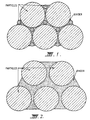
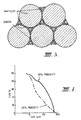
- Figures 1 to 3 show schematic representations of well-mixed composition according to the present invention.
- Figures 1 and 3 both have desired granulometry and binder levels.
- Figures 1 and 3 both have desired granulometry and binder levels.
- Figure 2 is a representation of a composition having poor granulometry and excess binder phase.
- large pools of binder phase exist between the particles and the desired thin layer of binder phase coating each particle is not obtained.
- the system shown in Figure 2 would not produce an ordered carbon upon pyrolysis at 800°C to 1200°C.
- Figure 4 is a plot showing the particle size distribution for particle mixture.
- the mixture represented by the solid line has relatively low porposity and would be suitable for use in the present invention.
- the mixture represented by the dotted lines has a porosity of 45% and would require larger amounts of binder.
- a number of polymerisable resins may be suitable for use in the present invention.
- Resins that may be used include phenolics such as novolacs and resoles, polyphenylene, epoxy, polyamide, polyimide, furane, nitrile eterocyclic and alkyd resins.
- One or more polymerisable resins may be included in the binder phase.
- the binder phase may also include one or more polymerisation promoters to enable a polymerisation and/or a crosslinking reaction to occur.
- the polymerisation promoter may simply act as an initiator for the reaction or it may take part in the polymerisation reaction as a reactant.
- the binder phase may further comprise one or more solvents.
- the solvent(s) may be used to adjust the viscosity of the resin-based binder system.
- the solvent also actively participates in and facilitates a polymerisation and/or cross-linking reaction with the resin.
- the preferred binder phase of the present invention comprises a novolac resin, furfuryl alcohol and hexamine.
- Hexamine is also known as hexamethylene-tetramine.
- the furfuryl alcohol acts as a solvent and as a polymer precursor.
- the hexamine acts as a polymerisation promoter.
- the inventors have found that both the furfuryl alcohol and the hexamine take part in the reaction sequence that occurs during curing and pyrolysis and become incorporated into the final structure.
- nitrogen is retained in the structure through carbonisation and it is postulated that the retention of nitrogen is an important feature in further increasing the high Fermi level and alkali resistance of the carbon.
- the polymer may be capable of being involved in aromatic ring formation during pyrolysis. The retention of much of the nitrogen and some hydrogen in the material even after baking to 1100°C is a non standard behaviour compared with pyrolysis of the individual components.
- the binder phase may comprise 20-60% novolac, with hexamine being added in proportion, normally being around 15-25% of the novolac (all percentages being weight percent, unless otherwise specified). Furfuryl alcohol makes up the balance. More preferably, the binder phase comprises 30-45% novolac, 6-9% hexamine and 46-64% furfuryl alcohol.
- polyamides, polyimides and nitriles may be formed as intermediates during curing of the binder phase. Accordingly, polyamides, polyimides and nitriles may be used as original components in the binder phase. However, it is preferred to use appropriate compositions of novolac/furfuryl alcohol/ hexamine to generate these compounds in-situ as the components of the novolac/furfuryl alcohol/hexamine system are lower in price than polyamides, polyimides and nitriles.
- Polyamide resins are generally made from the reaction of a polybasic acid and a polyamide.
- suitable precursor materials that may be used to produce polyamide resins suitable for use in the present invention include acids such as terephthalic acid, isophthalic acid, pyromellitic acid, glutaric acid, adipic acid and pimelic acid, and amines selected from 0-phenylene diamine, 2,4-diaminotoluene, 4,4 methylene dianiline, ethylene diamine, hexamethylene diamine and piperazine.
- polyimide resins suitable for use in the present invention include polybenzimadazoles, poly(N,N'-bis (p,p'-oxydiphenylene)) pyromellitimide and poly(m-phenylene pyromellitimide).
- Nitriles that can be used in the present invention include basic compounds such as acrylonitrile or benzyinitrile which can react to form polymeric species such as amides, or longer chain forms, such as polyacrylonitrile.
- furane resins suitable for use in the present invention include poly(furfuryl alcohol) and its substituted derivatives and poly(2,5 bis(hydroxymethyl) furan and its substituted derivatives.
- polyphenylene resins suitable for use in the present invention include polyphenylene, polyperfluorophenylene, polyphenylene oxide and polyphenylene sulfide. Substitution of the aromatic ring is possible and common using groups of which the following are examples: phenyl, methyl, epoxides, phenylsulphate and hydroxyl.
- epoxy resins suitable for use in the present invention include those that are prepared by reacting resins selected from diglycidyl ether of bisphenol A and its derivatives, glycidyl ethers of cresol-novolac resins, glycidyl ethers of phenol-novolac resins and tetraglycidylmethylene dianiline and its derivatives with amines selected from ethylene diamine, propylene diamine, p-phenylene diamine, 2,4 diamino toluene and 4,4 methylene dianiline.
- Alkyd resins suitable for use in the present invention may be prepared from the reaction of polyhydric alcohols and polybasic acids (or their anhydrides) modified with monobasic fatty acids. Examples of each of these materials are:
- the type of solvent and polymerisation reaction used are dependent upon the resin system chosen and whether it is physically compatible with the solid particles and whether the resin requires a polymerisation promoter to initiate and/or take part in the polymerisation reaction.
- polymerisation promoters suitable for use in the present invention include formaldehyde, trioxane, epoxides, urea formaldehyde, melamine formaldehyde, organic acids, such as p-toluene sulphonic acid, and phosphoric acid.
- Other polymerisation promoters compatible with the particular polymerisable resin used may also be utilised.
- boron oxide B 2 O 3
- boric acid Other polymerisation promoters that may be used in the present invention are boron oxide (B 2 O 3 ) or boric acid. These compounds are especially suitable for use in resin systems that include furfuryl alcohol. Not only does the boron oxide assist in promoting the polymerisation reaction, it is also postulated that the boron oxide acts to associate with edge carbon atoms in the carbonaceous structure formed following baking. This has the potential to improve the sodium resistance of the carbonaceous material formed after baking due to one or more of the following mechanisms:
- the binder phase may be polymerised by any suitable method known to those skilled in the art.
- the binder phase may be polymerised by heating to an elevated temperature, by addition of chemicals such as polymerising agents or by a combination of both. Heating to an elevated temperature is the preferred method of polymerising the binder phase.
- the binder phase should have a char yield upon carbonisation of at least 20%. If the char yield is significantly lower than 20%, the final product may have poor structural integrity, high porosity and low density. Preferably, the char yield is greater than 25%.
- the char-yield is calculated according to the following equation: baked mass binder phase green mass binder phase x 100%
- the composition is particularly suitable for preparing carbon-containing materials.
- the process may further comprise shaping the mixture obtained by step (i) into a desired shape prior to curing.
- the binder phase is cured by heating the mixture obtained in step (i) to an elevated temperature.
- the preferred form of the process involves mixing the binder phase components of polymerisable resin and optional crosslinking agent(s) and solvent(s).
- the amount of solvent and/or temperature of the binder phase are controlled to achieve the desired viscosity (less than 10 Pa.s) and the solid particles are then added.
- the solid particles are a bimodal or trimodal mixture to achieve the desired granulometry and to obtain the desired packing density.
- a continuous distribution of particle sizes may be used.
- the voids between particles are less than 20 ⁇ m in diameter and preferably less than 15 ⁇ m in diameter, most preferably less than 5 ⁇ m.
- the mixture of binder phase and particles will comprise 20 - 45% by volume of binder phase, which includes very fine filler particles. This amount of binder phase will wet the solid particles and fill the small voids between particles. Using the preferred particle sizes, this gives a surface layer of binder phase coating each particle of a thickness of 2 ⁇ m or less.
- the mixture is preferably subsequently heated to an elevated temperature to polymerise the binder phase around the particles.
- the temperature used in this curing step is dependent upon the properties of the particular resin used in the binder phase, with temperatures in the range of 100 - 200°C being typical.
- the curing step causes at least partial polymerisation of the binder phase and results in the formation of a strong structure that may be described as a polymeric matrix in intimate contact with and holding the solid particles. It is preferred that curing results in the formation of a polymerisation product that includes at least areas of ordered polymer. Unreacted materials are typically driven off as volatiles and this stage must be closely controlled to avoid disrupting the structure. For the preferred novolac system, this may take 30 hours at a temperature of 200°C.
- the material is carbonised by heating at a reasonably slow rate to a temperature in the range of 800 - 1200°C, preferably 900 - 1100°C.
- a reasonably slow rate of temperature increase is used because volatiles need to be released or oxide atoms and unlinked hydrocarbons and aromatics are lost.
- the carbonised article may then be used.
- the method of the present invention is particularly suitable for manufacturing articles and artefacts.
- the green mixture of particles and binder phase should have sufficient strength to be self-supporting and enable easy handling prior to curing. Additionally, the system does not pass through a liquid phase during curing and baking and hence improved dimensional stability may be obtained during baking.
- articles and objects made in accordance with the invention have a closed porosity and a low total porosity, which may be of the order of 15 - 20%.
- the final material also has a fine porosity, with pore size generally being less than 1 ⁇ m.
- the method of the present invention is particularly useful for producing cathodes for use in aluminium electrolysis cells.
- the solid particles are preferably graphite and/or anthracite if the cathode is to be used in a conventional cell.
- the solid particulate material used in the method preferably includes a refractory hard material, more preferably titanium diboride.
- Articles produced according to the invention also exhibit good strength, with a flexural strength in the range of 5 - 10 MPa being typical. This is similar to the strength of conventional aluminium cathode carbons.
- the resin-based system also can give stronger bonding from lower thickness and better penetration of porous filler particles than can be achieved with pitch. This is due to the ability to use functional groups on the resins to promote wetting of fillers and also being able to control rheology to give desired thicknesses.
- the surface chemistry of the solid particles can also be controlled to match the binder component properties. These may allow the surface of the solid particles to provide hetero atoms to actually take part in the reactions and/or to selectively attach to parts of the binder components to promote ordering in the initial uncured state which assists in forming the desired final structure. For example, in the preferred novolac/hexamine/furfuryl alcohol system, the promotion of oxides on the surface of the solid particles has been found to improve wetting and spreading.
- the resin-based system of the present invention allows these advantages to be realised, whilst also incorporating resistance to disruption of the carbon structure by alkali metals, especially sodium. This has not been achieved before.
- the article of the invention may be a cathode for use in an electrolysis cell for aluminium production. Tests carried out on a range of carbon-based materials have all shown excellent resistance to physical disruption by sodium attack.
- the carbon-containing material is particularly suitable for use in the cathode structure of aluminium smelting cells.
- Resin/polymer systems can offer substantial advantages in physical and electrical properties, provided their lack of chemical resistance can be overcome.
- the present invention has achieved this.
- Pitch is comprised of polyaromatic hydrocarbons, is variable in composition, and contains carcinogenic agents).
- the chemistry can be controlled, the components are known and standard technology exists for handling and disposing of them.
- a suitable resin system may also be applicable in the development of advanced smelting technologies currently restricted by the unavailability of materials.
- the present invention has largely overcome the problems of resistance to sodium disruption of resin-based systems in aluminium smelting cells and allows the above-mentioned advantages to accrue. Further advantages arising from use of the present invention in the cathode structure of aluminium cells may include:
- additives are to be included in the composition , it will be most convenient for these additives to form a part of the solid particulate material added to the composition. It will be appreciated that the additives should meet the requirement of being wetted by the binder phase. Furthermore, the additive particles should have a granulometry that allows formation of the thin layer of binder and minimises the formation of large voids.
- Articles produced in accordance with the invention may also be used in many other fields.
- refractory bricks and refractory linings may be produced by using solid particles of oxide materials. Ceramics may also be made by using solid ceramic particles in the system. Use of refractory hard materials, such as TiB 2 , may allow the production of aluminium wettable cathodes for use in aluminium smelting.
- the product can be used to make stand-alone artefacts such as electrodes (cathodes and anodes), refractories and the like.
- the product can be bonded to a substrate either during fabrication or afterwards to give laminated structures.
- the artefact does not need to have uniform composition of solid particles and these may be graded to change properties over the dimensions or thickness of the article.
Landscapes
- Chemical & Material Sciences (AREA)
- Engineering & Computer Science (AREA)
- Ceramic Engineering (AREA)
- Materials Engineering (AREA)
- Organic Chemistry (AREA)
- Structural Engineering (AREA)
- Manufacturing & Machinery (AREA)
- Inorganic Chemistry (AREA)
- Chemical Kinetics & Catalysis (AREA)
- Electrochemistry (AREA)
- Metallurgy (AREA)
- Ceramic Products (AREA)
- Carbon And Carbon Compounds (AREA)
Claims (35)
- Procédé de préparation d'une matière contenant du carbone, lequel procédé comprend les étapes :caractérisé en ce que à l'étape (i) :(i) de mélange de particules de matière solide avec une phase liante ; laquelle matière est thermiquement stable dans une plage de températures allant de 800 °C à 1200 °C ; la phase liante comprenant au moins une résine polymérisable et éventuellement un ou plusieurs composants choisis parmi au moins un promoteur de polymérisation et au moins un solvant, la phase liante ayant un rendement de carbonisation en excès de 20 % lors du chauffage à une température se situant dans la plage allant de 800 à 1200 °C ;(ii) de durcissement de ladite phase liante pour au moins polymériser partiellement ladite phase liante ; et(iii) de chauffage du mélange durci à une température se situant dans la plage allant de 800 à 1200 °C pour carboniser ladite phase liante pour produire une matière à base de carbone résistant à la dislocation par des métaux alcalins ;lesdites particules de matière solide ont une granulométrie dans laquelle les espaces vides entre les particules ont une taille inférieure à 20 µm de diamètre ;la phase liante a une viscosité inférieure à 10 Pa.S, la viscosité étant déterminée à la température de mélange en l'absence de très fines particules de charge dans la phase liante ; etdans ledit mélange, lesdites particules sont revêtues d'une couche de ladite phase liante ayant une épaisseur inférieure à 2 µm.
- Procédé selon la revendication 1, comprenant en outre une étape de façonnage du mélange obtenu à l'étape (i) en une forme souhaitée avant durcissement.
- Procédé selon la revendication 1 ou 2, dans lequel ladite phase liante est durcie en chauffant le mélange obtenu à l'étape (i).
- Procédé selon la revendication 3, dans lequel ledit mélange est durci en chauffant à une température se situant dans la plage allant de 100 à 200 °C.
- Procédé selon l'une quelconque des revendications 1 à 4, comprenant en outre une étape de protection du mélange durci de l'oxydation lors de l'étape (iii).
- Procédé selon l'une quelconque des revendications précédentes, dans lequel le mélange fourni à l'étape (i) a une ou plusieurs propriétés physiques choisies parmi les quantités relatives desdites particules et de ladite phase liante, la viscosité de la phase liante et la granulométrie des particules.
- Procédé selon l'une quelconque des revendications précédentes, dans lequel ladite viscosité de la phase liante est inférieure à 1,0 Pa.S à la température de mélange utilisée pour mélanger ladite phase liante avec lesdites particules solides.
- Procédé selon l'une quelconque des revendications précédentes, dans lequel ladite viscosité de la phase liante se situe dans la plage allant de 0,1 à 0,5 Pa.S à la température de mélange utilisée pour mélanger ladite phase liante avec lesdites particules solides.
- Procédé selon l'une quelconque des revendications précédentes, dans lequel ladite phase liante comprend 20 à 45 % en volume de ladite composition et lesdites particules solides comprennent 55 à 80 % en volume de ladite composition, à l'état brut.
- Procédé selon l'une quelconque des revendications précédentes, dans lequel lesdites particules solides ont une dimension comprise entre 5 µm et 2000 µm.
- Procédé selon la revendication 10, dans lequel lesdites particules solides comprennent un mélange bimodal de particules, un mélange trimodal de particules ou un mélange contrôlé de particules ayant une distribution de taille continue.
- Procédé selon l'une quelconque des revendications précédentes, dans lequel ladite épaisseur de ladite couche mince de ladite phase liante est inférieure à 1 µm.
- Procédé selon l'une quelconque des revendications précédentes, dans lequel ladite épaisseur de ladite couche mince de ladite phase liante est inférieure à 0,5 µm.
- Procédé selon l'une quelconque des revendications précédentes, dans lequel ladite matière solide est choisie parmi un ou plusieurs éléments comprenant le coke, l'anthracite, le graphite, une matière céramique, des matières dures réfractaires et des matières à haut point de fusion.
- Procédé selon l'une quelconque des revendications précédentes, dans lequel ledit mélange comprend en outre de très fines particules dont les dimensions se situent dans la plage allant de 30 à 500 nm.
- Procédé selon l'une quelconque des revendications précédentes, dans lequel ladite au moins une résine polymérisable est une résine phénolique, une résine polyamide, une résine polyimide, une résine furane, une résine nitrile, une résine époxy, un polyphénylène, une résine hétérocyclique ou une résine alkyde.
- Procédé selon la revendication 16, dans lequel ladite résine polymérisable est une résine novolaque et ladite phase liante comprend en outre de l'alcool furfurylique et de l'hexaméthylènetétramine.
- Procédé selon la revendication 17, dans lequel ladite phase liante comprend 20 à 60 % de novolaque, 15 à 25 % d'hexaméthylènetétramine et 15 à 65 % d'alcool furfurylique.
- Procédé selon la revendication 17, dans lequel ladite phase liante comprend 30 à 45 % de novolaque, 6 à 9 % d'hexaméthylènetétramine et 46 à 64 % d'alcool furfurylique.
- Procédé selon la revendication 17, dans lequel ladite phase liante comprend 40,2 % de novolaque, 8,6 % d'hexaméthylènetétramine et 51,2 % d'alcool furfurylique.
- Procédé selon la revendication 16, dans lequel ladite résine polymérisable est une résine polyamide préparée par une réaction d'au moins un polyacide préparé à partir d'au moins un précurseur choisi dans le groupe constitué par l'acide téréphtalique, l'acide isophtalique, l'acide pyromellitique, l'acide glutarique, l'acide adipique et l'acide pimélique, et d'au moins une polyamine préparée à partir d'au moins un précurseur choisi parmi la O-phénylène diamine, le 2,4-diaminotoluène, la 4, 4-méthylène dianiline, l'éthylène diamine, l'hexaméthylène diamine ou la pipérazine.
- Procédé selon la revendication 16, dans lequel ladite résine polymérisable est une résine polyimide choisie parmi les polybenzimidazoles, le poly(N,N'-bis(p,p'-oxydiphénylène) pyromellitimide et le poly(m-phénylène pyromellitimide).
- Procédé selon la revendication 16, dans lequel ladite résine polymérisable est une résine furane choisie parmi le poly(alcool furfurylique) et ses dérivés substitués et le poly(2,5-bis(hydroxyméthyl))furane et ses dérivés substitués.
- Procédé selon la revendication 16, dans lequel ladite résine polymérisable est un polyphénylène choisi parmi le polyphénylène, le polyperfluorophénylène, l'oxyde de polyphénylène ou le sulfure de polyphénylène, éventuellement avec la substitution du cycle aromatique par au moins un groupe choisi dans le groupe constitué par le phényle, le méthyle, les époxydes, le phénylsulfate et l'hydroxyle.
- Procédé selon la revendication 16, dans lequel ladite résine polymérisable est une résine époxy choisie parmi celles qui sont préparées en faisant réagir des résines choisies parmi l'éther diglycidylique de bisphénol A et ses dérivés, les éthers glycidyliques de résines crésol-novolaque, les éthers glycidyliques de résines phénol-novolaque ou la tétradiglycidylméthylène dianiline et ses dérivés avec des amines choisies parmi l'éthylène diamine, la propylène diamine, la p-phénylène diamine,. le 2,4-diaminotoluène ou la 4,4-méthylène dianiline.
- Procédé selon la revendication 16, dans lequel ladite résine polymérisable est une résine alkyde préparée à partir de la réaction de polyols et de polyacides (ou leurs anhydrides) modifiés avec des acides gras monobasiques, dans lequel ledit polyol est choisi dans le groupe comprenant le glycérol, le pentaérythritol ou le sorbitol, ledit polyacide étant choisi dans le groupe comprenant l'acide phtalique, l'acide maléique, l'acide adipique ou l'acide pyromellitique et ledit acide gras est choisi dans le groupe comprenant l'acide stéarique, l'acide oléique, l'acide linoléique et l'acide palmitique.
- Procédé selon l'une quelconque des revendications précédentes, dans lequel ladite phase liante comprend un composant qui contient un atome donneur d'électrons, et un réseau contenant du carbone restant après cuisson de ladite composition à une température se situant dans la plage allant de 800 à 1200 °C contient au moins certains desdits atomes donneurs d'électrons incorporés dans celui-ci.
- Procédé selon la revendication 27, dans lequel ledit atome donneur d'électrons est l'azote.
- Procédé selon la revendication 27, dans lequel ledit atome donneur d'électrons est l'oxygène.
- Procédé selon l'une quelconque des revendications précédentes, dans lequel lesdites particules solides sont traitées pour améliorer la mouillabilité des particules solides par la phase liante.
- Procédé selon l'une quelconque des revendications précédentes, dans lequel une chaíne polymère primaire dans le mélange durci subit une déshydrogénation sensible au cours d'une pyrolyse sans dislocation sensible du polymère, qui est assistée par la présence d'hétéroatomes à l'intérieur du polymère.
- Article comprenant des particules solides et une matrice carbonée retenant lesdites particules solides, ladite matrice carbonée étant résistance à la dislocation par des métaux alcalins, et ledit article pouvant être obtenu à partir desdites particules solides et d'une phase liante comprenant une résine polymérisable et éventuellement un promoteur de polymérisation et/ou un solvant par un procédé selon l'une quelconque des revendications précédentes.
- Article selon la revendication 32, dans lequel ledit article est une cathode destinée à être utilisée dans une cellule d'électrolyse en aluminium.
- Système liant-résine adapté pour être utilisé dans la phase liante dans un procédé selon l'une quelconque des revendications 1 à 31, le système liant-résine comprenant au moins un composant ayant un atome donneur d'électrons incorporé dans celui-ci lors de la polymérisation ledit atome donneur d'électrons étant retenu dans une matière contenant du carbone produite en cuisant le système liant-résine à des températures se situant dans la plage allant de 800 à 1200 °C.
- Composition destinée à être utilisée dans un procédé selon l'une quelconque des revendications 1 à 31, ladite composition comprenant un mélange de particules d'une matière solide et d'une phase liante selon l'une quelconque des revendications 1 à 31 ; dans laquelle, dans ledit mélange, lesdites particules sont revêtues d'une couche de ladite phase liante ; et dans laquelle lorsque ladite composition est carbonisée par chauffage à une température se situant dans la plage allant de 800 °C à 1200 °C, ladite composition forme une matière contenant du carbone résistant à la dislocation par des métaux alcalins.
Applications Claiming Priority (4)
| Application Number | Priority Date | Filing Date | Title |
|---|---|---|---|
| AUPL9522/93 | 1993-06-21 | ||
| AUPL952293 | 1993-06-21 | ||
| AUPL952293 | 1993-06-21 | ||
| PCT/AU1994/000338 WO1995000458A1 (fr) | 1993-06-21 | 1994-06-21 | Systemes liants |
Publications (3)
| Publication Number | Publication Date |
|---|---|
| EP0705233A1 EP0705233A1 (fr) | 1996-04-10 |
| EP0705233A4 EP0705233A4 (fr) | 1997-09-24 |
| EP0705233B1 true EP0705233B1 (fr) | 2004-12-08 |
Family
ID=3776992
Family Applications (1)
| Application Number | Title | Priority Date | Filing Date |
|---|---|---|---|
| EP94918686A Expired - Lifetime EP0705233B1 (fr) | 1993-06-21 | 1994-06-21 | Systemes liants |
Country Status (6)
| Country | Link |
|---|---|
| EP (1) | EP0705233B1 (fr) |
| BR (1) | BR9406902A (fr) |
| CA (1) | CA2164338C (fr) |
| NO (1) | NO319014B1 (fr) |
| WO (1) | WO1995000458A1 (fr) |
| ZA (1) | ZA944431B (fr) |
Families Citing this family (4)
| Publication number | Priority date | Publication date | Assignee | Title |
|---|---|---|---|---|
| JPH1064539A (ja) * | 1996-08-12 | 1998-03-06 | Kagaku Gijutsu Shinko Jigyodan | 電池電極材 |
| FR2821365A1 (fr) * | 2001-02-28 | 2002-08-30 | Carbone Savoie | Cathode graphite pour l'electrolyse de l'aluminium |
| RU2359941C2 (ru) * | 2007-09-13 | 2009-06-27 | Валентин Всеволодович Васильев | Алкилрезорциноформальдегидное связующее для огнеупоров |
| CN114899401A (zh) * | 2022-05-17 | 2022-08-12 | 深圳市杰孚瑞科技有限公司 | 无定形碳粘结材料及其制备方法和匣钵 |
Family Cites Families (3)
| Publication number | Priority date | Publication date | Assignee | Title |
|---|---|---|---|---|
| US4481052A (en) * | 1983-01-28 | 1984-11-06 | Martin Marietta Corporation | Method of making refractory hard metal containing tiles for aluminum cell cathodes |
| US4775455A (en) * | 1986-04-07 | 1988-10-04 | Borden, Inc. | Binder system for anodes, cathodes, and electrodes |
| CA1271324A (fr) * | 1987-03-23 | 1990-07-10 | Sadashiv Nadkarni | Colle pour blocs cathodiques |
-
1994
- 1994-06-21 CA CA002164338A patent/CA2164338C/fr not_active Expired - Fee Related
- 1994-06-21 WO PCT/AU1994/000338 patent/WO1995000458A1/fr not_active Ceased
- 1994-06-21 ZA ZA944431A patent/ZA944431B/xx unknown
- 1994-06-21 BR BR9406902A patent/BR9406902A/pt not_active IP Right Cessation
- 1994-06-21 EP EP94918686A patent/EP0705233B1/fr not_active Expired - Lifetime
-
1995
- 1995-11-24 NO NO19954758A patent/NO319014B1/no not_active IP Right Cessation
Also Published As
| Publication number | Publication date |
|---|---|
| EP0705233A4 (fr) | 1997-09-24 |
| CA2164338A1 (fr) | 1995-01-05 |
| NO954758L (no) | 1996-02-21 |
| CA2164338C (fr) | 2002-01-08 |
| EP0705233A1 (fr) | 1996-04-10 |
| WO1995000458A1 (fr) | 1995-01-05 |
| ZA944431B (en) | 1995-02-15 |
| NO319014B1 (no) | 2005-06-06 |
| BR9406902A (pt) | 1996-04-09 |
| NO954758D0 (no) | 1995-11-24 |
Similar Documents
| Publication | Publication Date | Title |
|---|---|---|
| US4466996A (en) | Aluminum cell cathode coating method | |
| US4582553A (en) | Process for manufacture of refractory hard metal containing plates for aluminum cell cathodes | |
| US4775455A (en) | Binder system for anodes, cathodes, and electrodes | |
| AU569488B2 (en) | Refractory hard metal containing tiles for aluminum cell cathodes | |
| US4624766A (en) | Aluminum wettable cathode material for use in aluminum reduction cell | |
| US4544469A (en) | Aluminum cell having aluminum wettable cathode surface | |
| US4526911A (en) | Aluminum cell cathode coating composition | |
| US5886092A (en) | Binder systems | |
| US4466995A (en) | Control of ledge formation in aluminum cell operation | |
| CA1256232A (fr) | Pile d'electrolyse de l'aluminium | |
| EP0705233B1 (fr) | Systemes liants | |
| EP0083654B1 (fr) | Revetements cathodiques en materiau dur refractaire-fibres de carbone pour des cellules de reduction d'aluminium | |
| US4816511A (en) | Cement for cathode blocks | |
| EP0102186B1 (fr) | Cellule d'électrolyse pour la fabrication électrolytique de l'aluminium | |
| AU672318B2 (en) | Binder systems | |
| NZ211026A (en) | Refractory hard material-containing plates for aluminium cell cathodes | |
| WO1984000565A1 (fr) | Cycle de durcissement de revetement cathodique en aluminium | |
| NO162731B (no) | Fremgangsmaate for fremstilling av en aluminiumfuktbar katodeoverflate. |
Legal Events
| Date | Code | Title | Description |
|---|---|---|---|
| PUAI | Public reference made under article 153(3) epc to a published international application that has entered the european phase |
Free format text: ORIGINAL CODE: 0009012 |
|
| 17P | Request for examination filed |
Effective date: 19951228 |
|
| AK | Designated contracting states |
Kind code of ref document: A1 Designated state(s): FR GB NL |
|
| A4 | Supplementary search report drawn up and despatched |
Effective date: 19970805 |
|
| AK | Designated contracting states |
Kind code of ref document: A4 Designated state(s): FR GB NL |
|
| RHK1 | Main classification (correction) |
Ipc: C04B 35/52 |
|
| 17Q | First examination report despatched |
Effective date: 20000217 |
|
| GRAP | Despatch of communication of intention to grant a patent |
Free format text: ORIGINAL CODE: EPIDOSNIGR1 |
|
| GRAS | Grant fee paid |
Free format text: ORIGINAL CODE: EPIDOSNIGR3 |
|
| GRAA | (expected) grant |
Free format text: ORIGINAL CODE: 0009210 |
|
| AK | Designated contracting states |
Kind code of ref document: B1 Designated state(s): FR GB NL |
|
| REG | Reference to a national code |
Ref country code: GB Ref legal event code: FG4D |
|
| RIC1 | Information provided on ipc code assigned before grant |
Ipc: 7C 08J 5/00 B Ipc: 7C 08J 3/00 B Ipc: 7C 25C 7/02 B Ipc: 7C 25C 3/08 B Ipc: 7C 04B 41/83 B Ipc: 7C 04B 35/64 B Ipc: 7C 04B 35/58 B Ipc: 7C 04B 35/52 A |
|
| PLBE | No opposition filed within time limit |
Free format text: ORIGINAL CODE: 0009261 |
|
| STAA | Information on the status of an ep patent application or granted ep patent |
Free format text: STATUS: NO OPPOSITION FILED WITHIN TIME LIMIT |
|
| 26N | No opposition filed |
Effective date: 20050909 |
|
| ET | Fr: translation filed | ||
| PGFP | Annual fee paid to national office [announced via postgrant information from national office to epo] |
Ref country code: NL Payment date: 20100624 Year of fee payment: 17 |
|
| REG | Reference to a national code |
Ref country code: NL Ref legal event code: V1 Effective date: 20120101 |
|
| PG25 | Lapsed in a contracting state [announced via postgrant information from national office to epo] |
Ref country code: NL Free format text: LAPSE BECAUSE OF NON-PAYMENT OF DUE FEES Effective date: 20120101 |
|
| PGFP | Annual fee paid to national office [announced via postgrant information from national office to epo] |
Ref country code: GB Payment date: 20120625 Year of fee payment: 19 Ref country code: FR Payment date: 20120705 Year of fee payment: 19 |
|
| GBPC | Gb: european patent ceased through non-payment of renewal fee |
Effective date: 20130621 |
|
| REG | Reference to a national code |
Ref country code: FR Ref legal event code: ST Effective date: 20140228 |
|
| PG25 | Lapsed in a contracting state [announced via postgrant information from national office to epo] |
Ref country code: GB Free format text: LAPSE BECAUSE OF NON-PAYMENT OF DUE FEES Effective date: 20130621 |
|
| PG25 | Lapsed in a contracting state [announced via postgrant information from national office to epo] |
Ref country code: FR Free format text: LAPSE BECAUSE OF NON-PAYMENT OF DUE FEES Effective date: 20130701 |