EP0705601B1 - Lösungen von Anthrachinonen zur parenteralen Applikation - Google Patents
Lösungen von Anthrachinonen zur parenteralen Applikation Download PDFInfo
- Publication number
- EP0705601B1 EP0705601B1 EP94115597A EP94115597A EP0705601B1 EP 0705601 B1 EP0705601 B1 EP 0705601B1 EP 94115597 A EP94115597 A EP 94115597A EP 94115597 A EP94115597 A EP 94115597A EP 0705601 B1 EP0705601 B1 EP 0705601B1
- Authority
- EP
- European Patent Office
- Prior art keywords
- solution according
- anthraquinones
- polyethylene glycol
- anthraquinone
- solutions
- Prior art date
- Legal status (The legal status is an assumption and is not a legal conclusion. Google has not performed a legal analysis and makes no representation as to the accuracy of the status listed.)
- Expired - Lifetime
Links
Classifications
-
- A—HUMAN NECESSITIES
- A61—MEDICAL OR VETERINARY SCIENCE; HYGIENE
- A61K—PREPARATIONS FOR MEDICAL, DENTAL OR TOILETRY PURPOSES
- A61K31/00—Medicinal preparations containing organic active ingredients
- A61K31/70—Carbohydrates; Sugars; Derivatives thereof
- A61K31/7028—Compounds having saccharide radicals attached to non-saccharide compounds by glycosidic linkages
- A61K31/7034—Compounds having saccharide radicals attached to non-saccharide compounds by glycosidic linkages attached to a carbocyclic compound, e.g. phloridzin
- A61K31/704—Compounds having saccharide radicals attached to non-saccharide compounds by glycosidic linkages attached to a carbocyclic compound, e.g. phloridzin attached to a condensed carbocyclic ring system, e.g. sennosides, thiocolchicosides, escin, daunorubicin
-
- A—HUMAN NECESSITIES
- A61—MEDICAL OR VETERINARY SCIENCE; HYGIENE
- A61K—PREPARATIONS FOR MEDICAL, DENTAL OR TOILETRY PURPOSES
- A61K31/00—Medicinal preparations containing organic active ingredients
- A61K31/185—Acids; Anhydrides, halides or salts thereof, e.g. sulfur acids, imidic, hydrazonic or hydroximic acids
- A61K31/19—Carboxylic acids, e.g. valproic acid
- A61K31/192—Carboxylic acids, e.g. valproic acid having aromatic groups, e.g. sulindac, 2-aryl-propionic acids, ethacrynic acid
-
- A—HUMAN NECESSITIES
- A61—MEDICAL OR VETERINARY SCIENCE; HYGIENE
- A61K—PREPARATIONS FOR MEDICAL, DENTAL OR TOILETRY PURPOSES
- A61K31/00—Medicinal preparations containing organic active ingredients
- A61K31/12—Ketones
- A61K31/122—Ketones having the oxygen directly attached to a ring, e.g. quinones, vitamin K1, anthralin
-
- A—HUMAN NECESSITIES
- A61—MEDICAL OR VETERINARY SCIENCE; HYGIENE
- A61K—PREPARATIONS FOR MEDICAL, DENTAL OR TOILETRY PURPOSES
- A61K31/00—Medicinal preparations containing organic active ingredients
- A61K31/13—Amines
- A61K31/135—Amines having aromatic rings, e.g. ketamine, nortriptyline
- A61K31/136—Amines having aromatic rings, e.g. ketamine, nortriptyline having the amino group directly attached to the aromatic ring, e.g. benzeneamine
-
- A—HUMAN NECESSITIES
- A61—MEDICAL OR VETERINARY SCIENCE; HYGIENE
- A61K—PREPARATIONS FOR MEDICAL, DENTAL OR TOILETRY PURPOSES
- A61K47/00—Medicinal preparations characterised by the non-active ingredients used, e.g. carriers or inert additives; Targeting or modifying agents chemically bound to the active ingredient
- A61K47/06—Organic compounds, e.g. natural or synthetic hydrocarbons, polyolefins, mineral oil, petrolatum or ozokerite
- A61K47/08—Organic compounds, e.g. natural or synthetic hydrocarbons, polyolefins, mineral oil, petrolatum or ozokerite containing oxygen, e.g. ethers, acetals, ketones, quinones, aldehydes, peroxides
- A61K47/14—Esters of carboxylic acids, e.g. fatty acid monoglycerides, medium-chain triglycerides, parabens or PEG fatty acid esters
-
- A—HUMAN NECESSITIES
- A61—MEDICAL OR VETERINARY SCIENCE; HYGIENE
- A61K—PREPARATIONS FOR MEDICAL, DENTAL OR TOILETRY PURPOSES
- A61K47/00—Medicinal preparations characterised by the non-active ingredients used, e.g. carriers or inert additives; Targeting or modifying agents chemically bound to the active ingredient
- A61K47/06—Organic compounds, e.g. natural or synthetic hydrocarbons, polyolefins, mineral oil, petrolatum or ozokerite
- A61K47/22—Heterocyclic compounds, e.g. ascorbic acid, tocopherol or pyrrolidones
-
- A—HUMAN NECESSITIES
- A61—MEDICAL OR VETERINARY SCIENCE; HYGIENE
- A61K—PREPARATIONS FOR MEDICAL, DENTAL OR TOILETRY PURPOSES
- A61K47/00—Medicinal preparations characterised by the non-active ingredients used, e.g. carriers or inert additives; Targeting or modifying agents chemically bound to the active ingredient
- A61K47/30—Macromolecular organic or inorganic compounds, e.g. inorganic polyphosphates
- A61K47/36—Polysaccharides; Derivatives thereof, e.g. gums, starch, alginate, dextrin, hyaluronic acid, chitosan, inulin, agar or pectin
- A61K47/40—Cyclodextrins; Derivatives thereof
-
- A—HUMAN NECESSITIES
- A61—MEDICAL OR VETERINARY SCIENCE; HYGIENE
- A61K—PREPARATIONS FOR MEDICAL, DENTAL OR TOILETRY PURPOSES
- A61K9/00—Medicinal preparations characterised by special physical form
- A61K9/0012—Galenical forms characterised by the site of application
- A61K9/0019—Injectable compositions; Intramuscular, intravenous, arterial, subcutaneous administration; Compositions to be administered through the skin in an invasive manner
-
- C—CHEMISTRY; METALLURGY
- C09—DYES; PAINTS; POLISHES; NATURAL RESINS; ADHESIVES; COMPOSITIONS NOT OTHERWISE PROVIDED FOR; APPLICATIONS OF MATERIALS NOT OTHERWISE PROVIDED FOR
- C09B—ORGANIC DYES OR CLOSELY-RELATED COMPOUNDS FOR PRODUCING DYES, e.g. PIGMENTS; MORDANTS; LAKES
- C09B1/00—Dyes with anthracene nucleus not condensed with any other ring
- C09B1/02—Hydroxy-anthraquinones; Ethers or esters thereof
-
- C—CHEMISTRY; METALLURGY
- C09—DYES; PAINTS; POLISHES; NATURAL RESINS; ADHESIVES; COMPOSITIONS NOT OTHERWISE PROVIDED FOR; APPLICATIONS OF MATERIALS NOT OTHERWISE PROVIDED FOR
- C09B—ORGANIC DYES OR CLOSELY-RELATED COMPOUNDS FOR PRODUCING DYES, e.g. PIGMENTS; MORDANTS; LAKES
- C09B67/00—Influencing the physical, e.g. the dyeing or printing properties of dyestuffs without chemical reactions, e.g. by treating with solvents grinding or grinding assistants, coating of pigments or dyes; Process features in the making of dyestuff preparations; Dyestuff preparations of a special physical nature, e.g. tablets, films
- C09B67/0033—Blends of pigments; Mixtured crystals; Solid solutions
- C09B67/0034—Mixtures of two or more pigments or dyes of the same type
- C09B67/0038—Mixtures of anthraquinones
-
- C—CHEMISTRY; METALLURGY
- C09—DYES; PAINTS; POLISHES; NATURAL RESINS; ADHESIVES; COMPOSITIONS NOT OTHERWISE PROVIDED FOR; APPLICATIONS OF MATERIALS NOT OTHERWISE PROVIDED FOR
- C09B—ORGANIC DYES OR CLOSELY-RELATED COMPOUNDS FOR PRODUCING DYES, e.g. PIGMENTS; MORDANTS; LAKES
- C09B67/00—Influencing the physical, e.g. the dyeing or printing properties of dyestuffs without chemical reactions, e.g. by treating with solvents grinding or grinding assistants, coating of pigments or dyes; Process features in the making of dyestuff preparations; Dyestuff preparations of a special physical nature, e.g. tablets, films
- C09B67/0071—Process features in the making of dyestuff preparations; Dehydrating agents; Dispersing agents; Dustfree compositions
- C09B67/0083—Solutions of dyes
Definitions
- the invention relates to stable, heat-sterilizable solutions of anthraquinones (anthraquinone and anthraquinone derivatives, including anthraquinone releasing compounds, such as. Glycosides) as defined in the claims. You are as pharmaceutical preparations suitable for parenteral applications.
- Anthraquinone compounds of the type mentioned are of great interest because they have been shown to have inhibitory effects against viruses and / or retroviruses.
- hydroxy derivatives of anthraquinones are suitable for the prophylaxis and therapy of diseases which are caused by viruses of the Herpetoviridae family (eg herpes simplex, cytomegalovirus, varicella zoster, Epstein-Barr virus), see " Use of anthraquinone derivatives for the prophylaxis and therapy of viral diseases ", May, G.
- microemulsions O / W emulsions With Soybean oil, cottonseed oils, semi-synthetic neutral oils, e.g. Miglyol®) or Liposomes (phospholipids) are not suitable carriers for anthraquinones: either the desired concentrations were not reached or the stability the preparations turned out to be unsatisfactory.
- anthraquinones e.g. Danthron, purpurin or hypericin, an anthraquinone dimer
- alkalizing is usually inadequate, i.e. it only therapeutically inadequate concentrations are achieved, while the Alkalization requires physiologically unacceptable alkali concentrations Stability of the solutions adversely affected.
- an object of the invention to overcome the above-mentioned disadvantages of the prior art to overcome. More specifically, it is the object of the invention for parenteral administration to provide suitable solutions of anthraquinone and its derivatives, which contains the active substance in sufficient amounts, i.e. corresponding concentrations, included to maintain therapeutically relevant blood levels.
- solvents in the combination are polyoxyethylene-polyoxypropylene block polymers ("Polaxamer USP / NF", Lutrol®-F types), 2-pyrrolidone (Soluphor® P), ethanol, benzyl alcohol, phenylethyl alcohol, liquid polyethylene glycols (Lutrol®-E types), glycerin, propylene glycol, butylene glycol or their mixtures in Consideration.
- Polyoxyethylene-polyoxypropylene block polymers (“Polaxamer USP / NF", Lutrol®-F types), 2-pyrrolidone (Soluphor® P), ethanol, benzyl alcohol, phenylethyl alcohol, liquid polyethylene glycols (Lutrol®-E types), glycerin, propylene glycol, butylene glycol or their mixtures in Consideration.
- These solutions can additionally contain the auxiliaries customary for the production of pharmaceutical preparations.
- anthraquinones are alizarin, Anthraflavinklare, chrysazin, quinizarin, purpurin, emodin, quinalizarin, Rhein, chrysophanic, 1,4-dihydroxy-2,3-dimethyl anthraquinone, 1-amino-4-hydroxyanthraquinone and carminic acid, where the radicals R 1 - R 8 are as given in Table 1.
- C 1-4 alkyl radicals are methyl, ethyl, n- and i-propyl and n-, i- and t-butyl, where R 2 and R 3 are preferably methyl.
- glycosides can be used as sugar residues. Particularly preferred are glucose, mannose, galactose, arabinose, N-acethylglucosamine, muramic acid, Neuraminic acid and the corresponding alcohols and polyglycans.
- Polyethylene glycol 660-12 hydrosystearate e.g. Solutol® from BASF
- Solutol® from BASF
- anthraquinones are very readily soluble in Solutol® HS 15. These solutions can be diluted with aqueous phase and are for production of solutions of anthraquinones with the properties defined at the outset.
- the solutions according to the invention contain between 1 and 90% by weight, preferably 10-60 % By weight and more preferably 20-40% by weight of the solubilizer.
- Tetrahydrofurfyl alcohol polyethylene glycol ether are ethers with one or more Ethylene oxide units and their mixtures.
- a commercially available TFPG is e.g. under the names Glycofurol®, Glycofurol 75® and Tetraglykol® available.
- Glycofurol® Glycofurol 75®
- Tetraglykol® available.
- a product is used which is made up of equal parts of tetrahydrofurfuryl alcohol polyethylene glycol ether and tetrahydrofurfuryl alcohol polydiethylene glycol ether (CAS No. 9004-76-6) consists.
- TFPG tetrahydrofurfuryl alcohol polyethylene glycol ether
- Numerous Injection and infusion preparations (benzodiazepines, phenytoin, co-trimoxazole, vitamins) with this solubilizer are approved as medicinal products and on the market.
- anthraquinones are very readily soluble in TFPG.
- the solutions according to the invention generally contain 10 to 80% by volume of tetrahydrofurfuryl alcohol polyethylene glycol ether, preferably 20-70% by volume and more particularly preferred Way 30 - 60 vol .-%.
- the solutions are heat sterilizable and unexpected about one long period stable.
- Solutions containing TFPG especially those with high anthraquinone concentrations, however, in some cases tend to increase the water content, i.e. when diluted with Water or usual infusion solutions, spontaneously or within a short time to cloudiness and crystallizations. Solutions contaminated with such crystal deposits may then no longer be administered parenterally for reasons of drug safety serious side effects may occur.
- polyvinylpyrrolidone is added as a stabilizer.
- Polyvinyl pyrrolidone is described as a pharmaceutical additive in pharmacopoeias and in different Types available commercially.
- Polyvinylpyrrolidones are preferred according to the invention with a molecular weight up to about 40,000, corresponding to a K value in the range of 10-30.
- PVP types with a K value are particularly suitable for parenteral use in the range of 10-20.
- Such stabilized solutions are advantageous if Parenteral solutions with the solution mediator TFPG desired as an infusion additive become.
- TFPG tetrahydrofurfuryl alcohol polyethylene glycol ether
- polyvinylpyrrolidone as a stabilizer in the general 10-80% by weight TFPG and 1-10% by weight polyvinylpyrrolidone.
- parenteral Purposes are water-soluble etherified ⁇ - or ⁇ -cyclodextrin compounds prefers.
- side effects may occur in rare cases surrender. The least side effects indicate according to currently available Investigations on the hydroxypropyl- ⁇ -cyclodextrin. It is therefore preferred.
- anthraquinones can also be used with cyclodextrin Solubilizers can be converted into aqueous solutions. It was found that in the solutions according to the invention the molar ratio of dissolved Anthraquinone and dissolved cyclodextrin is approximately 1: 1; i.e. with 1 mole of cyclodextrin 1 mol of anthraquinone can be dissolved as a solubilizer. The UV-VIS spectroscopic examination of these solutions showed no significant deviations of spectra with solutions of the corresponding anthraquinones at the same pH in other solvents were obtained.
- solutions according to the invention contain 5-40% by weight, preferably 10-25% by weight and most preferably 15% by weight of one or more cyclodextrins.
- the preparations according to the invention contain anthraquinone or its derivatives, as defined in claim 1, in concentrations of> 10 -5 mol / l, preferably of> 10 -4 mol / l and even more preferably of> 10 -3 mol / l.
- Solubilizers or solvents such as polyoxyethylene-polyoxypropylene block polymers ("Polaxamer USP / NF", Lutrol®-F types), 2-pyrrolidone (Soluphor® P), ethanol, Benzyl alcohol, phenylethyl alcohol, liquid polyethylene glycols (Lutrol®-E types), Glycerin, propylene glycol, butylene glycol or mixtures thereof, as in the following Examples listed can be used to dissolve anthraquinones in the desired solutions To transfer properties. Because of the undesirable side effects already mentioned is the use of the latter, in the solutions according to the invention, additional solution brokers restricted.
- the substances were dissolved in Solutol® HS 15 at approx. 40-60 degrees Celsius and into the about 50-65 ° C aqueous phase slowly incorporated.
- the aqueous phase contained either none, single or multiple, i.e. Combinations of those listed above Formulation aids (other solvents or solubilizers, buffer systems, Stabilizers, etc.), depending on the desired concentration and type of anthraquinone derivative to be dissolved and the desired properties with regard to chemical and physical stability or other pharmaceutical requirements.
- the solutions were sterile filtered, filled into injection vials or ampoules and heat sterilized.
- Anthraquinones (see above), purified by recrystallization, were removed at room temperature in the desired amount of Glykofurol 75® as tetrahydrofurfuryl alcohol polyethylene glycol ether dissolved and mixed with the aqueous phase.
- the aqueous phase either did not contain any single or multiple, i.e.
- Combinations of the formulation aids listed above Polyvinylpyrrolidone as a stabilizer for those to be diluted with aqueous phases particularly suitable preparations, buffer systems, other solubilizers, stabilizers etc.), depending on the desired concentration and type of anthraquinone derivative to be dissolved, as well as the desired properties with regard to chemical and physical Stability as well as other pharmaceutical requirements.
- Table 3 shows exemplary formulations according to the invention, the parenterally applicable requirements defined at the beginning Solutions of anthraquinone derivatives correspond.
- Anthraquinones (see above), which had been purified by recrystallization, were stirred up into a about 40 degrees Celsius solution of the cyclodextrin compound. After more complete Dissolution was sterile filtered, filled into injection vials or ampoules and heat sterilized. Similarly, dry mixtures of cyclodextrin and Anthraquinone or by evaporation or as a lyophilisate from cyclodextrin-anthraquinone solutions obtained dry mixtures with a commercially available injection or Infusion preparation (water for injection, physiological saline, etc.) into one injectable preparation can be processed.
- a commercially available injection or Infusion preparation water for injection, physiological saline, etc.
- Table 4 shows an example of aqueous formulations according to the invention which meet the requirements defined at the outset for solutions of anthraquinones which can be used parenterally.
Landscapes
- Health & Medical Sciences (AREA)
- Chemical & Material Sciences (AREA)
- Life Sciences & Earth Sciences (AREA)
- Medicinal Chemistry (AREA)
- Pharmacology & Pharmacy (AREA)
- Epidemiology (AREA)
- Animal Behavior & Ethology (AREA)
- General Health & Medical Sciences (AREA)
- Public Health (AREA)
- Veterinary Medicine (AREA)
- Chemical Kinetics & Catalysis (AREA)
- Organic Chemistry (AREA)
- Engineering & Computer Science (AREA)
- General Chemical & Material Sciences (AREA)
- Oil, Petroleum & Natural Gas (AREA)
- Molecular Biology (AREA)
- Dermatology (AREA)
- Inorganic Chemistry (AREA)
- Medicinal Preparation (AREA)
- Acyclic And Carbocyclic Compounds In Medicinal Compositions (AREA)
- Pharmaceuticals Containing Other Organic And Inorganic Compounds (AREA)
Description
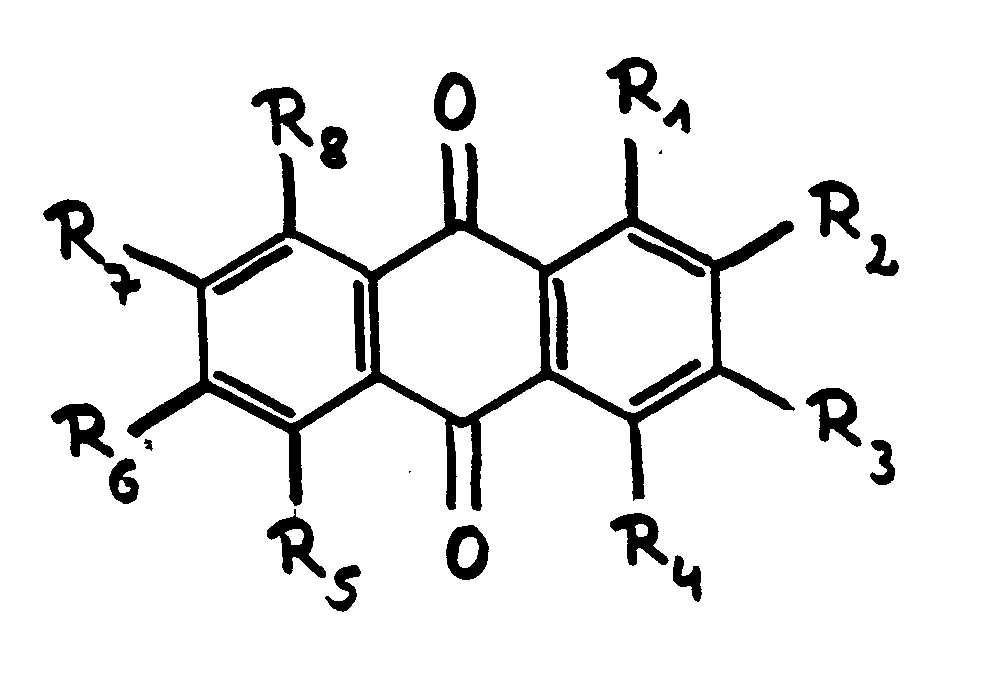
| Übersicht der untersuchten Anthrachinone | ||||||||
| Strukturformel: | ||||||||
| Verbindung | 1 | 2 | 3 | 4 | 5 | 6 | 7 | 8 |
| (1) Alzarin | OH | OH | --- | --- | --- | --- | --- | --- |
| (2) Anthraflavinsäure | --- | OH | --- | --- | --- | OH | --- | --- |
| (3) Chrysazin (= Danthron) | OH | --- | --- | --- | --- | --- | --- | OH |
| (4) Chinizarin | OH | --- | --- | OH | --- | --- | --- | --- |
| (5) Purpurin | OH | OH | --- | OH | --- | --- | --- | --- |
| (6) Emodin | OH | --- | OH | --- | --- | OH | --- | OH |
| (7) Chinalizarin | OH | OH | --- | --- | OH | --- | --- | OH |
| (8) Rhein | --- | COOH | --- | OH | OH | --- | --- | --- |
| (9) Chrysophansäure | OH | --- | CH3 | --- | --- | --- | --- | OH |
| (10) 1.4-Dihydroxy-2.3-diemthylanthrachinon | OH | CH3 | CH3 | OH | --- | --- | --- | --- |
| (11) 1-Amino-4-hydroxyanthrachinon | NH2 | --- | --- | OH | --- | --- | --- | --- |
| (12) Karminsäure (R=Glucose) | CH3 | COOH | OH | --- | OH | OH | R | OH |


| Materialbezeichnung | Einwaage in g | ||||||||
| Anthrachinon (s.Tab. 1) | |||||||||
| 1 | 0,010 | 0,020 | 0,075 | ||||||
| 2 | 0,020 | ||||||||
| 3 | 0,020 | ||||||||
| 4 | 0,020 | ||||||||
| 5 | 0,025 | ||||||||
| 8 | 0,030 | ||||||||
| 12 | 0,300 | ||||||||
| Lösungsvermittler | |||||||||
| Hydroxypropyl-β-Cyclodextrin | 10,000 | 15,000 | 25,000 | 25,000 | 20,000 | 15,000 | 15,000 15,000 | 15,000 | |
| Zusatzkomponenten | |||||||||
| Ethanol | 1,000 | ||||||||
| Glycerol | 2,000 | ||||||||
| Polyethylenglykol | 10,000 | ||||||||
| Phosphatpuffer | 0,150 | 0,150 | 0,150 | 0,150 | 0,150 | 0,150 | 0,150 | 0,150 | 0,150 |
| EDTA-Natrium | 0,050 | 0,050 | 0,050 | 0,050 | 0,050 | 0,050 | 0,050 | 0,050 | 0,050 |
| Wasser für Injektion | ad 100 ml |
Claims (8)
- Stabile, hitzesterilisierbare Lösungen von Anthrachinonen, welche ein oder mehrere Anthrachinone der Formelin der R1 bis R8, die gleich oder verschieden sein können, H, OH, C1-4-Alkyl, NH2 oder OR9 bzw. NHR10 bedeuten, wobei R9 und R10 C1-4-Alkyl oder einen glykosidisch gebundenen Zuckerrest darstellen, sowie deren Dimere oder Rhein und Karminsäure in einer Konzentration von > 10-5mol/l zusammen mit mindestens einem Lösungsvermittler aus
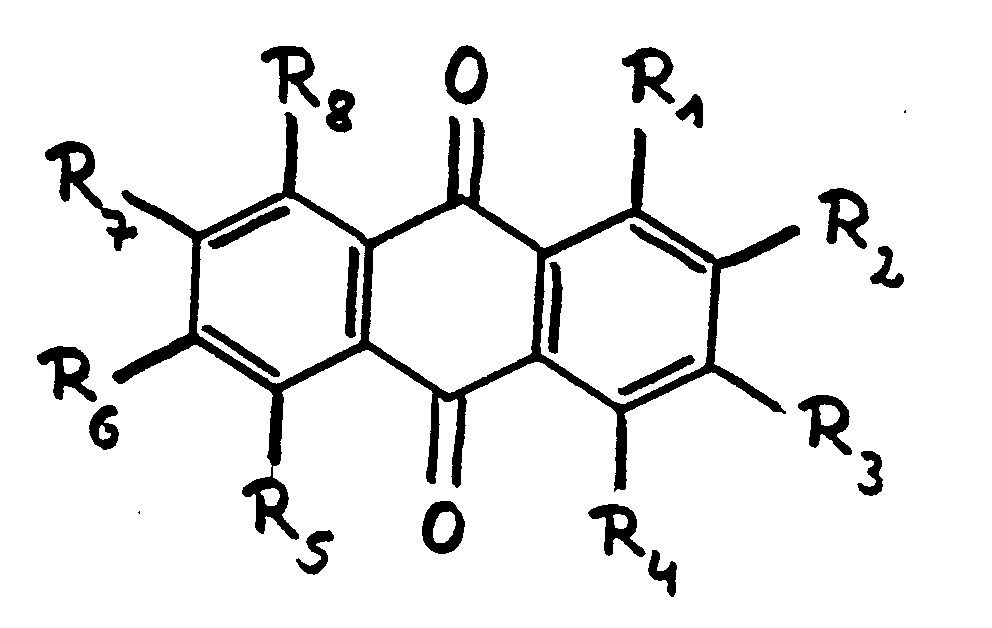 allein oder in Kombination mit einem oder mehreren anderen, physiologisch geeigneten, nichtwässrigen Lösungsmitteln bzw. Lösungsvermittlern sowie Wasser und ggf. zusätzliche für die Herstellung von pharmazeutischen Zubereitungen übliche Hilfsstoffe enthalten.I. Polyethylenglykol-660-12-HydroxystearatII. TetrahydrofurfurylalkoholpolyethylenglykoletherIII. Wasserlösliche β- und γ-Cyclodextrinderivate,
 - Lösung gemäß Anspruch 1, dadurch gekennzeichnet, daß das AnthrachinonderivatAlizarin,Anthraflavinsäure,Chrysazin,Chinizarin,Purpurin,Emodin,Chinalizarin,Chrysophansäure,1,4-Dihydroxy-2,3-dimethylanthrachinon oder1-Amino-4-hydroxyanthrachinon ist.
- Lösung gemäß Anspruch 1 oder 2, dadurch gekennzeichnet, daß sie die Anthrachinone in einer Konzentration > 10-3 mol/l enthält.
- Lösung gemaß einem der Ansprüche 1 bis 3, dadurch gekennzeichnet, daß sie als weitere Lösungsvermittler Polyoxyethylen-Polyoxypropylen-Blockpolymere, 2-Pyrrolidon, Ethanol, Benzylalkohol, Phenylethylalkohol, flüssige Polyethylenglykole, Glycerin, Propylenglykol, Butylenglykol oder deren Mischungen enthält.
- Lösung gemaß einem der vorstehenden Ansprüche, dadurch gekennzeichnet, daß sie Polyethylenglykol-660-12-Hydroxystearat in einer Menge von 1-90 Gew.-%, vorzugsweise 10-60 Gew.-%, in noch bevorzugterer Weise 20-40 Gew.-% enthält.
- Lösung gemaß einem der Ansprüche 1 bis 4, dadurch gekennzeichnet, daß sie Tetrahydrofurfurylalkoholpolyethylenglykolether (TFPG) in einer Menge von 10 - 80 Gew.-%, vorzugsweise 20 - 70 Gew.-% und besonders bevorzugt 30 - 60 Gew.-% enthält.
- Lösung gemäß Anspruch 6, dadurch gekennzeichnet, daß sie in Kombination mit TFPG Polyvinylpyrrolidon in einer Menge von 1-10 Gew.-%, vorzugsweise 1-5 Gew.-% und besonders bevorzugt von 3-5 Gew.-% enthält.
- Lösung gemäß einem der Ansprüche 1 bis 4, dadurch gekennzeichnet, daß sie die Cyclodextrinderivate als Lösungsvermittler in einer Menge von 5-40 Gew.-%, vorzugsweise 10-25 Gew.-% und am meisten bevorzugt 15 Gew.-% enthält.
Priority Applications (3)
| Application Number | Priority Date | Filing Date | Title |
|---|---|---|---|
| DE59409088T DE59409088D1 (de) | 1994-10-04 | 1994-10-04 | Lösungen von Anthrachinonen zur parenteralen Applikation |
| AT94115597T ATE188870T1 (de) | 1994-10-04 | 1994-10-04 | Lösungen von anthrachinonen zur parenteralen applikation |
| EP94115597A EP0705601B1 (de) | 1994-10-04 | 1994-10-04 | Lösungen von Anthrachinonen zur parenteralen Applikation |
Applications Claiming Priority (1)
| Application Number | Priority Date | Filing Date | Title |
|---|---|---|---|
| EP94115597A EP0705601B1 (de) | 1994-10-04 | 1994-10-04 | Lösungen von Anthrachinonen zur parenteralen Applikation |
Publications (2)
| Publication Number | Publication Date |
|---|---|
| EP0705601A1 EP0705601A1 (de) | 1996-04-10 |
| EP0705601B1 true EP0705601B1 (de) | 2000-01-19 |
Family
ID=8216353
Family Applications (1)
| Application Number | Title | Priority Date | Filing Date |
|---|---|---|---|
| EP94115597A Expired - Lifetime EP0705601B1 (de) | 1994-10-04 | 1994-10-04 | Lösungen von Anthrachinonen zur parenteralen Applikation |
Country Status (3)
| Country | Link |
|---|---|
| EP (1) | EP0705601B1 (de) |
| AT (1) | ATE188870T1 (de) |
| DE (1) | DE59409088D1 (de) |
Families Citing this family (13)
| Publication number | Priority date | Publication date | Assignee | Title |
|---|---|---|---|---|
| ATE218359T1 (de) | 1994-11-03 | 2002-06-15 | Novartis Erfind Verwalt Gmbh | Neue zubereitungsformen des cyclosporins zur oralen applikation mit einfacher zusammensetzung und hoher bioverfügbarkeit und verfahren zu deren herstellung |
| DE19544507B4 (de) | 1995-11-29 | 2007-11-15 | Novartis Ag | Cyclosporin enthaltende Präparate |
| US5935581A (en) * | 1996-07-24 | 1999-08-10 | Kapadia; Govind J. | Inhibitory effects of synthetic and natural colorants on carcinogenesis |
| FR2758264B1 (fr) * | 1997-01-16 | 1999-03-26 | Charles Dumontet | Compositions medicamenteuses contenant de l'edta ou un de ses derives pour la prevention de la toxicite cutanee et sous-cutanee des anthracyclines et de leurs derives |
| FR2782455B3 (fr) * | 1998-08-20 | 2000-09-15 | Sanofi Sa | Composition pharmaceutique injectable a base d'un sel pharmaceutiquement acceptable du clopidogrel ou de ticlopidine |
| WO2001051089A1 (de) * | 2000-01-13 | 2001-07-19 | Merck Patent Gmbh | Pharmazeutische zubereitungen enthaltend 2-pyrrolidon als lösungsvermittler |
| WO2002094324A1 (en) * | 2001-05-18 | 2002-11-28 | Institute Of Materials Research & Engineering | Injectable drug delivery systems with cyclodextrin-polymer based hydrogels |
| US20030220294A1 (en) * | 2002-03-21 | 2003-11-27 | Wallace Kendall B. | Cyclodextrin compositions and methods of treating viral infections |
| KR20050099311A (ko) * | 2004-04-09 | 2005-10-13 | 에이엔에이치 케어연구소(주) | 주사제용 항암제 조성물 |
| DE202006021184U1 (de) | 2005-06-25 | 2013-06-05 | Charité - Universitätsmedizin Berlin | Wässrige Methacetin-Lösung |
| TW200816983A (en) | 2006-04-07 | 2008-04-16 | Sunten Phytotech Co Ltd | Anthracenedione compounds |
| US9119819B2 (en) | 2008-04-30 | 2015-09-01 | Wockhardt Ltd. | Oral liquid compositions of rhein or diacerein |
| CN101613421B (zh) * | 2009-05-08 | 2011-12-14 | 南开大学 | 蒽醌修饰β-环糊精假聚轮烷DNA非共价交联试剂 |
Family Cites Families (9)
| Publication number | Priority date | Publication date | Assignee | Title |
|---|---|---|---|---|
| JPS6054286B2 (ja) * | 1979-09-18 | 1985-11-29 | 江澤 林 | 免疫増強剤 |
| DE3574932D1 (de) * | 1984-02-27 | 1990-02-01 | American Cyanamid Co | Verwendung von 1,4 bisubstituierten anthrachinonen zur herstellung von immunsuppressiva. |
| ATE59290T1 (de) * | 1986-03-07 | 1991-01-15 | American Cyanamid Co | Stabile injizierbare arzneiformulierung des 1,4- dihydroxy-5,8-bis((2-(hydroxyaethylamino)|thyl)amino)anthrachinondihydrochlorids. |
| DE3623376A1 (de) * | 1986-07-11 | 1988-01-21 | Behringwerke Ag | Pharmazeutische formulierung und verfahren zu deren herstellung |
| JPH01121215A (ja) * | 1987-11-06 | 1989-05-12 | Nippon Hai Potsukusu:Kk | シアリダーゼ阻害剤 |
| JPH02149515A (ja) * | 1988-11-30 | 1990-06-08 | Tsumura & Co | アルドースリダクターゼ阻害剤 |
| JPH0374326A (ja) * | 1989-08-17 | 1991-03-28 | Tsumura & Co | ケミルミネッセンス抑制剤 |
| GB9103075D0 (en) * | 1991-02-13 | 1991-03-27 | Washington Odur Ayuko | Trinitrobenzene derivatives and their therapeutic use |
| DE4013023A1 (de) * | 1990-04-24 | 1991-11-07 | Lohmann Rudolf Lomapharm | Verwendung von anthrachinonderivaten zur prophylaxe und therapie von viruserkrankungen |
-
1994
- 1994-10-04 EP EP94115597A patent/EP0705601B1/de not_active Expired - Lifetime
- 1994-10-04 DE DE59409088T patent/DE59409088D1/de not_active Expired - Fee Related
- 1994-10-04 AT AT94115597T patent/ATE188870T1/de not_active IP Right Cessation
Also Published As
| Publication number | Publication date |
|---|---|
| DE59409088D1 (de) | 2000-02-24 |
| ATE188870T1 (de) | 2000-02-15 |
| EP0705601A1 (de) | 1996-04-10 |
Similar Documents
| Publication | Publication Date | Title |
|---|---|---|
| EP0242328B1 (de) | Arzneimittel zur Behandlung von Entzündungen im Auge | |
| EP0117888B2 (de) | Flüssigzubereitungen von Dihydropyridinen, ein Verfahren zu ihrer Herstellung, sowie ihre Verwendung bei der Bekämpfung von Erkrankungen | |
| DE69920201T2 (de) | Zusammensetzungen enthaltend glykolderivate, alkohole und vitamin d | |
| EP0316633B1 (de) | Azelastin enthaltende Arzneimittel zur Anwendung in der Nase und/oder am Auge | |
| DE69109021T2 (de) | Augentropfenarzneimittel. | |
| EP0093999B1 (de) | Arzneimittelzubereitungen von Oxicam-Derivaten und Verfahren zu deren Herstellung | |
| EP2766008B1 (de) | Zusammensetzung für die nasale applikation mit verbesserter stabilität | |
| EP0705601A1 (de) | Lösungen von Anthrachinonen zur parenteralen Applikation | |
| DE602004013035T2 (de) | Suspension von loteprednol-etabonat und tobramycin für die topische ophthalmische anwendung | |
| DE69229318T2 (de) | Hydrierte Rizinusöl-enthaltende injizierbare Formulierungen mit verlängerter Wirkstoffabgabe | |
| DE69625200T2 (de) | Arzneimittel enthaltend lamotrigin | |
| WO2001078732A1 (de) | Lagerstabile infusionslösung des ciprofloxacins | |
| DE69804998T2 (de) | Mometasonfuroat-suspensionen zum zerstäuben | |
| EP0435826A1 (de) | Intravenöse Lösungen für Status Epilepticus | |
| DE19541919C2 (de) | Pharmazeutische Zubereitung zur Behandlung akuter Rhinitiden | |
| DD244292A5 (de) | Trockensubstanzen und stabile suspensionen | |
| DE69019404T2 (de) | Derivate von Penciclovir zur Behandlung von Hepatitis-B-Infektionen. | |
| DE3751589T2 (de) | Anthracyclin-Glucosid enthaltende einspritzbare gebrauchsfertige Lösungen gegen Krebs. | |
| EP0277462A1 (de) | Verfahren zur Herstellung nasaler Lösungen enthaltend synthetisches Human calcitonin. | |
| DE19530708C2 (de) | Pharmazeutisches Präparat mit trypanoziden Eigenschaften | |
| WO2002026233A1 (de) | Lagerstabile infusionslösung des ciprofloxacins mit verringertem säuregehalt | |
| DE4010228A1 (de) | Verfahren zur herstellung eines mittels gegen virale infektionen, vorzugsweise gegen aids | |
| DE69636837T2 (de) | 1,2,4-benzotriazinoxid-formulierungen | |
| EP0024258A1 (de) | Die Herstellung pharmazeutischer Zusammensetzungen zur Behandlung von Herpes-Infektionen | |
| DE3122689C2 (de) | N-Trifluoracetyl-adriamycin-14-0-hemiglutarat und -hemiadipat und diese Verbindungen enthaltende pharmazeutische Zubereitungen |
Legal Events
| Date | Code | Title | Description |
|---|---|---|---|
| PUAI | Public reference made under article 153(3) epc to a published international application that has entered the european phase |
Free format text: ORIGINAL CODE: 0009012 |
|
| 17P | Request for examination filed |
Effective date: 19941004 |
|
| AK | Designated contracting states |
Kind code of ref document: A1 Designated state(s): AT BE CH DE DK ES FR GB GR IE IT LI LU MC NL PT SE |
|
| 17Q | First examination report despatched |
Effective date: 19980616 |
|
| GRAG | Despatch of communication of intention to grant |
Free format text: ORIGINAL CODE: EPIDOS AGRA |
|
| GRAG | Despatch of communication of intention to grant |
Free format text: ORIGINAL CODE: EPIDOS AGRA |
|
| GRAG | Despatch of communication of intention to grant |
Free format text: ORIGINAL CODE: EPIDOS AGRA |
|
| GRAH | Despatch of communication of intention to grant a patent |
Free format text: ORIGINAL CODE: EPIDOS IGRA |
|
| GRAH | Despatch of communication of intention to grant a patent |
Free format text: ORIGINAL CODE: EPIDOS IGRA |
|
| GRAA | (expected) grant |
Free format text: ORIGINAL CODE: 0009210 |
|
| AK | Designated contracting states |
Kind code of ref document: B1 Designated state(s): AT BE CH DE FR GB IT LI LU NL SE |
|
| PG25 | Lapsed in a contracting state [announced via postgrant information from national office to epo] |
Ref country code: SE Free format text: THE PATENT HAS BEEN ANNULLED BY A DECISION OF A NATIONAL AUTHORITY Effective date: 20000119 Ref country code: NL Free format text: LAPSE BECAUSE OF FAILURE TO SUBMIT A TRANSLATION OF THE DESCRIPTION OR TO PAY THE FEE WITHIN THE PRESCRIBED TIME-LIMIT Effective date: 20000119 Ref country code: IT Free format text: LAPSE BECAUSE OF FAILURE TO SUBMIT A TRANSLATION OF THE DESCRIPTION OR TO PAY THE FEE WITHIN THE PRE;WARNING: LAPSES OF ITALIAN PATENTS WITH EFFECTIVE DATE BEFORE 2007 MAY HAVE OCCURRED AT ANY TIME BEFORE 2007. THE CORRECT EFFECTIVE DATE MAY BE DIFFERENT FROM THE ONE RECORDED.SCRIBED TIME-LIMIT Effective date: 20000119 Ref country code: FR Free format text: THE PATENT HAS BEEN ANNULLED BY A DECISION OF A NATIONAL AUTHORITY Effective date: 20000119 |
|
| REF | Corresponds to: |
Ref document number: 188870 Country of ref document: AT Date of ref document: 20000215 Kind code of ref document: T |
|
| REG | Reference to a national code |
Ref country code: CH Ref legal event code: NV Representative=s name: RIEDERER HASLER & PARTNER PATENTANWAELTE AG Ref country code: CH Ref legal event code: EP |
|
| GBT | Gb: translation of ep patent filed (gb section 77(6)(a)/1977) |
Effective date: 20000127 |
|
| REF | Corresponds to: |
Ref document number: 59409088 Country of ref document: DE Date of ref document: 20000224 |
|
| ET | Fr: translation filed | ||
| NLV1 | Nl: lapsed or annulled due to failure to fulfill the requirements of art. 29p and 29m of the patents act | ||
| PG25 | Lapsed in a contracting state [announced via postgrant information from national office to epo] |
Ref country code: LU Free format text: LAPSE BECAUSE OF NON-PAYMENT OF DUE FEES Effective date: 20001004 Ref country code: GB Free format text: LAPSE BECAUSE OF NON-PAYMENT OF DUE FEES Effective date: 20001004 Ref country code: AT Free format text: LAPSE BECAUSE OF NON-PAYMENT OF DUE FEES Effective date: 20001004 |
|
| PG25 | Lapsed in a contracting state [announced via postgrant information from national office to epo] |
Ref country code: LI Free format text: LAPSE BECAUSE OF NON-PAYMENT OF DUE FEES Effective date: 20001031 Ref country code: CH Free format text: LAPSE BECAUSE OF NON-PAYMENT OF DUE FEES Effective date: 20001031 Ref country code: BE Free format text: LAPSE BECAUSE OF NON-PAYMENT OF DUE FEES Effective date: 20001031 |
|
| PLBE | No opposition filed within time limit |
Free format text: ORIGINAL CODE: 0009261 |
|
| STAA | Information on the status of an ep patent application or granted ep patent |
Free format text: STATUS: NO OPPOSITION FILED WITHIN TIME LIMIT |
|
| 26N | No opposition filed | ||
| BERE | Be: lapsed |
Owner name: RUDOLF LOHMANN G.M.B.H. K.G. PHARMAZEUTISCHE FABRI Effective date: 20001031 |
|
| GBPC | Gb: european patent ceased through non-payment of renewal fee |
Effective date: 20001004 |
|
| REG | Reference to a national code |
Ref country code: CH Ref legal event code: PL |
|
| PG25 | Lapsed in a contracting state [announced via postgrant information from national office to epo] |
Ref country code: DE Free format text: LAPSE BECAUSE OF NON-PAYMENT OF DUE FEES Effective date: 20010703 |
|
| REG | Reference to a national code |
Ref country code: FR Ref legal event code: ST |