EP0708174B1 - Verfahren und Anlage zur Reinigung von Altölen - Google Patents
Verfahren und Anlage zur Reinigung von Altölen Download PDFInfo
- Publication number
- EP0708174B1 EP0708174B1 EP95402302A EP95402302A EP0708174B1 EP 0708174 B1 EP0708174 B1 EP 0708174B1 EP 95402302 A EP95402302 A EP 95402302A EP 95402302 A EP95402302 A EP 95402302A EP 0708174 B1 EP0708174 B1 EP 0708174B1
- Authority
- EP
- European Patent Office
- Prior art keywords
- oil
- line
- extraction
- zone
- ppm
- Prior art date
- Legal status (The legal status is an assumption and is not a legal conclusion. Google has not performed a legal analysis and makes no representation as to the accuracy of the status listed.)
- Expired - Lifetime
Links
- 238000000034 method Methods 0.000 title claims description 28
- 239000010913 used oil Substances 0.000 title description 11
- 238000009434 installation Methods 0.000 title description 7
- 238000000605 extraction Methods 0.000 claims description 48
- 229930195733 hydrocarbon Natural products 0.000 claims description 36
- 150000002430 hydrocarbons Chemical class 0.000 claims description 36
- 239000004215 Carbon black (E152) Substances 0.000 claims description 32
- 238000004821 distillation Methods 0.000 claims description 24
- 239000002904 solvent Substances 0.000 claims description 24
- 238000005292 vacuum distillation Methods 0.000 claims description 22
- 229910052751 metal Inorganic materials 0.000 claims description 18
- 239000002184 metal Substances 0.000 claims description 18
- 230000018044 dehydration Effects 0.000 claims description 13
- 238000006297 dehydration reaction Methods 0.000 claims description 13
- 239000003054 catalyst Substances 0.000 claims description 11
- ATUOYWHBWRKTHZ-UHFFFAOYSA-N Propane Chemical compound CCC ATUOYWHBWRKTHZ-UHFFFAOYSA-N 0.000 claims description 8
- 239000001257 hydrogen Substances 0.000 claims description 8
- 229910052739 hydrogen Inorganic materials 0.000 claims description 8
- 238000000638 solvent extraction Methods 0.000 claims description 8
- XLYOFNOQVPJJNP-UHFFFAOYSA-N water Substances O XLYOFNOQVPJJNP-UHFFFAOYSA-N 0.000 claims description 8
- 239000007789 gas Substances 0.000 claims description 6
- 239000007788 liquid Substances 0.000 claims description 6
- 238000009835 boiling Methods 0.000 claims description 5
- 239000001294 propane Substances 0.000 claims description 4
- 125000004432 carbon atom Chemical group C* 0.000 claims description 3
- 238000004064 recycling Methods 0.000 claims description 3
- UCKMPCXJQFINFW-UHFFFAOYSA-N Sulphide Chemical compound [S-2] UCKMPCXJQFINFW-UHFFFAOYSA-N 0.000 claims description 2
- 239000003638 chemical reducing agent Substances 0.000 claims description 2
- 125000004435 hydrogen atom Chemical class [H]* 0.000 claims 2
- 239000003921 oil Substances 0.000 description 68
- 238000011282 treatment Methods 0.000 description 15
- 239000000203 mixture Substances 0.000 description 14
- 150000002739 metals Chemical class 0.000 description 12
- 239000002253 acid Substances 0.000 description 10
- ZAMOUSCENKQFHK-UHFFFAOYSA-N Chlorine atom Chemical compound [Cl] ZAMOUSCENKQFHK-UHFFFAOYSA-N 0.000 description 9
- 239000000460 chlorine Substances 0.000 description 9
- 229910052801 chlorine Inorganic materials 0.000 description 9
- 239000000047 product Substances 0.000 description 9
- IJGRMHOSHXDMSA-UHFFFAOYSA-N Atomic nitrogen Chemical compound N#N IJGRMHOSHXDMSA-UHFFFAOYSA-N 0.000 description 8
- 238000010438 heat treatment Methods 0.000 description 8
- 239000003463 adsorbent Substances 0.000 description 7
- PNEYBMLMFCGWSK-UHFFFAOYSA-N aluminium oxide Inorganic materials [O-2].[O-2].[O-2].[Al+3].[Al+3] PNEYBMLMFCGWSK-UHFFFAOYSA-N 0.000 description 6
- 238000006386 neutralization reaction Methods 0.000 description 6
- 238000009834 vaporization Methods 0.000 description 6
- 230000008016 vaporization Effects 0.000 description 6
- 101100352919 Caenorhabditis elegans ppm-2 gene Proteins 0.000 description 5
- UFHFLCQGNIYNRP-UHFFFAOYSA-N Hydrogen Chemical compound [H][H] UFHFLCQGNIYNRP-UHFFFAOYSA-N 0.000 description 5
- NINIDFKCEFEMDL-UHFFFAOYSA-N Sulfur Chemical compound [S] NINIDFKCEFEMDL-UHFFFAOYSA-N 0.000 description 5
- 239000000654 additive Substances 0.000 description 5
- 229910052717 sulfur Inorganic materials 0.000 description 5
- 239000011593 sulfur Substances 0.000 description 5
- OKTJSMMVPCPJKN-UHFFFAOYSA-N Carbon Chemical compound [C] OKTJSMMVPCPJKN-UHFFFAOYSA-N 0.000 description 4
- OAICVXFJPJFONN-UHFFFAOYSA-N Phosphorus Chemical compound [P] OAICVXFJPJFONN-UHFFFAOYSA-N 0.000 description 4
- VYPSYNLAJGMNEJ-UHFFFAOYSA-N Silicium dioxide Chemical compound O=[Si]=O VYPSYNLAJGMNEJ-UHFFFAOYSA-N 0.000 description 4
- 229910052799 carbon Inorganic materials 0.000 description 4
- 238000009833 condensation Methods 0.000 description 4
- 230000005494 condensation Effects 0.000 description 4
- 230000008030 elimination Effects 0.000 description 4
- 238000003379 elimination reaction Methods 0.000 description 4
- 239000010687 lubricating oil Substances 0.000 description 4
- 229910052757 nitrogen Inorganic materials 0.000 description 4
- 229910052698 phosphorus Inorganic materials 0.000 description 4
- 239000011574 phosphorus Substances 0.000 description 4
- 238000000926 separation method Methods 0.000 description 4
- 238000005352 clarification Methods 0.000 description 3
- 238000001914 filtration Methods 0.000 description 3
- 239000000446 fuel Substances 0.000 description 3
- 239000002699 waste material Substances 0.000 description 3
- LYCAIKOWRPUZTN-UHFFFAOYSA-N Ethylene glycol Chemical compound OCCO LYCAIKOWRPUZTN-UHFFFAOYSA-N 0.000 description 2
- ZOKXTWBITQBERF-UHFFFAOYSA-N Molybdenum Chemical compound [Mo] ZOKXTWBITQBERF-UHFFFAOYSA-N 0.000 description 2
- PXHVJJICTQNCMI-UHFFFAOYSA-N Nickel Chemical compound [Ni] PXHVJJICTQNCMI-UHFFFAOYSA-N 0.000 description 2
- 238000010306 acid treatment Methods 0.000 description 2
- 150000007513 acids Chemical class 0.000 description 2
- HIGRAKVNKLCVCA-UHFFFAOYSA-N alumine Chemical compound C1=CC=[Al]C=C1 HIGRAKVNKLCVCA-UHFFFAOYSA-N 0.000 description 2
- 239000002199 base oil Substances 0.000 description 2
- 229910001570 bauxite Inorganic materials 0.000 description 2
- 238000005119 centrifugation Methods 0.000 description 2
- 239000003795 chemical substances by application Substances 0.000 description 2
- 238000007906 compression Methods 0.000 description 2
- 230000006835 compression Effects 0.000 description 2
- 230000000694 effects Effects 0.000 description 2
- 230000007613 environmental effect Effects 0.000 description 2
- 239000000295 fuel oil Substances 0.000 description 2
- 229910052750 molybdenum Inorganic materials 0.000 description 2
- 239000011733 molybdenum Substances 0.000 description 2
- 238000002203 pretreatment Methods 0.000 description 2
- 238000010926 purge Methods 0.000 description 2
- 238000000746 purification Methods 0.000 description 2
- 239000013049 sediment Substances 0.000 description 2
- 239000000377 silicon dioxide Substances 0.000 description 2
- 239000010802 sludge Substances 0.000 description 2
- 230000006641 stabilisation Effects 0.000 description 2
- 238000003860 storage Methods 0.000 description 2
- WWNBZGLDODTKEM-UHFFFAOYSA-N sulfanylidenenickel Chemical class [Ni]=S WWNBZGLDODTKEM-UHFFFAOYSA-N 0.000 description 2
- QYLJIYOGHRGUIH-CIUDSAMLSA-N Arg-Ile Chemical compound CC[C@H](C)[C@@H](C(O)=O)NC(=O)[C@@H](N)CCCNC(N)=N QYLJIYOGHRGUIH-CIUDSAMLSA-N 0.000 description 1
- BIVQBWSIGJFXLF-UHFFFAOYSA-N PPM-18 Chemical compound C=1C(=O)C2=CC=CC=C2C(=O)C=1NC(=O)C1=CC=CC=C1 BIVQBWSIGJFXLF-UHFFFAOYSA-N 0.000 description 1
- 238000010795 Steam Flooding Methods 0.000 description 1
- 229910021536 Zeolite Inorganic materials 0.000 description 1
- 230000000996 additive effect Effects 0.000 description 1
- 230000002411 adverse Effects 0.000 description 1
- 230000004075 alteration Effects 0.000 description 1
- 239000003963 antioxidant agent Substances 0.000 description 1
- 125000003118 aryl group Chemical group 0.000 description 1
- 239000010426 asphalt Substances 0.000 description 1
- 125000004429 atom Chemical group 0.000 description 1
- 239000011230 binding agent Substances 0.000 description 1
- 239000004927 clay Substances 0.000 description 1
- 229910052570 clay Inorganic materials 0.000 description 1
- 239000010941 cobalt Substances 0.000 description 1
- 229910017052 cobalt Inorganic materials 0.000 description 1
- GUTLYIVDDKVIGB-UHFFFAOYSA-N cobalt atom Chemical compound [Co] GUTLYIVDDKVIGB-UHFFFAOYSA-N 0.000 description 1
- 238000002485 combustion reaction Methods 0.000 description 1
- 150000001875 compounds Chemical class 0.000 description 1
- 238000001816 cooling Methods 0.000 description 1
- 239000010779 crude oil Substances 0.000 description 1
- 238000005520 cutting process Methods 0.000 description 1
- 238000010908 decantation Methods 0.000 description 1
- 238000010586 diagram Methods 0.000 description 1
- HNPSIPDUKPIQMN-UHFFFAOYSA-N dioxosilane;oxo(oxoalumanyloxy)alumane Chemical compound O=[Si]=O.O=[Al]O[Al]=O HNPSIPDUKPIQMN-UHFFFAOYSA-N 0.000 description 1
- 238000007599 discharging Methods 0.000 description 1
- 238000004090 dissolution Methods 0.000 description 1
- 239000003995 emulsifying agent Substances 0.000 description 1
- 235000021183 entrée Nutrition 0.000 description 1
- -1 etc. Substances 0.000 description 1
- 239000000945 filler Substances 0.000 description 1
- XPFVYQJUAUNWIW-UHFFFAOYSA-N furfuryl alcohol Chemical compound OCC1=CC=CO1 XPFVYQJUAUNWIW-UHFFFAOYSA-N 0.000 description 1
- 239000003502 gasoline Substances 0.000 description 1
- 150000002431 hydrogen Chemical class 0.000 description 1
- 238000005984 hydrogenation reaction Methods 0.000 description 1
- WGCNASOHLSPBMP-UHFFFAOYSA-N hydroxyacetaldehyde Natural products OCC=O WGCNASOHLSPBMP-UHFFFAOYSA-N 0.000 description 1
- 239000012535 impurity Substances 0.000 description 1
- 238000010348 incorporation Methods 0.000 description 1
- 238000002347 injection Methods 0.000 description 1
- 239000007924 injection Substances 0.000 description 1
- JEIPFZHSYJVQDO-UHFFFAOYSA-N iron(III) oxide Inorganic materials O=[Fe]O[Fe]=O JEIPFZHSYJVQDO-UHFFFAOYSA-N 0.000 description 1
- 239000012263 liquid product Substances 0.000 description 1
- 238000005461 lubrication Methods 0.000 description 1
- 238000004519 manufacturing process Methods 0.000 description 1
- 229910052752 metalloid Inorganic materials 0.000 description 1
- 150000002738 metalloids Chemical class 0.000 description 1
- 239000000693 micelle Substances 0.000 description 1
- 239000002480 mineral oil Substances 0.000 description 1
- CWQXQMHSOZUFJS-UHFFFAOYSA-N molybdenum disulfide Chemical compound S=[Mo]=S CWQXQMHSOZUFJS-UHFFFAOYSA-N 0.000 description 1
- 239000010705 motor oil Substances 0.000 description 1
- 229910052759 nickel Inorganic materials 0.000 description 1
- 239000002245 particle Substances 0.000 description 1
- 230000000737 periodic effect Effects 0.000 description 1
- 239000003208 petroleum Substances 0.000 description 1
- 229920000642 polymer Polymers 0.000 description 1
- 239000002244 precipitate Substances 0.000 description 1
- 238000001556 precipitation Methods 0.000 description 1
- 230000002035 prolonged effect Effects 0.000 description 1
- 238000011084 recovery Methods 0.000 description 1
- 230000001172 regenerating effect Effects 0.000 description 1
- 230000008929 regeneration Effects 0.000 description 1
- 238000011069 regeneration method Methods 0.000 description 1
- 238000003303 reheating Methods 0.000 description 1
- 229910052710 silicon Inorganic materials 0.000 description 1
- 239000010703 silicon Substances 0.000 description 1
- 239000002689 soil Substances 0.000 description 1
- 239000012265 solid product Substances 0.000 description 1
- 238000011105 stabilization Methods 0.000 description 1
- 239000000725 suspension Substances 0.000 description 1
- WFKWXMTUELFFGS-UHFFFAOYSA-N tungsten Chemical compound [W] WFKWXMTUELFFGS-UHFFFAOYSA-N 0.000 description 1
- 229910052721 tungsten Inorganic materials 0.000 description 1
- 239000010937 tungsten Substances 0.000 description 1
- 239000010457 zeolite Substances 0.000 description 1
Images
Classifications
-
- C—CHEMISTRY; METALLURGY
- C10—PETROLEUM, GAS OR COKE INDUSTRIES; TECHNICAL GASES CONTAINING CARBON MONOXIDE; FUELS; LUBRICANTS; PEAT
- C10M—LUBRICATING COMPOSITIONS; USE OF CHEMICAL SUBSTANCES EITHER ALONE OR AS LUBRICATING INGREDIENTS IN A LUBRICATING COMPOSITION
- C10M175/00—Working-up used lubricants to recover useful products ; Cleaning
- C10M175/0025—Working-up used lubricants to recover useful products ; Cleaning by thermal processes
- C10M175/0033—Working-up used lubricants to recover useful products ; Cleaning by thermal processes using distillation processes; devices therefor
-
- C—CHEMISTRY; METALLURGY
- C10—PETROLEUM, GAS OR COKE INDUSTRIES; TECHNICAL GASES CONTAINING CARBON MONOXIDE; FUELS; LUBRICANTS; PEAT
- C10G—CRACKING HYDROCARBON OILS; PRODUCTION OF LIQUID HYDROCARBON MIXTURES, e.g. BY DESTRUCTIVE HYDROGENATION, OLIGOMERISATION, POLYMERISATION; RECOVERY OF HYDROCARBON OILS FROM OIL-SHALE, OIL-SAND, OR GASES; REFINING MIXTURES MAINLY CONSISTING OF HYDROCARBONS; REFORMING OF NAPHTHA; MINERAL WAXES
- C10G67/00—Treatment of hydrocarbon oils by at least one hydrotreatment process and at least one process for refining in the absence of hydrogen only
-
- C—CHEMISTRY; METALLURGY
- C10—PETROLEUM, GAS OR COKE INDUSTRIES; TECHNICAL GASES CONTAINING CARBON MONOXIDE; FUELS; LUBRICANTS; PEAT
- C10M—LUBRICATING COMPOSITIONS; USE OF CHEMICAL SUBSTANCES EITHER ALONE OR AS LUBRICATING INGREDIENTS IN A LUBRICATING COMPOSITION
- C10M175/00—Working-up used lubricants to recover useful products ; Cleaning
- C10M175/005—Working-up used lubricants to recover useful products ; Cleaning using extraction processes; apparatus therefor
Definitions
- the present invention relates to a method and an installation for the purification of used oils, i.e. a treatment intended to produce at least one base oil usable again.
- oils are in particular mineral oils of hydrocarbons, generally of petroleum origin, most often containing various additives such as agents anti-rust, antioxidants, emulsifiers, viscosity additives, etc., oils which after more or less long use in an internal combustion engine, as agents lubrication, have had their properties adversely changed and have loaded with products such as carbonaceous residues, oxidized products, water, hydrocarbons not burnt, which led to drain them.
- additives such as agents anti-rust, antioxidants, emulsifiers, viscosity additives, etc.
- Used oils contain a multitude of contaminating elements since practically all the groups of the periodic table can be represented, as the example demonstrates below.
- Another process for regenerating used oils uses acid treatment sulfuric sections obtained during clarification with solvent or distillation under empty. These sections, freed from acid sludge, are then treated with adsorbent.
- waste (acid sludge, adsorbents) is produced, elimination requires taking into account the ecological constraints linked to Environmental Protection. This elimination, storage and treatment is therefore expensive and increases the costs of current processes.
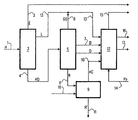
- the charge of used oil (s) to be treated which has previously been freed of the particles in suspension by filtration, for example on a sieve, is introduced into the dehydration 2.
- Dehydration techniques are those used on most regeneration chains of oils.
- distillation is carried out at atmospheric pressure or under a slight vacuum so as not to spoil the products.
- the distillation temperature is below 240 ° C or even less than 200 ° C, for example 120 to 180 ° C, or 120 - 150 ° C.
- the HD dehydrated oil thus obtained is sent directly to a vacuum distillation 5, that is to say without undergoing solvent extraction as in the art prior.
- This oil charge is brought to a high temperature so as to subject it to a suitable heat treatment so that the oil is not cracked thermally, but that the dispersing additives are destabilized.
- the vacuum distillation column will advantageously be adjusted in order to obtain a top so-called diesel cut (GO), in lateral racking one or more so-called distillate cuts under vacuum and bottom a distillation residue.
- GO diesel cut
- distillate cuts under vacuum
- bottom a distillation residue This preferred embodiment is shown on the Figure 1 with production of two vacuum distillates.
- the diesel cut collected at the head of the column is very rich in chlorine and contains metals, mainly silicon. Its final boiling point is between 280 and 370 ° C.
- the distilled fraction could be, for example, a spindle fraction (light oil of viscosity at 40 ° C close to 20.10 -6 m 2 / s) and engine oil bases such as SSU 100 to 600 oils.
- a spindle fraction light oil of viscosity at 40 ° C close to 20.10 -6 m 2 / s
- engine oil bases such as SSU 100 to 600 oils.
- the vacuum residue contains the majority of metals and metalloids (around 6,000 - 25,000 ppm for example) present in oil and mainly polymers rushed. It corresponds to an initial boiling point of 450 to 500 ° C.
- the vacuum residue obtained is sent to an extraction zone 9 where it is treated with preferably by means of a paraffinic hydrocarbon containing 3 to 6 carbon atoms or a mixture of several of these hydrocarbons in the liquid state, so as to extract the clarified oil from the residue.
- the extraction treatment with light liquid paraffinic hydrocarbon is carried out preferably between 40 ° C and the critical temperature of the hydrocarbon, under pressure sufficient to maintain this hydrocarbon in the liquid state.
- propane by example, the preferred temperature is between 45 ° C and the critical temperature of the hydrocarbon.
- the gradient of temperature is preferably higher than 20 ° C, and better still at least 25 ° C).
- the liquid hydrocarbon / oil volume ratio is 2: 1 to 30: 1, preferably 5: 1 to 15: 1.
- Propane is the preferred hydrocarbon.
- the contacting of the residue under vacuum with the light paraffinic hydrocarbon is generally carried out continuously in a column (extractor) from which firstly withdraw a mixture of paraffinic hydrocarbon and clarified oil, and on the other hand at the bottom an extraction residue R 'causing part of said hydrocarbon paraffinic.
- the amount of solvent (paraffinic hydrocarbon) injected into the extractor is divided into two equal or unequal parts.
- a quantity is used to dilute the charge and adjust the injection temperature of the mixture, the other part, injected directly in the column, is used to adjust the temperature at the bottom of the column and also continue to extract the oil trapped in the residue.
- This process is very effective due to the selective dissolution of the oil in the paraffinic hydrocarbon, and the precipitation of an extremely concentrated residue at the bottom of the column.
- the light paraffinic hydrocarbon is separated from the clarified oil HC and can then be recycled to the extraction area.
- the solvent is separated from the oil by vaporization of the extractor head mixture on separates, by expansion and reheating followed by steam training, the hydrocarbon light clarified oil.
- the light hydrocarbon is, after cooling, compression and condensation, advantageously recycled for a new extraction.
- the solvent is recovered under supercritical conditions as described in patent FR-2,598,717, the teaching of which is included.
- the separation phases is then obtained by heating, without vaporization or condensation.
- the solvent is then recycled under supercritical pressure.
- the advantage of these conditions supercritical is to eliminate the vaporization and condensation operations of vapors necessary in the case of conventional conditions to recover the solvent.
- the extractor base mixture contains the residue precipitated in the hydrocarbon lightweight. This mixture has a fairly low viscosity due to the amount of light hydrocarbon it contains. Once the light hydrocarbon has been removed, its handling becomes very delicate because of the high viscosity. To overcome this drawback, the extraction residue containing solvent withdrawn at the bottom of the extractor can be mixed with a step-down viscosity. The assembly after expansion is, for example, heated and stripped with steam. The light hydrocarbon after compression and condensation, is recycled to the column extraction. The residue completely freed from the solvent can be recovered in the form of fuel or mixed with bitumen.
- the distilled oil fraction (s) and the clarified HC oil are sent (alone or in mixture) in a hydrotreating zone 12 where they are treated with hydrogen in presence of at least one catalyst to finish purifying them and improving their qualities for better valuation.
- This treatment makes it possible to obtain lubricating oils in accordance with the specifications. without resorting to soil treatment and / or acid treatment sulfuric. These lubricating oils have very good thermal stability and good light stability. Hydrotreatment catalyst (s) have a lifetime prolonged because the products having undergone the pre-treatment operations are well purified.
- the catalyst is a hydrotreatment catalyst containing at least one oxide or one sulfide of at least one group VI metal and / or at least one group VIII metal, such that molybdenum, tungsten, nickel, cobalt, a support, for example alumina, silica-alumina or a zeolite.
- a preferred catalyst is a catalyst based on nickel sulfides and molybdenum supported on alumina.
- a final distillation allows, if necessary, to adjust the cutting points.
- the diesel fraction obtained after vacuum distillation can also be hydrotreated to remove chlorine and lower the sulfur content. We can very advantageously mix the diesel cut with the light fractions L obtained at the dehydration by atmospheric distillation.
- This hydrotreatment is preferably carried out with the catalysts used for the treatment of vacuum distillate (s) and clarified oil.
- the qualities of diesel obtained at the end of this hydrotreatment make it possible to successfully pass all the specifications and allows the incorporation of this cut into fuel storage.
- the treatment according to the present invention carried out with hydrotreatment makes it possible to maintain a good level of catalyst activity.
- the metal content is less than 5 ppm, and the chlorine content less than 5 ppm and most often undetectable.
- the content of aromatic polynuclear compounds (PNA) is most often of the order that of the base oils obtained by hydrorefining (of the order of 0.2-0.5% weight), it can be equal to that of refined solvent oils (furfurol for example) that is to say approximately 1.5% by weight.
- the installation comprises as zone (2) a distillation atmospheric or under light vacuum with separation of the light fraction (s) L containing petrol by a pipe (13).
- a pipe (6) for evacuating the diesel cut from the distillation zone (5) under vacuum.
- the diesel, distilled oil and clarified oil fractions can be processed directly by hydrotreatment in zone (12) (representation of FIG. 1), it being understood that they are treated separately.
- they will be stored separately and processed by campaign.
- Hydrogen is introduced into the hydrotreating zone (12) directly into the reactor (as in Figure 1) but it can be introduced with the load to be treated.
- the invention includes this possibility.
- a heat exchanger is advantageously arranged to cool the residue.
- This means is preferably a means of vaporization. It is advantageously composed of at least one regulator, one heating means and a steam drive device (stripper).
- the solvent recovered then preferably passes through a heat exchanger, a compressor and a condenser before being recycled for extraction by a pipeline suitable which connects said separation means and the extraction zone (9).
- it is arranged in the area (9) under conditions supercritical, a heating means to separate the solvent and a pipe to recycle the solvent to zone (9).
- the water removed by atmospheric distillation represents 4% by weight of the charge and the light fraction L 2.4% by weight.
- the dehydrated oil (93.6% of the charge) is sent to the vacuum distillation unit: in the example chosen, we have grouped the two distillates from the side draws.
- the 1 + 2 distillates correspond to boiling points between 280 ° C and 565 ° C.
- the 1 + 2 distillates are sent to the hydrotreating unit, the vacuum residue is sent to the solvent clarification unit (extraction zone (9)).
- the bottom cut (vacuum residue) obtained during vacuum distillation is sent to the solvent extraction unit.
- the residue obtained is "fluxed" (mixed with dehydrated oil or with a hydrocarbon viscosity reducer) and can be used as fuel or used as a binder in road bitumens.
- the clarified oil is separated from the light hydrocarbon by vaporization to give the Bright Stock (BS) cut.
- the mixture of vacuum distillates 1 + 2 and the oil (Bright Stock) are sent respectively (separately) to the hydrotreating unit on a catalyst containing nickel sulfide, molybdenum sulfide and an alumina support.
- the operating conditions are as follows: Temperature 300/280 ° C Partial hydrogen pressure 50 bar Residence time 1 hour Hydrogen recycling 380 Nm 3 / m 3 of load.
- the products obtained after hydrotreatment are characterized by a reduction heavy aromatics content, a significant decrease in sulfur content, and by a total elimination of chlorine and metals.
- the viscosity index of these bases of oils is maintained or improved, stability in the presence of heat or light is very good.
- the extraction unit is therefore very well suited for treating the residue cut under vacuum and for the more it requires an investment divided by 3 compared to the investment of a total oil clarification installation after dehydration, since the capacity to the unit is reduced to about a third of that required in the prior art.
- the metals contained in the clarified oil are in an amount greater than 300 ppm.
- the molecules containing the metals (impurities) easily precipitate in the solvent medium, the high concentration of metals (degraded additives) makes it possible to have insoluble micelles which will grow in size as they grow stay in the column and by density difference fall to the bottom of the extractor.
- the present invention which has demonstrated and exploited this effect, makes it possible to enhance the maximum all the products contained in the used oil collected.
- the yield in recoverable products is close to 99% compared to the amount of hydrocarbon contained in the oil collected.
- the residue leaving the extraction is itself recoverable.
Landscapes
- Chemical & Material Sciences (AREA)
- Oil, Petroleum & Natural Gas (AREA)
- Engineering & Computer Science (AREA)
- Chemical Kinetics & Catalysis (AREA)
- General Chemical & Material Sciences (AREA)
- Organic Chemistry (AREA)
- Combustion & Propulsion (AREA)
- Physics & Mathematics (AREA)
- Thermal Sciences (AREA)
- Production Of Liquid Hydrocarbon Mixture For Refining Petroleum (AREA)
- Lubricants (AREA)
- Organic Low-Molecular-Weight Compounds And Preparation Thereof (AREA)
- Solid-Sorbent Or Filter-Aiding Compositions (AREA)
- Fats And Perfumes (AREA)
Claims (14)
- Verfahren zur Reinigung eines verbrauchten Öls die Stufen der Dehydratisierung, der Vakuumdestillation, der Lösungsmittelextraktion und des Hydrotreatments umfassend, dadurch gekennzeichnet, dassdas verbrauchte dehydratisierte Öl direkt unter Vakuum zur Erzeugung eines Rückstands und wenigstens einer destillierten Ölfraktion destilliert wird,der Vakuumdestillationsrückstand direkt dieser Extraktion derart ausgesetzt wird, dass ein sogenanntes geklärtes oder gereinigtes Öl und ein Extraktionsrückstand erhalten wird, unddie Fraktion (die Fraktionen) des destillierten Öls und des geklärten oder gereinigten Öls einer Stabilisierungsbehandlung durch Hydrotreatment unterzogen wird (werden).
- Verfahren nach Anspruch 1, dadurch gekennzeichnet, dass die verbrauchten Öle durch atmosphärische Destillation bei einer Temperatur von weniger als 240°C dehydratisiert werden.
- Verfahren nach einem der vorhergehenden Ansprüche, dadurch gekennzeichnet, dass der Vakuumdestillationsrückstand einen Anfangssiedepunkt zwischen 450 und 500°C aufweist.
- Verfahren nach einem der vorhergehenden Ansprüche, dadurch gekennzeichnet, dass die Vakuumdestillation einen sogenannten Gasölschnitt mit einem Siedeendpunkt zwischen 280 und 370°C erzeugt.
- Verfahren nach einem der vorhergehenden Ansprüche, dadurch gekennzeichnet, dass die Extraktion vermittels eines paraffinischen Kohlenwasserstoffs, der 3 bis 6 Kohlenstoffatome hat, bei einer Temperatur zwischen 40°C und der kritischen Temperatur des Kohlenwasserstoffs unter einem ausreichenden Druck durchgeführt wird, um den Kohlenwasserstoff im flüssigen Zustand zu halten, und dies bei einem Volumenverhältnis Kohlenwasserstoff/ÖI zwischen 2 : 1 und 30:1.
- Verfahren nach einem der vorhergehenden Ansprüche, dadurch gekennzeichnet, dass die Extraktion mit Propan durchgeführt wird.
- Verfahren nach einem der vorhergehenden Ansprüche, dadurch gekennzeichnet, dass die aus der Extraktion stammende Fraktion, welche das geklärte Öl enthält und auch Lösungsmittel enthält, einer Verdampfung derart ausgesetzt wird, dass das Lösungsmittel, welches zur Extraktion rezykliert wird, abgetrennt wird.
- Verfahren nach einem der Ansprüche 1 bis 6, dadurch gekennzeichnet, dass das Lösungsmittel vom geklärten oder gereinigten Öl unter überkritischen Bedingungen getrennt wird und dass es zur Extraktion unter einem überkritischen Druck rezykliert wird.
- Verfahren nach einem der vorhergehenden Ansprüche, dadurch gekennzeichnet, dass der Extraktionsrückstand mit einem Viskositätssenker vermischt wird.
- Verfahren nach einem der vorhergehenden Ansprüche, dadurch gekennzeichnet, dass der (die) Gasölschnitt(e) ebenfalls einem Hydrotreatment ausgesetzt wird (werden).
- Verfahren nach einem der vorhergehenden Ansprüche, dadurch gekennzeichnet, dass das Hydrotreatment unter Wasserstoff in Anwesenheit eines Katalysators durchgeführt wird, der über einen Träger verfügt und wenigstens ein Oxid oder ein Sulfid wenigstens eines Metalls der Gruppe VI und/oder wenigstens eines Metalls der Gruppe VIII bei einer Temperatur von 250 - 400°C, einem Druck von 5 - 150 bar und einer Raumgeschwindigkeit von 0,1-10h-1 stattfindet.
- Installation zur Durchführung des Verfahrens nach einem der Ansprüche 1 bis 11, umfassend:wobei diese Installation sich dadurch auszeichnet, dasseine Zone (2) zur Dehydratation, verbunden mit einer Leitung (1) zum Einführen der Charge des verbrauchten Öls, einer Leitung. (3) zum Austritt des Wassers und einer Leitung (4) zum Abzug des dehydratisierten Öls,eine Zone (5) zur Vakuumdestillation, in welche die Leitung (4) mündet und die wenigstens mit einer Leitung (7) zum Abzug der Fraktion (der Fraktionen) des destillierten Öls und wenigstens einer Leitung (8) zum Abzug des Vakuumrückstands versehen ist,eine Zone (12) des Hydrotreatments, versehen mit wenigstens einer Leitung (7, 10, 13) zum Einführen des zu behandelnden Schnitts, wenigstens einer Leitung zum Abziehen des behandelten Schnitts (16, 17), wenigstens einer Leitung (14) zum Zuführen von Wasserstoff und wenigstens einer Leitung (15) für den Gasaustritt,eine Zone (9) zur Lösungsmittelextraktion,eine Leitung (4) aus der Dehydratisierungszone (2) das dehydratisierte Öl abzieht und es direkt in die Zone (5) der Vakuumdestillation gibt, und dassdie Extraktionszone (9) mit einer Leitung (18) zum Einführen des Lösungsmittels, einer Leitung (8) zur direkten Zuführung des Rückstands aus der Vakuumdestillationszone (5) zur Zone (9), einer Leitung (11) zum Abzug des Extraktionsrückstands und einer Leitung (10) für den Austritt des geklärten oder gereinigten Öls versehen ist.
- Installation nach Anspruch 12, dadurch gekennzeichnet, dass die Zone 2 der Dehydratation durch Destillation versehen ist mit einer Leitung (13) für den Austritt der leichten Fraktion, welche das Benzin enthält, und dass eine Leitung (6) aus der Vakuumdestillationszone (5) den Gasölschnitt abzieht.
- Installation nach einem der Ansprüche 12 oder 13, dadurch gekennzeichnet, dass in Höhe der Zone (9) ein Mittel zum Trennen des Lösungsmittels vom gereinigten Öl angeordnet ist, und dass eine Rezyklierungsleitung für das Lösungsmittel dieses Trennmittel und die Extraktionszone (9) verbindet.
Applications Claiming Priority (2)
| Application Number | Priority Date | Filing Date | Title |
|---|---|---|---|
| FR9412448A FR2725725B1 (fr) | 1994-10-17 | 1994-10-17 | Procede et installation pour la purification des huiles usagees |
| FR9412448 | 1994-10-17 |
Publications (2)
| Publication Number | Publication Date |
|---|---|
| EP0708174A1 EP0708174A1 (de) | 1996-04-24 |
| EP0708174B1 true EP0708174B1 (de) | 2001-12-12 |
Family
ID=9467979
Family Applications (1)
| Application Number | Title | Priority Date | Filing Date |
|---|---|---|---|
| EP95402302A Expired - Lifetime EP0708174B1 (de) | 1994-10-17 | 1995-10-16 | Verfahren und Anlage zur Reinigung von Altölen |
Country Status (13)
| Country | Link |
|---|---|
| US (2) | US5759385A (de) |
| EP (1) | EP0708174B1 (de) |
| JP (1) | JP4051488B2 (de) |
| KR (1) | KR100372802B1 (de) |
| CN (1) | CN1100854C (de) |
| CA (1) | CA2160652C (de) |
| DE (1) | DE69524533T2 (de) |
| EG (1) | EG20615A (de) |
| ES (1) | ES2169748T3 (de) |
| FR (1) | FR2725725B1 (de) |
| NO (1) | NO313296B1 (de) |
| PL (1) | PL177602B1 (de) |
| SA (2) | SA95160353B1 (de) |
Families Citing this family (47)
| Publication number | Priority date | Publication date | Assignee | Title |
|---|---|---|---|---|
| US6117309A (en) * | 1997-09-08 | 2000-09-12 | Probex Corporation | Method of rerefining waste oil by distillation and extraction |
| DE19852007C2 (de) | 1998-11-11 | 2002-06-13 | Mineraloel Raffinerie Dollberg | Verfahren zur Wiederaufarbeitung von Altölen |
| US6320090B1 (en) * | 1999-03-10 | 2001-11-20 | Miami University | Method of removing contaminants from petroleum distillates |
| CN1253544C (zh) * | 2001-10-16 | 2006-04-26 | 国际壳牌研究有限公司 | 提高预处理过的废油的质量 |
| PT1559768E (pt) * | 2002-07-15 | 2006-09-29 | Sener Grupo De Ingenier A S A | Metodo de regeneracao de oleos usados atraves de extraccao com solventes |
| CA2396206A1 (en) | 2002-07-30 | 2004-01-30 | Nouredine Fakhri | Process for the treatment of waste oils |
| RU2232787C1 (ru) * | 2003-08-21 | 2004-07-20 | Красноярский государственный технический университет | Установка для регенерации отработанных смазочных материалов |
| ES2199697B1 (es) * | 2003-09-23 | 2005-02-01 | Sener Grupo De Ingenieria, S.A. | Procedimiento para regenerar aceites usados por desmetalizacion y destilacion. |
| RU2282478C1 (ru) * | 2005-03-05 | 2006-08-27 | Селиванов Николай Павлович | Установка для получения масляных дистиллятов из мазута (варианты) и способ получения масляных дистиллятов из мазута на этой установке (варианты) |
| RU2275954C1 (ru) * | 2005-03-05 | 2006-05-10 | Суслин Владимир Александрович | Установка для получения масляных дистиллятов из тяжелых остатков углеводородного сырья первичной переработки нефти (варианты) и способ получения масляных дистиллятов из тяжелых остатков углеводородного сырья первичной переработки нефти на этой установке (варианты) |
| US8366912B1 (en) | 2005-03-08 | 2013-02-05 | Ari Technologies, Llc | Method for producing base lubricating oil from waste oil |
| KR100739414B1 (ko) * | 2006-06-23 | 2007-07-13 | 권선대 | 오일 확산진공 증류장치 및 방법 |
| WO2008036696A2 (en) * | 2006-09-18 | 2008-03-27 | Pablo Martin De Julian | Process for recovering used lubricating oils using clay and centrifugation |
| US20100179080A1 (en) * | 2006-09-18 | 2010-07-15 | Martin De Julian Pablo | Process for recovering used lubricating oils using clay and centrifugation |
| US8299001B1 (en) | 2006-09-18 | 2012-10-30 | Martin De Julian Pablo | Process for recovering used lubricating oils using clay and centrifugation |
| CN100445355C (zh) * | 2007-04-30 | 2008-12-24 | 京福马(北京)石油化工高新技术有限公司 | 废润滑油加氢再生方法 |
| US9051521B2 (en) * | 2010-12-23 | 2015-06-09 | Stephen Lee Yarbro | Using supercritical fluids to refine hydrocarbons |
| JP6278587B2 (ja) * | 2012-03-21 | 2018-02-14 | Jxtgエネルギー株式会社 | 高芳香族基油及び高芳香族基油の製造方法 |
| CN103045298B (zh) * | 2012-12-27 | 2016-03-16 | 宜昌升华新能源科技有限公司 | 一种用于废油回收裂解馏分燃油的系统 |
| WO2014135968A1 (en) * | 2013-03-07 | 2014-09-12 | Verolube, Inc. | Method for producing base lubricating oil from oils recovered from combustion engine service |
| CN104178210B (zh) * | 2013-05-27 | 2018-08-03 | 山东恒利热载体工程技术有限公司 | 一种回收废弃高沸点导热油的方法及工艺装置 |
| FR3012819B1 (fr) * | 2013-11-06 | 2016-09-23 | Axens | Procede de production d'huiles blanches repondant a la norme cfr a partir d'huiles usagees |
| EP3078730A4 (de) * | 2013-11-08 | 2017-07-19 | Sener Ingenieria Y Sistemas, S.A. | Verfahren zur erhöhung der ausbeute von schmierölbasen bei der regeneration von altölen |
| CN104531328A (zh) * | 2015-01-08 | 2015-04-22 | 劳淑仪 | 全加氢型废润滑油加氢再生工艺 |
| US9802176B2 (en) | 2015-03-24 | 2017-10-31 | Saudi Arabian Oil Company | Method for mixing in a hydrocarbon conversion process |
| CN104893767B (zh) * | 2015-05-19 | 2016-08-17 | 李菊明 | 一种废机油加工高品质燃料油的生产工艺 |
| ITUB20150917A1 (it) | 2015-05-28 | 2016-11-28 | Viscolube S R L | Processo per la rigenerazione di olii usati |
| US12025435B2 (en) | 2017-02-12 | 2024-07-02 | Magēmã Technology LLC | Multi-stage device and process for production of a low sulfur heavy marine fuel oil |
| US10604709B2 (en) | 2017-02-12 | 2020-03-31 | Magēmā Technology LLC | Multi-stage device and process for production of a low sulfur heavy marine fuel oil from distressed heavy fuel oil materials |
| US20180230389A1 (en) | 2017-02-12 | 2018-08-16 | Magēmā Technology, LLC | Multi-Stage Process and Device for Reducing Environmental Contaminates in Heavy Marine Fuel Oil |
| US12559689B2 (en) | 2017-02-12 | 2026-02-24 | Magēmā Technology LLC | Multi-stage process and device for treatment heavy marine fuel and resultant composition and the removal of detrimental solids |
| US11788017B2 (en) | 2017-02-12 | 2023-10-17 | Magëmã Technology LLC | Multi-stage process and device for reducing environmental contaminants in heavy marine fuel oil |
| US12281266B2 (en) | 2017-02-12 | 2025-04-22 | Magẽmã Technology LLC | Heavy marine fuel oil composition |
| US12071592B2 (en) | 2017-02-12 | 2024-08-27 | Magēmā Technology LLC | Multi-stage process and device utilizing structured catalyst beds and reactive distillation for the production of a low sulfur heavy marine fuel oil |
| CN107287018A (zh) * | 2017-08-06 | 2017-10-24 | 张家彬 | 一种废润滑油再生工艺 |
| CN109754888A (zh) * | 2019-01-16 | 2019-05-14 | 中国辐射防护研究院 | 一种利用核电站中废吸附剂处理放射性废油的方法 |
| KR102365337B1 (ko) | 2020-01-09 | 2022-02-18 | 한국화학연구원 | 폐유 증류 잔사물을 이용한 악취 및 유해증기가 저감된 중질유분 제조 기술 |
| SG11202108126TA (en) * | 2019-02-05 | 2021-08-30 | Regen Iii Corp | Method and system for re-refining and upgrading used oil |
| CN110180241A (zh) * | 2019-05-25 | 2019-08-30 | 禹涵(上海)环保科技有限公司 | 一种润滑油颗粒u形耦合分散装置 |
| KR102085351B1 (ko) * | 2019-07-08 | 2020-03-05 | 이종호 | 폐유를 이용한 연료유의 제조방법 |
| CN113105937B (zh) * | 2021-04-14 | 2022-08-30 | 中国恩菲工程技术有限公司 | 废矿物油的处理系统及处理方法 |
| EP4183462A1 (de) | 2021-11-23 | 2023-05-24 | TotalEnergies OneTech | Verfahren zur desodorierung von regenerierten schmierölen mit überkritischem co2 |
| EP4183463A1 (de) | 2021-11-23 | 2023-05-24 | TotalEnergies OneTech | Verfahren zur regenerierung von gebrauchten schmiermitteln unter verwendung von überkritischem co2 |
| FR3130826A1 (fr) | 2021-12-21 | 2023-06-23 | Totalenergies Marketing Services | Méthode de purification d’huiles lubrifiantes au moins en partie re-raffinées |
| CN116790311A (zh) * | 2022-03-14 | 2023-09-22 | 天津木华清研科技有限公司 | 废油精制方法及混合系统 |
| FR3164222A1 (fr) | 2024-07-08 | 2026-01-09 | Totalenergies Onetech | Procede de purification d’huiles lubrifiantes au moins en partie re-raffinees par traitement basique sous irradiation micro-ondes |
| WO2026039139A1 (en) | 2024-08-16 | 2026-02-19 | ExxonMobil Technology and Engineering Company | Compositions comprising group ii base stock and c18-c48-polyalphaolefin |
Family Cites Families (14)
| Publication number | Priority date | Publication date | Assignee | Title |
|---|---|---|---|---|
| US3244614A (en) * | 1963-04-22 | 1966-04-05 | Gulf Oil Corp | Solvent refining and dewaxing process |
| US3723295A (en) * | 1970-08-17 | 1973-03-27 | Sun Oil Co | Hydrocracking production of lubes |
| US3919076A (en) * | 1974-07-18 | 1975-11-11 | Pilot Res & Dev Co | Re-refining used automotive lubricating oil |
| FR2301592A1 (fr) * | 1975-02-20 | 1976-09-17 | Inst Francais Du Petrole | Procede de regeneration d'huiles lubrifiantes usagees par extraction au solvant et hydrogenation |
| US4071438A (en) * | 1976-06-03 | 1978-01-31 | Vacsol Corporation | Method of reclaiming waste oil by distillation and extraction |
| US4169044A (en) * | 1977-07-21 | 1979-09-25 | Phillips Petroleum Company | Re-refining used lube oil |
| IT1091961B (it) * | 1978-01-12 | 1985-07-06 | Snam Progetti | Procedimento per la rigenerazione degli oli esausti |
| CA1157414A (en) * | 1980-12-31 | 1983-11-22 | Theodore M. Classen | Reclaiming used motor oil via supercritical solvent extraction and hydrotreating |
| IT1137280B (it) * | 1981-07-07 | 1986-09-03 | Assoreni E Snamprogetti Spa | Procedimento per recupero di oli esausti |
| DE3602586A1 (de) * | 1986-01-29 | 1987-07-30 | Krupp Koppers Gmbh | Verfahren zur aufarbeitung von altoel |
| FR2598717B1 (fr) | 1986-05-14 | 1988-08-26 | Inst Francais Du Petrole | Procede de desasphaltage d'une huile d'hydrocarbure renfermant de l'asphalte |
| US4917788A (en) * | 1987-07-12 | 1990-04-17 | Mobil Oil Corporation | Manufacture of lube base stocks |
| US5286386A (en) * | 1988-12-22 | 1994-02-15 | Ensr Corporation | Solvent extraction process for treatment of oily substrates |
| GB2257156B (en) * | 1991-06-25 | 1995-09-13 | Exxon Research Engineering Co | Process for producing bright stock from deasphalted resid and heavy distillate |
-
1994
- 1994-10-17 FR FR9412448A patent/FR2725725B1/fr not_active Expired - Lifetime
-
1995
- 1995-10-13 NO NO19954097A patent/NO313296B1/no not_active IP Right Cessation
- 1995-10-15 EG EG85795A patent/EG20615A/xx active
- 1995-10-16 PL PL95310964A patent/PL177602B1/pl unknown
- 1995-10-16 ES ES95402302T patent/ES2169748T3/es not_active Expired - Lifetime
- 1995-10-16 EP EP95402302A patent/EP0708174B1/de not_active Expired - Lifetime
- 1995-10-16 CA CA002160652A patent/CA2160652C/fr not_active Expired - Lifetime
- 1995-10-16 DE DE69524533T patent/DE69524533T2/de not_active Expired - Lifetime
- 1995-10-17 JP JP26828395A patent/JP4051488B2/ja not_active Expired - Lifetime
- 1995-10-17 CN CN95119191A patent/CN1100854C/zh not_active Expired - Lifetime
- 1995-10-17 US US08/543,988 patent/US5759385A/en not_active Expired - Lifetime
- 1995-10-17 KR KR1019950035733A patent/KR100372802B1/ko not_active Expired - Lifetime
- 1995-10-31 SA SA95160353A patent/SA95160353B1/ar unknown
- 1995-10-31 SA SA05260105A patent/SA95260105B1/ar unknown
-
1997
- 1997-01-03 US US08/778,692 patent/US5843384A/en not_active Expired - Lifetime
Also Published As
| Publication number | Publication date |
|---|---|
| CN1128789A (zh) | 1996-08-14 |
| EG20615A (fr) | 1999-09-30 |
| JPH08199185A (ja) | 1996-08-06 |
| SA95260105B1 (ar) | 2006-06-04 |
| ES2169748T3 (es) | 2002-07-16 |
| EP0708174A1 (de) | 1996-04-24 |
| US5759385A (en) | 1998-06-02 |
| DE69524533D1 (de) | 2002-01-24 |
| KR960014307A (ko) | 1996-05-22 |
| JP4051488B2 (ja) | 2008-02-27 |
| NO954097L (no) | 1996-04-18 |
| PL177602B1 (pl) | 1999-12-31 |
| CA2160652A1 (fr) | 1996-04-18 |
| NO313296B1 (no) | 2002-09-09 |
| CA2160652C (fr) | 2007-10-09 |
| FR2725725A1 (fr) | 1996-04-19 |
| PL310964A1 (en) | 1996-04-29 |
| KR100372802B1 (ko) | 2003-04-26 |
| DE69524533T2 (de) | 2002-05-29 |
| US5843384A (en) | 1998-12-01 |
| SA95160353B1 (ar) | 2006-06-04 |
| NO954097D0 (no) | 1995-10-13 |
| FR2725725B1 (fr) | 1996-12-13 |
| CN1100854C (zh) | 2003-02-05 |
Similar Documents
| Publication | Publication Date | Title |
|---|---|---|
| EP0708174B1 (de) | Verfahren und Anlage zur Reinigung von Altölen | |
| EP0621334B1 (de) | Verfahren zur Herstellung von Brennstoff-durch Extraktion und Wasserstoffbehandlung von Kohlenwasserstoffeinsatz und so hergestellte Gasöl | |
| CA1079215A (en) | Thermal treatment of used petroleum oils | |
| CA1091607A (en) | Method for reclaiming waste lubricating oils | |
| CA2615197A1 (fr) | Procede de conversion de residus incluant 2 desasphaltages en serie | |
| JP3036822B2 (ja) | 潤滑油の溶剤抽出 | |
| FR2753985A1 (fr) | Procede catalytique de conversion d'un residu petrolier impliquant une hydrodemetallisation en lit fixe de catalyseur | |
| US4424117A (en) | Hydrostripping process of crude oil | |
| NL2024521B1 (en) | Method for upgrading waste oil | |
| CN111484872A (zh) | 一种渣油脱金属方法 | |
| Loghmanova et al. | New technology of regeneration of used automobile oils | |
| CA1157414A (en) | Reclaiming used motor oil via supercritical solvent extraction and hydrotreating | |
| CA1190878A (fr) | Procede de fabrication d'une essence par valorisation d'huiles hydrocarbonnees | |
| CS270226B2 (en) | Method of light products and usually applicable fuel oils production from ends-after oil treatment | |
| EP0411973B1 (de) | Verfahren zur Behandlung von Metall enthaltenden Petroleumfraktionen beim Vorhandensein von Feststoffpartikeln, die eine magnetohydrostatische Trennungsstufe für diese Partikeln umfassen, und Rückführung von mindestens einem Teil dieser Partikeln | |
| RU2757810C1 (ru) | Способ деасфальтизации углеводородного сырья | |
| JPS5912996A (ja) | 使用ずみ潤滑油の再精製法 | |
| FR2480773A1 (fr) | Procede de conversion d'huiles lourdes d'hydrocarbures, contenant des asphaltenes, en fractions plus legeres, comportant un recyclage des fractions lourdes non converties | |
| JPH0362753B2 (de) | ||
| FR2788278A1 (fr) | Procede de production d'huiles blanches et de bases craquables a partir d'huiles de lubrification usagees | |
| Whisman et al. | Method for reclaiming waste lubricating oils | |
| BE521521A (de) | ||
| WO2016192893A1 (fr) | Procédé de conversion de charges comprenant une étape de viscoréduction, une étape de précipitation et une étape de séparation des sédiments pour la production de fiouls | |
| BE520153A (de) |
Legal Events
| Date | Code | Title | Description |
|---|---|---|---|
| PUAI | Public reference made under article 153(3) epc to a published international application that has entered the european phase |
Free format text: ORIGINAL CODE: 0009012 |
|
| AK | Designated contracting states |
Kind code of ref document: A1 Designated state(s): DE ES GB GR IT NL SE |
|
| 17P | Request for examination filed |
Effective date: 19961024 |
|
| 17Q | First examination report despatched |
Effective date: 19991206 |
|
| GRAG | Despatch of communication of intention to grant |
Free format text: ORIGINAL CODE: EPIDOS AGRA |
|
| GRAG | Despatch of communication of intention to grant |
Free format text: ORIGINAL CODE: EPIDOS AGRA |
|
| GRAG | Despatch of communication of intention to grant |
Free format text: ORIGINAL CODE: EPIDOS AGRA |
|
| GRAH | Despatch of communication of intention to grant a patent |
Free format text: ORIGINAL CODE: EPIDOS IGRA |
|
| GRAH | Despatch of communication of intention to grant a patent |
Free format text: ORIGINAL CODE: EPIDOS IGRA |
|
| ITF | It: translation for a ep patent filed | ||
| GRAA | (expected) grant |
Free format text: ORIGINAL CODE: 0009210 |
|
| AK | Designated contracting states |
Kind code of ref document: B1 Designated state(s): DE ES GB GR IT NL SE |
|
| REG | Reference to a national code |
Ref country code: GB Ref legal event code: IF02 |
|
| REF | Corresponds to: |
Ref document number: 69524533 Country of ref document: DE Date of ref document: 20020124 |
|
| GBT | Gb: translation of ep patent filed (gb section 77(6)(a)/1977) |
Effective date: 20020222 |
|
| REG | Reference to a national code |
Ref country code: ES Ref legal event code: FG2A Ref document number: 2169748 Country of ref document: ES Kind code of ref document: T3 |
|
| REG | Reference to a national code |
Ref country code: GR Ref legal event code: EP Ref document number: 20010401013 Country of ref document: GR |
|
| PLBE | No opposition filed within time limit |
Free format text: ORIGINAL CODE: 0009261 |
|
| STAA | Information on the status of an ep patent application or granted ep patent |
Free format text: STATUS: NO OPPOSITION FILED WITHIN TIME LIMIT |
|
| 26N | No opposition filed | ||
| REG | Reference to a national code |
Ref country code: DE Ref legal event code: R081 Ref document number: 69524533 Country of ref document: DE Owner name: IFP ENERGIES NOUVELLES, FR Free format text: FORMER OWNER: INSTITUT FRANCAIS DU PETROLE, RUEIL-MALMAISON, HAUTS-DE-SEINE, FR Effective date: 20110331 |
|
| PGFP | Annual fee paid to national office [announced via postgrant information from national office to epo] |
Ref country code: SE Payment date: 20141022 Year of fee payment: 20 Ref country code: GR Payment date: 20141029 Year of fee payment: 20 Ref country code: ES Payment date: 20141007 Year of fee payment: 20 Ref country code: GB Payment date: 20141022 Year of fee payment: 20 Ref country code: DE Payment date: 20141023 Year of fee payment: 20 |
|
| PGFP | Annual fee paid to national office [announced via postgrant information from national office to epo] |
Ref country code: NL Payment date: 20141020 Year of fee payment: 20 |
|
| PGFP | Annual fee paid to national office [announced via postgrant information from national office to epo] |
Ref country code: IT Payment date: 20141022 Year of fee payment: 20 |
|
| REG | Reference to a national code |
Ref country code: DE Ref legal event code: R071 Ref document number: 69524533 Country of ref document: DE |
|
| REG | Reference to a national code |
Ref country code: NL Ref legal event code: MK Effective date: 20151015 |
|
| REG | Reference to a national code |
Ref country code: GB Ref legal event code: PE20 Expiry date: 20151015 |
|
| REG | Reference to a national code |
Ref country code: SE Ref legal event code: EUG |
|
| REG | Reference to a national code |
Ref country code: ES Ref legal event code: FD2A Effective date: 20160126 |
|
| PG25 | Lapsed in a contracting state [announced via postgrant information from national office to epo] |
Ref country code: GB Free format text: LAPSE BECAUSE OF EXPIRATION OF PROTECTION Effective date: 20151015 |
|
| REG | Reference to a national code |
Ref country code: GR Ref legal event code: MA Ref document number: 20010401013 Country of ref document: GR Effective date: 20151017 |
|
| PG25 | Lapsed in a contracting state [announced via postgrant information from national office to epo] |
Ref country code: ES Free format text: LAPSE BECAUSE OF EXPIRATION OF PROTECTION Effective date: 20151017 |