EP0708535A1 - Verfahren und gerät zur detektion von doppelsprechen, sowie echokompensator - Google Patents
Verfahren und gerät zur detektion von doppelsprechen, sowie echokompensator Download PDFInfo
- Publication number
- EP0708535A1 EP0708535A1 EP95917502A EP95917502A EP0708535A1 EP 0708535 A1 EP0708535 A1 EP 0708535A1 EP 95917502 A EP95917502 A EP 95917502A EP 95917502 A EP95917502 A EP 95917502A EP 0708535 A1 EP0708535 A1 EP 0708535A1
- Authority
- EP
- European Patent Office
- Prior art keywords
- double talk
- speech
- echo
- feature
- present
- Prior art date
- Legal status (The legal status is an assumption and is not a legal conclusion. Google has not performed a legal analysis and makes no representation as to the accuracy of the status listed.)
- Withdrawn
Links
Images



Classifications
-
- H—ELECTRICITY
- H04—ELECTRIC COMMUNICATION TECHNIQUE
- H04B—TRANSMISSION
- H04B3/00—Line transmission systems
- H04B3/02—Details
- H04B3/20—Reducing echo effects or singing; Opening or closing transmitting path; Conditioning for transmission in one direction or the other
- H04B3/23—Reducing echo effects or singing; Opening or closing transmitting path; Conditioning for transmission in one direction or the other using a replica of transmitted signal in the time domain, e.g. echo cancellers
-
- H—ELECTRICITY
- H04—ELECTRIC COMMUNICATION TECHNIQUE
- H04B—TRANSMISSION
- H04B3/00—Line transmission systems
- H04B3/02—Details
- H04B3/20—Reducing echo effects or singing; Opening or closing transmitting path; Conditioning for transmission in one direction or the other
- H04B3/23—Reducing echo effects or singing; Opening or closing transmitting path; Conditioning for transmission in one direction or the other using a replica of transmitted signal in the time domain, e.g. echo cancellers
- H04B3/234—Reducing echo effects or singing; Opening or closing transmitting path; Conditioning for transmission in one direction or the other using a replica of transmitted signal in the time domain, e.g. echo cancellers using double talk detection
Definitions
- This invention relates to a double talk detecting method which is carried out in a mobile communications network and in a long-distance telephone line network when echo is canceled, a double talk detecting apparatus and an echo canceler, which are suited to be used for carrying out the afore-mentioned method.
- the subscriber's line In a long-distance telephone line via a submarine cable or via a communication satellite, the subscriber's line, in general, connected to both ends of the line is of a two-wire circuit and its long-distance transmission portion is of a four-wire circuit employed for amplification of signal and some other purposes.
- the subscriber's line of a terrestrial analog telephone is of a two-wire circuit and its portion from a terminal of the mobile telephone to a switch, etc. is of a four-wire circuit.
- the connection region between the two-wire and the four-wire is provided with a hybrid circuit for performing a four-wire/two-wire conversion.
- This hybrid circuit is designed to match with the impedance of the two-wire circuit.
- a received signal reaching an input side of the four-wire of the hybrid circuit tends to leak toward an output side of the four-wire, thereby generating a so-called echo. Since such an echo reaches the talker at a lower sound level than the talker's voice and after a delay of a predetermined time period, a speech hindrance is created. Such a speech hindrance caused by echo becomes significant as the signal propagation time becomes longer.
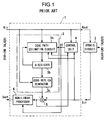
- Fig. 1 shows a schematic construction of an echo canceler which can be used in a mobile communications network.
- the echo canceler 1 illustrated here is located on a front stage of a hybrid circuit 2.
- the subscriber of an analog telephone is referred to as the "near-end talker" and the subscriber of a mobile telephone as the "far-end talker”.
- a far-end speech signal input into the echo canceler 1 is represented by Rin; a far-end speech signal output from the echo canceler 1, by Rout; a near-end speech signal input into the echo canceler 1, by Sin; and a near-end speech signal output from the echo canceler 1; by Sout, respectively.
- the echo canceler 1 shown in Fig. 1 comprises an echo path estimation circuit/echo replica generator 3, a control unit 4, an adder 5, and a non-linear processor 6.
- the echo path estimation circuit/echo replica generator 3 detects a response characteristic of the hybrid circuit 2 based on both the far-end speech input Rin and near-end speech input Sin and estimates an echo path (namely, echo propagating line). Then, an anticipated echo (namely, echo replica) from the hybrid circuit 2 is generated through a convolutional operation as a result of estimation and the far-end speech input Rin. In the adder 5, this echo replica is subtracted from the near-end speech input Sin, thereby canceling the echo.
- a learning identification algorithm is used. Among many adaptive algorithms, this learning identification algorithm is comparatively small in computational complexity and good in convergence characteristic.
- the echo path estimation circuit/echo replica generator 3 includes an echo path estimation circuit 3a, an H-register 3b, and an echo replica generator 3c.
- the echo path estimation circuit 3a estimates an echo path using the learning identification algorithm which is, among many other adaptive algorithms, generally comparatively small in computational complexity and good in convergence characteristic, and writes a tap coefficient (as later described) corresponding to the estimated echo path in the H-register 3b.
- the echo replica generator 3c comprises an FIR adaptive digital filter. The generator 3c generates an echo replica using the tap coefficient in the H-register 3b and through a convolutional operation with the far-end speech input Rin.
- the learning identification algorithm is a known estimation algorithm as disclosed, for example, in Institute of Electronics and Communication Engineers of Japan (IECE) Journal '77/11 Vol. J60-A NO.11, article under the heading of "Regarding Echo Canceling Characteristic of Echo Canceler Using Learning Identification Algorithm” (written by: Itakura and Nishikawa). The outline of the learning identification algorithm discussed in this article will be briefly described.
- the echo y k at the time kT (where T is a sampling interval) can be expressed as follows.
- an estimation value Y k of y k can be given by the following expression.
- Y k H k t x k
- the next tap coefficient H k+1 is calculated so that the residual echo will be reduced.
- the above-mentioned algorithm can be specifically expressed as listed below.
- the far-end speech input Rin which is taken into the echo path estimation circuit 3a, is handled as a digital signal Xt (where t is a sampling time) having N pieces of sample values.
- X t (x(t), x(t-1), ... , ... x(t-(N-1))
- H t (h t (0), h t (t), ... ... ...
- H t+1 H t + ⁇ H t Therefore, the echo path estimation circuit 3a reads the tap coefficient H in the H-register 3b. By adding ⁇ H t , which is calculated in the expression (11), to the tap coefficient H thus read, the echo path estimation circuit 3a, in turn, calculates the next tap coefficient H t+1 and writes it in the H-register 3b. In this way, the tap coefficients H in the H-register 3b are gradually renewed. What has been described so far is a specific computation in the digital circuit according to the learning identification algorithm. Also, the above expressions (6) to (12) are disclosed in Japanese Patent Laid-Open Application No. Hei 5-129989 and some others.
- the non-linear processor 6 In order to remove such an echo component (hereinafter referred to as the "residual echo"), the non-linear processor 6 is employed.
- This non-linear processor 6 undertakes a non-linear switching operation. Specifically, in case the near-end speech output Sout is constituted merely of an echo, in other words, in case only the far-end talker is currently engaged in speech (this state is hereinafter referred to as the "far-end talker's single talk"), a switching operation is made such that the transmission of the near-end speech output Sout is prohibited or an operation is made such that the near-end speech output Sout is replaced by a pseudo noise.
- the control unit 4 controls the echo path estimation circuit/echo replica generator 3 and the non-linear processor 6. That is, the control unit 4 detects the far-end taker's speechless condition or detects the double talk, controls the ON/OFF state of the learning function of the echo path estimation, detects the far-end talker's single talk, and controls the switching operation of the non-linear processor 6.
- a power ratio of the far-end speech output Rout to the near-end speech input Sin is heretofore used, and if this ratio exceeds an expected echo level (for example, the maximum echo level 6dB specified by CCITT standards), it is judged that the double talk has occurred.
- this conventional double talk detecting method has such a problem in that the detection is delayed. That is, in case there is no sufficient level difference at the beginning of generation of the double talk, the double talk is not detected and only when the level difference exceeds a predetermined value, the double talk is detected. As a consequence, a detection of the double talk is not performed at a good timing. Also, in the case where the speech levels of the far-end taker and near-end talker are greatly different, the double talk cannot be detected effectively.
- the ratio of the generated echo power to the transmitting power of the near-end talker's speech becomes small.
- the difference between the power for transmitting echo and the power for transmitting the near-end talker's speech is reduced and therefore, it becomes difficult to smoothly distinguish the echo from the near-end talker's speech. As a consequence, it becomes difficult to detect the double talk accurately.
- the low accuracy of the double talk detection causes a fear of mis-learning of the echo path estimation.
- Such a mis-learning not only deteriorates the function of echo cancellation but also to generate a wrong echo replica, thereby sending noises to the far-end taker, etc.
- the present invention has been accomplished in view of such a background as mentioned above. It is, therefore, a first object of the invention to provide a double talk detecting method in which features specified by a far-end speech signal and a near-end speech signal are extracted to detect the double talk correctly.
- a second object of the invention is to provide a double talk detecting apparatus and an echo canceler, which are suited to be used for carrying out the afore-mentioned method.
- a double talk detecting method applicable to an echo canceler which is employed in a telephone line network for performing a transmission between a speech coming through a four-wire circuit and another speech coming through a two-wire circuit, comprising: a first step of extracting a first feature from a first speech signal corresponding to a speech on the four-wire circuit side, the first feature being specified by a waveform of the first speech signal; a second step of extracting a second feature from a second speech signal corresponding to a speech on the two-wire circuit side, the second feature being specified by a waveform of the second speech signal; and a third step of comparing the first feature with the second feature and judging whether or not a double talk is present, based on a result of the comparison.
- the speech signals may be divided into a plurality of frequency bands in order to compare the first and second speech signals in each frequency band.
- the features specified by the waveforms of the speech signals is, in some cases, a mere sampling result of those speech signals.
- Fig. 1 is a block diagram showing a construction of a conventional echo canceler.
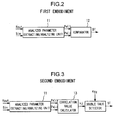
- Fig. 2 is a block diagram showing a schematic construction of an apparatus embodying a double talk detecting method according to a first embodiment of the present invention.
- Fig. 3 is a block diagram showing a schematic construction of an apparatus embodying a double talk detecting method according to a second embodiment of the present invention.
- Fig. 4 is a block diagram showing a schematic construction of an apparatus embodying a double talk detecting method according to a third embodiment of the present invention.
- Fig. 5 is a block diagram showing a construction of an important portion of the apparatus shown in Fig. 4.
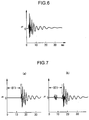
- Fig. 6 is a graph showing a general impulse response of an echo path.
- Fig. 7 is a graph showing an impulse response of an echo path when a delay is involved.
- Fig. 8 is a block diagram showing a schematic construction of an apparatus embodying a double talk detecting method according to a fourth embodiment of the present invention.
- Fig. 9 is a block diagram showing one example of a detailed construction of a comparator used in the fourth embodiment.
- Fig. 2 is a block diagram showing a schematic construction of an apparatus embodying a double talk detecting method according to the present invention.
- This apparatus is located in the afore-mentioned control unit 4.
- reference numeral 11 denotes an analyzed parameter extracting/analyzing unit.
- speech pitches are employed as analyzed parameters which are used for detecting the double talk.
- the speech pitches indicate a vibration cycle of human vocal cords. For example, in a case of an active speech, the vocal cords are vibrated and a predetermined basic cycle (or basic frequency) appears in the vibration.
- the analyzed parameter extracting/analyzing unit 11 extracts such speech pitches.
- the input speech signals are measured/accumulated for a certain time (for example, about 10 ms) and thereafter, the analyzed parameters are extracted. That is, it takes for 10 ms until the first analyzed parameter is extracted but thereafter the analyzed parameters are extracted at intervals corresponding to sampling pitches.
- the above-mentioned analyzed parameters Pr(i) and Ps(i) refer to values at each time. Then, the comparator unit 12 compares the analyzed parameters Pr(i) and Ps(i) at each input time. If the analyzed parameters Pr(i) and Ps(i) are equal to each other or if both of them are determined as equivalent to each other, it can be determined that only an echo caused by the speech of a far-end talker is generated. In contrast, if the parameters Pr(i) and Ps(i) are different from each other, it is judged that a state of both the speeches of the far-end talker and near-end talker being simultaneously transmitted, i.e., double talk, is generated. In such a case, the comparator unit 12 sends a signal DT indicative of a generation of the double talk to the echo path estimation circuit/echo replica generator 3. As a consequence, the learning function of estimation of an echo path is turned off.
- Rout corresponds to the speech of the far-end talker whereas Sin corresponds its echo.
- the pitches of the speech of the far-end talker and its echo become generally equal to each other at a predetermined time. Since a delay of several tens ms (for example, about 60 ms) occurs between an input and an output, i.e., between the signals Rout and Sin, of the hybrid circuit 2, if the analyzed parameters of the two are compared exactly at the same time, they are, indeed, slightly different.
- the analyzed parameters of the two are compared within a range of a predetermined time, taking into consideration such a delay, they are almost the same. In this case, namely, in the case where an echo is present, the learning function of estimation of an echo path works.
- Fig. 3 is a block diagram showing a schematic construction of an apparatus embodying a double talk detecting method according to the second embodiment of the present invention. This apparatus is located in the afore-mentioned control unit 4. In this illustration, the analyzed parameter extracting/analyzing unit 11 is constructed in the same manner as the first embodiment.
- a correlation value calculator 13 calculates a time correlation value kj of the analyzed parameters Pr(i) and Ps(i) input therein, in accordance with the following expression (13).
- kj 1/ G R
- G S ⁇ i j - N S j Pr ( i - N D ) P S ( i ) )
- N D represents a sample value of the echo delay
- N S represents a section in which the above-mentioned correlation calculation is made.
- G R and G S are expressed by the under-listed expressions (14) and (15), respectively.
- the double talk detection unit 13 compares the correlation value kj thus calculated with a predetermined threshold K TH and detects/judges whether or not the double talk is present, based on the result of comparison.
- the threshold is set within a range of 0 ⁇ K TH ⁇ 1. It should be noted that this threshold is set to an optimum value through various experiments, actual measurements, or the like.
- the threshold kj shows the degree of correlation of fluctuations of the analyzed parameters of both the far-end speech output Rout and near-end speech input Sin.
- Rout corresponds to the speech of the far-end talker whereas Sin corresponds its echo.
- the degree of correlation between both of them is comparatively high.
- Rout corresponds to the speech of the far-end talker
- Sin corresponds to the speech of the near-end talker.
- the speech pitches of the far-end talker and near-end talker are different and therefore, the degree of correlation of the analyzed parameters between them is lowered. Therefore, when this degree of correlation is lowered below a predetermined value (namely, threshold), it can be judged that the double talk has occurred.
- a predetermined value namely, threshold
- Fig. 4 is a block diagram showing a construction of one embodiment of the present invention.
- a control unit 104 in this embodiment performs merely the controlling of the non-linear processor 6, different from the control unit 4 shown in Fig. 5. Specifically, it detects the far-end talker's single talk and performs merely the controlling of a switching operation of the non-linear processor 6.
- the double talk detection in this embodiment is performed within an echo path estimation circuit 103a.
- Fig. 5 is a block diagram showing a construction of an important portion of the echo path estimation circuit 103a.
- reference numeral 10 denotes a computation unit for calculating a fluctuation ⁇ H of a tap coefficient H in accordance with the learning identification algorithm
- reference numeral 12 denotes an adder.
- reference numeral 25 denotes a processing register which is constructed in the same manner as the H-register 3b. Output signals from the processing register 25 are supplied to a storage register 26-1 and the adder 12, respectively. A plurality of such storage registers are provided as represented by 26-1 to 26-n. The construction of each register is the same as the H-register 3b. The tap coefficient H is gradually transmitted from the storage register 26-1 toward the storage register 26-n. An output data from the storage register 26-n is supplied to the H-register 3b.
- response characteristic of an impulse of the echo path is as shown in Fig. 6.
- This response characteristic of the echo path corresponds directly to the pattern of the tap coefficient H. More strictly, if the echo path estimation circuit 103a performs a correct learning, a time series pattern (see the expression (7)) of the calculated tap coefficient H is the same as the response characteristic of the impulse of the echo path.
- the response characteristic of the echo path is slightly different.
- the response characteristic of the echo path is classified into about 10 to 20 patterns which are selected so as not to provide substantial inconveniences in actual practice.
- the patterns indicative of individual response characteristics are stored in memories M1 to Mn, respectively.
- Reference numeral 20 denotes a double talk monitor. In response to a signal SEL, the double talk monitor 20 selects the memories M1 to Mn one after another and compares the response characteristics stored in the various memories with the output tap coefficient H from the adder 12.
- the double talk monitor 20 watches how far the tap coefficient H, which is output from the adder 12, is remote from the response characteristics (reference values) stored in the memories. If they are remote from the response characteristics to the extent exceeding a range of allowable errors which are preliminarily established for all of the memories M1 to Mn, the double talk monitor 20 outputs a double talk detection signal DT. In this case, information indicative of allowable errors is also stored in the memories M1 to Mn.
- the computation unit 10 calculates such a ⁇ H capable of reducing the residual echo in accordance with the learning identification algorithm and adds the obtained ⁇ H to the current tap coefficient H (tap coefficient in the processing register 25) to prepare a tap coefficient of the next time point.
- the prepared tap coefficient is supplied to the processing register 25.
- the tap coefficient H in the processing register 25 is adaptively controlled.
- the tap coefficient H, which has been supplied to the processing register 25, is gradually transmitted to the storage registers 26-1 to 26-n. Therefore, the tap coefficient H stored in the storage register 26-n is a tap coefficient which is intended before several samplings. Since the tap coefficient H stored in the storage register 26-n is transmitted to the H-register 3b, the echo replica generator 3c generates an echo replica based on the tap coefficient which is intended before several samplings.
- the tap coefficient H which is output from the adder 12 is coincident with the response characteristic stored in one of the memories M1 to Mn or is converged into the range of the allowable errors. Therefore, the double talk monitor 20 does not output the double talk detection signal DT.
- the computation unit 10 is brought into a mis-learning state because the speech signal of the near-end talker is superimposed on the adder 5.
- the calculated value of ⁇ H does not correspond to the impulse response of the echo path. Consequently, the value of the tap coefficient H, which is output from the adder 12, is deviated from the response characteristics stored in the memories M1 to Mn.
- the double talk monitor 20 outputs the double talk detection signal DT.
- the tap coefficient H which is stored in the storage register 26-n intended before several samplings, i.e., the correct coefficient H before the double talk state is created, is transmitted to the H-register 3b. Consequently, the echo replica generator 3c does not generate an unnecessary echo replica and generates an echo replica based on the tap coefficient H which is calculated immediately before the double talk state is created.
- the storage registers 26-1 to 26-n do not accept any new input but keep holding the internal data. Therefore, the tap coefficient H supplied to the H-register 3b holds the value immediately before the double talk state is created.
- the tap coefficient written in the processing register 25 is successively supplied to the adder 12 in order to add ⁇ H thereto.
- the tap coefficient H remains as "a deviated value" with respect to the reference value (response characteristic in each memory).
- ⁇ H calculated by the computation unit 10 gradually becomes closer to the reference value and is finally converged into the range of the allowable value, because it gradually becomes a correct value.
- the double talk monitor 20 stops the transmission of the double talk detection signal DT.
- the storage registers 26-1 to 26-n resume the shift of the tap coefficient H.
- the storage register 26-n is closed at its input end until the content of the processing register 25 at the time point the transmission of the double talk detection signal DT is stopped, is supplied.
- the content of the H-register 3b is not renewed until the arrival of a correctly renewed tap coefficient. In this way, a state, which existed before the double talk is detected, is created again and a correctly renewed tap coefficient H is supplied to the H-register 3b.
- the H-register 3b holds a tap coefficient which is intended before several samplings and therefore, it is hardly susceptible to any adverse effect caused by mis-learning.
- a tap coefficient reflecting the result of learning is transmitted again to the H-register 3b.
- the impulse response characteristics of the echo path are stored in the storage means and a judgment is made as to whether or not the double talk is present, based on the result of comparison between the output tap coefficient from the echo path estimation means and the impulse response characteristics within the storage means. Therefore, a reliable double talk detection can be performed in accordance with the characteristics of the hybrids.
- the tap coefficient which is output from the echo path estimation means, is stored in the tap coefficient delayed storage means after the delay of a plurality of stages.
- Fig. 8 is a block diagram showing a schematic construction of the fourth embodiment embodying a double talk detecting method according to the present invention.
- This apparatus is located within the control unit 4.
- reference numerals 41 and 42 denote groups of band-pass filters constituted of a plurality of band-pass filters (BPF), respectively.
- the band-pass filters group 41 divide the signal of the far-end speech output Rout into a plurality of frequency bands (hereinafter referred to as the "sub-bands") and output the same.
- the band-width of each sub-band is selected to be an optimum width through various experiments/actual measurements.
- the band-pass filters group 42 divide the signal of the near-end speech input Sin into a plurality of sub-bands and output the same.
- the sub-bands in the band-pass filters group 41 correspond to the sub-bands in the band-pass filters group 42, respectively.
- Reference numerals 431 to 43 n denote comparators, respectively.
- the number n (n represents an integer of 2 or more) of the comparators corresponds to the number of the subbands. That is, each comparator 43 compares the far-end speech output Rout with the near-end speech input Sin in each sub-band. In the case where the far-end speech output Rout and the near-end speech input Sin are different in power here, each comparator 43 outputs a signal indicating to that effect.
- Output signals from the comparators 431 to 43 n are input into an OR circuit 44.
- the OR circuit 44 When a signal is output from at least one of the comparators 431 to 43 n , the OR circuit 44 generates a double talk detection signal DT indicative of a generation of the double talk and outputs the same to the echo path estimation circuit/echo replica generator 3. By doing this, the learning function of the echo path is turned off.
- Fig. 9 shows one example of a construction of an internal circuit of each comparator 43.
- reference numeral 45 denotes a power ratio calculator. From the far-end speech output Rout and the near-end speech input Sin in each sub-band, the power ratio calculator 45 calculates a power ratio of the two. The power ratio calculated here is compared with a predetermined threshold TH in the comparator unit 46, and a signal is output when the power ratio exceeds the threshold.
- the signal of Rout and the signal of Sin are divided into sub-bands, respectively. Then, the signal on the Rout side and the signal on the Sin side are compared with each other in each sub-band, and it is judged that the double talk has occurred when both of the signals are different or when the power ratio of both of the signals exceeds a predetermined threshold.
- the accuracy of double talk detection is subjected to the effect of the speech levels of the far-end talker and near-end talker.
- the present invention can solve such a problem by dividing each signal into a plurality of sub-bands and comparing them.
- the speech of the far-end talker has a different frequency characteristic from that of the near-end talker.
- the reason is that the contents of speeches of the far-end talker and near-end talker are different. Even if the contents of speeches of the far-end talker and near-end talker are the same, their frequency characteristics are necessarily different because vibration waveforms of their vocal codes are different for each person.
- the double talk is heretofore detected merely based on the power ratio of the signals and disregarding the difference in frequency characteristic.
- the present invention pays attention to this difference in frequency characteristic and divides the waveform of the speech of each person into sub-bands.
Landscapes
- Engineering & Computer Science (AREA)
- Computer Networks & Wireless Communication (AREA)
- Signal Processing (AREA)
- Cable Transmission Systems, Equalization Of Radio And Reduction Of Echo (AREA)
Priority Applications (2)
| Application Number | Priority Date | Filing Date | Title |
|---|---|---|---|
| EP05012686A EP1578026A3 (de) | 1994-05-06 | 1995-05-02 | Verfahren und Gerät zur Detektion von Doppelsprechen sowie Echokompensator |
| EP05012685A EP1578025A1 (de) | 1994-05-06 | 1995-05-02 | Verfahren und Gerät zur Detektion von Doppelsprechen sowie Echokompensator |
Applications Claiming Priority (9)
| Application Number | Priority Date | Filing Date | Title |
|---|---|---|---|
| JP11763894A JP2953954B2 (ja) | 1994-05-06 | 1994-05-06 | ダブルトーク検出装置およびエコーキャンセラ |
| JP11763794A JPH07303071A (ja) | 1994-05-06 | 1994-05-06 | ダブルトーク検出方法 |
| JP11763994A JPH07303072A (ja) | 1994-05-06 | 1994-05-06 | ダブルトーク検出方法および装置 |
| JP117639/94 | 1994-05-06 | ||
| JP117638/94 | 1994-05-06 | ||
| JP117636/94 | 1994-05-06 | ||
| JP11763694A JPH07303070A (ja) | 1994-05-06 | 1994-05-06 | ダブルトーク検出方法 |
| JP117637/94 | 1994-05-06 | ||
| PCT/JP1995/000864 WO1995031050A1 (en) | 1994-05-06 | 1995-05-02 | Method and device for detecting double-talk, and echo canceler |
Publications (2)
| Publication Number | Publication Date |
|---|---|
| EP0708535A1 true EP0708535A1 (de) | 1996-04-24 |
| EP0708535A4 EP0708535A4 (de) | 2004-09-29 |
Family
ID=27470451
Family Applications (3)
| Application Number | Title | Priority Date | Filing Date |
|---|---|---|---|
| EP95917502A Withdrawn EP0708535A4 (de) | 1994-05-06 | 1995-05-02 | Verfahren und gerät zur detektion von doppelsprechen, sowie echokompensator |
| EP05012686A Withdrawn EP1578026A3 (de) | 1994-05-06 | 1995-05-02 | Verfahren und Gerät zur Detektion von Doppelsprechen sowie Echokompensator |
| EP05012685A Withdrawn EP1578025A1 (de) | 1994-05-06 | 1995-05-02 | Verfahren und Gerät zur Detektion von Doppelsprechen sowie Echokompensator |
Family Applications After (2)
| Application Number | Title | Priority Date | Filing Date |
|---|---|---|---|
| EP05012686A Withdrawn EP1578026A3 (de) | 1994-05-06 | 1995-05-02 | Verfahren und Gerät zur Detektion von Doppelsprechen sowie Echokompensator |
| EP05012685A Withdrawn EP1578025A1 (de) | 1994-05-06 | 1995-05-02 | Verfahren und Gerät zur Detektion von Doppelsprechen sowie Echokompensator |
Country Status (3)
| Country | Link |
|---|---|
| US (1) | US6272106B1 (de) |
| EP (3) | EP0708535A4 (de) |
| WO (1) | WO1995031050A1 (de) |
Cited By (5)
| Publication number | Priority date | Publication date | Assignee | Title |
|---|---|---|---|---|
| WO1997049196A3 (en) * | 1996-06-19 | 1998-02-12 | Nokia Telecommunications Oy | Echo suppressor and non-linear processor of echo canceller |
| GB2342832A (en) * | 1998-08-04 | 2000-04-19 | Motorola Inc | Detecting double-talk in an echo canceller |
| WO2001005053A1 (en) * | 1999-07-09 | 2001-01-18 | Dsp Software Engineering, Inc. | Fast line echo cancellation |
| EP0843455A3 (de) * | 1996-11-15 | 2003-08-06 | Alcatel | Verfahren und Anordnung zur adaptiven Echokompensation |
| WO2004021679A3 (en) * | 2002-02-21 | 2006-03-30 | Tecteon Plc | Echo detector having correlator with preprocessing |
Families Citing this family (13)
| Publication number | Priority date | Publication date | Assignee | Title |
|---|---|---|---|---|
| US6804203B1 (en) * | 2000-09-15 | 2004-10-12 | Mindspeed Technologies, Inc. | Double talk detector for echo cancellation in a speech communication system |
| US6744884B1 (en) * | 2000-09-29 | 2004-06-01 | Skyworks Solutions, Inc. | Speaker-phone system change and double-talk detection |
| US6904146B2 (en) * | 2002-05-03 | 2005-06-07 | Acoustic Technology, Inc. | Full duplex echo cancelling circuit |
| US6996229B2 (en) * | 2003-07-09 | 2006-02-07 | Utah State University | Echo cancellation filter |
| US6954530B2 (en) | 2003-07-09 | 2005-10-11 | Utah State University | Echo cancellation filter |
| KR101035736B1 (ko) * | 2003-12-12 | 2011-05-20 | 삼성전자주식회사 | 이동통신 시스템의 단말 장치에서 반향 제거 장치 및 방법 |
| JP4814329B2 (ja) | 2005-10-21 | 2011-11-16 | コーニンクレッカ フィリップス エレクトロニクス エヌ ヴィ | 音響エコーキャンセラ |
| JP4312227B2 (ja) * | 2006-11-21 | 2009-08-12 | 富士通株式会社 | エコー処理方法及び装置 |
| US20080159507A1 (en) * | 2006-12-27 | 2008-07-03 | Nokia Corporation | Distributed teleconference multichannel architecture, system, method, and computer program product |
| GB2449720A (en) * | 2007-05-31 | 2008-12-03 | Zarlink Semiconductor Inc | Detecting double talk conditions in a hands free communication system |
| US20090094026A1 (en) * | 2007-10-03 | 2009-04-09 | Binshi Cao | Method of determining an estimated frame energy of a communication |
| JP5658127B2 (ja) * | 2011-11-18 | 2015-01-21 | 日本電信電話株式会社 | 無線通信装置、無線通信方法及び無線通信プログラム |
| WO2021211113A1 (en) | 2020-04-15 | 2021-10-21 | Hewlett-Packard Development Company, L.P. | Double talk detectors |
Family Cites Families (19)
| Publication number | Priority date | Publication date | Assignee | Title |
|---|---|---|---|---|
| JPS5111313A (ja) | 1974-07-18 | 1976-01-29 | Nippon Electric Co | Sohokotsuwakenshutsukairo |
| US4282411A (en) * | 1979-06-04 | 1981-08-04 | Tellabs, Inc. | Residual echo suppressor for echo canceller |
| DE3070399D1 (en) * | 1980-12-06 | 1985-05-02 | Communications Satellite Corp | Improved double talk detector for echo cancellers |
| JPS57130099A (en) | 1981-02-06 | 1982-08-12 | Fujitsu Ltd | Voice recognition system |
| JPS5857197A (ja) | 1981-09-30 | 1983-04-05 | 日本電信電話株式会社 | 音声認識装置 |
| US4712235A (en) * | 1984-11-19 | 1987-12-08 | International Business Machines Corporation | Method and apparatus for improved control and time sharing of an echo canceller |
| JPS6265525A (ja) | 1985-09-17 | 1987-03-24 | Oki Electric Ind Co Ltd | ダブルト−ク検出回路 |
| JPS62176337A (ja) | 1986-01-30 | 1987-08-03 | Oki Electric Ind Co Ltd | 適応形エコ−キヤンセラ |
| JPH0720073B2 (ja) | 1987-05-20 | 1995-03-06 | 沖電気工業株式会社 | エコ−キヤンセラ |
| NL8701633A (nl) * | 1987-07-10 | 1989-02-01 | Philips Nv | Digitale echocompensator. |
| JPH01126839A (ja) | 1987-11-12 | 1989-05-18 | Japan Radio Co Ltd | エコー消去回路 |
| JPH02288734A (ja) | 1989-04-28 | 1990-11-28 | Mitsubishi Electric Corp | エコーキャンセラ |
| JPH03120434A (ja) | 1989-10-03 | 1991-05-22 | Toshiba Corp | 音声認識装置 |
| US5305309A (en) * | 1989-12-06 | 1994-04-19 | Fujitsu Limited | Echo canceller |
| JP2518433B2 (ja) * | 1990-01-24 | 1996-07-24 | 日本電気株式会社 | ダブルト―ク検出回路 |
| JP3120434B2 (ja) | 1990-03-20 | 2000-12-25 | 株式会社日立製作所 | プログラム動作解析方法 |
| NL9001016A (nl) * | 1990-04-27 | 1991-11-18 | Philips Nv | Digitale echocompensator met een dubbelspraakdetector. |
| JPH04128900A (ja) | 1990-09-20 | 1992-04-30 | Nec Ic Microcomput Syst Ltd | 音声認識装置 |
| DE69530040T2 (de) * | 1994-05-06 | 2004-02-12 | Ntt Mobile Communications Network Inc. | Verfahren zur echokompensation und echopfadschätzung |
-
1995
- 1995-05-02 EP EP95917502A patent/EP0708535A4/de not_active Withdrawn
- 1995-05-02 EP EP05012686A patent/EP1578026A3/de not_active Withdrawn
- 1995-05-02 WO PCT/JP1995/000864 patent/WO1995031050A1/ja not_active Ceased
- 1995-05-02 US US08/513,891 patent/US6272106B1/en not_active Expired - Fee Related
- 1995-05-02 EP EP05012685A patent/EP1578025A1/de not_active Withdrawn
Cited By (9)
| Publication number | Priority date | Publication date | Assignee | Title |
|---|---|---|---|---|
| WO1997049196A3 (en) * | 1996-06-19 | 1998-02-12 | Nokia Telecommunications Oy | Echo suppressor and non-linear processor of echo canceller |
| AU723043B2 (en) * | 1996-06-19 | 2000-08-17 | Nokia Telecommunications Oy | Echo suppressor and non-linear processor of echo canceller |
| US6574336B1 (en) | 1996-06-19 | 2003-06-03 | Nokia Telecommunications Oy | Echo suppressor and non-linear processor of echo canceller |
| EP0843455A3 (de) * | 1996-11-15 | 2003-08-06 | Alcatel | Verfahren und Anordnung zur adaptiven Echokompensation |
| GB2342832A (en) * | 1998-08-04 | 2000-04-19 | Motorola Inc | Detecting double-talk in an echo canceller |
| GB2342832B (en) * | 1998-08-04 | 2001-03-21 | Motorola Inc | Method and device for detecting near-end voice |
| WO2001005053A1 (en) * | 1999-07-09 | 2001-01-18 | Dsp Software Engineering, Inc. | Fast line echo cancellation |
| US6771772B1 (en) | 1999-07-09 | 2004-08-03 | Oguz Tanrikulu | Method and apparatus for fast network bulk delay and span estimation for line echo cancellation |
| WO2004021679A3 (en) * | 2002-02-21 | 2006-03-30 | Tecteon Plc | Echo detector having correlator with preprocessing |
Also Published As
| Publication number | Publication date |
|---|---|
| EP1578026A2 (de) | 2005-09-21 |
| EP1578025A1 (de) | 2005-09-21 |
| EP0708535A4 (de) | 2004-09-29 |
| WO1995031050A1 (en) | 1995-11-16 |
| EP1578026A8 (de) | 2005-12-21 |
| EP1578026A3 (de) | 2005-09-28 |
| US6272106B1 (en) | 2001-08-07 |
Similar Documents
| Publication | Publication Date | Title |
|---|---|---|
| US6272106B1 (en) | Method and device for detecting double-talk, and echo canceler | |
| EP1184998B1 (de) | Echokompensator und Echopfadschätzungsverfahren | |
| JP2538176B2 (ja) | エコ―制御装置 | |
| US9286881B2 (en) | Echo canceler and echo detector | |
| US6061444A (en) | Echo canceler and method for learning for the same | |
| EP2330752A1 (de) | Echolöscheinrichtung | |
| EP1119172A2 (de) | Netzwerkechokompensator | |
| US6766021B2 (en) | Echo canceller | |
| JPH0618331B2 (ja) | 経時変化特性を有する配線において発生するエコ−をディジタル消去するための装置 | |
| US6744886B1 (en) | Adaptive filter utilizing proportional affine projection algorithm | |
| JP2856113B2 (ja) | エコーキャンセラ | |
| US20090168993A1 (en) | Echo Canceler | |
| US20040252652A1 (en) | Cross correlation, bulk delay estimation, and echo cancellation | |
| US6766020B1 (en) | System and method for comfort noise generation | |
| EP1940042B1 (de) | Verfahren und Vorrichtung zur Echoverarbeitung | |
| JP2953954B2 (ja) | ダブルトーク検出装置およびエコーキャンセラ | |
| US7711107B1 (en) | Perceptual masking of residual echo | |
| JP3303524B2 (ja) | エコーキャンセラ学習方法 | |
| JPH07303070A (ja) | ダブルトーク検出方法 | |
| EP1232645B1 (de) | Echounterdrückung | |
| JPH07303072A (ja) | ダブルトーク検出方法および装置 | |
| JP3304609B2 (ja) | エコーキャンセラ学習方法 | |
| US20250391395A1 (en) | Echo suppressing device, echo suppressing method, and echo suppressing program | |
| JPH07303071A (ja) | ダブルトーク検出方法 | |
| JPH07303061A (ja) | エコーキャンセラおよびエコーパス推定方法 |
Legal Events
| Date | Code | Title | Description |
|---|---|---|---|
| PUAI | Public reference made under article 153(3) epc to a published international application that has entered the european phase |
Free format text: ORIGINAL CODE: 0009012 |
|
| 17P | Request for examination filed |
Effective date: 19950831 |
|
| AK | Designated contracting states |
Kind code of ref document: A1 Designated state(s): AT BE CH DE DK ES FR GB GR IE IT LI LU MC NL PT SE |
|
| RIC1 | Information provided on ipc code assigned before grant |
Ipc: 7H 04B 3/23 B Ipc: 7H 04B 3/20 A |
|
| A4 | Supplementary search report drawn up and despatched |
Effective date: 20040816 |
|
| 17Q | First examination report despatched |
Effective date: 20050203 |
|
| GRAP | Despatch of communication of intention to grant a patent |
Free format text: ORIGINAL CODE: EPIDOSNIGR1 |
|
| STAA | Information on the status of an ep patent application or granted ep patent |
Free format text: STATUS: THE APPLICATION IS DEEMED TO BE WITHDRAWN |
|
| 18D | Application deemed to be withdrawn |
Effective date: 20060707 |