EP0708538A2 - Système de communication à fibres optiques utilisant la conjugaison de phase optique - Google Patents
Système de communication à fibres optiques utilisant la conjugaison de phase optique Download PDFInfo
- Publication number
- EP0708538A2 EP0708538A2 EP95115698A EP95115698A EP0708538A2 EP 0708538 A2 EP0708538 A2 EP 0708538A2 EP 95115698 A EP95115698 A EP 95115698A EP 95115698 A EP95115698 A EP 95115698A EP 0708538 A2 EP0708538 A2 EP 0708538A2
- Authority
- EP
- European Patent Office
- Prior art keywords
- optical fiber
- light
- optical
- communication system
- signal light
- Prior art date
- Legal status (The legal status is an assumption and is not a legal conclusion. Google has not performed a legal analysis and makes no representation as to the accuracy of the status listed.)
- Granted
Links
Images








Classifications
-
- H—ELECTRICITY
- H04—ELECTRIC COMMUNICATION TECHNIQUE
- H04B—TRANSMISSION
- H04B10/00—Transmission systems employing electromagnetic waves other than radio-waves, e.g. infrared, visible or ultraviolet light, or employing corpuscular radiation, e.g. quantum communication
- H04B10/25—Arrangements specific to fibre transmission
- H04B10/2507—Arrangements specific to fibre transmission for the reduction or elimination of distortion or dispersion
- H04B10/2513—Arrangements specific to fibre transmission for the reduction or elimination of distortion or dispersion due to chromatic dispersion
- H04B10/2531—Arrangements specific to fibre transmission for the reduction or elimination of distortion or dispersion due to chromatic dispersion using spectral inversion
-
- H—ELECTRICITY
- H04—ELECTRIC COMMUNICATION TECHNIQUE
- H04B—TRANSMISSION
- H04B10/00—Transmission systems employing electromagnetic waves other than radio-waves, e.g. infrared, visible or ultraviolet light, or employing corpuscular radiation, e.g. quantum communication
- H04B10/25—Arrangements specific to fibre transmission
- H04B10/2507—Arrangements specific to fibre transmission for the reduction or elimination of distortion or dispersion
- H04B10/2543—Arrangements specific to fibre transmission for the reduction or elimination of distortion or dispersion due to fibre non-linearities, e.g. Kerr effect
- H04B10/255—Self-phase modulation [SPM]
Definitions
- the present invention relates to an optical fiber communication system using optical phase conjugation.
- the conventional optical communication system is constructed by employment of optical components having linear optical characteristics, so that some limits are existent with respect to the characteristics and the functions though the construction is simple.
- a non-repeating system and a multistage optical amplifiers repeating system covering a long distance of several hundred to several thousand kilometers, and the transmission speed thereof is as high as several Gb/sec to 10 Gb/sec or more.
- the most important and serious one is harmful influence of GVD in a fiber.
- the transmission characteristics are deteriorated by the influence derived from GVD and so forth to consequently induce restrictions on both the transmission speed and the transmission distance.
- the principal countermeasure adopted in the prior art against GVD is based fundamentally on an idea to minimize the dispersion of the fiber itself.
- the dispersion is reduced to zero at transmission center wavelengths of 1.3 ⁇ m and/or 1.55 ⁇ m.
- Study of an optical modulator which generates signals less affected by GVD is also in progress, and a novel modulator using LiNbO3 is currently developed. Further advanced study is presently in progress with regard to a method of compensating for GVD in a transmission line by previously giving inverse chirping to transmission signal light or a method of carrying out compensation for dispersion either optically or electrically in a receiver.
- continuous researches and studies are advanced with respect to the entirety of transmitters, transmission lines and receivers due to reflection of such serious problems.
- signal light is composed of an optical pulse (inclusive of a pulse train consisting of a plurality of optical pulses) processed through intensity modulation or amplitude modulation, there may occur a phenomenon that the pulse waveform is distorted by some other reasons than GVD. Notable ones are assumed to be as follows:
- an optical pulse propagates in a dispersion medium.
- a normal dispersion medium ⁇ 2 ⁇ / ⁇ 2 >0
- the pulse is shifted toward a lower frequency side at its leading edge or is shifted toward a higher frequency side at its trailing edge.
- an anomalous dispersion medium ⁇ 2 ⁇ / ⁇ 2 ⁇ 0
- the pulse is shifted toward a higher frequency side at its leading edge or is shifted toward a lower frequency side at its trailing edge.
- ⁇ and ⁇ denote the propagation constant and the angular frequency of the light, respectively.
- the pulse width is increased.
- ⁇ n (t) n 2
- n2 is the amount termed nonlinear refractive index, and its value in the case of a silica fiber is approximately 3.2 x 10 ⁇ 20m2/W.
- ⁇ z denotes the interaction length. This phenomenon is generally termed self-phase modulation (SPM).
- the optical pulse Due to this SPM, the optical pulse is shifted to a lower frequency side at its leading edge or is shifted toward a higher frequency side at its trailing edge. Because of the chirping caused by such SPM, the influence of the dispersion is rendered more noticeable to consequently increase the pulse distortion. Therefore, when the optical pulse is affected by the optical Kerr effect in a normal dispersion medium, the pulse is more broadened than in the case of dispersion alone; whereas in an anomalous dispersion medium, there occurs pulse compression.
- an optical fiber communication system which comprises a first optical fiber for transmitting signal light therethrough; a phase conjugator for generating, in response to the signal light supplied from the first optical fiber, phase conjugate light corresponding to the signal light; and a second optical fiber for transmitting the phase conjugate light supplied thereto from the phase conjugator; wherein, when the first and second optical fibers are virtually divided into the same number of sections respectively, the average values of the GVDs of the relevant sections which, out of the entire divided sections, correspond to each other as counted consecutively from the phase conjugator, are so set as to have the same sign and the value approximately in inverse proportion to the length of each divided section, and the average value of the product of the optical frequency, the signal light intensity and the nonlinear refractive index in each divided section is so set as to be approximately in inverse proportion to the length of each divided section.
- an optical fiber communication system which comprises a first optical fiber for transmitting signal light therethrough; a phase conjugator for generating, in response to the signal light supplied from the first optical fiber, phase conjugate light corresponding to the signal light; and a second optical fiber for transmitting the phase conjugate light supplied thereto from the phase conjugator; wherein the total GVD in the first optical fiber is approximately equal to the total GVD in the second optical fiber, and when at least one of the first and second optical fibers is virtually divided into a plurality of sections, the product of the optical frequency, the average signal light intensity, the nonlinear refractive index and the reciprocal of the average GVD in each of the sections is substantially fixed.
- the optical fiber communication system is so constituted as mentioned above, it is possible to attain a novel function which is capable of compensating for the waveform distortion derived from the synergism of GVD and optical Kerr effect.
- the optical fiber in the following description is defined as a single mode fiber.
- Fig. 1 is a schematic diagram showing a fundamental constitution of the optical fiber communication system according to the present invention.
- a transmitter 2 generates signal light by performing modulation on the basis of transmission data.
- the signal light Es thus produced is transmitted as probe light through a first optical fiber SMF1 (length L1, dispersion D1, nonlinear refractive index n21) and then is inputted to a phase conjugator (PC) 6 disposed in the middle of an entire transmission line.
- the phase conjugator 6 the signal light Es is transformed into phase conjugate light Ec by the use of pump light Eo and is transmitted to a receiver 4 through a second optical fiber SMF2 (length L2, dispersion D2, nonlinear refractive index n22).
- the receiver 4 receives the phase conjugate light by its photo detector and detects the signal.
- signal detection is performed through, e.g., optical heterodyne detection or direct detection after extraction of the phase conjugate light via a band pass filter, whereby the transmission data is reproduced.
- the optical fiber employed here is a silica fiber for example, and typical one is a 1.3 ⁇ m zero dispersion fiber or a 1.55 ⁇ m dispersion shifted fiber employed generally in light communication.
- the signal light may be one produced by wavelength-division-multiplexing a plurality of signal light outputs obtained from a plurality of signal sources of mutually different wavelength.
- the phase conjugator 6 has a second-order or third-order nonlinear optical medium and a means for supplying signal light and pump light to such a medium. Phase conjugate light is generated by parametric effect in the case of using a second-order nonlinear optical medium, or by degenerate or nondegenerate four-wave mixing (FWM) in the case of using a third-order nonlinear optical medium.
- FWM degenerate or nondegenerate four-wave mixing
- the third-order nonlinear optical medium may be composed of a silica optical fiber for example, and it is possible in this case to generate satisfactory phase conjugate light by selectively presetting the pump light wavelength in FWM approximately to the zero dispersion wavelength of the optical fiber (as disclosed in Japanese Patent Application Hei 5 (1993)-221856).
- Fig. 2 is a block diagram of an exemplary phase conjugator.
- This phase conjugator comprises an optical fiber 121 as a nonlinear optical medium, a laser diode 122 as a pump light source, and an optical coupler 123 as an optical means for supplying a combination of the signal light and the pump light to the optical fiber 121.
- the optical fiber 121 is a single mode fiber.
- the wavelength for giving zero dispersion of the optical fiber 121 becomes coincident with the pump light wavelength (oscillation wavelength of the laser diode 122).
- the optical coupler 123 has four ports 123A, 123B, 123C and 123D. To the port 123A is connected the first optical fiber SMF1 shown in Fig. 1; to the port 123B is connected the laser diode 122; to the port 123C is connected the first end of the optical fiber 121; and the port 123D is a dead end. Meanwhile the second end of the optical fiber 121 is connected to the second optical fiber SMF2 in Fig. 1.
- connection signifies operative connection inclusive of optical direct connection and also connection via any optical element such as an optical filter or an optical isolator, and further includes connection after proper adjustment of polarization.
- the optical coupler 123 so functions as to output from the port 123C the light supplied to the ports 123A and 123B.
- This optical coupler 123 may be of fiber fused type or may consist of a half mirror, a wavelength-division multiplexer or a polarized beam splitter.
- the signal light which is supplied to the port 123A of the optical coupler 123, with the pump light supplied to the port 123B thereof, and then to supply the combined light to the optical fiber 121 which is a nonlinear optical medium, hence realizing conversion of the signal light into the phase conjugate light by four-light mixing.
- Fig. 3 is a block diagram of another exemplary phase conjugator.
- this phase conjugator is characterized by the provision of a polarization scrambler 124 disposed between a laser diode 122 and a port 123B of an optical coupler 123.
- a polarization scrambler 124 disposed between a laser diode 122 and a port 123B of an optical coupler 123.
- the polarization state of the light supplied to the first end of the fiber fails to coincide with the polarization state of the light outputted from the second end of the fiber.
- the polarized state of the signal light supplied to the phase conjugator is varied with the lapse of time by environmental changes and so forth.
- the efficiency of conversion from the signal light into the phase conjugate light in the phase conjugator is dependent on the relationship between the polarized state of the signal light and that of the pump light supplied to the phase conjugator.
- the pump light outputted from the laser diode 122 is joined to the signal light via the polarization scrambler 124, so that even if the polarization state of the supplied signal light is varied with the lapse of time, it is still possible to realize stable operations of various optical devices.
- the polarization scrambler 124 has a known ordinary construction including a combination of a 1/2 wavelength plate and a 1/4 wavelength plate, a LiNbO3 phase modulator and so forth, and when the pump light outputted from the laser diode 122 is substantially linear polarized one for example, the scrambler 124 so functions as to randamize the state of polarization thereof.
- the polarization scrambler 124 is connected to act on the pump light outputted from the laser diode 122.
- the constitution may be so modified that the scrambler is disposed between the port 123A of the optical coupler 123 and the first optical fiber SMF1 shown in Fig. 1 or is incorporated in the transmitter in such a manner as act on the signal light.
- n2 and A eff stand for the nonlinear refractive index of the fiber and the effective core area thereof respectively, and c stands for the light velocity in a vacuum.
- the first-order dispersion is taken into consideration, and any higher-order dispersion is omitted.
- ⁇ (z), ⁇ 2(z), ⁇ (z) are functions of z.
- ⁇ (z, T) A (z) u (z, T)
- a (z) ⁇ A (0) exp [- (1 ⁇ 2) 0 z ⁇ (z) dz ] denotes the amplitude, where one case of ⁇ (z)>0 signifies that the transmission line has a loss, and the other case of ⁇ (z) ⁇ 0 signifies that the transmission line has a gain. Meanwhile A(z) ⁇ A(0) signifies that there is no loss.
- A(z) 2 P(z) corresponds to the optical power. Substituting Eqs.
- sgn[ ⁇ 2] ⁇ ⁇ 1 takes a value +1 when ⁇ 2>0 signifying normal dispersion, or takes a value -1 when ⁇ 2 ⁇ 0 signifying anomalous dispersion. If Eq. (9) is established, the complex conjugate thereof is also established, so that the following equation is obtained.
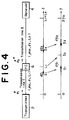
- Fig. 4 the system shown in Fig. 4 will be discussed below.
- the transmission line loss is compensated for by repeating with light amplification.
- a phase conjugator is disposed between a transmission line I (length L1) and a transmission line II (length L2).
- u( ⁇ ) obeys evolution equation (9).
- u( ⁇ 0) is transformed into the light u*( ⁇ 0) by the phase conjugator, and u*( ⁇ ) propagates in the transmission line II ( ⁇ 0 ⁇ 2 ⁇ 0) obeying evolution equation (10).
- ⁇ 21 (z 1 ) dz 1 - ⁇ 22 (z 2 ) dz 2
- ⁇ 1 (z 1 ) A 1 (z 1 ) 2 dz 1 - ⁇ 2 (z 2 ) A 2 (z 2 ) 2 dz 2
- z1 and z2 are defined as follows. L1 Z1
- dz - L1 Z2
- dz The section length dz is in inverse proportion to the intra-section dispersion or to the product of the nonlinear constant and the optical power.
- Eqs. (18) and (19) represent the requisites for compensation and signify that the total amount of the dispersion and the total amount of the optical Kerr effect in each small section are equal to those in the corresponding small section.
- Eq. (4) and I P/A eff represent the light intensity
- the above equations signify that the desired compensation can be achieved if the product of the dispersion value, the nonlinear refractive index and the light intensity in each small section of the transmission lines I and II is set to be in inverse proportion to the length of the section and also if the ratio thereof is set to be equalized.
- ⁇ , D and ⁇ are fixed, the following equations can be obtained by integrating Eqs. (18) and (19).
- the ratio of the optical Kerr effect to the dispersion value is controlled. Therefore, complete compensation can be realized by giving, at the positions equivalently symmetrical with respect to the phase conjugator, the same ratio of the optical Kerr effect to the dispersion. An increase of this ratio along the transmission line can be attained by gradually decreasing the dispersion or gradually increasing the optical Kerr effect. It is possible to change the dispersion value by adequately designing the fiber. For example, the above ratio is changeable by changing the zero dispersion wavelength of a dispersion shifted fiber (DSF) or by changing the specific refractive index difference between the core and the clad of the fiber or the core diameter thereof.
- DSF dispersion shifted fiber
- an optical fiber applicable to the present invention can be manufactured by continuously changing at least one fiber parameter selected from the loss, nonlinear refractive index, mode field diameter and dispersion.
- a description will be given with regard to a method of changing the light intensity. For instance, an increase of the light intensity along a transmission line having some loss can be attained by gradually decreasing the effective core area A eff .
- the mode field diameter (MFD) is reduced to a half for example, the light intensity is increased approximately four times.
- the MFD needs to be further reduced if the loss is greater, any excessive reduction of the MFD causes an increase of the loss on the contrary to consequently fail in achieving satisfactory effect.
- the minimum value of the MFD effective in practical use is at most 2 to 3 ⁇ m.
- the MFD of a 1.3 ⁇ m zero dispersion SMF is about 10 ⁇ m and the MFD of a 1.55 ⁇ m DSF is about 8 ⁇ m
- the loss compensable merely by the MFD alone is about 10-14 dB compared with the SMF or about 8-12 dB compared with the DSF.
- the present invention may be carried out by combining the effect of reducing the core diameter with the effect of decreasing the dispersion value. For example, even in case a further loss of 3 dB is existent, the requisite in Eq.(14) is realizable if the dispersion value can be halved.
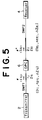
- Fig. 5 shows a first embodiment of the present invention.
- parameters of small sections 1j (length ⁇ z 1j ) and 2j (length ⁇ z 2j ) at positions z 1j and z 2j (defined by Eq.(17)) in transmission lines symmetrical with respect to a phase conjugator 6 are so set as represented by the following equations.
- D 1j ⁇ z 1j D 2j ⁇ z 2j
- D 1j ⁇ 2 n 22j ⁇ I 2j ⁇ D 2j
- ⁇ I j ⁇ denotes the average intensity in each section. Setting of such average intensity is the same as that already mentioned.
- Fig. 6 shows a second embodiment of the present invention.
- This embodiment represents an exemplary case where the invention is applied to multistage-repeating transmission employing optical amplifiers.
- another optical fiber SMF1 is virtually divided into N sections, wherein each section has a length of l1 and the total length is L1.
- the optical Kerr effect it is so set as to satisfy the condition of Eq. (23) in the corresponding small sections which are in the sections mutually corresponding with respect to a phase conjugator 6.
- the above setting is executed, in transmission over a repeating section of 50 km, with the optical fiber SMF1 actually or virtually divided at an interval of 500 m. Therefore, if the optical fiber SMF1 employed has a total length of 20 km and is divided by 40 at an interval of 500 m, then it becomes possible to perform transmission over a total length of 2000 km with 39 repeaters each covering 50 km posterior to the phase conjugator 6.
- the division in this example is at equal intervals, the intervals need not be equalized in particular since the requisite is that the conditions of Eqs. (22) and (23) are satisfied with regard to the corresponding sections.
- the requisite regarding the dispersion or power can be alleviated by increasing the distance l1, instead of equal-interval division thereof, in accordance with a reduction of the intensity caused by the loss.
- the loss effect can be diminished substantially by dividing each repeating section without fixing the dispersion in such a manner as to relatively increase the dispersion in a high-power portion while relatively decreasing the dispersion in a low-power portion.
- This method renders it possible to alleviate the requirements for the dispersion or power in the optical fiber SMF1.
- the optical fiber SMF2 is used for light-amplified repeating transmission.
- the optical fiber SMF1 is used for light-amplified repeating transmission and thereafter compensation is made in the optical fiber SMF2 by the same method.
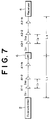
- Such an example is shown in Fig. 7.
- Fig. 7 shows a third embodiment of the present invention.
- the numbers of repeaters anterior and posterior to a phase conjugator 6 are mutually equalized, and the conditions are so set that Eqs. (22) and (23) are satisfied in the sections symmetrical with respect to the phase conjugator 6.
- the loss effect can be diminished substantially by dividing each repeating section without fixing the dispersion in the optical fiber SMF2 in such a manner as to relatively increase the dispersion in a high-power portion while relatively decreasing the dispersion in a low-power portion.
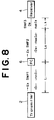
- Fig. 8 shows a fourth embodiment of the present invention.
- the dispersion D3 of a third optical fiber SMF3 having a length L3 and disposed between an optical fiber SMF2 and a receiver 4 as shown in Fig. 8, and the optical Kerr effect n23I3 in such fiber SMF3, are adequately adjusted to thereby realize substantially complete compensation.
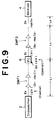
- Fig. 9 shows a fifth embodiment of the present invention.
- a plurality of repeaters are provided at positions anterior and posterior to a phase conjugator 6, and the conditions may be so set as to satisfy Eqs. (22) and (23) in the sections mutually corresponding with respect to the phase conjugator 6. More roughly, satisfactory compensation is achievable to a certain extent by setting the conditions in such a manner that the above equations are satisfied with regard to the average value in the entire length, as disclosed in Japanese Patent Application No. Hei 5 (1993)-221856.
- a third optical fiber SMF3 may be disposed as in the foregoing fourth embodiment of Fig. 8, and its dispersion D3 and optical Kerr effect n23I3 may be adequately adjusted.
- the dispersion value proximate to zero dispersion can be changed in accordance with a second-order dispersion inclination (approx. 0.08 ps/nm2/km) by changing the wavelength of the signal light.
- Fig. 10 shows a frequency arrangement of signal light, pump light and phase conjugate light to the respective zero dispersion wavelengths ⁇ 10 and ⁇ 20 of optical fibers SMF1 and SMF2. If the dispersion curves of the two fibers are shifted in the same direction by some change of the environment (as indicated by chained lines in Fig. 10), ⁇ S and ⁇ C should be shifted in the same direction. However, since ⁇ C is shifted in the reverse direction to any change of ⁇ S , it is desired that, simultaneously with a change of ⁇ S , ⁇ P is also changed in the same direction and by the same value as ⁇ S . In the case of Fig.
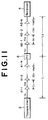
- Fig. 11 shows a sixth embodiment of the present invention.
- the dispersion control shown in Fig.7 is executed to alleviate the harmful influence of the power change (deterioration) between light amplifiers. More specifically, each repeating section is divided into several portions, and the dispersion value is gradually decreased in the forward direction of transmission.
- Fig. 12 represents an example where each repeating section is divided into three portions, and the dispersion values therein are so set as to become -0.35, -0.30 and -0.25 ps/nm/km respectively in the forward direction of transmission.
- the relay section has a length of 51 km in the above example, then it is divided at an interval of 17 km per portion, so that the dispersion inclination becomes approximately -0.04 dB/km. Therefore, if the fiber loss is -0.20 dB/km, it is possible to reduce the change of the ratio, which is expressed by Eq.
- Fig. 13 shows a seventh embodiment of the present invention.
- This embodiment represents an example where, when the invention is applied to a light-amplified multi-repeating transmission system, the ratio of the nonlinear effect and dispersion is maintained constant in an optical fiber SMF1.
- the optical fiber SMF1 is virtually divided into a plurality of sections, and the sum of the dispersion value D Sj ⁇ z Sj in each section j is equalized to the total GVD of the optical fiber SMF2, and further the absolute value( ⁇ n21I Sj /D Sj ) of the nonlinear effect in each section j is set to be fixed.
- optical fiber SMF2 is performed light-amplified multi-repeating transmission which employs average value approximation, wherein the total of the nonlinear effect in the optical fiber SMF1 is equalized to the total of the average value of the nonlinear effect in the optical fiber SMF2. Also with regard to the optical fiber SMF2, the same setting may be executed as for the optical fiber SMF1.
- the reduction of I Sj resulting from the loss can be compensated by gradually decreasing D 1j , it is possible to keep the ratio of the nonlinear effect and dispertion constant.
- the dispersion value in each section can be kept constant by increasing the length ⁇ 1j of each section in inverse proportion to the loss. That is, the compensation is so made as to keep constant both of n21I 1j ⁇ z 1j and D 1j ⁇ z 1j .
- the number of divisions of the optical fiber SMF1 is equal to the number of repeaters in the optical fiber SMF2.
- Fig. 14 shows an eighth embodiment of the present invention.
- the light outputted from a phase conjugator 6 is branched into two by means of an optical coupler 8 or an unshown optical switch, and one branch light is transmitted via an optical fiber SMF2 (length L2) to a receiver 4 (#1) while the other branch light is transmitted via an optical fiber SMF3 (length L3) to another receiver 4 (#2).
- the optical fiber SMF2 is equipped with light amplifiers A2-1, 2, ..., N; and the optical fiber SMF3 is equipped with light amplifiers A3-1, 2, ..., N.
- Fig. 15 shows a ninth embodiment of the present invention.
- a plurality of third fibers are used to perform additional compensation in WDM transmission.
- Denoted by 10 (#1, #2, ..., #N) in this diagram are optical filters for selection of channels with regard to the phase conjugate light transmitted via an optical fiber SMF2.
- the light outputs obtained from the optical filters 10 (#1, #2, ..., #N) are transmitted via compensating optical fibers SMF3-1, 2, ..., N respectively to receivers 4 (#1, #2, ..., #N).
- WDM signal lights E S1 , E S2 , ..., E SN (frequencies: ⁇ S1 , ⁇ S2 , ..., ⁇ SN ) of N channels transmitted via the optical fiber SMF1 are transformed by a phase conjugator 6 into WDM phase conjugate lights E C1 , E C2 , ..., E CN (frequencies: ⁇ C1 , ⁇ C2 , ..., ⁇ CN ) of N channels, which are further transmitted via the optical fiber SMF2 and then are received by the corresponding receivers.
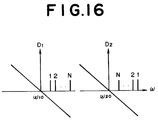
- the channels in the optical fibers SMF1 and SMF2 are so dispersed as illustrated in Fig. 16.
- signs of dispersion anterior and posterior to the phase conjugator need to be identical, so that the frequency arrangement with respect to zero dispersion becomes such as shown in Fig. 16.
- the absolute value of the dispersion to the first channel is minimum in the optical fiber SMF1
- the absolute value of the dispersion to the Nth channel is minimum. In principle, therefore, it is difficult to achieve complete dispersion compensation simultaneously for the entire channels.
- frequency selection is executed with regard to each channel after the output of the optical fiber SMF2 is branched, and then additional compensation is executed by the use of third fibers SMF3-1, 2, ..., N which conform to the residual compensation amounts for the individual channels.
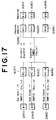
- a tenth embodiment of the present invention shown in Fig. 17 is contrived to execute ideal compensation equally for the entire channels.
- signal lights of respective channels are transmitted via individual fibers SMF11, 12, ..., 1N with the intensities (I11, I12,...,I 1N ) conforming to different dispersions.
- the output light of the optical fiber SMF1 is converted into phase conjugate light by phase conjugators 6 (#1), (#2), ..., (#N) of individual channels or by an unshown single phase conjugator for the entire channels, and the light outputs thereof are transmitted via a common optical fiber SMF2 to be received in the same manner as in the foregoing ninth embodiment of Fig. 15.
- an optical multiplexer for combining a plurality of signal lights or phase conjugate lights is omitted.
- a third optical fiber SMF3 is not necessary here.
- the dispersion and the nonlinear effect in each channel may be set by any of the methods mentioned hereinabove.
- phase conjugator Since the phase conjugator has polarization dependency, its conversion efficiency is different in accordance with the polarized state of signal light, whereby the overall system characteristic is rendered unstable. Furthermore, optical component elements used in the phase conjugator or the light amplifier also have polarization dependency in most cases, so that the signal level is rendered unstable when multiple stages thereof are connected. Such instability can be suppressed by applying polarization diversity or polarization active control, or by executing polarization scrambling for the signal light or pump light. Particularly the method of executing polarization scrambling for the signal light in a transmitter is advantageous due to a simple constitution and in view of elimination of the harmful influence from various kinds of polarization dependency which raise some problems currently in long distance transmission.
- Fig. 18 shows a frequency arrangement in optical phase conjugation where four-wave mixing is employed.
- a gain band is existent in a light amplifier, and therefore it has a frequency ⁇ g which gives a peak of the gain.
- ⁇ g which gives a peak of the gain.
- this wavelength is in the vicinity of 1558.5 nm.
- the wavelengths of signal light and phase conjugate light are positionally symmetrical with respect to the wavelength of pump light as shown in Fig. 18, and therefore the gain peak can be ensured over the whole transmission line by shifting the peak wavelength in regard to half the entire light amplifiers.
- an optical filter may be used to eliminate spontaneous emission light from the light amplifier so as to prevent the filtering effect of the light amplifier.
- the optical fiber SMF2 none of optical filter is necessary since the pump light and the signal light passing through the phase conjugator can be eliminated by the filtering effect of the light amplifier, whereby the construction is effectively simplified. It is a matter of course that, instead of utilizing the filtering effect of such EDFA, each repeating amplifier may be equipped with an optical filter to eliminate spontaneous emission light.
- a satisfactory result can be achieved by providing a plurality of band pass filters correspondingly to a plurality of light amplifiers so as to eliminate the spontaneous emission light noise generated in the light amplifiers. It is desired that the pass bands of such band pass filters are so set as to become narrower in accordance with an increase of the distance from the phase conjugator. The reason is based on the following fact.
- the spectrum of the signal component in the output light from the transmitter is the narrowest as it is free from any distortion.
- the signal component is inputted via the first optical fiber to the phase conjugator, its spectrum is most widened as it is affected by the distortion.
- the widened spectrum of the signal component is gradually narrowed in the longitudinal direction of the second optical fiber. Therefore, effective elimination of the noise component is rendered possible by setting the pass band of each band pass filter in the manner mentioned above.
- Fig. 19 shows an eleventh embodiment of the present invention. This embodiment represents an example of utilizing the filtering effect of a light amplifier most efficiently.
- the eleventh embodiment is characterized in the point that a transmitter 2' includes both an optical fiber SMF1 and a phase conjugator 6.
- the optical fiber SMF1 is supplied with signal light outputted from an optical modulator 12.
- the dispersion D1 of the optical fiber SMF1 is set to be relatively large, whereby the length L2 of the optical fiber SMF2 can be set to a sufficiently great value, hence realizing long-distance transmission.
- Fig. 20 shows a twelfth embodiment of the present invention.
- a receiver 4' includes both a phase conjugator 6 and an optical fiber SMF2.
- an optical fiber SMF1 serving as a transmission line, there are provided a plurality of loss-compensating light amplifiers A-1, 2, ..., (1-N).
- A-1, 2, ..., (1-N) After arrival at the receiver 4', the repeated signal light is transformed into phase conjugate light by the phase conjugator 6 and then is supplied to a detector 14 via the optical fiber SMF2.
- this embodiment is advantageous for use in an optical WDM transmission system or the like. More specifically, compensation for the waveform distortion can be executed by first changing, in WDM transmission, the frequency of the pump light in the phase conjugator to thereby change the frequency of the phase conjugate light, then performing channel selection by means of an optical filter or the like in the posterior stage, and thereafter transmitting the phase conjugate light via the optical fiber SMF2. If the light is branched into the number of channels anterior or posterior to the phase conjugator 6, the entire channels can be received simultaneously.
- Fig. 21 shows a thirteenth embodiment of the present invention. This embodiment represents an example of applying the invention to bidirectional transmission, where there are employed two of the average-approximation transmission systems shown in Fig. 9.
- a down circuit 16 comprises a transmitter 2A, a receiver 4A, a phase conjugator 6A, an optical fiber SMF11 laid between the transmitter 2A and the phase conjugator 6A, and an optical fiber SMF12 laid between the phase conjugator 6A and the receiver 4A.
- An up circuit 18 comprises a transmitter 2B, a receiver 4B, a phase conjugator 6B, an optical fiber SMF21 laid between the transmitter 2B and the phase conjugator 6B, and an optical fiber SMF22 laid between the phase conjugator 6B and the receiver 4B.
- a plurality of loss-compensating light amplifiers are provided in each of the optical fibers.
- signal light E S1 (frequency ⁇ 1) outputted from the transmitter 2A is transmitted after being transformed into phase conjugate light E C1 (frequency ⁇ 2) by the phase conjugator 6A.
- signal light E S2 (frequency ⁇ 2) outputted from the transmitter 2B is transmitted after being transformed into phase conjugate light E C2 (frequency ⁇ 1) by the phase conjugator 6B.
- the entire lights of the frequency ⁇ 1 are transmitted on the left sides of the phase conjugators 6A and 6B in the diagram, while the entire lights of the frequency ⁇ 2 are transmitted on the right sides thereof. Consequently, even when the pass frequency bands are limited with insertion of optical filters in the individual circuits, the signals can be transferred properly if the frequencies are the same. Namely, it is possible to directly apply the technique of turning around a monitor signal or the like executed in ordinary bidirectional transmission.
- the frequency of the down circuit and that of the up circuit are set to be mutually coincident in this embodiment. However, such frequency coincidence is not exactly needed in the down and up circuits if the frequencies are included in the above-described pass bands.
- a single bidirectional phase conjugator may be used in common as well.
- the parameters or frequencies in the optical fibers may be set to arbitrary values. In such a case, each phase conjugator need not be disposed at the same position.
- Fig. 23 is a block diagram of a phase conjugator for bidirectional transmission.
- This phase conjugator 60 is disposed, for example, at the middle of each of the down circuit 16 and the up circuit 18 in the system of Fig. 21. Since the partial configuration relative to the down circuit 16 and that relative to the up circuit 18 are the same, an explanation will be given below merely on the configuration relative to the down circuit 16 alone.
- phase conjugator 60 signal light inputted to the phase conjugator 60 is supplied via optical couplers 20, 22 and 24 to a nonlinear medium 26.
- Phase conjugate light generated in the nonlinear medium 26 is outputted via an optical filter 28, a light amplifier 30 and optical couplers 32 and 34 in this order.
- the optical coupler 20 serves to partially couple the output light of the up circuit 18 to the input light of the down circuit 16.
- the optical coupler 22 partially branches the input light of the down circuit 16, and the branch light is supplied to a photo diode 36.
- the output of the photo diode 36 is supplied to an input monitor circuit 38, whose output is then supplied to both a control circuit 40 and a data signal circuit 44.
- the output of the control circuit 40 and the output of the data signal circuit 44 are supplied to a pump light source 42, whose pump light is supplied via the optical coupler 24 to the nonlinear medium 26.
- a portion of the output light branched by the optical coupler 32 is supplied to a photo diode 46, whose output is then supplied to an APC circuit 48 and an output monitor circuit 50.
- the output of the APC circuit 48 and that of the output monitor circuit 50 are supplied respectively to the pump light source 42 and the data signal circuit 44. Meanwhile a portion of the output light branched by the optical coupler 34 is supplied to the input side of the up circuit 18.
- the input signal light E S1 and the pump light E P1 are optically coupled and supplied to the nonlinear medium 26, whereby phase conjugate light E C1 is generated.
- the phase conjugate light is partially branched and, after photo-electric conversion, the power and the frequency of the pump light source 42 are so controlled that the power of the phase conjugate light is adjusted to a required value.
- Low-degree intensity modulation or frequency modulation is executed to the pump light source 42 by the data signal having the monitor value of the output power, whereby the data signal is superimposed on the phase conjugate light.
- the input signal light is partially branched and, after photoelectric conversion, signal superimposition similar to the above is executed by the data signal having the monitor value of the converted signal, or various control actions are executed by the monitor signal delivered from the transmitting station.
- Such data signals are electrically transferred to or from the up circuit whenever required.
- the output power control may be performed in a form including output control of the light amplifier 30.
- a single phase conjugator is disposed between a transmitter and a receiver.
- longer-distance transmission is rendered possible in a modification where a plurality of the fundamental constitutions of the present invention except its transmitter and receiver are connected in series, and the transmitter and the receiver are disposed at both ends of such series connection.
- a bidirectional transmission system can be constructed by utilizing the seventh embodiment of Fig. 13.
Landscapes
- Physics & Mathematics (AREA)
- Electromagnetism (AREA)
- Engineering & Computer Science (AREA)
- Computer Networks & Wireless Communication (AREA)
- Signal Processing (AREA)
- Spectroscopy & Molecular Physics (AREA)
- Nonlinear Science (AREA)
- Optical Communication System (AREA)
Applications Claiming Priority (6)
| Application Number | Priority Date | Filing Date | Title |
|---|---|---|---|
| JP255849/94 | 1994-10-20 | ||
| JP25584994 | 1994-10-20 | ||
| JP25584994 | 1994-10-20 | ||
| JP4457495 | 1995-03-03 | ||
| JP44574/95 | 1995-03-03 | ||
| JP04457495A JP3494738B2 (ja) | 1994-10-20 | 1995-03-03 | 光位相共役を用いた光ファイバ通信システム |
Publications (3)
| Publication Number | Publication Date |
|---|---|
| EP0708538A2 true EP0708538A2 (fr) | 1996-04-24 |
| EP0708538A3 EP0708538A3 (fr) | 2000-10-25 |
| EP0708538B1 EP0708538B1 (fr) | 2010-04-28 |
Family
ID=26384522
Family Applications (1)
| Application Number | Title | Priority Date | Filing Date |
|---|---|---|---|
| EP19950115698 Expired - Lifetime EP0708538B1 (fr) | 1994-10-20 | 1995-10-05 | Système de communication à fibres optiques utilisant la conjugaison de phase optique |
Country Status (3)
| Country | Link |
|---|---|
| EP (1) | EP0708538B1 (fr) |
| JP (1) | JP3494738B2 (fr) |
| DE (1) | DE69536073D1 (fr) |
Cited By (6)
| Publication number | Priority date | Publication date | Assignee | Title |
|---|---|---|---|---|
| WO1998008138A1 (fr) | 1996-08-22 | 1998-02-26 | Fujitsu Limited | Systeme de communication a fibre optique utilisant un conjugue de la phase optique, appareil applicable au systeme et son procede de fabrication |
| WO2000055993A3 (fr) * | 1999-03-12 | 2001-01-11 | Nokia Networks Oy | Compensation de la dispersion dans un reseau de communication optique et reseau de communication optique |
| WO2001069821A1 (fr) * | 2000-03-16 | 2001-09-20 | Siemens Aktiengesellschaft | Ensemble amplificateur raman |
| EP1079552A3 (fr) * | 1999-08-26 | 2004-01-02 | Fujitsu Limited | Procédé, dispositif optique et système de transmission à fibres optiques |
| US8160240B2 (en) | 2008-05-28 | 2012-04-17 | Microsemi Semiconductor (U.S.) Inc. | Echo cancellation balance using noise generator and average power detection |
| CN110274885A (zh) * | 2019-07-03 | 2019-09-24 | 西安文理学院 | 宽谱带时间分辨吸收光谱单次测量装置 |
Families Citing this family (3)
| Publication number | Priority date | Publication date | Assignee | Title |
|---|---|---|---|---|
| JPH11243374A (ja) | 1998-02-26 | 1999-09-07 | Fujitsu Ltd | 光信号伝送システム及び、これに用いる光信号伝送装置 |
| JP5027434B2 (ja) | 2006-03-28 | 2012-09-19 | 富士通株式会社 | 光信号の波形を整形する装置 |
| JP5381089B2 (ja) | 2008-12-25 | 2014-01-08 | 富士通株式会社 | 光信号処理装置 |
Citations (1)
| Publication number | Priority date | Publication date | Assignee | Title |
|---|---|---|---|---|
| EP0643498A1 (fr) | 1993-09-10 | 1995-03-15 | AT&T Corp. | Transmission optique de type non-soliton de capacité hyper-élevée utilisant la conjugaison de phase optique |
-
1995
- 1995-03-03 JP JP04457495A patent/JP3494738B2/ja not_active Expired - Fee Related
- 1995-10-05 DE DE69536073T patent/DE69536073D1/de not_active Expired - Lifetime
- 1995-10-05 EP EP19950115698 patent/EP0708538B1/fr not_active Expired - Lifetime
Patent Citations (1)
| Publication number | Priority date | Publication date | Assignee | Title |
|---|---|---|---|---|
| EP0643498A1 (fr) | 1993-09-10 | 1995-03-15 | AT&T Corp. | Transmission optique de type non-soliton de capacité hyper-élevée utilisant la conjugaison de phase optique |
Cited By (11)
| Publication number | Priority date | Publication date | Assignee | Title |
|---|---|---|---|---|
| WO1998008138A1 (fr) | 1996-08-22 | 1998-02-26 | Fujitsu Limited | Systeme de communication a fibre optique utilisant un conjugue de la phase optique, appareil applicable au systeme et son procede de fabrication |
| EP0862078A4 (fr) * | 1996-08-22 | 2006-03-22 | Fujitsu Ltd | Systeme de communication a fibre optique utilisant un conjugue de la phase optique, appareil applicable au systeme et son procede de fabrication |
| WO2000055993A3 (fr) * | 1999-03-12 | 2001-01-11 | Nokia Networks Oy | Compensation de la dispersion dans un reseau de communication optique et reseau de communication optique |
| US6724997B2 (en) | 1999-03-12 | 2004-04-20 | Nokia Corporation | Dispersion compensation in optical communication network and optical communication network |
| EP1079552A3 (fr) * | 1999-08-26 | 2004-01-02 | Fujitsu Limited | Procédé, dispositif optique et système de transmission à fibres optiques |
| US7379637B2 (en) | 1999-08-26 | 2008-05-27 | Fujitsu Limited | Method, optical device, and system for optical fiber transmission |
| WO2001069821A1 (fr) * | 2000-03-16 | 2001-09-20 | Siemens Aktiengesellschaft | Ensemble amplificateur raman |
| US6870980B2 (en) | 2000-03-16 | 2005-03-22 | Siemens Aktiengesellschaft | Raman amplifier system |
| US8160240B2 (en) | 2008-05-28 | 2012-04-17 | Microsemi Semiconductor (U.S.) Inc. | Echo cancellation balance using noise generator and average power detection |
| CN110274885A (zh) * | 2019-07-03 | 2019-09-24 | 西安文理学院 | 宽谱带时间分辨吸收光谱单次测量装置 |
| CN110274885B (zh) * | 2019-07-03 | 2022-04-05 | 西安文理学院 | 宽谱带时间分辨吸收光谱单次测量装置 |
Also Published As
| Publication number | Publication date |
|---|---|
| DE69536073D1 (de) | 2010-06-10 |
| EP0708538A3 (fr) | 2000-10-25 |
| JP3494738B2 (ja) | 2004-02-09 |
| EP0708538B1 (fr) | 2010-04-28 |
| JPH08171102A (ja) | 1996-07-02 |
Similar Documents
| Publication | Publication Date | Title |
|---|---|---|
| US6341026B1 (en) | Optical communication system using optical phase conjugation to suppress waveform distortion caused by chromatic dispersion and optical kerr effect | |
| EP0987583B1 (fr) | Appareil de conjugaison de phase insensible à la polarisation et système comprenant un tel appareil | |
| EP0703680B1 (fr) | Appareil et procédé de compensation de dispersion chromatique résultant de conjugaison de phase optique, ou conversion électro-optique d'autre type | |
| US6424773B1 (en) | Optical gate device, manufacturing method for the device, and system including the device | |
| EP0643319B1 (fr) | Mélangeur optique à quatre photons insensible à la polarisation avec signaux de pompage polarisés orthogonalement | |
| JP3494661B2 (ja) | 光位相共役を用いた光ファイバ通信システム並びに該システムに適用可能な装置及びその製造方法 | |
| JP3419510B2 (ja) | 波長分散を補償した光通信システム及び該システムに適用可能な位相共役光発生装置 | |
| US6160942A (en) | Optical fiber communication system using optical phase conjugation | |
| EP0643498B1 (fr) | Transmission optique de type non-soliton de capacité hyper-élevée utilisant la conjugaison de phase optique | |
| EP0767395B1 (fr) | Dispositif et procédé pour modifier les caractéristiques spectrales des signaux optiques | |
| EP0708538B1 (fr) | Système de communication à fibres optiques utilisant la conjugaison de phase optique | |
| JP4040583B2 (ja) | 光伝送システム | |
| JP4056933B2 (ja) | 光位相共役を用いた光ファイバ通信システム並びに該システムに適用可能な装置及びその製造方法 | |
| EP1576747B1 (fr) | Systeme de transmission optique mettant en oeuvre un dispositif de conjugaison de phase optique | |
| JP3913804B2 (ja) | 光位相共役を用いた光ファイバ通信システム | |
| JP4008484B2 (ja) | 光位相共役を用いた光ファイバ通信システム | |
| JP4008483B2 (ja) | 光位相共役を用いた光ファイバ通信システム | |
| JP4057042B2 (ja) | 光位相共役を用いた光ファイバ通信システム | |
| JP4008482B2 (ja) | 光位相共役を用いた光ファイバ通信システム |
Legal Events
| Date | Code | Title | Description |
|---|---|---|---|
| PUAI | Public reference made under article 153(3) epc to a published international application that has entered the european phase |
Free format text: ORIGINAL CODE: 0009012 |
|
| AK | Designated contracting states |
Kind code of ref document: A2 Designated state(s): DE FR GB |
|
| PUAL | Search report despatched |
Free format text: ORIGINAL CODE: 0009013 |
|
| RIC1 | Information provided on ipc code assigned before grant |
Free format text: 7H 04B 10/18 A, 7G 02F 1/35 B |
|
| AK | Designated contracting states |
Kind code of ref document: A3 Designated state(s): DE FR GB |
|
| 17P | Request for examination filed |
Effective date: 20001025 |
|
| 17Q | First examination report despatched |
Effective date: 20070828 |
|
| GRAP | Despatch of communication of intention to grant a patent |
Free format text: ORIGINAL CODE: EPIDOSNIGR1 |
|
| GRAS | Grant fee paid |
Free format text: ORIGINAL CODE: EPIDOSNIGR3 |
|
| GRAA | (expected) grant |
Free format text: ORIGINAL CODE: 0009210 |
|
| AK | Designated contracting states |
Kind code of ref document: B1 Designated state(s): DE FR GB |
|
| REG | Reference to a national code |
Ref country code: GB Ref legal event code: FG4D |
|
| REF | Corresponds to: |
Ref document number: 69536073 Country of ref document: DE Date of ref document: 20100610 Kind code of ref document: P |
|
| PGFP | Annual fee paid to national office [announced via postgrant information from national office to epo] |
Ref country code: FR Payment date: 20100915 Year of fee payment: 16 |
|
| PGFP | Annual fee paid to national office [announced via postgrant information from national office to epo] |
Ref country code: DE Payment date: 20101019 Year of fee payment: 16 |
|
| PLBE | No opposition filed within time limit |
Free format text: ORIGINAL CODE: 0009261 |
|
| STAA | Information on the status of an ep patent application or granted ep patent |
Free format text: STATUS: NO OPPOSITION FILED WITHIN TIME LIMIT |
|
| PGFP | Annual fee paid to national office [announced via postgrant information from national office to epo] |
Ref country code: GB Payment date: 20101026 Year of fee payment: 16 |
|
| 26N | No opposition filed |
Effective date: 20110131 |
|
| REG | Reference to a national code |
Ref country code: FR Ref legal event code: ST Effective date: 20120629 |
|
| PG25 | Lapsed in a contracting state [announced via postgrant information from national office to epo] |
Ref country code: DE Free format text: LAPSE BECAUSE OF NON-PAYMENT OF DUE FEES Effective date: 20120501 |
|
| REG | Reference to a national code |
Ref country code: DE Ref legal event code: R119 Ref document number: 69536073 Country of ref document: DE Effective date: 20120501 |
|
| PG25 | Lapsed in a contracting state [announced via postgrant information from national office to epo] |
Ref country code: FR Free format text: LAPSE BECAUSE OF NON-PAYMENT OF DUE FEES Effective date: 20111102 |
|
| GBPC | Gb: european patent ceased through non-payment of renewal fee |
Effective date: 20121005 |
|
| PG25 | Lapsed in a contracting state [announced via postgrant information from national office to epo] |
Ref country code: GB Free format text: LAPSE BECAUSE OF NON-PAYMENT OF DUE FEES Effective date: 20121005 |