EP0708945B1 - Verfahren zur analyse von kursivschrift - Google Patents
Verfahren zur analyse von kursivschrift Download PDFInfo
- Publication number
- EP0708945B1 EP0708945B1 EP95914487A EP95914487A EP0708945B1 EP 0708945 B1 EP0708945 B1 EP 0708945B1 EP 95914487 A EP95914487 A EP 95914487A EP 95914487 A EP95914487 A EP 95914487A EP 0708945 B1 EP0708945 B1 EP 0708945B1
- Authority
- EP
- European Patent Office
- Prior art keywords
- strings
- population
- writing
- groups
- string
- Prior art date
- Legal status (The legal status is an assumption and is not a legal conclusion. Google has not performed a legal analysis and makes no representation as to the accuracy of the status listed.)
- Expired - Lifetime
Links
Images

Classifications
-
- G—PHYSICS
- G06—COMPUTING OR CALCULATING; COUNTING
- G06V—IMAGE OR VIDEO RECOGNITION OR UNDERSTANDING
- G06V30/00—Character recognition; Recognising digital ink; Document-oriented image-based pattern recognition
- G06V30/10—Character recognition
- G06V30/32—Digital ink
- G06V30/36—Matching; Classification
- G06V30/373—Matching; Classification using a special pattern or subpattern alphabet
-
- G—PHYSICS
- G06—COMPUTING OR CALCULATING; COUNTING
- G06F—ELECTRIC DIGITAL DATA PROCESSING
- G06F18/00—Pattern recognition
- G06F18/20—Analysing
- G06F18/21—Design or setup of recognition systems or techniques; Extraction of features in feature space; Blind source separation
-
- G—PHYSICS
- G06—COMPUTING OR CALCULATING; COUNTING
- G06V—IMAGE OR VIDEO RECOGNITION OR UNDERSTANDING
- G06V30/00—Character recognition; Recognising digital ink; Document-oriented image-based pattern recognition
- G06V30/10—Character recognition
- G06V30/22—Character recognition characterised by the type of writing
- G06V30/226—Character recognition characterised by the type of writing of cursive writing
- G06V30/2268—Character recognition characterised by the type of writing of cursive writing using stroke segmentation
- G06V30/2272—Character recognition characterised by the type of writing of cursive writing using stroke segmentation with lexical matching
Definitions
- the present invention relates to a method for analyzing cursive writing, in which elementary forms are recognized in a word written with cursive writing and letters or groups of letters are reconstructed from these forms and a dictionary of groups of possible letters is searched for groups identical to the groups constructed from the forms extracted from the writing or resembling these groups, this delivering a plurality of strings of characters capable of corresponding to the word to be recognized.
- the automatic recognition of manuscript characters allows more natural communication between a user and a computer, without using a keyboard.
- the function consists in transforming cursive or "script" strokes into a string of characters.
- the Applicant has sought to recognize writing by recording the motion of the pen and by recognizing words with the aid of a lexicon.
- the purpose of the invention is to improve the speed of calculation and the recognition performance of such a method.
- the invention relates to a method of analyzing cursive writing as set out in claim 1.
- a reproduction procedure is carried out on the basis of a population of "candidate" strings, that is to say descendants in the genetic sense of the term, are constructed, a descendant string being obtained by crossing, that is to say combining elements picked from two of the said strings of the population, and at least some of the descendant strings are appended to the starting population.
- the starting population consists of a selection of only the most appropriate strings, and only the most appropriate are in turn chosen among the descendants to be appended to the starting selection.
- the population obtained following a first reproduction procedure may again be subjected to a reproduction procedure.
- each of the "parent” strings is picked at random from the starting population, and in each of the "parent” strings, that one of the elements which is picked therefrom in order to construct a descendant is picked therefrom also at random.
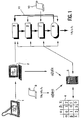
- FIG. 1 A diagrammatic view of the whole of a system is depicted in Figure 1.
- Information is extracted from a handwritten text by means of a graphics tablet 1.
- a graphics tablet Such a tablet records the speed and direction of movement of a pen on a tablet, whilst a person is writing.
- a preprocessing phase is carried out in a processing unit 2. Smoothing of the recorded signals makes it possible to overcome local variations due especially to the acquisition facilities, for example by means of a filter which replaces the components at the instant T i by the weighted mean of the components at times T i-1 , T i , T i+1 .
- This filter has three components so as to afford filtering of the curves representing the horizontal speed, the vertical speed and the direction angle.
- the curves thus obtained make it possible to recognize primitives, namely basic forms, representing a way of writing a part of a letter.
- primitives are an upwards spike, a downwards spike, a loop, a dome and a dish.
- the processing unit 2 carries out an analysis in order to find primitives.
- the position of the central zone of the word is estimated by calculating a histogram of the projections of the primitives onto a vertical.
- Each of the primitives is designated by a code. Twenty-eight different codes (called ⁇ , ⁇ , ⁇ , ⁇ , etc) are used, based on four basic primitives (spike, loop, dome or dish, link between two primitives) and by considering their position with respect to the centre of the word. Certain word parts are isolated; for example the bars of the "t"'s and the dots of the "i"'s are extracted.
- allographs More accomplished forms, called allographs, are formed from primitives so as to construct a letter or even a group of two or three letters.
- An allograph is therefore the representation of a way of writing a letter or a group of letters coded on the basis of primitives.
- the representations of allographs in terms of graphical primitives are built up on the basis of statistical information concerning the way in which the subject writes the 26 letters as well as the most often used digraphs or trigraphs (allographs with respectively two or three characters are called digraphs or trigraphs).
- the series of codes corresponds to a known object from a dictionary of allographs, which is defined by the sequence of codes of its primitives
- the corresponding allograph is recognized.
- Often only some of the codes of an allograph to be recognized correspond to a sequence of codes from the dictionary, and the allograph is not recognized with certainty.
- Several among the most probable solutions are then retained and in this way a population of possible solutions is processed next.
- strings The individuals of the population of possible solutions are called "strings".
- the representation of a string by the list of primitives describing how the word is written in cursive writing is called the “graphical image”.
- a string can also be represented by the ASCII codes which define the letters thereof, and this representation is called the "lexical image”.
- Figure 2 represents the primitives, slightly separated from one another relative to their position in a cursive script in which they would be joined up, of the allograph "TH n ", the n indicating that this is an n th way of writing the group of letters t, h. It consists of a tall upwards spike (code ⁇ ), followed by a dish (code ⁇ ), a loop (code ⁇ ), a short downwards spike (code ⁇ ), followed by a dome (code ⁇ ), and by a dish (code ⁇ ).
- Another illustration is the string TH 1 I 2 S 5 ( Figure 3), which is composed of three allographs and whose lexical image is the word "this” . Its graphical image is the list: ⁇ , ⁇ , ⁇ , ⁇ , ⁇ , ⁇ , ⁇ , ⁇ , ⁇ .
- the similarity between the graphical image of the string proposed as solution and the coding of the primitives of the word recorded by the graphics tablet 1 ( Figure 1) and delivered in the form of codes of primitives by the processing unit 2 is called the “fitness”. For example if the word to be recognized is “that” the string “TH 1 I 2 S 5 " has a higher fitness than "B 2 L 1 UE 1 ", because it corresponds better, although the correspondence is not complete.
- the fitness is evaluated by a fitness evaluation module 5 by means of a classical method of evaluating the correspondence between strings, for example the so-called “modified Levenshtein distance” method (4).
- a genetic algorithm is used to improve the population of strings. This is a procedure in which descendants, in the genetic sense of the term, namely strings obtained by combining starting strings, are constructed from a limited-quantity selection of strings, from among which descendants the most appropriate are in turn chosen, this gradually optimizing the population. Thus the word retained at the very end is the one which corresponds to the string having the best fitness.
- Preanalysis of the word to be recognized has delivered several strings of primitives, constituting the initial population which it will be sought to improve.
- a lexical analyzer generates, on the basis of a string of primitives, (for example ⁇ ), a list of possible words (for example TH AS S) from words contained in a dictionary of allographs 3.
- the initial population is thus constructed with codings of allographs based on the words from a dictionary of allographs.
- the individuals constituting a population have a fixed size.
- the length of a string is not fixed.
- the genetic algorithm is implemented by virtue of operators 6 to 9.
- Each of the operators calls upon the fitness evaluation module 5, especially to decide whether an individual from the population should be eliminated or preserved.
- the selection operator 9 makes it possible to contrive that, on average, the best strings are not lost and the worst disappear. For each string it determines whether it should be preserved or destroyed, according to a probability connected with the fitness, which is evaluated by the fitness evaluation module 5.
- the processing unit 2 delivers the starting population to the module 9.
- Each string contains a share of significant information which forms its fitness. Unfortunately, it is awkward to locate this information in the string since the fitness is a global value relating to the whole of the string.
- a statistical method is used in the crossing operator 7 to solve this problem: firstly, strings from the population which are chosen at random are associated pairwise, the randomness being weighted to give the strings having a higher fitness a higher probability of being chosen. Next, each pair of strings undergoes a crossing as represented in Figure 4. The new string does not necessarily have a better fitness than its "parents", and a call to the fitness evaluation module makes it possible to choose the "offspring" to be preserved. As the starting population contains a limited number of allographs, the number of solutions which will be reviewed is limited.
- the mutation operator 8 introduces noise into the crossing procedure: an allograph may be altered during the crossing, with a probability fixed at the start. Three types of mutation may be introduced, with various proportions of changed allographs relative to the total allographs of a string:
- a significant word element is a sub-string which possesses characteristics possessed by the best strings.
- the string should at least contain as many valid digraphs or trigraphs as possible (a digraph or a trigraph is valid if it is present in the dictionary of allographs: this presence depends especially on the language, for example the digraph "KN" is very rare in French whilst it is frequent in English).
- the mutation or crossing operators 7 and 8 act in the following non-deterministic manner: considering the lexical image of a string, a transformation of a digraph or of a trigraph is accepted (probabilistically) if it creates a valid digraph or trigraph, or if it avoids the destruction thereof.
- each string output by one of the operators 7 or 8 ascends to the selection operator 9 so as to be appended to the population (arrow 11).
- the module 6 determines whether the procedure should continue or be stopped.
- the effect of the action of the mutation operator is that the population is never entirely stable, which implies that the procedure could be continued indefinitely.
- Several criteria are used in the stop decision module 6 to determine whether or not a solution is valid and to decide to stop:
Landscapes
- Engineering & Computer Science (AREA)
- Theoretical Computer Science (AREA)
- Physics & Mathematics (AREA)
- General Physics & Mathematics (AREA)
- Computer Vision & Pattern Recognition (AREA)
- Data Mining & Analysis (AREA)
- Multimedia (AREA)
- Bioinformatics & Cheminformatics (AREA)
- Evolutionary Computation (AREA)
- Evolutionary Biology (AREA)
- General Engineering & Computer Science (AREA)
- Bioinformatics & Computational Biology (AREA)
- Artificial Intelligence (AREA)
- Life Sciences & Earth Sciences (AREA)
- Machine Translation (AREA)
- Character Discrimination (AREA)
Claims (6)
- Verfahren zur Analyse von Kursivschrift, bei dem elementare Formen in einem kursiv geschriebenen Wort erkannt werden und Buchstaben oder Buchstabengruppen aus diesen Formen rekonstruiert werden und ein Wörterbuch von Gruppen möglicher Buchstaben nach Gruppen durchsucht wird, die mit den Gruppen, welche aus denjenigen Formen konstruiert wurden, die aus der Schrift extrahiert wurden, identisch sind oder diesen Gruppen ähneln, wodurch man eine Vielzahl von Zeichenketten erhält, die dem zu erkennenden Wort entsprechen können, dadurch gekennzeichnet, dass ein Reproduktionsverfahren auf der Basis dieser Population von "Kandidaten"-Zeichenketten durchgeführt wird, das heißt, es werden Abkömmlinge im genetischen Sinn des Wortes konstruiert, wobei man eine Abkömmling-Zeichenkette durch Kreuzen erhält, also durch Kombinieren von Elementen, die aus zwei der genannten Zeichenketten der Population ausgewählt wurden, und mindestens einige der Abkömmling-Zeichenketten werden gemäß ihrer Eignung zu der Ausgangspopulation hinzugefügt.
- Verfahren nach dem vorhergehenden Anspruch, dadurch gekennzeichnet, dass die Ausgangspopulation aus einer Auswahl von nur den am meisten geeigneten Zeichenketten besteht, und nur die am meisten geeigneten Zeichenketten werden ihrerseits unter den zu der ursprünglichen Auswahl hinzuzufügenden Abkömmlingen ausgewählt.
- Verfahren nach Anspruch 1 und 2, dadurch gekennzeichnet, dass die nach einer ersten Reproduktionsprozedur erhaltene Population erneut einer Reproduktionsprozedur unterzogen wird.
- Verfahren nach einem der vorhergehenden Ansprüche, dadurch gekennzeichnet, dass jede der "Eltern" -Zeichenketten zufallsmäßig aus der Ausgangspopulation ausgewählt wird.
- Verfahren nach einem der vorhergehenden Anspüche, dadurch gekennzeichnet, dass in jeder der "Eltern"-Zeichenketten dasjenige der Elemente, das daraus ausgewählt wird, um einen Abkömmling zu konstruieren, ebenfalls zufallsmäßig daraus ausgewählt wird.
- Verfahren nach einem der vorhergehenden Ansprüche, dadurch gekennzeichnet, dass bei einigen der Kreuzungen Mutationen erzeugt werden.
Applications Claiming Priority (3)
| Application Number | Priority Date | Filing Date | Title |
|---|---|---|---|
| FR9404716A FR2719140A1 (fr) | 1994-04-20 | 1994-04-20 | Méthode pour l'analyse d'écriture cursive. |
| FR9404716 | 1994-04-29 | ||
| PCT/IB1995/000280 WO1995029458A1 (en) | 1994-04-20 | 1995-04-20 | Method for analyzing cursive writing |
Publications (2)
| Publication Number | Publication Date |
|---|---|
| EP0708945A1 EP0708945A1 (de) | 1996-05-01 |
| EP0708945B1 true EP0708945B1 (de) | 2000-07-12 |
Family
ID=9462305
Family Applications (1)
| Application Number | Title | Priority Date | Filing Date |
|---|---|---|---|
| EP95914487A Expired - Lifetime EP0708945B1 (de) | 1994-04-20 | 1995-04-20 | Verfahren zur analyse von kursivschrift |
Country Status (6)
| Country | Link |
|---|---|
| US (1) | US5940533A (de) |
| EP (1) | EP0708945B1 (de) |
| JP (1) | JPH08512162A (de) |
| DE (1) | DE69517910T2 (de) |
| FR (1) | FR2719140A1 (de) |
| WO (1) | WO1995029458A1 (de) |
Families Citing this family (6)
| Publication number | Priority date | Publication date | Assignee | Title |
|---|---|---|---|---|
| JP3577207B2 (ja) * | 1996-12-12 | 2004-10-13 | 富士通株式会社 | 遺伝的アルゴリズム実行装置、実行方法およびそのプログラム記憶媒体 |
| US7139738B2 (en) * | 2002-06-27 | 2006-11-21 | Koninklijke Philips Electronics N.V. | Face recognition using evolutionary algorithms |
| JP2005301664A (ja) * | 2004-04-12 | 2005-10-27 | Fuji Xerox Co Ltd | 画像辞書作成装置、符号化装置、データファイル、画像辞書作成方法及びそのプログラム |
| RO121497B1 (ro) * | 2005-02-09 | 2007-06-29 | Softwin S.R.L. | Sistem informatic şi metodă pentru achiziţia, analiza şi autentificarea semnăturii olografe |
| US7454063B1 (en) | 2005-09-22 | 2008-11-18 | The United States Of America As Represented By The Director National Security Agency | Method of optical character recognition using feature recognition and baseline estimation |
| US7620245B2 (en) * | 2006-05-30 | 2009-11-17 | Microsoft Corporation | Cursive handwriting recognition with hierarchical prototype search |
Family Cites Families (5)
| Publication number | Priority date | Publication date | Assignee | Title |
|---|---|---|---|---|
| US4754489A (en) * | 1985-10-15 | 1988-06-28 | The Palantir Corporation | Means for resolving ambiguities in text based upon character context |
| US5029223A (en) * | 1990-02-02 | 1991-07-02 | International Business Machines Corporation | Constraint driven-on line recognition of handwritten characters and symbols |
| WO1991014990A1 (en) * | 1990-03-28 | 1991-10-03 | Koza John R | Non-linear genetic algorithms for solving problems by finding a fit composition of functions |
| JPH0684006A (ja) * | 1992-04-09 | 1994-03-25 | Internatl Business Mach Corp <Ibm> | オンライン手書き文字認識方法 |
| US5649027A (en) * | 1992-07-24 | 1997-07-15 | Microsoft Corporation | Recognition of handwritten words |
-
1994
- 1994-04-20 FR FR9404716A patent/FR2719140A1/fr active Pending
-
1995
- 1995-04-20 EP EP95914487A patent/EP0708945B1/de not_active Expired - Lifetime
- 1995-04-20 JP JP7527504A patent/JPH08512162A/ja not_active Abandoned
- 1995-04-20 US US08/564,258 patent/US5940533A/en not_active Expired - Fee Related
- 1995-04-20 WO PCT/IB1995/000280 patent/WO1995029458A1/en not_active Ceased
- 1995-04-20 DE DE69517910T patent/DE69517910T2/de not_active Expired - Fee Related
Also Published As
| Publication number | Publication date |
|---|---|
| WO1995029458A1 (en) | 1995-11-02 |
| DE69517910D1 (de) | 2000-08-17 |
| JPH08512162A (ja) | 1996-12-17 |
| EP0708945A1 (de) | 1996-05-01 |
| US5940533A (en) | 1999-08-17 |
| FR2719140A1 (fr) | 1995-10-27 |
| DE69517910T2 (de) | 2001-02-15 |
Similar Documents
| Publication | Publication Date | Title |
|---|---|---|
| US5438630A (en) | Word spotting in bitmap images using word bounding boxes and hidden Markov models | |
| US5745600A (en) | Word spotting in bitmap images using text line bounding boxes and hidden Markov models | |
| US5825919A (en) | Technique for generating bounding boxes for word spotting in bitmap images | |
| US5067165A (en) | Character recognition method | |
| EP0602956B1 (de) | Texterkennung | |
| EP0439743B1 (de) | Beschränkungsabhängig gesteuerte on-line Erkennung von handgeschriebenen Zeichen und Symbolen | |
| US6917708B2 (en) | Handwriting recognition by word separation into silhouette bar codes and other feature extraction | |
| JPH1074250A (ja) | 文書処理装置、文書処理方法、および記憶媒体 | |
| EP0097820B1 (de) | Verfahren zur lernfähigen Zuordnung von Indexnummern für Bildelement-Matrixmuster | |
| JPH04298162A (ja) | 近隣ブロック予測ビット圧縮法 | |
| US5335289A (en) | Recognition of characters in cursive script | |
| Lehal et al. | Feature extraction and classification for OCR of Gurmukhi script | |
| Mostafa et al. | An end-to-end ocr framework for robust arabic-handwriting recognition using a novel transformers-based model and an innovative 270 million-words multi-font corpus of classical arabic with diacritics | |
| US5940533A (en) | Method for analyzing cursive writing | |
| JP3917349B2 (ja) | 文字認識結果を利用して情報を検索する検索装置および方法 | |
| EP0602955B1 (de) | Texterkennung | |
| Procter et al. | Cursive handwriting recognition using hidden Markov models and a lexicon-driven level building algorithm | |
| Menier et al. | A genetic algorithm for on-line cursive handwriting recognition | |
| Amin | OCR of Arabic texts | |
| Han et al. | Coarse classification of Chinese characters via stroke clustering method | |
| JPS60153575A (ja) | 文字読取方法 | |
| Amin | Recognition of printed Arabic text using machine learning | |
| KR100200871B1 (ko) | 이항 인식에 기반한 문자 인식 방법 및 장치 | |
| Tierney et al. | Printed Cyrillic character recognition system | |
| Haraty et al. | ABJAD: An Off-Line Arabic Handwritten Recognition System |
Legal Events
| Date | Code | Title | Description |
|---|---|---|---|
| PUAI | Public reference made under article 153(3) epc to a published international application that has entered the european phase |
Free format text: ORIGINAL CODE: 0009012 |
|
| AK | Designated contracting states |
Kind code of ref document: A1 Designated state(s): DE FR GB |
|
| 17P | Request for examination filed |
Effective date: 19960502 |
|
| RAP3 | Party data changed (applicant data changed or rights of an application transferred) |
Owner name: LABORATOIRES D'ELECTRONIQUE PHILIPS Owner name: KONINKLIJKE PHILIPS ELECTRONICS N.V. |
|
| GRAG | Despatch of communication of intention to grant |
Free format text: ORIGINAL CODE: EPIDOS AGRA |
|
| RTI1 | Title (correction) |
Free format text: METHOD OF ANALYZING CURSIVE WRITING |
|
| 17Q | First examination report despatched |
Effective date: 19990915 |
|
| GRAG | Despatch of communication of intention to grant |
Free format text: ORIGINAL CODE: EPIDOS AGRA |
|
| GRAH | Despatch of communication of intention to grant a patent |
Free format text: ORIGINAL CODE: EPIDOS IGRA |
|
| RAP1 | Party data changed (applicant data changed or rights of an application transferred) |
Owner name: KONINKLIJKE PHILIPS ELECTRONICS N.V. |
|
| GRAH | Despatch of communication of intention to grant a patent |
Free format text: ORIGINAL CODE: EPIDOS IGRA |
|
| GRAA | (expected) grant |
Free format text: ORIGINAL CODE: 0009210 |
|
| AK | Designated contracting states |
Kind code of ref document: B1 Designated state(s): DE FR GB |
|
| REF | Corresponds to: |
Ref document number: 69517910 Country of ref document: DE Date of ref document: 20000817 |
|
| ET | Fr: translation filed | ||
| PLBE | No opposition filed within time limit |
Free format text: ORIGINAL CODE: 0009261 |
|
| STAA | Information on the status of an ep patent application or granted ep patent |
Free format text: STATUS: NO OPPOSITION FILED WITHIN TIME LIMIT |
|
| 26N | No opposition filed | ||
| REG | Reference to a national code |
Ref country code: GB Ref legal event code: IF02 |
|
| PGFP | Annual fee paid to national office [announced via postgrant information from national office to epo] |
Ref country code: FR Payment date: 20040427 Year of fee payment: 10 |
|
| PGFP | Annual fee paid to national office [announced via postgrant information from national office to epo] |
Ref country code: GB Payment date: 20040429 Year of fee payment: 10 |
|
| PGFP | Annual fee paid to national office [announced via postgrant information from national office to epo] |
Ref country code: DE Payment date: 20040615 Year of fee payment: 10 |
|
| PG25 | Lapsed in a contracting state [announced via postgrant information from national office to epo] |
Ref country code: GB Free format text: LAPSE BECAUSE OF NON-PAYMENT OF DUE FEES Effective date: 20050420 |
|
| PG25 | Lapsed in a contracting state [announced via postgrant information from national office to epo] |
Ref country code: DE Free format text: LAPSE BECAUSE OF NON-PAYMENT OF DUE FEES Effective date: 20051101 |
|
| GBPC | Gb: european patent ceased through non-payment of renewal fee |
Effective date: 20050420 |
|
| PG25 | Lapsed in a contracting state [announced via postgrant information from national office to epo] |
Ref country code: FR Free format text: LAPSE BECAUSE OF NON-PAYMENT OF DUE FEES Effective date: 20051230 |
|
| REG | Reference to a national code |
Ref country code: FR Ref legal event code: ST Effective date: 20051230 |