EP0709829A2 - Capteur à effet magnétorésistif - Google Patents
Capteur à effet magnétorésistif Download PDFInfo
- Publication number
- EP0709829A2 EP0709829A2 EP95116825A EP95116825A EP0709829A2 EP 0709829 A2 EP0709829 A2 EP 0709829A2 EP 95116825 A EP95116825 A EP 95116825A EP 95116825 A EP95116825 A EP 95116825A EP 0709829 A2 EP0709829 A2 EP 0709829A2
- Authority
- EP
- European Patent Office
- Prior art keywords
- magnetic
- magneto
- resistance
- resistive effect
- magnetic layer
- Prior art date
- Legal status (The legal status is an assumption and is not a legal conclusion. Google has not performed a legal analysis and makes no representation as to the accuracy of the status listed.)
- Ceased
Links
Images
Classifications
-
- B—PERFORMING OPERATIONS; TRANSPORTING
- B82—NANOTECHNOLOGY
- B82Y—SPECIFIC USES OR APPLICATIONS OF NANOSTRUCTURES; MEASUREMENT OR ANALYSIS OF NANOSTRUCTURES; MANUFACTURE OR TREATMENT OF NANOSTRUCTURES
- B82Y25/00—Nanomagnetism, e.g. magnetoimpedance, anisotropic magnetoresistance, giant magnetoresistance or tunneling magnetoresistance
-
- G—PHYSICS
- G01—MEASURING; TESTING
- G01R—MEASURING ELECTRIC VARIABLES; MEASURING MAGNETIC VARIABLES
- G01R33/00—Arrangements or instruments for measuring magnetic variables
- G01R33/02—Measuring direction or magnitude of magnetic fields or magnetic flux
- G01R33/06—Measuring direction or magnitude of magnetic fields or magnetic flux using galvano-magnetic devices
- G01R33/09—Magnetoresistive devices
- G01R33/093—Magnetoresistive devices using multilayer structures, e.g. giant magnetoresistance sensors
-
- G—PHYSICS
- G11—INFORMATION STORAGE
- G11B—INFORMATION STORAGE BASED ON RELATIVE MOVEMENT BETWEEN RECORD CARRIER AND TRANSDUCER
- G11B5/00—Recording by magnetisation or demagnetisation of a record carrier; Reproducing by magnetic means; Record carriers therefor
- G11B5/127—Structure or manufacture of heads, e.g. inductive
- G11B5/33—Structure or manufacture of flux-sensitive heads, i.e. for reproduction only; Combination of such heads with means for recording or erasing only
- G11B5/39—Structure or manufacture of flux-sensitive heads, i.e. for reproduction only; Combination of such heads with means for recording or erasing only using magneto-resistive devices or effects
- G11B5/3903—Structure or manufacture of flux-sensitive heads, i.e. for reproduction only; Combination of such heads with means for recording or erasing only using magneto-resistive devices or effects using magnetic thin film layers or their effects, the films being part of integrated structures
-
- G—PHYSICS
- G11—INFORMATION STORAGE
- G11B—INFORMATION STORAGE BASED ON RELATIVE MOVEMENT BETWEEN RECORD CARRIER AND TRANSDUCER
- G11B5/00—Recording by magnetisation or demagnetisation of a record carrier; Reproducing by magnetic means; Record carriers therefor
- G11B5/127—Structure or manufacture of heads, e.g. inductive
- G11B5/33—Structure or manufacture of flux-sensitive heads, i.e. for reproduction only; Combination of such heads with means for recording or erasing only
- G11B5/39—Structure or manufacture of flux-sensitive heads, i.e. for reproduction only; Combination of such heads with means for recording or erasing only using magneto-resistive devices or effects
- G11B5/3903—Structure or manufacture of flux-sensitive heads, i.e. for reproduction only; Combination of such heads with means for recording or erasing only using magneto-resistive devices or effects using magnetic thin film layers or their effects, the films being part of integrated structures
- G11B5/3906—Details related to the use of magnetic thin film layers or to their effects
-
- G—PHYSICS
- G11—INFORMATION STORAGE
- G11B—INFORMATION STORAGE BASED ON RELATIVE MOVEMENT BETWEEN RECORD CARRIER AND TRANSDUCER
- G11B5/00—Recording by magnetisation or demagnetisation of a record carrier; Reproducing by magnetic means; Record carriers therefor
- G11B5/127—Structure or manufacture of heads, e.g. inductive
- G11B5/33—Structure or manufacture of flux-sensitive heads, i.e. for reproduction only; Combination of such heads with means for recording or erasing only
- G11B5/39—Structure or manufacture of flux-sensitive heads, i.e. for reproduction only; Combination of such heads with means for recording or erasing only using magneto-resistive devices or effects
- G11B5/3903—Structure or manufacture of flux-sensitive heads, i.e. for reproduction only; Combination of such heads with means for recording or erasing only using magneto-resistive devices or effects using magnetic thin film layers or their effects, the films being part of integrated structures
- G11B5/3906—Details related to the use of magnetic thin film layers or to their effects
- G11B5/3916—Arrangements in which the active read-out elements are coupled to the magnetic flux of the track by at least one magnetic thin film flux guide
- G11B5/3919—Arrangements in which the active read-out elements are coupled to the magnetic flux of the track by at least one magnetic thin film flux guide the guide being interposed in the flux path
- G11B5/3922—Arrangements in which the active read-out elements are coupled to the magnetic flux of the track by at least one magnetic thin film flux guide the guide being interposed in the flux path the read-out elements being disposed in magnetic shunt relative to at least two parts of the flux guide structure
- G11B5/3925—Arrangements in which the active read-out elements are coupled to the magnetic flux of the track by at least one magnetic thin film flux guide the guide being interposed in the flux path the read-out elements being disposed in magnetic shunt relative to at least two parts of the flux guide structure the two parts being thin films
-
- G—PHYSICS
- G11—INFORMATION STORAGE
- G11B—INFORMATION STORAGE BASED ON RELATIVE MOVEMENT BETWEEN RECORD CARRIER AND TRANSDUCER
- G11B5/00—Recording by magnetisation or demagnetisation of a record carrier; Reproducing by magnetic means; Record carriers therefor
- G11B5/127—Structure or manufacture of heads, e.g. inductive
- G11B5/33—Structure or manufacture of flux-sensitive heads, i.e. for reproduction only; Combination of such heads with means for recording or erasing only
- G11B5/39—Structure or manufacture of flux-sensitive heads, i.e. for reproduction only; Combination of such heads with means for recording or erasing only using magneto-resistive devices or effects
- G11B5/3903—Structure or manufacture of flux-sensitive heads, i.e. for reproduction only; Combination of such heads with means for recording or erasing only using magneto-resistive devices or effects using magnetic thin film layers or their effects, the films being part of integrated structures
- G11B5/3906—Details related to the use of magnetic thin film layers or to their effects
- G11B5/3929—Disposition of magnetic thin films not used for directly coupling magnetic flux from the track to the MR film or for shielding
-
- G—PHYSICS
- G11—INFORMATION STORAGE
- G11B—INFORMATION STORAGE BASED ON RELATIVE MOVEMENT BETWEEN RECORD CARRIER AND TRANSDUCER
- G11B5/00—Recording by magnetisation or demagnetisation of a record carrier; Reproducing by magnetic means; Record carriers therefor
- G11B5/127—Structure or manufacture of heads, e.g. inductive
- G11B5/33—Structure or manufacture of flux-sensitive heads, i.e. for reproduction only; Combination of such heads with means for recording or erasing only
- G11B5/39—Structure or manufacture of flux-sensitive heads, i.e. for reproduction only; Combination of such heads with means for recording or erasing only using magneto-resistive devices or effects
- G11B5/3903—Structure or manufacture of flux-sensitive heads, i.e. for reproduction only; Combination of such heads with means for recording or erasing only using magneto-resistive devices or effects using magnetic thin film layers or their effects, the films being part of integrated structures
- G11B5/3906—Details related to the use of magnetic thin film layers or to their effects
- G11B5/3945—Heads comprising more than one sensitive element
Definitions
- This invention relates to a magneto-resistive effect magnetic sensor having a magnetic layer whose resistivity is changed with a recording magnetic field derived from a magnetic recording medium. More particularly, it relaters to a thin-film magnetic head for detecting changes in resistance as a playback output voltage.
- the playback output is lowered with a conventional induction magnetic head whose playback output depends upon the velocity of the recording medium, thus proving a hindrance in increasing the disc capacity.
- the magneto-resistive effect magnetic head in which changes in resistance of a magnetic layer (MR element) having the magneto-resistive effect of being changed in resistivity by a magnetic field are detected as a playback output voltage, is attracting attention as a magnetic head capable of realizing a high capacity in a small-sized hard disc since the playback output is not dependent on the velocity of the recording medium and a high playback output may be achieved for a lower speed of the recording medium.
- This MR thin-film head is a playback magnetic head exploiting the so-called magneto-resistive effect in which the electrical resistance is changed with the angle defined between the direction of magnetization in a transition metal material and the direction of the current flowing therein. That is, if the MR element is subjected to the stray magnetic flux from the magnetic recording medium, the direction of magnetization of the MR element is changed by the magnetic flux and assumes an angle conforming to the magnetic quantity with respect to the direction of the current flowing in the MR element. Thus the electrical resistance of the MR element is changed and a change in voltage corresponding to this change in the electrical resistance appears across both terminal electrodes of the MR element in which flows the current. The magnetic recording signals may be read out with this change in voltage as a voltage signal.
- the MR thin-film head is produced by depositing the MR element, an electrode film or an insulating layer on-a slider by a thin-film forming technique and by etching the films to a preset shape by a photolithographic technique.
- a lower magnetic pole and an upper magnetic pole as shielding elements are arranged for defining the gap length during reproduction for prohibiting unneeded magnetic flux from entering the MR element.
- a so-called vertical type MR thin-film magnetic head in which the sense current flows in a direction perpendicular to the track width, has a non-magnetic substrate, on which an insulating layer, a soft magnetic film as the lower magnetic pole and an insulating layer formed of Al2O3 or SiO2, are deposited in this order.
- an MR element On this insulating layer is arranged an MR element so that its length is perpendicular to its surface facing the magnetic recording medium (the surface on which slides the magnetic recording medium) and so that its one end face is exposed on the surface on which slides the magnetic recording medium.
- Both ends of the MR element are provided with front and rear electrodes for supplying the current to the MR element, and the insulating layer formed of Al2O3 or SiO2 is formed on the MR element.
- the insulating layer is sandwiched between the front and rear electrodes.
- a bias conductor facing the MR element, another insulating layer and a soft magnetic film as the upper magnetic pole, are layered in this order for constituting the MR thin-film head.
- the above-described MR thin-film magnetic head is of such a structure in which the MR device is sandwiched by the upper and lower magnetic poles, it is possible to improve the S/N ratio and the recording density of the playback output as compared to that not having the upper and lower magnetic poles.
- magnetic sensors exploiting the MR element, that is MR sensors, to say nothing of the above-mentioned MR thin-film head, magnetic domains tend to be produced in the MR element thus producing the so-called Barkhausen noise due to movement of the magnetic wall caused by the external magnetic field.
- MR element magnetic layer
- the present invention is directed to a magneto-resistive effect magnetic sensor having a magnetic layer whose resistivity is changed with a recording magnetic field derived from a magnetic recording medium, wherein changes in resistance in the MR element are detected as a playback output voltage.
- a magneto-resistive effect magnetic sensor including a magnetic layer having a magneto-resistive effect and a high-resistance magnetic layer formed thereon via a non-magnetic layer, wherein a resistance ratio of the high-resistance magnetic layer to the magnetic layer is set so as to be not less than 2.4. If the resistance ratio is less than 2.4, the sense current flowing into the MR element is insufficient such that desired sensitivity cannot be achieved.
- the material of the high-resistance magnetic layer is preferably a crystalline material or an amorphous material.
- the material preferably has magnetic properties, such as anisotropic magnetic field, saturation magnetization, coercivity or magnetostriction constants substantially equivalent to those of the MR element.
- the MR element has the saturation magnetization different from that of the high-resistance magnetic layer, there is a risk that the directions of magnetization thereof are not stabilized in the anti-parallel magnetized state, so that a magnetic wall tends to be formed.
- the MR element has the anisotropic magnetic field different from that of the high-resistance magnetic layer, the external magnetic field is strengthened along the difficult axis of the MR element and the high-resistance magnetic layer, the angles of rotation of magnetization of the MR element and the high-resistance magnetic layer with respect to the external magnetic field in the course of magnetization of the MR element and the high-resistance magnetic layer differ from each other, as a result of which discontinuities (jumps) are undesirably produced in the resistance change in the MR element.
- discontinuities jumps
- a magneto-static interaction operates on the MR element and the high-resistance magnetic layer via the non-magnetic layer in a direction of equating the rates of rotation of magnetization of the MR element and the high-resistance magnetic layer.
- magnetization of the MR element and hence the sensitivity of the MR element are influenced by the anisotropic magnetic field.
- it is possible in principle to improve sensitivity of the MR element by suitably setting e .g., the anisotropic magnetic field of the high-resistance magnetic layer, it remains indefinite to which extent the discontinuities of resistance changes in the MR element can be suppressed by the magneto-static interaction operating on the MR element and the high-resistance magnetic layer.
- a magnetic wall tends to be formed by the unbalance in magnetization of the MR element and the high-resistance magnetic layer.
- the anisotropic magnetic field of the MR element be equal to that of the high resistance magnetic layer.
- the material of the non-magnetic layer is preferably an insulating material or an electrically conductive material.
- an insulating material such as Al2O3 or SiO2 or an electrically conductive material, such as Ti, Ta, Mo, W or Cr, may be employed.
- the MR sensor of the present invention may be typified by a magneto-resistive effect thin-film magnetic head (MR thin-film head) in which the MR element is formed by a thin-film forming technique and a change in resistance of the MR element is detected as a playback output voltage.
- MR thin-film head magneto-resistive effect thin-film magnetic head
- the magnetic head is loaded on a small-sized hard disc for realizing high storage capacity.
- the MR thin-film head may be a so-called shield type MR thin-film head in which the MR element is formed between the lower and upper magnetic poles and the magnetic flux other than the signal magnetic flux is absorbed by the upper or lower magnetic pole without being intruded into the MR element.
- the MR thin-film head may similarly be comprised of a lower magnetic pole and an upper magnetic pole having one ends magnetically connected to each other.
- the lower magnetic pole or the upper magnetic pole is fractionated and a magnetic layer exhibiting magneto-resistive effect is provided at a fractionated portion for constituting a magnetic conducting path.
- a high-resistance magnetic layer is provided in an upper-layer portion or in a lower-layer portion of the MR element via the non-magnetic layer. If no external magnetic field is applied to the MR thin-film head, the states of magnetization of the MR element and the high-resistance magnetic layer are anti-parallel along the easy axis, while no magnetic wall is generated. If the external magnetic field applied to the MR thin-film head is strengthened along the difficult axis, the directions of magnetization of the MR element and the high-resistance magnetic layer are rotated from the anti-parallel state by the process of rotation of magnetization.
- the MR element and the high-resistance magnetic layer are magnetized to the same direction. Since the difficult axes of both the MR element and the high-resistance magnetic layer are aligned with the direction of propagation of the magnetic flux, no magnetic wall is formed, thus evading generation of the Barkhausen noise.
- the Barkhausen noise may be suppressed, while high sensitivity may be maintained.
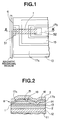
- Fig.1 is a schematic plan view showing a MR thin-film magnetic head according to the present invention, with an upper magnetic pole being removed.
- Fig.2 is a cross-sectional view taken along line A-A' of Fig.1 for schematically illustrating essential portions of the MR thin-film magnetic head shown in Fig. 1.
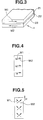
- Fig.3 is a schematic perspective view showing the construction of the magnetic sensing portion.
- Fig.4 schematically shows the direction of magnetization in case an external magnetic field is not applied to the MR thin-film head.
- Fig.5 schematically shows changes in the direction of magnetization in case the external magnetic field starts to be applied to the MR thin-film head.
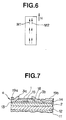
- Fig.6 schematically shows the direction of magnetization in case a stronger external magnetic field is applied to the MR thin-film head.
- Fig.7 is a cross-sectional view showing essential portions of a modification of an MR thin-film magnetic head according to the present invention.
- the MR thin-film head has a magnetic sensor section 1 sandwiched between a lower magnetic pole 2 and an upper magnetic pole 3 and extending perpendicular to the surface on which slides the magnetic recording medium, and hence is constituted as a vertical type thin-film magnetic head, as shown in Figs.1 and 2.
- a lower magnetic pole 2 which is a shield magnetic film formed of e.g., Ni-Fe, is deposited on a non-magnetic substrate 11 formed of Al2O3-TiC via an insulating layer 12, and an insulating layer 13 of silicon nitride (SiO2) is deposited on the surface of the lower magnetic pole 2.
- a shield magnetic film formed of e.g., Ni-Fe is deposited on a non-magnetic substrate 11 formed of Al2O3-TiC via an insulating layer 12, and an insulating layer 13 of silicon nitride (SiO2) is deposited on the surface of the lower magnetic pole 2.
- the magnetic sensing section 1 is formed on the insulating layer 13 and an insulating layer 14 formed of SiO2 is deposited at a pre-set portion in the vicinity of the magnetic sensing section 1.
- a bias conductor 15 via an insulating layer 18 for impressing a bias magnetic field on an MR element 21 constituting the magnetic sensing section 1 as later explained.
- an insulating layer 16 of SiO2 on which the upper magnetic pole 3 formed by a magnetic pole of Ni-Fe is deposited for completing the MR thin-film head.
- the arraying position and the pattern of the bias conductor 15 may be set in any desired manner.
- a two-layered structure or a helical structure may be employed.
- a permanent magnet thin film may also be employed instead of the structure across which a magnetic field is induced by the electric current.
- the insulating films 3, 14 may also be formed of beryllium oxide or aluminum nitride in place of SiO2.
- the magnetic sensor 1 is made up of a magnetic layer exhibiting magneto-resistive effect (MR element) 21, a non-magnetic layer 22 and a high resistance magnetic layer 23 provided in an upper-layer portion or a lower-layer portion of the MR element 21, with the non-magnetic layer 22 in-between, as shown in Fig. 3.
- the resistance ratio of the high resistance magnetic layer 23 to the MR element 21 is set so as to be 2.4 or higher, herein 5 to 10. If the resistance ratio is less than 2.4, the amount of the sense current flowing into the MR element 21 becomes insufficient so that desired sensitivity can not be achieved. Since the MR element has a resistivity of 20 to 30 ohm/cm, it is sufficient if the material of the high-resistance magnetic layer 23 is selected taking into account such resistivity of the MR element.
- the MR element 21 is formed of Ni-Fe and has a thickness of 39 nm.
- the metals Fe, Ni or Fe exhibiting uniaxial anisotropy or not exhibiting anisotropy in the major plane and also displaying magneto-resistive effect and stable magnetic properties, or alloys thereof, may be employed as the material for the MR element 21.
- the non-magnetic layer 22 is formed to a thickness of 100 ⁇ from Al2O3 as an insulating material.
- an insulating material such as SiO2, or an electrically conductive material, such as Ti, Ta, Mo, W or Cr may be used as materials of the non-magnetic material 22.
- the high-resistance material 23 is formed to a thickness of 30 nm from a so-based amorphous material, specifically CoZrNb or CoZrHf.
- a so-based amorphous material specifically CoZrNb or CoZrHf.
- crystalline materials may also be employed for the high-resistance magnetic layer 23. These materials need to have magnetic properties, such as anisotropic magnetic field Hk, saturation magnetization Ms, coercivity Hc or magnetostriction constant ⁇ equivalent those of the MR element 21 and a resistance ratio with respect to the MR element 21 of the high-resistance magnetic layer 23 of not less than 2.4.
- the magnetic sensor section 1 is arranged so that its longitudinal direction is perpendicular to the surface thereof facing the magnetic recording medium, that is the surface on which slides the magnetic recording medium, and so that its one end face is exposed to the surface on which slides the magnetic recording medium.
- a pair of electrodes formed by electrically conductive films namely a font end electrode 17a and a rear end electrode 17b, are formed at an end of the magnetic sensor section 1 towards the surface on which slides the magnetic recording medium and at a portion spaced apart a pre-set distance from the end of the sensor 1, respectively.
- the front end electrode 17a and the rear end electrode 17b are formed for flowing the sense current along the length of the sensor 1, that is in a direction along the length of the sensor 1.
- the magnetic sensor 1 and the insulating layer 18 are sandwiched between the front end electrode 17a and the rear end electrode 17b.
- the region of the magnetic sensor section 1 between the front end electrode 17a and the rear end electrode 17b exhibits the magneto-resistive effect.
- the lower magnetic pole 2 is formed by a magnetic film of e.g., Ni-Fe by e.g., an ion beam etching method.
- the insulating layer 13 is then formed on the lower magnetic pole 2, and the magnetic sensor 1 is formed on the insulating layer 13. That is, the high-resistance magnetic layer 23, non-magnetic layer 22 and the MR element 21 of the Co-based amorphous material, Al2O3 and Ni-Fe, respectively, are formed in this order on the insulating layer 13 by thin-film forming technique, that is sputtering or vacuum deposition. Then, using a photoresist, the resulting assembly is patterned to the shape of the magnetic sensor section 1 and etched to a required shape.
- magnetic properties such as anisotropic magnetic field Hk, saturation magnetization Ms, coercivity Hc or magnetostriction coefficient ⁇ of the magnetic sensor section 1 are adapted so as to be equivalent to those of the high-resistance magnetic layer 23.
- the insulating layer 14 is then formed at a pre-set portion close to the magnetic sensor section 1 and electrode holes 31, 32 are formed for forming the electrode films (the front end electrode 17a and the rear end electrode 17b) . That is, a resist is first applied to form a resist layer which then is shaped to a pre-set pattern using a mask. The insulating layer 14 is etched by RIE to form the electrode holes 31, 32 to pre-set patterns. The resist layer then is removed.
- the bias conductor 15 and the front end electrode 17a and the rear end electrode 17b of W, Ti or Mo are formed on the magnetic sensor section 1 via the insulating layer 18 by sputtering followed by RIE. Subsequently, the insulating layer 16 is formed.
- a pre-set resist frame is formed. After Ni-Fe plating, the resist film is removed. A resist is further formed to a pre-set shape and removed by wet etching for forming the upper magnetic pole 3.
- the MR thin-film head is completed by the above procedure.
- the high-resistance magnetic layer 23 is provided in the upper-layer portion or in the lower-layer portion of the MR element 21 with the interposition of the non-magnetic layer 22. If no external magnetic field is applied to the MR thin-film magnetic head, the magnetized state of the MR element 21 and the high-resistance magnetic layer 23 is anti-parallel to each other along the easy axis, without formation of magnetic wall, as shown in Figs.3 and 4, in which the direction of magnetization of the MR element 21 and that of the high-resistance magnetic layer 23 are indicated by arrows M1 and M2, respectively.
- the directions of magnetization of the MR element 21 and the high-resistance magnetic layer 23 are rotated from the anti-parallel state by the process of rotation of magnetization, as shown in Fig.5. If the external magnetic field is strengthened further, the MR element 21 and the high-resistance magnetic layer 23 are magnetized to the same direction, as shown in Fig. 6. Since the difficult axes of both the MR element 21 and the high-resistance magnetic layer 23 are aligned with the direction of propagation of the magnetic flux, no magnetic wall is formed, thus evading generation of the Barkhausen noise.
- the resistance ratio of the high-resistance magnetic layer 23 to the MR element 21 is not less than 2.4, so that, as compared to the conventional MR thin-film head the magnetic sensor of which is constituted by two-layer MR elements, the present MR thin-film head gives a larger output, such that, if the resistance ratio is 5, the output is improved by about 40%.
- the Barkhausen noise is suppressed, while the high sensitivity is maintained.
- the MR thin-film head of the illustrated embodiment is substantially the same as that of the above embodiment except that the foremost pat of the magnetic sensor 1 is not facing the surface on which slides the magnetic recording medium.
- the parts or components similar to those of the previous embodiment are depicted by the same numerals and the corresponding description is omitted, for simplicity.
- the MR thin-film head of the present modification has a lower magnetic pole 2 and an upper magnetic pole 3, as shown in Fig. 7.
- the lower magnetic pole 2 has its rear end 2a connected magnetically, while the upper magnetic pole 3 is fractionated at 3c into a forward magnetic pole portion 3a and a rear magnetic pole potion 3b.
- the fractionated portion 1 operates as an opened magnetic portion constituting a magnetic path.
- the MR thin-film head is not provided with electrodes, that is the front end electrode 17a or the rear end electrode 17b, while it is provided with terminal connection conductors 19a, 19b not electrically connected with terminal portions of the forward or rear magnetic poles 3a, 3b.
- the bias conductor 15 is provided above the magnetic sensor 1, in stead of below the sensor, as in the previous embodiment.
- the high-resistance magnetic layer 23 is provided in an upper-layer portion or in a lower-layer portion of the MR element 21 via the non-magnetic layer 22. If no external magnetic field is applied to the MR thin-film head, the states of magnetization of the MR element 21 and the high-resistance magnetic layer 23 are anti-parallel along the easy axis, while no magnetic wall is generated. If the external magnetic field H applied to the MR thin-film head is strengthened along the difficult axis, the directions of magnetization of the MR element 21 and the high-resistance magnetic layer 23 are rotated from the anti-parallel state by the process of rotation of magnetization, as shown in Fig.5.
- the MR element 21 and the high-resistance magnetic layer 23 are magnetized to the same direction, as shown in Fig. 6. Since the difficult axes of both the MR element 21 and the high-resistance magnetic layer 23 are aligned with the direction of propagation of the magnetic flux, no magnetic wall is formed, thus evading generation of the Barkhausen noise.
- the resistance ratio of the high-resistance magnetic layer 23 to the MR element 21 is not less than 2.4, so that, as compared to the conventional MR thin-film head the magnetic sensor section of which is constituted by two-layer MR elements, the present MR thin-film head gives a larger output, such ,that, if the resistance ratio is 5, the output is improved by about 40%.
- the Barkhausen noise is suppressed, while the high sensitivity is maintained.
- the present invention is not limited to the above-described embodiments.
- the MR thin-film head has the upper magnetic pole 3 and the lower magnetic pole 2 above and below the magnetic sensor 1, respectively
- the present invention may also be applied to a non-shield MR thin-film head not having the upper magnetic pole 3 or the lower magnetic pole 2 above and below the magnetic sensor 1, respectively.
- the present invention may also be applied to a non-shield MR thin-film head not having the upper magnetic pole 3 or the lower magnetic pole 2.
- the MR sensor of the present invention may be used as various devices utilizing MR characteristics in addition to the MR thin-film head.
Landscapes
- Engineering & Computer Science (AREA)
- Manufacturing & Machinery (AREA)
- Physics & Mathematics (AREA)
- Chemical & Material Sciences (AREA)
- Nanotechnology (AREA)
- Condensed Matter Physics & Semiconductors (AREA)
- General Physics & Mathematics (AREA)
- Crystallography & Structural Chemistry (AREA)
- Magnetic Heads (AREA)
Applications Claiming Priority (2)
| Application Number | Priority Date | Filing Date | Title |
|---|---|---|---|
| JP26572794A JPH08129718A (ja) | 1994-10-28 | 1994-10-28 | 磁気抵抗効果型磁気センサ |
| JP265727/94 | 1994-10-28 |
Publications (2)
| Publication Number | Publication Date |
|---|---|
| EP0709829A2 true EP0709829A2 (fr) | 1996-05-01 |
| EP0709829A3 EP0709829A3 (fr) | 1997-01-22 |
Family
ID=17421167
Family Applications (1)
| Application Number | Title | Priority Date | Filing Date |
|---|---|---|---|
| EP95116825A Ceased EP0709829A3 (fr) | 1994-10-28 | 1995-10-25 | Capteur à effet magnétorésistif |
Country Status (2)
| Country | Link |
|---|---|
| EP (1) | EP0709829A3 (fr) |
| JP (1) | JPH08129718A (fr) |
Cited By (3)
| Publication number | Priority date | Publication date | Assignee | Title |
|---|---|---|---|---|
| WO2001006222A3 (fr) * | 1999-07-20 | 2001-04-26 | Fidelica Microsystems Inc | Utilisation de films minces multicouches comme detecteurs de contrainte |
| US6694822B1 (en) | 1999-07-20 | 2004-02-24 | Fidelica Microsystems, Inc. | Use of multi-layer thin films as stress sensor |
| US7073397B2 (en) | 1999-07-20 | 2006-07-11 | Fidelica Microsystems, Inc. | Magnetoresistive semiconductor pressure sensors and fingerprint identification/verification sensors using same |
Citations (1)
| Publication number | Priority date | Publication date | Assignee | Title |
|---|---|---|---|---|
| US4642270A (en) * | 1983-11-29 | 1987-02-10 | Tdk Corporation | Magnetic recording medium |
Family Cites Families (4)
| Publication number | Priority date | Publication date | Assignee | Title |
|---|---|---|---|---|
| JPS62141619A (ja) * | 1985-12-16 | 1987-06-25 | Nec Corp | 薄膜磁気ヘツド |
| US5159513A (en) * | 1991-02-08 | 1992-10-27 | International Business Machines Corporation | Magnetoresistive sensor based on the spin valve effect |
| WO1995018442A1 (fr) * | 1993-12-30 | 1995-07-06 | Seagate Technology, Inc. | Espaces interblocs en carbone analogue a du diamant amorphe pour tetes de lectures magnetoresistives |
| JP2785678B2 (ja) * | 1994-03-24 | 1998-08-13 | 日本電気株式会社 | スピンバルブ膜およびこれを用いた再生ヘッド |
-
1994
- 1994-10-28 JP JP26572794A patent/JPH08129718A/ja not_active Withdrawn
-
1995
- 1995-10-25 EP EP95116825A patent/EP0709829A3/fr not_active Ceased
Patent Citations (1)
| Publication number | Priority date | Publication date | Assignee | Title |
|---|---|---|---|---|
| US4642270A (en) * | 1983-11-29 | 1987-02-10 | Tdk Corporation | Magnetic recording medium |
Cited By (4)
| Publication number | Priority date | Publication date | Assignee | Title |
|---|---|---|---|---|
| WO2001006222A3 (fr) * | 1999-07-20 | 2001-04-26 | Fidelica Microsystems Inc | Utilisation de films minces multicouches comme detecteurs de contrainte |
| US6694822B1 (en) | 1999-07-20 | 2004-02-24 | Fidelica Microsystems, Inc. | Use of multi-layer thin films as stress sensor |
| US7073397B2 (en) | 1999-07-20 | 2006-07-11 | Fidelica Microsystems, Inc. | Magnetoresistive semiconductor pressure sensors and fingerprint identification/verification sensors using same |
| US7077010B2 (en) | 1999-07-20 | 2006-07-18 | Fidelica Microsystems, Inc. | Magnetoresistive semiconductor pressure sensors and fingerprint identification/verification sensors using same |
Also Published As
| Publication number | Publication date |
|---|---|
| EP0709829A3 (fr) | 1997-01-22 |
| JPH08129718A (ja) | 1996-05-21 |
Similar Documents
| Publication | Publication Date | Title |
|---|---|---|
| JPH0950613A (ja) | 磁気抵抗効果素子及び磁界検出装置 | |
| US6134091A (en) | Spin-valve magneto-resistive head with horizontal type structure | |
| US5671105A (en) | Magneto-resistive effect thin-film magnetic head | |
| US7027271B2 (en) | Magnetoresistive device in a thin-film magnetic head and method of manufacturing same having particular electrode overlay configuration | |
| US5491606A (en) | Planar magnetoresistive head with an improved gap structure | |
| US5808843A (en) | Magnetoresistance effect reproduction head | |
| US6120920A (en) | Magneto-resistive effect magnetic head | |
| EP0570883B1 (fr) | Elément magnétorésistif | |
| EP0709829A2 (fr) | Capteur à effet magnétorésistif | |
| JPH05135332A (ja) | 磁気抵抗効果再生ヘツドおよびそれを用いた磁気記録装置 | |
| JPH08235542A (ja) | 磁気抵抗効果素子 | |
| EP0756270B1 (fr) | Tête magnétique à couche mince | |
| US20020036874A1 (en) | Magnetoresistive device and method of manufacturing same and thin-film magnetic head and method of manufacturing same | |
| JP2669376B2 (ja) | 磁気抵抗効果ヘッド | |
| JP2508475B2 (ja) | 磁気抵抗効果型磁気ヘツド | |
| JP3934881B2 (ja) | 垂直通電型磁気抵抗効果素子、垂直通電型磁気抵抗効果ヘッドおよび磁気記録再生装置 | |
| JP3764361B2 (ja) | 磁気抵抗効果素子の製造方法 | |
| JPH09251616A (ja) | 薄膜磁気ヘッド | |
| JPH0918069A (ja) | 磁気抵抗装置およびそれを形成するためのプロセス | |
| JPH0572642B2 (fr) | ||
| JPH10275310A (ja) | 薄膜磁気ヘッド及びその製造方法 | |
| JPH06119620A (ja) | 磁気抵抗効果ヘッド | |
| JPH07110921A (ja) | 磁気抵抗効果型薄膜ヘッド | |
| JPH0887721A (ja) | 磁気変換素子及び薄膜磁気ヘッド | |
| JPH07326023A (ja) | 磁気ヘッド及びそれを用いた磁気記憶装置 |
Legal Events
| Date | Code | Title | Description |
|---|---|---|---|
| PUAI | Public reference made under article 153(3) epc to a published international application that has entered the european phase |
Free format text: ORIGINAL CODE: 0009012 |
|
| AK | Designated contracting states |
Kind code of ref document: A2 Designated state(s): DE FR GB |
|
| PUAL | Search report despatched |
Free format text: ORIGINAL CODE: 0009013 |
|
| AK | Designated contracting states |
Kind code of ref document: A3 Designated state(s): DE FR GB |
|
| 17P | Request for examination filed |
Effective date: 19970625 |
|
| 17Q | First examination report despatched |
Effective date: 19990428 |
|
| GRAG | Despatch of communication of intention to grant |
Free format text: ORIGINAL CODE: EPIDOS AGRA |
|
| STAA | Information on the status of an ep patent application or granted ep patent |
Free format text: STATUS: THE APPLICATION HAS BEEN REFUSED |
|
| 18R | Application refused |
Effective date: 20010518 |