EP0711064B1 - Schalten eines Endgeräts, wie Faksimilegerät, auf einen von zwei Kanälen - Google Patents
Schalten eines Endgeräts, wie Faksimilegerät, auf einen von zwei Kanälen Download PDFInfo
- Publication number
- EP0711064B1 EP0711064B1 EP19950402427 EP95402427A EP0711064B1 EP 0711064 B1 EP0711064 B1 EP 0711064B1 EP 19950402427 EP19950402427 EP 19950402427 EP 95402427 A EP95402427 A EP 95402427A EP 0711064 B1 EP0711064 B1 EP 0711064B1
- Authority
- EP
- European Patent Office
- Prior art keywords
- message
- communication
- data
- telephone line
- terminal
- Prior art date
- Legal status (The legal status is an assumption and is not a legal conclusion. Google has not performed a legal analysis and makes no representation as to the accuracy of the status listed.)
- Expired - Lifetime
Links
- 230000006854 communication Effects 0.000 claims description 124
- 238000004891 communication Methods 0.000 claims description 123
- 230000015654 memory Effects 0.000 claims description 83
- 230000005540 biological transmission Effects 0.000 claims description 31
- 238000000034 method Methods 0.000 claims description 14
- 230000004044 response Effects 0.000 claims description 12
- 238000012544 monitoring process Methods 0.000 claims description 7
- 230000004913 activation Effects 0.000 claims 1
- 238000010200 validation analysis Methods 0.000 claims 1
- 230000006870 function Effects 0.000 description 6
- 238000012795 verification Methods 0.000 description 4
- 238000012937 correction Methods 0.000 description 3
- 238000004088 simulation Methods 0.000 description 3
- 230000015556 catabolic process Effects 0.000 description 2
- 125000004122 cyclic group Chemical group 0.000 description 2
- 238000009792 diffusion process Methods 0.000 description 2
- 230000008569 process Effects 0.000 description 2
- 238000006677 Appel reaction Methods 0.000 description 1
- 238000001514 detection method Methods 0.000 description 1
- 238000010586 diagram Methods 0.000 description 1
- 239000000284 extract Substances 0.000 description 1
- 230000012447 hatching Effects 0.000 description 1
- 230000010354 integration Effects 0.000 description 1
- 230000007246 mechanism Effects 0.000 description 1
- 230000011664 signaling Effects 0.000 description 1
Images

Classifications
-
- H—ELECTRICITY
- H04—ELECTRIC COMMUNICATION TECHNIQUE
- H04N—PICTORIAL COMMUNICATION, e.g. TELEVISION
- H04N1/00—Scanning, transmission or reproduction of documents or the like, e.g. facsimile transmission; Details thereof
- H04N1/32—Circuits or arrangements for control or supervision between transmitter and receiver or between image input and image output device, e.g. between a still-image camera and its memory or between a still-image camera and a printer device
- H04N1/327—Initiating, continuing or ending a single-mode communication; Handshaking therefor
- H04N1/32797—Systems adapted to communicate over more than one channel, e.g. via ISDN
-
- H—ELECTRICITY
- H04—ELECTRIC COMMUNICATION TECHNIQUE
- H04N—PICTORIAL COMMUNICATION, e.g. TELEVISION
- H04N1/00—Scanning, transmission or reproduction of documents or the like, e.g. facsimile transmission; Details thereof
- H04N1/00127—Connection or combination of a still picture apparatus with another apparatus, e.g. for storage, processing or transmission of still picture signals or of information associated with a still picture
- H04N1/00281—Connection or combination of a still picture apparatus with another apparatus, e.g. for storage, processing or transmission of still picture signals or of information associated with a still picture with a telecommunication apparatus, e.g. a switched network of teleprinters for the distribution of text-based information, a selective call terminal
- H04N1/00283—Connection or combination of a still picture apparatus with another apparatus, e.g. for storage, processing or transmission of still picture signals or of information associated with a still picture with a telecommunication apparatus, e.g. a switched network of teleprinters for the distribution of text-based information, a selective call terminal with a television apparatus
-
- H—ELECTRICITY
- H04—ELECTRIC COMMUNICATION TECHNIQUE
- H04N—PICTORIAL COMMUNICATION, e.g. TELEVISION
- H04N1/00—Scanning, transmission or reproduction of documents or the like, e.g. facsimile transmission; Details thereof
- H04N1/32—Circuits or arrangements for control or supervision between transmitter and receiver or between image input and image output device, e.g. between a still-image camera and its memory or between a still-image camera and a printer device
- H04N1/327—Initiating, continuing or ending a single-mode communication; Handshaking therefor
-
- H—ELECTRICITY
- H04—ELECTRIC COMMUNICATION TECHNIQUE
- H04N—PICTORIAL COMMUNICATION, e.g. TELEVISION
- H04N2201/00—Indexing scheme relating to scanning, transmission or reproduction of documents or the like, and to details thereof
- H04N2201/0008—Connection or combination of a still picture apparatus with another apparatus
- H04N2201/0015—Control of image communication with the connected apparatus, e.g. signalling capability
- H04N2201/0022—Selecting or switching between an image communication mode and a non-image communication mode
-
- H—ELECTRICITY
- H04—ELECTRIC COMMUNICATION TECHNIQUE
- H04N—PICTORIAL COMMUNICATION, e.g. TELEVISION
- H04N2201/00—Indexing scheme relating to scanning, transmission or reproduction of documents or the like, and to details thereof
- H04N2201/32—Circuits or arrangements for control or supervision between transmitter and receiver or between image input and image output device, e.g. between a still-image camera and its memory or between a still-image camera and a printer device
- H04N2201/3201—Display, printing, storage or transmission of additional information, e.g. ID code, date and time or title
- H04N2201/3212—Display, printing, storage or transmission of additional information, e.g. ID code, date and time or title of data relating to a job, e.g. communication, capture or filing of an image
- H04N2201/3218—Display, printing, storage or transmission of additional information, e.g. ID code, date and time or title of data relating to a job, e.g. communication, capture or filing of an image of a confirmation, acknowledgement or receipt
Definitions
- the present invention relates to a device for switching between a transmitting terminal and a data receiver and a telephone line from a switched telephone network.
- the invention applies more particularly in the case where the data receives data broadcast over a network radio broadcast and the terminal is a fax machine, although the terminal can be a telex, videotex or teletex terminal.
- Fax machines are increasingly installed both in the professional sector and in the residential sector.
- a fax machine is typically connected to the telephone network switched by a line telephone to transmit and receive data fax machine.
- the communication protocol used by group 1 to 3 fax machines is defined by CCITT recommendation T30 on automatic interworking of fax machines belonging to groups 1 to 3.
- the fax machines of group 4 communicate through the digital network to integration of ISDN services using a protocol similar to that used for teletex.
- a radio network of dissemination of data such as for example DIDON or DIGICAST (registered trademarks)
- DIDON or DIGICAST registered trademarks
- the receiver then transmits the received fax data to a conventional fax machine.
- Fax broadcasting is more particularly intended for receivers and mobile fax machines for example in a vehicle automobile.
- a fax machine can therefore be connected either to switched telephone network, i.e. a network of broadcasting of data through a receiver appropriate. These two connections are exclusive one the other.
- switched telephone network i.e. a network of broadcasting of data through a receiver appropriate.
- These two connections are exclusive one the other.
- the user must choose between the possibility of receiving and transmitting faxes over the switched network and by therefore not to receive a broadcast fax through the broadcasting network, and the possibility of receive broadcast faxes and therefore not to receive and transmit faxes by the switched network.
- the user is forced to manual connections and disconnections successive faxes either to a subscriber line of the switched network, either at the terminals of the receiver appropriate, so the fax machine does not receive all faxes sent to him.
- the user has two fax machines permanently connected to the network switched and the other to the broadcast network, which is expensive.
- US-A-4,991,201 discloses a device automatic switching that connects a fax machine selectively to a radio frequency receiver and to a telephone line depending on the priority of communication attributed to first receptions fax messages from the receiver radio frequency to the fax machine, on the one hand, and to reception of second fax messages from the telephone line and transmissions from third fax messages by fax machine via the telephone line, on the other hand.
- the switching interrupts all communication with the fax via the telephone line, and establishes the link between the radio frequency receiver and the fax machine to directly send him a third message.
- the transmitter that has forwarded the second or third fax message having been interrupted and which is a terminal or the fax machine itself, receives switching device an invitation message to retransmit the second or third message from fax interrupted. So the second or third fax message may be interrupted for transmit a first fax message even incorrect or partial radio frequency receiver at since the switching device does not includes no way to check if a first message received by the radio frequency receiver is correct or incomplete.
- the switching device does not nothing when receiving a first message from fax when the fax machine receives a second fax message or transmits a third message fax machine.
- the first previous message is lost.
- An invitation message to retransmit the first fax message can be sent to the terminal remote correspondent via a telephone line wired, when the telephone line is released.
- the present invention aims to provide a automatic switching device not interrupting no fax messages being received or fax transmission and verifying that the first fax messages received by the radio receiver are perfectly correct before deciding to send them to the fax machine only when the telephone line is available. So no first fax message incorrect is unnecessarily transmitted to the fax machine, which avoids any untimely occupation of the phone line, and no first message from deemed received fax is lost at because of an occupation of the telephone line by a second or third fax message in progress Communication.
- a switching device between a data terminal receiving first and second data messages and transmitting third data messages, a receiver data to receive first messages, and a telephone line receiving the second messages from a telephone network and transmitting the third messages to the network telephone, the device comprising a switching means for selectively connect the data terminal to the data receiver and telephone line, is characterized in that it includes means for reconstruct groups of packages from broadcast packets received by the receiver and reject packets or groups erroneous or incomplete packets, a memory medium to memorize the correct package groups from so as to reconstruct the first messages, and a means of communication to read the first messages reconstituted in the memory medium and in that said switching means maintains a connection between data terminal and line at least as long as one of the second and third data messages is received or transmitted through the data terminal, and connects the means of communication and the data terminal when first message is reconstructed in the means of memory and when the phone line is unoccupied by any of the second and third data messages so the way to communication reads and transmits said at least one first message reconstituted
- the data terminal when it is a fax machine, it can sometimes receive correct and complete faxes sent by a data dissemination network, sometimes receive or send faxes over the network switched telephone without interrupting a fax communication or lose a fax.
- each group of packets received contains a control sequence
- the means for rebuild does not write the package group to the memory means when the result of a treatment predefined content of package group differs of a predetermined result.
- the means for restore can write package groups reconstituted and correct from a first message from fax in the memory medium gradually into response to R successive repetitions of the third fax message, R being an integer strictly positive. Any group of packets received deemed incorrect or incomplete is not written in the memory medium. So as soon as the first message is completely and completely reconstituted after r repetitions, with r lower or equal to R, the R-r repetitions of the first message are ignored and are not stored.
- the switching device When the first stored messages include acknowledgment requests which are detected by the communication medium, the switching device includes a memory for memorize acknowledgment requests detected by the communication means, and a means of transmission to transmit messages acknowledgment of receipt in response to requests acknowledgment of receipt read in said brief, the switching means connecting the means of transmission to the telephone line when a acknowledgment request is stored in memory and no second or third message from data is to be received or transmitted in line telephone.
- switching In order to signal an occupation of the line telephone or fax machine switching includes simulation means of occupation.
- the switching means connects the phone line simulation when the means of communication is connected to the terminal of data in order to transmit a first message to it (MT1).
- the switching means connects the means of data terminal occupancy simulation when an acknowledgment message is to transmit in the telephone line by means of transmission and none of the first, second and third data messages is to be received or transmit.
- each group of packets received is validated by treating said group with a sequence of group control it contains, so write in said memory means only groups correct and complete packages.
- the method may include receiving R successive repetitions of each first message from data in order to progressively write only the groups of packages properly reconstructed and completely in the memory medium, R being a whole number at least one.
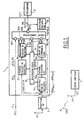
- a device for switching 1 is connected to a line 2-wire LT analog telephone subscriber public or private PSTN switched telephone network.
- the device 1 is also connected to a receiver data radio frequency 2 which receives data broadcast by a radio network having a extended coverage via a receiving antenna 21.
- the switching device 1 is connected to a data transmitter and receiver terminal, such that a fax machine 3 which will be referred to in the next, across a short stretch of line LDT telephone, or to a management circuit fax integrated into a computer, or even is connected to or integrated into a telex terminal, a videotex terminal, or a teletex terminal.
- the switching device is realized in the form a box to connect to a conventional fax machine or in the form of an incorporated electronic circuit in the fax machine.
- the radio broadcast network of data is by way of example the high quality sound broadcasting network DIGICAST loyalty (registered trademark) which broadcasts data per packet. In the following, only the broadcast is considered.
- a sending center 4 formats the data to transmit, in the form of a radio signal from SRD data transmitted by a transmitting antenna 41.
- the SRD signal is received by antenna 21.
- a fax to be broadcast by the data broadcasting network is any graphic document.
- the facsimile is previously digitized into a facsimile message TEL in the form of a series of N bytes OCT 1 to OCT N , N being any positive integer depending on the length of the document.
- This TEL facsimile message is transmitted successively R times by the sending center 4, R being a strictly positive integer, that is to say at least equal to 1 and typically equal to 5, so that, when received in the device switch 1, the message is validated before any retransmission to the fax machine 3.
- the fax message TEL is divided into groups of data DG 1 to DG M of variable length, M being an integer depending on the length of the document.
- a DG m data group where m is an integer between 1 and M, has a maximum length of 8192 bytes.
- the DG m data group comprises a BD m data block containing consecutive bytes among the OCT 1 to OCT N bytes and is terminated by a group control sequence.
- This sequence is used to validate the data group as a function of a generator polynomial characterizing, in a known manner, a predetermined error detection code, called cyclic redundancy code (CRC), applied to the bits contained in the group and preceding the group control sequence.
- CRC cyclic redundancy code
- the data group DG m is formed by a set of packets PAQ m, 1 to PAQ m, P of fixed length, P being a positive integer.
- a PAQ packet m, p where p is an integer between 1 and P, includes an ETP packet header m, p and a BDP data block m, p .
- the ETP header m, p notably includes a group identifier for identifying the DG m data group to which the packet belongs, a sequential packet number which orders the packet in the group, and a group end indicator for locate the last package in the group.
- the data block BDP m, p contains data from the data group DG m .
- the packages have a predetermined fixed length.
- the data block BDP m, P of the last packet PAQ m, P associated with the data group DG m comprises stuffing bytes B m, P.
- Each data packet is preferably coded according to a known error correction code in order to correct errors in the packet on reception due to electromagnetic disturbances in the transmission from the sending center 4.
- the data packets to be broadcast PAQ m, 1 to PAQ m, P are transposed into the signal SRD to be transmitted in a manner known per se, for example in the form of a data signal modulating a carrier frequency.
- Data packets of several first facsimile messages to be broadcast are interleaved in the SRD signal.
- An access control mechanism derived from "Eurocrypt” system standardized by CEN (Committee European Standardization) for television, is associated with data dissemination to ensure data confidentiality and billing in the paid services.
- the radio frequency data receiver 2 receives the signal SRD via the antenna 21 and extracts from the SRD signal the transmitted data packets PAQ 1.1 to PAQ M, P from the DG data groups 1 to DG M belonging to a first TEL fax message. The receiver 2 applies the extracted data packets to the switching device 1.
- the switching device 1 From the output of receiver 2, the switching device 1 comprises a circuit for fax reconstruction 11 connected in series with a fax memory 12.
- Memory 12 has an output connected to a communication circuit 13.
- a first output from the communication circuit 13 is connected to an input terminal B41 of a circuit switch 14 described below with reference to the figure 4.
- a second output from the communication 13 is connected to a memory of accused of reception 15 in series with a transmission circuit acknowledgment of receipt 16.
- Circuit 16 is connected to a first input / output terminal B23 of the circuit switch 14.
- the LT telephone line is connected to a second circuit input / output terminal B21 switch 14.
- the switch circuit 14 is connected to the LDT telephone line section serving fax 3 by a third terminal input / output B33.
- a sequencer 17 comprising a microprocessor whose functions are described below, is connected to each of circuits 11 to 16, to monitor in particular the content of memories 12 and 15, and at a occupancy detector 18 connected to terminal B33 for detect an occupation of the telephone line between fax machine 3 and terminal B33.
- each of the circuit terminals switch 14, or each of the contact terminals included in switch circuit 14 is a port to two terminals when the telephone line has two wires, or a four-terminal port when the line telephone has four wires.
- the facsimile reconstruction circuit 11 is intended to reconstruct the datasets after correction of packets and fax messages, from the reconstructed and validated groups, so that the communication circuit 13 restores only correct and complete fax messages to fax 3 and postponed due to reconstructions and checks described below.
- the facsimile reconstruction circuit 11 receives the data packets PAQ 1.1 to PAQ M, P relating to a first fax message TEL from the receiver 2. Each packet is corrected as a function of the error correction code. If a packet is lost by observing that the sequential packet number jumps by one or more units, the group having lost this packet will be deemed unacceptable and rejected during its subsequent verification. Each data packet received PAQ m, p is written in a column of packet boxes in a buffer memory included in the circuit 11, corresponding to the group of data being reconstructed, according to the group identifier included in the ETP m, p header of the packet and puts it in the next packet box according to the sequential packet number included in the packet header.
- the circuit 11 thus concatenates the data packets received into the data groups DG 1 to DG M as a function of the information in the headers ETP 1.1 to ETP M, P of the received packets.
- a verification circuit included in the circuit 11 verifies that the group DG m thus reconstituted is correct and complete.
- the verification of the group consists in dividing the series of bits contained in the group DG m , including the group control sequence, by the polynomial generating the cyclic redundancy code.
- the data group DG m is erroneous and is refused by not storing it in memory 12.
- the groups DG 1 to DG M which are validated as correct and complete by the verification circuit are only written in a file of boxes in the memory 12 as a function of the sequential group numbers in order to reconstruct therein the fax message received TEL, as described below.
- the circuit 11 When the circuit 11 reconstructed and validated a correct data group received DG m, it analyzes header AND m DG dataset m to determine whether this data group belongs to a first fax message already partially stored.
- circuit 11 assigns a free line of boxes in memory 12 to the fax message to which the group belongs, and creates an EDR fax message header.
- Circuit 11 writes the EDR facsimile message header into the first box of the assigned queue in the assigned queue of memory 12 and the correct data group is reconstituted by writing a box in the queue of boxes assigned according to the sequential group number included in the header of the correct reconstructed data group.
- the group is written in a box of the queue of boxes assigned to this fax message addressed as a function of the sequential number of the correct data group reconstructed.
- the sequential number group included in the data group header correct reconstituted signals the positioning of the group of data in the fax message so to write it in the box of the file of boxes of assigned group memory.
- the sequencer 17 can decide to read the message from stored fax TEL for transmission to facsimile machine 3 according to the method of the invention described further if the section of the LDT telephone line is available. Any other messages from TEL faxes received later, whether correct or incorrect, are systematically rejected and are not stored in memory 12.
- a TEL facsimile message is not transmitted to the facsimile machine 3 by the switching device 1 if, after the R repetitions of the TEL facsimile message, at least one of the data groups DG 1 to DG M is deemed to be incorrect by the circuit 11. Under these conditions, no incorrect fax message is transmitted to the fax machine 3 through the line segment LDT in order to avoid any unnecessary occupation of the telephone line between the switching device 1 and the fax machine 3 by messages from erroneous and unusable faxes.
- the unusable fax messages partially stored in the memory 12 are periodically erased by the sequencer 17.
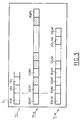
- the memory 12 contains at a given instant several fax messages received, for example three in number, TEL, TEL K , TEL W which are in different states and written in respective queues (lines) of boxes in memory 12.
- the first fax messages TEL, TEL K and TEL W are associated with fax message headers EDR, EDR (K) and EDR (W) respectively.
- the EDR, EDR (K) or EDR (W) header contains a facsimile identifier, a complete or incomplete status indicator updated by circuit 11, and the time of arrival of the latest data.
- the status indicator in the EDR header indicates that the TEL fax message is incomplete and in the process of receiving and repeating. Two groups of data DG 1 and DG 2 of the TEL message were received and stored. The last data set of the TEL fax message has not been validated or received, and the size of the TEL fax message is not known.
- the status indicator in the EDR header (K) indicates that the TEL K fax message is incomplete. However, the last DG R (K) data group has already been received, validated and stored. In the queue of memory boxes assigned to the TEL K message, boxes indicated by hatching are empty of intermediate data groups which are awaiting reception. An intermediate data group is awaiting reception, for example because the data packets are not broadcast consecutively from the first to the last for a given fax message, or because data packets have been lost and / or have not not received correctly by the data receiver 2.
- the status indicator in the EDR header (W) indicates that the TEL W fax message is complete. Consequently, the queue of boxes in the memory 12 temporarily assigned to the fax message TEL W contains all the validated data groups, that is to say correct and complete, DG 1 (W) to DG S (W) of the fax message TEL N and can be transmitted to the fax machine 3 if the LDT telephone line section between the device 1 and the fax machine 3 is unoccupied.
- the communication circuit 13 transmits first short complete MT1 fax messages read in memory 12 at the fax machine 3 according to the CCITT recommendation T30.
- a communication from first fax message between device 1 and the fax machine 3 is caused by the sequencer 17 and is carried out through the switch circuit 14, these last two circuits being detailed in the after.
- message communication from fax between device 1 and fax machine 3 is made up of three main steps relating to establishment of communication, transmission of the fax message and release.
- control messages are exchanged between the circuit 13 and the fax machine 3 to check the correct communication process.
- the messages of checks include an MQ acknowledgment message and an ME error message transmitted from the facsimile 3 to circuit 13 across the leg LDT line.
- the MQ acknowledgment message indicates that the fax message has been received correctly by fax 3 and for example printed on paper or stored in a fax memory 3.
- the error message ME indicates an error of transmission.
- circuit 13 After the communication between the circuit 13 and the fax machine 3 and if the fax machine 3 sent an MQ acknowledgment message to the circuit 13, the first MT1 fax message that was transmitted during this communication is deleted in memory 12 under the control of circuit 13 via the sequencer 17. If the fax machine 3 transmits a ME error message at circuit 13, then the first fax message MT1 was not correctly transmitted and is not erased in memory 12 after breaking the communication to be forwarded to new, during a next communication. When memory 12 contains several messages from complete fax, circuit 13 chooses first fax message written completely in memory, or the one that occupies the most memory boxes, for free up boxes in memory 12 for future fax messages.
- a first MT1 fax message contains a DAR acknowledgment request and a Associated NTA subscriber telephone number identifying the terminal requesting the communication from the first fax message MT1
- the communication circuit 13 written the DAR acknowledgment request and the NTA associate subscriber telephone number in the memory 15, under the control of sequencer 17, after the break in communication between circuit 13 and fax 3 and provided that the first MT1 fax message was correctly transmitted, i.e. the acknowledgment message MQ has been received by circuit 13.
- the acknowledgment transmission circuit 16 is controlled by the sequencer 17 as explained in the following.
- Circuit 16 transmits an acknowledgment message of MAR reception at the remote requesting terminal signaled by the NTA subscriber telephone number read in memory 15, by the telephone line LT according to a low speed asynchronous data transmission, typically 1200 bit / s.
- the requesting terminal remote transmits an MAQ acknowledgment message to circuit 16. The latter then clears the request DAR acknowledgment and telephone number NTA subscriber in memory 15, via the sequencer 17.
- an acknowledgment message MAR corresponding to a first fax message MT1 transmitted to fax 3 is not necessarily transmitted to the remote requesting terminal immediately after the transmission of the first fax message MT1, for example because between time the LT telephone line becomes occupied by a communication between the fax machine 3 and a any remote terminal.
- Memory 15 contains then at a given time several requests for accused DAR reception that will cause later as many accused message communications from MAR reception between circuit 16 and terminals remote requesters.
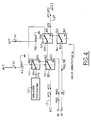
- the circuit switch 14 mainly includes four two-way contacts 141, 142, 143 and 144, two control relays 145 and 146 and a simulator of occupation 147. As already said, for example for a two-wire telephone line, each contact is actually a double contact. Relay 145 controls simultaneously contacts 141 and 142, and the relay 146 controls contacts 143 and 144 simultaneously.
- Each contact 141, 142, 143, 144 includes first, second and third terminals B11, B12 and B13 ; B21, B22 and B23; B31, B32 and B33; B41, B42 and B43.
- the first terminal is selectively connected to second and third terminals.
- the occupancy simulator 147 is connected to the terminal B11 of contact 141.
- Terminal B12 of contact 141 is connected to terminal B32 of contact 142.
- the terminal B13 of contact 141 is connected to terminal B22 of contact 142 and to terminal B31 of contact 143.
- LT telephone line is connected to the terminal B21 of contact 142.
- the transmission circuit acknowledgment of receipt 16 is connected to terminal B23 of the contact 142.
- the communication circuit 13 is connected to the terminal B41 of contact 144.
- Terminal B42 of contact 144 is connected to terminal B33 of contact 143 and, at across the LDT line segment, at fax machine 3.
- the terminal B43 of contact 144 has no connection.
- the relays 145 and 146 are controlled by the sequencer 17 in order to establish connections in device 1 via contacts 141, 142, 143 and 144.
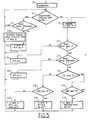
- the sequencer 17 controls circuits 13, 14 and 16 according to a algorithm comprising fifteen steps E0 to E14.
- Step E0 initializes the operation of the switching device 1. This step is not traveled only when the device 1 and notably includes zeroing of a wait delay TEMP.
- the TEMP waiting time is initialized or activated (step E14).
- the time delay TEMP has a duration between a few seconds and a few tens of seconds during which only a communication from the fax machine 3 to the PSTN switched telephone network can be performed. Such communication is therefore a priority particularly on a first communication fax message from the circuit communication 13 to the fax machine 3.
- Step E1 checks whether the TEMP time delay is elapsed. If the timer has not expired, the sequencer 17 checks in step E2 thanks to the detector occupancy 18 if an outgoing call is requested by fax 3.
- step E1 If no outgoing call is requested by fax machine 3, the algorithm returns to step E1.
- step E3 the sequencer 17 configures the circuit switch 14 according to connections c1.
- Terminal B21 is connected to terminal B22 and terminal B31 is connected to terminal B33 to connect the fax machine 3 to the LT telephone line.
- Step E3 includes then the classic communication of a third MT3 message between fax machine 3 and a terminal remote, the switching device 1 then being "transparent" to such communication.
- the algorithm goes to step E14 in which the TEMP timer is activated then the sequencer 17 configure the switch circuit 14 according to the c2 connections.
- Terminal B11 is connected to the terminal B12
- terminal B31 is connected to terminal B32
- the terminal B21 is connected to terminal B22 to connect the occupation simulator 147 on the telephone line LT.
- Terminal B41 is connected to terminal B42 for connect the fax machine 3 to the communication 13.
- the circuit 13 is inhibited by the sequencer 17 and does not transmit first fax message.
- the algorithm returns to step E1.
- step E1 when the time delay TEMP is over, the algorithm goes to the step of rest E4.
- Sequencer 17 configures the circuit switch 14 according to connections c1.
- Terminal B21 is connected to terminal B22 and terminal B31 is connected to terminal B33 to connect the fax machine 3 to the LT telephone line.
- incoming communication is possible requested by a remote terminal over the network dial-up telephone to transmit a second message MT2, an outgoing call requested by fax machine 3 to transmit a third MT3 message to a remote terminal, transmission of a first MT1 fax message read in memory 12 to fax 3, and transmission of a message MAR acknowledgment of receipt, established from a DAR acknowledgment request read in memory 15, to a remote terminal, followed by receipt of a MAQ acknowledgment message.
- step E5 the sequencer 17 monitors thanks to the occupancy detector 18 if a communication is requested by a remote terminal. If the answer is positive, then the algorithm goes to the step of communication E6.
- Step E6 includes the process the communication of a second fax message MT2. As in step E3, the switching device 1 is "transparent" to the communication of the second fax message. After the detector 18 has detected communication breakdown, the algorithm returns to step E14 to activate the timer TEMP standby and reconfigure the switch circuit 14, then in step E1.
- step E5 If in step E5 no incoming communication is not requested by a remote terminal, the algorithm go to step E7 so that the detector 18 monitors if an outgoing call is requested by the fax machine 3.
- Step E7 is analogous to step E2. If the answer is positive, the algorithm goes to the step of communication E8 which is analogous to step E3 and includes the communication of a third MT3 message. After step E8, the algorithm returns to step E14.
- steps E5-E6 and E7-E8 while the line LT telephone is busy with a communication of arrival or departure, the reconstruction circuit 11 writes correct and complete package groups of the very first fax message being reconstruction in memory 12, and the first fax messages already rebuilt and not yet read and transmitted by the communication circuit 13 are kept in memory 12.
- step E9 the algorithm goes to step E9 to check whether a first MT1 fax message to transmit is contained in memory 12, that is to say if a message from TEL fax was completely written in the memory 12.
- Step E9 is always followed by a step E10 during which the sequencer 17 checks whether a DAR acknowledgment request has been written in memory 15, i.e. if a MAR acknowledgment message is to be transmitted.
- Step E11 includes the configuration of switch circuit 14 for connect terminals B41 and B42, and terminals B21 and B23 according to connections c3.
- the sequencer 17 controls the communication circuit 13 to establish communication with the fax machine 3, transmit the first MT1 fax message read in memory 12 and break the communication, like previously described.
- circuit 16 is controlled by sequencer 17 to establish a communication with a remote terminal, transmit a MAR acknowledgment message depending on a corresponding DAR acknowledgment request previously produced by circuit 13 and read in memory 15, receive an MAQ acknowledgment message and break the communication, as before described.
- the algorithm After the breakdown of the two communications with the fax 3 and line LT, the algorithm returns to step E14 and the TEMP time delay is activated.
- step E11 successively establishes several communications between circuit 16 and remote terminals, simultaneously to a single communication between the communication circuit 13 and the fax machine 3.
- a communication from first fax message usually has a duration greater than that of a message communication acknowledgment of receipt.
- several requests for acknowledgment of receipt DAR can be simultaneously stored in memory 15, especially due to the priority of communications from fax machine 3 to the telephone network switched.
- the number of successive communications between the circuit 16 and remote terminals is limited by one share by number of acknowledgment messages MAR to be transmitted at a given time, and on the other hand either by a maximum number, predetermined and fixed, either by the duration of the message communication of fax performed simultaneously.
- successive message communications MAR acknowledgments are made as long as the first fax message communication is not not broken.
- each communication acknowledgment message taken individually is identical to that described previously.
- step E14 After breaking communication with the fax 3 and breaking the last communication with the LT line, the algorithm returns in step E14.
- step E12 configures in step E12 the circuit switch 14 according to connections c2 by connecting terminals B41 and B42 to connect the circuit communication 13 to fax machine 3 and by connecting terminals B11 and B12, terminals B21 and B22, and the terminals B31 and B32 to connect the simulator of occupation 147 on the LT telephone line.
- Step E12 then comprises the communication of the fax message MT1 between circuit 13 and the fax machine 3, as previously described, then the return to step E14.
- step E13 configure the switch circuit 14 according to the c4 connections to connect circuit 16 to the line LT telephone and to connect the simulator busy 147 at fax machine 3. Circuit 16 transmits the MAR acknowledgment message and receives an MAQ acknowledgment message. Then the algorithm returns to step E14.
- steps E9 and E10 If in steps E9 and E10 no message of fax is to be sent to fax 3 and no acknowledgment message is to transmit to a remote terminal then the algorithm returns to rest step E4.
- the succession of steps E5, E7, E9 and E10 after the flow of the TEMP time delay gives the priority to fax message communication and then to a message communication from outgoing fax, relative to transmission of a first fax message MT1 stored in memory 12 or MAR acknowledgment message stored in memory 15.
Landscapes
- Engineering & Computer Science (AREA)
- Multimedia (AREA)
- Signal Processing (AREA)
- Computer Networks & Wireless Communication (AREA)
- Human Computer Interaction (AREA)
- Facsimiles In General (AREA)
Claims (13)
- Umschaltvorrichtung (1) zwischen einem Datenendgerät (3), das erste und zweite Datennachrichten*** (MT1, MT2) empfängt und dritte Datennachrichten (MT3) überträgt, einem Empfänger (2) von Daten, um erste Nachrichten (MT1) zu empfangen, und einer Telephonleitung (LT), die die zweiten Nachrichten (MT2) aus einem Telephonnetz (RTC) empfängt und die dritten Nachrichten (MT3) ins Telephonnetz (RTC) überträgt, wobei die Vorrichtung ein Schaltmittel (14) umfasst, um selektiv das Datenendgerät (3) mit dem Datenempfänger (2) und der Telephonleitung (LT) zu verbinden,
dadurch gekennzeichnet, dass sie umfasstein Mittel (11) zur Wiederherstellung der Paketgruppen (DGm) aus vom Empfänger empfangenen ausgesendeten Paketen (PAQm,p), und Aussonderung der fehlerhaften oder unvollständigen Pakete oder Paketgruppen, ein Speichermittel (12) zur Speicherung der korrekten Paketgruppen derart, dass die ersten Nachrichten (MT1) wiederhergestellt werden, und ein Übertragungsmittel (13), um die wiederhergestellten ersten Nachrichten (MT1) im Speichermittel (12) zu lesen,und dadurch, dass das genannte Schaltmittel (14) eine Verbindung zwischen dem Datenendgerät (3) und der Telephonleitung (LT) mindestens solange aufrechterhält, wie eine der zweiten oder dritten Datennachrichten (MT2, MT3) vom Datenendgerät empfangen oder gesendet wird, und das Übertragungsmittel (13) mit dem Datenendgerät (3) verbindet, wenn eine erste Nachricht (MT1) im Speichermittel (12) wiederhergestellt worden ist und wenn die Telephonleitung (LT) nicht von irgendeiner der zweiten oder dritten Datennachrichten belegt wird, damit das Übertragungsmittel die genannte mindestens eine wiederhergestellte erste Nachricht (MT1) liest und an das Datenendgerät (3) überträgt. - Schaltvorrichtung nach Patentanspruch 1, in dem jede Paketgruppe (DGm) eine Prüfsequenz enthält und das Mittel zur Wiederherstellung (11) die Paketgruppe nicht in das Speichermittel (12) speichert, wenn das Ergebnis einer vorbestimmten Verarbeitung des Inhalts der Paketgruppe von einem vorbestimmten Ergebnis abweicht.
- Schaltvorrichtung nach Patentanspruch 1 oder 2, in der das Mittel zur Wiederherstellung (11) die wiederhergestellten und korrekten Paketgruppen einer ersten Telefaxnachricht (TEL) nach und nach in Reaktion auf R aufeinanderfolgende Wiederholungen der genannten ersten Telefaxnachricht in das Speichermittel (12) schreibt, wobei R eine streng positive ganze Zahl ist, während keine empfangene Paketgruppe, die als fehlerhaft oder unvollständig erkannt wurde, in das Speichermittel (12) geschrieben wird.
- Schaltvorrichtung nach irgendeinem der Patentansprüche 1 bis 3, in der die gespeicherten ersten Nachrichten (MT1) Empfangsbestätigungsanforderungen (DAR) verstehen, die vom Übertragungsmittel (13) festgestellt werden und einen Speicher (15) umfassen, um die vom Übertragungsmittel festgestellten Empfangsbestätigungsanforderungen (DAR) zu speichern und ein Sendemittel (16) zur Sendung von Empfangsbestätigungsmeldungen (MAR) in Antwort auf im genannten Speicher (15) gelesene Empfangsbestätigungsanforderungen, wobei das Schaltmittel (14) das Sendemittel (16) mit der Telephonleitung (LT) verbindet, wenn eine Empfangsbestätigungsanforderung im Speicher (15) gespeichert ist und keine zweite oder dritte Datennachricht (MT1, MT2) in der Telephonleitung empfangen oder gesendet werden muss.
- Schaltvorrichtung nach irgendeinem der Patentansprüche 1 bis 4, ein Mittel (147) zur Simulation einer Belegung der Telephonleitung (LT) umfassend, wobei das Schaltmittel (14) das Simulationsmittel (147) mit der Telephonleitung (LT) verbindet, wenn das Übertragungsmittel (13) mit dem Datenendgerät (3) verbunden ist, um ihm eine erste Nachricht (MT1) zu übertragen.
- Schaltvorrichtung nach den Patentansprüchen 4 und 5, in der das Schaltmittel (14) das Simulationsmittel (147) mit dem Datenendgerät (3) verbindet, wenn eine Empfangsbestätigungsmeldung (MAR) durch das Sendemittel (16) in die Telephonleitung (LT) übertragen werden soll und keine der ersten, zweiten und dritten Datennachrichten empfangen oder gesendet werden soll.
- Schaltverfahren zur Anwendung der Vorrichtung nach irgendeinem der Patentansprüche 1 bis 6, dadurch gekennzeichnet, dass es die Schritte umfasst:Überwachung (E5, E7) einer Anforderung der Eingangs- oder Ausgangsübertragung zwischen dem Datenendgerät (3) und einem entfernten Endgerät über die Telephonleitung (LT) des Telephonwählnetzes (RTC),Aufrechterhaltung (E6, E8) einer Verbindung zwischen dem Datenendgerät (3) und der Telephonleitung (LT) durch das Schaltmittel (14) in Reaktion auf eine Übertragungsanforderung, die im Überwachungsschritt (E5, E7) festgestellt wurde, und Speicherung der korrekten und vollständigen empfangenen Paketgruppe einer beliebigen ersten Nachricht (MT1), die gerade wiederhergestellt wird, ins Speichermittel (12), insbesondere, wenn die Telephonleitung (LT) belegt ist,Prüfung (E9), ob eine erste wiederhergestellte Datennachricht (MT1) im Speichermittel (12) gespeichert ist, wenn keine Übertragungsanforderung im Überwachungsschritt (E5, E7) festgestellt wurde, und in Reaktion auf eine wiederhergestellte erste Datennachricht (MT1), die im Speichermittel gespeichert wurde, Verbindung (E11, E12) des Datenendgeräts (3) durch das Schaltmittel (14) mit dem Übertragungsmittel (13), wenn die Telephonleitung nicht mit irgendeiner der zweiten oder dritten Nachrichten (MT2, MT3) belegt ist,Herstellung (E11, E12) einer Verbindung zwischen dem Schaltmittel (13) und dem Datenendgerät (3) zur Übertragung der gespeicherten ersten Datennachricht (MT1), undVerbindung (El) des Datenendgeräts (3) mit der Telephonleitung (LT) nach Unterbrechung der Übermittlung zwischen dem Übertragungsmittel (13) und dem Datenendgerät (3).
- Schaltverfahren nach Patentanspruch 7, eine Freigabe jeder empfangenen Paketgruppe durch Verarbeitung der genannten Gruppe mit einer Gruppenprüfsequenz, die sie enthält, umfassend, derart, dass in das genannte Speichermittel (12) nur korrekte und vollständige Pakete geschrieben werden.
- Schaltverfahren nach Patentanspruch 7 oder 8, den Empfang von R aufeinanderfolgenden Wiederholungen jeder ersten Datennachricht (MT1) umfassend, um nacheinander nur die korrekt und vollständig wiederhergestellten Paketgruppen ins Speichermittel (12) zu schreiben, wobei R eine ganze Zahl mindestens gleich Eins ist.
- Schaltverfahren nach irgendeinem der Patentansprüche 7 bis 9, dadurch gekennzeichnet, dass der Schritt (E12) der Herstellung einer Verbindung zwischen dem Übertragungsmittel (13) und dem Datenendgerät (3) die Speicherung einer Empfangsbestätigungsanforderung (DAR), die vom Übertragungsmittel (13) festgestellt wurde, im Speicher (15) der Übertragungsvorrichtung, der in Patentanspruch 4 definiert wurde, umfasst.
- Schaltverfahren nach Patentanspruch 10, dadurch gekennzeichnet, dass es nach dem Schritt (E9) der Prüfung, ob eine erste Datennachricht im Speichermittel (12) gespeichert ist, die Schritte umfasst:Prüfung (E10), ob mindestens eine Empfangsbestätigungsanforderung (DAR) im Speicher (15) gespeichert ist, undin Reaktion auf eine im Speicher (15) gespeicherte Empfangsbestätigungsanforderung (DAR), Verbindung (E11) des Mittels zur Sendung einer Empfangsbestätigungsmeldung (16) durch das Schaltmittel (14) mit der Telephonleitung (LT), undHerstellung (E11, E13) einer Verbindung zwischen dem Mittel zur Sendung einer Empfangsbestätigungsmeldung (16) und einem fernen Endgerät über die Telephonleitung (LT) zur Sendung einer Empfangsbestätigungsmeldung (MAR) an das ferne Endgerät.
- Schaltverfahren nach Patentanspruch 11, dadurch gekennzeichnet, dass der Schritt (E11) der Verbindung des Datenendgeräts (3) mit dem Übertragungsmittel (13) im wesentlichen gleichzeitig ist mit dem Schritt (E13) der Verbindung des Mittels zur Sendung von Empfangsbestätigungsmeldungen (16) und des fernen Endgeräts über die Telephonleitung (LT).
- Schaltverfahren nach irgendeinem der Patentansprüche 7 bis 12, dadurch gekennzeichnet, dass es vor dem Schritt der Verbindung die Schritte umfasst:Einschalten (E14) einer Wartezeit (TEMP) nach einer Unterbrechung der Verbindung zwischen dem Datenendgerät (3) und dem Übertragungsmittel (13) oder zwischen dem Datenendgerät (3) und einem fernen Endgerät über die Telephonleitung (LT), oder zwischen einem Mittel zur Sendung von Empfangsbestätigungsmeldungen (16) und einem fernen Endgerät über die Telephonleitung (LT),Überwachung (E2) während der Wartezeit (TEMP), ob eine Ausgangsübertragung vom Datenendgerät (3) angefordert wird, undVerbindung (E3) des Datenendgeräts (3) mit der Telephonleitung (LT) über das Schaltmittel (14), wenn während der Wartezeit eine Ausgangsübertragung im Schritt der Überwachung (E2) festgestellt wird.
Applications Claiming Priority (2)
| Application Number | Priority Date | Filing Date | Title |
|---|---|---|---|
| FR9413269A FR2726716B1 (fr) | 1994-11-03 | 1994-11-03 | Commutation d'un terminal, tel que telecopieur, a deux reseaux |
| FR9413269 | 1994-11-03 |
Publications (2)
| Publication Number | Publication Date |
|---|---|
| EP0711064A1 EP0711064A1 (de) | 1996-05-08 |
| EP0711064B1 true EP0711064B1 (de) | 1999-12-22 |
Family
ID=9468547
Family Applications (1)
| Application Number | Title | Priority Date | Filing Date |
|---|---|---|---|
| EP19950402427 Expired - Lifetime EP0711064B1 (de) | 1994-11-03 | 1995-11-02 | Schalten eines Endgeräts, wie Faksimilegerät, auf einen von zwei Kanälen |
Country Status (3)
| Country | Link |
|---|---|
| EP (1) | EP0711064B1 (de) |
| DE (1) | DE69514077T2 (de) |
| FR (1) | FR2726716B1 (de) |
Family Cites Families (2)
| Publication number | Priority date | Publication date | Assignee | Title |
|---|---|---|---|---|
| US4991201A (en) * | 1989-06-07 | 1991-02-05 | Tseng Ling Yuan | SCA facsimile adapter |
| JPH0356255U (de) * | 1989-06-29 | 1991-05-30 |
-
1994
- 1994-11-03 FR FR9413269A patent/FR2726716B1/fr not_active Expired - Fee Related
-
1995
- 1995-11-02 EP EP19950402427 patent/EP0711064B1/de not_active Expired - Lifetime
- 1995-11-02 DE DE1995614077 patent/DE69514077T2/de not_active Expired - Fee Related
Also Published As
| Publication number | Publication date |
|---|---|
| DE69514077T2 (de) | 2000-07-20 |
| EP0711064A1 (de) | 1996-05-08 |
| FR2726716A1 (fr) | 1996-05-10 |
| FR2726716B1 (fr) | 1996-12-20 |
| DE69514077D1 (de) | 2000-01-27 |
Similar Documents
| Publication | Publication Date | Title |
|---|---|---|
| EP0841813B1 (de) | Verfahren zum Aktualisieren der Programm-Ausstattung eines Videoempfängers | |
| EP0479096B1 (de) | Brücke zur Verbindung eines lokalen, nach der Norm IEEE 802.3 gerichteten Netzes an ein ATM Fernmeldenetz | |
| CN100428705C (zh) | 具有用于控制无争用访问的数据帧中传输的争用控制字段的csma通信 | |
| EP0034514B1 (de) | Digitale Zeitvielfach-Vermittlungsanlage für Leitungen mit Sprach- und Datenpaketübertragungen | |
| JP3577393B2 (ja) | 高速データ通信モデム | |
| DE60109689T2 (de) | Verfahren und Protokoll zur Anpassung jeder einzelnen Verbindung in einem Mehrknoten-Netzwerk zu einer maximalen Datenrate | |
| EP0377350B1 (de) | Mehrfachprotokoll-ISDN-Übertragungssteuerung | |
| US6484318B1 (en) | CATV communication system and method for the internet connection | |
| FR2578374A1 (fr) | Appareil de fac-simile analogique et numerique | |
| FR2505114A1 (fr) | Systeme de traitement de donnees video de television | |
| FR2656178A1 (fr) | Procede et appareil permettant d'augmenter la reutilisation de frequences sur une meme voie dans un reseau de radiocommunication de donnees a plusieurs stations. | |
| EP0390015B1 (de) | Vorrichtung zur Verarbeitung von Signalisierungsnachrichten in einem asynchronen Zeitkommunikationsnetz | |
| JPS6273844A (ja) | テレマテイ−ク端末のフレ−ム送出方式 | |
| EP0834227B1 (de) | Methode und verfahren für datenpakete-empfang in einem einwegübertragungsvorrichtung | |
| EP0711064B1 (de) | Schalten eines Endgeräts, wie Faksimilegerät, auf einen von zwei Kanälen | |
| FR2585909A1 (fr) | Procede de transmission de donnees par paquets a travers un reseau ou une chaine de transmission, et dispositif de mise en oeuvre | |
| JPS61281670A (ja) | ファクシミリ装置 | |
| EP1212879A1 (de) | Verfahren und system zur übertragung einer meldungskette für datenbanken | |
| FR2661016A1 (fr) | Procede de transfert des donnees. | |
| EP0454558A1 (de) | Mehrfachprotokoll-Umwandler für den Anschluss von mehreren asynchronen Endstellen an ein Fernmeldenetz | |
| WO2002033855A1 (fr) | Procede d'etalonnage de voie de retour, et dispositif d'abonne correspondant | |
| CH645223A5 (fr) | Dispositif de controle des communications dans un reseau de transmission en duplex. | |
| JPS63104542A (ja) | テレマテイ−ク受信端末 | |
| EP1176841B1 (de) | Verfahren für Kommunikation zwischen einer Basisstation und einer Mobilfunkstation, und eine Mobilfunkstation für die Verwendung dieses Verfahrens | |
| EP4142247A1 (de) | Übertragungsverfahren und knotenvorrichtung für die implementierung dieses verfahrens |
Legal Events
| Date | Code | Title | Description |
|---|---|---|---|
| PUAI | Public reference made under article 153(3) epc to a published international application that has entered the european phase |
Free format text: ORIGINAL CODE: 0009012 |
|
| 17P | Request for examination filed |
Effective date: 19951106 |
|
| AK | Designated contracting states |
Kind code of ref document: A1 Designated state(s): DE FR GB IT SE |
|
| GRAG | Despatch of communication of intention to grant |
Free format text: ORIGINAL CODE: EPIDOS AGRA |
|
| 17Q | First examination report despatched |
Effective date: 19981102 |
|
| GRAG | Despatch of communication of intention to grant |
Free format text: ORIGINAL CODE: EPIDOS AGRA |
|
| GRAG | Despatch of communication of intention to grant |
Free format text: ORIGINAL CODE: EPIDOS AGRA |
|
| GRAH | Despatch of communication of intention to grant a patent |
Free format text: ORIGINAL CODE: EPIDOS IGRA |
|
| GRAH | Despatch of communication of intention to grant a patent |
Free format text: ORIGINAL CODE: EPIDOS IGRA |
|
| GRAA | (expected) grant |
Free format text: ORIGINAL CODE: 0009210 |
|
| AK | Designated contracting states |
Kind code of ref document: B1 Designated state(s): DE FR GB IT SE |
|
| PG25 | Lapsed in a contracting state [announced via postgrant information from national office to epo] |
Ref country code: SE Free format text: THE PATENT HAS BEEN ANNULLED BY A DECISION OF A NATIONAL AUTHORITY Effective date: 19991222 Ref country code: IT Free format text: LAPSE BECAUSE OF FAILURE TO SUBMIT A TRANSLATION OF THE DESCRIPTION OR TO PAY THE FEE WITHIN THE PRE;WARNING: LAPSES OF ITALIAN PATENTS WITH EFFECTIVE DATE BEFORE 2007 MAY HAVE OCCURRED AT ANY TIME BEFORE 2007. THE CORRECT EFFECTIVE DATE MAY BE DIFFERENT FROM THE ONE RECORDED.SCRIBED TIME-LIMIT Effective date: 19991222 |
|
| REF | Corresponds to: |
Ref document number: 69514077 Country of ref document: DE Date of ref document: 20000127 |
|
| GBT | Gb: translation of ep patent filed (gb section 77(6)(a)/1977) |
Effective date: 20000131 |
|
| PLBE | No opposition filed within time limit |
Free format text: ORIGINAL CODE: 0009261 |
|
| STAA | Information on the status of an ep patent application or granted ep patent |
Free format text: STATUS: NO OPPOSITION FILED WITHIN TIME LIMIT |
|
| 26N | No opposition filed | ||
| REG | Reference to a national code |
Ref country code: GB Ref legal event code: IF02 |
|
| PGFP | Annual fee paid to national office [announced via postgrant information from national office to epo] |
Ref country code: GB Payment date: 20061026 Year of fee payment: 12 |
|
| PGFP | Annual fee paid to national office [announced via postgrant information from national office to epo] |
Ref country code: DE Payment date: 20061108 Year of fee payment: 12 |
|
| PGFP | Annual fee paid to national office [announced via postgrant information from national office to epo] |
Ref country code: FR Payment date: 20061128 Year of fee payment: 12 |
|
| GBPC | Gb: european patent ceased through non-payment of renewal fee |
Effective date: 20071102 |
|
| PG25 | Lapsed in a contracting state [announced via postgrant information from national office to epo] |
Ref country code: DE Free format text: LAPSE BECAUSE OF NON-PAYMENT OF DUE FEES Effective date: 20080603 |
|
| REG | Reference to a national code |
Ref country code: FR Ref legal event code: ST Effective date: 20080930 |
|
| PG25 | Lapsed in a contracting state [announced via postgrant information from national office to epo] |
Ref country code: GB Free format text: LAPSE BECAUSE OF NON-PAYMENT OF DUE FEES Effective date: 20071102 |
|
| PG25 | Lapsed in a contracting state [announced via postgrant information from national office to epo] |
Ref country code: FR Free format text: LAPSE BECAUSE OF NON-PAYMENT OF DUE FEES Effective date: 20071130 |