EP0717733B1 - Kondensierte tricyclische heteroaromatische verbindungen als dopamin-rezeptor-subtyp-liganden - Google Patents
Kondensierte tricyclische heteroaromatische verbindungen als dopamin-rezeptor-subtyp-liganden Download PDFInfo
- Publication number
- EP0717733B1 EP0717733B1 EP94925560A EP94925560A EP0717733B1 EP 0717733 B1 EP0717733 B1 EP 0717733B1 EP 94925560 A EP94925560 A EP 94925560A EP 94925560 A EP94925560 A EP 94925560A EP 0717733 B1 EP0717733 B1 EP 0717733B1
- Authority
- EP
- European Patent Office
- Prior art keywords
- ylmethyl
- benzo
- dihydro
- compound
- indazole
- Prior art date
- Legal status (The legal status is an assumption and is not a legal conclusion. Google has not performed a legal analysis and makes no representation as to the accuracy of the status listed.)
- Expired - Lifetime
Links
- 0 CCCC(CC)C(C*(C)C)C(C1NC(C)(**)N)N*C1NC Chemical compound CCCC(CC)C(C*(C)C)C(C1NC(C)(**)N)N*C1NC 0.000 description 1
Classifications
-
- C—CHEMISTRY; METALLURGY
- C07—ORGANIC CHEMISTRY
- C07D—HETEROCYCLIC COMPOUNDS
- C07D405/00—Heterocyclic compounds containing both one or more hetero rings having oxygen atoms as the only ring hetero atoms, and one or more rings having nitrogen as the only ring hetero atom
- C07D405/14—Heterocyclic compounds containing both one or more hetero rings having oxygen atoms as the only ring hetero atoms, and one or more rings having nitrogen as the only ring hetero atom containing three or more hetero rings
-
- A—HUMAN NECESSITIES
- A61—MEDICAL OR VETERINARY SCIENCE; HYGIENE
- A61P—SPECIFIC THERAPEUTIC ACTIVITY OF CHEMICAL COMPOUNDS OR MEDICINAL PREPARATIONS
- A61P25/00—Drugs for disorders of the nervous system
-
- A—HUMAN NECESSITIES
- A61—MEDICAL OR VETERINARY SCIENCE; HYGIENE
- A61P—SPECIFIC THERAPEUTIC ACTIVITY OF CHEMICAL COMPOUNDS OR MEDICINAL PREPARATIONS
- A61P25/00—Drugs for disorders of the nervous system
- A61P25/18—Antipsychotics, i.e. neuroleptics; Drugs for mania or schizophrenia
-
- A—HUMAN NECESSITIES
- A61—MEDICAL OR VETERINARY SCIENCE; HYGIENE
- A61P—SPECIFIC THERAPEUTIC ACTIVITY OF CHEMICAL COMPOUNDS OR MEDICINAL PREPARATIONS
- A61P43/00—Drugs for specific purposes, not provided for in groups A61P1/00-A61P41/00
-
- A—HUMAN NECESSITIES
- A61—MEDICAL OR VETERINARY SCIENCE; HYGIENE
- A61P—SPECIFIC THERAPEUTIC ACTIVITY OF CHEMICAL COMPOUNDS OR MEDICINAL PREPARATIONS
- A61P9/00—Drugs for disorders of the cardiovascular system
- A61P9/08—Vasodilators for multiple indications
-
- C—CHEMISTRY; METALLURGY
- C07—ORGANIC CHEMISTRY
- C07D—HETEROCYCLIC COMPOUNDS
- C07D231/00—Heterocyclic compounds containing 1,2-diazole or hydrogenated 1,2-diazole rings
- C07D231/54—Heterocyclic compounds containing 1,2-diazole or hydrogenated 1,2-diazole rings condensed with carbocyclic rings or ring systems
-
- C—CHEMISTRY; METALLURGY
- C07—ORGANIC CHEMISTRY
- C07D—HETEROCYCLIC COMPOUNDS
- C07D231/00—Heterocyclic compounds containing 1,2-diazole or hydrogenated 1,2-diazole rings
- C07D231/54—Heterocyclic compounds containing 1,2-diazole or hydrogenated 1,2-diazole rings condensed with carbocyclic rings or ring systems
- C07D231/56—Benzopyrazoles; Hydrogenated benzopyrazoles
-
- C—CHEMISTRY; METALLURGY
- C07—ORGANIC CHEMISTRY
- C07D—HETEROCYCLIC COMPOUNDS
- C07D401/00—Heterocyclic compounds containing two or more hetero rings, having nitrogen atoms as the only ring hetero atoms, at least one ring being a six-membered ring with only one nitrogen atom
- C07D401/02—Heterocyclic compounds containing two or more hetero rings, having nitrogen atoms as the only ring hetero atoms, at least one ring being a six-membered ring with only one nitrogen atom containing two hetero rings
- C07D401/06—Heterocyclic compounds containing two or more hetero rings, having nitrogen atoms as the only ring hetero atoms, at least one ring being a six-membered ring with only one nitrogen atom containing two hetero rings linked by a carbon chain containing only aliphatic carbon atoms
-
- C—CHEMISTRY; METALLURGY
- C07—ORGANIC CHEMISTRY
- C07D—HETEROCYCLIC COMPOUNDS
- C07D401/00—Heterocyclic compounds containing two or more hetero rings, having nitrogen atoms as the only ring hetero atoms, at least one ring being a six-membered ring with only one nitrogen atom
- C07D401/02—Heterocyclic compounds containing two or more hetero rings, having nitrogen atoms as the only ring hetero atoms, at least one ring being a six-membered ring with only one nitrogen atom containing two hetero rings
- C07D401/12—Heterocyclic compounds containing two or more hetero rings, having nitrogen atoms as the only ring hetero atoms, at least one ring being a six-membered ring with only one nitrogen atom containing two hetero rings linked by a chain containing hetero atoms as chain links
-
- C—CHEMISTRY; METALLURGY
- C07—ORGANIC CHEMISTRY
- C07D—HETEROCYCLIC COMPOUNDS
- C07D491/00—Heterocyclic compounds containing in the condensed ring system both one or more rings having oxygen atoms as the only ring hetero atoms and one or more rings having nitrogen atoms as the only ring hetero atoms, not provided for by groups C07D451/00 - C07D459/00, C07D463/00, C07D477/00 or C07D489/00
- C07D491/02—Heterocyclic compounds containing in the condensed ring system both one or more rings having oxygen atoms as the only ring hetero atoms and one or more rings having nitrogen atoms as the only ring hetero atoms, not provided for by groups C07D451/00 - C07D459/00, C07D463/00, C07D477/00 or C07D489/00 in which the condensed system contains two hetero rings
- C07D491/04—Ortho-condensed systems
Definitions
- This invention relates to a particular class of fused tricyclic heteroaromatic compounds based on a substituted pyrazole moiety.
- These compounds are ligands for dopamine receptor subtypes within the body and are therefore of use in the treatment and/or prevention of disorders of the dopamine system, including schizophrenia, depression, nausea, Parkinson's disease, tardive dyskinesias and extrapyramidal side-effects associated with treatment by conventional neuroleptic agents, neuroleptic malignant syndrome, and disorders of hypothalamic-pituitary function such as hyperprolactinaemia and amenorrhoea.
- the compounds according to the present invention may thus be of use in the prevention and/or treatment of gastrointestinal disorders, and the facilitation of gastric emptying.
- Dependence-inducing agents such as cocaine and amphetamine have been shown to interact with the dopamine system.
- Compounds capable of counteracting this effect including the compounds in accordance with the present invention, may accordingly be of value in the prevention or reduction of dependence on a dependence-inducing agent.
- Dopamine is known to be a peripheral vasodilator; for example, it has been shown to exert a dilatory effect on the renal vascular bed. This implies that the compounds of the present invention may be beneficial in controlling vascular blood flow.
- dopamine receptor mRNA in rat heart and large vessels has been noted. This suggests a role for dopamine receptor ligands in controlling cardiovascular function, either by affecting cardiac and smooth muscle contractility or by modulating the secretion of vasoactive substances.
- the compounds according to the present invention may therefore be of assistance in the prevention and/or treatment of such conditions as hypertension and congestive heart failure.
- the dopamine D 1 receptor subtype has been shown to occur in at least two discrete forms. Two forms of the D 2 receptor subtype, and at least one form of the D 3 receptor subtype, have also been discovered. More recently, the D 4 (Van Tol et al ., Nature (London), 1991, 350 , 610) and D 5 (Sunahara et al ., Nature (London), 1991, 350 , 614) receptor subtypes have been described.
- DE-A-2119977 there is described and claimed inter alia a class of 3-(substituted-amino)methyl-naphth[1,2-c]isoxazoles, and processes for their preparation. No utility is, however, ascribed in DE-A-2119977 to the compounds described therein.
- US patents 3553230 and 3825539 describe a range of 4H[1]benzopyrano[3,4-d]isoxazole derivatives.
- the compounds of US-3553230 are stated to have utility as muscle relaxants and antidepressant agents, whilst those of US-3825539 are stated to possess central nervous system depressant and anti-inflammatory activity.
- the compounds of both publications are alleged to be useful as intermediates in the preparation of pickling inhibitors, wood preservatives and moth proofing agents. In neither publication, however, is there any suggestion that the compounds described therein would be of any assistance in treating disorders of the dopamine system.
- the compounds in accordance with the present invention being ligands for dopamine receptor subtypes within the body, are accordingly of use in the treatment and/or prevention of disorders of the dopamine system.
- the present invention accordingly provides a compound of formula I, or a salt thereof: wherein the broken circle represents two non-adjacent double bonds whereby the five-membered ring containing X and Y is aromatic;
- the five-membered heteroaromatic ring containing the moieties X and Y in formula I above is a substituted pyrazole ring.
- the monocyclic heteroaliphatic ring Q in the compounds of formula I above is suitably a substituted pyrrolidinyl, piperidinyl, tetrahydropyridinyl, morpholinyl or piperazinyl ring, or an optionally substituted dihydroisoindolyl or tetrahydroisoquinolinyl ring, preferably linked through a nitrogen atom.
- suitable rings for the substituent Q include the moieties of formula Qa, Qb, Qc and Qd: in which the broken line represents an optional chemical bond;
- the compounds of the present invention are preferably prepared and utilised in the form of a free base or as a pharmceutically acceptable salt thereof.
- the salts of the compounds of formula I will be pharmaceutically acceptable salts.
- Other salts may, however, be useful in the preparation of the compounds of use in the invention or of their pharmaceutically acceptable salts.
- Suitable pharmaceutically acceptable salts of the compounds of use in this invention include acid addition salts which may, for example, be formed by mixing a solution of the compound of use in the invention with a solution of a pharmaceutically acceptable acid such as hydrochloric acid, sulphuric acid, fumaric acid, maleic acid, succinic acid, acetic acid, benzoic acid, oxalic acid, citric acid, tartaric acid, carbonic acid or phosphoric acid.
- a pharmaceutically acceptable acid such as hydrochloric acid, sulphuric acid, fumaric acid, maleic acid, succinic acid, acetic acid, benzoic acid, oxalic acid, citric acid, tartaric acid, carbonic acid or phosphoric acid.
- suitable pharmaceutically acceptable salts thereof may include alkali metal salts, e.g. sodium or potassium salts; alkaline earth metal salts, e.g. calcium or magnesium salts; and salts formed with suitable organic ligands, e.g. quaternary ammonium salts.
- hydrocarbon as used herein includes straight-chained, branched and cyclic groups containing up to 18 carbon atoms, suitably up to 15 carbon atoms, and conveniently up to 12 carbon atoms.
- Suitable hydrocarbon groups include C 1-6 alkyl, C 2-6 alkenyl, C 2-6 alkynyl, C 3-7 cycloalkyl, C 3-7 cycloalkyl(C 1-6 )alkyl, aryl, aryl(C 1-6 )alkyl, aryl(C 2-6 )alkenyl and aryl(C 2-6 )alkynyl.
- a heterocyclic group includes cyclic groups containing up to 18 carbon atoms and at least one heteroatom preferably selected from oxygen, nitrogen and sulphur.
- the heterocyclic group suitably contains up to 15 carbon atoms and conveniently up to 12 carbon atoms, and is preferably linked through carbon.
- suitable heterocyclic groups include C 3-7 heterocycloalkyl, C 3-7 heterocycloalkyl(C 1-6 )alkyl, heteroaryl, heteroaryl(C 1-6 )alkyl, heteroaryl(C 2-6 )alkenyl and heteroaryl(C 2-6 )alkynyl groups.
- Suitable alkyl groups within the scope of the term "hydrocarbon" and within the definition of the substituents R 6 , R 7 and R 8 include straight-chained and branched alkyl groups containing from 1 to 6 carbon atoms. Typical examples include methyl and ethyl groups, and straight-chained or branched propyl and butyl groups. Particular alkyl groups are methyl, ethyl, isopropyl and t-butyl.
- Suitable alkenyl groups within the scope of the term "hydrocarbon" and within the definition of the substituents R 6 and R 7 include straight-chained and branched alkenyl groups containing from 2 to 6 carbon atoms. Typical examples include vinyl and allyl groups.
- Suitable alkynyl groups within the scope of the term "hydrocarbon" and within the definition of the substituents R 6 and R 7 include straight-chained and branched alkynyl groups containing from 2 to 6 carbon atoms. Typical examples include ethynyl and propargyl groups.
- Suitable cycloalkyl groups within the scope of the term "hydrocarbon" and within the definition of the substituents R 6 and R 7 include groups containing from 3 to 7 carbon atoms. Particular cycloalkyl groups are cyclopropyl and cyclohexyl.
- a particular C 3-7 cycloalkyl(C 1-6 )alkyl group within the scope of the term "hydrocarbon" and within the definition of the substituents R 6 and R 7 is cyclohexylethyl.
- aryl groups within the scope of the term "hydrocarbon” and within the definition of the substituents R 6 , R 7 and R 8 include phenyl and naphthyl.
- aryl(C 1-6 )alkyl groups within the scope of the term "hydrocarbon" and within the definition of the substituents R 6 , R 7 and R 8 include benzyl, naphthylmethyl, phenethyl and phenylpropyl.
- a particular aryl(C 2-6 )alkenyl group within the scope of the term "hydrocarbon” and within the definition of the substituents R 6 and R 7 is phenylethenyl.
- a particular aryl(C 2-6 )alkynyl group within the scope of the term "hydrocarbon" and within the definition of the substituents R 6 and R 7 is phenylethynyl.
- Suitable heterocycloalkyl groups include azetidinyl, pyrrolidyl, piperidyl, piperazinyl, morpholinyl and tetrahydrofuryl groups.
- a particular C 3-7 heterocycloalkyl(C 1-6 )alkyl group within the scope of the expression "a heterocyclic group" and within the definition of the substituents R 6 and R 7 is tetrahydrofurylethyl.
- Suitable heteroaryl groups within the scope of the expression "a heterocyclic group" and within the definition of the substituents R 6 and R 7 include pyridyl, quinolyl, isoquinolyl, pyridazinyl, pyrimidinyl, pyrazinyl, pyranyl, furyl, benzofuryl, dibenzofuryl, thienyl, benzthienyl, indolyl, imidazolyl, oxadiazolyl and thiadiazolyl groups.
- heteroaryl(C 1-6 )alkyl groups within the scope of the expression "a heterocyclic group" and within the definition of the substituents R 6 and R 7 include thienylmethyl, pyridylmethyl, pyrimidinylmethyl, pyrazinylmethyl and furylethyl.
- a particular heteroaryl(C 2-6 )alkenyl group within the scope of the expression "a heterocyclic group" and within the definition of the substituents R 6 and R 7 is thienyl-ethenyl.
- hydrocarbon and heterocyclic groups may in turn be optionally substituted by one or more groups selected from C 1-6 alkyl, adamantyl, phenyl, aryl(C 1-6 )alkyl, halogen, C 1-6 haloalkyl, C 1-6 aminoalkyl, trifluoromethyl, hydroxy, C 1-6 alkoxy, aryloxy, keto, C 1-3 alkylenedioxy, nitro, cyano, carboxy, C 2-6 alkoxycarbonyl, C 2-6 alkoxycarbonyl(C 1-6 )alkyl, C 2-6 alkylcarbonyloxy, arylcarbonyloxy, C 2-6 alkylcarbonyl, arylcarbonyl, C 1-6 alkylthio, C 1-6 alkylsulphinyl, C 1-6 alkylsulphonyl, arylsulphonyl, trifluoromethanesulphonyloxy,
- halogen as used herein includes fluorine, chlorine, bromine and iodine, especially chlorine.
- the compounds according to the invention may accordingly exist as enantiomers. Where the compounds according to the invention possess two or more asymmetric centres, they may additionally exist as diastereoisomers. It is to be understood that all such isomers and mixtures thereof are encompassed within the scope of the present invention.
- the substituents R 1 and R 2 independently represent hydrogen or methyl, especially hydrogen.
- Suitable values for the substituents R 3 , R 4 and R 5 include hydrogen, halogen, cyano, nitro, trifluoromethyl, amino, C 1-6 alkylamino, di(C 1-6 )alkylamino, C 1-6 alkyl, C 1-6 alkoxy, aryl(C 1-6 )alkoxy and C 2-6 alkylcarbonyl. Particular values include hydrogen, fluoro, chloro, methyl, methoxy and benzyloxy.
- the substituent R 6 represents hydrogen
- Suitable values for the substituent R 7 include C 1-6 alkyl, aryl, aryl(C 1-6 )alkyl, aryl(C 2-6 )alkenyl, aryl(C 2-6 )alkynyl, heteroaryl, heteroaryl(C 1-6 )alkyl, heteroaryl(C 2-6 )alkenyl and heteroaryl(C 2-6 )alkynyl, any of which groups may be optionally substituted.
- optional substituents on the group R 7 include C 1-6 alkyl, halogen, trifluoromethyl, C 1-6 alkoxy, nitro, C 1-6 alkylamino and di(C 1-6 )alkylamino.
- R 7 Particular values of R 7 include methyl, ethyl, n-propyl, isopropyl, phenyl, methylphenyl, ethylphenyl, chlorophenyl, dichlorophenyl, iodophenyl, trifluoromethyl-phenyl, methoxyphenyl, ethoxyphenyl, nitrophenyl, dimethylamino-phenyl, benzyl, chlorobenzyl, phenethyl, phenyl-ethenyl, phenyl-ethynyl, chloropyridyl, quinolyl, isoquinolyl, indolyl, furylethyl and furylethenyl.
- R 8 include hydrogen, phenyl, chloro and bromo.
- R 13 includes hydrogen, fluoro, chloro, methyl, ethyl, methoxy and benzyloxy.
- R 19 include hydrogen, methyl, ethyl, chloro, iodo, trifluoromethyl, methoxy, ethoxy, nitro and dimethylamino.
- R 18 include hydrogen, phenyl, chloro and bromo, especially hydrogen.
- compositions comprising one or more compounds of this invention in association with a pharmaceutically acceptable carrier.
- these compositions are in unit dosage forms such as tablets, pills, capsules, powders, granules, sterile parenteral solutions or suspensions, metered aerosol or liquid sprays, drops, ampoules, auto-injector devices or suppositories; for oral, parenteral, intranasal, sublingual or rectal administration, or for administration by inhalation or insufflation.
- the compositions may be presented in a form suitable for once-weekly or once-monthly administration; for example, an insoluble salt of the active compound, such as the decanoate salt, may be adapted to provide a depot preparation for intramuscular injection.
- the principal active ingredient is mixed with a pharmaceutical carrier, e.g. conventional tableting ingredients such as corn starch, lactose, sucrose, sorbitol, talc, stearic acid, magnesium stearate, dicalcium phosphate or gums, and other pharmaceutical diluents, e.g. water, to form a solid preformulation composition containing a homogeneous mixture of a compound of the present invention, or a non-toxic pharmaceutically acceptable salt thereof.
- a pharmaceutical carrier e.g. conventional tableting ingredients such as corn starch, lactose, sucrose, sorbitol, talc, stearic acid, magnesium stearate, dicalcium phosphate or gums, and other pharmaceutical diluents, e.g. water
- a pharmaceutical carrier e.g. conventional tableting ingredients such as corn starch, lactose, sucrose, sorbitol, talc, stearic acid, magnesium stearate, dicalcium
- This solid preformulation composition is then subdivided into unit dosage forms of the type described above containing from 0.1 to about 500 mg of the active ingredient of the present invention.
- the tablets or pills of the novel composition can be coated or otherwise compounded to provide a dosage form affording the advantage of prolonged action.
- the tablet or pill can comprise an inner dosage and an outer dosage component, the latter being in the form of an envelope over the former.
- the two components can be separated by an enteric layer which serves to resist disintegration in the stomach and permits the inner component to pass intact into the duodenum or to be delayed in release.
- enteric layers or coatings such materials including a number of polymeric acids and mixtures of polymeric acids with such materials as shellac, cetyl alcohol and cellulose acetate.
- liquid forms in which the novel compositions of the present invention may be incorporated for administration orally or by injection include aqueous solutions, suitably flavoured syrups, aqueous or oil suspensions, and flavoured emulsions with edible oils such as cottonseed oil, sesame oil, coconut oil or peanut oil, as well as elixirs and similar pharmaceutical vehicles.
- Suitable dispersing or suspending agents for aqueous suspensions include synthetic and natural gums such as tragacanth, acacia, alginate, dextran, sodium carboxymethylcellulose, methylcellulose, polyvinylpyrrolidone or gelatin.
- a suitable dosage level is about 0.01 to 250 mg/kg per day, preferably about 0.05 to 100 mg/kg per day, and especially about 0.05 to 5 mg/kg per day.
- the compounds may be administered on a regimen of 1 to 4 times per day.
- the compounds in accordance with the present invention may be prepared by a process which comprises reacting a compound of formula III with a compound of formula IV: wherein Z, Q, R 1 , R 2 , R 3 , R 4 and R 5 are as defined above; followed, if necessary, by separation of the resulting mixture of isomers by conventional means.
- the reaction is conveniently carried out by stirring the reactants in a suitable solvent, for example a mixture of N,N-dimethylformamide and methanol, optionally in the presence of a non-nucleophilic base such as triethylamine or ethyldiisopropylamine, suitably at room temperature.
- a suitable solvent for example a mixture of N,N-dimethylformamide and methanol
- a non-nucleophilic base such as triethylamine or ethyldiisopropylamine
- the compounds of formula III above may be prepared by reacting a carboxylic acid of formula V, or an activated derivative thereof, with two equivalents of a metal enolate of formula VI: wherein Z, Q, R 1 , R 3 , R 4 and R 5 are as defined above, and M represents a metal capable of providing a suitable counterion for the enolate anion.
- the metal M is suitably an alkali metal, especially lithium.
- the activated derivative of the carboxylic acid V is suitably the compound formed by reaction between the carboxylic acid V and 1,1'-carbonyldiimidazole, conveniently in tetrahydrofuran at room temperature.
- reaction between compound V, or the activated derivative thereof, and compound VI is suitably carried out in a solvent such as tetrahydrofuran, commencing at -78°C with warming to 0°C.
- the metal enolate of formula VI is ideally prepared by reacting the corresponding carbonyl compound of formula VII: wherein Z, R 1 , R 3 , R 4 and R 5 are as defined above; with a non-nucleophilic base such as lithium diisopropylamide, suitably in tetrahydrofuran at -78°C.
- a non-nucleophilic base such as lithium diisopropylamide, suitably in tetrahydrofuran at -78°C.
- the compounds according to the present invention may be prepared by a process which comprises reacting a compound of formula VIII with a compound of formula IX: wherein X, Y, Z, R 1 , R 3 , R 4 and R 5 are as defined above, Q 1 represents the residue of the moiety Q as defined above, and L represents a suitable leaving group.
- the leaving group L is suitably a halogen atom, e.g. chlorine or bromine; or a quaternary ammonium cation, e.g. trimethylammonium.
- the reaction between compounds VIII and IX is conveniently carried out by stirring the reactants under basic conditions in a suitable solvent, for example potassium carbonate in N,N-dimethylformamide, or triethylamine in tetrahydrofuran or acetonitrile.
- a suitable solvent for example potassium carbonate in N,N-dimethylformamide, or triethylamine in tetrahydrofuran or acetonitrile.
- L represents a quaternary ammonium cation
- the reaction will typically be carried out in the presence of a base such as ethyldiisopropylamine, suitably in N,N-dimethylformamide at an elevated temperature, e.g. approximately 60-100°C; or the reagent of formula IX will firstly be lithiated, and then reacted with compound VIII in tetrahydrofuran at room temperature, with subsequent heating to reflux.
- the intermediate of formula VIII may suitably be prepared from the corresponding precursor compound of formula X: wherein X, Y, Z, R 1 , R 3 , R 4 and R 5 are as defined above; by sequential methylation reactions using procedures well known from the art.
- One such procedure comprises reductive methylation using formaldehyde in the presence of sodium cyanoborohydride; followed by a standard methylation reaction using methyl iodide.
- the intermediates of formula X may conveniently be prepared by reacting the appropriate compound of formula VI as defined above with the compound of formula BOC-NMe-CH 2 -CO 2 H, or an activated derivative thereof, in which BOC denotes the t-butoxycarbonyl protecting group, under conditions analogous to those described above for the reaction between compounds V and VI.
- BOC denotes the t-butoxycarbonyl protecting group
- the resulting compound is then treated with the reagent of formula IV as defined above, under conditions analogous to those described above for the reaction between compounds III and IV, and the BOC protecting group is removed at an appropriate stage, to afford the desired intermediate of formula X.
- the intermediate of formula VIII may suitably be prepared from the corresponding compound of formula VIII wherein L is hydroxy.
- the intermediate VIII where L is chloro may conveniently be prepared from the corresponding hydroxy derivative by treatment with oxalyl chloride in the presence of N,N-dimethylformamide.
- the precursor of formula VIII wherein L is hydroxy may in turn conveniently be prepared by reduction of the ester derivative of formula XI: wherein X, Y, Z, R 1 , R 3 , R 4 and R 5 are as defined above; and T represents a C 1-4 alkyl group, typically methyl or ethyl.
- a suitable reducing agent for effecting this transformation is lithium aluminium hydride.
- the intermediates of formula XI may conveniently be prepared by reacting the appropriate compound of formula VI as defined above with an oxalate derivative of formula (CO 2 T) 2 , under conditions analogous to those described above for the reaction between compounds V and VI. The resulting compound is then treated with the reagent of formula IV as defined above, under conditions analogous to those described above for the reaction between compounds III and IV, to afford the desired intermediate of formula XI.
- any compound of formula I initially obtained from any of the above processes may, where appropriate, subsequently be elaborated into a further desired compound of formula I using techniques known from the art.
- a compound of formula I wherein R 2 is hydrogen initially obtained may be converted into a corresponding compound wherein R 2 represents C 1-6 alkyl by standard alkylation techniques, such as treatment with an alkyl halide, e.g. methyl iodide, typically under basic conditions, e.g. sodium hydride in N,N-dimethylformamide, or triethylamine in acetonitrile.
- the compounds may be prepared in racemic form, or individual enantiomers may be prepared either by enantiospecific synthesis or by resolution.
- the compounds may, for example, be resolved into their component enantiomers by standard techniques, such as the formation of diastereomeric pairs by salt formation with an optically active acid, such as (-)-di-p-toluoyl-d-tartaric acid and/or (+)-di-p-toluoyl-l-tartaric acid followed by fractional crystallization and regeneration of the free base.
- the compounds may also be resolved by formation of diastereomeric esters or amides, followed by chromatographic separation and removal of the chiral auxiliary.
- any of the above synthetic sequences it may be necessary and/or desirable to protect sensitive or reactive groups on any of the molecules concerned. This may be achieved by means of conventional protecting groups, such as those described in Protective Groups in Organic Chemistry , ed. J.F.W. McOmie, Plenum Press, 1973; and T.W. Greene & P.G.M. Wuts, Protective Groups in Organic Synthesis , John Wiley & Sons, 1991.
- the protecting groups may be removed at a convenient subsequent stage using methods known from the art.
- the compounds useful in this invention potently inhibit [ 3 H]-spiperone binding to human dopamine D 4 receptor subtypes expressed in clonal cell lines.
- Clonal cell lines expressing the human dopamine D 4 receptor subtype were harvested in PBS and then lysed in 10 mM Tris-HCl pH 7.4 buffer containing 5 mM MgSO 4 for 20 min on ice. Membranes were centrifuged at 50,000g for 15 min at 4°C and the resulting pellets resuspended in assay buffer (50 mM Tris-HCl pH 7.4 containing 5 mM EDTA, 1.5 mM CaCl 2 , 5 mM MgCl 2 , 5 mM KCl, 120 mM NaCl, and 0.1% ascorbic acid) at 20 mg/ml wet weight.
- assay buffer 50 mM Tris-HCl pH 7.4 containing 5 mM EDTA, 1.5 mM CaCl 2 , 5 mM MgCl 2 , 5 mM KCl, 120 mM NaCl, and 0.1% ascorbic acid
- Incubations were carried out for 60 min at room temperature (22°C) in the presence of 0.05-2 nM [ 3 H]-spiperone or 0.2 nM for displacement studies and were initiated by addition of 20-100 ⁇ g protein in a final assay volume of 0.5 ml.
- the incubation was terminated by rapid filtration over GF/B filters presoaked in 0.3% PEI and washed with 10 ml ice-cold 50 mM Tris-HCl, pH 7.4. Specific binding was determined by 10 ⁇ M apomorphine and radioactivity determined by counting in a LKB beta counter. Binding parameters were determined by non-linear least squares regression analysis, from which the inhibition constant K i could be calculated for each test compound.
- a solution of lithium diisopropylamide in THF (300 cm 3 ) was prepared at 0°C by the addition of n -butyllithium (2.5 mol dm -3 ; 43 cm 3 ) to diisopropylamine (14.9 cm 3 ) under argon.
- the yellow solution was cooled to -78°C and ⁇ -tetralone (14.1 cm 3 ) in THF (20 cm 3 ) was added dropwise, then stirred for 30 minutes.
- Carbonyldiimidazole (8.6 g) was added to a solution of N- tert -butyloxycarbonyl sarcosine (10.0 g) in THF (100 cm 3 ) at 0°C under argon. After stirring for 15 minutes, the yellow solution was cannulated into the above enolate solution. The mixture was stirred at -78°C for 30 minutes, then warmed to room temperature. After a further 30 minutes, the thick brown gel was poured into saturated aqueous ammonium chloride (400 cm 3 ). The two phases were separated and the aqueous layer was further extracted with ethyl acetate (200 cm 3 ). The combined organic extracts were dried (MgSO 4 ), filtered and concentrated.
- the mixture was basified with aqueous sodium hydroxide (1 mol dm -3 ; 30 cm 3 ), diluted with water (50 cm 3 ) and saturated with sodium chloride before extraction with ethyl acetate (2 x 50 cm 3 ).
- a solution of lithium disopropylamide in dry THF (100 cm 3 ) was prepared at room temperature by the addition of n -butyllithium (2.5 mol dm -3 ; 6.5 cm 3 ) to diisopropylamine (2.25cm 3 ) under argon.
- the yellow solution was cooled to -78°C and a solution of 1-indanone (2.12 g) in dry THF (10 cm 3 ) was added dropwise. The yellow solution was stirred at -78°C for 40 minutes.
- Carbonyldiimidazole (1.3 g) was added portionwise to a stirred solution of (4-(4-methoxyphenyl)-piperazin-1-yl)-acetic acid (2.00 g) in 3:1 THF-DMF (40 cm 3 ) at room temperature. After 15 minutes, the solution was cannulated into the above yellow solution. The resulting grey-green slurry was stirred at -78°C for 15 minutes, then warmed to room temperature and poured into dilute aqueous ammonium chloride (200 cm 3 ). The mixture was extracted with ethyl acetate (100 cm 3 ). The organic extract was dried (MgSO 4 ), filtered and concentrated to give a brown oil.
Landscapes
- Chemical & Material Sciences (AREA)
- Organic Chemistry (AREA)
- Health & Medical Sciences (AREA)
- Engineering & Computer Science (AREA)
- Bioinformatics & Cheminformatics (AREA)
- General Health & Medical Sciences (AREA)
- Veterinary Medicine (AREA)
- General Chemical & Material Sciences (AREA)
- Medicinal Chemistry (AREA)
- Nuclear Medicine, Radiotherapy & Molecular Imaging (AREA)
- Chemical Kinetics & Catalysis (AREA)
- Pharmacology & Pharmacy (AREA)
- Life Sciences & Earth Sciences (AREA)
- Animal Behavior & Ethology (AREA)
- Public Health (AREA)
- Biomedical Technology (AREA)
- Neurology (AREA)
- Neurosurgery (AREA)
- Cardiology (AREA)
- Heart & Thoracic Surgery (AREA)
- Psychiatry (AREA)
- Pharmaceuticals Containing Other Organic And Inorganic Compounds (AREA)
- Nitrogen Condensed Heterocyclic Rings (AREA)
- Heterocyclic Carbon Compounds Containing A Hetero Ring Having Nitrogen And Oxygen As The Only Ring Hetero Atoms (AREA)
- Acyclic And Carbocyclic Compounds In Medicinal Compositions (AREA)
- Steroid Compounds (AREA)
- Nitrogen And Oxygen Or Sulfur-Condensed Heterocyclic Ring Systems (AREA)
- Plural Heterocyclic Compounds (AREA)
Claims (8)
- Eine Verbindung der Formel I oder ein Salz davon:
 einer der Reste X und Y Stickstoff bedeutet, und der andere der Reste X und Y N-R2 bedeutet,Z eine chemische Bindung, ein Sauerstoff- oder Schwefelatom oder eine Methylengruppe bedeutet,Q einen substituierten oder aryl-kondensierten fünf- oder sechsgliedrigen monocyclischen heteroaliphatischen Ring bedeutet, der ein oder zwei Stickstoffatome und gegebenenfalls ein Sauerstoffatom enthält,R1 und R2 unabhängig voneinander Wasserstoff oder C1-6-Alkyl bedeuten,R3, R4 und R5 unabhängig voneinander Wasserstoff, Kohlenwasserstoff, eine heterocyclische Gruppe, Halogen, Cyano, Trifluormethyl, Nitro, -ORa, -SRa, -SORa, -SO2Ra, -SO2NRaRb, -NRaRb, -NRaCORb, -NRaCO2Rb, -CORa, -CO2Ra oder -CO2NRaRb bedeuten, undRa und Rb unabhängig voneinander Wasserstoff, Kohlenwasserstoff oder eine heterocyclische Gruppe bedeuten.
 - Eine wie in Anspruch 1 beanspruchte Verbindung, dargestellt durch Formel IIA, und Salze davon:
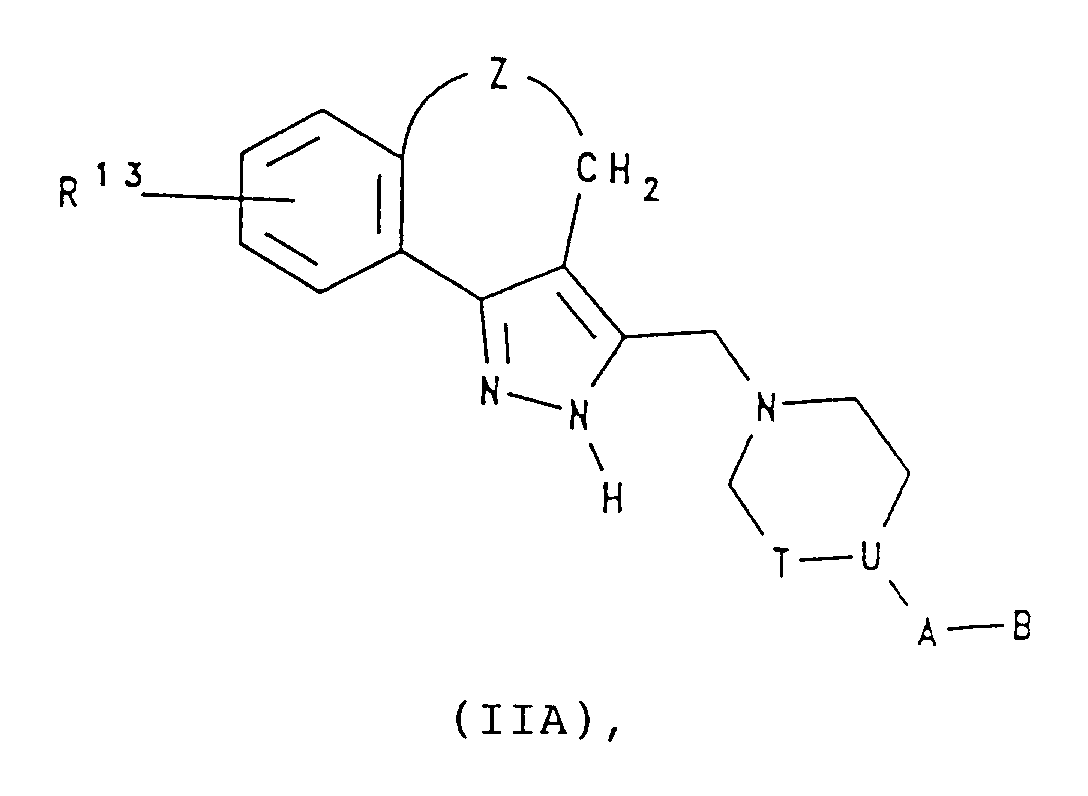 Z wie in Anspruch 1 definiert ist, -T-U -CH2N-, -CH2CH- oder -CH=C- bedeutet,A -(CH2)n- oder -CH=CH- bedeutet,n null, 1, 2 oder 3 ist,B eine Gruppe der Formel (i), (ii), (iii) oder (iv) bedeutet:
 R13 und R19 unabhängig voneinander Wasserstoff, Halogen, Cyano, Nitro, Trifluormethyl, Amino, C1-6-Alkylamino, Di-(C1-6)alkylamino, C1-6-Alkyl, C1-6-Alkoxy, Aryl(C1-6)alkoxy oder C2-6-Alkoxycarbonyl bedeuten.
 - Eine wie in Anspruch 1 beanspruchte Verbindung, dargestellt durch Formel IIB, und Salze davon:
 Z wie in Anspruch 1 definiert ist,W -CH2- oder -CH2CH2- bedeutet,R13 wie in Anspruch 2 definiert ist, undR18 Wasserstoff, C1-6-Alkyl, C1-6-Alkoxy, Aryl, Aryl(C1-6)-alkyl oder Halogen bedeutet.
 - Eine Verbindung, ausgewählt aus:3-[4-(4-Methoxyphenyl)piperazin-1-ylmethyl]-4,5-dihydro-1H-benzo[g]indazol,3-[4-(5-Chlorpyridin-2-yl)piperazin-1-ylmethyl]-4,5-dihydro-1H-benzo[g]indazol,3-(1,2,3,4-Tetrahydroisochinolin-2-ylmethyl)-4,5-dihydro-1H-benzo[g]indazol,3-[4-(Isochinolin-3-yl)piperazin-1-ylmethyl]-4,5-dihydro-1H-benzo[g]indazol,3-(4-Phenyl-1,2,3,6-tetrahydropyridin-1-ylmethyl)-4,5-dihydro-1H-benzo[g]indazol,3-[4-(2-Furan-2-yl)ethyl)-1,2,3,6-tetrahydropyridin-1-ylmethyl]-4,5-dihydro-1H-benzo[g]indazol,3-[4-(2-Phenylethyl)-1,2,3,6-tetrahydropyridin-1-ylmethyl]-4,5-dihydro-1H-benzo[g]indazol,3-(4-Phenylpiperidin-1-ylmethyl)-4,5-dihydro-1H-benzo[g]-indazol,3-(4-Benzylpiperazin-1-ylmethyl)-4,5-dihydro-1H-benzo[g]-indazol,3-[4-(Chinolin-2-yl)piperazin-1-ylmethyl]-4,5-dihydro-1H-benzo[g]indazol,3-[4-((E)-2-Phenylethenyl)-1,2,3,6-tetrahydropyridin-1-ylmethyl]-4,5-dihydro-1H-benzo[g]indazol,3-[4-(4-Methoxyphenyl)piperazin-1-ylmethyl]-1,4-dihydroindeno[1,2-c]pyrazol,3-[4-(4-Methoxyphenyl)piperazin-1-ylmethyl]benzo[b]-2H-pyrano[4,3-c]-1H-pyrazol,und Salze davon.
- Eine pharmazeutische Zusammensetzung, die eine wie in irgendeinem der vorhergehenden Ansprüche beanspruchte Verbindung in Verbindung mit einem pharmazeutisch annehmbaren Träger enthält.
- Eine wie in irgendeinem der Ansprüche 1 bis 4 beanspruchte Verbindung zur Verwendung in der Therapie.
- Die Verwendung einer wie in irgendeinem der Ansprüche 1 bis 4 beanspruchten Verbindung zur Herstellung eines Medikaments zur Behandlung und/oder Prävention von Störungen des Dopamin-Systems.
- Ein Verfahren zur Herstellung einer wie in Anspruch 1 beanspruchten Verbindung, das die Umsetzung einer Verbindung der Formel III mit einer Verbindung der Formel IV umfaßt:

Applications Claiming Priority (3)
| Application Number | Priority Date | Filing Date | Title |
|---|---|---|---|
| GB9318691 | 1993-09-09 | ||
| GB939318691A GB9318691D0 (en) | 1993-09-09 | 1993-09-09 | Therapeutic agents |
| PCT/GB1994/001935 WO1995007262A1 (en) | 1993-09-09 | 1994-09-06 | Fused tricyclic heteroaromatic derivatives as dopamine receptor subtype ligands |
Publications (2)
| Publication Number | Publication Date |
|---|---|
| EP0717733A1 EP0717733A1 (de) | 1996-06-26 |
| EP0717733B1 true EP0717733B1 (de) | 1997-12-03 |
Family
ID=10741750
Family Applications (1)
| Application Number | Title | Priority Date | Filing Date |
|---|---|---|---|
| EP94925560A Expired - Lifetime EP0717733B1 (de) | 1993-09-09 | 1994-09-06 | Kondensierte tricyclische heteroaromatische verbindungen als dopamin-rezeptor-subtyp-liganden |
Country Status (10)
| Country | Link |
|---|---|
| US (1) | US5686480A (de) |
| EP (1) | EP0717733B1 (de) |
| JP (1) | JPH09502199A (de) |
| AT (1) | ATE160773T1 (de) |
| AU (1) | AU684304B2 (de) |
| CA (1) | CA2168738A1 (de) |
| DE (1) | DE69407191T2 (de) |
| ES (1) | ES2110256T3 (de) |
| GB (1) | GB9318691D0 (de) |
| WO (1) | WO1995007262A1 (de) |
Families Citing this family (12)
| Publication number | Priority date | Publication date | Assignee | Title |
|---|---|---|---|---|
| DE19519056A1 (de) * | 1995-05-24 | 1997-01-16 | Klinge Co Chem Pharm Fab | Verwendung von Antidepressiva zur Behandlung von Asthma und/oder Atemwegserkrankungen mittels inhalatorischer Applikation |
| US6187774B1 (en) * | 1996-03-04 | 2001-02-13 | Yoshitomi Pharmaceutical Industries, Ltd. | Fused heterocyclic compounds and pharmaceutical applications thereof |
| WO2000012500A2 (en) * | 1998-09-02 | 2000-03-09 | Neurogen Corporation | 2-aryl-4-(1-[4-heteroaryl]piperazin-1-yl) methylimidazoles: dopamine d4 receptor subtype ligands |
| US6107313A (en) * | 1998-10-02 | 2000-08-22 | Combichem, Inc. | Dopamine receptor antagonists |
| US6462036B1 (en) | 1998-11-06 | 2002-10-08 | Basf Aktiengesellschaft | Tricyclic pyrazole derivatives |
| WO2003024935A2 (en) * | 2001-09-19 | 2003-03-27 | Pharmacia Corporation | Substituted pyrazolyl compounds for the treatment of inflammation |
| AR040967A1 (es) * | 2002-08-12 | 2005-04-27 | Janssen Pharmaceutica Nv | Derivados de isoxazolina triciclicos c- sustituidos y su uso como anti- depresivos |
| US7462717B2 (en) | 2002-08-21 | 2008-12-09 | Janssen Pharmaceutica N.V. | C6-and C9-substituted chromeno[4,3-c]isoxazoline derivatives and their use as anti-depressants |
| AP2527A (en) | 2006-10-31 | 2012-12-06 | Pfizer Prod Inc | Pyrazoline compounds as mineralocorticoid receptorantagonists |
| AU2008249745B2 (en) * | 2007-05-09 | 2012-01-12 | Pfizer Inc. | Substituted heterocyclic derivatives and compositions and their pharmaceutical use as antibacterials |
| US20110263588A1 (en) * | 2008-10-27 | 2011-10-27 | Glaxo Group Limited | Tricyclic compounds as glutamate receptor modulators |
| DE102010055499A1 (de) * | 2010-12-22 | 2011-06-16 | W.C. Heraeus Gmbh | Prozess zur Herstellung von Bendamustinalkylester, Bendarmustin sowie Derivaten davon |
Family Cites Families (4)
| Publication number | Priority date | Publication date | Assignee | Title |
|---|---|---|---|---|
| US3553230A (en) * | 1967-09-26 | 1971-01-05 | Colgate Palmolive Co | 3-aminoalkyl and 3-amino derivatives of 4h(1)benzopyrano(3,4-d)isoxazoles |
| US3969527A (en) * | 1975-07-28 | 1976-07-13 | E. R. Squibb & Sons, Inc. | CNS active compounds |
| ES2076253T3 (es) * | 1989-05-19 | 1995-11-01 | Hoechst Roussel Pharma | N-(ariloxialquil)-heteroarilpiperidinas y -heteroarilpiperazinas, un procedimiento para su preparacion y su uso como medicamentos. |
| JPH08502958A (ja) * | 1992-10-23 | 1996-04-02 | メルク シヤープ エンド ドーム リミテツド | ドーパミンレセプターサブタイプリガンド |
-
1993
- 1993-09-09 GB GB939318691A patent/GB9318691D0/en active Pending
-
1994
- 1994-09-06 AT AT94925560T patent/ATE160773T1/de not_active IP Right Cessation
- 1994-09-06 US US08/605,096 patent/US5686480A/en not_active Expired - Fee Related
- 1994-09-06 ES ES94925560T patent/ES2110256T3/es not_active Expired - Lifetime
- 1994-09-06 EP EP94925560A patent/EP0717733B1/de not_active Expired - Lifetime
- 1994-09-06 DE DE69407191T patent/DE69407191T2/de not_active Expired - Fee Related
- 1994-09-06 AU AU75425/94A patent/AU684304B2/en not_active Ceased
- 1994-09-06 JP JP7508528A patent/JPH09502199A/ja active Pending
- 1994-09-06 CA CA002168738A patent/CA2168738A1/en not_active Abandoned
- 1994-09-06 WO PCT/GB1994/001935 patent/WO1995007262A1/en not_active Ceased
Also Published As
| Publication number | Publication date |
|---|---|
| AU684304B2 (en) | 1997-12-11 |
| WO1995007262A1 (en) | 1995-03-16 |
| ATE160773T1 (de) | 1997-12-15 |
| ES2110256T3 (es) | 1998-02-01 |
| DE69407191T2 (de) | 1998-07-02 |
| EP0717733A1 (de) | 1996-06-26 |
| JPH09502199A (ja) | 1997-03-04 |
| CA2168738A1 (en) | 1995-03-16 |
| DE69407191D1 (de) | 1998-01-15 |
| AU7542594A (en) | 1995-03-27 |
| US5686480A (en) | 1997-11-11 |
| GB9318691D0 (en) | 1993-10-27 |
Similar Documents
| Publication | Publication Date | Title |
|---|---|---|
| EP0689535B1 (de) | Benzimidazole derivate | |
| US5563152A (en) | Pyrrolo-pyridine derivatives | |
| US5563150A (en) | Pyrrolo-pyridine derivatives | |
| US5670522A (en) | Dopamine receptor subtype ligands | |
| US5614518A (en) | Morpholine derivatives as dopamine receptor subtype ligands | |
| DE69420394T2 (de) | Pyrrolopyridinderivate als dopaminrezeptor liganden | |
| US5712285A (en) | Pyrrolo-pyridine derivatives | |
| US5665732A (en) | Indazole derivatives | |
| US5686480A (en) | Fused tricyclic heteroaromatic derivatives as dopamine receptor subtype ligands | |
| US5576336A (en) | Indole derivatives as dopamine D4 antagonists | |
| US5830901A (en) | Tetrahydropyridinylmethyl derivatives of pyrrolo 2,3-B!pyridine | |
| US6080745A (en) | Fused tricyclic heteroaromatic derivatives as dopamine receptor subtype ligands | |
| US5763448A (en) | Pyrmidine derivatives | |
| US5939436A (en) | Five-membered heteroaromatic compounds as dopamine receptor subtype ligands | |
| GB2299581A (en) | 3-(Tetrahydropyridin-1-yl-methyl)pyrrolo[2,3-b]pyridine derivatives as ligands for dopamine receptor subtypes | |
| US5849765A (en) | Tetrahydropyridine derivatives as dopamine receptor subtype ligands | |
| US5684006A (en) | Isoxazole and pyrazole derivatives as dopamine receptor subtype ligands | |
| US5861407A (en) | Tetrahydropyridine derivatives as dopamine receptor subtype ligands | |
| US5700941A (en) | Octahydronaphthyridine derivatives | |
| GB2298421A (en) | 2-Heterocyclylmethyl-pyrrolo[2,3-b]pyridine derivatives as ligands for dopamine receptor subtypes | |
| GB2299582A (en) | Octahydronaphthyridine derivatives |
Legal Events
| Date | Code | Title | Description |
|---|---|---|---|
| PUAI | Public reference made under article 153(3) epc to a published international application that has entered the european phase |
Free format text: ORIGINAL CODE: 0009012 |
|
| 17P | Request for examination filed |
Effective date: 19960409 |
|
| AK | Designated contracting states |
Kind code of ref document: A1 Designated state(s): AT BE CH DE DK ES FR GB GR IE IT LI LU NL PT SE |
|
| 17Q | First examination report despatched |
Effective date: 19960605 |
|
| GRAG | Despatch of communication of intention to grant |
Free format text: ORIGINAL CODE: EPIDOS AGRA |
|
| GRAH | Despatch of communication of intention to grant a patent |
Free format text: ORIGINAL CODE: EPIDOS IGRA |
|
| GRAH | Despatch of communication of intention to grant a patent |
Free format text: ORIGINAL CODE: EPIDOS IGRA |
|
| GRAA | (expected) grant |
Free format text: ORIGINAL CODE: 0009210 |
|
| AK | Designated contracting states |
Kind code of ref document: B1 Designated state(s): AT BE CH DE DK ES FR GB GR IE IT LI LU NL PT SE |
|
| PG25 | Lapsed in a contracting state [announced via postgrant information from national office to epo] |
Ref country code: NL Free format text: LAPSE BECAUSE OF FAILURE TO SUBMIT A TRANSLATION OF THE DESCRIPTION OR TO PAY THE FEE WITHIN THE PRESCRIBED TIME-LIMIT Effective date: 19971203 Ref country code: LI Free format text: LAPSE BECAUSE OF FAILURE TO SUBMIT A TRANSLATION OF THE DESCRIPTION OR TO PAY THE FEE WITHIN THE PRESCRIBED TIME-LIMIT Effective date: 19971203 Ref country code: GR Free format text: LAPSE BECAUSE OF FAILURE TO SUBMIT A TRANSLATION OF THE DESCRIPTION OR TO PAY THE FEE WITHIN THE PRESCRIBED TIME-LIMIT Effective date: 19971203 Ref country code: DK Free format text: LAPSE BECAUSE OF NON-PAYMENT OF DUE FEES Effective date: 19971203 Ref country code: CH Free format text: LAPSE BECAUSE OF FAILURE TO SUBMIT A TRANSLATION OF THE DESCRIPTION OR TO PAY THE FEE WITHIN THE PRESCRIBED TIME-LIMIT Effective date: 19971203 Ref country code: BE Free format text: LAPSE BECAUSE OF FAILURE TO SUBMIT A TRANSLATION OF THE DESCRIPTION OR TO PAY THE FEE WITHIN THE PRESCRIBED TIME-LIMIT Effective date: 19971203 Ref country code: AT Free format text: LAPSE BECAUSE OF FAILURE TO SUBMIT A TRANSLATION OF THE DESCRIPTION OR TO PAY THE FEE WITHIN THE PRESCRIBED TIME-LIMIT Effective date: 19971203 |
|
| REF | Corresponds to: |
Ref document number: 160773 Country of ref document: AT Date of ref document: 19971215 Kind code of ref document: T |
|
| REG | Reference to a national code |
Ref country code: CH Ref legal event code: EP |
|
| REF | Corresponds to: |
Ref document number: 69407191 Country of ref document: DE Date of ref document: 19980115 |
|
| REG | Reference to a national code |
Ref country code: ES Ref legal event code: FG2A Ref document number: 2110256 Country of ref document: ES Kind code of ref document: T3 |
|
| ITF | It: translation for a ep patent filed | ||
| ET | Fr: translation filed | ||
| PG25 | Lapsed in a contracting state [announced via postgrant information from national office to epo] |
Ref country code: SE Free format text: LAPSE BECAUSE OF FAILURE TO SUBMIT A TRANSLATION OF THE DESCRIPTION OR TO PAY THE FEE WITHIN THE PRESCRIBED TIME-LIMIT Effective date: 19980303 Ref country code: PT Free format text: LAPSE BECAUSE OF FAILURE TO SUBMIT A TRANSLATION OF THE DESCRIPTION OR TO PAY THE FEE WITHIN THE PRESCRIBED TIME-LIMIT Effective date: 19980303 |
|
| NLV1 | Nl: lapsed or annulled due to failure to fulfill the requirements of art. 29p and 29m of the patents act | ||
| REG | Reference to a national code |
Ref country code: CH Ref legal event code: PL |
|
| PG25 | Lapsed in a contracting state [announced via postgrant information from national office to epo] |
Ref country code: LU Free format text: LAPSE BECAUSE OF NON-PAYMENT OF DUE FEES Effective date: 19980906 Ref country code: IE Free format text: LAPSE BECAUSE OF NON-PAYMENT OF DUE FEES Effective date: 19980906 |
|
| PLBE | No opposition filed within time limit |
Free format text: ORIGINAL CODE: 0009261 |
|
| STAA | Information on the status of an ep patent application or granted ep patent |
Free format text: STATUS: NO OPPOSITION FILED WITHIN TIME LIMIT |
|
| 26N | No opposition filed | ||
| PGFP | Annual fee paid to national office [announced via postgrant information from national office to epo] |
Ref country code: ES Payment date: 20001006 Year of fee payment: 7 |
|
| PGFP | Annual fee paid to national office [announced via postgrant information from national office to epo] |
Ref country code: GB Payment date: 20010628 Year of fee payment: 8 |
|
| PGFP | Annual fee paid to national office [announced via postgrant information from national office to epo] |
Ref country code: FR Payment date: 20010817 Year of fee payment: 8 |
|
| PGFP | Annual fee paid to national office [announced via postgrant information from national office to epo] |
Ref country code: DE Payment date: 20010820 Year of fee payment: 8 |
|
| PG25 | Lapsed in a contracting state [announced via postgrant information from national office to epo] |
Ref country code: ES Free format text: LAPSE BECAUSE OF NON-PAYMENT OF DUE FEES Effective date: 20010907 |
|
| REG | Reference to a national code |
Ref country code: GB Ref legal event code: IF02 |
|
| PG25 | Lapsed in a contracting state [announced via postgrant information from national office to epo] |
Ref country code: GB Free format text: LAPSE BECAUSE OF NON-PAYMENT OF DUE FEES Effective date: 20020906 |
|
| PG25 | Lapsed in a contracting state [announced via postgrant information from national office to epo] |
Ref country code: DE Free format text: LAPSE BECAUSE OF NON-PAYMENT OF DUE FEES Effective date: 20030401 |
|
| GBPC | Gb: european patent ceased through non-payment of renewal fee |
Effective date: 20020906 |
|
| PG25 | Lapsed in a contracting state [announced via postgrant information from national office to epo] |
Ref country code: FR Free format text: LAPSE BECAUSE OF NON-PAYMENT OF DUE FEES Effective date: 20030603 |
|
| REG | Reference to a national code |
Ref country code: FR Ref legal event code: ST |
|
| REG | Reference to a national code |
Ref country code: ES Ref legal event code: FD2A Effective date: 20021011 |
|
| PG25 | Lapsed in a contracting state [announced via postgrant information from national office to epo] |
Ref country code: IT Free format text: LAPSE BECAUSE OF NON-PAYMENT OF DUE FEES;WARNING: LAPSES OF ITALIAN PATENTS WITH EFFECTIVE DATE BEFORE 2007 MAY HAVE OCCURRED AT ANY TIME BEFORE 2007. THE CORRECT EFFECTIVE DATE MAY BE DIFFERENT FROM THE ONE RECORDED. Effective date: 20050906 |