EP0719760B1 - Dérivés naphtaléniques et leur utilisation comme agonistes et antagonists de PGE2 - Google Patents
Dérivés naphtaléniques et leur utilisation comme agonistes et antagonists de PGE2Info
- Publication number
- EP0719760B1 EP0719760B1 EP95309493A EP95309493A EP0719760B1 EP 0719760 B1 EP0719760 B1 EP 0719760B1 EP 95309493 A EP95309493 A EP 95309493A EP 95309493 A EP95309493 A EP 95309493A EP 0719760 B1 EP0719760 B1 EP 0719760B1
- Authority
- EP
- European Patent Office
- Prior art keywords
- alkylene
- formula
- naphthyl
- compound
- oxy
- Prior art date
- Legal status (The legal status is an assumption and is not a legal conclusion. Google has not performed a legal analysis and makes no representation as to the accuracy of the status listed.)
- Expired - Lifetime
Links
- 150000002790 naphthalenes Chemical class 0.000 title claims description 7
- XEYBRNLFEZDVAW-ARSRFYASSA-N dinoprostone Chemical compound CCCCC[C@H](O)\C=C\[C@H]1[C@H](O)CC(=O)[C@@H]1C\C=C/CCCC(O)=O XEYBRNLFEZDVAW-ARSRFYASSA-N 0.000 title abstract description 25
- 239000000556 agonist Substances 0.000 title abstract description 15
- 239000005557 antagonist Substances 0.000 title abstract description 13
- 229960002986 dinoprostone Drugs 0.000 title abstract 2
- XEYBRNLFEZDVAW-UHFFFAOYSA-N prostaglandin E2 Natural products CCCCCC(O)C=CC1C(O)CC(=O)C1CC=CCCCC(O)=O XEYBRNLFEZDVAW-UHFFFAOYSA-N 0.000 title abstract 2
- 125000002947 alkylene group Chemical group 0.000 claims abstract description 85
- 125000001997 phenyl group Chemical group [H]C1=C([H])C([H])=C(*)C([H])=C1[H] 0.000 claims abstract description 30
- 150000003839 salts Chemical class 0.000 claims abstract description 30
- 229910052757 nitrogen Inorganic materials 0.000 claims abstract description 27
- 125000004433 nitrogen atom Chemical group N* 0.000 claims abstract description 26
- 125000000753 cycloalkyl group Chemical group 0.000 claims abstract description 22
- 125000001624 naphthyl group Chemical group 0.000 claims abstract description 22
- 231100000252 nontoxic Toxicity 0.000 claims abstract description 18
- 230000003000 nontoxic effect Effects 0.000 claims abstract description 18
- 125000000217 alkyl group Chemical group 0.000 claims abstract description 11
- 229910052736 halogen Inorganic materials 0.000 claims abstract description 7
- 150000002367 halogens Chemical class 0.000 claims abstract description 6
- 125000003342 alkenyl group Chemical group 0.000 claims abstract description 4
- 125000000623 heterocyclic group Chemical group 0.000 claims abstract description 3
- 150000001875 compounds Chemical class 0.000 claims description 118
- QTBSBXVTEAMEQO-UHFFFAOYSA-N Acetic acid Chemical compound CC(O)=O QTBSBXVTEAMEQO-UHFFFAOYSA-N 0.000 claims description 111
- 238000000034 method Methods 0.000 claims description 28
- LFQSCWFLJHTTHZ-UHFFFAOYSA-N Ethanol Chemical compound CCO LFQSCWFLJHTTHZ-UHFFFAOYSA-N 0.000 claims description 26
- 125000004178 (C1-C4) alkyl group Chemical group 0.000 claims description 21
- 125000001424 substituent group Chemical group 0.000 claims description 18
- 239000002253 acid Substances 0.000 claims description 17
- -1 3,3-diphenylcarbazoyl Chemical group 0.000 claims description 15
- 125000004169 (C1-C6) alkyl group Chemical group 0.000 claims description 13
- 125000000882 C2-C6 alkenyl group Chemical group 0.000 claims description 11
- 125000001495 ethyl group Chemical group [H]C([H])([H])C([H])([H])* 0.000 claims description 10
- 125000004435 hydrogen atom Chemical group [H]* 0.000 claims description 10
- 230000007062 hydrolysis Effects 0.000 claims description 10
- 238000006460 hydrolysis reaction Methods 0.000 claims description 10
- 125000003161 (C1-C6) alkylene group Chemical group 0.000 claims description 8
- PXIPVTKHYLBLMZ-UHFFFAOYSA-N Sodium azide Chemical compound [Na+].[N-]=[N+]=[N-] PXIPVTKHYLBLMZ-UHFFFAOYSA-N 0.000 claims description 8
- 239000001257 hydrogen Substances 0.000 claims description 8
- 229910052739 hydrogen Inorganic materials 0.000 claims description 8
- UFHFLCQGNIYNRP-UHFFFAOYSA-N Hydrogen Chemical compound [H][H] UFHFLCQGNIYNRP-UHFFFAOYSA-N 0.000 claims description 7
- 125000001584 benzyloxycarbonyl group Chemical group C(=O)(OCC1=CC=CC=C1)* 0.000 claims description 7
- 125000002496 methyl group Chemical group [H]C([H])([H])* 0.000 claims description 7
- DLFVBJFMPXGRIB-UHFFFAOYSA-N Acetamide Chemical compound CC(N)=O DLFVBJFMPXGRIB-UHFFFAOYSA-N 0.000 claims description 6
- 125000000229 (C1-C4)alkoxy group Chemical group 0.000 claims description 4
- QUSNBJAOOMFDIB-UHFFFAOYSA-N Ethylamine Chemical compound CCN QUSNBJAOOMFDIB-UHFFFAOYSA-N 0.000 claims description 4
- 206010000210 abortion Diseases 0.000 claims description 4
- 231100000176 abortion Toxicity 0.000 claims description 4
- 239000003814 drug Substances 0.000 claims description 4
- 238000002360 preparation method Methods 0.000 claims description 4
- 125000006590 (C2-C6) alkenylene group Chemical group 0.000 claims description 3
- 208000002193 Pain Diseases 0.000 claims description 3
- 239000011248 coating agent Substances 0.000 claims description 3
- 238000000576 coating method Methods 0.000 claims description 3
- 125000000956 methoxy group Chemical group [H]C([H])([H])O* 0.000 claims description 3
- 125000000449 nitro group Chemical group [O-][N+](*)=O 0.000 claims description 3
- 239000008194 pharmaceutical composition Substances 0.000 claims description 3
- UYWQUFXKFGHYNT-UHFFFAOYSA-N phenylmethyl ester of formic acid Natural products O=COCC1=CC=CC=C1 UYWQUFXKFGHYNT-UHFFFAOYSA-N 0.000 claims description 3
- 230000002265 prevention Effects 0.000 claims description 3
- 125000006239 protecting group Chemical group 0.000 claims description 3
- 125000001412 tetrahydropyranyl group Chemical group 0.000 claims description 3
- 206010012735 Diarrhoea Diseases 0.000 claims description 2
- 208000007882 Gastritis Diseases 0.000 claims description 2
- 239000003937 drug carrier Substances 0.000 claims description 2
- 125000005843 halogen group Chemical group 0.000 claims description 2
- DVURHBLIUQKMAB-UHFFFAOYSA-N n-[(3-chlorophenyl)-phenylmethyl]-3-[5-(cyanomethoxy)naphthalen-1-yl]propanamide Chemical compound ClC1=CC=CC(C(NC(=O)CCC=2C3=CC=CC(OCC#N)=C3C=CC=2)C=2C=CC=CC=2)=C1 DVURHBLIUQKMAB-UHFFFAOYSA-N 0.000 claims description 2
- FUWAGOXRPKZQHP-UHFFFAOYSA-N n-benzhydryl-3-[5-(2h-tetrazol-5-ylmethoxy)naphthalen-1-yl]propanamide Chemical compound C=1C=CC=CC=1C(C=1C=CC=CC=1)NC(=O)CCC(C1=CC=C2)=CC=CC1=C2OCC1=NN=NN1 FUWAGOXRPKZQHP-UHFFFAOYSA-N 0.000 claims description 2
- ZJKWVDIRYTTWLR-UHFFFAOYSA-N n-benzhydryl-3-[5-(cyanomethoxy)naphthalen-1-yl]propanamide Chemical compound C=1C=CC2=C(OCC#N)C=CC=C2C=1CCC(=O)NC(C=1C=CC=CC=1)C1=CC=CC=C1 ZJKWVDIRYTTWLR-UHFFFAOYSA-N 0.000 claims description 2
- 239000012279 sodium borohydride Substances 0.000 claims description 2
- 229910000033 sodium borohydride Inorganic materials 0.000 claims description 2
- 125000002023 trifluoromethyl group Chemical group FC(F)(F)* 0.000 claims description 2
- 125000000391 vinyl group Chemical group [H]C([*])=C([H])[H] 0.000 claims description 2
- 229920002554 vinyl polymer Polymers 0.000 claims description 2
- 238000004519 manufacturing process Methods 0.000 claims 2
- 150000004702 methyl esters Chemical class 0.000 claims 2
- 206010020772 Hypertension Diseases 0.000 claims 1
- 239000012448 Lithium borohydride Substances 0.000 claims 1
- 208000007536 Thrombosis Diseases 0.000 claims 1
- 208000025865 Ulcer Diseases 0.000 claims 1
- 230000035568 catharsis Effects 0.000 claims 1
- 230000006698 induction Effects 0.000 claims 1
- 231100000397 ulcer Toxicity 0.000 claims 1
- 150000004677 hydrates Chemical class 0.000 abstract description 5
- 125000004450 alkenylene group Chemical group 0.000 abstract description 3
- GHRYSOFWKRRLMI-UHFFFAOYSA-N 1-naphthyloxyacetic acid Chemical class C1=CC=C2C(OCC(=O)O)=CC=CC2=C1 GHRYSOFWKRRLMI-UHFFFAOYSA-N 0.000 abstract 1
- 102000008866 Prostaglandin E receptors Human genes 0.000 abstract 1
- 108010088540 Prostaglandin E receptors Proteins 0.000 abstract 1
- 125000003545 alkoxy group Chemical group 0.000 abstract 1
- OKKJLVBELUTLKV-UHFFFAOYSA-N Methanol Chemical compound OC OKKJLVBELUTLKV-UHFFFAOYSA-N 0.000 description 87
- YMWUJEATGCHHMB-UHFFFAOYSA-N Dichloromethane Chemical compound ClCCl YMWUJEATGCHHMB-UHFFFAOYSA-N 0.000 description 65
- HEDRZPFGACZZDS-UHFFFAOYSA-N Chloroform Chemical compound ClC(Cl)Cl HEDRZPFGACZZDS-UHFFFAOYSA-N 0.000 description 38
- 238000004809 thin layer chromatography Methods 0.000 description 37
- 239000000203 mixture Substances 0.000 description 36
- XEKOWRVHYACXOJ-UHFFFAOYSA-N Ethyl acetate Chemical compound CCOC(C)=O XEKOWRVHYACXOJ-UHFFFAOYSA-N 0.000 description 33
- HEDRZPFGACZZDS-MICDWDOJSA-N Trichloro(2H)methane Chemical compound [2H]C(Cl)(Cl)Cl HEDRZPFGACZZDS-MICDWDOJSA-N 0.000 description 28
- 238000006243 chemical reaction Methods 0.000 description 28
- 239000000243 solution Substances 0.000 description 27
- WYURNTSHIVDZCO-UHFFFAOYSA-N Tetrahydrofuran Chemical compound C1CCOC1 WYURNTSHIVDZCO-UHFFFAOYSA-N 0.000 description 20
- FAPWRFPIFSIZLT-UHFFFAOYSA-M Sodium chloride Chemical compound [Na+].[Cl-] FAPWRFPIFSIZLT-UHFFFAOYSA-M 0.000 description 16
- 230000000694 effects Effects 0.000 description 16
- VLKZOEOYAKHREP-UHFFFAOYSA-N n-Hexane Chemical compound CCCCCC VLKZOEOYAKHREP-UHFFFAOYSA-N 0.000 description 16
- VEXZGXHMUGYJMC-UHFFFAOYSA-N Hydrochloric acid Chemical compound Cl VEXZGXHMUGYJMC-UHFFFAOYSA-N 0.000 description 15
- 235000019439 ethyl acetate Nutrition 0.000 description 15
- RTZKZFJDLAIYFH-UHFFFAOYSA-N Diethyl ether Chemical compound CCOCC RTZKZFJDLAIYFH-UHFFFAOYSA-N 0.000 description 14
- XLYOFNOQVPJJNP-UHFFFAOYSA-N water Chemical compound O XLYOFNOQVPJJNP-UHFFFAOYSA-N 0.000 description 14
- 239000007864 aqueous solution Substances 0.000 description 13
- UHOVQNZJYSORNB-UHFFFAOYSA-N Benzene Chemical compound C1=CC=CC=C1 UHOVQNZJYSORNB-UHFFFAOYSA-N 0.000 description 12
- ZMANZCXQSJIPKH-UHFFFAOYSA-N Triethylamine Chemical compound CCN(CC)CC ZMANZCXQSJIPKH-UHFFFAOYSA-N 0.000 description 12
- 239000003960 organic solvent Substances 0.000 description 11
- 229920006395 saturated elastomer Polymers 0.000 description 11
- JUJWROOIHBZHMG-UHFFFAOYSA-N Pyridine Chemical compound C1=CC=NC=C1 JUJWROOIHBZHMG-UHFFFAOYSA-N 0.000 description 10
- KXKVLQRXCPHEJC-UHFFFAOYSA-N methyl acetate Chemical compound COC(C)=O KXKVLQRXCPHEJC-UHFFFAOYSA-N 0.000 description 10
- YLQBMQCUIZJEEH-UHFFFAOYSA-N tetrahydrofuran Natural products C=1C=COC=1 YLQBMQCUIZJEEH-UHFFFAOYSA-N 0.000 description 10
- CSCPPACGZOOCGX-UHFFFAOYSA-N Acetone Chemical compound CC(C)=O CSCPPACGZOOCGX-UHFFFAOYSA-N 0.000 description 9
- 239000003795 chemical substances by application Substances 0.000 description 8
- 239000011780 sodium chloride Substances 0.000 description 8
- 239000002904 solvent Substances 0.000 description 8
- 125000005842 heteroatom Chemical group 0.000 description 7
- LMDZBCPBFSXMTL-UHFFFAOYSA-N 1-ethyl-3-(3-dimethylaminopropyl)carbodiimide Chemical compound CCN=C=NCCCN(C)C LMDZBCPBFSXMTL-UHFFFAOYSA-N 0.000 description 6
- NLXLAEXVIDQMFP-UHFFFAOYSA-N Ammonia chloride Chemical compound [NH4+].[Cl-] NLXLAEXVIDQMFP-UHFFFAOYSA-N 0.000 description 6
- OKKJLVBELUTLKV-MZCSYVLQSA-N Deuterated methanol Chemical compound [2H]OC([2H])([2H])[2H] OKKJLVBELUTLKV-MZCSYVLQSA-N 0.000 description 6
- ZMXDDKWLCZADIW-UHFFFAOYSA-N N,N-Dimethylformamide Chemical compound CN(C)C=O ZMXDDKWLCZADIW-UHFFFAOYSA-N 0.000 description 6
- KDLHZDBZIXYQEI-UHFFFAOYSA-N Palladium on carbon Substances [Pd] KDLHZDBZIXYQEI-UHFFFAOYSA-N 0.000 description 6
- HEMHJVSKTPXQMS-UHFFFAOYSA-M Sodium hydroxide Chemical compound [OH-].[Na+] HEMHJVSKTPXQMS-UHFFFAOYSA-M 0.000 description 6
- 150000004820 halides Chemical class 0.000 description 6
- BWHMMNNQKKPAPP-UHFFFAOYSA-L potassium carbonate Chemical compound [K+].[K+].[O-]C([O-])=O BWHMMNNQKKPAPP-UHFFFAOYSA-L 0.000 description 6
- 239000011541 reaction mixture Substances 0.000 description 6
- RWRDLPDLKQPQOW-UHFFFAOYSA-N Pyrrolidine Chemical compound C1CCNC1 RWRDLPDLKQPQOW-UHFFFAOYSA-N 0.000 description 5
- 230000001079 digestive effect Effects 0.000 description 5
- 239000003701 inert diluent Substances 0.000 description 5
- 239000012044 organic layer Substances 0.000 description 5
- 238000007911 parenteral administration Methods 0.000 description 5
- 230000008855 peristalsis Effects 0.000 description 5
- UMJSCPRVCHMLSP-UHFFFAOYSA-N pyridine Natural products COC1=CC=CN=C1 UMJSCPRVCHMLSP-UHFFFAOYSA-N 0.000 description 5
- 238000010898 silica gel chromatography Methods 0.000 description 5
- YYROPELSRYBVMQ-UHFFFAOYSA-N 4-toluenesulfonyl chloride Chemical compound CC1=CC=C(S(Cl)(=O)=O)C=C1 YYROPELSRYBVMQ-UHFFFAOYSA-N 0.000 description 4
- QOSSAOTZNIDXMA-UHFFFAOYSA-N Dicylcohexylcarbodiimide Chemical compound C1CCCCC1N=C=NC1CCCCC1 QOSSAOTZNIDXMA-UHFFFAOYSA-N 0.000 description 4
- NQRYJNQNLNOLGT-UHFFFAOYSA-N Piperidine Chemical compound C1CCNCC1 NQRYJNQNLNOLGT-UHFFFAOYSA-N 0.000 description 4
- DTQVDTLACAAQTR-UHFFFAOYSA-N Trifluoroacetic acid Chemical compound OC(=O)C(F)(F)F DTQVDTLACAAQTR-UHFFFAOYSA-N 0.000 description 4
- 208000036029 Uterine contractions during pregnancy Diseases 0.000 description 4
- ILAHWRKJUDSMFH-UHFFFAOYSA-N boron tribromide Chemical compound BrB(Br)Br ILAHWRKJUDSMFH-UHFFFAOYSA-N 0.000 description 4
- 239000000872 buffer Substances 0.000 description 4
- 229960004132 diethyl ether Drugs 0.000 description 4
- 238000002347 injection Methods 0.000 description 4
- 239000007924 injection Substances 0.000 description 4
- 239000007788 liquid Substances 0.000 description 4
- HQKMJHAJHXVSDF-UHFFFAOYSA-L magnesium stearate Chemical compound [Mg+2].CCCCCCCCCCCCCCCCCC([O-])=O.CCCCCCCCCCCCCCCCCC([O-])=O HQKMJHAJHXVSDF-UHFFFAOYSA-L 0.000 description 4
- PSHKMPUSSFXUIA-UHFFFAOYSA-N n,n-dimethylpyridin-2-amine Chemical compound CN(C)C1=CC=CC=N1 PSHKMPUSSFXUIA-UHFFFAOYSA-N 0.000 description 4
- 0 *S*Cc1cc(cccc2)c2cc1 Chemical compound *S*Cc1cc(cccc2)c2cc1 0.000 description 3
- JKTCBAGSMQIFNL-UHFFFAOYSA-N 2,3-dihydrofuran Chemical compound C1CC=CO1 JKTCBAGSMQIFNL-UHFFFAOYSA-N 0.000 description 3
- QGZKDVFQNNGYKY-UHFFFAOYSA-N Ammonia Chemical compound N QGZKDVFQNNGYKY-UHFFFAOYSA-N 0.000 description 3
- 229920002153 Hydroxypropyl cellulose Polymers 0.000 description 3
- DGAQECJNVWCQMB-PUAWFVPOSA-M Ilexoside XXIX Chemical compound C[C@@H]1CC[C@@]2(CC[C@@]3(C(=CC[C@H]4[C@]3(CC[C@@H]5[C@@]4(CC[C@@H](C5(C)C)OS(=O)(=O)[O-])C)C)[C@@H]2[C@]1(C)O)C)C(=O)O[C@H]6[C@@H]([C@H]([C@@H]([C@H](O6)CO)O)O)O.[Na+] DGAQECJNVWCQMB-PUAWFVPOSA-M 0.000 description 3
- JLTDJTHDQAWBAV-UHFFFAOYSA-N N,N-dimethylaniline Chemical compound CN(C)C1=CC=CC=C1 JLTDJTHDQAWBAV-UHFFFAOYSA-N 0.000 description 3
- KWYUFKZDYYNOTN-UHFFFAOYSA-M Potassium hydroxide Chemical compound [OH-].[K+] KWYUFKZDYYNOTN-UHFFFAOYSA-M 0.000 description 3
- DNIAPMSPPWPWGF-UHFFFAOYSA-N Propylene glycol Chemical compound CC(O)CO DNIAPMSPPWPWGF-UHFFFAOYSA-N 0.000 description 3
- 150000001412 amines Chemical class 0.000 description 3
- 235000019270 ammonium chloride Nutrition 0.000 description 3
- 210000001772 blood platelet Anatomy 0.000 description 3
- 239000002775 capsule Substances 0.000 description 3
- 150000001732 carboxylic acid derivatives Chemical class 0.000 description 3
- KRKNYBCHXYNGOX-UHFFFAOYSA-N citric acid Chemical compound OC(=O)CC(O)(C(O)=O)CC(O)=O KRKNYBCHXYNGOX-UHFFFAOYSA-N 0.000 description 3
- 230000027119 gastric acid secretion Effects 0.000 description 3
- 239000001863 hydroxypropyl cellulose Substances 0.000 description 3
- 235000010977 hydroxypropyl cellulose Nutrition 0.000 description 3
- 229910000027 potassium carbonate Inorganic materials 0.000 description 3
- KAQKFAOMNZTLHT-OZUDYXHBSA-N prostaglandin I2 Chemical compound O1\C(=C/CCCC(O)=O)C[C@@H]2[C@@H](/C=C/[C@@H](O)CCCCC)[C@H](O)C[C@@H]21 KAQKFAOMNZTLHT-OZUDYXHBSA-N 0.000 description 3
- 238000006722 reduction reaction Methods 0.000 description 3
- 229910052708 sodium Inorganic materials 0.000 description 3
- 239000011734 sodium Substances 0.000 description 3
- 239000008247 solid mixture Substances 0.000 description 3
- 239000007921 spray Substances 0.000 description 3
- 239000003381 stabilizer Substances 0.000 description 3
- 150000003512 tertiary amines Chemical class 0.000 description 3
- VHYFNPMBLIVWCW-UHFFFAOYSA-N 4-Dimethylaminopyridine Chemical compound CN(C)C1=CC=NC=C1 VHYFNPMBLIVWCW-UHFFFAOYSA-N 0.000 description 2
- XKRFYHLGVUSROY-UHFFFAOYSA-N Argon Chemical compound [Ar] XKRFYHLGVUSROY-UHFFFAOYSA-N 0.000 description 2
- IJGRMHOSHXDMSA-UHFFFAOYSA-N Atomic nitrogen Chemical compound N#N IJGRMHOSHXDMSA-UHFFFAOYSA-N 0.000 description 2
- 229910015845 BBr3 Inorganic materials 0.000 description 2
- FBPFZTCFMRRESA-KVTDHHQDSA-N D-Mannitol Chemical compound OC[C@@H](O)[C@@H](O)[C@H](O)[C@H](O)CO FBPFZTCFMRRESA-KVTDHHQDSA-N 0.000 description 2
- CKLJMWTZIZZHCS-UHFFFAOYSA-N D-OH-Asp Natural products OC(=O)C(N)CC(O)=O CKLJMWTZIZZHCS-UHFFFAOYSA-N 0.000 description 2
- ROSDSFDQCJNGOL-UHFFFAOYSA-N Dimethylamine Chemical compound CNC ROSDSFDQCJNGOL-UHFFFAOYSA-N 0.000 description 2
- 108010010803 Gelatin Proteins 0.000 description 2
- WHUUTDBJXJRKMK-UHFFFAOYSA-N Glutamic acid Natural products OC(=O)C(N)CCC(O)=O WHUUTDBJXJRKMK-UHFFFAOYSA-N 0.000 description 2
- CKLJMWTZIZZHCS-REOHCLBHSA-N L-aspartic acid Chemical compound OC(=O)[C@@H](N)CC(O)=O CKLJMWTZIZZHCS-REOHCLBHSA-N 0.000 description 2
- WHUUTDBJXJRKMK-VKHMYHEASA-N L-glutamic acid Chemical compound OC(=O)[C@@H](N)CCC(O)=O WHUUTDBJXJRKMK-VKHMYHEASA-N 0.000 description 2
- TWRXJAOTZQYOKJ-UHFFFAOYSA-L Magnesium chloride Chemical compound [Mg+2].[Cl-].[Cl-] TWRXJAOTZQYOKJ-UHFFFAOYSA-L 0.000 description 2
- BAVYZALUXZFZLV-UHFFFAOYSA-N Methylamine Chemical compound NC BAVYZALUXZFZLV-UHFFFAOYSA-N 0.000 description 2
- 229920000168 Microcrystalline cellulose Polymers 0.000 description 2
- KAESVJOAVNADME-UHFFFAOYSA-N Pyrrole Chemical compound C=1C=CNC=1 KAESVJOAVNADME-UHFFFAOYSA-N 0.000 description 2
- UIIMBOGNXHQVGW-UHFFFAOYSA-M Sodium bicarbonate Chemical compound [Na+].OC([O-])=O UIIMBOGNXHQVGW-UHFFFAOYSA-M 0.000 description 2
- 239000004015 abortifacient agent Substances 0.000 description 2
- 231100000641 abortifacient agent Toxicity 0.000 description 2
- 150000008065 acid anhydrides Chemical class 0.000 description 2
- 230000000202 analgesic effect Effects 0.000 description 2
- 230000003276 anti-hypertensive effect Effects 0.000 description 2
- 230000002785 anti-thrombosis Effects 0.000 description 2
- 230000000767 anti-ulcer Effects 0.000 description 2
- 239000007900 aqueous suspension Substances 0.000 description 2
- 125000001797 benzyl group Chemical group [H]C1=C([H])C([H])=C(C([H])=C1[H])C([H])([H])* 0.000 description 2
- WGQKYBSKWIADBV-UHFFFAOYSA-N benzylamine Chemical compound NCC1=CC=CC=C1 WGQKYBSKWIADBV-UHFFFAOYSA-N 0.000 description 2
- 230000027455 binding Effects 0.000 description 2
- 230000036772 blood pressure Effects 0.000 description 2
- 125000000484 butyl group Chemical group [H]C([*])([H])C([H])([H])C([H])([H])C([H])([H])[H] 0.000 description 2
- UFWIBTONFRDIAS-UHFFFAOYSA-N c1cc2ccccc2cc1 Chemical compound c1cc2ccccc2cc1 UFWIBTONFRDIAS-UHFFFAOYSA-N 0.000 description 2
- 229910052799 carbon Inorganic materials 0.000 description 2
- 239000003054 catalyst Substances 0.000 description 2
- 239000000799 cathartic agent Substances 0.000 description 2
- 210000004027 cell Anatomy 0.000 description 2
- 238000007796 conventional method Methods 0.000 description 2
- 239000003085 diluting agent Substances 0.000 description 2
- MGHPNCMVUAKAIE-UHFFFAOYSA-N diphenylmethanamine Chemical compound C=1C=CC=CC=1C(N)C1=CC=CC=C1 MGHPNCMVUAKAIE-UHFFFAOYSA-N 0.000 description 2
- 239000000839 emulsion Substances 0.000 description 2
- OAYLNYINCPYISS-UHFFFAOYSA-N ethyl acetate;hexane Chemical compound CCCCCC.CCOC(C)=O OAYLNYINCPYISS-UHFFFAOYSA-N 0.000 description 2
- 238000009472 formulation Methods 0.000 description 2
- 239000008273 gelatin Substances 0.000 description 2
- 229920000159 gelatin Polymers 0.000 description 2
- 235000019322 gelatine Nutrition 0.000 description 2
- 235000011852 gelatine desserts Nutrition 0.000 description 2
- 235000013922 glutamic acid Nutrition 0.000 description 2
- 239000004220 glutamic acid Substances 0.000 description 2
- 230000005764 inhibitory process Effects 0.000 description 2
- 239000000865 liniment Substances 0.000 description 2
- 235000019359 magnesium stearate Nutrition 0.000 description 2
- 239000000463 material Substances 0.000 description 2
- 239000012528 membrane Substances 0.000 description 2
- YDCHPLOFQATIDS-UHFFFAOYSA-N methyl 2-bromoacetate Chemical compound COC(=O)CBr YDCHPLOFQATIDS-UHFFFAOYSA-N 0.000 description 2
- 239000008108 microcrystalline cellulose Substances 0.000 description 2
- 235000019813 microcrystalline cellulose Nutrition 0.000 description 2
- 229940016286 microcrystalline cellulose Drugs 0.000 description 2
- 150000007522 mineralic acids Chemical class 0.000 description 2
- IWFDFAITSXSWFW-UHFFFAOYSA-N n-[2-(5-hydroxynaphthalen-1-yl)ethyl]-2,2-diphenylacetamide Chemical compound C1=CC=C2C(O)=CC=CC2=C1CCNC(=O)C(C=1C=CC=CC=1)C1=CC=CC=C1 IWFDFAITSXSWFW-UHFFFAOYSA-N 0.000 description 2
- TYRSUOJJMTZHSQ-UHFFFAOYSA-N n-benzhydryl-3-(5-hydroxynaphthalen-1-yl)propanamide Chemical compound C1=CC=C2C(O)=CC=CC2=C1CCC(=O)NC(C=1C=CC=CC=1)C1=CC=CC=C1 TYRSUOJJMTZHSQ-UHFFFAOYSA-N 0.000 description 2
- 229910052759 nickel Inorganic materials 0.000 description 2
- 239000012457 nonaqueous media Substances 0.000 description 2
- 150000007524 organic acids Chemical class 0.000 description 2
- CTSLXHKWHWQRSH-UHFFFAOYSA-N oxalyl chloride Chemical compound ClC(=O)C(Cl)=O CTSLXHKWHWQRSH-UHFFFAOYSA-N 0.000 description 2
- 229910052763 palladium Inorganic materials 0.000 description 2
- 239000006187 pill Substances 0.000 description 2
- 239000002244 precipitate Substances 0.000 description 2
- 239000003755 preservative agent Substances 0.000 description 2
- 125000001436 propyl group Chemical group [H]C([*])([H])C([H])([H])C([H])([H])[H] 0.000 description 2
- 238000000746 purification Methods 0.000 description 2
- 208000010110 spontaneous platelet aggregation Diseases 0.000 description 2
- 239000000126 substance Substances 0.000 description 2
- 239000000829 suppository Substances 0.000 description 2
- 239000003826 tablet Substances 0.000 description 2
- FYSNRJHAOHDILO-UHFFFAOYSA-N thionyl chloride Chemical compound ClS(Cl)=O FYSNRJHAOHDILO-UHFFFAOYSA-N 0.000 description 2
- JOXIMZWYDAKGHI-UHFFFAOYSA-N toluene-4-sulfonic acid Chemical compound CC1=CC=C(S(O)(=O)=O)C=C1 JOXIMZWYDAKGHI-UHFFFAOYSA-N 0.000 description 2
- VZCYOOQTPOCHFL-UHFFFAOYSA-N trans-butenedioic acid Natural products OC(=O)C=CC(O)=O VZCYOOQTPOCHFL-UHFFFAOYSA-N 0.000 description 2
- LWIHDJKSTIGBAC-UHFFFAOYSA-K tripotassium phosphate Chemical compound [K+].[K+].[K+].[O-]P([O-])([O-])=O LWIHDJKSTIGBAC-UHFFFAOYSA-K 0.000 description 2
- 210000003462 vein Anatomy 0.000 description 2
- 239000000080 wetting agent Substances 0.000 description 2
- LAYKXXDKBWCIFM-UHFFFAOYSA-N (3-chlorophenyl)-phenylmethanamine Chemical compound C=1C=CC(Cl)=CC=1C(N)C1=CC=CC=C1 LAYKXXDKBWCIFM-UHFFFAOYSA-N 0.000 description 1
- BVOBEKTUNHUKRO-UHFFFAOYSA-N 1,2-dimethoxyethane;methanol Chemical compound OC.COCCOC BVOBEKTUNHUKRO-UHFFFAOYSA-N 0.000 description 1
- RYHBNJHYFVUHQT-UHFFFAOYSA-N 1,4-Dioxane Chemical compound C1COCCO1 RYHBNJHYFVUHQT-UHFFFAOYSA-N 0.000 description 1
- JVSFQJZRHXAUGT-UHFFFAOYSA-N 2,2-dimethylpropanoyl chloride Chemical compound CC(C)(C)C(Cl)=O JVSFQJZRHXAUGT-UHFFFAOYSA-N 0.000 description 1
- FJEIAMZTTSKPKE-UHFFFAOYSA-N 2,2-diphenyl-n-[2-(5-phenylmethoxynaphthalen-1-yl)ethyl]acetamide Chemical compound C=1C=CC=CC=1C(C=1C=CC=CC=1)C(=O)NCCC(C1=CC=C2)=CC=CC1=C2OCC1=CC=CC=C1 FJEIAMZTTSKPKE-UHFFFAOYSA-N 0.000 description 1
- QNCFBHFBKQXAOU-UHFFFAOYSA-N 2-(5-phenylmethoxynaphthalen-1-yl)ethanamine Chemical compound C1=CC=C2C(CCN)=CC=CC2=C1OCC1=CC=CC=C1 QNCFBHFBKQXAOU-UHFFFAOYSA-N 0.000 description 1
- HZAXFHJVJLSVMW-UHFFFAOYSA-N 2-Aminoethan-1-ol Chemical compound NCCO HZAXFHJVJLSVMW-UHFFFAOYSA-N 0.000 description 1
- WBJWXIQDBDZMAW-UHFFFAOYSA-N 2-hydroxynaphthalene-1-carbonyl chloride Chemical compound C1=CC=CC2=C(C(Cl)=O)C(O)=CC=C21 WBJWXIQDBDZMAW-UHFFFAOYSA-N 0.000 description 1
- YOETUEMZNOLGDB-UHFFFAOYSA-N 2-methylpropyl carbonochloridate Chemical compound CC(C)COC(Cl)=O YOETUEMZNOLGDB-UHFFFAOYSA-N 0.000 description 1
- RSEBUVRVKCANEP-UHFFFAOYSA-N 2-pyrroline Chemical compound C1CC=CN1 RSEBUVRVKCANEP-UHFFFAOYSA-N 0.000 description 1
- WGTASENVNYJZBK-UHFFFAOYSA-N 3,4,5-trimethoxyamphetamine Chemical compound COC1=CC(CC(C)N)=CC(OC)=C1OC WGTASENVNYJZBK-UHFFFAOYSA-N 0.000 description 1
- FPQQSJJWHUJYPU-UHFFFAOYSA-N 3-(dimethylamino)propyliminomethylidene-ethylazanium;chloride Chemical compound Cl.CCN=C=NCCCN(C)C FPQQSJJWHUJYPU-UHFFFAOYSA-N 0.000 description 1
- BMYNFMYTOJXKLE-UHFFFAOYSA-N 3-azaniumyl-2-hydroxypropanoate Chemical compound NCC(O)C(O)=O BMYNFMYTOJXKLE-UHFFFAOYSA-N 0.000 description 1
- ZCYVEMRRCGMTRW-UHFFFAOYSA-N 7553-56-2 Chemical compound [I] ZCYVEMRRCGMTRW-UHFFFAOYSA-N 0.000 description 1
- QTBSBXVTEAMEQO-UHFFFAOYSA-M Acetate Chemical compound CC([O-])=O QTBSBXVTEAMEQO-UHFFFAOYSA-M 0.000 description 1
- GUBGYTABKSRVRQ-XLOQQCSPSA-N Alpha-Lactose Chemical compound O[C@@H]1[C@@H](O)[C@@H](O)[C@@H](CO)O[C@H]1O[C@@H]1[C@@H](CO)O[C@H](O)[C@H](O)[C@H]1O GUBGYTABKSRVRQ-XLOQQCSPSA-N 0.000 description 1
- YZXBAPSDXZZRGB-DOFZRALJSA-M Arachidonate Chemical compound CCCCC\C=C/C\C=C/C\C=C/C\C=C/CCCC([O-])=O YZXBAPSDXZZRGB-DOFZRALJSA-M 0.000 description 1
- 239000004475 Arginine Substances 0.000 description 1
- WKBOTKDWSSQWDR-UHFFFAOYSA-N Bromine atom Chemical compound [Br] WKBOTKDWSSQWDR-UHFFFAOYSA-N 0.000 description 1
- SZTCZDKCQTYLBI-UHFFFAOYSA-N COC(COc1cccc2c1cccc2CCC(O)=O)=O Chemical compound COC(COc1cccc2c1cccc2CCC(O)=O)=O SZTCZDKCQTYLBI-UHFFFAOYSA-N 0.000 description 1
- UOOLJADUWLPLGE-MRXNPFEDSA-N C[C@H](c1ccccc1)NC(CCc1cccc2c1cccc2OCC(O)=O)=O Chemical compound C[C@H](c1ccccc1)NC(CCc1cccc2c1cccc2OCC(O)=O)=O UOOLJADUWLPLGE-MRXNPFEDSA-N 0.000 description 1
- OYPRJOBELJOOCE-UHFFFAOYSA-N Calcium Chemical compound [Ca] OYPRJOBELJOOCE-UHFFFAOYSA-N 0.000 description 1
- OKTJSMMVPCPJKN-UHFFFAOYSA-N Carbon Chemical compound [C] OKTJSMMVPCPJKN-UHFFFAOYSA-N 0.000 description 1
- PTHCMJGKKRQCBF-UHFFFAOYSA-N Cellulose, microcrystalline Chemical compound OC1C(O)C(OC)OC(CO)C1OC1C(O)C(O)C(OC)C(CO)O1 PTHCMJGKKRQCBF-UHFFFAOYSA-N 0.000 description 1
- ZAMOUSCENKQFHK-UHFFFAOYSA-N Chlorine atom Chemical compound [Cl] ZAMOUSCENKQFHK-UHFFFAOYSA-N 0.000 description 1
- KRKNYBCHXYNGOX-UHFFFAOYSA-K Citrate Chemical compound [O-]C(=O)CC(O)(CC([O-])=O)C([O-])=O KRKNYBCHXYNGOX-UHFFFAOYSA-K 0.000 description 1
- RGHNJXZEOKUKBD-SQOUGZDYSA-M D-gluconate Chemical compound OC[C@@H](O)[C@@H](O)[C@H](O)[C@@H](O)C([O-])=O RGHNJXZEOKUKBD-SQOUGZDYSA-M 0.000 description 1
- AEMOLEFTQBMNLQ-AQKNRBDQSA-N D-glucopyranuronic acid Chemical compound OC1O[C@H](C(O)=O)[C@@H](O)[C@H](O)[C@H]1O AEMOLEFTQBMNLQ-AQKNRBDQSA-N 0.000 description 1
- FEWJPZIEWOKRBE-JCYAYHJZSA-N Dextrotartaric acid Chemical compound OC(=O)[C@H](O)[C@@H](O)C(O)=O FEWJPZIEWOKRBE-JCYAYHJZSA-N 0.000 description 1
- XTHFKEDIFFGKHM-UHFFFAOYSA-N Dimethoxyethane Chemical compound COCCOC XTHFKEDIFFGKHM-UHFFFAOYSA-N 0.000 description 1
- KCXVZYZYPLLWCC-UHFFFAOYSA-N EDTA Chemical compound OC(=O)CN(CC(O)=O)CCN(CC(O)=O)CC(O)=O KCXVZYZYPLLWCC-UHFFFAOYSA-N 0.000 description 1
- PXGOKWXKJXAPGV-UHFFFAOYSA-N Fluorine Chemical compound FF PXGOKWXKJXAPGV-UHFFFAOYSA-N 0.000 description 1
- VZCYOOQTPOCHFL-OWOJBTEDSA-N Fumaric acid Chemical compound OC(=O)\C=C\C(O)=O VZCYOOQTPOCHFL-OWOJBTEDSA-N 0.000 description 1
- WQZGKKKJIJFFOK-GASJEMHNSA-N Glucose Natural products OC[C@H]1OC(O)[C@H](O)[C@@H](O)[C@@H]1O WQZGKKKJIJFFOK-GASJEMHNSA-N 0.000 description 1
- CPELXLSAUQHCOX-UHFFFAOYSA-N Hydrogen bromide Chemical compound Br CPELXLSAUQHCOX-UHFFFAOYSA-N 0.000 description 1
- ODKSFYDXXFIFQN-BYPYZUCNSA-P L-argininium(2+) Chemical compound NC(=[NH2+])NCCC[C@H]([NH3+])C(O)=O ODKSFYDXXFIFQN-BYPYZUCNSA-P 0.000 description 1
- KDXKERNSBIXSRK-YFKPBYRVSA-N L-lysine Chemical compound NCCCC[C@H](N)C(O)=O KDXKERNSBIXSRK-YFKPBYRVSA-N 0.000 description 1
- JVTAAEKCZFNVCJ-UHFFFAOYSA-M Lactate Chemical compound CC(O)C([O-])=O JVTAAEKCZFNVCJ-UHFFFAOYSA-M 0.000 description 1
- GUBGYTABKSRVRQ-QKKXKWKRSA-N Lactose Natural products OC[C@H]1O[C@@H](O[C@H]2[C@H](O)[C@@H](O)C(O)O[C@@H]2CO)[C@H](O)[C@@H](O)[C@H]1O GUBGYTABKSRVRQ-QKKXKWKRSA-N 0.000 description 1
- KDXKERNSBIXSRK-UHFFFAOYSA-N Lysine Natural products NCCCCC(N)C(O)=O KDXKERNSBIXSRK-UHFFFAOYSA-N 0.000 description 1
- 239000004472 Lysine Substances 0.000 description 1
- FYYHWMGAXLPEAU-UHFFFAOYSA-N Magnesium Chemical compound [Mg] FYYHWMGAXLPEAU-UHFFFAOYSA-N 0.000 description 1
- 229930195725 Mannitol Natural products 0.000 description 1
- AFVFQIVMOAPDHO-UHFFFAOYSA-M Methanesulfonate Chemical compound CS([O-])(=O)=O AFVFQIVMOAPDHO-UHFFFAOYSA-M 0.000 description 1
- 239000012359 Methanesulfonyl chloride Substances 0.000 description 1
- MBBZMMPHUWSWHV-BDVNFPICSA-N N-methylglucamine Chemical compound CNC[C@H](O)[C@@H](O)[C@H](O)[C@H](O)CO MBBZMMPHUWSWHV-BDVNFPICSA-N 0.000 description 1
- 229910002651 NO3 Inorganic materials 0.000 description 1
- NHNBFGGVMKEFGY-UHFFFAOYSA-N Nitrate Chemical compound [O-][N+]([O-])=O NHNBFGGVMKEFGY-UHFFFAOYSA-N 0.000 description 1
- 238000010934 O-alkylation reaction Methods 0.000 description 1
- DTVDOWYZJDKTKT-UHFFFAOYSA-N OC(COc1c(cccc2OCC(NC(c3ccccc3)c3ccccc3)=O)c2ccc1)=O Chemical compound OC(COc1c(cccc2OCC(NC(c3ccccc3)c3ccccc3)=O)c2ccc1)=O DTVDOWYZJDKTKT-UHFFFAOYSA-N 0.000 description 1
- ZSDWAVQEFDPHJV-UHFFFAOYSA-N OC(COc1cccc2c1cccc2OCC(NN(c1ccccc1)c1ccccc1)=O)=O Chemical compound OC(COc1cccc2c1cccc2OCC(NN(c1ccccc1)c1ccccc1)=O)=O ZSDWAVQEFDPHJV-UHFFFAOYSA-N 0.000 description 1
- MUBZPKHOEPUJKR-UHFFFAOYSA-N Oxalic acid Chemical compound OC(=O)C(O)=O MUBZPKHOEPUJKR-UHFFFAOYSA-N 0.000 description 1
- 229910019142 PO4 Inorganic materials 0.000 description 1
- 239000002202 Polyethylene glycol Substances 0.000 description 1
- ZLMJMSJWJFRBEC-UHFFFAOYSA-N Potassium Chemical compound [K] ZLMJMSJWJFRBEC-UHFFFAOYSA-N 0.000 description 1
- AEKNYBWUEYNWMJ-QWOOXDRHSA-N Pramiconazole Chemical compound O=C1N(C(C)C)CCN1C1=CC=C(N2CCN(CC2)C=2C=CC(OC[C@@H]3O[C@](CN4N=CN=C4)(CO3)C=3C(=CC(F)=CC=3)F)=CC=2)C=C1 AEKNYBWUEYNWMJ-QWOOXDRHSA-N 0.000 description 1
- VYPSYNLAJGMNEJ-UHFFFAOYSA-N Silicium dioxide Chemical compound O=[Si]=O VYPSYNLAJGMNEJ-UHFFFAOYSA-N 0.000 description 1
- 208000013738 Sleep Initiation and Maintenance disease Diseases 0.000 description 1
- 229920002472 Starch Polymers 0.000 description 1
- QAOWNCQODCNURD-UHFFFAOYSA-L Sulfate Chemical compound [O-]S([O-])(=O)=O QAOWNCQODCNURD-UHFFFAOYSA-L 0.000 description 1
- 239000004480 active ingredient Substances 0.000 description 1
- 239000002671 adjuvant Substances 0.000 description 1
- 239000003513 alkali Substances 0.000 description 1
- 229910052783 alkali metal Inorganic materials 0.000 description 1
- 150000001340 alkali metals Chemical class 0.000 description 1
- 229910052784 alkaline earth metal Inorganic materials 0.000 description 1
- 150000001342 alkaline earth metals Chemical class 0.000 description 1
- PYHXGXCGESYPCW-UHFFFAOYSA-N alpha-phenylbenzeneacetic acid Natural products C=1C=CC=CC=1C(C(=O)O)C1=CC=CC=C1 PYHXGXCGESYPCW-UHFFFAOYSA-N 0.000 description 1
- 229910021529 ammonia Inorganic materials 0.000 description 1
- 150000003863 ammonium salts Chemical class 0.000 description 1
- 229940035676 analgesics Drugs 0.000 description 1
- 239000000730 antalgic agent Substances 0.000 description 1
- 230000001142 anti-diarrhea Effects 0.000 description 1
- 239000003793 antidiarrheal agent Substances 0.000 description 1
- 229940125714 antidiarrheal agent Drugs 0.000 description 1
- 229940114078 arachidonate Drugs 0.000 description 1
- ODKSFYDXXFIFQN-UHFFFAOYSA-N arginine Natural products OC(=O)C(N)CCCNC(N)=N ODKSFYDXXFIFQN-UHFFFAOYSA-N 0.000 description 1
- 229910052786 argon Inorganic materials 0.000 description 1
- XYOVOXDWRFGKEX-UHFFFAOYSA-N azepine Chemical compound N1C=CC=CC=C1 XYOVOXDWRFGKEX-UHFFFAOYSA-N 0.000 description 1
- LKSPYOVNNMPMIZ-UHFFFAOYSA-N azete Chemical compound C1=CN=C1 LKSPYOVNNMPMIZ-UHFFFAOYSA-N 0.000 description 1
- 239000002585 base Substances 0.000 description 1
- SRSXLGNVWSONIS-UHFFFAOYSA-M benzenesulfonate Chemical compound [O-]S(=O)(=O)C1=CC=CC=C1 SRSXLGNVWSONIS-UHFFFAOYSA-M 0.000 description 1
- WPYMKLBDIGXBTP-UHFFFAOYSA-N benzoic acid Chemical compound OC(=O)C1=CC=CC=C1 WPYMKLBDIGXBTP-UHFFFAOYSA-N 0.000 description 1
- 150000008366 benzophenones Chemical class 0.000 description 1
- WQZGKKKJIJFFOK-VFUOTHLCSA-N beta-D-glucose Chemical compound OC[C@H]1O[C@@H](O)[C@H](O)[C@@H](O)[C@@H]1O WQZGKKKJIJFFOK-VFUOTHLCSA-N 0.000 description 1
- 230000037396 body weight Effects 0.000 description 1
- GDTBXPJZTBHREO-UHFFFAOYSA-N bromine Substances BrBr GDTBXPJZTBHREO-UHFFFAOYSA-N 0.000 description 1
- 229910052794 bromium Inorganic materials 0.000 description 1
- 125000004369 butenyl group Chemical group C(=CCC)* 0.000 description 1
- 229910052791 calcium Inorganic materials 0.000 description 1
- 239000011575 calcium Substances 0.000 description 1
- CHRHZFQUDFAQEQ-UHFFFAOYSA-L calcium;2-hydroxyacetate Chemical compound [Ca+2].OCC([O-])=O.OCC([O-])=O CHRHZFQUDFAQEQ-UHFFFAOYSA-L 0.000 description 1
- 125000004432 carbon atom Chemical group C* 0.000 description 1
- 229940084030 carboxymethylcellulose calcium Drugs 0.000 description 1
- 239000001913 cellulose Substances 0.000 description 1
- 229920002678 cellulose Polymers 0.000 description 1
- 235000010980 cellulose Nutrition 0.000 description 1
- 239000003153 chemical reaction reagent Substances 0.000 description 1
- 210000004978 chinese hamster ovary cell Anatomy 0.000 description 1
- 239000000460 chlorine Substances 0.000 description 1
- 229910052801 chlorine Inorganic materials 0.000 description 1
- 238000013375 chromatographic separation Methods 0.000 description 1
- 238000004440 column chromatography Methods 0.000 description 1
- 239000007891 compressed tablet Substances 0.000 description 1
- 230000037020 contractile activity Effects 0.000 description 1
- 238000001816 cooling Methods 0.000 description 1
- 125000001995 cyclobutyl group Chemical group [H]C1([H])C([H])([H])C([H])(*)C1([H])[H] 0.000 description 1
- 125000000582 cycloheptyl group Chemical group [H]C1([H])C([H])([H])C([H])([H])C([H])([H])C([H])(*)C([H])([H])C1([H])[H] 0.000 description 1
- 125000000113 cyclohexyl group Chemical group [H]C1([H])C([H])([H])C([H])([H])C([H])(*)C([H])([H])C1([H])[H] 0.000 description 1
- NISGSNTVMOOSJQ-UHFFFAOYSA-N cyclopentanamine Chemical compound NC1CCCC1 NISGSNTVMOOSJQ-UHFFFAOYSA-N 0.000 description 1
- 125000001511 cyclopentyl group Chemical group [H]C1([H])C([H])([H])C([H])([H])C([H])(*)C1([H])[H] 0.000 description 1
- ZBCBWPMODOFKDW-UHFFFAOYSA-N diethanolamine Chemical compound OCCNCCO ZBCBWPMODOFKDW-UHFFFAOYSA-N 0.000 description 1
- FSBVERYRVPGNGG-UHFFFAOYSA-N dimagnesium dioxido-bis[[oxido(oxo)silyl]oxy]silane hydrate Chemical compound O.[Mg+2].[Mg+2].[O-][Si](=O)O[Si]([O-])([O-])O[Si]([O-])=O FSBVERYRVPGNGG-UHFFFAOYSA-N 0.000 description 1
- 239000002270 dispersing agent Substances 0.000 description 1
- 238000010494 dissociation reaction Methods 0.000 description 1
- 230000005593 dissociations Effects 0.000 description 1
- 238000004090 dissolution Methods 0.000 description 1
- 238000004821 distillation Methods 0.000 description 1
- 239000012153 distilled water Substances 0.000 description 1
- 239000003995 emulsifying agent Substances 0.000 description 1
- CCIVGXIOQKPBKL-UHFFFAOYSA-M ethanesulfonate Chemical compound CCS([O-])(=O)=O CCIVGXIOQKPBKL-UHFFFAOYSA-M 0.000 description 1
- RIFGWPKJUGCATF-UHFFFAOYSA-N ethyl chloroformate Chemical compound CCOC(Cl)=O RIFGWPKJUGCATF-UHFFFAOYSA-N 0.000 description 1
- 238000002474 experimental method Methods 0.000 description 1
- 238000001914 filtration Methods 0.000 description 1
- 239000000796 flavoring agent Substances 0.000 description 1
- 239000011737 fluorine Substances 0.000 description 1
- 229910052731 fluorine Inorganic materials 0.000 description 1
- 235000013355 food flavoring agent Nutrition 0.000 description 1
- 235000003599 food sweetener Nutrition 0.000 description 1
- 230000002496 gastric effect Effects 0.000 description 1
- 239000011521 glass Substances 0.000 description 1
- 229940050410 gluconate Drugs 0.000 description 1
- 239000008103 glucose Substances 0.000 description 1
- 235000001727 glucose Nutrition 0.000 description 1
- 229940097042 glucuronate Drugs 0.000 description 1
- 239000008187 granular material Substances 0.000 description 1
- 239000007902 hard capsule Substances 0.000 description 1
- 238000010438 heat treatment Methods 0.000 description 1
- 125000006038 hexenyl group Chemical group 0.000 description 1
- 125000004051 hexyl group Chemical group [H]C([H])([H])C([H])([H])C([H])([H])C([H])([H])C([H])([H])C([H])([H])* 0.000 description 1
- 238000004128 high performance liquid chromatography Methods 0.000 description 1
- 230000001077 hypotensive effect Effects 0.000 description 1
- 238000010348 incorporation Methods 0.000 description 1
- 239000000411 inducer Substances 0.000 description 1
- 230000001939 inductive effect Effects 0.000 description 1
- 239000011261 inert gas Substances 0.000 description 1
- 230000002401 inhibitory effect Effects 0.000 description 1
- 206010022437 insomnia Diseases 0.000 description 1
- 239000011630 iodine Substances 0.000 description 1
- 229910052740 iodine Inorganic materials 0.000 description 1
- 238000009533 lab test Methods 0.000 description 1
- 239000008101 lactose Substances 0.000 description 1
- 238000005567 liquid scintillation counting Methods 0.000 description 1
- 239000000314 lubricant Substances 0.000 description 1
- 229910052749 magnesium Inorganic materials 0.000 description 1
- 239000011777 magnesium Substances 0.000 description 1
- 229910001629 magnesium chloride Inorganic materials 0.000 description 1
- 239000000391 magnesium silicate Substances 0.000 description 1
- 229910052919 magnesium silicate Inorganic materials 0.000 description 1
- 235000019792 magnesium silicate Nutrition 0.000 description 1
- VZCYOOQTPOCHFL-UPHRSURJSA-N maleic acid Chemical compound OC(=O)\C=C/C(O)=O VZCYOOQTPOCHFL-UPHRSURJSA-N 0.000 description 1
- 239000000594 mannitol Substances 0.000 description 1
- 235000010355 mannitol Nutrition 0.000 description 1
- 239000002207 metabolite Substances 0.000 description 1
- QARBMVPHQWIHKH-UHFFFAOYSA-N methanesulfonyl chloride Chemical compound CS(Cl)(=O)=O QARBMVPHQWIHKH-UHFFFAOYSA-N 0.000 description 1
- GRWIABMEEKERFV-UHFFFAOYSA-N methanol;oxolane Chemical compound OC.C1CCOC1 GRWIABMEEKERFV-UHFFFAOYSA-N 0.000 description 1
- 125000000896 monocarboxylic acid group Chemical group 0.000 description 1
- MXXFDZNZGLBJRF-UHFFFAOYSA-N n-[(3-chlorophenyl)-phenylmethyl]-3-(5-hydroxynaphthalen-1-yl)propanamide Chemical compound C1=CC=C2C(O)=CC=CC2=C1CCC(=O)NC(C=1C=C(Cl)C=CC=1)C1=CC=CC=C1 MXXFDZNZGLBJRF-UHFFFAOYSA-N 0.000 description 1
- YBUCMAVOXNJDFK-UHFFFAOYSA-N n-[(3-chlorophenyl)-phenylmethyl]-3-(5-methoxynaphthalen-1-yl)propanamide Chemical compound C1=CC=C2C(OC)=CC=CC2=C1CCC(=O)NC(C=1C=C(Cl)C=CC=1)C1=CC=CC=C1 YBUCMAVOXNJDFK-UHFFFAOYSA-N 0.000 description 1
- FKPSOBFIKISXTL-UHFFFAOYSA-N n-benzhydryl-3-(5-methoxynaphthalen-1-yl)propanamide Chemical compound C1=CC=C2C(OC)=CC=CC2=C1CCC(=O)NC(C=1C=CC=CC=1)C1=CC=CC=C1 FKPSOBFIKISXTL-UHFFFAOYSA-N 0.000 description 1
- 230000009871 nonspecific binding Effects 0.000 description 1
- 239000002674 ointment Substances 0.000 description 1
- 239000004006 olive oil Substances 0.000 description 1
- 235000008390 olive oil Nutrition 0.000 description 1
- 235000005985 organic acids Nutrition 0.000 description 1
- 125000002255 pentenyl group Chemical group C(=CCCC)* 0.000 description 1
- 125000001147 pentyl group Chemical group C(CCCC)* 0.000 description 1
- 239000002304 perfume Substances 0.000 description 1
- LCPDWSOZIOUXRV-UHFFFAOYSA-N phenoxyacetic acid Chemical class OC(=O)COC1=CC=CC=C1 LCPDWSOZIOUXRV-UHFFFAOYSA-N 0.000 description 1
- NBIIXXVUZAFLBC-UHFFFAOYSA-K phosphate Chemical compound [O-]P([O-])([O-])=O NBIIXXVUZAFLBC-UHFFFAOYSA-K 0.000 description 1
- 239000010452 phosphate Substances 0.000 description 1
- XNGIFLGASWRNHJ-UHFFFAOYSA-L phthalate(2-) Chemical compound [O-]C(=O)C1=CC=CC=C1C([O-])=O XNGIFLGASWRNHJ-UHFFFAOYSA-L 0.000 description 1
- 239000010773 plant oil Substances 0.000 description 1
- 229920001223 polyethylene glycol Polymers 0.000 description 1
- 239000000244 polyoxyethylene sorbitan monooleate Substances 0.000 description 1
- 235000010482 polyoxyethylene sorbitan monooleate Nutrition 0.000 description 1
- 229940068968 polysorbate 80 Drugs 0.000 description 1
- 229920000053 polysorbate 80 Polymers 0.000 description 1
- 239000001267 polyvinylpyrrolidone Substances 0.000 description 1
- 229920000036 polyvinylpyrrolidone Polymers 0.000 description 1
- 235000013855 polyvinylpyrrolidone Nutrition 0.000 description 1
- 229910052700 potassium Inorganic materials 0.000 description 1
- 239000011591 potassium Substances 0.000 description 1
- 229910000160 potassium phosphate Inorganic materials 0.000 description 1
- 235000011009 potassium phosphates Nutrition 0.000 description 1
- 239000000843 powder Substances 0.000 description 1
- 239000000047 product Substances 0.000 description 1
- 230000001737 promoting effect Effects 0.000 description 1
- 238000000159 protein binding assay Methods 0.000 description 1
- 239000008213 purified water Substances 0.000 description 1
- ZVJHJDDKYZXRJI-UHFFFAOYSA-N pyrroline Natural products C1CC=NC1 ZVJHJDDKYZXRJI-UHFFFAOYSA-N 0.000 description 1
- 238000001953 recrystallisation Methods 0.000 description 1
- 238000010992 reflux Methods 0.000 description 1
- 239000012266 salt solution Substances 0.000 description 1
- 239000000741 silica gel Substances 0.000 description 1
- 229910002027 silica gel Inorganic materials 0.000 description 1
- 229910000030 sodium bicarbonate Inorganic materials 0.000 description 1
- 235000017557 sodium bicarbonate Nutrition 0.000 description 1
- WBHQBSYUUJJSRZ-UHFFFAOYSA-M sodium bisulfate Chemical compound [Na+].OS([O-])(=O)=O WBHQBSYUUJJSRZ-UHFFFAOYSA-M 0.000 description 1
- 229910000342 sodium bisulfate Inorganic materials 0.000 description 1
- 239000001509 sodium citrate Substances 0.000 description 1
- NLJMYIDDQXHKNR-UHFFFAOYSA-K sodium citrate Chemical compound O.O.[Na+].[Na+].[Na+].[O-]C(=O)CC(O)(CC([O-])=O)C([O-])=O NLJMYIDDQXHKNR-UHFFFAOYSA-K 0.000 description 1
- 239000007901 soft capsule Substances 0.000 description 1
- 238000001228 spectrum Methods 0.000 description 1
- 238000012289 standard assay Methods 0.000 description 1
- 239000008107 starch Substances 0.000 description 1
- 235000019698 starch Nutrition 0.000 description 1
- 239000007858 starting material Substances 0.000 description 1
- 239000008223 sterile water Substances 0.000 description 1
- 239000003206 sterilizing agent Substances 0.000 description 1
- 235000000346 sugar Nutrition 0.000 description 1
- 229940124530 sulfonamide Drugs 0.000 description 1
- 229910021653 sulphate ion Inorganic materials 0.000 description 1
- 239000000375 suspending agent Substances 0.000 description 1
- 239000000725 suspension Substances 0.000 description 1
- 239000003765 sweetening agent Substances 0.000 description 1
- 208000024891 symptom Diseases 0.000 description 1
- 239000006188 syrup Substances 0.000 description 1
- 235000020357 syrup Nutrition 0.000 description 1
- 125000000999 tert-butyl group Chemical group [H]C([H])([H])C(*)(C([H])([H])[H])C([H])([H])[H] 0.000 description 1
- QEMXHQIAXOOASZ-UHFFFAOYSA-N tetramethylammonium Chemical compound C[N+](C)(C)C QEMXHQIAXOOASZ-UHFFFAOYSA-N 0.000 description 1
- 230000001225 therapeutic effect Effects 0.000 description 1
- 231100000419 toxicity Toxicity 0.000 description 1
- 230000001988 toxicity Effects 0.000 description 1
- YNJBWRMUSHSURL-UHFFFAOYSA-N trichloroacetic acid Chemical compound OC(=O)C(Cl)(Cl)Cl YNJBWRMUSHSURL-UHFFFAOYSA-N 0.000 description 1
- 125000004953 trihalomethyl group Chemical group 0.000 description 1
- LENZDBCJOHFCAS-UHFFFAOYSA-N tris Chemical compound OCC(N)(CO)CO LENZDBCJOHFCAS-UHFFFAOYSA-N 0.000 description 1
- 238000005406 washing Methods 0.000 description 1
Classifications
-
- C—CHEMISTRY; METALLURGY
- C07—ORGANIC CHEMISTRY
- C07D—HETEROCYCLIC COMPOUNDS
- C07D213/00—Heterocyclic compounds containing six-membered rings, not condensed with other rings, with one nitrogen atom as the only ring hetero atom and three or more double bonds between ring members or between ring members and non-ring members
- C07D213/02—Heterocyclic compounds containing six-membered rings, not condensed with other rings, with one nitrogen atom as the only ring hetero atom and three or more double bonds between ring members or between ring members and non-ring members having three double bonds between ring members or between ring members and non-ring members
- C07D213/04—Heterocyclic compounds containing six-membered rings, not condensed with other rings, with one nitrogen atom as the only ring hetero atom and three or more double bonds between ring members or between ring members and non-ring members having three double bonds between ring members or between ring members and non-ring members having no bond between the ring nitrogen atom and a non-ring member or having only hydrogen or carbon atoms directly attached to the ring nitrogen atom
- C07D213/24—Heterocyclic compounds containing six-membered rings, not condensed with other rings, with one nitrogen atom as the only ring hetero atom and three or more double bonds between ring members or between ring members and non-ring members having three double bonds between ring members or between ring members and non-ring members having no bond between the ring nitrogen atom and a non-ring member or having only hydrogen or carbon atoms directly attached to the ring nitrogen atom with substituted hydrocarbon radicals attached to ring carbon atoms
- C07D213/36—Radicals substituted by singly-bound nitrogen atoms
- C07D213/40—Acylated substituent nitrogen atom
-
- C—CHEMISTRY; METALLURGY
- C07—ORGANIC CHEMISTRY
- C07C—ACYCLIC OR CARBOCYCLIC COMPOUNDS
- C07C233/00—Carboxylic acid amides
- C07C233/01—Carboxylic acid amides having carbon atoms of carboxamide groups bound to hydrogen atoms or to acyclic carbon atoms
- C07C233/16—Carboxylic acid amides having carbon atoms of carboxamide groups bound to hydrogen atoms or to acyclic carbon atoms having the nitrogen atom of at least one of the carboxamide groups bound to a carbon atom of a hydrocarbon radical substituted by singly-bound oxygen atoms
- C07C233/17—Carboxylic acid amides having carbon atoms of carboxamide groups bound to hydrogen atoms or to acyclic carbon atoms having the nitrogen atom of at least one of the carboxamide groups bound to a carbon atom of a hydrocarbon radical substituted by singly-bound oxygen atoms with the substituted hydrocarbon radical bound to the nitrogen atom of the carboxamide group by an acyclic carbon atom
- C07C233/22—Carboxylic acid amides having carbon atoms of carboxamide groups bound to hydrogen atoms or to acyclic carbon atoms having the nitrogen atom of at least one of the carboxamide groups bound to a carbon atom of a hydrocarbon radical substituted by singly-bound oxygen atoms with the substituted hydrocarbon radical bound to the nitrogen atom of the carboxamide group by an acyclic carbon atom having the carbon atom of the carboxamide group bound to an acyclic carbon atom of a carbon skeleton containing six-membered aromatic rings
-
- C—CHEMISTRY; METALLURGY
- C07—ORGANIC CHEMISTRY
- C07C—ACYCLIC OR CARBOCYCLIC COMPOUNDS
- C07C235/00—Carboxylic acid amides, the carbon skeleton of the acid part being further substituted by oxygen atoms
- C07C235/02—Carboxylic acid amides, the carbon skeleton of the acid part being further substituted by oxygen atoms having carbon atoms of carboxamide groups bound to acyclic carbon atoms and singly-bound oxygen atoms bound to the same carbon skeleton
- C07C235/04—Carboxylic acid amides, the carbon skeleton of the acid part being further substituted by oxygen atoms having carbon atoms of carboxamide groups bound to acyclic carbon atoms and singly-bound oxygen atoms bound to the same carbon skeleton the carbon skeleton being acyclic and saturated
- C07C235/18—Carboxylic acid amides, the carbon skeleton of the acid part being further substituted by oxygen atoms having carbon atoms of carboxamide groups bound to acyclic carbon atoms and singly-bound oxygen atoms bound to the same carbon skeleton the carbon skeleton being acyclic and saturated having at least one of the singly-bound oxygen atoms further bound to a carbon atom of a six-membered aromatic ring, e.g. phenoxyacetamides
- C07C235/20—Carboxylic acid amides, the carbon skeleton of the acid part being further substituted by oxygen atoms having carbon atoms of carboxamide groups bound to acyclic carbon atoms and singly-bound oxygen atoms bound to the same carbon skeleton the carbon skeleton being acyclic and saturated having at least one of the singly-bound oxygen atoms further bound to a carbon atom of a six-membered aromatic ring, e.g. phenoxyacetamides having the nitrogen atoms of the carboxamide groups bound to hydrogen atoms or to acyclic carbon atoms
-
- C—CHEMISTRY; METALLURGY
- C07—ORGANIC CHEMISTRY
- C07C—ACYCLIC OR CARBOCYCLIC COMPOUNDS
- C07C235/00—Carboxylic acid amides, the carbon skeleton of the acid part being further substituted by oxygen atoms
- C07C235/02—Carboxylic acid amides, the carbon skeleton of the acid part being further substituted by oxygen atoms having carbon atoms of carboxamide groups bound to acyclic carbon atoms and singly-bound oxygen atoms bound to the same carbon skeleton
- C07C235/32—Carboxylic acid amides, the carbon skeleton of the acid part being further substituted by oxygen atoms having carbon atoms of carboxamide groups bound to acyclic carbon atoms and singly-bound oxygen atoms bound to the same carbon skeleton the carbon skeleton containing six-membered aromatic rings
- C07C235/34—Carboxylic acid amides, the carbon skeleton of the acid part being further substituted by oxygen atoms having carbon atoms of carboxamide groups bound to acyclic carbon atoms and singly-bound oxygen atoms bound to the same carbon skeleton the carbon skeleton containing six-membered aromatic rings having the nitrogen atoms of the carboxamide groups bound to hydrogen atoms or to acyclic carbon atoms
-
- C—CHEMISTRY; METALLURGY
- C07—ORGANIC CHEMISTRY
- C07C—ACYCLIC OR CARBOCYCLIC COMPOUNDS
- C07C235/00—Carboxylic acid amides, the carbon skeleton of the acid part being further substituted by oxygen atoms
- C07C235/42—Carboxylic acid amides, the carbon skeleton of the acid part being further substituted by oxygen atoms having carbon atoms of carboxamide groups bound to carbon atoms of six-membered aromatic rings and singly-bound oxygen atoms bound to the same carbon skeleton
- C07C235/66—Carboxylic acid amides, the carbon skeleton of the acid part being further substituted by oxygen atoms having carbon atoms of carboxamide groups bound to carbon atoms of six-membered aromatic rings and singly-bound oxygen atoms bound to the same carbon skeleton with carbon atoms of carboxamide groups bound to carbon atoms of six-membered aromatic rings being part of condensed ring systems and singly-bound oxygen atoms, bound to the same carbon skeleton
-
- C—CHEMISTRY; METALLURGY
- C07—ORGANIC CHEMISTRY
- C07C—ACYCLIC OR CARBOCYCLIC COMPOUNDS
- C07C243/00—Compounds containing chains of nitrogen atoms singly-bound to each other, e.g. hydrazines, triazanes
- C07C243/24—Hydrazines having nitrogen atoms of hydrazine groups acylated by carboxylic acids
- C07C243/26—Hydrazines having nitrogen atoms of hydrazine groups acylated by carboxylic acids with acylating carboxyl groups bound to hydrogen atoms or to acyclic carbon atoms
- C07C243/28—Hydrazines having nitrogen atoms of hydrazine groups acylated by carboxylic acids with acylating carboxyl groups bound to hydrogen atoms or to acyclic carbon atoms to hydrogen atoms or to carbon atoms of a saturated carbon skeleton
-
- C—CHEMISTRY; METALLURGY
- C07—ORGANIC CHEMISTRY
- C07C—ACYCLIC OR CARBOCYCLIC COMPOUNDS
- C07C255/00—Carboxylic acid nitriles
- C07C255/01—Carboxylic acid nitriles having cyano groups bound to acyclic carbon atoms
- C07C255/16—Carboxylic acid nitriles having cyano groups bound to acyclic carbon atoms containing cyano groups and singly-bound oxygen atoms bound to the same carbon atom of an acyclic carbon skeleton
-
- C—CHEMISTRY; METALLURGY
- C07—ORGANIC CHEMISTRY
- C07D—HETEROCYCLIC COMPOUNDS
- C07D257/00—Heterocyclic compounds containing rings having four nitrogen atoms as the only ring hetero atoms
- C07D257/02—Heterocyclic compounds containing rings having four nitrogen atoms as the only ring hetero atoms not condensed with other rings
- C07D257/04—Five-membered rings
Definitions
- This invention relates to naphthalene derivatives of formula (I) as hereinafter defined, processes for their preparation and pharmaceutical compositions containing them.
- EP-A-0608847 discloses carbocyclic sulfonamides which are active as antagonists or agonists of PGE 2 .
- PGE 2 has been known as a metabolite in the arachidonate cascade. Its known activities include uterine contractile activity, a pain-inducing effect, a promoting effect on digestive peristalsis, an awaking effect, a suppressive effect on gastric acid secretion, hypotensive activity and blood platelet inhibition activity. Antagonist or agonist activities on these effects would be expected to confer the following activities on a compound.
- PGE 2 antagonists are considered to inhibit uterine contraction, to have analgesic action, to inhibit digestive peristalsis, or to induce sleep. Therefore PGE 2 antagonists are considered to be useful for the prevention of abortion, or as analgesics, antidiarrheals or sleep inducers.
- PGE 2 agonists are considered to stimulate uterine contraction, to promote digestive peristalsis, to suppress gastric acid secretion, to lower blood pressure or to inhibit blood platelet aggregation. Therefore PGE 2 agonists are considered to be useful as abortifacients, cathartics, and antiulcer, anti-gastritis, antihypertensive or antithrombosis agents.
- the compounds disclosed in the above Japanese Patent Application Kokai Hei 6-72978 or European Patent Application EP-0542203A3 are different in structure from the compounds of the present invention because the naphthalene ring in the basic skeleton of the former compounds is always partially saturated. It is disclosed that the activity of these compounds is as PGI 2 antagonists or agonists.
- PGE 2 and PGI 2 belong to the common PG family, but their activities are entirely different from each other. Therefore, naturally the activities and effectiveness of the compounds which antagonize or agonize PGE 2 are different from those of the compounds which antagonize or agonize PGI 2 . So, it is not possible to predict that the compounds of the present invention possess PGE 2 antagonist or agonist activities from the disclosure of Japanese Patent Application Kokai Hei 6-72978 or European Patent Application EP-0542203A3.
- the present invention provides naphthalene derivatives of the formula (I)
- C1-4 alkyl represented by R 3 , R 4 , R 5 , R 6 and R 10 , and in R 2 means methyl, ethyl, propyl, butyl and isomeric groups thereof.
- the C1-4 alkoxy in R 2 means methoxy, ethoxy, propoxy, butoxy and isomeric groups thereof.
- C1-4 alkylene in R 1 means methylene, ethylene, trimethylene, tetramethylene and isomeric groups thereof.
- the C1-6 alkylene represented by A and in A means methylene, ethylene, trimethylene, tetramethylene, pentamethylene, hexamethylene and isomeric groups thereof.
- the C2-6 alkenylene represented by A means the above mentioned alkylene having 1-3 double bonds, for example vinylene, propenylene, butenylene, pentenylene or hexenylene.
- C1-6 alkyl represented by R 2 means methyl, ethyl, propyl, butyl, pentyl, hexyl and isomeric groups thereof.
- C2-6 alkenyl represented by R 2 and in R 2 means the above mentioned alkyl having 1-3 double bonds, for example, vinyl propenyl, butenyl, pentenyl or hexenyl.
- C4-7 cycloalkyl in R 2 means cyclobutyl, cyclopentyl, cyclohexyl, cycloheptyl.
- 4-7 membered heterocyclic ring containing one nitrogen atom in R 2 may be saturated or unsaturated.
- examples of such a ring include azete, pyrrole, pyrroline, pyrrolidine, pyridine, pyridoline, pyridolidine, piperidine, azepine, azoline and azolidine.
- the halogen in R 2 means chlorine, bromine, fluorine and iodine.
- R 2 the group which does not contain any 4-7 membered heterocyclic ring containing one nitrogen atom, for example,
- R 2 the group which contains at least one 4-7 membered heterocyclic ring containing one nitrogen atom, for example,
- alkyl, alkylene and alkenylene may be straight-chain or branched-chain. Double bond in alkenylene incudes configurations E and Z and EZ mixtures. Isomers generated by asymmetric carbon(s) e.g. branched alkyl are also included within the present invention.
- Non-toxic and water-soluble salts are preferred.
- Suitable salts include salts of alkali metals (e.g. potassium or sodium), salts of alkaline earth metals (e.g. calcium or magnesium), ammonium salts, salts of pharmaceutically acceptable organic amines (e.g. tetramethylammonium, triethylamine, methylamine, dimethylamine, cyclopentylamine, benzylamine, phenethylamine, piperidine, monoethanolamine, diethanolamine, tris(hydroxymethyl)aminomethane, lysine, arginine or N-methyl-D-glucamine).
- alkali metals e.g. potassium or sodium
- salts of alkaline earth metals e.g. calcium or magnesium
- ammonium salts e.g. tetramethylammonium, triethylamine, methylamine, dimethylamine, cyclopentylamine, benzylamine, phenethy
- the compounds of the formula (I) may be converted into the corresponding acid addition salts by methods known per se.
- Non-toxic and water-soluble acid addition salts are preferred.
- Suitable acid addition salts include salts of inorganic acids, e.g., hydrochloride, hydrobromide, sulphate, phosphate or nitrate and salts of organic acids, e.g., acetate, lactate, tartarate, oxalate, fumarate, maleate, citrate, benzoate, methanesulphonate, ethanesulphonate, benzenesulphonate, toluenesulphonate, isethioate, glucuronate or gluconate.
- inorganic acids e.g., hydrochloride, hydrobromide, sulphate, phosphate or nitrate
- organic acids e.g., acetate, lactate, tartarate, oxalate, fumarate, maleate, cit
- the compounds of the formula (I) and salts thereof may be converted into hydrates thereof by methods known per se .
- Particularly preferred compounds of the formula (I) of the present invention are the compounds described in the Examples and the following Tables 1-49.
- R 1a is (C1-4 alkylene)-COOR 10 in which R 10 is as hereinbefore defined and the other symbols are as hereinbefore defined
- R 10a is (C1-4 alkylene)-COOR 10 in which R 10 is as hereinbefore defined
- the other symbols are as hereinbefore defined
- reaction to form an amide bond is well known. It may be carried out, for example:
- the reactions (1), (2) and (3) described above are carried out under an atmosphere of inert gas (e.g. argon or nitrogen) under anhydrous conditions.
- inert gas e.g. argon or nitrogen
- hydrolysis under alkaline conditions is known.
- hydrolysis may be carried out in a water-miscible organic solvent (e.g. methanol, ethanol, dimethoxyethane or a mixture thereof), using an alkali (e.g. sodium hydroxide or potassium hydroxide), at 0-50°C.
- a water-miscible organic solvent e.g. methanol, ethanol, dimethoxyethane or a mixture thereof
- an alkali e.g. sodium hydroxide or potassium hydroxide
- compounds of the formula (I), wherein R 1 is (C1-4 alkylene)-COOR 10 in which R 10 is as hereinbefore defined, and B is CONR 3 in which R 3 is as hereinbefore defined, i.e. the compounds of the formula (Ib) wherein all symbols are as hereinbefore defined may be prepared by reacting the compounds of the formula (IV) wherein all symbols are as hereinbefore defined with the compounds of the formula (V) R 3 HN-R 2 wherein all symbols are as hereinbefore defined to form an amide-bond, optionally followed by hydrolysis under alkaline conditions.
- Forming an amide-bond or hydrolysis under alkaline conditions may be carried out by the methods as hereinbefore described.
- the compounds of the formula (II) and (IV) may be prepared according to the reaction of the following Schemes (A) and (B), respectively.
- R 3a is C1-4 alkyl
- R 20 is t-butoxycarbonyl (Boc) or benzyloxycarbonyl (Cbz)
- R 30 is benzyl or t-butyl
- X 1 and X 2 each, independently, is halogen, and the other symbols are as hereinbefore defined.
- O-alkylation is known, and for example, this reaction may be carried out in a water-miscible organic solvent (e.g. acetone, THF or methylene chloride) in the presence of a base (e.g. potassium carbonate), at 0-50°C.
- a water-miscible organic solvent e.g. acetone, THF or methylene chloride
- a base e.g. potassium carbonate
- the hydrolysis under alkaline conditions may be carried out by the method as hereinbefore described.
- Removal of the protecting group may be carried out by known methods. For example, removal of cbz may be carried out under an atmosphere of hydrogen gas, in an organic solvent (e.g. methanol, ethanol or THF), using a catalyst (e.g. Pd-C, Pd or Ni), at 0-50°C. Removal of tetrahydropyranyl and boc may be carried out in a water-miscible organic solvent (e.g. methanol, ethanol, THF or dioxane), using an organic acid (e.g. acetic acid, p-toluenesulfonic acid, trifluoroacetic acid or trichloroacetic acid) or an inorganic acid (e.g. hydrochloric acid or hydrobromic acid), at 0-90°C.
- an organic solvent e.g. methanol, ethanol or THF
- a catalyst e.g. Pd-C, Pd or Ni
- compounds of the formula (Ic) wherein R 1c is (C1-4 alkylene)-tetrazolyl may be prepared by reacting compounds of the formula (Ic) wherein R 1c is (C1-4 alkylene)-cyano with sodium aside in an organic solvent (e.g. dihydrofuran (DHF)), in the presence of ammonium chloride.
- organic solvent e.g. dihydrofuran (DHF)
- the reduction reaction is known, and for example, this reaction may be carried out under an atmosphere of hydrogen gas, in an organic solvent (e.g. methanol, ethanol or THF), in the presence of a reduction catalyst (e.g. Pd-C, Pd or Ni) at 0-50°C.
- an organic solvent e.g. methanol, ethanol or THF
- a reduction catalyst e.g. Pd-C, Pd or Ni
- reaction for the removal of alkyl is known, and for example, this reaction may be carried out in an inert organic solvent (e.g. methylene chloride or chloroform) using BBr 3 , at 0-50°C.
- inert organic solvent e.g. methylene chloride or chloroform
- the compounds of the formula (XIII) may be prepared according to the reactions of the following Scheme (C).
- compounds of formula (I) wherein R 1 is (C1-3 alkylene)-CH 2 OH, (C1-3 alkylene)-CH 2 NH 2 , (C1-4 alkylene)-CONR 4 R 5 and (C1-4 alkylene)-CONR 6 -(C1-4 alkylene)-OH may be prepared according to the reactions of the following Scheme (D).
- obtained products may be purified by conventional techniques. For example, purification may be carried out by distillation at atmospheric or reduced pressure, by high performance liquid chromatography, by thin layer chromatography or by column chromatography using silica gel or magnesium silicate, by washing or by recrystallization. Purification may be carried out after each reaction, or after a series of reactions.
- the starting materials and reagents in the present invention are known per se or may be prepared by known methods.
- the compounds of the present invention of the formula (I) are useful as PGE 2 antagonists or agonists, because they bind onto prostaglandin E 2 receptors and have antagonist or agonist activity on their action.
- membrane fraction was carried out according to the method of Sugimoto et al [J. Biol. Chem. 267, 6463-6466 (1992)], using expression CHO cell of prostanoide receptor subtype (mouse EP 3 ⁇ ).
- the standard assay mixture contained membrane fraction (0.5mg/ml), [ 3 H]-PGE 2 in a final volume of 200ml was incubated for 1 hour at room temperature. The reaction was terminated by addition of 3 ml of ice-cold buffer. The mixture was rapidly filtered through a glass filter (GF/B). The radioactivity associated with the filter was measured by liquid scintillation counting.
- the toxicity of the compounds of the present invention is very low and therefore, it is confirmed that these compounds are safe for use as medicine.
- the compounds of the formula (I) and non-toxic salts and hydrates thereof are useful as PGE 2 antagonists or agonists, because they bind onto prostaglandin E 2 receptors and have an antagonist or agonist activity on them.
- PGE 2 antagonists are considered e.g. to inhibit uterine contraction, to have an analgesic action, to inhibit digestive peristalsis or to induce sleep; therefore they are useful for prevention and/or treatment of abortion, pain, diarrhea or insomnia.
- PGE 2 agonists are considered e.g. to promote uterine contraction, to promote digestive peristalsis, to suppress gastric acid secretion or to lower blood pressure and inhibition of blood platelet aggregation as mentioned above. Therefore, PGE 2 agonists are useful as abortifacients, cathartics, and antiulcer, antigastritis, antihypertensive or antithrombosis agents.
- the compounds of the formula (I), and non-toxic salts and hydrates thereof may normally be administered systemically or partially, usually by oral or parenteral administration.
- the present invention provides a pharmaceutical composition which comprises a naphthalene derivative of formula (I) or a non-toxic salt or hydrate thereof in association with a pharmaceutically acceptable carrier or coating.
- the dose to be administered is determined depending upon e.g. age, body weight, symptom, the desired therapeutic effect, the route of administration, and the duration of the treatment.
- the doses per person per dose are generally between 1 ⁇ g and 100 mg, by oral administration, up to several times per day, and between 0.1 ⁇ g and 10 mg, by parenteral administration (preferred into vein) up to several times per day, or continuous administration between 1 and 24 hrs. per day into vein.
- the doses to be used depend upon various conditions. Therefore, there are cases in which doses lower than or greater than the ranges specified above may be used.
- the compounds of the present invention may be administered in the form of e.g. solid compositions, liquid compositions or other compositions for oral administration, or injections, liniments or suppositories for parenteral administration.
- Solid compositions for oral administration include compressed tablets, pills, capsules, dispersible powders, and granules.
- Capsules include hard capsules and soft capsules.
- one or more of the active compound(s) is or are, admixed with at least one inert diluent such as lactose, mannitol, mannit, glucose, hydroxypropyl cellulose, microcrystalline cellulose, starch, polyvinylpyrrolidone, magnesium metasilicate aluminate.
- the compositions may also comprise, as is normal practice, additional substances other than inert diluents: e.g. lubricating agents such as magnesium stearate, disintegrating agents such as cellulose calcium glycolate, and assisting agents for dissolving such as glutamic acid, asparaginic acid.
- the tablets or pills may, if desired, be coated with film of gastric or enteric material such as sugar, gelatin, hydroxypropyl cellulose or hydroxypropyl cellulose phthalate, or be coated with two or more films. And further, coating may include containment within capsules of absorbable materials such as gelatin.
- Liquid compositions for oral administration include, for example, pharmaceutically acceptable emulsions, solutions, syrups and elixirs.
- one or more of the active compound(s) is or are comprised in inert diluent(s) commonly used in the art (for example, purified water or ethanol).
- inert diluents such compositions may also comprise adjuvants such as wetting agents, suspending agents, sweetening agents, flavouring agents, perfuming agents and preserving agents.
- compositions for oral administration include spray compositions which may be prepared by known methods and which comprise one or more of the active compound(s).
- Spray compositions may comprise additional substances other than inert diluents: e.g. stabilizing agents such as sodium hydrogen sulfate, stabilizing agents to give isotonicity, isotonic buffer such as sodium chloride, sodium citrate, citric acid.
- stabilizing agents such as sodium hydrogen sulfate
- isotonic buffer such as sodium chloride, sodium citrate, citric acid.
- Injections for parenteral administration include sterile aqueous or non-aqueous solutions, suspensions and emulsions.
- Aqueous solutions or suspensions include distilled water for injection and physiological salt solution.
- Non-aqueous solutions or suspensions may, for example, include propylene glycol, polyethylene glycol, plant oil such as olive oil, alcohol such as ethanol, or POLYSORBATE80 (registered trade mark).
- Such compositions may comprise additional diluents: e.g. preserving agents, wetting agents, emulsifying agents, dispersing agents, stabilizing agents and agents to assist dissolution (for example, glutamic acid or asparaginic acid).
- They may be sterilized for example, by filtration through a bacteria-retaining filter, by incorporation of sterilizing agents in the compositions or by irradiation. They also be manufactured in the form of sterile solid compositions and which can be dissolved in sterile water or some other sterile diluents for injection immediately before used.
- compositions for parenteral administration include liquids for external use, and endemic liniments, ointment, suppositories and pessaries which comprise one or more of the active compound(s) and may be prepared by known methods.
Landscapes
- Chemical & Material Sciences (AREA)
- Organic Chemistry (AREA)
- Pharmaceuticals Containing Other Organic And Inorganic Compounds (AREA)
- Organic Low-Molecular-Weight Compounds And Preparation Thereof (AREA)
- Acyclic And Carbocyclic Compounds In Medicinal Compositions (AREA)
- Plural Heterocyclic Compounds (AREA)
Claims (11)
- Dérivé de naphtalène de formule (I)
 dans laquelle R1 est(i) un groupe (alkylène en C1-4)―COOR10 dans lequel R10 est l'hydrogène ou un groupe alkyle en C1-4,(ii) un groupe (alkylène en C1-4)―OH,(iii) un groupe (alkylène en C1-4)―CONR4R5 dans lequel chaque R4 et R5 est, indépendamment, un hydrogène ou un groupe alkyle en C1-4,(iv) un groupe (alkylène en C1-4)―CONR6―(alkylène en C1-4)―OH dans lequel R6 est l'hydrogène ou un groupe alkylène en C1-4)(v) un groupe (alkylène en C1-4)―NR4R5 dans lequel R4 et R5 sont tels que définis ci-dessus,(vi) un groupe (alkylène en C1-4)―cyano ou(vii) un groupe (alkylène en C1-4)―tétrazolyle,A est une liaison simple, un groupe alkylène en C1-6, alcénylène en C2-6, ―S(alkylène en C1-6) ou ―O―(alkylène en C1-6),B est un groupe NR3CO ou CONR3, dans lequel R3 est l'hydrogène ou un groupe alkyle en C1-4, etR2 estet, quand R2 contient un cycle phényle, cycloalkyle, naphtyle ou hétérocyclique, ledit cycle n'est pas substitué ou est substitué par 1 à 3 substituant(s) sélectionné(s) parmi un groupe alkyle en C1-4, alcoxy en C1-4, halogéno, nitro et trifluorométhyle ; ou un sel non toxique, un sel d'addition d'acide non toxique ou un hydrate de ceux-ci.(i) un groupe alkyle en C1-6,(ii) un groupe alcényle en C2-6,(iii) un groupe alkyle en C1-6 substitué par de 1 à 3 substituant(s) sélectionné(s) parmi les groupes phényle, cycloalkyle en C4-7, naphtyle et un cycle hétérocyclique de 4 à 7 chaínons contenant un atome d'azote,(iv) un groupe alcényle en C2-6 substitué par 1 à 3 substituant(s) sélectionné(s) parmi les groupes phényle, cycloalkyle en C4-7, naphtyle et un cycle hétérocyclique de 4 à 7 chaínons contenant un atome d'azote,(v) un groupe NR7R8 dans lequel chaque R7 et R8, indépendamment, est un groupe phényle, cycloalkyle en C4-7, naphtyle ou un cycle hétérocyclique de 4 à 7 chaínons contenant un atome d'azote ou(vi) un groupe (alkylène en C1-6)―NR7R8 dans lequel R7 et R8 sont tels que définis ci-dessus,
- Composé selon la revendication 1, caractérisé en ce que R1 est un groupe (alkylène en C1-4)―COOR10.
- Composé selon la revendication 1, caractérisé en ce que R1 est un groupe (alkylène en C1-4)―OH, (alkylène en C1-4)―CONR4R5, (alkylène en C1-4)―CONR6(alkylène en C1-4)―OH, (alkylène en C1-4)―NR4R5, (alkylène en C1-4)―cyano ou (alkylène en C1-4)―tétrazolyle.
- Composé selon l'une quelconque des revendications 1 à 3, caractérisé en ce que R2 est(i) un groupe alkyle en C1-6,(ii) un groupe alcényle en C2-6,(iii) un groupe alkyle en C1-6 substitué par 1 à 3 substituant(s) sélectionné(s) parmi les groupes phényle, cycloalkyle en C4-7 et naphtyle,(iv-a) un groupe alcényle en C2-6 substitué par 1 à 3 substituant(s) sélectionné(s) parmi les groupes phényle, cycloalkyle en C4-7 ou naphtyle,(v-a) NR7aR8a dans lequel R7a et R8a est chacun, indépendamment, un groupe phényle, cycloalkyle en C4-7 et naphtyle ou(vi-a) un groupe (alkylène en C1-6)―NR7aR8a dans lequel R7a et R8a sont tels que définis ci-dessus.
- Composé selon l'une quelconque des revendications 1 à 3, caractérisé en ce que R2 est(iii-b) un groupe alkyle en C1-6 substitué par un cycle hétérocyclique de 4 à 7 chaínons contenant un atome d'azote, ledit alkyle n'ayant pas de substituants supplémentaires ou ayant un ou deux substituants supplémentaires sélectionnés parmi les groupes phényle, cycloalkyle en C4-7, naphtyle et un cycle hétérocyclique de 4 à 7 chaínons contenant un atome d'azote,(iv-b) un groupe alcényle en C2-6 substitué par un cycle hétérocyclique de 4 à 7 chaínons contenant un atome d'azote, ledit groupe alcényle n'ayant pas de substituants supplémentaires ou ayant un ou deux substituants supplémentaires sélectionnés parmi les groupes phényle, cycloalkyle en C4-7, naphtyle et un cycle hétérocyclique de 4 à 7 chaínons contenant un atome d'azote,(v-b) NR7bR8b dans lequel un de R7b et R8b est un groupe phényle, cycloalkyle en C4-7, naphtyle ou un cycle hétérocyclique de 4 à 7 chaínons contenant un atome d'azote et l'autre est un cycle hétérocyclique de 4 à 7 chaínons contenant un atome d'azote ou(vi-b) un groupe (alkylène en C1-6)―NR7bR8b dans lequel R7b et R8b sont tels que définis ci-dessus.
- Composé selon la revendication 4, caractérisé en ce qu'il estl'acide [5-(2-diphénylméthylaminocarbonyléthyl)naphtyl-1-oxy]acétique,l'acide [5-(2-(3,3-diphénylcarbazoyl)éthyl)naphtyl-1-oxy]acétique,l'acide [5-(diphénylméthylaminocarbonylméthoxy)naphtyl-1-oxy]acétique,l'acide [5-(3,3-diphénylcarbazoyl)méthoxy)naphtyl-1-oxy]acétique,l'acide [5-(diphénylméthylaminocarbonylméthyl)naphtyl-1-oxy]acétique,l'acide [5-(diphénylméthylaminocarbonyl)naphtyl-1-oxy]acétique,l'acide [6-(diphénylméthylaminocarbonylméthyl)naphtyl-1-oxy]acétique,l'acide [6-(phénylméthylaminocarbonylméthyl)naphtyl-1-oxy]acétique,l'acide [5-(2-phénylméthylaminocarbonyléthyl)naphtyl-1-oxy]acétique,l'acide [5-(diphénylméthylaminocarbonyl)naphtyl-1-oxy]acétique,l'acide [6-(2-diphénylméthylaminocarbonyléthyl)naphtyl-1-oxy]acétique,I'acide[5-[2-((1R)-1-phényléthyl)aminocarbonyléthyl)naphtyl-1-oxy]acétique,l'acide[5-[2-((1S)-1-phényléthyl)aminocarbonyléthyl]naphtyl-1-oxy]acétique,l'acide [5-[2-(N-diphénylméthyl-N-éthylaminocarbonyl)éthyl]naphtyl-1-oxy]acétique,l'acide [5-[2-(diphénylméthylaminocarbonyl)vinyl]naphtyl-1-oxy]acétique,l'acide [5-[2-(diphénylméthylcarbonylamino)éthyl]naphtyl-1-oxy]acétique oul'acide [5-[2-[1-phényl-1-(3-chlorophényl)méthyl]aminocarbonyléthyl]naphtyl-1-oxy]acétique, ou l'ester méthylique de ce composé.
- Composé selon la revendication 5, qui est l'acide [5-[2-[1-phényl-1-(3-pyridyl)méthyl]aminocarbonyléthyl]naphtyl-1-oxy]acétique, ou l'ester méthylique de ce composé.
- Composé selon la revendication 3 qui estle 2-[5-(2-diphénylméthylaminocarbonyléthyl)naphtyl-1-oxy]éthanol,l'amide de l'acide [5-(2-diphénylméthylaminocarbonyléthyl)naphtyl-1-oxy]acétique,l'amide de l'acide N,N-diméthyl--[5(2-diphénylméthylaminocarbonyléthyl)naphtyl-1-oxy]acétique,l'amide de l'acide N-(2-hydroxyéthyl)-[5-(2-diphénylméthylaminocarbonyléthyl)naphtyl-1-oxy]acétique,la 2-[5-(2-diphénylméthylaminocarbonyléthyl)naphtyl-1-oxy]éthylamine,le 1-cyanométhoxy-5-(2-diphénylméthylaminocarbonyléthyl)naphtalène,le 1-tétrazolylméthoxy-5-(2-diphénylméthylaminocarbonyléthyl)naphtalène, oule 1-cyanométhoxy-5-[2-[1-phényl-1-(3-chlorophényl)méthyl]aminocarbonyléthyl)naphtalène.
- Procédé de préparation d'un dérivé de naphtalène de formule (I) telle que définie dans la revendication 1 ou un sel non toxique, un sel d'addition d'cide non toxique ou un hydrate de ceux-ci qui comprend :(a) quand le composé de formule (I) est conforme à la formule (Ia)dans laquelle R1a est un groupe (alkylène en C1-4)-COOR10 dans lequel R10 est tel que défini dans la revendication 1 et les autres symboles sont tels que définis dans la revendication 1,
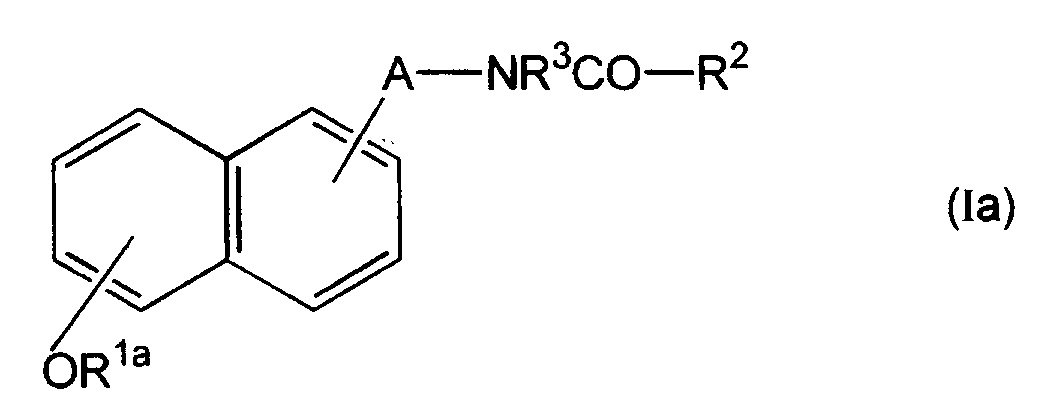
la réaction d'un composé de formule (II)dans laquelle R1aa est un groupe (alkylène en C1-4)-COOR10a dans lequel R10a est un groupe alkyle en C1-4, et les autres symboles sont tels que définis ci-dessus, avec un composé de formule (III)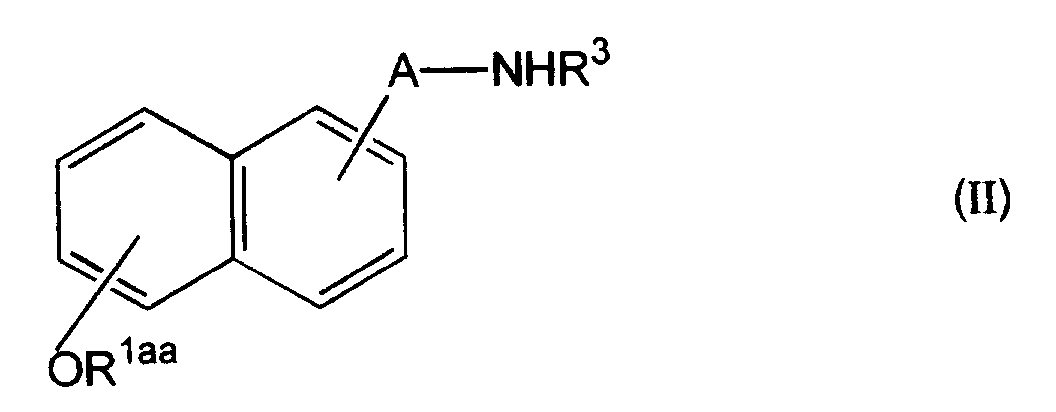 (b) quand le composé de formule (I) est conforme à la formule (Ib)dans laquelle tous les symboles sont tels que définis ci-dessus, la réaction d'un composé de formule (IV)
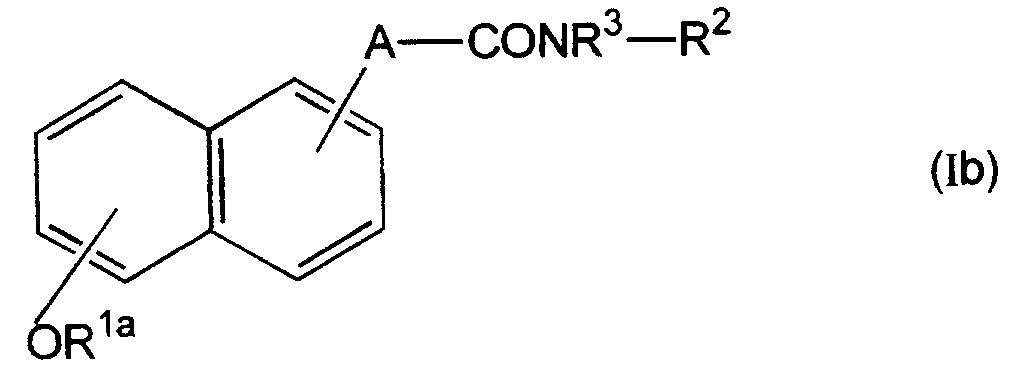 dans laquelle tous les symboles sont tels que définis ci-dessus, avec un composé de formule (V)
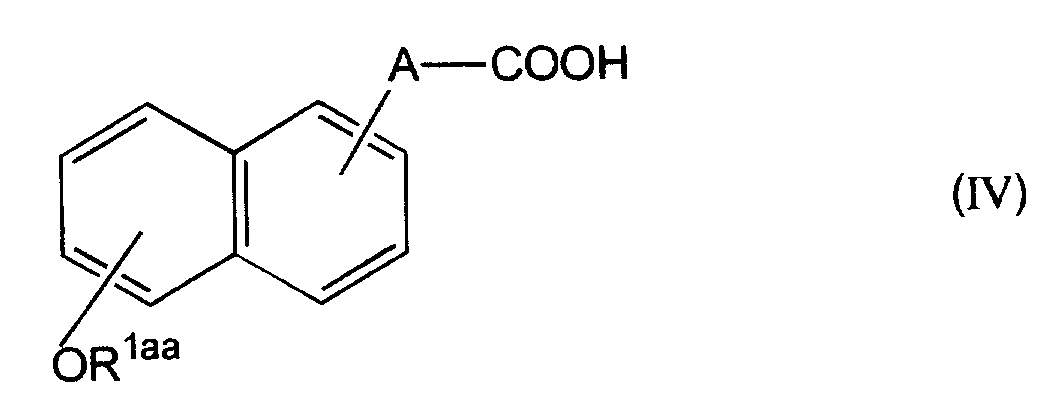 (c) quand le composé de formule (I) est conforme à la formule (Ic)dans laquelle R1c est un groupe (alkylène en C1-4)―COOR10, (alkylène en C1-4)―OH, (alkylène en C1-4)―CONR4R5, (alkylène en C1-4)―CONR6― (alkylène en C1-4)―OH, (alkylène en C1-4)―NR4R5, (alkylène en C1-4)― cyano ou (alkylène en C1-4)―tétrazolyle tel que défini dans la revendication 1, et les autres symboles sont tels que définis dans la revendication 1,

la réaction d'un composé de formule (Id)dans laquelle tous les symboles sont tels que définis ci-dessus avec un composé de formule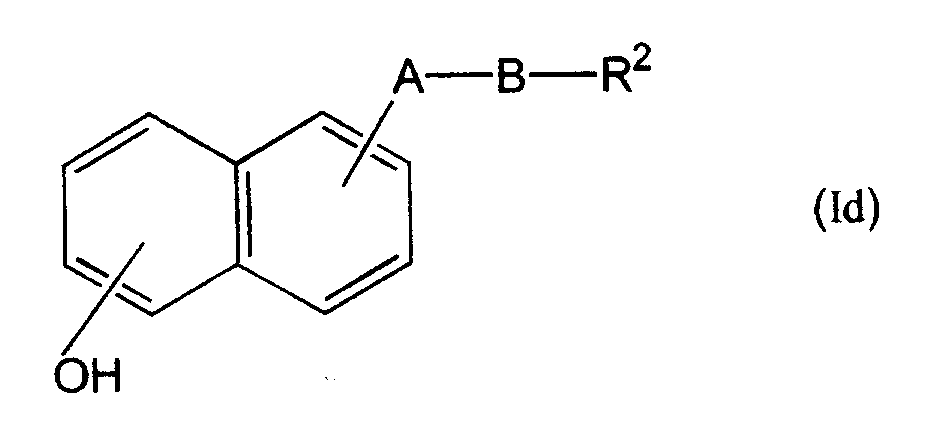 dans lequel R5a est un groupe alkyle en C1-4, benzyloxycarbonyle ou t-butoxycarbonyle, R30a est un groupe tétrahydropyranyle, benzyloxycarbonyle ou t-butoxycarbonyle, et les autres symboles sont tels que définis ci-dessus, en option suivie par une hydrolyse dans des conditions alcalines ou par élimination du groupe protecteur ;(alkylène en C1-4)―COOR10a,(alkylène en C1-4)―OR30a,(alkylène en C1-4)―CONR4R5a,(alkylène en C1-4)―CONR6―(alkylène en C1-4)―OR30a,(alkylène en C1-4)―NR4R5a,(alkylène en C1-4)―cyano ou(alkylène en C1-4)―tétrazolyl-R30a(d) quand le composé de formule (I) est conforme à la formule (Ic) dans laquelle R1c est un groupe (alkylène en C1-4)-tétrazolyle et les autres symboles sont tels que définis dans la revendication 1, la réaction d'un composé de formule (Ic) dans laquelle R1c est un groupe (alkylène en C1-4)-cyano et les autres symboles sont tels que définis ci-dessus, avec l'azide de sodium ;(e) quand le composé de formule (I) est conforme à la formule (Ie)dans laquelle tous les symboles sont tels que définis dans la revendication 1, la réaction d'un composé de formule (XVIa)
 dans laquelle tous les symboles sont tels que définis ci-dessus avec NaBH4 ou LiBH4 ;
 (f) quand le composé de formule (I) est conforme à la formule (1f)dans laquelle tous les symboles sont tels que définis dans la revendication 1, la réaction d'un composé de formule (Ie) dans laquelle tous les symboles sont tels que définis ci-dessus avec NaN3, suivie d'une réduction ;
 (g) quand le composé de formule (I) est conforme à la formule (Ig)dans laquelle tous les symboles sont tels que définis dans la revendication 1, la réaction d'un composé de formule (XVIb)
 dans laquelle tous les symboles sont tels que définis ci-dessus avec un composé de formule
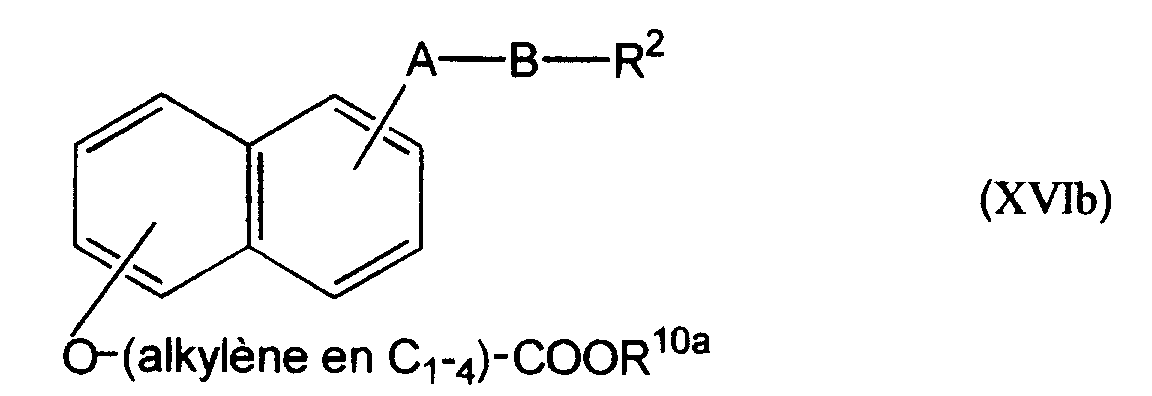 (h) quand le composé de formule (I) est conforme à la formule (Ih)dans laquelle tous les symboles sont tels que définis dans la revendication 1, la réaction d'un composé de formule (XVIb) dans laquelle tous les symboles sont tels que définis ci-dessus avec un composé de formule
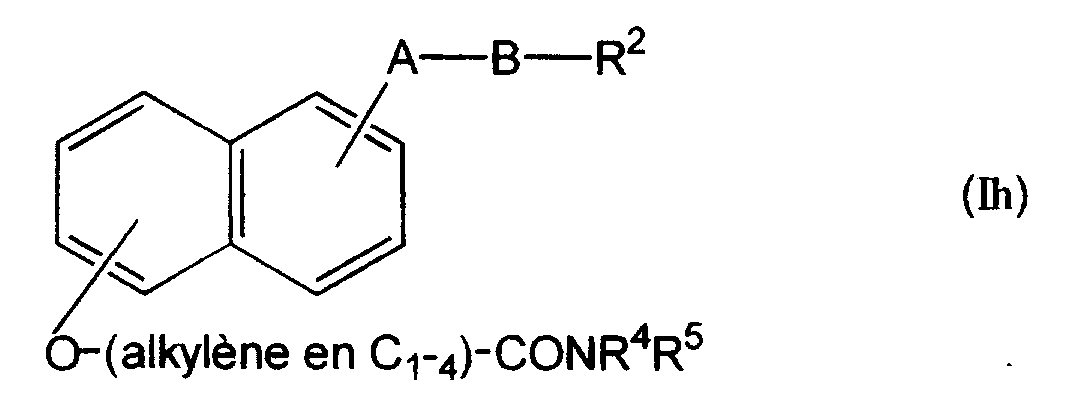 (i) éventuellement la conversion d'un composé de formule (I) pour obtenir ainsi un sel non toxique, un sel d'addition d'acide non toxique ou un hydrate de ceux-ci.
- Composition pharmaceutique qui comprend un dérivé de naphtalène de formule (I) telle que définie dans la revendication 1, ou un sel non toxique, ou un sel d'addition d'acide non toxique ou un hydrate de ceux-ci, en association avec un véhicule ou un revêtement acceptable du point de vue pharmaceutique.
- Utilisation d'un dérivé de naphtalène de formule (I) telle que définie dans la revendication 1, ou un sel non toxique, un sel d'addition d'acide non toxique ou un hydrate de ceux-ci, dans la fabrication d'un médicament pour le traitement et/ou la prévention de fausse-couche, de douleur, de diarrhée, de cathares, d'ulcères, de gastrites, d'hypertension ou de thrombose, ou dans la fabrication d'un médicament pour provoquer un avortement ou le sommeil.
Applications Claiming Priority (3)
| Application Number | Priority Date | Filing Date | Title |
|---|---|---|---|
| JP33765194 | 1994-12-28 | ||
| JP33765194 | 1994-12-28 | ||
| JP337651/94 | 1994-12-28 |
Publications (2)
| Publication Number | Publication Date |
|---|---|
| EP0719760A1 EP0719760A1 (fr) | 1996-07-03 |
| EP0719760B1 true EP0719760B1 (fr) | 1999-09-22 |
Family
ID=18310666
Family Applications (1)
| Application Number | Title | Priority Date | Filing Date |
|---|---|---|---|
| EP95309493A Expired - Lifetime EP0719760B1 (fr) | 1994-12-28 | 1995-12-28 | Dérivés naphtaléniques et leur utilisation comme agonistes et antagonists de PGE2 |
Country Status (8)
| Country | Link |
|---|---|
| US (2) | US5753700A (fr) |
| EP (1) | EP0719760B1 (fr) |
| KR (1) | KR100384261B1 (fr) |
| AT (1) | ATE184871T1 (fr) |
| DE (1) | DE69512364T2 (fr) |
| DK (1) | DK0719760T3 (fr) |
| ES (1) | ES2140629T3 (fr) |
| GR (1) | GR3031808T3 (fr) |
Families Citing this family (9)
| Publication number | Priority date | Publication date | Assignee | Title |
|---|---|---|---|---|
| FR2734815B1 (fr) * | 1995-05-31 | 1997-07-04 | Adir | Nouveaux composes arylalkyl (thio) carboxamides, leurs procedes de preparation et les compositions pharmaceutiques qui les contiennent |
| US5750564A (en) * | 1995-09-12 | 1998-05-12 | Hellberg; Mark | Anti-oxidant esters of non-steroidal anti-inflammatory agents |
| AU8750298A (en) * | 1997-08-28 | 1999-03-22 | Ono Pharmaceutical Co. Ltd. | Peroxisome proliferator-activated receptor controllers |
| US6335459B1 (en) | 1998-12-23 | 2002-01-01 | Syntex (U.S.A.) Llc | Aryl carboxylic acid and aryl tetrazole derivatives as IP receptor modulators |
| FR2791344B1 (fr) * | 1999-03-25 | 2002-02-15 | Adir | Nouveaux derives dimeriques substitues, leur procede de preparation et les compositions pharmaceutiques qui les contiennent |
| GB2389580A (en) * | 2002-06-12 | 2003-12-17 | Bayer Ag | 2-Naphthamide PGI2 antagonists |
| WO2004032964A1 (fr) * | 2002-10-10 | 2004-04-22 | Ono Pharmaceutical Co., Ltd. | Remedes pour affections allergiques |
| KR100622667B1 (ko) * | 2004-08-31 | 2006-09-19 | 한국화학연구원 | 나프틸옥시아세트산 유도체 |
| ATE509925T1 (de) | 2006-11-17 | 2011-06-15 | Pfizer | Substituierte bicyclocarbonsäureamidverbindungen |
Family Cites Families (11)
| Publication number | Priority date | Publication date | Assignee | Title |
|---|---|---|---|---|
| GB899714A (en) * | 1959-06-12 | 1962-06-27 | Ici Ltd | New metal-complexes of monoazo dyestuffs containing unsaturated acylamino groups |
| FR2059962A1 (en) * | 1969-08-05 | 1971-06-11 | Ici Ltd | Amine derivatives |
| JPS49119718A (fr) * | 1973-03-23 | 1974-11-15 | ||
| US4327022A (en) * | 1973-08-16 | 1982-04-27 | Sterling Drug Inc. | Heterocyclic alkyl naphthols |
| JPS5089352A (fr) * | 1973-12-17 | 1975-07-17 | ||
| JPS5430023A (en) * | 1977-08-11 | 1979-03-06 | Ricoh Co Ltd | Diazo copying method |
| US4543352A (en) * | 1983-04-29 | 1985-09-24 | William H. Rorer, Inc. | Naphthalene aminoalkylene ethers and thioethers, and their pharmaceutical uses |
| CA1261835A (fr) * | 1984-08-20 | 1989-09-26 | Masaaki Toda | Benz(thio) amides fusionnes |
| US5182272A (en) * | 1991-05-03 | 1993-01-26 | G. D. Searle & Co. | 8-substituted-dibenz[b,f][1,4]oxazepine-10(11)-carboxylic acid, substituted hydrazides, pharmaceutical compositions, and methods for treating pain |
| US5344836A (en) * | 1991-11-11 | 1994-09-06 | Ono Pharmaceutical Co., Ltd. | Fused benzeneoxyacetic acid derivatives |
| US5372931A (en) * | 1992-12-22 | 1994-12-13 | Eastman Kodak Company | Use of 4'-hydroxy- and 4'-alkoxy-substituted electron transfer agents in compositions, elements, test kits and analytical methods |
-
1995
- 1995-12-18 US US08/574,133 patent/US5753700A/en not_active Expired - Fee Related
- 1995-12-26 KR KR1019950056504A patent/KR100384261B1/ko not_active Expired - Fee Related
- 1995-12-28 DK DK95309493T patent/DK0719760T3/da active
- 1995-12-28 EP EP95309493A patent/EP0719760B1/fr not_active Expired - Lifetime
- 1995-12-28 DE DE69512364T patent/DE69512364T2/de not_active Expired - Fee Related
- 1995-12-28 ES ES95309493T patent/ES2140629T3/es not_active Expired - Lifetime
- 1995-12-28 AT AT95309493T patent/ATE184871T1/de not_active IP Right Cessation
-
1998
- 1998-01-23 US US09/012,448 patent/US6013673A/en not_active Expired - Fee Related
-
1999
- 1999-11-10 GR GR990402901T patent/GR3031808T3/el unknown
Also Published As
| Publication number | Publication date |
|---|---|
| EP0719760A1 (fr) | 1996-07-03 |
| DE69512364T2 (de) | 2000-02-03 |
| KR100384261B1 (ko) | 2003-08-21 |
| ATE184871T1 (de) | 1999-10-15 |
| KR960022438A (ko) | 1996-07-18 |
| US5753700A (en) | 1998-05-19 |
| US6013673A (en) | 2000-01-11 |
| GR3031808T3 (en) | 2000-02-29 |
| ES2140629T3 (es) | 2000-03-01 |
| DK0719760T3 (da) | 1999-12-20 |
| DE69512364D1 (de) | 1999-10-28 |
Similar Documents
| Publication | Publication Date | Title |
|---|---|---|
| EP0947500B1 (fr) | Derives de sulfamide, et medicaments contenant ces derives en tant que principe actif | |
| EP0558062B1 (fr) | Dérivés d'acide phénoxyacétique et compositions pharmaceutiques les contenant | |
| KR0142417B1 (ko) | 3급알킬작용성화된피레라진유도체 | |
| CA2493660A1 (fr) | Nouveaux composes | |
| EP1259484B1 (fr) | Carboxamides utilises comme inhibiteurs de proteine de transfert triglyceridique microsomique et de la secretion d'apolipoproteine b | |
| JPH075539B2 (ja) | 置換スルホンアミドベンズアミド及びその製法 | |
| JPH0673038A (ja) | ビフェニル誘導体、これらの化合物を含む医薬組成物及びそれらの調製法 | |
| AU3294799A (en) | Meta-azacyclic amino benzoic acid compounds and derivatives thereof being integrin antagonists | |
| KR0174283B1 (ko) | 고리가 접합된 벤젠옥시아세트산 유도체 | |
| EP0719760A1 (fr) | Dérivés d'acide naphtyloxyacétique et leur utilisation comme agonistes et antagonistes de PGE2 | |
| JP2656594B2 (ja) | ジアミン化合物、その製法及び該化合物を含有する高血圧症及び炎症を治療するための医薬 | |
| EP1511719B1 (fr) | Derives d'amide utilises comme inhibiteurs de l'activite enzymatique de la renine | |
| IL133578A (en) | Derivatives of aryl carboxylic acid and aryl tetrazole, and pharmaceutical preparations containing them and processes for their preparation | |
| CA2040319C (fr) | Derives de l'acide bicyclohydroxamique substitue par un groupement sulfonylamine | |
| MX2008015979A (es) | Derivados de aril- y heteroaril-etil-acilguanidina, su preparacion y su aplicacion en terapeutica. | |
| CZ280337B6 (cs) | Estery kyseliny dusičné s deriváty cyklohexanolu | |
| AU2004276128A1 (en) | Amide-type carboxamide derivatives | |
| WO1995009160A1 (fr) | Derive de benzolactame | |
| US5212173A (en) | Alkylaminoalkylamine and ether compounds, processes and intermediates for their preparation, and medicaments containing them | |
| HU195644B (en) | Process for producing new phenyl-acetonitril derivatives and pharmaceutical compositions containing them as active components | |
| JPH08239356A (ja) | ナフチルオキシ酢酸誘導体およびそれを有効成分として含有する医薬 | |
| JP3116256B2 (ja) | (チオ)ウレア誘導体 | |
| AU722680B2 (en) | Sulphur derivatives with a retroamide bond as endothelin-coating enzyme inhibitors | |
| JP2002332278A (ja) | Edg受容体拮抗作用を有する複素環誘導体 | |
| EP0174136A1 (fr) | Dérivés de dihydro-1H-pyrrolo[1,2-c]imidazole-3,5-dione comme activateurs de cognition |
Legal Events
| Date | Code | Title | Description |
|---|---|---|---|
| PUAI | Public reference made under article 153(3) epc to a published international application that has entered the european phase |
Free format text: ORIGINAL CODE: 0009012 |
|
| AK | Designated contracting states |
Kind code of ref document: A1 Designated state(s): AT BE CH DE DK ES FR GB GR IE IT LI LU NL PT SE |
|
| 17P | Request for examination filed |
Effective date: 19961230 |
|
| 17Q | First examination report despatched |
Effective date: 19971121 |
|
| GRAG | Despatch of communication of intention to grant |
Free format text: ORIGINAL CODE: EPIDOS AGRA |
|
| GRAG | Despatch of communication of intention to grant |
Free format text: ORIGINAL CODE: EPIDOS AGRA |
|
| GRAG | Despatch of communication of intention to grant |
Free format text: ORIGINAL CODE: EPIDOS AGRA |
|
| GRAH | Despatch of communication of intention to grant a patent |
Free format text: ORIGINAL CODE: EPIDOS IGRA |
|
| GRAH | Despatch of communication of intention to grant a patent |
Free format text: ORIGINAL CODE: EPIDOS IGRA |
|
| GRAA | (expected) grant |
Free format text: ORIGINAL CODE: 0009210 |
|
| AK | Designated contracting states |
Kind code of ref document: B1 Designated state(s): AT BE CH DE DK ES FR GB GR IE IT LI LU NL PT SE |
|
| REF | Corresponds to: |
Ref document number: 184871 Country of ref document: AT Date of ref document: 19991015 Kind code of ref document: T |
|
| REG | Reference to a national code |
Ref country code: CH Ref legal event code: NV Representative=s name: R. A. EGLI & CO. PATENTANWAELTE Ref country code: CH Ref legal event code: EP |
|
| REF | Corresponds to: |
Ref document number: 69512364 Country of ref document: DE Date of ref document: 19991028 |
|
| ITF | It: translation for a ep patent filed | ||
| REG | Reference to a national code |
Ref country code: IE Ref legal event code: FG4D |
|
| REG | Reference to a national code |
Ref country code: DK Ref legal event code: T3 |
|
| REG | Reference to a national code |
Ref country code: PT Ref legal event code: SC4A Free format text: AVAILABILITY OF NATIONAL TRANSLATION Effective date: 19991006 |
|
| ET | Fr: translation filed | ||
| REG | Reference to a national code |
Ref country code: ES Ref legal event code: FG2A Ref document number: 2140629 Country of ref document: ES Kind code of ref document: T3 |
|
| PLBE | No opposition filed within time limit |
Free format text: ORIGINAL CODE: 0009261 |
|
| STAA | Information on the status of an ep patent application or granted ep patent |
Free format text: STATUS: NO OPPOSITION FILED WITHIN TIME LIMIT |
|
| 26N | No opposition filed | ||
| REG | Reference to a national code |
Ref country code: GB Ref legal event code: IF02 |
|
| PGFP | Annual fee paid to national office [announced via postgrant information from national office to epo] |
Ref country code: SE Payment date: 20031204 Year of fee payment: 9 |
|
| PGFP | Annual fee paid to national office [announced via postgrant information from national office to epo] |
Ref country code: NL Payment date: 20031205 Year of fee payment: 9 |
|
| PGFP | Annual fee paid to national office [announced via postgrant information from national office to epo] |
Ref country code: FR Payment date: 20031210 Year of fee payment: 9 |
|
| PGFP | Annual fee paid to national office [announced via postgrant information from national office to epo] |
Ref country code: AT Payment date: 20031211 Year of fee payment: 9 |
|
| PGFP | Annual fee paid to national office [announced via postgrant information from national office to epo] |
Ref country code: DK Payment date: 20031216 Year of fee payment: 9 |
|
| PGFP | Annual fee paid to national office [announced via postgrant information from national office to epo] |
Ref country code: IE Payment date: 20031218 Year of fee payment: 9 |
|
| PGFP | Annual fee paid to national office [announced via postgrant information from national office to epo] |
Ref country code: GR Payment date: 20031222 Year of fee payment: 9 |
|
| PGFP | Annual fee paid to national office [announced via postgrant information from national office to epo] |
Ref country code: GB Payment date: 20031224 Year of fee payment: 9 |
|
| PGFP | Annual fee paid to national office [announced via postgrant information from national office to epo] |
Ref country code: LU Payment date: 20031230 Year of fee payment: 9 Ref country code: ES Payment date: 20031230 Year of fee payment: 9 |
|
| PGFP | Annual fee paid to national office [announced via postgrant information from national office to epo] |
Ref country code: PT Payment date: 20031231 Year of fee payment: 9 |
|
| PGFP | Annual fee paid to national office [announced via postgrant information from national office to epo] |
Ref country code: CH Payment date: 20040105 Year of fee payment: 9 |
|
| PGFP | Annual fee paid to national office [announced via postgrant information from national office to epo] |
Ref country code: DE Payment date: 20040108 Year of fee payment: 9 |
|
| PGFP | Annual fee paid to national office [announced via postgrant information from national office to epo] |
Ref country code: BE Payment date: 20040212 Year of fee payment: 9 |
|
| PG25 | Lapsed in a contracting state [announced via postgrant information from national office to epo] |
Ref country code: LU Free format text: LAPSE BECAUSE OF NON-PAYMENT OF DUE FEES Effective date: 20041228 Ref country code: IE Free format text: LAPSE BECAUSE OF NON-PAYMENT OF DUE FEES Effective date: 20041228 Ref country code: GB Free format text: LAPSE BECAUSE OF NON-PAYMENT OF DUE FEES Effective date: 20041228 Ref country code: AT Free format text: LAPSE BECAUSE OF NON-PAYMENT OF DUE FEES Effective date: 20041228 |
|
| PG25 | Lapsed in a contracting state [announced via postgrant information from national office to epo] |
Ref country code: SE Free format text: LAPSE BECAUSE OF NON-PAYMENT OF DUE FEES Effective date: 20041229 Ref country code: ES Free format text: LAPSE BECAUSE OF NON-PAYMENT OF DUE FEES Effective date: 20041229 |
|
| PG25 | Lapsed in a contracting state [announced via postgrant information from national office to epo] |
Ref country code: LI Free format text: LAPSE BECAUSE OF NON-PAYMENT OF DUE FEES Effective date: 20041231 Ref country code: CH Free format text: LAPSE BECAUSE OF NON-PAYMENT OF DUE FEES Effective date: 20041231 Ref country code: BE Free format text: LAPSE BECAUSE OF NON-PAYMENT OF DUE FEES Effective date: 20041231 |
|
| PG25 | Lapsed in a contracting state [announced via postgrant information from national office to epo] |
Ref country code: DK Free format text: LAPSE BECAUSE OF NON-PAYMENT OF DUE FEES Effective date: 20050103 |
|
| PG25 | Lapsed in a contracting state [announced via postgrant information from national office to epo] |
Ref country code: PT Free format text: LAPSE BECAUSE OF NON-PAYMENT OF DUE FEES Effective date: 20050628 |
|
| BERE | Be: lapsed |
Owner name: *ONO PHARMACEUTICAL CO. LTD Effective date: 20041231 |
|
| PG25 | Lapsed in a contracting state [announced via postgrant information from national office to epo] |
Ref country code: NL Free format text: LAPSE BECAUSE OF NON-PAYMENT OF DUE FEES Effective date: 20050701 Ref country code: DE Free format text: LAPSE BECAUSE OF NON-PAYMENT OF DUE FEES Effective date: 20050701 |
|
| PG25 | Lapsed in a contracting state [announced via postgrant information from national office to epo] |
Ref country code: GR Free format text: LAPSE BECAUSE OF NON-PAYMENT OF DUE FEES Effective date: 20050704 |
|
| REG | Reference to a national code |
Ref country code: DK Ref legal event code: EBP |
|
| EUG | Se: european patent has lapsed | ||
| REG | Reference to a national code |
Ref country code: CH Ref legal event code: PL |
|
| GBPC | Gb: european patent ceased through non-payment of renewal fee |
Effective date: 20041228 |
|
| PG25 | Lapsed in a contracting state [announced via postgrant information from national office to epo] |
Ref country code: FR Free format text: LAPSE BECAUSE OF NON-PAYMENT OF DUE FEES Effective date: 20050831 |
|
| REG | Reference to a national code |
Ref country code: PT Ref legal event code: MM4A Effective date: 20050628 |
|
| NLV4 | Nl: lapsed or anulled due to non-payment of the annual fee |
Effective date: 20050701 |
|
| REG | Reference to a national code |
Ref country code: IE Ref legal event code: MM4A |
|
| REG | Reference to a national code |
Ref country code: FR Ref legal event code: ST |
|
| PG25 | Lapsed in a contracting state [announced via postgrant information from national office to epo] |
Ref country code: IT Free format text: LAPSE BECAUSE OF NON-PAYMENT OF DUE FEES;WARNING: LAPSES OF ITALIAN PATENTS WITH EFFECTIVE DATE BEFORE 2007 MAY HAVE OCCURRED AT ANY TIME BEFORE 2007. THE CORRECT EFFECTIVE DATE MAY BE DIFFERENT FROM THE ONE RECORDED. Effective date: 20051228 |
|
| REG | Reference to a national code |
Ref country code: ES Ref legal event code: FD2A Effective date: 20041229 |
|
| BERE | Be: lapsed |
Owner name: *ONO PHARMACEUTICAL CO. LTD Effective date: 20041231 |