EP0720219A2 - Fabrication d'une couche conductrice pour circuit intégré - Google Patents
Fabrication d'une couche conductrice pour circuit intégré Download PDFInfo
- Publication number
- EP0720219A2 EP0720219A2 EP96300023A EP96300023A EP0720219A2 EP 0720219 A2 EP0720219 A2 EP 0720219A2 EP 96300023 A EP96300023 A EP 96300023A EP 96300023 A EP96300023 A EP 96300023A EP 0720219 A2 EP0720219 A2 EP 0720219A2
- Authority
- EP
- European Patent Office
- Prior art keywords
- conductive material
- layer
- runners
- thickness
- blanket
- Prior art date
- Legal status (The legal status is an assumption and is not a legal conclusion. Google has not performed a legal analysis and makes no representation as to the accuracy of the status listed.)
- Withdrawn
Links
Images
Classifications
-
- H—ELECTRICITY
- H10—SEMICONDUCTOR DEVICES; ELECTRIC SOLID-STATE DEVICES NOT OTHERWISE PROVIDED FOR
- H10W—GENERIC PACKAGES, INTERCONNECTIONS, CONNECTORS OR OTHER CONSTRUCTIONAL DETAILS OF DEVICES COVERED BY CLASS H10
- H10W20/00—Interconnections in chips, wafers or substrates
- H10W20/01—Manufacture or treatment
- H10W20/031—Manufacture or treatment of conductive parts of the interconnections
-
- Y—GENERAL TAGGING OF NEW TECHNOLOGICAL DEVELOPMENTS; GENERAL TAGGING OF CROSS-SECTIONAL TECHNOLOGIES SPANNING OVER SEVERAL SECTIONS OF THE IPC; TECHNICAL SUBJECTS COVERED BY FORMER USPC CROSS-REFERENCE ART COLLECTIONS [XRACs] AND DIGESTS
- Y10—TECHNICAL SUBJECTS COVERED BY FORMER USPC
- Y10S—TECHNICAL SUBJECTS COVERED BY FORMER USPC CROSS-REFERENCE ART COLLECTIONS [XRACs] AND DIGESTS
- Y10S438/00—Semiconductor device manufacturing: process
- Y10S438/927—Electromigration resistant metallization
Definitions
- This invention relates to integrated circuits and methods for their fabrication.
- runners Modern integrated circuits are often fabricated with several layers of conductors, often termed "runners". Usually the runners are formed by depositing a blanket layer of a conductive material such as aluminum. Then a patterned photoresist is formed over the aluminum layer. Using the patterned photoresist as a mask, a plasma etching process is initiated and the aluminum is patterned. The patterned aluminum may then be covered with a dielectric.
- a conductive material such as aluminum.
- the invention includes forming a blanket layer of conductive material overlying a dielectric substrate. Then a blanket etchback procedure is performed to reduce the thickness of the conductive material, thereby producing a second blanket layer of conductive material, Then the second layer of conductive material is patterned to form runners.
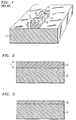
- substrate 11 is a dielectric, typically an oxide of silicon, or a dielectric containing substantial amount of an oxide of silicon.
- Reference numeral 13 denotes a runner formed according to conventional techniques.
- Reference numerals 15, 17, and 19 denote some of the grain boundaries in runner 13. It has been observed that runners which have grain boundaries that extend along the principal axis of the runner (such as grain boundaries 19) tend to be susceptible to stress migration failures. Furthermore, runners 13 formed by conventional techniques often have small randomly located grains, such as that denoted by reference numeral 21.
- Applicant has discovered that the resistance of runners to stress migration, and possibly electromigration can be improved if the runner has a more bamboo-like structure. Applicant has discovered that it is desirable to minimize or reduce the number of grain boundaries which have a directional component along the axis of the runner (such as grain boundary 19) and also to reduce the number of small grains such as that indicated by reference numeral 21.
- Runner 13 has a width denoted by w; and height denoted by h.
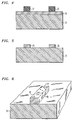
- reference numeral 31 denotes a substrate which, typically, may be an oxide of silicon or contain a substantial amount of an oxide of silicon. Desirably, substrate 31 is smoothed or planarized.
- Metal layer 33 is formed on top of dielectric 31 desirably, by sputtering, although evaporation or other deposition techniques may also be used.
- the thickness, t, of layer 33 is desirably made to be approximately twice the width of the final desired narrowest runner.
- the grain size of layer 33 is generally proportional to thickness and the density of small grains decreases significantly with increasing deposited - film thickness, t.
- the grain size of the patterned runner is generally proportional to the twice the width of the completed, patterned runner with greatly reduced numbers of small grains, thereby producing a uniform bamboo-like structure.
- aluminum layer 33 has been etched back. Typically, approximately 50% of the thickness t, of aluminum runner 33 has been removed.
- a blanket etch back of aluminum layer 33 may be performed by using a dry etching procedure well known to those skill in the art. Alternatively, the upper half of layer 33 may be anodized, converting it to an oxide. The aluminum oxide is removed in a chemical bath containing phosphoric acid and other etchants such as chromic acid known to those of skill of the art.
- patterned photoresist 37 (Fig. 4) is formed on top of layer 35.
- a dry etching process known to those skill in the art is performed to produce patterned runners 41 and 39.
- runner 41 a portion of patterned runner 41 is illustrated.
- Reference numeral 45 and 47 denote grain boundaries. It will be noted that small grains, such as that designated by reference numeral 21 in Fig. 1 and grains having grain boundaries with components parallel to the long axis of the runner (such as that designated by reference numeral 19 in Fig. 1) generally absent. Thus, runner 41 exhibits greater resistance to stress migration and electromigration.
- the inventive technique may be applied to form aluminum runners. It may also be implored to form aluminum runners from Al-Cu and/or Al-Cu-Si. Furthermore, the inventive technique may also be used to form runners containing principally copper or principally silver.
- the inventive technique may be applied to metal runners formed over conductive underlayers, such as patterned aluminum over TiN and/or Ti and/or a refractory metal silicide. The underlying conductive layer may be patterned together with the aluminum or in a subsequent step.
Landscapes
- Internal Circuitry In Semiconductor Integrated Circuit Devices (AREA)
- Semiconductor Integrated Circuits (AREA)
Applications Claiming Priority (2)
| Application Number | Priority Date | Filing Date | Title |
|---|---|---|---|
| US367380 | 1982-04-12 | ||
| US08/367,380 US5599737A (en) | 1994-12-30 | 1994-12-30 | Conductive runner fabrication |
Publications (2)
| Publication Number | Publication Date |
|---|---|
| EP0720219A2 true EP0720219A2 (fr) | 1996-07-03 |
| EP0720219A3 EP0720219A3 (fr) | 1997-05-07 |
Family
ID=23446935
Family Applications (1)
| Application Number | Title | Priority Date | Filing Date |
|---|---|---|---|
| EP96300023A Withdrawn EP0720219A3 (fr) | 1994-12-30 | 1996-01-02 | Fabrication d'une couche conductrice pour circuit intégré |
Country Status (3)
| Country | Link |
|---|---|
| US (1) | US5599737A (fr) |
| EP (1) | EP0720219A3 (fr) |
| JP (1) | JPH08236532A (fr) |
Family Cites Families (10)
| Publication number | Priority date | Publication date | Assignee | Title |
|---|---|---|---|---|
| US4891112A (en) * | 1985-11-12 | 1990-01-02 | Eastman Kodak Company | Sputtering method for reducing hillocking in aluminum layers formed on substrates |
| US5001541A (en) * | 1989-03-22 | 1991-03-19 | Texas Instruments Incorporated | Advanced electromigration resistant interconnect structure and process |
| US5167760A (en) * | 1989-11-14 | 1992-12-01 | Intel Corporation | Etchback process for tungsten contact/via filling |
| US5057455A (en) * | 1989-11-30 | 1991-10-15 | At&T Bell Laboratories | Formation of integrated circuit electrodes |
| US5141897A (en) * | 1990-03-23 | 1992-08-25 | At&T Bell Laboratories | Method of making integrated circuit interconnection |
| US5278448A (en) * | 1991-03-19 | 1994-01-11 | Matsushita Electric Industrial Co., Ltd. | Semiconductor device and method of fabricating the same |
| JPH06177127A (ja) * | 1991-05-30 | 1994-06-24 | Sony Corp | 配線形成方法 |
| JPH04354337A (ja) * | 1991-05-31 | 1992-12-08 | Kawasaki Steel Corp | 半導体装置の製造方法 |
| US5202274A (en) * | 1991-06-14 | 1993-04-13 | Samsung Electronics Co., Ltd. | Method of fabricating thin film transistor |
| EP0609501B1 (fr) * | 1993-01-20 | 1999-09-15 | Kabushiki Kaisha Toshiba | Métallisation basé sur l'aluminium pour dispositif semi-conducteur |
-
1994
- 1994-12-30 US US08/367,380 patent/US5599737A/en not_active Expired - Fee Related
-
1995
- 1995-12-28 JP JP7343003A patent/JPH08236532A/ja not_active Withdrawn
-
1996
- 1996-01-02 EP EP96300023A patent/EP0720219A3/fr not_active Withdrawn
Also Published As
| Publication number | Publication date |
|---|---|
| US5599737A (en) | 1997-02-04 |
| EP0720219A3 (fr) | 1997-05-07 |
| JPH08236532A (ja) | 1996-09-13 |
Similar Documents
| Publication | Publication Date | Title |
|---|---|---|
| US5367284A (en) | Thin film resistor and method for manufacturing the same | |
| US5270255A (en) | Metallization process for good metal step coverage while maintaining useful alignment mark | |
| US6469609B2 (en) | Method of fabricating silver inductor | |
| JPS6185879A (ja) | 導電パタ−ンの形成方法 | |
| JPH06140396A (ja) | 半導体装置とその製法 | |
| US6268287B1 (en) | Polymerless metal hard mask etching | |
| US5234864A (en) | Method for interconnecting layers in a semiconductor device using two etching gases | |
| US5663102A (en) | Method for forming multi-layered metal wiring semiconductor element using cmp or etch back | |
| JPH03138934A (ja) | 異なる深さを有する窓のエッチング法 | |
| US4855252A (en) | Process for making self-aligned contacts | |
| JPH0766942B2 (ja) | 多層相互接続導体パターン製造方法 | |
| US5041191A (en) | Diffusion barrier for thin film hybrid circuits | |
| JP2770945B2 (ja) | タングステン被覆法 | |
| US4717449A (en) | Dielectric barrier material | |
| US5599737A (en) | Conductive runner fabrication | |
| JP2808616B2 (ja) | 半導体装置の製造方法 | |
| US6395629B1 (en) | Interconnect method and structure for semiconductor devices | |
| JP2892337B2 (ja) | 半導体素子の金属配線製造方法 | |
| US5200359A (en) | Method of decreasing contact resistance between a lower elevation aluminum layer and a higher elevation electrically conductive layer | |
| US4713682A (en) | Dielectric barrier material | |
| US6548413B1 (en) | Method to reduce microloading in metal etching | |
| JPH0918117A (ja) | 導電体層形成方法 | |
| KR100265839B1 (ko) | 반도체 소자의 금속배선 형 성방법 | |
| JPH08186120A (ja) | 半導体装置の製造方法 | |
| JPH05251566A (ja) | 多層配線構造 |
Legal Events
| Date | Code | Title | Description |
|---|---|---|---|
| PUAI | Public reference made under article 153(3) epc to a published international application that has entered the european phase |
Free format text: ORIGINAL CODE: 0009012 |
|
| AK | Designated contracting states |
Kind code of ref document: A2 Designated state(s): DE FR GB |
|
| PUAL | Search report despatched |
Free format text: ORIGINAL CODE: 0009013 |
|
| AK | Designated contracting states |
Kind code of ref document: A3 Designated state(s): DE FR GB |
|
| 17P | Request for examination filed |
Effective date: 19971023 |
|
| STAA | Information on the status of an ep patent application or granted ep patent |
Free format text: STATUS: THE APPLICATION HAS BEEN WITHDRAWN |
|
| 18W | Application withdrawn |
Withdrawal date: 19980424 |