EP0723043B1 - Verbundstruktur aus Milchsäure-Derivate - Google Patents
Verbundstruktur aus Milchsäure-Derivate Download PDFInfo
- Publication number
- EP0723043B1 EP0723043B1 EP95470032A EP95470032A EP0723043B1 EP 0723043 B1 EP0723043 B1 EP 0723043B1 EP 95470032 A EP95470032 A EP 95470032A EP 95470032 A EP95470032 A EP 95470032A EP 0723043 B1 EP0723043 B1 EP 0723043B1
- Authority
- EP
- European Patent Office
- Prior art keywords
- lactic acid
- composite structure
- film
- layers
- composite
- Prior art date
- Legal status (The legal status is an assumption and is not a legal conclusion. Google has not performed a legal analysis and makes no representation as to the accuracy of the status listed.)
- Expired - Lifetime
Links
- 239000002131 composite material Substances 0.000 title claims abstract description 48
- JVTAAEKCZFNVCJ-UHFFFAOYSA-N lactic acid Chemical compound CC(O)C(O)=O JVTAAEKCZFNVCJ-UHFFFAOYSA-N 0.000 title claims abstract description 43
- 239000004310 lactic acid Substances 0.000 title claims abstract description 21
- 235000014655 lactic acid Nutrition 0.000 title claims abstract description 21
- 229920000642 polymer Polymers 0.000 claims abstract description 35
- 239000004745 nonwoven fabric Substances 0.000 claims abstract description 9
- 229920001577 copolymer Polymers 0.000 claims abstract description 6
- 238000000034 method Methods 0.000 claims description 16
- 239000000203 mixture Substances 0.000 claims description 13
- 229920001169 thermoplastic Polymers 0.000 claims description 2
- 239000000463 material Substances 0.000 abstract description 5
- 239000010410 layer Substances 0.000 description 36
- 238000004519 manufacturing process Methods 0.000 description 15
- 239000000835 fiber Substances 0.000 description 14
- 230000004888 barrier function Effects 0.000 description 10
- 229920000747 poly(lactic acid) Polymers 0.000 description 10
- 230000008569 process Effects 0.000 description 10
- 238000007664 blowing Methods 0.000 description 9
- 238000003490 calendering Methods 0.000 description 8
- 239000000126 substance Substances 0.000 description 8
- 238000010586 diagram Methods 0.000 description 7
- 238000001125 extrusion Methods 0.000 description 7
- 238000007789 sealing Methods 0.000 description 7
- 238000010521 absorption reaction Methods 0.000 description 6
- 230000000694 effects Effects 0.000 description 6
- 239000002994 raw material Substances 0.000 description 6
- 239000002253 acid Substances 0.000 description 5
- 239000011230 binding agent Substances 0.000 description 5
- 238000001914 filtration Methods 0.000 description 5
- 238000009434 installation Methods 0.000 description 5
- 238000003475 lamination Methods 0.000 description 5
- XLYOFNOQVPJJNP-UHFFFAOYSA-N water Substances O XLYOFNOQVPJJNP-UHFFFAOYSA-N 0.000 description 5
- 229920000954 Polyglycolide Polymers 0.000 description 4
- 239000000654 additive Substances 0.000 description 4
- 239000007788 liquid Substances 0.000 description 4
- 238000003466 welding Methods 0.000 description 4
- 238000001816 cooling Methods 0.000 description 3
- 238000009413 insulation Methods 0.000 description 3
- 230000000737 periodic effect Effects 0.000 description 3
- 238000009987 spinning Methods 0.000 description 3
- 239000003381 stabilizer Substances 0.000 description 3
- 230000001954 sterilising effect Effects 0.000 description 3
- 238000004659 sterilization and disinfection Methods 0.000 description 3
- 241000196324 Embryophyta Species 0.000 description 2
- 208000034530 PLAA-associated neurodevelopmental disease Diseases 0.000 description 2
- 229920000331 Polyhydroxybutyrate Polymers 0.000 description 2
- 230000002745 absorbent Effects 0.000 description 2
- 239000002250 absorbent Substances 0.000 description 2
- 239000006229 carbon black Substances 0.000 description 2
- 230000015556 catabolic process Effects 0.000 description 2
- 239000011248 coating agent Substances 0.000 description 2
- 238000000576 coating method Methods 0.000 description 2
- 238000006731 degradation reaction Methods 0.000 description 2
- 239000000975 dye Substances 0.000 description 2
- 230000002209 hydrophobic effect Effects 0.000 description 2
- 239000007943 implant Substances 0.000 description 2
- 238000010030 laminating Methods 0.000 description 2
- 239000002362 mulch Substances 0.000 description 2
- 239000005015 poly(hydroxybutyrate) Substances 0.000 description 2
- 229920001610 polycaprolactone Polymers 0.000 description 2
- 239000004632 polycaprolactone Substances 0.000 description 2
- 229920000728 polyester Polymers 0.000 description 2
- 239000004633 polyglycolic acid Substances 0.000 description 2
- 239000004626 polylactic acid Substances 0.000 description 2
- 229920000098 polyolefin Polymers 0.000 description 2
- 238000004804 winding Methods 0.000 description 2
- IUPHTVOTTBREAV-UHFFFAOYSA-N 3-hydroxybutanoic acid;3-hydroxypentanoic acid Chemical compound CC(O)CC(O)=O.CCC(O)CC(O)=O IUPHTVOTTBREAV-UHFFFAOYSA-N 0.000 description 1
- 229920013642 Biopol™ Polymers 0.000 description 1
- 208000010392 Bone Fractures Diseases 0.000 description 1
- 240000009088 Fragaria x ananassa Species 0.000 description 1
- AEMRFAOFKBGASW-UHFFFAOYSA-N Glycolic acid Polymers OCC(O)=O AEMRFAOFKBGASW-UHFFFAOYSA-N 0.000 description 1
- MHAJPDPJQMAIIY-UHFFFAOYSA-N Hydrogen peroxide Chemical compound OO MHAJPDPJQMAIIY-UHFFFAOYSA-N 0.000 description 1
- CZMRCDWAGMRECN-UHFFFAOYSA-N Rohrzucker Natural products OCC1OC(CO)(OC2OC(CO)C(O)C(O)C2O)C(O)C1O CZMRCDWAGMRECN-UHFFFAOYSA-N 0.000 description 1
- 239000012963 UV stabilizer Substances 0.000 description 1
- 239000005862 Whey Substances 0.000 description 1
- 102000007544 Whey Proteins Human genes 0.000 description 1
- 108010046377 Whey Proteins Proteins 0.000 description 1
- 239000004480 active ingredient Substances 0.000 description 1
- 230000000996 additive effect Effects 0.000 description 1
- 230000000975 bioactive effect Effects 0.000 description 1
- 229920000229 biodegradable polyester Polymers 0.000 description 1
- 239000004622 biodegradable polyester Substances 0.000 description 1
- 229920002988 biodegradable polymer Polymers 0.000 description 1
- 239000004621 biodegradable polymer Substances 0.000 description 1
- 230000015572 biosynthetic process Effects 0.000 description 1
- BVKZGUZCCUSVTD-UHFFFAOYSA-N carbonic acid Chemical compound OC(O)=O BVKZGUZCCUSVTD-UHFFFAOYSA-N 0.000 description 1
- 238000009264 composting Methods 0.000 description 1
- 238000012936 correction and preventive action Methods 0.000 description 1
- 230000003247 decreasing effect Effects 0.000 description 1
- 229920006238 degradable plastic Polymers 0.000 description 1
- 229920006237 degradable polymer Polymers 0.000 description 1
- 230000008021 deposition Effects 0.000 description 1
- 238000009792 diffusion process Methods 0.000 description 1
- 238000012377 drug delivery Methods 0.000 description 1
- 238000001035 drying Methods 0.000 description 1
- 239000010408 film Substances 0.000 description 1
- 239000006260 foam Substances 0.000 description 1
- 230000004927 fusion Effects 0.000 description 1
- 230000002962 histologic effect Effects 0.000 description 1
- 238000009940 knitting Methods 0.000 description 1
- 238000010128 melt processing Methods 0.000 description 1
- 238000002844 melting Methods 0.000 description 1
- 230000008018 melting Effects 0.000 description 1
- 239000000178 monomer Substances 0.000 description 1
- -1 over-blowing Substances 0.000 description 1
- 238000004806 packaging method and process Methods 0.000 description 1
- 230000035699 permeability Effects 0.000 description 1
- 239000003208 petroleum Substances 0.000 description 1
- 239000000049 pigment Substances 0.000 description 1
- 239000002985 plastic film Substances 0.000 description 1
- 239000004014 plasticizer Substances 0.000 description 1
- 229940065514 poly(lactide) Drugs 0.000 description 1
- 230000001681 protective effect Effects 0.000 description 1
- 230000005855 radiation Effects 0.000 description 1
- 230000001603 reducing effect Effects 0.000 description 1
- 230000001105 regulatory effect Effects 0.000 description 1
- 239000011347 resin Substances 0.000 description 1
- 229920005989 resin Polymers 0.000 description 1
- 239000002689 soil Substances 0.000 description 1
- 239000002910 solid waste Substances 0.000 description 1
- 230000000087 stabilizing effect Effects 0.000 description 1
- 230000003068 static effect Effects 0.000 description 1
- 235000021012 strawberries Nutrition 0.000 description 1
- 239000002344 surface layer Substances 0.000 description 1
- 230000008685 targeting Effects 0.000 description 1
- 230000003612 virological effect Effects 0.000 description 1
- 239000002699 waste material Substances 0.000 description 1
- 238000009941 weaving Methods 0.000 description 1
- 238000005493 welding type Methods 0.000 description 1
Images
Classifications
-
- B—PERFORMING OPERATIONS; TRANSPORTING
- B32—LAYERED PRODUCTS
- B32B—LAYERED PRODUCTS, i.e. PRODUCTS BUILT-UP OF STRATA OF FLAT OR NON-FLAT, e.g. CELLULAR OR HONEYCOMB, FORM
- B32B27/00—Layered products comprising a layer of synthetic resin
- B32B27/02—Layered products comprising a layer of synthetic resin in the form of fibres or filaments
-
- B—PERFORMING OPERATIONS; TRANSPORTING
- B32—LAYERED PRODUCTS
- B32B—LAYERED PRODUCTS, i.e. PRODUCTS BUILT-UP OF STRATA OF FLAT OR NON-FLAT, e.g. CELLULAR OR HONEYCOMB, FORM
- B32B27/00—Layered products comprising a layer of synthetic resin
- B32B27/12—Layered products comprising a layer of synthetic resin next to a fibrous or filamentary layer
-
- B—PERFORMING OPERATIONS; TRANSPORTING
- B32—LAYERED PRODUCTS
- B32B—LAYERED PRODUCTS, i.e. PRODUCTS BUILT-UP OF STRATA OF FLAT OR NON-FLAT, e.g. CELLULAR OR HONEYCOMB, FORM
- B32B27/00—Layered products comprising a layer of synthetic resin
- B32B27/36—Layered products comprising a layer of synthetic resin comprising polyesters
-
- D—TEXTILES; PAPER
- D04—BRAIDING; LACE-MAKING; KNITTING; TRIMMINGS; NON-WOVEN FABRICS
- D04H—MAKING TEXTILE FABRICS, e.g. FROM FIBRES OR FILAMENTARY MATERIAL; FABRICS MADE BY SUCH PROCESSES OR APPARATUS, e.g. FELTS, NON-WOVEN FABRICS; COTTON-WOOL; WADDING ; NON-WOVEN FABRICS FROM STAPLE FIBRES, FILAMENTS OR YARNS, BONDED WITH AT LEAST ONE WEB-LIKE MATERIAL DURING THEIR CONSOLIDATION
- D04H1/00—Non-woven fabrics formed wholly or mainly of staple fibres or like relatively short fibres
- D04H1/40—Non-woven fabrics formed wholly or mainly of staple fibres or like relatively short fibres from fleeces or layers composed of fibres without existing or potential cohesive properties
- D04H1/42—Non-woven fabrics formed wholly or mainly of staple fibres or like relatively short fibres from fleeces or layers composed of fibres without existing or potential cohesive properties characterised by the use of certain kinds of fibres insofar as this use has no preponderant influence on the consolidation of the fleece
- D04H1/4326—Condensation or reaction polymers
- D04H1/435—Polyesters
-
- D—TEXTILES; PAPER
- D04—BRAIDING; LACE-MAKING; KNITTING; TRIMMINGS; NON-WOVEN FABRICS
- D04H—MAKING TEXTILE FABRICS, e.g. FROM FIBRES OR FILAMENTARY MATERIAL; FABRICS MADE BY SUCH PROCESSES OR APPARATUS, e.g. FELTS, NON-WOVEN FABRICS; COTTON-WOOL; WADDING ; NON-WOVEN FABRICS FROM STAPLE FIBRES, FILAMENTS OR YARNS, BONDED WITH AT LEAST ONE WEB-LIKE MATERIAL DURING THEIR CONSOLIDATION
- D04H13/00—Other non-woven fabrics
-
- D—TEXTILES; PAPER
- D04—BRAIDING; LACE-MAKING; KNITTING; TRIMMINGS; NON-WOVEN FABRICS
- D04H—MAKING TEXTILE FABRICS, e.g. FROM FIBRES OR FILAMENTARY MATERIAL; FABRICS MADE BY SUCH PROCESSES OR APPARATUS, e.g. FELTS, NON-WOVEN FABRICS; COTTON-WOOL; WADDING ; NON-WOVEN FABRICS FROM STAPLE FIBRES, FILAMENTS OR YARNS, BONDED WITH AT LEAST ONE WEB-LIKE MATERIAL DURING THEIR CONSOLIDATION
- D04H3/00—Non-woven fabrics formed wholly or mainly of yarns or like filamentary material of substantial length
- D04H3/005—Synthetic yarns or filaments
- D04H3/009—Condensation or reaction polymers
- D04H3/011—Polyesters
-
- Y—GENERAL TAGGING OF NEW TECHNOLOGICAL DEVELOPMENTS; GENERAL TAGGING OF CROSS-SECTIONAL TECHNOLOGIES SPANNING OVER SEVERAL SECTIONS OF THE IPC; TECHNICAL SUBJECTS COVERED BY FORMER USPC CROSS-REFERENCE ART COLLECTIONS [XRACs] AND DIGESTS
- Y10—TECHNICAL SUBJECTS COVERED BY FORMER USPC
- Y10T—TECHNICAL SUBJECTS COVERED BY FORMER US CLASSIFICATION
- Y10T428/00—Stock material or miscellaneous articles
- Y10T428/31504—Composite [nonstructural laminate]
- Y10T428/31855—Of addition polymer from unsaturated monomers
- Y10T428/31909—Next to second addition polymer from unsaturated monomers
-
- Y—GENERAL TAGGING OF NEW TECHNOLOGICAL DEVELOPMENTS; GENERAL TAGGING OF CROSS-SECTIONAL TECHNOLOGIES SPANNING OVER SEVERAL SECTIONS OF THE IPC; TECHNICAL SUBJECTS COVERED BY FORMER USPC CROSS-REFERENCE ART COLLECTIONS [XRACs] AND DIGESTS
- Y10—TECHNICAL SUBJECTS COVERED BY FORMER USPC
- Y10T—TECHNICAL SUBJECTS COVERED BY FORMER US CLASSIFICATION
- Y10T442/00—Fabric [woven, knitted, or nonwoven textile or cloth, etc.]
- Y10T442/60—Nonwoven fabric [i.e., nonwoven strand or fiber material]
- Y10T442/601—Nonwoven fabric has an elastic quality
- Y10T442/602—Nonwoven fabric comprises an elastic strand or fiber material
-
- Y—GENERAL TAGGING OF NEW TECHNOLOGICAL DEVELOPMENTS; GENERAL TAGGING OF CROSS-SECTIONAL TECHNOLOGIES SPANNING OVER SEVERAL SECTIONS OF THE IPC; TECHNICAL SUBJECTS COVERED BY FORMER USPC CROSS-REFERENCE ART COLLECTIONS [XRACs] AND DIGESTS
- Y10—TECHNICAL SUBJECTS COVERED BY FORMER USPC
- Y10T—TECHNICAL SUBJECTS COVERED BY FORMER US CLASSIFICATION
- Y10T442/00—Fabric [woven, knitted, or nonwoven textile or cloth, etc.]
- Y10T442/60—Nonwoven fabric [i.e., nonwoven strand or fiber material]
- Y10T442/659—Including an additional nonwoven fabric
- Y10T442/66—Additional nonwoven fabric is a spun-bonded fabric
- Y10T442/662—Needled
-
- Y—GENERAL TAGGING OF NEW TECHNOLOGICAL DEVELOPMENTS; GENERAL TAGGING OF CROSS-SECTIONAL TECHNOLOGIES SPANNING OVER SEVERAL SECTIONS OF THE IPC; TECHNICAL SUBJECTS COVERED BY FORMER USPC CROSS-REFERENCE ART COLLECTIONS [XRACs] AND DIGESTS
- Y10—TECHNICAL SUBJECTS COVERED BY FORMER USPC
- Y10T—TECHNICAL SUBJECTS COVERED BY FORMER US CLASSIFICATION
- Y10T442/00—Fabric [woven, knitted, or nonwoven textile or cloth, etc.]
- Y10T442/60—Nonwoven fabric [i.e., nonwoven strand or fiber material]
- Y10T442/659—Including an additional nonwoven fabric
- Y10T442/66—Additional nonwoven fabric is a spun-bonded fabric
- Y10T442/663—Hydroentangled
-
- Y—GENERAL TAGGING OF NEW TECHNOLOGICAL DEVELOPMENTS; GENERAL TAGGING OF CROSS-SECTIONAL TECHNOLOGIES SPANNING OVER SEVERAL SECTIONS OF THE IPC; TECHNICAL SUBJECTS COVERED BY FORMER USPC CROSS-REFERENCE ART COLLECTIONS [XRACs] AND DIGESTS
- Y10—TECHNICAL SUBJECTS COVERED BY FORMER USPC
- Y10T—TECHNICAL SUBJECTS COVERED BY FORMER US CLASSIFICATION
- Y10T442/00—Fabric [woven, knitted, or nonwoven textile or cloth, etc.]
- Y10T442/60—Nonwoven fabric [i.e., nonwoven strand or fiber material]
- Y10T442/659—Including an additional nonwoven fabric
- Y10T442/671—Multiple nonwoven fabric layers composed of the same polymeric strand or fiber material
-
- Y—GENERAL TAGGING OF NEW TECHNOLOGICAL DEVELOPMENTS; GENERAL TAGGING OF CROSS-SECTIONAL TECHNOLOGIES SPANNING OVER SEVERAL SECTIONS OF THE IPC; TECHNICAL SUBJECTS COVERED BY FORMER USPC CROSS-REFERENCE ART COLLECTIONS [XRACs] AND DIGESTS
- Y10—TECHNICAL SUBJECTS COVERED BY FORMER USPC
- Y10T—TECHNICAL SUBJECTS COVERED BY FORMER US CLASSIFICATION
- Y10T442/00—Fabric [woven, knitted, or nonwoven textile or cloth, etc.]
- Y10T442/60—Nonwoven fabric [i.e., nonwoven strand or fiber material]
- Y10T442/674—Nonwoven fabric with a preformed polymeric film or sheet
- Y10T442/675—Ester condensation polymer sheet or film [e.g., polyethylene terephthalate, etc.]
-
- Y—GENERAL TAGGING OF NEW TECHNOLOGICAL DEVELOPMENTS; GENERAL TAGGING OF CROSS-SECTIONAL TECHNOLOGIES SPANNING OVER SEVERAL SECTIONS OF THE IPC; TECHNICAL SUBJECTS COVERED BY FORMER USPC CROSS-REFERENCE ART COLLECTIONS [XRACs] AND DIGESTS
- Y10—TECHNICAL SUBJECTS COVERED BY FORMER USPC
- Y10T—TECHNICAL SUBJECTS COVERED BY FORMER US CLASSIFICATION
- Y10T442/00—Fabric [woven, knitted, or nonwoven textile or cloth, etc.]
- Y10T442/60—Nonwoven fabric [i.e., nonwoven strand or fiber material]
- Y10T442/681—Spun-bonded nonwoven fabric
-
- Y—GENERAL TAGGING OF NEW TECHNOLOGICAL DEVELOPMENTS; GENERAL TAGGING OF CROSS-SECTIONAL TECHNOLOGIES SPANNING OVER SEVERAL SECTIONS OF THE IPC; TECHNICAL SUBJECTS COVERED BY FORMER USPC CROSS-REFERENCE ART COLLECTIONS [XRACs] AND DIGESTS
- Y10—TECHNICAL SUBJECTS COVERED BY FORMER USPC
- Y10T—TECHNICAL SUBJECTS COVERED BY FORMER US CLASSIFICATION
- Y10T442/00—Fabric [woven, knitted, or nonwoven textile or cloth, etc.]
- Y10T442/60—Nonwoven fabric [i.e., nonwoven strand or fiber material]
- Y10T442/682—Needled nonwoven fabric
-
- Y—GENERAL TAGGING OF NEW TECHNOLOGICAL DEVELOPMENTS; GENERAL TAGGING OF CROSS-SECTIONAL TECHNOLOGIES SPANNING OVER SEVERAL SECTIONS OF THE IPC; TECHNICAL SUBJECTS COVERED BY FORMER USPC CROSS-REFERENCE ART COLLECTIONS [XRACs] AND DIGESTS
- Y10—TECHNICAL SUBJECTS COVERED BY FORMER USPC
- Y10T—TECHNICAL SUBJECTS COVERED BY FORMER US CLASSIFICATION
- Y10T442/00—Fabric [woven, knitted, or nonwoven textile or cloth, etc.]
- Y10T442/60—Nonwoven fabric [i.e., nonwoven strand or fiber material]
- Y10T442/689—Hydroentangled nonwoven fabric
Definitions
- the present invention relates to a composite structure comprising one or more layers of nonwoven associated with one or more several films, or one or more layers of nonwoven associated between they.
- This invention also relates to the manufacturing method. of said composite structure and the method for combining the different layers of this composite.
- said composite products consist of polyolefins.
- Applications in which this type of composition is used are: baby diapers, periodic towels, baby clothes protection, masks and operating fields in the medical field and some products for absorption and filtration, protection of plants in agriculture and mulching.
- degradable polymers especially those which are biodegradable, is one of the solutions to this problem.
- PLA lactic acid
- PLAs offer the possibility of obtaining mechanical and physico-chemical properties which are comparable to those of conventional polymers (US Patents 4743257, 1988 and 4968317, 1990).
- US Patents 4743257, 1988 and 4968317, 1990 US Patents 4743257, 1988 and 4968317, 1990.
- PLA Unlike other polymers biodegradable, it is very easy to manufacture at relatively low cost bottom, fine fibers from polymers derived from PLA (Ahamad Y.A.
- MITSUI TOATSU CHEMICALS INC. made a request patent on May 12, 1992, EP-A-0 514 137, entitled “Degradable lamination composition ".
- This patent concerns polymers derived from PLA (including copolymers of PLA and hydroxycarboxylic acid) used for laminating with paper in the industry of packaging.
- PLA derivatives are made from renewable materials such as than beet sugar or whey. So making these polymers in no way affect the natural balance (greenhouse effect) and does not use petroleum, non-renewable energy.
- the present invention relates to a composite structure based of polymers derived from PLA.
- This composite structure is composed of layers of nonwoven and / or films. Each layer has properties mechanical, barrier effect, absorption, filtration and thermal insulation can be adapted to each application by selecting the suitable composition of nonwovens and acid-based films polylactic.
- the invention consists of a structure composite comprising at least one layer of nonwoven and at minus a layer of film, characterized in that the layers are composed of thermoplastic polymers derived exclusively from acid lactic.
- a lactic acid derivative is used chosen as a whole (lactic acid D, lactic acid L), or a derivative lactic acid D and L, or a mixture of lactic acid L and acid lactic D.
- the polymer, the copolymer, or the mixture of polymers with an average molecular weight of between 10,000 and 1,000,000.
- all the layers of nonwoven of the structure according to the invention by a process chosen from all (hot calendering, needling, water jet binding, binder chemical, over-blowing, film extrusion).
- the layers of nonwoven and film that make up a structure according to the invention have individual properties particular.
- the invention relates to a composite structure with several layers, using PLA-based polymer (s). These are consist of L pure polylactide (PLLA), D pure polylactide (PDLA), D-L polylactide copolymers whose ratio varies from 0% to 100%, as well than mixtures of the polymers mentioned.
- PLA-based polymer consist of L pure polylactide (PLLA), D pure polylactide (PDLA), D-L polylactide copolymers whose ratio varies from 0% to 100%, as well than mixtures of the polymers mentioned.
- the average molecular weight of the polymer can vary from 10,000 1,000,000 or preferably 40,000 to 600,000. A degradation important being carried out during the fusion, the molecular weight should not not be less. Higher molecular weight could cause higher viscosity during melting.
- the raw material (polymer (s) derived from PLA), used in this invention could contain a plasticizer in proportions of 0.1 to 15% and / or 0.1 to 20% of lactic monomer and / or from 0.01 to 5% of different types of stabilizers, pigments and others dyes.
- Each layer of said multi-layered composite product could be done using different material compositions raw materials based on PLA and various additives.
- Said composite consists of at least one layer. Each of these layers is either a fleece of fleece or a film, so the composite comprises at least one nonwoven. Each layer is intended for a specific use. In the case of an operating field for example, said composite has a layer of nonwoven having properties of absorption and comfort, and a layer of film with barrier effect (viral barrier).
- Said compositions, particularly MB and SB can also be used in periodic towels (patent US 4,578,069, 1986 using a composite based on polyolefins), or sterilization sheets (US Patent 4,766,029, 1988 using a tri-laminate SB + MB + SB).
- the fleece fleece is a fabric-like material, made without weaving or knitting, having a structure of oriented fibers.
- the fibers can either be continuous, varying in length from 5mm to 500mm.
- the fiber titer ranges from 0.05 to 20 dtex.
- the veil (s) can (can) be welded (s) or not welded (s). Welding can be done by needling, water jets, chemical binder or heat sealing.
- the SB ply brings good mechanical properties to the composite structure (strength, elongation, flexibility). She can also be used for absorption and filtration. In certain applications where it constitutes the surface layer, it brings softness and comfort.
- the polymer is melted and extruded using a single or twin screw extruder at a temperature that is preferably between 140 and 280 ° C and is routed to a pump spinning which is normally a gear pump.
- a filter and a static mixer are installed before the pumps.
- the molten polymer passes through the filter up to the die with holes preferably varying from 0.2 to 2.0 mm and particularly from 0.4 to 1.0 mm.
- the polymer is spun at through the die to the cooling installation and stretching. Cooling can be done using cooled air, a temperature preferably varying between 0 and 40 ° C and the speed varying from 0.1 to 5 / s, the stretching can be carried out by air suction or air forced through the stretching system.
- the stretching system can have a slot or may consist of a series of tubes or slots.
- the speed of the drawing air is preferably between 10 and 400 m / s.
- the fibers obtained have a diameter decreasing and oriented structure.
- the stretch ratio is generally 1.1 to 20 times, preferably 2 to 15 times.
- the titer of the fibers is preferably between 0.5 and 20 dtex, more particularly from 1 to 10 dtex.
- the spinning system is followed by a deposition system which layer the fibers randomly on the carpet.
- the carpet carries the tablecloth fibers to a calender heated to a temperature preferably varying from 40 to 160 ° C, more particularly from 60 to 110 ° C.
- the other layers will be juxtaposed to form the composite, by example: another tablecloth SB, a tablecloth MB or both, and / or a layer of movie.
- the basic weight can be adjusted according to the speed. It is generally ranges from 5 to 200 g / m2 depending on the application.
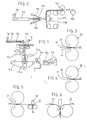
- the diagram in Figure 1 relates to a presentation of the process SB (i.e. S-Tex): (the) hopper for raw material, (2a) extruder, (2'a) screws, (3a) die, (4a) carpet, (5a) grille, (6a) web guidance and winding tension adjustment, (7a) winding, (9a) fiber cooling system, (11a) slit drawing (11'a) drawing suction.
- SB i.e. S-Tex
- the ply MB of said composite structure is intended for provide properties such as: absorption, filtration and / or thermal insulation, softness and comfort. It also allows to adapt the permeability of the composite.
- the MB process also includes a extruder intended to melt the polymer. Temperatures range from preferably between 150 and 280 ° C. The polymer is conveyed from the extruder to the sector. The die has only one row of holes. The holes have a diameter of 0.2 to 2 mm.
- An air pulse generated on both sides of the row of holes projects the polymer in the form of fibers onto the moving web.
- the fiber titer ranges from 0.05 to 2 dtex.
- the basic weight of the MB tablecloth is regulated according to the speed of the belt.
- the sheet MB can be deposited directly on the sheet SB. This process is called "over-blowing". In this process, the SB system is installed before the MB system, both installed before the grille. The calender performs the heat sealing of the two layers.
- the diagram in Figure 2 represents the MB process: (1b) raw material hopper, (2b) extruder, (3b) die, (4b) formation, (5b) calender, (6b) winder, (9b) blowing, (11b) aspiration.
- the film layer of said composite structure is intended to provide properties such as: liquid barriers and good drapability.
- the film can however be porous (US Patent 5,208,098, 1993) and in this case it is permeable and absorbent.
- the film is deposited on the composite structure by extrusion.
- the temperature of the extruder is 150 to 280 ° C and the slot of the 0.2 to 2 mm die.
- the film layer can be extruded separately and welded to the composite by calendering, only a non-woven structure previously calendered which can be associated therewith, namely the extruded film can be used to weld separate nonwoven layers.
- the thickness of the film or films of said composite structure is preferably from 0.001 to 1.0 mm.
- nonwoven structures according to the invention are described below.
- Example 1 Trilaminated nonwoven for medical application (see Figure 3).
- This composite structure is completely based on PLA (precisely PLLA), manufactured on a production line using three different slots: first an installation (SB) delivering a tablecloth (12), secondly an MB installation delivering a tablecloth (13) and last another SB installation delivering a sheet (14). These installations follow each other in sequence and a grille (15) welds the different layers between them.
- SB installation
- MB MB installation
- SB MB installation
- the first SB web (12) has a grammage of 10 - 20 g / m2 and the fibers have a titer of 1.5 to 2.5 dtex.
- the MB tablecloth (13) has a weight of 5.0 to 15 g / m2 and a titer of 0.1 to 0.3 dtex.
- the weight of the second SB tablecloth (14) is between 10 and 20 g / m2 and the fibers have a titer of 1.5 to 3.0 dtex.
- the surface welded is around 8 to 15% and the calendering temperature between 65 ° C and 120 ° C, depending on the type of raw material, the additives and the speed used.
- the resistance of this composite is between 40 and 100 N / 5cm and the elongation at break of 30 to 60%.
- the SB plies (12, 14) of said composite structure improve strength and elongation, as well as comfort and absorbent properties. Certain additives make it possible to obtain tablecloths Hydrophilic or hydrophobic SB.
- the MB tablecloth (13) is intended to provide the property barrier to liquids, but does not have a gas barrier effect (ventilated structure).
- the tablecloth MB placed between tablecloths SB increases the flexibility and comfort of said composite structure.
- This trilaminate can find applications in clothing protective (hydrophilic inner face, hydrophobic outer face) in the operating theaters (gowns and operating theaters).
- this structure composite should have resistance properties against radiation used during sterilization.
- the derivative polymer of PLA can be stabilized against gamma and beta rays (the doses normal used in medical environment being 25 or 50 KGy) per the addition of certain stabilizers. Reducing properties mechanical after sterilization will be less than 15% using stabilizers.
- Example 2 Laminated composite structure for application in hygiene (see Figure 4).
- This composite structure is completely based on PLA (precisely PLLA having an average molecular weight of 30,000 to 150,000 with temperature stabilizing Adpack) and consists of two layers (16, 17) a tablecloth SB and a tablecloth MB.
- the sheets are welded by calendering with a surface of welding from 9 to 15%.
- the temperature of the grille (18) should be slightly lower on the MB side (about 10 to 20 ° C less).
- the tablecloth SB has a weight of 15 to 25 g / m2 and the tablecloth MB of 5 to 10 g / m2.
- the total weight will be from 20 to 35 g / m2, the resistance from 25 to 50 N / m2 and the elongation at break of 30 to 50%.
- the SB ply provides satisfactory mechanical properties and serves as support; the MB tablecloth has a barrier effect to liquids but can be vapor permeable.
- Example 3 Composite structure for agriculture (see Figures 5 and 6).
- the composite structure based on PLA, intended for use in agriculture includes an SB veil (21) and a film layer (22).
- the structure can be manufactured by extrusion / coating (19) of a layer of film (22) on the sheet SB (FIG. 5) or by laminating these two layers (21, 22) together by heat sealing (Figure 5) a black dye (carbon black 0.5 - 1.5% by weight) is used for the two layers so to obtain an opaque structure suitable for mulching (US patent 3,580 196, 1971 using a non-degradable plastic sheet).
- the SB sheet provides the resistance and the film provides sealing.
- the SB layer constitutes the external face, this dries more quickly after rain, which keeps strawberries in good condition, for example.
- the waterproof film prevents the soil from drying out.
- the colour black is a barrier to the sun and prevents the growth of weeds.
- biodegradability offers the following advantages: the product for mulching can be left in place and it will degrade over time (function modulated from 2 to 36 months), it can also be removed and buried, or intended for composting with a degradation of several weeks.
- the lifespan can be adjusted by using an additive UV stabilizer.
Landscapes
- Engineering & Computer Science (AREA)
- Textile Engineering (AREA)
- Chemical & Material Sciences (AREA)
- Chemical Kinetics & Catalysis (AREA)
- Laminated Bodies (AREA)
- Nonwoven Fabrics (AREA)
- Organic Low-Molecular-Weight Compounds And Preparation Thereof (AREA)
- Preparation Of Compounds By Using Micro-Organisms (AREA)
- Absorbent Articles And Supports Therefor (AREA)
- Orthopedics, Nursing, And Contraception (AREA)
- Polyesters Or Polycarbonates (AREA)
- Materials For Medical Uses (AREA)
Claims (8)
- Verbundstruktur bestehend aus zumindest einer Schicht einer Textilverbundware und zumindest einer Schicht eines Films, dadurch gekennzeichnet, daß alle Schichten aus thermoplastischen Polymeren bestehen, die alle von Milchsäure abgeleitet sind.
- Verbundstruktur gemäß Anspruch 1, dadurch gekennzeichnet, daß die Milchsäure aus der Menge (D-Milchsäure, L-Milchsäure) ausgewählt ist.
- Verbundstruktur gemäß Anspruch 1, dadurch gekennzeichnet, daß die Milchsäure eine D- und L-Milchsäure ist.
- Verbundstruktur gemäß Anspruch 1, dadurch gekennzeichnet, daß die Milchsäure eine Mischung aus der L-Milchsäure und der D-Milchsäure ist.
- Verbundstruktur gemäß Anspruch 1, dadurch gekennzeichnet, daß das Element der Gruppe (Polymer, Copolymer, Polymermischung) ein mittleres Molekulargewicht zwischen einschließlich 10.000 und 100.000 aufweist.
- Verbundstruktur gemäß einem der vorhergehenden Ansprüche 1 bis 5, dadurch gekennzeichnet, daß die Titer der Fasern, die jede Schicht der Textilverbundware bilden, die die Struktur ausbildet, zwischen 0,05 und 20 Dtex liegen.
- Verbundstruktur gemäß einem der Ansprüche 1 bis 6, dadurch gekennzeichnet, daß die Dicke jedes Films der Struktur zwischen 0,001 und 1 mm liegt.
- Verbundstruktur gemäß einem der Ansprüche 1 bis 7, dadurch gekennzeichnet, daß alle Textilverbundwarenschichten, die sie ausbilden, gemäß einem Verfahren hergestellt sind, das aus der Gruppe (SB, Trockenverfahren, Naßverfahren, MB) ausgewählt ist.
Applications Claiming Priority (2)
| Application Number | Priority Date | Filing Date | Title |
|---|---|---|---|
| FR9412333A FR2725732B1 (fr) | 1994-10-12 | 1994-10-12 | Structure composite formee de derives d'acide lactique et son procede d'obtention |
| FR9412333 | 1994-10-12 |
Publications (3)
| Publication Number | Publication Date |
|---|---|
| EP0723043A2 EP0723043A2 (de) | 1996-07-24 |
| EP0723043A3 EP0723043A3 (de) | 1996-09-04 |
| EP0723043B1 true EP0723043B1 (de) | 1999-06-16 |
Family
ID=9467901
Family Applications (1)
| Application Number | Title | Priority Date | Filing Date |
|---|---|---|---|
| EP95470032A Expired - Lifetime EP0723043B1 (de) | 1994-10-12 | 1995-10-04 | Verbundstruktur aus Milchsäure-Derivate |
Country Status (9)
| Country | Link |
|---|---|
| US (1) | US5702826A (de) |
| EP (1) | EP0723043B1 (de) |
| JP (1) | JP3948030B2 (de) |
| AT (1) | ATE181380T1 (de) |
| CA (1) | CA2160314A1 (de) |
| DE (1) | DE69510319T2 (de) |
| DK (1) | DK0723043T3 (de) |
| ES (1) | ES2135681T3 (de) |
| FR (1) | FR2725732B1 (de) |
Families Citing this family (17)
| Publication number | Priority date | Publication date | Assignee | Title |
|---|---|---|---|---|
| US6506873B1 (en) | 1997-05-02 | 2003-01-14 | Cargill, Incorporated | Degradable polymer fibers; preparation product; and, methods of use |
| DE19750890A1 (de) * | 1997-11-18 | 1999-05-27 | Alexander Maksimow | Verfahren und Vorrichtung zur Herstellung einer aus Zellstoff-Fasern bestehenden Faserstoffbahn |
| JP2001151319A (ja) * | 1999-11-30 | 2001-06-05 | Nippon Filcon Co Ltd | 防汚性衛生用不織布製品加工用ベルト |
| US6770356B2 (en) * | 2001-08-07 | 2004-08-03 | The Procter & Gamble Company | Fibers and webs capable of high speed solid state deformation |
| AU2003275263A1 (en) * | 2002-09-26 | 2004-04-19 | Angiotech International Ag | Perivascular wraps |
| EP1556313B1 (de) * | 2002-10-10 | 2006-12-13 | HRD Corp | Zusatzstoff zum feuchtigkeitsbeständigmachen einer gipsplatte |
| US7994078B2 (en) * | 2002-12-23 | 2011-08-09 | Kimberly-Clark Worldwide, Inc. | High strength nonwoven web from a biodegradable aliphatic polyester |
| ES2261086B1 (es) * | 2005-04-27 | 2007-11-16 | Mimcord, S.A | Lamina de uso agricola. |
| US20060257616A1 (en) * | 2005-05-12 | 2006-11-16 | Stowe-Pharr Mills, Inc. (D/B/A Pharr Yarns, Inc.) | Renewable nonwoven carpet |
| EP1762655A1 (de) * | 2005-08-31 | 2007-03-14 | DS Textile Platform NV | Biologisch abbaubarer genadelter Bodenbelag |
| US8236904B2 (en) * | 2005-12-28 | 2012-08-07 | Ethicon, Inc. | Bioabsorbable polymer compositions exhibiting enhanced crystallization and hydrolysis rates |
| US8802002B2 (en) * | 2006-12-28 | 2014-08-12 | 3M Innovative Properties Company | Dimensionally stable bonded nonwoven fibrous webs |
| KR101322099B1 (ko) * | 2008-07-08 | 2013-10-25 | (주)엘지하우시스 | 친환경 생분해성 광고용 소재 |
| JP2010232895A (ja) * | 2009-03-26 | 2010-10-14 | Fuji Xerox Co Ltd | 通信制御装置及び情報処理装置 |
| FR2991230B1 (fr) * | 2012-05-31 | 2015-02-20 | Ahlstroem Oy | Complexe multicouche comprenant une couche a base d'un polymere biodegradable et un support a base de fibres cellulosiques ; procede de fabrication et utilisation |
| KR102200291B1 (ko) * | 2019-04-23 | 2021-01-08 | 에코폴리텍 주식회사 | Pla 부직포를 활용한 친환경 원단의 제조방법 |
| JP7616878B2 (ja) * | 2020-12-15 | 2025-01-17 | 東洋紡エムシー株式会社 | 成型用シート、及び成型体 |
Family Cites Families (14)
| Publication number | Priority date | Publication date | Assignee | Title |
|---|---|---|---|---|
| US3580196A (en) | 1968-05-27 | 1971-05-25 | Occidental Petroleum Corp | Plastic mulch |
| US4578069A (en) | 1984-08-10 | 1986-03-25 | Kimberly-Clark Corporation | Breathable baffle composite |
| FI75493C (fi) | 1985-05-08 | 1988-07-11 | Materials Consultants Oy | Sjaelvarmerat absorberbart osteosyntesmedel. |
| FI81498C (fi) | 1987-01-13 | 1990-11-12 | Biocon Oy | Kirurgiska material och instrument. |
| US4766029A (en) | 1987-01-23 | 1988-08-23 | Kimberly-Clark Corporation | Semi-permeable nonwoven laminate |
| US5216050A (en) * | 1988-08-08 | 1993-06-01 | Biopak Technology, Ltd. | Blends of polyactic acid |
| US5097005A (en) * | 1990-05-11 | 1992-03-17 | E. I. Du Pont De Nemours And Company | Novel copolyesters and their use in compostable products such as disposable diapers |
| US5208098A (en) | 1990-10-23 | 1993-05-04 | Amoco Corporation | Self-bonded nonwoven web and porous film composites |
| US5340646A (en) * | 1991-04-26 | 1994-08-23 | Mitsui Toatsu Chemicals, Inc. | Breathable, hydrolyzable porous film |
| JPH0539381A (ja) * | 1991-08-08 | 1993-02-19 | Mitsui Toatsu Chem Inc | 生分解性ポリマー組成物 |
| US5437918A (en) * | 1992-11-11 | 1995-08-01 | Mitsui Toatsu Chemicals, Inc. | Degradable non-woven fabric and preparation process thereof |
| US5359026A (en) * | 1993-07-30 | 1994-10-25 | Cargill, Incorporated | Poly(lactide) copolymer and process for manufacture thereof |
| US5472518A (en) * | 1994-12-30 | 1995-12-05 | Minnesota Mining And Manufacturing Company | Method of disposal for dispersible compositions and articles |
| EP2864458B1 (de) | 2012-06-20 | 2017-05-17 | Castrol Limited | Reibwertsverminderer und ihre verwendung in schmier- und treibstoffen |
-
1994
- 1994-10-12 FR FR9412333A patent/FR2725732B1/fr not_active Expired - Lifetime
-
1995
- 1995-10-04 AT AT95470032T patent/ATE181380T1/de not_active IP Right Cessation
- 1995-10-04 ES ES95470032T patent/ES2135681T3/es not_active Expired - Lifetime
- 1995-10-04 EP EP95470032A patent/EP0723043B1/de not_active Expired - Lifetime
- 1995-10-04 DE DE69510319T patent/DE69510319T2/de not_active Expired - Lifetime
- 1995-10-04 DK DK95470032T patent/DK0723043T3/da active
- 1995-10-11 CA CA002160314A patent/CA2160314A1/fr not_active Abandoned
- 1995-10-12 JP JP28919995A patent/JP3948030B2/ja not_active Expired - Fee Related
- 1995-10-12 US US08/542,169 patent/US5702826A/en not_active Expired - Lifetime
Also Published As
| Publication number | Publication date |
|---|---|
| ES2135681T3 (es) | 1999-11-01 |
| JP3948030B2 (ja) | 2007-07-25 |
| ATE181380T1 (de) | 1999-07-15 |
| DE69510319T2 (de) | 2000-01-05 |
| DK0723043T3 (da) | 2000-01-10 |
| EP0723043A3 (de) | 1996-09-04 |
| FR2725732A1 (fr) | 1996-04-19 |
| FR2725732B1 (fr) | 1996-12-13 |
| EP0723043A2 (de) | 1996-07-24 |
| CA2160314A1 (fr) | 1996-04-13 |
| DE69510319D1 (de) | 1999-07-22 |
| US5702826A (en) | 1997-12-30 |
| JPH09169082A (ja) | 1997-06-30 |
Similar Documents
| Publication | Publication Date | Title |
|---|---|---|
| EP0747065B1 (de) | Biologisch abbaubares Vlies/Filmverbundmaterial | |
| EP0723043A2 (de) | Verbundstruktur aus Milchsäure-Derivate und Verfahren zur Herstellung | |
| US7972692B2 (en) | Biodegradable multicomponent fibers | |
| AU2011288213B2 (en) | Toughened polylactic acid fibers | |
| EP0767263B1 (de) | Hydrophiler Vliesstoff auf Basis von Polylactiden | |
| CN101563391B (zh) | 用于形成纤维的生物可降解聚乳酸 | |
| US6441267B1 (en) | Heat bondable biodegradable fiber | |
| AU2006341586A1 (en) | Biodegradable nonwoven laminate | |
| CA2160313A1 (fr) | Procede de fabrication d'un non-tisse a base d'acide lactique et non-tisse obtenu | |
| US5985776A (en) | Nonwoven based on polymers derived from lactic acid, process for manufacture and use of such a nonwoven | |
| EP0637641A1 (de) | Vliesstoff bestehend aus Polymeren von Milchsäurederivaten und Herstellverfahren und Anwendung eines solchen Vliesstoffes | |
| JP2010144302A (ja) | 耐久性を有するポリ乳酸系スパンボンド不織布 | |
| JP3573612B2 (ja) | 生分解性防草シート | |
| JP4493275B2 (ja) | 透明性に優れた長繊維不織布 | |
| JP2000333542A (ja) | 生分解性農業用被覆資材 | |
| JP2000045164A (ja) | 生分解性マルチシート | |
| WO2025187479A1 (ja) | 不織布、積層体、エアフィルター、マスク用フィルター、及び、マスク | |
| JPH10128918A (ja) | 複合構造を有する生分解性の不織布フィルム及びその製造方法 | |
| JP2000045163A (ja) | 生分解性を有する農業用ハウスの内張り用シート | |
| JP2003289731A (ja) | 生分解性農業用被覆シート | |
| MX2008007608A (en) | Biodegradable continuous filament web |
Legal Events
| Date | Code | Title | Description |
|---|---|---|---|
| PUAI | Public reference made under article 153(3) epc to a published international application that has entered the european phase |
Free format text: ORIGINAL CODE: 0009012 |
|
| PUAL | Search report despatched |
Free format text: ORIGINAL CODE: 0009013 |
|
| AK | Designated contracting states |
Kind code of ref document: A2 Designated state(s): AT BE CH DE DK ES GB GR IT LI LU NL SE |
|
| RIN1 | Information on inventor provided before grant (corrected) |
Inventor name: LAHTENKORVA, KIMMO Inventor name: GUIPOUY, PHILIPPE Inventor name: EHRET, PHILIPPE |
|
| AK | Designated contracting states |
Kind code of ref document: A3 Designated state(s): AT BE CH DE DK ES GB GR IT LI LU NL SE |
|
| RAP1 | Party data changed (applicant data changed or rights of an application transferred) |
Owner name: FIBERWEB FRANCE SA |
|
| 17P | Request for examination filed |
Effective date: 19960913 |
|
| 17Q | First examination report despatched |
Effective date: 19971112 |
|
| GRAG | Despatch of communication of intention to grant |
Free format text: ORIGINAL CODE: EPIDOS AGRA |
|
| GRAG | Despatch of communication of intention to grant |
Free format text: ORIGINAL CODE: EPIDOS AGRA |
|
| GRAH | Despatch of communication of intention to grant a patent |
Free format text: ORIGINAL CODE: EPIDOS IGRA |
|
| GRAH | Despatch of communication of intention to grant a patent |
Free format text: ORIGINAL CODE: EPIDOS IGRA |
|
| GRAA | (expected) grant |
Free format text: ORIGINAL CODE: 0009210 |
|
| AK | Designated contracting states |
Kind code of ref document: B1 Designated state(s): AT BE CH DE DK ES GB GR IT LI LU NL SE |
|
| PG25 | Lapsed in a contracting state [announced via postgrant information from national office to epo] |
Ref country code: GR Free format text: LAPSE BECAUSE OF NON-PAYMENT OF DUE FEES Effective date: 19990616 |
|
| REF | Corresponds to: |
Ref document number: 181380 Country of ref document: AT Date of ref document: 19990715 Kind code of ref document: T |
|
| REG | Reference to a national code |
Ref country code: CH Ref legal event code: EP |
|
| REF | Corresponds to: |
Ref document number: 69510319 Country of ref document: DE Date of ref document: 19990722 |
|
| GBT | Gb: translation of ep patent filed (gb section 77(6)(a)/1977) |
Effective date: 19990813 |
|
| ITF | It: translation for a ep patent filed | ||
| REG | Reference to a national code |
Ref country code: CH Ref legal event code: NV Representative=s name: PIETER SPIERENBURG PATENTANWALT DIPL. PHYS. |
|
| PG25 | Lapsed in a contracting state [announced via postgrant information from national office to epo] |
Ref country code: LU Free format text: LAPSE BECAUSE OF NON-PAYMENT OF DUE FEES Effective date: 19991004 |
|
| REG | Reference to a national code |
Ref country code: ES Ref legal event code: FG2A Ref document number: 2135681 Country of ref document: ES Kind code of ref document: T3 |
|
| PGFP | Annual fee paid to national office [announced via postgrant information from national office to epo] |
Ref country code: DK Payment date: 19991125 Year of fee payment: 5 Ref country code: AT Payment date: 19991125 Year of fee payment: 5 |
|
| PGFP | Annual fee paid to national office [announced via postgrant information from national office to epo] |
Ref country code: ES Payment date: 19991130 Year of fee payment: 5 |
|
| REG | Reference to a national code |
Ref country code: DK Ref legal event code: T3 |
|
| PLBE | No opposition filed within time limit |
Free format text: ORIGINAL CODE: 0009261 |
|
| STAA | Information on the status of an ep patent application or granted ep patent |
Free format text: STATUS: NO OPPOSITION FILED WITHIN TIME LIMIT |
|
| 26N | No opposition filed | ||
| PG25 | Lapsed in a contracting state [announced via postgrant information from national office to epo] |
Ref country code: DK Free format text: LAPSE BECAUSE OF NON-PAYMENT OF DUE FEES Effective date: 20001004 Ref country code: AT Free format text: LAPSE BECAUSE OF NON-PAYMENT OF DUE FEES Effective date: 20001004 |
|
| PG25 | Lapsed in a contracting state [announced via postgrant information from national office to epo] |
Ref country code: ES Free format text: LAPSE BECAUSE OF NON-PAYMENT OF DUE FEES Effective date: 20001005 |
|
| REG | Reference to a national code |
Ref country code: DK Ref legal event code: EBP |
|
| REG | Reference to a national code |
Ref country code: GB Ref legal event code: IF02 |
|
| REG | Reference to a national code |
Ref country code: ES Ref legal event code: FD2A Effective date: 20011113 |
|
| PG25 | Lapsed in a contracting state [announced via postgrant information from national office to epo] |
Ref country code: IT Free format text: LAPSE BECAUSE OF NON-PAYMENT OF DUE FEES;WARNING: LAPSES OF ITALIAN PATENTS WITH EFFECTIVE DATE BEFORE 2007 MAY HAVE OCCURRED AT ANY TIME BEFORE 2007. THE CORRECT EFFECTIVE DATE MAY BE DIFFERENT FROM THE ONE RECORDED. Effective date: 20051004 |
|
| PGFP | Annual fee paid to national office [announced via postgrant information from national office to epo] |
Ref country code: BE Payment date: 20131014 Year of fee payment: 19 Ref country code: DE Payment date: 20131002 Year of fee payment: 19 Ref country code: SE Payment date: 20131011 Year of fee payment: 19 Ref country code: CH Payment date: 20131014 Year of fee payment: 19 Ref country code: GB Payment date: 20131002 Year of fee payment: 19 |
|
| PGFP | Annual fee paid to national office [announced via postgrant information from national office to epo] |
Ref country code: NL Payment date: 20131010 Year of fee payment: 19 |
|
| REG | Reference to a national code |
Ref country code: DE Ref legal event code: R119 Ref document number: 69510319 Country of ref document: DE |
|
| REG | Reference to a national code |
Ref country code: NL Ref legal event code: V1 Effective date: 20150501 |
|
| REG | Reference to a national code |
Ref country code: CH Ref legal event code: PL |
|
| REG | Reference to a national code |
Ref country code: SE Ref legal event code: EUG |
|
| GBPC | Gb: european patent ceased through non-payment of renewal fee |
Effective date: 20141004 |
|
| PG25 | Lapsed in a contracting state [announced via postgrant information from national office to epo] |
Ref country code: BE Free format text: LAPSE BECAUSE OF NON-PAYMENT OF DUE FEES Effective date: 20141031 |
|
| PG25 | Lapsed in a contracting state [announced via postgrant information from national office to epo] |
Ref country code: LI Free format text: LAPSE BECAUSE OF NON-PAYMENT OF DUE FEES Effective date: 20141031 Ref country code: SE Free format text: LAPSE BECAUSE OF NON-PAYMENT OF DUE FEES Effective date: 20141005 Ref country code: GB Free format text: LAPSE BECAUSE OF NON-PAYMENT OF DUE FEES Effective date: 20141004 Ref country code: CH Free format text: LAPSE BECAUSE OF NON-PAYMENT OF DUE FEES Effective date: 20141031 Ref country code: DE Free format text: LAPSE BECAUSE OF NON-PAYMENT OF DUE FEES Effective date: 20150501 |
|
| PG25 | Lapsed in a contracting state [announced via postgrant information from national office to epo] |
Ref country code: NL Free format text: LAPSE BECAUSE OF NON-PAYMENT OF DUE FEES Effective date: 20150501 |