EP0724562B1 - Synthese de sphingosines - Google Patents
Synthese de sphingosines Download PDFInfo
- Publication number
- EP0724562B1 EP0724562B1 EP94930717A EP94930717A EP0724562B1 EP 0724562 B1 EP0724562 B1 EP 0724562B1 EP 94930717 A EP94930717 A EP 94930717A EP 94930717 A EP94930717 A EP 94930717A EP 0724562 B1 EP0724562 B1 EP 0724562B1
- Authority
- EP
- European Patent Office
- Prior art keywords
- product
- reacting
- isopropylidene
- lactol
- formula
- Prior art date
- Legal status (The legal status is an assumption and is not a legal conclusion. Google has not performed a legal analysis and makes no representation as to the accuracy of the status listed.)
- Expired - Lifetime
Links
- 0 C[C@]1[C@](C)C=C(*)[C@@]2OC(C)(C)O[C@]12 Chemical compound C[C@]1[C@](C)C=C(*)[C@@]2OC(C)(C)O[C@]12 0.000 description 12
- KXFGFBMUQMLNGZ-WKKGSWGPSA-N CC(C)(OC1)OC1[C@H](/C=C/C)O Chemical compound CC(C)(OC1)OC1[C@H](/C=C/C)O KXFGFBMUQMLNGZ-WKKGSWGPSA-N 0.000 description 1
- SAVGWMAEAMRCEZ-JNBLPZDZSA-N CC(C)(OC1)OC1[C@H](/C=C/N)O Chemical compound CC(C)(OC1)OC1[C@H](/C=C/N)O SAVGWMAEAMRCEZ-JNBLPZDZSA-N 0.000 description 1
- YOAVEMRIFZKKAS-SOGVLRHJSA-N CC1(C)[O]=C(CC(C[C@@H]2CNCC[O]=C)OC=C)[C@H]2O1 Chemical compound CC1(C)[O]=C(CC(C[C@@H]2CNCC[O]=C)OC=C)[C@H]2O1 YOAVEMRIFZKKAS-SOGVLRHJSA-N 0.000 description 1
- CALDQXRAQNLBHJ-UWVGGRQHSA-N CCC[C@@H]1[C@H](CO)OC(C)(C)CC1 Chemical compound CCC[C@@H]1[C@H](CO)OC(C)(C)CC1 CALDQXRAQNLBHJ-UWVGGRQHSA-N 0.000 description 1
Images



Classifications
-
- C—CHEMISTRY; METALLURGY
- C07—ORGANIC CHEMISTRY
- C07C—ACYCLIC OR CARBOCYCLIC COMPOUNDS
- C07C213/00—Preparation of compounds containing amino and hydroxy, amino and etherified hydroxy or amino and esterified hydroxy groups bound to the same carbon skeleton
- C07C213/02—Preparation of compounds containing amino and hydroxy, amino and etherified hydroxy or amino and esterified hydroxy groups bound to the same carbon skeleton by reactions involving the formation of amino groups from compounds containing hydroxy groups or etherified or esterified hydroxy groups
Definitions
- This invention relates to a method for the synthesis of sphingosines. More particularly, this invention relates to the synthesis of the four stereoisomers 1-4 of sphingosine by conversion of an achiral starting material.
- Sphingosines constitute a group of related long-chain aliphatic 2-amino-1,3-diols, of which D- erythro -1,3-dihydroxy-2-amino-4,5-trans-octadecene is the most frequently occurring in animal glycosphingolipids.
- Glycosphingolipids are the glycosides of N-acylsphingosine, the trivial name of which is ceramide.
- the structural variation in fatty acids, sphingosines, and carbohydrates results in a great number of chemically distinct glycosphingolipids.
- sphingosines and their derivatives, glycosphingolipids are of interest because of their diverse bioactivities and biological roles.
- Sphingosines also serve as chain terminators in various gangliosides.
- Galactosyl ceramide has been shown to be a receptor for HIV binding in cells lacking the CD4 receptor.
- Patent No. 5,110,987 describe the preparation of sphingosine or its derivatives from serine or related compounds. These methods are disadvantageous due to the impossibility of obtaining all four stereoisomers of sphingosine from the same starting compound. Moreover, methods utilizing serine as a starting material are quite lengthy and, thus, are not amenable to potential scale-up.
- Another effort to synthesize optically pure sphingosines utilized the stereospecific hydration of chlorofumaric acid with fumarase to give L- threo -chloromalic acid as a chiral pool reagent and result in the synthesis of D- erythro -sphingosine, as described in Findeis et al., J. Org. Chem. , 52:2838-2848 (1987). This method is complicated and only results in the synthesis of one stereoisomer of sphingosine.
- the present invention provides a process for the synthesis of a stereospecific sphingosine comprising providing an arene diol of the formula: wherein X is H, halogen, OH, OR, phenyl, acetylene, NH 2 , N 3 , NR 2 , NRH, NO 2 , CO 2 H, or CN and R is lower alkyl or lower alkenyl; protecting the diol as its acetonide with the following formula: converting the acetonide to an epoxide having the formula: reacting the epoxide with an effective amount of an azide salt to stereospecifically open the epoxide and obtain an azido alcohol with the formula: reacting the azido alcohol first with excess ozone and then with excess borohydride to give a first lactol with the formula: reacting the first lactol with an acidic ion exchange resin to deprotect the first lactol and obtain a second lactol of the formula: react
- a stereospecific sphingosine is synthesized by a method including reacting the epoxide first with FeCl 3 and then with an azide salt to obtain a stereospecific azido alcohol.
- a stereospecific sphingosine is synthesized by a method including reacting the epoxide first with LiCl in the presence of ethyl acetoacetate and then with an azide salt to obtain a stereospecific azido alcohol.
- a stereospecific sphingosine is synthesized by a method including reacting the epoxide with an azide salt to obtain a stereospecific azido alcohol.
- Figure 1 illustrates the synthesis of L-threo-sphingosine or a derivative thereof according to the present invention.
- the letters a-h indicate the following reagents used: (a) (1) 2,2-dimethoxypropane, cat. p-TsOH, CH 2 Cl 2 , (2) mCPBA, CH 2 Cl 2 ; (b) NaN 3 , NH 4 +Cl-, 1,2-dimethoxyethane/EtOH,/H 2 O, 70°C; (c) (1) O 3 , CH 3 OH, -78°C, (2) NaBH 4 , CH 3 OH, 0°C to RT; (d) Amberlyst acidic resin; (e) NaIO 4 , H 2 O; (f) n-tetradecyltriphenylphosphonium bromide 1.2eq, phenyllithium 4.4eq, toluene/THF, -30°C, quenched at 0°C; (g) H 2
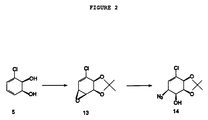
- Figure 2 illustrates the synthesis of the epoxide and azido alcohol which are used to synthesize D-erythro-sphingosine.
- Figure 3 illustrates the synthesis of an intermediate found to be useful for obtaining the stereoisomers of sphingosine according to the present invention, which intermediate is obtained from L-erythrose synthesized from chlorobenzene.
- Figure 4 illustrates the synthesis of the stereoisomers of sphingosine from the intermediate of Figure 3.
- the present invention takes advantage of the chirality introduced in the microbial oxidation of arene diols to effectively synthesize stereospecific sphingosines.
- a stereospecific sphingosine can be obtained from an achiral aromatic source.
- the sphingosines obtained in this manner are optically pure and can be used for the manufacture of useful glycosphingolipids or other derivatives.
- synthesis of sphingosines by the process of the present invention enables economical scale-up of the process since all of the stereoisomers can be prepared using the same starting material and very similar synthesis reactants and procedures.
- Figure 1 sets forth the synthesis of L-threo-sphingosine according to the present invention. This synthesis will be used throughout to illustrate the invention, but should not be construed as limiting the invention to the reactants and compounds shown therein.
- the other isomers of sphingosine can be obtained by identical steps provided the other three isomers of azido alcohol are made.
- the azido alcohols which result in the sphingosine stereoisomers are as follows:
- a substituted benzenediol preferably obtained by microbial oxidation with Pseudomonas putida , strain 39D, is first obtained.
- the diol may be obtained by microbial oxidation with other Pseudomonas putida strains, provided the proper diol is obtained.
- Benzenediols obtained via microbial oxidation may be commercially obtained from Genencor International, Rochester, N.Y., ICI Fine Chemicals, Manchester, U.K. or Enzymatics, Ltd., Cambridge, U.K.
- the diol is chlorobenzenediol 5 ((2R, 3S)-2,3-dihydroxy-1-chlorocyclohexa-4,6-diene).
- Suitable substituents include H, halogen, OH, OR, phenyl, acetylene, NH 2 , N 3 , NR 2 , NRH, NO 2 , CO 2 H, or CN and R is lower alkyl or lower alkenyl.
- R has about one to six carbons.
- X is Cl.
- the benzenediol 5 is protected as its acetonide by reacting the diol with a ketone protecting reagent in the first step of a in Figure 1.
- the diol is protected to allow selectivity in the subsequent reaction steps.
- only one face is open to the approach of an electrophilic reagent resulting in a stereocontrolled introduction of the next stereocenter.
- ketone protecting reagent known to those of skill in the art may be used, such as acetone, dlmethoxypropane, cyclohexanone, among others.
- the diol is reacted with 2,2-dimethoxypropane in the presence of a catalyst, p-toluenesulfonic acid, and a solvent, methylene chloride.
- the reaction can take place in any suitable solvent, such as methylene chloride or acetone, among others. This reaction is described in U.S. Patent No. 5,200,516.
- the acetonide is then converted to an anti epoxide 6 , preferably by epoxidation of the acetonide with meta-chloroperbenzoic acid (mCPBA) in a suitable solvent in the second part of a in Figure 1 (see U.S. Patent No. 5,200,516).
- mCPBA meta-chloroperbenzoic acid
- the solvent is the same as that used in the reaction to obtain the acetonide, eliminating the need for multiple reaction vessels.
- the diol is directly reacted with mCPBA to obtain the syn epoxide and protection as an acetonide as described above is conducted after the epoxidation step.
- the anti epoxide 6 or the syn epoxide, depending on the desired isomer, is then reacted in step b with an effective amount of an azide salt to stereospecifically open the epoxide and obtain an azido alcohol 7 , or azido alcohol isomer (see above).
- the preferred azide is sodium azide.
- other azide salts can be used including, but not limited to, lithium azide, potassium azide, cesium azide or a tetraalkylammonium azide.
- the reaction to obtain azido alcohol 7 is preferably carried out in the presence of ammonium chloride as a catalyst.
- 1,2-dimethoxyethane and ethanol are preferably used as the solvent, but other suitable solvents known to those of skill in the art may be used.
- the reaction is carried out at a temperature above room temperature, especially between about 55° and about 85°C. In the most preferred embodiment, the reaction is carried out at about 70°C.
- the azide is provided in an amount effective to stereospecifically open the epoxide and form the desired azido alcohol.
- the azide will generally be used in slight excess to ensure complete reaction. This step allows the production of the desired sphingosine isomer. Discussions regarding the stereoselective generation of the azido alcohol may be found in Hudlicky et al., J. Chem. Soc. Perkin Trans. 1 , pp. 2907-2917 (1991) and Hudlicky et al., J. Org. Chem. , 58:985 (1993), incorporated herein by reference.
- the azido alcohol obtained will determine the stereoisomer of sphingosine to be obtained.
- the azido alcohol needed to synthesize D-erythro-sphingosine (1) may be obtained by reacting FeCl 3 with the syn epoxide and then reacting the product obtained therefrom with an azide salt.
- the azido alcohol needed to synthesize L-threo-sphingosine (2) may be obtained by reacting the anti epoxide with an azide salt in the presence of ammonium chloride, as discussed above.
- the azido alcohol needed to synthesize L-erythro-sphingosine (3) may be obtained by reacting the anti epoxide with LiCl in the presence of ethyl acetoacetate and then reacting the product therefrom with an azide salt.
- the azido alcohol needed to synthesize D-threo-sphingosine (4) may be obtained by reacting the syn epoxide with an azide salt.
- any of the desired sphingosines can be produced by the same reaction sequence once the appropriate azido alcohol is provided. Therefore, the remaining steps discussed in the context of Figure 1 will be substantially identical no matter which sphingosine is being synthesized.
- step c of Figure 1 a two part reaction is conducted.
- the azido alcohol is reacted with excess ozone at low temperatures.
- a solvent such as methanol may be used.
- the temperature of this reaction preferably will be about -70 to about -85°C, most preferably about -78°C.
- excess borohydride is reacted with the product from the ozonolysis to produce a first lactol 8 .
- the preferred borohydride reagent is sodium borohydride.
- Other borohydride reagents could be used including, but not limited to, lithium, potassium or tetraalkylammonium borohydride.
- the temperature is preferably raised for this reaction to about 0°C.
- the reaction preferably is monitored by thin layer chromatography to ascertain when the reaction is complete.
- the reaction temperature may be raised to about room temperature, if required, to complete the reduction to the lactol 8 .
- the first lactol is then contacted in step d with an acidic ion exchange resin to deprotect it and form a second lactone 9a .
- Suitable ion acid exchange resins are commercially available from Aldrich or other companies. Some suitable resins include Amberlyst 15, Amberlyst IR 118, Amberlite CG-50, Dowex 50 X 8-100, among others.
- the second lactol 9a is then reacted in step e with an effective amount of alkali metal periodate to produce a third lactol 10 by way of 9b .
- the alkali metal periodate can be, for example, the lithium, sodium or potassium salt.
- the preferred alkali metal periodate is sodium periodate.
- the resulting lactol is then subjected to Wittig olefination in step f to produce azidosphingosine 11 .
- the Wittig reaction generally is carried out in an inert gas atmosphere, for example under nitrogen, at low temperatures, using an aliphatic triphenylphosphonium halide in the presence of a base.
- a base for purposes of the production of sphingosine, n-tetradecyltriphenylphosphonium bromide is preferred.
- Suitable bases for the Wittig reaction include organic lithium compounds, such as phenyllithium, lithium methylate or lithium ethylate or compounds such as sodium amide, sodium methylate and sodium carbonate.
- the base is phenyllithium.
- Solvents which can be used are aromatic hydrocarbons, such as benzene, toluene or xylene, or ethers, such as diethyl ether, tetrahydrofuran or dioxane.
- the solvent is a toluene, THF, or a mixture thereof.
- the solvent is anhydrous.
- the Wittig reaction preferably takes place at temperatures of about -25° to about -40°C. In a preferred embodiment, the reaction takes place at about -35° to about -30°C.
- the azidosphingosine is preferably reduced in step g to the desired sphingosine isomer. This reduction can be performed by any of the methods known in the art, such as by H 2 S, H 2 /catalyst(Pd), LiAlH 4 or NaBH 4 , among others. In the preferred embodiment, the azidosphingosine is reduced with hydrogen sulfide in pyridine or other solvent.
- step h illustrates the acylation of sphingosine.
- this step is carried out using acetic anhydride in a solvent, preferably, pyridine.
- FIG 2 illustrates the intermediates obtained when synthesizing the sphingosine isomer D-erythro-sphingosine, which is the naturally found stereoisomer.
- Epoxide 13 is obtained by m-CPBA, as above, directed syn by the diol and then protected by reaction with dimethoxypropane or other ketone protecting reagent. The epoxide is then reacted first with FeCl 3 and then with an azide salt to obtain an azido alcohol 14 . Treatment of azido alcohol 14 under the same reaction conditions deployed with azido alcohol 7 from Figure 1 will lead to the natural isomer.
- the starting material is a arene diol, preferably 2,3-dihydroxy-1 chloro-cyclohexa-4,6-diene.
- the diol is reacted to obtain L-erythrose 15 as shown in Hudlicky et al., J. Org. Chem. , 55:4683 (1990), and U.S. Patent No. 5,200,516.
- the erythrose is synthesized as follows: treating (+)-cis-2,3-dihydroxy-1-chloro-cyclohexa-4,6-diene with p-toluenesulfonic acid in the presence of 2,2-dimethoxypropane to form (2R,3S)-2,3-isopropylidene-1-chloro-cyclohexa-4,6-diene; subjecting said (2R,3S)-2,3-isopropylidene-1-chloro-cyclohexa-4,6-diene to ozonolysis followed by cyclization of the product of said ozonolysis to form 2,3-O-isopropylidene-D-erythruronolactone; reducing said 2,3-O-isopropylidene-D-erythruronolactone in the presence of sodium borohydride to produce sodium (S,S)-2,3-dihydroxy-2,3-O-isopropyliden
- Erythrose 15 is then subjected to the Wittig reaction using an aliphatic triphenylphosphonium halide in the presence of a base to obtain compound 16 .
- Figure 4 illustrates the reaction paths for the synthesis of each sphingosine isomer from compound 16 .
- compound 16 is first reacted with H + or acid to effect catalytic deprotection and provide compound 17 .
- This compound is reacted with benzylaldehyde in the presence of acid to provide compound 20 which is reacted with methanesulfonylchloride (MSCl), lithium bromide, sodium azide and lithium aluminum hydride in a four step reaction to provide compound 22 which is then subjected to hydrogen chloride to obtain sphingosine 1.
- MSCl methanesulfonylchloride
- compound 22 may be reacted with methanesulfonylchloride, sodium azide and lithium aluminum hydride in a three step reaction to provide compound 23 which is then subjected to hydrogen chloride to obtain sphingosine 4.
- compound 17 is reacted with dimethoxypropane in the presence of acid and acetone to obtain compound 18 , which then undergoes Mitsunobu inversion (generally, diethyldiazo dicarboxylate, triphenylphosphene and benzoic acid as reactants, see U.S. Patent No. 5,110,987) to compound 19 .
- Mitsunobu inversion generally, diethyldiazo dicarboxylate, triphenylphosphene and benzoic acid as reactants, see U.S. Patent No. 5,110,987
- Compound 19 is reacted with benzaldehyde in the presence of acid to obtain compound 21 which then undergoes the same reactions as above to obtain compounds 24 and 25 , which are reacted with hydrogen chloride to obtain sphingosines 2 and 3, respectively.
- Figure 1 illustrates the synthesis of L-threo-sphingosine and the numbered structures in Figure 1 correspond to the numbered compounds whose synthesis is described herein.
- 2,3-dihydroxy-1-chloro-cyclohexa-4,6-diene 5 was obtained by enzymatic oxygenation of chlorobenzene with Pseudomonas putida 39D as taught in Hudlicky et al., J. Am. Chem. Soc. , 110(14):4735 (1988), incorporated herein by reference in its entirety.
- P. putida 39D was grown at 28°C in MBS-arginine medium (75 mL) in a 250 mL Erlenmeyer flask. Toluene was supplied by a scale bulb attached to the flask by a neoprene stopper, and the culture was aerated on a reciprocal shaker.
- the culture was centrifuged at 5000 rpm during 10 minutes, the medium was discarded, and the cells were suspended in 400 mL of fresh MBS-arginine medium and placed in a 1-L Erlenmeyer flask equipped with a bubbler. A stream of air/chlorobenzene (5:1 by volume) was bubbled through the medium controlled by a thermostat at 28-29°C. After 24 hours the culture was centrifuged, the cells were discarded, and the pH of the medium was adjusted to 8.4 with aqueous NaOH. The solution was saturated with NaCl, centrifuged again, and extracted with ethyl acetate (acid-free, 5 X 100 mL).
- the 2,3 dihydroxy-1-chloro-cyclohexa-4,6-diene 5 obtained was protected as an acetonide by the reaction of 2,2-dimethoxypropane in the presence of p-toluenesulfonic acid.
- benzenediol 736.5 mg, 4.646 mmol
- DMP 2,2-dimethoxypropane
- 3:1 2,2-dimethoxypropane
- the epoxide 6 was then subjected to stereospecific opening with sodium azide to yield an azido alcohol 7 .
- Epoxide (133 mg, 0.657 mmol), sodium azide (2.63 mmol, 171 mg), and dry ammonium chloride (2.63 mmol, 141 mg) were dissolved in a mixture of DME-EtOH-H 2 O (1.5:1:1), and the solution was heated at 80°C for 1 h. After cooling, brine (15mL) and ethyl acetate (5 mL) were added, with stirring continued for 10 min. The layers were separated, and the aqueous layer was extracted with ethyl acetate (3 x 5 mL).
- the azido alcohol 7 (1097.0 mg, 4.465 mmoles) was placed in a reaction vessel (glass) with methanol (11 mL). This solution was cooled in a dry-ice/acetone bath and an excess of O 3 /O 2 was bubbled through the solution for 25 minutes. Nitrogen was then bubbled through the solution for half an hour at -78°C. The reaction temperature was then raised to 0°C.
- n-tetradecyltriphenylphosphonium bromide (371.159 mg, 0.688 mmol) followed by toluene (6.0 mL); the temperature was then lowered with an ice-bath.
- Phenyllithium (1.53 mL of a 1.8 M solution) was subsequently added over a ten minute period (the solution initially colorless turned a dark reddish brown). This was stirred for 15 minutes and then the temperature was lowered to 40°C.
- the bath temperature was then maintained between -35°C and -30°C for 40 minutes of which the first 20 minutes were used to add the lactol 10 (86.8 mg, 0.598 mmol, dissolved in THF (2.0 mL)). The temperature was then raised to 0°C over 30 minutes and the reaction quenched with CH 3 OH (2.0 mL) and then H 2 O (2.0 Ml). Extraction with EtOAc, MgSO 4 , drying, and column chromatography yielded 5.3 mg (2.72%) of a 2:1 (trans/cis) mixture of olefins, having the structure 11 shown in Figure 1.
- azidosphingosine 11 The properties of azidosphingosine 11 were as follows: 1 H NMR (CDCl 3 ) ⁇ 5.80 (m, 1H), 5.54 (m, 1H), 4.24 (t, 1H), 3.91 (m, 1H), 3.75 (m, 1H), 3.43 (m, 1H), 2.1 (m, 8H), 1.25 (m, 50H), 0.85 (t, 7H). Assignment was aided by 1 H NMR of pure cis-azidosphingosine.
- azidosphingosine was then reacted with hydrogen sulfide in pyridine (see Schmidt, Liebigs. Ann. Chem. , 663-667 (1988) and U.S. Patent No. 4,937,328, incorporated herein by reference) to yield L-threo-sphingosine.
Landscapes
- Chemical & Material Sciences (AREA)
- Organic Chemistry (AREA)
- Chemical Kinetics & Catalysis (AREA)
- Organic Low-Molecular-Weight Compounds And Preparation Thereof (AREA)
- Preparation Of Compounds By Using Micro-Organisms (AREA)
Claims (18)
- Processus de synthèse d'une sphingosine stéréospécifique comprenanta. la fourniture d'un arène diol répondant à la formule suivante:dans laquelle X est H, un halogène, un groupe OH, OR, phényle, acétylène, NH2, N3, NR2, NRH, NO2, CO2H ou CN, et R est un groupe alcoyle ou alkényle inférieur ;
 b. la protection du diol sous la forme de sa combinaison acétonique répondant à la formule suivante:
 c. la conversion de la combinaison acétonique en un époxyde répondant à la formule suivante:
 d. la mise en réaction de l'époxyde avec une quantité efficace d'un sel d'azothydrure pour ouvrir stéréospécifiquement l'époxyde et obtenir l'azido-alcool répondant à la formule suivante:
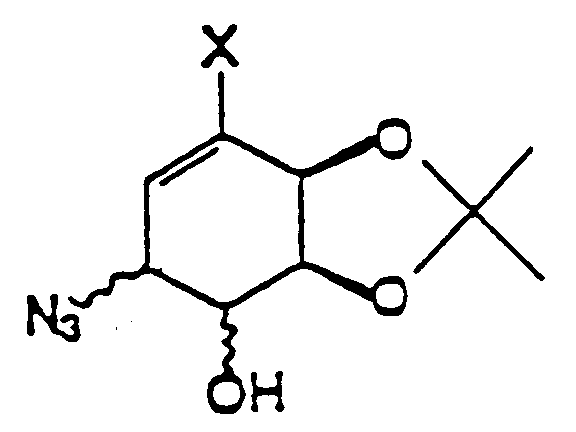 e. la mise en réaction de l'azido-alcool avec un excès d'ozone et puis avec un excès de borohydrure pour donner un premier lactol répondant à la formule suivante:
 f. la mise en réaction du premier lactol avec une résine échangeuse d'ions acides afin de déprotéger le premier lactol et obtenir un deuxième lactol répondant à la formule suivante:
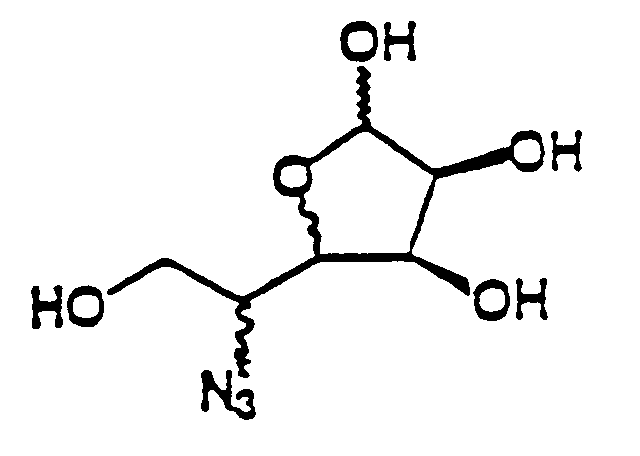 g. la mise en deuxième du second lactol avec une quantité efficace d'un périodate alcalin afin d'obtenir un troisième lactol répondant à la formule suivante:
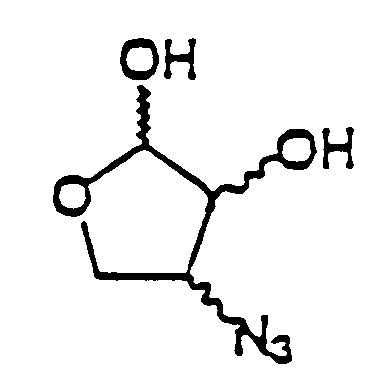 h. la soumission du troisième lactol à une oléfinication de Wittig afin de donner une azidosphingosine ; eti. la réduction de l'azidosphingosine en une amine afin d'obtenir la sphingosine désirée.
 - Processus selon la revendication 1, dans lequel le diol est obtenu par oxydation microbienne par Pseudomonas putida, souche 39D.
- Processus selon la revendication 1, dans lequel le diol est protégé sous la forme de sa combinaison acétonique en faisant réagir le diol avec du 2,2-diméthoxypropane.
- Processus selon la revendication 1, dans lequel la combinaison acétonique est convertie en l'époxyde en faisant réagir la combinaison acétonique avec de l'acide m-chloroperbenzoïque.
- Processus selon la revendication 1, dans lequel l'azothydrure de métal alcalin est l'azothydrure de sodium.
- Processus selon la revendication 1, dans lequel le borohydrure est le borohydrure de sodium.
- Processus selon la revendication 1, dans lequel le périodate de métal alcalin est le périodate de sodium.
- Processus selon la revendication 1, dans lequel la réduction de l'azidosphingosine est réalisée avec du sulfure d'hydrogène.
- Processus selon la revendication 1, comprenant en outre l'acylation de la sphingosine avec de l'anhydride acétique.
- Processus selon la revendication 1, dans lequel X est Cl.
- Processus de synthèse de L-thréo-sphingosine comprenant:a. la protection du 2,3-dihydroxy-1-chloro-cyclohexa-4,6-diène en faisant réagir le diol avec du 2,2-diméthoxypropane afin d'obtenir une combinaison acétonique intermédiaire;b. la conversion de la combinaison acétonique en un époxyde par mise en réaction avec l'acide m-chloroperbenzoïque dans le chlorure de méthylène;c. la mise en réaction de l'époxyde avec une quantité efficace d'azothydrure de sodium afin d'ouvrir stéréospécifiquement l'époxyde et obtenir un azido-alcool répondant à la formule suivante:
 d. la mise en réaction de l'azido-alcool d'abord avec un excès d'ozone et puis avec un excès de borohydrure afin d'obtenir un premier lactol répondant à la formule suivante:
 e. la mise en réaction du premier lactol avec une résine échangeuse d'ions acides afin de déprotéger le premier lactol et obtenir un deuxième lactol répondant à la formule suivante:
 f. la mise en réaction du deuxième lactol avec une quantité efficace de périodate de sodium afin d'obtenir un troisième lactol répondant à la formule suivante:
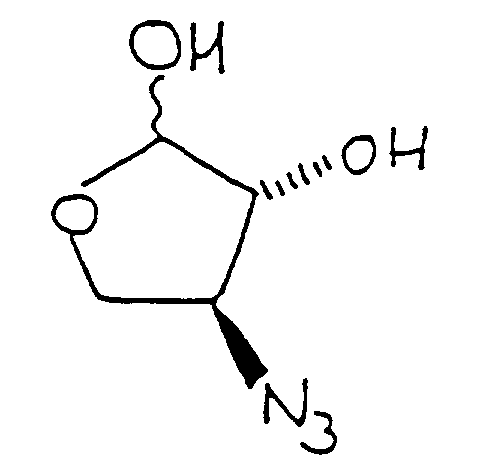 g. la soumission du troisième lactol à une oléfinication de Wittig avec du bromure de n-tétradécyltriphénylphosphonium afin de donner une azidosphingosine ; eth. la réduction de l'azidosphingosine en une amine afin d'obtenir la L-thréo-sphingosine.
 - Processus de synthèse de D-érythro-sphingosine comprenant:a. la conversion du 2,3-dihydroxy-1-chloro-cyclohexa-4,6-diène en un époxyde en faisant réagir le diol avec de l'acide m-chloroperbenzoïque dans le chlorure de méthylène;b. la protection de l'époxyde en faisant réagir l'époxyde avec du 2,2-diméthoxypropane afin d'obtenir un époxyde protégé;c. la mise en réaction de l'époxyde protégé d'abord avec du FeCl3 et puis avec une quantité efficace d'azothydrure de sodium afin d'ouvrir stéréospécifiquement l'époxyde et obtenir un azido-alcool répondant à la formule suivante:
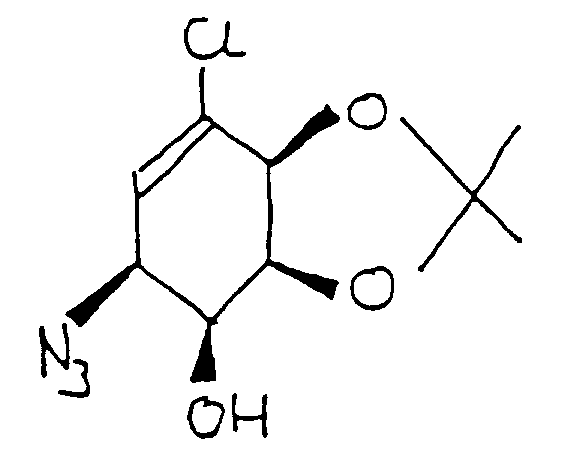 d. la mise en réaction de l'azido-alcool d'abord avec un excès d'ozone et puis avec un excès de borohydrure afin d'obtenir un premier lactol répondant à la formule suivante:
 e. la mise en réaction du premier lactol avec une résine échangeuse d'ions acides afin de déprotéger le premier lactol et obtenir un deuxième lactol répondant à la formule suivante:
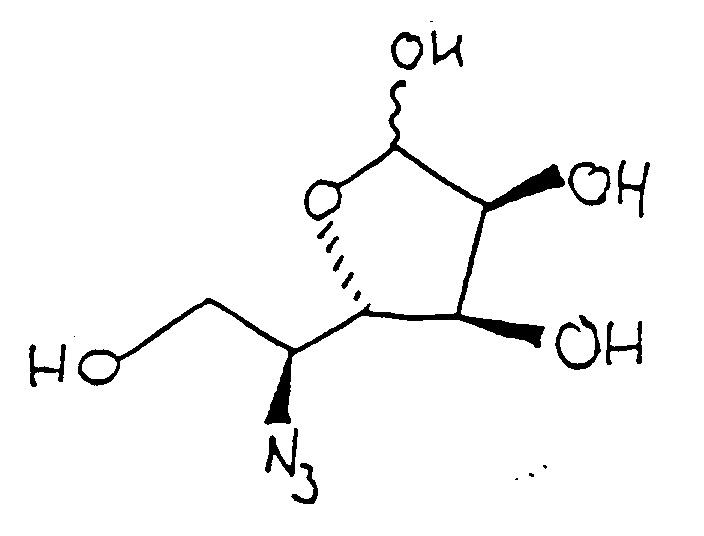 f. la mise en réaction du deuxième lactol avec une quantité efficace de périodate de sodium pour obtenir un troisième lactol répondant à la formule suivante:
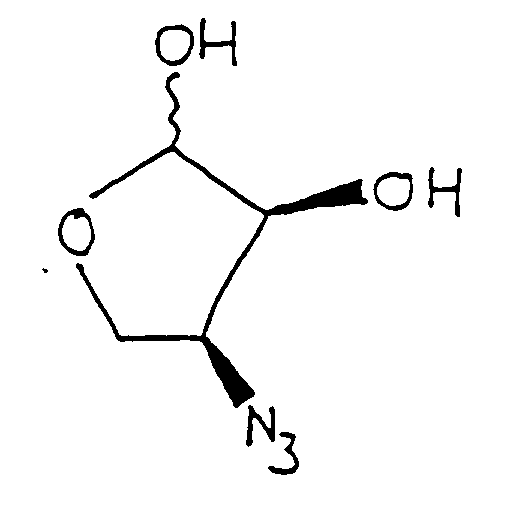 g. la soumission du troisième lactol à une oléfinication de Wittig avec du bromure de n-tétradécyltriphénylphosphonium afin de donner une azidosphingosine; eth. la réduction de l'azidosphingosine en une amine afin d'obtenir la D-érythro-sphingosine.
 - Processus de synthèse de L-érythro-sphingosine comprenant :a. la protection du 2,3-dihydroxy-1-chloro-cyclohexa-4,6-diène en faisant réagir le diol avec du 2,2-diméthoxypropane afin d'obtenir une combinaison acétonique intermédiaire;b. la conversion de la combinaison acétonique en un époxyde par mise en réaction avec du m-CPBA dans le chlorure de méthylène;c. la mise en réaction de l'époxyde avec une quantité efficace de chlorure de lithium en présence d'acéto-acétate d'éthyle et puis avec une quantité efficace d'azothydrure de sodium afin d'ouvrir stéréospécifiquement l'époxyde et obtenir un azido-alcool répondant à la formule suivante:
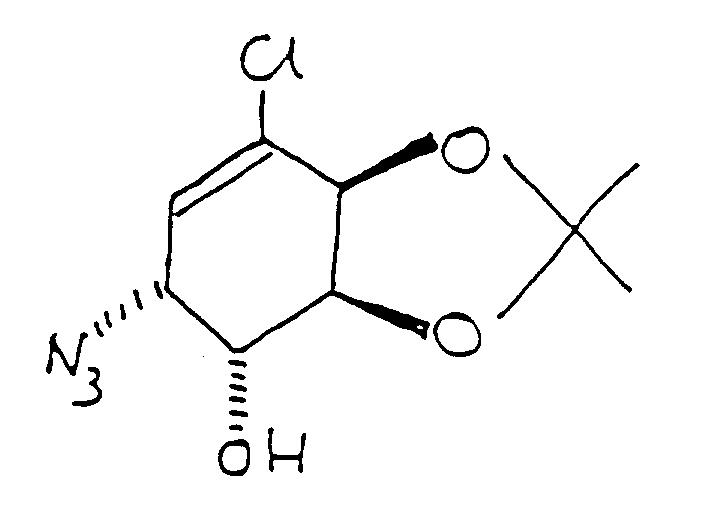 d. la mise en réaction de l'azido-alcool d'abord avec un excès d'ozone et puis avec un excès de borohydrure afin d'obtenir un premier lactol répondant à la formule suivante:
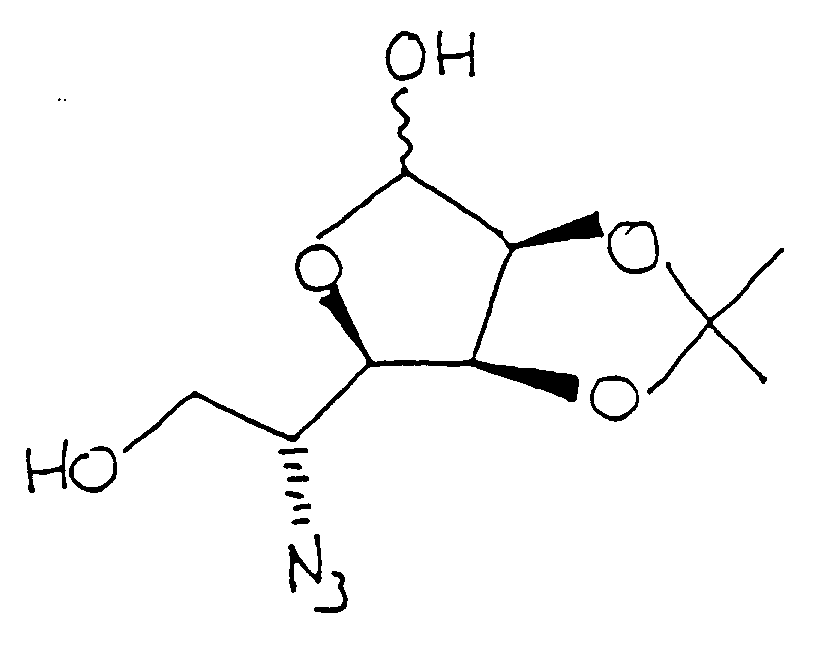 e. la mise en réaction du premier lactol avec une résine échangeuse d'ions acides afin de déprotéger le premier lactol et obtenir un deuxième lactol répondant à la formule suivante:
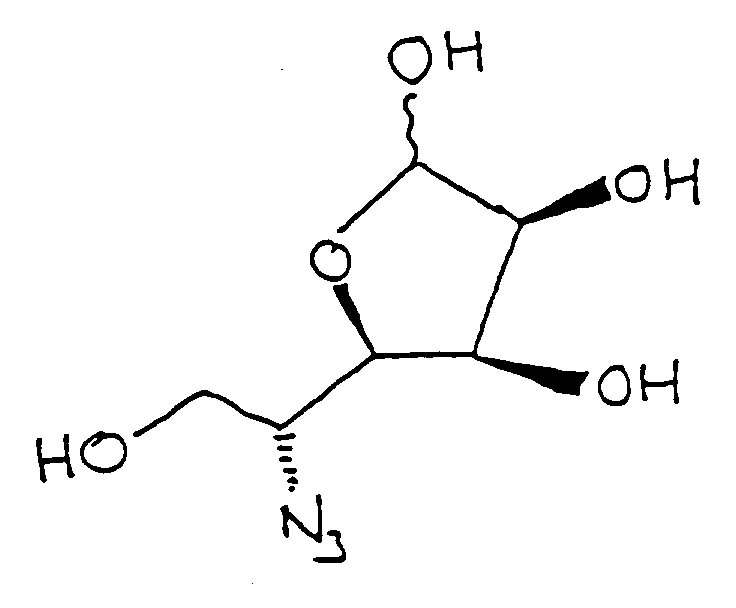 f. la mise en réaction du deuxième lactol avec une quantité efficace de périodate de sodium afin d'obtenir un troisième lactol répondant à la formule suivante:
 g. la soumission du troisième lactol à une oléfinication de Wittig avec du bromure de n-tétradécyitriphénylphosphonium afin de donner une azidosphingosine ; eth. la réduction de l'azidosphingosine en une amine afin d'obtenir la L-érythro-sphingosine.
 - Processus de synthèse de D-thréo-sphingosine comprenant:a. la conversion du 2,3-dihydroxy-1-chloro-cyclohexa-4,6-diène en un époxyde en faisant réagir le diol avec de l'acide m-chloroperbenzoïque dans le chlorure de méthylène;b. la protection de l'époxyde en faisant réagir l'époxyde avec du 2,2-diméthoxypropane afin d'obtenir un époxyde protégé;c. la mise en réaction de l'époxyde avec une quantité efficace d'azothydrure de sodium afin d'ouvrir stéréospécifiquement l'époxyde et obtenir un azido-alcool répondant à la formule suivante:
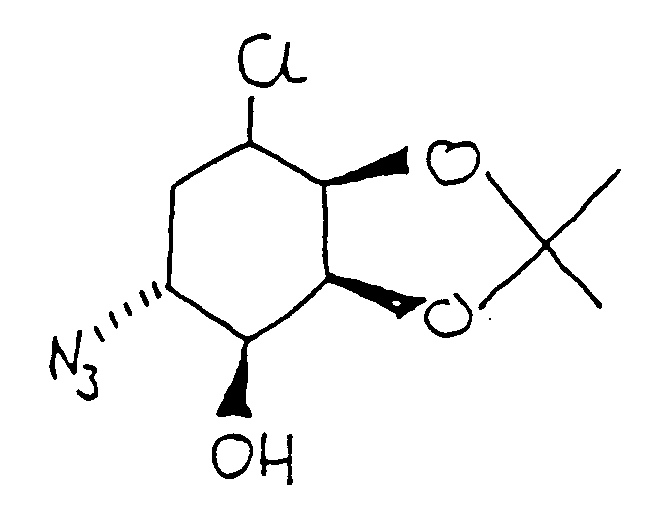 d. la mise en réaction de l'azido-alcool d'abord avec un excès d'ozone et puis avec un excès de borohydrure afin d'obtenir un premier lactol répondant à la formule suivante:
 e. la mise en réaction du premier lactol avec une résine échangeuse d'ions acides afin de déprotéger le premier lactol et obtenir un deuxième lactol répondant à la formule suivante:
 f. la mise en réaction du deuxième lactol avec une quantité efficace de périodate de sodium pour obtenir un troisième lactol répondant à la formule suivante:
 g. la soumission du troisième lactol à une oléfinication de Wittig avec du bromure de n-tétradécyltriphénylphosphonium afin de donner une azidosphingosine; eth. la réduction de l'azidosphingosine en une amine afin d'obtenir la D-thréo-sphingosine.
 - Procédé de synthèse de D-érythro-sphingosine comprenant:a. le traitement du (+)-cis-2,3-dihydroxy-1-chloro-cyclohexa-4,6-diène par l'acide p-toluène sulfonique en présence de 2,2-diméthoxypropane pour former du (2R, 3S)-2,3-isopropylidène-1-chloro-cyclohexa-4,6-diène;b. la soumission dudit (2R, 3S)-2,3-isopropylidène-1-chloro-cyclohexa-4,6-diène à l'ozonolyse suivie par la cyclisation du produit de ladite ozonolyse pour former du 2,3-O-isopropylidène-D-érythruronolactone;c. la réduction dudit 2,3-O-isopropylidène-D-érythruronolactone en présence de borohydrure de sodium pour produire du (S,S)-2,3-dihydroxy-2,3-O-isopropylidène-4-hydroxybutanoate de sodium;d. la cyclisation dudit (S,S)-2,3-dihydroxy-2,3-O-isopropylidène-4-hydroxybutanoate de sodium en présence d'iodométhane pour former du 2,3-O-isopropylidène-L-érythrono-1,4-lactone;e. le traitement dudit 2,3-O-isopropylidène-L-érythrono-1,4-lactone par une solution de DIBAL pour former du 2,3-O-isopropylidène-L-érythrose;f. la déprotection dudit 2,3-O-isopropylidène-L-érythrose pour former du L-érythrose;g. la soumission dudit L-érythrose à une oléfinication de Wittig pour obtenir un produit répondant à la formule suivante:
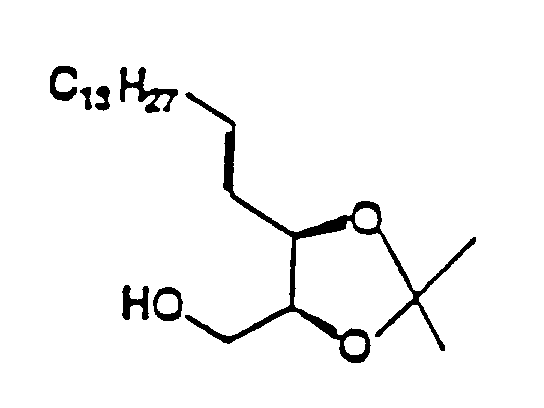 h. la soumission du produit de l'étape g à la déprotection catalytique par du H+ afin d'obtenir un produit répondant à la formule suivante:
 i. la mise en réaction du produit obtenu dans l'étape h avec du benzaldéhyde en présence de H+ afin d'obtenir un produit répondant à la formule suivante:
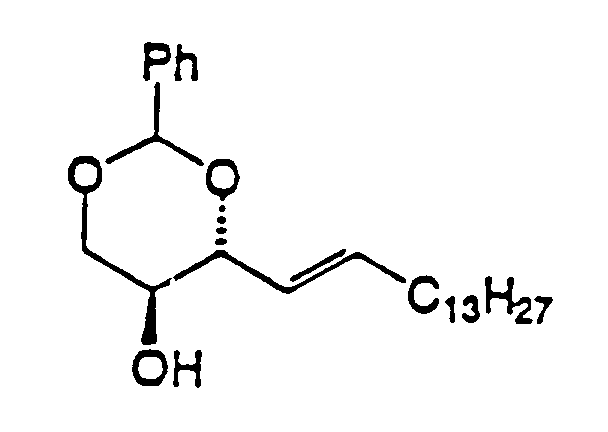 j. la mise en réaction du produit obtenu dans l'étape i avec du chlorure de méthane sulfonyle, du bromure de lithium, de l'azothydrure de sodium et de l'hydrure de lithium et d'aluminium dans une réaction séquentielle en quatre étapes afin d'obtenir un produit répondant à la formule suivante:
 k. la mise en réaction du produit obtenu dans l'étape j avec de l'acide chlorhydrique pour obtenir la D-érythro-sphingosine.
 - Procédé de synthèse de D-thréo-sphingosine comprenant:a. le traitement du (+)-cis-2,3-dihydroxy-1-chloro-cyclohexa-4,6-diène par l'acide p-toluène sulfonique en présence de 2,2-diméthoxypropane pour former du (2R, 3S)-2,3-isopropylidène-1-chloro-cyclohexa-4,6-diène;b. la soumission dudit (2R, 3S)-2,3-isopropylidène-1-chloro-cyclohexa-4,6-diène à l'ozonolyse suivie par la cyclisation du produit de ladite ozonolyse pour former du 2,3-O-isopropylidène-D-érythruronolactone;c. la réduction dudit 2,3-O-isopropylidène-D-érythruronolactone en présence de borohydrure de sodium pour produire du (S,S)-2,3-dihydroxy-2,3-O-isopropylidène-4-hydroxybutanoate de sodium;d. la cyclisation dudit (S,S)-2,3-dihydroxy-2,3-O-isopropylidène-4-hydroxybutanoate de sodium en présence d'iodométhane pour former du 2,3-O-isopropylidène-L-érythrono-1,4-lactone;e. le traitement dudit 2,3-O-isopropylidène-L-érythrono-1,4-lactone par une solution de DIBAL pour former du 2,3-O-isopropylidène-L-érythrose;f. la déprotection dudit 2,3-O-isopropylidène-L-érythrose pour former du L-érythrose;g. la soumission dudit L-érythrose à une oléfinication de Wittig pour obtenir un produit répondant à la formule suivante:
 h. la soumission du produit obtenu dans l'étape g à la déprotection catalytique par du H+ afin d'obtenir un produit répondant à la formule suivante:
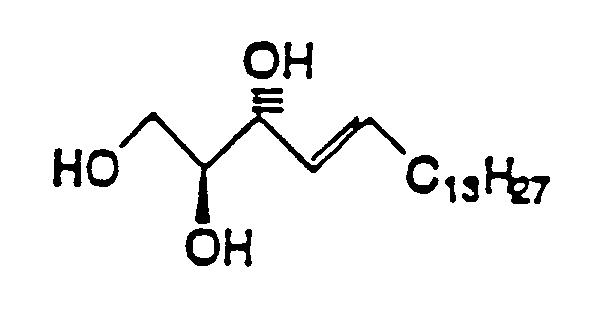 i. la mise en réaction du produit obtenu dans l'étape h avec du benzaldéhyde en présence de H+ afin d'obtenir un produit répondant à la formule suivante:
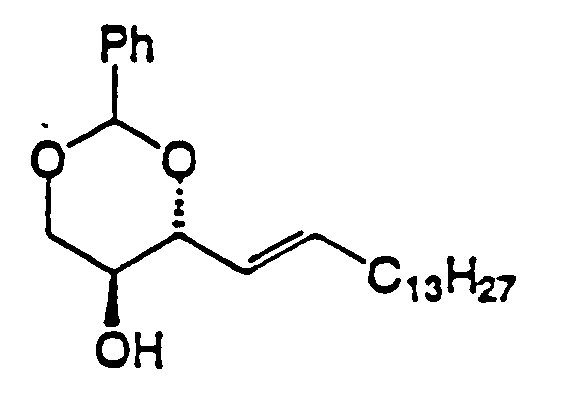 j. la mise en réaction du produit obtenu dans l'étape i avec du chlorure de méthane sulfonyle, de l'azothydrure de sodium et de l'hydrure de lithium et d'aluminium dans une réaction séquentielle en trois étapes afin d'obtenir un produit répondant à la formule suivante:
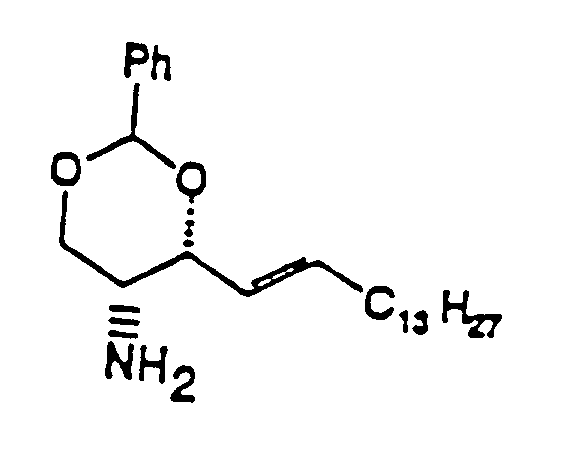 k. la mise en réaction du produit obtenu dans l'étape j avec de l'acide chlorhydrique pour obtenir la D-érythro-sphingosine.
 - Procédé de synthèse de L-thréo-sphingosine comprenant:a. le traitement du (+)-cis-2,3-dihydroxy-1-chloro-cyclohexa-4,6-diène par l'acide p-toluène sulfonique en présence de 2,2-diméthoxypropane pour former du (2R, 3S)-2,3-isopropylidène-1-chloro-cyclohexa-4,6-diène;b. la soumission dudit (2R, 3S)-2,3-isopropylidène-1-chloro-cyclohexa-4,6-diène à une ozonolyse suivie par la cyclisation du produit de ladite ozonolyse pour former du 2,3-O-isopropylidène-D-érythruronolactone;c. la réduction dudit 2,3-O-isopropylidène-D-érythruronolactone en présence de borohydrure de sodium pour produire du (S,S)-2,3-dihydroxy-2,3-O-isopropylidène-4-hydroxybutanoate de sodium;d. la cyclisation dudit (S,S)-2,3-dihydroxy-2,3-O-isopropylidène-4-hydroxybutanoate de sodium en présence d'iodométhane pour former du 2,3-O-isopropylidène-L-érythrono-1,4-lactone;e. le traitement dudit 2,3-O-isopropylidène-L-érythrono-1,4-lactone par une solution de DIBAL pour former du 2,3-O-isopropylidène-L-érythrose;f. la déprotection dudit 2,3-O-isopropylidène-L-érythrose pour former du L-érythrose;g. la soumission dudit L-érythrose à une oléfinication de Wittig pour obtenir un produit répondant à la formule suivante:
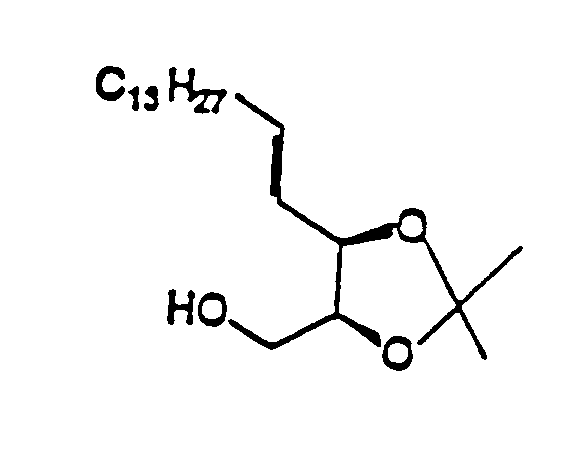 h. la soumission du produit obtenu dans l'étape g à la déprotection catalytique par du H+ afin d'obtenir un produit répondant à la formule suivante:
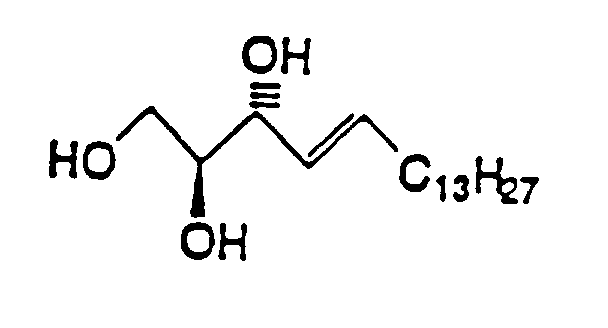 i. la mise en réaction du produit obtenu dans l'étape h avec du dimethoxypropane en présence de H+ et d'acétone afin d'obtenir un produit répondant à la formule suivante:
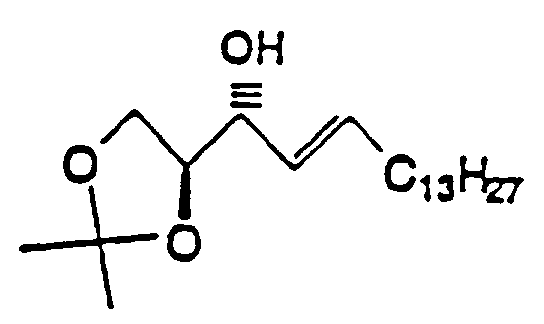 j. la soumission du produit obtenu dans l'étape i à une inversion de Mitsunobu pour obtenir un produit répondant à la formule suivante:
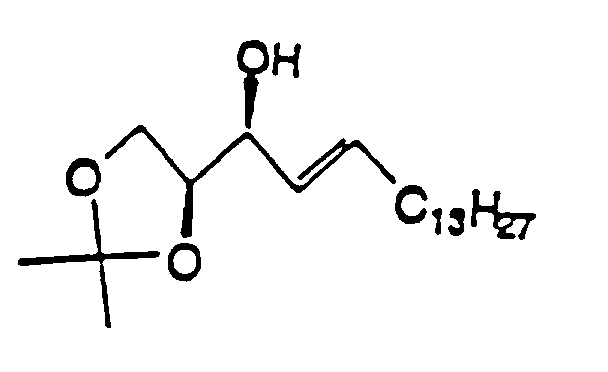 k. la mise en réaction du produit obtenu dans l'étape j avec du benzaldéhyde en présence de H+ afin d'obtenir un produit répondant à la formule suivante:
 l. la mise en réaction du produit obtenu dans l'étape k avec du chlorure de méthane sulfonyle, du bromure de lithium, de l'azothydrure de sodium et de l'hydrure de lithium et d'aluminium dans une réaction séquentielle en quatre étapes afin d'obtenir un produit répondant à la formule suivante:
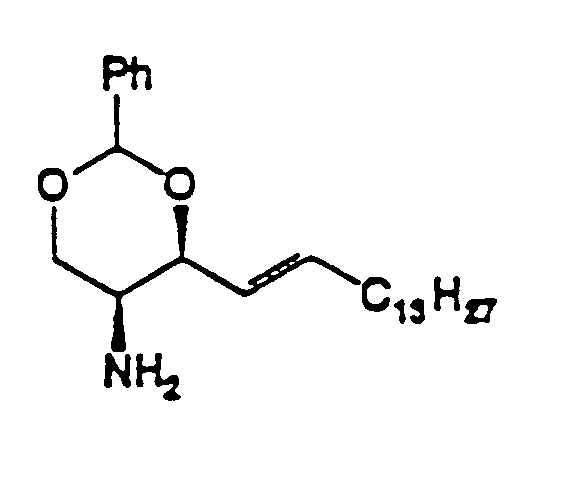 m. la mise en réaction du produit obtenu dans l'étape l avec du chlorure d'hydrogène pour obtenir la L-thréo-sphingosine.
 - Procédé de synthèse de L-érythro-sphingosine comprenant:a. le traitement du (+)-cis-2,3-dihydroxy-1-chloro-cyclohexa-4,6-diène par l'acide p-toluène sulfonique en présence de 2,2-diméthoxypropane pour former du (2R, 3S)-2,3-isopropylidène-1-chloro-cyclohexa-4,6-diène;b. la soumission dudit (2R, 3S)-2,3-isopropylidène-1-chloro-cyclohexa-4,6-diène à une ozonolyse suivie par la cyclisation du produit de ladite ozonolyse pour former du 2,3-O-isopropylidène-D-érythruronolactone;c. la réduction dudit 2,3-O-isopropylidène-D-érythruronolactone en présence de borohydrure de sodium pour produire du (S,S)-2,3-dihydroxy-2,3-O-isopropylidène-4-hydroxybutanoate de sodium;d. la cyclisation dudit (S,S)-2,3-dihydroxy-2,3-O-isopropylidène-4-hydroxybutanoate de sodium en présence d'iodométhane pour former du 2,3-O-isopropylidène-L-érythrono-1,4-lactone;e. le traitement dudit 2,3-O-isopropylidène-L-érythrono-1,4-lactone par une solution de DIBAL pour former du 2,3-O-isopropylidène-L-érythrose;f. la déprotection dudit 2,3-O-isopropylidène-L-érythrose pour former du L-érythrose;g. la soumission dudit L-érythrose à une oléfinication de Wittig pour obtenir un produit répondant à la formule suivante:
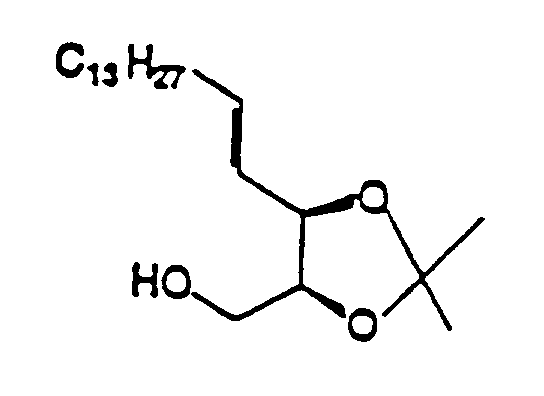 h. la soumission du produit obtenu dans l'étape g à la déprotection catalytique par du H+ afin d'obtenir un produit répondant à la formule suivante:
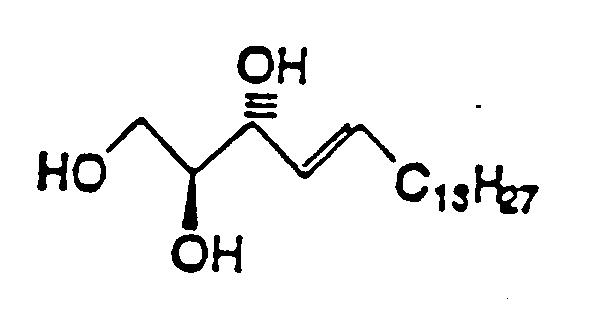 i. la mise en réaction du produit obtenu dans l'étape h avec du diméthoxypropane en présence de H+ et d'acétone afin d'obtenir un produit répondant à la formule suivante:
 j. la soumission du produit obtenu dans l'étape i à une inversion de Mitsunobu pour obtenir un produit répondant à la formule suivante:
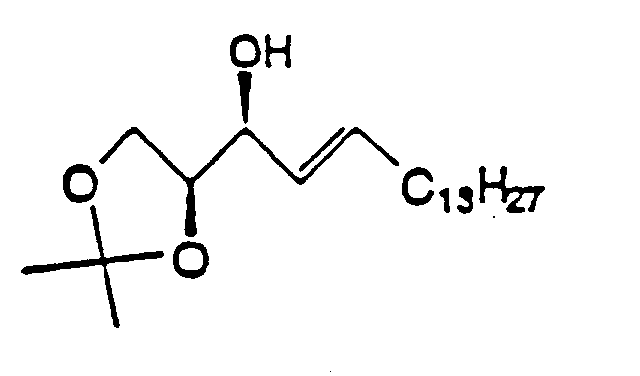 k. la mise en réaction du produit obtenu dans l'étape j avec du benzaldéhyde en présence de H+ afin d'obtenir un produit répondant à la formule suivante:
 l. la mise en réaction du produit obtenu dans l'étape k avec du chlorure de méthane sulfonyle, de l'azothydrure de sodium et de l'hydrure de lithium et d'aluminium dans une réaction séquentielle en trois étapes afin d'obtenir un produit répondant à la formule suivante:
 m. la mise en réaction du produit obtenu dans l'étape l avec de l'acide chlorhydrique pour obtenir la L-érythro-sphingosine.
Applications Claiming Priority (3)
| Application Number | Priority Date | Filing Date | Title |
|---|---|---|---|
| US13734693A | 1993-10-18 | 1993-10-18 | |
| US137346 | 1993-10-18 | ||
| PCT/US1994/011540 WO1995011222A1 (fr) | 1993-10-18 | 1994-10-11 | Synthese de sphingosines |
Publications (2)
| Publication Number | Publication Date |
|---|---|
| EP0724562A1 EP0724562A1 (fr) | 1996-08-07 |
| EP0724562B1 true EP0724562B1 (fr) | 1998-06-03 |
Family
ID=22476987
Family Applications (1)
| Application Number | Title | Priority Date | Filing Date |
|---|---|---|---|
| EP94930717A Expired - Lifetime EP0724562B1 (fr) | 1993-10-18 | 1994-10-11 | Synthese de sphingosines |
Country Status (7)
| Country | Link |
|---|---|
| US (2) | US5488166A (fr) |
| EP (1) | EP0724562B1 (fr) |
| JP (2) | JP3783730B2 (fr) |
| CA (1) | CA2174431C (fr) |
| DE (1) | DE69410814T2 (fr) |
| ES (1) | ES2117304T3 (fr) |
| WO (1) | WO1995011222A1 (fr) |
Families Citing this family (9)
| Publication number | Priority date | Publication date | Assignee | Title |
|---|---|---|---|---|
| US6720184B1 (en) | 1991-08-05 | 2004-04-13 | Emory University | Method of altering sphingolipid metabolism and detecting fumonisin ingestion and contamination |
| FR2727407B1 (fr) * | 1994-11-30 | 1996-12-27 | Oreal | Procede de preparation de 2-amino-alcane-1,3-diols |
| US6232299B1 (en) | 1996-05-01 | 2001-05-15 | Eli Lilly And Company | Use of protein kinase C inhibitors to enhance the clinical efficacy of oncolytic agents and radiation therapy |
| CA2320117A1 (fr) * | 1998-02-12 | 1999-08-19 | Emory University | Derives de sphingolipides et procedes d'utilisation |
| BR9911457A (pt) | 1998-06-24 | 2001-12-11 | Univ Emory | Uso de 3'-azida-2', 3'-dideoxiuridina em combinaçãocom drogas anti-hiv adicionais para a manufaturade um medicamento para o tratamento de hiv |
| US20040175384A1 (en) * | 2003-12-12 | 2004-09-09 | Mohapatra Shyam S. | Protein kinase C as a target for the treatment of respiratory syncytial virus |
| US8592368B2 (en) | 2003-12-19 | 2013-11-26 | University Of South Florida | JAK/STAT inhibitors and MAPK/ERK inhibitors for RSV infection |
| AR056517A1 (es) | 2005-09-16 | 2007-10-10 | Schering Corp | Composiciones y metodos farmaceuticos utilizando temozolomida y un inhibidor de la proteina quinasa |
| WO2008030840A2 (fr) * | 2006-09-06 | 2008-03-13 | Emory University | Synthèse de sphingosines et leurs dérivés |
Family Cites Families (11)
| Publication number | Priority date | Publication date | Assignee | Title |
|---|---|---|---|---|
| JPH0651715B2 (ja) * | 1985-06-07 | 1994-07-06 | 理化学研究所 | シアロシルセレブロシド類及びその製造法 |
| ATE71104T1 (de) * | 1985-08-13 | 1992-01-15 | Solco Basel Ag | Neues verfahren zur herstellung von sphingosinderivaten. |
| US5010059A (en) * | 1987-06-26 | 1991-04-23 | Solco Basel Ag | Pharmaceutical products and lactosyl compounds |
| JP2588729B2 (ja) * | 1987-10-05 | 1997-03-12 | 塩野義製薬株式会社 | スフィンゴシン誘導体 |
| US5110987A (en) * | 1988-06-17 | 1992-05-05 | Emory University | Method of preparing sphingosine derivatives |
| US5012000A (en) * | 1989-10-30 | 1991-04-30 | Eastman Kodak Company | Total synthesis of chiral 2-amino-1,3-diols |
| US5068345A (en) * | 1989-10-30 | 1991-11-26 | Eastman Kodak Company | Oxazolidinone aldol adduct |
| US5200516A (en) * | 1990-02-16 | 1993-04-06 | Virginia Tech Intellectual Properties | Synthesis of sugars from substituted and unsubstituted arene diols |
| US5137919A (en) * | 1990-12-31 | 1992-08-11 | Biomembrane Institute | Effect of N,N,N,-trimethylsphingosine on protein kinase C activity melanoma cell growth in vitro; metastatic potential in vivo and human platelet aggregation |
| US5151360A (en) * | 1990-12-31 | 1992-09-29 | Biomembrane Institute | Effect of n,n,n-trimethylsphingosine on protein kinase-c activity, melanoma cell growth in vitro, metastatic potential in vivo and human platelet aggregation |
| US5220043A (en) * | 1991-03-21 | 1993-06-15 | Ohio University | Synthesis of D-erythro-sphingomyelins |
-
1994
- 1994-10-11 WO PCT/US1994/011540 patent/WO1995011222A1/fr not_active Ceased
- 1994-10-11 DE DE69410814T patent/DE69410814T2/de not_active Expired - Lifetime
- 1994-10-11 ES ES94930717T patent/ES2117304T3/es not_active Expired - Lifetime
- 1994-10-11 JP JP51200295A patent/JP3783730B2/ja not_active Expired - Lifetime
- 1994-10-11 EP EP94930717A patent/EP0724562B1/fr not_active Expired - Lifetime
- 1994-10-11 CA CA002174431A patent/CA2174431C/fr not_active Expired - Lifetime
-
1995
- 1995-01-23 US US08/377,095 patent/US5488166A/en not_active Expired - Lifetime
- 1995-02-21 US US08/389,622 patent/US5488167A/en not_active Expired - Lifetime
-
2005
- 2005-10-05 JP JP2005292657A patent/JP4224049B2/ja not_active Expired - Lifetime
Also Published As
| Publication number | Publication date |
|---|---|
| CA2174431C (fr) | 2005-12-06 |
| WO1995011222A1 (fr) | 1995-04-27 |
| DE69410814D1 (de) | 1998-07-09 |
| CA2174431A1 (fr) | 1995-04-27 |
| ES2117304T3 (es) | 1998-08-01 |
| JP2006028196A (ja) | 2006-02-02 |
| DE69410814T2 (de) | 1998-11-12 |
| EP0724562A1 (fr) | 1996-08-07 |
| US5488166A (en) | 1996-01-30 |
| JP3783730B2 (ja) | 2006-06-07 |
| US5488167A (en) | 1996-01-30 |
| JPH09503786A (ja) | 1997-04-15 |
| JP4224049B2 (ja) | 2009-02-12 |
Similar Documents
| Publication | Publication Date | Title |
|---|---|---|
| US5602263A (en) | Syntheses of D-chiro-3-inosose and (+)-D-chiro inositol | |
| CA1340549C (fr) | Methode pour preparer des derives de la sphingosine | |
| US5488167A (en) | Synthesis of sphingosines | |
| DE69915110T2 (de) | Verfahren zur herstellung von arylethern | |
| EP0293006A1 (fr) | Composés en rapport avec un céramide artificiel et leur préparation | |
| US6417403B1 (en) | Process for preparing chiral (s)-2,3-disubstituted-1-propylamine derivatives | |
| Handa et al. | The pyranoside ring as a nucleophile in aldol condensations | |
| US4408063A (en) | Preparation of epihalohydrin enantiomers | |
| US5571939A (en) | Method for preparing dodecahydro-3a,6,6,9a-tetramethylnaphtho[2,1-b]furan and novel haloethyl decalin derivatives | |
| CA1310014C (fr) | Diols de type monoacetal enantiomeriquement purs, leur preparation et leurutilisation | |
| FR2689890A1 (fr) | Procédé de fabrication d'un dérivé à groupe benzo[b]thiophényle-5 et intermédiaire de fabrication. | |
| JP4549753B2 (ja) | ボグリボースの製造法 | |
| JPS6354351A (ja) | 光学活性1−メチル−3−フエニルプロピルアジド及びその化合物を用いる光学活性アミンの製造法 | |
| JP2750874B2 (ja) | (−)−3−(p−トリル)グリシドール | |
| Sankaranarayanan et al. | Asymmetric synthesis of a cytotoxic amide of Telesto riisei | |
| KR100420263B1 (ko) | 아지리딘-2-카르복시산 에스테르로부터 이소세린 및 그유도체들을 제조하는 방법 | |
| JP3770678B2 (ja) | 光学活性アルコール及びそのカルボン酸エステル | |
| JPH042586B2 (fr) | ||
| JP2000072700A (ja) | 光学活性グリコール及びその製造方法 | |
| FR2548181A1 (fr) | Nouveaux 1-(4'-alkylamido)-2'-(1-(n-(alkyl)imino)ethyl) phenoxy-3-alkylamino-2-propanols utiles comme intermediaires pour la preparation de composes a activite pharmacologique | |
| JPS59181268A (ja) | 環状カルバメ−ト化合物及びその製造方法 | |
| JPH06157486A (ja) | セラミド誘導体とその製造方法及び中間体 | |
| JPS58157734A (ja) | (2r,3s)−オクタンジオ−ル及びその誘導体 | |
| KR20000015622A (ko) | 키랄 4-치환된-3-하이드록시부티르산과 이의 염의 제조방법 | |
| JPS6115075B2 (fr) |
Legal Events
| Date | Code | Title | Description |
|---|---|---|---|
| PUAI | Public reference made under article 153(3) epc to a published international application that has entered the european phase |
Free format text: ORIGINAL CODE: 0009012 |
|
| 17P | Request for examination filed |
Effective date: 19960503 |
|
| AK | Designated contracting states |
Kind code of ref document: A1 Designated state(s): BE CH DE ES FR GB IE IT LI NL |
|
| 17Q | First examination report despatched |
Effective date: 19960814 |
|
| GRAG | Despatch of communication of intention to grant |
Free format text: ORIGINAL CODE: EPIDOS AGRA |
|
| GRAG | Despatch of communication of intention to grant |
Free format text: ORIGINAL CODE: EPIDOS AGRA |
|
| GRAH | Despatch of communication of intention to grant a patent |
Free format text: ORIGINAL CODE: EPIDOS IGRA |
|
| GRAH | Despatch of communication of intention to grant a patent |
Free format text: ORIGINAL CODE: EPIDOS IGRA |
|
| GRAA | (expected) grant |
Free format text: ORIGINAL CODE: 0009210 |
|
| AK | Designated contracting states |
Kind code of ref document: B1 Designated state(s): BE CH DE ES FR GB IE IT LI NL |
|
| REG | Reference to a national code |
Ref country code: CH Ref legal event code: NV Representative=s name: E. BLUM & CO. PATENTANWAELTE Ref country code: CH Ref legal event code: EP |
|
| ITF | It: translation for a ep patent filed | ||
| REF | Corresponds to: |
Ref document number: 69410814 Country of ref document: DE Date of ref document: 19980709 |
|
| REG | Reference to a national code |
Ref country code: ES Ref legal event code: FG2A Ref document number: 2117304 Country of ref document: ES Kind code of ref document: T3 |
|
| ET | Fr: translation filed | ||
| REG | Reference to a national code |
Ref country code: IE Ref legal event code: FG4D |
|
| PLBE | No opposition filed within time limit |
Free format text: ORIGINAL CODE: 0009261 |
|
| STAA | Information on the status of an ep patent application or granted ep patent |
Free format text: STATUS: NO OPPOSITION FILED WITHIN TIME LIMIT |
|
| 26N | No opposition filed | ||
| REG | Reference to a national code |
Ref country code: GB Ref legal event code: IF02 |
|
| REG | Reference to a national code |
Ref country code: CH Ref legal event code: PFA Owner name: VIRGINIA TECH INTELLECTUAL PROPERTIES, INC. Free format text: VIRGINIA TECH INTELLECTUAL PROPERTIES, INC.#1900 KRAFT DRIVE#BLACKSBURG, VA 24061 (US) -TRANSFER TO- VIRGINIA TECH INTELLECTUAL PROPERTIES, INC.#1900 KRAFT DRIVE#BLACKSBURG, VA 24061 (US) |
|
| PGFP | Annual fee paid to national office [announced via postgrant information from national office to epo] |
Ref country code: FR Payment date: 20131017 Year of fee payment: 20 Ref country code: CH Payment date: 20131029 Year of fee payment: 20 Ref country code: IE Payment date: 20131025 Year of fee payment: 20 Ref country code: BE Payment date: 20131028 Year of fee payment: 20 Ref country code: DE Payment date: 20131029 Year of fee payment: 20 Ref country code: GB Payment date: 20131028 Year of fee payment: 20 |
|
| PGFP | Annual fee paid to national office [announced via postgrant information from national office to epo] |
Ref country code: NL Payment date: 20131026 Year of fee payment: 20 Ref country code: ES Payment date: 20131028 Year of fee payment: 20 Ref country code: IT Payment date: 20131024 Year of fee payment: 20 |
|
| REG | Reference to a national code |
Ref country code: DE Ref legal event code: R071 Ref document number: 69410814 Country of ref document: DE |
|
| REG | Reference to a national code |
Ref country code: DE Ref legal event code: R071 Ref document number: 69410814 Country of ref document: DE |
|
| REG | Reference to a national code |
Ref country code: CH Ref legal event code: PL |
|
| REG | Reference to a national code |
Ref country code: NL Ref legal event code: V4 Effective date: 20141011 |
|
| REG | Reference to a national code |
Ref country code: GB Ref legal event code: PE20 Expiry date: 20141010 |
|
| REG | Reference to a national code |
Ref country code: IE Ref legal event code: MK9A |
|
| REG | Reference to a national code |
Ref country code: ES Ref legal event code: FD2A Effective date: 20150108 |
|
| PG25 | Lapsed in a contracting state [announced via postgrant information from national office to epo] |
Ref country code: IE Free format text: LAPSE BECAUSE OF EXPIRATION OF PROTECTION Effective date: 20141011 Ref country code: ES Free format text: LAPSE BECAUSE OF EXPIRATION OF PROTECTION Effective date: 20141012 Ref country code: GB Free format text: LAPSE BECAUSE OF EXPIRATION OF PROTECTION Effective date: 20141010 |