EP0725113A1 - Compositions de silicone amidée et fluorinée et composition réticulables de siloxane - Google Patents
Compositions de silicone amidée et fluorinée et composition réticulables de siloxane Download PDFInfo
- Publication number
- EP0725113A1 EP0725113A1 EP96300438A EP96300438A EP0725113A1 EP 0725113 A1 EP0725113 A1 EP 0725113A1 EP 96300438 A EP96300438 A EP 96300438A EP 96300438 A EP96300438 A EP 96300438A EP 0725113 A1 EP0725113 A1 EP 0725113A1
- Authority
- EP
- European Patent Office
- Prior art keywords
- group
- compound
- formula
- fluorinated
- divalent
- Prior art date
- Legal status (The legal status is an assumption and is not a legal conclusion. Google has not performed a legal analysis and makes no representation as to the accuracy of the status listed.)
- Granted
Links
- 0 *C***(*)C(C=CC1)=CC1=C Chemical compound *C***(*)C(C=CC1)=CC1=C 0.000 description 2
Images


Classifications
-
- C—CHEMISTRY; METALLURGY
- C08—ORGANIC MACROMOLECULAR COMPOUNDS; THEIR PREPARATION OR CHEMICAL WORKING-UP; COMPOSITIONS BASED THEREON
- C08L—COMPOSITIONS OF MACROMOLECULAR COMPOUNDS
- C08L71/00—Compositions of polyethers obtained by reactions forming an ether link in the main chain; Compositions of derivatives of such polymers
- C08L71/02—Polyalkylene oxides
-
- C—CHEMISTRY; METALLURGY
- C07—ORGANIC CHEMISTRY
- C07F—ACYCLIC, CARBOCYCLIC OR HETEROCYCLIC COMPOUNDS CONTAINING ELEMENTS OTHER THAN CARBON, HYDROGEN, HALOGEN, OXYGEN, NITROGEN, SULFUR, SELENIUM OR TELLURIUM
- C07F7/00—Compounds containing elements of Groups 4 or 14 of the Periodic Table
- C07F7/02—Silicon compounds
- C07F7/08—Compounds having one or more C—Si linkages
- C07F7/0803—Compounds with Si-C or Si-Si linkages
- C07F7/081—Compounds with Si-C or Si-Si linkages comprising at least one atom selected from the elements N, O, halogen, S, Se or Te
- C07F7/0812—Compounds with Si-C or Si-Si linkages comprising at least one atom selected from the elements N, O, halogen, S, Se or Te comprising a heterocyclic ring
-
- C—CHEMISTRY; METALLURGY
- C07—ORGANIC CHEMISTRY
- C07F—ACYCLIC, CARBOCYCLIC OR HETEROCYCLIC COMPOUNDS CONTAINING ELEMENTS OTHER THAN CARBON, HYDROGEN, HALOGEN, OXYGEN, NITROGEN, SULFUR, SELENIUM OR TELLURIUM
- C07F7/00—Compounds containing elements of Groups 4 or 14 of the Periodic Table
- C07F7/02—Silicon compounds
- C07F7/21—Cyclic compounds having at least one ring containing silicon, but no carbon in the ring
-
- C—CHEMISTRY; METALLURGY
- C08—ORGANIC MACROMOLECULAR COMPOUNDS; THEIR PREPARATION OR CHEMICAL WORKING-UP; COMPOSITIONS BASED THEREON
- C08G—MACROMOLECULAR COMPOUNDS OBTAINED OTHERWISE THAN BY REACTIONS ONLY INVOLVING UNSATURATED CARBON-TO-CARBON BONDS
- C08G65/00—Macromolecular compounds obtained by reactions forming an ether link in the main chain of the macromolecule
- C08G65/002—Macromolecular compounds obtained by reactions forming an ether link in the main chain of the macromolecule from unsaturated compounds
- C08G65/005—Macromolecular compounds obtained by reactions forming an ether link in the main chain of the macromolecule from unsaturated compounds containing halogens
- C08G65/007—Macromolecular compounds obtained by reactions forming an ether link in the main chain of the macromolecule from unsaturated compounds containing halogens containing fluorine
-
- C—CHEMISTRY; METALLURGY
- C08—ORGANIC MACROMOLECULAR COMPOUNDS; THEIR PREPARATION OR CHEMICAL WORKING-UP; COMPOSITIONS BASED THEREON
- C08G—MACROMOLECULAR COMPOUNDS OBTAINED OTHERWISE THAN BY REACTIONS ONLY INVOLVING UNSATURATED CARBON-TO-CARBON BONDS
- C08G65/00—Macromolecular compounds obtained by reactions forming an ether link in the main chain of the macromolecule
- C08G65/02—Macromolecular compounds obtained by reactions forming an ether link in the main chain of the macromolecule from cyclic ethers by opening of the heterocyclic ring
- C08G65/32—Polymers modified by chemical after-treatment
- C08G65/329—Polymers modified by chemical after-treatment with organic compounds
- C08G65/336—Polymers modified by chemical after-treatment with organic compounds containing silicon
-
- C—CHEMISTRY; METALLURGY
- C08—ORGANIC MACROMOLECULAR COMPOUNDS; THEIR PREPARATION OR CHEMICAL WORKING-UP; COMPOSITIONS BASED THEREON
- C08L—COMPOSITIONS OF MACROMOLECULAR COMPOUNDS
- C08L83/00—Compositions of macromolecular compounds obtained by reactions forming in the main chain of the macromolecule a linkage containing silicon with or without sulfur, nitrogen, oxygen or carbon only; Compositions of derivatives of such polymers
- C08L83/04—Polysiloxanes
- C08L83/08—Polysiloxanes containing silicon bound to organic groups containing atoms other than carbon, hydrogen and oxygen
-
- C—CHEMISTRY; METALLURGY
- C08—ORGANIC MACROMOLECULAR COMPOUNDS; THEIR PREPARATION OR CHEMICAL WORKING-UP; COMPOSITIONS BASED THEREON
- C08L—COMPOSITIONS OF MACROMOLECULAR COMPOUNDS
- C08L83/00—Compositions of macromolecular compounds obtained by reactions forming in the main chain of the macromolecule a linkage containing silicon with or without sulfur, nitrogen, oxygen or carbon only; Compositions of derivatives of such polymers
- C08L83/14—Compositions of macromolecular compounds obtained by reactions forming in the main chain of the macromolecule a linkage containing silicon with or without sulfur, nitrogen, oxygen or carbon only; Compositions of derivatives of such polymers in which at least two but not all the silicon atoms are connected by linkages other than oxygen atoms
Definitions
- This invention relates to novel fluorinated amide compounds which are useful as stock materials for rubber materials having heat, solvent and chemical resistance and release agents. It also relates to curable compositions which when allowed to stand at room temperature or heated, will readily cure into products having improved solvent, chemical and heat resistance, low-temperature properties, and moisture impermeability.
- Curable fluorinated elastomer compositions comprising a polymer of fluorinated organic compound and a crosslinking agent have been used in a variety of fields. Such compositions are cured into elastomers which are utilized, for example, as rubber, paint and mold release agents.
- fluoro-rubber has poor low-temperature properties and cannot be liquefied.
- Silicone rubber has poor chemical resistance and solvent resistance.
- Fluorosilicone rubber which was developed as a rubber material having combined properties of both, is insufficient in chemical resistance and resistance to polar solvents.
- Fluorinated elastomers and resins used as paint and mold release agents are desired to exhibit better mold release and water repellent properties.
- An object of the present invention is to provide a novel and improved fluorinated amide compound which will form a cured product having improved solvent resistance, chemical resistance, heat resistance, low-temperature properties, and moisture impermeability.
- Another object of the present invention is to provide a curable composition comprising a fluorinated amide compound and a fluorinated organohydrogensiloxane.
- a novel fluorinated amide compound of the following general formula (1) is obtained by reacting a compound having an acid fluoride group at either end of the following general formula (4) with a secondary amine compound of the following general formula (5) or by reacting a compound of formula (4) with a compound of the following general formula (6) and then with a compound of formula (5) and that this fluorinated amide compound of formula (1) can form an elastomer having an increased fluorine content and low surface energy.
- the present invention in one aspect provides a fluorinated amide compound of formula (1).
- the present invention provides a curable composition
- a curable composition comprising (A) a fluorinated amide compound of formula (1), (B) a fluorinated organohydrogensiloxane containing at least one monovalent perfluorooxyalkyl, monovalent perfluoroalkyl, divalent perfluorooxyalkylene or divalent perfluoroalkylene group and at least two hydrosilyl groups in a molecule, and (C) a catalytic amount of a platinum group compound.
- Component (B) is present in an amount to give 0.5 to 5 mol of the hydrosilyl (Si-H) group per mol of the aliphatic unsaturated group in the composition.
- FIG. 1 is an IR spectrum chart of a fluorinated amide compound prepared in Example 1.
- FIG. 2 is an IR spectrum chart of a fluorinated amide compound prepared in Example 2.
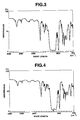
- FIG. 3 is an IR spectrum chart of a fluorinated amide compound prepared in Example 3.
- FIG. 4 is an IR spectrum chart of a fluorinated amide compound prepared in Example 4.
- FIG. 5 is an IR spectrum chart of a fluorinated amide compound prepared in Example 5.
- the fluorinated amide compound of the present invention is represented by the general formula (1).
- R 1 in formula (1) is a substituted or unsubstituted monovalent hydrocarbon group, preferably having 1 to 10 carbon atoms, more preferably 1 to 8 carbon atoms, and preferably free of an aliphatic unsaturated bond.
- R 2 is a hydrogen atom or a monovalent hydrocarbon group as represented by R 1 .
- Exemplary monovalent hydrocarbon groups represented by R 1 and R 2 include alkyl groups such as methyl, ethyl, propyl, isopropyl, butyl, isobutyl, tert-butyl, hexyl, octyl, and decyl; cycloalkyl groups such as cyclopentyl, cyclohexyl, and cycloheptyl; alkenyl groups such as vinyl, allyl, propenyl, isopropenyl, butenyl, isobutenyl, hexenyl, and cyclohexenyl; aryl groups such as phenyl, tolyl, xylyl, and naphthyl; aralkyl groups such as benzyl, phenylethyl, phenylpropyl, and methylbenzyl; and substituted ones of these groups wherein some or all of the hydrogen atoms are replaced by halogen atom
- Q in formula (1) is a group represented by the following general formula (2) or (3).
- R 2 in formula (2) is as defined above.
- R 3 is a substituted or unsubstituted divalent hydrocarbon group, preferably having 1 to 20 carbon atoms, more preferably 2 to 10 carbon atoms, for example, alkylene groups such as methylene, ethylene, propylene, methylethylene, butylene, and hexamethylene; cycloalkylene groups such as cyclohexylene; arylene groups such as phenylene, tolylene, xylylene, naphthylene, and biphenylene; substituted ones of these groups wherein some hydrogen atoms are replaced by halogen atoms; and combinations of such substituted or unsubstituted alkylene and/or arylene groups.
- the group represented by R 3 may have at least one intervening atom midway its linkage.
- the intervening atom is an oxygen, nitrogen or silicon atom. More particularly, the oxygen atom may intervene as -O-.
- the nitrogen atom may intervene as -NR'- wherein R' is a hydrogen atom, an alkyl group having 1 to 8 carbon atoms, especially 1 to 6 carbon atoms or an aryl group.
- the silicon atom may intervene as an organosilylene group or as a group containing a linear or cyclic organosiloxane as shown below.
- R" is an alkyl group having 1 to 8 carbon atoms or aryl group as exemplified for R 1 and R 2
- R′′′ is an alkylene group having 1 to 6 carbon atoms or arylene group as exemplified for R 3
- n is an integer of 0 to 10, especially 0 to 5.
- R 4 and R 5 in formula (3) are independently selected from substituted or unsubstituted divalent hydrocarbon groups, preferably having 1 to 10 carbon atoms, more preferably 2 to 6 carbon atoms, for example, alkylene groups such as methylene, ethylene, propylene, methylethylene, butylene, and hexamethylene, cycloalkylene groups such as cyclohexylene and substituted ones of these groups wherein some hydrogen atoms are replaced by halogen atoms.
- alkylene groups such as methylene, ethylene, propylene, methylethylene, butylene, and hexamethylene
- cycloalkylene groups such as cyclohexylene and substituted ones of these groups wherein some hydrogen atoms are replaced by halogen atoms.
- Rf is a divalent perfluoroalkylene or perfluoropolyether group.
- the divalent perfluoropolyether group is preferably represented by the following formulae: wherein X is F or CF 3 group and letters p, q and r are integers in the range: p ⁇ 1, q ⁇ 1, and 2 ⁇ p + q ⁇ 200, especially 2 ⁇ p + q ⁇ 110 and 0 ⁇ r ⁇ 6, wherein letters r, s and t are integers in the range: 0 ⁇ r ⁇ 6, s ⁇ 0, t ⁇ 0, and 0 ⁇ s + t ⁇ 200, especially 2 ⁇ s + t ⁇ 110, wherein X is F or CF 3 group and letters u and v are integers in the range: 1 ⁇ u ⁇ 20 and 1 ⁇ v ⁇ 20, and -CF 2 CF 2 -(OCF 2 CF 2 CF 2 ) w -OCF 2 CF 2 - wherein w is an integer in the range: 1 ⁇ w ⁇ 100.
- Rf examples of Rf are given below.
- the fluorinated amide compound of formula (1) contains at least one divalent perfluoroalkylene or perfluoropolyether group while a is preferably an integer of 0 to 10, more preferably 1 to 6.
- the fluorinated amide compounds of formula (1) according to the invention may be used in various forms covering from low viscosity polymers having a viscosity of several tens of centistokes at 25°C to solid raw rubber-like polymers.
- raw rubber-like polymers are preferred for the intended application as heat vulcanizable rubber and polymers having a viscosity of about 100 to about 100,000 centistokes at 25°C are preferred for the intended application as liquid rubber. Too low viscosity would be undesirable because cured products would have low elongation as elastomers and imbalance of physical properties.
- the fluorinated amide compounds of formula (1) can be obtained by the following method.
- the fluorinated amide compound of formula (1) wherein a is equal to 0 can be synthesized by reacting a compound having an acid fluoride group at either end of the following general formula (4) with a primary or secondary amine compound of the following general formula (5) in the presence of an acid acceptor such as trimethylamine.
- R 1 , R 2 and Rf are as defined previously.
- fluorinated amide compound of formula (1) wherein a is an integer of at least 1 can be synthesized by reacting a compound having an acid fluoride group at either end of formula (4) with a diamine compound of the following general formula (6): H-Q-H (6) wherein Q is as defined previously in the presence of an acid acceptor and further reacting with a primary or secondary amine compound of formula (5).
- the compound having an acid fluoride group at either end of formula (4) and the primary or secondary amine compound of formula (5) may be used in an desired ratio, it is preferred that the molar ratio of the charge (a) of the formula (4) compound to the charge (b) of the formula (5) compound, (a)/(b), range from 0.1 mol/mol to 1.2 mol/mol, especially from 0.2 mol/mol to 0.5 mol/mol.
- the compound of formula (4) and the compound of formula (6) are mixed such that the molar charge (a) of the formula (4) compound is not less than the molar charge (c) of the formula (6) compound.
- the number (represented by a ) of recurring units in formula (1) may be controlled to an appropriate value by adjusting the molar ratio (a)/(c). Higher values of (a)/(c) allow for synthesis of polymers having a relatively low molecular weight whereas molar ratios (a)/(c) approximating to 1 allow for synthesis of polymers having a high molecular weight.
- Reaction conditions are not critical. Preferred conditions include a temperature of 20 to 100°C and a time of about 1 to 8 hours, more preferably a temperature of 20 to 50°C and a time of about 2 to 4 hours.
- those fluorinated amide compounds wherein Q is a group having an intervening silicon atom can be synthesized by selecting an amine compound of formula (5) as a primary or secondary compound having an aliphatic unsaturated group such as vinyl and allyl, subjecting it to the above-mentioned reaction to form a compound having a vinyl group at either end of the following general formula (1'), and further reacting the compound of formula (1') with an organosiloxane compound having two hydrosilyl groups in a molecule of the following general formula (7) in the presence of an addition reaction catalyst.
- P represents a divalent organic group having a siloxane bond as exemplified below.
- the compound having a vinyl group at either end of formula (1') and the compound of formula (7) are mixed such that the molar charge (d) of the formula (1') compound is greater than the molar charge (e) of the formula (7) compound.
- the molar ratio (d)/(e) is at most 2. That is, 1 ⁇ (d)/(e) ⁇ 2.
- higher values of (d)/(e) allow for synthesis of polymers having a relatively low molecular weight whereas molar ratios (d)/(e) approximating to 1 allow for synthesis of polymers having a high molecular weight.
- the catalyst used herein is selected from the elements of Group VIII in the Periodic Table and compounds thereof, for example, chloroplatinic acid, alcohol-modified chloroplatinic acid (see USP 3,220,972), complexes of chloroplatinic acid with olefins (see USP 3,159,601, 3,159,662 and 3,775,452), platinum black and palladium on supports such as alumina, silica and carbon, rhodium-olefin complexes, and chlorotris(triphenylphosphine)rhodium (Wilkinson catalyst). It is used in a catalytic amount.
- the complexes are preferably used as solution in suitable solvents such as alcohol, ketone, ether and hydrocarbon solvents.
- reaction is effected at about 50 to 150°C, especially about 80 to 120°C, for about 2 to 4 hours.
- the fluorinated amide compounds of the present invention can form elastomers having a high fluorine content and low surface energy, which will find use in a variety of applications as raw materials, for example, base materials for rubber materials having heat, chemical and solvent resistance and base components for mold release agents.
- elastomers can be obtained by reacting a polymer of a fluorinated amide compound blocked with a vinyl group at either end with a compound having at least three hydrosilyl groups in a molecule in the presence of an addition reaction catalyst.
- These elastomers exhibit high heat, solvent and chemical resistance because of high fluorine contents and are improved in mold release and water repellency because of low surface energy. Then the elastomers are useful as sealants, molded parts, extruded parts, coating materials and mold release agents.
- a curable composition comprising (A) a fluorinated amide compound of formula (1) as a base polymer, (B) a fluorinated organohydrogensiloxane as a crosslinking agent or chain extending agent, and (C) a platinum group compound as a catalyst.
- the curable composition of the invention contains components (A), (B) and (C) as essential components.
- Component (A) is a fluorinated amide compound of formula (1) defined above.
- Component (B) is a fluorinated organohydrogensiloxane which serves as a crosslinking agent and chain extender for the fluorinated amide compound (A).
- the fluorinated organohydrogensiloxane (B) should contain at least one monovalent perfluorooxyalkyl group, monovalent perfluoroalkyl group, divalent perfluorooxyalkylene group or divalent perfluoroalkylene group and at least two, preferably at least three hydrosilyl (Si-H) groups in a molecule.
- the perfluorooxyalkyl, perfluoroalkyl, perfluorooxyalkylene and perfluoroalkylene groups are preferably those represented by the following general formulae.
- the fluorinated organohydrogensiloxanes may be of cyclic or chain structure or three-dimensional network. They preferably have at least one monovalent organic group having a perfluoroalkyl, perfluoroalkyl ether or perfluoroalkylene group of the following general formula in a molecule as a monovalent substituent attached to a silicon atom. -CH 2 CH 2 Rf 1 -CH 2 CH 2 -Rf 1 -CH 2 CH 2 -
- R 6 is a divalent hydrocarbon group, preferably having 1 to 10 carbon atoms, more preferably 2 to 6 carbon atoms, for example, alkylene groups such as methylene, ethylene, propylene, methylethylene, tetramethylene, and hexamethylene, and arylene groups such as phenylene
- R 7 is a hydrogen atom or a monovalent hydrocarbon group, preferably having 1 to 8 carbon atoms, more preferably 1 to 6 carbon atoms as defined for R 2
- Rf 1 is a monovalent perfluoroalkyl, monovalent perfluorooxyalkyl, divalent perfluorooxyalkylene or divalent perfluoroalkylene group as previously exemplified.
- the fluorinated organohydrogensiloxane (B) has a monovalent substituent group attached to a silicon atom other than the monovalent organic group having a monovalent or divalent fluorinated substituent (i.e., perfluoroalkyl, perfluorooxyalkyl, perfluorooxyalkylene or perfluoroalkylene group).
- a monovalent or divalent fluorinated substituent i.e., perfluoroalkyl, perfluorooxyalkyl, perfluorooxyalkylene or perfluoroalkylene group.
- the other substituent group include monovalent hydrocarbon groups free of an aliphatic unsaturated bond, preferably having 1 to 10 carbon atoms, more preferably 1 to 8 carbon atoms as previously defined for R 2 .
- the number of silicon atoms per molecule of the fluorinated organohydrogensiloxane is not critical although it generally has about 2 to 60, preferably about 4 to 30 silicon atoms.
- fluorinated organohydrogensiloxane examples include methyl and Ph is phenyl.
- the resulting curable composition will yield a uniform cured product.
- Component (B) is blended in the composition in such an amount as to provide 0.5 to 5 mol, preferably 1 to 2 mol of the hydrosilyl group (i.e., Si-H group) in component (B) per mol of the aliphatic unsaturated group (e.g., vinyl, allyl and cycloalkenyl groups) in the entire composition, especially component (A).
- the hydrosilyl group i.e., Si-H group
- the aliphatic unsaturated group e.g., vinyl, allyl and cycloalkenyl groups
- component (A) and (B) are blended such that about 0.1 to 50 parts by weight of component (B) is present per 100 parts by weight of component (A).
- the curable composition further contains a platinum group compound as an essential component (C). It is a catalyst for catalyzing addition reaction or hydrosilylation between the fluorinated amide compound and the fluorinated organohydrogensiloxane, that is, serves as a curing promoter. Since the platinum group compounds are generally compounds of noble metals and expensive, relatively easily available platinum compounds are often used.
- platinum compound examples include chloroplatinic acid, complexes of chloroplatinic acid with olefins such as ethylene, complexes of chloroplatinic acid with alcohols or vinylsiloxanes, and platinum on silica, alumina and carbon. Platinum group compounds other than the platinum compounds are also useful.
- Known examples include compounds of rhodium, ruthenium, iridium, and palladium, for example, such as RhCl(PPh 3 ) 3 , RhCl(CO)(PPh 3 ) 2 , RhCl(C 2 H 4 ) 2 , Ru 3 (CO) 12 , IrCl(CO)(PPh 3 ) 2 , and Pd(PPh 3 ) 4 wherein Ph is phenyl.
- these catalysts may be used in solid form if they are solid catalysts.
- a solution of chloroplatinic acid or its complex in a suitable solvent is preferably used as a miscible mixture with the fluorinated amide compound (A).
- the amount of the catalyst used is not critical. A desired curing rate will be achieved with a catalytic amount. From an economical point of view or to produce satisfactory cured products, the catalyst is preferably added in an amount of about 1 to 1,000 ppm, more preferably about 10 to 500 ppm of platinum group element based on the weight of the entire curable composition.
- additives may be added to the curable composition of the invention in order to enhance their practical usage.
- the amount of the fluorinated organohydrogensiloxane blended is determined by taking into account the amount of these additives blended in addition to component (A). More specifically, 0.5 to 5 mol of Si-H group should be present per mol of the aliphatic unsaturated group (e.g., vinyl, allyl and cycloalkenyl groups) in the entire composition as previously mentioned.
- fillers may be blended in the curable composition of the invention for the purposes of reducing thermal shrinkage upon heating, reducing the coefficient of thermal expansion of elastomers as cured, improving thermal stability, weather resistance, chemical resistance, flame retardancy and mechanical strength, and reducing gas permeability.
- Exemplary fillers include fumed silica, quartz powder, glass fibers, carbon, metal oxides such as iron oxide, titanium oxide, and cerium oxide, and metal carbonates such as calcium carbonate and magnesium carbonate. If desired, suitable pigments, dyes or antioxidants may also be added.
- the composition can be prepared simply by mixing the above-defined components.
- the curable composition as mixed can be cured at room temperature depending on the type of functional group in the fluorinated amide compound as the first essential component and the type of catalyst as the third essential component.
- the composition is cured by heating at 100 to 150°C for several minutes to several hours.
- the curable composition of the invention may be dissolved in suitable fluorinated solvents such as meta-xylene hexafluoride and fluorinates to a desired concentration depending on its application and purpose.
- suitable fluorinated solvents such as meta-xylene hexafluoride and fluorinates
- the fluorinated amide compoud of the invention can form an elastomer or resin having a high fluorine content and low surface energy which is useful as a base material for rubber materials having heat resistance, solvent resistance and chemical resistance as well as a base material for mold release agents.
- the curable composition of the invention will cure into products which exhibit high solvent and chemical resistance because of high fluorine contents, low moisture permeability, and improved mold release and water repellency because of low surface energy. Then the cured products or elastomers are useful as automotive rubber materials required to be oil resistant, tent film materials, sealants, molded parts, extruded parts, coating materials, printing machine roll materials, and electrical moisture-proof coating materials.
- a 1-liter four-necked flask equipped with a stirrer, thermometer, Dimroth condenser, and dropping funnel was charged with 1,000 g of a compound having an acid fluoride group at each end of the following formula (8).
- a mixture of 72.0 g of vinylsilylamine of the following formula (9) and 44.8 g of triethylamine was added dropwise to the flask at 20°C.
- reaction was effected at 60°C for 2 hours.
- the reaction mixture was subject to filtration under pressure and the filtrate was vacuum stripped at 120°C/3 mmHg, yielding 989.5 g of a compound as a pale yellow clear liquid.
- the compound had a viscosity of 9,500 centistokes at 25°C, a specific gravity of 1.829 at 25°C, and a refractive index of 1.3258 at 25°C.
- the vinyl content of this compound was quantitatively determined to be 0.035 mol/100 g. From these data, the compound was identified to be a polymer of a fluorinated amide compound represented by the following structural formula (10).
- a 500-ml four-necked flask equipped with a stirrer, thermometer, Dimroth condenser, and dropping funnel was charged with 500 g of a compound having an acid fluoride group at each end of formula (11).
- a mixture of 12.4 g of vinylsilylaniline of formula (9) and 7.7 g of triethylamine was added dropwise to the flask at 20°C through the dropping funnel.
- reaction was effected at 60°C for 2 hours.
- the reaction mixture was subject to filtration under pressure and the filtrate was vacuum stripped at 120°C/3 mmHg, yielding 469.4 g of a compound as a pale yellow clear liquid.
- the compound had a viscosity of 21,000 centistokes at 25°C, a specific gravity of 1.884 at 25°C, and a refractive index of 1.3136 at 25°C.
- the vinyl content of this compound was quantitatively determined to be 0.013 mol/100 g. From these data, the compound was identified to be a polymer of a fluorinated amide compound represented by the following structural formula (12).
- a 200-ml four-necked flask equipped with a stirrer, thermometer, Dimroth condenser, and dropping funnel was charged with 76.9 g of the compound having an acid fluoride group at each end of formula (8).
- a mixture of 1.14 g of 2,5-dimethylpiperazine and 2.9 g of triethylamine was added dropwise to the flask at 20°C through the dropping funnel. After the dropwise addition, reaction was effected at 60°C for 2 hours. After 0.36 g of vinylsilylamine of formula (9) was added to the reaction mixture, reaction was effected at 60°C for 2 hours and post-treatment was done as in Example 1, yielding 72.9 g of a compound as a pale yellow clear liquid.
- the compound had a viscosity of 43,200 centistokes at 25°C.
- the vinyl content of this compound was quantitatively determined to be 0.005 mol/100 g. From these data, the compound was identified to be a polymer of a fluorinated amide compound represented by the following structural formula (13).
- Example 3 A flask as used in Example 3 was charged with 100.0 g of the compound obtained in Example 1, that is, compound of formula (10) having a vinyl group at each end (viscosity 9,500 centistokes at 25°C) and 50.0 g of meta-xylene hexafluoride. The flask was heated to 90°C with stirring and 0.1 g of an isopropyl alcohol solution of 2% chloroplatinic acid was added thereto. Then 4.25 g of a cyclotetrasiloxane of the following formula (14) was added dropwise to the flask through the dropping funnel, allowing reaction to take place.
- a cyclotetrasiloxane of the following formula (14) was added dropwise to the flask through the dropping funnel, allowing reaction to take place.
- reaction solution was aged while the disappearance of the cyclotetrasiloxane was confirmed by gas chromatography. Thereafter, the reaction solution was cooled down to room temperature, and 1.5 g of activated carbon was added to the solution which was agitated for 2 hours. The reaction solution was subject to post-treatment as in Example 1, yielding 99.2 g of a clear liquid compound.
- the compound was quantitatively determined to find a vinyl content of 0.009 mol/100 g. From these data, the compound was identified to be a polymer of a fluorinated amide compound having the following structural formula (15).
- a 200-ml four-necked separable flask equipped with a stirrer, thermometer, Dimroth condenser, and dropping funnel was charged with 81.6 g of a compound having an acid fluoride group at each end of the following formula (16).
- a mixture of 2.8 g of vinylsilylaniline of the following formula (17) and 1.0 g of triethylamine was added dropwise to the flask at 20°C through the dropping funnel.
- reaction was effected at 60°C for 2 hours.
- the reaction mixture was subject to filtration under pressure and the filtrate was vacuum stripped at 120°C/3 mmHg, yielding 76.8 g of a compound as a pale yellow clear liquid.
- the compound was quantitatively determined to find a vinyl content of 0.013 mol/100 g. From these data, the compound was identified to be a polymer of a fluorinated amide compound having the following structural formula (18).
- Example 2 To 100 parts of the polymer obtained in Example 1, that is, polymer of formula (10) having a viscosity of 9,500 centistokes at 25°C, an average molecular weight of 5,720 and a vinyl content of 0.035 mol/100 g was added 10 parts of fumed silica having a specific surface area of 200 m 2 /g and treated with trimethylsiloxy group. They were mixed, heat treated, and milled on a three-roll mill.
- the resulting composition was defoamed under vacuum, placed in a rectangular frame of 2 mm high, deaerated again, and press cured at 120 kg/cm 2 and 150°C for 10 minutes.
- a specimen was cut from the cured sheet and measured for physical properties according to JIS K-6301, with the results shown below.
- Hardness (JIS-A) 46 Elongation (%) 240
- hardness in JIS A scale was measured using a type A spring hardness tester prescribed in JIS K-6301.
- Table 1 Heat resistance Initial 3 days 7 days 200°C Hardness (JIS-A) 46 51 (+5) 48 (+2) Elongation (%) 240 160 (-33) 140 (-42) TS (kgf/cm 2 ) 59 44 (-25) 43 (-27) Heat loss (%) - 1.1 1.2 250°C Hardness (JIS-A) 46 43 (+3) 42 (-4) Elongation (%) 240 140 (-42) 120 (-50) TS (kgf/cm 2 ) 59 31 (-47) 27 (-54) Heat loss (%) - 2.5 4.5
- Figures in parentheses are percents based on the initial for elongation and tensile strength, and increase or decrease of points for hardness.
- Viton GFLT is a fluoroelastomer, Du Pont de Nemours, E.I.
- FE61 is a fluorosilicone rubber, Shin-Etsu Chemical Co., Ltd.
- Table 4 Low-temperature property (German twist test) Composition I Viton E-60C KE951 T 2 -10°C -6°C -41°C T 5 -36°C -11°C -43°C T 10 -44°C -14°C -44°C T 100 -50°C -20°C -50°C
- Viton E-60C is a fluoroelastomer, Du Pont de Nemours, E.I. & Co.
- KE951 is a silicone rubber, Shin-Etsu Chemical Co., Ltd.
- Table 5 Moisture permeability (CUP test) Sample Moisture permeability (g/m 2 ⁇ 24hr) Composition I 4 KE951 100 Viton GFLT 4 FE251 50 Note: CUP test under condition B at 40°C and RH 90% KE951 is a silicone rubber, Shin-Etsu Chemical Co., Ltd. Viton GFLT is a fluoroelastomer, Du Pont de Nemours, E.I. & Co. FE251 is a fluorosilicone rubber, Shin-Etsu Chemical Co., Ltd.
- a composition was prepared by the same procedure as in Example 6 except that 100 parts of the polymer obtained in Example 2, that is, polymer of formula (12) having a viscosity of 21,000 centistokes at 25°C, an average molecular weight of 16,000 and a vinyl content of 0.013 mol/100 g and 16.3 parts of the fluorinated cyclohydrogensiloxane used in Example 6 were used.
- a cured sheet was similarly prepared therefrom.
- a composition was prepared by the same procedure as in Example 6 except that 100 parts of a polymer of the following formula (20) having a viscosity of 128,600 centistokes at 25°C, an average molecular weight of 23,000 and a vinyl content of 0.009 mol/100 g was used instead of the polymer of Example 1 and 11.6 parts of the fluorinated cyclohydrogensiloxane used in Example 6 was used.
- a cured sheet was similarly prepared therefrom.
- a composition was prepared by the same procedure as in Example 6 except that 100 parts of a polymer of the following formula (21) having a viscosity of 65,100 centistokes at 25°C, an average molecular weight of 27,640 and a vinyl content of 0.007 mol/100 g was used instead of the polymer of Example 1 and 9.0 parts of the fluorinated cyclohydrogensiloxane used in Example 6 was used.
- a cured sheet was similarly prepared therefrom.
- a composition was prepared by the same procedure as in Example 6 except that 100 parts of the polymer obtained in Example 5, that is, polymer of formula (18) having a viscosity of 9,800 centistokes at 25°C, an average molecular weight of 15,380 and a vinyl content of 0.013 mol/100 g was used instead of the polymer of Example 1.
- To the polymer were added 3.41 parts of a fluorinated cyclohydrogensiloxane of the following formula (22), 0.2 part of the toluene solution used in Example 6, and 0.4 part of 2-ethynylhexanol.
- a cured sheet was similarly prepared therefrom.
Landscapes
- Chemical & Material Sciences (AREA)
- Organic Chemistry (AREA)
- Health & Medical Sciences (AREA)
- Chemical Kinetics & Catalysis (AREA)
- Medicinal Chemistry (AREA)
- Polymers & Plastics (AREA)
- General Chemical & Material Sciences (AREA)
- Compositions Of Macromolecular Compounds (AREA)
Applications Claiming Priority (6)
| Application Number | Priority Date | Filing Date | Title |
|---|---|---|---|
| JP7027297A JP2943644B2 (ja) | 1995-01-23 | 1995-01-23 | 含フッ素アミド化合物 |
| JP27297/95 | 1995-01-23 | ||
| JP2729695 | 1995-01-23 | ||
| JP7027296A JP2990646B2 (ja) | 1995-01-23 | 1995-01-23 | 硬化性組成物 |
| JP27296/95 | 1995-01-23 | ||
| JP2729795 | 1995-01-23 |
Publications (2)
| Publication Number | Publication Date |
|---|---|
| EP0725113A1 true EP0725113A1 (fr) | 1996-08-07 |
| EP0725113B1 EP0725113B1 (fr) | 2000-09-27 |
Family
ID=26365200
Family Applications (1)
| Application Number | Title | Priority Date | Filing Date |
|---|---|---|---|
| EP96300438A Expired - Lifetime EP0725113B1 (fr) | 1995-01-23 | 1996-01-23 | Compositions de silicone amidée et fluorinée et composition réticulables de siloxane |
Country Status (3)
| Country | Link |
|---|---|
| US (1) | US5665846A (fr) |
| EP (1) | EP0725113B1 (fr) |
| DE (1) | DE69610445T2 (fr) |
Cited By (9)
| Publication number | Priority date | Publication date | Assignee | Title |
|---|---|---|---|---|
| EP0765916A3 (fr) * | 1995-09-29 | 1997-10-01 | Shinetsu Chemical Co | Compositions réticulables par hydrosilylation |
| EP1167453A3 (fr) * | 2000-06-29 | 2002-01-09 | Shin-Etsu Chemical Co., Ltd. | Compositions de fluoropolyéthers réticulables |
| EP1172415A1 (fr) * | 2000-07-10 | 2002-01-16 | Shin-Etsu Chemical Co., Ltd. | Compositions de fluoropolyéthers réticulables |
| EP1247830A3 (fr) * | 2001-02-20 | 2003-04-02 | Shin-Etsu Chemical Co., Ltd. | Compositions fluorées et reticulables, leur preparation et usage |
| EP1302500A3 (fr) * | 2001-10-12 | 2003-12-03 | Nichias Corporation | Composition de matériau d'étanchéité résistant au plasma à base de fluoroélastomère |
| EP1616895A1 (fr) * | 2004-07-12 | 2006-01-18 | Shinetsu Chemical Co., Ltd. | Composition d' apprêt pour élastomère fluore ou pour gel fluore |
| US7081508B2 (en) | 2004-06-25 | 2006-07-25 | Shin-Etsu Chemical Co., Ltd. | Primer composition |
| EP1918339A1 (fr) * | 2006-11-06 | 2008-05-07 | Shin-Etsu Chemical Co., Ltd. | Composition de revêtement |
| EP2199296A1 (fr) | 2008-12-18 | 2010-06-23 | Shin-Etsu Chemical Co., Ltd. | Composé de silicone organique |
Families Citing this family (32)
| Publication number | Priority date | Publication date | Assignee | Title |
|---|---|---|---|---|
| TW393498B (en) * | 1995-04-04 | 2000-06-11 | Novartis Ag | The preparation and use of Polysiloxane-comprising perfluoroalkyl ethers |
| DE69633372D1 (de) * | 1995-10-23 | 2004-10-21 | Oce Tech Bv | Verlängerte difunktionelle Perfluoropolyether-Öle und daraus hergestellte Kautschuks |
| JP3292074B2 (ja) * | 1996-12-19 | 2002-06-17 | 信越化学工業株式会社 | 含フッ素アミド化合物 |
| JP3487146B2 (ja) * | 1997-09-22 | 2004-01-13 | 信越化学工業株式会社 | 含フッ素硬化性組成物 |
| JP3594113B2 (ja) * | 1998-07-16 | 2004-11-24 | 信越化学工業株式会社 | 含フッ素アミド化合物 |
| JP4016239B2 (ja) * | 2000-07-05 | 2007-12-05 | 信越化学工業株式会社 | 硬化性フルオロポリエーテル系ゴム組成物 |
| JP3687738B2 (ja) * | 2001-01-16 | 2005-08-24 | 信越化学工業株式会社 | 硬化性組成物 |
| JP4054952B2 (ja) * | 2001-08-14 | 2008-03-05 | 信越化学工業株式会社 | 含フッ素アミド化合物及びその製造方法 |
| EP1288243A1 (fr) * | 2001-08-29 | 2003-03-05 | Shin-Etsu Chemical Co., Ltd. | Compositions de fluoropolyèthers réticulables et articles fabriqués à partir de celles-ci |
| US20030176516A1 (en) * | 2002-03-15 | 2003-09-18 | Greene, Tweed Of Delaware, Inc. | Cellular perfluoroelastomeric compositions, sealing members, methods of making the same and cellular materials for medical applications |
| JP4231997B2 (ja) * | 2002-11-19 | 2009-03-04 | 信越化学工業株式会社 | 硬化性フルオロポリエーテル系ゴム組成物及びゴム製品 |
| US20060100343A1 (en) * | 2004-11-10 | 2006-05-11 | Shin-Etsu Chemical Co., Ltd. | Fluororubber/silicone rubber blend and molded rubber articles |
| EP1834990B1 (fr) * | 2004-12-20 | 2012-03-07 | Nippon Valqua Industries, Ltd. | Composition de caoutchouc et materiau d'etancheite pour un dispositif de traitement au plasma |
| JP2006219668A (ja) * | 2005-01-14 | 2006-08-24 | Shin Etsu Chem Co Ltd | 熱硬化性フルオロポリエーテル系組成物 |
| JP4446183B2 (ja) * | 2005-04-21 | 2010-04-07 | 信越化学工業株式会社 | 硬化性フルオロポリエーテル系ゴム組成物及びゴム製品 |
| JP4725730B2 (ja) * | 2006-03-01 | 2011-07-13 | 信越化学工業株式会社 | シリコーンゴム成形品とフッ素系エラストマーとが一体化されたゴム物品の製造方法 |
| JP4314493B2 (ja) * | 2006-11-02 | 2009-08-19 | 信越化学工業株式会社 | 高分子電解質膜用パーフルオロポリエーテルゴム組成物及びイオン導電性高分子電解質膜 |
| CN101652404B (zh) * | 2007-04-06 | 2012-03-14 | 优迈特株式会社 | 含氟聚醚化合物、其制备方法和含有其的固化性组合物 |
| JP4573054B2 (ja) * | 2007-05-25 | 2010-11-04 | 信越化学工業株式会社 | 熱硬化性フルオロポリエーテル系接着剤組成物及び接着方法 |
| JP2009088115A (ja) * | 2007-09-28 | 2009-04-23 | Shin Etsu Chem Co Ltd | 車載用電気電子部品 |
| JP4507263B2 (ja) * | 2008-01-16 | 2010-07-21 | 信越化学工業株式会社 | 含フッ素硬化性組成物 |
| US20110278770A1 (en) * | 2009-01-30 | 2011-11-17 | Akinobu Isurugi | Mold, mold manufacturing method and method for manufacturing anti-reflection film using the mold |
| JP5459232B2 (ja) * | 2010-01-19 | 2014-04-02 | 信越化学工業株式会社 | 付加硬化型フルオロポリエーテル系接着剤組成物 |
| JP5246190B2 (ja) * | 2010-03-24 | 2013-07-24 | 信越化学工業株式会社 | 含フッ素硬化性組成物及びゴム物品 |
| JP5459033B2 (ja) | 2010-04-14 | 2014-04-02 | 信越化学工業株式会社 | 接着剤組成物 |
| JP5246212B2 (ja) | 2010-07-14 | 2013-07-24 | 信越化学工業株式会社 | 硬化性パーフルオロポリエーテル系ゲル組成物及びその硬化物を用いたゲル製品 |
| JP5549554B2 (ja) | 2010-11-15 | 2014-07-16 | 信越化学工業株式会社 | 熱硬化性フルオロポリエーテル系接着剤組成物及びその接着方法 |
| JP5653877B2 (ja) | 2011-10-04 | 2015-01-14 | 信越化学工業株式会社 | 光半導体封止用硬化性組成物及びこれを用いた光半導体装置 |
| JP5859421B2 (ja) | 2012-06-05 | 2016-02-10 | 信越化学工業株式会社 | 光半導体封止用硬化性組成物及びこれを用いた光半導体装置 |
| JP6160540B2 (ja) | 2014-03-31 | 2017-07-12 | 信越化学工業株式会社 | 硬化性パーフルオロポリエーテル系ゲル組成物及びその硬化物を用いたゲル製品 |
| JP6451592B2 (ja) | 2015-10-28 | 2019-01-16 | 信越化学工業株式会社 | 熱伝導性含フッ素硬化性組成物、その硬化物及び電気・電子部品 |
| US10647899B2 (en) | 2017-06-26 | 2020-05-12 | Shin-Etsu Chemical Co., Ltd. | Heat-curable fluoropolyether-based adhesive composition and electric/electronic component |
Citations (2)
| Publication number | Priority date | Publication date | Assignee | Title |
|---|---|---|---|---|
| EP0542471A1 (fr) * | 1991-11-13 | 1993-05-19 | Dow Corning Corporation | Caoutchouc à base de fluorosilicones à haut compartement de résistance |
| EP0573282A1 (fr) * | 1992-06-02 | 1993-12-08 | Shin-Etsu Chemical Co., Ltd. | Composés organosiliques contenant du fluor |
Family Cites Families (5)
| Publication number | Priority date | Publication date | Assignee | Title |
|---|---|---|---|---|
| US4057566A (en) * | 1976-01-08 | 1977-11-08 | Dow Corning Corporation | Fluorocarbon siloxane compositions |
| FR2678277B1 (fr) * | 1991-06-27 | 1993-10-22 | Dow Corning Corp | Silicones contenant des groupes ether de vinyle peripheriques lateraux reticulables par des photo-initiateurs cationiques et leur application a des revetements et des produits anti-adhesifs pour papier. |
| DE69314384T2 (de) * | 1992-06-02 | 1998-03-05 | Shinetsu Chemical Co | Fluorenthaltende Organopolysiloxanzusammensetzung |
| JP2782406B2 (ja) * | 1993-02-09 | 1998-07-30 | 信越化学工業株式会社 | 室温硬化性組成物 |
| JP2954444B2 (ja) * | 1993-03-12 | 1999-09-27 | 信越化学工業株式会社 | 室温硬化性組成物 |
-
1996
- 1996-01-23 EP EP96300438A patent/EP0725113B1/fr not_active Expired - Lifetime
- 1996-01-23 US US08/590,318 patent/US5665846A/en not_active Expired - Lifetime
- 1996-01-23 DE DE69610445T patent/DE69610445T2/de not_active Expired - Lifetime
Patent Citations (2)
| Publication number | Priority date | Publication date | Assignee | Title |
|---|---|---|---|---|
| EP0542471A1 (fr) * | 1991-11-13 | 1993-05-19 | Dow Corning Corporation | Caoutchouc à base de fluorosilicones à haut compartement de résistance |
| EP0573282A1 (fr) * | 1992-06-02 | 1993-12-08 | Shin-Etsu Chemical Co., Ltd. | Composés organosiliques contenant du fluor |
Cited By (16)
| Publication number | Priority date | Publication date | Assignee | Title |
|---|---|---|---|---|
| EP0765916A3 (fr) * | 1995-09-29 | 1997-10-01 | Shinetsu Chemical Co | Compositions réticulables par hydrosilylation |
| EP1167453A3 (fr) * | 2000-06-29 | 2002-01-09 | Shin-Etsu Chemical Co., Ltd. | Compositions de fluoropolyéthers réticulables |
| US6552152B2 (en) | 2000-06-29 | 2003-04-22 | Shin-Etsu Chemical Co., Ltd. | Curable fluoropolyether rubber compositions |
| EP1172415A1 (fr) * | 2000-07-10 | 2002-01-16 | Shin-Etsu Chemical Co., Ltd. | Compositions de fluoropolyéthers réticulables |
| US6528562B2 (en) | 2000-07-10 | 2003-03-04 | Shin-Etsu Chemical Co., Ltd. | Curable fluoropolyether rubber compositions |
| US6673876B2 (en) | 2001-02-20 | 2004-01-06 | Shin-Etsu Chemical Co., Ltd. | Fluorinated curable compositions |
| EP1247830A3 (fr) * | 2001-02-20 | 2003-04-02 | Shin-Etsu Chemical Co., Ltd. | Compositions fluorées et reticulables, leur preparation et usage |
| US6787610B2 (en) | 2001-10-12 | 2004-09-07 | Nichias Corporation | Plasma-resistant fluorine-based elastomer sealing material |
| EP1302500A3 (fr) * | 2001-10-12 | 2003-12-03 | Nichias Corporation | Composition de matériau d'étanchéité résistant au plasma à base de fluoroélastomère |
| US7081508B2 (en) | 2004-06-25 | 2006-07-25 | Shin-Etsu Chemical Co., Ltd. | Primer composition |
| EP1616895A1 (fr) * | 2004-07-12 | 2006-01-18 | Shinetsu Chemical Co., Ltd. | Composition d' apprêt pour élastomère fluore ou pour gel fluore |
| US7485693B2 (en) | 2004-07-12 | 2009-02-03 | Shin-Etsu Chemical Co., Ltd. | Primer composition for a fluorinated elastomer or a fluorinated gel |
| EP1918339A1 (fr) * | 2006-11-06 | 2008-05-07 | Shin-Etsu Chemical Co., Ltd. | Composition de revêtement |
| US7868119B2 (en) | 2006-11-06 | 2011-01-11 | Shin-Etsu Chemical Co., Ltd. | Coating composition |
| EP2199296A1 (fr) | 2008-12-18 | 2010-06-23 | Shin-Etsu Chemical Co., Ltd. | Composé de silicone organique |
| US8143359B2 (en) | 2008-12-18 | 2012-03-27 | Shin-Etsu Chemical Co., Ltd. | Organic silicone compound |
Also Published As
| Publication number | Publication date |
|---|---|
| EP0725113B1 (fr) | 2000-09-27 |
| DE69610445D1 (de) | 2000-11-02 |
| DE69610445T2 (de) | 2001-04-19 |
| US5665846A (en) | 1997-09-09 |
Similar Documents
| Publication | Publication Date | Title |
|---|---|---|
| EP0725113B1 (fr) | Compositions de silicone amidée et fluorinée et composition réticulables de siloxane | |
| JP2990646B2 (ja) | 硬化性組成物 | |
| EP0765916B1 (fr) | Compositions réticulables par hydrosilylation | |
| EP1033387B1 (fr) | Compositions de fluoropolyéthers réticulables | |
| US6552152B2 (en) | Curable fluoropolyether rubber compositions | |
| US6759468B2 (en) | Curable fluoropolyether base rubber compositions | |
| EP0688762B1 (fr) | Composés organiques fluorés et compositions réticulables les contenant | |
| US6528562B2 (en) | Curable fluoropolyether rubber compositions | |
| EP0573283B1 (fr) | Composition d'organopolysiloxane contenant du fluor | |
| JPH11116684A (ja) | 硬化性組成物 | |
| JP3298413B2 (ja) | 硬化性組成物 | |
| JPH115902A (ja) | 硬化性シリコーンゴム組成物 | |
| US6160074A (en) | Fluorine-containing curable compositions | |
| JP2943644B2 (ja) | 含フッ素アミド化合物 | |
| JPH06271765A (ja) | 室温硬化性組成物 | |
| US20020137842A1 (en) | Curable fluoropolyether base rubber compositions | |
| JP3077536B2 (ja) | 硬化性組成物 | |
| JP3674680B2 (ja) | 硬化性フルオロポリエーテルゴム組成物 | |
| JP3036385B2 (ja) | 硬化性組成物 | |
| JP2002293919A (ja) | 硬化性フルオロポリエーテルゴム組成物 | |
| EP0711781A1 (fr) | Composé organosilicique et un procédé pour le préparer |
Legal Events
| Date | Code | Title | Description |
|---|---|---|---|
| PUAI | Public reference made under article 153(3) epc to a published international application that has entered the european phase |
Free format text: ORIGINAL CODE: 0009012 |
|
| AK | Designated contracting states |
Kind code of ref document: A1 Designated state(s): DE FR GB |
|
| 17P | Request for examination filed |
Effective date: 19961203 |
|
| GRAG | Despatch of communication of intention to grant |
Free format text: ORIGINAL CODE: EPIDOS AGRA |
|
| 17Q | First examination report despatched |
Effective date: 19991004 |
|
| GRAG | Despatch of communication of intention to grant |
Free format text: ORIGINAL CODE: EPIDOS AGRA |
|
| GRAH | Despatch of communication of intention to grant a patent |
Free format text: ORIGINAL CODE: EPIDOS IGRA |
|
| GRAH | Despatch of communication of intention to grant a patent |
Free format text: ORIGINAL CODE: EPIDOS IGRA |
|
| GRAA | (expected) grant |
Free format text: ORIGINAL CODE: 0009210 |
|
| AK | Designated contracting states |
Kind code of ref document: B1 Designated state(s): DE FR GB |
|
| REF | Corresponds to: |
Ref document number: 69610445 Country of ref document: DE Date of ref document: 20001102 |
|
| ET | Fr: translation filed | ||
| PLBE | No opposition filed within time limit |
Free format text: ORIGINAL CODE: 0009261 |
|
| STAA | Information on the status of an ep patent application or granted ep patent |
Free format text: STATUS: NO OPPOSITION FILED WITHIN TIME LIMIT |
|
| 26N | No opposition filed | ||
| REG | Reference to a national code |
Ref country code: GB Ref legal event code: IF02 |
|
| PGFP | Annual fee paid to national office [announced via postgrant information from national office to epo] |
Ref country code: DE Payment date: 20140115 Year of fee payment: 19 |
|
| PGFP | Annual fee paid to national office [announced via postgrant information from national office to epo] |
Ref country code: FR Payment date: 20140108 Year of fee payment: 19 |
|
| PGFP | Annual fee paid to national office [announced via postgrant information from national office to epo] |
Ref country code: GB Payment date: 20140122 Year of fee payment: 19 |
|
| REG | Reference to a national code |
Ref country code: DE Ref legal event code: R119 Ref document number: 69610445 Country of ref document: DE |
|
| GBPC | Gb: european patent ceased through non-payment of renewal fee |
Effective date: 20150123 |
|
| PG25 | Lapsed in a contracting state [announced via postgrant information from national office to epo] |
Ref country code: DE Free format text: LAPSE BECAUSE OF NON-PAYMENT OF DUE FEES Effective date: 20150801 Ref country code: GB Free format text: LAPSE BECAUSE OF NON-PAYMENT OF DUE FEES Effective date: 20150123 |
|
| REG | Reference to a national code |
Ref country code: FR Ref legal event code: ST Effective date: 20150930 |
|
| PG25 | Lapsed in a contracting state [announced via postgrant information from national office to epo] |
Ref country code: FR Free format text: LAPSE BECAUSE OF NON-PAYMENT OF DUE FEES Effective date: 20150202 |