EP0725502A2 - Méthode pour le décodage et l'affichage des informations routières numériques radiodiffusées - Google Patents
Méthode pour le décodage et l'affichage des informations routières numériques radiodiffusées Download PDFInfo
- Publication number
- EP0725502A2 EP0725502A2 EP95119660A EP95119660A EP0725502A2 EP 0725502 A2 EP0725502 A2 EP 0725502A2 EP 95119660 A EP95119660 A EP 95119660A EP 95119660 A EP95119660 A EP 95119660A EP 0725502 A2 EP0725502 A2 EP 0725502A2
- Authority
- EP
- European Patent Office
- Prior art keywords
- location
- data
- memory
- traffic
- output
- Prior art date
- Legal status (The legal status is an assumption and is not a legal conclusion. Google has not performed a legal analysis and makes no representation as to the accuracy of the status listed.)
- Granted
Links
Images

Classifications
-
- H—ELECTRICITY
- H04—ELECTRIC COMMUNICATION TECHNIQUE
- H04H—BROADCAST COMMUNICATION
- H04H20/00—Arrangements for broadcast or for distribution combined with broadcast
- H04H20/53—Arrangements specially adapted for specific applications, e.g. for traffic information or for mobile receivers
- H04H20/55—Arrangements specially adapted for specific applications, e.g. for traffic information or for mobile receivers for traffic information
-
- G—PHYSICS
- G10—MUSICAL INSTRUMENTS; ACOUSTICS
- G10L—SPEECH ANALYSIS TECHNIQUES OR SPEECH SYNTHESIS; SPEECH RECOGNITION; SPEECH OR VOICE PROCESSING TECHNIQUES; SPEECH OR AUDIO CODING OR DECODING
- G10L13/00—Speech synthesis; Text to speech systems
-
- G—PHYSICS
- G08—SIGNALLING
- G08G—TRAFFIC CONTROL SYSTEMS
- G08G1/00—Traffic control systems for road vehicles
- G08G1/09—Arrangements for giving variable traffic instructions
- G08G1/091—Traffic information broadcasting
- G08G1/092—Coding or decoding of the information
-
- G—PHYSICS
- G08—SIGNALLING
- G08G—TRAFFIC CONTROL SYSTEMS
- G08G1/00—Traffic control systems for road vehicles
- G08G1/09—Arrangements for giving variable traffic instructions
- G08G1/091—Traffic information broadcasting
- G08G1/093—Data selection, e.g. prioritizing information, managing message queues, selecting the information to be output
-
- H—ELECTRICITY
- H04—ELECTRIC COMMUNICATION TECHNIQUE
- H04H—BROADCAST COMMUNICATION
- H04H2201/00—Aspects of broadcast communication
- H04H2201/10—Aspects of broadcast communication characterised by the type of broadcast system
- H04H2201/13—Aspects of broadcast communication characterised by the type of broadcast system radio data system/radio broadcast data system [RDS/RBDS]
Definitions
- the invention is based on a method according to the type of the main claim.
- the radio data system enables an additional and inaudible transmission of digital data in parallel to radio programs in a data channel.
- Specifications of the radio data system for VHF radio can be found in Tech. 3244 - E, March 1984 of the European Runfunk Union (EBU).
- Radio receivers with suitable RDS decoders can record and decode transmitted data in addition to radio reception with the same receiver.
- the data transmission takes place in 32 groups of 108 bits each, each group being assigned a specific service. Group 8a is intended for the transmission of digitally coded traffic reports.
- the structure and coding of these traffic reports are specified in the standard proposal ALERT C, November 1990, published by the RDS ATT ALERT Consortium.
- the essential elements of a traffic announcement are the location and the event. This information is cataloged, which means that a unique code is assigned to every traffic-relevant location and every traffic-relevant event.
- the chaining of the locations in the location table along existing streets shows the course.
- facilities for decoding, storing, further processing and outputting the traffic reports are required to use the traffic message channel TMC (Traffic Message Channel).
- TMC Traffic Message Channel
- the object of the present invention is to provide a method for decoding and outputting received digitally coded traffic reports, in which decoding and outputting of the traffic reports are also possible if the storage capacity for storing all the data provided in the ALERT C standard for all Places of an area are not available.
- This object is achieved in that data which are required for decoding and further data which are used for output are stored in a memory, that the memory content is queried for output of a traffic message, which further data for output of this traffic message in the memory are stored and that the output of the traffic announcement takes place in one of several classes depending on the type and scope of this further data.
- the method according to the invention makes it possible, for example, to operate a radio receiver that is set up to receive digitally coded traffic reports with chip cards that have different amounts of data per location.
- chip cards can be produced which contain data for important locations or location codes, such as motorway junctions and junctions of large cities, which enable output in a higher class, while for less important locations there is little data available for simple output.
- This division can be designed differently when several chip cards covering the same area are issued.
- a chip card can be advantageous, for example, which in Bavaria contains all the data required for high-quality output for each location code and only a minimum amount of data for the other federal states.
- chip cards for the location-relevant data has many advantages, for example new chip cards can be acquired when the road network changes, or the chip cards can be rewritten in the case of rewritable memories in the chip cards. It is also possible to purchase a chip card that is valid for that country if you are driving in another country. Because of the limited capacity of the smart cards, the advantage of the The method according to the invention is particularly large when using chip cards for storing the location-relevant data. However, an advantageous application of the method in connection with different types of memories is also possible.
- An advantageous embodiment of the method according to the invention is that the memory content is also queried as to whether there is data required for a selection of traffic reports, and that the traffic report is selected if suitable data are available in the memory for the selection. This enables a further reduction in the memory requirement if there is no selection in the output.
- a significant reduction in the storage requirement compared to the storage of all the data provided according to the standard results in a development of the method according to the invention in that it is queried whether location-related data required for the output of a traffic report are available as place names, and that numbers and / or abbreviations are used.
- a further, even more simplified output, which is below this class, is achieved by an embodiment of this further development in that it is queried whether a description exists as a punctiform location for the location of a traffic announcement, and that if the description is not available, a reference to a stored in the memory Street segment is used.
- An advantageous device for carrying out the method according to the invention is characterized in that the memory, which is preferably designed as an exchangeable data carrier, has at least location codes of the preceding and following location and a code of a road section for each linked location code of the respective area which the location is located, an indication of the type of location, and for selected location codes contains further data which enable output in one or more classes.
- the memory which is preferably designed as an exchangeable data carrier, has at least location codes of the preceding and following location and a code of a road section for each linked location code of the respective area which the location is located, an indication of the type of location, and for selected location codes contains further data which enable output in one or more classes.
- Locations or location codes are linked if the locations adjacent to one another in the course of a street are required for decoding.
- isolated locations are also possible for traffic reports that can only relate to this location. This applies, for example, to a parking garage, the blocking of which is disseminated in a traffic announcement. For such a place, it is only necessary to state the name, the type of place and, if applicable, an area reference.
- all location codes of the respective area can be decoded and simple outputs can also be made with the aid of further data which may be added to all location codes.
- output or better output of the traffic reports is only possible with the help of the additional data added to the selected location codes.
- the further data comprise at least one code of a road section on which the location is located. In many cases, this makes it much easier to issue traffic reports.
- More precise output of the traffic reports, at least for motorway junctions, is possible in that for at least some of the selected location codes the further data also include at least one juncture number.
- a detailed output is possible in that for at least some of the selected location codes, the further data further comprise at least one location name.
- the exemplary embodiment is shown as a block diagram. However, this does not mean that it is limited to implementation using individual circuits corresponding to the blocks. Rather, the radio receiver can be implemented in a particularly advantageous manner with the aid of highly integrated circuits. In this case, digital signal processors can be used which, with suitable programming, carry out the processing steps shown in the block diagrams.
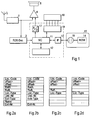
- Fig. 1 shows some modules of a radio receiver required to explain the invention and in the part framed by dashed lines used to carry out the method according to the invention.
- the signals to be received are fed via an antenna 1 to a receiving part 2, to the output of which an RDS decoder 3 and an audio amplifier 4 with a loudspeaker 5 are connected.
- the decoding and reproduction of the digitally coded traffic reports is controlled by a microcomputer 11.
- This is connected to a memory 12 in which event-related and language-relevant data and algorithms are stored.
- Output signals of the RDS decoder 3 can be fed to the microcomputer 11.
- the microcomputer 11 is connected via an interface 13 to a card read / write device, which is not shown separately in FIG. 1.
- the connection to a memory 14 on a chip card 15 is established via an interface 16 also located on the chip card.
- a voice output is provided, for which purpose digital voice signals are synthesized in the microcomputer 11 and are supplied to the audio amplifier 4 via a digital / analog converter 17.
- the traffic reports and further information can be represented with the aid of a display device 18 (display) which is connected to the microcomputer 11 via a display driver 19.
- the memory 14 can be designed as read-only memory (ROM), so that the user must purchase a new chip card 15 in the event of changes, or as a non-volatile read / write memory to be rewritten in each case. This can then be used for Changes to the location-relevant data or a change in the area of interest to the user are described with new data.
- ROM read-only memory
- the location information and event information transmitted with a digitally coded traffic announcement are language-independent.
- the representatives belonging to the codes are therefore stored in a specific national language in decoding tables in the memories 14 and 12.
- the events are language-dependent, but country-independent, since the events are standardized across Europe.
- Place names are country-dependent, so a place code in France shows a different place than the same code in Germany.
- the locations are distinguished by a country code, which is transmitted separately in the radio data system. It can therefore be assumed that most chip cards each concern a country or larger parts of a country. However, it cannot be ruled out that chip cards for several countries or sub-regions of several countries, for example the roads in the Alpine region, are also produced.
- the data record for a location code shown schematically in FIG. 2a contains the location-related data provided in the ALERT standard. This includes a location code (Loc.-Code), location codes (offset +, offset-) of the previous and following location in the course of a street, a code (RefA) of an area to which the location belongs, a code ( RefL) of a section of road (segment) on which the location is located, an indication (Loc.-Type) of the type of location, the type of motorway junction (Exit-Type) and a name. In the exemplary embodiment, a redirection number and a connection number are additionally present.
- the segment information and the point location can be output in the traffic report, for example in the Form: "A7, Kassel towards Hanover, between Derneburg and Hildesheim, ⁇ Eventis ⁇ ".
- the street class (A) and the street number (7) were taken from the location description of the location segment that was accessed via RefL. "3 km traffic jam" or another event relevant to road traffic can then be output as an event.
- Such an output belongs to the highest possible class, which is referred to below as Class 1 (Cl.1).
- the radio receiver working according to the method of the invention uses the segment information (RefL) and the connection numbers to issue a traffic report in class 2 (Cl.2), so that the same received traffic report is then output as follows: "A7, Kassel towards Hanover , between junction 63 and 62, "event".
- the statement of the traffic report output is just as precise as in the case of the data record according to FIG. 2a. It can even be seen as an advantage that place names that are difficult to pronounce are replaced by numerical expressions.
- the lower storage space requirement is, however, paid for by the fact that the numbers of the connection points are less meaningful and are usually not so easy to remember.
- the output of the numbers has the advantage over an output of the names, however, that even a person unfamiliar with the location recognizes whether or how many connection points are between a connection point just passed and the location of a traffic obstruction announced with the traffic report.
- the data record according to FIG. 2c does not contain a description of the punctiform locations, but like the data records according to FIGS. 2a and 2b the reference to the road segment.
- this is an issue of the traffic report in class 3 (Cl.3) possible as follows: "A7, Kassel direction Hannover, ⁇ Eventis ⁇ ".
- the memory requirement has been significantly reduced, it is still possible to issue a traffic report.
- the local accuracy of the traffic announcement becomes less depending on the segment length.
- the reference to the segment is also no longer available.
- the message is decoded but not output. Even if a traffic report relating to these locations is not output, the inclusion of these locations with data records according to FIG. 2d is necessary in the memory. This is because they are required for decoding traffic reports which relate to other locations, but which require a link to the location codes stored according to FIG. 2d for decoding.
- the flowchart shown in FIG. 3 schematically represents the program effective for carrying out the method according to the invention in the microcomputer 11.
- a traffic report with a location code and the extent Ext. Has been received at 21 or read out from a buffer store, at 22 the program branches depending on whether the extent is 0. If the extent is 0, only one location code is required for decoding and output. However, if the extent is not equal to 0, an additional code is required in addition to the location code in the received traffic report, for example a code indicated by offset + or by offset-.
- the program branches depending on whether both location codes are present in the location list. If this is not the case, it is determined at 25 that the traffic announcement cannot be decoded and the program is repeated at 21 when the next traffic announcement is received. However, if both location codes are present, a check is made at 27 as to whether both location codes meet the conditions required for class 4, for example whether offset + and offset-are present. If this is not the case, these locations are not linked and output is not possible, which is determined at 28. At 29 it is checked whether both location codes of class 3 are sufficient. If this is not the case, no output is possible, which is determined at 30.
- Program part 31 then checks whether the location codes of class 2 are sufficient. If this is not the case, a traffic report according to class 3 is output at 32. Finally, at 33 it is checked whether both location codes meet the conditions of class 1. If this is not the case, a class 2 output takes place at 34, while a class 1 output is carried out if applicable at 35.
- the location code to location code can be output in different classes. If, for example, only one number is stored for a connection point, while the name is also stored at a neighboring connection point, a traffic announcement that affects both places can show the one place with the number and the other place with the name. Compared to the program shown in FIG. 3, independent tests would then have to be carried out for each location code instead of tests 27, 29, 31, 33.
Landscapes
- Engineering & Computer Science (AREA)
- Multimedia (AREA)
- Physics & Mathematics (AREA)
- General Physics & Mathematics (AREA)
- Signal Processing (AREA)
- Computational Linguistics (AREA)
- Health & Medical Sciences (AREA)
- Audiology, Speech & Language Pathology (AREA)
- Human Computer Interaction (AREA)
- Acoustics & Sound (AREA)
- Circuits Of Receivers In General (AREA)
Applications Claiming Priority (2)
| Application Number | Priority Date | Filing Date | Title |
|---|---|---|---|
| DE19503416 | 1995-02-03 | ||
| DE19503416A DE19503416A1 (de) | 1995-02-03 | 1995-02-03 | Verfahren zur Decodierung und zur Ausgabe von empfangenen digitalen codierten Verkehrsmeldungen |
Publications (3)
| Publication Number | Publication Date |
|---|---|
| EP0725502A2 true EP0725502A2 (fr) | 1996-08-07 |
| EP0725502A3 EP0725502A3 (fr) | 1997-01-15 |
| EP0725502B1 EP0725502B1 (fr) | 2006-08-02 |
Family
ID=7753019
Family Applications (1)
| Application Number | Title | Priority Date | Filing Date |
|---|---|---|---|
| EP95119660A Expired - Lifetime EP0725502B1 (fr) | 1995-02-03 | 1995-12-13 | Méthode pour le décodage et l'affichage des informations routières numériques radiodiffusées |
Country Status (4)
| Country | Link |
|---|---|
| EP (1) | EP0725502B1 (fr) |
| JP (1) | JP3786459B2 (fr) |
| KR (2) | KR100450913B1 (fr) |
| DE (2) | DE19503416A1 (fr) |
Cited By (7)
| Publication number | Priority date | Publication date | Assignee | Title |
|---|---|---|---|---|
| EP0867851A3 (fr) * | 1997-03-25 | 2000-06-14 | MANNESMANN Aktiengesellschaft | Système pour l'affichage optique d'informations routières |
| EP0930594A3 (fr) * | 1998-01-14 | 2000-07-19 | Robert Bosch Gmbh | Récepteur de messages codés en numérique |
| WO2001006478A1 (fr) * | 1999-07-20 | 2001-01-25 | Robert Bosch Gmbh | Procede pour coder des encombrements affectant plusieurs voies de circulation |
| WO2001018769A1 (fr) * | 1999-09-07 | 2001-03-15 | Robert Bosch Gmbh | Procede de codage et de decodage d'objets dans un reseau de voies de circulation |
| EP0984417A3 (fr) * | 1998-09-01 | 2002-04-17 | Siemens Aktiengesellschaft | Mémoire de données pour véhicules |
| WO2008028886A1 (fr) * | 2006-09-05 | 2008-03-13 | Continental Automotive Gmbh | Terminal mobile pour un système d'information routière et procédé pour activer un dispositif de contrôle d'accès dans un terminal mobile |
| EP1889239A4 (fr) * | 2005-05-27 | 2017-05-10 | LG Electronics Inc. | Procede et appareil de decodage d'un signal audio |
Families Citing this family (3)
| Publication number | Priority date | Publication date | Assignee | Title |
|---|---|---|---|---|
| DE19527185A1 (de) * | 1995-07-26 | 1997-01-30 | Philips Patentverwaltung | RDS-TMC-Rundfunkempfänger |
| DE19527186A1 (de) * | 1995-07-26 | 1997-01-30 | Philips Patentverwaltung | RDS-TMC-Rundfunkempfänger |
| DE102012223780A1 (de) * | 2012-12-19 | 2014-06-26 | Bayerische Motoren Werke Aktiengesellschaft | Verfahren und System zum Erzeugen von Verkehrsinformationen für mindestens ein Fahrzeug |
Family Cites Families (10)
| Publication number | Priority date | Publication date | Assignee | Title |
|---|---|---|---|---|
| DE3536820A1 (de) * | 1985-10-16 | 1987-04-16 | Bosch Gmbh Robert | Verkehrfunk-decoder |
| DE3709523A1 (de) * | 1987-03-23 | 1988-10-13 | Bosch Gmbh Robert | Rundfunkempfaenger mit mindestens einem verkehrsfunkdecoder |
| DE3914104A1 (de) * | 1989-04-28 | 1990-11-15 | Bosch Gmbh Robert | Rundfunkempfaenger, insbesondere fahrzeugempfaenger |
| JPH03152700A (ja) * | 1989-11-08 | 1991-06-28 | Toyota Motor Corp | 車両用走行情報提供装置 |
| JPH04270395A (ja) * | 1991-01-23 | 1992-09-25 | Mitsubishi Electric Corp | 車載用交通情報提供装置 |
| JP3151731B2 (ja) * | 1991-10-04 | 2001-04-03 | アイシン・エィ・ダブリュ株式会社 | ナビゲーション装置 |
| JPH05120597A (ja) * | 1991-10-25 | 1993-05-18 | Toshiba Corp | 交通情報提供装置 |
| US5406626A (en) * | 1993-03-15 | 1995-04-11 | Macrovision Corporation | Radio receiver for information dissemenation using subcarrier |
| DE4314614C2 (de) * | 1993-05-04 | 1997-04-24 | Bosch Gmbh Robert | Chipkarte und Lesegerät für eine Chipkarte |
| KR100256607B1 (ko) * | 1994-12-28 | 2000-05-15 | 윤종용 | 음성의 주행 지역정보를 안내하는 이동체용 네비게이션 장치 및 그 방법 |
-
1995
- 1995-02-03 DE DE19503416A patent/DE19503416A1/de not_active Withdrawn
- 1995-12-13 DE DE59511060T patent/DE59511060D1/de not_active Expired - Lifetime
- 1995-12-13 EP EP95119660A patent/EP0725502B1/fr not_active Expired - Lifetime
-
1996
- 1996-01-29 JP JP01283496A patent/JP3786459B2/ja not_active Expired - Fee Related
- 1996-02-02 KR KR1019960002853A patent/KR100450913B1/ko not_active Expired - Fee Related
- 1996-02-02 KR KR1019960002852A patent/KR100452171B1/ko not_active Expired - Fee Related
Cited By (12)
| Publication number | Priority date | Publication date | Assignee | Title |
|---|---|---|---|---|
| EP0867851A3 (fr) * | 1997-03-25 | 2000-06-14 | MANNESMANN Aktiengesellschaft | Système pour l'affichage optique d'informations routières |
| EP0930594A3 (fr) * | 1998-01-14 | 2000-07-19 | Robert Bosch Gmbh | Récepteur de messages codés en numérique |
| EP0984417A3 (fr) * | 1998-09-01 | 2002-04-17 | Siemens Aktiengesellschaft | Mémoire de données pour véhicules |
| US6611888B2 (en) | 1998-09-01 | 2003-08-26 | Siemens Vdo Automotive Ag | Integrated connector having a memory unit for a receiver |
| WO2001006478A1 (fr) * | 1999-07-20 | 2001-01-25 | Robert Bosch Gmbh | Procede pour coder des encombrements affectant plusieurs voies de circulation |
| US6597982B1 (en) | 1999-07-20 | 2003-07-22 | Robert Bosch Gmbh | Method for coding congestion affecting several traffic lanes |
| WO2001018769A1 (fr) * | 1999-09-07 | 2001-03-15 | Robert Bosch Gmbh | Procede de codage et de decodage d'objets dans un reseau de voies de circulation |
| AU768488B2 (en) * | 1999-09-07 | 2003-12-11 | Robert Bosch Gmbh | Method for coding and decoding objects in a road traffic network |
| US6687611B1 (en) | 1999-09-07 | 2004-02-03 | Robert Bosch Gmbh | Method for coding and decoding objects in a road traffic network |
| EP1889239A4 (fr) * | 2005-05-27 | 2017-05-10 | LG Electronics Inc. | Procede et appareil de decodage d'un signal audio |
| WO2008028886A1 (fr) * | 2006-09-05 | 2008-03-13 | Continental Automotive Gmbh | Terminal mobile pour un système d'information routière et procédé pour activer un dispositif de contrôle d'accès dans un terminal mobile |
| CN101356555B (zh) * | 2006-09-05 | 2010-11-03 | 大陆汽车有限责任公司 | 用于交通信息系统的移动终端设备及用于触发移动终端设备中的访问控制装置的方法 |
Also Published As
| Publication number | Publication date |
|---|---|
| KR100450913B1 (ko) | 2005-04-19 |
| DE59511060D1 (de) | 2006-09-14 |
| KR100452171B1 (ko) | 2004-12-30 |
| KR960032297A (ko) | 1996-09-17 |
| EP0725502A3 (fr) | 1997-01-15 |
| EP0725502B1 (fr) | 2006-08-02 |
| JP3786459B2 (ja) | 2006-06-14 |
| JPH08251053A (ja) | 1996-09-27 |
| KR960032951A (ko) | 1996-09-17 |
| DE19503416A1 (de) | 1996-08-08 |
Similar Documents
| Publication | Publication Date | Title |
|---|---|---|
| EP0769181B1 (fr) | Dispositif permettant de fournir des informations au conducteur d'un vehicule | |
| EP0580617B1 (fr) | Recepteur radio, en particulier recepteur radio de vehicule | |
| EP0756260B1 (fr) | Récepteur radio RDS-TMC | |
| EP0584310A1 (fr) | Recepteur de radiodiffusion pour la circulation routiere | |
| DE19516477A1 (de) | Einrichtung zur Aufbereitung und Ausgabe von Informationen für einen Fahrzeugführer | |
| DE3810177A1 (de) | Rundfunkempfaenger, insbesondere fahrzeugempfaenger | |
| EP0725505B1 (fr) | Récepteur de radiodiffusion pour la réception la gestion et l'affichage d'informations routières codées numériques | |
| EP0756259B1 (fr) | Récepteur radio RDS-TMC | |
| DE19905893A1 (de) | Verfahren zur Übertragung von digital codierten Verkehrsnachrichten und Funkempfänger dazu | |
| EP0725502B1 (fr) | Méthode pour le décodage et l'affichage des informations routières numériques radiodiffusées | |
| EP0756257B1 (fr) | Récepteur radio RDS-TMC | |
| EP0725500B1 (fr) | Dispositif de gestion des informations routières codées en numérique pour récepteur de radiodiffusion | |
| EP0829977A2 (fr) | RDS-TMC radiorécepteur pour le traitement des indications des régions ou des indication des routes suprarégionales spécifiées selon les régions | |
| EP0725504B1 (fr) | Récepteur RDS comportant un dispositif d'affichage d'informations routières | |
| EP0790591A1 (fr) | Banque de données de lieux pour la détermination d'itinéraires dans un réseau de circulation routière | |
| EP0725501B1 (fr) | Dispositif pour la présentation audible d'informations numériques codées de trafic utilisant un synthétiseur de paroles | |
| EP0757454B1 (fr) | Récepteur de radiodiffusion avec réception des signaux RDS-TMC | |
| DE19628086A1 (de) | Verfahren und Einrichtung zur Selektion von digital codierten Verkehrsmeldungen | |
| DE19718132A1 (de) | RDS-TMC-Rundfunkempfänger mit einem Sprachsegmentspeicher | |
| EP1721299B1 (fr) | Procede de sortie d'informations textuelles au moyen d'un affichage | |
| EP0756258B1 (fr) | Récepteur radio RDS-TMC | |
| EP0880245B1 (fr) | Récepteur avec un dispositif pour sélectionner des messages codés numériquement | |
| DE19839413A1 (de) | Verfahren zur Verknüpfung von digitalen Verkehrswegenetzbeschreibungen und Ortsdatenbank | |
| EP0756261A1 (fr) | Récepteur radio RDS-TMC | |
| DE3810178A1 (de) | Rundfunkempfaenger, insbesondere fahrzeugempfaenger |
Legal Events
| Date | Code | Title | Description |
|---|---|---|---|
| PUAI | Public reference made under article 153(3) epc to a published international application that has entered the european phase |
Free format text: ORIGINAL CODE: 0009012 |
|
| AK | Designated contracting states |
Kind code of ref document: A2 Designated state(s): DE FR IT SE |
|
| PUAL | Search report despatched |
Free format text: ORIGINAL CODE: 0009013 |
|
| AK | Designated contracting states |
Kind code of ref document: A3 Designated state(s): DE FR IT SE |
|
| 17P | Request for examination filed |
Effective date: 19970715 |
|
| 17Q | First examination report despatched |
Effective date: 20020625 |
|
| GRAP | Despatch of communication of intention to grant a patent |
Free format text: ORIGINAL CODE: EPIDOSNIGR1 |
|
| GRAS | Grant fee paid |
Free format text: ORIGINAL CODE: EPIDOSNIGR3 |
|
| GRAA | (expected) grant |
Free format text: ORIGINAL CODE: 0009210 |
|
| AK | Designated contracting states |
Kind code of ref document: B1 Designated state(s): DE FR IT SE |
|
| REF | Corresponds to: |
Ref document number: 59511060 Country of ref document: DE Date of ref document: 20060914 Kind code of ref document: P |
|
| REG | Reference to a national code |
Ref country code: SE Ref legal event code: TRGR |
|
| ET | Fr: translation filed | ||
| PLBE | No opposition filed within time limit |
Free format text: ORIGINAL CODE: 0009261 |
|
| STAA | Information on the status of an ep patent application or granted ep patent |
Free format text: STATUS: NO OPPOSITION FILED WITHIN TIME LIMIT |
|
| 26N | No opposition filed |
Effective date: 20070503 |
|
| PGFP | Annual fee paid to national office [announced via postgrant information from national office to epo] |
Ref country code: SE Payment date: 20091218 Year of fee payment: 15 |
|
| PGFP | Annual fee paid to national office [announced via postgrant information from national office to epo] |
Ref country code: IT Payment date: 20101227 Year of fee payment: 16 |
|
| REG | Reference to a national code |
Ref country code: SE Ref legal event code: EUG |
|
| PG25 | Lapsed in a contracting state [announced via postgrant information from national office to epo] |
Ref country code: SE Free format text: LAPSE BECAUSE OF NON-PAYMENT OF DUE FEES Effective date: 20101214 |
|
| PGFP | Annual fee paid to national office [announced via postgrant information from national office to epo] |
Ref country code: FR Payment date: 20120103 Year of fee payment: 17 |
|
| PGFP | Annual fee paid to national office [announced via postgrant information from national office to epo] |
Ref country code: DE Payment date: 20120221 Year of fee payment: 17 |
|
| REG | Reference to a national code |
Ref country code: FR Ref legal event code: ST Effective date: 20130830 |
|
| REG | Reference to a national code |
Ref country code: DE Ref legal event code: R119 Ref document number: 59511060 Country of ref document: DE Effective date: 20130702 |
|
| PG25 | Lapsed in a contracting state [announced via postgrant information from national office to epo] |
Ref country code: DE Free format text: LAPSE BECAUSE OF NON-PAYMENT OF DUE FEES Effective date: 20130702 |
|
| PG25 | Lapsed in a contracting state [announced via postgrant information from national office to epo] |
Ref country code: FR Free format text: LAPSE BECAUSE OF NON-PAYMENT OF DUE FEES Effective date: 20130102 |
|
| PG25 | Lapsed in a contracting state [announced via postgrant information from national office to epo] |
Ref country code: IT Free format text: LAPSE BECAUSE OF NON-PAYMENT OF DUE FEES Effective date: 20121213 |