EP0726329A1 - Verfahren und Gerät zur Abtrennung von Technetium - Google Patents
Verfahren und Gerät zur Abtrennung von Technetium Download PDFInfo
- Publication number
- EP0726329A1 EP0726329A1 EP19960300785 EP96300785A EP0726329A1 EP 0726329 A1 EP0726329 A1 EP 0726329A1 EP 19960300785 EP19960300785 EP 19960300785 EP 96300785 A EP96300785 A EP 96300785A EP 0726329 A1 EP0726329 A1 EP 0726329A1
- Authority
- EP
- European Patent Office
- Prior art keywords
- technetium
- liquid waste
- catalyst
- radioactive liquid
- vessel
- Prior art date
- Legal status (The legal status is an assumption and is not a legal conclusion. Google has not performed a legal analysis and makes no representation as to the accuracy of the status listed.)
- Granted
Links
- 229910052713 technetium Inorganic materials 0.000 title claims abstract description 154
- GKLVYJBZJHMRIY-UHFFFAOYSA-N technetium atom Chemical compound [Tc] GKLVYJBZJHMRIY-UHFFFAOYSA-N 0.000 title claims abstract description 152
- 238000000034 method Methods 0.000 title claims description 47
- 239000010808 liquid waste Substances 0.000 claims abstract description 169
- 239000003054 catalyst Substances 0.000 claims abstract description 95
- 230000002285 radioactive effect Effects 0.000 claims abstract description 85
- 239000003638 chemical reducing agent Substances 0.000 claims abstract description 46
- 239000003153 chemical reaction reagent Substances 0.000 claims abstract description 36
- 150000003839 salts Chemical class 0.000 claims abstract description 35
- 230000002829 reductive effect Effects 0.000 claims abstract description 12
- 238000001914 filtration Methods 0.000 claims abstract description 6
- 239000007787 solid Substances 0.000 claims description 53
- 230000001603 reducing effect Effects 0.000 claims description 35
- 239000011941 photocatalyst Substances 0.000 claims description 24
- 239000001257 hydrogen Substances 0.000 claims description 17
- 229910052739 hydrogen Inorganic materials 0.000 claims description 17
- IJGRMHOSHXDMSA-UHFFFAOYSA-N Atomic nitrogen Chemical compound N#N IJGRMHOSHXDMSA-UHFFFAOYSA-N 0.000 claims description 16
- UFHFLCQGNIYNRP-UHFFFAOYSA-N Hydrogen Chemical compound [H][H] UFHFLCQGNIYNRP-UHFFFAOYSA-N 0.000 claims description 14
- 239000007788 liquid Substances 0.000 claims description 13
- 229910052757 nitrogen Inorganic materials 0.000 claims description 8
- 239000000126 substance Substances 0.000 claims description 8
- 239000003795 chemical substances by application Substances 0.000 claims description 6
- 150000003863 ammonium salts Chemical class 0.000 claims description 3
- 150000002429 hydrazines Chemical class 0.000 claims description 2
- 150000002443 hydroxylamines Chemical class 0.000 claims description 2
- 230000001678 irradiating effect Effects 0.000 claims description 2
- 239000006228 supernatant Substances 0.000 claims description 2
- 238000004062 sedimentation Methods 0.000 claims 1
- 230000000694 effects Effects 0.000 abstract description 7
- 230000007423 decrease Effects 0.000 abstract description 3
- 238000012545 processing Methods 0.000 description 39
- 238000006243 chemical reaction Methods 0.000 description 27
- 230000003247 decreasing effect Effects 0.000 description 19
- 239000000243 solution Substances 0.000 description 17
- 230000008901 benefit Effects 0.000 description 14
- LFQSCWFLJHTTHZ-UHFFFAOYSA-N Ethanol Chemical compound CCO LFQSCWFLJHTTHZ-UHFFFAOYSA-N 0.000 description 11
- 239000000203 mixture Substances 0.000 description 11
- 238000000926 separation method Methods 0.000 description 11
- 230000002378 acidificating effect Effects 0.000 description 10
- BASFCYQUMIYNBI-UHFFFAOYSA-N platinum Chemical group [Pt] BASFCYQUMIYNBI-UHFFFAOYSA-N 0.000 description 10
- 230000008569 process Effects 0.000 description 10
- ATRRKUHOCOJYRX-UHFFFAOYSA-N Ammonium bicarbonate Chemical compound [NH4+].OC([O-])=O ATRRKUHOCOJYRX-UHFFFAOYSA-N 0.000 description 9
- 239000001099 ammonium carbonate Substances 0.000 description 9
- 235000012501 ammonium carbonate Nutrition 0.000 description 9
- 239000002699 waste material Substances 0.000 description 9
- GRYLNZFGIOXLOG-UHFFFAOYSA-N Nitric acid Chemical compound O[N+]([O-])=O GRYLNZFGIOXLOG-UHFFFAOYSA-N 0.000 description 7
- 229910017604 nitric acid Inorganic materials 0.000 description 7
- 238000004140 cleaning Methods 0.000 description 6
- 231100000614 poison Toxicity 0.000 description 6
- 230000007096 poisonous effect Effects 0.000 description 6
- KDLHZDBZIXYQEI-UHFFFAOYSA-N Palladium Chemical compound [Pd] KDLHZDBZIXYQEI-UHFFFAOYSA-N 0.000 description 5
- RAESLDWEUUSRLO-UHFFFAOYSA-O aminoazanium;nitrate Chemical compound [NH3+]N.[O-][N+]([O-])=O RAESLDWEUUSRLO-UHFFFAOYSA-O 0.000 description 5
- 229910052751 metal Inorganic materials 0.000 description 5
- 239000002184 metal Substances 0.000 description 5
- 238000011084 recovery Methods 0.000 description 5
- 238000012958 reprocessing Methods 0.000 description 5
- XLYOFNOQVPJJNP-UHFFFAOYSA-N water Substances O XLYOFNOQVPJJNP-UHFFFAOYSA-N 0.000 description 5
- KJTLSVCANCCWHF-UHFFFAOYSA-N Ruthenium Chemical compound [Ru] KJTLSVCANCCWHF-UHFFFAOYSA-N 0.000 description 4
- GWEVSGVZZGPLCZ-UHFFFAOYSA-N Titan oxide Chemical compound O=[Ti]=O GWEVSGVZZGPLCZ-UHFFFAOYSA-N 0.000 description 4
- 239000002253 acid Substances 0.000 description 4
- 229910052707 ruthenium Inorganic materials 0.000 description 4
- OGIDPMRJRNCKJF-UHFFFAOYSA-N titanium oxide Inorganic materials [Ti]=O OGIDPMRJRNCKJF-UHFFFAOYSA-N 0.000 description 4
- -1 137Cs Chemical compound 0.000 description 3
- QGZKDVFQNNGYKY-UHFFFAOYSA-O Ammonium Chemical compound [NH4+] QGZKDVFQNNGYKY-UHFFFAOYSA-O 0.000 description 3
- 150000002431 hydrogen Chemical class 0.000 description 3
- 229910052697 platinum Inorganic materials 0.000 description 3
- 230000009467 reduction Effects 0.000 description 3
- 238000001179 sorption measurement Methods 0.000 description 3
- QGZKDVFQNNGYKY-UHFFFAOYSA-N Ammonia Chemical compound N QGZKDVFQNNGYKY-UHFFFAOYSA-N 0.000 description 2
- CURLTUGMZLYLDI-UHFFFAOYSA-N Carbon dioxide Chemical compound O=C=O CURLTUGMZLYLDI-UHFFFAOYSA-N 0.000 description 2
- QAOWNCQODCNURD-UHFFFAOYSA-N Sulfuric acid Chemical compound OS(O)(=O)=O QAOWNCQODCNURD-UHFFFAOYSA-N 0.000 description 2
- 239000007864 aqueous solution Substances 0.000 description 2
- 230000002708 enhancing effect Effects 0.000 description 2
- 238000010438 heat treatment Methods 0.000 description 2
- 238000005342 ion exchange Methods 0.000 description 2
- 150000002500 ions Chemical class 0.000 description 2
- 230000007246 mechanism Effects 0.000 description 2
- 150000002739 metals Chemical class 0.000 description 2
- 230000007935 neutral effect Effects 0.000 description 2
- 230000001590 oxidative effect Effects 0.000 description 2
- 229910052763 palladium Inorganic materials 0.000 description 2
- BWHMMNNQKKPAPP-UHFFFAOYSA-L potassium carbonate Chemical compound [K+].[K+].[O-]C([O-])=O BWHMMNNQKKPAPP-UHFFFAOYSA-L 0.000 description 2
- 239000002901 radioactive waste Substances 0.000 description 2
- 229910052703 rhodium Inorganic materials 0.000 description 2
- 239000010948 rhodium Substances 0.000 description 2
- MHOVAHRLVXNVSD-UHFFFAOYSA-N rhodium atom Chemical compound [Rh] MHOVAHRLVXNVSD-UHFFFAOYSA-N 0.000 description 2
- 239000002915 spent fuel radioactive waste Substances 0.000 description 2
- 229910052724 xenon Inorganic materials 0.000 description 2
- FHNFHKCVQCLJFQ-UHFFFAOYSA-N xenon atom Chemical compound [Xe] FHNFHKCVQCLJFQ-UHFFFAOYSA-N 0.000 description 2
- BVKZGUZCCUSVTD-UHFFFAOYSA-M Bicarbonate Chemical compound OC([O-])=O BVKZGUZCCUSVTD-UHFFFAOYSA-M 0.000 description 1
- OKTJSMMVPCPJKN-UHFFFAOYSA-N Carbon Chemical compound [C] OKTJSMMVPCPJKN-UHFFFAOYSA-N 0.000 description 1
- 239000003929 acidic solution Substances 0.000 description 1
- 239000003463 adsorbent Substances 0.000 description 1
- 238000013019 agitation Methods 0.000 description 1
- 229910021529 ammonia Inorganic materials 0.000 description 1
- 238000005349 anion exchange Methods 0.000 description 1
- 125000000129 anionic group Chemical group 0.000 description 1
- 125000004429 atom Chemical group 0.000 description 1
- 229910052799 carbon Inorganic materials 0.000 description 1
- 239000001569 carbon dioxide Substances 0.000 description 1
- 229910002092 carbon dioxide Inorganic materials 0.000 description 1
- 230000008859 change Effects 0.000 description 1
- 239000012459 cleaning agent Substances 0.000 description 1
- 230000002860 competitive effect Effects 0.000 description 1
- 238000011109 contamination Methods 0.000 description 1
- 238000007796 conventional method Methods 0.000 description 1
- 230000008021 deposition Effects 0.000 description 1
- 238000003795 desorption Methods 0.000 description 1
- 238000010790 dilution Methods 0.000 description 1
- 239000012895 dilution Substances 0.000 description 1
- 239000006185 dispersion Substances 0.000 description 1
- 238000004090 dissolution Methods 0.000 description 1
- 230000008030 elimination Effects 0.000 description 1
- 238000003379 elimination reaction Methods 0.000 description 1
- 238000000605 extraction Methods 0.000 description 1
- 230000004992 fission Effects 0.000 description 1
- 239000003673 groundwater Substances 0.000 description 1
- 239000012510 hollow fiber Substances 0.000 description 1
- NILJXUMQIIUAFY-UHFFFAOYSA-N hydroxylamine;nitric acid Chemical compound ON.O[N+]([O-])=O NILJXUMQIIUAFY-UHFFFAOYSA-N 0.000 description 1
- 239000010857 liquid radioactive waste Substances 0.000 description 1
- 239000012528 membrane Substances 0.000 description 1
- 239000011259 mixed solution Substances 0.000 description 1
- 238000002156 mixing Methods 0.000 description 1
- 239000007800 oxidant agent Substances 0.000 description 1
- 238000007254 oxidation reaction Methods 0.000 description 1
- 230000033116 oxidation-reduction process Effects 0.000 description 1
- 125000004430 oxygen atom Chemical group O* 0.000 description 1
- 230000035515 penetration Effects 0.000 description 1
- 229910000027 potassium carbonate Inorganic materials 0.000 description 1
- 238000001556 precipitation Methods 0.000 description 1
- 239000000047 product Substances 0.000 description 1
- 239000010453 quartz Substances 0.000 description 1
- 230000005855 radiation Effects 0.000 description 1
- 229920005989 resin Polymers 0.000 description 1
- 239000011347 resin Substances 0.000 description 1
- 230000002441 reversible effect Effects 0.000 description 1
- 229920006395 saturated elastomer Polymers 0.000 description 1
- VYPSYNLAJGMNEJ-UHFFFAOYSA-N silicon dioxide Inorganic materials O=[Si]=O VYPSYNLAJGMNEJ-UHFFFAOYSA-N 0.000 description 1
- 239000002904 solvent Substances 0.000 description 1
- 238000000638 solvent extraction Methods 0.000 description 1
- 239000013076 target substance Substances 0.000 description 1
- 230000036962 time dependent Effects 0.000 description 1
- 239000012780 transparent material Substances 0.000 description 1
- 238000005406 washing Methods 0.000 description 1
Images


Classifications
-
- C—CHEMISTRY; METALLURGY
- C22—METALLURGY; FERROUS OR NON-FERROUS ALLOYS; TREATMENT OF ALLOYS OR NON-FERROUS METALS
- C22B—PRODUCTION AND REFINING OF METALS; PRETREATMENT OF RAW MATERIALS
- C22B61/00—Obtaining metals not elsewhere provided for in this subclass
-
- G—PHYSICS
- G21—NUCLEAR PHYSICS; NUCLEAR ENGINEERING
- G21C—NUCLEAR REACTORS
- G21C19/00—Arrangements for treating, for handling, or for facilitating the handling of, fuel or other materials which are used within the reactor, e.g. within its pressure vessel
- G21C19/42—Reprocessing of irradiated fuel
- G21C19/44—Reprocessing of irradiated fuel of irradiated solid fuel
- G21C19/46—Aqueous processes, e.g. by using organic extraction means, including the regeneration of these means
-
- Y—GENERAL TAGGING OF NEW TECHNOLOGICAL DEVELOPMENTS; GENERAL TAGGING OF CROSS-SECTIONAL TECHNOLOGIES SPANNING OVER SEVERAL SECTIONS OF THE IPC; TECHNICAL SUBJECTS COVERED BY FORMER USPC CROSS-REFERENCE ART COLLECTIONS [XRACs] AND DIGESTS
- Y02—TECHNOLOGIES OR APPLICATIONS FOR MITIGATION OR ADAPTATION AGAINST CLIMATE CHANGE
- Y02E—REDUCTION OF GREENHOUSE GAS [GHG] EMISSIONS, RELATED TO ENERGY GENERATION, TRANSMISSION OR DISTRIBUTION
- Y02E30/00—Energy generation of nuclear origin
- Y02E30/30—Nuclear fission reactors
-
- Y—GENERAL TAGGING OF NEW TECHNOLOGICAL DEVELOPMENTS; GENERAL TAGGING OF CROSS-SECTIONAL TECHNOLOGIES SPANNING OVER SEVERAL SECTIONS OF THE IPC; TECHNICAL SUBJECTS COVERED BY FORMER USPC CROSS-REFERENCE ART COLLECTIONS [XRACs] AND DIGESTS
- Y02—TECHNOLOGIES OR APPLICATIONS FOR MITIGATION OR ADAPTATION AGAINST CLIMATE CHANGE
- Y02W—CLIMATE CHANGE MITIGATION TECHNOLOGIES RELATED TO WASTEWATER TREATMENT OR WASTE MANAGEMENT
- Y02W30/00—Technologies for solid waste management
- Y02W30/50—Reuse, recycling or recovery technologies
Definitions
- the present invention relates to a method for separating and eliminating technetium from a solution containing radioactive nuclides.
- the solution containing radioactive nuclides is radioactive liquid waste generated from nuclear power stations, reprocessing plants, radioactive isotope handling facilities, and other nuclear power facilities, for example.
- JP-A-5-52995 (1993) disclosed an oxidizing volatilization method
- JP-A-5-100085 (1993) disclosed a combined process of an anion exchange method and a method for reducing to oxides and precipitation
- JP-A-5-209998 (1993) disclosed a combined process of a method for reducing to oxides and a method for electrolytic deposition of coexisting metals with the aim of eliminating technetium from the coexisting metals, respectively.
- JP-A-62-93320 (1987) disclosed a method for recovering technetium by heating the technetium with a reducing agent and a platinum group element
- JP-A-5-215895 (1993) disclosed a method for recovering technetium and ruthenium concurrently by adding SiC and alcohol as a reducing agent and a reducing assistant agent respectively.
- One of the objects of the present invention is to provide a method for separating technetium, which can reduce a generated amount of secondary waste remarkably, and an apparatus therefor.
- Another of the objects of the present invention is to provide a method for separating technetium with an enhanced reducing reaction, and an apparatus therefor.
- Another of the objects of the present invention is to provide a method for separating technetium with a simple composition of apparatus, and an apparatus thereof.
- Another of the objects of the present invention is to provide a method for separating technetium with a remarkable reducing reaction which can reduce an amount of secondary waste generation significantly, and an apparatus therefor.
- Another of the objects of the present invention is to provide a method for separating technetium to recover solid state technetium with a preferable recovering efficiency, and an apparatus therefor.
- Another of the objects of the present invention is to provide a method for separating technetium which can reduce a consumed amount of catalyst, and an apparatus therefor.
- the present invention consists in separating technetium in radioactive liquid waste from the radioactive liquid waste by adding a salt free reagent, that is a reducing agent, to the radioactive liquid waste in order to reduce the technetium to solid state technetium in the presence of catalyst and the salt free reagent.
- a salt free reagent that is a reducing agent
- Technetium in the radioactive liquid waste can be reduced to metallic technetium effectively by effects of catalyst and a salt free reagent. Accordingly, concentration of technetium in the radioactive liquid waste after removing-the metallic technetium decreases remarkably.
- the salt free reagent is a weak reducing agent, it can proceed the reducing reaction of technetium by enhancing effect of catalyst.
- the catalyst can enhance the reducing reaction of technetium to a solid state.
- the enhancing effect of the catalyst to the reducing reaction is based on adsorbing hydrogen onto surface of the catalyst, and reacting the hydrogen with technetium.
- the salt free reagent is preferably metal-free and is decomposed to gaseous components such as nitrogen, carbon dioxide and the like by a reaction with technetium or positive holes.
- the present invention also consists in reducing technetium to a solid state by using photocatalyst as the catalyst, and irradiating the radioactive liquid waste containing a salt free reagent and the photocatalyst with electromagnetic waves.
- the reducing reaction of technetium is enhanced more than a case when the photocatalyst is not used.
- the solid state technetium can be adsorbed rapidly onto the photocatalyst. Therefore, technetium in radioactive liquid waste can be removed effectively.
- the photocatalyst emits electrons by irradiation with electromagnetic waves to enhance the reducing reaction of technetium. Furthermore, the photocatalyst adsorbs hydrogen (atoms) at its surface, and enhances the reducing reaction by making the hydrogen react with technetium.
- the electromagnetic waves have a role to emit electrons and apparent positive holes from the photocatalyst. The electrons reduce technetium directly or indirectly, and the positive holes are consumed by the salt free reagent or electron donors.
- a composition of apparatus can be simplified significantly. Furthermore, technetium in radioactive liquid waste can be reduced and removed continuously by relatively simple operation.
- the salt free reagent contains nitrogen and hydrogen, reducing reaction of the reagent is remarkable. Accordingly, technetium can be reduced effectively with relatively a small amount of salt free reagent. And an amount of secondary waste generation can be decreased as much as the amount of saved salt free reagent.
- salt free reagent containing nitrogen and hydrogen ammonium salts, hydrazine salts, hydroxylamine salts, and the like can be used.
- a preferred feature of the invention is adsorbing the solid state technetium onto catalyst. As the solid state technetium generated by the reducing reaction is adsorbed by the catalyst, a recovery efficiency of solid state technetium from the radioactive liquid waste can be improved.
- the present invention includes the steps of holding the radioactive liquid waste containing the catalyst and the salt free reagent in a vessel, reducing technetium contained in the radioactive liquid waste to a solid state, subsequently, removing the catalyst and the solid state technetium from the radioactive liquid waste which is released from said vessel, supplying raw radioactive liquid waste the vessel, and contacting the raw radioactive liquid waste with the previously removed catalyst and the solid state technetium.
- the catalyst removed from the released radioactive liquid waste can be re-used for the raw radioactive liquid waste, and accordingly, consuming amount of the catalyst can be decreased.
- the present invention includes the steps of removing the catalyst and the solid state technetium from the released radioactive liquid waste by filtration with a filter, and introducing the removed catalyst and solid state technetium in the vessel by the raw radioactive liquid waste which is supplied into the vessel through the filter.
- the catalyst removed by the filter is introduced in the vessel by utilizing the raw radioactive liquid waste which is supplied through the filter, the removed catalyst can be return into the vessel readily. As the removed catalyst is re-used in the vessel, it is not necessary to install a new apparatus.
- the present invention includes the steps of removing the catalyst and the solid state technetium from the released radioactive liquid waste by filtration with a filter which is arranged in the vicinity of liquid waste outlet at the bottom portion of said vessel, introducing the raw radioactive liquid waste into the vessel, subsequently mixing the catalyst and the solid state technetium which are removed by the filter with the raw radioactive liquid waste by agitating the raw radioactive liquid waste.
- the removed catalyst can be returned into the vessel readily. Therefore, no new apparatus is necessary for returning the removed catalyst into the vessel.
- a switching valve 6 is provided to a piping system 30.
- the piping 31 connected to the switching valve 6 is inserted into a liquid waste processing vessel 5.
- a valve with filter 7 is provided to the piping 31.
- the valve with filter 7 comprises a valve portion 32 and a filter portion 33 which locates in downstream position from the valve portion 32.
- a pump 40 is provided to the piping 30 in downstream position from the switching valve 6.
- a reducing agent vessel 37 filled with the reducing agent 2 is connected to the liquid waste processing vessel 5 by piping 38.
- a valve 39 is provided to piping 38.
- a catalyst vessel 34 filled with catalyst 3 is connected to the liquid waste processing vessel 5 with piping 35.
- a valve 36 is provided to the piping 35.
- the high level radioactive liquid waste 1 generated from spent nuclear fuel reprocessing plants contains radioactive nuclides such as fission products as 90 Sr, 99 Tc, 137 Cs, and 144 Ce, and transuranium elements as 237 Np, and 241 Am.
- the high level radioactive liquid waste 1 is introduced into a liquid waste processing vessel 5 by switching the switching valve 6 to the liquid waste processing vessel 5 (to inlet). Subsequently, the reducing agent 2 and the catalyst 3 are added into the liquid waste processing vessel 5 by opening the valves 39 and 36.
- the liquid waste in the liquid waste processing vessel 5 is agitated by an agitator 19 .
- ammonium carbonate exists in the solution, i.e. the high level liquid waste, in a condition of a carbonic acid ion and an ammonium ion. After 1-2 hours agitation, the technetium in the high level liquid waste is reduced to a tetravalent or a non-valent solid state (oxide or metal) from a heptavalent ionic state (four oxygen atoms are coordinated to form a negative monovalent anionic. state as a whole). Concentration of nitric acid in the high level liquid waste 1 is about 3 mol/liter.
- the above reducing agent is a salt free reagent, and the reagent is decomposed to gaseous components after the reaction.
- the reducing agent is a substance which has a function to reduce a target substance by releasing hydrogen or electrons by itself.
- An assistant reducing agent is- a substance which has a function to prevent a reverse reaction of the reducing reaction, that is, an oxidation reaction.
- the switching valve 6 is switched so that the valve provided with filter 7 and the pump 40 is connected under a condition that the valve portion 32 is keeping open, and the pump is operated.
- the processed liquid waste 4 in the liquid waste processing vessel 5 is released passing through the valve provided with filter 7 and the switching valve 6.
- the filter portion 33 of the valve provided with filter 7 catches the catalyst and the solid state technetium, and prevents them from releasing outside with the processed liquid waste 4.
- filtrating mechanism such as sintered metal filter and hollow fiber membrane are effective.
- the catalyst and the solid state technetium remained on the filter (at - the processing vessel side) are reversely washed into the processing vessel 5 when subsequent high level radioactive liquid waste 1 is introduced into the processing vessel 5.
- the catalyst can be used repeatedly as described above, and finally, reversely washed with a cleaning agent such as demineralized water, and is recovered with the solid state technetium.
- the catalyst and the technetium can be separated by re-dissolving the technetium. After separating the technetium as described above, the catalyst can be re-used in the reducing and separating process of technetium contained in the high level liquid waste or other purposes.
- the technetium in the high level liquid waste can be recovered finally as a small amount of solution.
- the reducing agent is a salt free reagent and the catalyst can be used repeatedly. Therefore, the amount of generated secondary waste can be suppressed to a minimum. That means, the volumetric amount of the high level liquid waste is not changed, and the volume of recovered technetium is remarkably small.
- Ammonium carbonate which is used as a reducing agent in the present embodiment, contains hydrogen and nitrogen, and has a strong reducing effect. Therefore, in accordance with the present embodiment, the technetium in the high level liquid waste 1 can be reduced effectively with a small amount of ammonium carbonate, the removed amount of the solid state technetium at the filter portion 33 is increased, and the generated amount of the secondary waste is decreased. Furthermore, the radioactive level of the processed liquid waste can be decreased.
- FIG. 2 is a graph indicating a relationship between residual concentration (relative value) of technetium in the liquid waste and elapsing time when applying the present embodiment and other reference processes to a 3 mol/liter nitric acid aqueous solution wherein technetium ions exist as same as the high level liquid waste 1.
- various agents were respectively added to the solution for determining their effects.
- the technetium concentration in the solution does not change.
- a recovery mechanism of technetium is considered as following. Because the recovery (reduction) of technetium proceeds in the presence of an ammonium salt, the reducing reaction is considered to be controlled by a reducing effect of ammonium ion (ammonia) itself, or a reducing effect of hydrogen in the ammonium ion. Especially, it is well known that hydrogen is adsorbed onto the catalyst such as platinum in an atomic state, and the hydrogen reacts to reduce dissolved substance. Therefore, the hydrogen has a sufficient capability to reduce technetium.
- hydroxylamine nitrate has the same effect as ammonium carbonate, it was revealed that a substance (reagent) capable of reducing reaction, or a substance (reagent) having hydrogen contributed to the reducing reaction of technetium, forming a solid state technetium, and recovering of technetium from the solution. Therefore, an existence of the above substance and the catalyst is indispensable condition for reducing and recovering technetium.
- nuclides are contained in the high level liquid waste 1. Most of the nuclides do not disturb the reducing reaction and recovering of technetium. Only a few nuclides consume the reducing agents (competitive with the reducing reaction of technetium). However, the consumption of the reducing agents does not cause any problem if an excessive amount of the reducing agent is added to the solution.
- technetium which has a long half-life (210 x 10 3 years) and is significantly poisonous and mobile from a disposed place to other places with penetration of ground water after the disposal of waste, can be separated and eliminated from the high level liquid waste generated from reprocessing plants by a remarkably simple and convenient method. Accordingly, poisonous and dangerous character of waste caused by technetium can be eliminated. Furthermore, a volumetric amount of radioactive liquid waste or-radioactive waste which necessitates a long period control can be decreased. Furthermore, a period for controlling a large amount of radioactive liquid waste can be decreased remarkably, and an advantage to make the waste harmless in a short time can be realized.
- technetium whichis an useful element as catalyst or a preventing agent for shells from adhering to ship bodies can be recovered and re-used. If ruthenium, rhodium, and palladium coexist, the above elements can be recovered concurrently with technetium, and can be re-used as catalyst.
- the above useful elements can be mutually separated by a conventional well known method such as a method utilizing a potential difference of oxidation-reduction, and a method utilizing a difference in chemical characteristics.
- the concentration of nitric acid is not decreased. Therefore, the amount of liquid waste to be processed, and the amount of liquid waste after the process are hardly increased.
- a piping system is used for both supplying the liquid waste to the processing vessel and releasing the processed liquid waste from the processing vessel. Furthermore, a filter is provided to the pipe at the middle of the piping system and the filter is reversely washed with supplying liquid waste. Therefore, the method and steps for separating technetium can be simplified, and the apparatus for the separation can be simple and small.
- the catalyst which is removed from the released radioactive liquid waste by the filter portion 33 can be re-used for raw radioactive liquid waste, and accordingly, consumption of the catalyst can be decreased.
- the catalyst which is removed by the filter portion 33 can be introduced into the vessel 4 by utilizing raw radioactive liquid waste supplied into the catalyst vessel 34 through the filter portion 33, and accordingly, the removed catalyst can be returned into the catalyst vessel 34 readily. Therefore, it is not necessary to install any new apparatus for returning the removed catalyst into the catalyst vessel 34.
- platinum was used as the catalyst.
- other catalysts such as metallic ruthenium, metallic rhodium, metallic palladium, and the like.
- contamination of the processed liquid waste with the liquid waste before the processing can be prevented completely even if the apparatus composition becomes somewhat complex.
- the solid body remained on the filter must be eliminated by reversely washing with cleaning liquid other than the liquid waste, or by mechanical means.
- the second embodiment of the present invention is explained hereinafter on a case when the present invention is applied to low level radioactive liquid waste having low acidic concentration or neutral state referring to FIG. 3.
- Low level radioactive liquid waste 8 is supplied to a liquid waste processing vessel 12 from a liquid waste supplying vessel 9 by opening a valve 41.
- a significantly weak reducing agent which is a salt free reagent such as hydrazine nitrate (HN), and the like containing hydrogen and nitrogen, is supplied from a reducing agent supplying vessel 10 by opening a valve 42
- catalyst such as titanium oxide and the like is supplied from a catalyst supplying vessel 11 by opening a valve 43
- an assistant reducing agent such as ethanol and the like is supplied from a storage tank (not shown in FIG. 3), to the liquid waste processing vessel 12, respectively.
- the amount of HN to be added is sufficiently small.
- a valve portion of the valve provided with filter 15 is opened.
- the valve provided with filter 15 has a filter portion and the valve portion as same as the valve provided with filter 7. The filter portion locates closer position to the liquid waste processing vessel 12 than the valve portion.
- the processed liquid waste is transferred to a processed liquid waste receiving vessel 16 remaining solid components (catalyst adsorbing technetium) at surface of the filter.
- technetium is separated from the low level radioactive liquid waste 8.
- the present embodiment differs from the embodiment 1, the liquid waste in the present embodiment has a low acid concentration in comparison with the embodiment 1. Therefore, technetium ion can be reduced to a solid state in the presence of catalyst with very weak reducing agent such as HN.
- HN is a salt free reagent, and is decomposed to gaseous components and water after the reaction.
- the catalyst and solid state technetium remained on the filter (at a side close to the liquid waste processing vessel) can be dispersed-into the liquid waste in the liquid waste processing vessel 12 by supplying the low level radioactive liquid waste 8 (and a reducing agent) 12 subsequent processing into the liquid waste processing vessel 12 and agitating the liquid waste. Therefore, the catalyst can be used repeatedly. Finally, the catalyst is recovered with technetium by supplying cleaning liquid (demineralized water, and the like) into the liquid waste processing vessel 12.
- a liquid-solid separation filter such as sintered metal filter and the like used at the filter portion is arranged at an even plane with the bottom of the liquid waste processing vessel 12, and the rotor blade 14 is arranged in the vicinity of the processing vessel bottom, or making the rotor have a structure which can be moved to close to the processing vessel bottom.
- the dispersion of the catalyst captured by the filter into the liquid waste can-be achieved effectively. Separation of the catalyst from technetium can be achieved by re-dissolution of the technetium.
- the catalyst can be re-used after separating the technetium for reducing and separating technetium in low level radioactive liquid waste again, or for other objects.
- titanium oxide is used as the catalyst.
- the same advantage can be realized by other catalysts as well as the embodiment 1.
- the residual solid body on the filter is eliminated finally from the filter with cleaning liquid.
- mechanical elimination of the residual solid body such advantages can be realized that an addition of the cleaning liquid and an increase in volume of the liquid waste can be avoided, the amount of water in the solid body can be decreased, and a process for eliminating moisture from the solid body can be omitted.
- the present embodiment indicates an example when the present invention is applied to the low level liquid waste having an originally low acid concentration or neutral property, but the same advantages can be realized when the present invention is applied to high level liquid waste 1 containing nitric acid (acidic) generated after treating the liquid waste with an acid concentration decreasing operation.
- the acid concentration decreasing operation such operations as denitration, and dilution are adoptable.
- the present embodiment can be applied to alkaline liquid waste with the same advantages.
- the solid state technetium generated by the reducing reaction is adsorbed onto the titanium oxide, that is the catalyst, and accordingly, a recovery efficiency of the solid state technetium from the radioactive liquid waste can be improved.
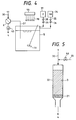
- the third embodiment of the present invention is a case when technetium is recovered from acidic radioactive liquid waste by a method using light, and is explained hereinafter referring to FIG. 4.
- composition of the apparatus used in the present embodiment is the same composition of the apparatus used in the embodiment 1 except eliminating the valve provided with filter and adding a light irradiation apparatus (for instance, a Xenon lamp) 44.
- the reducing agent vessel 37 is filled with photocatalyst 3A.
- Acidic radioactive liquid waste containing technetium 17 is supplied to the liquid waste processing vessel 5 through the pilings 30 and 31.
- a reducing agent 2 which is a salt free reducing agent
- photocatalyst 3A are supplied to the liquid waste processing vessel 5.
- ammonium carbonate as the reducing agents, and titanium oxide supporting platinum at surface as the photocatalyst 3A are used, respectively.
- Ethanol as an assistant reducing agent is supplied to the liquid waste processing vessel 5 from a tank which is not shown in FIG. 4.
- light 18 is irradiated to the mixed solution from the light irradiation apparatus 44.
- the light light released from Xenon lamp is used.
- the photocatalyst 3A remained at the bottom portion of the liquid waste processing vessel 5 can be used in the next operation of the process without any handling. Or the photocatalyst 3A can be used for the same object as the embodiment 3 or any other objects after recovering and separating from technetium.
- the same advantage as the embodiment 1 can be obtained.
- the embodiment 1 uses simpler composition of the apparatus than the present embodiment as much as no light irradiation apparatus 44 is used.
- the reducing reaction of technetium is enhanced more than the embodiment 1 because the photocatalyst 3A is used and light is irradiated. Accordingly, the solid state technetium contained in the acidic radioactive liquid waste 17 is adsorbed by the photocatalyst 3A in a short time.
- recovered useful technetium can be utilized in an industrial field and in a research field.
- the same advantage as the present embodiment can be realized with irradiation of electromagnetic waves such as radiation and the like instead of the light to the acidic radioactive liquid waste 17 mixed with the reducing agent 2 and the photocatalyst 3A in the liquid waste processing vessel 5.
- the photocatalyst 3A which adsorbed technetium can be separated from the liquid waste by arranging the valve with filter 7, or arranging a centrifuge. Although the filtration and the centrifugal separation require extra equipments and operations, the solid-liquid separation can be separated effectively.
- the fourth embodiment of the present invention is a case when the liquid waste processing vessel 5 is replaced with a column type processing apparatus.
- the column 22 of the present embodiment has a porous plate 21 which is arranged at the lower end portion of inside the column, and catalysts 3 (for instance, palladium) are packed onto the porous plate 21.
- the piping 30 for supplying high level liquid waste 1 is connected to the upper end portion of the column 22.
- the piping 45 provided with a flow rate control valve 46 is connected to the piping 30.
- High level liquid waste 1 flows through the piping 30.
- a mixed liquid of the reducing agent for instance, ammonium carbonate
- the assistant reducing agent for instance, ethanol
- the flow rate of the mixed liquid is controlled by the flow rate control valve 46.
- the reducing agent and the assistant reducing agent are mixed in a predetermined ratio, and is stored in a tank which is not shown in FIG. 4.
- a mixed liquid of the high level liquid waste 1, the reducing agent, and the assistant reducing agent is supplied into the column 22.
- Technetium is reduced by the effect of the reducing agent and the catalyst 3 as same as the above other embodiments while the high level liquid waste passes through the column 22, and is adsorbed onto the catalyst 3.
- the processed liquid waste 4 released from the column 22 hardly contain technetium nor platinum group elements. Passing velocity of the high level liquid waste 1 through the column 22 must be controlled so that technetium is not released from the column. However, even if a larger amount of technetium than a desirable amount are contained in the processed liquid waste, it is possible to decrease the amount less than a desirable amount by re-passing the processed liquid waste through the column.
- the high level liquid waste 1 can be supplied to the column continuously until an adsorbing capacity of the catalyst 3 for technetium and other elements is saturated or an activity of the catalyst is decreased. Further, when a plurality of columns 22 are prepared and operated alternately (exchange), a continuous operation for a long period becomes possible. Furthermore, alternate repeating reduction-adsorption of technetium (liquid waste processing) and re-dissolving-desorption (recovery of technetium) makes it possible to use a same column 22 and the catalyst 3 for a long period. When the column is made of transparent material such as quartz, irradiation of light from outside the column becomes possible, and consequently, reduction-separation efficiency of technetium can be improved.
- the present embodiment can be applied to general radioactive liquid waste other than the high level liquid waste.
- a very weak reducing agent such as a salt free reagent is sufficient as the reducing agent.
- apparatus composition can be more compact than the embodiment 1.
- technetium in liquid waste can be separated continuously and removed effectively by relatively simple operating steps, and poisonous character of the liquid waste can be decreased significantly. An amount of poisonous waste can be decreased remarkably.
- technetium in radioactive liquid waste can be separated and removed effectively and simply. Accordingly, such advantages are realized that poisonous character of a large amount of radioactive waste can be decreased and the amount of poisonous radioactive waste (technetium) can be decreased significantly. Furthermore, useful element such as technetium can be recovered and re-used.
Landscapes
- Engineering & Computer Science (AREA)
- Physics & Mathematics (AREA)
- Chemical & Material Sciences (AREA)
- General Engineering & Computer Science (AREA)
- High Energy & Nuclear Physics (AREA)
- Manufacturing & Machinery (AREA)
- Plasma & Fusion (AREA)
- Materials Engineering (AREA)
- Mechanical Engineering (AREA)
- Metallurgy (AREA)
- Organic Chemistry (AREA)
- Catalysts (AREA)
- Removal Of Specific Substances (AREA)
Applications Claiming Priority (3)
| Application Number | Priority Date | Filing Date | Title |
|---|---|---|---|
| JP2148395 | 1995-02-09 | ||
| JP21483/95 | 1995-02-09 | ||
| JP2148395 | 1995-02-09 |
Publications (2)
| Publication Number | Publication Date |
|---|---|
| EP0726329A1 true EP0726329A1 (de) | 1996-08-14 |
| EP0726329B1 EP0726329B1 (de) | 2000-06-07 |
Family
ID=12056229
Family Applications (1)
| Application Number | Title | Priority Date | Filing Date |
|---|---|---|---|
| EP19960300785 Expired - Lifetime EP0726329B1 (de) | 1995-02-09 | 1996-02-06 | Verfahren und Gerät zur Abtrennung von Technetium |
Country Status (2)
| Country | Link |
|---|---|
| EP (1) | EP0726329B1 (de) |
| DE (1) | DE69608714T2 (de) |
Cited By (1)
| Publication number | Priority date | Publication date | Assignee | Title |
|---|---|---|---|---|
| US9388478B1 (en) | 2014-12-19 | 2016-07-12 | Savannah River Nuclear Solutions, Llc | Technetium recovery from high alkaline solution |
Citations (8)
| Publication number | Priority date | Publication date | Assignee | Title |
|---|---|---|---|---|
| GB2011696A (en) * | 1977-12-28 | 1979-07-11 | Us Energy | Method for recovering palladium and technetium values from nuclear fuel reprocessing wast solutions |
| SU980396A1 (ru) * | 1980-07-23 | 1983-05-23 | Московский Ордена Ленина,Ордена Октябрьской Революции И Ордена Трудового Красного Знамени Государственный Университет Им.М.В.Ломоносова | Способ выделени технеци (V11) из облученного альфа-частицами ниоби |
| JPS60194399A (ja) * | 1984-02-24 | 1985-10-02 | オーストラリアン アトミツク エナージイ コミツシヨン | 初期過テクネチウム酸塩水溶液の処理方法 |
| JPS623694A (ja) * | 1985-06-26 | 1987-01-09 | コミサリヤ・ア・レネルジ・アトミク | 特に有機溶剤によるウラン及び/又はプルトニウムの抽出に際して,テクネチウム及び/又はレニウムの抽出を防止する方法 |
| JPS6293320A (ja) * | 1985-10-18 | 1987-04-28 | Japan Atom Energy Res Inst | テクネチウムの回収法 |
| JPH0259433A (ja) * | 1988-08-25 | 1990-02-28 | Japan Atom Energy Res Inst | テクネチウムの吸着分離方法 |
| EP0535837A1 (de) * | 1991-10-02 | 1993-04-07 | Westinghouse Electric Corporation | Dekontaminierung von radioaktiven Metallen |
| JPH05215895A (ja) * | 1992-02-05 | 1993-08-27 | Hitachi Ltd | 放射性溶液中のルテニウム及びテクネチウムの分離方法並びにそれを用いた使用済核燃料再処理プロセス |
-
1996
- 1996-02-06 DE DE69608714T patent/DE69608714T2/de not_active Expired - Fee Related
- 1996-02-06 EP EP19960300785 patent/EP0726329B1/de not_active Expired - Lifetime
Patent Citations (13)
| Publication number | Priority date | Publication date | Assignee | Title |
|---|---|---|---|---|
| JPS5496412A (en) * | 1977-12-28 | 1979-07-30 | Us Energy | Method of recovering valuable paradilum and technetium from waste liquid of retreated nuclear fuel |
| GB2011696A (en) * | 1977-12-28 | 1979-07-11 | Us Energy | Method for recovering palladium and technetium values from nuclear fuel reprocessing wast solutions |
| SU980396A1 (ru) * | 1980-07-23 | 1983-05-23 | Московский Ордена Ленина,Ордена Октябрьской Революции И Ордена Трудового Красного Знамени Государственный Университет Им.М.В.Ломоносова | Способ выделени технеци (V11) из облученного альфа-частицами ниоби |
| US4738834A (en) * | 1984-02-24 | 1988-04-19 | Australia Nuclear Science & Technology Organization | Treatment of technetium containing solutions |
| JPS60194399A (ja) * | 1984-02-24 | 1985-10-02 | オーストラリアン アトミツク エナージイ コミツシヨン | 初期過テクネチウム酸塩水溶液の処理方法 |
| JPS623694A (ja) * | 1985-06-26 | 1987-01-09 | コミサリヤ・ア・レネルジ・アトミク | 特に有機溶剤によるウラン及び/又はプルトニウムの抽出に際して,テクネチウム及び/又はレニウムの抽出を防止する方法 |
| US4764352A (en) * | 1985-06-26 | 1988-08-16 | Commissariat A L'energie Atomique | Process for preventing the extraction of technetium and/or rhenium, particularly during the extraction of uranium and/or plutonium by an organic solvent |
| FR2593494A1 (fr) * | 1985-10-18 | 1987-07-31 | Japan Atomic Energy Res Inst | Procede de recuperation du technetium |
| JPS6293320A (ja) * | 1985-10-18 | 1987-04-28 | Japan Atom Energy Res Inst | テクネチウムの回収法 |
| JPH0259433A (ja) * | 1988-08-25 | 1990-02-28 | Japan Atom Energy Res Inst | テクネチウムの吸着分離方法 |
| EP0535837A1 (de) * | 1991-10-02 | 1993-04-07 | Westinghouse Electric Corporation | Dekontaminierung von radioaktiven Metallen |
| JPH05209998A (ja) * | 1991-10-02 | 1993-08-20 | Westinghouse Electric Corp <We> | 放射能汚染金属からのテクネチウムの抽出方法 |
| JPH05215895A (ja) * | 1992-02-05 | 1993-08-27 | Hitachi Ltd | 放射性溶液中のルテニウム及びテクネチウムの分離方法並びにそれを用いた使用済核燃料再処理プロセス |
Non-Patent Citations (3)
| Title |
|---|
| DATABASE WPI Section Ch Week 8409, Derwent World Patents Index; Class E31, AN 84-054332, XP002003918 * |
| PATENT ABSTRACTS OF JAPAN vol. 014, no. 236 (C - 0720) 18 May 1990 (1990-05-18) * |
| PATENT ABSTRACTS OF JAPAN vol. 017, no. 654 (P - 1653) 3 December 1993 (1993-12-03) * |
Cited By (1)
| Publication number | Priority date | Publication date | Assignee | Title |
|---|---|---|---|---|
| US9388478B1 (en) | 2014-12-19 | 2016-07-12 | Savannah River Nuclear Solutions, Llc | Technetium recovery from high alkaline solution |
Also Published As
| Publication number | Publication date |
|---|---|
| DE69608714D1 (de) | 2000-07-13 |
| DE69608714T2 (de) | 2001-02-15 |
| EP0726329B1 (de) | 2000-06-07 |
Similar Documents
| Publication | Publication Date | Title |
|---|---|---|
| Foster et al. | Reversible photoreductive deposition and oxidative dissolution of copper ions in titanium dioxide aqueous suspensions | |
| Koma et al. | Trivalent f-element intra-group separation by solvent extraction with CMPO-complexant system | |
| EP3221048B1 (de) | Verfahren und vorrichtung zur rückgewinnung von radioaktiven nukliden aus verbrauchten harzmaterialien | |
| GB2077482A (en) | Coolant system decontamination | |
| US5852786A (en) | Process for decontaminating radioactive materials | |
| US8696911B2 (en) | Decontamination of radioactive liquid effluent by solid-liquid extraction using a recycle loop | |
| US5523513A (en) | Decontamination processes | |
| EP1509926B1 (de) | Neuer wiedergewinnungs-prozess | |
| JPH04215806A (ja) | 分離方法 | |
| US20110220579A1 (en) | Removal of metal ions from aqueous effluents | |
| JP7159257B2 (ja) | 放射性化学廃棄物処理装置及び放射性化学廃棄物の処理方法 | |
| WO2011016916A2 (en) | Compositions and methods for treating nuclear fuel | |
| EP0555996B1 (de) | Verfahren und Vorrichtung für die Behandlung einer wässrigen industriellen Abfallflüssigkeit | |
| US4622176A (en) | Method of processing radioactive liquid wastes containing radioactive ruthenium | |
| EP0726329B1 (de) | Verfahren und Gerät zur Abtrennung von Technetium | |
| US20040077482A1 (en) | Method for decontaminating solid iodine filters | |
| JP7284722B2 (ja) | 放射性廃液の処理方法 | |
| KR102453558B1 (ko) | 방사성 화학 폐기물 처리 장치 및 방사성 화학 폐기물의 처리 방법 | |
| JP7273682B2 (ja) | α核種除去システム | |
| Fukasawa et al. | Photochemical reactions of neptunium in nitric acid solution containing photocatalyst | |
| JPH08277428A (ja) | テクネチウムの分離方法及びその分離装置 | |
| JP7178322B2 (ja) | 放射性廃液の処理方法及び放射性廃液処理システム | |
| JP7123757B2 (ja) | 放射性廃液の処理方法及び放射性廃液処理システム | |
| JP2839585B2 (ja) | ネプツニウムの還元方法および装置 | |
| JP2640527B2 (ja) | 硝酸溶液中溶存物質の酸化方法及び装置 |
Legal Events
| Date | Code | Title | Description |
|---|---|---|---|
| PUAI | Public reference made under article 153(3) epc to a published international application that has entered the european phase |
Free format text: ORIGINAL CODE: 0009012 |
|
| 17P | Request for examination filed |
Effective date: 19960226 |
|
| AK | Designated contracting states |
Kind code of ref document: A1 Designated state(s): DE FR GB |
|
| 17Q | First examination report despatched |
Effective date: 19981204 |
|
| GRAG | Despatch of communication of intention to grant |
Free format text: ORIGINAL CODE: EPIDOS AGRA |
|
| GRAG | Despatch of communication of intention to grant |
Free format text: ORIGINAL CODE: EPIDOS AGRA |
|
| GRAH | Despatch of communication of intention to grant a patent |
Free format text: ORIGINAL CODE: EPIDOS IGRA |
|
| GRAH | Despatch of communication of intention to grant a patent |
Free format text: ORIGINAL CODE: EPIDOS IGRA |
|
| GRAA | (expected) grant |
Free format text: ORIGINAL CODE: 0009210 |
|
| AK | Designated contracting states |
Kind code of ref document: B1 Designated state(s): DE FR GB |
|
| REF | Corresponds to: |
Ref document number: 69608714 Country of ref document: DE Date of ref document: 20000713 |
|
| ET | Fr: translation filed | ||
| PLBE | No opposition filed within time limit |
Free format text: ORIGINAL CODE: 0009261 |
|
| STAA | Information on the status of an ep patent application or granted ep patent |
Free format text: STATUS: NO OPPOSITION FILED WITHIN TIME LIMIT |
|
| 26N | No opposition filed | ||
| REG | Reference to a national code |
Ref country code: GB Ref legal event code: IF02 |
|
| PGFP | Annual fee paid to national office [announced via postgrant information from national office to epo] |
Ref country code: FR Payment date: 20060224 Year of fee payment: 11 |
|
| PGFP | Annual fee paid to national office [announced via postgrant information from national office to epo] |
Ref country code: GB Payment date: 20060227 Year of fee payment: 11 |
|
| PGFP | Annual fee paid to national office [announced via postgrant information from national office to epo] |
Ref country code: DE Payment date: 20060309 Year of fee payment: 11 |
|
| GBPC | Gb: european patent ceased through non-payment of renewal fee |
Effective date: 20070206 |
|
| REG | Reference to a national code |
Ref country code: FR Ref legal event code: ST Effective date: 20071030 |
|
| PG25 | Lapsed in a contracting state [announced via postgrant information from national office to epo] |
Ref country code: DE Free format text: LAPSE BECAUSE OF NON-PAYMENT OF DUE FEES Effective date: 20070901 |
|
| PG25 | Lapsed in a contracting state [announced via postgrant information from national office to epo] |
Ref country code: GB Free format text: LAPSE BECAUSE OF NON-PAYMENT OF DUE FEES Effective date: 20070206 Ref country code: FR Free format text: LAPSE BECAUSE OF NON-PAYMENT OF DUE FEES Effective date: 20070228 |