EP0726604A2 - Dispositif de type MIS et méthode de fabrication - Google Patents
Dispositif de type MIS et méthode de fabrication Download PDFInfo
- Publication number
- EP0726604A2 EP0726604A2 EP96300813A EP96300813A EP0726604A2 EP 0726604 A2 EP0726604 A2 EP 0726604A2 EP 96300813 A EP96300813 A EP 96300813A EP 96300813 A EP96300813 A EP 96300813A EP 0726604 A2 EP0726604 A2 EP 0726604A2
- Authority
- EP
- European Patent Office
- Prior art keywords
- silicon
- layer
- substrate
- wide band
- semiconductor material
- Prior art date
- Legal status (The legal status is an assumption and is not a legal conclusion. Google has not performed a legal analysis and makes no representation as to the accuracy of the status listed.)
- Granted
Links
Images





Classifications
-
- H—ELECTRICITY
- H10—SEMICONDUCTOR DEVICES; ELECTRIC SOLID-STATE DEVICES NOT OTHERWISE PROVIDED FOR
- H10D—INORGANIC ELECTRIC SEMICONDUCTOR DEVICES
- H10D30/00—Field-effect transistors [FET]
- H10D30/60—Insulated-gate field-effect transistors [IGFET]
- H10D30/64—Double-diffused metal-oxide semiconductor [DMOS] FETs
- H10D30/66—Vertical DMOS [VDMOS] FETs
- H10D30/668—Vertical DMOS [VDMOS] FETs having trench gate electrodes, e.g. UMOS transistors
-
- H—ELECTRICITY
- H10—SEMICONDUCTOR DEVICES; ELECTRIC SOLID-STATE DEVICES NOT OTHERWISE PROVIDED FOR
- H10D—INORGANIC ELECTRIC SEMICONDUCTOR DEVICES
- H10D12/00—Bipolar devices controlled by the field effect, e.g. insulated-gate bipolar transistors [IGBT]
- H10D12/01—Manufacture or treatment
- H10D12/031—Manufacture or treatment of IGBTs
-
- H—ELECTRICITY
- H10—SEMICONDUCTOR DEVICES; ELECTRIC SOLID-STATE DEVICES NOT OTHERWISE PROVIDED FOR
- H10D—INORGANIC ELECTRIC SEMICONDUCTOR DEVICES
- H10D12/00—Bipolar devices controlled by the field effect, e.g. insulated-gate bipolar transistors [IGBT]
- H10D12/411—Insulated-gate bipolar transistors [IGBT]
- H10D12/441—Vertical IGBTs
- H10D12/461—Vertical IGBTs having non-planar surfaces, e.g. having trenches, recesses or pillars in the surfaces of the emitter, base or collector regions
- H10D12/481—Vertical IGBTs having non-planar surfaces, e.g. having trenches, recesses or pillars in the surfaces of the emitter, base or collector regions having gate structures on slanted surfaces, on vertical surfaces, or in grooves, e.g. trench gate IGBTs
-
- H—ELECTRICITY
- H10—SEMICONDUCTOR DEVICES; ELECTRIC SOLID-STATE DEVICES NOT OTHERWISE PROVIDED FOR
- H10D—INORGANIC ELECTRIC SEMICONDUCTOR DEVICES
- H10D30/00—Field-effect transistors [FET]
- H10D30/01—Manufacture or treatment
-
- H—ELECTRICITY
- H10—SEMICONDUCTOR DEVICES; ELECTRIC SOLID-STATE DEVICES NOT OTHERWISE PROVIDED FOR
- H10D—INORGANIC ELECTRIC SEMICONDUCTOR DEVICES
- H10D62/00—Semiconductor bodies, or regions thereof, of devices having potential barriers
- H10D62/10—Shapes, relative sizes or dispositions of the regions of the semiconductor bodies; Shapes of the semiconductor bodies
- H10D62/13—Semiconductor regions connected to electrodes carrying current to be rectified, amplified or switched, e.g. source or drain regions
- H10D62/149—Source or drain regions of field-effect devices
- H10D62/151—Source or drain regions of field-effect devices of IGFETs
- H10D62/152—Source regions of DMOS transistors
- H10D62/154—Dispositions
-
- H—ELECTRICITY
- H10—SEMICONDUCTOR DEVICES; ELECTRIC SOLID-STATE DEVICES NOT OTHERWISE PROVIDED FOR
- H10D—INORGANIC ELECTRIC SEMICONDUCTOR DEVICES
- H10D62/00—Semiconductor bodies, or regions thereof, of devices having potential barriers
- H10D62/80—Semiconductor bodies, or regions thereof, of devices having potential barriers characterised by the materials
- H10D62/83—Semiconductor bodies, or regions thereof, of devices having potential barriers characterised by the materials being Group IV materials, e.g. B-doped Si or undoped Ge
- H10D62/8303—Diamond
-
- H—ELECTRICITY
- H10—SEMICONDUCTOR DEVICES; ELECTRIC SOLID-STATE DEVICES NOT OTHERWISE PROVIDED FOR
- H10D—INORGANIC ELECTRIC SEMICONDUCTOR DEVICES
- H10D62/00—Semiconductor bodies, or regions thereof, of devices having potential barriers
- H10D62/80—Semiconductor bodies, or regions thereof, of devices having potential barriers characterised by the materials
- H10D62/83—Semiconductor bodies, or regions thereof, of devices having potential barriers characterised by the materials being Group IV materials, e.g. B-doped Si or undoped Ge
- H10D62/832—Semiconductor bodies, or regions thereof, of devices having potential barriers characterised by the materials being Group IV materials, e.g. B-doped Si or undoped Ge being Group IV materials comprising two or more elements, e.g. SiGe
- H10D62/8325—Silicon carbide
-
- H—ELECTRICITY
- H10—SEMICONDUCTOR DEVICES; ELECTRIC SOLID-STATE DEVICES NOT OTHERWISE PROVIDED FOR
- H10D—INORGANIC ELECTRIC SEMICONDUCTOR DEVICES
- H10D62/00—Semiconductor bodies, or regions thereof, of devices having potential barriers
- H10D62/10—Shapes, relative sizes or dispositions of the regions of the semiconductor bodies; Shapes of the semiconductor bodies
- H10D62/13—Semiconductor regions connected to electrodes carrying current to be rectified, amplified or switched, e.g. source or drain regions
- H10D62/149—Source or drain regions of field-effect devices
- H10D62/151—Source or drain regions of field-effect devices of IGFETs
-
- H—ELECTRICITY
- H10—SEMICONDUCTOR DEVICES; ELECTRIC SOLID-STATE DEVICES NOT OTHERWISE PROVIDED FOR
- H10D—INORGANIC ELECTRIC SEMICONDUCTOR DEVICES
- H10D62/00—Semiconductor bodies, or regions thereof, of devices having potential barriers
- H10D62/80—Semiconductor bodies, or regions thereof, of devices having potential barriers characterised by the materials
- H10D62/82—Heterojunctions
-
- H—ELECTRICITY
- H10—SEMICONDUCTOR DEVICES; ELECTRIC SOLID-STATE DEVICES NOT OTHERWISE PROVIDED FOR
- H10D—INORGANIC ELECTRIC SEMICONDUCTOR DEVICES
- H10D62/00—Semiconductor bodies, or regions thereof, of devices having potential barriers
- H10D62/80—Semiconductor bodies, or regions thereof, of devices having potential barriers characterised by the materials
- H10D62/82—Heterojunctions
- H10D62/822—Heterojunctions comprising only Group IV materials heterojunctions, e.g. Si/Ge heterojunctions
-
- H—ELECTRICITY
- H10—SEMICONDUCTOR DEVICES; ELECTRIC SOLID-STATE DEVICES NOT OTHERWISE PROVIDED FOR
- H10D—INORGANIC ELECTRIC SEMICONDUCTOR DEVICES
- H10D64/00—Electrodes of devices having potential barriers
- H10D64/20—Electrodes characterised by their shapes, relative sizes or dispositions
- H10D64/27—Electrodes not carrying the current to be rectified, amplified, oscillated or switched, e.g. gates
- H10D64/311—Gate electrodes for field-effect devices
- H10D64/411—Gate electrodes for field-effect devices for FETs
- H10D64/511—Gate electrodes for field-effect devices for FETs for IGFETs
-
- H—ELECTRICITY
- H10—SEMICONDUCTOR DEVICES; ELECTRIC SOLID-STATE DEVICES NOT OTHERWISE PROVIDED FOR
- H10D—INORGANIC ELECTRIC SEMICONDUCTOR DEVICES
- H10D64/00—Electrodes of devices having potential barriers
- H10D64/20—Electrodes characterised by their shapes, relative sizes or dispositions
- H10D64/27—Electrodes not carrying the current to be rectified, amplified, oscillated or switched, e.g. gates
- H10D64/311—Gate electrodes for field-effect devices
- H10D64/411—Gate electrodes for field-effect devices for FETs
- H10D64/511—Gate electrodes for field-effect devices for FETs for IGFETs
- H10D64/517—Gate electrodes for field-effect devices for FETs for IGFETs characterised by the conducting layers
- H10D64/519—Gate electrodes for field-effect devices for FETs for IGFETs characterised by the conducting layers characterised by their top-view geometrical layouts
-
- Y—GENERAL TAGGING OF NEW TECHNOLOGICAL DEVELOPMENTS; GENERAL TAGGING OF CROSS-SECTIONAL TECHNOLOGIES SPANNING OVER SEVERAL SECTIONS OF THE IPC; TECHNICAL SUBJECTS COVERED BY FORMER USPC CROSS-REFERENCE ART COLLECTIONS [XRACs] AND DIGESTS
- Y10—TECHNICAL SUBJECTS COVERED BY FORMER USPC
- Y10S—TECHNICAL SUBJECTS COVERED BY FORMER USPC CROSS-REFERENCE ART COLLECTIONS [XRACs] AND DIGESTS
- Y10S438/00—Semiconductor device manufacturing: process
- Y10S438/931—Silicon carbide semiconductor
Definitions
- the present invention relates to a semiconductor device and a method of manufacturing the same, and more particularly to a vertical type power semiconductor device such as a power MOSFET (Metal Oxide Silicon Field Effect Transistor), an SI (Static Induction) thyristor, and an IGBT (Insulated Gate Bipolar Transistor) power transistor, and to a method of manufacturing such a vertical type power semiconductor device.
- a vertical type power semiconductor device such as a power MOSFET (Metal Oxide Silicon Field Effect Transistor), an SI (Static Induction) thyristor, and an IGBT (Insulated Gate Bipolar Transistor) power transistor
- a current passing between main electrodes can be controlled by controlling a gate voltage, so that such semiconductor device may be advantageously used in a power transducer and switching power source as a high speed switching element.
- a vertical type semiconductor device in which a current flows vertically within a substrate it is possible to control a very large current.
- a silicon substrate has been generally used as a semiconductor substrate.
- the silicon substrate there are formed channels and currents pass through these channels and semiconductor regions adjacent to the channels.
- a channel and adjoining semiconductor regions have certain resistance even in a conductive state (generally termed as an on-resistance). Therefore, heat is generated during the conduction state.
- a threshold temperature below which the device operates safely is about one hundred and several tens degree in Celsius's temperature scale. Therefore, when a large current flows, a breakdown voltage of semiconductor device might be decreased and an efficiency of the device might be reduced by a loss due to heat. Therefore, it has been proposed to decrease the on-resistance as low as possible. For instance, in order to reduce a resistance of the channel, it has been proposed to reduce a length of the channel. However, this solution is limited by a fine working, so that the channel resistance could not be decreased to a desired value.
- the silicon carbide substrate has several advantages such that a wide band gap, high electron mobility, high saturation drift velocity, high thermal conduction and high breakdown voltage. Such properties show that the silicon carbide substrate is particularly suitable for the power semiconductor device. However, it is practically very difficult to manufacture a semiconductor device comprising the silicon carbide substrate. Therefore, in the above reference, characteristics of SiC power MOS FET are derived by theoretical calculations. This simulation indicates that the on-resistance of the SiC power MOS FET is smaller than that of the Si power MOS FET by about 2000 times and a breakdown voltage of the SiC power MOS PET amounts to about 5000V.
- the silicon carbide substrate having good property, so that it could not be possible to realize the power semiconductor device having excellent characteristics even if the theoretical calculation indicates such excellent characteristics. Furthermore, in a feature, a silicon carbide substrate could be manufactured, but a cost of the silicon carbide substrate would become higher than the silicon substrate. Since the silicon carbide substrate can be treated or machined only with difficulty, a manufacturing cost of the silicon carbide substrate would become very expensive.
- the present invention provides a novel and useful semiconductor device which uses a hybrid type semiconductor substrate, in which a high breakdown voltage can be attained even if a thickness of the substrate is small and thus the on-resistance can be reduced and heat generation can be suppressed, a loss due to heat generation can be reduced, and the substrate can be manufactured easily at a low cost.
- a vertical type semiconductor device comprising a semiconductor substrate having a first main surface and a second main surface being opposite to the first main surface; and at least one control electrode region formed in said semiconductor substrate, whereby a current passing between said first and second main surfaces of the semiconductor substrate is controlled by controlling a voltage applied to said control electrode region, wherein said semiconductor substrate is formed by a hybrid structure semiconductor substrate including a first substrate made of silicon and a second semiconductor substrate made of a semiconductor material having a band gap wider than that of the first substrate of silicon.
- said semiconductor substrate is formed by a silicon substrate, a wide band-gap semiconductor substrate formed on the silicon substrate and a silicon epitaxial layer formed epitaxially on the wide band-gap semiconductor substrate.
- Said wide band-gap semiconductor substrate may be formed by a silicon carbide, diamond or composite material of silicon carbide and diamond.
- the semiconductor device may be advantageously constructed as MOS FET by using the above mentioned hybrid-type semiconductor substrate.
- the semiconductor substrate is formed by a silicon substrate of one conductivity type, a wide band-gap semiconductor material layer epitaxially grown on a surface of said silicon substrate and made of a semiconductor material of opposite conductivity type and having a low impurity concentration, and a silicon layer epitaxially deposited on said wide band-gap semiconductor material layer and made of silicon having a high impurity concentration.
- said silicon layer there are formed recesses having a such depth that the surface of said wide band-gap semiconductor material layer is exposed or a part of said silicon layer is remained under the recesses to such an extent that a depth of said remained part of the silicon layer amounts to a depth of an inverted channel to be formed in the silicon layer during operation.
- a silicon oxide film is formed on an inner surface of said recess, a gate electrode is formed on said silicon oxide film, a source region is formed by inverting the conductivity type of a part of the silicon layer which adjoins said silicon oxide film, a source electrode is formed on said source region, and a drain electrode is formed on a rear surface of said silicon substrate.
- the semiconductor device is constructed as IGBT.
- the semiconductor substrate is formed by a silicon substrate of one conductivity type, a first silicon layer of the opposite conductivity type formed on a surface of said silicon substrate and having a high impurity concentration, a wide band-gap semiconductor material layer epitaxially grown on a surface of said first silicon layer and made of a semiconductor material of the opposite conductivity type and having a low impurity concentration, and a second silicon layer epitaxially deposited on said wide band-gap semiconductor material layer and made of silicon of the opposite conductivity type having a high impurity concentration.
- said second silicon layer there are formed recesses having such a depth that the surface of said wide band-gap semiconductor material layer is exposed or a part of said second silicon layer is remained under the recesses to such an extent that a depth of said remained part of the second silicon layer amounts to a depth of an inverted channel which is formed in the second silicon layer during operation.
- a silicon oxide film is formed on an inner surface of said recess, a gate electrode is formed on said silicon oxide film, an emitter region is formed by inverting the conductivity type of a part of the second silicon layer which adjoins said silicon oxide film, an emitter electrode is formed on said emitter region, and a collector electrode is formed on a rear surface of said silicon substrate.
- the semiconductor substrate is formed by a silicon substrate of one conductivity type, a wide band-gap semiconductor material layer epitaxially deposited on a surface of said silicon substrate and made of a semiconductor material of the opposite conductivity type and having a low impurity concentration, and a silicon layer epitaxially grown on said wide band-gap semiconductor material layer and made of silicon having a high impurity concentration.
- said silicon layer there are formed recesses having a depth such that the surface of said wide band-gap semiconductor material layer is exposed or a part of said silicon layer is remained under the recesses to such an extent that a depth of said remained part of the silicon layer amounts to a depth of an inverted channel to be formed in the silicon layer during operation.
- a silicon oxide film is formed on an inner surface of said recess, a gate electrode is formed on said silicon oxide film, an emitter region is formed by inverting the conductivity type of a part of the silicon layer which adjoins said silicon oxide film, an emitter electrode is formed on said emitter region, and a collector electrode is formed on a rear surface of said silicon substrate.
- the semiconductor substrate is formed by, for instance, a silicon substrate, a wide band-gap semiconductor material layer epitaxially deposited on said silicon substrate and a silicon layer epitaxially deposited on the wide band-gap semiconductor material layer. Since the wide band-gap semiconductor material layer has a higher breakdown property than the silicon substrate, the wide band-gap semiconductor material layer can be thin, and therefore on-resistance can be decreased. Therefore, an amount of heat generated by the semiconductor device can be decreased. Moreover, the upper silicon layer can be easily worked or machined and can be formed to have excellent characteristics at a low cost as compared with a case in which a whole substrate is made of a wide band-gap semiconductor material such as silicon carbide and diamond. Therefore, a cost of the semiconductor device can be reduced.
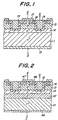
- Fig. 1 is a cross sectional view showing an embodiment of the semiconductor device according to the invention.
- the semiconductor device is formed as a power MOS FET.
- the semiconductor device comprises a semiconductor substrate formed by an N + type silicon substrate 11 having an impurity concentration of 3x10 18 atoms/cm 3 and a thickness of about 300 micron meters.
- the semiconductor substrate further comprises an N - type silicon carbide layer 12 epitaxially grown on a surface of the silicon substrate 11.
- the silicon carbide layer 12 has an impurity concentration of 5x10 16 atoms/cm 3 and having a thickness of about 10 micron meters.
- the semiconductor substrate further includes a P + type silicon layer 13 epitaxially deposited on a surface of the-silicon carbide layer 12.
- the silicon layer 13 has an impurity concentration of 1x10 18 atoms/cm 3 and a thickness of about 20 micron meters.
- a silicon oxide film 14 On a surface of the recesses is covered with a silicon oxide film 14.
- the silicon oxide film 14 may be formed by thermal oxidation or CVD using a TEOS (tetra ethoxysilane) gas.
- TEOS tetra ethoxysilane
- gate electrodes 15 On the silicon oxide film 14, there are deposited gate electrodes 15.
- N + type source regions 16 are formed in the P + type silicon layer 13 by inverting the conductivity type of surface parts of the silicon layer which are brought into contact with the silicon oxide film 14.
- the source regions 16 have an impurity concentration of about 1x10 19 atoms/cm3.
- source electrodes 17 made of aluminum.
- a drain electrode 18 by depositing aluminum.
- a bias voltage is applied across the drain electrode 18 and the source electrode 17 such that the drain is positive and the source is negative.
- no gate voltage is applied to the gate electrode 15
- no inverted channel is formed at portions of the P + type silicon layer 13 which are brought into contact with the silicon oxide film 14, so that electrons supplied from the source electrode 17 are not conducted to the silicon carbide layer 12. Therefore, no current flows between the source electrode 17 and the drain electrode 18 and the semiconductor device is in an off- or non-conductive condition.
- a breakdown voltage is determined by a depletion layer produced by the P + type silicon layer 13 and N - silicon carbide layer 12.
- Silicon carbide has a wider band-gap than the silicon and a breakdown voltage of silicon carbide is higher than that of silicon by about one order. Therefore, a thickness of the silicon carbide layer can be reduced.
- the silicon carbide layer.12 has a high breakdown voltage and can be thin. Therefore, on-resistance can be decreased. This results in that an amount of heat generated by the semiconductor device can be reduced and a loss due to heat can be decreased. Furthermore, the inverted channel is formed within the silicon layer 13 whose impurity concentration can be easily and precisely controlled, and thus a desired property can be realized. Moreover, the recess for forming the inversion layer is formed within the silicon layer 13, and therefore the recess can be easily formed. In order to realize a high speed device for switching a current at a high speed, it is required to extinguish carriers at a high speed.
- the silicon substrate includes the wide band-gap semiconductor material layer having a small thickness, so that the on-resistance can be reduced. Therefore, even though the above mentioned process for reducing life time of carriers is performed to increase extinguishing speed of carriers, it is possible to realize the semiconductor device having low loss due to on-resistance.
- silicon carbide or diamond has a higher heat conduction than silicon, heat generated at the channel can be dissipated speedily and a heat resistance of the device can be improved.
- the semiconductor substrate according to the invention has both a property of silicon such as low cost, easy workability and easy formation and a property of wide band-gap semiconductor material such as a high breakdown voltage.
- Fig. 2 is a cross sectional view showing an embodiment of the semiconductor device constructed as IGBT according to the invention.
- a semiconductor substrate is formed by a P + type silicon substrate 21 having an impurity concentration of about 3x10 18 atoms/cm 3 , N type first silicon layer 22 epitaxially deposited on a surface of the silicon substrate 21 and having an impurity concentration of about 1x10 17 atoms/cm 3 and a thickness of about 10 micron meters, N - type silicon carbide layer 12 epitaxially grown on a surface of the first silicon layer 22 and having an impurity concentration of 5x10 16 atoms/cm 3 and having a thickness of about 10 micron meters, and a second P + type silicon layer 13 epitaxially deposited on a surface of the silicon carbide layer 12.
- the second silicon layer 13 has an impurity concentration of 1x10 16 atoms/cm 3 and a thickness of about 20 micron meters.
- N + type emitter regions 46 and emitter electrodes 47 are formed on the emitter regions.
- collector electrode 48 On a rear surface of the silicon substrate 11 is formed a collector electrode 48.
- a bias voltage is applied across the collector electrode 48 and the emitter electrode 47 such that the collector electrode becomes positive and the emitter electrode becomes negative.
- a voltage is not applied to the gate electrode 15
- an inverted channel is not generated at portions of the P + type second silicon layer 13 which are brought into contact with the silicon oxide film 14, so that electrons supplied from the source electrode 17 are not conducted into the silicon carbide layer 12. Therefore, no current flows between the collector electrode 48 and the emitter electrode 47, so that the semiconductor device is in a cut-off state.
- a positive voltage is applied to the gate electrode 15, negative charge is induced in portions of the second silicon layer 13 adjoining the silicon oxide film 14 and an inverted channel is formed therein.
- the N - type silicon carbide layer 12 serving as a drift layer. Then, holes are injected from the P + type silicon layer 21 and minority carriers are stored in the N - silicon carbide layer 12. In this manner, a large current passes from the collector electrode 48 to the emitter electrode 47 via the silicon substrate 21,N type first silicon layer 22, N - silicon carbide layer 12, the inversion channel and emitter region 46.
- the N - silicon carbide layer 12 serves as the drift layer having a high breakdown electric field strength, and therefore a desired breakdown voltage can be attained by using a thin silicon carbide layer. Thus, on-resistance can be decreased and loss due to heat generation can be reduced.
- On-resistance of the power MOS FET is mainly determined by the N - silicon carbide layer 12 having a high resistance.
- minority carriers, i.e. holes are stored in this silicon carbide layer, a concentration of majority carriers, i.e. electrons is also increased (conductivity modulation) , and thus the on-resistance of IGBT becomes lower than that of MOS FET.
- Fig. 3 is a cross sectional view showing another embodiment of the semiconductor device formed as IGBT according to the invention. Also in this embodiment, portions similar to those shown in Fig. 2 are denoted by the same reference numerals used in Fig. 2.
- a semiconductor substrate is formed by an P + type silicon substrate 21 having an impurity concentration of about 3x10 18 atoms/cm 3 , an N - type silicon carbide layer 12 epitaxially grown on a surface of the silicon substrate 21 and having an impurity concentration of 5x10 16 atoms/cm 3 and a thickness of about 10 micron meters, and a P + type silicon layer 13 epitaxially deposited on a surface of the silicon carbide layer 12.
- the silicon layer 13 has an impurity concentration of 3x10 18 atoms/cm 3 and a thickness of about 20 micron meters.
- a collector electrode 48 On a rear surface of the silicon substrate 21 is formed a collector electrode 48.
- the present embodiment has similar advantages to those of the embodiment illustrated in Fig. 2.
- Fig. 4 is a cross sectional view depicting another embodiment of the semiconductor device according to the invention constituted as MOS FET.
- portions similar to those of the embodiment shown in Fig. 1 are denoted by the same reference numerals used in Fig. 1.
- a semiconductor substrate is formed by an N + type silicon substrate 11 having a hight impurity concentration of about 3x10 18 atoms/cm 3 , an N - type silicon carbide layer 12 epitaxially grown on a surface of the silicon substrate 11 and having an impurity concentration of about 5x10 15 atoms/cm 3 , and a P + type silicon layer 13 epitaxially grown on a surface of the silicon carbide layer 12 and having an impurity concentration of about 1x10 18 atoms/cm 3 .
- the silicon layer 13 there are formed recesses which extend through the silicon layer 13 and partially penetrate into the silicon carbide layer 12. On a surface of the recesses is covered with a silicon oxide film 14, and gate electrodes 15 is formed on the silicon oxide film 14. N + type source regions 16 are formed in surface regions of the P + type silicon layer 13 which are brought into contact with the silicon oxide film 14. The source regions 16 have a high impurity concentration of about 1x10 19 atoms/cm 3 . On the source regions 16 are formed source electrodes 17 made of aluminum. On a rear surface of the silicon substrate 11 is formed a drain electrode 18 by depositing aluminum. The construction so far explained is similar to that of the first embodiment illustrated in Fig. 1.
- an N + type second silicon substrate 25 having a high impurity concentration of about 1x10 19 atoms/cm 3 is joined on a surface of the silicon layer 13, and a source electrode 17 is formed on a surface of the second silicon substrate 25.
- the gate electrodes 15 are formed such that they do not contact with the second silicon substrate 25. That is to say, the recesses are not fully filed with the gate electrodes 15, but spaces are formed on the gate electrodes.
- the second silicon substrate 25 is joined on the silicon layer 13, it is possible to form the single source electrode 17 commonly for all elements. Moreover, a depth of the recesses can be shallow, so that the construction is preferable for the fine working.
- Fig. 5 is a cross sectional view showing another embodiment of the semiconductor device formed as IGBT according to the invention.
- a semiconductor substrate is formed by a P + type silicon substrate 21 having an impurity concentration of about 3x10 18 atoms/cm 3 , an N - type silicon carbide layer 12 epitaxially grown on a surface of the silicon substrate 21 and having an impurity concentration of 5x10 15 atoms/cm 3 , and a P + type silicon layer 13 epitaxially deposited on a surface of the silicon carbide layer 12 and having an impurity concentration of 3x10 18 atoms/cm 3 , said silicon layer 13 serving as a base region.
- a silicon oxide film 14 is formed on an inner wall of the recesses and gate electrodes 15 are formed on the silicon oxide film.
- N + type emitter regions 46 are formed in surface regions of the silicon layer 13 which are brought into contact with the silicon oxide film 14 and emitter electrodes 47 are formed on the emitter regions 46.
- a collector electrode 48 is formed on a rear surface of the silicon substrate 21.
- an N + type second silicon substrate 25 having a high impurity concentration of about 1x10 19 atoms/cm 3 is joined on a surface of the silicon layer 13, and an emitter electrode 47 is formed on a surface of the second silicon substrate 25.
- the gate electrodes 15 are formed such that they are not brought into contact with the second silicon substrate 25.
- the emitter electrode 47 can be formed commonly for all the elements, and a depth of the recesses can be made small.
- Figs. 6A to 6F are cross sectional views illustrating successive steps of an embodiment of the method of manufacturing the semiconductor device according to the invention.
- the power MOS FET shown in Fig. 1 is to be manufactured.
- an N + type silicon substrate 11 having an impurity concentration of 3x10 18 atoms/cm 3 and a thickness of about 300 micron meters is prepared.
- an N type silicon carbide layer 12 having a low impurity concentration of 5x10 16 atoms/cm 3 is epitaxially grown on a surface of the silicon substrate 11 such that the silicon carbide layer 12 has a thickness of about 10 micron meters.
- a P + type silicon layer 13 having an impurity concentration of 1x10 18 atoms/cm 3 and a thickness of about 20 micron meters is epitaxially deposited on a surface of the silicon carbide layer 12.
- recesses 31 are formed in the silicon layer 13 by anisotropic etching as shown in Fig. 6C.
- a surface of the silicon layer 13 is partially etched away, but according to the invention, it I not always necessary to perform such etching. This will be explained further in detail.
- a silicon oxide film 32 having a thickness of 5000 ⁇ is formed on an inner wall of the recesses 31 and on a surface of the silicon layer 13 as depicted in Fig. 6D. Further an aluminum film 33 is formed such that the recesses 31 are fully filed with aluminum.
- the silicon oxide film 32 is formed by thermal oxidation.
- the silicon oxide film 32 may be formed by CVD using a TEOS gas.
- the aluminum film 33 is formed by CVD method, but may be formed by sputtering.
- the aluminum film 33 and silicon oxide film 32 are partially removed by etching or chemical mechanical polishing to expose a surface of the silicon layer 13 as shown in Fig. 6E.
- N type impurity ions are implanted and diffused into the surface of the silicon layer 13 to form N + type source regions 16 having an impurity concentration of about 1x10 19 atoms/cm 3 .
- source electrodes 17 are formed on the source regions 16 and a drain electrode 18 is formed on a rear surface of the silicon substrate 11 by aluminum deposition.
- the semiconductor substrate is formed by the silicon substrate, silicon carbide layer epitaxially deposited on the silicon substrate, and silicon layer epitaxially deposited on the silicon carbide layer.
- the inversion channel has to be formed within the silicon layer and silicon carbide layer.
- a breakdown voltage might be reduced due to crystal incommensurate structure at the boundary.
- the present invention provides a novel structure which can mitigate such a problem. Now several embodiments of the semiconductor device according to the invention will be explained.
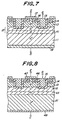
- Fig. 7 is a cross sectional view showing an embodiment of the semiconductor device according to the invention, in which the above explained problem of the crystal defect in the boundary between the silicon substrate and the silicon carbide layer can be solved.
- the basic structure of the present embodiment is identical with that of the first embodiment shown in Fig. 1.
- an N type diffusion layer 41 having a higher impurity concentration than that of the silicon carbide layer 12 is formed between the N + type silicon substrate 11 and the N - type silicon carbide layer 12.
- the N type diffusion layer 41 may be formed by diffusing impurity ions from the silicon substrate 11 into the silicon carbide layer 12 after epitaxially depositing the silicon carbide layer 12.
- the N type diffusion layer 41 has an impurity concentration of 5x10 17 atoms/cm 3 and a thickness of about 10 micron meters.
- the depletion layer formed at the P + N - junction could not spread beyond the boundary between the bulk portion of the silicon carbide layer 12 and the N type diffusion layer 41.
- the depletion layer having the maximum electric field is formed within the same crystal without no crystal incommensurate structure, i.e. within the silicon carbide crystal. Therefore, the above mentioned decrease in the breakdown voltage due to the crystal incommensurate structure can be effectively removed.
- Fig. 8 is a cross sectional view showing a modification of the embodiment of the semiconductor device according to the invention, in which the above mentioned decrease in the breakdown voltage due to the crystal incommensurate structure can be avoided.
- an N type silicon carbide layer 43 having a thickness of about 10 micron meters on the silicon substrate 11 by epitaxial growth
- an N - silicon carbide layer 12 having a thickness of about 20 micron meters is formed on the N type silicon carbide layer 43 by epitaxial growth.
- the N type silicon carbide layer 43 has an impurity concentration of 5x10 17 atoms/cm 3 which is higher than that of the N - type silicon carbide layer 12.
- Fig. 9 is a cross sectional view showing a modification of the embodiment of the semiconductor device according to the invention shown in Fig. 3, in which the decrease in the breakdown voltage due to the crystal incommensurate structure can be mitigated.
- an N type silicon layer 22 having an impurity concentration of about 5x10 17 atoms/cm 3 and a thickness of about 10 micron meters is epitaxially deposited on the P + type silicon substrate 21.
- N - type silicon carbide layer 12 having a thickness of about 20 micron meters is epitaxially grown on the N type silicon carbide layer 22.
- N type impurity ions are diffused from the N type silicon layer 22 into the N - type silicon carbide layer 12 to form an N type diffusion layer 41 having a thickness of about 10 micron meters.
- This N type diffusion layer 41 has an impurity concentration of about 5x10 17 atoms/cm 3 .
- the decease in the breakdown voltage due to crystal incommensurate structure at the boundary betw.een the silicon substrate and the silicon carbide layer can be avoided. It should be noted that a similar problem might occur at a boundary between a silicon carbide layer and a silicon layer having a high impurity concentration. According to the invention, this problem can be also solved by a similar measure.
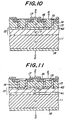
- Fig. 10 is a cross sectional view showing a modification of the embodiment shown in Fig. 1, in which the above mentioned problem can be removed by providing a diffusion layer in a surface of the silicon carbide layer adjoining the silicon layer.
- a diffusion layer in a surface of the silicon carbide layer adjoining the silicon layer.
- N + type silicon substrate 11 there is epitaxially formed an N + type silicon carbide layer 12 having a thickness of about 20 micron meters, and a P + type silicon layer 13 is epitaxially deposited on the silicon carbide layer 12.
- P type impurity ions are diffused from the silicon layer 13 into the silicon carbide layer 12 to form a P type diffusion layer 42 having a thickness of about 5 micron meters.
- This P type diffusion layer 42 has an impurity concentration of 5x10 17 atoms/cm 3 .
- Fig. 11 is a cross sectional view depicting another embodiment of the semiconductor device according to the invention, in which both the N type diffusion layer 41 shown in Fig. 7 and the P type diffusion layer 42 illustrated in Fig. 10 are provided.
- an N + type silicon substrate 11 an N - type silicon carbide layer 12 having an impurity concentration of 5x10 15 atoms/cm 3 is epitaxially deposited.
- an N type silicon carbide layer 41 having an impurity concentration of 3x10 18 atoms/cm 3 and a thickness of about 5 micron meters is formed by diffusing N type impurity ions from the silicon substrate 11 into the silicon carbide layer 12.
- an P + type silicon layer 13 is epitaxially deposited on the silicon carbide layer 12, and then a p type diffusion layer 42 having a thickness of about 5 micron meters is formed in a surface region of the silicon carbide layer 12 by diffusing P type impurity ions from the P + type silicon layer 13 into the surface region of the silicon carbide layer 12.
- the P type diffusion layer 42 has an impurity concentration of about 5x10 17 atoms/cm 3 .
- the bulk of the silicon carbide layer 12 becomes about 10 micron meters.
- the N type silicon carbide layer 41 is provided between the N + type silicon substrate 11 and the N - type silicon carbide layer 12 and the P type diffusion layer 42 is existent between the and the P type diffusion layer 42 is existent between the N - type silicon carbide layer 12 and the P + type silicon layer 13. Therefore, upon the operation it is possible to avoid the decrease in breakdown voltage due to the crystal defect within the silicon carbide layer 12 at which an electric field of the depletion layer formed by the reverse bias becomes maximum.
- Fig. 12 is a cross sectional view showing a modified embodiment of the power MOS FET of joint type shown in Fig. 4.
- an N type diffusion layer 41 is formed in a surface of an N - type silicon carbide layer 12 which adjoins with an N + type silicon substrate 11, and a P type diffusion layer 42 is formed in a surface of the N - type silicon carbide layer 12 which is brought into contact with a P@ type silicon layer 13.
- an N - type silicon carbide layer 12 is epitaxially deposited, and then, an N type diffusion layer 41 is formed by diffusing N type impurity ions from the silicon substrate 11 into the silicon carbide layer 12.
- a P + type silicon layer 13 is epitaxially deposited on the silicon carbide layer 12, and then a P type diffusion layer 42 is formed in a surface region of the silicon carbide layer 12 by diffusing P type impurity ions from the P + type silicon layer 13 into the surface region of the silicon carbide layer 12.
- Each of the N type diffusion layer 41 and P type diffusion layer 42 has a thickness of 5 micron meters, so that the bulk of the silicon carbide layer 12 becomes about 10 micron meters.
- Fig. 13 is a cross sectional view depicting a modification of the joint type IGBT illustrated in Fig. 5.
- an N type silicon carbide layer 43 having an impurity concentration of about 3x10 18 atoms/cm 3 and a thickness of about 5 micron meters.
- an N - type silicon carbide layer 12 having a thickness of about 15 micron meters is epitaxially deposited on the N type silicon carbide layer 43
- a P + type silicon layer 13 is epitaxially deposited on the N - type silicon carbide layer 12.
- P type impurity ions are diffused from the P + type silicon layer 13 into the surface region of the N - type silicon carbide layer 12 to form a P type diffusion layer 42 having a thickness of about 5 micron meters.
- Figs. 14A-14D are cross sectional views showing several embodiments of the second semiconductor substrate used in the joint type semiconductor device. In these embodiments, lower surfaces of the substrates are to be brought into contact with the first silicon substrate.
- a metal film 52 is applied on a surface of a silicon substrate 51. The metal film 52 may be formed by a vapor deposition of aluminum.
- a substrate 53 is wholly formed by a metal plate.
- recesses 55 are formed in a surface of a silicon substrate 54 and an insulating films 56 such as oxide films are formed on inner walls of the recesses.
- Fig. 14A are cross sectional views showing several embodiments of the second semiconductor substrate used in the joint type semiconductor device. In these embodiments, lower surfaces of the substrates are to be brought into contact with the first silicon substrate.
- a metal film 52 is applied on a surface of a silicon substrate 51. The metal film 52 may be formed by a vapor deposition of aluminum.
- a substrate 53 is wholly formed by a metal plate.
- a metal film 58 having a given pattern is formed on a surface of a silicon substrate 57 and openings of the metal film 58 are filled with insulating films 59 such as oxide films, said insulating film having a thickness smaller than that of the metal film.
- the insulating films 56 and 59 of the embodiments shown in Figs. 14C and 14D correspond to the recesses in which the gate electrodes 15 are formed, and the metal films 58 of the embodiment illustrated in Fig. 14D are joined to the source or emitter regions 16.
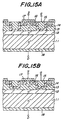
- the recesses for forming the gate electrodes 15 are formed such that the recesses fully penetrate the P + silicon layer 13 and partially penetrate into the surface of the silicon carbide layer 12.
- the recesses may be formed such that the surface of the silicon carbide layer 12 is just exposed as shown in Fig. 15A or the recesses do not reach the boundary between the silicon carbide layer 12 and the P + silicon layer 13 as illustrated in Fig. 15B.
- the recesses can be formed without fine control, because the silicon carbide layer 12 is hardly etched than the silicon layer 13.
- the recesses are formed to such a depth that the inversion channel formed by applying a voltage to the gate electrode 15 extends just up to the boundary between the silicon carbide layer 12 and the silicon layer 13.
- FIGs. 15A and 15b show the modifications of the embodiment formed as MOS FET shown in Fig. 1, but according to the invention, similar modifications may be conceived for the remaining embodiments.
- the semiconductor substrate having the hybrid structure is formed by the silicon substrate and the wide band-gap semiconductor material layer such as silicon carbide layer and diamond layer, so that a required breakdown voltage can be attained by reducing a thickness of the semiconductor substrate. Therefore, it is possible to reduce the on-resistance, and thus an amount of generated heat can be reduced and a loss due to heat can be decreased.
- the diamond layer having a high thermal conduction is used in the hybrid type semiconductor substrate, the diamond layer serves as a heat sink for dissipating heat generated by the channel, so that the heat dissipation property can be improved.
- the semiconductor substrate includes cheap silicon having a good workability, and thus the semiconductor device having a good property can be easily manufactured at a low cost.
Landscapes
- Insulated Gate Type Field-Effect Transistor (AREA)
- Electrodes Of Semiconductors (AREA)
Applications Claiming Priority (3)
| Application Number | Priority Date | Filing Date | Title |
|---|---|---|---|
| JP2041795 | 1995-02-08 | ||
| JP7020417A JPH08213607A (ja) | 1995-02-08 | 1995-02-08 | 半導体装置およびその製造方法 |
| JP20417/95 | 1995-02-08 |
Publications (3)
| Publication Number | Publication Date |
|---|---|
| EP0726604A2 true EP0726604A2 (fr) | 1996-08-14 |
| EP0726604A3 EP0726604A3 (fr) | 1997-09-24 |
| EP0726604B1 EP0726604B1 (fr) | 2002-07-17 |
Family
ID=12026468
Family Applications (1)
| Application Number | Title | Priority Date | Filing Date |
|---|---|---|---|
| EP96300813A Expired - Lifetime EP0726604B1 (fr) | 1995-02-08 | 1996-02-07 | Dispositif de type MIS et méthode de fabrication |
Country Status (4)
| Country | Link |
|---|---|
| US (2) | US6002143A (fr) |
| EP (1) | EP0726604B1 (fr) |
| JP (1) | JPH08213607A (fr) |
| DE (1) | DE69622295T2 (fr) |
Cited By (10)
| Publication number | Priority date | Publication date | Assignee | Title |
|---|---|---|---|---|
| WO1998042025A1 (fr) * | 1997-03-18 | 1998-09-24 | Simi Silicium Microelectronic Integration Gmbh | Agencement de contacts destine a un ensemble semiconducteur integre et de type planar et procede pour realiser cet agencement de contacts |
| EP0808513A4 (fr) * | 1995-02-10 | 1998-10-07 | Siliconix Inc | Transistor a effet de champ avec une tranchee, presentant une sensibilite diminuee au claquage et une resistance source-drain basse |
| EP0971394A4 (fr) * | 1997-08-13 | 2000-01-12 | Matsushita Electric Industrial Co Ltd | Substrat et dispositif semi-conducteurs |
| EP1708277A1 (fr) * | 2005-03-30 | 2006-10-04 | Nissan Motor Company, Limited | Dispositif semi-conducteur et son procédé de fabrication |
| EP1793423A3 (fr) * | 2005-11-30 | 2008-09-03 | Hitachi, Ltd. | Dispositif de semi-conducteur de puissance et dispositif de conversion de puissance l'utilisant |
| CN100481353C (zh) * | 2005-03-30 | 2009-04-22 | 日产自动车株式会社 | 半导体装置及其制造方法 |
| ITTO20100722A1 (it) * | 2010-08-30 | 2012-03-01 | St Microelectronics Srl | Dispositivo elettronico integrato e relativo metodo di fabbricazione |
| US8653590B2 (en) | 2010-08-30 | 2014-02-18 | Stmicroelectronics S.R.L. | Vertical-conduction integrated electronic device and method for manufacturing thereof |
| US9018635B2 (en) | 2010-08-30 | 2015-04-28 | Stmicroelectronics S.R.L. | Integrated electronic device with edge-termination structure and manufacturing method thereof |
| CN107086243A (zh) * | 2017-03-16 | 2017-08-22 | 西安电子科技大学 | 具有宽带隙材料与硅材料复合的u‑mosfet |
Families Citing this family (70)
| Publication number | Priority date | Publication date | Assignee | Title |
|---|---|---|---|---|
| DE19610135C1 (de) * | 1996-03-14 | 1997-06-19 | Siemens Ag | Elektronische Einrichtung, insbesondere zum Schalten elektrischer Ströme, für hohe Sperrspannungen und mit geringen Durchlaßverlusten |
| WO1998026458A1 (fr) * | 1996-12-11 | 1998-06-18 | The Kansai Electric Power Co., Inc. | Semi-conducteur a grille isolee |
| US6426260B1 (en) * | 1997-12-02 | 2002-07-30 | Magepower Semiconductor Corp. | Switching speed improvement in DMO by implanting lightly doped region under gate |
| JP3428459B2 (ja) * | 1998-09-01 | 2003-07-22 | 富士電機株式会社 | 炭化けい素nチャネルMOS半導体素子およびその製造方法 |
| US6855983B1 (en) * | 1998-11-10 | 2005-02-15 | Toyota Jidosha Kabushiki Kaisha | Semiconductor device having reduced on resistance |
| KR100451450B1 (ko) * | 1998-12-18 | 2004-10-06 | 인피니언 테크놀로지스 아게 | 바디 영역내에 트렌치 형상의 게이트-전극 및 추가 고도핑 층을 갖는 전계 효과 트랜지스터 |
| US6211018B1 (en) * | 1999-08-14 | 2001-04-03 | Electronics And Telecommunications Research Institute | Method for fabricating high density trench gate type power device |
| US6429041B1 (en) * | 2000-07-13 | 2002-08-06 | Cree, Inc. | Methods of fabricating silicon carbide inversion channel devices without the need to utilize P-type implantation |
| US6501099B2 (en) * | 2001-03-05 | 2002-12-31 | The United States Of America As Represented By The Secretary Of The Army | Modified-anode gate turn-off thyristor |
| US6770911B2 (en) * | 2001-09-12 | 2004-08-03 | Cree, Inc. | Large area silicon carbide devices |
| US6734462B1 (en) | 2001-12-07 | 2004-05-11 | The United States Of America As Represented By The Secretary Of The Army | Silicon carbide power devices having increased voltage blocking capabilities |
| US6900477B1 (en) | 2001-12-07 | 2005-05-31 | The United States Of America As Represented By The Secretary Of The Army | Processing technique to improve the turn-off gain of a silicon carbide gate turn-off thyristor and an article of manufacture |
| CA2381128A1 (fr) * | 2002-04-09 | 2003-10-09 | Quantiscript Inc. | Epargne pour faisceau electronique polarisee par plasma |
| US7217950B2 (en) * | 2002-10-11 | 2007-05-15 | Nissan Motor Co., Ltd. | Insulated gate tunnel-injection device having heterojunction and method for manufacturing the same |
| US7221010B2 (en) * | 2002-12-20 | 2007-05-22 | Cree, Inc. | Vertical JFET limited silicon carbide power metal-oxide semiconductor field effect transistors |
| US7074643B2 (en) * | 2003-04-24 | 2006-07-11 | Cree, Inc. | Silicon carbide power devices with self-aligned source and well regions and methods of fabricating same |
| US6979863B2 (en) * | 2003-04-24 | 2005-12-27 | Cree, Inc. | Silicon carbide MOSFETs with integrated antiparallel junction barrier Schottky free wheeling diodes and methods of fabricating the same |
| FR2868209B1 (fr) * | 2004-03-25 | 2006-06-16 | Commissariat Energie Atomique | Transistor a effet de champ a canal en carbone diamant |
| US20050269630A1 (en) * | 2004-06-04 | 2005-12-08 | Jianjun Cao | Trench type semiconductor device with reduced Qgd |
| US7118970B2 (en) | 2004-06-22 | 2006-10-10 | Cree, Inc. | Methods of fabricating silicon carbide devices with hybrid well regions |
| EP1641030B1 (fr) * | 2004-09-28 | 2012-01-11 | Nissan Motor Co., Ltd. | Procédé de fabrication d'un dispositif semi-conducteur |
| JP4862254B2 (ja) * | 2004-09-28 | 2012-01-25 | 日産自動車株式会社 | 半導体装置の製造方法 |
| JP2006128506A (ja) * | 2004-10-29 | 2006-05-18 | Sharp Corp | トレンチ型mosfet及びその製造方法 |
| JP2006245243A (ja) * | 2005-03-02 | 2006-09-14 | Fuji Electric Device Technology Co Ltd | 半導体装置およびその製造方法 |
| JP4802542B2 (ja) * | 2005-04-19 | 2011-10-26 | 株式会社デンソー | 炭化珪素半導体装置 |
| US7391057B2 (en) * | 2005-05-18 | 2008-06-24 | Cree, Inc. | High voltage silicon carbide devices having bi-directional blocking capabilities |
| US7615801B2 (en) * | 2005-05-18 | 2009-11-10 | Cree, Inc. | High voltage silicon carbide devices having bi-directional blocking capabilities |
| US20060261346A1 (en) * | 2005-05-18 | 2006-11-23 | Sei-Hyung Ryu | High voltage silicon carbide devices having bi-directional blocking capabilities and methods of fabricating the same |
| US7414268B2 (en) | 2005-05-18 | 2008-08-19 | Cree, Inc. | High voltage silicon carbide MOS-bipolar devices having bi-directional blocking capabilities |
| US7528040B2 (en) | 2005-05-24 | 2009-05-05 | Cree, Inc. | Methods of fabricating silicon carbide devices having smooth channels |
| JP2006351924A (ja) * | 2005-06-17 | 2006-12-28 | Denso Corp | 半導体装置 |
| JP4956776B2 (ja) * | 2005-09-08 | 2012-06-20 | 日産自動車株式会社 | 半導体装置の製造方法 |
| WO2007032214A1 (fr) * | 2005-09-14 | 2007-03-22 | The Kansai Electric Power Co., Inc. | Procédé de production d’un dispositif semi-conducteur au carbure de silicium |
| US7531396B2 (en) * | 2006-03-14 | 2009-05-12 | Nissan Motor Co., Ltd. | Method of manufacturing semiconductor device |
| JP4087416B2 (ja) * | 2006-04-06 | 2008-05-21 | シャープ株式会社 | パワーicデバイス及びその製造方法 |
| EP1852895A1 (fr) * | 2006-05-05 | 2007-11-07 | Kinik Company | Substrat à diamant et procédé de sa fabrication |
| JP5228291B2 (ja) * | 2006-07-06 | 2013-07-03 | 日産自動車株式会社 | 半導体装置の製造方法 |
| DE102006033505B4 (de) * | 2006-07-19 | 2010-09-16 | Infineon Technologies Austria Ag | Halbleitervorrichtung mit reduziertem "Tail"-Widerstand und Herstellungsverfahren für eine solche |
| US8432012B2 (en) | 2006-08-01 | 2013-04-30 | Cree, Inc. | Semiconductor devices including schottky diodes having overlapping doped regions and methods of fabricating same |
| US7728402B2 (en) * | 2006-08-01 | 2010-06-01 | Cree, Inc. | Semiconductor devices including schottky diodes with controlled breakdown |
| US8710510B2 (en) * | 2006-08-17 | 2014-04-29 | Cree, Inc. | High power insulated gate bipolar transistors |
| US8835987B2 (en) * | 2007-02-27 | 2014-09-16 | Cree, Inc. | Insulated gate bipolar transistors including current suppressing layers |
| JP2009004499A (ja) * | 2007-06-20 | 2009-01-08 | Kansai Electric Power Co Inc:The | pnダイオード、電気回路装置、および電力変換装置 |
| US8232558B2 (en) | 2008-05-21 | 2012-07-31 | Cree, Inc. | Junction barrier Schottky diodes with current surge capability |
| US8124983B2 (en) * | 2008-08-28 | 2012-02-28 | Infineon Technologies Ag | Power transistor |
| SG164324A1 (en) | 2009-02-20 | 2010-09-29 | Semiconductor Energy Lab | Semiconductor device and manufacturing method of the same |
| US8288220B2 (en) * | 2009-03-27 | 2012-10-16 | Cree, Inc. | Methods of forming semiconductor devices including epitaxial layers and related structures |
| US8294507B2 (en) | 2009-05-08 | 2012-10-23 | Cree, Inc. | Wide bandgap bipolar turn-off thyristor having non-negative temperature coefficient and related control circuits |
| US8629509B2 (en) * | 2009-06-02 | 2014-01-14 | Cree, Inc. | High voltage insulated gate bipolar transistors with minority carrier diverter |
| US8193848B2 (en) | 2009-06-02 | 2012-06-05 | Cree, Inc. | Power switching devices having controllable surge current capabilities |
| US8541787B2 (en) * | 2009-07-15 | 2013-09-24 | Cree, Inc. | High breakdown voltage wide band-gap MOS-gated bipolar junction transistors with avalanche capability |
| US8354690B2 (en) | 2009-08-31 | 2013-01-15 | Cree, Inc. | Solid-state pinch off thyristor circuits |
| US9117739B2 (en) | 2010-03-08 | 2015-08-25 | Cree, Inc. | Semiconductor devices with heterojunction barrier regions and methods of fabricating same |
| US8415671B2 (en) | 2010-04-16 | 2013-04-09 | Cree, Inc. | Wide band-gap MOSFETs having a heterojunction under gate trenches thereof and related methods of forming such devices |
| US9142662B2 (en) | 2011-05-06 | 2015-09-22 | Cree, Inc. | Field effect transistor devices with low source resistance |
| US9029945B2 (en) | 2011-05-06 | 2015-05-12 | Cree, Inc. | Field effect transistor devices with low source resistance |
| JP5749580B2 (ja) * | 2011-06-16 | 2015-07-15 | ルネサスエレクトロニクス株式会社 | 半導体装置及び半導体装置の製造方法 |
| US9640617B2 (en) | 2011-09-11 | 2017-05-02 | Cree, Inc. | High performance power module |
| US8664665B2 (en) | 2011-09-11 | 2014-03-04 | Cree, Inc. | Schottky diode employing recesses for elements of junction barrier array |
| WO2013036370A1 (fr) | 2011-09-11 | 2013-03-14 | Cree, Inc. | Module d'alimentation à haute densité de courant comprenant des transistors à topologie améliorée |
| US9373617B2 (en) | 2011-09-11 | 2016-06-21 | Cree, Inc. | High current, low switching loss SiC power module |
| US8680587B2 (en) | 2011-09-11 | 2014-03-25 | Cree, Inc. | Schottky diode |
| US8618582B2 (en) | 2011-09-11 | 2013-12-31 | Cree, Inc. | Edge termination structure employing recesses for edge termination elements |
| US20140055901A1 (en) * | 2012-08-25 | 2014-02-27 | North Carolina State University | Solid state fault isolation devices and methods |
| CN103681818B (zh) * | 2012-09-12 | 2016-08-17 | 上海华虹宏力半导体制造有限公司 | 消除闩锁效应的沟槽型绝缘栅双极型晶体管器件结构及方法 |
| JP6237408B2 (ja) * | 2014-03-28 | 2017-11-29 | 住友電気工業株式会社 | 炭化珪素半導体装置およびその製造方法 |
| CN107425062A (zh) * | 2017-08-17 | 2017-12-01 | 电子科技大学 | 一种提高抗浪涌能力的栅控晶闸管器件 |
| CN113436976B (zh) * | 2021-06-30 | 2022-06-14 | 泰科天润半导体科技(北京)有限公司 | 一种圆形栅功率器件的自对准p型制造方法 |
| CN114361287B (zh) * | 2022-01-04 | 2024-02-23 | 中国工程物理研究院流体物理研究所 | 一种用于高温环境的硅基光触发多门极半导体开关芯片 |
| CN114783873B (zh) * | 2022-06-22 | 2022-10-14 | 泰科天润半导体科技(北京)有限公司 | 具有两层外延的碳化硅凹槽mos栅控晶闸管的制造方法 |
Family Cites Families (15)
| Publication number | Priority date | Publication date | Assignee | Title |
|---|---|---|---|---|
| US4641164A (en) * | 1986-05-30 | 1987-02-03 | Rca Corporation | Bidirectional vertical power MOS device and fabrication method |
| US5164325A (en) * | 1987-10-08 | 1992-11-17 | Siliconix Incorporated | Method of making a vertical current flow field effect transistor |
| JPH01196873A (ja) * | 1988-02-02 | 1989-08-08 | Sharp Corp | 炭化珪素半導体装置 |
| JP2576173B2 (ja) * | 1988-02-02 | 1997-01-29 | 日本電装株式会社 | 絶縁ゲート型半導体装置 |
| US4994871A (en) * | 1988-12-02 | 1991-02-19 | General Electric Company | Insulated gate bipolar transistor with improved latch-up current level and safe operating area |
| JPH02180077A (ja) * | 1989-01-04 | 1990-07-12 | Meidensha Corp | 電界効果トランジスタ |
| US5151762A (en) * | 1990-04-12 | 1992-09-29 | Mitsubishi Denki Kabushiki Kaisha | Semiconductor device, fabricating method thereof and flash control device using the semiconductor device |
| US5371378A (en) * | 1992-06-08 | 1994-12-06 | Kobe Steel Usa, Inc. | Diamond metal base/permeable base transistor and method of making same |
| US5294814A (en) * | 1992-06-09 | 1994-03-15 | Kobe Steel Usa | Vertical diamond field effect transistor |
| GB9216599D0 (en) * | 1992-08-05 | 1992-09-16 | Philips Electronics Uk Ltd | A semiconductor device comprising a vertical insulated gate field effect device and a method of manufacturing such a device |
| US5506421A (en) * | 1992-11-24 | 1996-04-09 | Cree Research, Inc. | Power MOSFET in silicon carbide |
| US5378912A (en) * | 1993-11-10 | 1995-01-03 | Philips Electronics North America Corporation | Lateral semiconductor-on-insulator (SOI) semiconductor device having a lateral drift region |
| US5396085A (en) * | 1993-12-28 | 1995-03-07 | North Carolina State University | Silicon carbide switching device with rectifying-gate |
| DE4430732C2 (de) * | 1994-08-30 | 1998-07-02 | Daimler Benz Ag | Vertikaler Feldeffekt-Transistor hoher Leistung und Verfahren zu dessen Herstellung |
| US5877515A (en) * | 1995-10-10 | 1999-03-02 | International Rectifier Corporation | SiC semiconductor device |
-
1995
- 1995-02-08 JP JP7020417A patent/JPH08213607A/ja active Pending
-
1996
- 1996-02-07 EP EP96300813A patent/EP0726604B1/fr not_active Expired - Lifetime
- 1996-02-07 DE DE69622295T patent/DE69622295T2/de not_active Expired - Fee Related
- 1996-02-08 US US08/598,396 patent/US6002143A/en not_active Expired - Fee Related
-
1999
- 1999-05-20 US US09/315,050 patent/US6025233A/en not_active Expired - Fee Related
Cited By (16)
| Publication number | Priority date | Publication date | Assignee | Title |
|---|---|---|---|---|
| EP0808513A4 (fr) * | 1995-02-10 | 1998-10-07 | Siliconix Inc | Transistor a effet de champ avec une tranchee, presentant une sensibilite diminuee au claquage et une resistance source-drain basse |
| WO1998042025A1 (fr) * | 1997-03-18 | 1998-09-24 | Simi Silicium Microelectronic Integration Gmbh | Agencement de contacts destine a un ensemble semiconducteur integre et de type planar et procede pour realiser cet agencement de contacts |
| EP0971394A4 (fr) * | 1997-08-13 | 2000-01-12 | Matsushita Electric Industrial Co Ltd | Substrat et dispositif semi-conducteurs |
| EP1708277A1 (fr) * | 2005-03-30 | 2006-10-04 | Nissan Motor Company, Limited | Dispositif semi-conducteur et son procédé de fabrication |
| CN100481353C (zh) * | 2005-03-30 | 2009-04-22 | 日产自动车株式会社 | 半导体装置及其制造方法 |
| US7588961B2 (en) | 2005-03-30 | 2009-09-15 | Nissan Motor Co., Ltd. | Semiconductor device and manufacturing method thereof |
| US7859015B2 (en) | 2005-03-30 | 2010-12-28 | Nissan Motor Co., Ltd. | Semiconductor device |
| EP1793423A3 (fr) * | 2005-11-30 | 2008-09-03 | Hitachi, Ltd. | Dispositif de semi-conducteur de puissance et dispositif de conversion de puissance l'utilisant |
| ITTO20100722A1 (it) * | 2010-08-30 | 2012-03-01 | St Microelectronics Srl | Dispositivo elettronico integrato e relativo metodo di fabbricazione |
| US8653590B2 (en) | 2010-08-30 | 2014-02-18 | Stmicroelectronics S.R.L. | Vertical-conduction integrated electronic device and method for manufacturing thereof |
| US8921211B2 (en) | 2010-08-30 | 2014-12-30 | Stmicroelectronics S.R.L. | Vertical-conduction integrated electronic device and method for manufacturing thereof |
| US9018635B2 (en) | 2010-08-30 | 2015-04-28 | Stmicroelectronics S.R.L. | Integrated electronic device with edge-termination structure and manufacturing method thereof |
| US9142666B2 (en) | 2010-08-30 | 2015-09-22 | Stmicroelectronics S.R.L. | Integrated electronic device and method for manufacturing thereof |
| US9142646B2 (en) | 2010-08-30 | 2015-09-22 | Stmicroelectronics S.R.L. | Integrated electronic device with edge-termination structure and manufacturing method thereof |
| US9257550B2 (en) | 2010-08-30 | 2016-02-09 | Stmicroelectronics S.R.L. | Integrated electronic device and method for manufacturing thereof |
| CN107086243A (zh) * | 2017-03-16 | 2017-08-22 | 西安电子科技大学 | 具有宽带隙材料与硅材料复合的u‑mosfet |
Also Published As
| Publication number | Publication date |
|---|---|
| EP0726604A3 (fr) | 1997-09-24 |
| DE69622295T2 (de) | 2003-02-27 |
| US6025233A (en) | 2000-02-15 |
| DE69622295D1 (de) | 2002-08-22 |
| US6002143A (en) | 1999-12-14 |
| JPH08213607A (ja) | 1996-08-20 |
| EP0726604B1 (fr) | 2002-07-17 |
Similar Documents
| Publication | Publication Date | Title |
|---|---|---|
| US6025233A (en) | Method of manufacturing a semiconductor device | |
| JP3385938B2 (ja) | 炭化珪素半導体装置及びその製造方法 | |
| KR100869324B1 (ko) | 베이스 리치-쓰루를 방지하는 측면 확장 베이스 차폐영역을 구비한 전력 반도체 소자 및 그 제조방법 | |
| CN100555663C (zh) | 碳化硅器件及其制造方法 | |
| US6194741B1 (en) | MOSgated trench type power semiconductor with silicon carbide substrate and increased gate breakdown voltage and reduced on-resistance | |
| US6117735A (en) | Silicon carbide vertical FET and method for manufacturing the same | |
| KR100199997B1 (ko) | 탄화규소 반도체장치 | |
| US5831288A (en) | Silicon carbide metal-insulator semiconductor field effect transistor | |
| KR100474214B1 (ko) | 실리콘 카바이드 수평 채널이 버퍼된 게이트 반도체 소자 | |
| JP3620513B2 (ja) | 炭化珪素半導体装置 | |
| US6316791B1 (en) | Semiconductor structure having a predetermined alpha-silicon carbide region, and use of this semiconductor structure | |
| CN102364688B (zh) | 一种垂直双扩散金属氧化物半导体场效应晶体管 | |
| CN113838908A (zh) | 包括沟槽栅极结构和掩埋遮蔽区的半导体器件和制造方法 | |
| US5661312A (en) | Silicon carbide MOSFET | |
| US5917204A (en) | Insulated gate bipolar transistor with reduced electric fields | |
| CN118486734A (zh) | 碳化硅沟槽栅金属氧化物半导体场效应晶体管及制备方法 | |
| US20250241017A1 (en) | Vertical trench coupling capacitance gated-controlled junction field effect transistor and manufacturing method thereof | |
| KR20000029577A (ko) | 선형전류-전압특성을가지는반도체부품 | |
| EP0687015A2 (fr) | Dispositif semi-conducteur et procédé de manufacture | |
| US7521731B2 (en) | Semiconductor device and method of manufacturing the same | |
| US5773849A (en) | Field of the invention | |
| US5757035A (en) | Semiconductor device | |
| CN117317026A (zh) | 一种半导体器件及其制造方法 | |
| EP1863096B1 (fr) | Dispositif semi-conducteur et sa méthode de fabrication | |
| JPH10341025A (ja) | 縦形接合形電界効果トランジスタ |
Legal Events
| Date | Code | Title | Description |
|---|---|---|---|
| PUAI | Public reference made under article 153(3) epc to a published international application that has entered the european phase |
Free format text: ORIGINAL CODE: 0009012 |
|
| AK | Designated contracting states |
Kind code of ref document: A2 Designated state(s): CH DE GB LI SE |
|
| PUAL | Search report despatched |
Free format text: ORIGINAL CODE: 0009013 |
|
| AK | Designated contracting states |
Kind code of ref document: A3 Designated state(s): CH DE GB LI SE |
|
| 17P | Request for examination filed |
Effective date: 19980324 |
|
| 17Q | First examination report despatched |
Effective date: 19991008 |
|
| GRAG | Despatch of communication of intention to grant |
Free format text: ORIGINAL CODE: EPIDOS AGRA |
|
| GRAG | Despatch of communication of intention to grant |
Free format text: ORIGINAL CODE: EPIDOS AGRA |
|
| GRAG | Despatch of communication of intention to grant |
Free format text: ORIGINAL CODE: EPIDOS AGRA |
|
| GRAH | Despatch of communication of intention to grant a patent |
Free format text: ORIGINAL CODE: EPIDOS IGRA |
|
| GRAH | Despatch of communication of intention to grant a patent |
Free format text: ORIGINAL CODE: EPIDOS IGRA |
|
| GRAA | (expected) grant |
Free format text: ORIGINAL CODE: 0009210 |
|
| AK | Designated contracting states |
Kind code of ref document: B1 Designated state(s): CH DE GB LI SE |
|
| REG | Reference to a national code |
Ref country code: GB Ref legal event code: FG4D |
|
| REG | Reference to a national code |
Ref country code: CH Ref legal event code: EP |
|
| REF | Corresponds to: |
Ref document number: 69622295 Country of ref document: DE Date of ref document: 20020822 |
|
| PLBE | No opposition filed within time limit |
Free format text: ORIGINAL CODE: 0009261 |
|
| STAA | Information on the status of an ep patent application or granted ep patent |
Free format text: STATUS: NO OPPOSITION FILED WITHIN TIME LIMIT |
|
| 26N | No opposition filed |
Effective date: 20030422 |
|
| PGFP | Annual fee paid to national office [announced via postgrant information from national office to epo] |
Ref country code: SE Payment date: 20051220 Year of fee payment: 11 Ref country code: GB Payment date: 20051220 Year of fee payment: 11 Ref country code: CH Payment date: 20051220 Year of fee payment: 11 |
|
| PGFP | Annual fee paid to national office [announced via postgrant information from national office to epo] |
Ref country code: DE Payment date: 20051224 Year of fee payment: 11 |
|
| PG25 | Lapsed in a contracting state [announced via postgrant information from national office to epo] |
Ref country code: SE Free format text: LAPSE BECAUSE OF NON-PAYMENT OF DUE FEES Effective date: 20070208 |
|
| PG25 | Lapsed in a contracting state [announced via postgrant information from national office to epo] |
Ref country code: LI Free format text: LAPSE BECAUSE OF NON-PAYMENT OF DUE FEES Effective date: 20070228 Ref country code: CH Free format text: LAPSE BECAUSE OF NON-PAYMENT OF DUE FEES Effective date: 20070228 |
|
| REG | Reference to a national code |
Ref country code: CH Ref legal event code: PL |
|
| EUG | Se: european patent has lapsed | ||
| GBPC | Gb: european patent ceased through non-payment of renewal fee |
Effective date: 20070207 |
|
| PG25 | Lapsed in a contracting state [announced via postgrant information from national office to epo] |
Ref country code: DE Free format text: LAPSE BECAUSE OF NON-PAYMENT OF DUE FEES Effective date: 20070901 |
|
| PG25 | Lapsed in a contracting state [announced via postgrant information from national office to epo] |
Ref country code: GB Free format text: LAPSE BECAUSE OF NON-PAYMENT OF DUE FEES Effective date: 20070207 |