EP0735248A2 - Mehrventilbrennkraftmaschine - Google Patents
Mehrventilbrennkraftmaschine Download PDFInfo
- Publication number
- EP0735248A2 EP0735248A2 EP96105096A EP96105096A EP0735248A2 EP 0735248 A2 EP0735248 A2 EP 0735248A2 EP 96105096 A EP96105096 A EP 96105096A EP 96105096 A EP96105096 A EP 96105096A EP 0735248 A2 EP0735248 A2 EP 0735248A2
- Authority
- EP
- European Patent Office
- Prior art keywords
- valve
- valves
- cylinder head
- valve seats
- distance
- Prior art date
- Legal status (The legal status is an assumption and is not a legal conclusion. Google has not performed a legal analysis and makes no representation as to the accuracy of the status listed.)
- Granted
Links
Images




Classifications
-
- F—MECHANICAL ENGINEERING; LIGHTING; HEATING; WEAPONS; BLASTING
- F01—MACHINES OR ENGINES IN GENERAL; ENGINE PLANTS IN GENERAL; STEAM ENGINES
- F01L—CYCLICALLY OPERATING VALVES FOR MACHINES OR ENGINES
- F01L1/00—Valve-gear or valve arrangements, e.g. lift-valve gear
- F01L1/26—Valve-gear or valve arrangements, e.g. lift-valve gear characterised by the provision of two or more valves operated simultaneously by same transmitting-gear; peculiar to machines or engines with more than two lift-valves per cylinder
- F01L1/265—Valve-gear or valve arrangements, e.g. lift-valve gear characterised by the provision of two or more valves operated simultaneously by same transmitting-gear; peculiar to machines or engines with more than two lift-valves per cylinder peculiar to machines or engines with three or more intake valves per cylinder
-
- F—MECHANICAL ENGINEERING; LIGHTING; HEATING; WEAPONS; BLASTING
- F01—MACHINES OR ENGINES IN GENERAL; ENGINE PLANTS IN GENERAL; STEAM ENGINES
- F01L—CYCLICALLY OPERATING VALVES FOR MACHINES OR ENGINES
- F01L3/00—Lift-valve, i.e. cut-off apparatus with closure members having at least a component of their opening and closing motion perpendicular to the closing faces; Parts or accessories thereof
- F01L3/22—Valve-seats not provided for in preceding subgroups of this group; Fixing of valve-seats
-
- F—MECHANICAL ENGINEERING; LIGHTING; HEATING; WEAPONS; BLASTING
- F02—COMBUSTION ENGINES; HOT-GAS OR COMBUSTION-PRODUCT ENGINE PLANTS
- F02F—CYLINDERS, PISTONS OR CASINGS, FOR COMBUSTION ENGINES; ARRANGEMENTS OF SEALINGS IN COMBUSTION ENGINES
- F02F1/00—Cylinders; Cylinder heads
- F02F1/24—Cylinder heads
- F02F1/42—Shape or arrangement of intake or exhaust channels in cylinder heads
- F02F1/4214—Shape or arrangement of intake or exhaust channels in cylinder heads specially adapted for four or more valves per cylinder
-
- F—MECHANICAL ENGINEERING; LIGHTING; HEATING; WEAPONS; BLASTING
- F02—COMBUSTION ENGINES; HOT-GAS OR COMBUSTION-PRODUCT ENGINE PLANTS
- F02B—INTERNAL-COMBUSTION PISTON ENGINES; COMBUSTION ENGINES IN GENERAL
- F02B2275/00—Other engines, components or details, not provided for in other groups of this subclass
- F02B2275/18—DOHC [Double overhead camshaft]
-
- F—MECHANICAL ENGINEERING; LIGHTING; HEATING; WEAPONS; BLASTING
- F02—COMBUSTION ENGINES; HOT-GAS OR COMBUSTION-PRODUCT ENGINE PLANTS
- F02F—CYLINDERS, PISTONS OR CASINGS, FOR COMBUSTION ENGINES; ARRANGEMENTS OF SEALINGS IN COMBUSTION ENGINES
- F02F1/00—Cylinders; Cylinder heads
- F02F1/24—Cylinder heads
- F02F2001/244—Arrangement of valve stems in cylinder heads
- F02F2001/245—Arrangement of valve stems in cylinder heads the valve stems being orientated at an angle with the cylinder axis
Definitions
- This invention relates to a multiple valve internal combustion engine comprising a cylinder head unit having valve seats in associated valve openings operable by respective valves slidingly received in associated valve guides, said valve seats consisting of a metal different to the metal of a cylinder head, and a method for producing a valve seat within a cylinder head unit of a multiple valve internal combustion engine.
- valve seats are usually installed by press-fitting around the circumference of the air intake and exhaust port openings in the cylinder head.
- valve seats With pressed-in valve seats, however, the valve seats themselves must have enough strength and durability to withstand the pressing operation, and as a result, they are comparatively thick, and they are relatively deep to accommodate the press-fitting operation. In multivalve engines with a high number of valves, using these seats requires that there be some distance separating the valves, and this feature imposes limits on the valve diameter and how closely they may be positioned to the dome of the combustion chamber. These limitations in turn limit the degree to which the amount of air intake gas can be increased.
- this objective is solved in that said valve seats are metallurgically bonded to said cylinder head and that a first distance between adjacent valve seats is greater than or equal to a second distance between adjacent valves when said valves are in fully closed position and/or in that said valve seats are metallurgically bonded to said cylinder head and that a third distance between a bottom end of a contact surface of said valve seats with said valves and an edge of a casting skin of a combustion chamber is smaller than or equal to a fourth distance between the bottom surface of said valves and said bottom end of said contact surface, when said valves are in fully closed position, whereby said edge is produced by applying a finishing treatment to said valve seats.
- these valves are intake valves whereby it is advantageous for a more effective heat transfer that a water jacket positioned between said valves seat or valves, respectively, comprises a lower wall being arranged adjacent said valve seats.
- valve seats being much smaller than conventional valve seats, it is possible to increase the air intake gas flows for a multiple valve internal combustion engine having three air intake valves and two exhaust valves.
- a plastic deformation layer By forming of said plastic deformation layer, bonding strength between the valve seats and the cylinder head unit is surprisingly and unexpectedly increased, despite the fact that no permanent melting reaction layers are formed.
- the bonding results neither from the recess configuration nor the valve seats configuration, the area around the valve seats and the cylinder head unit can be reduced, thereby realizing a compact cylinder head unit.
- valve seats are typically made of an Fe-based sinted alloy, and the cylinder head unit is typically made of an aluminium alloy. Further, the valve seats preferably have metal deposits (such that made of Cu) capable of forming an eutectic alloy with a cylinder head unit so that the metal deposits and the material of said cylinder head unit undergo a so-called solid-state diffusion.
- the solid-state diffusion may take place between the material of the valve seats and the material of the cylinder head unit without said metal deposits.
- the metal deposits are present it is possible to obtain a high level bonding strength.
- this objective is solved for a method for producing a valve seat as indicated above by comprising the steps of: (a) placing a valve seat insert onto the surface of an opening within said cylinder head unit, (b) pressing said valve seat insert against said cylinder head unit and then impressing a voltage between the abutting surfaces of said valve seat insert and said cylinder head unit, so that said valve seat insert and said cylinder head unit are metallurgically bonded with each other, and (c) applying a finishing treatment to said bonded pieces so that said valve seats are metallurgically boned to said cylinder head and that a first distance between adjacent valve seats is greater than or equal to a second distance between adjacent insertable valves, and/or that a third distance between a bottom end of a contact surface of said valve seats with said insertable valves and an edge of a casting skin of a combustion chamber is smaller than or equal to a fourth distance between the bottom surface of said insertable valves and said bottom end of said contact surface when said insertable valves are in fully closed position,
- valve seat insert with metal deposits which are capable of forming an eutectic alloy with said cylinder head unit, whereby it is possible to provide said valve seat insert with a film coating of said metal deposits.
- coating it is advantageous to provide said coating with a thickness of 0.1-30 ⁇ m, for instance by electroplating, non-electrical plating or by injection molding.
- the diameter of the valves by using bonded valve seats which are laid out so that the distance between the valve seats is greater than or equal to the distance between the valves when they are fully closed, thereby making it possible to increase the gas exchange volume of said internal combustion engine, in turn allowing increased engine output due to the increased availability of air intake gas.
- valves it is possible to position the valves in closer proximity to the dome of the combustion chamber because of the use of bonded valve seats which are installed in a manner such that the distance between the bottom end of the contact surface of the valve seat to the edge of the combustion chamber casting skin is less than or equal to the distance from the bottom surface of the valve to the bottom end of the valve seat contact surface.
- This design especially reduces the air intake flow resistance to the intake flow passing the air intake valve. This feature allows an increase in the amount of air intake gas, in turn allowing improved engine output.
- the diameter of the air intake valves has been increased, or the valves have been located in closer proximity to the dome of the combustion chamber, whereby the amount of air intake is increased and engine output is improved.
- the heat conduction distance between the water jacket and the valve seat and valve has been shortened, and further, because the valve seat itself is very thin, this design allows better cooling of the valve and valve seat, thereby lowering their temperatures and increasing the strength of the valve and valve seat.
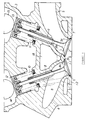
- Figure 1 is a vertical sectional view of the cylinder head of an internal combustion engine according to this invention
- Figure 2 is an enlarged sectional view of the area around the air intake port of the same cylinder head.
- the internal combustion engine in this embodiment is a four cycle, 5-valve engine comprising, for each cylinder, three air intake valves 1-1, 1-2 (1-1 represents the air intake valves on both sides and 1-2 is the center air intake valve (center valve)) and two exhaust valves 2 (see Figure 1).
- the air intake valves 1-1, 1-2 and exhaust valves 2 that are installed into the respective three air intake ports 4 and the two exhaust ports 5 that are formed in the lightweight Al alloy cylinder head 3 are opened and closed at the appropriate timing to perform the required gas exchange.
- concave combustion domes 3a which comprise the combustion chambers S.
- the above mentioned air intake valves 1-1, 1-2 and exhaust valves 2 are intermittently seated against the valve seats 6, 7 installed around the circumference of the openings of the foregoing air intake ports 4 and exhaust ports 5 in the combustion chamber.
- the air intake valves 1-1, 1-2 and the exhaust valves 2 are slidably inserted into respective valve guides 8, 9, and they are held in the normally closed position by the valve springs 10, 11.
- the air intake valves 1-1, 1-2 and the exhaust valves 2 are driven at the appropriate timing by rotating cams 14, 15 that are in sliding contact with the valve lifters 12, 13.
- valve seats 6, 7 are bonded valve seats that are formed from Fe type sintering material with excellent impact strength, wear resistance and high temperature strength, and their surface comprises a film coating 16 (see Figure 9) that is 0.1 to 30 ⁇ m thick. These seats are bonded to the cylinder head 3 by resistance heating. Also, the pores in the Fe sintered stock that comprises said bonded valve seats 6, 7 are filled by immersing them in a molten metal such as Cu, which offers high heat conductivity and self-lubricating properties.
- the material used for the foregoing film coating should be selected from materials that will form co-crystallization alloys with Al, the primary component of the Al alloy constituting the cylinder head, and which evince a melting point lower than that of Al or the principal alloy components.
- Cu was used for that purpose.
- the Cu film coating 16 was formed in the present embodiment by electroplating, but it is also possible to use a non-electrical plating method, or to injection-mold the film coating 16.
- the melting points of Al and Cu by themselves are 660°C and 1083°C, respectively, the melting point of Al-Cu alloy at the co-crystal point is 548°C, which is lower than the melting points of either Al or Cu (660°C, 1083°C). Accordingly, it is possible to form an Al-Cu co-crystal alloy with a melting point lower than Al or Cu.
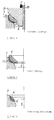
- Figures 3 through 8 are cutaway sectional views that will be used to explain the bonding process for the bonded valve seats;
- Figure 9 is a detailed enlargement of the A area in Figure 4, and
- Figure 10 is a detailed enlargement of the B area in Figure 5.
- the projection 6a on the outside circumference of the valve seat 6 is brought into contact with the projection 6 on the circumference of the air intake port 4 of the cylinder head 3.
- the upper electrode 21 shown in Figure 4 is guided by a guide bar 20 inserted into the valve guide hole that was previously formed in the cylinder head 3.
- the upper electrode 21 of the resistance welding machine which can slide up and down along the guide bar 20, is inserted into the inside tapered surface 6b of the bonded valve seat 6, in a manner such that the upper electrode 21 applies a certain force F to the bonded valve seat 6 and holds it against the cylinder head 3.
- the Al alloy of the cylinder head stock and the Cu constituting the film coating 16 are in solid phase contact, pressing against each other.
- the contact between the valve seat 6 and the cylinder head 3 is as shown in Figure 9.
- valve seat 6 causes the valve seat 6 to be strongly bonded to the cylinder head 3, at which time the current is cut off. Then, as shown in Figure 6, a plastic deformation layer 17 is formed at the contact interface between the valve seat 6 and the cylinder head 3, and the liquid phase extruded at the ends of the contact interface solidifies.
- valve seat 6 is machined and finished to the desired shape, which operation completes the bonding of the valve seat to the cylinder head, and which results in the valve seat 6 being strongly integrated into the cylinder head 3 around the opening of the air intake port 4.
- the bonded valve seats 6, 7 bonded in the above described manner are very thin (normally about 500 ⁇ m), and because their widths and heights are also very slight, as is shown in Figure 2 for example, the distance a 1 between the valve seats 6 on the air intake side can be selected to be greater than or equal to the distance b 1 between the air intake valves 1-1, 1-2 when they are in their fully closed position (a 1 ⁇ b 1 ).
- the distance a 1 between the valve seats 6 on the air intake side can be selected to be greater than or equal to the distance b 1 between the air intake valves 1-1, 1-2 when they are in their fully closed position (a 1 ⁇ b 1 ).
- This feature makes it possible to improve engine output by increasing the amount of air intake gas supplied to through the air intake valves 1-1, 1-2 into the inside of the cylinder (not shown).
- the a surface is the casting skin of the combustion chamber S.
- the distance c from the bottom end P of the contact surface of the valve seat 6 to the edge Q of the casting skin of the combustion chamber is selected to be less than the distance d from the bottom surface of the air intake valves 1-1, 1-2 to the bottom end of the contact surface P of the valve seat 6 (c ⁇ d).
- This edge Q is always formed by finishing the last surface of the bonded valve seat as well as of conventional valve seats. The finishing space should be small, because a reduction of the aluminium body between adjacent valve seats should be avoided for strength reasons.
- a water jacket 18 is formed in the cylinder head 3 for the purpose of circulating coolant, but since the bonded valve seats 6, 7 are employed in this embodiment, it is possible to form the lower wall 18a of the water jacket 18 in the throat area 4a, 5a of the air intake ports 4 and exhaust ports 5. This feature results in shortened heat conduction distance between the water jacket 18, and the valves seats 6, 7 as well as the air intake and exhaust valves 1-1, 1-2, 2.
- valve seats 6, 7 are themselves very thin, there is a further enhancement of the cooling available for the air intake and exhaust valves 1-1, 1-2, 2 and the valve seats 6, 7, lowering their temperature and resulting in higher actual strength for said air intake and exhaust valves 1-1, 1-2, 2 and valve seats 6, 7.
- bonded valve seats are used in this invention and the distance between valve seats is selected to be greater than or equal to the distance between the fully closed valves, thereby making it possible to increase the valve diameter, thus improving gas exchange volume in the internal combustion engine.
- This feature makes it possible to increase the amount of intake gas and improve engine output.
- bonded valve seats are used and the distance from the bottom of the contact surface of the valve seats to the edge of the casting skin of the combustion chamber is selected to be less than or equal to the distance from the bottom surface of the valve to the bottom end of the contact surface of the valve seat, allowing the valves to be placed in closer proximity to the center of the dome of the combustion chamber and farther away from the cylinder walls. This feature increases the intake gas flow due to a lowered resistance in the flow of intake air passing the air intake valves, in turn allowing improved engine output.
- the air intake valve are made larger in diameter or they have been moved closer to the center of the combustion dome to increase air intake flows and to improve engine output.
- the heat conduction distance between the water jacket and the valve seats and valves has been shortened, resulting in increased cooling and lower temperatures for the valves and valve seats, thus increasing the strength of said valves and valve seats.
Landscapes
- Engineering & Computer Science (AREA)
- Mechanical Engineering (AREA)
- General Engineering & Computer Science (AREA)
- Chemical & Material Sciences (AREA)
- Combustion & Propulsion (AREA)
- Cylinder Crankcases Of Internal Combustion Engines (AREA)
- Valve-Gear Or Valve Arrangements (AREA)
- Lift Valve (AREA)
- Pressure Welding/Diffusion-Bonding (AREA)
Applications Claiming Priority (3)
| Application Number | Priority Date | Filing Date | Title |
|---|---|---|---|
| JP76624/95 | 1995-03-31 | ||
| JP7076624A JPH08270500A (ja) | 1995-03-31 | 1995-03-31 | 内燃エンジン |
| JP7662495 | 1995-03-31 |
Publications (3)
| Publication Number | Publication Date |
|---|---|
| EP0735248A2 true EP0735248A2 (de) | 1996-10-02 |
| EP0735248A3 EP0735248A3 (de) | 1998-01-21 |
| EP0735248B1 EP0735248B1 (de) | 2002-11-27 |
Family
ID=13610521
Family Applications (1)
| Application Number | Title | Priority Date | Filing Date |
|---|---|---|---|
| EP96105096A Expired - Lifetime EP0735248B1 (de) | 1995-03-31 | 1996-03-29 | Mehrventilbrennkraftmaschine |
Country Status (4)
| Country | Link |
|---|---|
| US (1) | US5687685A (de) |
| EP (1) | EP0735248B1 (de) |
| JP (1) | JPH08270500A (de) |
| DE (1) | DE69624963T2 (de) |
Cited By (2)
| Publication number | Priority date | Publication date | Assignee | Title |
|---|---|---|---|---|
| WO1998028523A1 (en) * | 1996-12-21 | 1998-07-02 | Unova U.K. Limited | Method of fitting a valve seating ring and an apparatus therefor |
| US6347377B2 (en) | 1998-11-04 | 2002-02-12 | Phoenix Technologies Ltd. | Method and apparatus for providing intelligent power management |
Families Citing this family (9)
| Publication number | Priority date | Publication date | Assignee | Title |
|---|---|---|---|---|
| JPH08296417A (ja) * | 1995-04-26 | 1996-11-12 | Yamaha Motor Co Ltd | エンジン用シリンダヘッド |
| US6223713B1 (en) * | 1996-07-01 | 2001-05-01 | Tecumseh Products Company | Overhead cam engine with cast-in valve seats |
| DE60010813T2 (de) * | 1999-08-06 | 2004-10-07 | Honda Motor Co Ltd | Diffusionsverbindungsverfahren |
| DE10255447A1 (de) * | 2002-11-28 | 2004-06-24 | Daimlerchrysler Ag | Ventilsitz und Verfahren zur Herstellung eines Ventilsitzes |
| US20070137604A1 (en) * | 2005-12-21 | 2007-06-21 | Silseth John R | Motorcycle engine |
| DE102007031464A1 (de) * | 2006-07-17 | 2008-01-24 | Alstom Technology Ltd. | Dampfeinlassventil einer Dampfturbine |
| KR101788519B1 (ko) * | 2014-08-18 | 2017-10-19 | 오리진 일렉트릭 캄파니 리미티드 | 금속 접합체 및 금속 접합체의 제조 방법 |
| US20170058823A1 (en) * | 2015-08-24 | 2017-03-02 | GM Global Technology Operations LLC | Cylinder head with blended inlet valve seat for high tumble inlet port |
| WO2022230329A1 (ja) * | 2021-04-30 | 2022-11-03 | 三菱重工業株式会社 | 蒸気弁 |
Family Cites Families (10)
| Publication number | Priority date | Publication date | Assignee | Title |
|---|---|---|---|---|
| IT1155320B (it) * | 1982-04-22 | 1987-01-28 | Fiat Auto Spa | Metodo per l'ottenimento di una sede valvola su una testata di un motore endotermico e motore con sedi valvola ottenute con tale metodo |
| JPS62150014A (ja) * | 1985-12-25 | 1987-07-04 | Toyota Motor Corp | アルミニウム合金製バルブシ−トレスシリンダヘツド |
| JPS62168669A (ja) * | 1986-01-21 | 1987-07-24 | Toyota Central Res & Dev Lab Inc | 複合アルミニウム部材の製造方法 |
| JPH01186261A (ja) * | 1988-01-18 | 1989-07-25 | Toyota Motor Corp | バルブシートの接合方法 |
| JPH03210961A (ja) * | 1990-01-12 | 1991-09-13 | Toyota Motor Corp | シリンダヘッドの製造方法 |
| JP3270937B2 (ja) * | 1992-04-08 | 2002-04-02 | ヤマハ発動機株式会社 | エンジンのシリンダヘッド構造 |
| JPH05332106A (ja) * | 1992-05-29 | 1993-12-14 | Nissan Motor Co Ltd | 内燃機関のバルブシート |
| JPH05340299A (ja) * | 1992-06-08 | 1993-12-21 | Mazda Motor Corp | エンジンのアルミニウム合金製シリンダヘッド及びその製造方法 |
| DE69411413T2 (de) * | 1993-02-19 | 1998-11-05 | Yamaha Motor Co Ltd | Brennkraftmaschine |
| US5492091A (en) * | 1994-12-23 | 1996-02-20 | Ford Motor Company | Thermally conductive valve seat insert assembly |
-
1995
- 1995-03-31 JP JP7076624A patent/JPH08270500A/ja active Pending
-
1996
- 1996-03-29 DE DE69624963T patent/DE69624963T2/de not_active Expired - Lifetime
- 1996-03-29 EP EP96105096A patent/EP0735248B1/de not_active Expired - Lifetime
- 1996-04-01 US US08/625,941 patent/US5687685A/en not_active Expired - Lifetime
Cited By (4)
| Publication number | Priority date | Publication date | Assignee | Title |
|---|---|---|---|---|
| WO1998028523A1 (en) * | 1996-12-21 | 1998-07-02 | Unova U.K. Limited | Method of fitting a valve seating ring and an apparatus therefor |
| US6259054B1 (en) | 1996-12-21 | 2001-07-10 | Unova U.K. Limited | Method of fitting a valve seating ring and an apparatus therefor |
| US6347377B2 (en) | 1998-11-04 | 2002-02-12 | Phoenix Technologies Ltd. | Method and apparatus for providing intelligent power management |
| US6523123B2 (en) | 1998-11-04 | 2003-02-18 | Phoenix Technologies Ltd. | Method and apparatus for providing intelligent power management |
Also Published As
| Publication number | Publication date |
|---|---|
| DE69624963T2 (de) | 2003-04-10 |
| US5687685A (en) | 1997-11-18 |
| EP0735248B1 (de) | 2002-11-27 |
| EP0735248A3 (de) | 1998-01-21 |
| JPH08270500A (ja) | 1996-10-15 |
| DE69624963D1 (de) | 2003-01-09 |
Similar Documents
| Publication | Publication Date | Title |
|---|---|---|
| US5802716A (en) | Method for bonding a valve seat with a cylinder head | |
| EP0735248B1 (de) | Mehrventilbrennkraftmaschine | |
| EP0723069B1 (de) | Ventil-Sitz für einen Zylinderkopf und Verfahren zu ihrer Herstellung | |
| US5787853A (en) | Valve seat-bonding area structures and valve seat-bonded cylinder head with the structures | |
| EP0733792A2 (de) | Zylinderblock und Verfahren zur Herstellung von Laufflächen für eine Brennkraftmaschine | |
| US6138351A (en) | Method of making a valve seat | |
| US5768779A (en) | Method of manufacturing cylinder head for engine | |
| EP0743428B1 (de) | Ventilsitzeinsatz | |
| EP0794030A1 (de) | Verfahren zum Verbinden von Metalle und Ventilsitz eingesetzt in einem Zylinderkopf | |
| EP0751284B1 (de) | Zylinderkopf und Verfahren zur Herstellung eines Ventilsitzes | |
| GB2138093A (en) | Rocker arm for internal combustion engine | |
| US5960760A (en) | Light weight hollow valve assembly | |
| EP0736670A2 (de) | Mehrventil-Brennkraftmaschine | |
| EP0719917B1 (de) | Zylindereinheit und Verfahren zur Formung ihrer Gleitfläche | |
| US5778531A (en) | Method of manufacturing cylinder head for engine | |
| EP0730085B1 (de) | Zylinderkopf und Verfahren zur Herstellung eines Ventilsitzes | |
| JPS5930465A (ja) | アルミニウム合金による鉄系材料の鋳包み方法 | |
| US5899185A (en) | Method of increasing heat transfer of a fitted material of a cylinder head in an internal combustion engine and a fitted portion of the fitted material | |
| EP0773351B1 (de) | Verfahren zur Herstellung eines Zylinderkopfes mit zwei unterschiedlichen Ventilsitzen | |
| JPH08232618A (ja) | エンジンバルブシートの鋳ぐるみ方法 | |
| JPH10122033A (ja) | エンジンのボア間構造 | |
| US20080236536A1 (en) | Cast engine component having metallurgically bonded inserts | |
| JPH0642320A (ja) | 内燃機関用バルブシート | |
| JPH09317552A (ja) | 内燃エンジン | |
| JP2794053B2 (ja) | 内燃機関用油圧タペット及びその製造方法 |
Legal Events
| Date | Code | Title | Description |
|---|---|---|---|
| PUAI | Public reference made under article 153(3) epc to a published international application that has entered the european phase |
Free format text: ORIGINAL CODE: 0009012 |
|
| AK | Designated contracting states |
Kind code of ref document: A2 Designated state(s): DE FR GB IT |
|
| PUAL | Search report despatched |
Free format text: ORIGINAL CODE: 0009013 |
|
| AK | Designated contracting states |
Kind code of ref document: A3 Designated state(s): DE FR GB IT |
|
| 17P | Request for examination filed |
Effective date: 19980716 |
|
| 17Q | First examination report despatched |
Effective date: 20001113 |
|
| GRAG | Despatch of communication of intention to grant |
Free format text: ORIGINAL CODE: EPIDOS AGRA |
|
| GRAG | Despatch of communication of intention to grant |
Free format text: ORIGINAL CODE: EPIDOS AGRA |
|
| GRAH | Despatch of communication of intention to grant a patent |
Free format text: ORIGINAL CODE: EPIDOS IGRA |
|
| GRAH | Despatch of communication of intention to grant a patent |
Free format text: ORIGINAL CODE: EPIDOS IGRA |
|
| GRAA | (expected) grant |
Free format text: ORIGINAL CODE: 0009210 |
|
| AK | Designated contracting states |
Kind code of ref document: B1 Designated state(s): DE FR GB IT |
|
| REG | Reference to a national code |
Ref country code: GB Ref legal event code: FG4D |
|
| REF | Corresponds to: |
Ref document number: 69624963 Country of ref document: DE Date of ref document: 20030109 |
|
| ET | Fr: translation filed | ||
| PLBE | No opposition filed within time limit |
Free format text: ORIGINAL CODE: 0009261 |
|
| STAA | Information on the status of an ep patent application or granted ep patent |
Free format text: STATUS: NO OPPOSITION FILED WITHIN TIME LIMIT |
|
| 26N | No opposition filed |
Effective date: 20030828 |
|
| PGFP | Annual fee paid to national office [announced via postgrant information from national office to epo] |
Ref country code: IT Payment date: 20100323 Year of fee payment: 15 Ref country code: FR Payment date: 20100324 Year of fee payment: 15 |
|
| PGFP | Annual fee paid to national office [announced via postgrant information from national office to epo] |
Ref country code: GB Payment date: 20100322 Year of fee payment: 15 |
|
| PGFP | Annual fee paid to national office [announced via postgrant information from national office to epo] |
Ref country code: DE Payment date: 20100429 Year of fee payment: 15 |
|
| GBPC | Gb: european patent ceased through non-payment of renewal fee |
Effective date: 20110329 |
|
| REG | Reference to a national code |
Ref country code: FR Ref legal event code: ST Effective date: 20111130 |
|
| PG25 | Lapsed in a contracting state [announced via postgrant information from national office to epo] |
Ref country code: DE Free format text: LAPSE BECAUSE OF NON-PAYMENT OF DUE FEES Effective date: 20111001 Ref country code: FR Free format text: LAPSE BECAUSE OF NON-PAYMENT OF DUE FEES Effective date: 20110331 |
|
| REG | Reference to a national code |
Ref country code: DE Ref legal event code: R119 Ref document number: 69624963 Country of ref document: DE Effective date: 20111001 |
|
| PG25 | Lapsed in a contracting state [announced via postgrant information from national office to epo] |
Ref country code: GB Free format text: LAPSE BECAUSE OF NON-PAYMENT OF DUE FEES Effective date: 20110329 Ref country code: IT Free format text: LAPSE BECAUSE OF NON-PAYMENT OF DUE FEES Effective date: 20110329 |