EP0735775A2 - Appareil et méthode de traitement d'images - Google Patents
Appareil et méthode de traitement d'images Download PDFInfo
- Publication number
- EP0735775A2 EP0735775A2 EP96302244A EP96302244A EP0735775A2 EP 0735775 A2 EP0735775 A2 EP 0735775A2 EP 96302244 A EP96302244 A EP 96302244A EP 96302244 A EP96302244 A EP 96302244A EP 0735775 A2 EP0735775 A2 EP 0735775A2
- Authority
- EP
- European Patent Office
- Prior art keywords
- image
- code
- detecting
- input
- image processing
- Prior art date
- Legal status (The legal status is an assumption and is not a legal conclusion. Google has not performed a legal analysis and makes no representation as to the accuracy of the status listed.)
- Granted
Links
Images





Classifications
-
- G—PHYSICS
- G06—COMPUTING OR CALCULATING; COUNTING
- G06T—IMAGE DATA PROCESSING OR GENERATION, IN GENERAL
- G06T9/00—Image coding
- G06T9/008—Vector quantisation
-
- H—ELECTRICITY
- H04—ELECTRIC COMMUNICATION TECHNIQUE
- H04N—PICTORIAL COMMUNICATION, e.g. TELEVISION
- H04N19/00—Methods or arrangements for coding, decoding, compressing or decompressing digital video signals
- H04N19/10—Methods or arrangements for coding, decoding, compressing or decompressing digital video signals using adaptive coding
- H04N19/102—Methods or arrangements for coding, decoding, compressing or decompressing digital video signals using adaptive coding characterised by the element, parameter or selection affected or controlled by the adaptive coding
- H04N19/124—Quantisation
-
- H—ELECTRICITY
- H04—ELECTRIC COMMUNICATION TECHNIQUE
- H04N—PICTORIAL COMMUNICATION, e.g. TELEVISION
- H04N19/00—Methods or arrangements for coding, decoding, compressing or decompressing digital video signals
- H04N19/10—Methods or arrangements for coding, decoding, compressing or decompressing digital video signals using adaptive coding
- H04N19/134—Methods or arrangements for coding, decoding, compressing or decompressing digital video signals using adaptive coding characterised by the element, parameter or criterion affecting or controlling the adaptive coding
- H04N19/136—Incoming video signal characteristics or properties
-
- H—ELECTRICITY
- H04—ELECTRIC COMMUNICATION TECHNIQUE
- H04N—PICTORIAL COMMUNICATION, e.g. TELEVISION
- H04N19/00—Methods or arrangements for coding, decoding, compressing or decompressing digital video signals
- H04N19/10—Methods or arrangements for coding, decoding, compressing or decompressing digital video signals using adaptive coding
- H04N19/169—Methods or arrangements for coding, decoding, compressing or decompressing digital video signals using adaptive coding characterised by the coding unit, i.e. the structural portion or semantic portion of the video signal being the object or the subject of the adaptive coding
- H04N19/17—Methods or arrangements for coding, decoding, compressing or decompressing digital video signals using adaptive coding characterised by the coding unit, i.e. the structural portion or semantic portion of the video signal being the object or the subject of the adaptive coding the unit being an image region, e.g. an object
-
- H—ELECTRICITY
- H04—ELECTRIC COMMUNICATION TECHNIQUE
- H04N—PICTORIAL COMMUNICATION, e.g. TELEVISION
- H04N19/00—Methods or arrangements for coding, decoding, compressing or decompressing digital video signals
- H04N19/10—Methods or arrangements for coding, decoding, compressing or decompressing digital video signals using adaptive coding
- H04N19/169—Methods or arrangements for coding, decoding, compressing or decompressing digital video signals using adaptive coding characterised by the coding unit, i.e. the structural portion or semantic portion of the video signal being the object or the subject of the adaptive coding
- H04N19/17—Methods or arrangements for coding, decoding, compressing or decompressing digital video signals using adaptive coding characterised by the coding unit, i.e. the structural portion or semantic portion of the video signal being the object or the subject of the adaptive coding the unit being an image region, e.g. an object
- H04N19/172—Methods or arrangements for coding, decoding, compressing or decompressing digital video signals using adaptive coding characterised by the coding unit, i.e. the structural portion or semantic portion of the video signal being the object or the subject of the adaptive coding the unit being an image region, e.g. an object the region being a picture, frame or field
-
- H—ELECTRICITY
- H04—ELECTRIC COMMUNICATION TECHNIQUE
- H04N—PICTORIAL COMMUNICATION, e.g. TELEVISION
- H04N19/00—Methods or arrangements for coding, decoding, compressing or decompressing digital video signals
- H04N19/10—Methods or arrangements for coding, decoding, compressing or decompressing digital video signals using adaptive coding
- H04N19/169—Methods or arrangements for coding, decoding, compressing or decompressing digital video signals using adaptive coding characterised by the coding unit, i.e. the structural portion or semantic portion of the video signal being the object or the subject of the adaptive coding
- H04N19/17—Methods or arrangements for coding, decoding, compressing or decompressing digital video signals using adaptive coding characterised by the coding unit, i.e. the structural portion or semantic portion of the video signal being the object or the subject of the adaptive coding the unit being an image region, e.g. an object
- H04N19/176—Methods or arrangements for coding, decoding, compressing or decompressing digital video signals using adaptive coding characterised by the coding unit, i.e. the structural portion or semantic portion of the video signal being the object or the subject of the adaptive coding the unit being an image region, e.g. an object the region being a block, e.g. a macroblock
-
- H—ELECTRICITY
- H04—ELECTRIC COMMUNICATION TECHNIQUE
- H04N—PICTORIAL COMMUNICATION, e.g. TELEVISION
- H04N19/00—Methods or arrangements for coding, decoding, compressing or decompressing digital video signals
- H04N19/50—Methods or arrangements for coding, decoding, compressing or decompressing digital video signals using predictive coding
- H04N19/503—Methods or arrangements for coding, decoding, compressing or decompressing digital video signals using predictive coding involving temporal prediction
- H04N19/51—Motion estimation or motion compensation
- H04N19/537—Motion estimation other than block-based
- H04N19/54—Motion estimation other than block-based using feature points or meshes
-
- H—ELECTRICITY
- H04—ELECTRIC COMMUNICATION TECHNIQUE
- H04N—PICTORIAL COMMUNICATION, e.g. TELEVISION
- H04N19/00—Methods or arrangements for coding, decoding, compressing or decompressing digital video signals
- H04N19/60—Methods or arrangements for coding, decoding, compressing or decompressing digital video signals using transform coding
-
- H—ELECTRICITY
- H04—ELECTRIC COMMUNICATION TECHNIQUE
- H04N—PICTORIAL COMMUNICATION, e.g. TELEVISION
- H04N19/00—Methods or arrangements for coding, decoding, compressing or decompressing digital video signals
- H04N19/90—Methods or arrangements for coding, decoding, compressing or decompressing digital video signals using coding techniques not provided for in groups H04N19/10-H04N19/85, e.g. fractals
- H04N19/94—Vector quantisation
-
- H—ELECTRICITY
- H04—ELECTRIC COMMUNICATION TECHNIQUE
- H04N—PICTORIAL COMMUNICATION, e.g. TELEVISION
- H04N5/00—Details of television systems
- H04N5/222—Studio circuitry; Studio devices; Studio equipment
- H04N5/262—Studio circuits, e.g. for mixing, switching-over, change of character of image, other special effects ; Cameras specially adapted for the electronic generation of special effects
- H04N5/2628—Alteration of picture size, shape, position or orientation, e.g. zooming, rotation, rolling, perspective, translation
-
- H—ELECTRICITY
- H04—ELECTRIC COMMUNICATION TECHNIQUE
- H04N—PICTORIAL COMMUNICATION, e.g. TELEVISION
- H04N19/00—Methods or arrangements for coding, decoding, compressing or decompressing digital video signals
- H04N19/10—Methods or arrangements for coding, decoding, compressing or decompressing digital video signals using adaptive coding
- H04N19/102—Methods or arrangements for coding, decoding, compressing or decompressing digital video signals using adaptive coding characterised by the element, parameter or selection affected or controlled by the adaptive coding
- H04N19/13—Adaptive entropy coding, e.g. adaptive variable length coding [AVLC] or context adaptive binary arithmetic coding [CABAC]
-
- H—ELECTRICITY
- H04—ELECTRIC COMMUNICATION TECHNIQUE
- H04N—PICTORIAL COMMUNICATION, e.g. TELEVISION
- H04N19/00—Methods or arrangements for coding, decoding, compressing or decompressing digital video signals
- H04N19/10—Methods or arrangements for coding, decoding, compressing or decompressing digital video signals using adaptive coding
- H04N19/134—Methods or arrangements for coding, decoding, compressing or decompressing digital video signals using adaptive coding characterised by the element, parameter or criterion affecting or controlling the adaptive coding
- H04N19/146—Data rate or code amount at the encoder output
-
- H—ELECTRICITY
- H04—ELECTRIC COMMUNICATION TECHNIQUE
- H04N—PICTORIAL COMMUNICATION, e.g. TELEVISION
- H04N19/00—Methods or arrangements for coding, decoding, compressing or decompressing digital video signals
- H04N19/10—Methods or arrangements for coding, decoding, compressing or decompressing digital video signals using adaptive coding
- H04N19/134—Methods or arrangements for coding, decoding, compressing or decompressing digital video signals using adaptive coding characterised by the element, parameter or criterion affecting or controlling the adaptive coding
- H04N19/146—Data rate or code amount at the encoder output
- H04N19/149—Data rate or code amount at the encoder output by estimating the code amount by means of a model, e.g. mathematical model or statistical model
-
- H—ELECTRICITY
- H04—ELECTRIC COMMUNICATION TECHNIQUE
- H04N—PICTORIAL COMMUNICATION, e.g. TELEVISION
- H04N19/00—Methods or arrangements for coding, decoding, compressing or decompressing digital video signals
- H04N19/10—Methods or arrangements for coding, decoding, compressing or decompressing digital video signals using adaptive coding
- H04N19/134—Methods or arrangements for coding, decoding, compressing or decompressing digital video signals using adaptive coding characterised by the element, parameter or criterion affecting or controlling the adaptive coding
- H04N19/146—Data rate or code amount at the encoder output
- H04N19/15—Data rate or code amount at the encoder output by monitoring actual compressed data size at the memory before deciding storage at the transmission buffer
-
- H—ELECTRICITY
- H04—ELECTRIC COMMUNICATION TECHNIQUE
- H04N—PICTORIAL COMMUNICATION, e.g. TELEVISION
- H04N19/00—Methods or arrangements for coding, decoding, compressing or decompressing digital video signals
- H04N19/90—Methods or arrangements for coding, decoding, compressing or decompressing digital video signals using coding techniques not provided for in groups H04N19/10-H04N19/85, e.g. fractals
- H04N19/91—Entropy coding, e.g. variable length coding [VLC] or arithmetic coding
Definitions
- This invention relates to an image processing apparatus and method. More particularly, the invention relates to an image processing apparatus and method for high-efficiency encoding and recognition of images, as well as to an image processing apparatus and method for detecting the feature points of an image.
- the only orthogonal filter of finite degree which truly satisfies the requirements of a linear topological characteristic and perfect reproducibility is the Haar filter (which is equivalent to a second-order quadrature mirror filter).
- an encoding characteristic that is near ideal has attained an implementable technical level.
- high-rate quantization of an unstored information source combining linear quantization and entropy encoding of a quantized output makes it possible to achieve quantization at a quantization loss of approximately 0.25 bit/sample in comparison with the rate-distortion limit.
- an excellent quantization performance can be realized by combining scalar quantization, which is equipped with a dead zone, and entropy encoding of a quantized output, wherein the entropy encoding includes zero-run encoding.
- utilization of vector quantization also is possible.
- asymmetric image encoding The foundation of the concept of a new type of image encoding (referred to as “asymmetric image encoding"), sometimes called “feature extraction encoding” or “structure extraction encoding” does not necessarily depend completely upon filtering theory alone, as is the case with conventional image encoding techniques.
- symbolizing and reproduction algorithms are required to have the following properties:
- Asymmetric image encoding presently being studied can be classified as follows:
- an edge is widely accepted as the feature of an image.
- an edge refers to a portion of the image where there is a large amount of change in image intensity (luminance, density, saturation and hue).
- Edge position is detected as the position of the maximal value of the first-order differential coefficient or as the position at which a second-order differential coefficient becomes zero.
- a method of detecting an edge from a first-order differential coefficient is susceptible to noise.
- a method of detecting an edge from the zero-cross point of a second-order differential coefficient also is disadvantageous in that the precision of the position of the detected edge is influenced strongly by noise.
- a method of detecting an edge by multi-resolution analysis is highly resistant to the effects of noise but involves a large amount of calculation.
- an edge detected by these methods generally is continuous. If it is attempted to encode the original image based upon such an edge, it becomes necessary to execute some kind of threshold-value processing in order to select a finite number of feature points from a continuously existing edge.
- One object of the present invention is to provide an image processing apparatus and method in which it is possible to execute asymmetric encoding that does not require the extraction of three-dimensional motion and three-dimensional structures.
- a first embodiment of the invention provides an image processing apparatus, comprising: transformation means for transforming data space of an input image to multi-resolution space and outputting a multi-resolution representation of the input image; detecting means for detecting a singularity in the input image; extracting means for extracting a local pattern, which is formed by a spatial arrangement of intensities of the multi-resolution representation in a partial area containing the detected singularity, with regard to partial areas of a plurality of sizes; quantizing means for creating a quantization code book based upon the extracted local pattern and replacing the multi-resolution representation by a code word using the code book; and encoding means for algebraic encoding code data which includes position coordinates of the singularity in the multi-resolution representation and the code word provided by the quantizing means.
- Another object of the present invention is to provide an image processing apparatus and method in which image data are retrieved from a partial image by applying the aforementioned apparatus and method to image recognition.
- the foregoing object is attained by providing an apparatus further comprising memory means for storing degree of conformity or quantization error, calculated by the quantizing means, when the local pattern is allocated to a representative vector; and deciding means which, on the basis of the degree of conformity or quantization error, is for deciding the order relating to the perspective depth between any two representative vectors contained in the code data; wherein the encoding means encodes the order relating to the perspective depth.
- a separate object of the present invention is to provide an image processing apparatus and method strongly resistant to the effects of noise, in which a finite number of feature points can be readily obtained.
- an image processing apparatus comprising: input means for entering an image; transformation means for transforming data of the input image, which is represented by a function on a two-dimensional plane entered by the input means, to data of a vector field; detecting means for detecting a pole and a zero point of image data transformed by the transformation means; arithmetic means for calculating a finite number of expansion coefficients of a polynomial expansion about the pole detected by the detecting means; and deciding means which, based upon the position of each pole detected by the detecting means, is for deciding an area in which a polynomial expansion of finite degree obtained by the arithmetic means about each pole can be approximated.
- Fig. 1 is a block diagram illustrating the construction of an image processing apparatus according to an embodiment of the present invention.
- the apparatus includes an image input unit 101, such as an image scanner, for reading the image of an original and producing an input image 151.
- the image input unit 101 is also capable of directly entering image data from an image processor or computer, not shown.
- the input image 151 is represented by Equation (1) shown below. Further, in a case where the input image is given as a digital image, it will suffice to convert this equation to discrete points. f ( x ), x ⁇ R 2 (1)
- a transformation unit 102 transforms the data space of the input image 151 to multi-resolution space.
- multi-resolution space is four-dimensional space defined by a one-dimensional scale parameter s, a two-dimensional shift parameter b and a one-dimensional rotation-angle parameter ⁇ .
- the input image 151 expressed in multi-resolution space is referred to as a multi-resolution representation 152.
- the transformation unit 102 performs a transformation in accordance with Equations (2), (3), shown below.
- R( ⁇ ) represents a rotation matrix and ⁇ x a function referred to as an analyzing wavelet, which satisfies the condition of Equation (4) below.
- an image f is reproduced in the manner of Equation (5) below.
- ⁇ s,b, ⁇ (x) s -1 ⁇ (R( ⁇ ) -1 ( x-b s ))
- each parameter is set in the manner indicated by Equation (6) below.
- Equation (6) j represents the depth of a local pattern, defined later. This differs from the method of dealing with parameters used ordinarily in that a shift parameter in Equation (6) has a width 2 Max(0,k-j) .
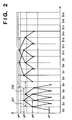
- the spatial sampling interval (the offset between an interval indicated at 201 and an interval indicated at 202) at a certain scale is equal to a space width 203 of a wavelet base at a scale finer than the above-mentioned scale by an amount equivalent to the depth of the local pattern.
- real space coordinates are adopted as two-dimensional coordinates in real space (the image), and coordinates in multi-resolution space are denoted by parameter coordinates.
- the multi-resolution space becomes three-dimensional, with the axis relating to the angle of rotation having omitted.
- analyzing wavelets having rotational symmetry are employed in order to facilitate an understanding of the following discussion. However, the discussion would be similar even if the angle of rotation were taken into account.
- real space is expressed by one dimension for the sake of simplicity.
- a transformation unit 103 transforms the multi-resolution representation 152 to a representation of local pattern space and outputs a local pattern 153.
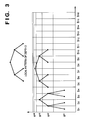
- the neighborhood N ⁇ (s 1 ,b 1 ) with depth ⁇ is equal to a quad tree (a binary tree in Fig. 3) including the node (s 1 ,b 1 ) as the root.
- the local pattern of parameter coordinates (s,b) with depth ⁇ is that obtained by making the value of the wavelet coefficient ⁇ sj,bk > at the parameter coordinates correspond to each node of N ⁇ (s,b).
- the local pattern space of depth ⁇ is referred to as function space established by defining an inner product, which is defined by Equation (10) below as the set of the quad tree mentioned above (see Fig. 4). The summation on the right-hand side of Equation (10) extends over nodes belonging to the local pattern.
- the local pattern space of depth ⁇ will be denoted by T ⁇ and elements thereof will be denoted by t ⁇ n ⁇ T ⁇ hereinafter.
- the transformation unit 103 extracts the corresponding local patterns in discrete multi-resolution space and maps them in local pattern space of the respectively corresponding depths. Furthermore, the transformation unit 103 counts the frequency p(t ⁇ n ) of appearance of each of the local patterns t ⁇ n and stores this value.
- a singularity detector 1031 detects singularities of an image that has been entered by the image input unit 101.
- An edge detected by a Laplacian filter or Canny filter or a feature point of the image may serve as a singularity.
- the code book creating unit 104 registers a local pattern t ⁇ n , at which the appearance frequency p has exceeded a suitable value (threshold value), in a code book as a representative vector, and establishes a relationship between the representative vector and a codeword.
- a suitable value for example, d ⁇ n hereinafter. It should be noted that there can be a case in which the threshold value with respect to the occurrence frequency p is set for every depth ⁇ and a case in which the threshold value is set to be the same for all depths ⁇ .
- Equation (11) The order relationship referred to here is indicated by Equation (11) below. When trees coincide, this means that the values of wavelet coefficients at each node coincide. Though local patterns having different depths are correlated by such an order relation, the actual data contains an error. Therefore, representation as indicated by Equation (12) below using the inner product defined earlier is more realistic.
- a quantizer 105 compares the multi-resolution representation 152 with a representative vector in a code book 154.
- the quantizer 105 performs the comparison with regard to local patterns of all depths for which representative vectors exist at each of the parameter coordinates in multi-resolution space, and the local patterns in the neighborhood of each of the parameter coordinates are replaced by code words corresponding to the representative vector d ⁇ n for which the above-mentioned inner product is maximized, thereby achieving encoding.
- the maximal value of the inner product does not become greater than a certain threshold value
- the local pattern which is the object of comparison is adopted as the candidate for a representative vector and the parameter coordinates and depth thereof are outputted to the transformation unit 103.
- correspondence between appropriate code words and all parameter coordinates of multi-resolution space is obtained.
- a redundancy eliminating unit 106 compresses an image 155 that has been encoded by the above-described local pattern.
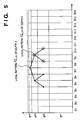
- the data encoded using the representative vectors at each of the parameter coordinates are redundant in the sense of the order relation between representative vectors close to each other in real space (see Fig. 5). Accordingly, among the representative vectors supportive of which in real space share a common region, the redundancy eliminating unit 106 deletes unnecessary representative vectors using the set-theoretical order relation extracted by the inclusion-relation extractor 1041.
- a perspective-order computation unit 107 extracts the perspective-order relationship with respect to real depth in the real space of real objects represented by representative vectors from a signal 156 outputted by the redundancy eliminating unit 106. There exists some pairs of representative vectors close to each other in the real space supportive of which in real space share a common region. Accordingly, these perspective-order relationships can be obtained depending upon which of two representative vectors in nearer than the other to the wavelet coefficients in the common region. This will be described with reference to Fig. 6.
- the quantizer 105 calculates the inner product of the representative vectors. If a representative vector regarding an object situated at the most forward position in real space has been acquired and this object is not hidden by anything, the inner product between this representative vector and a local pattern corresponding to this object will coincide with the norm of the representative vector in a state in which there is no measured error.
- Local patterns 601 and 602 in Fig. 6 are local patterns corresponding to such an object (situated at the most forward position).
- a local pattern 603 shown in Fig. 6 is a local pattern corresponding to an object hidden by another object.
- a common region shared by the support of the local pattern 603 and that of the other object (i.e., the local pattern 602) in real space is b 10 and b 11 .
- the inner product between the representative vectors corresponding thereto should coincide with the norm.
- the shared regions b10 and b11 it can be predicted that the object 603 will be hidden by the object 602.
- the perspective-order relationship of the respective local pattern can be determined.
- An algebraic encoder 108 algebraically encodes an output signal 157 from the perspective-order computation unit 107, namely a code word, real space coordinates, rotation and scale of a singularity and perspective-order information, and outputs a code 158.
- the outputted code 158 is stored in a memory (not shown) or transmitted via a line.
- An algebraic decoder 109 algebraically decodes the code 158, which has entered from a memory or line.
- An inverse quantizer 110 generates local patterns from the code word contained in the algebraically decoded signal 159 and outputs the local patterns as a signal 160 indicative of the multi-resolution representation.
- an image synthesizer 111 On the basis of the algebraically decoded real space coordinates, rotation, scale and perspective-order information, an image synthesizer 111 combines at least two local patterns, which have been generated by the inverse quantizer 110, into a single image.
- the signal 160 is expressed in multi-resolution space.
- An inverse transformation unit 112 inversely transforms the image (the multi-resolution representation), which has been synthesized by the image synthesizer 111, to a function in real space and outputs a signal 162 indicative of this function.
- An image output unit 113 is a printer or display and forms or displays the image represented by the signal 162.
- the image output unit 113 stores the signal 162 on a recording medium or outputs the signal 162 to an image processor or computer, not shown.
- the transformation unit 102 transforms the input image 151 to multi-resolution space.
- it is also effective to transform the input image 151 to a multi-resolution pyramid.
- This method involves dividing the original image into several (e.g., four) partial images, obtaining the mean of the pixel values of each of the partial images, subdividing the partial images into several partial images and obtaining the mean of each image. By repeating this processing, a multi-resolution space approximation of the original image can be obtained.
- each input image can be expressed by a plurality of code words as well as the positions and sizes thereof or by the perspective-order relationship of the representative vectors.
- innumerable images can be generated by movement of a finite number of rigid bodies, this embodiment makes it possible to compactly express an image set of this type.
- this embodiment has the following effects:
- Fig. 7 is a block diagram illustrating the construction of an image processing apparatus according to a second embodiment of the present invention.
- the apparatus includes an image input unit 1108 having a wide-view lens 1101, an array sensor 1102 and an input-parameter controller 1106, the details of which will be described later.
- Image input unit 1108 having a wide-view lens 1101, an array sensor 1102 and an input-parameter controller 1106, the details of which will be described later.
- Light that has passed through the wide-angle lens 1101 impinges upon the array sensor 1102, which converts the light to an image signal and outputs the image signal.
- a transformation unit 1103 applies processing, described later, to the image signal that has entered from the image input unit 1108.
- a singularity detector 1104 applies processing, described later, to a signal that has entered from the transformation unit 1103.
- a transformation encoder 1105 applies processing, described later, to a signal that has entered from the singularity detector 1104 and outputs a code to an information processor 1107.
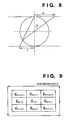
- Fig. 8 is a diagram showing an example of a coordinate transformation performed by the wide-view lens 1101.
- x represents the radius of a polar coordinate system on an image plane situated on the front side of the input system
- an t represents the radius of the polar coordinate system after a transformation performed by the wide-view lens 1101. Since this optical system is rotationally symmetric, the description given below will rendered solely with regard to the radial direction.
- the coordinate transformation performed by the wide-view lens 1101 described above is a conformal map. Accordingly, singularities not present in the original image do not arise.
- the transformation unit 1103 causes a gradient V to act upon an image f(x,y) which is a function in two-dimensional space, thereby generating a vector field.
- e1,e2 are components of basis.
- the singularity detector 1104 detects singularities by utilizing the argument principle.
- Step 2 A circle C centered on z k,p and having a suitable radius ⁇ is considered.
- N z g - N p g ⁇ c arg g ( z ) 2 ⁇
- ⁇ c arg[g(z)] is calculated in the manner described below (see Fig. 9, which illustrates an integration path).
- the integration path may be a closed curve and is not limited the size shown in Fig. 9.
- z z m,n ⁇ ( g ( z m +1, n +1 ), g ( z m +1, n ))+ ⁇ ( g ( Z m , n +1 ), g ( z m +1, n +1 )) + ⁇ ( g ( z m -1, n +1 ), g ( z m , n +1 ))+ ⁇ ( g ( z m -1, n ), g ( z m -1, n +1 )) + ⁇ ( g ( z m -1, n ), g ( z m -1, n +1 )) + ⁇ (
- an orthogonal polynomial expansion can be employed.
- the input-parameter controller 1106 controls the rotational angle of the optic axis of wide-view lens 1101 based upon control information of the rotational angle of the optic axis that has entered from the information processor 1107.
- the information processor 1106 calculates the amount of control of the rotational angle of the optic axis in such a manner that a singularity is taken on the optic axis.
- the apparatus is strongly resistant to noise.
- impulse noise is detected as an edge in the method that relies upon both first-order and second-order differentiation.
- impulse noise is detected as a zero point.
- a pole is employed as a singularity, as mentioned above, impulse noise has no effect whatsoever upon singularity detection.
- Adopting a pole and not a zero point as a singularity is appropriate from the viewpoint of function approximation. The reason for this is that the deciding factor of converging radius in case of series expansion is the position of a pole; a zero point plays no part whatsoever.
- this embodiment can be suitably applied to image processing such as extraction of feature points and encoding/decoding of images.
- the present invention can be applied to a system constituted by a plurality of devices (e.g., host computer, interface, reader, printer) or to an apparatus comprising a single device (e.g., copy machine, facsimile).
- devices e.g., host computer, interface, reader, printer
- apparatus comprising a single device (e.g., copy machine, facsimile).
- the object of the present invention can be also achieved by providing a storage medium storing program codes for performing the aforesaid processes to a system or an apparatus, reading the program codes with a computer (e.g., CPU, MPU) of the system or apparatus from the storage medium, then executing the program.
- a computer e.g., CPU, MPU
- the program codes read from the storage medium realize the functions according to the embodiments, and the storage medium storing the program codes constitutes the invention.
- the storage medium such as a floppy disk, a hard disk, an optical disk, a magneto-optical disk, CD-ROM, CD-R, a magnetic tape, a non-volatile type memory card, and ROM can be used for providing the program codes.
- the present invention includes a case where an OS (operating system) or the like working on the computer performs a part or entire processes in accordance with designations of the program codes and realizes functions according to the above embodiments.
- the present invention also includes a case where, after the program codes read from the storage medium are written in a function expansion card which is inserted into the computer or in a memory provided in a function expansion unit which is connected to the computer, CPU or the like contained in the function expansion card or unit performs a part or entire process in accordance with designations of the program codes and realizes functions of the above embodiments.
Landscapes
- Engineering & Computer Science (AREA)
- Multimedia (AREA)
- Signal Processing (AREA)
- Physics & Mathematics (AREA)
- General Physics & Mathematics (AREA)
- Theoretical Computer Science (AREA)
- Compression Or Coding Systems Of Tv Signals (AREA)
- Image Processing (AREA)
- Compression, Expansion, Code Conversion, And Decoders (AREA)
Applications Claiming Priority (6)
| Application Number | Priority Date | Filing Date | Title |
|---|---|---|---|
| JP76515/95 | 1995-03-31 | ||
| JP7076515A JPH08272594A (ja) | 1995-03-31 | 1995-03-31 | 画像処理装置およびその方法 |
| JP76510/95 | 1995-03-31 | ||
| JP7651095 | 1995-03-31 | ||
| JP7651095A JPH08275163A (ja) | 1995-03-31 | 1995-03-31 | 画像処理装置およびその方法 |
| JP7651595 | 1995-03-31 |
Publications (3)
| Publication Number | Publication Date |
|---|---|
| EP0735775A2 true EP0735775A2 (fr) | 1996-10-02 |
| EP0735775A3 EP0735775A3 (fr) | 1997-10-15 |
| EP0735775B1 EP0735775B1 (fr) | 2003-05-14 |
Family
ID=26417659
Family Applications (1)
| Application Number | Title | Priority Date | Filing Date |
|---|---|---|---|
| EP96302244A Expired - Lifetime EP0735775B1 (fr) | 1995-03-31 | 1996-03-29 | Appareil et méthode de traitement d'images |
Country Status (4)
| Country | Link |
|---|---|
| US (2) | US5917943A (fr) |
| EP (1) | EP0735775B1 (fr) |
| CA (1) | CA2173092C (fr) |
| DE (1) | DE69628083T2 (fr) |
Cited By (3)
| Publication number | Priority date | Publication date | Assignee | Title |
|---|---|---|---|---|
| EP0841811A3 (fr) * | 1996-11-12 | 2000-01-19 | Sony Corporation | Dispositif et méthode de traitement de signal vidéo |
| EP0841812A3 (fr) * | 1996-11-12 | 2000-01-19 | Sony Corporation | Dispositif et méthode de traitement de signal vidéo |
| EP1001544A1 (fr) * | 1998-11-09 | 2000-05-17 | Canon Kabushiki Kaisha | Dispositif et procédé d'adaptation des turbocodeurs et des décodeurs associés à des séquences de longueur variable |
Families Citing this family (28)
| Publication number | Priority date | Publication date | Assignee | Title |
|---|---|---|---|---|
| CA2173092C (fr) * | 1995-03-31 | 2000-04-18 | Teruyoshi Washizawa | Appareil et methode de traitement d'images |
| AUPO951297A0 (en) * | 1997-09-29 | 1997-10-23 | Canon Information Systems Research Australia Pty Ltd | Method and apparatus for digital data compression |
| EP1065881B1 (fr) * | 1998-03-05 | 2008-07-09 | Matsushita Electric Industrial Co., Ltd. | Procede de codage d'images, procede de codage / decodage d'images, codeur d'images ou appareil d'enregistrement / reproduction d'images |
| US6198412B1 (en) * | 1999-01-20 | 2001-03-06 | Lucent Technologies Inc. | Method and apparatus for reduced complexity entropy coding |
| JP3437555B2 (ja) * | 2001-03-06 | 2003-08-18 | キヤノン株式会社 | 特定点検出方法及び装置 |
| WO2002071331A2 (fr) * | 2001-03-07 | 2002-09-12 | Pulsent Corporation | Extension predictive de contours dans des regions non couvertes |
| EP1423975A1 (fr) * | 2001-07-11 | 2004-06-02 | Daniel Kilbank | Systeme et procede de compression de donnees |
| JP2005524260A (ja) * | 2002-04-23 | 2005-08-11 | キルバンク ダニエル | 通信においてマイクロレッツを使用するためのシステムおよび方法 |
| CN1313979C (zh) * | 2002-05-03 | 2007-05-02 | 三星电子株式会社 | 产生三维漫画的装置和方法 |
| EP1574067B1 (fr) * | 2002-12-17 | 2017-06-07 | Zoran (France) | Traitement ou compression de signaux n-dimensionnels a l'aide de paquets d'ondelettes et de bandelettes modifies |
| US7408486B2 (en) * | 2003-04-21 | 2008-08-05 | Qbit Corporation | System and method for using a microlet-based modem |
| US7251376B2 (en) * | 2003-08-29 | 2007-07-31 | Canadian Space Agency | Data compression engines and real-time wideband compressor for multi-dimensional data |
| JP4371120B2 (ja) * | 2006-05-16 | 2009-11-25 | ソニー株式会社 | 画像処理装置及び画像処理方法、プログラム及び記録媒体 |
| US8620979B2 (en) * | 2007-12-26 | 2013-12-31 | Zoran (France) S.A. | Filter banks for enhancing signals using oversampled subband transforms |
| JP5335004B2 (ja) | 2009-02-13 | 2013-11-06 | パナソニック株式会社 | ベクトル量子化装置、ベクトル逆量子化装置、およびこれらの方法 |
| JP2013005064A (ja) * | 2011-06-13 | 2013-01-07 | Sony Corp | 送信装置、送信方法、及びプログラム |
| US9047534B2 (en) * | 2011-08-11 | 2015-06-02 | Anvato, Inc. | Method and apparatus for detecting near-duplicate images using content adaptive hash lookups |
| US9237358B2 (en) * | 2011-11-08 | 2016-01-12 | Qualcomm Incorporated | Context reduction for context adaptive binary arithmetic coding |
| US10474745B1 (en) | 2016-04-27 | 2019-11-12 | Google Llc | Systems and methods for a knowledge-based form creation platform |
| US11039181B1 (en) | 2016-05-09 | 2021-06-15 | Google Llc | Method and apparatus for secure video manifest/playlist generation and playback |
| US10750248B1 (en) | 2016-05-10 | 2020-08-18 | Google Llc | Method and apparatus for server-side content delivery network switching |
| US10750216B1 (en) | 2016-05-10 | 2020-08-18 | Google Llc | Method and apparatus for providing peer-to-peer content delivery |
| US10771824B1 (en) | 2016-05-10 | 2020-09-08 | Google Llc | System for managing video playback using a server generated manifest/playlist |
| US10595054B2 (en) | 2016-05-10 | 2020-03-17 | Google Llc | Method and apparatus for a virtual online video channel |
| US10785508B2 (en) | 2016-05-10 | 2020-09-22 | Google Llc | System for measuring video playback events using a server generated manifest/playlist |
| US11069378B1 (en) | 2016-05-10 | 2021-07-20 | Google Llc | Method and apparatus for frame accurate high resolution video editing in cloud using live video streams |
| US11032588B2 (en) | 2016-05-16 | 2021-06-08 | Google Llc | Method and apparatus for spatial enhanced adaptive bitrate live streaming for 360 degree video playback |
| CN106504224A (zh) * | 2016-09-14 | 2017-03-15 | 湖北工业大学 | 图像正交矩数值稳定性分析方法 |
Family Cites Families (21)
| Publication number | Priority date | Publication date | Assignee | Title |
|---|---|---|---|---|
| US3967056A (en) * | 1973-02-26 | 1976-06-29 | Minolta Camera Kabushiki Kaisha | Automatic focusing apparatus |
| US5067158A (en) * | 1985-06-11 | 1991-11-19 | Texas Instruments Incorporated | Linear predictive residual representation via non-iterative spectral reconstruction |
| EP0339589A3 (fr) * | 1988-04-28 | 1992-01-02 | Sharp Kabushiki Kaisha | Système de codage par transformation orthogonale pour données d'images |
| US5473555A (en) * | 1988-08-18 | 1995-12-05 | Hewlett-Packard Company | Method and apparatus for enhancing frequency domain analysis |
| US5341457A (en) * | 1988-12-30 | 1994-08-23 | At&T Bell Laboratories | Perceptual coding of audio signals |
| EP0387051B1 (fr) * | 1989-03-10 | 1997-08-06 | Canon Kabushiki Kaisha | Procédé et dispositif pour le codage d'information d'image |
| US5150432A (en) * | 1990-03-26 | 1992-09-22 | Kabushiki Kaisha Toshiba | Apparatus for encoding/decoding video signals to improve quality of a specific region |
| US5150209A (en) * | 1990-05-11 | 1992-09-22 | Picturetel Corporation | Hierarchical entropy coded lattice threshold quantization encoding method and apparatus for image and video compression |
| JPH0739968B2 (ja) * | 1991-03-25 | 1995-05-01 | 日本電信電話株式会社 | 音響伝達特性模擬方法 |
| US5327520A (en) * | 1992-06-04 | 1994-07-05 | At&T Bell Laboratories | Method of use of voice message coder/decoder |
| DE69333288T2 (de) * | 1992-09-01 | 2004-08-26 | Apple Computer, Inc., Cupertino | Verbesserte vektorquantisierung |
| JP3293920B2 (ja) * | 1993-01-22 | 2002-06-17 | キヤノン株式会社 | 画像処理装置およびその方法 |
| US5398069A (en) * | 1993-03-26 | 1995-03-14 | Scientific Atlanta | Adaptive multi-stage vector quantization |
| US5696851A (en) * | 1993-04-30 | 1997-12-09 | Comsat Corporation | Codeword-dependent post-filtering for vector quantization-based image compression |
| US5692100A (en) * | 1994-02-02 | 1997-11-25 | Matsushita Electric Industrial Co., Ltd. | Vector quantizer |
| US5426673A (en) * | 1994-02-09 | 1995-06-20 | The Regents Of The University Of California | Discrete cosine transform-based image coding and decoding method |
| US5577135A (en) * | 1994-03-01 | 1996-11-19 | Apple Computer, Inc. | Handwriting signal processing front-end for handwriting recognizers |
| JP3372635B2 (ja) * | 1994-03-14 | 2003-02-04 | キヤノン株式会社 | 制御装置 |
| CA2173092C (fr) * | 1995-03-31 | 2000-04-18 | Teruyoshi Washizawa | Appareil et methode de traitement d'images |
| US5696850A (en) | 1995-12-21 | 1997-12-09 | Eastman Kodak Company | Automatic image sharpening in an electronic imaging system |
| US5729694A (en) * | 1996-02-06 | 1998-03-17 | The Regents Of The University Of California | Speech coding, reconstruction and recognition using acoustics and electromagnetic waves |
-
1996
- 1996-03-29 CA CA002173092A patent/CA2173092C/fr not_active Expired - Fee Related
- 1996-03-29 US US08/623,536 patent/US5917943A/en not_active Expired - Fee Related
- 1996-03-29 EP EP96302244A patent/EP0735775B1/fr not_active Expired - Lifetime
- 1996-03-29 DE DE69628083T patent/DE69628083T2/de not_active Expired - Fee Related
-
1999
- 1999-05-17 US US09/312,841 patent/US6898326B2/en not_active Expired - Lifetime
Non-Patent Citations (5)
| Title |
|---|
| COMPUTER VISION GRAPHICS AND IMAGE PROCESSING, vol. 51, no. 3, 1 September 1990, pages 275-298, XP000172434 ULUPINAR F ET AL: "REFINING EDGES DETECTED BY A LOG OPERATOR*" * |
| IEEE TRANSACTIONS ON IMAGE PROCESSING, vol. 4, no. 4, 1 April 1995, pages 478-485, XP000498982 EGGER O ET AL: "SUBBAND CODING OF IMAGES USING ASYMMETRICAL FILTER BANKS" * |
| IEEE TRANSACTIONS ON INFORMATION THEORY, vol. 38, no. 2 PT. 02, 1 March 1992, pages 617-643, XP000257716 MALLAT S ET AL: "SINGULARITY DETECTION AND PROCESSING WITH WAVELETS" * |
| SIGNAL PROCESSING. IMAGE COMMUNICATION, vol. 6, no. 6, 1 February 1995, pages 561-577, XP000491861 YANG K H ET AL: "WAVELET TRANSFORM CODING FOR MCP ERROR IMAGES USING QUADTREE DECOMPOSITION AND ECVQ" * |
| TRAITEMENT DU SIGNAL, vol. 7, no. 2, 1 January 1990, pages 101-115, XP000309411 MATHIEU P ET AL: "COMPRESSION D'IMAGE PAR TRANSFORMEE EN ONDELETTE ET QUANTIFICATION VECTORIELLE" * |
Cited By (5)
| Publication number | Priority date | Publication date | Assignee | Title |
|---|---|---|---|---|
| EP0841811A3 (fr) * | 1996-11-12 | 2000-01-19 | Sony Corporation | Dispositif et méthode de traitement de signal vidéo |
| EP0841812A3 (fr) * | 1996-11-12 | 2000-01-19 | Sony Corporation | Dispositif et méthode de traitement de signal vidéo |
| US6441864B1 (en) | 1996-11-12 | 2002-08-27 | Sony Corporation | Video signal processing device and method employing transformation matrix to generate composite image |
| EP1001544A1 (fr) * | 1998-11-09 | 2000-05-17 | Canon Kabushiki Kaisha | Dispositif et procédé d'adaptation des turbocodeurs et des décodeurs associés à des séquences de longueur variable |
| US6766489B1 (en) | 1998-11-09 | 2004-07-20 | Canon Kabushiki Kaisha | Device and method of adapting turbocoders and the associated decoders to sequences of variable length |
Also Published As
| Publication number | Publication date |
|---|---|
| CA2173092C (fr) | 2000-04-18 |
| US20030053705A1 (en) | 2003-03-20 |
| DE69628083T2 (de) | 2003-12-04 |
| CA2173092A1 (fr) | 1996-10-01 |
| US5917943A (en) | 1999-06-29 |
| DE69628083D1 (de) | 2003-06-18 |
| EP0735775B1 (fr) | 2003-05-14 |
| US6898326B2 (en) | 2005-05-24 |
| EP0735775A3 (fr) | 1997-10-15 |
Similar Documents
| Publication | Publication Date | Title |
|---|---|---|
| US5917943A (en) | Image processing apparatus and method | |
| CN113678466B (zh) | 用于预测点云属性编码的方法和设备 | |
| Thanou et al. | Graph-based compression of dynamic 3D point cloud sequences | |
| US9349072B2 (en) | Local feature based image compression | |
| Distasi et al. | Image compression by B-tree triangular coding | |
| US5870502A (en) | System and method for a multiresolution transform of digital image information | |
| US6476805B1 (en) | Techniques for spatial displacement estimation and multi-resolution operations on light fields | |
| EP0562672A2 (fr) | Procédé de représentation d'images par compression de données | |
| EP1274250A2 (fr) | Procédé pour utiliser l'analyse de contenu de sujet pour la compression d'images numériques | |
| EP1574067A1 (fr) | Traitement ou compression de signaux n-dimensionnels a l'aide de paquets d'ondelettes et de bandelettes modifies | |
| CN101167363A (zh) | 处理视频数据装置和方法 | |
| KR20100016272A (ko) | Pixon 방법을 사용한 이미지 압축 및 압축 해제 | |
| KR20200138079A (ko) | 전역적 문맥을 이용하는 기계 학습 기반의 이미지 압축을 위한 방법 및 장치 | |
| Sheppard et al. | A vector quantizer for image restoration | |
| Panchapakesan et al. | Blur identification from vector quantizer encoder distortion | |
| Zhang et al. | Light field sampling | |
| KR20150128664A (ko) | 픽셀의 2개의 블록을 비교하기 위한 방법 및 장치 | |
| EP4233006B1 (fr) | Appareils et méthodes pour la quantification spatiale faisant partie d'une compression d'un nuage à points | |
| Valtchev et al. | Convolutional autoencoders for lossy light field compression | |
| Dansereau | 4D light field processing and its application to computer vision | |
| US20260095586A1 (en) | Motion coding for dynamic meshes using intra- and inter-frame graph fourier transforms | |
| Nicolas et al. | Minimum description length criterion and segmentation map coding for region-based video compression | |
| Zhao et al. | Image compression and denoising using multiresolution region-based image description scheme: Y. Zhao et al. | |
| JPH10177655A (ja) | 動画像処理装置 | |
| von Buelow | Lossless Compression of Structured and Unstructured Multi-View Image Data |
Legal Events
| Date | Code | Title | Description |
|---|---|---|---|
| PUAI | Public reference made under article 153(3) epc to a published international application that has entered the european phase |
Free format text: ORIGINAL CODE: 0009012 |
|
| AK | Designated contracting states |
Kind code of ref document: A2 Designated state(s): DE FR GB |
|
| PUAL | Search report despatched |
Free format text: ORIGINAL CODE: 0009013 |
|
| AK | Designated contracting states |
Kind code of ref document: A3 Designated state(s): DE FR GB |
|
| 17P | Request for examination filed |
Effective date: 19980225 |
|
| 17Q | First examination report despatched |
Effective date: 20000215 |
|
| GRAG | Despatch of communication of intention to grant |
Free format text: ORIGINAL CODE: EPIDOS AGRA |
|
| GRAG | Despatch of communication of intention to grant |
Free format text: ORIGINAL CODE: EPIDOS AGRA |
|
| GRAH | Despatch of communication of intention to grant a patent |
Free format text: ORIGINAL CODE: EPIDOS IGRA |
|
| GRAH | Despatch of communication of intention to grant a patent |
Free format text: ORIGINAL CODE: EPIDOS IGRA |
|
| GRAA | (expected) grant |
Free format text: ORIGINAL CODE: 0009210 |
|
| AK | Designated contracting states |
Designated state(s): DE FR GB |
|
| PG25 | Lapsed in a contracting state [announced via postgrant information from national office to epo] |
Ref country code: FR Free format text: LAPSE BECAUSE OF FAILURE TO SUBMIT A TRANSLATION OF THE DESCRIPTION OR TO PAY THE FEE WITHIN THE PRESCRIBED TIME-LIMIT Effective date: 20030514 |
|
| REG | Reference to a national code |
Ref country code: GB Ref legal event code: FG4D |
|
| REF | Corresponds to: |
Ref document number: 69628083 Country of ref document: DE Date of ref document: 20030618 Kind code of ref document: P |
|
| PLBE | No opposition filed within time limit |
Free format text: ORIGINAL CODE: 0009261 |
|
| STAA | Information on the status of an ep patent application or granted ep patent |
Free format text: STATUS: NO OPPOSITION FILED WITHIN TIME LIMIT |
|
| 26N | No opposition filed |
Effective date: 20040217 |
|
| EN | Fr: translation not filed | ||
| PGFP | Annual fee paid to national office [announced via postgrant information from national office to epo] |
Ref country code: GB Payment date: 20060317 Year of fee payment: 11 |
|
| PGFP | Annual fee paid to national office [announced via postgrant information from national office to epo] |
Ref country code: DE Payment date: 20060518 Year of fee payment: 11 |
|
| GBPC | Gb: european patent ceased through non-payment of renewal fee |
Effective date: 20070329 |
|
| PG25 | Lapsed in a contracting state [announced via postgrant information from national office to epo] |
Ref country code: DE Free format text: LAPSE BECAUSE OF NON-PAYMENT OF DUE FEES Effective date: 20071002 |
|
| PG25 | Lapsed in a contracting state [announced via postgrant information from national office to epo] |
Ref country code: GB Free format text: LAPSE BECAUSE OF NON-PAYMENT OF DUE FEES Effective date: 20070329 |