EP0736582B1 - Tinte, Tintenstrahldruckverfahren und -gerät - Google Patents
Tinte, Tintenstrahldruckverfahren und -gerät Download PDFInfo
- Publication number
- EP0736582B1 EP0736582B1 EP96105460A EP96105460A EP0736582B1 EP 0736582 B1 EP0736582 B1 EP 0736582B1 EP 96105460 A EP96105460 A EP 96105460A EP 96105460 A EP96105460 A EP 96105460A EP 0736582 B1 EP0736582 B1 EP 0736582B1
- Authority
- EP
- European Patent Office
- Prior art keywords
- ink
- polymer
- group
- isoelectric point
- acid copolymer
- Prior art date
- Legal status (The legal status is an assumption and is not a legal conclusion. Google has not performed a legal analysis and makes no representation as to the accuracy of the status listed.)
- Expired - Lifetime
Links
- 238000000034 method Methods 0.000 title claims description 20
- 230000008569 process Effects 0.000 title claims description 12
- 239000000976 ink Substances 0.000 claims description 281
- 229920000642 polymer Polymers 0.000 claims description 96
- 150000001875 compounds Chemical class 0.000 claims description 72
- 229920001577 copolymer Polymers 0.000 claims description 70
- XLYOFNOQVPJJNP-UHFFFAOYSA-N water Substances O XLYOFNOQVPJJNP-UHFFFAOYSA-N 0.000 claims description 68
- 239000000049 pigment Substances 0.000 claims description 44
- KFDVPJUYSDEJTH-UHFFFAOYSA-N 4-ethenylpyridine Chemical compound C=CC1=CC=NC=C1 KFDVPJUYSDEJTH-UHFFFAOYSA-N 0.000 claims description 38
- 125000002091 cationic group Chemical group 0.000 claims description 33
- 125000000129 anionic group Chemical group 0.000 claims description 32
- VZCYOOQTPOCHFL-UHFFFAOYSA-N trans-butenedioic acid Natural products OC(=O)C=CC(O)=O VZCYOOQTPOCHFL-UHFFFAOYSA-N 0.000 claims description 32
- LVHBHZANLOWSRM-UHFFFAOYSA-N methylenebutanedioic acid Natural products OC(=O)CC(=C)C(O)=O LVHBHZANLOWSRM-UHFFFAOYSA-N 0.000 claims description 28
- VVJKKWFAADXIJK-UHFFFAOYSA-N Allylamine Chemical group NCC=C VVJKKWFAADXIJK-UHFFFAOYSA-N 0.000 claims description 24
- 229920002126 Acrylic acid copolymer Polymers 0.000 claims description 22
- 239000000178 monomer Substances 0.000 claims description 22
- 239000002904 solvent Substances 0.000 claims description 19
- OFOBLEOULBTSOW-UHFFFAOYSA-N Propanedioic acid Natural products OC(=O)CC(O)=O OFOBLEOULBTSOW-UHFFFAOYSA-N 0.000 claims description 18
- 239000011976 maleic acid Substances 0.000 claims description 18
- KGIGUEBEKRSTEW-UHFFFAOYSA-N 2-vinylpyridine Chemical compound C=CC1=CC=CC=N1 KGIGUEBEKRSTEW-UHFFFAOYSA-N 0.000 claims description 17
- VZCYOOQTPOCHFL-OWOJBTEDSA-N Fumaric acid Natural products OC(=O)\C=C\C(O)=O VZCYOOQTPOCHFL-OWOJBTEDSA-N 0.000 claims description 16
- 239000001530 fumaric acid Substances 0.000 claims description 14
- 150000003839 salts Chemical class 0.000 claims description 14
- IOXXVNYDGIXMIP-UHFFFAOYSA-N n-methylprop-2-en-1-amine Chemical compound CNCC=C IOXXVNYDGIXMIP-UHFFFAOYSA-N 0.000 claims description 12
- 239000002270 dispersing agent Substances 0.000 claims description 10
- DEGZUQBZHACZKW-UHFFFAOYSA-N 2-(methylamino)ethyl 2-methylprop-2-enoate Chemical compound CNCCOC(=O)C(C)=C DEGZUQBZHACZKW-UHFFFAOYSA-N 0.000 claims description 9
- 125000004435 hydrogen atom Chemical group [H]* 0.000 claims description 9
- 125000003178 carboxy group Chemical group [H]OC(*)=O 0.000 claims description 8
- DYUWTXWIYMHBQS-UHFFFAOYSA-N n-prop-2-enylprop-2-en-1-amine Chemical compound C=CCNCC=C DYUWTXWIYMHBQS-UHFFFAOYSA-N 0.000 claims description 6
- 125000004432 carbon atom Chemical group C* 0.000 claims description 4
- 229920003145 methacrylic acid copolymer Polymers 0.000 claims description 4
- 229940117841 methacrylic acid copolymer Drugs 0.000 claims description 4
- 239000003960 organic solvent Substances 0.000 claims description 4
- 125000000217 alkyl group Chemical group 0.000 claims description 3
- 125000003277 amino group Chemical group 0.000 claims description 3
- 239000001913 cellulose Substances 0.000 claims description 3
- 229920002301 cellulose acetate Polymers 0.000 claims description 3
- 229920000098 polyolefin Polymers 0.000 claims description 3
- 229920002635 polyurethane Polymers 0.000 claims description 3
- 239000004814 polyurethane Substances 0.000 claims description 3
- 229920002689 polyvinyl acetate Polymers 0.000 claims description 3
- 239000011118 polyvinyl acetate Substances 0.000 claims description 3
- HNJBEVLQSNELDL-UHFFFAOYSA-N pyrrolidin-2-one Chemical group O=C1CCCN1 HNJBEVLQSNELDL-UHFFFAOYSA-N 0.000 claims description 3
- HRPVXLWXLXDGHG-UHFFFAOYSA-N Acrylamide Chemical compound NC(=O)C=C HRPVXLWXLXDGHG-UHFFFAOYSA-N 0.000 claims description 2
- 125000002883 imidazolyl group Chemical group 0.000 claims description 2
- 125000001841 imino group Chemical group [H]N=* 0.000 claims description 2
- 239000003002 pH adjusting agent Substances 0.000 claims description 2
- 238000007599 discharging Methods 0.000 claims 3
- 238000007641 inkjet printing Methods 0.000 claims 2
- MTHSVFCYNBDYFN-UHFFFAOYSA-N diethylene glycol Chemical compound OCCOCCO MTHSVFCYNBDYFN-UHFFFAOYSA-N 0.000 description 122
- 239000000203 mixture Substances 0.000 description 63
- 239000006185 dispersion Substances 0.000 description 57
- PEDCQBHIVMGVHV-UHFFFAOYSA-N Glycerine Chemical compound OCC(O)CO PEDCQBHIVMGVHV-UHFFFAOYSA-N 0.000 description 56
- 239000007864 aqueous solution Substances 0.000 description 50
- 235000011187 glycerol Nutrition 0.000 description 28
- KFZMGEQAYNKOFK-UHFFFAOYSA-N Isopropanol Chemical compound CC(C)O KFZMGEQAYNKOFK-UHFFFAOYSA-N 0.000 description 27
- 239000000243 solution Substances 0.000 description 27
- 239000000975 dye Substances 0.000 description 21
- 239000000463 material Substances 0.000 description 18
- 230000000740 bleeding effect Effects 0.000 description 16
- 238000004040 coloring Methods 0.000 description 16
- 230000000052 comparative effect Effects 0.000 description 13
- HEMHJVSKTPXQMS-UHFFFAOYSA-M Sodium hydroxide Chemical compound [OH-].[Na+] HEMHJVSKTPXQMS-UHFFFAOYSA-M 0.000 description 12
- 238000000227 grinding Methods 0.000 description 12
- VEXZGXHMUGYJMC-UHFFFAOYSA-N Hydrochloric acid Chemical compound Cl VEXZGXHMUGYJMC-UHFFFAOYSA-N 0.000 description 10
- -1 amide compounds Chemical class 0.000 description 9
- 238000009472 formulation Methods 0.000 description 9
- VHUUQVKOLVNVRT-UHFFFAOYSA-N Ammonium hydroxide Chemical compound [NH4+].[OH-] VHUUQVKOLVNVRT-UHFFFAOYSA-N 0.000 description 8
- MCMNRKCIXSYSNV-UHFFFAOYSA-N Zirconium dioxide Chemical compound O=[Zr]=O MCMNRKCIXSYSNV-UHFFFAOYSA-N 0.000 description 8
- 235000011114 ammonium hydroxide Nutrition 0.000 description 8
- 235000019241 carbon black Nutrition 0.000 description 8
- 239000006229 carbon black Substances 0.000 description 8
- XCJYREBRNVKWGJ-UHFFFAOYSA-N copper(II) phthalocyanine Chemical compound [Cu+2].C12=CC=CC=C2C(N=C2[N-]C(C3=CC=CC=C32)=N2)=NC1=NC([C]1C=CC=CC1=1)=NC=1N=C1[C]3C=CC=CC3=C2[N-]1 XCJYREBRNVKWGJ-UHFFFAOYSA-N 0.000 description 8
- 238000002156 mixing Methods 0.000 description 8
- 229940104573 pigment red 5 Drugs 0.000 description 8
- YODZTKMDCQEPHD-UHFFFAOYSA-N thiodiglycol Chemical compound OCCSCCO YODZTKMDCQEPHD-UHFFFAOYSA-N 0.000 description 8
- LYCAIKOWRPUZTN-UHFFFAOYSA-N Ethylene glycol Chemical compound OCCO LYCAIKOWRPUZTN-UHFFFAOYSA-N 0.000 description 7
- 230000003247 decreasing effect Effects 0.000 description 7
- 229950006389 thiodiglycol Drugs 0.000 description 7
- QTBSBXVTEAMEQO-UHFFFAOYSA-N Acetic acid Chemical compound CC(O)=O QTBSBXVTEAMEQO-UHFFFAOYSA-N 0.000 description 6
- RTZKZFJDLAIYFH-UHFFFAOYSA-N Diethyl ether Chemical compound CCOCC RTZKZFJDLAIYFH-UHFFFAOYSA-N 0.000 description 6
- WMFOQBRAJBCJND-UHFFFAOYSA-M Lithium hydroxide Chemical compound [Li+].[OH-] WMFOQBRAJBCJND-UHFFFAOYSA-M 0.000 description 6
- VYPSYNLAJGMNEJ-UHFFFAOYSA-N Silicium dioxide Chemical compound O=[Si]=O VYPSYNLAJGMNEJ-UHFFFAOYSA-N 0.000 description 6
- 239000004094 surface-active agent Substances 0.000 description 6
- 229910052799 carbon Inorganic materials 0.000 description 5
- 238000001879 gelation Methods 0.000 description 5
- VZCYOOQTPOCHFL-UPHRSURJSA-N maleic acid Chemical compound OC(=O)\C=C/C(O)=O VZCYOOQTPOCHFL-UPHRSURJSA-N 0.000 description 5
- 230000003287 optical effect Effects 0.000 description 5
- 239000011347 resin Substances 0.000 description 5
- 229920005989 resin Polymers 0.000 description 5
- 230000004044 response Effects 0.000 description 5
- 239000004576 sand Substances 0.000 description 5
- 239000007787 solid Substances 0.000 description 5
- JAHNSTQSQJOJLO-UHFFFAOYSA-N 2-(3-fluorophenyl)-1h-imidazole Chemical compound FC1=CC=CC(C=2NC=CN=2)=C1 JAHNSTQSQJOJLO-UHFFFAOYSA-N 0.000 description 4
- AGBXYHCHUYARJY-UHFFFAOYSA-N 2-phenylethenesulfonic acid Chemical compound OS(=O)(=O)C=CC1=CC=CC=C1 AGBXYHCHUYARJY-UHFFFAOYSA-N 0.000 description 4
- QGZKDVFQNNGYKY-UHFFFAOYSA-N Ammonia Chemical compound N QGZKDVFQNNGYKY-UHFFFAOYSA-N 0.000 description 4
- 239000002250 absorbent Substances 0.000 description 4
- 230000002745 absorbent Effects 0.000 description 4
- 229920006318 anionic polymer Polymers 0.000 description 4
- 239000011324 bead Substances 0.000 description 4
- 239000011362 coarse particle Substances 0.000 description 4
- 239000003086 colorant Substances 0.000 description 4
- 125000003438 dodecyl group Chemical group [H]C([H])([H])C([H])([H])C([H])([H])C([H])([H])C([H])([H])C([H])([H])C([H])([H])C([H])([H])C([H])([H])C([H])([H])C([H])([H])C([H])([H])* 0.000 description 4
- 239000008151 electrolyte solution Substances 0.000 description 4
- 238000011049 filling Methods 0.000 description 4
- KWIUHFFTVRNATP-UHFFFAOYSA-N glycine betaine Chemical compound C[N+](C)(C)CC([O-])=O KWIUHFFTVRNATP-UHFFFAOYSA-N 0.000 description 4
- 125000002958 pentadecyl group Chemical group [H]C([*])([H])C([H])([H])C([H])([H])C([H])([H])C([H])([H])C([H])([H])C([H])([H])C([H])([H])C([H])([H])C([H])([H])C([H])([H])C([H])([H])C([H])([H])C([H])([H])C([H])([H])[H] 0.000 description 4
- 230000035699 permeability Effects 0.000 description 4
- 238000002360 preparation method Methods 0.000 description 4
- SMBAGGHBUKLZPQ-UHFFFAOYSA-J tetrasodium 6-amino-4-hydroxy-3-[[7-sulfinato-4-[(4-sulfonatophenyl)diazenyl]naphthalen-1-yl]diazenyl]naphthalene-2,7-disulfonate Chemical compound C1=CC(=CC=C1N=NC2=C3C=CC(=CC3=C(C=C2)N=NC4=C(C5=CC(=C(C=C5C=C4S(=O)(=O)[O-])S(=O)(=O)[O-])N)O)S(=O)[O-])S(=O)(=O)[O-].[Na+].[Na+].[Na+].[Na+] SMBAGGHBUKLZPQ-UHFFFAOYSA-J 0.000 description 4
- 230000008719 thickening Effects 0.000 description 4
- 239000001052 yellow pigment Substances 0.000 description 4
- SMZOUWXMTYCWNB-UHFFFAOYSA-N 2-(2-methoxy-5-methylphenyl)ethanamine Chemical compound COC1=CC=C(C)C=C1CCN SMZOUWXMTYCWNB-UHFFFAOYSA-N 0.000 description 3
- NIXOWILDQLNWCW-UHFFFAOYSA-N 2-Propenoic acid Natural products OC(=O)C=C NIXOWILDQLNWCW-UHFFFAOYSA-N 0.000 description 3
- ZMXDDKWLCZADIW-UHFFFAOYSA-N N,N-Dimethylformamide Chemical compound CN(C)C=O ZMXDDKWLCZADIW-UHFFFAOYSA-N 0.000 description 3
- KWYUFKZDYYNOTN-UHFFFAOYSA-M Potassium hydroxide Chemical compound [OH-].[K+] KWYUFKZDYYNOTN-UHFFFAOYSA-M 0.000 description 3
- DNIAPMSPPWPWGF-UHFFFAOYSA-N Propylene glycol Chemical compound CC(O)CO DNIAPMSPPWPWGF-UHFFFAOYSA-N 0.000 description 3
- 239000002253 acid Substances 0.000 description 3
- 230000002378 acidificating effect Effects 0.000 description 3
- 230000015572 biosynthetic process Effects 0.000 description 3
- ZBNARPCCDMHDDV-UHFFFAOYSA-N chembl1206040 Chemical compound C1=C(S(O)(=O)=O)C=C2C=C(S(O)(=O)=O)C(N=NC3=CC=C(C=C3C)C=3C=C(C(=CC=3)N=NC=3C(=CC4=CC(=CC(N)=C4C=3O)S(O)(=O)=O)S(O)(=O)=O)C)=C(O)C2=C1N ZBNARPCCDMHDDV-UHFFFAOYSA-N 0.000 description 3
- 230000000694 effects Effects 0.000 description 3
- 239000003792 electrolyte Substances 0.000 description 3
- 125000001495 ethyl group Chemical group [H]C([H])([H])C([H])([H])* 0.000 description 3
- 229920001477 hydrophilic polymer Polymers 0.000 description 3
- 239000002563 ionic surfactant Substances 0.000 description 3
- 230000007935 neutral effect Effects 0.000 description 3
- 238000011084 recovery Methods 0.000 description 3
- MEKOFIRRDATTAG-UHFFFAOYSA-N 2,2,5,8-tetramethyl-3,4-dihydrochromen-6-ol Chemical compound C1CC(C)(C)OC2=C1C(C)=C(O)C=C2C MEKOFIRRDATTAG-UHFFFAOYSA-N 0.000 description 2
- HZAXFHJVJLSVMW-UHFFFAOYSA-N 2-Aminoethan-1-ol Chemical compound NCCO HZAXFHJVJLSVMW-UHFFFAOYSA-N 0.000 description 2
- MHOFGBJTSNWTDT-UHFFFAOYSA-M 2-[n-ethyl-4-[(6-methoxy-3-methyl-1,3-benzothiazol-3-ium-2-yl)diazenyl]anilino]ethanol;methyl sulfate Chemical compound COS([O-])(=O)=O.C1=CC(N(CCO)CC)=CC=C1N=NC1=[N+](C)C2=CC=C(OC)C=C2S1 MHOFGBJTSNWTDT-UHFFFAOYSA-M 0.000 description 2
- SVTBMSDMJJWYQN-UHFFFAOYSA-N 2-methylpentane-2,4-diol Chemical compound CC(O)CC(C)(C)O SVTBMSDMJJWYQN-UHFFFAOYSA-N 0.000 description 2
- FEIQOMCWGDNMHM-UHFFFAOYSA-N 5-phenylpenta-2,4-dienoic acid Chemical compound OC(=O)C=CC=CC1=CC=CC=C1 FEIQOMCWGDNMHM-UHFFFAOYSA-N 0.000 description 2
- CSCPPACGZOOCGX-UHFFFAOYSA-N Acetone Chemical compound CC(C)=O CSCPPACGZOOCGX-UHFFFAOYSA-N 0.000 description 2
- 239000004925 Acrylic resin Substances 0.000 description 2
- 229920000178 Acrylic resin Polymers 0.000 description 2
- IAZDPXIOMUYVGZ-UHFFFAOYSA-N Dimethylsulphoxide Chemical compound CS(C)=O IAZDPXIOMUYVGZ-UHFFFAOYSA-N 0.000 description 2
- LFQSCWFLJHTTHZ-UHFFFAOYSA-N Ethanol Chemical compound CCO LFQSCWFLJHTTHZ-UHFFFAOYSA-N 0.000 description 2
- CERQOIWHTDAKMF-UHFFFAOYSA-N Methacrylic acid Chemical compound CC(=C)C(O)=O CERQOIWHTDAKMF-UHFFFAOYSA-N 0.000 description 2
- SECXISVLQFMRJM-UHFFFAOYSA-N N-Methylpyrrolidone Chemical compound CN1CCCC1=O SECXISVLQFMRJM-UHFFFAOYSA-N 0.000 description 2
- 229910006145 SO3Li Inorganic materials 0.000 description 2
- PPBRXRYQALVLMV-UHFFFAOYSA-N Styrene Chemical compound C=CC1=CC=CC=C1 PPBRXRYQALVLMV-UHFFFAOYSA-N 0.000 description 2
- WYURNTSHIVDZCO-UHFFFAOYSA-N Tetrahydrofuran Chemical compound C1CCOC1 WYURNTSHIVDZCO-UHFFFAOYSA-N 0.000 description 2
- 239000003945 anionic surfactant Substances 0.000 description 2
- 229960003237 betaine Drugs 0.000 description 2
- 229920006317 cationic polymer Polymers 0.000 description 2
- 239000003093 cationic surfactant Substances 0.000 description 2
- 238000005119 centrifugation Methods 0.000 description 2
- 238000006243 chemical reaction Methods 0.000 description 2
- DHQJMKJYFOHOSY-UHFFFAOYSA-L disodium 4-amino-3-[[4-[4-[(2,4-diaminophenyl)diazenyl]-3-methylphenyl]-2-methylphenyl]diazenyl]-5-oxido-6-phenyldiazenyl-7-sulfonaphthalene-2-sulfonate Chemical compound [Na+].[Na+].Cc1cc(ccc1N=Nc1ccc(N)cc1N)-c1ccc(N=Nc2c(N)c3c(O)c(N=Nc4ccccc4)c(cc3cc2S([O-])(=O)=O)S([O-])(=O)=O)c(C)c1 DHQJMKJYFOHOSY-UHFFFAOYSA-L 0.000 description 2
- LGWXIBBJZQOXSO-UHFFFAOYSA-L disodium 5-acetamido-4-hydroxy-3-[(2-methylphenyl)diazenyl]naphthalene-2,7-disulfonate Chemical compound [Na+].[Na+].OC1=C2C(NC(=O)C)=CC(S([O-])(=O)=O)=CC2=CC(S([O-])(=O)=O)=C1N=NC1=CC=CC=C1C LGWXIBBJZQOXSO-UHFFFAOYSA-L 0.000 description 2
- JBKVHLHDHHXQEQ-UHFFFAOYSA-N epsilon-caprolactam Chemical compound O=C1CCCCCN1 JBKVHLHDHHXQEQ-UHFFFAOYSA-N 0.000 description 2
- 239000011521 glass Substances 0.000 description 2
- 238000010438 heat treatment Methods 0.000 description 2
- 229920001600 hydrophobic polymer Polymers 0.000 description 2
- 239000007788 liquid Substances 0.000 description 2
- 239000012528 membrane Substances 0.000 description 2
- 230000005499 meniscus Effects 0.000 description 2
- 239000011148 porous material Substances 0.000 description 2
- 238000001556 precipitation Methods 0.000 description 2
- 238000000926 separation method Methods 0.000 description 2
- 239000000758 substrate Substances 0.000 description 2
- PUPZLCDOIYMWBV-UHFFFAOYSA-N (+/-)-1,3-Butanediol Chemical compound CC(O)CCO PUPZLCDOIYMWBV-UHFFFAOYSA-N 0.000 description 1
- ZWVMLYRJXORSEP-UHFFFAOYSA-N 1,2,6-Hexanetriol Chemical compound OCCCCC(O)CO ZWVMLYRJXORSEP-UHFFFAOYSA-N 0.000 description 1
- CYSGHNMQYZDMIA-UHFFFAOYSA-N 1,3-Dimethyl-2-imidazolidinon Chemical compound CN1CCN(C)C1=O CYSGHNMQYZDMIA-UHFFFAOYSA-N 0.000 description 1
- RYHBNJHYFVUHQT-UHFFFAOYSA-N 1,4-Dioxane Chemical compound C1COCCO1 RYHBNJHYFVUHQT-UHFFFAOYSA-N 0.000 description 1
- QWIGSMCPAKBYLY-UHFFFAOYSA-O 2,4-dimethoxy-n-[2-(1,3,3-trimethylindol-1-ium-2-yl)ethenyl]aniline Chemical compound COC1=CC(OC)=CC=C1NC=CC1=[N+](C)C2=CC=CC=C2C1(C)C QWIGSMCPAKBYLY-UHFFFAOYSA-O 0.000 description 1
- RFOIWENXLZSKSY-UHFFFAOYSA-N 4-ethenylpyrrolidin-2-one Chemical compound C=CC1CNC(=O)C1 RFOIWENXLZSKSY-UHFFFAOYSA-N 0.000 description 1
- HCXJFMDOHDNDCC-UHFFFAOYSA-N 5-$l^{1}-oxidanyl-3,4-dihydropyrrol-2-one Chemical group O=C1CCC(=O)[N]1 HCXJFMDOHDNDCC-UHFFFAOYSA-N 0.000 description 1
- HMEKVHWROSNWPD-UHFFFAOYSA-N Erioglaucine A Chemical compound [NH4+].[NH4+].C=1C=C(C(=C2C=CC(C=C2)=[N+](CC)CC=2C=C(C=CC=2)S([O-])(=O)=O)C=2C(=CC=CC=2)S([O-])(=O)=O)C=CC=1N(CC)CC1=CC=CC(S([O-])(=O)=O)=C1 HMEKVHWROSNWPD-UHFFFAOYSA-N 0.000 description 1
- FXHOOIRPVKKKFG-UHFFFAOYSA-N N,N-Dimethylacetamide Chemical compound CN(C)C(C)=O FXHOOIRPVKKKFG-UHFFFAOYSA-N 0.000 description 1
- 239000004698 Polyethylene Substances 0.000 description 1
- 239000002202 Polyethylene glycol Substances 0.000 description 1
- 229910006069 SO3H Inorganic materials 0.000 description 1
- GSEJCLTVZPLZKY-UHFFFAOYSA-N Triethanolamine Chemical compound OCCN(CCO)CCO GSEJCLTVZPLZKY-UHFFFAOYSA-N 0.000 description 1
- ZMANZCXQSJIPKH-UHFFFAOYSA-N Triethylamine Chemical compound CCN(CC)CC ZMANZCXQSJIPKH-UHFFFAOYSA-N 0.000 description 1
- XSQUKJJJFZCRTK-UHFFFAOYSA-N Urea Chemical compound NC(N)=O XSQUKJJJFZCRTK-UHFFFAOYSA-N 0.000 description 1
- 150000007513 acids Chemical class 0.000 description 1
- 239000000654 additive Substances 0.000 description 1
- 150000001298 alcohols Chemical class 0.000 description 1
- XAGFODPZIPBFFR-UHFFFAOYSA-N aluminium Chemical compound [Al] XAGFODPZIPBFFR-UHFFFAOYSA-N 0.000 description 1
- 229910052782 aluminium Inorganic materials 0.000 description 1
- PNEYBMLMFCGWSK-UHFFFAOYSA-N aluminium oxide Inorganic materials [O-2].[O-2].[O-2].[Al+3].[Al+3] PNEYBMLMFCGWSK-UHFFFAOYSA-N 0.000 description 1
- 229910021529 ammonia Inorganic materials 0.000 description 1
- 230000002421 anti-septic effect Effects 0.000 description 1
- 239000003963 antioxidant agent Substances 0.000 description 1
- 229940064004 antiseptic throat preparations Drugs 0.000 description 1
- 239000008365 aqueous carrier Substances 0.000 description 1
- 239000003125 aqueous solvent Substances 0.000 description 1
- 125000001204 arachidyl group Chemical group [H]C([*])([H])C([H])([H])C([H])([H])C([H])([H])C([H])([H])C([H])([H])C([H])([H])C([H])([H])C([H])([H])C([H])([H])C([H])([H])C([H])([H])C([H])([H])C([H])([H])C([H])([H])C([H])([H])C([H])([H])C([H])([H])C([H])([H])C([H])([H])[H] 0.000 description 1
- 229920001400 block copolymer Polymers 0.000 description 1
- 238000009835 boiling Methods 0.000 description 1
- 239000004202 carbamide Substances 0.000 description 1
- BVKZGUZCCUSVTD-UHFFFAOYSA-N carbonic acid Chemical compound OC(O)=O BVKZGUZCCUSVTD-UHFFFAOYSA-N 0.000 description 1
- 230000003197 catalytic effect Effects 0.000 description 1
- 150000001768 cations Chemical class 0.000 description 1
- 239000000919 ceramic Substances 0.000 description 1
- 230000008859 change Effects 0.000 description 1
- 239000002738 chelating agent Substances 0.000 description 1
- IWWWBRIIGAXLCJ-BGABXYSRSA-N chembl1185241 Chemical compound C1=2C=C(C)C(NCC)=CC=2OC2=C\C(=N/CC)C(C)=CC2=C1C1=CC=CC=C1C(=O)OCC IWWWBRIIGAXLCJ-BGABXYSRSA-N 0.000 description 1
- 239000003795 chemical substances by application Substances 0.000 description 1
- 238000005345 coagulation Methods 0.000 description 1
- 230000015271 coagulation Effects 0.000 description 1
- 125000004122 cyclic group Chemical group 0.000 description 1
- 230000001419 dependent effect Effects 0.000 description 1
- 238000009792 diffusion process Methods 0.000 description 1
- YSVBPNGJESBVRM-UHFFFAOYSA-L disodium;4-[(1-oxido-4-sulfonaphthalen-2-yl)diazenyl]naphthalene-1-sulfonate Chemical compound [Na+].[Na+].C1=CC=C2C(N=NC3=C(C4=CC=CC=C4C(=C3)S([O-])(=O)=O)O)=CC=C(S([O-])(=O)=O)C2=C1 YSVBPNGJESBVRM-UHFFFAOYSA-L 0.000 description 1
- 238000009826 distribution Methods 0.000 description 1
- 238000001035 drying Methods 0.000 description 1
- 239000000428 dust Substances 0.000 description 1
- 229920001971 elastomer Polymers 0.000 description 1
- 150000002170 ethers Chemical class 0.000 description 1
- 238000001704 evaporation Methods 0.000 description 1
- 230000008020 evaporation Effects 0.000 description 1
- 230000003631 expected effect Effects 0.000 description 1
- 239000000945 filler Substances 0.000 description 1
- 239000010408 film Substances 0.000 description 1
- 125000000524 functional group Chemical group 0.000 description 1
- 229920000578 graft copolymer Polymers 0.000 description 1
- 229940051250 hexylene glycol Drugs 0.000 description 1
- 230000002209 hydrophobic effect Effects 0.000 description 1
- WGCNASOHLSPBMP-UHFFFAOYSA-N hydroxyacetaldehyde Natural products OCC=O WGCNASOHLSPBMP-UHFFFAOYSA-N 0.000 description 1
- 229920000831 ionic polymer Polymers 0.000 description 1
- JEIPFZHSYJVQDO-UHFFFAOYSA-N iron(III) oxide Inorganic materials O=[Fe]O[Fe]=O JEIPFZHSYJVQDO-UHFFFAOYSA-N 0.000 description 1
- 238000004519 manufacturing process Methods 0.000 description 1
- 239000000693 micelle Substances 0.000 description 1
- 229910001120 nichrome Inorganic materials 0.000 description 1
- 125000002460 pentacosyl group Chemical group [H]C([*])([H])C([H])([H])C([H])([H])C([H])([H])C([H])([H])C([H])([H])C([H])([H])C([H])([H])C([H])([H])C([H])([H])C([H])([H])C([H])([H])C([H])([H])C([H])([H])C([H])([H])C([H])([H])C([H])([H])C([H])([H])C([H])([H])C([H])([H])C([H])([H])C([H])([H])C([H])([H])C([H])([H])C([H])([H])[H] 0.000 description 1
- 239000012466 permeate Substances 0.000 description 1
- 230000000704 physical effect Effects 0.000 description 1
- 239000004033 plastic Substances 0.000 description 1
- 229920003023 plastic Polymers 0.000 description 1
- 229920000573 polyethylene Polymers 0.000 description 1
- 229920001223 polyethylene glycol Polymers 0.000 description 1
- 229920001451 polypropylene glycol Polymers 0.000 description 1
- 238000011085 pressure filtration Methods 0.000 description 1
- 230000003449 preventive effect Effects 0.000 description 1
- 102000004169 proteins and genes Human genes 0.000 description 1
- 108090000623 proteins and genes Proteins 0.000 description 1
- 238000001454 recorded image Methods 0.000 description 1
- 229910052814 silicon oxide Inorganic materials 0.000 description 1
- 238000004513 sizing Methods 0.000 description 1
- 239000011734 sodium Substances 0.000 description 1
- 238000003892 spreading Methods 0.000 description 1
- 230000007480 spreading Effects 0.000 description 1
- 150000005846 sugar alcohols Polymers 0.000 description 1
- HXJUTPCZVOIRIF-UHFFFAOYSA-N sulfolane Chemical compound O=S1(=O)CCCC1 HXJUTPCZVOIRIF-UHFFFAOYSA-N 0.000 description 1
- YLQBMQCUIZJEEH-UHFFFAOYSA-N tetrahydrofuran Natural products C=1C=COC=1 YLQBMQCUIZJEEH-UHFFFAOYSA-N 0.000 description 1
- 239000010409 thin film Substances 0.000 description 1
- ZIBGPFATKBEMQZ-UHFFFAOYSA-N triethylene glycol Chemical compound OCCOCCOCCO ZIBGPFATKBEMQZ-UHFFFAOYSA-N 0.000 description 1
- GWAKFAUFNNPZFE-UHFFFAOYSA-K trisodium 2-[4-[(2-amino-4-oxidophenyl)diazenyl]anilino]-5-[(1-amino-8-oxido-7-phenyldiazenyl-3,6-disulfonaphthalen-2-yl)diazenyl]benzenesulfonate Chemical compound NC1=C(C(=CC2=CC(=C(C(=C12)O)N=NC1=CC=CC=C1)S(=O)(=O)[O-])S(=O)(=O)[O-])N=NC1=CC(=C(C=C1)NC1=CC=C(C=C1)N=NC1=C(C=C(C=C1)O)N)S(=O)(=O)[O-].[Na+].[Na+].[Na+] GWAKFAUFNNPZFE-UHFFFAOYSA-K 0.000 description 1
- 238000009834 vaporization Methods 0.000 description 1
- 230000008016 vaporization Effects 0.000 description 1
- 239000002699 waste material Substances 0.000 description 1
- 239000003021 water soluble solvent Substances 0.000 description 1
- 229920003169 water-soluble polymer Polymers 0.000 description 1
Images



Classifications
-
- C—CHEMISTRY; METALLURGY
- C09—DYES; PAINTS; POLISHES; NATURAL RESINS; ADHESIVES; COMPOSITIONS NOT OTHERWISE PROVIDED FOR; APPLICATIONS OF MATERIALS NOT OTHERWISE PROVIDED FOR
- C09D—COATING COMPOSITIONS, e.g. PAINTS, VARNISHES OR LACQUERS; FILLING PASTES; CHEMICAL PAINT OR INK REMOVERS; INKS; CORRECTING FLUIDS; WOODSTAINS; PASTES OR SOLIDS FOR COLOURING OR PRINTING; USE OF MATERIALS THEREFOR
- C09D11/00—Inks
- C09D11/30—Inkjet printing inks
Definitions
- the present invention relates to a technique for obtaining a waterproof ink image with decreased color-bleeding when a color image is formed on plain paper.
- it relates to an ink useful in image formation by means of an ink-jet recording process and apparatus using the ink.
- Ink-jet recording methods include recording by adhering ejected ink or inks to a recording medium such as paper.
- a recording head having high density multi-orifices can be easily used in an ink-jet recording method in which liquid drops are discharged by forming bubbles in the ink by means of thermal energy from an electro-thermal transducer as the discharge energy supplying means.
- an image having high resolution and high quality can be recorded at high speed.
- conventional inks used for ink-jet recording generally include water as the major component and contain water-soluble solvents having a high boiling point, such as glycol, in order to prevent drying and clogging. Therefore, when recording on plain paper as the recording medium with such inks, the following problem occurs: The image cannot be satisfactorily fixed, and is not formed homogeneously, possibly due to nonhomogeneous distribution of fillers and sizing agents on the recording medium surface. In particular, when forming color images, different color inks are continuously overlapped before each color ink is completely fixed on the paper. Thus, at the boundary section of different colors in the image, nonhomogeneous color mixing (called “bleeding” below) is observed. Moreover, satisfactory water-proof printing has been increasingly demanded recently.
- Japanese Patent Laid-Open No. 55-65269 As a means for solving the above problems, the addition of a compound which improves permeability, such as a surfactant, to the inks is disclosed in Japanese Patent Laid-Open No. 55-65269. Further, an ink mainly containing volatile solvents is disclosed in Japanese Patent Laid-Open No. 55-66976.
- United States Patent No. 5,106,416 discloses an ink containing a cation dyestuff, an ampholytic surfactant, and a nonionic amphiphilic compound.
- United States Patent No. 5,226,957 discloses an ink containing a water-insoluble dyestuff, a polymeric colloidal compound, and a surfactant.
- inks using betaine types of acrylic resins are disclosed in Japanese Patent Laid-Open Nos. 60-96673 and 4-139272.
- United States Patent No. 5,106,416 intends to provide an ink containing a cationic dyestuff, an ampholytic surfactant, and a nonionic amphiphilic compound, in which the diffusion of the coloring material is suppressed by the addition of the ampholytic surfactant in an amount that is at least equal to the critical micelle concentration or more, images obtained from this ink are not entirely satisfactory due to the enhanced permeability of the ink itself caused by the surfactant, similar to the aforementioned Japanese Patent Laid-Open No. 55-65269.
- the ink containing a water-insoluble dyestuff, a polymeric colloidal compound, and a surfactant disclosed in United States Patent No. 5,226,957, the same disadvantages as well as the problems mentioned in United States Patent No. 5,106,416 exist: Clogging in the head and nozzle occurs due to the precipitation of the water-insoluble dyestuff or coagulation of the colloidal compound.
- betaine types of acrylic resins are used to prevent bleeding of the oil-soluble ink in Japanese Patent Laid-Open No. 60-96673, or to improve the stability of the pigment ink in Japanese Patent Laid-Open No. 4-139272, high quality images cannot be achieved on plain paper.
- EP-A-0 556 650 discloses an ink-jet ink composition
- EP-A-0 556 649 discloses an ink-jet ink comprising an aqueous carrier medium which comprises water or a mixture of water and at least one organic component; a particulate solid, preferrably a pigment; and an ABC three-block polymer comprising an A block which is a hydrophilic polymer, a B block which is a polymer capable of binding to the particulate solid, a C block, different than the A or B block, which is a hydrophobic or hydrophilic polymer; and wherein the A and C blocks are end blocks.
- the present invention intends to solve the aforementioned problems, and in particular, to provide an ink for forming uniform, high quality images with decreased bleeding and good image density, when the recording, especially color recording, is done on plain paper, and to provide an ink-jet recording process and apparatus using such ink.
- Recording images satisfying the above-mentioned objects can be obtained by including an ampholytic polymer having both cationic groups and anionic groups in an ink having a coloring material and a solvent for dissolving or dispersing the coloring material.
- the ink When adding the ampholytic polymer having both cationic groups and anionic groups to the ink, the ink becomes a polymeric ampholytic electrolyte, which changes to a polymeric electrolyte showing anionic characteristics or cationic characteristics depending on its pH.
- both the dyestuff and the ampholytic polymer stably exist by means of the repulsion between the two molecules when the pH is higher than the isoelectric point of the ampholytic polymer. This is because the ampholytic polymer behaves as a polymeric electrolyte having anionic characteristics in the ink.
- the isoelectric points of the ampholytic polymers generally range in the neutral region, although, depending on their structure, the ampholytic polymers show both anionic and cationic characteristics and an electrically balanced state at the neutral region.
- anionic and cationic groups in the ampholytic polymer form intramolecular salts, resulting in a rapid viscosity increase or thickening and gelation.
- a cationic group in the ampholytic polymer and the anionic group in the dyestuff forms a salt, and the coloring material is fixed in the polymer.
- the coloring material in the ink is fixed together with the polymeric compound near the surface of the recording paper due to the fixation of the dyestuff in the polymer, and thickening and gelation of the ampholytic polymer, the image density is satisfactorily high and homogeneous, and bleeding of color images can be prevented. Thus, high quality images can be obtained. Moreover, since the coloring material is fixed within the polymer forming the intramolecular salt and since the solubility of the ampholytic polymer itself in water is decreased by the intramolecular salt formation, the water-proof properties will also be improved.
- the ink used in the present invention contains an ampholytic polymer.
- ampholytic polymers include copolymers obtained by copolymerizing a monomer having an anionic group, such as carboxyl group and sulfonic group, with a monomer having a cationic group, such as amino group, imino group, pyrrolidone ring, and imidazole ring. Any random, alternate, block, or graft copolymers may be preferably used.
- Examples of preferred monomers having an anionic group include unsaturated monomers having at least one carboxyl or sulfonic group, such as acrylic acid, itaconic acid, methacrylic acid, maleic acid, fumaric acid, and styrenesulfonic acid.
- Examples of preferred monomers having a cationic group may include unsaturated monomers having at least a cationic group, such as 2-vinylpyrrolidone, 4-vinylpyrrolidone, n-methylaminoethyl methacrylate, allylamine, and diallylamine.
- unsaturated monomers having at least a cationic group such as 2-vinylpyrrolidone, 4-vinylpyrrolidone, n-methylaminoethyl methacrylate, allylamine, and diallylamine.
- ampholytic polymers examples include copolymers of allylamine/maleic acid, n-methylallylamine/maleic acid, 4-vinylpyridine/acrylic acid, n-methylaminoethyl methacrylate/methacrylic acid, acrylamide/styrenesulfonic acid, allylamine/styrenesulfonic acid, 2-vinylpyridine/maleic acid, diallylamine/styrene sulfonic acid, 4-vinylpyridine/maleic acid, 2-vinylpyridine/itaconic acid, n-methylaminoethyl methacrylate/acrylic acid, 4-vinylpyridine/itaconic acid, n-methyl allylamine/itaconic acid and 4-vinylpyridine/fumaric acid. Proteins having ampholytic characteristics can also be used.
- the ampholytic polymers can be used without limitation on their physical properties, the preferred weight-average molecular weight of the polymer ranges from 1,000 to 1,000,000. A polymer of molecular weight less than 1,000 does not cause sufficient thickening and gelation even when the pH is changed, whereas a polymer of molecular weight exceeding 1,000,000 increases the initial viscosity of the ink, resulting in poor discharge characteristics.
- the isoelectric point of the ampholytic polymer can be adjusted as needed by varying the ratio of the monomer having an anionic group to the monomer having a cationic group.
- the isoelectric point ranges from a pH of 3 to 10, and preferably 5 to 10.
- the solubility of the ampholytic polymer reaches its minimum at the isoelectric point.
- approximately 1 to 20 weight% of the ampholytic polymer is previously dissolved in water, and the solution is adjusted to a pH greater than 10 with ammonia or the like. Then the pH is decreased by gradually adding acetic acid or the like. The pH at which maximum milky turbidity or precipitation appears, is taken as the isoelectric point.
- another procedure is also available in which the pH is raised gradually. Both procedures will give almost the same value. If the two results are different from each other, the average is taken as the isoelectric point.
- the content of the ampholytic polymer in the ink desirably ranges from 0.1 to 30 percent by weight.
- a content of less than 0.1 percent by weight does not cause the expected effects on thickening and gelation, whereas a content exceeding 30 percent by weight increases the initial viscosity of the ink to an unsatisfactory extent.
- the preferred content ranges from 0.2 to 10 percent by weight, and most preferably from 0.3 to 8 percent by weight.
- each of X 1 , X 2 , X 3 , and X 4 in the compound having general formula (A) is preferably selected from salts of carboxyl group, salts of sulfonic group, and hydrogen atom.
- the compound having general formula (A) forms a cyclic structure, which readily results in decreased performance and reliability of the ink.
- each of R 1 and R 4 is an alkyl group having 1 to 32 carbon atoms, and each of c+d and e+f is an integer of 0 to 16, and each of a, b, g, and h is an integer of 1 or 2.
- the content of the compound having general formula (A) in the ink is desirably 0.01 to 20 weight percent, and preferably 0.1 to 10.0 weight percent, although it considerably depends on the usage, object, coloring material, and ink composition.
- any conventional dyestuffs and pigments can be employed.
- the dyestuffs include acidic dyestuffs, basic dyestuffs, direct dyestuffs, and any other dyestuffs.
- the content of the coloring material is not limited, it preferably ranges from 0.1 to 20 percent by weight of the total weight of the ink.
- the solvent for dissolving or dispersing the coloring material and ampholytic polymer generally comprises water and an optional water-soluble organic solvent.
- the water-soluble organic solvent used in the present invention include amide compounds such as dimethylformamide and dimethylacetamide; ketone compounds such as acetone; ether compounds such as tetrahydrofuran and dioxane; poly(alkylene glycol) compounds such as polyethylene glycol and polypropylene glycol; alkylene glycol compounds such as ethylene glycol, propylene glycol, butylene glycol, triethylene glycol, 1,2,6-hexanetriol, thiodiethylene glycol, hexylene glycol, and diethylene glycol; lower alkyl ether compounds of polyhydric alcohols such as glycerine, ethylene glycol monomethyl (or monoethyl) ether, diethylene glycol monomethyl (or monoethyl) ether, and triethylene glycol monomethyl (or monoethyl) ether; monohydric alcohol
- the content of the water-soluble organic solvent preferably ranges from 1 to 80 percent by weight, and more preferably from 3 to 50 percent by weight.
- Any pH modifier including alkaline, such as ammonia water, sodium hydroxide, and potassium hydroxide, and acids, such as acetic acid, carbonic acid, and hydrochloric acid, may be used as needed in order to adjust the ink to a predetermined pH.
- additives such as surfactants, antiseptics, rust preventives, antioxidants, vaporization promoters, chelating agents, and water-soluble polymers can be added to the ink of the present invention if necessary.
- the ionic characteristics of the ampholytic polymer used must be adjusted by varying the pH in response to the ionic characteristics of the dyestuff used.
- the ampholytic polymer is converted to an anionic polymer electrolytic solution by adjusting the pH to a value higher than its isoelectric point in the aqueous solution used.
- the anionic dyestuff is added to prepare the ink.
- a cationic polymer electrolytic solution is prepared by adjusting the pH of the aqueous solution of the ampholytic polymer to a value lower than its isoelectric point.
- the compound having general formula (A) can be used in a way similar to the above ampholytic polymer in the present invention, in which the pH of the solution is previously adjusted in response to the ionic property of the coloring material used.
- an aqueous solution in which the compound (A) is dissolved at an alkaline region is preferably used, whereas when using a cationic dyestuff, an aqueous solution dissolved at an acidic region is preferably used.
- the pigment dispersion is previously prepared.
- Dispersants used may be, for example, anionic polymers, cationic polymers, anionic surfactants, and cationic surfactants.
- Dispersion of the pigment can also be carried out by any dispersing machine, for example, a sand grinder.
- the ionic characteristics of the ampholytic polymer must also be previously adjusted with respect to pH, in response to the ionic characteristics of the dispersion resin being used.
- the ampholytic polymer when an anionic polymer, such as styrene/acrylic acid copolymer, is used as the dispersant to prepare the pigment dispersion, the ampholytic polymer must be converted to the respective anionic polymer electrolytic solution by adjusting the pH to a value higher than its isoelectric point, before the pigment dispersion is added. Then the ink of the present invention is prepared by adding the pigment dispersion to the polymer electrolytic solution.
- an anionic polymer such as styrene/acrylic acid copolymer
- Any conventional recording paper can be used in the present invention, and conventional plain paper can be preferably used.
- the recording apparatus used in the present invention will be explained.
- the preferred recording process and apparatus are ink-jet recording process and apparatus in which the liquid drop is jetted by thermal energy produced by a recording signal provided to the ink in the recording head.
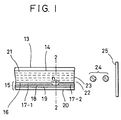
- the structure of the recording head, the main component of the apparatus, is shown in Figs. 1, 2 and 3.
- the head 13 is produced by the adhesion of a plate having a groove 14 through which ink flows, made of glass, ceramic, or plastic, and a thermal head 15 including a heating resistance layer for thermal recording (in these figures, although a thin-film head is shown, it is for the purpose of description and not of limitation).
- the thermal head 15 comprises a protecting film 16 formed of silicon oxide and the like, aluminum electrodes 17-1 and 17-2, a heating resistance layer 18 made of nichrome, a heat accumulating layer 19, and a radiating substrate 20 such as an alumina substrate.
- the ink 21 reaches a discharge orifice 22 and forms a meniscus 23 due to pressure.
- the region n in the thermal head 15 is rapidly heated, and a bubble forms in the ink in contact with the thermal head 15.
- the meniscus 23 protrudes due to the pressure from bubble formation.
- the ink drop 24 formed at the discharge orifice 22 is ejected toward the recording medium 25.
- Fig. 3 is a perspective view of a recording head in which a number of nozzles as shown in Fig. 1 are arranged.
- This recording head is made by adhering a plate 27 such as a glass plate having a number of passages 26 to a thermal head 28 similar to that described in Fig. 1.
- Fig. 1 is a cross-sectional view of the head 13 along the ink passage
- Fig. 2 is a cross-sectional view at the line 2-2 of Fig. 1.
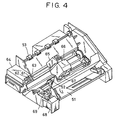
- Fig. 4 is an example of an ink-jet recording apparatus incorporating the above-described head.
- an end of a blade 61 acting as a wiper, is held by a blade holding member to form a fixed end formed as a cantilever.
- the blade 61 is provided at a position adjacent a region being recorded by the recording head 65.
- the blade 61 is held so as to protrude into the path of movement of the recording head 65.
- a cap 62 for the ink-ejection opening of the recording head 65 is placed at the home position adjacent the blade 61.
- the cap 62 moves in the direction perpendicular to the direction of movement of the recording head 65, and can contact the ink-ejection opening to cap it.
- An ink absorbent 63 is provided adjacent the blade 61, and protrudes into the path of movement of the recording head 65, like the blade 61.
- An ink-jet recovery section 64 consists of the blade 61, the cap 62, and the ink absorbent 63. The blade 61 and the ink absorbent 63 remove water, dust and the like from the ink-ejection opening.
- the recording head 65 has an energy-generating means and records images on the recording medium opposite the ink-ejection opening having a nozzle, by ejecting the ink.
- a carriage 66 is provided to carry the recording head 65 mounted on the carriage 66.
- the carriage 66 is attached so as to slide along a guide shaft 67, and a part of the carriage 66 connects with a belt 69 driven by a motor 68 (the connection is not shown in Fig. 4). Since the carriage 66 can move along the guide shaft 67, the recording head 65 can also move to the recording regions and their surrounding regions.
- the recording medium is fed to a position opposite the ink-ejection opening of the recording head 65 by a feeder 51 inserting the recording medium and a carrying roll 52 driven by a motor (not shown), and is discharged to a discharge section provided with a discharge roll 53 as recording proceeds.
- the recording head 65 When the recording head 65 returns to the home position due to completion of recording and the like, the cap 62 in the ink-jet recovery section 64 recedes from the path of movement of the recording head 65, but the blade 61 protrudes into the path of movement. As a result, the ink-ejection opening of the recording head 65 is wiped.
- the cap 62 contacts the ink-ejection opening of the recording head 65 in order to cap the ink-ejection opening, the cap 62 moves so as to protrude into the path of movement of the recording head.
- the recording head 65 moves from the home position to a position starting the recording, since the cap 62 and blade 61 are located at the same position as that at wiping, the ink-ejection opening of the recording head 65 is also wiped by this motion.
- the recording head 65 moves to the home position at the time of completion of recording and recovery of the ink-jet. Further, the recording head 65 moves to the home position for wiping at predetermined intervals when the recording head 65 moves between recording regions.
- Fig. 5 is an embodiment of the ink cartridge 45 containing the ink to be fed to the head though an ink feeding member such as a tube.
- the ink is stored in an ink reservoir 40, for example, an ink bag, having a rubber stopper 42 at the opening end.
- the ink in the ink bag 40 can be fed to the head by inserting a needle (not shown in the figure) into the stopper 42.
- Waste ink is absorbed with an ink absorbent 44.
- Desirable materials for the surface which contacts the ink in the ink reservoir are polyolefin compounds, in particular, polyethylene.
- a recording unit 70 contains the ink reservoir such as an ink absorbing member, and the ink in the ink absorbing member is discharged as an ink drop from a head 71 having plural orifices.
- the material composing the ink absorbing member polyurethane, cellulose or polyvinyl acetate may be used.
- An opening 72 is provided to communicate air to the recording unit inside.
- the recording unit 70 is used instead of the recording head shown in Fig. 4 and is freely loaded to and unloaded from the carriage 66.
- ink-jet recording apparatus which discharges the ink drops by applying thermal energy to the ink has been described.
- other types of ink-jet recording apparatus such as the piezoelectric type, can also be used.
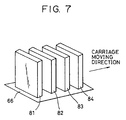
- a recording apparatus shown in Fig. 7 may be used, in which four recording heads shown in Fig. 3 are arranged on the carriage 66. These recording heads 81, 82, 83 and 84 discharge yellow, magenta, cyan, and black inks, respectively. These heads 81 to 84 are arranged in the recording apparatus and discharge the respective inks in response to recording signals.
- the number of recording heads is not restricted to the embodiment shown in Fig. 7, in which four heads are used.
- the yellow ink, magenta ink, cyan ink, and black ink may be discharged from the respective nozzles in a long recording head as shown in Fig. 8.
- an ampholytic polymer was dissolved into a mixture of a solvent and water, and the pH of the solution was adjusted to 9.5 with ammonia water.
- the dyestuff i.e., C. I. Direct Yellow 86, or C. I. Food Black 2
- the solution was filtered under pressure with a membrane filter having a pore size of 0.22 ⁇ m made by Sumitomo Electric Industries, Ltd., brand name: FLUOROPORE-FILTER, to obtain a recording ink.
- an ink was prepared in a manner similar to EXAMPLE 1, but the pH of the solution was adjusted to 9.5 with sodium hydroxide instead of ammonia water.
- the composition of yellow ink allylamine/styrenesulfonic acid copolymer (Mw 80,000) 2 pbw Diethylene glycol 10 pbw Glycerin 5 pbw C.
- the composition of magenta ink 4-vinylpyridine/acrylic acid copolymer (Mw 8,000) 5 pbw Thiodiglycol 20 pbw C. I.
- an ink was prepared in a manner similar to EXAMPLE 1, but the pH of the solution was adjusted to 9.5 with sodium hydroxide instead of ammonia water.
- the composition of yellow ink allylamine/styrenesulfonic acid copolymer (Mw 2,000) 10 pbw Diethylene glycol 30 pbw Glycerin 5 pbw Urea 5 pbw C.
- Mw 2,000
- Diethylene glycol 30 pbw Glycerin 5 pbw Urea 5 pbw C.
- the composition of magenta ink 4-vinylpyridine/maleic acid copolymer (Mw 800,000) 0.5 pbw Thiodiglycol 30 pbw C. I.
- an ink was prepared in a manner similar to EXAMPLE 1, but the pH of the solution was adjusted to 5.5 with hydrochloric acid to dissolve the ampholytic polymer.
- the composition of yellow ink allylamine/styrenesulfonic acid copolymer (Mw 80,000) 2 pbw Diethylene glycol 10 pbw Glycerin 5 pbw C.
- Basic Yellow 11 3 pbw Water 80 pbw
- the composition of magenta ink 4-vinylpyridine/acrylic acid copolymer (Mw 8,000) 5 pbw Thiodiglycol 20 pbw C. I.
- the above components were mixed and heated to 70 °C in a water bath to completely dissolve the resin component.
- 15 parts by weight of C. I. Pigment Yellow 12 was added.
- the dispersion was further treated under the following conditions: Dispersion mixer Sand grinder made by Igarashi Kikai K.K. Grinding media Zirconia Beads (1 mm in diameter) Filling ratio of grinding media 50% by volume Grinding time 3 hours After the treatment, the dispersion was subjected to centrifugal separation at 12,000 rpm for 20 minutes, to eliminate coarse particles.
- Magenta, cyan, and black dispersions were also prepared by a similar process by using 15 parts by weight of C. I. Pigment Red 5, 15 parts by weight of C. I. Pigment Blue 15, and 15 parts by weight of carbon black, respectively, instead of C. I. Pigment Yellow 12. After the pH of each ampholytic polymer solution was adjusted to 9.5 with ammonia water, the respective pigment dispersion was added and mixed to obtain the respective recording ink. The composition of magenta ink The dispersion of C. I.
- Pigment Red 5 30 pbw n-methylallylamine/itaconic acid copolymer (Mw 7,000) 5 pbw Glycerin 5 pbw Diethylene glycol 12 pbw Isopropyl alcohol 3 pbw Water 45 pbw The composition of cyan ink The dispersion of C. I.
- the above components were mixed and heated to 70 °C in a water bath to completely dissolve the resin component.
- 15 parts by weight of C. I. Pigment Yellow 12 was added.
- the dispersion was further treated under the following conditions: Dispersion mixer Sand grinder made by Igarashi Kikai K.K. Grinding media Zirconia Beads (1 mm in diameter) Filling ratio of grinding media 50% by volume Grinding time 3 hours After the treatment, the dispersion was subjected to centrifugal separation at 12,000 rpm for 20 minutes, to eliminate coarse particles.
- Magenta, cyan, and black dispersions were also prepared by a similar process by using 15 parts by weight of C. I. Pigment Red 5, 15 parts by weight of C. I. Pigment Blue 15, and 15 parts by weight of carbon black, respectively, instead of C. I. Pigment Yellow 12. After the pH of each ampholytic polymer solution was adjusted to 5.0 with hydrochloric acid, the respective pigment dispersion was added and mixed to obtain the respective recording ink. The composition of magenta ink The dispersion of C. I.
- Pigment Red 5 30 pbw n-methylallylamine/itaconic acid copolymer (Mw 7,000) 5 pbw Glycerin 5 pbw Diethylene glycol 12 pbw Isopropyl alcohol 3 pbw Water 45 pbw The composition of cyan ink The dispersion of C. I.
- each of the ampholytic polymer and the compound having general formula (A) was previously dissolved into a solution having a predetermined pH.
- each of the ampholytic polymer i.e., methylallylamine/itaconic acid copolymer, and Compound (1) was prepared as a 25% aqueous solution having a pH of 9.5 with aqueous ammonia.
- the pigment dispersion was gradually added into the solution while mixing thoroughly to obtain the yellow ink.
- C. I. Pigment Yellow 12 15 parts by weight of C. I. Pigment Red 5 for a magenta ink, 15 parts by weight of C. I. Pigment Blue 15 for a cyan ink, and 15 parts by weight of carbon black for a black ink were added to prepare the respective dispersions.
- the magenta, cyan, and black inks were similarly prepared according to the following formulations: The composition of magenta ink The above dispersion of C. I.
- each of the ampholytic polymer i.e., 4-vinylpyridine/fumaric acid copolymer, and Compound (2) was prepared as a 25% aqueous solution having a pH of 4.5 with hydrochloric acid.
- the pigment dispersion was gradually added into the solution while mixing thoroughly to obtain the yellow ink.
- C. I. Pigment Yellow 12 15 parts by weight of C. I. Pigment Red 5 for a magenta ink, 15 parts by weight of C. I. Pigment Blue 15 for a cyan ink, and 15 parts by weight of carbon black for a black ink were added to prepare the respective dispersions.
- the magenta, cyan, and black inks were similarly prepared according to the following formulations: The composition of magenta ink The above dispersion of C. I.
- EXAMPLES 1 and 7 the yellow and black inks were recorded at the same time.
- EXAMPLES 2, 3, 5, 6, 8, 9, 11, and 12 the four color inks, i.e., yellow, magenta, cyan, and black inks, were recorded at the same time.
- EXAMPLES 4 and 10 the yellow, magenta, cyan inks were recorded at the same time, and a black color was generated by combining these three colors.
- a recording apparatus similar to that shown in Fig. 4 with four recording heads as shown in Fig. 7 was used to form color images.
- the recording head used was the one used in BJC820, trade name of an ink-jet printer made by Canon.
- the heads were driven with an applied voltage of 28V, a pulse width of 3.2 ⁇ seconds, and a drive frequency of 5 kHz.
- the present invention provides an image having excellent image density without bleeding, and excellent water resistance when color ink-jet recording is performed on plain paper. Further, according to the ink-jet recording process and apparatus of the present invention, an image having excellent image density without bleeding, and excellent water resistance can be recorded on plain paper when the above-mentioned ink is used.
Landscapes
- Chemical & Material Sciences (AREA)
- Life Sciences & Earth Sciences (AREA)
- Engineering & Computer Science (AREA)
- Materials Engineering (AREA)
- Wood Science & Technology (AREA)
- Organic Chemistry (AREA)
- Inks, Pencil-Leads, Or Crayons (AREA)
- Ink Jet Recording Methods And Recording Media Thereof (AREA)
Claims (28)
- Tinte für den Tintenstrahldruck auf Normalpapier, welche aufweisteinen Farbstoff,ein Lösungsmittel zum Auflösen der Tinte undein ampholytisches Polymeres mit einem isoelektrischen Punkt in einem pH-Bereich zwischen 3 und 10, wobei das Polymere ein Kopolymeres aus einem Momomeren mit einer anionischen Gruppe und einem Monomeren mit einer kationischen Gruppe und, wobei(a) der Farbstoff ein anionischer Farbstoff und die Tinte einen höheren pH-Wert als der des isoelektrischen Punktes des Polymeren hat und der pH-Wert der Tinte derart eingestellt ist, dass das Aufbringen der Tinte auf Normalpapier zur Folge hat, dass der pH-Wert der Tinte gleich dem isoelektrischen Punkt des ampholytischen Polymeren wird und der anionische Farbstoff mit dem ampholytischen Polymeren reagiert; oder(b) der Farbstoff ein kationischer Farbstoff ist und die Tinte einen niedrigeren pH-Wert als der des isoelektrischen Punktes des Polymeren hat und der pH-Wert der Tinte derart eingestellt ist, dass das Aufbringen der Tinte auf Normalpapier zur Folge hat, dass der pH-Wert der Tinte im wesentlichen gleich dem isoelektrischen Punkt des ampholytischen Polymeren wird und der kationische Farbstoff mit dem ampholytischen Polymeren reagiert.
- Tinte zum Tintenstrahldruck auf Normalpapier, welche aufweist:(a) - ein Pigment,die Tinte einen höheren pH-Wert hat als der des isoelektrischen Punktes des Polymeren und der pH-Wert der Tinte derart eingestellt ist, dass das Aufbringen der Tinte auf Normalpapier zur Folge hat, das der pH-Wert der Tinte gleich dem isoelektrischen Punkt des ampholytischen Polymeren wird, und das Dispergierungsmittel eine anionische Gruppe zur Reaktion mit dem ampholytischen Polymeren hat, oderein Lösungsmittel undein ampholytisches Polymeres mit einem isoelektrischen Punkt in einem pH-Bereich zwischen 3 und 10, wobei das Polymere ein Kopolymeres aus einem Monomeren mit einer anionischen Gruppe und einem Monomeren mit einer kationischen Gruppe ist, undeinen Dispergierungsmittel mit einer anionischen Gruppe zum anionischen Dispergieren des Pigmentes in dem Lösungsmittel, wobei(b) - ein Pigmentdie Tinte einen niedrigeren pH-Wert als der des isoelektrischen Punktes des Polymeren hat und der pH-Wert der Tinte derart eingestellt ist, dass das Aufbringen der Tinte auf Normalpapier zur Folge hat, dass der pH-Wert der Tinte gleich dem isoelektrischen Punkt wird, und das Dispergierungsmittel eine kationische Gruppe zur Reaktion mit dem ampholytischen Polymeren hat.ein Lösungsmittel,ein ampholytisches Polymeres mit einem isoelektrischen Punkt in einem pH-Bereich zwischen 3 und 10, wobei das Polymere ein Kopolymeres aus einem Monomeren mit einer anionischen Gruppe und einem Monomeren mit einer kationischen Gruppe ist, undein Dispergierungsmittel mit einer kationischen Gruppe zum kationischen Dispergieren des Pigmentes im Lösungsmittel, wobei
- Tinte nach Anspruch 1 oder 2, wobei
0.1 bis 20 gw.-% der Tinte das ampholytische Polymere ist. - Tinte nach einem der vorangehenden Ansprüche, wobei
das ampholytische Polymere aus der Gruppe ausgewählt ist, welche besteht aus:
Allylamin/Maleinsäure-Copolymer, n-Methylallylamin/Maleinsäure-Copolymer, 4-Vinylpyridin/Acrylsäure-Copolymer, n-Methylaminoethyl Methacrylat/Methacrylsäure-Copolymer, Acrylamid/Styrenesulfonsäure-Copolymer, Allylamin/Styrenesulfonsäure-Copolymer, 2-Vinylpyridin/ Maleinsäure-Copolymer, Diallylamin/Styrenesulfonsäure-Copolymer, 4-Vinylpyridin/Maleinsäure-Copolymer, 2-Vinylpyridin/ltaconsäure-Copolymer, n-Methylaminoethyl Methacrylat/Acrylsäure-Copolymer, 4-Vinylpyridin/Itaconsäure-Copolymer, n-Methallylamin/Itaconsäure-Copolymer und 4-Vinylpyridin/Fumarinsäure. - Tinte nach einem der vorangehenden Ansprüche, wobei
die anionische Gruppe eine Karboxyl- oder Sulfongruppe ist. - Tinte nach einem der vorangehenden Ansprüche, wobei
das Lösungsmittel Wasser und ein wasserlösliches organisches Lösungsmittel aufweist. - Tinte nach einem der vorangehenden Ansprüche, wobei
die kationische Gruppe aus der aus einer Aminogruppe, einer Iminogruppe, einem Pyrrolindonring und einem Imidazolring bestehenden Gruppe ausgewählt ist. - Tinte nach Anspruch 1 oder 2, wobei
das ampholytische Polymere ein gewichtsbezogenes mittleres Molekulargewicht im Bereich zwischen 1.000 und 1.000.000 hat. - Tinte nach einem der vorangehenden Ansprüche, wobei
die Tinte weiter ein pH-Wert-Modifizierungsmittel aufweist. - Tinte nach einem der vorangehenden Ansprüche, wobei
die Tinte weiter aufweist:eine durch die folgende allgemeine Formel (A) repräsentierte Verbindung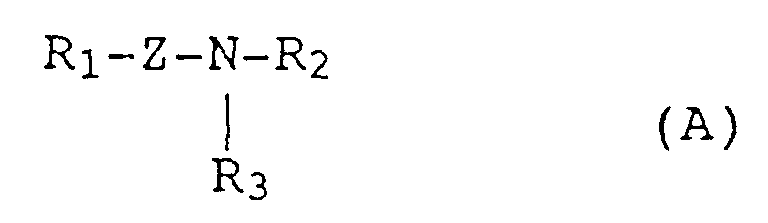 wobeiR1 ein Wasserstoffatom oder eine Alkylgruppe mit 1 bis 48 Kohlenstoffatomen darstellt;R2 ein Wasserstoffatom oder (CH2)a-X1 darstellt, wobei a eine ganze Zahl zwischen 1 und 4 ist;R3 ein Wasserstoffatom, (CH2)b-X2 oder R4-Y darstellt, wobei b eine ganze Zahl zwischen 1 und 4 ist;R4 ein Wasserstoffatom oder eine Alkylgruppe mit 1 bis 48 Kohlenstoffatomen darstellt;Z (NR5CmH2l)c(NHCnH2n)d darstellt, wobei I und n jeweils eine ganze Zahl zwischen 2 und 4 und c + d eine ganze Zahl zwischen 0 und 50 ist;Y (NR6CmH2,)e(NHCpH2p)f darstellt, wobei m und p jeweils eine ganze Zahl zwischen 2 und 4 und e + f eine ganze Zahl zwischen 0 und 50 sind;R5 (CH2)g-X3 darstellt, wobei g eine ganze Zahl zwischen 1 und 4 ist,R6 (CH2)h-X4 darstellt, wobei h eine ganze Zahl zwischen 1 und 4 darstellt, X1, X2, X3 und X4 jeweils aus der aus einer Karboxylgruppe, Salzen der Karboxylgruppe, einer Sulfongruppe, Salzen der Sulfongruppe und einem Wasserstoffatom bestehenden Gruppe ausgewählt ist;und, wenn R2 und R3 jeweils ein Wasserstoffatom ist, c und e nicht beide gleichzeitig Null sind und X1, X2, X3 und X4 nicht sämtlich Wasserstoffatome sind.
 - Tinte nach Anspruch 10, wobei
X1, X2, X3 und X4 jeweils aus der aus Salzen der Karboxylgruppe, Salzen der Sulfongruppe und einem Wasserstoff bestehenden Gruppe ausgewählt sind. - Tinte nach einem der Ansprüche 10 bis 11, wobei
R1 und R4 der Verbindung mit der allgemeinen Formel (A) eine Alkylgruppe mit 1 bis 32 Kohlenstoffatomen sind, wobei c + d und e + f jeweils eine ganze Zahl zwischen 0 und 16 ist und a, b, g und h jeweils eine ganze Zahl mit dem Wert 1 oder 2 ist. - Tinte nach einem der Ansprüche 10 bis 12, wobei
die Anteile des ampholytischen Polymeren und der Verbindung mit der allgemeinen Formel (A) zwischen 0,1 und 30 gw.-% bzw. zwischen 0,01 und 10 gw.-% des Gesamtgewichtes der Tinte liegen. - Verfahren zur Aufzeichnung eines Bildes auf ein Aufzeichnungsmedium, mit den Schritten:(i) Bereitstellung eines Aufzeichnungsmediums, dessen Oberfläche einen bestimmten pH-Wert hat,(ii) Bereitstellen einer Tinte, welche aus der Gruppe ausgewählt ist, die besteht aus:(a) einer Tinte mit einem anionischen Farbstoff, einem Lösungsmittel zum Auflösen des anionischen Farbstoffs und einem ampholytischen Polymeren mit einem isoelektrischen Punkt im pH-Wert zwischen 3 und 10, wobei das Polymere ein Copolymeres aus einem Monomeren mit einer anionischen Gruppe und einem Monomeren mit einer kationischen Gruppe ist, die Tinte eine höheren pH-Wert als der isoelektrische Punkt des Polymeren hat, der pH-Wert der Tinte derart eingestellt ist, dass das Aufbringen der Tinte auf Normalpapier zur Folge hat, dass der pH-Wert der Tinte gleich dem isoelektrischen Punkt des ampholytischen Polymeren wird, und der kationische Farbstoff mit dem ampholytischen Polymeren reagiert,(b) einer Tinte mit einem kationischen Farbstoff, einem Lösungsmittel zum Auflösen des kationischen Farbstoffes und einem ampholytischen Polymeren mit einem isoelektrischen Punkt in einem pH-Bereich zwischen 3 und 10, wobei das Polymere ein Copolymeres aus einem Monomeren mit einer anionischen Gruppe und einem Monomeren mit einer kationischen Gruppe ist, die Tinte einen niedrigeren pH-Wert als der isoelektrische Punkt des Polymeren hat, der pH-Wert der Tinte derart eingestellt ist, dass das Aufbringen der Tinte auf Normalpapier zur Folge hat, dass der pH-Wert der Tinte gleich dem isoelektrischen Punkt des ampholytischen Polymeren wird, und der kationische Farbstoff mit dem ampholytischen Polymeren reagiert,(c) einer Tinte mit einem Lösungsmittel, einem in dem Lösungsmittel dispergierten anionischen Pigment, einem Dispergierungsmittel mit einer anionischen Gruppe zum anionischen Dispergieren des Pigmentes im Lösungsmittel und einem ampholytischen Polymeren mit einem isoelektrischen Punkt im pH-Bereich zwischen 3 und 10, welches ein Kopolymeres aus einem Monomeren mit einer anionischen Gruppe und einem Monomeren mit einer kationischen Gruppe ist, wobei die Tinte einen höheren pH-Wert als der isoelektrische Punkt des Polymeren hat, der pH-Wert der Tinte derart eingestellt ist, dass das Aufbringen der Tinte auf Normalpapier zur Folge hat, dass der pH-Wert der Tinte gleich dem isoelektrischen Punkt des ampholytischen Polymeren wird, und das Dispergierungsmittel eine anionische Gruppe zur Reaktion mit dem ampholytischen Polymeren hat, und(d) einer Tinte mit einem Lösungsmittel, einem in dem Lösungsmittel kationisch dispergierten Pigment, einem Dispergierungsmittel mit einer kationischen Gruppe zum kationischen Dispergieren des Pigments in dem Lösungsmittel und einem ampholytischen Polymeren mit einem isoelektrischen Punkt in einem pH-Bereich zwischen 3 und 10, welches ein Kopolymeres aus einem Monomeren mit einer anionischen Gruppe und einem Monomeren mit einer kationischen Gruppe ist, wobei die Tinte ein niedrigeren pH-Wert als der isoelektrische Punkt des Polymeren hat, der pH-Wert der Tinte derart eingestellt ist, dass das Aufbringen der Tinte auf Normalpapier zur Folge hat, dass der pH-Wert der Tinte gleich dem isoelektrischen Punkt des ampholytischen Polymeren wird und das Dispergierungsmittel eine kationische Gruppe zur Reaktion mit dem ampholytischen Polymeren hat,(iii) Aufbringen der Tinte auf die Oberfläche von Normalpapier durch einen Tintenstrahlaustragprozeß und(iv) Bewirken eines Gelierens des ampholytischen Polymerens und Fixieren des Farbstoffs oder des Pigments auf der Oberfläche des Normalpapiers.
- Tintenstrahlaufzeichnungsverfahren nach Anspruch 14, wobei
das Tintenstrahlsystem Tintentröpfchen durch Zufuhr thermischer Energie zur Tinte ausbildet. - Verwendung der Tinte nach einem der Ansprüche 1 bis 13
in einer Tintenstrahlaufzeichnungsvorrichtung, welche ein Tintenreservoir und einen Tintenstrahlkopf zur Ausbildung von Tintentröpfchen aus der aus dem Tintenreservoir zugeführten Tinte aufweist. - Verwendung der Tinte nach einem der Ansprüche 1 bis 13
in einer Tintenstrahlaufzeichnungseinheit, welche ein die Tinte enthaltendes Tintenreservoir und einen Kopf zum Austragen von Tintentröpfchen aufweist. - Verwendung nach Anspruch 17, wobei
der Kopf Tintentröpfchen durch Zufuhr thermischer Energie zur Tinte austrägt. - Verwendung nach Anspruch 17, wobei
das Tintenreservoir aus Polyurethan, Zellulose oder Polyvinylacetat gebildet ist. - Verwendung der Tinte nach einem der Ansprüche 1 bis 13
in einer Tintenpatrone, die ein die Tinte enthaltendes Tintenreservoir aufweist. - Verwendung nach Anspruch 20, wobei
das Tintenreservoir eine in Kontakt mit der Tinte stehende Oberfläche hat, die eine Polyolefin-Verbindung aufweist. - Verwendung der Tinte nach einem der Ansprüche 1 bis 13
in einer Tintenstrahlaufzeichnungsvorrichtung, welche eine Tintenstrahlaufzeichnungseinheit mit einem die Tinte enthaltenden Tintenreservoir und einen Kopf zum Austragen von Tinte als Tröpfchen aufweist. - Verwendung nach Anspruch 22, wobei
der Kopf Tintentröpfchen durch Zufuhr thermischer Energie zur Tinte austrägt. - Verwendung nach Anspruch 23, wobei
das Tintenreservoir aus Polyurethan, Zellulose oder Polyvinylacetat gebildet ist. - Verwendung einer Tinte nach einem der Ansprüche 1 bis 13
in einer Tintenstrahlaufzeichnungseinheit, die einen Aufzeichnungskopf zum Austragen von Tintentröpfchen und eine Tintenpatrone mit einem Tinte enthaltenden Tintenreservoir und einen Tintenzufuhrabschnitt zum Zuführen der Tinte aus der Tintenpatrone zum Aufzeichnungskopf hat. - Verwendung nach Anspruch 25, wobei
der Aufzeichnungskopf Tintentröpfchen durch Zufuhr thermischer Energie zur Tinte austrägt. - Verwendung nach Anspruch 25, wobei
das Tintenreservoir eine in Kontakt mit der Tinte stehende Oberfläche hat, welche eine Polyolefin-Verbindung aufweist. - Verwendung der Tinte nach einem der Ansprüche 1 bis 13
zur Tintenstrahlaufzeichnung.
Applications Claiming Priority (6)
| Application Number | Priority Date | Filing Date | Title |
|---|---|---|---|
| JP10708295 | 1995-04-07 | ||
| JP10708295 | 1995-04-07 | ||
| JP107082/95 | 1995-04-07 | ||
| JP1476596 | 1996-01-04 | ||
| JP14765/96 | 1996-01-04 | ||
| JP1476596A JPH09188843A (ja) | 1996-01-04 | 1996-01-04 | インク、これを用いた記録方法及びかかるインクを用いた機器 |
Publications (3)
| Publication Number | Publication Date |
|---|---|
| EP0736582A2 EP0736582A2 (de) | 1996-10-09 |
| EP0736582A3 EP0736582A3 (de) | 1997-01-15 |
| EP0736582B1 true EP0736582B1 (de) | 2001-10-10 |
Family
ID=26350778
Family Applications (1)
| Application Number | Title | Priority Date | Filing Date |
|---|---|---|---|
| EP96105460A Expired - Lifetime EP0736582B1 (de) | 1995-04-07 | 1996-04-04 | Tinte, Tintenstrahldruckverfahren und -gerät |
Country Status (3)
| Country | Link |
|---|---|
| US (1) | US6174354B1 (de) |
| EP (1) | EP0736582B1 (de) |
| DE (1) | DE69615730T2 (de) |
Families Citing this family (42)
| Publication number | Priority date | Publication date | Assignee | Title |
|---|---|---|---|---|
| EP0818516B1 (de) * | 1996-07-08 | 2005-03-02 | Hewlett-Packard Company, A Delaware Corporation | Wässrige Tinte enthaltend wasserunlösliche Farbstoffe |
| DE69722767T2 (de) * | 1996-11-13 | 2004-02-12 | Seiko Epson Corp. | Tintezusammensetzung enthaltend ein wasserlösliches harz |
| DE69815188T2 (de) * | 1997-03-25 | 2003-11-27 | Seiko Epson Corp., Tokio/Tokyo | Tintenzusammensetzung enthaltend ein kationisches wasserlösliches Harz |
| US6048389A (en) * | 1998-02-18 | 2000-04-11 | Eastman Kodak Company | Ink jet inks containing modifiers for improved drop formation |
| US20020150732A1 (en) * | 2001-02-09 | 2002-10-17 | Manisha Sarkar | Image receptor sheet containing vinylpyridine copolymer |
| US7059715B2 (en) * | 2002-09-13 | 2006-06-13 | Fuji Photo Film Co., Ltd. | Sheet for ink jet recording, ink for ink jet recording, manufacturing method of ink for ink jet recording, ink set for ink jet recording, and ink jet recording method |
| CA2511100C (en) | 2002-12-27 | 2008-12-23 | Canon Kabushiki Kaisha | Water base ink, method of ink jet recording, ink cartridge, recording unit, ink jet recording apparatus and method of image formation |
| ATE516329T1 (de) * | 2004-05-10 | 2011-07-15 | Canon Kk | Tintensatz, tintenstrahldruckverfahren, tintenpatrone, tintenstrahldruckvorrichtung und bildherstellungsverfahren |
| WO2006001508A1 (ja) * | 2004-06-24 | 2006-01-05 | Canon Kabushiki Kaisha | 水性インク、インクタンク、インクジェット記録装置、インクジェット記録方法、及びインクジェット記録画像 |
| WO2006001538A1 (ja) * | 2004-06-28 | 2006-01-05 | Canon Kabushiki Kaisha | 水性インク、水性インクセット、インクカートリッジ、インクジェット記録装置、インクジェット記録方法及び画像形成方法 |
| CN1977004B (zh) * | 2004-06-28 | 2010-05-05 | 佳能株式会社 | 水性墨水、喷墨记录方法、墨盒、记录单元、喷墨记录装置和图像形成方法 |
| AU2005257524B2 (en) * | 2004-06-28 | 2009-07-30 | Canon Kabushiki Kaisha | Aqueous ink, ink set, and image forming method |
| WO2006001540A1 (ja) * | 2004-06-28 | 2006-01-05 | Canon Kabushiki Kaisha | シアンインク、インクセット、インクと反応液のセット、及び画像形成方法 |
| CN1973005B (zh) * | 2004-06-28 | 2010-09-29 | 佳能株式会社 | 青色墨水及成套墨水 |
| CN1972809B (zh) * | 2004-06-28 | 2011-09-07 | 佳能株式会社 | 记录方法、墨盒及图像形成方法 |
| JP2006069181A (ja) * | 2004-09-06 | 2006-03-16 | Brother Ind Ltd | インクジェット記録装置用インクカートリッジ及びインクジェット記録装置 |
| JP4812078B2 (ja) | 2004-12-28 | 2011-11-09 | キヤノン株式会社 | インクジェット記録装置 |
| US7666255B2 (en) * | 2005-03-09 | 2010-02-23 | Hewlett-Packard Development Company, L.P. | Ink-jet inks having surfactants below the critical micelle concentration and associated methods |
| DE102005017052A1 (de) * | 2005-04-12 | 2006-10-19 | Basf Ag | Verfahren zum Aufbringen von gelösten oder dispergierten Substanzen |
| JP4971754B2 (ja) * | 2005-11-16 | 2012-07-11 | キヤノン株式会社 | 水性インク、インクジェット記録方法、インクカートリッジ、記録ユニット、及びインクジェット記録装置 |
| JP5938815B2 (ja) * | 2006-05-25 | 2016-06-22 | キヤノン株式会社 | 水性インク、インクジェット記録方法、インクカートリッジ、記録ユニット、及びインクジェット記録装置 |
| WO2008055244A2 (en) | 2006-10-31 | 2008-05-08 | Sensient Colors Inc. | Modified pigments and methods for making and using the same |
| US20100010148A1 (en) * | 2007-02-26 | 2010-01-14 | Mitsubishi Chemical Corporation | Aqueous pigment dispersion, method for producing the same, and recording liquid containing the same |
| JP2008239964A (ja) * | 2007-03-01 | 2008-10-09 | Canon Inc | インクジェット記録用インクセット及びインクジェット記録方法 |
| US7988277B2 (en) * | 2007-05-11 | 2011-08-02 | Canon Kabushiki Kaisha | Ink set, ink jet recording method, ink cartridge, recording unit, ink jet recording method, and aqueous ink |
| US7682433B2 (en) * | 2007-05-11 | 2010-03-23 | Canon Kabushiki Kaisha | Ink set, ink jet recording method, ink cartridge, recording unit, and ink jet recording apparatus |
| US8016932B2 (en) * | 2007-05-11 | 2011-09-13 | Canon Kabushiki Kaisha | Aqueous ink, ink set, image forming method and image forming apparatus |
| EP3483222A3 (de) | 2007-08-23 | 2019-08-07 | Sensient Colors LLC | Selbstdispergierte pigmente und ihre herstellung und verwendung |
| JP2009263626A (ja) * | 2008-03-31 | 2009-11-12 | Fujifilm Corp | 水不溶性色材分散体及びこの製造方法、これを用いた記録液、画像形成方法、及び画像形成装置 |
| JP2010235741A (ja) * | 2009-03-31 | 2010-10-21 | Fujifilm Corp | 水不溶性色材分散体 |
| EP2417202A2 (de) * | 2009-04-07 | 2012-02-15 | Sensient Colors LLC | Selbstdispergierende teilchen und verfahren zu ihrer herstellung und verwendung |
| WO2011055595A1 (ja) * | 2009-11-04 | 2011-05-12 | コニカミノルタホールディングス株式会社 | インクジェット用水性インク、およびインクジェット記録方法 |
| JP5709474B2 (ja) * | 2009-12-11 | 2015-04-30 | キヤノン株式会社 | 反応液とインクとのセット、及び画像形成方法 |
| JP6029304B2 (ja) | 2011-04-19 | 2016-11-24 | キヤノン株式会社 | インクと反応液とのセット、及び画像形成方法 |
| JP6000597B2 (ja) | 2011-04-19 | 2016-09-28 | キヤノン株式会社 | インク、インクカートリッジ及びインクジェット記録方法 |
| JP5988754B2 (ja) | 2011-09-08 | 2016-09-07 | キヤノン株式会社 | 水性インク、インクカートリッジ、及びインクジェット記録方法 |
| EP2574646B1 (de) | 2011-09-30 | 2014-10-08 | Brother Kogyo Kabushiki Kaisha | Tintensatz auf Wasserbasis für Tintenstrahlaufzeichnung, Tinte auf Wasserbasis und Tintenstrahlaufzeichnungsverfahren |
| JP2013209620A (ja) | 2012-03-02 | 2013-10-10 | Canon Inc | インク、インクカートリッジ、及びインクジェット記録方法 |
| JP6558974B2 (ja) | 2014-06-30 | 2019-08-14 | キヤノン株式会社 | 水性インク、水性インクの製造方法、インクカートリッジ、及びインクジェット記録方法 |
| US10253200B2 (en) | 2015-01-23 | 2019-04-09 | Canon Kabushiki Kaisha | Aqueous ink, ink cartridge, and ink jet recording method |
| JP2016138253A (ja) | 2015-01-23 | 2016-08-04 | キヤノン株式会社 | 水性インク、インクカートリッジ、及びインクジェット記録方法 |
| US12480012B2 (en) | 2021-01-29 | 2025-11-25 | Canon Kabushiki Kaisha | Ink jet recording method and ink jet recording apparatus |
Family Cites Families (21)
| Publication number | Priority date | Publication date | Assignee | Title |
|---|---|---|---|---|
| JPS5565269A (en) | 1978-11-10 | 1980-05-16 | Seiko Epson Corp | Quick drying ink for ink jet recording |
| JPS5566976A (en) | 1978-11-13 | 1980-05-20 | Seiko Epson Corp | Quick-drying ink for ink-jet recording |
| JPS6096673A (ja) | 1983-10-31 | 1985-05-30 | Pentel Kk | 水性インキ |
| JPS6159911A (ja) | 1984-08-30 | 1986-03-27 | Nec Corp | 切換スイツチ回路 |
| JPS6159914A (ja) | 1984-08-31 | 1986-03-27 | Fujitsu Ltd | デイジタル圧縮装置 |
| JPS6159912A (ja) | 1984-08-31 | 1986-03-27 | Fujitsu Ltd | Ttl回路 |
| US4909986A (en) * | 1985-07-23 | 1990-03-20 | Dainippon Ink | Aqueous deodorants and deodorizing methods |
| US4904719A (en) * | 1987-01-15 | 1990-02-27 | Wacker-Chemie Gmbh | Noncorrosive, aqueous organopolysiloxane emulsions |
| CA1336110C (en) * | 1989-02-03 | 1995-06-27 | Robert Gregory Swisher | Polymeric-containing compositions with improved oxidative stability |
| JP3137331B2 (ja) * | 1989-10-31 | 2001-02-19 | ソニー株式会社 | 自動画質調整装置 |
| JPH03145382A (ja) * | 1989-10-31 | 1991-06-20 | Sanyo Electric Co Ltd | 輪郭補正回路 |
| US5272201A (en) | 1990-04-11 | 1993-12-21 | E. I. Du Pont De Nemours And Company | Amine-containing block polymers for pigmented ink jet inks |
| US5240982A (en) * | 1990-06-13 | 1993-08-31 | National Starch And Chemical Investment Holding Corporation | Amphoteric surfactants and copolymerizable amphorteric surfactants for use in latex paint |
| US5288687A (en) * | 1990-07-20 | 1994-02-22 | Mitsubishi Paper Mills Limited | Carbonless copying paper |
| JPH04139272A (ja) | 1990-09-29 | 1992-05-13 | Pentel Kk | 水性顔料インキ組成物 |
| US5106416A (en) | 1991-08-28 | 1992-04-21 | Hewlett-Packard Company | Bleed alleviation using zwitterionic surfactants and cationic dyes |
| DE69325401T2 (de) | 1992-02-20 | 1999-11-25 | E.I. Du Pont De Nemours & Co., Inc. | Dreiblock-Polymer Dispersionsmittel enthaltende Wasserdispersionen |
| US5226957A (en) | 1992-03-17 | 1993-07-13 | Hewlett-Packard Company | Solubilization of water-insoluble dyes via microemulsions for bleedless, non-threading, high print quality inks for thermal ink-jet printers |
| US5648405A (en) * | 1992-12-30 | 1997-07-15 | E. I. Du Pont De Nemours And Company | Aqueous ink jet inks |
| US5482545A (en) | 1993-12-28 | 1996-01-09 | Canon Kabushiki Kaisha | Ink, and ink-jet recording method and instrument using the same |
| US5529616A (en) * | 1994-11-23 | 1996-06-25 | E. I. Du Pont De Nemours And Company | Ink jet inks containing mixtures of alcohols |
-
1996
- 1996-04-02 US US08/626,312 patent/US6174354B1/en not_active Expired - Lifetime
- 1996-04-04 EP EP96105460A patent/EP0736582B1/de not_active Expired - Lifetime
- 1996-04-04 DE DE69615730T patent/DE69615730T2/de not_active Expired - Lifetime
Also Published As
| Publication number | Publication date |
|---|---|
| US6174354B1 (en) | 2001-01-16 |
| DE69615730D1 (de) | 2001-11-15 |
| EP0736582A3 (de) | 1997-01-15 |
| DE69615730T2 (de) | 2002-07-04 |
| EP0736582A2 (de) | 1996-10-09 |
Similar Documents
| Publication | Publication Date | Title |
|---|---|---|
| EP0736582B1 (de) | Tinte, Tintenstrahldruckverfahren und -gerät | |
| US5792249A (en) | Liquid composition, ink set, image-forming method and apparatus using the same | |
| CA2100201C (en) | Ink, ink-jet recording method, and ink-jet recording apparatus | |
| AU748191B2 (en) | Ink, ink set, ink cartridge, recording unit, image recording apparatus and image recording method | |
| AU642976B2 (en) | Ink, ink-jet recording process, and instrument using the ink | |
| EP0663299B1 (de) | Flüssige Zusammensetzung und Tintensortiment, Bildaufzeichnungsverfahren und Vorrichtung und Vorrichtung dafür | |
| EP1090966B1 (de) | Tintensatz für Tintenstrahl-Aufzeichnung, Tintenstrahl-Aufzeichnungsverfahren, Aufzeichnungseinheit, Aufzeichnungsgerät und Verfahren zur Reduzierung der Farbvermischung | |
| EP0675179B1 (de) | Bilderzeugungsverfahren, Tintenset und Tintenstrahlvorrichtung zu diesem Zweck | |
| US5985975A (en) | Liquid composition, ink set and method and apparatus for image by using the composition and ink set | |
| US5549740A (en) | Liquid composition, ink set and image forming method and apparatus using the composition and ink set | |
| US6460989B1 (en) | Ink set, formation of colored area on recording medium, and ink-jet recording apparatus | |
| US6375317B1 (en) | Ink, ink-jet recording process, recording unit, ink cartridge and ink-jet recording apparatus | |
| EP0581135B1 (de) | Tintenstrahlaufzeichnungsverfahren, Tintensortiment und Tintenstrahlaufzeichnungsgerät zur Verwendung in diesen Verfahren | |
| US5624484A (en) | Liquid composition and ink set, and image-forming process and apparatus using the same | |
| US6299675B1 (en) | Printing method, image forming process, ink, ink set, recording unit, image forming apparatus and print | |
| EP1191077A1 (de) | Flüssige Zusammensetzung, Tinte für Tintenstrahl, Tintenset für Tintenstrahlaufzeichnung, Tintenstrahlaufzeichnungsverfahren, Aufzeichnungseinheit, Tintenpatrone, und Tintenstrahlaufzeichnungsgerät | |
| JP3624014B2 (ja) | 液体組成物、インクセット及びこれを用いた画像形成方法と画像形成装置 | |
| JP4014056B2 (ja) | インクジェット用のインク、これを用いたインクジェット記録方法及びインクジェット記録装置 | |
| JPH09188843A (ja) | インク、これを用いた記録方法及びかかるインクを用いた機器 | |
| JPH06228478A (ja) | インクセット及びこれを用いたカラー画像の形成方法 | |
| JPH09151348A (ja) | インクセット、インクジェット記録方法及びインクジェット機器 | |
| JPH10219162A (ja) | インク組成物、インクセット、これを用いる画像記録方法及び記録装置 | |
| JPH09151346A (ja) | インクセット、これを用いるインクジェット記録方法及びインクジェット機器 | |
| JPH09151349A (ja) | インクセット、これを用いた記録方法及びかかるインクを用いた機器 | |
| US20030119940A1 (en) | Ink composition with improved lightfastness |
Legal Events
| Date | Code | Title | Description |
|---|---|---|---|
| PUAI | Public reference made under article 153(3) epc to a published international application that has entered the european phase |
Free format text: ORIGINAL CODE: 0009012 |
|
| AK | Designated contracting states |
Kind code of ref document: A2 Designated state(s): CH DE ES FR GB IT LI NL |
|
| PUAL | Search report despatched |
Free format text: ORIGINAL CODE: 0009013 |
|
| AK | Designated contracting states |
Kind code of ref document: A3 Designated state(s): CH DE ES FR GB IT LI NL |
|
| 17P | Request for examination filed |
Effective date: 19970714 |
|
| 17Q | First examination report despatched |
Effective date: 19980721 |
|
| GRAG | Despatch of communication of intention to grant |
Free format text: ORIGINAL CODE: EPIDOS AGRA |
|
| GRAG | Despatch of communication of intention to grant |
Free format text: ORIGINAL CODE: EPIDOS AGRA |
|
| GRAH | Despatch of communication of intention to grant a patent |
Free format text: ORIGINAL CODE: EPIDOS IGRA |
|
| GRAH | Despatch of communication of intention to grant a patent |
Free format text: ORIGINAL CODE: EPIDOS IGRA |
|
| GRAA | (expected) grant |
Free format text: ORIGINAL CODE: 0009210 |
|
| AK | Designated contracting states |
Kind code of ref document: B1 Designated state(s): CH DE ES FR GB IT LI NL |
|
| PG25 | Lapsed in a contracting state [announced via postgrant information from national office to epo] |
Ref country code: NL Free format text: LAPSE BECAUSE OF FAILURE TO SUBMIT A TRANSLATION OF THE DESCRIPTION OR TO PAY THE FEE WITHIN THE PRESCRIBED TIME-LIMIT Effective date: 20011010 Ref country code: LI Free format text: LAPSE BECAUSE OF FAILURE TO SUBMIT A TRANSLATION OF THE DESCRIPTION OR TO PAY THE FEE WITHIN THE PRESCRIBED TIME-LIMIT Effective date: 20011010 Ref country code: IT Free format text: LAPSE BECAUSE OF FAILURE TO SUBMIT A TRANSLATION OF THE DESCRIPTION OR TO PAY THE FEE WITHIN THE PRESCRIBED TIME-LIMIT;WARNING: LAPSES OF ITALIAN PATENTS WITH EFFECTIVE DATE BEFORE 2007 MAY HAVE OCCURRED AT ANY TIME BEFORE 2007. THE CORRECT EFFECTIVE DATE MAY BE DIFFERENT FROM THE ONE RECORDED. Effective date: 20011010 Ref country code: CH Free format text: LAPSE BECAUSE OF FAILURE TO SUBMIT A TRANSLATION OF THE DESCRIPTION OR TO PAY THE FEE WITHIN THE PRESCRIBED TIME-LIMIT Effective date: 20011010 |
|
| REG | Reference to a national code |
Ref country code: CH Ref legal event code: EP |
|
| REF | Corresponds to: |
Ref document number: 69615730 Country of ref document: DE Date of ref document: 20011115 |
|
| ET | Fr: translation filed | ||
| REG | Reference to a national code |
Ref country code: GB Ref legal event code: IF02 |
|
| NLV1 | Nl: lapsed or annulled due to failure to fulfill the requirements of art. 29p and 29m of the patents act | ||
| REG | Reference to a national code |
Ref country code: CH Ref legal event code: PL |
|
| PG25 | Lapsed in a contracting state [announced via postgrant information from national office to epo] |
Ref country code: ES Free format text: LAPSE BECAUSE OF FAILURE TO SUBMIT A TRANSLATION OF THE DESCRIPTION OR TO PAY THE FEE WITHIN THE PRESCRIBED TIME-LIMIT Effective date: 20020430 |
|
| PLBE | No opposition filed within time limit |
Free format text: ORIGINAL CODE: 0009261 |
|
| STAA | Information on the status of an ep patent application or granted ep patent |
Free format text: STATUS: NO OPPOSITION FILED WITHIN TIME LIMIT |
|
| 26N | No opposition filed | ||
| PGFP | Annual fee paid to national office [announced via postgrant information from national office to epo] |
Ref country code: GB Payment date: 20140414 Year of fee payment: 19 |
|
| PGFP | Annual fee paid to national office [announced via postgrant information from national office to epo] |
Ref country code: FR Payment date: 20140428 Year of fee payment: 19 Ref country code: DE Payment date: 20140430 Year of fee payment: 19 |
|
| REG | Reference to a national code |
Ref country code: DE Ref legal event code: R119 Ref document number: 69615730 Country of ref document: DE |
|
| GBPC | Gb: european patent ceased through non-payment of renewal fee |
Effective date: 20150404 |
|
| PG25 | Lapsed in a contracting state [announced via postgrant information from national office to epo] |
Ref country code: GB Free format text: LAPSE BECAUSE OF NON-PAYMENT OF DUE FEES Effective date: 20150404 Ref country code: DE Free format text: LAPSE BECAUSE OF NON-PAYMENT OF DUE FEES Effective date: 20151103 |
|
| REG | Reference to a national code |
Ref country code: FR Ref legal event code: ST Effective date: 20151231 |
|
| PG25 | Lapsed in a contracting state [announced via postgrant information from national office to epo] |
Ref country code: FR Free format text: LAPSE BECAUSE OF NON-PAYMENT OF DUE FEES Effective date: 20150430 |