EP0737018A2 - Verfahren zur gemeinsamen Nutzung eines einzelnen Funkkanals in einem zellularem Netz - Google Patents
Verfahren zur gemeinsamen Nutzung eines einzelnen Funkkanals in einem zellularem Netz Download PDFInfo
- Publication number
- EP0737018A2 EP0737018A2 EP96105013A EP96105013A EP0737018A2 EP 0737018 A2 EP0737018 A2 EP 0737018A2 EP 96105013 A EP96105013 A EP 96105013A EP 96105013 A EP96105013 A EP 96105013A EP 0737018 A2 EP0737018 A2 EP 0737018A2
- Authority
- EP
- European Patent Office
- Prior art keywords
- radio channel
- mobile unit
- request
- requesting
- transmitting
- Prior art date
- Legal status (The legal status is an assumption and is not a legal conclusion. Google has not performed a legal analysis and makes no representation as to the accuracy of the status listed.)
- Granted
Links
Images


Classifications
-
- H—ELECTRICITY
- H04—ELECTRIC COMMUNICATION TECHNIQUE
- H04W—WIRELESS COMMUNICATION NETWORKS
- H04W84/00—Network topologies
- H04W84/02—Hierarchically pre-organised networks, e.g. paging networks, cellular networks, WLAN [Wireless Local Area Network] or WLL [Wireless Local Loop]
- H04W84/04—Large scale networks; Deep hierarchical networks
- H04W84/08—Trunked mobile radio systems
-
- H—ELECTRICITY
- H04—ELECTRIC COMMUNICATION TECHNIQUE
- H04W—WIRELESS COMMUNICATION NETWORKS
- H04W72/00—Local resource management
- H04W72/20—Control channels or signalling for resource management
-
- H—ELECTRICITY
- H04—ELECTRIC COMMUNICATION TECHNIQUE
- H04W—WIRELESS COMMUNICATION NETWORKS
- H04W72/00—Local resource management
- H04W72/30—Resource management for broadcast services
-
- H—ELECTRICITY
- H04—ELECTRIC COMMUNICATION TECHNIQUE
- H04W—WIRELESS COMMUNICATION NETWORKS
- H04W76/00—Connection management
- H04W76/30—Connection release
-
- H—ELECTRICITY
- H04—ELECTRIC COMMUNICATION TECHNIQUE
- H04W—WIRELESS COMMUNICATION NETWORKS
- H04W84/00—Network topologies
- H04W84/18—Self-organising networks, e.g. ad-hoc networks or sensor networks
- H04W84/20—Leader-follower arrangements
-
- H—ELECTRICITY
- H04—ELECTRIC COMMUNICATION TECHNIQUE
- H04W—WIRELESS COMMUNICATION NETWORKS
- H04W84/00—Network topologies
- H04W84/18—Self-organising networks, e.g. ad-hoc networks or sensor networks
- H04W84/22—Self-organising networks, e.g. ad-hoc networks or sensor networks with access to wired networks
-
- H—ELECTRICITY
- H04—ELECTRIC COMMUNICATION TECHNIQUE
- H04W—WIRELESS COMMUNICATION NETWORKS
- H04W92/00—Interfaces specially adapted for wireless communication networks
- H04W92/16—Interfaces between hierarchically similar devices
- H04W92/18—Interfaces between hierarchically similar devices between terminal devices
Definitions
- This invention relates to a method and apparatus for acquiring and sharing a single radio channel in a mobile communications network.
- a single cell base manages the use of the radio spectrum for a particular geographic area, and provides wireless-to-wired bridging between a radio network and a terrestrial landline network.
- the spectrum is divided into channels, one or more of which are dedicated to control and signalling functions.
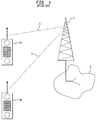
- a cell base is shown with several telephones (mobile phones 16 and 18) in its service area.
- the dotted lines 3 in the figure show that the logical connectivity (the flow of spoken information) is between the cell base 1 and each telephone 16 and 18. There is no logical connectivity directly between the telephones.
- a mobile phone In order to establish a connection with the cell base, a mobile phone first scans to find which channel is currently in use by the cell base for control and signalling purposes. It then waits and signals its presence in the cell, and that it desires to originate a call.
- the cell base responds by placing the call through its attachment to the landline network 6, and reserves a channel for use by the mobile phone. Actually, since in AMPS a channel is needed for transmission to the cell base (the "uplink” channel) and an additional channel is needed simultaneously for transmission from the cell base to the mobile phone (the "downlink” channel), a channel pair is allocated. Once the call is completed through the landline network, the mobile phone is free to use the channel pair for the call.
- a wireless subnetwork of notebook computers for example, in a cell base can acquire and maintain exclusive use of a channel pair for wireless communication among themselves.
- this invention provides a method and apparatus for sharing a single radio channel among a plurality of mobile units in cellular network.
- a request signal is transmitted from a selected one of the mobile units to the base station, where the request signal indicates a request to use a radio channel.
- a radio channel is assigned to the selected mobile unit for use by the mobile unit.
- the selected mobile unit then transmits idle signals over the radio channel to indicate its use of the radio channel.
- the selected unit also transmits advertisement signals to other mobile units indicating that the other mobile units may request use of the channel.
- the other mobile unit will transmit a second request to the selected mobile unit indicating a request to use the channel.
- the selected mobile unit will then transmit a response to the latter request indicating that the requesting other mobile unit may use the radio channel.
- the requesting other mobile unit receives the latter response from the selected mobile unit, it will then proceed to use the channel.
- the selected mobile unit Upon cessation of use of the channel by the requesting mobile unit, the selected mobile unit will resume transmission of the idle signal to indicate to the cell base that the radio channel is still being used.
- FIG. 1 schematically illustrates a wireless cellular network connected to a landline network.
- FIG. 2 schematically illustrates a wireless subnetwork in communication with a base station.
- FIG. 3 schematically illustrates the flowchart for establishing and maintaining a wireless subnetwork according to the invention.
- FIG. 4 is a flowchart schematically illustrating the scanning and registration procedures followed by the slave devices.
- FIG. 5 schematically illustrates the flowchart for the transmission and reception of data by the slave devices following registration.
- FIG. 2 Shown in FIG. 2 are three notebook computers 5, 12 and 14 equipped with radios capable of communicating with cell base 1 and with each other using channels allocated by the base station.
- computer 5 acts as a Ad Hoc Controller (AHC) while computers 12 and 14 are the slaves.
- AHC Ad Hoc Controller
- the AHC is distinguished from a slave only in the computer program that it runs.
- FIG. 3 describes the function of the AHC. This logical flow has three segments: initiation, management, and termination.
- the notebook computers are capable of being adapted to wireless data communication through the incorporation of a generic adapter interface, which could be a PCMCIA (Personal Computer Memory Card Industry Association) adapter card containing control logic and a radio compatible with the AMPS system. If the adapter card is to be used for telephone communications as well as wireless data communications, additional connections must be made to the card to accommodate a telephone handset. In any case, an antenna must be provided to receive and radiate the radio signals. The antenna may be contained on the adapter card or may be connected to the adapter through an extension of the adapter interface or through a separate cable.
- PCMCIA Personal Computer Memory Card Industry Association
- the form of the device participating in the wireless subnetwork need not be precisely as shown.
- the device and its radio may be combined into a single unit, and the device need not be a notebook computer.
- the combination of the device and radio must be capable of implementing the method of the invention.
- the preferable means of implementing the invention is as a computer program.
- the invention will be described as the interaction of a computer program with the functions and facilities of the adapter card 8.
- the adapter implements the functions of a cellular telephone: it scans for a control channel, registers itself with the cell base, and awaits either incoming or outgoing call requests.
- it is also capable of transmitting and receiving digital data, either through a modem, which generates audible tones of controlled frequency, amplitude and phase by which the digital data is conveyed, or directly through some form of digital modulation of the radio frequency carrier.
- the invention is embodied in a computer program, which may be in the notebook computer, in a control processor in the adapter card, or may be partitioned between the two.
- the program of FIG. 3 is in a control processor. Overall control would be provided by the notebook computer in the form of initiating or terminating the AHC function. But alternatively, the entire program could be run in the notebook computer.
- the facilities of the adapter card include the RF transceiver, the modem (if using audible tones to transmit data) or a digital modulator and demodulator (if using direct digital modulation of the RF carrier).
- a control processor on the adapter card capable of implementing the specific functions listed below.
- the adapter card If the adapter card is designed as a PCMCIA cellular telephone with a modem, it must be modified to provide packet service.
- Existing cellular modems are designed to operate in a point-to-point mode with a continuous connection between endpoints. In this application, the modem must switch on and off so that the channel can be released to another mobile unit, to share the channel. It must also be possible to direct a slave to listen on a specific channel.
- This adapter cord is generically a cellular telephone, but in those devices the scanning for a control channel is automatic.
- the invention requires that the cellular transceiver be capable of listening on a specific channel for an AHC header message.
- the specific functions required of the adapter card are:
- Transmission and reception of data may be simultaneous or alternate, depending on whether both of the channel pairs are used, or just one. If the means by which the adapter card transmits digital data are through audible tones which can be accurately reproduced on the downlink channel by the cell base, then transmission and reception can be simultaneous. If digital modulation is used, which cannot be accurately reproduced on the downlink channel by the cell base, then only the uplink channel can be used and data transmission and reception must be done alternately.
- the notebooks participating in the wireless subnetwork are of two types: a unique instance, called the "Ad Hoc Controller," or AHC, and one or more slave instances.
- the AHC is distinguished from a slave only in the computer program that is runs.
- FIG. 3 describes the function of the AHC. This logical flow has three segments: initiation, management, and termination.
- wireless network initiation can be accomplished by having the AHC monitor for an incoming call.
- a slave wishing to use the facilities of the wireless subnetwork then places a conventional telephone call to the AHC.
- the slave sends digital data to the AHC informing it of the need to establish a wireless subnetwork.
- the slave then terminates the call, and the AHC establishes a wireless subnetwork using the method of FIG. 3.
- the AHC can de-register the slave.
- initiation 301 of a wireless subnetwork can be invoked at any time by the operator of the AHC device, or at a certain time of day, or periodically, or by other criteria such as, for example, because it has data to transmit.
- Initiation consists of invoking the call initiation function of the adapter with a known telephone number. This telephone number is preferably local, and is answered automatically with no audible response.
- a group of lines, known in the telephone industry as an "hunt group,” is preferable, allowing multiple AHCs in different cells to initiate their calls with the same telephone number.
- the implementation of automatic answering equipment is known to those skilled in the art.
- an arrangement can be made with the provider of cellular telephone services to provide a special number or sequence for the AHC to call. Since the intent of the call is merely to reserve a channel in the cell for the transmission of digital data among the members of the wireless subnetwork, no actual call need be placed.
- Management of the wireless subnetwork by the AHC consists of identifying the AHC via transmission of AHC header messages 303, soliciting requests to transmit from a slave station. The AHC then pauses briefly to receive transmissions 304 from one or more slave stations containing control requests to the AHC, or to transmit data to the other slaves. If no requests are received 305, and if the termination criteria has not been met 306, the AHC transmits an AHC header message again 303. If requests are received from the slaves, the AHC acknowledges the request with a grant message 307 to a specific slave and awaits the transmission from the specific slave 308. If the transmission does not commence within a brief interval, the AHC assumes that no slave has data and recommences AHC header transmission. If the slave transmission does commence, the AHC waits for the transmission to complete and then recommences AHC header transmission 303.
- the AHC limits the duration of possible lack of transmission.
- the limit is explicit in that all slaves must transmit within a specific, short interval.
- the limit is implicit in that all slaves must commence transmission soon after the AHC acknowledgement, and the AHC commences transmission on the uplink after the slave transmission ceases.
- the AHC then processes the data contained in this transmission 314 and again transmits an AHC header message 303.
- the AHC can determine whether a transmission is directed to it based on information contained within the transmission, called a "destination address" in the art.
- the processing performed in the AHC 314 responsive to the receipt of data 315 is specific to the application of this system, and is beyond the scope of this invention.
- step 304 the AHC transmits a grant 307 to that station and awaits the transmission 308 from the station.
- the transmission may be from a slave station to another slave station, or may be to the AHC itself.
- step 309 the AHC finds that the transmission from the slave station was directed to the AHC and that a response is required 309, then the AHC must check 311 that the slave station is registered to receive data from the AHC. If it is, then the response can be transmitted 312. :p.In the case that the AHC has data to send to a particular slave, that data can be contained in the AHC header itself and transmitted in step 303. Alternatively, the AHC can use some protocol to ensure that the slave is ready to receive this data.
- the AHC can transmit a message in the AHC header in step 303 soliciting a request from the slave to receive data. This request would be received in some subsequent cycle in step 308. If no requests are received from slaves 305 and if the termination criteria 306 are met, then the AHC invokes the call termination function of the adapter 313. Termination of the wireless subnetwork occurs either because of an explicit command from the AHC computer, or because there have been no requests from slaves for a predetermined period of time, or for other reasons, such as a charges for the current call exceeding some preset limit. The AHC terminates the subnetwork by invoking the call termination function of its adapter. This function will always succeed.
- FIGS. 4 and 5 show the function of a slave device.
- FIG. 4 shows the first phases of its function, including scanning and registration.
- FIG. 5 shows its function in data transmission and reception.
- Initiation of the slave device can occur at the action of its operator, or periodically, or at some other criteria, say because the device has accumulated data for transmission.
- the slave device scans channels in the cell to hear an AHC header 401.
- the slave listens on a given channel for a period of time that is known to be greatly in excess of the interval between AHC header transmissions. If no AHC header is heard on any channel, the slave cannot join a wireless subnetwork in progress 402 because there isn't any in that cell.
- the slave may choose at this time to initiate a wireless subnetwork by becoming an AHC. See the initiation process described in FIG. 3. If an AHC header is heard 403, the slave initiates transmission of a registration request to the AHC subsequent to the receipt of the header 404.
- Randomization techniques may be applied to the retries: for example, each time a retry fails, the slave station may draw a random number R and then wait until it has heard R AHC headers before attempting its retry. If a modem is used for the transmission of digital data using audible tones, transmission and reception can be simultaneous. This permits a slave to detect simultaneous transmissions immediately and defer, increasing the probability that one of the transmissions will get through, and permitting more efficient means of sharing the channel. Such techniques are well-known to those skilled in the art of data communication.
- FIG. 5 shows the slave function for data transmission and reception. Once registered 501, the slave receives data 502 and determines its type.
- the data is destined for the slave, it processes the data 503. It may be the case that the data requires acknowledgement, but this is the function of some higher-level protocol and is beyond the scope of the current description.
- the mechanism permitting such acknowledgement is present, in that the slave may transmit data. If the data is not destined for the slave 504, it continues monitoring for data 502. If the slave has data to transmit 505, it first waits for the AHC header, soliciting transmission requests and then sends its request 506. If the request is acknowledged by the AHC 507, it sends its data 508.
Landscapes
- Engineering & Computer Science (AREA)
- Computer Networks & Wireless Communication (AREA)
- Signal Processing (AREA)
- Mobile Radio Communication Systems (AREA)
Applications Claiming Priority (2)
| Application Number | Priority Date | Filing Date | Title |
|---|---|---|---|
| US417570 | 1995-04-06 | ||
| US08/417,570 US5613206A (en) | 1995-04-06 | 1995-04-06 | Ad Hoc packet data networks using cellular telephone networks |
Publications (3)
| Publication Number | Publication Date |
|---|---|
| EP0737018A2 true EP0737018A2 (de) | 1996-10-09 |
| EP0737018A3 EP0737018A3 (de) | 1999-08-04 |
| EP0737018B1 EP0737018B1 (de) | 2007-01-10 |
Family
ID=23654517
Family Applications (1)
| Application Number | Title | Priority Date | Filing Date |
|---|---|---|---|
| EP96105013A Expired - Lifetime EP0737018B1 (de) | 1995-04-06 | 1996-03-29 | Verfahren zur gemeinsamen Nutzung eines einzelnen Funkkanals in einem zellularem Netz |
Country Status (5)
| Country | Link |
|---|---|
| US (1) | US5613206A (de) |
| EP (1) | EP0737018B1 (de) |
| JP (1) | JP3057000B2 (de) |
| KR (1) | KR100196880B1 (de) |
| DE (1) | DE69636826T2 (de) |
Cited By (5)
| Publication number | Priority date | Publication date | Assignee | Title |
|---|---|---|---|---|
| WO2000005843A1 (en) | 1998-07-21 | 2000-02-03 | Nec Corporation | Radio communication device for radio packet communication system |
| EP0917381A3 (de) * | 1997-10-09 | 2000-04-12 | Motorola, Inc. | Verfahren und Einrichtung zur überwachung der Direktverbindungen zwischenTeilnehmern |
| FR2802380A1 (fr) * | 1999-12-13 | 2001-06-15 | Matra Nortel Communications | Procede de controle d'un canal de communication partage par plusieurs stations, et station d'emission/reception pour la mise en oeuvre du procede |
| EP0958665A4 (de) * | 1997-02-06 | 2006-01-25 | Intermec Ip Corp | Drahtloses kabelnetzwerk mit geringer leistung, proximale ausbildung, entfernung und wiederherstellung |
| EP1687994A4 (de) * | 2003-12-03 | 2007-09-26 | Motorola Inc | Verfahren und vorrichtung zur herstellung einer direkten mobil-zu-mobil-kommunikation zwischen zellulären mobilterminalen |
Families Citing this family (14)
| Publication number | Priority date | Publication date | Assignee | Title |
|---|---|---|---|---|
| FI98686C (fi) * | 1993-11-01 | 1998-07-22 | Nokia Telecommunications Oy | Menetelmä suorakanavalla liikennöivän tilaaja-aseman hallitsemiseksi radiojärjestelmässä ja radiojärjestelmä |
| US5822309A (en) * | 1995-06-15 | 1998-10-13 | Lucent Technologies Inc. | Signaling and control architecture for an ad-hoc ATM LAN |
| US5805982A (en) * | 1995-07-28 | 1998-09-08 | Motorola, Inc. | Method and apparatus for measuring idle channel quality in an RF frequency sharing environment |
| KR100519276B1 (ko) * | 1998-05-11 | 2005-11-25 | 엘지전자 주식회사 | 차세대 이동 통신 시스템의 전용 채널 활성화 방법 |
| KR100426944B1 (ko) * | 1998-10-31 | 2004-06-12 | 엘지전자 주식회사 | 무선통신망에서패킷데이터통신을위한호처리방법 |
| FR2793988B1 (fr) * | 1999-05-19 | 2003-01-31 | Matra Nortel Communications | Procede de radiocommunication entre une station de base et des terminaux mobiles, stations de base et terminaux mobiles pour la mise en oeuvre d'un tel procede |
| US6894991B2 (en) * | 2000-11-30 | 2005-05-17 | Verizon Laboratories Inc. | Integrated method for performing scheduling, routing and access control in a computer network |
| US20020145978A1 (en) * | 2001-04-05 | 2002-10-10 | Batsell Stephen G. | Mrp-based hybrid routing for mobile ad hoc networks |
| EP1398910A1 (de) * | 2002-09-13 | 2004-03-17 | Siemens Aktiengesellschaft | Positionsabhängiges Routing einer Verbindung zwischen zwei Mobilstationen über eine oder mehrere zwischengeschaltete Mobilstationen |
| EP1458146A1 (de) * | 2003-03-11 | 2004-09-15 | Siemens Aktiengesellschaft | Verfahren und netzseitige Einrichtung zur Ermittlung eines Pfades in einem adhoc Funkkommunikationssystem |
| US20090075642A1 (en) * | 2003-10-27 | 2009-03-19 | Olli Rantapuska | Method and devices for relayed peer-to-peer communications between terminals in mobile networks |
| US7516478B2 (en) * | 2005-06-03 | 2009-04-07 | Microsoft Corporation | Remote management of mobile devices |
| US8661102B1 (en) * | 2005-11-28 | 2014-02-25 | Mcafee, Inc. | System, method and computer program product for detecting patterns among information from a distributed honey pot system |
| US8520673B2 (en) * | 2006-10-23 | 2013-08-27 | Telcordia Technologies, Inc. | Method and communication device for routing unicast and multicast messages in an ad-hoc wireless network |
Family Cites Families (3)
| Publication number | Priority date | Publication date | Assignee | Title |
|---|---|---|---|---|
| JP3025712B2 (ja) * | 1991-05-20 | 2000-03-27 | パイオニアコミュニケーションズ株式会社 | コードレス電話の子機間通話方式 |
| FI97519C (fi) * | 1993-08-26 | 1996-12-27 | Nokia Telecommunications Oy | Menetelmä tilaaja-asemien ohjaamiseksi radiopuhelinjärjestelmässä, radiopuhelinjärjestelmä ja radiopuhelinjärjestelmän tilaaja-asema |
| US5515366A (en) * | 1994-11-17 | 1996-05-07 | International Business Machines Corporation | Method and apparatus for direct communication in a TDMA radio communication system |
-
1995
- 1995-04-06 US US08/417,570 patent/US5613206A/en not_active Expired - Lifetime
-
1996
- 1996-03-28 JP JP8074687A patent/JP3057000B2/ja not_active Expired - Lifetime
- 1996-03-29 EP EP96105013A patent/EP0737018B1/de not_active Expired - Lifetime
- 1996-03-29 DE DE69636826T patent/DE69636826T2/de not_active Expired - Lifetime
- 1996-04-04 KR KR1019960010122A patent/KR100196880B1/ko not_active Expired - Fee Related
Cited By (9)
| Publication number | Priority date | Publication date | Assignee | Title |
|---|---|---|---|---|
| EP0958665A4 (de) * | 1997-02-06 | 2006-01-25 | Intermec Ip Corp | Drahtloses kabelnetzwerk mit geringer leistung, proximale ausbildung, entfernung und wiederherstellung |
| EP0917381A3 (de) * | 1997-10-09 | 2000-04-12 | Motorola, Inc. | Verfahren und Einrichtung zur überwachung der Direktverbindungen zwischenTeilnehmern |
| WO2000005843A1 (en) | 1998-07-21 | 2000-02-03 | Nec Corporation | Radio communication device for radio packet communication system |
| EP1102436A4 (de) * | 1998-07-21 | 2005-08-10 | Nec Corp | Funkübertragungsgerät für ein funk-paketübertragungssystem |
| US6977913B1 (en) | 1998-07-21 | 2005-12-20 | Nec Corporation | Radio communication device for radio packet communication system |
| FR2802380A1 (fr) * | 1999-12-13 | 2001-06-15 | Matra Nortel Communications | Procede de controle d'un canal de communication partage par plusieurs stations, et station d'emission/reception pour la mise en oeuvre du procede |
| WO2001045440A1 (fr) * | 1999-12-13 | 2001-06-21 | Eads Defence And Security Networks | Procede de controle d'un canal de communication partage par plusieurs stations |
| US7136663B2 (en) | 1999-12-13 | 2006-11-14 | Eads Secure Networks | Method for controlling a communications channel shared by several stations |
| EP1687994A4 (de) * | 2003-12-03 | 2007-09-26 | Motorola Inc | Verfahren und vorrichtung zur herstellung einer direkten mobil-zu-mobil-kommunikation zwischen zellulären mobilterminalen |
Also Published As
| Publication number | Publication date |
|---|---|
| KR100196880B1 (ko) | 1999-06-15 |
| EP0737018B1 (de) | 2007-01-10 |
| KR960039721A (ko) | 1996-11-25 |
| JP3057000B2 (ja) | 2000-06-26 |
| JPH08288898A (ja) | 1996-11-01 |
| US5613206A (en) | 1997-03-18 |
| EP0737018A3 (de) | 1999-08-04 |
| DE69636826D1 (de) | 2007-02-22 |
| DE69636826T2 (de) | 2007-07-19 |
Similar Documents
| Publication | Publication Date | Title |
|---|---|---|
| EP0737018B1 (de) | Verfahren zur gemeinsamen Nutzung eines einzelnen Funkkanals in einem zellularem Netz | |
| US6009325A (en) | Method of and apparatus for operating a cellular phone in one of two modes | |
| KR100700925B1 (ko) | 디지털 셀룰러 통신 시스템에서 트래픽 채널의 고속 할당을 위한 방법 및 장치 | |
| CN1083676C (zh) | 直接模式转发器及其在移动无线系统中使用的方法 | |
| CN1070675C (zh) | 用于时分多址无线通信系统中的直接通信的方法和装置 | |
| US6996412B2 (en) | Efficient resource management for packet data services | |
| JP4673537B2 (ja) | 移動局によるパケット交換ページの受信を可能にするための方法 | |
| US5513248A (en) | Cordless telephone micro-cellular system | |
| US20040228292A1 (en) | Method and apparatus for providing full duplex dispatch | |
| US20090275360A1 (en) | Hybrid mobile communication terminal and method of acquiring system for data service in hybrid mobile communication terminal | |
| EP1180312A1 (de) | Systeme und verfahren für das drücken-zum-sprechen-merkmal für drahtlose kommunikationssysteme | |
| JPH10500815A (ja) | 移動通信システムにおける通話の確立方法 | |
| GB2229895A (en) | Portable cordless telephone systems | |
| KR940004997A (ko) | 다중가입자 장치를 사용하는 무선 전화통신 시스템 및 방법 | |
| KR100406471B1 (ko) | 일시적인장치확인자메시지응답제어방법 | |
| KR20010031579A (ko) | Cdma 디스패치 시스템 | |
| JP3898877B2 (ja) | 無線チャネル割当方法、無線通信システム及び無線中継装置 | |
| JP3589910B2 (ja) | 無線通信システム、ハンドオーバ方法及び無線中継装置 | |
| US6438113B1 (en) | Method for sharing an associated control channel of mobile station user in mobile communication system | |
| KR100605865B1 (ko) | 이동통신 시스템에서 호 설정 방법 및 장치 | |
| JP3790065B2 (ja) | 通信用チャネル制御方法 | |
| JPH0575530A (ja) | 移動体通信システムにおけるトラヒツク分散方式 | |
| JP2003264871A (ja) | 移動体通信システム | |
| JP3048883B2 (ja) | 電話装置 | |
| JP2589954B2 (ja) | 移動通信システム |
Legal Events
| Date | Code | Title | Description |
|---|---|---|---|
| PUAI | Public reference made under article 153(3) epc to a published international application that has entered the european phase |
Free format text: ORIGINAL CODE: 0009012 |
|
| AK | Designated contracting states |
Kind code of ref document: A2 Designated state(s): DE FR GB |
|
| 17P | Request for examination filed |
Effective date: 19970213 |
|
| PUAL | Search report despatched |
Free format text: ORIGINAL CODE: 0009013 |
|
| AK | Designated contracting states |
Kind code of ref document: A3 Designated state(s): DE FR GB |
|
| RIC1 | Information provided on ipc code assigned before grant |
Free format text: 6H 04Q 7/22 A, 6H 04B 7/26 B, 6H 04Q 7/32 B |
|
| GRAP | Despatch of communication of intention to grant a patent |
Free format text: ORIGINAL CODE: EPIDOSNIGR1 |
|
| GRAS | Grant fee paid |
Free format text: ORIGINAL CODE: EPIDOSNIGR3 |
|
| GRAA | (expected) grant |
Free format text: ORIGINAL CODE: 0009210 |
|
| AK | Designated contracting states |
Kind code of ref document: B1 Designated state(s): DE FR GB |
|
| REG | Reference to a national code |
Ref country code: GB Ref legal event code: FG4D |
|
| REF | Corresponds to: |
Ref document number: 69636826 Country of ref document: DE Date of ref document: 20070222 Kind code of ref document: P |
|
| ET | Fr: translation filed | ||
| PLBE | No opposition filed within time limit |
Free format text: ORIGINAL CODE: 0009261 |
|
| STAA | Information on the status of an ep patent application or granted ep patent |
Free format text: STATUS: NO OPPOSITION FILED WITHIN TIME LIMIT |
|
| 26N | No opposition filed |
Effective date: 20071011 |
|
| REG | Reference to a national code |
Ref country code: GB Ref legal event code: 746 Effective date: 20090216 |
|
| PGFP | Annual fee paid to national office [announced via postgrant information from national office to epo] |
Ref country code: FR Payment date: 20110318 Year of fee payment: 16 |
|
| REG | Reference to a national code |
Ref country code: FR Ref legal event code: ST Effective date: 20121130 |
|
| PG25 | Lapsed in a contracting state [announced via postgrant information from national office to epo] |
Ref country code: FR Free format text: LAPSE BECAUSE OF NON-PAYMENT OF DUE FEES Effective date: 20120402 |
|
| PGFP | Annual fee paid to national office [announced via postgrant information from national office to epo] |
Ref country code: DE Payment date: 20150323 Year of fee payment: 20 |
|
| PGFP | Annual fee paid to national office [announced via postgrant information from national office to epo] |
Ref country code: GB Payment date: 20150328 Year of fee payment: 20 |
|
| REG | Reference to a national code |
Ref country code: DE Ref legal event code: R071 Ref document number: 69636826 Country of ref document: DE |
|
| REG | Reference to a national code |
Ref country code: GB Ref legal event code: PE20 Expiry date: 20160328 |
|
| PG25 | Lapsed in a contracting state [announced via postgrant information from national office to epo] |
Ref country code: GB Free format text: LAPSE BECAUSE OF EXPIRATION OF PROTECTION Effective date: 20160328 |