EP0738724A2 - Verfahren zur Herstellung eines N-tert.Butylamids - Google Patents
Verfahren zur Herstellung eines N-tert.Butylamids Download PDFInfo
- Publication number
- EP0738724A2 EP0738724A2 EP96112342A EP96112342A EP0738724A2 EP 0738724 A2 EP0738724 A2 EP 0738724A2 EP 96112342 A EP96112342 A EP 96112342A EP 96112342 A EP96112342 A EP 96112342A EP 0738724 A2 EP0738724 A2 EP 0738724A2
- Authority
- EP
- European Patent Office
- Prior art keywords
- formula
- dihydro
- isoindole
- phenyl
- mixture
- Prior art date
- Legal status (The legal status is an assumption and is not a legal conclusion. Google has not performed a legal analysis and makes no representation as to the accuracy of the status listed.)
- Granted
Links
- 0 S=*C1OCS(CCCC2)C2C1 Chemical compound S=*C1OCS(CCCC2)C2C1 0.000 description 1
Classifications
-
- C—CHEMISTRY; METALLURGY
- C07—ORGANIC CHEMISTRY
- C07D—HETEROCYCLIC COMPOUNDS
- C07D209/00—Heterocyclic compounds containing five-membered rings, condensed with other rings, with one nitrogen atom as the only ring hetero atom
- C07D209/02—Heterocyclic compounds containing five-membered rings, condensed with other rings, with one nitrogen atom as the only ring hetero atom condensed with one carbocyclic ring
- C07D209/44—Iso-indoles; Hydrogenated iso-indoles
- C07D209/48—Iso-indoles; Hydrogenated iso-indoles with oxygen atoms in positions 1 and 3, e.g. phthalimide
-
- A—HUMAN NECESSITIES
- A61—MEDICAL OR VETERINARY SCIENCE; HYGIENE
- A61P—SPECIFIC THERAPEUTIC ACTIVITY OF CHEMICAL COMPOUNDS OR MEDICINAL PREPARATIONS
- A61P31/00—Antiinfectives, i.e. antibiotics, antiseptics, chemotherapeutics
- A61P31/12—Antivirals
-
- C—CHEMISTRY; METALLURGY
- C07—ORGANIC CHEMISTRY
- C07D—HETEROCYCLIC COMPOUNDS
- C07D401/00—Heterocyclic compounds containing two or more hetero rings, having nitrogen atoms as the only ring hetero atoms, at least one ring being a six-membered ring with only one nitrogen atom
- C07D401/02—Heterocyclic compounds containing two or more hetero rings, having nitrogen atoms as the only ring hetero atoms, at least one ring being a six-membered ring with only one nitrogen atom containing two hetero rings
- C07D401/06—Heterocyclic compounds containing two or more hetero rings, having nitrogen atoms as the only ring hetero atoms, at least one ring being a six-membered ring with only one nitrogen atom containing two hetero rings linked by a carbon chain containing only aliphatic carbon atoms
-
- C—CHEMISTRY; METALLURGY
- C07—ORGANIC CHEMISTRY
- C07D—HETEROCYCLIC COMPOUNDS
- C07D411/00—Heterocyclic compounds containing two or more hetero rings, at least one ring having oxygen and sulfur atoms as the only ring hetero atoms
- C07D411/02—Heterocyclic compounds containing two or more hetero rings, at least one ring having oxygen and sulfur atoms as the only ring hetero atoms containing two hetero rings
- C07D411/04—Heterocyclic compounds containing two or more hetero rings, at least one ring having oxygen and sulfur atoms as the only ring hetero atoms containing two hetero rings directly linked by a ring-member-to-ring-member bond
-
- C—CHEMISTRY; METALLURGY
- C07—ORGANIC CHEMISTRY
- C07D—HETEROCYCLIC COMPOUNDS
- C07D411/00—Heterocyclic compounds containing two or more hetero rings, at least one ring having oxygen and sulfur atoms as the only ring hetero atoms
- C07D411/02—Heterocyclic compounds containing two or more hetero rings, at least one ring having oxygen and sulfur atoms as the only ring hetero atoms containing two hetero rings
- C07D411/06—Heterocyclic compounds containing two or more hetero rings, at least one ring having oxygen and sulfur atoms as the only ring hetero atoms containing two hetero rings linked by a carbon chain containing only aliphatic carbon atoms
Definitions
- the present invention relates to a new process for the preparation of N-tert. Butyl-decahydro-2- [2 (R) -hydroxy-4-phenyl-3 (S) -phthalimidobutyl] - (4aS, 8aS) -isoquinoline-3 (S) -carboxamide of the formula and new intermediates in the process mentioned.
- the compound of formula I above is specifically described, for example, in example 1 of European patent publication 0.432.694 and is a valuable intermediate for the preparation of pharmacologically active compounds.
- the compound of the formula I can, as described in Examples 4 and 5 of the European patent publication mentioned, be converted into pharmacologically active compounds which are suitable for the treatment of viral infections, in particular those infections which are caused by HIV and other retroviruses.
- the process according to the invention is characterized in that a 1,3,2-dioxathiolane derivative of the general formula where X is SO or SO 2 , with the compound of the formula implements.
- a strong aqueous acid such as a mineral acid, for example sulfuric acid and the like.
- R is lower alkyl or phenyl, which may be substituted by one or two halogen atoms.
- the compound of the formula III used as the starting material is known and corresponds to that of the formula VII in the European patent publication 0.432.695.
- lower alkyl used above relates to straight-chain and branched saturated hydrocarbon radicals having 1-6, preferably 1-4, carbon atoms, such as methyl, ethyl, n-propyl, isopropyl, n-butyl, isobutyl, sec.butyl, tert. Butyl, pentyl, hexyl and the like.
- halogen refers to fluorine, chlorine, bromine and iodine.
- the 1,3,2-dioxathiolane derivative of the formula IV can be obtained from the 3-phenyl-2 (S) -phthalimidopropan-1-al of the formula V starting from the sequence V ⁇ VI ⁇ VII ⁇ IX ⁇ IV.
- the aldehyde of the formula V is converted into (2S, 3S) -3- (1,3-dioxo-2,3-dihydro-1H-isoindol-2-yl) -2-hydroxy in a manner known per se -4-phenylbutyronitrile of formula VI converted.
- a solution of the aldehyde of formula V e.g.
- the cyanohydrin of the formula VI obtained is likewise converted into the (1S, 2R) -2- (3-amino-1-benzyl-2-hydroxypropyl) -2,3-dihydro-1H-isoindole-1, 3-dione of formula VII converted, namely by hydrogenation in the presence of a catalyst, such as platinum oxide, palladium or Raney nickel, preferably platinum oxide, and reacting with an acid, such as a mineral acid, sulfonic acid or alkane carboxylic acid, preferably acetic acid, in a solvent, such as an alcohol or an alkane carboxylic acid, preferably acetic acid.
- the hydrogenation takes place at a pressure of about 100-5000 kPa, preferably about 100 kPa, and at a temperature between about -15 ° and 80 ° C, preferably at room temperature.
- the amino alcohol of the formula VII is then likewise in a manner known per se into the diol of the formula IX, the (1S, 2S) -2- (1-benzyl-2,3-dihydroxypropyl) -2,3-dihydro-1H-isoindole -1,3-dione, transferred.
- This transfer via diazonium salt also takes place according to methods known per se with sodium nitrite in the presence of an aqueous mineral acid or carboxylic acid, preferably in a 1: 1 mixture of acetic acid and water, at a temperature between about 0 ° and 40 ° C., preferably at about 0 ° C.
- the amino alcohol of formula VII need not be isolated before being converted into the diol of formula IX; rather, the sequence VI ⁇ VII ⁇ IX is expediently carried out in a pot.
- the hydrogenation of the cyanohydrin of the formula VI can be carried out in the presence of at least 1 molar equivalent of acid and water.
- a mixture of the aldehyde of the formula II and the diol of the formula IX is obtained directly, the ratio depending on the reaction conditions used.
- This reaction is also carried out according to methods known per se in the presence of a catalyst, such as palladium, platinum oxide or Raney nickel, preferably palladium on carbon, and 1 mol equivalent of an inorganic or organic acid, such as hydrochloric acid or acetic acid and the like, or an acidic ion exchanger , such as Dowex 50Wx4, H + and the like, and water, in an organic solvent which is inert under the reaction conditions, such as an alcohol, for example isopropanol, and the like at a temperature between about -15 ° and 100 ° C, suitably at room temperature, and one Pressure of about 100-15000 kPa, preferably 100-1000 kPa.
- a catalyst such as palladium, platinum oxide or Raney nickel, preferably palladium on carbon
- an inorganic or organic acid such as hydrochloric acid or acetic acid and the like
- an acidic ion exchanger such as Dowex 50Wx4, H + and the like
- water in an organic solvent
- the diol of formula IX is then converted in a further step into a 1,3,2-dioxathiolane derivative of formula IV.
- the diol of the formula IX is, in a manner known per se, in the presence of an organic base, preferably an amine, such as an alkylamine, for example triethylamine or Hunig base, in an organic solvent, such as a, which is inert under the reaction conditions Ethers, for example diethyl ether, tetrahydrofuran or dioxane, and the like are reacted with thionyl chloride at a temperature between about -15 ° and 80 ° C., preferably at about 0 ° C.
- a 1 1 mixture of the two isomers 2 - [(S) -1 - [(2R, 4S) - and [(2S, 4S) -2-oxo-1,3,2-dioxathiolan-4-yl ] -2-phenylethyl] -2,3-dihydro-1H-isoindole-1,3-dione obtained.
- the reaction is also carried out in a manner known per se with thionyl chloride without addition of an organic base at a temperature between about room temperature and 80 ° C., preferably at about 80 ° C., in an inert manner under the reaction conditions organic solvents such as a chlorinated hydrocarbon, e.g. carbon tetrachloride, and the like.
- organic solvents such as a chlorinated hydrocarbon, e.g. carbon tetrachloride, and the like.
- the crude product is reacted with an oxidizing agent in a solvent mixture such as carbon tetrachloride / acetonitrile / water and the like in a second reaction step. This reaction step also takes place according to methods known per se.
- An oxidizing agent suitable for the purpose of the present invention is, for example, a stoichiometric amount of sodium periodate in the presence of a catalytic amount of ruthenium chloride at a temperature between about 0 ° and 50 ° C, preferably at room temperature.
- the present invention also provides an alternative process for the preparation of the compound of the formula I, according to which the diol of the formula IX is used in a manner known per se using a sulfonyl chloride of the general formula RSO 2 Cl where R has the meaning given above, in the presence of an organic base, such as pyridine, piperidine, an alkylamine, for example triethylamine, and the like in an organic solvent which is inert under the reaction conditions, such as an aromatic hydrocarbon, for example toluene or xylene, an alkane arbonic ester, for example ethyl acetate, and the like in a compound of Formula X is transferred, which is then subsequently also known per se in the presence of a strong base, such as an alkali metal hydride, for example sodium hydride, or an alkali metal alkoxide, for example potassium tert-butoxide, and the like in an organic solvent which is inert under the reaction conditions, such as Dimethylformamide
- the compounds of the formulas IV, VII, IX and X are new and also a subject of the present invention.
- the 3-phenyl-2 (S) -phthalimidopropan-1-al of formula V is obtained by heating L-phenylalanine with phthalic anhydride in toluene, reaction of the resulting N-protected L-phenylalanine with oxalyl chloride in toluene and catalytic amounts of dimethylformamide and catalytic (Pd / C) hydrogenation of the resulting acid chloride corresponding to the desired aldehyde of formula V in the presence of 1,2-butylene oxide in toluene.
- reaction mixture is filtered and the concentrated filtrate is purified by chromatography, a mixture of (2S, 3S) -3- (1,3-dioxo-2,3-dihydro-1H-isoindol-2-yl) -2-hydroxy -4-phenylbutyraldehyde and (1S, 2S) -2- (1-benzyl-2,3-dihydroxypropyl) -2,3-dihydro-1H-isoindole-1,3-dione is obtained.
Landscapes
- Organic Chemistry (AREA)
- Chemical & Material Sciences (AREA)
- Health & Medical Sciences (AREA)
- Life Sciences & Earth Sciences (AREA)
- Nuclear Medicine, Radiotherapy & Molecular Imaging (AREA)
- General Health & Medical Sciences (AREA)
- Oncology (AREA)
- Chemical Kinetics & Catalysis (AREA)
- General Chemical & Material Sciences (AREA)
- Medicinal Chemistry (AREA)
- Virology (AREA)
- Pharmacology & Pharmacy (AREA)
- Animal Behavior & Ethology (AREA)
- Communicable Diseases (AREA)
- Public Health (AREA)
- Veterinary Medicine (AREA)
- Indole Compounds (AREA)
- Organic Low-Molecular-Weight Compounds And Preparation Thereof (AREA)
- Plural Heterocyclic Compounds (AREA)
- Pharmaceuticals Containing Other Organic And Inorganic Compounds (AREA)
- Other In-Based Heterocyclic Compounds (AREA)
Abstract
Description
- Die vorliegende Erfindung betrifft ein neues Verfahren zur Herstellung von N-tert. Butyl-decahydro-2-[2(R)-hydroxy-4-phenyl-3(S)-phthalimidobutyl]-(4aS,8aS)-isochinolin-3(S)-carboxamid der Formel

- Die Verbindung der obigen Formel I ist beispielsweise in Beispiel 1 der Europäischen Patentpublikation 0.432.694 spezifisch beschrieben und ist ein wertvolles Zwischenprodukt zur Herstellung von pharmakologisch aktiven Verbindungen. So kann die Verbindung der Formel I wie in den Beispielen 4 und 5 der genannten Europäischen Patentpublikation beschrieben in pharmakologisch aktive Verbindungen übergeführt werden, welche sich zur Behandlung viraler Infektionen eignen, insbesondere solcher Infektionen, die durch HIV und andere Retroviren verursacht werden.
- Das erfindungsgemässe Verfahren ist dadurch gekennzeichnet, dass man ein 1,3,2-Dioxathiolanderivat der allgemeinen Formel

mit der Verbindung der Formel
- Die Umsetzung einer Verbindung der obigen Formel IV mit der Verbindung der obigen Formel III erfolgt in an sich bekannter Weise in Abhängigkeit von der Bedeutung von X in Formel IV. So kann die Verbindung der Formel IV, worin X SO bedeutet, nach der Methode von B.B. Lohray und J.R. Ahuja [J. Chem. Soc., Chem. Commun. 1991, 95] in Gegenwart einer Base, wie einem Alkylamin, z.B. Triäthylamin, oder einem Alkalicarbonat, z.B. Kalium- oder Natriumcarbonat, und dergleichen in einem höher siedenden, unter den Reaktionsbedingungen inerten organischen Lösungsmittel, wie Isobutylmethylketon und dergleichen bei einer Temperatur von etwa 50°-150°C, vorzugsweise bei etwa 110°C, mit der Verbindung der Formel III umgesetzt werden. Die Verbindung der Formel IV, worin X SO2 bedeutet, kann nach der Methode von Y. Gao und K.B. Sharpless [JACS 110, 7538 (1988)] in einem unter den Reaktionsbedingungen inerten organischen Lösungsmittel, wie einem Aether, z.B. Diäthyläther, Tetrahydrofuran oder Dioxan, und dergleichen bei einer Temperatur zwischen etwa 0° und 80°, vorzugsweise bei Raumtemperatur, mit der Verbindung der Formel III umgesetzt und anschliessend in Gegenwart einer starken wässrigen Säure, wie einer Mineralsäure, z.B. Schwefelsäure und dergleichen, hydrolysiert werden.
- Die in den obigen Verfahren als Ausgangsstoffe eingesetzten Verbindungen der Formel IV sind neu und ebenfalls Gegenstand der vorliegenden Erfindung. Sie können wie im nachstehenden Reaktionsschema formelmässig angegeben hergestellt werden. In dem Reaktionsschema bedeutet R nieder Alkyl oder Phenyl, das durch ein oder zwei Halogenatome substituiert sein kann.
- Die als Ausgangsstoff eingesetzte Verbindung der Formel III ist bekannt und entspricht derjenigen der Formel VII in der Europäischen Patentpublikation 0.432.695.
- Der oben verwendete Ausdruck "nieder-Alkyl" betrifft geradkettige und verzweigte gesättigte Kohlenwasserstoffreste mit 1-6, vorzugsweise 1-4, Kohlenstoffatomen, wie Methyl, Aethyl, n-Propyl, Isopropyl, n-Butyl, Isobutyl, sec.Butyl, tert.Butyl, Pentyl, Hexyl und dergleichen. Der Ausdruck "Halogen" betrifft Fluor, Chlor, Brom und Jod.

- Das 1,3,2-Dioxathiolanderivat der Formel IV kann vom 3-Phenyl-2(S)-phthalimidopropan-1-al der Formel V ausgehend gemäss der Sequenz V→VI→VII→IX→IV erhalten werden. Dabei wird der Aldehyd der Formel V im ersten Schritt in an sich bekannter Weise in das (2S,3S)-3-(1,3-Dioxo-2,3-dihydro-1H-isoindol-2-yl)-2-hydroxy-4-phenylbutyronitril der Formel VI übergeführt. Dazu wird eine Lösung des Aldehyds der Formel V, z.B. in Toluol, mit wässerigem Natriumpyrosulfit versetzt, und das entstandene Additionsprodukt von Pyrosulfit und dem Aldehyd, gegebenenfalls in einem Lösungsmittel, wie Wasser oder gegebenenfalls wässrigem Dichlormethan oder Toluol, mit Natriumcyanid behandelt. In einer Variante wird ein Gemisch des Aldehyds der Formel V und Zink-(II)-bromid in einem Lösungsmittel, wie Methylenchlorid, bei -70° bis 0°C, z.B. -15°C, mit Trimethylsilylcyanid umgesetzt, und der entstandene Silyläther des Cyanhydrins durch Zugabe einer Lösung von Zitronensäure in Aethanol gespalten.
- Im nächsten Schritt wird das erhaltene Cyanhydrin der Formel VI in ebenfalls bekannter Weise in das (1S,2R)-2-(3-Amino-1-benzyl-2-hydroxypropyl)-2,3-dihydro-1H-isoindol-1,3-dion der Formel VII übergeführt, und zwar durch Hydrierung in Gegenwart eines Katalysators, wie Platinoxid, Palladium oder Raney-Nickel, vorzugsweise Platinoxid, und Umsetzen mit einer Säure, wie einer Mineralsäure, Sulfonsäure oder Alkancarbonsäure, vorzugsweise Essigsäure, in einem Lösungsmittel, wie einem Alkohol oder einer Alkancarbonsäure, vorzugsweise Essigsäure. Die Hydrierung erfolgt bei einem Druck von etwa 100-5000 kPa, vorzugsweise etwa 100 kPa, und bei einer Temperatur zwischen etwa -15° und 80°C, vorzugsweise bei Raumtemperatur.
- Anschliessend wird der Aminoalkohol der Formel VII ebenfalls in an sich bekannter Weise in das Diol der Formel IX, das (1S,2S)-2-(1-Benzyl-2,3-dihydroxypropyl)-2,3-dihydro-1H-isoindol-1,3-dion, übergeführt. Diese Ueberführung via Diazoniumsalz erfolgt ebenfalls nach an sich bekannten Methoden mit Natriumnitrit in Gegenwart einer wässerigen Mineralsäure oder Carbonsäure, vorzugsweise in einem 1:1-Gemisch von Essigsäure und Wasser, bei einer Temperatur zwischen etwa 0° und 40°C, vorzugsweise bei etwa 0°C. Der Aminoalkohol der Formel VII braucht vor der Ueberführung in das Diol der Formel IX nicht isoliert zu werden; vielmehr erfolgt die Sequenz VI→VII→IX zweckmässigerweise in einem Topf.
- Gemäss einer Alternative kann die Hydrierung des Cyanhydrins der Formel VI in Gegenwart von mindestens je 1 Moläquivalent Säure und Wasser durchgeführt werden. In diesem Fall wird direkt ein Gemisch aus dem Aldehyd der Formel II und dem Diol der Formel IX erhalten, wobei das Verhältnis von den verwendeten Reaktionsbedingungen abhängt. Auch diese Reaktionsführung erfolgt nach an sich bekannten Methoden in Gegenwart von einem Katalysator, wie Palladium, Platinoxid oder Raney-Nickel, vorzugsweise Palladium auf Kohle, und je 1 Moläquivalent einer anorganischen oder organischen Säure, wie Salzsäure oder Essigsäure und dergleichen, oder eines sauren Ionenaustauschers, wie Dowex 50Wx4,H+ und dergleichen, und Wasser, in einem unter den Reaktionsbedingungen inerten organischen Lösungsmittel, wie einem Alkohol, z.B. Isopropanol, und dergleichen bei einer Temperatur zwischen etwa -15° und 100°C, zweckmässigerweise bei Raumtemperatur, und einem Druck von etwa 100-15000 kPa, vorzugsweise 100-1000 kPa.
- Das Diol der Formel IX wird dann in einem weiteren Schritt in ein 1,3,2-Dioxathiolanderivat der Formel IV übergeführt. Wird die Verbindung der Formel IVa erwünscht, so wird das Diol der Formel IX in an sich bekannter Weise in Gegenwart einer organischen Base, vorzugsweise einem Amin, wie einem Alkylamin, z.B. Triäthylamin oder Hünigbase, in einem unter den Reaktionsbedingungen inerten organischen Lösungsmittel, wie einem Aether, z.B. Diäthyläther, Tetrahydrofuran oder Dioxan, und dergleichen bei einer Temperatur zwischen etwa -15° und 80°C, vorzugsweise bei etwa 0°C, mit Thionylchlorid umgesetzt. Dabei wird ein 1:1-Gemisch der beiden Isomeren 2-[(S)-1-[(2R,4S)- und [(2S,4S)-2-Oxo-1,3,2-dioxathiolan-4-yl]-2-phenyläthyl]-2,3-dihydro-1H-isoindol-1,3-dion erhalten. Wird hingegen die Verbindung der Formel IVb erwünscht, so erfolgt die Umsetzung ebenfalls in an sich bekannter Weise mit Thionylchlorid ohne Zusatz einer organischen Base bei einer Temperatur zwischen etwa Raumtemperatur und 80°C, vorzugsweise bei etwa 80°C, in einem unter den Reaktionsbedingungen inerten organischen Lösungsmittel, wie einem chlorierten Kohlenwasserstoff, z.B. Tetrachlorkohlenstoff, und dergleichen. Das Rohprodukt wird in einem zweiten Reaktionsschritt in einem Lösungsmittelgemisch, wie z.B. Tetrachlorkohlenstoff/Acetonitril/Wasser, und dergleichen mit einem Oxidationsmittel umgesetzt. Auch dieser Reaktionsschritt erfolgt nach an sich bekannten Methoden. Ein für den Zweck der vorliegenden Erfindung geeignetes Oxidationsmittel ist z.B. eine stöchiometrische Menge Natriumperjodat in Gegenwart einer katalytischen Menge von Rutheniumchlorid bei einer Temperatur zwischen etwa 0° und 50°C, vorzugsweise bei Raumtemperatur.
- Gegenstand der vorliegenden Erfindung ist auch noch ein Alternativverfahren zur Herstellung der Verbindung der Formel I, gemäss welchem das Diol der Formel IX in an sich bekannter Weise mit einem Sulfonylchlorid der allgemeinen Formel
RSO2Cl
worin R die oben angegebene Bedeutung besitzt,
in Gegenwart einer organischen Base, wie Pyridin, Piperidin, einem Alkylamin, z.B. Triäthylamin, und dergleichen in einem unter den Reaktionsbedingungen inerten organischen Lösungsmittel, wie einem aromatischen Kohlenwasserstoff, z.B. Toluol oder Xylol, einem Alkanearbonsäureester, z.B. Aethylacetat, und dergleichen in eine Verbindung der Formel X übergeführt wird, welche dann anschliessend nach ebenfalls an sich bekannten Methoden in Gegenwart einer starken Base, wie einem Alkalimetallhydrid, z.B. Natriumhydrid, oder einem Alkalimetallalkoxid, z.B. Kalium-tert.butylat, und dergleichen in einem unter den Reaktionsbedingungen inerten organischen Lösungsmittel, wie Dimethylformamid oder einem Aether, z.B. Diäthyläther, Tetrahydrofuran oder Dioxan, und dergleichen bei einer Temperatur zwischen etwa -15° bis 50°C, vorzugsweise bei etwa -15°C, in das Epoxyd 2(S)-[2-Phenyl-1(S)-phthalimidoäthyl]oxiran der Formel
- Das Epoxyd der Formel XII sowie dessen Ueberführung in die Verbindung der Formel I ist spezifisch bekannt und im Beispiel 1 der Europäischen Patentpublikation 0.432.694 beschrieben.
- Die Verbindungen der Formeln IV, VII, IX und X sind neu und ebenfalls Gegenstand der vorliegenden Erfindung. Das 3-Phenyl-2(S)-phthalimidopropan-1-al der Formel V erhält man durch Erhitzen von L-Phenylalanin mit Phthalsäureanhydrid in Toluol, Umsetzung des entstandenen N-geschützten L-Phenylalanins mit Oxalylchlorid in Toluol und katalytischen Mengen Dimethylformamid und katalytischer (Pd/C) Hydrierung des entstandenen, dem erwünschten Aldehyd der Formel V entsprechenden Säurechlorids in Gegenwart von 1,2-Butylenoxid in Toluol.
- Die folgenden Beispiele sollen die vorliegende Erfindung erläutern, sie jedoch in keiner Weise einschränken. Alle Temperaturen sind in Celsiusgraden angegeben.
-
- A1) Eine Suspension von 5 g 3-Phenyl-2(S)-phthalimidopropan-1-al und 4,43 g Zinkbromid in 50 ml Methylenchlorid wird unter Rühren bei -15° mit einer Lösung von 1,95 g Trimethylsilylcyanid in 5 ml Methylenchlorid versetzt und 5 Stunden bei -15° gerührt. Der gebildete Silyläther wird durch Zugabe einer Lösung von 5 g Zitronensäure in 50 ml Aethanol bei -10° gespalten. Das Gemisch wird eingeengt, und der Rückstand mit Wasser versetzt und mit Methylenchlorid extrahiert. Die organischen Extrakte werden getrocknet, filtriert, und das Filtrat eingeengt. Der Rückstand enthält 5,45 g (99%) rohes 3-(1,3-Dioxo-2,3-dihydro-1H-isoindol-2-yl)-2-hydroxy-4-phenylbutyronitril als 74:26-Gemisch der (2S,3S)- und (2R,3S)-Isomeren, IR (KBr): 3437m (OH), 2250w (C≡N), 1775m und 1713s (C=O von Imid).
- A2) Der das 3-Phenyl-2(S)-phthalimidopropan-1-al enthaltenden Lösung wird bei Raumtemperatur unter Rühren eine Lösung von 95,05 g Natriumpyrosulfit in 1 l Wasser zugesetzt. Nach 4,5 Stunden Rühren wird die das Additionsprodukt von Bisulfit und des obigen Aldehyds enthaltende wässrige Schicht mit Toluol gewaschen. Die Toluolschichten werden mit Wasser extrahiert. Den Wasserschichten werden 1200 ml Methylenchlorid zugesetzt, und das Gemisch wird unter Rühren bei Raumtemperatur mit einer Lösung von 41,66 g Natriumcyanid in 330 ml Wasser versetzt. Nach 1,2 Stunden Rühren wird Wasser zugesetzt. Die abgetrennte wässrige Schicht wird mit Methylenchlorid extrahiert. Die organischen Schichten werden getrocknet und filtriert, und der Rückstand wird mit Methylenchlorid gewaschen. Die Filtrate werden eingedampft, und der Rückstand in 200 ml Methylenchlorid gelöst. Der Lösung werden unter Rühren bei 30° 600 ml Hexan und dann bei 0° nochmals 600 ml Hexan zugesetzt. Die Suspension wird filtriert, und der Rückstand mit Hexan gewaschen und dann getrocknet. Man erhält 114,02 g (74%) eines 74,7:23,5:1,4:0,4-Gemisches der Isomeren (2S,3S):(2R,3S):(2R,3R):(2S,3R) von 3-(1,3-Dioxo-2,3-dihydro-1H-isoindol-2-yl)-2-hydroxy-4-phenylbutyronitril, Smp. 127,2-130,5°, [α]

- A3) Der das 3-Phenyl-2(S)-phthalimidopropan-1-al enthaltenden Lösung wird bei Raumtemperatur unter Rühren eine Lösung von 47,5 g Natriumpyrosulfit in 500 ml Wasser zugesetzt. Nach 7,5 Stunden Rühren wird die das Additionsprodukt von Pyrosulfit und des obigen Aldehyds enthaltende wässrige Schicht mit Toluol gewaschen. Die Toluolschichten werden mit Wasser extrahiert. Den Wasserschichten wird unter Rühren bei Raumtemperatur eine Lösung von 24,2 g Natriumcyanid in 200 ml Wasser zugesetzt. Die Suspension wird nach 1 Stunde Rühren filtriert, und der Rückstand mit Wasser neutral gewaschen. Nach Trocknen erhält man 112,03 g (73%) eines 67,2;32,8-Gemisches der Isomeren (2S,3S):(2R,3S) von 3-(1,3-Dioxo-2,3-dihydro-1H-isoindol-2-yl)-2-hydroxy-4-phenylbutyronitril, Smp. 131-133°, [α]

- B) Eine Suspension von 20,0 g eines 75:25-Gemisches der (2S,3S)- und (2R,3S)-Isomeren von 3-(1,3-Dioxo-2,3-dihydro-1H-isoindol-2-yl)-2-hydroxy-4-phenylbutyronitril und 2 g Platinoxid in 200 ml Essigsäure werden 2,5 Stunden bei Raumtemperatur und Atmosphärendruck hydriert, wobei 4000 ml Wasserstoff aufgenommen werden. Die Suspension wird mit 3 g Aktivkohle versetzt, 1 Stunde gerührt und filtriert. Das Filtrat, welches (1S,2R)-2-(3-Amino-1-benzyl-2-hydroxypropyl)-2,3-dihydro-1H-isoindol-1,3-dion-acetat enthält, wird mit 200 ml Wasser verdünnt, auf 0° abgekühlt, mit einer Lösung von 4,50 g Natriumnitrit in 6 ml Wasser versetzt, 3 Stunden bei 0° gerührt, erneut mit einer Lösung von 4,50 g Natriumnitrit in 6 ml Wasser versetzt und schliesslich nochmals 2 Stunden bei 0° gerührt. Das Reaktionsgemisch wird danach mit Methylenchlorid extrahiert. Die Extrakte werden mit Wasser gewaschen, getrocknet und filtriert, und das Filtrat eingeengt. Der Rückstand wird mit Methylenchlorid/Isopropanol (100:1) an Kieselgel gereinigt. Nach dem Eindampfen und Trocknen erhält man 6,25 g (31%) eines 83:17-Gemisches der (1S,2S)- und (1S,2R)-Isomeren von 2-(1-Benzyl-2,3-dihydroxypropyl)-2,3-dihydro-1H-isoindol-1,3-dion, IR: 3460 (OH), 1771m und 1701s (C=O von Imid).
- C) Eine Lösung von 0,51 g eines 83:17-Gemisches der (1S,2S)- und (1S,2R)-Isomeren von 2-(1-Benzyl-2,3-dihydroxypropyl)-2,3-dihydro-1H-isoindol-1,3-dion und 0,28 ml Triäthylamin in 5 ml Tetrahydrofuran wird auf 0° gekühlt, mit 0,15 ml Thionylchlorid versetzt und 1 Stunde bei 0° gerührt. Das Reaktionsgemisch wird mit 4 ml halbgesättigter Kochsalzlösung und 1 ml 1N Schwefelsäure versetzt und mit Essigester extrahiert. Die Extrakte werden getrocknet und filtriert, und das Filtrat zu 0,60 g (100%) von 83 Teilen eines 1:1 Gemisches der (2R,4S)- und (2S,4S)-Isomeren von 2-[(S)-1-[2-Oxo-1,3,2-dioxathiolan-4-yl]-2-phenyläthyl]-2,3-dihydro-1H-isoindol-1,3-dion sowie 17 Teilen eines 1:1 Gemisches der (2R,4R)- und (2S,4R)-Isomeren von 2-[(S)-1-[2-Oxo-1,3,2-dioxathiolan-4-yl]-2-phenyläthyl]-2,3-dihydro-1H-isoindol-1,3-dion eingedampft, IR (KBr): 1777m und 1713s (C=O von Imid), 1384s und 1212s (SO3).
- D) Eine Suspension von 0,35 g des obigen 83:17-Gemisches der beiden 1:1-Gemische der (2R,4S)- und (2S,4S)- bzw. (2R,4R)- und (2S,4R)-Isomeren von 2-[(S)-1-[2-Oxo-1,3,2-dioxathiolan-4-yl]-2-phenyläthyl]-2,3-dihydro-1H-isoindol-1,3-dion, 0,24 g N-tert.Butyl-decahydro-(4aS,8aS)-isochinolin-3(S)-carboxamid und 0,21 g Natriumcarbonat in 3,5 ml Isobutylmethylketon wird 24 Stunden zum Rückfluss erhitzt, danach abgekühlt und filtriert. Das Filtrat wird mit Hexan/Aethylacetat (4:1) an Kieselgel gereinigt. Nach dem Eindampfen und Trocknen erhält man 0,34 g (65%) reines N-tert.Butyl-decahydro-2-[2(R)-hydroxy-4-phenyl-3(S)-phthalimidobutyl]-(4aS,8aS)-isochinolin-3(S)-carboxamid, IR (KBr): 3388m (OH), 1771m und 1708s (C=O von Imid).
-
- A) Ein Gemisch von 3,1 g eines 83:17-Gemisches der (1S,2S)- und (1S,2R)-Isomeren von 2-(1-Benzyl-2,3-dihydroxypropyl)-2,3-dihydro-1H-isoindol-1,3-dion und 10 ml Tetrachlorkohlenstoff wird mit 0,9 ml Thionylchlorid versetzt und 0,5 Stunden zum Rückfluss erhitzt. Das Gemisch wird bei 0° mit 10 ml Acetonitril verdünnt und nacheinander mit 2 mg Rutheniumtrichloridtrihydrat, 3,2 g Natriumperjodat und 15 ml Wasser versetzt und 1 Stunde bei Raumtemperatur gerührt. Das Gemisch wird mit Aether extrahiert, und die Extrakte werden mit verdünnter Natriumbicarbonatlösung und Wasser gewaschen. Trocknen, Filtrieren und Einengen des Filtrates liefert ein 83:17-Gemisch von 2-[(S)-1-[(4S)- und (4R)-2-Dioxo-1,3,2-dioxathiolan-4-yl]-2-phenyläthyl]-2,3-dihydro-1H-isoindol-1,3-dion.
- B) Eine Lösung von 0,37 g eines 83:17-Gemisches von 2-[(S)-1-[(4S)- und (4R)-2-Dioxo-1,3,2-dioxathiolan-4-yl]-2-phenyläthyl]-2,3-dihydro-1H-isoindol-1,3-dion und 0,24 g N-tert.Butyl-decahydro-(4aS,8aS)-isochinolin-3(S)-carboxamid in 2 ml Tetrahydrofuran wird bis zum vollständigen Umsatz gerührt, anschliessend mit 5 ml 20%iger Schwefelsäure und 5 ml Aether versetzt, 10 Stunden gerührt und mit Aether extrahiert. Die Extrakte werden mit Wasser gewaschen, getrocknet und filtriert, und das Filtrat zu N-tert.Butyl-decahydro-2-[2(R)-hydroxy-4-phenyl-3(S)-phthalimidobutyl]-(4aS,8aS)-isochinolin-3(S)-carboxamid eingedampft, IR (KBr): 3388m (OH), 1771m und 1708s (C=O von Imid).
-
- A) Eine Lösung von 0,51 g eines 83:17-Gemisches der (1S,2S)- und (1S,2R)-Isomeren von 2-(1-Benzyl-2,3-dihydroxypropyl)-2,3-dihydro-1H-isoindol-1,3-dion, 0,4 ml Pyridin und 1 ml Aethylacetat wird mit 0,15 ml Methansulfochlorid versetzt und 4 Stunden bei Raumtemperatur gerührt. Das Gemisch wird mit Aethylacetat verdünnt und mit 2% Salzsäure gewaschen, und die Extrakte getrocknet und filtriert. Das Filtrat wird eingedampft, und der Rückstand mit Methylenchlorid/Isopropanol (100:1) an Kieselgel gereinigt. Nach dem Eindampfen und Trocknen erhält man 0,28 g (43%) reinen Methansulfonsäure-(2S,3S)-3-(1,3-Dioxo-2,3-dihydro-1H-isoindol-2-yl)-2-hydroxy-4-phenylbutylester, NMR (CDCl3): 7,7 (m,4H); 7,1 (m,5H); 4,6 (m,2H); 4,3 (m,2H); 3,55 (d,J=7,1H); 3,3 (m,2H); 3,1 (s,3H).
- B) Eine Lösung von 0,26 g Methansulfonsäure-(2S,3S)-3-(1,3-Dioxo-2,3-dihydro-1H-isoindol-2-yl)-2-hydroxy-4-phenylbutylester in 1,6 ml Tetrahydrofuran wird bei -15° mit einer Lösung von 0,09 g Kalium-tert.butylat in 0,5 ml Tetrahydrofuran versetzt und 0,5 Stunden gerührt. Das Gemisch wird mit 2,2 ml halbgesättigter Kochsalzlösung versetzt, und der pH-Wert mit 0,1 ml 1N Schwefelsäure auf 6 gestellt. Danach wird mit Aethylacetat extrahiert. Die Extrakte werden getrocknet und filtriert, und das Filtrat zu 0,12 g (60%) 2(S)-[2-Phenyl-1(S)-phthalimidoäthyl]oxiran eingedampft, IR (KBr): 1773m und 1709s (C=O von Imid).
- Eine Suspension von 10,0 g eines 75:25-Gemisches der (2S,3S)- und (2R,3S)-Isomeren von 3-(1,3-Dioxo-2,3-dihydro-1H-isoindol-2-yl)-2-hydroxy-4-phenylbutyronitril, 2,7 ml 37%ige Salzsäure, 50 ml Isopropanol und 50 ml Wasser wird mit 1 g Palladium auf Kohle (10%) versetzt und 5 Stunden bei 100 kPa hydriert. Das Reaktionsgemisch wird filtriert, und das eingeengte Filtrat durch Chromatographie gereinigt, wobei ein Gemisch von (2S,3S)-3-(1,3-Dioxo-2,3-dihydro-1H-isoindol-2-yl)-2-hydroxy-4-phenylbutyraldehyd und (1S,2S)-2-(1-Benzyl-2,3-dihydroxypropyl)-2,3-dihydro-1H-isoindol-1,3-dion erhalten wird. IR (KBr) von (1S,2S)-(2S,3S)-3-(1,3-Dioxo-2,3-dihydro-1H-isoindol-2-yl)-2-hydroxy-4-phenylbutyraldehyd; 3451 m (OH), 1774m und 1711s (C=O von Imid); IR von (1S,2S)-2-(1-Benzyl-2,3-dihydroxypropyl)-2,3-dihydro-1H-isoindol-1,3-dion: 3460m (OH).
- Anstelle von 2,7 ml 37%iger Salzsäure kann auch 30 ml feuchter Ionenaustauscher (Dowex 50Wx4,H+) verwendet werden, wodurch bevorzugt (2S,3S)-3-(1,3-Dioxo-2,3-dihydro-1H-isoindol-2-yl)-2-hydroxy-4-phenyl-butyraldehyd erhalten wird.
Claims (7)
- Verfahren zur Herstellung von N-tert.Butyl-decahydro-2-[2(R)-hydroxy-4-phenyl-3(S)-phthalimidobutyl]-(4aS,8aS)-isochinolin-3(S)-carboxamid der Formel


mit der Verbindung der Formel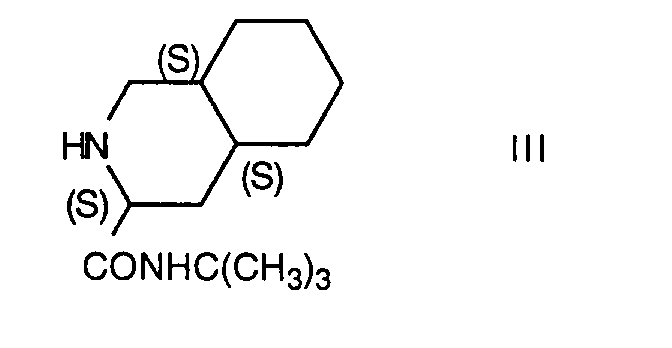
- Verfahren zur Herstellung von N-tert.Butyl-decahydro-2-[2(R)-hydroxy-4-phenyl-3(S)-phthalimidobutyl]-(4aS,8aS)-isochinolin-3(S)-carboxamid der Formel


RSO2Cl
worin R nieder Alkyl oder Phenyl, das durch ein oder zwei Halogenatome substituiert sein kann, bedeutet,
umsetzt, die erhaltene Verbindung der allgemeinen Formel
mit einer starken Base in das 2(S)-[2-Phenyl-1(S)-phthalimidoäthyl]oxiran der Formel

- 2-[(S)-1-[(2R,4S)- und [(2S,4S)-2-Oxo-1,3,2-dioxathiolan-4-yl]-2-phenyläthyl]-2,3-dihydro-1H-isoindol-1,3-dion der Formel

- 2-[(S)-1-[(4S)-2-Dioxo-1,3,2-dioxathiolan-4-yl]-2-phenyläthyl]-2,3-dihydro-1H-isoindol-1,3-dion

- (1S,2R)-2-(3-Amino-1-benzyl-2-hydroxypropyl)-2,3-dihydro-1H-isoindol-1,3-dion der Formel

- (1S,2S)-2-(1-Benzyl-2,3-dihydroxypropyl)-2,3-dihydro-1H-isoindol-1,3-dion der Formel

- Verbindungen der allgemeinen Formel

Applications Claiming Priority (5)
| Application Number | Priority Date | Filing Date | Title |
|---|---|---|---|
| CH213293 | 1993-07-15 | ||
| CH2132/93 | 1993-07-15 | ||
| CH2330/93 | 1993-08-04 | ||
| CH233093 | 1993-08-04 | ||
| EP94110247A EP0634410B1 (de) | 1993-07-15 | 1994-07-01 | Verfahren zur Herstellung eines N-tert.Butylisochinolin-3-carboxamid Derivates und Zwischenprodukte in diesem Verfahren |
Related Parent Applications (1)
| Application Number | Title | Priority Date | Filing Date |
|---|---|---|---|
| EP94110247.7 Division | 1994-07-01 |
Publications (3)
| Publication Number | Publication Date |
|---|---|
| EP0738724A2 true EP0738724A2 (de) | 1996-10-23 |
| EP0738724A3 EP0738724A3 (de) | 1997-02-19 |
| EP0738724B1 EP0738724B1 (de) | 1998-11-04 |
Family
ID=25689603
Family Applications (2)
| Application Number | Title | Priority Date | Filing Date |
|---|---|---|---|
| EP94110247A Expired - Lifetime EP0634410B1 (de) | 1993-07-15 | 1994-07-01 | Verfahren zur Herstellung eines N-tert.Butylisochinolin-3-carboxamid Derivates und Zwischenprodukte in diesem Verfahren |
| EP96112342A Expired - Lifetime EP0738724B1 (de) | 1993-07-15 | 1994-07-01 | Verfahren zur Herstellung eines N-tert.Butylamids |
Family Applications Before (1)
| Application Number | Title | Priority Date | Filing Date |
|---|---|---|---|
| EP94110247A Expired - Lifetime EP0634410B1 (de) | 1993-07-15 | 1994-07-01 | Verfahren zur Herstellung eines N-tert.Butylisochinolin-3-carboxamid Derivates und Zwischenprodukte in diesem Verfahren |
Country Status (8)
| Country | Link |
|---|---|
| US (3) | US5502210A (de) |
| EP (2) | EP0634410B1 (de) |
| JP (1) | JP2531935B2 (de) |
| CN (2) | CN1046510C (de) |
| AT (2) | ATE149162T1 (de) |
| DE (2) | DE59401846D1 (de) |
| DK (2) | DK0634410T3 (de) |
| ES (2) | ES2098080T3 (de) |
Families Citing this family (6)
| Publication number | Priority date | Publication date | Assignee | Title |
|---|---|---|---|---|
| US5591885A (en) * | 1994-09-23 | 1997-01-07 | Hoffman-La Roche Inc. | Process for the preparation of halogenated α-aminoketone compounds |
| US5831117A (en) * | 1995-01-20 | 1998-11-03 | G. D. Searle & Co. | Method of preparing retroviral protease inhibitor intermediates |
| DK0847994T3 (da) | 1996-12-11 | 2003-07-28 | Hoffmann La Roche | Fremgangsmåde til fremstilling af blandede anhydrider |
| ATE356070T1 (de) | 1999-06-22 | 2007-03-15 | Fuji Photo Film Co Ltd | Verfahren und apparat zum wickeln von film, verfahren und apparat zum zuführen von wickelkernen und verfahren und apparat zum kontrollieren des zustandes von filmrollen |
| US6916254B2 (en) * | 2003-01-02 | 2005-07-12 | Acushnet Company | Golf ball with small inner core |
| CN115721970A (zh) * | 2022-10-10 | 2023-03-03 | 安徽金轩科技有限公司 | 一种呋喃铵盐生产中废液回收肟酸装置及方法 |
Citations (2)
| Publication number | Priority date | Publication date | Assignee | Title |
|---|---|---|---|---|
| EP0432695A2 (de) | 1989-12-11 | 1991-06-19 | F. Hoffmann-La Roche Ag | Aminosäurederivate |
| EP0432694A2 (de) | 1989-12-11 | 1991-06-19 | F. Hoffmann-La Roche Ag | Aminoalkohole |
Family Cites Families (3)
| Publication number | Priority date | Publication date | Assignee | Title |
|---|---|---|---|---|
| JPS61227578A (ja) * | 1985-03-30 | 1986-10-09 | Neos Co Ltd | 1,3,2―ジオキサチオラン―2―オキシド誘導体およびその製法 |
| JPH0692427B2 (ja) * | 1989-07-11 | 1994-11-16 | 高砂香料工業株式会社 | 2,2’―ビス(ジシクロヘキシルホスフィノ)―6,6’―ジメチル―1,1’―ビフェニルを配位子とする錯体,およびその錯体を用いた有機カルボン酸とそのエステルの製造方法 |
| EP0583433B1 (de) * | 1992-01-31 | 1999-05-12 | F. Hoffmann-La Roche Ag | Diphosphinliganden |
-
1994
- 1994-07-01 AT AT94110247T patent/ATE149162T1/de not_active IP Right Cessation
- 1994-07-01 DE DE59401846T patent/DE59401846D1/de not_active Expired - Fee Related
- 1994-07-01 DK DK94110247.7T patent/DK0634410T3/da active
- 1994-07-01 EP EP94110247A patent/EP0634410B1/de not_active Expired - Lifetime
- 1994-07-01 EP EP96112342A patent/EP0738724B1/de not_active Expired - Lifetime
- 1994-07-01 AT AT96112342T patent/ATE172970T1/de not_active IP Right Cessation
- 1994-07-01 DK DK96112342T patent/DK0738724T3/da active
- 1994-07-01 DE DE59407243T patent/DE59407243D1/de not_active Expired - Fee Related
- 1994-07-01 ES ES94110247T patent/ES2098080T3/es not_active Expired - Lifetime
- 1994-07-01 ES ES96112342T patent/ES2125077T3/es not_active Expired - Lifetime
- 1994-07-11 US US08/273,088 patent/US5502210A/en not_active Expired - Fee Related
- 1994-07-11 JP JP6180433A patent/JP2531935B2/ja not_active Expired - Lifetime
- 1994-07-14 CN CN94107862A patent/CN1046510C/zh not_active Expired - Fee Related
-
1995
- 1995-12-20 US US08/575,193 patent/US5641886A/en not_active Expired - Fee Related
-
1997
- 1997-03-11 US US08/814,389 patent/US5698698A/en not_active Expired - Fee Related
-
1998
- 1998-07-27 CN CN98116643A patent/CN1215056A/zh active Pending
Patent Citations (2)
| Publication number | Priority date | Publication date | Assignee | Title |
|---|---|---|---|---|
| EP0432695A2 (de) | 1989-12-11 | 1991-06-19 | F. Hoffmann-La Roche Ag | Aminosäurederivate |
| EP0432694A2 (de) | 1989-12-11 | 1991-06-19 | F. Hoffmann-La Roche Ag | Aminoalkohole |
Also Published As
| Publication number | Publication date |
|---|---|
| JPH0753547A (ja) | 1995-02-28 |
| DE59401846D1 (de) | 1997-04-03 |
| CN1215056A (zh) | 1999-04-28 |
| US5641886A (en) | 1997-06-24 |
| CN1046510C (zh) | 1999-11-17 |
| ES2098080T3 (es) | 1997-04-16 |
| EP0634410A1 (de) | 1995-01-18 |
| EP0738724B1 (de) | 1998-11-04 |
| ATE172970T1 (de) | 1998-11-15 |
| ATE149162T1 (de) | 1997-03-15 |
| US5698698A (en) | 1997-12-16 |
| ES2125077T3 (es) | 1999-02-16 |
| DE59407243D1 (de) | 1998-12-10 |
| CN1104641A (zh) | 1995-07-05 |
| JP2531935B2 (ja) | 1996-09-04 |
| EP0738724A3 (de) | 1997-02-19 |
| DK0634410T3 (da) | 1997-06-02 |
| US5502210A (en) | 1996-03-26 |
| DK0738724T3 (da) | 1999-07-19 |
| EP0634410B1 (de) | 1997-02-26 |
Similar Documents
| Publication | Publication Date | Title |
|---|---|---|
| EP0432694B1 (de) | Aminoalkohole | |
| DE69723846T2 (de) | Verfahren zur Herstellung von Sildenafil | |
| DE3631824A1 (de) | Cycloalkano(1.2-b)indol-sulfonamide | |
| DE3010195C2 (de) | ||
| DE69906275T2 (de) | Intermediate und verfahren zur herstellung optisch aktiver oktansäure-derivate | |
| DE2458164A1 (de) | Verfahren zur herstellung von neuen heterocyclischen verbindungen | |
| EP0738724B1 (de) | Verfahren zur Herstellung eines N-tert.Butylamids | |
| DE69202173T2 (de) | Phenylethanolamino- und Phenylethanolaminomethyltetraline, Verfahren zu deren Herstellung Zwischenprodukte davon und diese enthaltende pharmazeutische Zusammensetzungen. | |
| DE2940443A1 (de) | Verfahren zur herstellung von erythro-(alpha)-2-piperidyl-2,8-bis-(trifluormethyl)-4-chinolin-methanol | |
| EP0414020B1 (de) | Verfahren zur Herstellung von Clausenamid und Neoclausenamid und deren Derivate | |
| JPH082873B2 (ja) | オクタヒドロインドール誘導体の製造方法 | |
| DE69430074T2 (de) | Analgetische 4-arylisoindolen | |
| DE69716962T2 (de) | Verfahren zur herstellung von substituierten trifluorobenzoesäurederivaten und deren ester | |
| DE3718892A1 (de) | Polyhydrobenz(c,d)indol-sulfonamide | |
| DE2818290A1 (de) | Neue naphthyridine | |
| EP0187619A2 (de) | 1,3-disubstituierte Tetrahydropyridine | |
| EP0090769B1 (de) | Verfahren zur Herstellung von 1,2,5,6-Tetrahydro-4H-pyrrolo(3,2,1-ij)-chinolin-4-on und neue 5-Halogen-1,2,3-(1,2-dihydropyrrolo)-4-chinolone als Zwischenprodukte zur Durchführung des Verfahrens | |
| DE69327092T2 (de) | Optisch aktives 1-phenylpyrrolidonderivat und dessen herstellung | |
| DE2257710C3 (de) | Verfahren zur Herstellung N-substituierter Indole | |
| DE69818983T2 (de) | Verfahren zur herstellung optisch aktiver imidazolverbindungen, zwischenprodukte zu ihrer herstellung und verfahren zu ihrer herstellung | |
| DE69111828T2 (de) | Synthese von Zwischenprodukten zur Herstellung von ACAT-Inhibitoren. | |
| EP0087657B1 (de) | Verfahren zur Herstellung von 1-(4-Chlorbenzoyl)-5-methoxy-2-methyl-3-indolacetoxyessigsäure | |
| DE3714438A1 (de) | Optisch aktive dihydropyridinlactone, verfahren zu ihrer herstellung und ihre verwendung | |
| EP0518110B1 (de) | Verfahren zur Herstellung der reinen Enantiomere der 4-[4-(4'-tert.Butylphenyl)-2-hydroxybutoxy]-benzoesäure und ihrer Alkylester | |
| EP0650966A1 (de) | Verfahren zur Herstellung eines Benzo(a)chinolizinon-Derivates |
Legal Events
| Date | Code | Title | Description |
|---|---|---|---|
| PUAI | Public reference made under article 153(3) epc to a published international application that has entered the european phase |
Free format text: ORIGINAL CODE: 0009012 |
|
| 17P | Request for examination filed |
Effective date: 19960731 |
|
| AC | Divisional application: reference to earlier application |
Ref document number: 634410 Country of ref document: EP |
|
| AK | Designated contracting states |
Kind code of ref document: A2 Designated state(s): AT BE CH DE DK ES FR GB IT LI NL |
|
| PUAL | Search report despatched |
Free format text: ORIGINAL CODE: 0009013 |
|
| AK | Designated contracting states |
Kind code of ref document: A3 Designated state(s): AT BE CH DE DK ES FR GB IT LI NL |
|
| 17Q | First examination report despatched |
Effective date: 19970613 |
|
| GRAG | Despatch of communication of intention to grant |
Free format text: ORIGINAL CODE: EPIDOS AGRA |
|
| GRAG | Despatch of communication of intention to grant |
Free format text: ORIGINAL CODE: EPIDOS AGRA |
|
| GRAH | Despatch of communication of intention to grant a patent |
Free format text: ORIGINAL CODE: EPIDOS IGRA |
|
| GRAH | Despatch of communication of intention to grant a patent |
Free format text: ORIGINAL CODE: EPIDOS IGRA |
|
| GRAA | (expected) grant |
Free format text: ORIGINAL CODE: 0009210 |
|
| AC | Divisional application: reference to earlier application |
Ref document number: 634410 Country of ref document: EP |
|
| AK | Designated contracting states |
Kind code of ref document: B1 Designated state(s): AT BE CH DE DK ES FR GB IT LI NL |
|
| REF | Corresponds to: |
Ref document number: 172970 Country of ref document: AT Date of ref document: 19981115 Kind code of ref document: T |
|
| REG | Reference to a national code |
Ref country code: CH Ref legal event code: EP |
|
| REF | Corresponds to: |
Ref document number: 59407243 Country of ref document: DE Date of ref document: 19981210 |
|
| ITF | It: translation for a ep patent filed | ||
| REG | Reference to a national code |
Ref country code: ES Ref legal event code: FG2A Ref document number: 2125077 Country of ref document: ES Kind code of ref document: T3 |
|
| ET | Fr: translation filed | ||
| GBT | Gb: translation of ep patent filed (gb section 77(6)(a)/1977) |
Effective date: 19990128 |
|
| REG | Reference to a national code |
Ref country code: DK Ref legal event code: T3 |
|
| PLBE | No opposition filed within time limit |
Free format text: ORIGINAL CODE: 0009261 |
|
| STAA | Information on the status of an ep patent application or granted ep patent |
Free format text: STATUS: NO OPPOSITION FILED WITHIN TIME LIMIT |
|
| 26N | No opposition filed | ||
| PGFP | Annual fee paid to national office [announced via postgrant information from national office to epo] |
Ref country code: DE Payment date: 20000626 Year of fee payment: 7 |
|
| PGFP | Annual fee paid to national office [announced via postgrant information from national office to epo] |
Ref country code: GB Payment date: 20000628 Year of fee payment: 7 Ref country code: CH Payment date: 20000628 Year of fee payment: 7 |
|
| PGFP | Annual fee paid to national office [announced via postgrant information from national office to epo] |
Ref country code: FR Payment date: 20000711 Year of fee payment: 7 |
|
| PGFP | Annual fee paid to national office [announced via postgrant information from national office to epo] |
Ref country code: DK Payment date: 20000712 Year of fee payment: 7 Ref country code: AT Payment date: 20000712 Year of fee payment: 7 |
|
| PGFP | Annual fee paid to national office [announced via postgrant information from national office to epo] |
Ref country code: ES Payment date: 20000719 Year of fee payment: 7 |
|
| PGFP | Annual fee paid to national office [announced via postgrant information from national office to epo] |
Ref country code: NL Payment date: 20000728 Year of fee payment: 7 |
|
| PGFP | Annual fee paid to national office [announced via postgrant information from national office to epo] |
Ref country code: BE Payment date: 20000818 Year of fee payment: 7 |
|
| PG25 | Lapsed in a contracting state [announced via postgrant information from national office to epo] |
Ref country code: GB Free format text: LAPSE BECAUSE OF NON-PAYMENT OF DUE FEES Effective date: 20010701 Ref country code: DK Free format text: LAPSE BECAUSE OF NON-PAYMENT OF DUE FEES Effective date: 20010701 Ref country code: AT Free format text: LAPSE BECAUSE OF NON-PAYMENT OF DUE FEES Effective date: 20010701 |
|
| PG25 | Lapsed in a contracting state [announced via postgrant information from national office to epo] |
Ref country code: ES Free format text: LAPSE BECAUSE OF NON-PAYMENT OF DUE FEES Effective date: 20010702 |
|
| PG25 | Lapsed in a contracting state [announced via postgrant information from national office to epo] |
Ref country code: LI Free format text: LAPSE BECAUSE OF NON-PAYMENT OF DUE FEES Effective date: 20010731 Ref country code: CH Free format text: LAPSE BECAUSE OF NON-PAYMENT OF DUE FEES Effective date: 20010731 Ref country code: BE Free format text: LAPSE BECAUSE OF NON-PAYMENT OF DUE FEES Effective date: 20010731 |
|
| BERE | Be: lapsed |
Owner name: F. HOFFMANN-LA ROCHE A.G. Effective date: 20010731 |
|
| PG25 | Lapsed in a contracting state [announced via postgrant information from national office to epo] |
Ref country code: NL Free format text: LAPSE BECAUSE OF NON-PAYMENT OF DUE FEES Effective date: 20020201 |
|
| GBPC | Gb: european patent ceased through non-payment of renewal fee |
Effective date: 20010701 |
|
| REG | Reference to a national code |
Ref country code: CH Ref legal event code: PL |
|
| REG | Reference to a national code |
Ref country code: DK Ref legal event code: EBP |
|
| PG25 | Lapsed in a contracting state [announced via postgrant information from national office to epo] |
Ref country code: FR Free format text: LAPSE BECAUSE OF NON-PAYMENT OF DUE FEES Effective date: 20020329 |
|
| NLV4 | Nl: lapsed or anulled due to non-payment of the annual fee |
Effective date: 20020201 |
|
| PG25 | Lapsed in a contracting state [announced via postgrant information from national office to epo] |
Ref country code: DE Free format text: LAPSE BECAUSE OF NON-PAYMENT OF DUE FEES Effective date: 20020501 |
|
| REG | Reference to a national code |
Ref country code: FR Ref legal event code: ST |
|
| REG | Reference to a national code |
Ref country code: ES Ref legal event code: FD2A Effective date: 20020810 |
|
| PG25 | Lapsed in a contracting state [announced via postgrant information from national office to epo] |
Ref country code: IT Free format text: LAPSE BECAUSE OF NON-PAYMENT OF DUE FEES Effective date: 20050701 |