EP0739996B1 - Oberflächenbehandlungsmittel für Beschichtung und derart beschichteter Gegenstand - Google Patents
Oberflächenbehandlungsmittel für Beschichtung und derart beschichteter Gegenstand Download PDFInfo
- Publication number
- EP0739996B1 EP0739996B1 EP96302993A EP96302993A EP0739996B1 EP 0739996 B1 EP0739996 B1 EP 0739996B1 EP 96302993 A EP96302993 A EP 96302993A EP 96302993 A EP96302993 A EP 96302993A EP 0739996 B1 EP0739996 B1 EP 0739996B1
- Authority
- EP
- European Patent Office
- Prior art keywords
- metal
- layer
- treating material
- particles
- plating
- Prior art date
- Legal status (The legal status is an assumption and is not a legal conclusion. Google has not performed a legal analysis and makes no representation as to the accuracy of the status listed.)
- Expired - Lifetime
Links
Images
Classifications
-
- C—CHEMISTRY; METALLURGY
- C03—GLASS; MINERAL OR SLAG WOOL
- C03C—CHEMICAL COMPOSITION OF GLASSES, GLAZES OR VITREOUS ENAMELS; SURFACE TREATMENT OF GLASS; SURFACE TREATMENT OF FIBRES OR FILAMENTS MADE FROM GLASS, MINERALS OR SLAGS; JOINING GLASS TO GLASS OR OTHER MATERIALS
- C03C17/00—Surface treatment of glass, not in the form of fibres or filaments, by coating
- C03C17/34—Surface treatment of glass, not in the form of fibres or filaments, by coating with at least two coatings having different compositions
- C03C17/36—Surface treatment of glass, not in the form of fibres or filaments, by coating with at least two coatings having different compositions at least one coating being a metal
- C03C17/3602—Surface treatment of glass, not in the form of fibres or filaments, by coating with at least two coatings having different compositions at least one coating being a metal the metal being present as a layer
- C03C17/3607—Coatings of the type glass/inorganic compound/metal
-
- C—CHEMISTRY; METALLURGY
- C03—GLASS; MINERAL OR SLAG WOOL
- C03C—CHEMICAL COMPOSITION OF GLASSES, GLAZES OR VITREOUS ENAMELS; SURFACE TREATMENT OF GLASS; SURFACE TREATMENT OF FIBRES OR FILAMENTS MADE FROM GLASS, MINERALS OR SLAGS; JOINING GLASS TO GLASS OR OTHER MATERIALS
- C03C17/00—Surface treatment of glass, not in the form of fibres or filaments, by coating
- C03C17/006—Surface treatment of glass, not in the form of fibres or filaments, by coating with materials of composite character
- C03C17/007—Surface treatment of glass, not in the form of fibres or filaments, by coating with materials of composite character containing a dispersed phase, e.g. particles, fibres or flakes, in a continuous phase
-
- C—CHEMISTRY; METALLURGY
- C03—GLASS; MINERAL OR SLAG WOOL
- C03C—CHEMICAL COMPOSITION OF GLASSES, GLAZES OR VITREOUS ENAMELS; SURFACE TREATMENT OF GLASS; SURFACE TREATMENT OF FIBRES OR FILAMENTS MADE FROM GLASS, MINERALS OR SLAGS; JOINING GLASS TO GLASS OR OTHER MATERIALS
- C03C17/00—Surface treatment of glass, not in the form of fibres or filaments, by coating
- C03C17/006—Surface treatment of glass, not in the form of fibres or filaments, by coating with materials of composite character
- C03C17/008—Surface treatment of glass, not in the form of fibres or filaments, by coating with materials of composite character comprising a mixture of materials covered by two or more of the groups C03C17/02, C03C17/06, C03C17/22 and C03C17/28
-
- C—CHEMISTRY; METALLURGY
- C03—GLASS; MINERAL OR SLAG WOOL
- C03C—CHEMICAL COMPOSITION OF GLASSES, GLAZES OR VITREOUS ENAMELS; SURFACE TREATMENT OF GLASS; SURFACE TREATMENT OF FIBRES OR FILAMENTS MADE FROM GLASS, MINERALS OR SLAGS; JOINING GLASS TO GLASS OR OTHER MATERIALS
- C03C17/00—Surface treatment of glass, not in the form of fibres or filaments, by coating
- C03C17/34—Surface treatment of glass, not in the form of fibres or filaments, by coating with at least two coatings having different compositions
- C03C17/36—Surface treatment of glass, not in the form of fibres or filaments, by coating with at least two coatings having different compositions at least one coating being a metal
-
- C—CHEMISTRY; METALLURGY
- C03—GLASS; MINERAL OR SLAG WOOL
- C03C—CHEMICAL COMPOSITION OF GLASSES, GLAZES OR VITREOUS ENAMELS; SURFACE TREATMENT OF GLASS; SURFACE TREATMENT OF FIBRES OR FILAMENTS MADE FROM GLASS, MINERALS OR SLAGS; JOINING GLASS TO GLASS OR OTHER MATERIALS
- C03C17/00—Surface treatment of glass, not in the form of fibres or filaments, by coating
- C03C17/34—Surface treatment of glass, not in the form of fibres or filaments, by coating with at least two coatings having different compositions
- C03C17/36—Surface treatment of glass, not in the form of fibres or filaments, by coating with at least two coatings having different compositions at least one coating being a metal
- C03C17/3602—Surface treatment of glass, not in the form of fibres or filaments, by coating with at least two coatings having different compositions at least one coating being a metal the metal being present as a layer
- C03C17/3644—Surface treatment of glass, not in the form of fibres or filaments, by coating with at least two coatings having different compositions at least one coating being a metal the metal being present as a layer the metal being silver
-
- C—CHEMISTRY; METALLURGY
- C04—CEMENTS; CONCRETE; ARTIFICIAL STONE; CERAMICS; REFRACTORIES
- C04B—LIME, MAGNESIA; SLAG; CEMENTS; COMPOSITIONS THEREOF, e.g. MORTARS, CONCRETE OR LIKE BUILDING MATERIALS; ARTIFICIAL STONE; CERAMICS; REFRACTORIES; TREATMENT OF NATURAL STONE
- C04B41/00—After-treatment of mortars, concrete, artificial stone or ceramics; Treatment of natural stone
- C04B41/009—After-treatment of mortars, concrete, artificial stone or ceramics; Treatment of natural stone characterised by the material treated
-
- C—CHEMISTRY; METALLURGY
- C04—CEMENTS; CONCRETE; ARTIFICIAL STONE; CERAMICS; REFRACTORIES
- C04B—LIME, MAGNESIA; SLAG; CEMENTS; COMPOSITIONS THEREOF, e.g. MORTARS, CONCRETE OR LIKE BUILDING MATERIALS; ARTIFICIAL STONE; CERAMICS; REFRACTORIES; TREATMENT OF NATURAL STONE
- C04B41/00—After-treatment of mortars, concrete, artificial stone or ceramics; Treatment of natural stone
- C04B41/45—Coating or impregnating, e.g. injection in masonry, partial coating of green or fired ceramics, organic coating compositions for adhering together two concrete elements
- C04B41/4505—Coating or impregnating, e.g. injection in masonry, partial coating of green or fired ceramics, organic coating compositions for adhering together two concrete elements characterised by the method of application
- C04B41/4507—Coating or impregnating, e.g. injection in masonry, partial coating of green or fired ceramics, organic coating compositions for adhering together two concrete elements characterised by the method of application using keying elements, e.g. particulate material, to facilitate the adherence of coating layers
-
- C—CHEMISTRY; METALLURGY
- C04—CEMENTS; CONCRETE; ARTIFICIAL STONE; CERAMICS; REFRACTORIES
- C04B—LIME, MAGNESIA; SLAG; CEMENTS; COMPOSITIONS THEREOF, e.g. MORTARS, CONCRETE OR LIKE BUILDING MATERIALS; ARTIFICIAL STONE; CERAMICS; REFRACTORIES; TREATMENT OF NATURAL STONE
- C04B41/00—After-treatment of mortars, concrete, artificial stone or ceramics; Treatment of natural stone
- C04B41/45—Coating or impregnating, e.g. injection in masonry, partial coating of green or fired ceramics, organic coating compositions for adhering together two concrete elements
- C04B41/50—Coating or impregnating, e.g. injection in masonry, partial coating of green or fired ceramics, organic coating compositions for adhering together two concrete elements with inorganic materials
- C04B41/51—Metallising, e.g. infiltration of sintered ceramic preforms with molten metal
-
- C—CHEMISTRY; METALLURGY
- C04—CEMENTS; CONCRETE; ARTIFICIAL STONE; CERAMICS; REFRACTORIES
- C04B—LIME, MAGNESIA; SLAG; CEMENTS; COMPOSITIONS THEREOF, e.g. MORTARS, CONCRETE OR LIKE BUILDING MATERIALS; ARTIFICIAL STONE; CERAMICS; REFRACTORIES; TREATMENT OF NATURAL STONE
- C04B41/00—After-treatment of mortars, concrete, artificial stone or ceramics; Treatment of natural stone
- C04B41/45—Coating or impregnating, e.g. injection in masonry, partial coating of green or fired ceramics, organic coating compositions for adhering together two concrete elements
- C04B41/52—Multiple coating or impregnating multiple coating or impregnating with the same composition or with compositions only differing in the concentration of the constituents, is classified as single coating or impregnation
-
- C—CHEMISTRY; METALLURGY
- C04—CEMENTS; CONCRETE; ARTIFICIAL STONE; CERAMICS; REFRACTORIES
- C04B—LIME, MAGNESIA; SLAG; CEMENTS; COMPOSITIONS THEREOF, e.g. MORTARS, CONCRETE OR LIKE BUILDING MATERIALS; ARTIFICIAL STONE; CERAMICS; REFRACTORIES; TREATMENT OF NATURAL STONE
- C04B41/00—After-treatment of mortars, concrete, artificial stone or ceramics; Treatment of natural stone
- C04B41/80—After-treatment of mortars, concrete, artificial stone or ceramics; Treatment of natural stone of only ceramics
- C04B41/81—Coating or impregnation
-
- C—CHEMISTRY; METALLURGY
- C04—CEMENTS; CONCRETE; ARTIFICIAL STONE; CERAMICS; REFRACTORIES
- C04B—LIME, MAGNESIA; SLAG; CEMENTS; COMPOSITIONS THEREOF, e.g. MORTARS, CONCRETE OR LIKE BUILDING MATERIALS; ARTIFICIAL STONE; CERAMICS; REFRACTORIES; TREATMENT OF NATURAL STONE
- C04B41/00—After-treatment of mortars, concrete, artificial stone or ceramics; Treatment of natural stone
- C04B41/80—After-treatment of mortars, concrete, artificial stone or ceramics; Treatment of natural stone of only ceramics
- C04B41/81—Coating or impregnation
- C04B41/85—Coating or impregnation with inorganic materials
- C04B41/88—Metals
-
- C—CHEMISTRY; METALLURGY
- C04—CEMENTS; CONCRETE; ARTIFICIAL STONE; CERAMICS; REFRACTORIES
- C04B—LIME, MAGNESIA; SLAG; CEMENTS; COMPOSITIONS THEREOF, e.g. MORTARS, CONCRETE OR LIKE BUILDING MATERIALS; ARTIFICIAL STONE; CERAMICS; REFRACTORIES; TREATMENT OF NATURAL STONE
- C04B41/00—After-treatment of mortars, concrete, artificial stone or ceramics; Treatment of natural stone
- C04B41/80—After-treatment of mortars, concrete, artificial stone or ceramics; Treatment of natural stone of only ceramics
- C04B41/81—Coating or impregnation
- C04B41/89—Coating or impregnation for obtaining at least two superposed coatings having different compositions
-
- C—CHEMISTRY; METALLURGY
- C23—COATING METALLIC MATERIAL; COATING MATERIAL WITH METALLIC MATERIAL; CHEMICAL SURFACE TREATMENT; DIFFUSION TREATMENT OF METALLIC MATERIAL; COATING BY VACUUM EVAPORATION, BY SPUTTERING, BY ION IMPLANTATION OR BY CHEMICAL VAPOUR DEPOSITION, IN GENERAL; INHIBITING CORROSION OF METALLIC MATERIAL OR INCRUSTATION IN GENERAL
- C23C—COATING METALLIC MATERIAL; COATING MATERIAL WITH METALLIC MATERIAL; SURFACE TREATMENT OF METALLIC MATERIAL BY DIFFUSION INTO THE SURFACE, BY CHEMICAL CONVERSION OR SUBSTITUTION; COATING BY VACUUM EVAPORATION, BY SPUTTERING, BY ION IMPLANTATION OR BY CHEMICAL VAPOUR DEPOSITION, IN GENERAL
- C23C24/00—Coating starting from inorganic powder
- C23C24/08—Coating starting from inorganic powder by application of heat or pressure and heat
- C23C24/082—Coating starting from inorganic powder by application of heat or pressure and heat without intermediate formation of a liquid in the layer
- C23C24/085—Coating with metallic material, i.e. metals or metal alloys, optionally comprising hard particles, e.g. oxides, carbides or nitrides
-
- C—CHEMISTRY; METALLURGY
- C03—GLASS; MINERAL OR SLAG WOOL
- C03C—CHEMICAL COMPOSITION OF GLASSES, GLAZES OR VITREOUS ENAMELS; SURFACE TREATMENT OF GLASS; SURFACE TREATMENT OF FIBRES OR FILAMENTS MADE FROM GLASS, MINERALS OR SLAGS; JOINING GLASS TO GLASS OR OTHER MATERIALS
- C03C2217/00—Coatings on glass
- C03C2217/40—Coatings comprising at least one inhomogeneous layer
- C03C2217/43—Coatings comprising at least one inhomogeneous layer consisting of a dispersed phase in a continuous phase
- C03C2217/44—Coatings comprising at least one inhomogeneous layer consisting of a dispersed phase in a continuous phase characterized by the composition of the continuous phase
- C03C2217/45—Inorganic continuous phases
-
- C—CHEMISTRY; METALLURGY
- C03—GLASS; MINERAL OR SLAG WOOL
- C03C—CHEMICAL COMPOSITION OF GLASSES, GLAZES OR VITREOUS ENAMELS; SURFACE TREATMENT OF GLASS; SURFACE TREATMENT OF FIBRES OR FILAMENTS MADE FROM GLASS, MINERALS OR SLAGS; JOINING GLASS TO GLASS OR OTHER MATERIALS
- C03C2217/00—Coatings on glass
- C03C2217/40—Coatings comprising at least one inhomogeneous layer
- C03C2217/43—Coatings comprising at least one inhomogeneous layer consisting of a dispersed phase in a continuous phase
- C03C2217/46—Coatings comprising at least one inhomogeneous layer consisting of a dispersed phase in a continuous phase characterized by the dispersed phase
- C03C2217/47—Coatings comprising at least one inhomogeneous layer consisting of a dispersed phase in a continuous phase characterized by the dispersed phase consisting of a specific material
- C03C2217/475—Inorganic materials
- C03C2217/479—Metals
-
- C—CHEMISTRY; METALLURGY
- C04—CEMENTS; CONCRETE; ARTIFICIAL STONE; CERAMICS; REFRACTORIES
- C04B—LIME, MAGNESIA; SLAG; CEMENTS; COMPOSITIONS THEREOF, e.g. MORTARS, CONCRETE OR LIKE BUILDING MATERIALS; ARTIFICIAL STONE; CERAMICS; REFRACTORIES; TREATMENT OF NATURAL STONE
- C04B2111/00—Mortars, concrete or artificial stone or mixtures to prepare them, characterised by specific function, property or use
- C04B2111/00474—Uses not provided for elsewhere in C04B2111/00
- C04B2111/00482—Coating or impregnation materials
- C04B2111/00491—Primers
-
- Y—GENERAL TAGGING OF NEW TECHNOLOGICAL DEVELOPMENTS; GENERAL TAGGING OF CROSS-SECTIONAL TECHNOLOGIES SPANNING OVER SEVERAL SECTIONS OF THE IPC; TECHNICAL SUBJECTS COVERED BY FORMER USPC CROSS-REFERENCE ART COLLECTIONS [XRACs] AND DIGESTS
- Y10—TECHNICAL SUBJECTS COVERED BY FORMER USPC
- Y10T—TECHNICAL SUBJECTS COVERED BY FORMER US CLASSIFICATION
- Y10T428/00—Stock material or miscellaneous articles
- Y10T428/12—All metal or with adjacent metals
- Y10T428/12014—All metal or with adjacent metals having metal particles
- Y10T428/12028—Composite; i.e., plural, adjacent, spatially distinct metal components [e.g., layers, etc.]
-
- Y—GENERAL TAGGING OF NEW TECHNOLOGICAL DEVELOPMENTS; GENERAL TAGGING OF CROSS-SECTIONAL TECHNOLOGIES SPANNING OVER SEVERAL SECTIONS OF THE IPC; TECHNICAL SUBJECTS COVERED BY FORMER USPC CROSS-REFERENCE ART COLLECTIONS [XRACs] AND DIGESTS
- Y10—TECHNICAL SUBJECTS COVERED BY FORMER USPC
- Y10T—TECHNICAL SUBJECTS COVERED BY FORMER US CLASSIFICATION
- Y10T428/00—Stock material or miscellaneous articles
- Y10T428/12—All metal or with adjacent metals
- Y10T428/12014—All metal or with adjacent metals having metal particles
- Y10T428/12028—Composite; i.e., plural, adjacent, spatially distinct metal components [e.g., layers, etc.]
- Y10T428/12049—Nonmetal component
-
- Y—GENERAL TAGGING OF NEW TECHNOLOGICAL DEVELOPMENTS; GENERAL TAGGING OF CROSS-SECTIONAL TECHNOLOGIES SPANNING OVER SEVERAL SECTIONS OF THE IPC; TECHNICAL SUBJECTS COVERED BY FORMER USPC CROSS-REFERENCE ART COLLECTIONS [XRACs] AND DIGESTS
- Y10—TECHNICAL SUBJECTS COVERED BY FORMER USPC
- Y10T—TECHNICAL SUBJECTS COVERED BY FORMER US CLASSIFICATION
- Y10T428/00—Stock material or miscellaneous articles
- Y10T428/12—All metal or with adjacent metals
- Y10T428/12014—All metal or with adjacent metals having metal particles
- Y10T428/12028—Composite; i.e., plural, adjacent, spatially distinct metal components [e.g., layers, etc.]
- Y10T428/12063—Nonparticulate metal component
- Y10T428/12104—Particles discontinuous
Definitions
- This invention relates to plating of conductive materials on substrates which normally afford a relatively poor adhesion with such plating materials.
- the plating may be carried out in a liquid phase, or the plating may be carried out by vapor deposition in a gas phase. Alternatively, the plating may be effected by sputtering.
- Non-electrolytic plating is well known as a method for metallizing a surface of an electrically insulating material.
- the material to be plated is a ceramic such as an aluminum oxide sintered body, an aluminum nitride sintered body, or a silicon carbide sintered body
- metallic palladium fine particles have been adhered to the surface thereof.
- a plating film is then formed thereon.
- the metallic palladium particles are formed on the surface by bringing an aqueous solution including palladium ions into contact with the ceramic surface and reducing it in situ.
- the ceramic is a sintered body
- irregularities on the material surface cause adherence to be slightly improved as a result of the anchoring effect
- the material surface is smooth, such as with glass, the plating very often peels from the surface.
- the material surface may be as smooth as glass and adherence again has been found to be bad.
- This invention has as one objective to solve the above problem. It is an object of the invention to provide a surface treating agent, which when used in plating a metal layer to a base material to which it has heretofore been difficult to plate, such as a ceramic, glass, polymer or metal, makes possible strong adherence of the plating to the base material.
- the agent includes at least one kind of metal ultrafine particle chosen from Au, Pt, Pd, Rh, Ag, and Ni, a fixative including an organic compound selected from alkoxides, organic acid salts and organic complex salts of Si or P or a metal selected from Ba, Mg, Al, Ca, Ti, V, Cr, Mn, Fe, Co, Ni, Cu, Zr, In, Sn and Pb for fixing the metal ultrafine particles, and an organic solvent.
- the fixative is preferably present in the ratio of 0.1 to 10 mol to 1 mol of the metal of the ultrafine particles.
- the agent may include a film strengthener and an organic solvent. With respect to 1 mol of the metal particles, the film strengthener is preferably present in the ratio of 0.01 to 5 mol.
- the agent may include a viscosity adjusting material such as a polymer material soluble in an organic solvent with noble metal ultrafine particles being dispersed in the polymer.
- a viscosity adjusting material such as a polymer material soluble in an organic solvent with noble metal ultrafine particles being dispersed in the polymer.
- the invention comprehends providing a complex made by preparing a thermodynamically inequilibrized polymer layer and bringing at least one kind of metal chosen from the group Au, Pt, Pd, Rh, Ag and Ni into contact with the surface of the polymer layer and heating the polymer layer, thereby stabilizing the polymer layer and dispersing the resulting ultrafine metal particles formed from the metal without aggregating them.
- the invention further comprehends polymerizing or baking the surface treating agent printed on the base material surface.
- At least one kind of ultrafine metal particles chosen from the group Au, Pt, Pd, Rh, Ag, and Ni is independently dispersed in the layer to be plated.
- the layer may be formed by polymerizing or baking the surface treating agent printed onto the base material surface and adhering a metal film thereon by plating, wherein at least one kind of metal ultrafine particle chosen from Au, Pt, Pd, Rh, Ag, and Ni is independently dispersed in the layer to be plated.
- the layer to be plated is interposed between the base material and the metal film and fixes these together.
- the ultrafine particles are not completely enveloped by the fixative in the layer to be plated but arc partially exposed.
- the metal particles become nuclei and precipitate metal ions and the metal plating film is strongly adhered thereto.
- Viscosity adjusting material may be utilized to maintain the viscosity of the treating agent at a suitable level for improved screen printing.
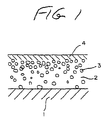
- Fig. 1 shows a cross-sectional view of a plating-treated base material according to the invention.
- the metal ultrafine particles used in the surface treating agent may be in the form of a complex made by dispersing ultrafine metal particles in a polymer in advance or in an organic solvent.
- a polymer layer is formed in a thermodynamically inequilibrized state.
- a vacuum vapor deposition method can be used wherein a polymer is heated in a vacuum, melted, and vaporized.
- a polymer layer is solidified on a substrate.
- the layer may be formed by a thermal decomposition method.
- a melting and rapid cooling and solidifying method may be employed wherein a polymer is heated at a temperature above its melting temperature and in this state immediately immersed in liquid nitrogen and thereby rapidly cooled, and a polymer layer thereby made to adhere to the substrate.
- vacuum vapor deposition using an ordinary vacuum vapor deposition apparatus, it is possible to obtain a high molecular weight layer on a substrate of glass or the like with a vacuum of 10 -4 to 10 -6 Torr (1.333 x 10 -2 to 1.333 x 10 -4 Pa) and a vapor deposition rate of 0.1 to 100 ⁇ m/min, and more preferably 0.5 to 5 ⁇ m/min.
- the thermal decomposition method is a method wherein a polymer, serving as the raw material, is thermally decomposed and vaporized in a closed space at a reduced pressure. This vapor is solidified whereby a regenerated polymer in a thermodynamically inequilibrized state (having a semi-stable structure) results.
- This is a method wherein after a predetermined amount of a polymer put in is thermally decomposed and vaporized this vapor is aggregated into a regenerated polymer in a heat treatment region. The vapor which did not aggregate is then aggregated into an oil-form low molecular weight material in a cooling region and a regenerated polymer in which oil-form low molecular weight polymer does not mix is obtained.
- a polymer layer is obtained by melting a polymer and rapidly cooling it at a rate higher than the characteristic critical cooling rate of the polymer.
- a polymer layer obtained in this way is placed in a thermodynamically unstable inequilibrized state and with the passing of time shifts to an equilibrium state.
- Polymers useful here are, for example, nylon 6, nylon 66, nylon 11, nylon 12, nylon 69, polyethylene terephthalate (PET), polyvinyl alcohol, polyphenylene sulfide (PPS), polystyrene (PS), polycarbonate, polymethyl methacrylate, and the like.
- PET polyethylene terephthalate
- PPS polyphenylene sulfide
- PS polystyrene
- the thermodynamically inequilibrized polymer layer is caused to have a metal layer adhered to a surface thereof.
- the metal layer is laminated onto the polymer layer by a method such as vapor deposition of a metal on the polymer layer using a vacuum vapor deposition apparatus, or by directly adhering a metal foil or metal sheet to the polymer layer.
- the metal may be Au (gold), Pt (platinum), Pd (palladium), Rh (rhodium), Ag (silver), Ni (nickel), etc.
- the complex of the metal layer and the polymer layer adhered together is heated at a temperature above the glass transition point and below the melting point of the polymer and the polymer layer is thereby shifted into a stable state.
- the metal of the metal layer forms metal ultrafine particles of a diameter under 100nm and having most of its particle diameter distribution in the range of 1 to 10 nm. These particles diffuse and permeate into the polymer layer. This continues until the polymer layer completely relaxes, and the thickness of the metal layer adhered to the high polymer layer also decreases to zero.
- the ultrafine particles are dispersed within the high polymer layer without aggregating. In this case, the contained amount of the ultrafine particle is 0.01 to 80wt%. This amount can be adjusted as desired by changing the production conditions of the polymer layer and changing the thickness of the metal layer.
- the method described above is not the only method of manufacturing the complex.
- there are methods such as making metal ultrafine particles by a gas phase method such as molten vaporization methods, a liquid phase method such as precipitation methods, a solid phase method, or a dispersion method and mechanically mixing ultrafine particles with a polymer consisting of a solution or a molten liquid, or simultaneously evaporating and mixing the polymer and a noble metal and mixing them in the gas phase.
- the obtained complex is mixed with and dissolved in a solvent consisting of methacrezole, dimethylformamide, cyclohexane, formic acid, or the like, and made into a paste in which the ultrafine particles are uniformly dispersed. Because the diameter of the ultrafine particles is small and a mutual interaction with the polymer exists, separation from the polymer, precipitation, and aggregation of ultrafine particles do not occur.
- Manufacture of ultrafine metal particles independently dispersed in an organic solvent is illustrated for example by an in-gas evaporation process disclosed in Japanese Unexamined Patent Publication No. H.3-34211.
- helium gas is introduced into a chamber.
- Evaporated metal is cooled and condensed by collision with the inert gas.
- a vapor of an organic solvent such as a ⁇ -terpineol or toluene is introduced to cover the particle surfaces.
- the fixative used in this invention is preferably an organic compound including a metal, such as for example Ba, Mg, Si, P, Al, Ca, Ti, V, Cr, Mn, Fe, Co, Ni, Cu, Zr, In, Sn, and Pb.
- a metal such as for example Ba, Mg, Si, P, Al, Ca, Ti, V, Cr, Mn, Fe, Co, Ni, Cu, Zr, In, Sn, and Pb.
- alkoxides such as ethoxides, propoxides of these metals, organic acid salts such as napthates, acetates and organic complex salts such as acetyl acetone complex, and oxine complex salt.
- the fixative is made a metal oxide by baking the treating agent, or by a condensation polymerization reaction.
- the resulting polymer suppresses particle growth of the metal ultrafine particles and simultaneously acts as an adhesive, strongly adhering to the base material surface and the metal ultrafine particles.
- Pre-plating treating liquid and non-electrolytic plating liquid may be Al, Ti, In, Sn, Si.
- the blend amount is 0.1 to 10mol, and more preferably 0.2 to 4mol, with respect to 1 mol of the metal of the ultrafine particles.
- the metal ultrafine particles aggregate and do not become catalytically active and are unable to adhere to the base material.
- the blend amount exceed 10mol, the fixative envelops the particles and there ceases to be catalytically active. Then, due to crystallization of the fixative, the film formed on the surface of the base material easily breaks and peels off.
- the film strengthener used in this invention is an organic compound including an element M', where M' is Si, B, P, In, or Sn.
- Such strengtheners include tetra i-propoxysilane, silicone oil, polysiloxane, triethoxysilane, tetraethoxysilane, tetra-n-butoxysilane, dietoxy dimethylsilane, triethyl borate, triphenyl borate, iproniadide phosphate, diphenyl phosphate, phosphono acetate, phosphoramidon, di-n-butyl phosphate, triethyl phosphate, n-amyl phosphate, etc.
- the preferred amount is 0.05 to 5mol with respect to 1mol of the metal of the ultrafine particles. When the amount of the film strengthener exceeds 5mol, the plating depositability and growth characteristics become poor.
- the organic solvent should be capable of dissolving the fixative without allowing the ultrafine particles in the treating agent to aggregate.
- a complex made by independently dispersing ultrafine particles in a polymer in advance methacrezole, methyl formamide, chlorophenol, dimethyl imidozolidinon, and dichloromethane are desirable.
- the complex is made by independently dispersing the ultrafine particles in an organic solvent, xylene, benzene, toluene, diphenyl methane, and terpineol are desirable.
- the added amount of the metal ultrafine particles and the fixative, which are solid components, by concentration in the treating liquid is 0.0001 to 50 wt.%, and preferably suitably determined according to the method of adhering the treating liquid to the base material.
- the viscosity adjusting material used in this invention keeps the viscosity of the treating agent at a suitable level and keeps handling at the time of screen printing good. It is desirable that this viscosity adjusting material decompose at a low temperature during baking, but this is not necessary and any viscosity adjusting material soluble in the organic solvent may be used.
- viscosity adjusting materials examples include cellulose types such as nitrocellulose, ethyl cellulose, cellulose acetate, butyl cellulose, acrylic types such as methyl acrylate, a polyamide types such as nylon 6, nylon 11, nylon 12, polyester types such as polyethylene terephthalate, polycaprolacton, polyether types such as polyoxymethylene, polycarbonate type, or polyvinyl types such as polystyrene, polybutadiene or polyisoprene.
- cellulose types such as nitrocellulose, ethyl cellulose, cellulose acetate, butyl cellulose, acrylic types such as methyl acrylate, a polyamide types such as nylon 6, nylon 11, nylon 12, polyester types such as polyethylene terephthalate, polycaprolacton, polyether types such as polyoxymethylene, polycarbonate type, or polyvinyl types such as polystyrene, polybutadiene or polyisoprene.
- the concentration of the viscosity adjusting material is determined by the purpose of use of the treating agent, but the concentration in the treating liquid should not be over 50wt%.
- a treating liquid including a viscosity adjusting material the ultrafine particles and the fixative are blended 0.1 to 10mol, and more preferably 0.2 to 4mol of the fixative with respect to 1mol of the metal of the ultrafine particles.
- the added amount of the metal ultrafine particles and the fixative is 0.0001 to 50wt% by concentration in the treating liquid, and preferably decided according to the method of adhering the treating liquid to the base material used.
- the metal ultrafine particles are dispersed in an organic solvent
- a viscosity adjusting material is added to and dissolved in the organic solvent in advance.
- the fixative is added and well stirred.
- the treating agent is coated onto a base material of ceramic, glass, polymer, metal, or the like, by brush-coating, screen printing, dipping, spraying, knife-coating, etc.
- a base material for example, a polyester plain weave, 255 denier
- a base material glass
- the treating agent is spread over the entire surface of the screen using a scraper.
- the screen is pushed on and moved with a squeegee so that the screen makes contact with the base material. With this, one printing is concluded and thereafter this is repeated.
- the base material is left for 10 to 30 minutes in an atmosphere of 100 to 200°C, the organic solvent is removed, and dried, or dried while being degassed in a sealed vessel, and shifted to a polymerizing or baking step.
- heat treatment is carried out in air in a temperature range of from room temperature to 300°C.
- the objects of the invention are also achieved by heating to a temperature of 300 to 800°C and oxidizing-decomposing it to produce a metal oxide.
- the base material obtained by adhering and baking the treating agent has on its surface a layer to be plated in which the metal ultrafine particles are independently dispersed.
- the metal ultrafine particles are not completely enveloped but are partially exposed. This is acid-treated and washed with water. It is put into an electrolysis tank and non-electrolytic plating is carried out, with the exposed metal ultrafine particles as nuclei, metal ions are deposited and a metal film is made.
- Fig. 1 shows a sectional view of a base material, or substrate 1.
- Metal ultrafine particles 3 are dispersed in a matrix layer 2 on the substrate. As shown, an increased proportion of the particles 3 is disposed at the surface of the matrix 2.
- a metal film 4 is made by depositing metal ions on the surface of this layer. Even when the base material 1 is glass or ceramic having a smooth surface, the treating agent of the invention assures a firm bond of the plating 4 thereto.
- the plating may comprise non-electrolytic plating as desired.
- noble metal ultrafine particles were added to predetermined amounts of organic solvent and stirred, and after that various fixatives were added and stirred and treating agents thereby made.
- the temperature during the process was room temperature.
- the ultrafine particles of noble metal used in Inventive Embodiments 1 and 2 were obtained using a vacuum vapor deposition apparatus. This method is called the RAD method. That is, polymer pellets 5g of nylon 11 were put into a tungsten board of a vacuum vapor deposition apparatus and reduced in pressure to 10 -6 Torr (1.333 x 10 -4 Pa). The tungsten board was heated in a vacuum and the polymer melted.
- Gold chips were put into the tungsten board, heated and melted. Vapor deposition was carried out in a vacuum of 10 -4 to 10 -6 (1.333 x 10 -2 to 1.333 x 10 -4 Pa) Torr and a metal vapor-deposited film thereby formed on the polymer layer. This was taken out of the vacuum vapor deposition apparatus and left for 10 minutes in a constant temperature tank held at 120°C and a complex obtained. As a result, gold was present at about 15 wt% in the polymer complex and the average particle diameter was 5 nm.
- the polymer complex was mixed with methacrezole in the weight ratio 1:1 and a polymer complex solution thereby made, as shown in Table 1.
- the metal ultrafine particles used in Inventive Embodiment 3 were made by the method called the in-gas vapor deposition method.
- the particles made in Inventive Embodiment 4 were made by a wet method by reducing an aqueous solution of a compound of gold (III), such as by adding calcium carbonate solution to chloroauric acid aqueous solution and reducing with formalin.
- an alkali glass plate and an alumina sintered plate were used as base materials. After these base materials were immersed for several seconds in a treating liquid at room temperature, they were taken out, dried at room temperature, and then heat-treated for 10 minutes in air at the respective temperatures of 100°C, 300°C, 500°C, and 700°C (alumina sintered plate only).
- Metal layers were formed on the treated samples by non-electrolytic plating (immersion for 10 minutes in a Ni-B type non-electrolytic plating liquid, 90°C) and vacuum vapor deposition (degree of vacuum 10 -4 Torr (1.333 x 10 -2 Pa), evaporation source tungsten wire, evaporated substance Ni, evaporation rate 5 nm/sec., evaporation amount 1.0 ⁇ m).
- the adherence of the nickel film to the base material was evaluated by a cellophane tape contact time peeling-off test.
- Example Alkali Glass Plate 100°C 300°C 500°C metallizing film plated film deposited film plated film plated film deposited film deposited film Inventive Embodiment 1 x/- 0/B 0/B 0/B 0/A Inventive Embodiment 2 x/- 0/B 0/B 0/B 0/A 0/A Inventive Embodiment 3 0/B 0/B 0/B 0/B 0/A 0/A Inventive Embodiment 4 0/B 0/B 0/B 0/B 0/A 0/A Comparison Example 1 x/- 0/C x/- 0/C ⁇ /- 0/C Comparison Example 2 ⁇ /- 0/C ⁇ /- 0/C ⁇ /- 0/C Comparison Example 3 ⁇ /- 0/C
- the blend table shown in Table 5 shows blends for screen printing.
- the base material was the same as in Inventive Embodiments 1 to 4.
- Screen printing on the base material was carried out under a polyester plain weave, 200 denier screen disposed horizontally.
- the base material was disposed with a gap of several millimeters under the screen.
- the treating agent was placed on the screen, using a squeegee.
- the treating agent was spread over the entire surface of the screen.
- the screen was pushed on and moved with a squeegee until the screen made contact with the base material surface.
- the base material coated with treating agent was dried in air for 10 minutes at 150°C, and after that heat-treated for 30 minutes at the respective temperatures. of 300°C, 500°C, and 700°C (alumina sintered plate only).
- Table 7 shows other blends for screen printing. These blends were made by first adding a viscosity adjusting material to a predetermined amount of an organic solvent and stirring and dissolving it, then sequentially adding metal ultrafine particles, a fixative, and a film strengthener and stirring at room temperature.
- the base material used was non-alkali glass.
- the above-mentioned base material was disposed with a gap of several millimeters therebetween.
- a squeegee was used to spread the treating agent over the entire surface of the screen.
- the screen was pushed on and moved with a squeegee until the screen made contact with the base material and the treating agent was coated onto the base material surface.
- the coated base material was dried in air for 10 minutes at 120°C, and then heat-treated for 30 minutes at 300°C.
- the base material was then cleaned by dipping in a commercially available acidic cleaner liquid at room temperature for 1 to 5 minutes. After that, plating was carried out
- the sample was plated by being immersed in non-electrolytic plating solution (immersed for 20 minutes in Ni-B type non-electrolytic plating liquid at 65°C).
- the adherence of the nickel film and the base material was evaluated by fixing a lead wire to a nickel film on 2 x 2mm on the base material by soldering and attaching a gauge to the lead wire and pulling it. The results are shown in Table 7.
- adding the film strengthener caused the strength to increase, the smoothness to increase, and a gloss to appear on the film.
- concentration of the silicon in the film strengthener is high, the plating depositability and growth characteristics become poor.
- the invention comprehends that at least one kind of metal ultrafine particle chosen from the group Au, Pt, Pd, Rh, Ag, and Ni, be dispersed in a specific amount of a fixative made up of an organic compound including a metal fixed to a base material substrate to effectively fix the ultrafine particles to the base material.
- An organic solvent, or film strengthener may be added.
- this mixture is coated onto a base formed of difficult to plate material, such as ceramic, glass, polymers, or metal, and polymerized or baked, the ultrafine particles are strongly held in the matrix in a state wherein they are partially exposed.
- the metal particles become nuclei for bonding of the plating thereto and, as a result, the metal plating film is strongly bonded to the base material.
- the adhesion strength between the base material and the metal film may be further increased.
- Adding a viscosity adjusting material maintains the viscosity of the treating agent at a suitable level to facilitate handling during screen printing.
Landscapes
- Chemical & Material Sciences (AREA)
- Engineering & Computer Science (AREA)
- Ceramic Engineering (AREA)
- Materials Engineering (AREA)
- Organic Chemistry (AREA)
- Structural Engineering (AREA)
- Chemical Kinetics & Catalysis (AREA)
- Geochemistry & Mineralogy (AREA)
- Life Sciences & Earth Sciences (AREA)
- General Chemical & Material Sciences (AREA)
- Inorganic Chemistry (AREA)
- Composite Materials (AREA)
- Dispersion Chemistry (AREA)
- Mechanical Engineering (AREA)
- Metallurgy (AREA)
- Chemically Coating (AREA)
- Other Surface Treatments For Metallic Materials (AREA)
- Laminated Bodies (AREA)
- Surface Treatment Of Glass (AREA)
Claims (16)
- Oberflächenbehandlungsmaterial zur Verwendung bei der Beschichtung einer Substratoberfläche mit einem Metallfilm, wobei das Oberflächenbehandlungsmaterial umfasst:ultrafeine Metallpartikel, ausgewählt aus der Gruppe bestehend aus Au, Pt, Pd, Rh, Ag und Ni;ein Fixiermittel, das eine organische Verbindung enthält, die ausgewählt ist aus Alkoxiden, Salzen organischer Säuren und organischen Komplexsalzen von Si oder P oder einem Metall, das ausgewählt ist aus Ba, Mg, Al, Ca, Ti, V, Cr, Mn, Fe, Co, Ni, Cu, Zr, In, Sn und Pb, um die ultrafeinen Metallpartikel zu fixieren; undein organisches Solvens.
- Oberflächenbehandlungsmaterial nach Anspruch 1, das darüber hinaus ein die Viskosität einstellendes Material enthält, das aus einem Material mit hohem Molekulargewicht gebildet ist, das in einem organischen Solvens löslich ist.
- Oberflächenbehandlungsmaterial nach Anspruch 1, wobei die Metallpartikel in einem Polymer dispergiert werden, bevor sie in dem Behandlungsmaterial eingeschlossen werden.
- Oberflächenbehandlungsmaterial nach Anspruch 1, wobei ein Komplex aus den Metallpartikeln gebildet wird, die in einem Polymer dispergiert werden, bevor sie in dem Behandlungsmaterial eingeschlossen werden, wobei der Komplex durch Aufbringen der Metallpartikel auf eine Oberfläche einer Schicht eines thermodynamisch inäquilibrierten Polymers gebildet wird, und Erhitzen der Schicht um die Schicht zu stabilisieren und die Partikel in der aggregationsfreien Schicht zu dispergieren.
- Oberflächenbehandlungsmaterial nach Anspruch 1, wobei die Metallpartikel in einem organischen Solvens dispergiert werden, bevor sie in das Behandlungsmaterial eingeschlossen werden.
- Vorformling, der mit einem Metallfilm beschichtet werden soll, wobei der Vorformling umfasst:wobei in der Verbindungsschicht eine Dispersion aus individuellen getrennten ultrafeinen Metallpartikeln vorliegt, die ausgewählt sind aus der Gruppe bestehend aus Au, Pt, Pd, Rh, Ag und Ni, wobei mindestens ein Teil der Partikel an der äußeren Oberfläche der Schicht exponiert ist, damit ein Metallfilm fest daran gebunden werden kann.ein Substrat, das eine Oberfläche aufweist; undeine Verbindungsschicht, die eine innere Oberfläche und eine äußere Beschichtungsoberfläche aufweist, wobei die innere Oberfläche fest an die Substratoberfläche gebunden ist, und
- Vorformling nach Anspruch 6, wobei die Verbindungsschicht eine auf der Substratoberfläche polymerisierte Schicht umfasst.
- Vorformling nach Anspruch 7, wobei die Verbindungsschicht eine auf die Substratoberfläche gebrannte Schicht umfasst.
- Beschichtete Struktur, umfassend:wobei die innere Verbindungsoberflächenschicht fest mit der Substratoberfläche verbunden ist, undein Substrat, das eine Oberfläche aufweist;eine Verbindungsschicht, die eine innere Verbindungsoberfläche und eine äußere Beschichtungsoberfläche aufweist,
wobei in der Verbindungsschicht eine Dispersion aus separaten, ultrafeinen Metallpartikeln vorliegt, die ausgewählt sind aus der Gruppe bestehend aus Au, Pt, Pd, Rh, Ag und Ni, und wobei mindestens ein Teil der Partikel an der äußeren Schichtoberfläche teilweise exponiert ist; und
die äußere Beschichtungsoberfläche mit einem Metallfilm beschichtet ist, wobei der Film an die teilweise exponierten Metallpartikel fest gebunden ist und dadurch durch die Verbindungsschicht mit der Substratoberfläche sicher befestigt ist. - Oberflächenbehandlungsmaterial nach Anspruch 1, wobei das Fixiermittel in einer Menge von 0,1 bis 10 Mol, bezogen auf 1 Mol Metallpartikel vorliegt.
- Oberflächenbehandlungsmaterial nach Anspruch 10, wobei das Fixiermittel eine organische Verbindung ist, die ein Metall enthält, das ausgewählt ist aus einem Metallalkoxid, einem Metallsalz einer organischen Säure und einem metallorganischen Komplexsalz.
- Oberflächenbehandlungsmateriäl nach Anspruch 11, wobei das Metall in der metallorganischen Verbindung ausgewählt ist aus Ba, Mg, Al, Ca, Ti, V, Cr, Mn, Fe, Co, Ni, Cu, Zr, In, Sn und Pb.
- Oberflächenbehandlungsmaterial nach Anspruch 11, wobei das Metallalkoxid ein Metallethoxid oder -propoxid ist, das aus mindestens einem der Metalle gebildet ist, die ausgewählt sind aus der Gruppe bestehend aus Ba, Mg, Al, Ca, Ti, V, Cr, Mn, Fe, Co, Ni, Cu, Zr, In, Sn und Pb.
- Oberflächenbehandlungsmaterial nach Anspruch 1, das darüber hinaus einen Filmverstärker enthält, der aus einer organischen Verbindung gebildet ist, die das Element M' enthält, wobei M' ausgewählt ist aus der Gruppe bestehend aus Si, B, P, In und Sn.
- Oberflächenbehandlungsmaterial nach Anspruch 1, das darüber hinaus einen Filmverstärker enthält, der ausgewählt aus der Gruppe bestehend aus Tetra-i-propoxysilan, Silikonöl, Polysiloxan, Triethoxysilan, Tetraethoxysilan, Tetra-n-butoxysilan, Diethoxydimethylsilan, Triethylborat, Triphenylborat, Iproniadidphosphat, Diphenylphosphat, Phosphonoacetat, Phosphoramidon, Di-n-butylphosphat, Triethylphosphat und n-Amylphosphat.
- Oberflächenbehandlungsmaterial nach Anspruch 1, das darüber hinaus ein Polymer umfasst, das ausgewählt ist aus der Gruppe bestehend aus Nylon 6, Nylon 66, Nylon 11, Nylon 12, Nylon 69, Polyethylenterephthalat (PET), Polyvinylalkohol, Polyphenylensulfid (PPS), Polystyrol (PS), Polycarbonat und Polymethylmethacrylat.
Applications Claiming Priority (6)
| Application Number | Priority Date | Filing Date | Title |
|---|---|---|---|
| JP129697/95 | 1995-04-28 | ||
| JP12969795 | 1995-04-28 | ||
| JP12969795 | 1995-04-28 | ||
| JP45491/96 | 1996-02-06 | ||
| JP4549196 | 1996-02-06 | ||
| JP8045491A JPH0912385A (ja) | 1995-04-28 | 1996-02-06 | メッキ用表面処理剤およびこれを付着した基材 |
Publications (3)
| Publication Number | Publication Date |
|---|---|
| EP0739996A2 EP0739996A2 (de) | 1996-10-30 |
| EP0739996A3 EP0739996A3 (de) | 1997-12-29 |
| EP0739996B1 true EP0739996B1 (de) | 2002-02-27 |
Family
ID=26385496
Family Applications (1)
| Application Number | Title | Priority Date | Filing Date |
|---|---|---|---|
| EP96302993A Expired - Lifetime EP0739996B1 (de) | 1995-04-28 | 1996-04-29 | Oberflächenbehandlungsmittel für Beschichtung und derart beschichteter Gegenstand |
Country Status (4)
| Country | Link |
|---|---|
| US (1) | US6171710B1 (de) |
| EP (1) | EP0739996B1 (de) |
| JP (1) | JPH0912385A (de) |
| DE (1) | DE69619428T2 (de) |
Cited By (1)
| Publication number | Priority date | Publication date | Assignee | Title |
|---|---|---|---|---|
| TWI550113B (zh) * | 2011-04-15 | 2016-09-21 | 日立造船股份有限公司 | 真空蒸鍍裝置 |
Families Citing this family (9)
| Publication number | Priority date | Publication date | Assignee | Title |
|---|---|---|---|---|
| JPH1087343A (ja) * | 1996-07-23 | 1998-04-07 | Nippon Sheet Glass Co Ltd | 着色膜被覆ガラス物品 |
| DE19645043A1 (de) * | 1996-10-31 | 1998-05-07 | Inst Neue Mat Gemein Gmbh | Verfahren zur Herstellung von Substraten mit Hochtemperatur- und UV-stabilen, transparenten, farbigen Beschichtungen |
| DE69708165T2 (de) * | 1996-11-21 | 2002-03-07 | Mitsuboshi Belting Ltd., Kobe | Gefärbte und gebrennte Beschichtung und Verfahren zu dessen Herstellung |
| JPH11116279A (ja) * | 1997-10-14 | 1999-04-27 | Mitsuboshi Belting Ltd | ガラス着色剤組成物 |
| US6486413B1 (en) * | 1999-11-17 | 2002-11-26 | Ebara Corporation | Substrate coated with a conductive layer and manufacturing method thereof |
| US6945969B1 (en) * | 2000-03-31 | 2005-09-20 | Medtronic, Inc. | Catheter for target specific drug delivery |
| JP4007269B2 (ja) * | 2003-07-29 | 2007-11-14 | オムロン株式会社 | 生体分子の形状転写方法、チップ基板の製造方法及びバイオチップの製造方法 |
| WO2011093515A1 (ja) * | 2010-01-28 | 2011-08-04 | 独立行政法人科学技術振興機構 | パターン状導電性膜の形成方法 |
| US9418959B1 (en) | 2015-07-08 | 2016-08-16 | Toyota Motor Engineering & Manufacturing North America, Inc. | Systems of bonded substrates |
Family Cites Families (20)
| Publication number | Priority date | Publication date | Assignee | Title |
|---|---|---|---|---|
| US3790400A (en) * | 1972-07-24 | 1974-02-05 | Macdermid Inc | Preparation of plastic substrates for electroless plating and solutions therefor |
| US3871944A (en) * | 1973-06-11 | 1975-03-18 | Minnesota Mining & Mfg | Integral composite element useful in electrostatic clutch or brake devices |
| DE2728465C2 (de) * | 1977-06-24 | 1982-04-22 | Preh, Elektrofeinmechanische Werke, Jakob Preh, Nachf. Gmbh & Co, 8740 Bad Neustadt | Gedruckte Schaltung |
| US4301040A (en) * | 1978-06-23 | 1981-11-17 | Charleswater Products, Inc. | Electrically conductive foam and method of preparation and use |
| US4535012A (en) * | 1983-09-30 | 1985-08-13 | Electro Materials Corp. Of America | Fast curing solderable conductor |
| JPS60120761A (ja) * | 1983-12-06 | 1985-06-28 | Toyo Alum Kk | 有機チタネ−ト処理金属粉顔料 |
| JPS62222153A (ja) * | 1984-09-29 | 1987-09-30 | Hiroshi Komiyama | 金属と誘電体とを含むガス感応性複合体とその製造方法 |
| DE3515985A1 (de) * | 1985-05-03 | 1986-11-06 | Wilhelm Ruf KG, 8000 München | Verfahren zur herstellung einer loetbaren beschichtung auf einem substrat und leiterbahnplatte bzw. loetbare kontaktflaeche |
| FR2621328A1 (fr) * | 1987-10-05 | 1989-04-07 | Rhone Poulenc Chimie | Particules metallisees de polymere fonctionnalise reticule, leur procede de preparation et leur application a la fabrication de materiaux electro-conducteurs |
| US5587111A (en) * | 1990-03-29 | 1996-12-24 | Vacuum Metallurgical Co., Ltd. | Metal paste, process for producing same and method of making a metallic thin film using the metal paste |
| JP2660937B2 (ja) * | 1990-07-16 | 1997-10-08 | 三井金属鉱業株式会社 | 銅導電性組成物 |
| US5731075A (en) * | 1990-11-21 | 1998-03-24 | Mitsuboshi Belting Ltd. | Colorant for a transparent substrate and method of making the colorant |
| JP2916085B2 (ja) * | 1994-08-31 | 1999-07-05 | 三ツ星ベルト株式会社 | ガラス着色用発色剤 |
| US5183692A (en) * | 1991-07-01 | 1993-02-02 | Motorola, Inc. | Polyimide coating having electroless metal plate |
| US5358669A (en) * | 1991-07-29 | 1994-10-25 | Ford Motor Company | Plastic composite glazings |
| US5234758A (en) * | 1992-06-03 | 1993-08-10 | The United States Of Americas As Represented By The Secretary Of The Navy | Nonlinear optical composites of metal cluster laden polymers |
| EP0598472B1 (de) * | 1992-08-20 | 1997-06-18 | Mitsuboshi Belting Ltd. | Glasartiger Werkstoff mit ultrafeinen dispergierten Teilchen und Verfahren zu seiner Herstellung |
| DE69305942T2 (de) * | 1992-09-15 | 1997-03-13 | Du Pont | Zusammensetzung für einen Polymer-Dickschichtwiderstand |
| US5458955A (en) * | 1993-10-21 | 1995-10-17 | Monsanto Company | Metal/polymer laminates having an anionomeric polymer film layer |
| US5492653A (en) * | 1994-11-07 | 1996-02-20 | Heraeus Incorporated | Aqueous silver composition |
-
1996
- 1996-02-06 JP JP8045491A patent/JPH0912385A/ja active Pending
- 1996-04-26 US US08/638,170 patent/US6171710B1/en not_active Expired - Fee Related
- 1996-04-29 EP EP96302993A patent/EP0739996B1/de not_active Expired - Lifetime
- 1996-04-29 DE DE69619428T patent/DE69619428T2/de not_active Expired - Fee Related
Cited By (1)
| Publication number | Priority date | Publication date | Assignee | Title |
|---|---|---|---|---|
| TWI550113B (zh) * | 2011-04-15 | 2016-09-21 | 日立造船股份有限公司 | 真空蒸鍍裝置 |
Also Published As
| Publication number | Publication date |
|---|---|
| JPH0912385A (ja) | 1997-01-14 |
| EP0739996A2 (de) | 1996-10-30 |
| US6171710B1 (en) | 2001-01-09 |
| DE69619428D1 (de) | 2002-04-04 |
| EP0739996A3 (de) | 1997-12-29 |
| DE69619428T2 (de) | 2002-10-10 |
Similar Documents
| Publication | Publication Date | Title |
|---|---|---|
| EP0858854B1 (de) | Verfahren zur Herstellung einer Metallpulverdispersion sowie Metallpulver enthaltender Stoff | |
| US5945158A (en) | Process for the production of silver coated particles | |
| US5110384A (en) | Process for making electrically conductive patterns | |
| EP0739996A2 (de) | Oberflächenbehandlungsmittel für Beschichtung und derart beschichteter Gegenstand | |
| JPS5818961B2 (ja) | セラミツク基板上に耐火性冶金属を形成する方法 | |
| JPS63203775A (ja) | 基板のメツキ処理方法 | |
| US4425378A (en) | Electroless nickel plating activator composition a method for using and a ceramic capacitor made therewith | |
| CA2284075C (en) | Nickel composite particle and production process therefor | |
| US4664942A (en) | Nickel diffusion bonded to metallized ceramic body and method | |
| EP0779773B1 (de) | Leitfähige Kupferpaste und Verfahren zur Herstellung einer Kupferleiterschicht | |
| US20080311414A1 (en) | Method of forming thin metal film and thin metal film manufactured by the forming method | |
| EP0909745B1 (de) | Zusammensetzung eines Glasfärbers | |
| JP2003212534A (ja) | 導電性シリカ系粒子 | |
| JP3179339B2 (ja) | メッキ用表面処理剤 | |
| JPH0694593B2 (ja) | 陽極酸化アルミニウム上への無電解ニッケル鍍金 | |
| JP2001295058A (ja) | メタライジング基板の製造方法 | |
| JP2000264761A (ja) | セラミックス基材メッキ用表面処理剤および該処理剤を用いたメッキ方法 | |
| JP3355832B2 (ja) | 回路パターンの形成方法及びそのペースト | |
| JP2714927B2 (ja) | 非晶質酸化チタン膜作製用組成物および非晶質酸化チタン膜の製造方法 | |
| JPH08167768A (ja) | 回路パターンの形成方法及びそのペースト | |
| JP2670796B2 (ja) | 金属めっきされたセラミックス成型体の製造方法 | |
| JPH03101291A (ja) | 導電パターンの製造方法 | |
| JPH09198920A (ja) | 銅導体ペースト及び該銅導体ペーストを印刷した基板 | |
| JP3152090B2 (ja) | セラミック配線板の製造方法 | |
| JP3016538B2 (ja) | 表面処理された窒化アルミニウム基材 |
Legal Events
| Date | Code | Title | Description |
|---|---|---|---|
| PUAI | Public reference made under article 153(3) epc to a published international application that has entered the european phase |
Free format text: ORIGINAL CODE: 0009012 |
|
| AK | Designated contracting states |
Kind code of ref document: A2 Designated state(s): DE FR GB |
|
| PUAL | Search report despatched |
Free format text: ORIGINAL CODE: 0009013 |
|
| AK | Designated contracting states |
Kind code of ref document: A3 Designated state(s): DE FR GB |
|
| 17P | Request for examination filed |
Effective date: 19980227 |
|
| 17Q | First examination report despatched |
Effective date: 19990715 |
|
| GRAG | Despatch of communication of intention to grant |
Free format text: ORIGINAL CODE: EPIDOS AGRA |
|
| GRAG | Despatch of communication of intention to grant |
Free format text: ORIGINAL CODE: EPIDOS AGRA |
|
| GRAH | Despatch of communication of intention to grant a patent |
Free format text: ORIGINAL CODE: EPIDOS IGRA |
|
| GRAH | Despatch of communication of intention to grant a patent |
Free format text: ORIGINAL CODE: EPIDOS IGRA |
|
| REG | Reference to a national code |
Ref country code: GB Ref legal event code: IF02 |
|
| GRAA | (expected) grant |
Free format text: ORIGINAL CODE: 0009210 |
|
| AK | Designated contracting states |
Kind code of ref document: B1 Designated state(s): DE FR GB |
|
| REF | Corresponds to: |
Ref document number: 69619428 Country of ref document: DE Date of ref document: 20020404 |
|
| ET | Fr: translation filed | ||
| PLBE | No opposition filed within time limit |
Free format text: ORIGINAL CODE: 0009261 |
|
| STAA | Information on the status of an ep patent application or granted ep patent |
Free format text: STATUS: NO OPPOSITION FILED WITHIN TIME LIMIT |
|
| 26N | No opposition filed |
Effective date: 20021128 |
|
| PGFP | Annual fee paid to national office [announced via postgrant information from national office to epo] |
Ref country code: DE Payment date: 20080602 Year of fee payment: 13 |
|
| PGFP | Annual fee paid to national office [announced via postgrant information from national office to epo] |
Ref country code: FR Payment date: 20080417 Year of fee payment: 13 |
|
| PGFP | Annual fee paid to national office [announced via postgrant information from national office to epo] |
Ref country code: GB Payment date: 20080429 Year of fee payment: 13 |
|
| GBPC | Gb: european patent ceased through non-payment of renewal fee |
Effective date: 20090429 |
|
| REG | Reference to a national code |
Ref country code: FR Ref legal event code: ST Effective date: 20091231 |
|
| PG25 | Lapsed in a contracting state [announced via postgrant information from national office to epo] |
Ref country code: DE Free format text: LAPSE BECAUSE OF NON-PAYMENT OF DUE FEES Effective date: 20091103 |
|
| PG25 | Lapsed in a contracting state [announced via postgrant information from national office to epo] |
Ref country code: GB Free format text: LAPSE BECAUSE OF NON-PAYMENT OF DUE FEES Effective date: 20090429 Ref country code: FR Free format text: LAPSE BECAUSE OF NON-PAYMENT OF DUE FEES Effective date: 20091222 |