EP0741197A1 - Procédé de production d'hydrate de peroxyde de métal alcalin - Google Patents
Procédé de production d'hydrate de peroxyde de métal alcalin Download PDFInfo
- Publication number
- EP0741197A1 EP0741197A1 EP96104000A EP96104000A EP0741197A1 EP 0741197 A1 EP0741197 A1 EP 0741197A1 EP 96104000 A EP96104000 A EP 96104000A EP 96104000 A EP96104000 A EP 96104000A EP 0741197 A1 EP0741197 A1 EP 0741197A1
- Authority
- EP
- European Patent Office
- Prior art keywords
- alkali
- solution
- peroxide
- cell
- oxygen
- Prior art date
- Legal status (The legal status is an assumption and is not a legal conclusion. Google has not performed a legal analysis and makes no representation as to the accuracy of the status listed.)
- Withdrawn
Links
- 238000000034 method Methods 0.000 title claims abstract description 30
- 150000004973 alkali metal peroxides Chemical class 0.000 title description 2
- 150000002978 peroxides Chemical class 0.000 claims abstract description 60
- 239000003513 alkali Substances 0.000 claims abstract description 57
- QVGXLLKOCUKJST-UHFFFAOYSA-N atomic oxygen Chemical compound [O] QVGXLLKOCUKJST-UHFFFAOYSA-N 0.000 claims abstract description 37
- 239000001301 oxygen Substances 0.000 claims abstract description 37
- 229910052760 oxygen Inorganic materials 0.000 claims abstract description 37
- 238000009792 diffusion process Methods 0.000 claims abstract description 17
- 238000004519 manufacturing process Methods 0.000 claims abstract description 15
- 239000007789 gas Substances 0.000 claims abstract description 7
- HEMHJVSKTPXQMS-UHFFFAOYSA-M Sodium hydroxide Chemical compound [OH-].[Na+] HEMHJVSKTPXQMS-UHFFFAOYSA-M 0.000 claims description 39
- XLYOFNOQVPJJNP-UHFFFAOYSA-N water Substances O XLYOFNOQVPJJNP-UHFFFAOYSA-N 0.000 claims description 16
- 238000005868 electrolysis reaction Methods 0.000 claims description 11
- 239000012528 membrane Substances 0.000 claims description 11
- 239000000706 filtrate Substances 0.000 claims description 9
- CDBYLPFSWZWCQE-UHFFFAOYSA-L Sodium Carbonate Chemical compound [Na+].[Na+].[O-]C([O-])=O CDBYLPFSWZWCQE-UHFFFAOYSA-L 0.000 claims description 8
- 238000005341 cation exchange Methods 0.000 claims description 8
- 238000002425 crystallisation Methods 0.000 claims description 7
- 230000008025 crystallization Effects 0.000 claims description 7
- QAOWNCQODCNURD-UHFFFAOYSA-N Sulfuric acid Chemical compound OS(O)(=O)=O QAOWNCQODCNURD-UHFFFAOYSA-N 0.000 claims description 6
- 239000000203 mixture Substances 0.000 claims description 5
- 150000002500 ions Chemical class 0.000 claims description 4
- 229910000029 sodium carbonate Inorganic materials 0.000 claims description 4
- MYMOFIZGZYHOMD-UHFFFAOYSA-N Dioxygen Chemical compound O=O MYMOFIZGZYHOMD-UHFFFAOYSA-N 0.000 claims description 3
- PMZURENOXWZQFD-UHFFFAOYSA-L Sodium Sulfate Chemical compound [Na+].[Na+].[O-]S([O-])(=O)=O PMZURENOXWZQFD-UHFFFAOYSA-L 0.000 claims description 3
- DGAQECJNVWCQMB-PUAWFVPOSA-M Ilexoside XXIX Chemical compound C[C@@H]1CC[C@@]2(CC[C@@]3(C(=CC[C@H]4[C@]3(CC[C@@H]5[C@@]4(CC[C@@H](C5(C)C)OS(=O)(=O)[O-])C)C)[C@@H]2[C@]1(C)O)C)C(=O)O[C@H]6[C@@H]([C@H]([C@@H]([C@H](O6)CO)O)O)O.[Na+] DGAQECJNVWCQMB-PUAWFVPOSA-M 0.000 claims description 2
- FKNQFGJONOIPTF-UHFFFAOYSA-N Sodium cation Chemical compound [Na+] FKNQFGJONOIPTF-UHFFFAOYSA-N 0.000 claims description 2
- 239000003011 anion exchange membrane Substances 0.000 claims description 2
- 150000001768 cations Chemical class 0.000 claims description 2
- 229910052708 sodium Inorganic materials 0.000 claims description 2
- 239000011734 sodium Substances 0.000 claims description 2
- 229910001415 sodium ion Inorganic materials 0.000 claims description 2
- 229910052938 sodium sulfate Inorganic materials 0.000 claims description 2
- 235000011152 sodium sulphate Nutrition 0.000 claims description 2
- 239000000243 solution Substances 0.000 description 58
- MHAJPDPJQMAIIY-UHFFFAOYSA-N Hydrogen peroxide Chemical compound OO MHAJPDPJQMAIIY-UHFFFAOYSA-N 0.000 description 28
- 238000000354 decomposition reaction Methods 0.000 description 7
- 239000013078 crystal Substances 0.000 description 6
- PFUVRDFDKPNGAV-UHFFFAOYSA-N sodium peroxide Chemical compound [Na+].[Na+].[O-][O-] PFUVRDFDKPNGAV-UHFFFAOYSA-N 0.000 description 6
- 239000003792 electrolyte Substances 0.000 description 5
- PXHVJJICTQNCMI-UHFFFAOYSA-N Nickel Chemical compound [Ni] PXHVJJICTQNCMI-UHFFFAOYSA-N 0.000 description 4
- 239000000047 product Substances 0.000 description 4
- 238000004061 bleaching Methods 0.000 description 3
- 239000000126 substance Substances 0.000 description 3
- CURLTUGMZLYLDI-UHFFFAOYSA-N Carbon dioxide Chemical compound O=C=O CURLTUGMZLYLDI-UHFFFAOYSA-N 0.000 description 2
- -1 Sodium peroxide octahydrate Chemical class 0.000 description 2
- DMLAVOWQYNRWNQ-UHFFFAOYSA-N azobenzene Chemical compound C1=CC=CC=C1N=NC1=CC=CC=C1 DMLAVOWQYNRWNQ-UHFFFAOYSA-N 0.000 description 2
- 238000001816 cooling Methods 0.000 description 2
- 238000001035 drying Methods 0.000 description 2
- QAOWNCQODCNURD-UHFFFAOYSA-M hydrogensulfate Chemical compound OS([O-])(=O)=O QAOWNCQODCNURD-UHFFFAOYSA-M 0.000 description 2
- 239000007788 liquid Substances 0.000 description 2
- 229910052751 metal Inorganic materials 0.000 description 2
- 239000002184 metal Substances 0.000 description 2
- 229910052759 nickel Inorganic materials 0.000 description 2
- 239000002244 precipitate Substances 0.000 description 2
- MWNQXXOSWHCCOZ-UHFFFAOYSA-L sodium;oxido carbonate Chemical compound [Na+].[O-]OC([O-])=O MWNQXXOSWHCCOZ-UHFFFAOYSA-L 0.000 description 2
- 229920000049 Carbon (fiber) Polymers 0.000 description 1
- 229920000557 Nafion® Polymers 0.000 description 1
- QAOWNCQODCNURD-UHFFFAOYSA-L Sulfate Chemical compound [O-]S([O-])(=O)=O QAOWNCQODCNURD-UHFFFAOYSA-L 0.000 description 1
- 239000004809 Teflon Substances 0.000 description 1
- 229920006362 Teflon® Polymers 0.000 description 1
- 229910052783 alkali metal Inorganic materials 0.000 description 1
- 229910000288 alkali metal carbonate Inorganic materials 0.000 description 1
- 150000008041 alkali metal carbonates Chemical class 0.000 description 1
- 150000008044 alkali metal hydroxides Chemical class 0.000 description 1
- 150000001340 alkali metals Chemical class 0.000 description 1
- 239000007864 aqueous solution Substances 0.000 description 1
- 238000004364 calculation method Methods 0.000 description 1
- 239000006229 carbon black Substances 0.000 description 1
- 239000001569 carbon dioxide Substances 0.000 description 1
- 229910002092 carbon dioxide Inorganic materials 0.000 description 1
- 230000003197 catalytic effect Effects 0.000 description 1
- 239000002738 chelating agent Substances 0.000 description 1
- 238000006243 chemical reaction Methods 0.000 description 1
- 239000007795 chemical reaction product Substances 0.000 description 1
- 239000008139 complexing agent Substances 0.000 description 1
- 150000001875 compounds Chemical class 0.000 description 1
- CTPXHNFFGNDMCM-UHFFFAOYSA-M ctk4f5363 Chemical compound [Na+].[O-]O CTPXHNFFGNDMCM-UHFFFAOYSA-M 0.000 description 1
- 239000012153 distilled water Substances 0.000 description 1
- 238000005516 engineering process Methods 0.000 description 1
- 238000002474 experimental method Methods 0.000 description 1
- 238000001914 filtration Methods 0.000 description 1
- XLYOFNOQVPJJNP-UHFFFAOYSA-M hydroxide Chemical compound [OH-] XLYOFNOQVPJJNP-UHFFFAOYSA-M 0.000 description 1
- 239000012535 impurity Substances 0.000 description 1
- VNWKTOKETHGBQD-UHFFFAOYSA-N methane Chemical compound C VNWKTOKETHGBQD-UHFFFAOYSA-N 0.000 description 1
- 150000004689 octahydrates Chemical class 0.000 description 1
- 230000003647 oxidation Effects 0.000 description 1
- 238000007254 oxidation reaction Methods 0.000 description 1
- 238000001556 precipitation Methods 0.000 description 1
- 238000002360 preparation method Methods 0.000 description 1
- 238000004886 process control Methods 0.000 description 1
- 230000001105 regulatory effect Effects 0.000 description 1
- 239000007858 starting material Substances 0.000 description 1
- 238000003860 storage Methods 0.000 description 1
Images
Classifications
-
- C—CHEMISTRY; METALLURGY
- C25—ELECTROLYTIC OR ELECTROPHORETIC PROCESSES; APPARATUS THEREFOR
- C25B—ELECTROLYTIC OR ELECTROPHORETIC PROCESSES FOR THE PRODUCTION OF COMPOUNDS OR NON-METALS; APPARATUS THEREFOR
- C25B1/00—Electrolytic production of inorganic compounds or non-metals
- C25B1/01—Products
- C25B1/28—Per-compounds
- C25B1/30—Peroxides
Definitions
- the invention relates to a method for producing alkali peroxide hydrate.
- Peroxide solutions are becoming increasingly important as oxidation and bleaching chemicals because the reaction product water, which arises from the peroxide, does not pollute the environment.
- alkaline aqueous hydrogen peroxide solutions used for pulp and paper bleaching.
- Hydrogen peroxide and sodium hydroxide solution are used as starting materials for the bleaching liquor.
- sodium peroxide or sodium hydroperoxide is formed in an aqueous solution.
- US Pat. No. 4,693,794 describes an electrochemical process for the production of hydrogen peroxide, in which oxygen from air, from which the carbon dioxide has been removed beforehand, passes to a cathode, past which an alkaline electrolyte flows Hydrogen peroxide is reduced, the electrochemical cell being separated by a membrane in the anode chamber and cathode chamber.
- U.S. Patent 4,758,317 discloses a process for the production of hydrogen peroxide, which is characterized in that oxygen is reduced to hydrogen peroxide on a cathode in the presence of an aqueous alkaline electrolyte in an electrochemical cell consisting of a porous oxygen diffusion cathode and an anode and which is separated by a membrane in the cathode compartment and anode compartment.
- US Patent 4,872,957 discloses a method for the reaction of a liquid with a gas in an electrochemical cell which consists of a porous gas diffusion cathode, a microporous diaphragm and an anode and in which an electrolyte circulates.
- US Pat. No. 4,317,704 describes a method for operating an electrochemical cell in which a gas / liquid mixture of an oxygen-containing gas and a catholyte flows through a cathode and part of the oxygen at this cathode is reduced.
- US Pat. No. 4,431,494 describes a process for the production of alkaline peroxide solutions by electrochemical means, which is characterized in that the aqueous alkaline electrolysis solution contains a complexing agent or a chelating agent in order to reduce the catalytic effect of impurities on the decomposition of At least partially suppress peroxide.
- EP 0 066 663 A1 discloses an electrochemical cell for producing an alkaline peroxide solution in which an oxygen- or air-containing solution is provided by a porous cathode flows, wherein oxygen is reduced and in which the cathode chamber is separated from the anode chamber by a membrane.
- DE 43 11 665 C1 describes a process for the production of alkaline peroxide solutions in an electrochemical cell, which consists of an oxygen diffusion cathode, a cation exchange membrane and an anode.
- An alkali hydrogen sulfate solution is contained in the electrolyte circuit and an alkali sulfate or alkali hydrogen sulfate-containing solution is used as the starting anolyte.
- DE 43 17 349 C1 describes a process for the preparation of aqueous alkaline peroxide and / or percarbonate solution in an electrochemical cell, which consists of a porous oxygen diffusion cathode and an anode.
- the cell is operated with a low external cell voltage.
- An alkali metal hydroxide-containing and / or alkali metal carbonate-containing electrolyte is passed through the cell chamber between the oxygen diffusion cathode and the anode, and alkali metal peroxide and / or percarbonate in which the H 2 O 2 / alkali metal molar ratio is used is produced by cathodic reduction of oxygen is less than 4.
- Alkali peroxide hydrate e.g. Sodium peroxide octahydrate can precipitate out of concentrated solutions which are obtained by adding hydrogen peroxide solutions to sodium hydroxide solution.
- the octahydrate can be dehydrated by drying over sulfuric acid, so that a product with a low water content is formed.
- the aim of this invention is to provide a process which allows the production of alkali peroxide hydrate by means of electrolysis in an economical manner.
- oxygen or an oxygen-containing gas is introduced into an electrochemical cell at an oxygen diffusion cathode and an alkali-containing solution is fed to the anode by operating at a current density of 0.05 to 0 , 5 A / cm 2 and at a temperature of the alkali-containing solution of 45 to 95 ° C.
- the alkali peroxide-containing solution is removed from the cell in a period of 20 to 100 hours after the first start-up or continuously during operation and that the solution taken from the cell to a temperature between -10 cooled to 35 ° C and then the crystallized alkali peroxide hydrate is separated from the residual solution.
- the concentration of the alkali-containing solution is variable within very wide limits. An alkali concentration in the range from 15 to 30% by weight is preferred, however, since it enables a solution with a relatively high alkali peroxide content to be prepared in a relatively short time.
- the temperature of the alkali-containing solution is set, for example, by the development of heat during the electrolysis and by means of thermostatting via a heat exchanger. This solution is cooled, e.g. by cooling over a heat exchanger or by standing in the crystallization container at room temperature.
- the peroxide solution can be enriched at these electrolysis temperatures to concentrations above 4 to 9% hydrogen peroxide, typical concentrations being in the range between 5 to 8%.
- the considerable decomposition rates observed after the first start-up with new plant parts are reduced to a minimum after operation over a longer period of time.
- the decomposition rate of peroxide is then well below 2 g / l . H. It is believed that the initially new parts of the plant are covered with a passive layer which reduces the decomposition of peroxide at the interface between the solution and the parts of the plant.
- alkali peroxide hydrate crystals precipitate, which typically consist of 20 to 38% by weight of alkali peroxide, the rest being water.
- the crystals can be separated from the solution, for example, by filtration.
- the alkali peroxide-containing solution is circulated, that a partial stream is removed from this circuit and led to crystallization, and that at least such a large amount of water or an alkali-containing solution is fed into the circuit so that the volume of the alkali peroxide-containing solution is balanced again.
- the circuit makes it easy to remove the alkali peroxide-containing solution and to add water or an alkali peroxide-containing solution continuously.
- the average flow rate for the circulation of the alkali peroxide-containing solution and the volume of the product solution removed from this circuit are adjusted depending on the volume and the geometry of the cell, the electrode area, the current density and the desired concentration of the product solution so that the Heat development is optimally regulated and no relatively stronger concentration gradients build up in the cell. These values can be determined by a few simple experiments. For example, optimal flow velocities can range from 1 to 5 l / h.
- oxygen diffusion cathode is fed to the oxygen diffusion cathode.
- oxygen of the air / oxygen mixture also means pure oxygen.
- An advantageous oxygen diffusion cathode is described, for example, in US Pat. No. 4,293,396.
- the cations migrate from the anolyte to the oxygen diffusion cathode after it has passed through a cation exchange membrane were.
- the cation exchange membrane divides the cell into a cathode compartment and an anode compartment, in which the catholyte and anolyte are located.
- an alkali-containing solution as anolyte and an alkali-peroxide-containing solution as catholyte are circulated through the anode compartment as a catholyte.
- a sodium-containing solution is used as the alkali-containing solution.
- a solution containing sodium hydroxide, solution containing sodium sulfate or solution containing sodium carbonate is used.
- the operation of the electrolysis is carried out with a current density of 0.1 to 0.25 A / cm 2 and at a temperature of 60 to 80 ° C.
- the process control with this current density and at this temperature has the advantage that a corrosive attack of components of the electrolytic cell and a decomposition of peroxide is largely avoided, but at the same time solutions with technically usable peroxide concentration can be produced in a relatively short time.
- the solution removed from the cell is cooled to a temperature between 0 to 25 ° C. At this temperature, rapid, reliable crystallization of alkali peroxide hydrate is ensured.
- the anodically formed oxygen is fed to the oxygen diffusion cathode.
- the filtrate of the alkali peroxide-containing solution removed and cooled from the cell is returned to the catholyte circuit.
- the filtrate of the alkali peroxide-containing solution removed from the cell and cooled is returned to the catholyte circuit and that the molar ratio of alkali to peroxide required for the production of alkali peroxide hydrate is from two to one by separating alkali ions from the fitrate in a further electrochemical cell in which the alkali ions are fed to the catholyte via a cation exchange membrane and in which protons are fed from an anolyte containing sulfuric acid to the filtrate via an anion exchange membrane.
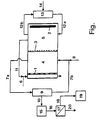
- the figure shows the electrolytic cell with the associated lines, the cell consisting of an oxygen diffusion cathode (1), an anode (2) and a cation exchange membrane (3), which the cell into a cathode chamber (4) and in divides an anode chamber (5).
- oxygen or air is supplied via line (6).
- the front of the cathode (1) is wetted by the catholyte, which is circulated via lines (7a and 7b) and is supplied to the demineralized water via line (8).
- a tank (9) is integrated in this circuit, from which the peroxide-containing solution is removed via line (10).
- the oxygen generated at the anode is passed via line (11) to the oxygen diffusion cathode.
- the anolyte flows via lines (12a and 12b) in a circuit in which a tank (13) is integrated, into which concentrated alkali-containing solution is added via line (14).
- the peroxide-containing solution is fed via line (10) to a crystallization chamber (15) and then via line (16) to a filter (17).
- the alkali peroxide hydrate obtained is fed via line (18) to a drying chamber (19).
- the filtrate is removed via line (20).
- the electrolytic cell is constructed as shown in the figure.
- Cathode compartment (4) and anode compartment (5) are separated by a cation exchange membrane (3) (Nafion 324).
- the cathode (1) is composed of a current collector made of a nickel mesh expanded metal or perforated plate, onto which an approximately 0.4 mm thick, porous and electrically conductive carbon fabric is pressed, which with is coated with a Teflon / carbon black mixture. Air at a pressure of 0.06 bar is supplied to the rear of this cathode (1).
- the electrode area is approx. 0.354 m 2 .
- the anode consists of a nickel expanded metal.
- the anolyte consists of a 20% by weight sodium hydroxide solution, which is kept at a constant concentration during the electrolysis by the addition of concentrated, 45% by weight sodium hydroxide solution. With a current of 530 A and a cell voltage of 2.6 V, an alkaline peroxide solution with a concentration of 5.3% by weight peroxide (calculated as hydrogen peroxide) and 13.9% by weight sodium hydroxide is produced. The current efficiency is 90% for peroxide and 95% for sodium hydroxide.
- the weight ratio of sodium hydroxide to hydrogen peroxide is approximately 2.6 and the molar ratio is approximately 2.2. Approx. 4.7 l of this solution is withdrawn per hour from the catholyte circuit.
- the catholyte volume is replenished by adding the same volume of distilled water (4.7 l / h) via line (8).
- the peroxide solution is cooled from 55 ° C to 20 ° C.
- a white product crystallizes out.
- the crystals are filtered off, washed with cold water and then dried in a stream of air.
- a sample of 100 g contains 34.6 g sodium peroxide and 65.4 g water of crystallization.
- the crystals thus contain 0.44 mol of sodium peroxide and 3.63 mol of water, which gives a molar ratio of sodium peroxide to water of 1 to 8.2. 11.3% by weight of sodium hydroxide and 4.06% by weight of hydrogen peroxide remain dissolved in the filtrate.
- the electrolysis is carried out as in Example 1.
- the crystallization takes place at 4 ° C.
- the crystals contain 33.8 g sodium peroxide and 66.2 g water. This matches with a molar ratio of sodium peroxide to water of 1 to 8.49. This means that 0.49 mol (6% by weight) of adhering water are still found in the air-dried crystals. 8.75% sodium hydroxide and 3.0% hydrogen peroxide remain dissolved in the filtrate.
Landscapes
- Chemical & Material Sciences (AREA)
- Inorganic Chemistry (AREA)
- Engineering & Computer Science (AREA)
- Chemical Kinetics & Catalysis (AREA)
- Electrochemistry (AREA)
- Materials Engineering (AREA)
- Metallurgy (AREA)
- Organic Chemistry (AREA)
- Electrolytic Production Of Non-Metals, Compounds, Apparatuses Therefor (AREA)
Applications Claiming Priority (2)
| Application Number | Priority Date | Filing Date | Title |
|---|---|---|---|
| DE1995116304 DE19516304C1 (de) | 1995-05-04 | 1995-05-04 | Verfahren zur Herstellung von Alkaliperoxid-Hydrat |
| DE19516304 | 1995-05-04 |
Publications (1)
| Publication Number | Publication Date |
|---|---|
| EP0741197A1 true EP0741197A1 (fr) | 1996-11-06 |
Family
ID=7761020
Family Applications (1)
| Application Number | Title | Priority Date | Filing Date |
|---|---|---|---|
| EP96104000A Withdrawn EP0741197A1 (fr) | 1995-05-04 | 1996-03-14 | Procédé de production d'hydrate de peroxyde de métal alcalin |
Country Status (2)
| Country | Link |
|---|---|
| EP (1) | EP0741197A1 (fr) |
| DE (1) | DE19516304C1 (fr) |
Families Citing this family (2)
| Publication number | Priority date | Publication date | Assignee | Title |
|---|---|---|---|---|
| CN116377456A (zh) * | 2023-04-04 | 2023-07-04 | 中国科学院宁波材料技术与工程研究所 | 一种过氧化钡的原位电化学制备方法及电解装置 |
| CN117286515A (zh) * | 2023-07-31 | 2023-12-26 | 中国科学院宁波材料技术与工程研究所 | 一种电化学原位制备碱土金属过氧化物的装置及方法 |
Citations (3)
| Publication number | Priority date | Publication date | Assignee | Title |
|---|---|---|---|---|
| FR2297929A1 (fr) * | 1975-01-15 | 1976-08-13 | Kernforschungsanlage Juelich | Procede de preparation d'eau oxygenee |
| US4680095A (en) * | 1986-11-03 | 1987-07-14 | Pennwalt Corporation | Continuous preparation of dialkanesulfonyl peroxide |
| EP0612864A2 (fr) * | 1993-02-26 | 1994-08-31 | Permelec Electrode Ltd | Cellule d'électrolyse et procédés de production d'hydroxide alcalin et de peroxyde d'hydrogène |
Family Cites Families (9)
| Publication number | Priority date | Publication date | Assignee | Title |
|---|---|---|---|---|
| US4317704A (en) * | 1978-03-02 | 1982-03-02 | The Dow Chemical Company | Method of operating an electrolytic cell |
| US4293396A (en) * | 1979-09-27 | 1981-10-06 | Prototech Company | Thin carbon-cloth-based electrocatalytic gas diffusion electrodes, and electrochemical cells comprising the same |
| EP0066663A1 (fr) * | 1981-06-10 | 1982-12-15 | La Cellulose Des Ardennes | Cellule électrolytique de production d'eau oxygénée en milieu alcalin |
| US4431494A (en) * | 1982-08-03 | 1984-02-14 | The Dow Chemical Company | Method for electrolytic production of alkaline peroxide solutions |
| US4693794A (en) * | 1986-11-20 | 1987-09-15 | Fmc Corporation | Process for manufacturing hydrogen peroxide electrolytically |
| US4758317A (en) * | 1986-11-20 | 1988-07-19 | Fmc Corporation | Process and cell for producing hydrogen peroxide |
| US4872957A (en) * | 1988-07-20 | 1989-10-10 | H-D Tech Inc. | Electrochemical cell having dual purpose electrode |
| DE4311665C1 (de) * | 1993-04-08 | 1994-08-18 | Metallgesellschaft Ag | Verfahren zur Herstellung von Alkaliperoxid-Lösungen |
| DE4317349C1 (de) * | 1993-05-25 | 1994-10-13 | Metallgesellschaft Ag | Verfahren zur Herstellung von Alkaliperoxid/Percarbonat-Lösungen |
-
1995
- 1995-05-04 DE DE1995116304 patent/DE19516304C1/de not_active Expired - Fee Related
-
1996
- 1996-03-14 EP EP96104000A patent/EP0741197A1/fr not_active Withdrawn
Patent Citations (3)
| Publication number | Priority date | Publication date | Assignee | Title |
|---|---|---|---|---|
| FR2297929A1 (fr) * | 1975-01-15 | 1976-08-13 | Kernforschungsanlage Juelich | Procede de preparation d'eau oxygenee |
| US4680095A (en) * | 1986-11-03 | 1987-07-14 | Pennwalt Corporation | Continuous preparation of dialkanesulfonyl peroxide |
| EP0612864A2 (fr) * | 1993-02-26 | 1994-08-31 | Permelec Electrode Ltd | Cellule d'électrolyse et procédés de production d'hydroxide alcalin et de peroxyde d'hydrogène |
Also Published As
| Publication number | Publication date |
|---|---|
| DE19516304C1 (de) | 1996-07-25 |
Similar Documents
| Publication | Publication Date | Title |
|---|---|---|
| EP0694087B1 (fr) | Procede de preparation de solutions de peroxydes alcalins | |
| DE69614516T3 (de) | Nanofiltration von konzentrierten wässrigen salzlösungen | |
| DE69215093T2 (de) | Vorrichtung und Verfahren zur elektrochemischen Zersetzung von Salzlösungen um die entsprechenden Basen und Säuren zu bilden | |
| DE69200006T2 (de) | Verfahren zur elektrolytischen Herstellung von Alkalimetall-Chlorat und chemische Hilfsverbindungen. | |
| DE2940186C2 (de) | Verfahren zur Herstellung von Nitriten | |
| DE3032875A1 (de) | Verfahren zur chloralkali-elektrolyse | |
| JPH08512099A (ja) | 硫化物を含有する白液の電解による多硫化物の製造 | |
| EP0095997A1 (fr) | Procédé pour la production de l'eau oxygénée et son utilisation | |
| DE4426246A1 (de) | Verfahren zur gleichzeitigen Herstellung von Alkalimetall- oder Ammoniumperoxodisulfatsalzen und Alkalimetallhydroxid | |
| DE69223910T2 (de) | Betrieb einer elektrochemischen Zelle | |
| EP0391192B1 (fr) | Procédé de préparation de dichromates alcalins et d'acide chromique par électrolyse | |
| DE60036100T2 (de) | Verfahren zur herstellung von polysulfiden durch anwendung elektrolytischer oxidation | |
| EP0599136A1 (fr) | Procédé de production d'hydroxide de nickel pur et son utilisation | |
| EP0011326B1 (fr) | Procédé de préparation de dioxide de chlore et le cas échéant, de chlore à partir d'acide chlorhydrique et de chlorate alcalin | |
| DE2753233A1 (de) | Verfahren zur herstellung von chlor und natriumcarbonatmonohydrat | |
| DE19516304C1 (de) | Verfahren zur Herstellung von Alkaliperoxid-Hydrat | |
| DE2432416A1 (de) | Verfahren zur gewinnung von elektrolytisch hergestellten alkalichloraten | |
| DE2124045C3 (de) | Verfahren zur elektrolytischen Her stellung von reinem Chlor, Wasserstoff und reinen konzentrierten Alkaliphosphat lösungen und Elektrolyslerzelle zur Durch führung des Verfahrens | |
| DE102004012334A1 (de) | Verfahren zur Herstellung von Metallhydroxiden, insbesondere Lithiumhydroxid | |
| DE4317349C1 (de) | Verfahren zur Herstellung von Alkaliperoxid/Percarbonat-Lösungen | |
| CH653710A5 (de) | Verfahren zur herstellung von blauen eisenhexacyanoferrat-iii-pigmenten. | |
| DD262679A5 (de) | Verfahren zur entfernung von chrom-vi-ionen aus waessrigen loesungen | |
| DE60004090T2 (de) | Verfahren zur herstellung einer alkalischen wasserstoffperoxidlösung und chlordioxid | |
| DE10031018B4 (de) | Chloralkalielektrolyse-Verfahren in Membranzellen unter Elektrolyse von ungereinigtem Siedesalz | |
| DE2837313A1 (de) | Verfahren zur elektrolyse waessriger alkalihalogenid-loesungen |
Legal Events
| Date | Code | Title | Description |
|---|---|---|---|
| PUAI | Public reference made under article 153(3) epc to a published international application that has entered the european phase |
Free format text: ORIGINAL CODE: 0009012 |
|
| AK | Designated contracting states |
Kind code of ref document: A1 Designated state(s): AT BE DE FR GB IT SE |
|
| 17P | Request for examination filed |
Effective date: 19970506 |
|
| GRAG | Despatch of communication of intention to grant |
Free format text: ORIGINAL CODE: EPIDOS AGRA |
|
| GRAG | Despatch of communication of intention to grant |
Free format text: ORIGINAL CODE: EPIDOS AGRA |
|
| GRAH | Despatch of communication of intention to grant a patent |
Free format text: ORIGINAL CODE: EPIDOS IGRA |
|
| 17Q | First examination report despatched |
Effective date: 19971030 |
|
| GRAH | Despatch of communication of intention to grant a patent |
Free format text: ORIGINAL CODE: EPIDOS IGRA |
|
| STAA | Information on the status of an ep patent application or granted ep patent |
Free format text: STATUS: THE APPLICATION HAS BEEN WITHDRAWN |
|
| 18W | Application withdrawn |
Withdrawal date: 19980303 |