EP0741973A1 - Produit de viande cuit et extrudé comprenant des additifs - Google Patents
Produit de viande cuit et extrudé comprenant des additifs Download PDFInfo
- Publication number
- EP0741973A1 EP0741973A1 EP96302764A EP96302764A EP0741973A1 EP 0741973 A1 EP0741973 A1 EP 0741973A1 EP 96302764 A EP96302764 A EP 96302764A EP 96302764 A EP96302764 A EP 96302764A EP 0741973 A1 EP0741973 A1 EP 0741973A1
- Authority
- EP
- European Patent Office
- Prior art keywords
- meat
- additive
- extruded
- extrudate
- fluid
- Prior art date
- Legal status (The legal status is an assumption and is not a legal conclusion. Google has not performed a legal analysis and makes no representation as to the accuracy of the status listed.)
- Granted
Links
- 239000000654 additive Substances 0.000 title claims abstract description 145
- 230000000996 additive effect Effects 0.000 title claims abstract description 140
- 235000013622 meat product Nutrition 0.000 title claims abstract description 76
- 235000013372 meat Nutrition 0.000 claims abstract description 275
- 239000000839 emulsion Substances 0.000 claims abstract description 49
- 238000004519 manufacturing process Methods 0.000 claims abstract description 8
- 239000012530 fluid Substances 0.000 claims description 91
- 238000001125 extrusion Methods 0.000 claims description 89
- 239000000758 substrate Substances 0.000 claims description 56
- 210000003205 muscle Anatomy 0.000 claims description 47
- 238000010411 cooking Methods 0.000 claims description 33
- 238000000034 method Methods 0.000 claims description 28
- 235000020997 lean meat Nutrition 0.000 claims description 16
- 239000000047 product Substances 0.000 claims description 16
- 238000011144 upstream manufacturing Methods 0.000 claims description 13
- 235000011194 food seasoning agent Nutrition 0.000 claims description 11
- XLYOFNOQVPJJNP-UHFFFAOYSA-N water Substances O XLYOFNOQVPJJNP-UHFFFAOYSA-N 0.000 claims description 11
- 238000004040 coloring Methods 0.000 claims description 9
- 239000002960 lipid emulsion Substances 0.000 claims description 9
- 238000005086 pumping Methods 0.000 claims description 7
- 239000003381 stabilizer Substances 0.000 claims description 7
- 241001465754 Metazoa Species 0.000 claims description 6
- 108010082495 Dietary Plant Proteins Proteins 0.000 claims description 3
- 108010011756 Milk Proteins Proteins 0.000 claims description 3
- 229920000615 alginic acid Polymers 0.000 claims description 3
- 235000010443 alginic acid Nutrition 0.000 claims description 3
- 239000003995 emulsifying agent Substances 0.000 claims description 3
- 229920000609 methyl cellulose Polymers 0.000 claims description 3
- 239000001923 methylcellulose Substances 0.000 claims description 3
- 235000013336 milk Nutrition 0.000 claims description 3
- 239000008267 milk Substances 0.000 claims description 3
- 210000004080 milk Anatomy 0.000 claims description 3
- 239000012466 permeate Substances 0.000 claims description 3
- 239000002562 thickening agent Substances 0.000 claims description 3
- 229920000881 Modified starch Polymers 0.000 claims description 2
- 235000019426 modified starch Nutrition 0.000 claims description 2
- 239000010410 layer Substances 0.000 description 62
- 239000007788 liquid Substances 0.000 description 32
- 239000000779 smoke Substances 0.000 description 11
- 230000008569 process Effects 0.000 description 8
- 238000005192 partition Methods 0.000 description 7
- 235000013305 food Nutrition 0.000 description 6
- 230000035515 penetration Effects 0.000 description 6
- 239000004278 EU approved seasoning Substances 0.000 description 5
- 239000011230 binding agent Substances 0.000 description 5
- 239000006188 syrup Substances 0.000 description 5
- 235000020357 syrup Nutrition 0.000 description 5
- 229920002472 Starch Polymers 0.000 description 4
- 230000000694 effects Effects 0.000 description 4
- 239000000796 flavoring agent Substances 0.000 description 4
- 235000013580 sausages Nutrition 0.000 description 4
- 235000019698 starch Nutrition 0.000 description 4
- 108010070551 Meat Proteins Proteins 0.000 description 3
- 230000015556 catabolic process Effects 0.000 description 3
- 238000004140 cleaning Methods 0.000 description 3
- 239000011248 coating agent Substances 0.000 description 3
- 238000000576 coating method Methods 0.000 description 3
- 238000001816 cooling Methods 0.000 description 3
- 238000005520 cutting process Methods 0.000 description 3
- 230000005012 migration Effects 0.000 description 3
- 238000013508 migration Methods 0.000 description 3
- 235000015277 pork Nutrition 0.000 description 3
- 238000007789 sealing Methods 0.000 description 3
- 239000008107 starch Substances 0.000 description 3
- 238000009966 trimming Methods 0.000 description 3
- 235000014122 turkey meat Nutrition 0.000 description 3
- 241000251468 Actinopterygii Species 0.000 description 2
- 239000000463 material Substances 0.000 description 2
- 239000011236 particulate material Substances 0.000 description 2
- 230000000391 smoking effect Effects 0.000 description 2
- MIDXCONKKJTLDX-UHFFFAOYSA-N 3,5-dimethylcyclopentane-1,2-dione Chemical compound CC1CC(C)C(=O)C1=O MIDXCONKKJTLDX-UHFFFAOYSA-N 0.000 description 1
- 235000002566 Capsicum Nutrition 0.000 description 1
- 241000196324 Embryophyta Species 0.000 description 1
- 239000006002 Pepper Substances 0.000 description 1
- 235000016761 Piper aduncum Nutrition 0.000 description 1
- 235000017804 Piper guineense Nutrition 0.000 description 1
- 244000203593 Piper nigrum Species 0.000 description 1
- 235000008184 Piper nigrum Nutrition 0.000 description 1
- 229910000831 Steel Inorganic materials 0.000 description 1
- 230000002378 acidificating effect Effects 0.000 description 1
- 230000008901 benefit Effects 0.000 description 1
- 235000013736 caramel Nutrition 0.000 description 1
- 239000011247 coating layer Substances 0.000 description 1
- 238000004925 denaturation Methods 0.000 description 1
- 230000036425 denaturation Effects 0.000 description 1
- 235000012438 extruded product Nutrition 0.000 description 1
- 235000019197 fats Nutrition 0.000 description 1
- 235000019634 flavors Nutrition 0.000 description 1
- 238000013467 fragmentation Methods 0.000 description 1
- 238000006062 fragmentation reaction Methods 0.000 description 1
- 239000003292 glue Substances 0.000 description 1
- 230000036541 health Effects 0.000 description 1
- 235000008216 herbs Nutrition 0.000 description 1
- 235000012907 honey Nutrition 0.000 description 1
- 239000004615 ingredient Substances 0.000 description 1
- 230000003993 interaction Effects 0.000 description 1
- 239000011344 liquid material Substances 0.000 description 1
- 230000003278 mimic effect Effects 0.000 description 1
- 238000010422 painting Methods 0.000 description 1
- 239000002245 particle Substances 0.000 description 1
- 239000013618 particulate matter Substances 0.000 description 1
- 235000014594 pastries Nutrition 0.000 description 1
- 230000000149 penetrating effect Effects 0.000 description 1
- 230000000750 progressive effect Effects 0.000 description 1
- 230000001737 promoting effect Effects 0.000 description 1
- 150000003839 salts Chemical class 0.000 description 1
- 239000007787 solid Substances 0.000 description 1
- 239000000243 solution Substances 0.000 description 1
- 235000013599 spices Nutrition 0.000 description 1
- 239000010959 steel Substances 0.000 description 1
Images


Classifications
-
- A—HUMAN NECESSITIES
- A23—FOODS OR FOODSTUFFS; TREATMENT THEREOF, NOT COVERED BY OTHER CLASSES
- A23L—FOODS, FOODSTUFFS OR NON-ALCOHOLIC BEVERAGES, NOT OTHERWISE PROVIDED FOR; PREPARATION OR TREATMENT THEREOF
- A23L13/00—Meat products; Meat meal; Preparation or treatment thereof
- A23L13/60—Comminuted or emulsified meat products, e.g. sausages; Reformed meat from comminuted meat product
-
- A—HUMAN NECESSITIES
- A22—BUTCHERING; MEAT TREATMENT; PROCESSING POULTRY OR FISH
- A22C—PROCESSING MEAT, POULTRY, OR FISH
- A22C11/00—Sausage making ; Apparatus for handling or conveying sausage products during manufacture
- A22C11/02—Sausage filling or stuffing machines
- A22C11/029—Sausage filling or stuffing machines with coating or lubricating means
-
- A—HUMAN NECESSITIES
- A22—BUTCHERING; MEAT TREATMENT; PROCESSING POULTRY OR FISH
- A22C—PROCESSING MEAT, POULTRY, OR FISH
- A22C11/00—Sausage making ; Apparatus for handling or conveying sausage products during manufacture
- A22C11/02—Sausage filling or stuffing machines
-
- A—HUMAN NECESSITIES
- A23—FOODS OR FOODSTUFFS; TREATMENT THEREOF, NOT COVERED BY OTHER CLASSES
- A23L—FOODS, FOODSTUFFS OR NON-ALCOHOLIC BEVERAGES, NOT OTHERWISE PROVIDED FOR; PREPARATION OR TREATMENT THEREOF
- A23L13/00—Meat products; Meat meal; Preparation or treatment thereof
- A23L13/40—Meat products; Meat meal; Preparation or treatment thereof containing additives
-
- A—HUMAN NECESSITIES
- A23—FOODS OR FOODSTUFFS; TREATMENT THEREOF, NOT COVERED BY OTHER CLASSES
- A23P—SHAPING OR WORKING OF FOODSTUFFS, NOT FULLY COVERED BY A SINGLE OTHER SUBCLASS
- A23P20/00—Coating of foodstuffs; Coatings therefor; Making laminated, multi-layered, stuffed or hollow foodstuffs
- A23P20/20—Making of laminated, multi-layered, stuffed or hollow foodstuffs, e.g. by wrapping in preformed edible dough sheets or in edible food containers
-
- A—HUMAN NECESSITIES
- A23—FOODS OR FOODSTUFFS; TREATMENT THEREOF, NOT COVERED BY OTHER CLASSES
- A23P—SHAPING OR WORKING OF FOODSTUFFS, NOT FULLY COVERED BY A SINGLE OTHER SUBCLASS
- A23P30/00—Shaping or working of foodstuffs characterised by the process or apparatus
- A23P30/20—Extruding
-
- A—HUMAN NECESSITIES
- A22—BUTCHERING; MEAT TREATMENT; PROCESSING POULTRY OR FISH
- A22C—PROCESSING MEAT, POULTRY, OR FISH
- A22C13/00—Sausage casings
- A22C2013/0046—Sausage casings suitable for impregnation with flavouring substances, e.g. caramel, liquid smoke, spices
Definitions
- the present invention relates to a cooked, extruded meat product comprising an additive such, for example, as a colouring, flavouring or seasoning.
- the present invention also embraces methods and apparatus for making such a cooked, extruded meat product.
- One prior art method for applying an additive to an extruded meat product consists in "painting" the additive in the form of a viscous syrup, by means of a pastry brush or the like, onto an outer surface of the extrudate prior to cooking.
- the syrup must be sufficiently viscous to remain in place on the product prior to and during cooking. Nevertheless, an amount of the syrup additive will be removed when the product comes into contact with, or rubs against other articles on the bench or in the oven.
- This method also suffers from the disadvantage that the viscous additive does not penetrate substantially into the meat extrudate.
- the flavour thus remains concentrated on the outside of the product which is unsatisfactory from the point of view of a consumer.
- the viscous additive is unprotected on the outer surface of the meat product during cooking and will, to an extent, be denatured as a result of the concentration of heat on the outer surface.
- the use of the viscous syrup additive makes it difficult to automate the process.
- US-A-4905587 to Smithers discloses a method for applying liquid smoke and other flavourings to sausages.
- the liquid smoke is applied to a meat substrate as it debouches a nozzle, and travels in contact with the meat product inside a stuffing horn prior to encasement in a flexible casing.
- Sufficient liquid smoke may be applied for complete coverage of the surface of the meat substrate, but substantial intermixing of the liquid smoke and meat is avoided to ensure that the liquid smoke does not penetrate the meat by more than one millimetre after the sausage is cooked. In this way the cooked sausage resembles one which has been smoked by a traditional smoking process in a smoke house.
- US-A-4905587 A disadvantage which is inherent in the method disclosed by US-A-4905587 is that the liquid smoke has to travel with the meat substrate along the entire length of the stuffing horn prior to encasement in the flexible casing. Whilst it is noted that US-A-4905587 is concerned to provide only a thin layer of liquid smoke on the meat substrate so as to mimic the effect of traditional smoking, this means that the method of US-A-4905587 would be unsuitable for applying greater amounts of fluid additive to the substrate, because the interaction between the meat substrate and a contiguous layer of liquid smoke of greater depth than is contemplated by US-A-4905587, at the point of contact juxtaposed the nozzle and along the length of the stuffing horn, will inevitably lead to occasional fracturing of the meat substrate in the stuffing horn, and substantial penetration of the liquid smoke into cracks opened up between fragmented sections of the substrate. Product affected in this way will be unusable and will therefore have to be thrown away.
- the apparatus disclosed by US-A-4905587 is not suitable for dispensing onto the sausage substrate liquid additives containing particulate matter such, for example, as ground seasonings, e.g. ground peppercorns.
- US-A-4905587 also suffers from the disadvantage that it cannot be used for applying liquid smoke to co-extruded meat products, such for example as those disclosed in the present applicants' previous European patent application no. EP-A-0024790.
- the liquid additive may contain particulate material such, for example, as ground seasonings, e.g. whole or ground peppercorns.
- a cooked, extruded meat product comprising a meat extrudate having an outwardly facing surface, which meat extrudate is impregnated with an additive in an additive zone which extends inwardly from said surface to a depth of at least 1mm.
- meal as used herein is meant the processed or unprocessed, edible parts of any animal, bird or fish which are capable of being extruded, including emulsified fat and emulsified lean meat trimmings, as well as natural or extended lean muscle meat.
- Said meat extrudate may comprise a unitary extrudate of lean muscle meat.
- the extrudate may comprise an extruded core and one or more contiguous, co-extruded layers of meat which are disposed wholly or partly around the core.
- Said extruded core may consist of lean muscle meat, and the meat forming the contiguous layer(s) may be the same or different from the core meat.
- the extrudate may comprise a core of lean muscle meat and a circumjacent, co-extruded layer of fat emulsion or a meat emulsion comprising emulsified lean meat trimmings.
- the additive zone will extend inwardly from the surface of the outermost layer of meat, or the core where no other layers are present.
- the additive may impregnate the core or a layer which is not the outermost layer, such that the additive zone is "sandwiched" between two contiguous layers of the extrudate.
- lean muscle meat to form one or more of the core or layers of the meat extrudate may be used natural or extended diced, sliced or comminuted lean muscle meat pieces. In a preferred embodiment whole muscle meat pieces are employed. Where one or more co-extruded meat or fat emulsion layers are provided, the fat emulsion may be as disclosed in EP-A-0024790 to the applicants.
- Said additive may be a flavouring, colouring or seasoning of the kind generally well known to persons skilled in the art for use in the food industry.
- the cooked, extruded meat product will be sliced in a direction across the axis of extrusion.
- Said additive zone may extend into the meat to a depth of 1 to 10mm, typically 1 to 5mm.
- the remainder of the meat substrate may remain substantially free of the additive.
- a method of making an extruded meat product comprising pumping a meat substrate through a stuffing horn to an extrusion head and thereafter through the extrusion head into a flexible casing, characterised by applying automatically fluid additive to an outwardly facing surface of the meat substrate as it debouches from the extrusion head into the flexible casing
- Said meat substrate may be extruded through one or more generally concentric meat dispensing orifices formed in the extrusion head, and the fluid additive may be applied to the meat substrate via a fluid dispensing orifice formed in the extrusion head wholly or partly around one or more of the meat dispensing orifices.
- a single meat dispensing orifice may be provided for extruding a lean muscle meat substrate therethrough, e.g. whole muscle meat, and the fluid dispensing orifice may be formed circumferentially around the meat dispensing orifice for applying fluid additive to the outer surface of the meat extrudate.
- a first meat dispensing orifice may be provided for extruding a core of whole muscle meat therethrough
- a second annular meat dispensing orifice may be provided for co-extruding a contiguous layer of meat around the core
- an annular fluid dispensing orifice may be provided for applying fluid additive to the outer surface of said contiguous layer of meat.
- said contiguous meat layer will consist of a fat or meat emulsion.
- the fluid dispensing orifice may be interposed between two concentric meat dispensing orifices, such that the fluid additive is dispensed between two neighbouring co-extruded meat layers.
- the stuffing horn may be equipped with a corresponding number of generally coaxial conduits, each of which conduits is coupled with a respective one of the meat dispensing orifices.
- the meat(s) to form the core and layer(s) will be pumped in parallel through the conduits of the stuffing horn to the extrusion head.
- a method of making a co-extruded meat product comprising co-extruding a lean muscle meat core and a contiguous fat or meat emulsion layer into a flexible casing, such that said fat or meat emulsion layer is disposed circumferentially of said core; characterised in that said fat or meat emulsion layer comprises a fluid additive.
- Said extruded or co-extruded meat product may be subsequently cooked, and during the cooking process said fluid additive will penetrate into an additive zone juxtaposed the said outwardly facing surface of the meat substrate.
- sufficient fluid additive may be used that the additive permeates into the additive zone to a depth of at least 1mm, and particularly 1-10mm.
- the penetration of the fluid additive may be assisted by the denaturing of the meat at or towards said surface during the cooking process.
- the fluid additive may be applied in the form of a viscous paste which may remain substantially on the said surface during cooking.
- the paste may, by way of example, contain particulate seasonings such as whole or ground peppercorns. This is particularly desirable where the paste is applied to a co-extruded meat product comprising a whole muscle meat core and contiguous fat or meat emulsion outer layer.
- water may be "cooked out” of the meat product during cooking, particularly where high quality whole muscle or natural lean meat substrates containing more than 80% or 90% lean meat are used.
- the fluid additive When the fluid additive is applied to an outermost layer which comprises lean muscle meat this water may collect under the flexible casing. When the casing is stripped from the meat product, the meat product may therefore be wet, and it will be appreciated that this is undesirable in food processing plant.
- Said flexible casing may be moisture impermeable.
- the flexible casing may be a moisture permeable casing such, for example, as a fibrous casing of the kind well known in the art.
- a moisture permeable casing will allow water "cooked-out" of the meat product to be removed as water vapour, so that the meat will be substantially dry when the casing is stripped away.
- said fat or meat emulsion layer may be stabilized by the addition of a stabilizer of known kinds to maintain the integrity of the fat emulsion layer after cooking.
- Said stabilizer may be selected from one or more of collagenous animal, milk or vegetable proteins, emulsifiers, stabilizers, thickeners such, for example, as alginates/"gums", methylcellulose and derivatives thereof, and natural and modified starches.
- extended lean muscle meat substrates containing 60-70% meat protein and binder e.g. water-retaining starch, may be employed, in which case water loss from the meat substrate may be reduced.
- a moisture-impermeable casing may be employed, or a fibrous casing may be used to give the meat product a characteristic surface texture or quality.
- an extruded meat product comprising a meat extrudate comprising a single, unitary extrudate or an outermost co-extruded layer, of lean muscle meat, which meat extrudate is received in a flexible casing; characterised by a layer of fluid additive intermediate the casing and the unitary extrudate or outermost layer, which fluid additive is adapted to penetrate into the meat during subsequent cooking, and in that said flexible casing is moisture permeable, thereby to permit water vapour to escape the extruded meat product during cooking.
- a co-extruded meat product comprising a first core of lean muscle meat substrate and a second contiguous outer layer of fat or meat emulsion, which second layer is disposed circumferentially of said first core; characterised in that said fat or meat emulsion includes a fluid additive which is adapted to penetrate into the lean muscle meat core during subsequent cooking.
- the meat product After cooking, the meat product will usually be allowed to cool.
- the casing sleeve will typically be inedible, and will be releasable from the meat product after cooling. After cooling therefore, the resilient sleeve may be stripped off the meat product, and the meat product may then be sliced.
- apparatus for making an extruded meat product comprising a stuffing horn comprising an upstream end and a downstream end, an extrusion head coupled to the downstream end of said stuffing horn, and meat pumping means for pumping meat substrate successively through the stuffing horn and extrusion head into a flexible casing carried on the stuffing horn, which extrusion head comprises:
- the extrusion head may comprise a single meat extrusion conduit and the cavity may be formed circumferentially therearound.
- the extrusion head may define a plurality of generally coaxial meat extrusion conduits, typically two, and the cavity may be formed around one or more of the conduits, typically around all of the conduits such that in use the fluid additive is applied to the outwardly facing surface of the outermost co-extruded layer of meat substrate.
- the fluid additive will be dispensed between two co-extruded layers of meat substrate, such that in the resultant, uncooked meat extrudate, the fluid additive will be sandwiched between the said two layers.
- Use of apparatus in accordance with the present invention may permit the application of a substantially uniform coating of additive to the outwardly facing surface of the meat extrudate as it debouches the at least one meat dispensing orifice.
- Application of the fluid additive to the meat substrate just before it is received in the flexible casing avoids the need to move the fluid additive within the stuffing horn in contact with the meat substrate, and allows close control over the amount of additive metered on the substrate, and the production of a meat product having a uniform layer of fluid additive applied thereto.
- the additive will be protected by the casing, and will be prevented from coming-off the meat during subsequent handling of the product.
- the extrusion head will usually be capable of being decoupled from the stuffing horn to allow cleaning of the extrusion head.
- the extrusion head may comprise a first inner body part which defines the at least one meat extrusion conduit, and a second outer body part which mates with the first part to define the said cavity intermediate the first and second parts. The extrusion head may therefore be disassembled to allow cleaning of the interior of the cavity.
- the apparatus of the present invention can be used to produce a succession of batches of meat product using different fluid additives for each successive batch, with little or no wasted meat substrate when the fluid additive is changed between batches.
- the fluid additive is applied to the meat as it is extruded into the casing, there is no risk of the fluid additive causing fragmentation of the meat substrate as it travels along the stuffing horn and through the extrusion head, even where a large amount of additive is used to achieve substantial penetration of the fluid additive into the meat.
- a liquid additive of low viscosity may optionally be used which may be less problematical with respect to automation of the process as compared with the viscous syrup additives used in prior art, and has the advantage that it may penetrate more readily into the surface of the meat substrate.
- the viscosity of the additive fluid can be varied according to the type of additive used and the desired end result, and as mentioned above, the use of a paste may be desirable in some cases.
- Said flexible casing may form a tight fit around the meat extrudate which will have the effect of promoting the migration of the fluid additive into the surface of the meat.
- the ingress of the fluid additive into the meat substrate may also be promoted by the quality of the meat itself which in the case of whole muscle meat may be relaxed and expanded towards its outer surface as it debouches through the extrusion head.
- the fluid additive may be sufficiently "wet" to aid entry of the fluid into the surface of the meat substrate.
- the fluid additive may be delivered slowly through the fluid dispensing orifice such that it is "dribbled" onto the outwardly facing surface of the extrudate to form a non-uniform pattern on the surface of the meat.
- the fluid additive may be pumped through the fluid dispensing orifice at a higher rate so as to provide a substantially uniform coverage over the entire outwardly facing surface of the extrudate.
- the flexible sleeve may encircle the stuffing horn and extrusion head.
- the fluid additive may be applied to the outwardly facing surface of the meat extrudate just upstream of a location where the meat contacts the inner surface of the casing, such that the fluid is inletted into a space between the meat extrudate and the casing.
- Said extrusion head may be constructed and arranged so as to shield the meat product from the casing until the fluid additive has been dispensed onto the surface of the meat.
- the meat product may be extruded as a succession of separate "logs" of pre-determined length. Once the extrudate has reached the pre-determined length a cutting and sealing apparatus of known kind may cut the extrudate and seal the cut ends of the casing on the trailing end of the log and the leading end of the next successive log. According to the invention, therefore, the flexible casing may be closed at a location downstream of the extrusion head, and the forward movement of the meat extrudate itself may cause the casing to be dispensed on to the extrudate from the stuffing horn in a progressive manner.
- Fluid additive may be delivered to the inlet means through a supply conduit disposed juxtaposed the stuffing horn.
- Said supply conduit may be disposed between the stuffing horn and the resilient sleeve.
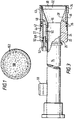
- Figure 1 shows a slice of a cooked, extruded meat product in accordance with the present invention.
- Figure 2 is an isometric view of apparatus for performing the present invention.
- Figure 3 is a side view, partly in cross-section, of a stuffing horn and extrusion head in accordance with the present invention.
- Figure 4 is an isometric view, partly cut-away, of an extruded meat product of the invention before cooking.
- Figure 5 is a cross-section through the extruded product of Figure 4.
- Figure 6 shows a slice of another cooked meat product in accordance with the present invention.
- Figure 7 is an isometric view of another apparatus for making the product of Figure 6.
- Figure 8 is a side-view , partly in section, of part of the apparatus of Figure 7.
- Figure 9 shows a slice of yet another cooked extruded meat product according to the present invention.
- Figure 10 shows a slice of yet another cooked, extruded meat product according to the invention.
- Figure 11 shows a side view, partly in section, of a different extrusion head according to the present invention.
- Figure 12 shows an isometric view of yet another apparatus for making the product of Figure 10.
- FIG. 1 A first example of a cooked, extruded meat product in accordance with the present invention is illustrated in Figure 1.
- This product comprises a meat substrate (100) which is extruded as a single, unitary extrudate of generally circular cross section.
- the extrudate has a generally cylindrical additive zone (102) which extends inwardly from the outer surface of the meat extrudate (100) to a depth of more than 1mm, preferably 1 to 10mm.
- meat substrate (100) lean muscle meat from any animal, bird or fish may be employed which is capable of being extruded.
- turkey meat is used.
- the lean muscle meat may have a high lean meat content of more than say 75 to 80% by weight.
- extended meat may be used comprising 60 to 70% lean muscle meat and the rest as binders such, for example, as starch binders.
- Said additive zone (102) is impregnated with an additive such, for example, as a colouring or flavouring.
- Said additive is applied in liquid form to the outer surface of the meat extrudate (100) in a manner as hereinafter described. During subsequent cooking, the additive penetrates into the additive zone (102); this penetration is assisted by denaturation of the lean muscle meat structure at or towards the outer surface of the extrudate (100) during cooking.
- the liquid additive may additionally contain seasoning, such for example as particles of pepper or other spices or herbs. Generally, these will not penetrate into meat, but will remain on the surface.
- the meat product may be sliced across the direction of extrusion to form thin, generally circular slices as shown in Figure 1.
- a process for making the meat product illustrated in Figure 1 comprises pumping meat (10) by a meat pump (12) from a first hopper (13) through an elongate steel pipe (14) of circular cross-section to an extrusion head (20) (see Figure 2).
- the meat (10) may comprise comminuted, diced or sliced meat pieces, or preferably whole muscle meat may be employed, as by deboning the carcase of an animal or bird and supplying all of the meat to the meat pump.
- the meat Before supplying the meat to the first hopper (13), the meat may be massaged with salt and/or other functional ingredients to draw out from the meat matter a liquid meat protein which acts as a meat glue.
- Said extrusion head (20 as shown in Figure 3, comprises a generally cylindrical body part (22) which defines a central passageway (24) therethrough.
- the upstream end (26) of the passageway (24) is adapted to accommodate the downstream end (16) of the pipe (14), such that lean muscle meat pumped through the pipe (14) is delivered into the passageway (24).
- the passageway (24) is flared radially outwardly at the point indicated at (28) in the downstream direction in the form of a frustocone, and terminates at the downstream end (34) of the body part (22) in a short cylindrical section (32). The widening of the passageway (24) towards the downstream end (30) thereof permits the whole muscle meat to expand and relax slightly as it debouches from the passageway (24).
- Said body part (22) carries thereon a cylindrical ring part (40) which encircles the downstream end (30) of the body part (22).
- An upstream end (42) of the ring part (40) is accommodated in a rebate (44) formed in the outer surface of the body part (22), and the downstream end (44) of the ring part (40) projects slightly in the downstream direction beyond the downstream end (30) of the body part (22).
- the downstream end (44) of the ring part (40) is spaced radially from the body part (22) to define an annular cavity (46) therebetween.
- the outer surface of the downstream end (30) of the body part (22) is shaped at (34) to provide a constriction at the downstream end of the annular cavity (46).
- the rebated part (44) of the body portion (22) is equipped with one or more O-rings (36) as shown in Figure 3 which are accommodated in grooves milled in the outer surface of the body part (22) and form a fluid-tight seal with the inner surface of the ring part (40).
- the outer surface of the extrusion head (20) defined by the ring part (40) and body part (22) is substantially smooth for reasons which will be described hereinafter.
- the body part (22) is formed with an inwardly directly circumferential channel (48) which communicates with a narrow cylindrical inlet passageway (50) drilled through the body part (22) in parallel with the passageway (24) between the channel (48) and the upstream end (26).
- a narrow cylindrical inlet passageway (50) drilled through the body part (22) in parallel with the passageway (24) between the channel (48) and the upstream end (26).
- the body part (22) accommodates an O-ring (52) in the inlet passageway (50) to form a seal with a nozzle part (60) of a connector (62) carried on the outer surface of said pipe (14).
- the connector (62) is adapted for connection to a flexible tube (64) as shown in Figure 1 for supplying a meat additive fluid from a second hopper (67) by a fluid pump (66) to the annular cavity (46) via the inlet passageway (50).
- the tube (64) may optionally pass through a tube retaining member (68) also carried by the pipe (14) at a distance upstream of the extrusion head (20).
- Meat additive fluid such for example as a solution of meat colouring, penetrating flavouring or external seasoning is pumped through the tube (64), the connector (62), the inlet passageway (50) and the annular cavity (46) in succession for application to the outer surface of the meat extrudate (10) as it debouches from the downstream end (30) of the passageway (24).
- the downstream end (44) of the ring part (40) which projects beyond the body part (22) serves to direct the fluid onto the meat.
- a releasable detent device (not shown) may be provided for holding the body and ring parts (22, 40) of the extrusion head (20) together. Furthermore, a releasable locking means may be provided for locking the downstream end of the pipe (14) in the passageway (24).
- the pipe (14) and extrusion head (20) carry thereabout a resilient sleeve (70) of the kind which is well known to a person skilled in the art for encasing meat products.
- Said sleeve (70) will typically be moisture-permeable, e.g. a fibrous casing, to allow water, which is "cooked-out" of the lean muscle meat during subsequent cooking, to escape as water vapour.
- the sleeve may be substantially moisture impermeable.
- the sleeve (70) is rucked to form a plurality of circumferential folds so that a sleeve of substantial length can be accommodated on the pipe (14).
- the meat product (10) is extruded through the extrusion head (20) in logs (80) of pre-determined length, as shown in Figure 4.
- the log (80) is cut by a cutting and sealing device (82) of a kind which is well known to a person skilled in the art which also seals both cut ends of the sleeve (70) as shown at (72) in Figure 2.
- the next succeeding log (80) is thus extruded into the closed end (72) of the sleeve (70) such that extrusion of the log causes or allows the sleeve (70) to pay-out from about the pipe (14) onto the exterior surface of the log.
- the smooth outer surface of the extrusion head allows the sleeve (70) to pass thereover without obstruction.
- the resilient sleeve (70) is dimensioned to form a tight fit round the meat extrudate as it debouches from the extrusion head (20).
- the forwardly protruding end (44) of the ring part (40) prevents the sleeve (70) from contacting the outer surface of the extrudate until the fluid additive has been applied to the meat.
- Said fluid additive is thus supplied to an annular space between the extruded meat log (80) and the sleeve (70) and can be delivered at a slow rate such that the fluid "dribbles" through the annular cavity (46) to form a non-continuous coating on the meat extrudate (10).
- the fluid can be pumped under substantial pressure between the sleeve (70) and the meat extrudate (10) to form a uniform coating.
- the viscosity of the fluid can be adjusted according to the desired end result, but advantageously the fluid will be sufficiently wet to assist in penetration of the additive into the meat extrudate (10) during cooking. It will be appreciated that the migration of the fluid additive into the meat will be promoted by the quality of the meat after extrusion, and also by the pressure exerted between the sleeve (70) and the extrudate (10).
- the fluid additive may, for example, comprise a colouring additive, e.g. caramel, or a flavouring such as honey or "Chinese” flavouring.
- the fluid may also contain seasoning such as whole or ground peppercorns. Additionally the fluid additive may be buffered at a mildly acidic pH to break-down the meat protein towards the surface of the meat extrudate (10) to facilitate migration of the fluid flavouring into the meat.
- Sufficient liquid additive may be supplied between the sleeve and the meat substrate that during subsequent cooking the additive permeates the meat to a depth of at least 1mm, typically 1-10mm, and more typically 1 to 5mm.
- fluid meat additive will be delivered onto the outer surface of the meat extrudate (10) from the annular cavity (46) to form a ring of fluid around the emerging portion of the meat extrudate (10).
- This ring of fluid will be entrained by the meat and surrounding sleeve (70) to advance progressively with the log (80).
- This "intermediate" product is illustrated in Figures 4 and 5 which show the layer of fluid additive (11) between the sleeve (70) and meat extrudate (10).
- a complete log of meat product thus formed is then transferred to a steam cooker for cooking the meat (10) and allowed to cool.
- the additive liquid will penetrate into the additive zone of the meat extrudate to a depth typically of up to 10mm. This penetration of the additive will be facilitated by the break-down of the lean muscle meat structure towards its surface.
- the sleeve may then be stripped off and the meat product sliced, e.g. in a direction transverse the axis of extrusion to form circular slices of meat (100) as shown in Figure 1.
- the slices include a circumferential additive zone (102) which is impregnated and marinated with the additive.
- the meat product comprises an extruded core (200) of lean muscle meat and a co-extruded layer (201) of a mobile fat or meat emulsion, which meat emulsion comprises emulsified lean meat trimmings.
- the lean meat core (200) Contiguous the fat or meat emulsion layer (201), the lean meat core (200) comprises an outwardly facing surface (203), and an additive zone (202) which extends inwardly from the outwardly facing surface (203) to a depth of more than one millimetre.
- the additive zone (202) is impregnated with additives such as colouring or flavouring.
- the present example can be manufactured using apparatus of the kind described above which is suitably modified to co-extrude a layer of fat or meat emulsion around the meat extrudate (200), such that liquid additive is dispensed intermediate the lean meat and fat or meat emulsion extrudates.
- the additive can be mixed with the fat or meat emulsion, which fat or meat emulsion can then be co-extruded with the meat substrate using apparatus of the kind described in EP-A-0024790 to the applicants.
- additive will migrate from the fat or meat emulsion layer into the additive zone (202) of the extruded lean muscle meat core (200).
- Apparatus suitable for making a co-extruded meat product of this kind is illustrated in Figures 7 and 8. Parts of this apparatus which are common to the apparatus illustrated in Figures 2 and 3 are indicated by the same reference numerals.
- the apparatus comprises an extrusion mandrel (210) fed with whole muscle turkey meat or other lean muscle meat from the first hopper, and fat or meat emulsion (212) from a second hopper (214) by a vane pump in a housing (216). Pipes (218) and (220) extend from the hoppers (13) and (214) respectively to a central passage and surrounding annulus of mandrel (210) as will be described with reference to Figure 8.
- the fat or meat emulsion (212) comprises liquid additive of the kind previously described.
- the elongate extrusion mandrel (210) has inner and outer concentric sections (222) and (224) of circular cross section.
- the inner section (222) provides a totally unobstructed passage for the passage of turkey meat which is solid in consistency, often comprising large, natural pieces.
- An axial inlet (226) at the rear end of the inner section (222) allows the entry of this meat from pipe (218).
- the mandrel outer section or casing (224) defines with the inner section (222) an annular space (228) through which the mobile meat or fat emulsion (212) forming the outer layer of the food product flows.
- a radially extending pipe (230) at the rear end of the mandrel (210) provides an inlet for the fat or meat emulsion from pipe (220).
- the inner and outer sections (222), (224) are connected by vanes (232).
- the extrusion head (234) is formed by the laterally enlarged front end part of the mandrel (210) and is seen in section in Figure 8.
- the space (228) is constricted here to define an annular frontwardly facing extrusion orifice (236).
- the main length of the space (228) through which the emulsion flows is relatively wide to allow free flow of the emulsion which, though fluid, may be viscous especially in the cool ambient conditions used within the food industry.
- the frontwardly facing extrusion orifice (238) of passage (222) is by contrast of enlarged area to allow the lean muscle meat some degree of physical relaxation just before it debouches the extrusion orifice (238).
- the extrusion mandrel carries thereon a rucked stock of flexible casing material, into which the co-extruded meat and fat product is delivered as the latter debouches the extrusion head (234).
- the product is manufactured in logs (80) of predetermined length, and once this length of meat and fat has be extruded through the extrusion head (238), the cutting and sealing device (82) cuts the log and casing and forms two sealed ends (72) as previously described.
- Each log (80) of meat product is subsequently cooked, typically in a steam cooker, during which cooking, the additive contained in the fat or meat emulsion (212) migrates into the additive zone (202) of the central extruded meat core (200).
- the additive contained in the fat or meat emulsion (212) migrates into the additive zone (202) of the central extruded meat core (200).
- one or more binders may be mixed homogeneously in the emulsion such, for example, as collagenous animal, milk or vegetable proteins, emulsifiers, stabilizers, thickeners such as alginates/"gums", methylcellulose, derivatives of methylcellulose, and starches of both natural and modified forms respectively.
- the flexible casing After cooking, the flexible casing can be stripped off as described above, and the meat product may be sliced.
- the presence of the outer emulsion layer (201) has the effect that water "cooked-out" of the meat during cooking is largely absorbed within the emulsion layer (201), and the use of a moisture permeable, fibrous casing (70) is not therefore necessary.
- a substantially moisture-impermeable casing can therefore be used.
- a fibrous casing can be used to obtain a particular surface quality of the meat product if desired.
- the meat product comprises a first extruded lean muscle meat core (300) of generally circular cross section and a second contiguous extruded lean muscle meat layer (302).
- the core (300) comprises an outwardly facing surface (301) which is contiguous an inwardly facing the surface (303) of the co-extruded layer (302).
- An additive zone (305) extends inwardly in the central core (300) from the outwardly facing surface (301) to a depth of 1mm or more, and also extends outwardly in the co-extruded surrounding layer (302) from the inwardly facing surface (303).
- the additive zone (305) is permeated by additives such as flavourings or colourings of the kind described above.
- the meat product of this present example can be manufactured by interposing a layer of liquid material between the lean muscle meat core (300) and surrounding co-extruded layer (302) as they debouch from an extrusion head. During subsequent cooking, the additive penetrates into the two lean meat layers (300,302), although the additive will tend to penetrate further into the inner meat layer (300) as compared with the outer co-extruded layer (302).
- Apparatus for manufacturing the meat product of this example may comprise hoppers, pumps and a mandrel of the kind hereinbefore described with reference to and as shown in Figures 7 and 8 of the accompanying drawings, with a modified extrusion head.
- the extrusion head may be of the kind described with reference to and as shown in Figure 3 for applying liquid additive to the outwardly facing surface (301) of the lean muscle meat core (300), but having in addition a further extrusion orifice (not illustrated) around the annular additive cavity of the Figure 3 extrusion head for dispensing the co-extruded layer (302).
- FIG 10 shows yet another example of a cooked, extruded meat product according to the present invention.
- the meat product comprises an extruded core (400) of a lean muscle meat substrate such, for example, as whole muscle pork meat, and a co-extruded circumferential, contiguous layer (402) of meat or fat emulsion.
- the outer surface (403) of the meat or fat emulsion layer (402) is coated with a coating layer (404) which may comprise a food flavouring such, for example, as a traditional Chinese flavouring, and may optionally comprise particulate material such for example as ground seasonings, e.g. whole or ground peppercorns (405).
- the product illustrated in Figure 10 may be manufactured by the apparatus according to the present invention which is illustrated in Figures 11 and 12. Parts of the apparatus illustrated in Figures 11 and 12 which are common to the apparatus illustrated in Figures 2 and 3 or Figures 7 and 8 are indicated by the same reference numerals.
- the apparatus of Figures 11 and 12 can be considered as combining features of the two apparatus shown in Figures 2 and 3 and Figures 7 and 8 respectively.
- the apparatus of Figures 11 and 12 comprises an elongate extrusion mandrel (210) of the kind shown in Figures 7 and 8 which comprises inner and outer concentric sections (222,224) of circular cross-section.
- Lean muscle meat (400) such for example as whole muscle pork meat
- a mobile fat or meat emulsion (412) which may be free of flavourings or colourings
- the pork lean meat (400) and mobile fat or meat emulsion (402) are moved along the mandrel (210) by respective vane pumps to an extrusion head (420) which is similar to the extrusion head as shown in Figure 3.
- the cylindrical body part (22) of extrusion head (420) carries in the central passageway (24) a shaped partition member (436).
- Said partition member (436) comprises a rear portion (438) which is generally cylindrical, and a front portion (440) which is generally frustoconical.
- the shaped partition (436) is mounted in the central passageway (24) by means of circumferentially spaced webs (442) which extend between the front portion (440) of the partition and the body part (22) of the extrusion head (420).
- the inner section (222) of the mandrel (210) mates with the cylindrical portion (438) of the partition as shown in Figure 11 such that lean muscle meat substrate pumped along the inner conduit of the mandrel (210) is extruded through the extrusion conduit defined by the frustoconical front portion (440) of the partition (436).
- the outer section (224) of the mandrel (210) mates with the body part (22) of the extrusion head (420), such that the mobile fat or meat emulsion (412) is extruded through a second extrusion conduit which is defined by the outer surface of the partition (436) and the inner surface of the body part (22).
- the mobile fat or meat emulsion is thus co-extruded with the meat substrate to form a contiguous, circumferential layer of fat or meat emulsion around the lean muscle meat extrudate.
- a fluid additive is pumped from a third hopper (67) through a flexible tube (64) and connector (62) into an inlet passageway (50) formed in the body part (22) of the extrusion head (420).
- the fluid additive then enters the annular cavity (46) and is applied to the outer surface of the fat or meat emulsion layer (402) as it debouches from the downstream end of the second meat extrusion conduit.
- the mandrel (210) and extrusion head (420) carry thereabout a resilient sleeve (70) which may be moisture-permeable or substantially moisture-impermeable.
- the co-extruded lean meat (400) and fat or meat emulsion layer (402) are delivered into the flexible casing downstream of the extrusion head (420) as the co-extrudate debouches from the extrusion head (420), and the fluid additive is delivered between the emulsion layer (402) and the casing (70).
- the resultant cased, extruded-meat product may be cooked, cooled and sliced as hereinbefore described.
- the fluid additive in this embodiment may have a paste-like consistency, and may comprise particulate ground seasonings such as peppercorns (405).
- a fluid additive of this kind will remain substantially on the surface of the emulsion layer (402) during cooking.
Landscapes
- Engineering & Computer Science (AREA)
- Life Sciences & Earth Sciences (AREA)
- Food Science & Technology (AREA)
- Chemical & Material Sciences (AREA)
- Polymers & Plastics (AREA)
- Wood Science & Technology (AREA)
- Zoology (AREA)
- Nutrition Science (AREA)
- Health & Medical Sciences (AREA)
- Manufacturing & Machinery (AREA)
- Meat, Egg Or Seafood Products (AREA)
- Formation And Processing Of Food Products (AREA)
- Processing Of Meat And Fish (AREA)
Applications Claiming Priority (2)
| Application Number | Priority Date | Filing Date | Title |
|---|---|---|---|
| GBGB9509585.7A GB9509585D0 (en) | 1995-05-11 | 1995-05-11 | Method and apparatus for making an extruded meat product |
| GB9509585 | 1995-05-11 |
Publications (2)
| Publication Number | Publication Date |
|---|---|
| EP0741973A1 true EP0741973A1 (fr) | 1996-11-13 |
| EP0741973B1 EP0741973B1 (fr) | 2003-03-19 |
Family
ID=10774325
Family Applications (1)
| Application Number | Title | Priority Date | Filing Date |
|---|---|---|---|
| EP96302764A Expired - Lifetime EP0741973B1 (fr) | 1995-05-11 | 1996-04-19 | Produit de viande cuit et extrudé comprenant des additifs |
Country Status (21)
| Country | Link |
|---|---|
| US (1) | US5928705A (fr) |
| EP (1) | EP0741973B1 (fr) |
| JP (1) | JPH08308475A (fr) |
| KR (1) | KR960040196A (fr) |
| CN (1) | CN1144041A (fr) |
| AT (1) | ATE234563T1 (fr) |
| AU (1) | AU703114B2 (fr) |
| CA (1) | CA2176320A1 (fr) |
| DE (1) | DE69626715T2 (fr) |
| DK (1) | DK0741973T3 (fr) |
| EG (1) | EG21167A (fr) |
| ES (1) | ES2190792T3 (fr) |
| GB (1) | GB9509585D0 (fr) |
| HU (1) | HU226011B1 (fr) |
| NO (1) | NO318425B1 (fr) |
| NZ (1) | NZ286477A (fr) |
| PL (1) | PL186569B1 (fr) |
| PT (1) | PT741973E (fr) |
| RU (1) | RU2168902C2 (fr) |
| UA (1) | UA46718C2 (fr) |
| ZA (1) | ZA963425B (fr) |
Cited By (15)
| Publication number | Priority date | Publication date | Assignee | Title |
|---|---|---|---|---|
| EP0850566A1 (fr) * | 1996-12-20 | 1998-07-01 | Bernard Matthews Plc | Appareil d'extrusion |
| WO1999022600A1 (fr) * | 1997-10-30 | 1999-05-14 | Townsend Engineering Company | Procedes et moyens de fabrication de troncons de saucisse co-extrudes |
| ES2155770A1 (es) * | 1999-02-09 | 2001-05-16 | Kraft Foods Inc | Metodo para aplicar una capa exterior de mejora a un producto carnico formado, portador de especias y aparato para ser usado en el mismo. |
| KR100337729B1 (ko) * | 1997-10-30 | 2002-06-03 | 알 디. 라르손, 레이 테오도르 타운샌드 | 압출된 소시지 스트랜드 제조방법 및 수단 |
| DE10338482A1 (de) * | 2003-05-15 | 2004-12-09 | Fritz Kortschack | Verfahren zur industriellen Verpackung, zum Haltbarmachen und/oder Oberflächenbehandeln von Lebensmitteln, isnbesondere Brät |
| DE10357688B3 (de) * | 2003-12-10 | 2005-02-17 | Westfalen-Krone Fleischwarenfabrikation Gmbh & Co. Kg | Vorrichtung zum Einfüllen einer Fleisch- oder Wurstmasse in einen Darm |
| DE202008008741U1 (de) * | 2008-07-02 | 2009-05-20 | Westf. Fleischwarenfabrik Stockmeyer Gmbh | Fleischerzeugnis aus einer Füllung und einer umgebenden Masse |
| WO2012044940A3 (fr) * | 2010-10-01 | 2012-06-07 | Sara Lee Corporation | Systèmes et procédés d'apport d'additifs dans un produit alimentaire |
| WO2013041165A1 (fr) * | 2011-09-22 | 2013-03-28 | Christian Auf Der Heide | Système et procédé d'enduction pour produits de type saucisses et produits alimentaires |
| EP2742804A1 (fr) * | 2012-12-14 | 2014-06-18 | Albert Handtmann Maschinenfabrik GmbH & Co. KG | Procédé de fabrication d'un aliment par coextrusion et utilisation d'un adhésif comme lubrifiant pendant la coextrusion |
| US20170000173A1 (en) * | 2012-07-12 | 2017-01-05 | The Hillshire Brands Company | Systems and Methods for Food Product Extrusion |
| TWI814059B (zh) * | 2020-08-20 | 2023-09-01 | 日商雷恩自動機股份有限公司 | 含有粒狀物的組合食品之成形方法 |
| EP4356740A1 (fr) * | 2022-09-29 | 2024-04-24 | VEMAG Maschinenbau GmbH | Tête de coextrusion, machine alimentaire et procédé de coextrusion d'une masse alimentaire |
| WO2024098059A3 (fr) * | 2022-11-04 | 2024-06-20 | Good Meat, Inc. | Système d'extrusion permettant de former un extrudat à plis ayant des propriétés organoleptiques améliorées |
| WO2024260985A1 (fr) * | 2023-06-19 | 2024-12-26 | Gea Food Solutions Bakel B.V. | Produit de collation extrudé |
Families Citing this family (19)
| Publication number | Priority date | Publication date | Assignee | Title |
|---|---|---|---|---|
| DE19800390C1 (de) * | 1998-01-08 | 1999-08-05 | Effem Gmbh | Verfahren zur Herstellung eines stückigen Futter- oder Lebensmittels sowie danach herstellbares Produkt |
| US6379738B1 (en) * | 1999-11-16 | 2002-04-30 | Nestec S.A. | Meat emulsion product |
| RU2223673C2 (ru) * | 2002-01-16 | 2004-02-20 | Государственное образовательное учреждение Воронежская государственная технологическая академия | Способ получения комбинированных экструзионных продуктов из мясного и растительного сырья |
| DE10215185A1 (de) * | 2002-04-05 | 2003-10-16 | Tetra Gmbh | Futter für Wassertiere |
| EA200700781A1 (ru) * | 2007-03-29 | 2008-06-30 | Общество С Ограниченной Ответственностью "Марс" | Пищевой продукт, имитирующий кусочки натуральной мясной мякоти, и способ его изготовления |
| US8945643B2 (en) | 2008-08-21 | 2015-02-03 | The Hillshire Brands, Company | System and method for forming a multi-layer extruded food product |
| PT2225951T (pt) * | 2009-03-06 | 2017-07-14 | Kraft Foods R & D Inc | Um processo e uma máquina para produzir uma folha de queijo processado recheada, bem como uma folha de queijo processado recheada |
| DE102010023963A1 (de) | 2010-06-16 | 2011-12-22 | Mars Inc. | Verfahren und Vorrichtung zum Herstellen eines geschäumten Fleisch- oder Fischprodukts |
| JP2014526260A (ja) * | 2011-09-12 | 2014-10-06 | ウォルフ,ジェームス,ビー. | 改善された成形食品 |
| AU2016255437B2 (en) | 2015-04-28 | 2020-10-08 | Mars, Incorporated | Process of preparing a sterilized wet pet food product |
| US12059020B1 (en) | 2016-02-12 | 2024-08-13 | Tyson Foods, Inc. | Method and apparatus for induction heated extrusion horn with conveyor |
| US11304437B1 (en) | 2016-02-12 | 2022-04-19 | Tyson Foods, Inc. | Cooking extrusion horn |
| US10624383B1 (en) | 2016-02-12 | 2020-04-21 | Tyson Foods, Inc. | Cooking extrusion horn |
| US10368572B2 (en) | 2016-02-12 | 2019-08-06 | Tyson Foods, Inc. | Cooking extrusion horn |
| US10201167B2 (en) | 2016-12-28 | 2019-02-12 | Campbell Soup Company | Systems and methods for producing irregular meat chunks |
| CN110338364A (zh) * | 2019-08-14 | 2019-10-18 | 徐州土巴猪生态农业有限公司 | 一种风味香肠制备方法 |
| KR102374322B1 (ko) * | 2020-01-21 | 2022-03-15 | 주식회사 미트뱅크 | 선택적 첨가물의 저감화를 위한 분쇄가공육의 이중충진 제조방법 및 이를 이용하여 제조된 분쇄가공육 |
| EP3868211B1 (fr) * | 2020-02-20 | 2023-08-02 | Albert Handtmann Maschinenfabrik GmbH & Co. KG | Dispositif et procédé de fabrication de produits coextrudés à épaisseur variable de la matière d'enveloppe |
| CN112493290B (zh) * | 2020-11-14 | 2022-03-08 | 济南香贝尔食品有限公司 | 一种用于熏蒸炉和杀菌锅的载物装置 |
Citations (10)
| Publication number | Priority date | Publication date | Assignee | Title |
|---|---|---|---|---|
| US1602331A (en) * | 1924-03-01 | 1926-10-05 | Charles C Britton | Machine for stuffing hot tamales, sausage, and the like |
| US3399423A (en) * | 1966-10-14 | 1968-09-03 | Mayer & Co Inc O | Apparatus for forming collagen fiber coated products |
| US3752618A (en) * | 1970-06-17 | 1973-08-14 | S Moreland | Apparatus for continuous sausage manufacture |
| US3971101A (en) * | 1972-10-02 | 1976-07-27 | Townsend Engineering Company | Apparatus for encasing a product |
| EP0024790A1 (fr) * | 1979-06-28 | 1981-03-11 | Bernard Matthews Limited | Produit alimentaire, sa préparation et installation à cet effet |
| EP0153024A1 (fr) * | 1984-02-03 | 1985-08-28 | Bernard Matthews Plc | Produit à base de viande |
| EP0300587A1 (fr) * | 1987-07-01 | 1989-01-25 | Bernard Matthews Plc | Produit de viande et procédé de préparation à coextrusion triple |
| US4905587A (en) * | 1987-12-16 | 1990-03-06 | Conagra, Inc. | Apparatus for applying a circumferential layer of liquid to a sausage |
| US4958412A (en) * | 1988-12-09 | 1990-09-25 | W. R. Grace & Co.-Conn. | Method and apparatus for coating a food product |
| US5238442A (en) * | 1992-06-26 | 1993-08-24 | Townsend Engineering Company | Method and means for applying liquid to the interior of a casing on a sausage encasing machine |
Family Cites Families (2)
| Publication number | Priority date | Publication date | Assignee | Title |
|---|---|---|---|---|
| AT389211B (de) * | 1977-09-14 | 1989-11-10 | Tivet Dev Ltd | Verfahren und vorrichtung zur herstellung proteinhaltiger nahrungsmittel |
| US5277857A (en) * | 1992-01-17 | 1994-01-11 | Viskase Corporation | Method of making a cellulose food casing |
-
1995
- 1995-05-11 GB GBGB9509585.7A patent/GB9509585D0/en active Pending
-
1996
- 1996-04-19 DK DK96302764T patent/DK0741973T3/da active
- 1996-04-19 DE DE69626715T patent/DE69626715T2/de not_active Expired - Fee Related
- 1996-04-19 PT PT96302764T patent/PT741973E/pt unknown
- 1996-04-19 EP EP96302764A patent/EP0741973B1/fr not_active Expired - Lifetime
- 1996-04-19 ES ES96302764T patent/ES2190792T3/es not_active Expired - Lifetime
- 1996-04-19 AT AT96302764T patent/ATE234563T1/de not_active IP Right Cessation
- 1996-04-23 US US08/636,569 patent/US5928705A/en not_active Expired - Fee Related
- 1996-04-29 AU AU51913/96A patent/AU703114B2/en not_active Ceased
- 1996-04-30 NZ NZ286477A patent/NZ286477A/en unknown
- 1996-04-30 ZA ZA963425A patent/ZA963425B/xx unknown
- 1996-05-02 HU HU9601162A patent/HU226011B1/hu not_active IP Right Cessation
- 1996-05-08 RU RU96109190/13A patent/RU2168902C2/ru not_active IP Right Cessation
- 1996-05-08 UA UA96051810A patent/UA46718C2/uk unknown
- 1996-05-08 EG EG39396A patent/EG21167A/xx active
- 1996-05-09 NO NO19961879A patent/NO318425B1/no unknown
- 1996-05-10 KR KR1019960015421A patent/KR960040196A/ko not_active Ceased
- 1996-05-10 PL PL96314162A patent/PL186569B1/pl not_active IP Right Cessation
- 1996-05-10 CN CN96108476A patent/CN1144041A/zh active Pending
- 1996-05-10 JP JP8116737A patent/JPH08308475A/ja active Pending
- 1996-05-10 CA CA002176320A patent/CA2176320A1/fr not_active Abandoned
Patent Citations (10)
| Publication number | Priority date | Publication date | Assignee | Title |
|---|---|---|---|---|
| US1602331A (en) * | 1924-03-01 | 1926-10-05 | Charles C Britton | Machine for stuffing hot tamales, sausage, and the like |
| US3399423A (en) * | 1966-10-14 | 1968-09-03 | Mayer & Co Inc O | Apparatus for forming collagen fiber coated products |
| US3752618A (en) * | 1970-06-17 | 1973-08-14 | S Moreland | Apparatus for continuous sausage manufacture |
| US3971101A (en) * | 1972-10-02 | 1976-07-27 | Townsend Engineering Company | Apparatus for encasing a product |
| EP0024790A1 (fr) * | 1979-06-28 | 1981-03-11 | Bernard Matthews Limited | Produit alimentaire, sa préparation et installation à cet effet |
| EP0153024A1 (fr) * | 1984-02-03 | 1985-08-28 | Bernard Matthews Plc | Produit à base de viande |
| EP0300587A1 (fr) * | 1987-07-01 | 1989-01-25 | Bernard Matthews Plc | Produit de viande et procédé de préparation à coextrusion triple |
| US4905587A (en) * | 1987-12-16 | 1990-03-06 | Conagra, Inc. | Apparatus for applying a circumferential layer of liquid to a sausage |
| US4958412A (en) * | 1988-12-09 | 1990-09-25 | W. R. Grace & Co.-Conn. | Method and apparatus for coating a food product |
| US5238442A (en) * | 1992-06-26 | 1993-08-24 | Townsend Engineering Company | Method and means for applying liquid to the interior of a casing on a sausage encasing machine |
Cited By (24)
| Publication number | Priority date | Publication date | Assignee | Title |
|---|---|---|---|---|
| EP0850566A1 (fr) * | 1996-12-20 | 1998-07-01 | Bernard Matthews Plc | Appareil d'extrusion |
| US6042466A (en) * | 1996-12-20 | 2000-03-28 | Bernard Matthews Plc | Extrusion apparatus |
| US6306446B1 (en) | 1996-12-20 | 2001-10-23 | Bernard Matthews, Plc | Co-extruded meat product |
| RU2225120C2 (ru) * | 1996-12-20 | 2004-03-10 | Бернард Мэтьюз ПЛС | Цевка, устройство для шприцевания и мясной продукт |
| WO1999022600A1 (fr) * | 1997-10-30 | 1999-05-14 | Townsend Engineering Company | Procedes et moyens de fabrication de troncons de saucisse co-extrudes |
| AU739116B2 (en) * | 1997-10-30 | 2001-10-04 | Townsend Engineering Company | Method and means for making coextruded sausage strands |
| KR100337729B1 (ko) * | 1997-10-30 | 2002-06-03 | 알 디. 라르손, 레이 테오도르 타운샌드 | 압출된 소시지 스트랜드 제조방법 및 수단 |
| USRE39943E1 (en) | 1997-10-30 | 2007-12-18 | Stork Townsend, Inc. | Method and means for making coextruded sausage strands |
| ES2155770A1 (es) * | 1999-02-09 | 2001-05-16 | Kraft Foods Inc | Metodo para aplicar una capa exterior de mejora a un producto carnico formado, portador de especias y aparato para ser usado en el mismo. |
| DE10338482A1 (de) * | 2003-05-15 | 2004-12-09 | Fritz Kortschack | Verfahren zur industriellen Verpackung, zum Haltbarmachen und/oder Oberflächenbehandeln von Lebensmitteln, isnbesondere Brät |
| DE10338482B4 (de) * | 2003-05-15 | 2006-11-16 | Fritz Kortschack | Verfahren zur industriellen Verpackung, zum Haltbarmachen und/oder Oberflächenbehandeln von Lebensmitteln, isnbesondere Brät |
| DE10357688B3 (de) * | 2003-12-10 | 2005-02-17 | Westfalen-Krone Fleischwarenfabrikation Gmbh & Co. Kg | Vorrichtung zum Einfüllen einer Fleisch- oder Wurstmasse in einen Darm |
| DE202008008741U1 (de) * | 2008-07-02 | 2009-05-20 | Westf. Fleischwarenfabrik Stockmeyer Gmbh | Fleischerzeugnis aus einer Füllung und einer umgebenden Masse |
| US10952444B2 (en) | 2008-08-21 | 2021-03-23 | The Hillshire Brands Company | Systems and methods for providing a food product with additives |
| WO2012044940A3 (fr) * | 2010-10-01 | 2012-06-07 | Sara Lee Corporation | Systèmes et procédés d'apport d'additifs dans un produit alimentaire |
| US10136656B2 (en) | 2010-10-01 | 2018-11-27 | The Hillshire Brands Company | Systems and methods for providing a food product with additives |
| WO2013041165A1 (fr) * | 2011-09-22 | 2013-03-28 | Christian Auf Der Heide | Système et procédé d'enduction pour produits de type saucisses et produits alimentaires |
| US20170000173A1 (en) * | 2012-07-12 | 2017-01-05 | The Hillshire Brands Company | Systems and Methods for Food Product Extrusion |
| EP2742804A1 (fr) * | 2012-12-14 | 2014-06-18 | Albert Handtmann Maschinenfabrik GmbH & Co. KG | Procédé de fabrication d'un aliment par coextrusion et utilisation d'un adhésif comme lubrifiant pendant la coextrusion |
| US9433221B2 (en) | 2012-12-14 | 2016-09-06 | Albert Handtmann Maschinenfabrik Gmbh & Co. Kg | Method for producing a foodstuff by coextrusion |
| TWI814059B (zh) * | 2020-08-20 | 2023-09-01 | 日商雷恩自動機股份有限公司 | 含有粒狀物的組合食品之成形方法 |
| EP4356740A1 (fr) * | 2022-09-29 | 2024-04-24 | VEMAG Maschinenbau GmbH | Tête de coextrusion, machine alimentaire et procédé de coextrusion d'une masse alimentaire |
| WO2024098059A3 (fr) * | 2022-11-04 | 2024-06-20 | Good Meat, Inc. | Système d'extrusion permettant de former un extrudat à plis ayant des propriétés organoleptiques améliorées |
| WO2024260985A1 (fr) * | 2023-06-19 | 2024-12-26 | Gea Food Solutions Bakel B.V. | Produit de collation extrudé |
Also Published As
| Publication number | Publication date |
|---|---|
| PL186569B1 (pl) | 2004-01-30 |
| HUP9601162A3 (en) | 1998-10-28 |
| NO961879L (no) | 1996-11-12 |
| ATE234563T1 (de) | 2003-04-15 |
| GB9509585D0 (en) | 1995-07-05 |
| JPH08308475A (ja) | 1996-11-26 |
| AU5191396A (en) | 1996-11-21 |
| ZA963425B (en) | 1996-11-06 |
| EP0741973B1 (fr) | 2003-03-19 |
| PL314162A1 (en) | 1996-11-12 |
| US5928705A (en) | 1999-07-27 |
| DE69626715D1 (de) | 2003-04-24 |
| HU226011B1 (en) | 2008-02-28 |
| DK0741973T3 (da) | 2003-07-21 |
| CA2176320A1 (fr) | 1996-11-12 |
| NZ286477A (en) | 1998-06-26 |
| PT741973E (pt) | 2003-06-30 |
| DE69626715T2 (de) | 2005-01-20 |
| KR960040196A (ko) | 1996-12-17 |
| NO318425B1 (no) | 2005-04-18 |
| CN1144041A (zh) | 1997-03-05 |
| RU2168902C2 (ru) | 2001-06-20 |
| NO961879D0 (no) | 1996-05-09 |
| UA46718C2 (uk) | 2002-06-17 |
| HU9601162D0 (en) | 1996-06-28 |
| ES2190792T3 (es) | 2003-08-16 |
| EG21167A (en) | 2000-12-31 |
| AU703114B2 (en) | 1999-03-18 |
| HUP9601162A2 (en) | 1997-05-28 |
Similar Documents
| Publication | Publication Date | Title |
|---|---|---|
| US5928705A (en) | Cooked extruded meat product comprising additive and method for making the same | |
| US5887415A (en) | Cooked, extruded meat product comprising additive | |
| FI92136C (fi) | Kokolihatuotteen valmistusmenetelmä | |
| EP0980210B1 (fr) | Formulation de saumure pour saler des chapelets de saucisse extrudee | |
| EP0153024B1 (fr) | Produit à base de viande | |
| RU96109190A (ru) | Приготовленные, экструдированные мясные продукты, содержащие добавку, способы их изготовления и устройство для их осуществления | |
| US3885053A (en) | Method of forming a skin surface on an extruded meat emulsion | |
| GB1583463A (en) | Method and apparatus for stuffing a flowable product into a casing | |
| US20100129498A1 (en) | Intermittent flow extrusion process and food product | |
| US6283846B1 (en) | Method and means for making sausages | |
| CA2518673C (fr) | Baudruche aromatisante | |
| US3473190A (en) | Collagen fiber coated product and method and apparatus for forming same | |
| WO2021084432A1 (fr) | Produit alimentaire, appareil de fabrication de produit alimentaire et procédé | |
| JP5416189B2 (ja) | ソーセージ風食品の製造方法および製造装置 | |
| US20210227839A1 (en) | Apparatus and method for applying liquid to sausage | |
| JP4030421B2 (ja) | ソーセージの製造用のノズル装置、及びソーセージの製造方法 | |
| MXPA99007532A (en) | Brine formulation for curing extruded sausage strand |
Legal Events
| Date | Code | Title | Description |
|---|---|---|---|
| PUAI | Public reference made under article 153(3) epc to a published international application that has entered the european phase |
Free format text: ORIGINAL CODE: 0009012 |
|
| AK | Designated contracting states |
Kind code of ref document: A1 Designated state(s): AT BE CH DE DK ES FI FR GB GR IE IT LI LU MC NL PT SE |
|
| AX | Request for extension of the european patent |
Free format text: LT PAYMENT 960429;LV PAYMENT 960429;SI PAYMENT 960429 |
|
| RAX | Requested extension states of the european patent have changed |
Free format text: LT PAYMENT 960429;LV PAYMENT 960429;SI PAYMENT 960429 |
|
| 17P | Request for examination filed |
Effective date: 19970428 |
|
| 17Q | First examination report despatched |
Effective date: 20000613 |
|
| RAP1 | Party data changed (applicant data changed or rights of an application transferred) |
Owner name: BERNARD MATTHEWS LIMITED |
|
| GRAH | Despatch of communication of intention to grant a patent |
Free format text: ORIGINAL CODE: EPIDOS IGRA |
|
| GRAH | Despatch of communication of intention to grant a patent |
Free format text: ORIGINAL CODE: EPIDOS IGRA |
|
| GRAA | (expected) grant |
Free format text: ORIGINAL CODE: 0009210 |
|
| AK | Designated contracting states |
Designated state(s): AT BE CH DE DK ES FI FR GB GR IE IT LI LU MC NL PT SE |
|
| AX | Request for extension of the european patent |
Extension state: LT LV SI |
|
| PG25 | Lapsed in a contracting state [announced via postgrant information from national office to epo] |
Ref country code: LI Free format text: LAPSE BECAUSE OF FAILURE TO SUBMIT A TRANSLATION OF THE DESCRIPTION OR TO PAY THE FEE WITHIN THE PRESCRIBED TIME-LIMIT Effective date: 20030319 Ref country code: GR Free format text: LAPSE BECAUSE OF FAILURE TO SUBMIT A TRANSLATION OF THE DESCRIPTION OR TO PAY THE FEE WITHIN THE PRESCRIBED TIME-LIMIT Effective date: 20030319 Ref country code: CH Free format text: LAPSE BECAUSE OF FAILURE TO SUBMIT A TRANSLATION OF THE DESCRIPTION OR TO PAY THE FEE WITHIN THE PRESCRIBED TIME-LIMIT Effective date: 20030319 |
|
| REG | Reference to a national code |
Ref country code: GB Ref legal event code: FG4D |
|
| REG | Reference to a national code |
Ref country code: CH Ref legal event code: EP |
|
| REG | Reference to a national code |
Ref country code: IE Ref legal event code: FG4D |
|
| REF | Corresponds to: |
Ref document number: 69626715 Country of ref document: DE Date of ref document: 20030424 Kind code of ref document: P |
|
| PG25 | Lapsed in a contracting state [announced via postgrant information from national office to epo] |
Ref country code: MC Free format text: LAPSE BECAUSE OF NON-PAYMENT OF DUE FEES Effective date: 20030430 |
|
| REG | Reference to a national code |
Ref country code: GR Ref legal event code: EP Ref document number: 20030401970 Country of ref document: GR |
|
| REG | Reference to a national code |
Ref country code: PT Ref legal event code: SC4A Free format text: AVAILABILITY OF NATIONAL TRANSLATION Effective date: 20030423 |
|
| REG | Reference to a national code |
Ref country code: SE Ref legal event code: TRGR |
|
| REG | Reference to a national code |
Ref country code: DK Ref legal event code: T3 |
|
| REG | Reference to a national code |
Ref country code: ES Ref legal event code: FG2A Ref document number: 2190792 Country of ref document: ES Kind code of ref document: T3 |
|
| LTIE | Lt: invalidation of european patent or patent extension |
Effective date: 20030319 |
|
| REG | Reference to a national code |
Ref country code: CH Ref legal event code: PL |
|
| ET | Fr: translation filed | ||
| PLBE | No opposition filed within time limit |
Free format text: ORIGINAL CODE: 0009261 |
|
| STAA | Information on the status of an ep patent application or granted ep patent |
Free format text: STATUS: NO OPPOSITION FILED WITHIN TIME LIMIT |
|
| 26N | No opposition filed |
Effective date: 20031222 |
|
| PGFP | Annual fee paid to national office [announced via postgrant information from national office to epo] |
Ref country code: ES Payment date: 20050323 Year of fee payment: 10 |
|
| PGFP | Annual fee paid to national office [announced via postgrant information from national office to epo] |
Ref country code: PT Payment date: 20050328 Year of fee payment: 10 |
|
| PGFP | Annual fee paid to national office [announced via postgrant information from national office to epo] |
Ref country code: GR Payment date: 20050331 Year of fee payment: 10 |
|
| PGFP | Annual fee paid to national office [announced via postgrant information from national office to epo] |
Ref country code: FI Payment date: 20050407 Year of fee payment: 10 |
|
| PGFP | Annual fee paid to national office [announced via postgrant information from national office to epo] |
Ref country code: BE Payment date: 20050414 Year of fee payment: 10 |
|
| PGFP | Annual fee paid to national office [announced via postgrant information from national office to epo] |
Ref country code: SE Payment date: 20050415 Year of fee payment: 10 Ref country code: NL Payment date: 20050415 Year of fee payment: 10 Ref country code: LU Payment date: 20050415 Year of fee payment: 10 |
|
| PGFP | Annual fee paid to national office [announced via postgrant information from national office to epo] |
Ref country code: DK Payment date: 20050427 Year of fee payment: 10 |
|
| PG25 | Lapsed in a contracting state [announced via postgrant information from national office to epo] |
Ref country code: FI Free format text: LAPSE BECAUSE OF NON-PAYMENT OF DUE FEES Effective date: 20060419 |
|
| PG25 | Lapsed in a contracting state [announced via postgrant information from national office to epo] |
Ref country code: SE Free format text: LAPSE BECAUSE OF NON-PAYMENT OF DUE FEES Effective date: 20060420 Ref country code: ES Free format text: LAPSE BECAUSE OF NON-PAYMENT OF DUE FEES Effective date: 20060420 |
|
| PG25 | Lapsed in a contracting state [announced via postgrant information from national office to epo] |
Ref country code: LU Free format text: LAPSE BECAUSE OF NON-PAYMENT OF DUE FEES Effective date: 20060430 Ref country code: BE Free format text: LAPSE BECAUSE OF NON-PAYMENT OF DUE FEES Effective date: 20060430 |
|
| PG25 | Lapsed in a contracting state [announced via postgrant information from national office to epo] |
Ref country code: DK Free format text: LAPSE BECAUSE OF NON-PAYMENT OF DUE FEES Effective date: 20060501 |
|
| PG25 | Lapsed in a contracting state [announced via postgrant information from national office to epo] |
Ref country code: PT Free format text: LAPSE BECAUSE OF NON-PAYMENT OF DUE FEES Effective date: 20061019 |
|
| PG25 | Lapsed in a contracting state [announced via postgrant information from national office to epo] |
Ref country code: NL Free format text: LAPSE BECAUSE OF NON-PAYMENT OF DUE FEES Effective date: 20061101 |
|
| REG | Reference to a national code |
Ref country code: DK Ref legal event code: EBP |
|
| EUG | Se: european patent has lapsed | ||
| REG | Reference to a national code |
Ref country code: PT Ref legal event code: MM4A Free format text: LAPSE DUE TO NON-PAYMENT OF FEES Effective date: 20061019 |
|
| NLV4 | Nl: lapsed or anulled due to non-payment of the annual fee |
Effective date: 20061101 |
|
| PGFP | Annual fee paid to national office [announced via postgrant information from national office to epo] |
Ref country code: IE Payment date: 20070403 Year of fee payment: 12 |
|
| PGFP | Annual fee paid to national office [announced via postgrant information from national office to epo] |
Ref country code: AT Payment date: 20070410 Year of fee payment: 12 |
|
| PGFP | Annual fee paid to national office [announced via postgrant information from national office to epo] |
Ref country code: DE Payment date: 20070627 Year of fee payment: 12 |
|
| REG | Reference to a national code |
Ref country code: ES Ref legal event code: FD2A Effective date: 20060420 |
|
| BERE | Be: lapsed |
Owner name: BERNARD *MATTHEWS LTD Effective date: 20060430 |
|
| PGFP | Annual fee paid to national office [announced via postgrant information from national office to epo] |
Ref country code: IT Payment date: 20070509 Year of fee payment: 12 |
|
| PGFP | Annual fee paid to national office [announced via postgrant information from national office to epo] |
Ref country code: FR Payment date: 20070427 Year of fee payment: 12 |
|
| REG | Reference to a national code |
Ref country code: IE Ref legal event code: MM4A |
|
| PG25 | Lapsed in a contracting state [announced via postgrant information from national office to epo] |
Ref country code: DE Free format text: LAPSE BECAUSE OF NON-PAYMENT OF DUE FEES Effective date: 20081101 |
|
| REG | Reference to a national code |
Ref country code: FR Ref legal event code: ST Effective date: 20081231 |
|
| PG25 | Lapsed in a contracting state [announced via postgrant information from national office to epo] |
Ref country code: AT Free format text: LAPSE BECAUSE OF NON-PAYMENT OF DUE FEES Effective date: 20080419 |
|
| PG25 | Lapsed in a contracting state [announced via postgrant information from national office to epo] |
Ref country code: IE Free format text: LAPSE BECAUSE OF NON-PAYMENT OF DUE FEES Effective date: 20080421 Ref country code: FR Free format text: LAPSE BECAUSE OF NON-PAYMENT OF DUE FEES Effective date: 20080430 |
|
| PG25 | Lapsed in a contracting state [announced via postgrant information from national office to epo] |
Ref country code: IT Free format text: LAPSE BECAUSE OF NON-PAYMENT OF DUE FEES Effective date: 20080419 |
|
| PGFP | Annual fee paid to national office [announced via postgrant information from national office to epo] |
Ref country code: GB Payment date: 20150429 Year of fee payment: 20 |
|
| REG | Reference to a national code |
Ref country code: GB Ref legal event code: PE20 Expiry date: 20160418 |
|
| PG25 | Lapsed in a contracting state [announced via postgrant information from national office to epo] |
Ref country code: GB Free format text: LAPSE BECAUSE OF EXPIRATION OF PROTECTION Effective date: 20160418 |