EP0742809B1 - Films a base de polyamide et de polymeres a blocs polyamides et blocs polyethers - Google Patents
Films a base de polyamide et de polymeres a blocs polyamides et blocs polyethers Download PDFInfo
- Publication number
- EP0742809B1 EP0742809B1 EP95941751A EP95941751A EP0742809B1 EP 0742809 B1 EP0742809 B1 EP 0742809B1 EP 95941751 A EP95941751 A EP 95941751A EP 95941751 A EP95941751 A EP 95941751A EP 0742809 B1 EP0742809 B1 EP 0742809B1
- Authority
- EP
- European Patent Office
- Prior art keywords
- polyamide
- blocks
- polyether
- film
- polymer
- Prior art date
- Legal status (The legal status is an assumption and is not a legal conclusion. Google has not performed a legal analysis and makes no representation as to the accuracy of the status listed.)
- Expired - Lifetime
Links
- 229920002647 polyamide Polymers 0.000 title claims description 79
- 239000004952 Polyamide Substances 0.000 title claims description 74
- 229920001400 block copolymer Polymers 0.000 title description 2
- RTZKZFJDLAIYFH-UHFFFAOYSA-N ether Substances CCOCC RTZKZFJDLAIYFH-UHFFFAOYSA-N 0.000 title 1
- 229920002292 Nylon 6 Polymers 0.000 claims abstract description 27
- LYCAIKOWRPUZTN-UHFFFAOYSA-N Ethylene glycol Chemical compound OCCO LYCAIKOWRPUZTN-UHFFFAOYSA-N 0.000 claims abstract description 18
- WGCNASOHLSPBMP-UHFFFAOYSA-N hydroxyacetaldehyde Natural products OCC=O WGCNASOHLSPBMP-UHFFFAOYSA-N 0.000 claims abstract description 9
- 229920002302 Nylon 6,6 Polymers 0.000 claims abstract description 6
- 239000004721 Polyphenylene oxide Substances 0.000 claims description 36
- 229920000570 polyether Polymers 0.000 claims description 36
- 229920000642 polymer Polymers 0.000 claims description 29
- -1 polytetramethylene Polymers 0.000 claims description 9
- 239000011159 matrix material Substances 0.000 claims description 5
- 238000000034 method Methods 0.000 claims description 5
- 238000002834 transmittance Methods 0.000 claims description 2
- 229920001577 copolymer Polymers 0.000 abstract 1
- 239000000203 mixture Substances 0.000 description 16
- JBKVHLHDHHXQEQ-UHFFFAOYSA-N epsilon-caprolactam Chemical compound O=C1CCCCCN1 JBKVHLHDHHXQEQ-UHFFFAOYSA-N 0.000 description 9
- 150000004985 diamines Chemical class 0.000 description 7
- 229920006146 polyetheresteramide block copolymer Polymers 0.000 description 7
- NAQMVNRVTILPCV-UHFFFAOYSA-N hexane-1,6-diamine Chemical compound NCCCCCCN NAQMVNRVTILPCV-UHFFFAOYSA-N 0.000 description 6
- 239000000047 product Substances 0.000 description 4
- JHWNWJKBPDFINM-UHFFFAOYSA-N Laurolactam Chemical compound O=C1CCCCCCCCCCCN1 JHWNWJKBPDFINM-UHFFFAOYSA-N 0.000 description 3
- 229920002614 Polyether block amide Polymers 0.000 description 3
- 239000002253 acid Substances 0.000 description 3
- 235000001014 amino acid Nutrition 0.000 description 3
- 238000006243 chemical reaction Methods 0.000 description 3
- 239000007859 condensation product Substances 0.000 description 3
- 238000004519 manufacturing process Methods 0.000 description 3
- 238000004806 packaging method and process Methods 0.000 description 3
- SLXKOJJOQWFEFD-UHFFFAOYSA-N 6-aminohexanoic acid Chemical compound NCCCCCC(O)=O SLXKOJJOQWFEFD-UHFFFAOYSA-N 0.000 description 2
- 239000004594 Masterbatch (MB) Substances 0.000 description 2
- WNLRTRBMVRJNCN-UHFFFAOYSA-N adipic acid Chemical compound OC(=O)CCCCC(O)=O WNLRTRBMVRJNCN-UHFFFAOYSA-N 0.000 description 2
- 150000001413 amino acids Chemical class 0.000 description 2
- 238000009833 condensation Methods 0.000 description 2
- 230000005494 condensation Effects 0.000 description 2
- 125000004427 diamine group Chemical group 0.000 description 2
- 235000019589 hardness Nutrition 0.000 description 2
- 150000003951 lactams Chemical class 0.000 description 2
- 239000000178 monomer Substances 0.000 description 2
- BDJRBEYXGGNYIS-UHFFFAOYSA-N nonanedioic acid Chemical compound OC(=O)CCCCCCCC(O)=O BDJRBEYXGGNYIS-UHFFFAOYSA-N 0.000 description 2
- PBLZLIFKVPJDCO-UHFFFAOYSA-N 12-aminododecanoic acid Chemical compound NCCCCCCCCCCCC(O)=O PBLZLIFKVPJDCO-UHFFFAOYSA-N 0.000 description 1
- OFOBLEOULBTSOW-UHFFFAOYSA-N Malonic acid Chemical compound OC(=O)CC(O)=O OFOBLEOULBTSOW-UHFFFAOYSA-N 0.000 description 1
- 241001080024 Telles Species 0.000 description 1
- FDLQZKYLHJJBHD-UHFFFAOYSA-N [3-(aminomethyl)phenyl]methanamine Chemical compound NCC1=CC=CC(CN)=C1 FDLQZKYLHJJBHD-UHFFFAOYSA-N 0.000 description 1
- 150000007513 acids Chemical class 0.000 description 1
- 235000011037 adipic acid Nutrition 0.000 description 1
- 239000001361 adipic acid Substances 0.000 description 1
- 125000001931 aliphatic group Chemical group 0.000 description 1
- 125000005250 alkyl acrylate group Chemical group 0.000 description 1
- 125000003275 alpha amino acid group Chemical group 0.000 description 1
- 229960002684 aminocaproic acid Drugs 0.000 description 1
- CJYXCQLOZNIMFP-UHFFFAOYSA-N azocan-2-one Chemical compound O=C1CCCCCCN1 CJYXCQLOZNIMFP-UHFFFAOYSA-N 0.000 description 1
- 238000000071 blow moulding Methods 0.000 description 1
- 150000001735 carboxylic acids Chemical class 0.000 description 1
- 239000003153 chemical reaction reagent Substances 0.000 description 1
- 238000013329 compounding Methods 0.000 description 1
- 230000001143 conditioned effect Effects 0.000 description 1
- 239000000470 constituent Substances 0.000 description 1
- 238000011109 contamination Methods 0.000 description 1
- 238000007278 cyanoethylation reaction Methods 0.000 description 1
- AVKNGPAMCBSNSO-UHFFFAOYSA-N cyclohexylmethanamine Chemical compound NCC1CCCCC1 AVKNGPAMCBSNSO-UHFFFAOYSA-N 0.000 description 1
- 150000001991 dicarboxylic acids Chemical class 0.000 description 1
- 150000002009 diols Chemical class 0.000 description 1
- QFTYSVGGYOXFRQ-UHFFFAOYSA-N dodecane-1,12-diamine Chemical compound NCCCCCCCCCCCCN QFTYSVGGYOXFRQ-UHFFFAOYSA-N 0.000 description 1
- 238000005553 drilling Methods 0.000 description 1
- 229920001038 ethylene copolymer Polymers 0.000 description 1
- 238000001125 extrusion Methods 0.000 description 1
- 235000013305 food Nutrition 0.000 description 1
- 235000013611 frozen food Nutrition 0.000 description 1
- 238000005984 hydrogenation reaction Methods 0.000 description 1
- RLSSMJSEOOYNOY-UHFFFAOYSA-N m-cresol Chemical compound CC1=CC=CC(O)=C1 RLSSMJSEOOYNOY-UHFFFAOYSA-N 0.000 description 1
- 229940100630 metacresol Drugs 0.000 description 1
- 239000012778 molding material Substances 0.000 description 1
- ZETYUTMSJWMKNQ-UHFFFAOYSA-N n,n',n'-trimethylhexane-1,6-diamine Chemical compound CNCCCCCCN(C)C ZETYUTMSJWMKNQ-UHFFFAOYSA-N 0.000 description 1
- 238000005580 one pot reaction Methods 0.000 description 1
- 229920000098 polyolefin Polymers 0.000 description 1
- 239000002243 precursor Substances 0.000 description 1
- 150000003839 salts Chemical class 0.000 description 1
- XLYOFNOQVPJJNP-UHFFFAOYSA-N water Substances O XLYOFNOQVPJJNP-UHFFFAOYSA-N 0.000 description 1
Classifications
-
- C—CHEMISTRY; METALLURGY
- C08—ORGANIC MACROMOLECULAR COMPOUNDS; THEIR PREPARATION OR CHEMICAL WORKING-UP; COMPOSITIONS BASED THEREON
- C08J—WORKING-UP; GENERAL PROCESSES OF COMPOUNDING; AFTER-TREATMENT NOT COVERED BY SUBCLASSES C08B, C08C, C08F, C08G or C08H
- C08J5/00—Manufacture of articles or shaped materials containing macromolecular substances
- C08J5/18—Manufacture of films or sheets
-
- C—CHEMISTRY; METALLURGY
- C08—ORGANIC MACROMOLECULAR COMPOUNDS; THEIR PREPARATION OR CHEMICAL WORKING-UP; COMPOSITIONS BASED THEREON
- C08L—COMPOSITIONS OF MACROMOLECULAR COMPOUNDS
- C08L77/00—Compositions of polyamides obtained by reactions forming a carboxylic amide link in the main chain; Compositions of derivatives of such polymers
-
- C—CHEMISTRY; METALLURGY
- C08—ORGANIC MACROMOLECULAR COMPOUNDS; THEIR PREPARATION OR CHEMICAL WORKING-UP; COMPOSITIONS BASED THEREON
- C08L—COMPOSITIONS OF MACROMOLECULAR COMPOUNDS
- C08L77/00—Compositions of polyamides obtained by reactions forming a carboxylic amide link in the main chain; Compositions of derivatives of such polymers
- C08L77/02—Polyamides derived from omega-amino carboxylic acids or from lactams thereof
-
- C—CHEMISTRY; METALLURGY
- C08—ORGANIC MACROMOLECULAR COMPOUNDS; THEIR PREPARATION OR CHEMICAL WORKING-UP; COMPOSITIONS BASED THEREON
- C08L—COMPOSITIONS OF MACROMOLECULAR COMPOUNDS
- C08L77/00—Compositions of polyamides obtained by reactions forming a carboxylic amide link in the main chain; Compositions of derivatives of such polymers
- C08L77/06—Polyamides derived from polyamines and polycarboxylic acids
-
- C—CHEMISTRY; METALLURGY
- C08—ORGANIC MACROMOLECULAR COMPOUNDS; THEIR PREPARATION OR CHEMICAL WORKING-UP; COMPOSITIONS BASED THEREON
- C08L—COMPOSITIONS OF MACROMOLECULAR COMPOUNDS
- C08L77/00—Compositions of polyamides obtained by reactions forming a carboxylic amide link in the main chain; Compositions of derivatives of such polymers
- C08L77/12—Polyester-amides
-
- C—CHEMISTRY; METALLURGY
- C08—ORGANIC MACROMOLECULAR COMPOUNDS; THEIR PREPARATION OR CHEMICAL WORKING-UP; COMPOSITIONS BASED THEREON
- C08J—WORKING-UP; GENERAL PROCESSES OF COMPOUNDING; AFTER-TREATMENT NOT COVERED BY SUBCLASSES C08B, C08C, C08F, C08G or C08H
- C08J2377/00—Characterised by the use of polyamides obtained by reactions forming a carboxylic amide link in the main chain; Derivatives of such polymers
Definitions
- the present invention relates to films based on polyamide and polymers with polyamide blocks and polyether blocks.
- the prior art JP 04-314 741 describes films made up of a mixture of (i) polyamide 6 and (ii) polyetheresteramide.
- Polyetheresteramide is a block polymer obtained by the condensation of polyoxytetramethylene glycol and polyamide blocks with carboxylic acid ends.
- Polyamide blocks come from polycaprolactam (PA-6) or polydodecalactam (PA-12).
- PA-6 polycaprolactam
- PA-12 polydodecalactam
- the amount of polyetheresteramide is between 0.5 and 9% by weight of the mixed.
- the property of this film is to resist folding at 0 ° C according to the method 101 c of standard MIL-B-131 F. We measure the number of holes produced during 1,000 folds.
- the piercing is important, if the amount of polyetheresteramide is too large, the transparency and mechanical properties of the film.
- the polyetheresteramide is such that the proportions by weight of the polyamide blocks and of the polyether blocks are in the ratio 45/55 at 30/70.
- the polyamide films used in industry food have good folding resistance, particularly at low temperature for packaging frozen food.
- films for packaging frozen (or frozen) products are resistant to perforation due to projecting parts or sharp edges of these products. It is as useful as during the transport of the frozen product and its handling, the say protruding parts and the sharp edges do not cause the film to pierce.
- the Applicant has discovered films based on (i) polyamide consisting essentially polyamide-6 or polyamide-6,6 and (ii) a block polymer polyamides and polyether blocks, the polyamide blocks being constituted essentially of polyamide-6 or polyamide-6,6, the polyether blocks being consisting essentially of polytetramethylene glycol, the ratio polyamide / polyether by weight of (ii) being greater than or equal to 50/50.
- US 4,970,274 describes molding materials and polyamide-6 films containing polymers containing polyamide blocks and polyether blocks.
- polyamide-6 blocks with polytetramethylene glycol blocks (PTMG) is neither cited nor exemplified.
- PTMG polytetramethylene glycol blocks
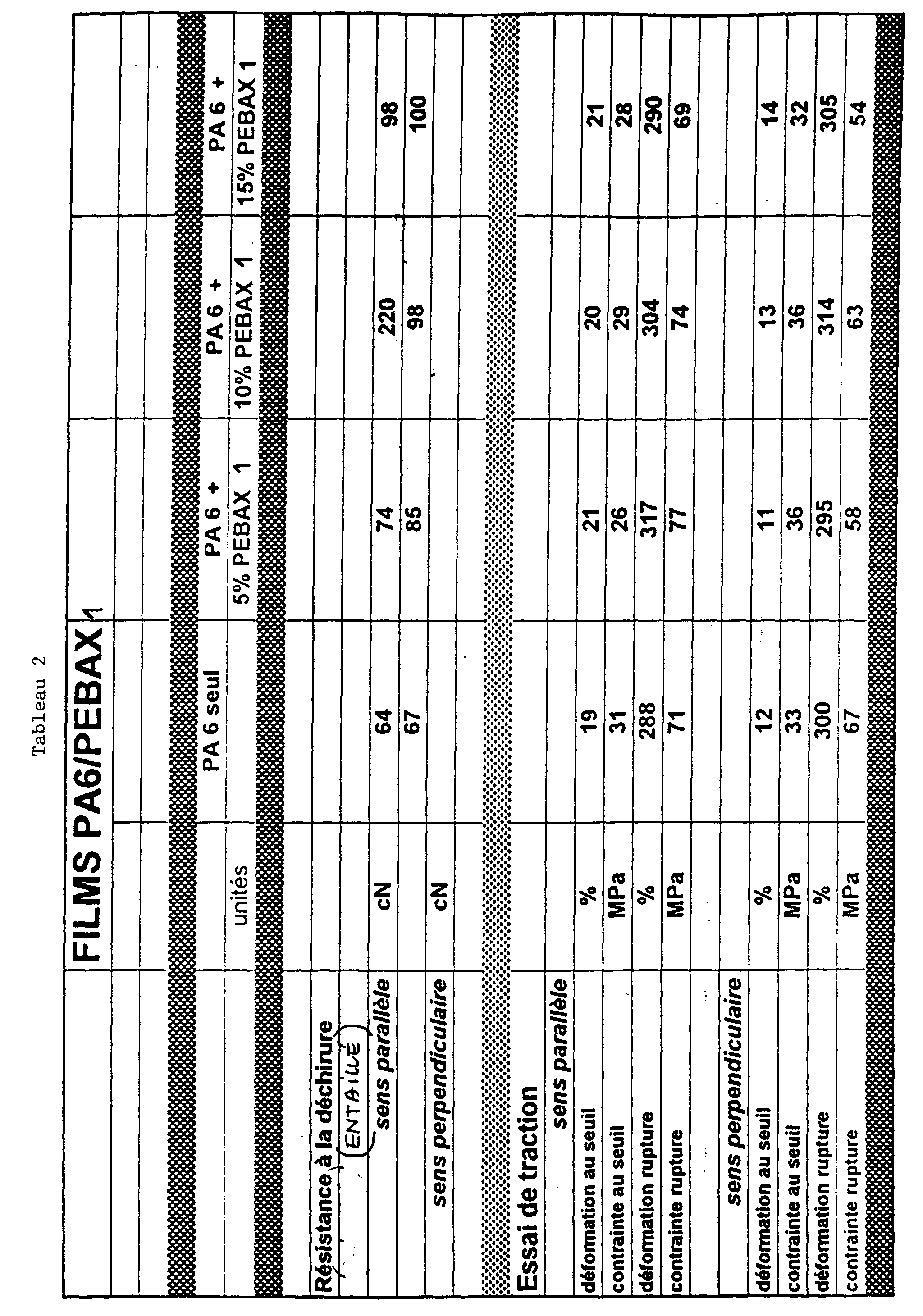
- the Applicant has found that this combination provided particular results, namely impact resistance while retaining the tensile and tear strength of a film of polyamide-6 (PA-6) or polyamide-6.6 (PA-6.6).
- the films of the invention have a polyamide matrix structure in which are dispersed nodules of polymers with polyamide blocks and polyether blocks.
- nodules are less than 0.3 ⁇ m.
- Another advantage of the invention is that the polyamide and the polymer to polyamide blocks and polyether blocks mix very easily for example in the extruder which feeds the film production machine. Simply prepare a simple dry barrel mix (it is not necessary to perform compounding, with or without masterbatch, with special screw profiles.
- Polyamide-6 is the condensation product of caprolactam or amino caproic acid
- polyamide-6,6 is the condensation product of adipic acid and hexamethylene diamine.
- Polyamide (i) PA-6 or PA-6,6 can also contain in its chain small amounts of other polyamide monomers, i.e. less than 30% in weight.
- PA-6 can contain lauryllactam, isophthalic, terephthalic, or hexamethylene diamine.
- PA-6,6 can contain caprolactam units, lauryllactam, isophthalic or terephthalic.
- polyamide (i) also denotes mixtures with PA-6 or PA-6,6 matrix with polyolefins.
- Polyamide sequences with dicarboxylic chain ends come, for example, from the condensation of alpha-omega acids aminocarboxylic or dicarboxylic acids and diamines in the presence of a chain limiting dicarboxylic acid.
- Molar mass in number M n polyamide sequences is between 300 and 15,000 and preferably between 600 and 5,000.
- the mass M n polyether blocks is between 100 and 6000 and preferably between 200 and 3000.
- Polymers with polyamide blocks and polyether blocks can also understand patterns randomly distributed. These polymers can be prepared by the simultaneous reaction of polyether and block precursors polyamides.
- polyetherdiol a lactam (or a alpha-omega amino acid) and a chain limiting diacid in the presence of a little of water.
- a polymer is obtained which essentially has polyether blocks, polyamide blocks of very variable length, but also the different reagents having reacted randomly which are distributed statistically along the polymer chain.
- polymers with polyamide blocks and polyether blocks that they come from of the copolycondensation of polyamide and polyether blocks prepared previously or in a one-step reaction have, for example, hardnesses shore D can be between 20 and 75 and advantageously between 30 and 70 and an intrinsic viscosity between 0.8 and 2.5 measured in metacresol at 250 ° C for an initial concentration of 0.8 g / 100 ml.
- the polyamide blocks consist essentially of PA-6 or PA-6,6 and like the polyamides (i) they can comprise other polyamides in mixture or other polyamide units in their chain.
- the polyether blocks consist of ⁇ O ⁇ (CH 2 ) 4 - units, whether these blocks in the polymer (ii) come from the reaction of polyether diamine on polyamide blocks with acid ends or from the reaction of polyether diols on blocks polyamides with acid ends, they are called for simplicity "PTMG blocks" (polytetramethylene glycol or polyoxytetramethylene glycol).
- the polymer with polyamide blocks and polyether blocks is such that polyamide is the major constituent by weight, that is to say that the amount of polyamide which is in the form of blocks and that which is optionally distributed of statistically in the chain represents more than 50% by weight of the polymer to polyamide blocks and polyether blocks.
- the amount of polyamide and the amount of polyether are in the ratio (polyamide / polyether) 50/50 to 95/5 and preferably 60/40 to 75/25.
- the polymer (ii) can also be a mixture of two or more polyamide block polymers and polyether blocks.
- the same polyamide blocks of (ii) are chosen for the same polyamide than the polyamide (i) constituting the film.
- the film of the invention can be prepared by mixing the polyamide and polymer with polyamide blocks and polyether blocks in the molten state followed by a blow molding or extrusion in a flat die and cylinder.
- the quantity of polymer containing polyamide and polyether blocks depends on the resistance to the impact we are looking for. Impact resistance increases with the amount. This quantity can be up to 40 parts per 100 parts of polyamide and advantageously 5 and 30 parts per 100 parts of polyamide.
- the impact resistance of a polyamide film with a thickness between 15 and 300 ⁇ m can be multiplied by 1.1 and more generally by a factor between 1.2 and 2.
- compositions for manufacturing the films of the invention can be obtained in the extruder which feeds the film manufacturing device. Just feed the extruder with polyamide (i) and the block polymer (ii) without it being necessary to knead them beforehand or prepare a masterbatch of (ii) in (i) and then incorporate it in (i).
- the Applicant has discovered that the majority blend of polyamide and minority of polymer with polyamide blocks and polyether blocks was presented under form of a polyamide matrix and nodules of at most 0.3 ⁇ m and advantageously ⁇ 0.2 of polymer containing polyamide blocks and polyether blocks.
- the nodules disperse very easily, it is not necessary to use screws particular, twin-screw or particular profiles.
- the nodules are approximately 0.1 ⁇ m.
- Block polymers derived from caprolactam and blocks are preferred. polytetramethylene glycol.
Landscapes
- Chemical & Material Sciences (AREA)
- Health & Medical Sciences (AREA)
- Chemical Kinetics & Catalysis (AREA)
- Medicinal Chemistry (AREA)
- Polymers & Plastics (AREA)
- Organic Chemistry (AREA)
- Engineering & Computer Science (AREA)
- Manufacturing & Machinery (AREA)
- Materials Engineering (AREA)
- Manufacture Of Macromolecular Shaped Articles (AREA)
- Laminated Bodies (AREA)
- Polyamides (AREA)
- Compositions Of Macromolecular Compounds (AREA)
- Materials For Medical Uses (AREA)
- Graft Or Block Polymers (AREA)
- Shaping By String And By Release Of Stress In Plastics And The Like (AREA)
Description
- d'un ou plusieurs aminoacides, tels les acides aminocaproïque, amino-7-heptanoïque, amino-11-undécanoïque et amino-12-dodécanoïque d'un ou plusieurs lactames tels que caprolactame, oenantholactame et lauryllactame ;
- d'un ou plusieurs sels ou mélanges de diamines telles l'hexaméthylènediamine, la dodécaméthylènediamine, la métaxylylènediamine, le bis-p aminocyclohexylméthane et la triméthylhexaméthylène diamine avec des diacides tels que les acides isophtalique, téréphtalique, adipique, azélaïque, subérique, sébacique et dodécanedicarboxylique ;
| Valeurs pour 50 % de casse | |||
| PA-6 parties | PEBAX 1 parties | Poids (grammes) | Transmittance à 700 (nm) |
| 100 | 0 | 600 à 700 | 81 % |
| 95 | 5 | 800 à 900 | 81 % |
| 90 | 10 | 800 à 900 | 83 % |
| 85 | 15 | 900 à 1 000 | 83 % |
Claims (4)
- Films à base de :
(i) polyamide constitué de polyamide-6 ou de polyamide-6,6 et (ii) d'un polymère à blocs polyamides et blocs polyéthers, les blocs polyamides étant constitués de polyamide-6 ou de polyamide-6,6, les blocs polyéther étant constitués de polytétraméthylène glycol, ou de son dérivé obtenu par remplacement des extrémités OH par des extrémités NH2, le rapport polyamide/polyéther en poids de (ii) étant compris entre 50/50 et 95/5 et le polymère à blocs polyamides et blocs polyéther (ii) étant sous forme de nodules inférieurs à 0,3 µm dispersés dans la matrice de polyamide (i). - Films selon la revendication 1 dans lesquels la résistance à l'impact selon ISO 7765-1 (Méthode B) est supérieure à celle du film de seul polyamide (i).
- Films selon l'une des revendications 1 ou 2 dans lesquels le rapport polyamide / polyéther en poids de (ii) est compris entre 60/40 à 75/25.
- Films selon l'une des revendications 1 à 3 dans lesquels la transparence mesurée par la transmittance à une longueur d'onde de 700 nm, est au moins égale à celle du film de seul polyamide (i).
Applications Claiming Priority (3)
| Application Number | Priority Date | Filing Date | Title |
|---|---|---|---|
| FR9414521 | 1994-12-02 | ||
| FR9414521 | 1994-12-02 | ||
| PCT/FR1995/001586 WO1996017003A1 (fr) | 1994-12-02 | 1995-12-01 | Films a base de polyamide et de polymeres a blocs polyamides et blocs polyethers |
Publications (2)
| Publication Number | Publication Date |
|---|---|
| EP0742809A1 EP0742809A1 (fr) | 1996-11-20 |
| EP0742809B1 true EP0742809B1 (fr) | 2001-08-08 |
Family
ID=9469427
Family Applications (1)
| Application Number | Title | Priority Date | Filing Date |
|---|---|---|---|
| EP95941751A Expired - Lifetime EP0742809B1 (fr) | 1994-12-02 | 1995-12-01 | Films a base de polyamide et de polymeres a blocs polyamides et blocs polyethers |
Country Status (13)
| Country | Link |
|---|---|
| US (1) | US5936044A (fr) |
| EP (1) | EP0742809B1 (fr) |
| JP (1) | JP3659974B2 (fr) |
| KR (1) | KR100318108B1 (fr) |
| CN (1) | CN1071354C (fr) |
| AT (2) | ATE204007T1 (fr) |
| CA (1) | CA2182035C (fr) |
| DE (2) | DE19581427T1 (fr) |
| DK (1) | DK0742809T3 (fr) |
| ES (1) | ES2161920T3 (fr) |
| FI (1) | FI111378B (fr) |
| NO (1) | NO312368B1 (fr) |
| WO (1) | WO1996017003A1 (fr) |
Cited By (1)
| Publication number | Priority date | Publication date | Assignee | Title |
|---|---|---|---|---|
| GB2570902B (en) * | 2018-02-08 | 2020-08-12 | Matrix Polymers Ltd | Polymer composition for rotational moulding |
Families Citing this family (17)
| Publication number | Priority date | Publication date | Assignee | Title |
|---|---|---|---|---|
| DE19645276A1 (de) * | 1996-11-02 | 1998-05-07 | Kalle Nalo Gmbh | Handfüllbare Wursthülle auf Polyamidbasis |
| US6110411A (en) * | 1997-03-18 | 2000-08-29 | Clausen; Christian Henning | Laser sinterable thermoplastic powder |
| FI114280B (fi) * | 2001-01-11 | 2004-09-30 | Eriksson Capital Ab | Polyamidiin ja polyamidilohkoja ja polyeetterilohkoja sisältäviin polymeereihin perustuva makkarankuori, joka on savustettavissa |
| US6399713B1 (en) * | 2001-01-24 | 2002-06-04 | Arizona Chemical Company | Hydrocarbon-terminated polyether-polyamide block copolymers and uses thereof |
| US6870011B2 (en) | 2001-01-24 | 2005-03-22 | Arizona Chemical Company | Hydrocarbon-terminated polyether-polyamide block copolymers and uses thereof |
| JP2003286341A (ja) * | 2002-01-28 | 2003-10-10 | Ube Ind Ltd | ポリアミド系エラストマー |
| FR2902431B1 (fr) * | 2006-06-14 | 2013-04-26 | Arkema France | Copolymeres a motif amides et a motif ethers ayant des proprietes optique ameliorees |
| FR2902435B1 (fr) * | 2006-06-14 | 2011-10-14 | Arkema France | Composition a base de polyamide transparent amorphe ou de tres faible cristallinite et de copolyamide a motifs ethers et a motifs amides |
| WO2007145324A1 (fr) * | 2006-06-16 | 2007-12-21 | Ube Industries, Ltd. | Élastomère de polyéther polyamide |
| BRPI0718527A2 (pt) | 2006-11-09 | 2013-11-19 | Valspar Sourcing Inc | Composição em pó, método, e, artigo tridimensional |
| US8247492B2 (en) | 2006-11-09 | 2012-08-21 | Valspar Sourcing, Inc. | Polyester powder compositions, methods and articles |
| US8142869B2 (en) | 2007-09-27 | 2012-03-27 | Toyoda Gosei Co., Ltd. | Coated base fabric for airbags |
| FR2960773B1 (fr) * | 2010-06-03 | 2015-12-11 | Oreal | Procedes de traitement cosmetique utilisant un revetement a base d'un polymere polyamide-polyether |
| KR102027423B1 (ko) * | 2013-06-28 | 2019-11-04 | 코오롱인더스트리 주식회사 | 이너라이너용 필름 |
| FR3019181B1 (fr) * | 2014-03-31 | 2020-06-19 | Arkema France | Compositions de polyamide et de peba pour l'injection de pieces rigides resistant a la fatigue |
| KR102360001B1 (ko) * | 2019-05-31 | 2022-02-09 | 롯데케미칼 주식회사 | 열가소성 수지 조성물 및 이를 이용한 성형품 |
| CN112480659A (zh) * | 2020-12-02 | 2021-03-12 | 厦门长塑实业有限公司 | 一种增韧型双向拉伸聚酰胺薄膜及其制备方法 |
Family Cites Families (10)
| Publication number | Priority date | Publication date | Assignee | Title |
|---|---|---|---|---|
| JPS5441955A (en) * | 1977-09-08 | 1979-04-03 | Toray Ind Inc | Impact-resistant resin composition |
| DE3270351D1 (en) * | 1981-03-16 | 1986-05-15 | Akzo Nv | Use of polyamide moulding compounds in processes for injection moulding objects of high impact strength |
| CH655941A5 (en) * | 1982-08-30 | 1986-05-30 | Inventa Ag | Flexible, polyamide-based thermoplastic moulding compositions with good low-temperature impact strength |
| US4970274A (en) * | 1988-09-30 | 1990-11-13 | Allied-Signal Inc. | Nylon compositions with superior film properties and impact strength |
| FR2592388B1 (fr) * | 1985-12-30 | 1988-02-26 | Atochem | Alliages a base de polyamide, polyetheramide et elastomere thermoplastique |
| JPS6363748A (ja) * | 1986-09-05 | 1988-03-22 | Toyo Plast Seiko Kk | 一軸配向ポリアミド系樹脂シ−ト |
| US4749754A (en) * | 1987-07-27 | 1988-06-07 | General Electric Company | Impact modified polyamide/polycarbonate |
| JPH04314741A (ja) * | 1991-04-15 | 1992-11-05 | Toray Ind Inc | ポリアミドフィルム |
| US5239004A (en) * | 1992-07-15 | 1993-08-24 | The Goodyear Tire & Rubber Company | Polyether ester amide-sulfur vulcanized rubber compounds |
| US5416171A (en) * | 1993-03-22 | 1995-05-16 | Industrial Technology Research Institute | Blending compositions of polyamides and block copolyetheramides |
-
1995
- 1995-12-01 DK DK95941751T patent/DK0742809T3/da active
- 1995-12-01 EP EP95941751A patent/EP0742809B1/fr not_active Expired - Lifetime
- 1995-12-01 CN CN95191443A patent/CN1071354C/zh not_active Expired - Fee Related
- 1995-12-01 AT AT95941751T patent/ATE204007T1/de not_active IP Right Cessation
- 1995-12-01 CA CA002182035A patent/CA2182035C/fr not_active Expired - Fee Related
- 1995-12-01 AT AT0901295A patent/AT406681B/de not_active IP Right Cessation
- 1995-12-01 KR KR1019960703556A patent/KR100318108B1/ko not_active Expired - Fee Related
- 1995-12-01 WO PCT/FR1995/001586 patent/WO1996017003A1/fr not_active Ceased
- 1995-12-01 ES ES95941751T patent/ES2161920T3/es not_active Expired - Lifetime
- 1995-12-01 DE DE19581427T patent/DE19581427T1/de not_active Withdrawn
- 1995-12-01 US US08/669,347 patent/US5936044A/en not_active Expired - Lifetime
- 1995-12-01 DE DE69522096T patent/DE69522096T2/de not_active Expired - Lifetime
- 1995-12-01 JP JP51834396A patent/JP3659974B2/ja not_active Expired - Fee Related
-
1996
- 1996-08-01 FI FI963042A patent/FI111378B/fi not_active IP Right Cessation
- 1996-08-01 NO NO19963220A patent/NO312368B1/no unknown
Cited By (1)
| Publication number | Priority date | Publication date | Assignee | Title |
|---|---|---|---|---|
| GB2570902B (en) * | 2018-02-08 | 2020-08-12 | Matrix Polymers Ltd | Polymer composition for rotational moulding |
Also Published As
| Publication number | Publication date |
|---|---|
| KR100318108B1 (ko) | 2002-05-16 |
| AT406681B (de) | 2000-07-25 |
| NO963220D0 (no) | 1996-08-01 |
| CA2182035C (fr) | 2001-04-17 |
| FI963042L (fi) | 1996-08-01 |
| US5936044A (en) | 1999-08-10 |
| NO312368B1 (no) | 2002-04-29 |
| DE69522096T2 (de) | 2002-06-06 |
| WO1996017003A1 (fr) | 1996-06-06 |
| DE19581427T1 (de) | 1997-01-16 |
| FI111378B (fi) | 2003-07-15 |
| JP3659974B2 (ja) | 2005-06-15 |
| FI963042A0 (fi) | 1996-08-01 |
| ATA901295A (de) | 1999-12-15 |
| ATE204007T1 (de) | 2001-08-15 |
| NO963220L (no) | 1996-08-01 |
| ES2161920T3 (es) | 2001-12-16 |
| EP0742809A1 (fr) | 1996-11-20 |
| CN1071354C (zh) | 2001-09-19 |
| JPH09508941A (ja) | 1997-09-09 |
| DE69522096D1 (en) | 2001-09-13 |
| DK0742809T3 (da) | 2001-11-26 |
| CN1139939A (zh) | 1997-01-08 |
| CA2182035A1 (fr) | 1996-06-06 |
Similar Documents
| Publication | Publication Date | Title |
|---|---|---|
| CA2182035C (fr) | Films a base de polyamide et de polymeres a blocs polyamides et blocs polyethers | |
| EP0550308B2 (fr) | Compositions transparentes de polyamides à tenue aux agents chimiques élévée | |
| FR2820141A1 (fr) | Composition transparente a base de polyamide | |
| EP1994077A2 (fr) | Nouvelles utilisations d'un copolymere comprenant des blocs polyamide et des blocs polyethers provenant au moins en partie du polytrimethylene ether glycol | |
| FR2846332A1 (fr) | Copolymeres transparents a blocs polyamides et blocs polyethers | |
| EP0842225B1 (fr) | Thermoplastiques a flexibilite et transparence amelioree | |
| EP2652013A1 (fr) | Copolymere polyamide-polyolefine | |
| EP2201059A1 (fr) | Polyamide de haute fluidite | |
| CA2196446C (fr) | Films a base de polyamides et de polyolefines | |
| EP0855431A1 (fr) | Melange de polymère à blocs polyamides et de copolymères à motifs vinylaromatiques et motifs anhydride | |
| EP1869125A1 (fr) | Melanges a base d elastomeres thermoplastiques | |
| WO2024009031A1 (fr) | Chaussures de sport a recycabilite amelioree | |
| KR20040015136A (ko) | 투명 필름 제조용 폴리아미드 성형 물질 | |
| EP0716126B1 (fr) | Composition translucide flexible à base de polyamide et articles obtenus à partir de cette composition | |
| EP3894480A1 (fr) | Poudre de copolymère à blocs polyamides et à blocs polyéthers | |
| FR2734269A1 (fr) | Caoutchoucs vulcanises modifies par des thermoplastiques |
Legal Events
| Date | Code | Title | Description |
|---|---|---|---|
| PUAI | Public reference made under article 153(3) epc to a published international application that has entered the european phase |
Free format text: ORIGINAL CODE: 0009012 |
|
| 17P | Request for examination filed |
Effective date: 19960626 |
|
| AK | Designated contracting states |
Kind code of ref document: A1 Designated state(s): AT BE CH DE DK ES FR GB GR IE IT LI LU NL PT SE |
|
| 17Q | First examination report despatched |
Effective date: 19990806 |
|
| RAP1 | Party data changed (applicant data changed or rights of an application transferred) |
Owner name: ATOFINA |
|
| RTI1 | Title (correction) |
Free format text: FILMS BASED ON POLYAMIDE AND POLY(AMIDE-ETHER) BLOCK COPOLYMERS |
|
| GRAG | Despatch of communication of intention to grant |
Free format text: ORIGINAL CODE: EPIDOS AGRA |
|
| GRAG | Despatch of communication of intention to grant |
Free format text: ORIGINAL CODE: EPIDOS AGRA |
|
| GRAH | Despatch of communication of intention to grant a patent |
Free format text: ORIGINAL CODE: EPIDOS IGRA |
|
| GRAH | Despatch of communication of intention to grant a patent |
Free format text: ORIGINAL CODE: EPIDOS IGRA |
|
| GRAA | (expected) grant |
Free format text: ORIGINAL CODE: 0009210 |
|
| AK | Designated contracting states |
Kind code of ref document: B1 Designated state(s): AT BE CH DE DK ES FR GB GR IE IT LI LU NL PT SE |
|
| PG25 | Lapsed in a contracting state [announced via postgrant information from national office to epo] |
Ref country code: IE Free format text: LAPSE BECAUSE OF FAILURE TO SUBMIT A TRANSLATION OF THE DESCRIPTION OR TO PAY THE FEE WITHIN THE PRESCRIBED TIME-LIMIT Effective date: 20010808 |
|
| REF | Corresponds to: |
Ref document number: 204007 Country of ref document: AT Date of ref document: 20010815 Kind code of ref document: T |
|
| REG | Reference to a national code |
Ref country code: CH Ref legal event code: EP |
|
| REG | Reference to a national code |
Ref country code: IE Ref legal event code: FG4D Free format text: FRENCH |
|
| REF | Corresponds to: |
Ref document number: 69522096 Country of ref document: DE Date of ref document: 20010913 |
|
| REG | Reference to a national code |
Ref country code: CH Ref legal event code: NV Representative=s name: A. BRAUN, BRAUN, HERITIER, ESCHMANN AG PATENTANWAE |
|
| ITF | It: translation for a ep patent filed | ||
| PG25 | Lapsed in a contracting state [announced via postgrant information from national office to epo] |
Ref country code: PT Free format text: LAPSE BECAUSE OF FAILURE TO SUBMIT A TRANSLATION OF THE DESCRIPTION OR TO PAY THE FEE WITHIN THE PRESCRIBED TIME-LIMIT Effective date: 20011108 |
|
| PG25 | Lapsed in a contracting state [announced via postgrant information from national office to epo] |
Ref country code: GR Free format text: LAPSE BECAUSE OF FAILURE TO SUBMIT A TRANSLATION OF THE DESCRIPTION OR TO PAY THE FEE WITHIN THE PRESCRIBED TIME-LIMIT Effective date: 20011109 |
|
| REG | Reference to a national code |
Ref country code: DK Ref legal event code: T3 |
|
| GBT | Gb: translation of ep patent filed (gb section 77(6)(a)/1977) |
Effective date: 20011106 |
|
| REG | Reference to a national code |
Ref country code: ES Ref legal event code: FG2A Ref document number: 2161920 Country of ref document: ES Kind code of ref document: T3 |
|
| PGFP | Annual fee paid to national office [announced via postgrant information from national office to epo] |
Ref country code: IE Payment date: 20011220 Year of fee payment: 7 |
|
| REG | Reference to a national code |
Ref country code: GB Ref legal event code: IF02 |
|
| PLBE | No opposition filed within time limit |
Free format text: ORIGINAL CODE: 0009261 |
|
| STAA | Information on the status of an ep patent application or granted ep patent |
Free format text: STATUS: NO OPPOSITION FILED WITHIN TIME LIMIT |
|
| 26N | No opposition filed | ||
| REG | Reference to a national code |
Ref country code: CH Ref legal event code: PFA Owner name: ATOFINA Free format text: ATOFINA#4/8 COURS MICHELET#92800 PUTEAUX (FR) -TRANSFER TO- ATOFINA#4/8 COURS MICHELET#92800 PUTEAUX (FR) |
|
| PGFP | Annual fee paid to national office [announced via postgrant information from national office to epo] |
Ref country code: DK Payment date: 20081212 Year of fee payment: 14 |
|
| PGFP | Annual fee paid to national office [announced via postgrant information from national office to epo] |
Ref country code: SE Payment date: 20091207 Year of fee payment: 15 Ref country code: CH Payment date: 20091215 Year of fee payment: 15 Ref country code: AT Payment date: 20091211 Year of fee payment: 15 |
|
| PGFP | Annual fee paid to national office [announced via postgrant information from national office to epo] |
Ref country code: NL Payment date: 20091204 Year of fee payment: 15 |
|
| PGFP | Annual fee paid to national office [announced via postgrant information from national office to epo] |
Ref country code: IT Payment date: 20091215 Year of fee payment: 15 Ref country code: GB Payment date: 20091125 Year of fee payment: 15 Ref country code: FR Payment date: 20091221 Year of fee payment: 15 Ref country code: ES Payment date: 20100113 Year of fee payment: 15 |
|
| PGFP | Annual fee paid to national office [announced via postgrant information from national office to epo] |
Ref country code: DE Payment date: 20091126 Year of fee payment: 15 Ref country code: BE Payment date: 20091224 Year of fee payment: 15 |
|
| REG | Reference to a national code |
Ref country code: DK Ref legal event code: EBP |
|
| PG25 | Lapsed in a contracting state [announced via postgrant information from national office to epo] |
Ref country code: DK Free format text: LAPSE BECAUSE OF NON-PAYMENT OF DUE FEES Effective date: 20100104 |
|
| BERE | Be: lapsed |
Owner name: *ATOFINA Effective date: 20101231 |
|
| REG | Reference to a national code |
Ref country code: NL Ref legal event code: V1 Effective date: 20110701 |
|
| REG | Reference to a national code |
Ref country code: CH Ref legal event code: PL |
|
| GBPC | Gb: european patent ceased through non-payment of renewal fee |
Effective date: 20101201 |
|
| PG25 | Lapsed in a contracting state [announced via postgrant information from national office to epo] |
Ref country code: AT Free format text: LAPSE BECAUSE OF NON-PAYMENT OF DUE FEES Effective date: 20101201 |
|
| REG | Reference to a national code |
Ref country code: FR Ref legal event code: ST Effective date: 20110831 |
|
| REG | Reference to a national code |
Ref country code: SE Ref legal event code: EUG |
|
| PG25 | Lapsed in a contracting state [announced via postgrant information from national office to epo] |
Ref country code: SE Free format text: LAPSE BECAUSE OF NON-PAYMENT OF DUE FEES Effective date: 20101202 Ref country code: BE Free format text: LAPSE BECAUSE OF NON-PAYMENT OF DUE FEES Effective date: 20101231 |
|
| PG25 | Lapsed in a contracting state [announced via postgrant information from national office to epo] |
Ref country code: CH Free format text: LAPSE BECAUSE OF NON-PAYMENT OF DUE FEES Effective date: 20101231 Ref country code: LI Free format text: LAPSE BECAUSE OF NON-PAYMENT OF DUE FEES Effective date: 20101231 Ref country code: FR Free format text: LAPSE BECAUSE OF NON-PAYMENT OF DUE FEES Effective date: 20110103 |
|
| REG | Reference to a national code |
Ref country code: DE Ref legal event code: R119 Ref document number: 69522096 Country of ref document: DE Effective date: 20110701 |
|
| PG25 | Lapsed in a contracting state [announced via postgrant information from national office to epo] |
Ref country code: DE Free format text: LAPSE BECAUSE OF NON-PAYMENT OF DUE FEES Effective date: 20110701 Ref country code: GB Free format text: LAPSE BECAUSE OF NON-PAYMENT OF DUE FEES Effective date: 20101201 |
|
| PG25 | Lapsed in a contracting state [announced via postgrant information from national office to epo] |
Ref country code: IT Free format text: LAPSE BECAUSE OF NON-PAYMENT OF DUE FEES Effective date: 20101201 Ref country code: NL Free format text: LAPSE BECAUSE OF NON-PAYMENT OF DUE FEES Effective date: 20110701 |
|
| REG | Reference to a national code |
Ref country code: ES Ref legal event code: FD2A Effective date: 20120206 |
|
| PG25 | Lapsed in a contracting state [announced via postgrant information from national office to epo] |
Ref country code: ES Free format text: LAPSE BECAUSE OF NON-PAYMENT OF DUE FEES Effective date: 20101202 |
|
| PGFP | Annual fee paid to national office [announced via postgrant information from national office to epo] |
Ref country code: LU Payment date: 20141202 Year of fee payment: 20 |