EP0743573A2 - Procédé de production d'éléments de formation d'image par migration à contraste - Google Patents
Procédé de production d'éléments de formation d'image par migration à contraste Download PDFInfo
- Publication number
- EP0743573A2 EP0743573A2 EP96303359A EP96303359A EP0743573A2 EP 0743573 A2 EP0743573 A2 EP 0743573A2 EP 96303359 A EP96303359 A EP 96303359A EP 96303359 A EP96303359 A EP 96303359A EP 0743573 A2 EP0743573 A2 EP 0743573A2
- Authority
- EP
- European Patent Office
- Prior art keywords
- groups
- methyl
- amino
- acid
- dimethyl
- Prior art date
- Legal status (The legal status is an assumption and is not a legal conclusion. Google has not performed a legal analysis and makes no representation as to the accuracy of the status listed.)
- Granted
Links
Images



Classifications
-
- G—PHYSICS
- G03—PHOTOGRAPHY; CINEMATOGRAPHY; ANALOGOUS TECHNIQUES USING WAVES OTHER THAN OPTICAL WAVES; ELECTROGRAPHY; HOLOGRAPHY
- G03G—ELECTROGRAPHY; ELECTROPHOTOGRAPHY; MAGNETOGRAPHY
- G03G17/00—Electrographic processes using patterns other than charge patterns, e.g. an electric conductivity pattern; Processes involving a migration, e.g. photoelectrophoresis, photoelectrosolography; Processes involving a selective transfer, e.g. electrophoto-adhesive processes; Apparatus essentially involving a single such process
- G03G17/04—Electrographic processes using patterns other than charge patterns, e.g. an electric conductivity pattern; Processes involving a migration, e.g. photoelectrophoresis, photoelectrosolography; Processes involving a selective transfer, e.g. electrophoto-adhesive processes; Apparatus essentially involving a single such process using photoelectrophoresis
-
- G—PHYSICS
- G03—PHOTOGRAPHY; CINEMATOGRAPHY; ANALOGOUS TECHNIQUES USING WAVES OTHER THAN OPTICAL WAVES; ELECTROGRAPHY; HOLOGRAPHY
- G03G—ELECTROGRAPHY; ELECTROPHOTOGRAPHY; MAGNETOGRAPHY
- G03G17/00—Electrographic processes using patterns other than charge patterns, e.g. an electric conductivity pattern; Processes involving a migration, e.g. photoelectrophoresis, photoelectrosolography; Processes involving a selective transfer, e.g. electrophoto-adhesive processes; Apparatus essentially involving a single such process
- G03G17/10—Electrographic processes using patterns other than charge patterns, e.g. an electric conductivity pattern; Processes involving a migration, e.g. photoelectrophoresis, photoelectrosolography; Processes involving a selective transfer, e.g. electrophoto-adhesive processes; Apparatus essentially involving a single such process using migration imaging, e.g. photoelectrosolography
Definitions
- the present invention is directed to methods for obtaining improved contrast density in migration imaging members. More specifically, the present invention is directed to processes for improving the contrast density of migration imaging members by selective transparentization of migration marking material.
- a process which comprises (a) providing a migration imaging member comprising (1) a substrate and (2) a softenable layer comprising a softenable material and a photosensitive migration marking material present in the softenable layer as a monolayer of particles situated at or near the surface of the softenable layer spaced from the substrate; (b) uniformly charging the imaging member; (3) imagewise exposing the charged imaging member to activating radiation at a wavelength to which the migration marking material is sensitive; (d) subsequent to step (c), causing the softenable material to soften and enabling a first portion of the migration marking material to migrate through the softenable material toward the substrate in an imagewise pattern while a second portion of the migration marking material remains substantially unmigrated within the softenable layer; and (e) contacting the second portion of the migration marking material with a transparentizing agent which transparentizes migration marking material.
- the migration imaging member can be uniformly charged and uniformly exposed to activating radiation at a wavelength to which the migration marking material is sensitive, followed by again causing the softenable material to soften and enabling the first portion of the migration marking material to migrate further through the softenable material toward the substrate.
- the present invention encompasses contacting an imaged migration imaging member with an agent for transparentizing migration marking material in a manner such that unmigrated marking material is transparentized while migrated migration marking material is not transparentized.
- the transparentizing agent is a material that affects migration marking material which comes into contact therewith by reducing the optical density of the softenable layer containing the migration marking material in said areas.
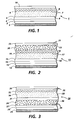
- migration imaging member 1 comprises a substrate 2, an optional adhesive layer 3 situated on the substrate 2, an optional charge blocking layer 4 situated on optional adhesive layer 3, an optional charge transport layer 5 situated on optional charge blocking layer 4, and a softenable layer 6 situated on optional charge transport layer 5, said softenable layer 6 comprising softenable material 7, migration marking material 8 situated at or near the surface of the layer spaced from the substrate, and optional charge transport material 9 dispersed throughout softenable material 7.
- Optional overcoating layer 10 is situated on the surface of softenable layer 6 spaced from the substrate 2. Any or all of the optional layers and materials can be absent from the imaging member.
- the migration imaging member can be in any suitable configuration, such as a web, a foil, a laminate, a strip, a sheet, a coil, a cylinder, a drum, an endless belt, an endless mobius strip, a circular disc, or any other suitable form.
- the substrate can be either electrically conductive or electrically insulating.
- the substrate can be opaque, translucent, semitransparent, or transparent, and can be of any suitable conductive material, including copper, brass, nickel, zinc, chromium, stainless steel, conductive plastics and rubbers, aluminum, semitransparent aluminum, steel, cadmium, silver, gold, paper rendered conductive by the inclusion of a suitable material therein or through conditioning in a humid atmosphere to ensure the presence of sufficient water content to render the material conductive, indium, tin, metal oxides, including tin oxide and indium tin oxide, and the like.
- the substrate can be opaque, translucent, semitransparent, or transparent, and can be of any suitable insulative material, such as paper, glass, plastic, polyesters such as Mylar® (available from Du Pont) or Melinex® 442 (available from ICI Americas, Inc.), and the like.
- the substrate can comprise an insulative layer with a conductive coating, such as vacuum-deposited metallized plastic, such as titanized or aluminized Mylar® polyester, wherein the metallized surface is in contact with the softenable layer or any other layer situated between the substrate and the softenable layer.
- the substrate has any effective thickness, typically from about 6 to about 250 microns, and preferably from about 50 to about 200 microns, although the thickness can be outside these ranges.
- the softenable layer can comprise one or more layers of softenable materials, which can be any suitable material, typically a plastic or thermoplastic material which is soluble in a solvent or softenable, for example, in a solvent liquid, solvent vapor, heat, or any combinations thereof.
- softenable is meant any material that can be rendered by a development step as described herein permeable to migration material migrating through its bulk. This permeability typically is achieved by a development step entailing dissolving, melting, or softening by contact with heat, vapors, partial solvents, as well as combinations thereof.
- suitable softenable materials include styrene-acrylic copolymers, such as styrene-hexylmethacrylate copolymers, styrene acrylate copolymers, styrene butylmethacrylate copolymers, styrene butylacrylate ethylacrylate copolymers, styrene ethylacrylate acrylic acid copolymers, and the like, polystyrenes, including polyalphamethyl styrene, alkyd substituted polystyrenes, styrene-olefin copolymers, styrene-vinyltoluene copolymers, polyesters, polyurethanes, polycarbonates, polyterpenes, silicone elastomers, mixtures thereof, copolymers thereof, and the like, as well as any other suitable materials as disclosed, for example, in U.S.
- the softenable layer can be of any effective thickness, typically from about 1 to about 30 microns, preferably from about 2 to about 25 microns, and more preferably from about 2 to about 10 microns, although the thickness can be outside these ranges.
- the softenable layer can be applied to the conductive layer by any suitable coating process. Typical coating processes include draw bar coating, spray coating, extrusion, dip coating, gravure roll coating, wire-wound rod coating, air knife coating and the like.
- the softenable layer also contains migration marking material.
- the migration marking material can be electrically photosensitive, photoconductive, or of any other suitable combination of materials, or possess any other desired physical property and still be suitable for use in the migration imaging members of the present invention.
- the migration marking materials preferably are particulate, wherein the particles are closely spaced from each other.
- Preferred migration marking materials generally are spherical in shape and submicron in size.
- the migration marking material generally is capable of substantial photodischarge upon electrostatic charging and exposure to activating radiation and is substantially absorbing and opaque to activating radiation in the spectral region where the photosensitive migration marking particles photogenerate charges.
- the migration marking material is generally present as a thin layer or monolayer of particles situated at or near the surface of the softenable layer spaced from the conductive layer.
- the particles of migration marking material When present as particles, the particles of migration marking material preferably have an average diameter of up to 2 microns, and more preferably of from about 0.1 to about 1 micron.
- the layer of migration marking particles is situated at or near that surface of the softenable layer spaced from or most distant from the conductive layer.
- the particles are situated at a distance of from about 0.01 to 0.1 micron from the layer surface, and more preferably from about 0.02 to 0.08 micron from the layer surface.
- the particles are situated at a distance of from about 0.005 to about 0.2 micron from each other, and more preferably at a distance of from about 0.05 to about 0.1 micron from each other, the distance being measured between the closest edges of the particles, i.e. from outer diameter to outer diameter.
- the migration marking material contiguous to the outer surface of the softenable layer is present in any effective amount, preferably from about 5 to about 80 percent by total weight of the softenable layer, and more preferably from about 25 to about 80 percent by total weight of the softenable layer, although the amount can be outside of this range.
- suitable migration marking materials include selenium, alloys of selenium with alloying components such as tellurium, arsenic, antimony, thallium, bismuth, or mixtures thereof, selenium and alloys of selenium doped with halogens, as disclosed in, for example, U.S. Patent 3,312,548, the disclosure of which is totally incorporated herein by reference, and the like, phthalocyanines, and any other suitable materials as disclosed, for example, in U.S. Patent 3,975,195 and other U.S. patents directed to migration imaging members and incorporated herein by reference.
- the migration imaging members can optionally contain a charge transport material.
- the charge transport material can be any suitable charge transport material either capable of acting as a softenable layer material or capable of being dissolved or dispersed on a molecular scale in the softenable layer material. When a charge transport material is also contained in another layer in the imaging member, preferably there is continuous transport of charge through the entire film structure.
- the charge transport material is defined as a material which is capable of allowing the charge injection process for one sign of charge from the migration marking material into the softenable layer and also of transporting that charge through the softenable layer.
- the charge transport material can be either a hole transport material (transports positive charges) or an electron transport material (transports negative charges).
- the sign of the charge used to sensitize the migration imaging member during imaging can be of either polarity.
- Charge transporting materials are well known in the art. Typical charge transporting materials include the following:
- Typical diamine transport molecules include N,N'-diphenyl-N,N'-bis(3"-methylphenyl)-(1,1'-biphenyl)-4,4'-diamine, N,N'-diphenyl-N,N'-bis(4-methylphenyl)-(1,1'-biphenyl)-4,4'-diamine, N,N'-diphenyl-N,N'-bis(2-methylphenyl)-(1,1'-biphenyl)-4,4'-diamine, N,N'-diphenyl-N,N'-bis(3-ethylphenyl)-(1,1'-biphenyl)-4,4'-diamine, N,N'-diphenyl-N,N'-bis(4-ethylphenyl)-(1,1'-biphenyl)-4,4'-diamine, N,N'-diphenyl-N,N'-bis
- Typical pyrazoline transport molecules include 1-[lepidyl-(2)]-3-(p-diethylaminophenyl)-5-(p-diethylaminophenyl)pyrazoline, 1-[quinolyl-(2)]-3-(p-diethylaminophenyl)-5-(p-diethylaminophenyl)pyrazoline, 1-[pyridyl-(2)]-3-(p-diethylaminostyryl)-5-(p-diethylaminophenyl)pyrazoline, 1-[6-methoxypyridyl-(2)]-3-(p-diethylaminostyryl)-5-(p-diethylaminophenyl) pyrazoline, 1-phenyl-3-[p-dimethyl
- Typical fluorene charge transport molecules include 9-(4'-dimethylaminobenzylidene)fluorene, 9-(4'-methoxybenzylidene)fluorene, 9-(2',4'-dimethoxybenzylidene)fluorene, 2-nitro-9-benzylidene-fluorene,2-nitro-9-(4'-diethylaminobenzylidene)fluorene, and the like.
- Oxadiazole transport molecules such as 2,5-bis(4-diethylaminophenyl)-1,3,4-oxadiazole, pyrazoline, imidazole, triazole, and the like.
- Other typical oxadiazole transport molecules are described, for example, in German Patent 1,058,836, German Patent 1,060,260, and German Patent 1,120,875, the disclosures of each of which are totally incorporated herein by reference.
- Hydrazone transport molecules such as p-diethylamino benzaldehyde(diphenylhydrazone), o-ethoxy-p-diethylaminobenzaldehyde-(diphenylhydrazone), o-methyl-p-diethylaminobenzaldehyde-(diphenylhydrazone), o-methyl-p-dimethylaminobenzaldehyde-(diphenylhydrazone), 1-naphthalenecarbaldehyde 1-methyl-1-phenylhydrazone, 1-naphthalenecarbaldehyde 1,1-phenylhydrazone, 4-methoxynaphthlene-1-carbaldeyde 1-methyl-1-phenylhydrazone, and the like.
- Carbazole phenyl hydrazone transport molecules such as 9-methylcarbazole-3-carbaldehyde-1,1-diphenylhydrazone, 9-ethylcarbazole-3-carbaldehyde-1-methyl-1-phenylhydrazone, 9-ethylcarbazole-3-carbaldehyde-1-ethyl-1-phenylhydrazone, 9-ethylcarbazole-3-carbaldehyde-1-ethyl-1-benzyl-1-phenylhydrazone, 9-ethylcarbazole-3-carbaldehyde-1,1-diphenylhydrazone, and the like.
- Oxadiazole derivatives such as 2,5-bis-(p-diethylaminophenyl)-oxadiazole-1,3,4 described in U.S. Patent 3,895,944, the disclosure of which is totally incorporated herein by reference.
- Tri-substituted methanes such as alkyl-bis(N,N-dialkylaminoaryl)methane, cycloalkyl-bis(N,N-dialkylaminoaryl)methane, and cycloalkenyl-bis(N,N-dialkylaminoaryl)methane as described in U.S. Patent 3,820,989, the disclosure of which is totally incorporated herein by reference.
- 9-Fluorenylidene methane derivatives having the formula wherein X and Y are cyano groups or alkoxycarbonyl groups; A, B, and W are electron withdrawing groups independently selected from the group consisting of acyl, alkoxycarbonyl nitro, alkylaminocarbonyl, and derivatives thereof; m is a number of from 0 to 2; and n is the number 0 or 1 as described in U.S. Patent 4,474,865, the disclosure of which is totally incorporated herein by reference.
- Typical 9-fluorenylidene methane derivatives encompassed by the above formula include (4-n-butoxycarbonyl-9-fluorenylidene)malonontrile, (4 phenethoxycarbonyl-9-fluorenylidene)malonontrile, (4-carbitoxy-9-fluorenylidene)malonontrile, (4-n-butoxycarbonyl-2,7-dinitro-9-fluorenylidene)malonate, an the like.
- charge transport materials include poly-1-vinylpyrene, poly-9-vinylanthracene poly-9-(4-pentenyl)-carbazole, poly-9-(5-hexyl)-carbazole, polymethylene pyrene, poly-1-(pyrenyl)-butadiene, polymers such as alkyl, nitro, amino, halogen, and hydroxy substitute polymers such as poly-3-amino carbazole, 1,3-dibromo-poly-N-vinyl carbazole, 3,6-dibromo poly-N-vinyl carbazole, and numerous other transparent organic polymeric or non-polymeri transport materials as described in U.S.
- charge transport materials are phthali anhydride, tetrachlorophthalic anhydride, benzil, mellitic anhydride, S-tricyanobenzene, picryl chloride, 2,4-dinitrochlorobenzene, 2,4-dinitrobromobenzene, 4-nitrobiphenyl, 4,4-dinitrophenyl, 2,4,6-trinitroanisole, trichlorotrinitrobenzene, trinitro-O-toluene, 4,6-dichloro-1,3-dinitrobenzene, 4,6-dibromo-1,3-dinitrobenzene, P-dinitrobenzene, chloranil, bromanil, and mixtures thereof, 2,4,7-trinitro-9-fluorenone, 2,4,5,7-tetranitrofluorenone trinitroanthracene, dinitroacridene, tetracyanopyrene
- charge transport materials such as triarylamines, including tritolyl amine, of the formula and the like, as disclosed in, for example, U.S. Patent 3,240,597 and U.S. Patent 3,180,730, the disclosures of which are totally incorporated herein by reference, and substituted diarylmethane and triarylmethane compounds, including bis-(4-diethylamino-2-methylphenyl)-phenylmethane, of the formula and the like, as disclosed in, for example, U.S. Patent 4,082,551, U.S. Patent 3,755,310, U.S. Patent 3,647,431, British Patent 984,965, British Patent 980,879, and British Patent 1,141,666, the disclosures of which are totally incorporated herein by reference.
- the amount of charge transport molecule which is used can vary depending upon the particular charge transport material and its compatibility (e.g. solubility) in the continuous insulating film forming binder phase of the softenable matrix layer and the like. Satisfactory results have been obtained using between about 5 percent to about 50 percent by weight charge transport molecule based on the total weight of the softenable layer.
- a particularly preferred charge transport molecule is one having the general formula wherein X, Y and Z are selected from the group consisting of hydrogen, an alkyl group having from 1 to about 20 carbon atoms and chlorine, and at least one of X, Y and Z is independently selected to be an alkyl group having from 1 to about 20 carbon atoms or chlorine.
- the compound can be named N,N'-diphenyl-N,N'-bis(alkylphenyl)-[1,1'-biphenyl]-4,4'-diamine wherein the alkyl is, for example, methyl, ethyl, propyl, n-butyl, or the like, or the compound can be N,N'-diphenyl-N,N'-bis(chlorophenyl)-[1,1'-biphenyl]-4,4'-diamine. results can be obtained when the softenable layer contains between about 8 percent to about 40 percent by weight of these diamine compounds based on the total weight of the softenable layer.
- the softenable layer contains between about 16 percent to about 32 percent by weight of N,N'-diphenyl-N,N'-bis(3"-methylphenyl)-(1,1'-biphenyl)-4,4'-diamine based on the total weight of the softenable layer.
- the charge transport material is present in the softenable material in any effective amount, typically from about 5 to about 50 percent by weight and preferably from about 8 to about 40 percent by weight, although the amount can be outside these ranges.
- the softenable layer can employ the charge transport material as the softenable material if the charge transport material possesses the necessary film-forming characteristics and otherwise functions as a softenable material.
- the charge transport material can be incorporated into the softenable layer by any suitable technique. For example, it can be mixed with the softenable layer components by dissolution in a common solvent. If desired, a mixture of solvents for the charge transport material and the softenable layer material can be employed to facilitate mixing and coating.
- the charge transport molecule and softenable layer mixture can be applied to the substrate by any conventional coating process. Typical coating processes include draw bar coating, spray coating, extrusion, dip coating, gravure roll coating, wire-wound rod coating, air knife coating, and the like.
- the optional adhesive layer can include any suitable adhesive material.
- Typical adhesive materials include copolymers of styrene and an acrylate, polyester resin such as DuPont 49000 (available from E.I. duPont de Nemours Company), copolymer of acrylonitrile and vinylidene chloride, polyvinyl acetate, polyvinyl butyral and the like and mixtures thereof.
- the adhesive layer can have any thickness, typically from about 0.05 to about 1 micron, although the thickness can be outside of this range. When an adhesive layer is employed, it preferably forms a uniform and continuous layer having a thickness of about 0.5 micron or less to ensure satisfactory discharge during the imaging process. It can also optionally include charge transport molecules.
- the optional charge transport layer can comprise any suitable film forming binder material.
- Typical film forming binder materials include styrene acrylate copolymers, polycarbonates, co-polycarbonates, polyesters, co-polyesters, polyurethanes, polyvinyl acetate, polyvinyl butyral, polystyrenes, alkyd substituted polystyrenes, styrene-olefin copolymers, styrene-co-n-hexylmethacrylate, an 80/20 mole percent copolymer of styrene and hexylmethacrylate having an intrinsic viscosity of 0.179 dl/gm; other copolymers of styrene and hexylmethacrylate, styrene-vinyltoluene copolymers, polyalpha-methylstyrene, mixtures thereof, and copolymers thereof.
- the above group of materials is not intended to be limiting, but merely illustrative of materials suitable as film forming binder materials in the optional charge transport layer.
- the film forming binder material typically is substantially electrically insulating and does not adversely chemically react during the imaging process.
- the optional charge transport layer has been described as coated on a substrate, in some embodiments, the charge transport layer itself can have sufficient strength and integrity to be substantially self supporting and can, if desired, be brought into contact with a suitable conductive substrate during the imaging process. As is well known in the art, a uniform deposit of electrostatic charge of suitable polarity can be substituted for a conductive layer.
- a uniform deposit of electrostatic charge of suitable polarity on the exposed surface of the charge transport spacing layer can be substituted for a conductive layer to facilitate the application of electrical migration forces to the migration layer.
- This technique of "double charging" is well known in the art.
- the charge transport layer is of any effective thickness, typically from about 1 to about 25 microns, and preferably from about 2 to about 20 microns, although the thickness can be outside these ranges.
- Charge transport molecules suitable for the charge transport layer are described in detail hereinabove.
- the specific charge transport molecule utilized in the charge transport layer of any given imaging member can be identical to or different from the charge transport molecule employed in the adjacent softenable layer.
- the concentration of the charge transport molecule utilized in the charge transport spacing layer of any given imaging member can be identical to or different from the concentration of charge transport molecule employed in the adjacent softenable layer.
- the amount of charge transport material used can vary depending upon the particular charge transport material and its compatibility (e.g. solubility) in the continuous insulating film forming binder.
- the charge transport material can be incorporated into the charge transport layer by techniques similar to those employed for the softenable layer.
- the optional charge blocking layer can be of various suitable materials, provided that the objectives of the present invention are achieved, including aluminum oxide, polyvinyl butyral, silane and the like, as well as mixtures thereof.
- This layer which is generally applied by known coating techniques, is of any effective thickness, typically from about 0.05 to about 0.5 micron, and preferably from about 0.05 to about 0.1 micron. Typical coating processes include draw bar coating, spray coating, extrusion, dip coating, gravure roll coating, wire-wound rod coating, air knife coating and the like.
- the optional overcoating layer can be substantially electrically insulating, or have any other suitable properties, provided that it is permeable to the transparentizing agent and/or to any liquid employed to transport the transparentizing agent to the migration marking material.
- the overcoating preferably is substantially transparent, at least in the spectral region where electromagnetic radiation is used for imagewise exposure step in the imaging process.
- the overcoating layer is continuous and preferably of a thickness up to about 0.1 to 4 microns. More preferably, the overcoating has a thickness of between about 0.1 and about 2 micron to minimize residual charge buildup. Overcoating layers greater than about 4 microns thick can also be used.
- Typical overcoating materials include acrylic-styrene copolymers, methacrylate polymers, methacrylate copolymers, styrene-butylmethacrylate copolymers, butylmethacrylate resins, vinylchloride copolymers, fluorinated homo or copolymers, high molecular weight polyvinyl acetate, organosilicon polymers and copolymers, polyesters, polycarbonates, polyamides, polyvinyl toluene and the like.
- the overcoating layer generally protects the softenable layer to provide greater resistance to the adverse effects of abrasion during handling and imaging.
- the overcoating layer preferably adheres strongly to the softenable layer to minimize damage.
- the overcoating layer can also have abhesive properties at its outer surface which provide improved resistance to filming during handling and/or imaging.
- the abhesive properties can be inherent in the overcoating layer or can be imparted to the overcoating layer by incorporation of another layer or component of abhesive material.
- These abhesive materials should not degrade the film forming components of the overcoating and preferably have a surface energy of less than about 30 ergs/cm 2 .
- Typical abhesive materials include fatty acids, salts and esters, fluorocarbons, silicones, and the like.
- the coatings can be applied by any suitable technique such as draw bar, spray, dip, melt, extrusion or gravure coating. It will be appreciated that these overcoating layers protect the imaging member before imaging, during imaging, after the members have been imaged.
- migration imaging member 11 comprises in the order shown a substrate 12, an optional adhesive layer 13 situated on substrate 12, an optional charge blocking layer 14 situated on optional adhesive layer 13, an optional charge transport layer 15 situated on optional charge blocking layer 14, a softenable layer 16 situated on optional charge transport layer 15, said softenable layer 16 comprising softenable material 17, charge transport material 18, and migration marking material 19 situated at or near the surface of the layer spaced from the substrate, and an infrared or red light radiation sensitive layer 20 situated on softenable layer 16 comprising infrared or red light radiation sensitive pigment particles 21 optionally dispersed in polymeric binder 22.
- infrared or red light radiation sensitive layer 20 can comprise infrared or red light radiation sensitive pigment particles 21 directly deposited as a layer by, for example, vacuum evaporation techniques or other coating methods.
- Optional overcoating layer 23 is situated on the surface of imaging member 11 spaced from the substrate 12.
- migration imaging member 24 comprises in the order shown a substrate 25, an optional adhesive layer 26 situated on substrate 25, an optional charge blocking layer 27 situated on optional adhesive layer 26, an infrared or red light radiation sensitive layer 28 situated on optional charge blocking layer 27 comprising infrared or red light radiation sensitive pigment particles 29 optionally dispersed in polymeric binder 30, an optional charge transport layer 31 situated on infrared or red light radiation sensitive layer 28, and a softenable layer 32 situated on optional charge transport layer 31, said softenable layer 32 comprising softenable material 33, charge transport material 34, and migration marking material 35 situated at or near the surface of the layer spaced from the substrate.
- Optional overcoating layer 36 is situated on the surface of imaging member 24 spaced from the substrate 25.
- the infrared or red light sensitive layer generally comprises a pigment sensitive to infrared and/or red light radiation. While the infrared or red light sensitive pigment may exhibit some photosensitivity in the wavelength to which the migration marking material is sensitive, it is preferred that photosensitivity in this wavelength range be minimized so that the migration marking material and the infrared or red light sensitive pigment exhibit absorption peaks in distinct, different wavelength regions.
- This pigment can be deposited as the sole or major component of the infrared or red light sensitive layer by any suitable technique, such as vacuum evaporation or the like.
- An infrared or red light sensitive layer of this type can be formed by placing the pigment and the imaging member comprising the substrate and any previously coated layers into an evacuated chamber, followed by heating the infrared or red light sensitive pigment to the point of sublimation.
- the sublimed material recondenses to form a solid film on the imaging member.
- the infrared or red light sensitive pigment can be dispersed in a polymeric binder and the dispersion coated onto the imaging member to form a layer.
- red light sensitive pigments examples include perylene pigments such as benzimidazole perylene, dibromoanthranthrone, crystalline trigonal selenium, beta-metal free phthalocyanine, azo pigments, and the like, as well as mixtures thereof.
- suitable infrared sensitive pigments include X-metal free phthalocyanine, metal phthalocyanines such as vanadyl phthalocyanine, chloroindium phthalocyanine, titanyl phthalocyanine, chloroaluminum phthalocyanine, copper phthalocyanine, magnesium phthalocyanine, and the like, squaraines, such as hydroxy squaraine, and the like as well as mixtures thereof.
- suitable optional polymeric binder materials include polystyrene, styrene-acrylic copolymers, such as styrene-hexylmethacrylate copolymers, styrene-vinyl toluene copolymers, polyesters, such as PE-200, available from Goodyear, polyurethanes, polyvinylcarbazoles, epoxy resins, phenoxy resins, polyamide resins, polycarbonates, polyterpenes, silicone elastomers, polyvinylalcohols, such as Gelvatol 20-90, 9000, 20-60, 6000, 20-30, 3000, 40-20, 40-10, 26-90, and 30-30, available from Monsanto Plastics and Resins Co., St.
- polystyrene styrene-acrylic copolymers, such as styrene-hexylmethacrylate copolymers, styrene-vinyl tolu
- polyvinylformals such as Formvar 12/85, 5/95E, 6/95E, 7/95E, and 15/95E, available from Monsanto Plastics and Resins Co., St. Louis, MO, polyvinylbutyrals, such as Butvar B-72, B-74, B-73, B-76, B-79, 8-90, and B-98, available from Monsanto Plastics and Resins Co., St. Louis, MO, Zeneca resin A622, available from Zeneca Colours, Wilmington, DE, and the like as well as mixtures thereof.
- the layer typically comprises the binder in an amount of from about 5 to about 95 percent by weight and the pigment in an amount of from about 5 to about 95 percent by weight,although the relative amounts can be outside this range.
- the infrared or red light sensitive layer comprises the binder in an amount of from about 40 to about 90 percent by weight and the pigment in an amount of from about 10 to about 60 percent by weight.
- the infrared sensitive layer can contain a charge transport material as described herein when a binder is present; when present, the charge transport material is generally contained in this layer in an amount of from about 5 to about 30 percent by weight of the layer.
- the optional charge transport material can be incorporated into the infrared or red light radiation sensitive layer by any suitable technique.
- it can be mixed with the infrared or red light radiation sensitive layer components by dissolution in a common solvent.
- a mixture of solvents for the charge transport material and the infrared or red light sensitive layer material can be employed to facilitate mixing and coating.
- the infrared or red light radiation sensitive layer mixture can be applied to the substrate by any conventional coating process. Typical coating processes include draw bar coating, spray coating, extrusion, dip coating, gravure roll coating, wire-wound rod coating, air knife coating, and the like.
- An infrared or red light sensitive layer wherein the pigment is present in a binder can be prepared by dissolving the polymer binder in a suitable solvent, dispersing the pigment in the solution by ball milling, coating the dispersion onto the imaging member comprising the substrate and any previously coated layers, and evaporating the solvent to form a solid film.
- the selected solvent is capable of dissolving the polymeric binder for the infrared or red sensitive layer but does not dissolve the softenable polymer in the layer containing the migration marking material.
- a suitable solvent is isobutanol with a polyvinyl butyral binder in the infrared or red sensitive layer and a styrene/ethyl acrylate/acrylic acid terpolymer softenable material in the layer containing migration marking material.
- the infrared or red light sensitive layer can be of any effective thickness. Typical thicknesses for infrared or red light sensitive layers comprising a pigment and a binder are from about 0.05 to about 2 microns, and preferably from about 0.1 to about 1.5 microns, although the thickness can be outside these ranges. Typical thicknesses for infrared or red light sensitive layers consisting of a vacuum-deposited layer of pigment are from about 200 to about 2,000 Angstroms, and preferably from about 300 to about 1,000 Angstroms, although the thickness can be outside these ranges.
- the transparentizing agent can be applied to the unmigrated migration marking material by any suitable method.
- the transparentizing agent can be dissolved or dispersed in a suitable solvent and applied to the surface of the softenable layer by any desired technique, such as draw bar coating, spray coating, extrusion, dip coating, gravure roll coating, wire-wound rod coating, air knife coating, wiping, painting, squeegee applicator, dabbing, or the like.
- the transparentizing agent can be present in the solution or dispersion in any effective amount, typically from about 0.1 to about 50 percent by weight, and preferably from about 0.5 to about 2 percent by weight, although the amount can be outside these ranges.
- solvents examples include water, alcohols such as methanol, ethanol, isopropanol, and the like, hydrocarbons such as toluene, hexane, heptane, and the like, ethers such as diethyl ether, tetrahydrofuran, and the like, and any other suitable solvent.
- the transparentizing agent preferably is applied to the migration imaging member in an amount ranging from about 0.5 part by weight transparentizing agent per 1 part by weight migration marking material to about 2 parts by weight transparentizing agent per 1 part by weight migration marking material, although the relative amounts can be outside this range.
- the transparentizing agent can also be applied to the imaging member by coating the transparentizing agent, either alone or dispersed within a binder, onto a base sheet and then contacting the surface of the base sheet coated with the transparentizing agent to the surface of the imaged migration imaging member so that the transparentizing agent contacts the unmigrated migration marking material.
- a layer of softenable material can be prepared by admixing the softenable material and the transparentizing agent and applying the mixture to the base sheet by any desired method, such as draw bar coating, spray coating, extrusion, dip coating, gravure roll coating, wire-wound rod coating, air knife coating or the like.
- the transparentizing agent can be coated directly onto the base sheet, with no need for a binder or matrix, by dissolving or dispersing the transparentizing agent into a solvent, coating the solution or dispersion onto the base sheet, and allowing the solvent to evaporate.
- the transparentizing agent can be vacuum evaporated onto the base sheet.
- the layer on the base sheet containing the transparentizing agent is from about 0.1 to about 4 microns thick, and preferably from about 0.1 to about 2 microns thick, although the thickness can be outside these ranges.
- the transparentizing agent preferably is a monomeric material.
- oligomeric materials i.e., molecules having up to about four repeating monomer units
- Some polymeric materials may also be suitable if they contain some functional groups similar to those contained in suitable monomeric or oligomeric materials. While not being limited to any particular theory, it is believed that the transparentizing agent may chelate with the migration marking material, thereby rendering it transparent, or may enhance the ability of the migration marking material to agglomerate, or may oxidize the migration marking material, thereby rendering it transparent.
- transparentizing agents suitable for the present invention include the following:
- Azacyclic and azaheterocyclic compounds including (A) piperidines and piperidine derivatives, including those of the general formulae: wherein R 1 , R 2 , R 3 , R 4 , R 5 , R 6 , R 7 , R 8 , R 9 , R 10 , R 11 , R 12 , R 13 , R 14 , R 15 , R 16 , R 17 , R 18 , R 19 , R 20 , R 21 , R 22 , R 23 , R 24 , R 25 , R 26 , R 27 , R 28 , R 29 , R 30 , R 31 , R 32 , R 33 , R 34 , R 35 , R 36 , R 37 , R 38 , and R 39 each, independently of the others, can be (but are not limited to) hydrogen atoms, alkyl groups, preferably with from 1 to about 6 carbon atoms and more preferably with from 1 to about 3 carbon atoms, substituted alkyl groups,
- n is an integer of 1, 2, or 3
- x is a number indicating the relative ratio between compound and acid (and may be a fraction)
- Y is an anion, such as Cl - , Br - , I - , HSO 4 - , SO 4 2- , NO 3 - , HCOO - , CH 3 COO - , HCO 3 - , CO 3 2- , H 2 PO 4 - , HPO 4 2- , PO 4 3- , SCN - , BF 4 - , ClO 4 - , SSO 3 - , CH 3 SO 3 - , CH 3 C 6 H 4 SO 3 - , SO 3 2- , BrO 3 -
- piperadine compounds and derivatives examples include (1) homopiperidine, (2) piperidinethiocyanate, (3) ( ⁇ )-2-piperidinemethanol, (4) 3-piperidinemethanol, (5) 2-piperidineethanol, (6) 4-piperidineethanol, (7) 4-piperidine monohydrate hydrochloride, (8) 1-aminopiperidine, (9) 1-(2-aminoethyl)piperidine,(10) 4-(aminomethyl)piperidine, (11) 3-piperidino-1,2-propanediol, (12) 1-piperidine propionic acid, (13) 1-methyl-4-(methylamino)piperidine, (14) 1-acetyl-3-methylpiperidine, (15) 4'-piperidinoacetophenone, (16) 4-phenylpiperidine, (17) 4-piperidinopiperidine, (18) 4-benzylpiperidine, (19) 4-(4-methylpiperidino)pyridine, (20) 4-piperidone ethylene ketal, (21) bis(pentamethylene)
- n is an integer of 1, 2, or 3
- x is a number indicating the relative ratio between compound and acid (and may be a fraction)
- Y is an anion, such as Cl - , Br - , I - , HSO 4 - , SO 4 2- , NO 3 - , HCOO - , CH 3 COO - , HCO 3 - , CO 3 2- , H 2 PO 4 - , HPO 4 2- , PO 4 3- , SCN - , BF 4 - , ClO 4 - , SSO 3 - , CH 3 SO 3 - , CH 3 C 6 H 4 SO 3 - , SO 3 2- , BrO 3 -
- piperazine compounds and derivatives include (1) piperazine and piperazine hexahydrate, (2) homopiperazine, (3) 1-methylpiperazine, (4) 2-methylpiperazine, (5) 1-acetylpiperazine, (6) 1-(2-hydroxyethyl)piperazin, (7) 1-(2-aminoethyl)piperazine, (8) tert-butyl 1-piperazinecarboxylate, (9) N-isopropyl-1-piperazineacetamide, (10) 1-(2-methoxyphenyl)piperazine, (11) 1-(2-pyridyl)piperazine, (12) 1-benzylpiperazine, (13) 1-cinnamylpiperazine, (14) 1-(4-chlorobenzhydryl)piperazine, (15) 2,6-dimethylpiperazine, (16) 1-amino-4-methylpiperazine, (17) 1-amino-4-(2-hydroxyethyl)piperazine, (18) 1,4-bis(2-hydroxyethyl)
- n is an integer of 1, 2, or 3
- x is a number indicating the relative ratio between compound and acid (and may be a fraction)
- Y is an anion, such as Cl - , Br - , I - , HSO 4 - , SO 4 2- , NO 3 - , HCOO - , CH 3 COO - , HCO 3 - , CO 3 2- , H 2 PO 4 - , HPO 4 2- , PO 4 3- , SCN - , BF 4 - , ClO 4 - , SSO 3 - , CH 3 SO 3 - , CH 3 C 6 H 4 SO 3 - , SO 3 2- , BrO 3 - ,
- n is an integer of 1, 2, or 3
- x is a number indicating the relative ratio between compound and acid (and may be a fraction)
- Y is an anion, such as Cl - , Br - , I - , HSO 4 - , SO 4 2- , NO 3 - , HCOO - , CH 3 COO - , HCO 3 - , CO 3 2- , H 2 PO 4 - , HPO 4 2- , PO 4 3- , SCN - , BF 4 - , ClO 4 - , SSO 3 - , CH 3 SO 3 - , CH 3 C 6 H 4 SO 3 - , SO 3 2- , BrO 3 -
- n is an integer of 1, 2, or 3
- x is a number indicating the relative ratio between compound and acid (and may be a fraction)
- Y is an anion, such as Cl - , Br - , I - , HSO 4 - , SO 4 2- , NO 3 - , HCOO - , CH 3 COO - , HCO 3 - , CO 3 2- , H 2 PO 4 - , HPO 4 2- , PO 4 3- , SCN - , BF 4 - , ClO 4 - , SSO 3 - , CH 3 SO 3 - , CH 3 C 6 H 4 SO 3 - , SO 3 2- , BrO 3 - ,
- n is an integer of 1, 2, or 3
- x is a number indicating the relative ratio between compound and acid (and may be a fraction)
- Y is an anion, such as Cl - , Br - , I - , HSO 4 - , SO 4 2- , NO 3 - , HCOO - , CH 3 COO - , HCO 3 - , CO 3 2- , H 2 PO 4 - , HPO 4 2- , PO 4 3- , SCN - , BF 4 - , ClO 4 - , SSO 3 - , CH 3 SO 3 - , CH 3 C 6 H 4 SO 3 - , SO 3 2- , BrO 3 - ,
- porphines and porphine derivatives include (a) 2,3,7,8,12,13,17,18-octaethyl-21H,23H-porphine, (b) dimethyl 3,7,12,17-tetramethyl-21H,23H-porphine-2,18-dipropionate, (c) dimethyl 7,12-diacetyl-3,8,13,17-tetramethyl-21H,23H-porphine-2, 18-dipropionate, (d) 8,3-divinyl-3,7,12,17-tetramethyl-21H,23H-porphine-2,18-dipropionic acid, disodium salt, (e) 5,10,15,20-tetraphenyl-21H,23H-porphine, (f) 5,10,1 5,20-tetrakis(4-methoxyphenyl)-21H,23H-porphine, (g) 5,10,15-20-tetrakis(4
- n is an integer of 1, 2, or 3
- x is a number indicating the relative ratio between compound and acid (and may be a fraction)
- Y is an anion, such as Cl - , Br - , I - , HSO 4 - , SO 4 2- , NO 3 - , HCOO - , CH 3 COO - , HCO 3 - , CO 3 2- , H 2 PO 4 - , HPO 4 2- , PO 4 3- , SCN - , BF 4 - , ClO 4 - , SSO 3 - , CH 3 SO 3 - , CH 3 C 6 H 4 SO 3 - , SO 3 2- , BrO 3 -
- n is an integer of 1, 2, or 3
- x is a number indicating the relative ratio between compound and acid (and may be a fraction)
- Y is an anion, such as Cl - , Br - , I - , HSO 4 - , SO 4 2- , NO 3 - , HCOO - , CH 3 COO - , HCO 3 - , CO 3 2- , H 2 PO 4 - , HPO 4 2- , PO 4 3- , SCN - , BF 4 - , ClO 4 - , SSO 3 - , CH 3 SO 3 - , CH 3 C 6 H 4 SO 3 - , SO 3 2- , BrO 3 - ,
- n is an integer of 1, 2, or 3
- x is a number indicating the relative ratio between pyrrole or pyrrolidine and acid (and may be a fraction)
- Y is an anion, such as Cl - , Br - , I - , HSO 4 - , SO 4 2- , NO 3 - , HCOO - , CH 3 COO - , HCO 3 - , CO 3 2- , H 2 PO 4 - , HPO 4 2- , PO 4 3- , SCN - , BF 4 - , ClO 4 - , SSO 3 - , CH 3 SO 3 - , CH 3 C 6 H 4 SO 3 - , SO 3 2-
- Suitable pyrrole and pyrrolidine compounds include (1) pyrrole-2-carboxaldehyde, (2) L-proline amide, (3) 3-pyrrolidino-1,2-propane diol, (4) 1-(pyrrolidino carbonylmethyl) piperazine, (5) 4-pyrrolidinopyridine, (6) 3-indolylacetonitrile, (7) 6-nitroindoline, (8) 7-azaindole, (9) indazole, (10) 2-acetyl-pyrrole, (11) 2-acetyl-1-methylpyrrole, (12) 3-acetyl-1-methylpyrrole, (13) 3-acetyl-2,4-dimethylpyrrole, (14) pyrrole-2-carboxylic acid, (15) 3-carboxy-1,4-dimethyl-2-pyrroleacetic acid, (16) proline, (17) 2-pyrrolidone-5-carboxylic acid, (18) 4-hydroxy-L-proline, (19) 1,1'-ethylene bis
- R 1 , R 2 , R 3 , and R 4 each, independently of the others, can be (but are not limited to) hydrogen atoms, alkyl groups, preferably with from 1 to about 6 carbon atoms and more preferably with from 1 to about 3 carbon atoms, substituted alkyl groups, preferably with from 1 to about 12 carbon atoms and more preferably with from 1 to about 6 carbon atoms, aryl groups, preferably with from about 6 to about 24 carbon atoms and more preferably with from about 6 to about 12 carbon atoms, substituted aryl groups, preferably with from about 6 to about 30 carbon atoms and more preferably with from about 6 to about 18 carbon atoms, arylalkyl groups, preferably with from about 7 to about 31 carbon atoms and more preferably with from about 7 to about 20 carbon atoms, substituted arylalkyl groups, preferably with from about 7 to about 32 carbon atoms
- n is an integer of 1, 2, or 3
- x is a number indicating the relative ratio between compound and acid (and may be a fraction)
- Y is an anion, such as Cl - , Br - , I - , HSO 4 - , SO 4 2- , NO 3 - , HCOO - , CH 3 COO - , HCO 3 - , CO 3 2- , H 2 PO 4 - , HPO 4 2- , PO 4 3- , SCN - , BF 4 - , ClO 4 - , SSO 3 - , CH 3 SO 3 - , CH 3 C 6 H 4 SO 3 - , SO 3 2- , BrO 3 -
- Suitable pyrazole compounds include (1) pyrazole, (2) 3-amino pyrazole, (3) 5-amino-1-ethylpyrazole, (4) 3-amino-4-carbethoxypyrazole, (5) 3-amino-5-methylpyrazole, (6) 3-amino-5-phenylpyrazole, (7) ethyl 4-pyrazole carboxylate, (8) diethyl 3,5-pyrazolecarboxylate, (9) 1,1'-(1-ethylpropylidene)bis 1H-pyrazole, (10) 4-bromopyrazole, (11) 4-bromo-3-methyl pyrazole, (12) 3,5-dimethyl pyrazole, (13) 4-bromo-3,5-dimethyl pyrazole, (14) 3,5-dimethyl pyrazole-1-carboxamide, (15) 3,5-dimethylpyrazole-1-methanol, (16) 3-methyl-1-vinylpyrazole, (17) 4-benzoyl-3-methyl-1-pheny
- n is an integer of 1, 2, or 3
- x is a number indicating the relative ratio between compound and acid (and may be a fraction)
- Y is an anion, such as Cl - , Br - , I - , HSO 4 - , SO 4 2- , NO 3 - , HCOO - , CH 3 COO - , HCO 3 - , CO 3 2- , H 2 PO 4 - , HPO 4 2- , PO 4 3- , SCN - , BF 4 - , ClO 4 - , SSO 3 - , CH 3 SO 3 - , CH 3 C 6 H 4 SO 3 - , SO 3 2- , BrO 3 -
- Suitable imidazole compounds include (1) imidazole, (2) 4-methylimidazole, (3) 2-ethylimidazole, (4) 2-propylimidazole, (5) 1-butylimidazole, (6) 2-undecylimidazole, (7) histamine, (8) 1-(3-aminopropyl) imidazole, (9) 1-acetylimidazole, (10) 2-methyl-1-vinylimidazole, (11) 2-ethyl-4-methylimidazole, (12) 1-benzyl-2-methylimidazole, (13) 1-methylbenzimidazole, (14) 1-ethyl-3-methyl-1,H-imidazolinium chloride, (15) 2-(aminomethyl) benzimidazole dihydrochloride hydrate, (16) 2,6-diamino-8-purinol hemisulfate monohydrate, (17) purin-6-yl-trimethyl ammonium chloride, (18) 4-methyl-5-imidazole
- n is an integer of 1, 2, or 3
- x is a number indicating the relative ratio between compound and acid (and may be a fraction)
- Y is an anion, such as Cl - , Br - , I - , HSO 4 - , SO 4 2- , NO 3 - , HCOO - , CH 3 COO - , HCO 3 - , CO 3 2- , H 2 PO 4 - , HPO 4 2- , PO 4 3- , SCN - , BF 4 - , ClO 4 - , SSO 3 - , CH 3 SO 3 - , CH 3 C 6 H 4 SO 3 - , SO 3 2- , BrO 3 - ,
- Suitable pyridine compounds include (1) N,N-bis (2-hydroxyethyl) isonicotinamide, (2) 1,2-bis(4-pyridyl) ethylene, (3) 2-(2-piperidinoethyl) pyridine, (4) 1,2-bis (4-pyridyl)ethane, (5) 4,4'-trimethylene pyridine, (6) aldrithiol-2, (7) aldrithiol-4, (8) 1,3-bis (3-pyridylmethyl)-2-thiourea, (9) 2,2':6',2"-terpyridine, (10) 2-[N,N-bis(triflouromethylsulfonyl)amino]pyridine, (11) 2,3-pyridine dicarboxylic acid, (12) 2,4-pyridine dicarboxylic acid monohydrate, (13) 2,5-pyridine dicarboxylic acid, (14) 2,6-pyridine dicarboxylic acid, (15) 3,4-pyridine dicarboxylic acid, (16) 3,5
- n is an integer of 1, 2, or 3
- x is a number indicating the relative ratio between compound and acid (and may be a fraction)
- Y is an anion, such as Cl - , Br - , I - , HSO 4 - , SO 4 2- , NO 3 - , HCOO - , CH 3 COO - , HCO 3 - , CO 3 2- , H 2 PO 4 - , HPO 4 2- , PO 4 3- , SCN - , BF 4 - , ClO 4 - , SSO 3 - , CH 3 SO 3 - , CH 3 C 6 H 4 SO 3 - , SO 3 2- , BrO 3 -
- Suitable quinoline and isoquinoline compounds include (1) 1,2,3,4-tetrahydro quinoline, (2) 6-ethoxy-1,2,3,4-tetrahydro-2,2,4-trimethyl quinoline, (3) 2-cyanoquinoline, (4) 1-cyanoisoquinoline, (5) 3-cyanoisoquinoline, (6) 3-amino quinoline, (7) 8-aminoquinoline, (8) 7,8-benzoquinoline, (9) 8-hydroxy quinoline, (10) 8-hydroxyquinoline, aluminium salt, (11) 8-hydroxyquinaldine, (12) 3,4,5,6,7,8-hexahydro 2 (1H)-quinolinone, (13) julolidine, (14) quinoxaline, (15) ethyl-2-quinoxalinecarboxylate, (16) quinoline, (17) 2-hydroxyquinoline, (18) 4-hydroxy quinoline, (19) 5-hydroxy quinoline, (20) 5-amino quinoline, (21) 6-amino quinoline, (22) 2-quino
- n is an integer of 1, 2, or 3
- x is a number indicating the relative ratio between compound and acid (and may be a fraction)
- Y is an anion, such as Cl - , Br - , I - , HSO 4 - , SO 4 2- , NO 3 - , HCOO - , CH 3 COO - , HCO 3 - , CO 3 2- , H 2 PO 4 - , HPO 4 2- , PO 4 3- , SCN - , BF 4 - , ClO 4 - , SSO 3 - , CH 3 SO 3 - , CH 3 C 6 H 4 SO 3 - , SO 3 2- , BrO 3 -
- Suitable pyrimidines include (1) pyrimidine, (2) 2 chloropyrimidine, (3) 4-phenylpyrimidine, (4) 5-bromopyrimidine, (5) 2,4-dichloropyrimidine, (6) 4,6-dichloropyri midine, (7) 2,4-dichloro-6-methylpyrimidine, (8) 6-chloro-2,4-di methoxypyrimidine, (9) 2-amino-4,6-dimethoxypyrimidine, (10) 2,4,6-trichloropyrimidine, (11) 2,4,5,6-tetrachloropyrimidine, (12) 1,3,4,6,7,8-hexahydro-1-methyl-2H-pyrimido [1,2-a] pyrimidine, (13) 1,3,4,6,7,8-hexahydro-2H-pyrimido [1,2-a] pyrimidine, (14) hexetidine, (15) tert-butyl 5-(4,6-dimethylpyrimidin-2-yl) thi
- n is an integer of 1, 2, or 3
- x is a number indicating the relative ratio between compound and acid (and may be a fraction)
- Y is an anion, such as Cl - , Br - , I - , HSO 4 - , SO 4 2- , NO 3 - , HCOO - , CH 3 COO - , HCO 3 - , CO 3 2- , H 2 PO 4 - , HPO 4 2- , PO 4 3- , SCN - , BF 4 - , ClO 4 - , SSO 3 - , CH 3 SO 3 - , CH 3 C 6 H 4 SO 3 - , SO 3 2- , BrO 3 - ,
- n is an integer of 1, 2, or 3
- x is a number indicating the relative ratio between compound and acid (and may be a fraction)
- Y is an anion, such as Cl - , Br - , I - , HSO 4 - , SO 4 2- , NO 3 - , HCOO - , CH 3 COO - , HCO 3 - , CO 3 2- , H 2 PO 4 - , HPO 4 2- , PO 4 3- , SCN - , BF 4 - , ClO 4 - , SSO 3 - , CH 3 SO 3 - , CH 3 C 6 H 4 SO 3 - , SO 3 2- , BrO 3 - ,
- pyridazines examples include (1) pyridazine, (2) phthalazine, (3) 4,5-dihydro-6-methyl-3(2H)-pyridazinone monohydrate, (4) 3,6-dichloropyridazine, (5) 3,4,5-trichloropyridazine, (6) 3,6-dichloro-4-methylpyridazine, (7) 3-chloro-6-methoxypyridazine, and the like; (N) pyrazines and pyrazine derivatives, including those of the general formula wherein R 1 , R 2 , R 3 , and R 4 each, independently of the others, can be (but are not limited to) hydrogen atoms, alkyl groups, preferably with from 1 to about 6 carbon atoms and more preferably with from 1 to about 3 carbon atoms, substituted alkyl groups, preferably with from 1 to about 12 carbon atoms and more preferably with from 1 to about 6 carbon atoms, ary
- n is an integer of 1, 2, or 3
- x is a number indicating the relative ratio between compound and acid (and may be a fraction)
- Y is an anion, such as Cl - , Br - , I - , HSO 4 - , SO 4 2- , NO 3 - , HCOO - , CH 3 COO - , HCO 3 - , CO 3 2- , H 2 PO 4 - , HPO 4 2- , PO 4 3- , SCN - , BF 4 - , ClO 4 - , SSO 3 - , CH 3 SO 3 - , CH 3 C 6 H 4 SO 3 - , SO 3 2- , BrO 3 -
- Suitable pyrazines include (1) pyrazine, (2) acetylpyrazine, (3) aminopyrazine, (4) 2,6-dichloropyrazine, (5) 2,3,5-trimethylpyrazine, (6) tetramethylpyrazine, (7) 5-methyl-2-pyrazine carboxylic acid, (8) pyrazine amide, (9) 2,3-pyrazine dicarboxamide, (10) 4-pyridazine carboxylic acid, (11) 2,3-pyrazine dicarboxylic acid, (12) lumazine monohydrate, (13) xanthopterin monohydrate, (14) 2-quinoxazoline carboxylic acid, (15) 2-quinoxalinol, (16) 2,3-dihydroxy quinoxaline, (17) phenazine methosulfate, and the like; (O) lactams and lactam derivatives, and thiolactams and thiolactam derivatives, including those of the general formulae
- n is an integer of 1, 2, or 3
- x is a number indicating the relative ratio between compound and acid (and may be a fraction)
- Y is an anion, such as Cl - , Br - , I - , HSO 4 - , SO 4 2- , NO 3 - , HCOO - , CH 3 COO - , HCO 3 - , CO 3 2- , H 2 PO 4 - , HPO 4 2- , PO 4 3- , SCN - , BF 4 - , ClO 4 - , SSO 3 - , CH 3 SO 3 - , CH 3 C 6 H 4 SO 3 - , SO 3 2- , BrO 3 - ,
- lactams and thiolactams examples include (1) 2-azetidinone ( ⁇ -propiolactam), (2) 2-pyrrolidinone, (3) pyrrolidone hydrotribromide, (4) ⁇ -valerolactam, (5) ⁇ -caprolactam, (6) amino- ⁇ -caprolactam, (7) N-methyl caprolactam, (8) 2-azacyclooctanone, (9) 2-azacyclononanone, (10) ⁇ -thiocaprolactam, (11) N-vinylcaprolactam, (12) ( ⁇ )-2-azabicyclo[2.2.1]hept-5-en-3-one, and the like; (P) imides and imide derivatives, including those of the general formula wherein R 1 can be selected from (but is not limited to) hydrogen atoms, alkyl groups, preferably with from 1 to about 6 carbon atoms and more preferably with from 1 to about 3 carbon atoms, substituted alkyl groups, preferably with from 1 to about 12 carbon
- n is an integer of 1, 2, or 3
- x is a number indicating the relative ratio between compound and acid (and may be a fraction)
- Y is an anion, such as Cl - , Br - , I - , HSO 4 - , SO 4 2- , NO 3 - , HCOO - , CH 3 COO - , HCO 3 - , CO 3 2- , H 2 PO 4 - , HPO 4 2- , PO 4 3- , SCN - , BF 4 - , ClO 4 - , SSO 3 - , CH 3 SO 3 - , CH 3 C 6 H 4 SO 3 - , SO 3 2- , BrO 3 - ,
- Suitable imide compounds include (1) maleimide, (2) N-ethylmaleimide, (3) N-butylmaleimide, (4) N-cyclohexylmaleimide, (5) N-phenylmaleimide, (6) N-benzylmaleimide, (7) N-hydroxymaleimide, (8) succinimide, (9) N-methylsuccinimide, (10) (S)-(-)-2-hydroxy-N-methylsuccinimide, (11) N-hydroxysuccinimide, (12) succinimidyl 2,2,2-trichloroethyl carbonate, (13) 2-dodecyl-N-(2,2,6,6-tetramethyl-4-ppiperidinyl) succinimide, (14) 2-dodecyl-N-(1,2,2,6,6-pentamethyl-4-piperdinyl) succinimide, (15) N-(1-acetyl-2,2,6,6-tetramethyl-4-piperidinyl)-2-do
- Oxa-aza-cyclic compounds including (A) oxazoles and oxazole derivatives, and isoxazoles and isoxazole derivatives, including those of the general formulae wherein R 1 , R 2 , R 3 , R 4 , R 5 , R 6 , R 7 , R 8 , R 9 , R 10 , R 11 , R 12 , R 13 , R 14 , and R 15 each, independently of the others, can be (but are not limited to) hydrogen atoms, alkyl groups, preferably with from 1 to about 6 carbon atoms and more preferably with from 1 to about 3 carbon atoms, substituted alkyl groups, preferably with from 1 to about 12 carbon atoms and more preferably with from 1 to about 6 carbon atoms, aryl groups, preferably with from about 6 to about 24 carbon atoms and more preferably with from about 6 to about 12 carbon atoms, substituted aryl groups, preferably with from about 6 to about 30 carbon atoms and more
- n is an integer of 1, 2, or 3
- x is a number indicating the relative ratio between compound and acid (and may be a fraction)
- Y is an anion, such as Cl - , Br - , I - , HSO 4 - , SO 4 2- , NO 3 - , HCOO - , CH 3 COO - , HCO 3 - , CO 3 2- , H 2 PO 4 - , HPO 4 2- , PO 4 3- , SCN - , BF 4 - , ClO 4 - , SSO 3 - , CH 3 SO 3 - , CH 3 C 6 H 4 SO 3 - , SO 3 2- , BrO 3 -
- Suitable oxazole and isoxazole compounds include (1) 3-amino-5-methyl isoxazole, (2) 5-amino-3-methyl isoxazole, (3) 3,5-dimethyl-4-nitroisoxazole, (4) 1,2-benzisoxazole, (5) 2,1-benzisoxazole (Anthranil), (6) cycloserine [4-amino-3-isoxazolidinone], (7) 4-benzyl-2-methyl-2-oxazoline, (8) 2-methyl-5-phenyl-2-oxazoline-4-methanol, (9) benzoxazole, (10) 2-methylbenzoxazole, (11) 2-chlorobenzoxazole, (12) 2-chloro-3-ethylbenzeneoxazolium tetrafluoroborate, (13) 2-oxazolidone, (14) 3-methyl-2-oxazolidinone, (15) 5-chloromethyl-2-oxazolidinone, (16) 4-isopropyl-2-
- n is an integer of 1, 2, or 3
- x is a number indicating the relative ratio between compound and acid (and may be a fraction)
- Y is an anion, such as Cl - , Br - , I - , HSO 4 - , SO 4 2- , NO 3 - , HCOO - , CH 3 COO - , HCO 3 - , CO 3 2- , H 2 PO 4 - , HPO 4 2- , PO 4 3- , SCN - , BF 4 - , ClO 4 - , SSO 3 - , CH 3 SO 3 - , CH 3 C 6 H 4 SO 3 - , SO 3 2- , BrO 3 -
- Suitable morpholines include (1) 4-aminomorpholine, (2) 4-morpholine carbonitrile, (3) 4-morpholine propionitrile, (4) 4-formyl morpholine, (5) 4-acetylmorpholine, (6) 4-(2-hydroxyethyl) morpholine, (7) 3-morpholino-1,2-propane diol, (8) 4-(3-amino propyl) morpholine, (9) 1-morpholino-1-cyclopentene, (10) 1-morpholino-1-cyclohexene, (11) 1-morpholino-1-cycloheptene, (12) 4-phenyl morpholine, (13) 4-morpholinoaniline, (14) 2,2,2-tribromoethyl phosphoromorpholino chloridate, (15) 1-(morpholino carbonyl methyl) piperazine, (16) 1,3-dimorpholine-2-nitropropane, (17) hemicholinium-3, (18) hemicholinium-15, (19) 2-methoxy-4-
- Oxacyclic compounds including (A) cyclic compounds wherein the ring contains one oxygen atom, such as (1) lactones and lactone derivatives, including those of the general formula wherein the curved portion of the structure represents a hydrocarbon chain or a substituted hydrocarbon chain, preferably of from about 2 to about 20 carbon atoms, wherein two or more substituents can be joined together to form a ring, and wherein the substituents on the hydrocarbon chain can be (but are not limited to) alkyl groups, preferably with from 1 to about 6 carbon atoms and more preferably with from 1 to about 3 carbon atoms, substituted alkyl groups, preferably with from 1 to about 12 carbon atoms and more preferably with from 1 to about 6 carbon atoms, aryl groups, preferably with from about 6 to about 24 carbon atoms and more preferably with from about 6 to about 12 carbon atoms, substituted aryl groups, preferably with from about 6 to about 30 carbon atoms and more preferably with from about 6 to about 18 carbon
- n is an integer of 1, 2, or 3
- x is a number indicating the relative ratio between compound and acid (and may be a fraction)
- Y is an anion, such as Cl - , Br - , I - , HSO 4 - , SO 4 2- , NO 3 - , HCOO - , CH 3 COO - , HCO 3 - , CO 3 2- , H 2 PO 4 - , HPO 4 2- , PO 4 3- , SCN - , BF 4 - , ClO 4 - , SSO 3 - , CH 3 SO 3 - , CH 3 C 6 H 4 SO 3 - , SO 3 2- , BrO 3 -
- lactone compounds include (a) ⁇ -butyrolactone, (b) ⁇ -valerolactone, (c) ⁇ -caprolactone, (d) ⁇ -octanoic lactone, (e) ⁇ -nonanoic lactone, (f) ⁇ -decanolactone, (g) undecanoic ⁇ -lactone, (h) ⁇ -phenyl- ⁇ -butyrolactone, (i) ( ⁇ )- ⁇ -carbethoxy- ⁇ -phenylbutyrolactone, (j) 2-coumaranone, (k)( ⁇ )- ⁇ , ⁇ -dimethyl- ⁇ -(hydroxymethyl)- ⁇ -butyrolactone, (l) (S)-(+)- ⁇ -ethoxy carbonyl- ⁇ -butyrolactone, (m) (S)-(-)-5-(hydroxymethyl)-2(5H)-furanone, (n) dihydro-4,4-dimethyl-2,3-furandione, (o
- n is an integer of 1, 2, or 3
- x is a number indicating the relative ratio between compound and acid (and may be a fraction)
- Y is an anion, such as Cl - , Br - , I - , HSO 4 - , SO 4 2- , NO 3 - , HCOO - , CH 3 COO - , HCO 3 - , CO 3 2- , H 2 PO 4 - , HPO 4 2- , PO 4 3- , SCN - , BF 4 - , ClO 4 - , SSO 3 - , CH 3 SO 3 - , CH 3 C 6 H 4 SO 3 - , SO 3 2- , BrO 3 - ,
- pyran compounds include (a) 4H-pyran-2-one, (b) methylcoumalate (methyl-2-oxo-2H-pyran-5-carboxylate, (c) methyl 2-oxo-2H-pyran-3-carboxylate, (d) 4,6-dimethyl- ⁇ -pyrone, (e) 4-methoxy-6-methyl-2H-pyran-2-one, (f) 2-oxo-6-pentyl-2H-pyran-3-carboxylic acid, (g) methylisodehydracetate, (h) ethylisodehydracetate, (i) 5,6-dihydro-2H-pyran-2-one, (j) 3,6-di hyd ro-4,6,6-tri methyl-2 H-pyran-2-one, (k) 3,4-d i hyd ro-6-methyl-2H-pyran-2-one, (l) 3-acetyl coumarin, (m) 6-methyl coumarin, (
- n is an integer of 1, 2, or 3
- x is a number indicating the relative ratio between compound and acid (and may be a fraction)
- Y is an anion, such as Cl - , Br - , I - , HSO 4 - , SO 4 2- , NO 3 - , HCOO - , CH 3 COO - , HCO 3 - , CO 3 2- , H 2 PO 4 - , HPO 4 2- , PO 4 3- , SCN - , BF 4 - , ClO 4 - , SSO 3 - , CH 3 SO 3 - , CH 3 C 6 H 4 SO 3 - , SO 3 2- , BrO 3 -
- cyclic anhydrides include (a) maleic anhydride, (b) bromomaleic anhydride, (c) citraconic anhydride, (d) 2,3-dimethylmaleic anhydride, (e) dichloromaleic anhydride, (f) cis-aconitic anhydride, (g) itaconic anhydride, (h) methylsuccinic anhydride, (i) S-acetylmercaptosuccinic anhydride, (j) 2,2-dimethylsuccinic anhydride, (k) phenylsuccinic anhydride, (I)( ⁇ )-2-octen-1-ylsuccinic anhydride, (m) 2-dodecen-1-ylsuccinic anhydride, (n) 2-octadecen-1-ylsuccinic anhydride, (o) 3-oxabicyclo [3.1.0] hexane-2,4-dione, (p) digly
- n is an integer of 1, 2, or 3
- x is a number indicating the relative ratio between compound and acid (and may be a fraction)
- Y is an anion, such as Cl - , Br - , I - , HSO 4 - , SO 4 2- , NO 3 - , HCOO - , CH 3 COO - , HCO 3 - , CO 3 2- , H 2 PO 4 - , HPO 4 2- , PO 4 3- , SCN - , BF 4 - , ClO 4 - , SSO 3 - , CH 3 SO 3 - , CH 3 C 6 H 4 SO 3 - , SO 3 2- , BrO 3 -
- suitable dioxanes and trioxanes include (a) glycolaldehyde dimer (2,5-dihydroxy-1,4-dioxane), (b) 6,7-dihydrocyclopenta-1,3-dioxin-5(4H)-one, (c) (2R,6R)-tert-butyl-6-methyl-1,3-dioxan-4-one, (d) 2,2-dimethyl-1,3-dioxane-4,6-dione, (e) 3,6-dimethyl-1,4-dioxane-2,5-dione, (f) 2,2,6-trimethyl-4H-1,3-dioxin-4-one, (g) 2,2,5-trimethyl-1,3-dioxane-4,6-dione, (h) 5-bromo-2,2,5-trimethyl-1,3-dioxane-4,6-dione, (i) 1,3-dioxane-5,
- n is an integer of 1, 2, or 3
- x is a number indicating the relative ratio between compound and acid (and may be a fraction)
- Y is an anion, such as Cl - , Br - , I - , HSO 4 - , SO 4 2- , NO 3 - , HCOO - , CH 3 COO - , HCO 3 - , CO 3 2- , H 2 PO 4 - , HPO 4 2- , PO 4 3- , SCN - , BF 4 - , ClO 4 - , SSO 3 - , CH 3 SO 3 - , CH 3 C 6 H 4 SO 3 - , SO 3 2- , BrO 3 -
- oxaspiros and ketals examples include (a) 1,6-dioxaspiro [4.4]nonane-2,7-dione, (b) 1,4-dioxaspiro [4.5]decan-2-one, (c) 1,7-dioxaspiro [5.5]undecane, (d) 2,4,8,10-tetraoxaspiro[5.5]undecane, (e) 3,9-divinyl-2,4,8-tetraoxaspiro[5.5]undecane, (f) 2,2-pentamethylene-1,3-dioxalane, (g) 2-phenyl-1,3-dioxalane, (h) 1,4-cyclohexanedione monoethylene ketal, (i) 1,4-cyclohexanedione bis(ethylene ketal), (j) 1,4-cyclohexanedione mono-2,2-dimethyl trimethylene ketal, and the
- n is an integer of 1, 2, or 3
- x is a number indicating the relative ratio between compound and acid (and may be a fraction)
- Y is an anion, such as Cl - , Br - , I - , HSO 4 - , SO 4 2- , NO 3 - , HCOO - , CH 3 COO - , HCO 3 - , CO 3 2- , H 2 PO 4 -, HPO 4 2- , PO 4 3- , SCN - , BF 4 - , ClO 4 - , SSO 3 - , CH 3 SO 3 - , CH 3 C 6 H 4 SO 3 - , SO 3 2- , BrO 3 - ,
- Suitable methylenedioxy compounds include (a) piperonal, (b) piperonyl acetate, (c) piperonyl alcohol, (d) piperonylnitrile, (e) piperonyl amine, (f) 6-nitropiperonal, (g) 6-nitropiperonyl alcohol, (h) 3',4'-(methylenedioxy)acetophenone, (i) 3,4-(methylenedioxy)aniline, (j) 2,3-(methylenedioxy)benzaldehyde, (k) 3,4-(methylenedioxy)phenylacetonitrile, (l) 3,4-(methylenedioxy)toluene, and the like; (C) crown ethers, including (1) 1,4,7,10-tetraoxacyclododecane (12-crown-4), (2) 2-(hydroxyethyl)-12-crown-4, (3) 2-(aminoethyl)-12-crown-4, (4) benzo-12-
- Cyclic hydrocarbons (wherein the compound contains at least one ring with only carbon atoms, although other rings present in the compound may contain atoms other than carbon and substituents may be present on the ring(s)), including (A) norbornanes and norbornane derivatives, and norbornenes and norbornene derivatives, including those of the general formulae wherein R 1 , R 2 , R 3 , R 4 , R 5 , R 6 , R 7 , R 8 , R 9 , R 10 , R 11 , and R 12 each, independently of the others, can be (but are not limited to) hydrogen atoms, alkyl groups, preferably with from 1 to about 6 carbon atoms and more preferably with from 1 to about 3 carbon atoms, substituted alkyl groups, preferably with from 1 to about 12 carbon atoms and more preferably with from 1 to about 6 carbon atoms, aryl groups, preferably with from about 6 to about 24 carbon atoms and more preferably with from about 6 to about
- n is an integer of 1, 2, or 3
- x is a number indicating the relative ratio between compound and acid (and may be a fraction)
- Y is an anion, such as Cl - , Br - , I - , HSO 4 - , SO 4 2- , NO 3 - , HCOO - , CH 3 COO - , HCO 3 - , CO 3 2- , H 2 PO 4 - , HPO 4 2- , PO 4 3- , SCN - , BF 4 - , ClO 4 - , SSO 3 - , CH 3 SO 3 - , CH 3 C 6 H 4 SO 3 - , SO 3 2- , BrO 3 -
- norbornanes and norbornenes examples include (1) norbornane, (Aldrich N3,200-8), (2) 2-norbornane carbonitrile, (3) 2-norbornane methanol, (4) 3-methyl-2-norbornane methanol, (5) camphene, (6) fenchyl alcohol, (7) thiocamphor, (8) norbornene, (9) 5-norbornene-2-carbonitrile, (10) 5-norbornene-2-carboxaldehyde, (11) 5-norbornene-2-methanol, (12) 5-norbornene-2,2-dimethanol, (13) 5-norbornene-2-benzoyl, (14) 2-norbornanone (norcamphor), (15) 3-chloro-2-norbornanone, (16) fenchone (1,3,3-trimethyl-2-norbornanone, (17) (+)-3-(trifluoroacetyl)camphor, (18) 3-heptafluorobutyryl camphor, (19)
- n is an integer of 1, 2, or 3
- x is a number indicating the relative ratio between compound and acid (and may be a fraction)
- Y is an anion, such as Cl - , Br - , I - , HSO 4 - , SO 4 2- , NO 3 - , HCOO - , CH 3 COO - , HCO 3 - , CO 3 2- , H 2 PO 4 - , HPO 4 2- , PO 4 3- , SCN - , BF 4 - , ClO 4 - , SSO 3 - , CH 3 SO 3 - , CH 3 C 6 H 4 SO 3 - , or the like, as well as mixtures thereof.
- cyclobutenes and cyclobutene derivatives include (1) 3,4-dimethoxy-3-cyclobutene-1,2-dione, (2) 3,4-diethoxy-3-cyclobutene-1,2-dione, (3) 3,4-diisopropoxy-3-cyclobutene-1,2-dione, (4) 3,4-dibutoxy-3-cyclobutene-1,2-dione, and the like; (C) cyclopentanes and cyclopentane derivatives, and cyclopentenes and cyclopentene derivatives, of the formulae wherein R 1 , R 2 , R 3 , R 4 , R 5 , R 6 , R 7 , R 8 , R 9 , and R 10 each, independently of the others, can be (but are not limited to) hydrogen atoms, alkyl groups, preferably with from 1 to about 6 carbon atoms and more preferably with from 1 to about 3 carbon atoms, substituted alkyl groups, preferably
- n is an integer of 1, 2, or 3
- x is a number indicating the relative ratio between compound and acid (and may be a fraction)
- Y is an anion, such as Cl - , Br - , I - , HSO 4 - , SO 4 2- , NO 3 - , HCOO - , CH 3 COO - , HCO 3 - , CO 3 2- , H 2 PO 4 - , HPO 4 2- , PO 4 3- , SCN - , BF 4 - , ClO 4 - , SSO 3 - , CH 3 SO 3 - , CH 3 C 6 H 4 SO 3 - , SO 3 2- , BrO 3 -
- cyclopentanes and cyclopentenes include (1) 3-methyl-2-(nitromethyl)-5-oxocyclopentaneacetic acid, (2) 3-ethyl-2-hydroxy-2-cyclopenten-1-one, (3) methyl-4-methoxy-2-oxo-3-cyclopentene-1-carboxylate, (4) 3,3a,6,6a-tetrahydro-2H-cyclopenta[b]furan-2-one, (5) 3a,4,5,6a-hexahydro-5-hydroxy-4(hydroxymethyl)-2H-cyclopenta[b]furan-2-one, (6) 3-methyl-1,2-cyclopentanedione, (7) 4-hydroxy-5-methyl-4-cyclopentene-1,3-dione monohydrate, and the like; (D) cyclohexane, cyclohexene, and cyclohexadiene compounds and derivatives, of the general formulae wherein R 1 , R 2 , R 3 , R 4 , R 5
- n is an integer of 1, 2, or 3
- x is a number indicating the relative ratio between compound and acid (and may be a fraction)
- Y is an anion, such as Cl - , Br - , I - , HSO 4 - , SO 4 2- , NO 3 - , HCOO - , CH 3 COO - , HCO 3 - , CO 3 2- , H 2 PO 4 - , HPO 4 2- , PO 4 3- , SCN - , BF 4 - , ClO 4 - , SSO 3 - , CH 3 SO 3 - , CH 3 C 6 H 4 SO 3 - , SO 3 2- , BrO 3 -
- cyclohexanes, cyclohexenes, and cyclohexadienes examples include (1) 2,4,4-trimethylcyclohexen-1-one, (2) ethyl-6-methyl-2-oxo-3-cyclohexene-1-carboxylate, (3) ethyl 4-hydroxy-6-methyl-2-oxo-3-cyclohexene-1-carboxylate, (4) 5-(1-acetoxy-1-methylethyl)-2-methyl-2-cyclohexen-1-one, (5) thymoquinone, (6) 2,6,6-trimethyl-2-cyclohexene-1,4-dione, and the like; (E) indans and indan derivatives, including those of the general formula wherein R 1 , R 2 , R 3 , R 4 , R 5 , R 6 , R 7 , R 8 , R 9 , and R 10 each, independently of the others, can be (but are not limited to) hydrogen atoms, alky
- n is an integer of 1, 2, or 3
- x is a number indicating the relative ratio between compound and acid (and may be a fraction)
- Y is an anion, such as Cl-, Br - , I - , HSO 4 - , SO 4 2- , NO 3 - , HCOO - , CH 3 COO - , HCO 3 - , CO 3 2- , H 2 PO 4 - , HPO 4 2- , PO 4 3- , SCN - , BF 4 - , ClO 4 - , SSO 3 - , CH 3 SO 3 - , CH 3 C 6 H 4 SO 3 - , SO 3 2- , BrO 3 - ,
- indans and indan derivatives include (1) indan, (2) 1-indanol, (3) 2-indanol, (4) 1-indanone, (5) 2-indanone, and the like; (F) tetralones and tetralone derivatives, including those of the general formulae wherein R 1 , R 2 , R 3 , R 4 , R 5 , R 6 , R 7 , R 8 , R 9 , and R 10 each, independently of the others, can be (but are not limited to) hydrogen atoms, alkyl groups, preferably with from 1 to about 6 carbon atoms and more preferably with from 1 to about 3 carbon atoms, substituted alkyl groups, preferably with from 1 to about 12 carbon atoms and more preferably with from 1 to about 6 carbon atoms, aryl groups, preferably with from about 6 to about 24 carbon atoms and more preferably with from about 6 to about 12 carbon atoms, substituted aryl groups, preferably with from about 6 to about 30 carbon atoms and
- n is an integer of 1, 2, or 3
- x is a number indicating the relative ratio between compound and acid (and may be a fraction)
- Y is an anion, such as Cl - , Br - , I - , HSO 4 - , SO 4 2- , NO 3 - , HCOO - , CH 3 COO - , HCO 3 - , CO 3 2- , H 2 PO 4 - , HPO 4 2- , PO 4 3- , SCN - , BF 4 - , ClO 4 - , SSO 3 - , CH 3 SO 3 - , CH 3 C 6 H 4 SO 3 - , SO 3 2- , BrO 3 -
- tetralones and tetralone derivatives include (1) 2-acetyl-1-tetralone, (2) 4-methyl-1-tetralone, (3) 5,7-dimethyl-1-tetralone, (4) 6,7-dimethoxy-I-tetralone, (5) 1-methyl-2-tetralone, (6) 6,7-dimethoxy-2-tetralone, and the like; (G) cyclonones and cyclonone derivatives, of the general formula wherein the curved portion of the structure represents a hydrocarbon chain or a substituted hydrocarbon chain, preferably of from about 3 to about 11 carbon atoms, wherein two or more substituents can be joined together to form a ring, and wherein the substituents on the hydrocarbon chain can be (but are not limited to) alkyl groups, preferably with from 1 to about 6 carbon atoms and more preferably with from 1 to about 3 carbon atoms, substituted alkyl groups, preferably with from 1 to about 12 carbon atoms and more preferably
- n is an integer of 1, 2, or 3
- x is a number indicating the relative ratio between compound and acid (and may be a fraction)
- Y is an anion, such as Cl - , Br - , I - , HSO 4 - , SO 4 2- , NO 3 - , HCOO - , CH 3 COO - , HCO 3 - , CO 3 2- , H 2 PO 4 - , HPO 4 2- , PO 4 3- , SCN - , BF 4 - , ClO 4 - , SSO 3 - , CH 3 SO 3 - , CH 3 C 6 H 4 SO 3 - , SO 3 2- , BrO 3 -
- cyclonones and cyclonone derivatives include (1) cyclohexanone, (2) cycloheptanone, (3) cyclooctanone, (4) cyclononanone, (5) cyclodecanone, (6) cycloundecanone, (7) cyclododecanone, (8) cyclotridecanone, (9) cyclopentadecanone, (10) 2-acetylcyclohexanone, (11) 2-allylcyclohexanone, (12) 2-phenylcyclohexanone, (13) cyclohexanedione, (14) 2-acetyl-1,3-cyclohexanedione, (15) 4,4-dimethyl-1,3-cyclohexanedione, (16) 2-acetyl-1,3-cyclopentanedione, (17) 3,3,5,5-tetramethyl-1,2-cyclopentanedione, and the like; (H) bicyclo[3.2.1]
- Sulfur-containing compounds including (A) thioureas and thiourea derivatives, such as (1) 1-allyl-2-thiourea, (2) 1-methallyl-3-methyl-2-thiourea, (3) 4-allyl-3-thiosemicarbazide, (4) 1,3-diethyl-2-thiourea, (5) 1,3-dibutyl-2-thiourea, (6) 1-benzyl-3-methyl-2-thiourea, (7) 1,1,3,3-tetramethyl-2-thiourea, (8) 2-imino-4-thiobiuret, (9) 1-allyl-3-(2-hydroxyethyl)-2-thiourea, (10) S-(2-aminoethyl)isothiouronium bromide hydrobromide, (11) S,S-diphenylsulfillimine monohydrate, and the like; (B) sulfones and sulfone derivatives, such as (1) methylsulfone (dimethyl), 2-
- R 1 , R 2 , R 3 , R 4 , R 5 , R 6 , and R 7 each, independently of the others, can be (but are not limited to) hydrogen atoms, alkyl groups, preferably with from 1 to about 6 carbon atoms and more preferably with from 1 to about 3 carbon atoms, substituted alkyl groups, preferably with from 1 to about 12 carbon atoms and more preferably with from 1 to about 6 carbon atoms, aryl groups, preferably with from about 6 to about 24 carbon atoms and more preferably with from about 6 to about 12 carbon atoms, substituted aryl groups, preferably with from about 6 to about 30 carbon atoms and more preferably with from about 6 to about 18 carbon atoms, aryl
- n is an integer of 1, 2, or 3
- x is a number indicating the relative ratio between compound and acid (and may be a fraction)
- Y is an anion, such as Cl - , Br - , I - , HSO 4 - , SO 4 2- , NO 3 - , HCOO - , CH 3 COO - , HCO 3 - , CO 3 2- , H 2 PO 4 - , HPO 4 2- , PO 4 3- , SCN - , BF 4 - , ClO 4 - , SSO 3 - , CH 3 SO 3 - , CH 3 C 6 H 4 SO 3 - , SO 3 2- , BrO 3 -
- thiazoles examples include (1) 2-amino-2-thiazoline, (2) 2-amino thiazole, (3) 2-amino-4-methylthiazole, (4) 2-amino-4-methylthiazole, (5) 2-amino-4-thiazoleacetic acid, (6) 2-acetamido-4-methylthiazole, (7)2-acetylthiazole, (8) 5-acetyl-2,4-dimethylthiazole, (9) 4-methyl-5-vinylthiazole, (10) 2-amino-4-phenyl-5-tetradecylthiazole, (11) 2,4-thiazolidine dione, (12) 3-aminorhodanine, (13) 3-methylrhodanine, (14) 3-ethylrhodanine, (15) 3-allylrhodanine, (16) 3-hydroxy-4-methyl-2(3H)-thiazolethione, (17) benzothiazole, (18) 2-methylbenzothiazole, (19) 2-(methylthio)benzothiazole
- n is an integer of 1, 2, or 3
- x is a number indicating the relative ratio between compound and acid (and may be a fraction)
- Y is an anion, such as Cl - , Br - , I - , HSO 4 - , SO 4 2- , NO 3 - , HCOO - , CH 3 COO - , HCO 3 - , CO 3 2- , H 2 PO 4 - , HPO 4 2- , PO 4 3- , SCN - , BF 4 - , ClO 4 - , SSO 3 - , CH 3 SO 3 - , CH 3 C 6 H 4 SO 3 - , SO 3 2- , BrO 3 -
- phenothiazines examples include (1) trifluoroperazine dihydrochloride, (2) thioridazine hydrochloride, (3) ( ⁇ )-promethazine hydrochloride, (4) ethopropazine hydrochloride, (5) chlorpromazine hydrochloride, and the like;
- Nitrile compounds and their derivatives including (1) cyanoacetohydrazide, (2) 4,4-dimethyl-3-oxopentanenitrile, (3) 1-cyano-N-methylthioformamide, (4) cyanomethyl N,N-dimethyl dithiocarbamate, (5) 4-hydroxy-3-methoxy-phenyl acetonitrile, (6) tosyl cyanide, (7) tosylmethyl isocyanide, (8) 5-fluoro-2-methyl benzonitrile, (9) 2-fluoro-5-methyl benzonitrile, (10) 4-(methylthio) benzonitrile, (11) 4-(dimethylamino) benzonitrile, (12) 3,4-dimethoxy benzonitrile, (13) 4-hydroxy-3-methoxy benzonitrile, (14) 4-(trans-4-pentyl cyclohexyl)benzonitrile, (15) 4'-pentyl-4'-biphenyl carbonitrile, (16) 4
- Isothiocyanate compounds and isocyanate compounds and their derivatives including (A) 4-azidophenyl isothiocyanate, (B) 1-naphthyl isothiocyanate, (C) 4-dimethyl amino-1-naphthyl isothiocyanate, (D) 1-isothiocyanato-4-(trans-4-propyl cyclohexyl) benzene, (E) 1-(trans-4-hexyl cyclohexyl)-4-isothiocyanato benzene, (F) 1-(4-trans-hexyl cyclohexyl)-4-[2-(4-isothio cyanatophenyl)] benzene, (G) 1-isothiocyanato-4-(trans-4-octylcyclohexyl) benzene, (H) 4-isothiocyanatophenyl-4-pentabicyclo [2.2.2]
- Oxime compounds and their derivatives including (A) formamidoxime, (B) acetaldoxime, (C) pyruvic aldehyde-1-oxime, (D) acetone oxime, (E) ethylchlorooximido acetate, (F) 2,3-butane dione monoxime, (G) 5-hydroxy pentenal oxime, (H) cyclopentanone oxime, (I) cyclohexanone oxime, (J) cyclooctanone oxime, (K) benzaldehyde oxime, (L) 2-nitrobenzaldehyde oxime, (M) salicyl aldoxime, (N) 2-isonitroso acetphenone, (O) 1-phenyl-1,2-propanedione 2-oxime, (P) 2-pyridine aldoxime, (Q) nifuroximeand the like;
- Hydroxamic acid derivatives including (A) acetohydroxamic acid, (B) suberohydroxamic acid, (C) mandelohydroxamic acid, (D) benzohydroxamic acid, (E) N-phenylbenzohydroxamic acid, and the like;
- Halide compounds including (A) tetraalkyl ammonium salts, such as (1) tetramethylammonium fluoride tetrahydrate, (2) tetraethylammonium acetate tetrahydrate, (3) tetrabutylammonium chloride, (4) tetrabutylammonium chloride hydrate, (5) tetrabutylammonium bromide, (6) tetrabutylammonium tribromide, (7) tetrabutylammonium acetate, (8) tetrabutylammonium thiocyanate, (9) tetrapentylammonium bromide, (10) tetrahexylammonium bromide, (11) tetrahexylammonium chloride, (12) tetrahexylammonium hydrogensulfate, (13) tetraheptylammonium chloride, (14) tetrah
- Any other transparentizing agent suitable for the selected migration marking material(s) can also be employed, as well as mixtures thereof.
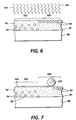
- FIGs 4 through 12 illustrate schematically a migration imaging member comprising a conductive substrate layer 90 that is connected to a reference potential such as a ground, and a softenable layer 91 comprising softenable material 92, migration marking material 93, and optional charge transport material 94.
- the member is uniformly charged in the dark to either polarity (negative charging is illustrated in Figure 4) by a charging means 99 such as a corona charging apparatus.
- the charged member is then exposed imagewise to radiation 100 at a wavelength to which the migration marking material 93 is sensitive.
- the migration marking material is selenium particles
- blue or green light can be used for imagewise exposure.
- Substantial photodischarge then occurs in the exposed areas.
- the imaging member is developed by causing the softenable material to soften by any suitable means (in Figure 6, by uniform application of heat energy 101 to the member).
- Application of heat in the illustrated manner causes softenable material 92 to soften, thereby enabling migration marking material 93 to migrate through softenable material 92 toward substrate 90.
- the heat development temperature and time depend upon factors such as the melt viscosity of the softenable layer, thickness of the softenable layer, the amount of heat energy, and the like. For example, at a temperature of 110°C to about 130°C, heat need only be applied for a few seconds. For lower temperatures, more heating time can be required.
- the softenable material decreases in viscosity, thereby decreasing its resistance to migration of the marking material 93 through the softenable layer 91.
- the net charge causes the charged marking material to migrate in image configuration towards the conductive layer 90 and disperse in the softenable layer 91, resulting in a D min area.
- the uncharged migration marking particles in areas 103 of the imaging member remain essentially neutral and uncharged.
- the unexposed migration marking particles remain substantially in their original position in softenable layer 91, resulting in a D max area.
- solvent vapor development can be substituted for heat development.
- Vapor development of migration imaging members is well known in the art. Generally, if solvent vapor softening is utilized, the solvent vapor exposure time depends upon factors such as the solubility of the softenable layers in the solvent, the type of solvent vapor, the ambient temperature, the concentration of the solvent vapors, and the like.
- the test for a satisfactory combination of time and temperature is to maximize optical contrast density and electrostatic contrast potential for xeroprinting.
- satisfactory results can be achieved by exposing the imaging member to the vapor of toluene for between about 4 seconds and about 60 seconds at a solvent vapor partial pressure of between about 5 millimeters and 30 millimeters of mercury when the unovercoated softenable layer contains an 80/20 mole percent copolymer of styrene and hexylmethacrylate having an intrinsic viscosity of 0.179 dl/gm and N,N'-diphenyl-N,N'-bis(3"-methylphenyl)-(1,1'-biphenyl)-4,4'-diamine.
- transparentizing agent 105 is applied to the surface of softenable layer 91.
- Migration marking material 93 in unmigrated areas 103 remains at or near the surface of softenable layer 91 and thus comes into contact with transparentizing agent 105, while migration marking material 93 in migrated areas 102 has migrated towards the conductive layer 90 and dispersed within softenable layer 91, and thus does not come into contact with transparentizing agent 105.
- transparentizing agent 105 can be dissolved or dispersed in a solvent, if the material itself is a solid and not a liquid, and applied to the surface of softenable layer 91 with an applicator 107 (which can be any suitable applicator, such as a gravure roller, a porous roll, a squeegee applicator, a painting member, a dabbing or wiping member, or the like. If transparentizing agent 105 is a liquid, it can be applied directly from applicator 107.
- transparentizing agent 105 can be coated onto base sheet 109, followed by contacting base sheet 109 with the surface of softenable layer 91 and applying heat and/or pressure.
- base sheet 109 coated with transparentizing agent 105 (which can, if desired, be dispersed within an optional binder) is placed in intimate contact with softenable layer 91 of the migration imaging member and the "sandwich" created by laying base sheet 109 onto the imaging member is passed through a nip created by roller 97 and roller 98.
- roller 98 which contacts base sheet 109 is heated, although either or both of the rollers 97 and 98 can be heated if desired.
- Rollers 97 and 98 are situated with respect to each other so as to form a nip, such that pressure is applied to softenable layer 91 and base sheet while they are in intimate contact with each other.
- Application of heat and pressure in the illustrated manner causes softenable material 92 and/or the optional binder on base sheet 109 to soften, thereby enabling unmigrated migration marking material 93 in areas 103 of the migration imaging member to come into contact with transparentizing agent 105.
- the temperature and time depend upon factors such as the melt viscosity of the softenable layer and/or binder, thickness of the softenable layer and/or binder layer, the amount of heat energy, and the like. For example, at a temperature of 110°C to about 130°C, heat need only be applied for a few seconds.
- Preferred temperatures for rollers 97 and/or 98 typically are from about 50 to about 130°C, and more preferably from about 80 to about 130°C, although the temperature can be outside these ranges.
- Preferred pressures within the nip between rollers 97 and 98 typically are from about 0.5 to about 5 pounds per square inch, although the pressure can be outside this range.
- unmigrated migration marking material 93 in areas 103 of the imaging member becomes effectively transparentized, resulting in an imaged migration imaging member as illustrated in Figure 9, in which the former D min areas (areas 102 of the imaging member) have become D max areas and the former D max areas (areas 103) have become D min areas, as illustrated schematically in Figure 9.
- the optical contrast density of the imaged member can be further improved.
- Any residual transparentizing agent, solvent, and/or binder is cleaned from the surface of softenable layer 91, followed by uniformly charging the imaging member in the dark to either polarity (negative charging is illustrated in Figure 10) by a charging means 99 such as a corona charging apparatus, as illustrated schematically in Figure 10.
- the charged member is then uniformly exposed imagewise to radiation 100 at a wavelength to which the migration marking material 93 is sensitive.
- the migration marking material is selenium particles
- blue or green light can be used for imagewise exposure.
- Substantial photodischarge then occurs in the exposed areas.
- the softenable material is once again caused to soften by any suitable means (in Figure 12, by uniform application of heat energy 101 to the member).
- Application of heat in the illustrated manner causes softenable material 92 to soften, thereby enabling migration marking material 93 in areas 102 of the imaging member to migrate further through softenable material 92 toward substrate 90.
- the migration marking particles 93 collect near substrate 90, resulting in a D max which approaches or matches that of the original unimaged member, while the D min areas exhibit little or no optical density attributable to migration marking material.
- imaging member illustrated in Figures 4, 5, 6, 7, 8, 9, 10, 11, and 12 is shown without any optional layers such as those illustrated in Figures 1, 2, and 3. If desired, alternative imaging member embodiments, such as those employing any or all of the optional layers illustrated in Figures 1,2, and 3, can also be employed.
- Migration imaging members were prepared as follows.
- a solution for the softenable layer was prepared by dissolving about 84 parts by weight of a terpolymer of styrene/ethylacrylate/acrylic acid (prepared as disclosed in U.S. Patent 4,853,307, and about 16 parts by weight of N,N'-diphenyl-N,N"-bis(3"-methylphenyl)-(1,1'-biphenyl)-4,4'-diamine (prepared as disclosed in U.S. Patent 4,265,990, in about 450 parts by weight of toluene.
- N,N'-diphenyl-N,N'-bis(3'-methylphenyl)-(1,1'-biphenyl)-4,4'-diamine is a charge transport material capable of transporting positive charges (holes).
- the resulting solution was coated by a solvent extrusion technique onto 3 mil thick polyester substrates (Melinex 442, aluminized to 50 percent light transmission), and the deposited softenable layers were allowed to dry at about 115°C for about 2 minutes, resulting in dried softenable layers with thicknesses of about 4 microns.
- the temperature of the softenable layers was then raised to about 115°C to lower the viscosity of the exposed surfaces of the softenable layers to about 5 ⁇ 10 3 poises in preparation for the deposition of marking material.
- Thin layers of particulate vitreous selenium were then applied by vacuum deposition in a vacuum chamber maintained at a vacuum of about 4 ⁇ 10 -4 Torr.
- the imaging members were then rapidly chilled to room temperature. Reddish monolayers of selenium particles having an average diameter of about 0.3 micron embedded about 0.05 to 0.1 micron below the surfaces of the copolymer layers were formed.
- the coated surfaces of the polyester sheets were placed in intimate contact with the surfaces of the migration imaging members coated with the softenable material and the migration marking material, and the "sandwiches" thus formed were subjected to temperatures of 100°C for 1 minute, at which temperature the softenable layer was softened sufficiently to enable contact between the embedded selenium particles and the transparentizing agents while the softenable material was in a molten state.
- the polyester sheets coated with the transparentizing agents were then separated from the migration imaging members and the UV absorption spectra at 685 nm of the migration imaging members were measured to determine the extent of migration marking material transparentization.
- UV absorption spectra were measured with a Shimadzu UV-160 spectrometer; all spectra were recorded by using 50°16 transmission aluminized ICI 442 polyester as a reference.
- the optical densities of the migration imaging members were also measured with a Macbeth TR927 densitometer in the visible, ultraviolet, and infrared range, using a Wratten No. 47 filter for the blue measurements, a Wratten No. 18A filter for the UV measurements, and a Wratten No. 25 filter for the IR measurements.
- the UV absorption spectrum at 685 nm and the optical density of the migration imaging members prior to contact with the sheet coated with transparentizing agent were also measured. The results were as follows: Agent UV absorption Optical Density vis.
- UV IR maleic anhydride 0.00 0.27 0.65 0.35 s-acetylmercapto succinic anhydride 0.00 0.30 0.48 0.38 2-octadecen-1-yl succinic anhydride 0.00 0.28 0.55 0.35 18-crown-6 0.00 0.30 0.60 0.35 benzo-18 crown-6 0.16 0.41 1.00 0.60 dibenzo-18 crown-6 0.60 0.60 1.20 0.65 dibenzo-24 crown-8 0.00 0.30 1.00 0.50 5-amino-3-methyl isooxazole 0.00 0.32 0.55 0.45 2-oxazolidone 0.50 0.71 0.95 0.75 5,5-dimethyl oxazolidine-2,4-dione 0.15 0.37 0.90 0.44 3-ethyl-2-thioxo-4-oxazolidinone 0.00 0.22 0.45 0.35 3-morpholino-1,2-propandiol 0.20 0.35 0.73 0.55 4-phenyl morpholine 0.00 0.30 0.55 0.32 N,N' -di
- Migration imaging members were prepared as described in Example I.
- the surfaces of the members thus formed were uniformly negatively charged to a surface potential of -142 Volts with a corona charging device and were subsequently optically exposed by placing test pattern masks comprising silver halide images in contact with the imaging members and exposing the members to blue light of 480 nanometers through the mask for a period of 5 seconds.
- the imaging members were then developed by heating them with an aluminum heating block in contact with the polyester substrates at temperatures of from about 85 to about 100°C for about 5 seconds. Images corresponding to the images on the test pattern masks were subsequently visible in the developed imaging members.
- the developed migration imaging members were then cut into pieces and pieces containing only Dmin areas (i.e., areas wherein the selenium particles had migrated in depth through the softenable layer) were placed in intimate contact with polyester sheets coated with a binder and a transparentizing agent and prepared as described in Example I.
- the UV absorption spectra at 685 nm of the D min areas of the migration imaging members were measured to determine the extent of migration marking material transparentization. UV absorption spectra were measured with a Shimadzu UV-160 spectrometer; all spectra were recorded by using 50% transmission aluminized ICI 442 polyester as a reference.
- the optical densities of the D min areas of the migration imaging members were also measured with a Macbeth TR927 densitometer in the visible, ultraviolet, and infrared range, using a Wratten No. 47 filter for the blue measurements, a Wratten No. 18A filter for the UV measurements, and a Wratten No. 25 filter for the IR measurements.
- the UV absorption spectrum at 685 nm and the optical density of the D min areas of the migration imaging members prior to contact with the sheet coated with transparentizing agent were also measured. The results were as follows: Agent UV absorption Optical Density vis.
- a migration imaging member was prepared as described in Example I and imaged as described in Example II. Thereafter, to the surface of the softenable layer was contacted a solution of heptane containing 2 percent by weight triethylphosphite by pouring the solution onto the surface of the softenable layer. Within 30 seconds, the selenium particles on the top surface of the softenable layer were transparentized, thereby revealing the image comprising the selenium particles which had migrated in depth within the softenable layer (formerly the D min area, now the D max area). The imaging member was then washed with hexane to remove residual triethylphosphite therefrom.
- Example III The process of Example III is repeated with the transparentizing agents employed in Examples I and II. It is believed that results substantially similar to those of Example III will be obtained.
Landscapes
- Health & Medical Sciences (AREA)
- Life Sciences & Earth Sciences (AREA)
- Chemical & Material Sciences (AREA)
- Chemical Kinetics & Catalysis (AREA)
- Electrochemistry (AREA)
- Molecular Biology (AREA)
- Physics & Mathematics (AREA)
- General Physics & Mathematics (AREA)
- Plural Heterocyclic Compounds (AREA)
- Silver Salt Photography Or Processing Solution Therefor (AREA)
- Duplication Or Marking (AREA)
- Electrophotography Using Other Than Carlson'S Method (AREA)
- Photoreceptors In Electrophotography (AREA)
Applications Claiming Priority (2)
| Application Number | Priority Date | Filing Date | Title |
|---|---|---|---|
| US441360 | 1995-05-15 | ||
| US08/441,360 US5514505A (en) | 1995-05-15 | 1995-05-15 | Method for obtaining improved image contrast in migration imaging members |
Publications (3)
| Publication Number | Publication Date |
|---|---|
| EP0743573A2 true EP0743573A2 (fr) | 1996-11-20 |
| EP0743573A3 EP0743573A3 (fr) | 1997-03-05 |
| EP0743573B1 EP0743573B1 (fr) | 2000-09-06 |
Family
ID=23752579
Family Applications (1)
| Application Number | Title | Priority Date | Filing Date |
|---|---|---|---|
| EP96303359A Expired - Lifetime EP0743573B1 (fr) | 1995-05-15 | 1996-05-14 | Procédé de production d'éléments de formation d'image par migration à contraste |
Country Status (5)
| Country | Link |
|---|---|
| US (1) | US5514505A (fr) |
| EP (1) | EP0743573B1 (fr) |
| JP (1) | JPH08314240A (fr) |
| CA (1) | CA2169980C (fr) |
| DE (1) | DE69610146T2 (fr) |
Cited By (1)
| Publication number | Priority date | Publication date | Assignee | Title |
|---|---|---|---|---|
| CN105247416A (zh) * | 2013-05-28 | 2016-01-13 | 佳能株式会社 | 电子照相感光构件、处理盒、电子照相设备和酞菁晶体 |
Families Citing this family (54)
| Publication number | Priority date | Publication date | Assignee | Title |
|---|---|---|---|---|
| US5696271A (en) * | 1994-02-16 | 1997-12-09 | Shionogi & Co., Ltd. | Process for the preparation of 3-isoxazolecarboxylic acid |
| EP0968323B1 (fr) * | 1997-03-18 | 2001-05-16 | Ceca S.A. | Compositions a base de sels de mercaptoacides et d'imidazolines comme inhibiteurs de la corrosion carbonique du fer et des metaux ferreux |
| US5981764A (en) * | 1997-07-25 | 1999-11-09 | Otsuka Chemical Co., Ltd. | Process for producing 1-aminopyrrolidine, and 1-aminopyrrolidine according to the process |
| US20030219427A1 (en) * | 1998-08-18 | 2003-11-27 | Allen Hamish J. | TPL-2/COT kinase and methods of use |
| PL347137A1 (en) * | 1998-08-18 | 2002-03-25 | Basf Ag | Tpl-2/cot kinase and methods of use |
| IT1304507B1 (it) * | 1998-12-29 | 2001-03-19 | Great Lakes Chemical Italia | Composti fotocromatici, procedimento per la loro preparazione e loroutilizzo in materiali polimerici. |
| AU1529901A (en) * | 1999-11-22 | 2001-06-04 | Smithkline Beecham Plc | Compounds |
| WO2001062233A2 (fr) * | 2000-02-25 | 2001-08-30 | F. Hoffmann La Roche Ag | Modulateurs de recepteurs de l'adenosine |
| ATE266022T1 (de) * | 2000-03-06 | 2004-05-15 | Smithkline Beecham Plc | Imidazol derivate als raf kinase inhibitoren |
| GB0005357D0 (en) * | 2000-03-06 | 2000-04-26 | Smithkline Beecham Plc | Compounds |
| EP1134221A1 (fr) * | 2000-03-15 | 2001-09-19 | Aventis Pharma Deutschland GmbH | Bêta-carbolines substituées comme inhibiteurs de lkB kinase |
| US7199137B2 (en) * | 2000-09-21 | 2007-04-03 | Smithkline Beecham Plc | Imidazole derivatives as Raf kinase inhibitors |
| JP4239133B2 (ja) | 2001-04-04 | 2009-03-18 | 富士電機デバイステクノロジー株式会社 | 電子写真用感光体およびその製造方法 |
| GB0112348D0 (en) * | 2001-05-19 | 2001-07-11 | Smithkline Beecham Plc | Compounds |
| US20040192689A1 (en) * | 2001-09-05 | 2004-09-30 | Dean David Kenneth | Heterocycle-carboxamide derivatives as raf kinase inhibitors |
| AR039241A1 (es) * | 2002-04-04 | 2005-02-16 | Biogen Inc | Heteroarilos trisustituidos y metodos para su produccion y uso de los mismos |
| EP1534679A4 (fr) * | 2002-08-30 | 2007-06-06 | Biostratum Inc | Inhibiteurs de produits terminaux avances de glycation post-amadori |
| UA80296C2 (en) * | 2002-09-06 | 2007-09-10 | Biogen Inc | Imidazolopyridines and methods of making and using the same |
| UA80295C2 (en) * | 2002-09-06 | 2007-09-10 | Biogen Inc | Pyrazolopyridines and using the same |
| CN1753864B (zh) | 2002-12-26 | 2010-05-05 | 盐野义制药株式会社 | 用捕捉糖链的分子纯化/浓缩糖链的方法和分析糖链结构的方法 |
| CL2004000234A1 (es) * | 2003-02-12 | 2005-04-15 | Biogen Idec Inc | Compuestos derivados 3-(piridin-2-il)-4-heteroaril-pirazol sustituidos, antagonistas de aik5 y/o aik4; composicion farmaceutica y uso del compuesto en el tratamiento de desordenes fibroticos como esclerodermia, lupus nefritico, cicatrizacion de herid |
| EP1708013A4 (fr) * | 2004-01-20 | 2009-07-01 | Teijin Chemicals Ltd | Lentille pour lunettes et son procede de production |
| US7417040B2 (en) * | 2004-03-01 | 2008-08-26 | Bristol-Myers Squibb Company | Fused tricyclic compounds as inhibitors of 17β-hydroxysteroid dehydrogenase 3 |
| US7378426B2 (en) * | 2004-03-01 | 2008-05-27 | Bristol-Myers Squibb Company | Fused heterotricyclic compounds as inhibitors of 17β-hydroxysteroid dehydrogenase 3 |
| US7842815B2 (en) * | 2004-06-17 | 2010-11-30 | Infinity Pharmaceuticals, Inc. | Compounds and methods for inhibiting the interaction of BCL proteins with binding partners |
| MXPA06014754A (es) * | 2004-06-17 | 2007-06-22 | Infinity Pharmaceuticals Inc | Compuestos y metodos para inhibir la interaccion de las proteinas bcl con los componentes de enlace. |
| US20060020004A1 (en) * | 2004-06-17 | 2006-01-26 | Infinity Pharmaceuticals, Inc. | Isoxazolidine compounds for treatment of bacterial infections |
| CA2581454A1 (fr) * | 2004-09-23 | 2006-03-30 | Reddy Us Therapeutics, Inc. | Nouveaux composes de pyrimidine, leur procede de preparation, et compositions les contenant |
| JP2006160836A (ja) * | 2004-12-03 | 2006-06-22 | Fuji Photo Film Co Ltd | 放射線の照射により硬化可能なインクジェット記録用インク及びこれを用いた平版印刷版作製方法 |
| SG126784A1 (en) * | 2005-04-15 | 2006-11-29 | Sun Ace Kakoh Pte Ltd | Stabiliser composition for chlorine-containing polymers |
| KR20080000665A (ko) * | 2005-04-22 | 2008-01-02 | 알란토스 파마슈티컬즈 홀딩, 인코포레이티드 | 디펩티딜 펩티다아제-ⅳ 억제제 |
| US7687658B2 (en) * | 2005-11-25 | 2010-03-30 | Hetero Drugs Limited | Process for oseltamivir phosphate |
| TWI389895B (zh) | 2006-08-21 | 2013-03-21 | Infinity Discovery Inc | 抑制bcl蛋白質與結合夥伴間之交互作用的化合物及方法 |
| JP4786490B2 (ja) * | 2006-09-29 | 2011-10-05 | 京セラミタ株式会社 | 電子写真感光体および画像形成装置 |
| JP4388975B2 (ja) * | 2007-10-16 | 2009-12-24 | シャープ株式会社 | トリアミン化合物を含有する電子写真感光体とそれを備えた画像形成装置およびトリアミン化合物とその製造方法 |
| FR2929115B1 (fr) * | 2008-03-31 | 2010-06-04 | Exsymol Sa | Utilisation cosmetique de composes conjugues d'auxines indoliques. |
| US8927551B2 (en) * | 2009-05-18 | 2015-01-06 | Infinity Pharmaceuticals, Inc. | Isoxazolines as inhibitors of fatty acid amide hydrolase |
| US9149465B2 (en) * | 2009-05-18 | 2015-10-06 | Infinity Pharmaceuticals, Inc. | Isoxazolines as inhibitors of fatty acid amide hydrolase |
| US8765735B2 (en) * | 2009-05-18 | 2014-07-01 | Infinity Pharmaceuticals, Inc. | Isoxazolines as inhibitors of fatty acid amide hydrolase |
| AU2010276236B2 (en) * | 2009-07-21 | 2014-03-20 | Gen-Probe Incorporated | Methods and compositions for quantitative detection of nucleic acid sequences over an extended dynamic range |
| US9073941B2 (en) | 2010-06-28 | 2015-07-07 | Academia Sinica | Compounds and methods for treating tuberculosis infection |
| JP2014134772A (ja) * | 2012-12-14 | 2014-07-24 | Canon Inc | 電子写真感光体、プロセスカートリッジおよび電子写真装置、ならびにフタロシアニン結晶 |
| EP3939972A1 (fr) | 2013-01-14 | 2022-01-19 | Molecular Insight Pharmaceuticals, Inc. | Produits radiopharmaceutiques à base de triazine et agents de radioimagerie |
| CN104148018B (zh) * | 2013-05-14 | 2018-04-20 | 上海亨臻实业有限公司 | 抗体亲和纯化材料及其用途 |
| US10879477B2 (en) * | 2014-02-19 | 2020-12-29 | Merck Patent Gmbh | Cyclic amine surface modifier and organic electronic devices comprising such cyclic amine surface modifier |
| US9477148B1 (en) | 2015-05-26 | 2016-10-25 | Industrial Technology Research Institute | Polymer, method for preparing the same, and a photosensitive resin composition thereof |
| HRP20240793T1 (hr) | 2018-04-18 | 2024-09-13 | Constellation Pharmaceuticals, Inc. | Modulatori enzima koji modificiraju metil, njihovi pripravci i upotreba |
| CN108615813B (zh) * | 2018-04-19 | 2021-07-16 | 苏州大学 | 基于一维有机无机杂化聚合物链的电存储器件及其制备方法 |
| EP3797108B1 (fr) | 2018-05-21 | 2022-07-20 | Constellation Pharmaceuticals, Inc. | Modulateurs de l'enzyme méthyl modifiant, compositions et leur utilisation. |
| MA55556A (fr) | 2019-04-02 | 2022-02-09 | Aligos Therapeutics Inc | Composés ciblant prmt5 |
| CN110016123B (zh) * | 2019-04-16 | 2021-07-09 | 广东固研电子材料有限公司 | 一种耐热阻燃型环氧树脂潜伏性固化剂 |
| LT4003532T (lt) | 2019-07-24 | 2024-11-11 | Constellation Pharmaceuticals, Inc. | 7-chlor-2- (4-(3-metoksiazetidin-1-il)cikloheksil)-2,4-dimetil-n-((6-metil-4-(metiltio)-2-okso-1,2-dihidropiridin-3-il)metil)benzo[d][1,3]dioksol-5-karboksamido kristalinės formos |
| CN114621421B (zh) * | 2022-04-01 | 2024-01-05 | 阿尔法(广东)高新材料有限公司 | 一种环保共聚酯、透明抗静电环保共聚酯膜制备及应用 |
| CN120574556B (zh) * | 2025-08-01 | 2025-11-28 | 山东大学 | 一种基于硫辛酸类化合物与氮杂环类化合物的胶粘剂及其制备方法与应用 |
Family Cites Families (15)
| Publication number | Priority date | Publication date | Assignee | Title |
|---|---|---|---|---|
| GB1200094A (en) * | 1966-10-31 | 1970-07-29 | Rank Xerox Ltd | Electrostatographic imaging method |
| US4101321A (en) * | 1967-01-27 | 1978-07-18 | Xerox Corporation | Imaging system |
| US4252890A (en) * | 1968-08-26 | 1981-02-24 | Xerox Corporation | Imaging system which agglomerates particulate material |
| CA942828A (en) * | 1968-08-26 | 1974-02-26 | James E. Adams | Method for producing images by flash exposure |
| US4029502A (en) * | 1968-08-26 | 1977-06-14 | Xerox Corporation | Imaging system containing agglomerable material |
| US3753705A (en) * | 1969-10-01 | 1973-08-21 | Xerox Corp | Agglomeration imaging process using hardenable material |
| US4082549A (en) * | 1972-10-27 | 1978-04-04 | Xerox Corporation | Agglomeration imaging process |
| US3950167A (en) * | 1973-09-26 | 1976-04-13 | Xerox Corporation | Imaging system |
| US4241156A (en) * | 1977-10-26 | 1980-12-23 | Xerox Corporation | Imaging system of discontinuous layer of migration material |
| US4536457A (en) * | 1984-01-03 | 1985-08-20 | Xerox Corporation | Migration imaging process |
| US4853307A (en) * | 1988-01-04 | 1989-08-01 | Xerox Corporation | Imaging member containing a copolymer of styrene and ethyl acrylate |
| US4880715A (en) * | 1988-01-04 | 1989-11-14 | Xerox Corporation | Imaging system |
| US4937163A (en) * | 1989-01-27 | 1990-06-26 | Xerox Corporation | Imaging member and processes thereof |
| US5240799A (en) * | 1990-07-23 | 1993-08-31 | Xerox Corporation | Dual electrode migration imaging members and apparatuses and processes for the preparation and use of same |
| WO1993004411A1 (fr) * | 1991-08-16 | 1993-03-04 | Eastman Kodak Company | Imagerie par migration a l'aide de colorants ou de pigments de blanchiment |
-
1995
- 1995-05-15 US US08/441,360 patent/US5514505A/en not_active Expired - Lifetime
-
1996
- 1996-02-21 CA CA002169980A patent/CA2169980C/fr not_active Expired - Fee Related
- 1996-05-08 JP JP8113456A patent/JPH08314240A/ja not_active Withdrawn
- 1996-05-14 DE DE69610146T patent/DE69610146T2/de not_active Expired - Fee Related
- 1996-05-14 EP EP96303359A patent/EP0743573B1/fr not_active Expired - Lifetime
Cited By (1)
| Publication number | Priority date | Publication date | Assignee | Title |
|---|---|---|---|---|
| CN105247416A (zh) * | 2013-05-28 | 2016-01-13 | 佳能株式会社 | 电子照相感光构件、处理盒、电子照相设备和酞菁晶体 |
Also Published As
| Publication number | Publication date |
|---|---|
| US5514505A (en) | 1996-05-07 |
| DE69610146D1 (de) | 2000-10-12 |
| EP0743573A3 (fr) | 1997-03-05 |
| CA2169980C (fr) | 2001-04-24 |
| CA2169980A1 (fr) | 1996-11-16 |
| EP0743573B1 (fr) | 2000-09-06 |
| DE69610146T2 (de) | 2001-01-11 |
| JPH08314240A (ja) | 1996-11-29 |
Similar Documents
| Publication | Publication Date | Title |
|---|---|---|
| EP0743573B1 (fr) | Procédé de production d'éléments de formation d'image par migration à contraste | |
| US3383993A (en) | Photoelectrophoretic imaging apparatus | |
| EP0149328B1 (fr) | Elément de méthode de formation d'image à migration | |
| US4536457A (en) | Migration imaging process | |
| CA2170298C (fr) | Elements d'imagerie a migration | |
| US3804620A (en) | Method of producing planographic plates by photoelectrophoretic imaging | |
| EP0743574B1 (fr) | Eléments de formation d'images par migration | |
| DE2256329A1 (de) | Feinteilige bilderzeugungszusammensetzung | |
| US3975195A (en) | Migration imaging system | |
| CA1332115C (fr) | Element d'imagerie contenant un copolymere de styrene et d'acrylate d'ethyle | |
| US3798030A (en) | Photoelectrosolographic imaging method utilizing powder particles | |
| US4113482A (en) | Migration imaging method involving color change | |
| US3820984A (en) | Method of migration imaging using fusible particles | |
| US3912505A (en) | Color imaging method employing a monolayer of beads | |
| US5690993A (en) | Overcoated migration imaging members | |
| US3645883A (en) | Photoelectrophoretic imaging apparatus employing photosensitive particles exhibiting fatigue characteristics | |
| US3820987A (en) | Photoelectrophoretic imaging with fixing on a separate electrode | |
| US3445227A (en) | Electrophotographic imaging processes employing 2,4-diamino-triazines as the electrically photosensitive particles | |
| US3676313A (en) | Removing undesired potential from the blocking electrode in a photoelectrophoretic imaging system | |
| US4465749A (en) | Electrostatic charge differential amplification (CDA) in imaging process | |
| US3713818A (en) | Migration imaging system with molten liquid development | |
| US3901697A (en) | Manifold imaging process using electrically photosensitive material subject to light fatigue | |
| US3718462A (en) | Manifold electrification process | |
| US3918969A (en) | Migration imaging method employing a uniform exposure step | |
| US6180297B1 (en) | Migration imaging process |
Legal Events
| Date | Code | Title | Description |
|---|---|---|---|
| PUAI | Public reference made under article 153(3) epc to a published international application that has entered the european phase |
Free format text: ORIGINAL CODE: 0009012 |
|
| AK | Designated contracting states |
Kind code of ref document: A2 Designated state(s): DE FR GB |
|
| PUAL | Search report despatched |
Free format text: ORIGINAL CODE: 0009013 |
|
| AK | Designated contracting states |
Kind code of ref document: A3 Designated state(s): DE FR GB |
|
| RIN1 | Information on inventor provided before grant (corrected) |
Inventor name: PERRON, MARIE-EVE Inventor name: CHEN, LIQIN Inventor name: MALHOTRA, SHADI L. Inventor name: SHAHIN, MICHAEL M. Inventor name: GRIFFITHS, CLIFFORD H. Inventor name: LIEBERMANN, GEORGE Inventor name: MAMMINO, JOSEPH Inventor name: LIMBURG, WILLIAM H. |
|
| 17P | Request for examination filed |
Effective date: 19970905 |
|
| 17Q | First examination report despatched |
Effective date: 19990121 |
|
| GRAG | Despatch of communication of intention to grant |
Free format text: ORIGINAL CODE: EPIDOS AGRA |
|
| GRAG | Despatch of communication of intention to grant |
Free format text: ORIGINAL CODE: EPIDOS AGRA |
|
| GRAH | Despatch of communication of intention to grant a patent |
Free format text: ORIGINAL CODE: EPIDOS IGRA |
|
| GRAH | Despatch of communication of intention to grant a patent |
Free format text: ORIGINAL CODE: EPIDOS IGRA |
|
| GRAA | (expected) grant |
Free format text: ORIGINAL CODE: 0009210 |
|
| AK | Designated contracting states |
Kind code of ref document: B1 Designated state(s): DE FR GB |
|
| REF | Corresponds to: |
Ref document number: 69610146 Country of ref document: DE Date of ref document: 20001012 |
|
| ET | Fr: translation filed | ||
| PLBE | No opposition filed within time limit |
Free format text: ORIGINAL CODE: 0009261 |
|
| STAA | Information on the status of an ep patent application or granted ep patent |
Free format text: STATUS: NO OPPOSITION FILED WITHIN TIME LIMIT |
|
| 26N | No opposition filed | ||
| REG | Reference to a national code |
Ref country code: GB Ref legal event code: IF02 |
|
| PGFP | Annual fee paid to national office [announced via postgrant information from national office to epo] |
Ref country code: FR Payment date: 20030508 Year of fee payment: 8 |
|
| PGFP | Annual fee paid to national office [announced via postgrant information from national office to epo] |
Ref country code: GB Payment date: 20030514 Year of fee payment: 8 |
|
| PGFP | Annual fee paid to national office [announced via postgrant information from national office to epo] |
Ref country code: DE Payment date: 20030522 Year of fee payment: 8 |
|
| PG25 | Lapsed in a contracting state [announced via postgrant information from national office to epo] |
Ref country code: GB Free format text: LAPSE BECAUSE OF NON-PAYMENT OF DUE FEES Effective date: 20040514 |
|
| PG25 | Lapsed in a contracting state [announced via postgrant information from national office to epo] |
Ref country code: DE Free format text: LAPSE BECAUSE OF NON-PAYMENT OF DUE FEES Effective date: 20041201 |
|
| GBPC | Gb: european patent ceased through non-payment of renewal fee |
Effective date: 20040514 |
|
| PG25 | Lapsed in a contracting state [announced via postgrant information from national office to epo] |
Ref country code: FR Free format text: LAPSE BECAUSE OF NON-PAYMENT OF DUE FEES Effective date: 20050131 |
|
| REG | Reference to a national code |
Ref country code: FR Ref legal event code: ST |