EP0754669B1 - Procedes de production d'alpha-halocetones, d'alpha-halohydrines et d'epoxydes - Google Patents
Procedes de production d'alpha-halocetones, d'alpha-halohydrines et d'epoxydes Download PDFInfo
- Publication number
- EP0754669B1 EP0754669B1 EP96901520A EP96901520A EP0754669B1 EP 0754669 B1 EP0754669 B1 EP 0754669B1 EP 96901520 A EP96901520 A EP 96901520A EP 96901520 A EP96901520 A EP 96901520A EP 0754669 B1 EP0754669 B1 EP 0754669B1
- Authority
- EP
- European Patent Office
- Prior art keywords
- producing
- general formula
- halo ketone
- ester derivative
- aralkyl
- Prior art date
- Legal status (The legal status is an assumption and is not a legal conclusion. Google has not performed a legal analysis and makes no representation as to the accuracy of the status listed.)
- Expired - Lifetime
Links
- 238000000034 method Methods 0.000 title claims description 93
- 125000001475 halogen functional group Chemical group 0.000 title claims description 64
- 150000002118 epoxides Chemical class 0.000 title claims description 42
- -1 magnesium halide Chemical class 0.000 claims description 82
- 239000002253 acid Substances 0.000 claims description 69
- 239000000203 mixture Substances 0.000 claims description 64
- 150000003839 salts Chemical class 0.000 claims description 48
- 125000000217 alkyl group Chemical group 0.000 claims description 43
- 125000003710 aryl alkyl group Chemical group 0.000 claims description 42
- 125000003118 aryl group Chemical group 0.000 claims description 42
- 238000006243 chemical reaction Methods 0.000 claims description 39
- 229910052739 hydrogen Inorganic materials 0.000 claims description 29
- 239000001257 hydrogen Substances 0.000 claims description 29
- 150000002148 esters Chemical class 0.000 claims description 28
- 229910052751 metal Inorganic materials 0.000 claims description 27
- 239000002184 metal Substances 0.000 claims description 27
- XLYOFNOQVPJJNP-UHFFFAOYSA-N water Substances O XLYOFNOQVPJJNP-UHFFFAOYSA-N 0.000 claims description 25
- 229910052736 halogen Inorganic materials 0.000 claims description 24
- CSNNHWWHGAXBCP-UHFFFAOYSA-L Magnesium sulfate Chemical compound [Mg+2].[O-][S+2]([O-])([O-])[O-] CSNNHWWHGAXBCP-UHFFFAOYSA-L 0.000 claims description 22
- 150000002367 halogens Chemical group 0.000 claims description 21
- FOCAUTSVDIKZOP-UHFFFAOYSA-N chloroacetic acid Chemical compound OC(=O)CCl FOCAUTSVDIKZOP-UHFFFAOYSA-N 0.000 claims description 20
- 229940024606 amino acid Drugs 0.000 claims description 19
- 150000002431 hydrogen Chemical group 0.000 claims description 19
- 239000011777 magnesium Substances 0.000 claims description 18
- 238000011065 in-situ storage Methods 0.000 claims description 17
- 229910052749 magnesium Inorganic materials 0.000 claims description 16
- 150000001732 carboxylic acid derivatives Chemical class 0.000 claims description 15
- FYYHWMGAXLPEAU-UHFFFAOYSA-N Magnesium Chemical compound [Mg] FYYHWMGAXLPEAU-UHFFFAOYSA-N 0.000 claims description 14
- 229930182832 D-phenylalanine Natural products 0.000 claims description 13
- 239000007795 chemical reaction product Substances 0.000 claims description 13
- 230000000911 decarboxylating effect Effects 0.000 claims description 13
- UYWQUFXKFGHYNT-UHFFFAOYSA-N phenylmethyl ester of formic acid Natural products O=COCC1=CC=CC=C1 UYWQUFXKFGHYNT-UHFFFAOYSA-N 0.000 claims description 13
- FDRCDNZGSXJAFP-UHFFFAOYSA-M sodium chloroacetate Chemical compound [Na+].[O-]C(=O)CCl FDRCDNZGSXJAFP-UHFFFAOYSA-M 0.000 claims description 13
- 239000002904 solvent Substances 0.000 claims description 12
- CSCPPACGZOOCGX-UHFFFAOYSA-N Acetone Chemical group CC(C)=O CSCPPACGZOOCGX-UHFFFAOYSA-N 0.000 claims description 11
- 150000001412 amines Chemical class 0.000 claims description 11
- UFHFLCQGNIYNRP-UHFFFAOYSA-N Hydrogen Chemical group [H][H] UFHFLCQGNIYNRP-UHFFFAOYSA-N 0.000 claims description 10
- 150000001875 compounds Chemical class 0.000 claims description 10
- 159000000003 magnesium salts Chemical class 0.000 claims description 9
- CQRPUKWAZPZXTO-UHFFFAOYSA-M magnesium;2-methylpropane;chloride Chemical compound [Mg+2].[Cl-].C[C-](C)C CQRPUKWAZPZXTO-UHFFFAOYSA-M 0.000 claims description 9
- 150000003863 ammonium salts Chemical class 0.000 claims description 7
- 125000000612 phthaloyl group Chemical group C(C=1C(C(=O)*)=CC=CC1)(=O)* 0.000 claims description 7
- COLNVLDHVKWLRT-QMMMGPOBSA-N L-Phenylalanine Natural products OC(=O)[C@@H](N)CC1=CC=CC=C1 COLNVLDHVKWLRT-QMMMGPOBSA-N 0.000 claims description 6
- 229910052943 magnesium sulfate Inorganic materials 0.000 claims description 6
- 235000019341 magnesium sulphate Nutrition 0.000 claims description 6
- RMHOGFJEHWOPLT-UHFFFAOYSA-M magnesium;di(propan-2-yl)azanide;chloride Chemical compound Cl[Mg+].CC(C)[N-]C(C)C RMHOGFJEHWOPLT-UHFFFAOYSA-M 0.000 claims description 6
- 229960005190 phenylalanine Drugs 0.000 claims description 6
- NAWXUBYGYWOOIX-SFHVURJKSA-N (2s)-2-[[4-[2-(2,4-diaminoquinazolin-6-yl)ethyl]benzoyl]amino]-4-methylidenepentanedioic acid Chemical compound C1=CC2=NC(N)=NC(N)=C2C=C1CCC1=CC=C(C(=O)N[C@@H](CC(=C)C(O)=O)C(O)=O)C=C1 NAWXUBYGYWOOIX-SFHVURJKSA-N 0.000 claims description 5
- 150000003862 amino acid derivatives Chemical class 0.000 claims description 5
- 150000001733 carboxylic acid esters Chemical class 0.000 claims description 5
- PKMBLJNMKINMSK-UHFFFAOYSA-N magnesium;azanide Chemical compound [NH2-].[NH2-].[Mg+2] PKMBLJNMKINMSK-UHFFFAOYSA-N 0.000 claims description 5
- 125000006239 protecting group Chemical group 0.000 claims description 5
- 159000000000 sodium salts Chemical class 0.000 claims description 5
- 150000003512 tertiary amines Chemical class 0.000 claims description 5
- 239000007818 Grignard reagent Substances 0.000 claims description 4
- 125000001181 organosilyl group Chemical group [SiH3]* 0.000 claims description 4
- 125000001584 benzyloxycarbonyl group Chemical group C(=O)(OCC1=CC=CC=C1)* 0.000 claims description 3
- 125000000753 cycloalkyl group Chemical group 0.000 claims description 3
- 150000004795 grignard reagents Chemical class 0.000 claims description 3
- 150000003944 halohydrins Chemical class 0.000 claims description 2
- 125000002924 primary amino group Chemical group [H]N([H])* 0.000 claims 3
- 239000003586 protic polar solvent Substances 0.000 claims 3
- WHXSMMKQMYFTQS-UHFFFAOYSA-N Lithium Chemical compound [Li] WHXSMMKQMYFTQS-UHFFFAOYSA-N 0.000 claims 2
- 229910052744 lithium Inorganic materials 0.000 claims 2
- 125000000467 secondary amino group Chemical class [H]N([*:1])[*:2] 0.000 claims 2
- 239000000243 solution Substances 0.000 description 114
- NEHMKBQYUWJMIP-UHFFFAOYSA-N chloromethane Chemical compound ClC NEHMKBQYUWJMIP-UHFFFAOYSA-N 0.000 description 107
- WYURNTSHIVDZCO-UHFFFAOYSA-N Tetrahydrofuran Chemical compound C1CCOC1 WYURNTSHIVDZCO-UHFFFAOYSA-N 0.000 description 90
- XEKOWRVHYACXOJ-UHFFFAOYSA-N Ethyl acetate Chemical compound CCOC(C)=O XEKOWRVHYACXOJ-UHFFFAOYSA-N 0.000 description 60
- 229940050176 methyl chloride Drugs 0.000 description 49
- YLQBMQCUIZJEEH-UHFFFAOYSA-N tetrahydrofuran Natural products C=1C=COC=1 YLQBMQCUIZJEEH-UHFFFAOYSA-N 0.000 description 45
- UAOMVDZJSHZZME-UHFFFAOYSA-N diisopropylamine Chemical compound CC(C)NC(C)C UAOMVDZJSHZZME-UHFFFAOYSA-N 0.000 description 42
- UIIMBOGNXHQVGW-UHFFFAOYSA-M Sodium bicarbonate Chemical class [Na+].OC([O-])=O UIIMBOGNXHQVGW-UHFFFAOYSA-M 0.000 description 38
- VLKZOEOYAKHREP-UHFFFAOYSA-N n-Hexane Chemical compound CCCCCC VLKZOEOYAKHREP-UHFFFAOYSA-N 0.000 description 36
- YXFVVABEGXRONW-UHFFFAOYSA-N Toluene Chemical compound CC1=CC=CC=C1 YXFVVABEGXRONW-UHFFFAOYSA-N 0.000 description 33
- 238000004519 manufacturing process Methods 0.000 description 33
- 125000000405 phenylalanyl group Chemical group 0.000 description 33
- XENVCRGQTABGKY-ZHACJKMWSA-N chlorohydrin Chemical compound CC#CC#CC#CC#C\C=C\C(Cl)CO XENVCRGQTABGKY-ZHACJKMWSA-N 0.000 description 27
- 229920006395 saturated elastomer Polymers 0.000 description 27
- LFQSCWFLJHTTHZ-UHFFFAOYSA-N Ethanol Chemical compound CCO LFQSCWFLJHTTHZ-UHFFFAOYSA-N 0.000 description 25
- IJGRMHOSHXDMSA-UHFFFAOYSA-N Atomic nitrogen Chemical compound N#N IJGRMHOSHXDMSA-UHFFFAOYSA-N 0.000 description 24
- 239000013078 crystal Substances 0.000 description 24
- 229910001873 dinitrogen Inorganic materials 0.000 description 24
- 239000011541 reaction mixture Substances 0.000 description 23
- FAPWRFPIFSIZLT-UHFFFAOYSA-M Sodium chloride Chemical compound [Na+].[Cl-] FAPWRFPIFSIZLT-UHFFFAOYSA-M 0.000 description 22
- 239000012074 organic phase Substances 0.000 description 20
- 125000004432 carbon atom Chemical group C* 0.000 description 19
- 229910000030 sodium bicarbonate Inorganic materials 0.000 description 18
- 239000002585 base Substances 0.000 description 17
- TWRXJAOTZQYOKJ-UHFFFAOYSA-L Magnesium chloride Chemical compound [Mg+2].[Cl-].[Cl-] TWRXJAOTZQYOKJ-UHFFFAOYSA-L 0.000 description 16
- OKKJLVBELUTLKV-UHFFFAOYSA-N Methanol Chemical compound OC OKKJLVBELUTLKV-UHFFFAOYSA-N 0.000 description 15
- MZRVEZGGRBJDDB-UHFFFAOYSA-N N-Butyllithium Chemical compound [Li]CCCC MZRVEZGGRBJDDB-UHFFFAOYSA-N 0.000 description 14
- 229940043279 diisopropylamine Drugs 0.000 description 14
- 239000000706 filtrate Substances 0.000 description 13
- 238000004128 high performance liquid chromatography Methods 0.000 description 13
- OISVCGZHLKNMSJ-UHFFFAOYSA-N 2,6-dimethylpyridine Chemical compound CC1=CC=CC(C)=N1 OISVCGZHLKNMSJ-UHFFFAOYSA-N 0.000 description 12
- MFYSUUPKMDJYPF-UHFFFAOYSA-N 2-[(4-methyl-2-nitrophenyl)diazenyl]-3-oxo-n-phenylbutanamide Chemical compound C=1C=CC=CC=1NC(=O)C(C(=O)C)N=NC1=CC=C(C)C=C1[N+]([O-])=O MFYSUUPKMDJYPF-UHFFFAOYSA-N 0.000 description 12
- RTZKZFJDLAIYFH-UHFFFAOYSA-N Diethyl ether Chemical compound CCOCC RTZKZFJDLAIYFH-UHFFFAOYSA-N 0.000 description 12
- ZMANZCXQSJIPKH-UHFFFAOYSA-N Triethylamine Chemical compound CCN(CC)CC ZMANZCXQSJIPKH-UHFFFAOYSA-N 0.000 description 12
- 239000000047 product Substances 0.000 description 12
- VEXZGXHMUGYJMC-UHFFFAOYSA-N Hydrochloric acid Chemical compound Cl VEXZGXHMUGYJMC-UHFFFAOYSA-N 0.000 description 11
- JIHFRPSFLTXYEP-JTQLQIEISA-N methyl (2s)-2-(methoxycarbonylamino)-3-phenylpropanoate Chemical compound COC(=O)N[C@H](C(=O)OC)CC1=CC=CC=C1 JIHFRPSFLTXYEP-JTQLQIEISA-N 0.000 description 11
- 230000007062 hydrolysis Effects 0.000 description 10
- 238000006460 hydrolysis reaction Methods 0.000 description 10
- 125000002496 methyl group Chemical group [H]C([H])([H])* 0.000 description 10
- 239000011780 sodium chloride Substances 0.000 description 10
- HEMHJVSKTPXQMS-UHFFFAOYSA-M Sodium hydroxide Chemical compound [OH-].[Na+] HEMHJVSKTPXQMS-UHFFFAOYSA-M 0.000 description 9
- QAOWNCQODCNURD-UHFFFAOYSA-N Sulfuric acid Chemical compound OS(O)(=O)=O QAOWNCQODCNURD-UHFFFAOYSA-N 0.000 description 9
- 235000001014 amino acid Nutrition 0.000 description 9
- 238000001914 filtration Methods 0.000 description 9
- 238000002329 infrared spectrum Methods 0.000 description 9
- QUXHCILOWRXCEO-UHFFFAOYSA-M magnesium;butane;chloride Chemical compound [Mg+2].[Cl-].CCC[CH2-] QUXHCILOWRXCEO-UHFFFAOYSA-M 0.000 description 9
- 238000000655 nuclear magnetic resonance spectrum Methods 0.000 description 9
- 239000003921 oil Substances 0.000 description 9
- 238000003756 stirring Methods 0.000 description 9
- 230000015572 biosynthetic process Effects 0.000 description 8
- 229910001629 magnesium chloride Inorganic materials 0.000 description 8
- 238000004445 quantitative analysis Methods 0.000 description 8
- NLXLAEXVIDQMFP-UHFFFAOYSA-N Ammonia chloride Chemical compound [NH4+].[Cl-] NLXLAEXVIDQMFP-UHFFFAOYSA-N 0.000 description 7
- YGYAWVDWMABLBF-UHFFFAOYSA-N Phosgene Chemical compound ClC(Cl)=O YGYAWVDWMABLBF-UHFFFAOYSA-N 0.000 description 7
- IMACFCSSMIZSPP-UHFFFAOYSA-N phenacyl chloride Chemical compound ClCC(=O)C1=CC=CC=C1 IMACFCSSMIZSPP-UHFFFAOYSA-N 0.000 description 7
- 239000007787 solid Substances 0.000 description 7
- SJRJJKPEHAURKC-UHFFFAOYSA-N N-Methylmorpholine Chemical compound CN1CCOCC1 SJRJJKPEHAURKC-UHFFFAOYSA-N 0.000 description 6
- 0 NCC([C@](Cc1ccccc1)*O)=O Chemical compound NCC([C@](Cc1ccccc1)*O)=O 0.000 description 6
- 239000002274 desiccant Substances 0.000 description 6
- 238000005516 engineering process Methods 0.000 description 6
- 125000001449 isopropyl group Chemical group [H]C([H])([H])C([H])(*)C([H])([H])[H] 0.000 description 6
- ZCSHNCUQKCANBX-UHFFFAOYSA-N lithium diisopropylamide Chemical compound [Li+].CC(C)[N-]C(C)C ZCSHNCUQKCANBX-UHFFFAOYSA-N 0.000 description 6
- QPJVMBTYPHYUOC-UHFFFAOYSA-N methyl benzoate Chemical compound COC(=O)C1=CC=CC=C1 QPJVMBTYPHYUOC-UHFFFAOYSA-N 0.000 description 6
- 150000001450 anions Chemical class 0.000 description 5
- 125000001797 benzyl group Chemical group [H]C1=C([H])C([H])=C(C([H])=C1[H])C([H])([H])* 0.000 description 5
- 239000007810 chemical reaction solvent Substances 0.000 description 5
- 125000001495 ethyl group Chemical group [H]C([H])([H])C([H])([H])* 0.000 description 5
- 150000002576 ketones Chemical class 0.000 description 5
- 125000001997 phenyl group Chemical group [H]C1=C([H])C([H])=C(*)C([H])=C1[H] 0.000 description 5
- 238000001953 recrystallisation Methods 0.000 description 5
- XWKFPIODWVPXLX-UHFFFAOYSA-N 2-methyl-5-methylpyridine Natural products CC1=CC=C(C)N=C1 XWKFPIODWVPXLX-UHFFFAOYSA-N 0.000 description 4
- BZLVMXJERCGZMT-UHFFFAOYSA-N Methyl tert-butyl ether Chemical compound COC(C)(C)C BZLVMXJERCGZMT-UHFFFAOYSA-N 0.000 description 4
- JGFZNNIVVJXRND-UHFFFAOYSA-N N,N-Diisopropylethylamine (DIPEA) Chemical compound CCN(C(C)C)C(C)C JGFZNNIVVJXRND-UHFFFAOYSA-N 0.000 description 4
- JLTDJTHDQAWBAV-UHFFFAOYSA-N N,N-dimethylaniline Chemical compound CN(C)C1=CC=CC=C1 JLTDJTHDQAWBAV-UHFFFAOYSA-N 0.000 description 4
- JUJWROOIHBZHMG-UHFFFAOYSA-N Pyridine Chemical compound C1=CC=NC=C1 JUJWROOIHBZHMG-UHFFFAOYSA-N 0.000 description 4
- PMZURENOXWZQFD-UHFFFAOYSA-L Sodium Sulfate Chemical compound [Na+].[Na+].[O-]S([O-])(=O)=O PMZURENOXWZQFD-UHFFFAOYSA-L 0.000 description 4
- WQDUMFSSJAZKTM-UHFFFAOYSA-N Sodium methoxide Chemical compound [Na+].[O-]C WQDUMFSSJAZKTM-UHFFFAOYSA-N 0.000 description 4
- 239000006227 byproduct Substances 0.000 description 4
- MTZQAGJQAFMTAQ-UHFFFAOYSA-N ethyl benzoate Chemical compound CCOC(=O)C1=CC=CC=C1 MTZQAGJQAFMTAQ-UHFFFAOYSA-N 0.000 description 4
- 125000005843 halogen group Chemical group 0.000 description 4
- 239000012279 sodium borohydride Substances 0.000 description 4
- 229910000033 sodium borohydride Inorganic materials 0.000 description 4
- 125000000026 trimethylsilyl group Chemical group [H]C([H])([H])[Si]([*])(C([H])([H])[H])C([H])([H])[H] 0.000 description 4
- JIAARYAFYJHUJI-UHFFFAOYSA-L zinc dichloride Chemical compound [Cl-].[Cl-].[Zn+2] JIAARYAFYJHUJI-UHFFFAOYSA-L 0.000 description 4
- QWUWMCYKGHVNAV-UHFFFAOYSA-N 1,2-dihydrostilbene Chemical group C=1C=CC=CC=1CCC1=CC=CC=C1 QWUWMCYKGHVNAV-UHFFFAOYSA-N 0.000 description 3
- QTBSBXVTEAMEQO-UHFFFAOYSA-N Acetic acid Chemical compound CC(O)=O QTBSBXVTEAMEQO-UHFFFAOYSA-N 0.000 description 3
- WEVYAHXRMPXWCK-UHFFFAOYSA-N Acetonitrile Chemical compound CC#N WEVYAHXRMPXWCK-UHFFFAOYSA-N 0.000 description 3
- YXHKONLOYHBTNS-UHFFFAOYSA-N Diazomethane Chemical compound C=[N+]=[N-] YXHKONLOYHBTNS-UHFFFAOYSA-N 0.000 description 3
- ULGZDMOVFRHVEP-RWJQBGPGSA-N Erythromycin Chemical compound O([C@@H]1[C@@H](C)C(=O)O[C@@H]([C@@]([C@H](O)[C@@H](C)C(=O)[C@H](C)C[C@@](C)(O)[C@H](O[C@H]2[C@@H]([C@H](C[C@@H](C)O2)N(C)C)O)[C@H]1C)(C)O)CC)[C@H]1C[C@@](C)(OC)[C@@H](O)[C@H](C)O1 ULGZDMOVFRHVEP-RWJQBGPGSA-N 0.000 description 3
- KFZMGEQAYNKOFK-UHFFFAOYSA-N Isopropanol Chemical compound CC(C)O KFZMGEQAYNKOFK-UHFFFAOYSA-N 0.000 description 3
- ZMXDDKWLCZADIW-UHFFFAOYSA-N N,N-Dimethylformamide Chemical compound CN(C)C=O ZMXDDKWLCZADIW-UHFFFAOYSA-N 0.000 description 3
- KWYUFKZDYYNOTN-UHFFFAOYSA-M Potassium hydroxide Chemical compound [OH-].[K+] KWYUFKZDYYNOTN-UHFFFAOYSA-M 0.000 description 3
- 235000019270 ammonium chloride Nutrition 0.000 description 3
- 239000007864 aqueous solution Substances 0.000 description 3
- 229910052794 bromium Inorganic materials 0.000 description 3
- 229910052801 chlorine Inorganic materials 0.000 description 3
- IJOOHPMOJXWVHK-UHFFFAOYSA-N chlorotrimethylsilane Chemical compound C[Si](C)(C)Cl IJOOHPMOJXWVHK-UHFFFAOYSA-N 0.000 description 3
- 230000000052 comparative effect Effects 0.000 description 3
- 125000003754 ethoxycarbonyl group Chemical group C(=O)(OCC)* 0.000 description 3
- SUYHVQFAQPEJLE-UHFFFAOYSA-L magnesium;2-chloroacetate Chemical compound [Mg+2].[O-]C(=O)CCl.[O-]C(=O)CCl SUYHVQFAQPEJLE-UHFFFAOYSA-L 0.000 description 3
- 125000001160 methoxycarbonyl group Chemical group [H]C([H])([H])OC(*)=O 0.000 description 3
- 229940095102 methyl benzoate Drugs 0.000 description 3
- 230000035484 reaction time Effects 0.000 description 3
- 125000000999 tert-butyl group Chemical group [H]C([H])([H])C(*)(C([H])([H])[H])C([H])([H])[H] 0.000 description 3
- UBOJYURSFIUEFZ-UHFFFAOYSA-N 2,3-di(propan-2-yl)benzamide Chemical compound CC(C)C1=CC=CC(C(N)=O)=C1C(C)C UBOJYURSFIUEFZ-UHFFFAOYSA-N 0.000 description 2
- QGZKDVFQNNGYKY-UHFFFAOYSA-N Ammonia Chemical compound N QGZKDVFQNNGYKY-UHFFFAOYSA-N 0.000 description 2
- XTHFKEDIFFGKHM-UHFFFAOYSA-N Dimethoxyethane Chemical compound COCCOC XTHFKEDIFFGKHM-UHFFFAOYSA-N 0.000 description 2
- KEAYESYHFKHZAL-UHFFFAOYSA-N Sodium Chemical compound [Na] KEAYESYHFKHZAL-UHFFFAOYSA-N 0.000 description 2
- 150000008065 acid anhydrides Chemical class 0.000 description 2
- 150000001298 alcohols Chemical class 0.000 description 2
- 235000008206 alpha-amino acids Nutrition 0.000 description 2
- VSCWAEJMTAWNJL-UHFFFAOYSA-K aluminium trichloride Chemical compound Cl[Al](Cl)Cl VSCWAEJMTAWNJL-UHFFFAOYSA-K 0.000 description 2
- 150000001413 amino acids Chemical class 0.000 description 2
- 150000008064 anhydrides Chemical class 0.000 description 2
- 125000000129 anionic group Chemical group 0.000 description 2
- UOCJDOLVGGIYIQ-PBFPGSCMSA-N cefatrizine Chemical group S([C@@H]1[C@@H](C(N1C=1C(O)=O)=O)NC(=O)[C@H](N)C=2C=CC(O)=CC=2)CC=1CSC=1C=NNN=1 UOCJDOLVGGIYIQ-PBFPGSCMSA-N 0.000 description 2
- 239000003638 chemical reducing agent Substances 0.000 description 2
- 238000004440 column chromatography Methods 0.000 description 2
- 238000001816 cooling Methods 0.000 description 2
- 125000000113 cyclohexyl group Chemical group [H]C1([H])C([H])([H])C([H])([H])C([H])(*)C([H])([H])C1([H])[H] 0.000 description 2
- 238000006114 decarboxylation reaction Methods 0.000 description 2
- 229940079593 drug Drugs 0.000 description 2
- 239000003814 drug Substances 0.000 description 2
- OAYLNYINCPYISS-UHFFFAOYSA-N ethyl acetate;hexane Chemical compound CCCCCC.CCOC(C)=O OAYLNYINCPYISS-UHFFFAOYSA-N 0.000 description 2
- QEWYKACRFQMRMB-UHFFFAOYSA-N fluoroacetic acid Chemical compound OC(=O)CF QEWYKACRFQMRMB-UHFFFAOYSA-N 0.000 description 2
- FFUAGWLWBBFQJT-UHFFFAOYSA-N hexamethyldisilazane Chemical compound C[Si](C)(C)N[Si](C)(C)C FFUAGWLWBBFQJT-UHFFFAOYSA-N 0.000 description 2
- 239000000543 intermediate Substances 0.000 description 2
- 229910052740 iodine Inorganic materials 0.000 description 2
- FQJYGNZBLZBJLS-UHFFFAOYSA-L magnesium;2-chloroacetate;chloride Chemical compound [Mg+2].[Cl-].[O-]C(=O)CCl FQJYGNZBLZBJLS-UHFFFAOYSA-L 0.000 description 2
- SDSWSVBXRBXPRL-LBPRGKRZSA-N methyl (2s)-2-[(2-methylpropan-2-yl)oxycarbonylamino]-3-phenylpropanoate Chemical compound CC(C)(C)OC(=O)N[C@H](C(=O)OC)CC1=CC=CC=C1 SDSWSVBXRBXPRL-LBPRGKRZSA-N 0.000 description 2
- LPNYRYFBWFDTMA-UHFFFAOYSA-N potassium tert-butoxide Chemical compound [K+].CC(C)(C)[O-] LPNYRYFBWFDTMA-UHFFFAOYSA-N 0.000 description 2
- 238000002360 preparation method Methods 0.000 description 2
- UMJSCPRVCHMLSP-UHFFFAOYSA-N pyridine Natural products COC1=CC=CN=C1 UMJSCPRVCHMLSP-UHFFFAOYSA-N 0.000 description 2
- 239000000376 reactant Substances 0.000 description 2
- 125000002914 sec-butyl group Chemical group [H]C([H])([H])C([H])([H])C([H])(*)C([H])([H])[H] 0.000 description 2
- 150000003335 secondary amines Chemical class 0.000 description 2
- QDRKDTQENPPHOJ-UHFFFAOYSA-N sodium ethoxide Chemical compound [Na+].CC[O-] QDRKDTQENPPHOJ-UHFFFAOYSA-N 0.000 description 2
- 239000012312 sodium hydride Substances 0.000 description 2
- 229910000104 sodium hydride Inorganic materials 0.000 description 2
- 239000000758 substrate Substances 0.000 description 2
- YBRBMKDOPFTVDT-UHFFFAOYSA-N tert-butylamine Chemical compound CC(C)(C)N YBRBMKDOPFTVDT-UHFFFAOYSA-N 0.000 description 2
- 239000011592 zinc chloride Substances 0.000 description 2
- 235000005074 zinc chloride Nutrition 0.000 description 2
- GAWAYYRQGQZKCR-REOHCLBHSA-N (S)-2-chloropropanoic acid Chemical compound C[C@H](Cl)C(O)=O GAWAYYRQGQZKCR-REOHCLBHSA-N 0.000 description 1
- FHUDAMLDXFJHJE-UHFFFAOYSA-N 1,1,1-trifluoropropan-2-one Chemical compound CC(=O)C(F)(F)F FHUDAMLDXFJHJE-UHFFFAOYSA-N 0.000 description 1
- CYSGHNMQYZDMIA-UHFFFAOYSA-N 1,3-Dimethyl-2-imidazolidinon Chemical compound CN1CCN(C)C1=O CYSGHNMQYZDMIA-UHFFFAOYSA-N 0.000 description 1
- 125000004066 1-hydroxyethyl group Chemical group [H]OC([H])([*])C([H])([H])[H] 0.000 description 1
- QDGAVODICPCDMU-UHFFFAOYSA-N 2-amino-3-[3-[bis(2-chloroethyl)amino]phenyl]propanoic acid Chemical compound OC(=O)C(N)CC1=CC=CC(N(CCCl)CCCl)=C1 QDGAVODICPCDMU-UHFFFAOYSA-N 0.000 description 1
- 125000004172 4-methoxyphenyl group Chemical group [H]C1=C([H])C(OC([H])([H])[H])=C([H])C([H])=C1* 0.000 description 1
- RVDLHGSZWAELAU-UHFFFAOYSA-N 5-tert-butylthiophene-2-carbonyl chloride Chemical compound CC(C)(C)C1=CC=C(C(Cl)=O)S1 RVDLHGSZWAELAU-UHFFFAOYSA-N 0.000 description 1
- VVJKKWFAADXIJK-UHFFFAOYSA-N Allylamine Chemical class NCC=C VVJKKWFAADXIJK-UHFFFAOYSA-N 0.000 description 1
- UXVMQQNJUSDDNG-UHFFFAOYSA-L Calcium chloride Chemical compound [Cl-].[Cl-].[Ca+2] UXVMQQNJUSDDNG-UHFFFAOYSA-L 0.000 description 1
- FOSCDBCOYQJHPN-UHFFFAOYSA-M Cl[Mg] Chemical compound Cl[Mg] FOSCDBCOYQJHPN-UHFFFAOYSA-M 0.000 description 1
- SECXISVLQFMRJM-UHFFFAOYSA-N N-Methylpyrrolidone Chemical compound CN1CCCC1=O SECXISVLQFMRJM-UHFFFAOYSA-N 0.000 description 1
- HTLZVHNRZJPSMI-UHFFFAOYSA-N N-ethylpiperidine Chemical compound CCN1CCCCC1 HTLZVHNRZJPSMI-UHFFFAOYSA-N 0.000 description 1
- DNEPGEPDVCDEAP-AWEZNQCLSA-N O-methyl (2S)-2-(N-phenylmethoxycarbonylanilino)propanethioate Chemical compound COC([C@@H](N(C(=O)OCC1=CC=CC=C1)C1=CC=CC=C1)C)=S DNEPGEPDVCDEAP-AWEZNQCLSA-N 0.000 description 1
- VYPSYNLAJGMNEJ-UHFFFAOYSA-N Silicium dioxide Chemical compound O=[Si]=O VYPSYNLAJGMNEJ-UHFFFAOYSA-N 0.000 description 1
- STSCVKRWJPWALQ-UHFFFAOYSA-N TRIFLUOROACETIC ACID ETHYL ESTER Chemical compound CCOC(=O)C(F)(F)F STSCVKRWJPWALQ-UHFFFAOYSA-N 0.000 description 1
- 125000002777 acetyl group Chemical group [H]C([H])([H])C(*)=O 0.000 description 1
- 125000003545 alkoxy group Chemical group 0.000 description 1
- 125000004453 alkoxycarbonyl group Chemical group 0.000 description 1
- 150000001370 alpha-amino acid derivatives Chemical class 0.000 description 1
- 125000003277 amino group Chemical group 0.000 description 1
- 229910021529 ammonia Inorganic materials 0.000 description 1
- 125000003236 benzoyl group Chemical group [H]C1=C([H])C([H])=C(C([H])=C1[H])C(*)=O 0.000 description 1
- KDPAWGWELVVRCH-UHFFFAOYSA-N bromoacetic acid Chemical compound OC(=O)CBr KDPAWGWELVVRCH-UHFFFAOYSA-N 0.000 description 1
- 239000001110 calcium chloride Substances 0.000 description 1
- 229910001628 calcium chloride Inorganic materials 0.000 description 1
- 159000000007 calcium salts Chemical class 0.000 description 1
- 150000001735 carboxylic acids Chemical class 0.000 description 1
- 239000003795 chemical substances by application Substances 0.000 description 1
- 150000003945 chlorohydrins Chemical class 0.000 description 1
- 239000012230 colorless oil Substances 0.000 description 1
- 238000006482 condensation reaction Methods 0.000 description 1
- 150000001879 copper Chemical class 0.000 description 1
- 238000002425 crystallisation Methods 0.000 description 1
- 230000008025 crystallization Effects 0.000 description 1
- HPNMFZURTQLUMO-UHFFFAOYSA-N diethylamine Chemical compound CCNCC HPNMFZURTQLUMO-UHFFFAOYSA-N 0.000 description 1
- 239000002360 explosive Substances 0.000 description 1
- 229910052731 fluorine Inorganic materials 0.000 description 1
- 125000005842 heteroatom Chemical group 0.000 description 1
- RBBOWEDMXHTEPA-UHFFFAOYSA-N hexane;toluene Chemical compound CCCCCC.CC1=CC=CC=C1 RBBOWEDMXHTEPA-UHFFFAOYSA-N 0.000 description 1
- 239000004030 hiv protease inhibitor Substances 0.000 description 1
- 125000004029 hydroxymethyl group Chemical group [H]OC([H])([H])* 0.000 description 1
- 238000009776 industrial production Methods 0.000 description 1
- YNESATAKKCNGOF-UHFFFAOYSA-N lithium bis(trimethylsilyl)amide Chemical compound [Li+].C[Si](C)(C)[N-][Si](C)(C)C YNESATAKKCNGOF-UHFFFAOYSA-N 0.000 description 1
- 229910003002 lithium salt Inorganic materials 0.000 description 1
- 159000000002 lithium salts Chemical class 0.000 description 1
- OHXYLFVFSUFWPO-UHFFFAOYSA-M lithium;2-chloroacetate Chemical compound [Li+].[O-]C(=O)CCl OHXYLFVFSUFWPO-UHFFFAOYSA-M 0.000 description 1
- UBJFKNSINUCEAL-UHFFFAOYSA-N lithium;2-methylpropane Chemical compound [Li+].C[C-](C)C UBJFKNSINUCEAL-UHFFFAOYSA-N 0.000 description 1
- XPLJNJGKLNJWNZ-UHFFFAOYSA-N lithium;cyclohexylazanide Chemical compound [Li+].[NH-]C1CCCCC1 XPLJNJGKLNJWNZ-UHFFFAOYSA-N 0.000 description 1
- MOBUGHKVYAPXPH-UHFFFAOYSA-L magnesium;2-chloroacetate;bromide Chemical compound [Mg+2].[Br-].[O-]C(=O)CCl MOBUGHKVYAPXPH-UHFFFAOYSA-L 0.000 description 1
- FKKWHMOEKFXMPU-UHFFFAOYSA-M magnesium;2-methylbutane;chloride Chemical compound [Mg+2].[Cl-].CC[C-](C)C FKKWHMOEKFXMPU-UHFFFAOYSA-M 0.000 description 1
- IZWPPZMYNSBLNI-UHFFFAOYSA-N magnesium;2-methylpropane Chemical compound [Mg+2].C[C-](C)C.C[C-](C)C IZWPPZMYNSBLNI-UHFFFAOYSA-N 0.000 description 1
- UKZCGMDMXDLAGZ-UHFFFAOYSA-M magnesium;2-methylpropane;bromide Chemical compound [Mg+2].[Br-].C[C-](C)C UKZCGMDMXDLAGZ-UHFFFAOYSA-M 0.000 description 1
- JPDWPLVFOQOYEA-UHFFFAOYSA-M magnesium;bis(trimethylsilyl)azanide;chloride Chemical compound [Mg+2].[Cl-].C[Si](C)(C)[N-][Si](C)(C)C JPDWPLVFOQOYEA-UHFFFAOYSA-M 0.000 description 1
- XDBOBNVQEBSKFO-UHFFFAOYSA-N magnesium;di(propan-2-yl)azanide Chemical compound CC(C)N(C(C)C)[Mg]N(C(C)C)C(C)C XDBOBNVQEBSKFO-UHFFFAOYSA-N 0.000 description 1
- UODMSBYDFUPQHC-UHFFFAOYSA-M magnesium;di(propan-2-yl)azanide;bromide Chemical compound CC(C)N([Mg]Br)C(C)C UODMSBYDFUPQHC-UHFFFAOYSA-M 0.000 description 1
- GTDCQMPQTQGUBI-UHFFFAOYSA-M magnesium;dicyclohexylazanide;chloride Chemical compound [Mg+2].[Cl-].C1CCCCC1[N-]C1CCCCC1 GTDCQMPQTQGUBI-UHFFFAOYSA-M 0.000 description 1
- KSLHSWUBLCFCIL-UHFFFAOYSA-M magnesium;propan-2-ylazanide;chloride Chemical compound [Cl-].CC(C)N[Mg+] KSLHSWUBLCFCIL-UHFFFAOYSA-M 0.000 description 1
- 230000000873 masking effect Effects 0.000 description 1
- 229910001510 metal chloride Inorganic materials 0.000 description 1
- 150000002739 metals Chemical class 0.000 description 1
- JDBGCNRESYAUON-NSHDSACASA-N methyl (2s)-2-(ethoxycarbonylamino)-3-phenylpropanoate Chemical compound CCOC(=O)N[C@H](C(=O)OC)CC1=CC=CC=C1 JDBGCNRESYAUON-NSHDSACASA-N 0.000 description 1
- BBACSHIJBOGXKL-INIZCTEOSA-N methyl (2s)-3-phenyl-2-(phenylmethoxycarbonylamino)propanoate Chemical compound C([C@@H](C(=O)OC)NC(=O)OCC=1C=CC=CC=1)C1=CC=CC=C1 BBACSHIJBOGXKL-INIZCTEOSA-N 0.000 description 1
- VSDUZFOSJDMAFZ-VIFPVBQESA-N methyl L-phenylalaninate Chemical compound COC(=O)[C@@H](N)CC1=CC=CC=C1 VSDUZFOSJDMAFZ-VIFPVBQESA-N 0.000 description 1
- 125000004092 methylthiomethyl group Chemical group [H]C([H])([H])SC([H])([H])* 0.000 description 1
- 238000002156 mixing Methods 0.000 description 1
- 125000004108 n-butyl group Chemical group [H]C([H])([H])C([H])([H])C([H])([H])C([H])([H])* 0.000 description 1
- 125000004123 n-propyl group Chemical group [H]C([H])([H])C([H])([H])C([H])([H])* 0.000 description 1
- 229910052757 nitrogen Inorganic materials 0.000 description 1
- 125000004433 nitrogen atom Chemical group N* 0.000 description 1
- 150000002900 organolithium compounds Chemical class 0.000 description 1
- 150000004965 peroxy acids Chemical class 0.000 description 1
- 239000012071 phase Substances 0.000 description 1
- COLNVLDHVKWLRT-UHFFFAOYSA-N phenylalanine Natural products OC(=O)C(N)CC1=CC=CC=C1 COLNVLDHVKWLRT-UHFFFAOYSA-N 0.000 description 1
- 125000004344 phenylpropyl group Chemical group 0.000 description 1
- 125000005544 phthalimido group Chemical group 0.000 description 1
- XAEFZNCEHLXOMS-UHFFFAOYSA-M potassium benzoate Chemical compound [K+].[O-]C(=O)C1=CC=CC=C1 XAEFZNCEHLXOMS-UHFFFAOYSA-M 0.000 description 1
- KPFSGNRRZMYZPH-UHFFFAOYSA-M potassium;2-chloroacetate Chemical compound [K+].[O-]C(=O)CCl KPFSGNRRZMYZPH-UHFFFAOYSA-M 0.000 description 1
- 239000002244 precipitate Substances 0.000 description 1
- OVARTBFNCCXQKS-UHFFFAOYSA-N propan-2-one;hydrate Chemical compound O.CC(C)=O OVARTBFNCCXQKS-UHFFFAOYSA-N 0.000 description 1
- 150000003333 secondary alcohols Chemical class 0.000 description 1
- 239000000741 silica gel Substances 0.000 description 1
- 229910002027 silica gel Inorganic materials 0.000 description 1
- 239000002002 slurry Substances 0.000 description 1
- 229910052938 sodium sulfate Inorganic materials 0.000 description 1
- 235000011152 sodium sulphate Nutrition 0.000 description 1
- 239000007858 starting material Substances 0.000 description 1
- 239000000126 substance Substances 0.000 description 1
- 238000003786 synthesis reaction Methods 0.000 description 1
- GIZSHQYTTBQKOQ-UHFFFAOYSA-N threo-Syringoylglycerol Chemical compound COC1=CC(C(O)C(O)CO)=CC(OC)=C1O GIZSHQYTTBQKOQ-UHFFFAOYSA-N 0.000 description 1
- 125000002088 tosyl group Chemical group [H]C1=C([H])C(=C([H])C([H])=C1C([H])([H])[H])S(*)(=O)=O 0.000 description 1
- 125000004044 trifluoroacetyl group Chemical group FC(C(=O)*)(F)F 0.000 description 1
- GKNXALOWPZOTRL-UHFFFAOYSA-N trimethylsilyl 2-chloroacetate Chemical compound C[Si](C)(C)OC(=O)CCl GKNXALOWPZOTRL-UHFFFAOYSA-N 0.000 description 1
- 150000003751 zinc Chemical class 0.000 description 1
Images


Classifications
-
- C—CHEMISTRY; METALLURGY
- C07—ORGANIC CHEMISTRY
- C07D—HETEROCYCLIC COMPOUNDS
- C07D303/00—Compounds containing three-membered rings having one oxygen atom as the only ring hetero atom
- C07D303/02—Compounds containing oxirane rings
- C07D303/36—Compounds containing oxirane rings with hydrocarbon radicals, substituted by nitrogen atoms
-
- C—CHEMISTRY; METALLURGY
- C07—ORGANIC CHEMISTRY
- C07C—ACYCLIC OR CARBOCYCLIC COMPOUNDS
- C07C269/00—Preparation of derivatives of carbamic acid, i.e. compounds containing any of the groups, the nitrogen atom not being part of nitro or nitroso groups
- C07C269/06—Preparation of derivatives of carbamic acid, i.e. compounds containing any of the groups, the nitrogen atom not being part of nitro or nitroso groups by reactions not involving the formation of carbamate groups
-
- C—CHEMISTRY; METALLURGY
- C07—ORGANIC CHEMISTRY
- C07C—ACYCLIC OR CARBOCYCLIC COMPOUNDS
- C07C29/00—Preparation of compounds having hydroxy or O-metal groups bound to a carbon atom not belonging to a six-membered aromatic ring
- C07C29/132—Preparation of compounds having hydroxy or O-metal groups bound to a carbon atom not belonging to a six-membered aromatic ring by reduction of an oxygen containing functional group
- C07C29/136—Preparation of compounds having hydroxy or O-metal groups bound to a carbon atom not belonging to a six-membered aromatic ring by reduction of an oxygen containing functional group of >C=O containing groups, e.g. —COOH
- C07C29/143—Preparation of compounds having hydroxy or O-metal groups bound to a carbon atom not belonging to a six-membered aromatic ring by reduction of an oxygen containing functional group of >C=O containing groups, e.g. —COOH of ketones
-
- C—CHEMISTRY; METALLURGY
- C07—ORGANIC CHEMISTRY
- C07C—ACYCLIC OR CARBOCYCLIC COMPOUNDS
- C07C319/00—Preparation of thiols, sulfides, hydropolysulfides or polysulfides
- C07C319/14—Preparation of thiols, sulfides, hydropolysulfides or polysulfides of sulfides
- C07C319/20—Preparation of thiols, sulfides, hydropolysulfides or polysulfides of sulfides by reactions not involving the formation of sulfide groups
-
- C—CHEMISTRY; METALLURGY
- C07—ORGANIC CHEMISTRY
- C07C—ACYCLIC OR CARBOCYCLIC COMPOUNDS
- C07C45/00—Preparation of compounds having >C = O groups bound only to carbon or hydrogen atoms; Preparation of chelates of such compounds
- C07C45/45—Preparation of compounds having >C = O groups bound only to carbon or hydrogen atoms; Preparation of chelates of such compounds by condensation
- C07C45/48—Preparation of compounds having >C = O groups bound only to carbon or hydrogen atoms; Preparation of chelates of such compounds by condensation involving decarboxylation
-
- C—CHEMISTRY; METALLURGY
- C07—ORGANIC CHEMISTRY
- C07C—ACYCLIC OR CARBOCYCLIC COMPOUNDS
- C07C49/00—Ketones; Ketenes; Dimeric ketenes; Ketonic chelates
- C07C49/76—Ketones containing a keto group bound to a six-membered aromatic ring
- C07C49/80—Ketones containing a keto group bound to a six-membered aromatic ring containing halogen
Definitions
- the present invention relates to a process for producing an ⁇ -halo ketone from a carboxylic acid derivative or ester utilizing an ⁇ -haloacetic acid, a process for producing an ⁇ -halohydrin by reducing the ⁇ -halo ketone so produced, and a process for producing an epoxide by reducing the ⁇ -halohydrin so produced.
- the present invention relates to a technology for producing aminohalo ketones, aminohalohydrins and aminoepoxides from amino acid derivatives or amino acid esters and particulary to a technology for producing optically active ⁇ -halo ketones, ⁇ -halohydrins and epoxides from the corresponding optically active amino-protected phenylalanine esters.
- ⁇ -Halo ketones, ⁇ -halohydrins and epoxides originating from optically active phenylalanine are compounds of value as intermediates for the production of medicines.
- Prior art documents GB-A-1 233 678 and EP-A-0 580 402 describe the preparation of ⁇ -halogenated secondary alcohols and an epoxide without dealing with the aspect of how the ⁇ -halogenated ketone which is the initial product for the preparation is made.
- Processes (1) and (2), wherein the explosive diazomethane is employed, are not satisfactory as industrial processes.
- Process (3) can hardly be implemented on an industrial scale partly because a low reaction temperature not exceeding -70 °C is essential and partly because it is applicable only to special cases using dibenzyl group as an amino-protecting group.
- process (5) comprising reducing chloroketones to chlorohydrins is not flawless in industrial applicability because there is no established industrial production technology for chloroketones.
- Processes (6), (7) and (8) for the production of epoxides are disadvantageous in that epoxides of the threo configuration are preferentially produced, with the erythro-epoxides being not obtainable unless special amino-protecting groups are employed.
- the present invention provides processes for efficiently producing ⁇ -haloketones, ⁇ -halohydrins and epoxides on an industrial scale.
- the inventors further developed processes for producing optically active halohydrins and epoxides in 2 or 3 steps from ⁇ -amino derivatives, particularly ⁇ -amino acid ester derivatives, by reducing said ⁇ -halo ketones to ⁇ -halohydrins and further to epoxides.
- the present invention has been developed on the basis of the above findings.
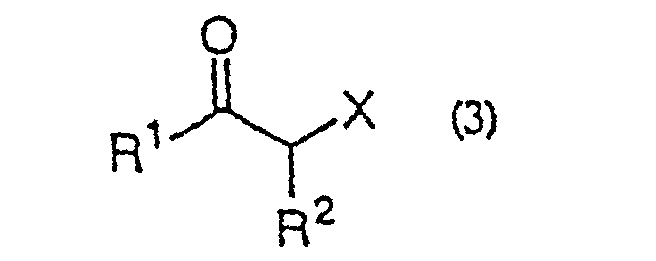
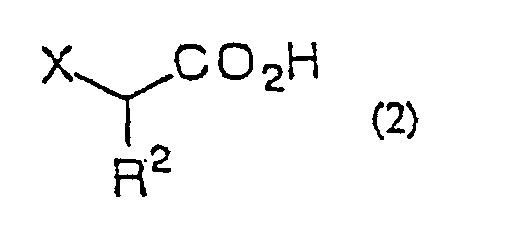
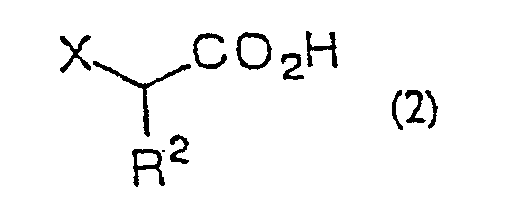
- the present invention is directed to a process for producing an ⁇ -halo ketone of general formula (3) (wherein R 1 represents alkyl, aralkyl or aryl; R 2 represents hydrogen, alkyl, aralkyl or aryl; X represents halogen) which comprises reacting a carboxylic acid derivative of the general formula (1) R 1 COA (wherein R 1 are as defined above; A represents a leaving group), or a carboxylic acid ester of the general formula (4) R 1 CO 2 R 3 (wherein R 1 and R 3 independently represent alkyl, aralkyl or aryl) with a metal enolate prepared from an ⁇ -haloacetic acid of the general formula (2) (wherein R 2 and X are as defined above) R 2 represents hydrogen, alkyl, aralkyl or aryl; X represents halogen) or an acceptable salt thereof and decarboxylating the reaction product in situ; a process for producing an ⁇ -halohydrin of the general formula (3)
- reaction schema of the invention is presented below.
- ⁇ -halohydrins and epoxides originating from L-phenylalanine which are obtainable with advantage in accordance with the production technology of the present invention, can for example be derivatized to HIV protease inhibitors as reported by Kevin E. B. Parkes et al. (J. Org. Chem., 59 , 3656, 1994).
- A is a group known to be capable of leaving and also forming a reactive carboxylic acid derivative in the form of COA, thus including but being not limited to alkoxy groups such as methoxy, ethoxy, etc., alkoxycarbonyl groups such as methoxycarbonyl, ethoxycarbonyl, etc., groups forming metal salts of carboxylic acids, such as OLi, ONa, etc., and halogen atoms such as Cl, Br and the like.
- R 1 represents, each as optionally substituted, straight-chain or branched alkyl of 1 to 30 carbon atoms, aryl of 6 to 35 carbon atoms, or aralkyl of 7 to 36 carbon atoms, thus including but being not limited to CH 3 -, CH 3 (CH 2 )n- (where n represents an integer of 1 to 29), (CH 3 ) 2 -CH-, (CH 3 ) 3 C(CH 2 )-, (CH 3 ) 2 CH(CH 2 ) 2 -, Ph- (where Ph represents phenyl), and Ph(CH 2 )m- (where m represents an integer of 1 to 9).
- R 2 represents hydrogen, alkyl of 1 to 5 carbon atoms, aryl of 6 to 10 carbon atoms, or aralkyl of 7 to 11 carbon atoms, and is preferably hydrogen.
- R 3 represents, each as optionally substituted, straight-chain or branched alkyl of 1 to 10 carbon atoms, aryl of 6 to 15 carbon atoms, or aralkyl of 7 to 21 carbon atoms, thus including but being not limited to methyl, ethyl, n-propyl, isopropyl, n-butyl, phenyl, benzyl, ⁇ -methylbenzyl, and phenylpropyl. Particularly preferred are methyl and ethyl.
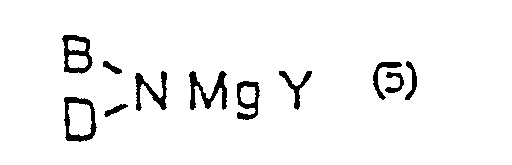
- a preferred example of the metal enolate mentioned above is a magnesium enolate prepared by reacting a magnesium amide of the general formula (5) (wherein B and D independently represents alkyl, aralkyl, aryl or silyl or, taken together, represent cycloalkyl; Y represents or halogen) with an ⁇ -haloacetic acid of the general formula (2) or an acceptable salt thereof; and a magnesium enolate prepared by reacting a Grignard reagent of the general formula (6) R 4 MgZ (wherein R 4 represents alkyl, aralkyl, or aryl; Z represents halogen or R 4 ) and an ⁇ -haloacetic acid of the general formula (2) or an acceptable-salt thereof.
- metal enolate means the anionic active species formed by the reaction between an ⁇ -haloacetic acid such as monochloroacetic acid or a salt thereof and a base such as chloromagnesium diisopropylamide.
- Mg enolate means the anionic active species formed by the reaction between an ⁇ -haloacetic acid or a salt thereof and an Mg base such as chloromagnesium diisopropylamide or t-butylmagnesiumamide.
- B and D independently represent straight-chain or branched alkyl of 1 to 10 carbon atoms, aryl of 6 to 15 carbon atoms, aralkyl of 7 to 21 carbon atoms, or silyl of 3 to 10 carbon atoms, thus including but being not limited to isopropyl, methyl, ethyl, phenyl, benzyl, trimethylsilyl, and, taken together, cyclohexyl. Particularly preferred are cases in which both B and D represent isopropyl, both B and D represent trimethylsilyl, and B and D, taken together, represent cyclohexyl.
- R 4 represents straight-chain or branched alkyl of 1 to 10 carbon atoms, aryl of 6 to 15 carbon atoms, or aralkyl of 7 to 21 carbon atoms, including but being not limited to t-butyl, t-amyl, isopropyl, sec-butyl, methyl, ethyl, benzyl, and phenyl. Particularly preferred are quaternary or tertiary alkyl groups such as t-butyl, t-amyl, isopropyl, and sec-butyl.
- R 5 represents hydrogen or, each as optionally substituted by a hetero-atom, straight-chain or branched alkyl of 1 to 20 carbon atoms, aryl of 6 to 25 carbon atoms, or aralkyl of 7 to 26 carbon atoms, and is typically the side chain of a common amino acid or the side chain of an amino acid derivative obtained by modifying a common amino acid.
- methyl, ethyl, isopropyl, t-butyl, hydroxymethyl, 1-hydroxyethyl, mercaptomethyl, methylthiomethyl, phenylthiomethyl, phenyl, p-methoxyphenyl, p-hydroxyphenyl, benzyl, p-methoxybenzyl, etc. can be mentioned.
- P 1 and P 2 both referred to above, independently represent hydrogen or an amino-protecting group.
- the amino-protecting group is not particularly limited but can be any protecting group that is conventionally used for masking an amino group, thus including the species described in inter alia Protective Groups in Organic Synthesis, 2nd Ed. (authored by Theodora W. Green and published by John Wiley & Sons, 1990) on pages 309 to 384.
- methoxycarbonyl, t-butoxycarbonyl, benzyloxycarbonyl, ethoxycarbonyl, acetyl, trifluoroacetyl, benzyl, dibenzyl, phthalimido, tosyl, benzoyl, etc. can be mentioned.
- X represents halogen and specifically includes Cl, Br, I, and F. Particularly preferred is Cl.
- Y, Z and W each may represent halogen, in which case it can be Cl, Br, I or F.
- the acceptable salt of ⁇ -haloacetic acid mentioned above includes the sodium salt, magnesium salt, lithium salt, potassium salt, zinc salt, calcium salt, copper salt, trimethylsilyl salt, ammonium salt, etc. These salts may be prepared in the reaction system for use as they are or be previously prepared.
- ⁇ -haloacetic acid of general formula (2) or of said acceptable salt thereof there can be mentioned monochloroacetic acid, monobromoacetic acid, monofluoroacetic acid, sodium monochloroacetate, chloromagnesium monochloroacetate, bromomagnesium monochloroacetate, magnesium bis(monochloroacetate), lithium monochloroacetate, potassium monochloroacetate, trimethylsilyl monochloroacetate, monochloropropionic acid and so forth.
- ammonium salts of monochloroacetic acid with ammonia t-butylamine, diethylamine, diisopropylamine, triethylamine, diisopropylethylamine, pyridine, 2,6-lutidine, N,N-dimethylaniline, N-ethylpiperidine, N-methylmorpholine, diazabicyclotriethylenediamine, etc.
- ammonium salts can be mentioned but not limited to the above, the ammonium salts with secondary or tertiary amines are preferred.
- a salt of the ⁇ -haloacetic acid of general formula (2) various processes can be mentioned according to the kinds of salt-forming metals.
- a metal salt such as magnesium chloride, calcium chloride, zinc chloride or aluminum chloride
- the corresponding metal salt can be obtained.
- an ⁇ -haloacetic acid such as monochloroacetic acid with said amines, respectively, in a suitable solvent
- ammonium salts can be obtained.
- the metal enolate mentioned above is produced by treating a haloacetic acid with 2 or more molar equivalents of a base or treating a previously prepared acceptable salt of the ⁇ -haloacetic acid with a base.
- the base that can be used for this purpose includes magnesium amides such as chloromagnesium diisopropylamide, bromomagnesium diisopropylamide, magnesium bis(diisopropyl)amide, chloromagnesium dicyclohexylamide, chloromagnesium t-butylamide, chloromagnesium hexamethyldisilazide, etc.; alkylmagnesium compounds such as t-butylmagnesium chloride, t-butylmagnesium bromide, t-amylmagnesium chloride, di-t-butylmagnesium, isopropylaminomagnesium chloride, etc.; organolithium compounds such as lithium diisopropylamide, lithium hexamethyldisilazide, lithium cyclohexylamide, n-butyl lithium, t-butyllithium, etc.; potassium t-butoxide, sodium hydride, magnesium ethoxide
- the amount of said base in case said acceptable salt of ⁇ -haloacetic acid is prepared in situ, is 2 to 6 molar equivalents, preferably 2 to 3 molar equivalents, based on the ⁇ -haloacetic acid.
- said acceptable salt of ⁇ -haloacetic acid is prepared beforehand, the base is used in a proportion of 1 to 3 molar equivalents, preferably 1 to 1.5 molar equivalents, based on the ⁇ -haloacetic acid.
- the amine that can be used for this purpose is usually a secondary amine or a tertiary amine, and is preferably a tertiary amine.
- the amine includes but is not limited to diisopropylamine, triethylamine, diisopropylethylamine, pyridine, 2,6-lutidine, N,N-dimethylaniline, N-ethylpyperidine, N-methylmorpholine, and diazabicyclotriethylenediamine.
- the amount of the amine is used in a proportion of preferably 0.01 to 10 molar equivalents and more preferably 0.1 to 6 molar equivalents based on the carboxylic acid derivative of general formula (1) or (8), particularly the ester of general formula (4) or (10). These amines can be added previously to the reaction system or added with the progress of reaction.
- the reaction solvent that can be used includes tetrahydrofuran, t-butyl methyl ether, diethyl ether, 1,2-dimethoxyethane, N,N-dimethylformamide, N-methylpyrrolidone, 1,3-dimethyl-2-imidazolidinone, and toluene, among others. These solvents are used singly or in combination.
- the enolate of the salt of a haloacetic acid can be prepared by treating the ⁇ -haloacetic acid or a salt thereof with above-mentioned molar equivalent of said base in said solvent at -70°C to 40°C, preferably -50°C to 20°C, and more preferably -30 °C to 0 °C and stirring the mixture for 10 minutes to 20 hours, preferably 30 minutes to 5 hours.
- the ⁇ -haloacetate enolate anion of the salt of an ⁇ -haloacetic acid generated in this manner is allowed to react with a carboxylic acid derivative of general formula (1) or (8), particularly an ester of general formula (4) or (10) to give the objective ⁇ -halo ketone through decarboxylation in situ.
- the term in situ means any stage of the course from the beginning of mixing of the reactants to the end of after-treatment.
- the proportion of the ⁇ -haloacetic acid or salt thereof to the carboxylic acid derivative or ester is 1 to 4 equivalents, preferably 1 to 3 equivalents.
- the above reaction can be carried out typically by adding said carboxylic acid derivative or ester or a solution thereof in a reaction solvent to the enolate anion solution prepared as above at -70 °C to 40 °C, preferably -50 °C to 30 °C, more preferably -30 °C to 20 °C and stirring the mixture for 10 minutes to 20 hours, preferably 30 minutes to 10 hours.
- N atom can be previously protected with e.g. a trimethylsilyl group by reacting the substrate compound with a silylating agent, e.g. trimethylsilyl chloride, in the presence of a base, or submitted to the reaction without prior protection.
- a silylating agent e.g. trimethylsilyl chloride
- the reaction solvent mentioned above can be used as the solvent.
- the after-treatment following the reaction may typically comprise the following procedure. After the above reaction time, the reaction is stopped by adding diluted hydrochloric acid, an aqueous solution of ammonium chloride, or the like and the reaction mixture is extracted with a solvent such as ethyl acetate, diethyl ether, toluene or the like. The extract is washed with saturated NaHCO 3 solution, saturated NaCl solution, etc. and dehydrated over a desiccant such as anhydrous sodium sulfate or magnesium sulfate. After the desiccant is filtered off, the filtrate is concentrated and purified by conventional means known to those skilled in the art, such as recrystallization or column chromatography, to provide the ⁇ -halo ketone of general formula (3) or general formula (9).
- a solvent such as ethyl acetate, diethyl ether, toluene or the like.
- the extract is washed with saturated NaHCO 3 solution, saturated NaCl solution
- sodium borohydride can be used with advantage. Its amount is 1 to 10 molar equivalents, preferably 2 to 5 molar equivalents, based on the ⁇ -halo ketone.
- the reaction solvent that can be used includes lower alcohols such as methanol, ethanol, etc., water, toluene, ethyl acetate, and tetrahydrofuran, among others. These solvents can be used singly or as a mixture.
- the reaction is carried out under stirring at -10 °C to 40 °C , preferably -10 °C to 10 °C, for 10 to 20 minutes, preferably 30 to 60 minutes.
- the after-treatment following the reaction may typically comprise the following procedure. After the above reaction time, the reaction is stopped by adding diluted hydrochloric acid, an aqueous solution of ammonium chloride, or the like and the reaction mixture is extracted with a solvent such as ethyl acetate, diethyl ether, toluene or the like. The extract is washed with saturated NaHCO 3 solution, saturated NaCl solution, etc.
- the ⁇ -halohydrin of general formula (11) or general formula (12) is treated with a base to provide the epoxide of general formula (13) or general formula (14).
- the preferred base for use in this step includes sodium hydroxide, potassium hydroxide, sodium methoxide, sodium ethoxide, potassium t-butoxide, and sodium hydride, among others.
- the amount of the base relative to the ⁇ -halohydrin is 1 to 10 molar equivalents, preferably 1 to 4 molar equivalents.
- As the reaction solvent lower alcohols such as methanol, ethanol, etc., water, toluene, acetone, tetrahydrofuran, etc. can be used singly or in combination.
- This reaction is carried out by treating the ⁇ -halohydrin with said base at -10 °C to 80°C, preferably 0°C to 40°C, for 10 to 180 minutes, preferably 30 to 60 minutes.
- the reaction is stopped by adding diluted hydrochloric acid, an aqueous solution of ammonium chloride or the like and the reaction mixture is extracted with a solvent such as ethyl acetate, diethyl ether or toluene.
- a solvent such as ethyl acetate, diethyl ether or toluene.
- the extract is washed with saturated aqueous NaHCO 3 solution, saturated aqueous NaCl solution, etc. and dried over a desiccant such as anhydrous sodium sulfate or anhydrous magnesium sulfate. After the desiccant is filtered off, the filtrate is concentrated to provide the epoxide.
- diisopropylamine (2.42 g, 24.0 mmol) was dissolved in tetrahydrofuran (20 mL) and the solution was cooled to 0°C .
- n-butyllithium (1.6 M/hexane, 13.8 mL, 22.0 mmol) and the mixture was stirred for 10 minutes.
- monochloroacetic acid (0.946 g, 10.0 mmol) was added and the mixture was stirred for 30 minutes.
- ethyl benzoate 0.514 g, 3.33 mmol
- Examples 2 to 7 were carried out in substantially the same manner as Example 1 using the following reaction temperature and time.
- diisopropylamine (0.668 g) was added to 6.67 mL of 0.9 M n-butylmagnesium chloride/tetrahydrofuran (6 mmol). The mixture was stirred at room temperature for 4 hours, after which it was cooled to 0 °C. Then, a solution of 284 mg (3.0 mmol) of monochloroacetic acid and 136 mg (1 mmol) of methyl benzoate in 5 mL of tetrahydrofuran was added portionwise for 5 minutes. This mixture was stirred at 0 °C for 30 minutes and, while the temperature was allowed to rise to room temperature, further stirred for 30 minutes.
- diisopropylamine (2.42 g, 24.0 mmol) was dissolved in tetrahydrofuran (20 mL) and the solution was cooled to 0°C. Then, n-butyllithium (1.6 M/hexane, 13.8 mL, 22.0 mmol) was added and the mixture was stirred for 10 minutes. After the mixture was cooled to -30 °C , monochloroacetic acid (0.946 g, 10.0 mmol) was added and the mixture was further stirred for 30 minutes.
- L-N-(methoxycarbonyl)phenylalanine methyl ester (purity 83.0%, 0.950 g, 3.33 mmol) was dissolved in tetrahydrofuran (10 mL) under the atomosphere of nitrogen gas and, after addition of n-butyllithium (1.6 M/hexane, 2.1 mL, 3.33 mmol) at -78 °C, the mixture was further stirred for 10 minutes. To this mixture was added trimethylsilyl chloride (0.363 g, 3.33 mmol) and the temperature of the mixture was allowed to rise to room temperature for 30 minutes.
- This solution was added gradually to the above lithium diisopropylamide solution cooled at -30 °C beforehand and the reaction was conducted at -30 °C for 30 minutes. Then, while the temperature of the reaction mixture was allowed to rise to room temperature, the reaction was further carried out for 30 minutes.
- This reaction mixture was poured in 1N-HCl (50 mL) and extracted with ethyl acetate (50 mL x 2). The extract was washed with saturated aqueous NaHCO 3 solution (50 mL x 1) and water (30 mL x 1) in that order and dried over anhydrous magnesium sulfate. After filtration, the filtrate was concentrated to provide light-yellow crystals (0.888 g).
- diisopropylamine (4.90 g, 48.4 mmol) was dissolved in tetrahydrofuran (50 mL) and the solution was cooled to 0°C. To this solution was added n-butyllithium (1.66 M/hexane, 26.5 mL, 44 mmol) and the mixture was stirred for 10 minutes. After cooling to -30°C, a solution of monochloroacetic acid (1.89 g, 20.0 mmol) in tetrahydrofuran (10 mL) was added and the mixture was stirred for 30 minutes.
- diisopropylamine (0.668 g) was added to 6.67 mL of 0.9 M n-butylmagnesium chloride/tetrahydrofuran (6 mmol) and the mixture was stirred at 0°C for 10 minutes. Then, a solution of 284 mg (3.0 mmol) of monochloroacetic acid and 201 mg (0.75 mmol) of L-N-(methoxycarbonyl)phenylalanine methyl ester (purity 88.0%) in 5 mL of tetrahydrofuran was added for 5 minutes and while the temperature was allowed to rise to room temperature, the mixture was stirred for 1 hour.
- This reaction mixture was poured in 1N-HCl (30 mL) and extracted with ethyl acetate (30 mL x 2). The extract was washed with saturated aqueous NaHCO 3 solution (50 mL x 1) and saturated aqueous NaCl solution (50 mL x 1) in that order and dried over anhydrous magnesium sulfate. After filtration, the filtrate was concentrated to provide light-yellow crystals (0.253 g).
- diisopropylamine (3.68 g, 37 mmol) was dissolved in tetrahydrofuran (40 ml) and the solution was cooled to 0°C.
- n-butyllithium (1.6 M/hexane, 30 mL, 48 mmol) and the mixture was stirred for 10 minutes.
- monochloroacetic acid (2.25 g, 23.8 mmol) was added and the mixture was stirred for 30 minutes.
- L-N-(t-butoxycarbonyl)phenylalanine methyl ester (purity 87.0%, 1.61 g, 5 mmol) was dissolved in tetrahydrofuran (10 mL) under the atomosphere of nitrogen gas and, after addition of n-butyllithium (1.6 M/hexane, 3.17 mL, 5 mmol) at -78 °C, the mixture was further stirred for 10 minutes. To this mixture was added trimethylsilyl chloride (0.545 g, 5 mmol) and the temperature of the mixture was allowed to rise to room temperature for 30 minutes.
- This solution was added gradually to the above lithium diisopropylamide solution cooled at -30 °C beforehand and the reaction was conducted at -30 °C for 30 minutes. Then, while the temperature of the reaction mixture was allowed to rise to room temperature, the reaction-was further carried out for 60 minutes.
- This reaction mixture was poured in saturated aqueous NH 4 Cl solution (50 mL) and extracted with ethyl acetate (50 mL x 2). The extract was washed with saturated aqueous NaHCO 3 solution (50 mL x 1) and water (50 mL x 1) in that order and dried over anhydrous magnesium sulfate. After filtration, the filtrate was concentrated to provide light-yellow crystals (2.062 g).
- diisopropylamine 44.52 g, 440 mmol
- n-butylmagnesium chloride 2.5 mol/kg solution, 159.7 g, 400 mmol
- tetrahydrofuran 12.8 ml
- solution B tetrahydrofuran
- this solution B was added to the above solution A for about 30 minutes.
- the internal temperature was increased to 40°C and the mixture was further stirred for 2 hours.
- a solution of 35% HCl (91.7 g) and water (200 ml) was stirred for 30 minutes for hydrolysis.
- t-butyl magnesium chloride (2M/L THF, 30.0 ml, 60 mmol) was added to a solution of L-N-(methoxycarbonyl)phenylalanine methyl ester (2.37 g, 10 mmol), sodium monochloroacetate (1.74 g, 15 mmol) and triethylamine (1.52 g, 15 mmol) in tetrahydrofuran (40 ml) for about 3 hours at an internal temperature not exceeding 10 °C. After completion of this addition, the internal temperature was increased to 20°C and the mixture was further stirred for 2 hours.
- this solution B was added to the above solution A followed by addition of a solution of L-N-(methoxycarbony)phenylalanine methyl ester (404 mg, 1.71 mmol) in tetrahydrofuran (5 ml) at 0 to 5 °C. After completion of this addition, the mixture was stirred at 0°C through room temperature for 1 hour and then refluxed for 30 minutes. To this reaction mixture was added 1N-HCl (30 ml) and the mixture was stirred for 30 minutes for hydrolysis.
- t-butylmagnesium chloride (2M/L THF, 30.0 ml, 60 mmol) was added to a solution of L-N-(methoxycarbonyl)phenylalanine methyl ester (2.37 g, 10 mmol), sodium monochloroacetate (1.74 g, 15 mmol) and 2,6-lutidine (3.21 g, 30 mmol) in tetrahydrofuran (40 ml) for about 3 hours at an internal temperature not exceeding 10 °C .
- t-butylmagnesium chloride (2M/L THF, 20.0 ml, 40 mmol) was added to a solution of L-N-(methoxycarbonyl)phenylalanine methyl ester (2.37 g, 10 mmol), sodium monochloroacetate (1.74 g, 15 mmol) and 2,6-lutidine (3.21 g, 30 mmol) in tetrahydrofuran (4 ml) for about 3 hours at an internal temperature not exceeding 10°C. After completion of this addition, the internal temperature was increased to 20°C and the mixture was further stirred for 2 hours.
- t-butylmagnesium chloride (2M/L THF, 20.0 ml, 40 mmol) was added to a solution of L-N-(methoxycarbonyl)phenylalanine methyl ester (474 mg, 2 mmol) in tetrahydrofuran (1 ml) dropwise for about 15 minutes at an internal temperature of about 20 °C with stirring.
- a solution of monochloroacetic acid (284 mg, 3 mmol) and triethylamine (610 mg, 12 mmol) in tetrahydrofuran (2 ml) dropwise for about 15 minutes at an internal temperature of about 20 °C with stirring.
- diisopropylamine (9.92 g, 88 mmol) was added to a solution of n-butylmagnesium chloride (2.5 mol/kg, 31.6 g, 80 mmol) in tetrahydrofuran (10 ml) for 30 minutes at 40°C and the mixture was further stirred at 40°C for 2 hours (solution B).
- solution B At an internal temperature of 10 °C to 15 °C , this solution B was added to the above solution A for about 30 minutes. After completion of this addition, the internal temperature was increased to 40°C and the mixture was further stirred for 1.5 hours.
- diisopropylamine (31.9 g, 315 mmol) was added to a solution of n-butylmagnesium chloride (2.5 mol/kg, 115 g, 286.4 mmol) in tetrahydrofuran (9.2 ml) for 30 minutes at 40°C and the mixture was further stirred at 40°C for 2 hours (solution B).
- this solution B was added to the above solution A for about 30 minutes. After completion of this addition, the internal temperature was increased to 40 °C and the mixture was further stirred for 2 hours. To this reaction mixture was added a solution consisting of 60% sulfuric acid (45.0 g) and water (170 ml) and the mixture was stirred for 30 minutes for hydrolysis. The organic phase was separated and washed with 5% aqueous NaHCO 3 solution (90 ml) and 5% aqueous sodium sulfate solution (90 ml) in that order. The organic phase was then concentrated under reduced pressure to provide a light-yellow solid (20.5 g).
- This mixture was further stirred at an internal temperatue of about 10 °C for 30 minutes, and, then, concentrated sulfuric acid (8.23 g)/water (500 ml) was added at an internal temperature of 12 to 17 °C .
- the mixtue was adjusted to pH about 6.5 with 30% sodium hydroxide, warmed to 50°C, and stirred for 30 minutes at that temperature.
- the mixture was cooled to about 10 °C and stirred at that temperautre for 1 hour.
- diisopropylamine (2.35 g, 23.2 mmol) was added to n-butylmagnesium chloride (2.0 mol/L THF, 11.6 ml, 23.2 mmol) for 30 minutes at room temperature and the mixture was stirred at 70°C for 30 minutes (solution B). At an internal temperature of about 5°C, this solution B was added to the above solution A for about 15 minutes. After completion of this addition, the internal temperature was increased to 70 °C and the mixture was further stirred for 30 minutes.
- ⁇ -halo ketones, ⁇ -halohydrins and epoxides can be produced effectively from carboxylic acid derivatives such as esters through the use of an ⁇ -haloacetic acid on an industrial scale as described above, optically active ⁇ -halo ketones, ⁇ -halohydrins and epoxides can be produced from the corresponding optically active N-protected phenylalanine esters so that the present invention can provide useful intermediates for the production of medicines.
Landscapes
- Chemical & Material Sciences (AREA)
- Organic Chemistry (AREA)
- Chemical Kinetics & Catalysis (AREA)
- Organic Low-Molecular-Weight Compounds And Preparation Thereof (AREA)
- Epoxy Compounds (AREA)
Claims (55)
- Procédé de production d'une α-halogénocétone de formule générale (3) :(dans laquelle R1 représente un groupe alkyle, aralkyle ou aryle ; R2 représente un hydrogène ou un groupe alkyle, aralkyle ou aryle ; X représente un halogène) qui comporte la réaction d'un dérivé d'acide carboxylique de formule générale (1) :
 (dans laquelle R2 et X sont tels que définis ci-dessus) ou d'un de ses sels acceptables et la décarboxylation du produit réactionnel in situ.
- Procédé de production d'une α-halogénocétone de formule générale (3) :(dans laquelle R1 représente un groupe alkyle, aralkyle ou aryle ; R2 représente un hydrogène ou un groupe alkyle, aralkyle ou aryle ; X représente un halogène) qui comporte la réaction d'un ester d'acide carboxylique de formule générale (4) :
 (dans laquelle R2 et X sont tels que définis ci-dessus) ou d'un de ses sels acceptables et la décarboxylation du produit réactionnel in situ.
- Procédé de production d'une α-halogénocétone selon la revendication 1 dans lequel l'énolate de métal préparé à partir d'un acide α-halogénoacétique ou d'un de ses sels acceptables est un énolate de magnésium.
- Procédé de production d'une α-halogénocétone selon la revendication 3 dans lequel l'énolate de magnésium est préparé en faisant réagir un amidure de magnésium de formule générale (5) :(dans laquelle B et D représentent indépendamment un groupe alkyle, aralkyle, aryle ou silyle ou, pris ensemble, représentent un groupe cycloalkyle ; Y représente :
 ou un halogène) avec un acide α-halogénoacétique de formule générale (2) :
 (dans laquelle R2 représente un hydrogène ou un groupe alkyle, aralkyle ou aryle ; X représente un halogène) ou un de ses sels acceptables.
- Procédé de production d'une α-halogénocétone selon la revendication 4 dans lequel le composé de formule générale (5) est le diisopropylamidure de chloromagnésium.
- Procédé de production d'une α-halogénocétone selon la revendication 3 dans lequel l'énolate de magnésium est préparé en faisant réagir un réactif de Grignard de formule générale (6) :(dans laquelle R2 représente un hydrogène ou un groupe alkyle, aralkyle ou aryle ; X représente un halogène) ou un de ses sels acceptables.

- Procédé de production d'une α-halogénocétone selon la revendication 6 dans lequel le composé de formule générale (6) est le chlorure de t-butyl-magnésium.
- Procédé de production d'une α-halogénocétone selon la revendication 6 ou 7 dans lequel la réaction est conduite en présence d'une amine.
- Procédé de production d'une α-halogénocétone selon la revendication 8 dans lequel l'amine est une amine secondaire ou une amine tertiaire.
- Procédé de production d'une α-halogénocétone selon la revendication 1, 2, 3, 4, 5, 6, 7, 8 ou 9 dans lequel le sel acceptable d'un acide α-halogénoacétique est un sel de sodium d'un acide α-halogénoacétique.
- Procédé de production d'une α-halogénocétone selon la revendication 1, 2, 3, 4, 5, 6, 7, 8 ou 9 dans lequel le sel acceptable d'un acide α-halogénoacétique est un sel de magnésium d'un acide α-halogénoacétique de formule générale (7) :(dans laquelle R2 est tel que défini précédemment ; W représente un halogène ou


- Procédé de production d'une α-halogénocétone selon la revendication 11 dans lequel le sel de magnésium d'un acide α-halogénoacétique est un sel préparé à partir d'un sel de sodium d'acide α-halogénoacétique et d'un halogénure de magnésium ou de sulfate de magnésium.
- Procédé de production d'une α-halogénocétone selon la revendication 11 dans lequel le sel de magnésium d'un acide α-halogénoacétique est un sel préparé à partir d'un acide α-halogénoacétique et de magnésium métallique.
- Procédé de production d'une α-halogénocétone selon la revendication 1, 2, 3, 4, 5, 6, 7, 8, 9, 10, 11 ou 12 dans lequel l'acide α-halogénoacétique est un acide monochloroacétique.
- Procédé de production d'une α-halogénocétone selon la revendication 1, 2, 3, 4, 5, 6, 7, 8, 9 ou 10 dans lequel le sel acceptable d'un acide α-halogénoacétique est un sel d'ammonium de l'acide α-halogénoacétique.
- Procédé de production d'une α-halogénocétone selon la revendication 1 ou 2 dans lequel l'énolate de métal formé à partir d'un acide α-halogénoacétique ou d'un de ses sels acceptables est un dianion lithium d'un acide monochloroacétique.
- Procédé de production d'une α-halogénocétone selon la revendication 1 ou 2 dans lequel l'énolate de métal formé à partir d'un acide α-halogénoacétique ou d'un de ses sels acceptables est un dianion magnésium d'un acide monochloroacétique.
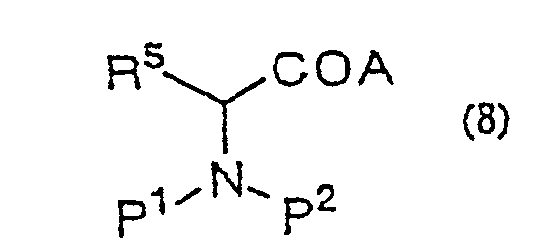
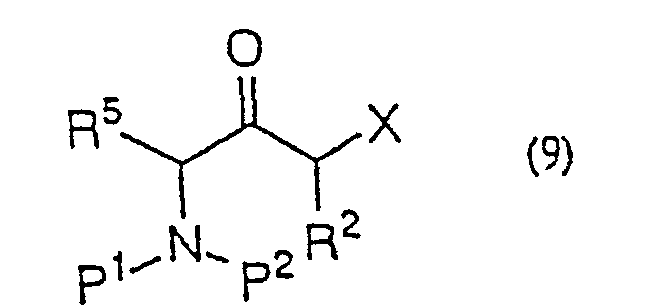
- Procédé de production d'une α-halogénocétone de formule générale (9) :(dans laquelle R2 représente un hydrogène ou un groupe alkyle, aralkyle ou aryle ; R5 représente un hydrogène ou un groupe alkyle, aralkyle ou aryle ; P1 et P2 représentent indépendamment un hydrogène ou un groupe amino-protecteur ou, pris ensemble, représentent un groupe phtaloyle ; X représente un halogène) qui comporte la réaction d'un dérivé d'acide aminé de formule générale (8) :
 (dans laquelle R5, P1 et P2 sont tels que définis ci-dessus ; A représente un groupe partant) avec un énolate de métal préparé à partir d'un acide α-halogénoacétique de formule générale (2)
 (dans laquelle R2 et X sont tels que définis ci-dessus) ou d'un de ses sels acceptables et la décarboxylation du produit réactionnel in situ.
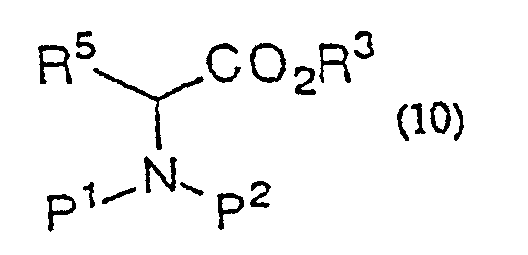
- Procédé de production d'une α-halogénocétone de formule générale (9) :(dans laquelle R2 représente un hydrogène ou un groupe alkyle, aralkyle ou aryle ; R5 représente un hydrogène ou un groupe alkyle, aralkyle ou aryle ; P1 et P2 représentent indépendamment un hydrogène ou un groupe amino-protecteur ou, pris ensemble, représentent un groupe phtaloyle ; X représente un halogène) qui comporte la réaction d'un dérivé ester d'acide aminé de formule générale (10)
 (dans laquelle R3 représente un groupe alkyle, aralkyle ou aryle ; R5, P1 et P2 sont tels que définis ci-dessus) avec un énolate de métal préparé à partir d'un acide α-halogénoacétique de formule générale (2)
 (dans laquelle R2 et X sont tels que définis ci-dessus) ou d'un de ses sels acceptables et la décarboxylation du produit réactionnel in situ.
- Procédé de production d'une α-halogénocétone selon la revendication 19 dans lequel le dérivé ester d'acide aminé est un dérivé ester d'acide aminé L optiquement actif ou un dérivé ester d'acide aminé D optiquement actif
- Procédé de production d'une α-halogénocétone selon la revendication 20 dans lequel le dérivé ester d'acide aminé est un dérivé ester de L-phénylalanine optiquement actif ou un dérivé ester de D-phénylalanine optiquement actif.
- Procédé de production d'une α-halogénocétone selon la revendication 21 dans lequel le dérivé ester de L-phénylalanine optiquement actif ou le dérivé ester de D-phénylalanine optiquement actif est un dérivé choisi dans le groupe constitué d'un ester de L-phénylalanine protégé par un groupe t-butoxycarbonyle, d'un ester de L-phénylalanine protégé par un groupe benzyloxycarbonyle, d'un ester de L-phénylalanine protégé par un groupe méthoxycarbonyle, et d'un ester de L-phénylalanine protégé par un groupe éthoxycarbonyle.
- Procédé de production d'une α-halogénocétone selon la revendication 18, 19, 20, 21 ou 22 dans lequel l'énolate de métal préparé à partir d'un acide α-halogénoacétique ou d'un de ses sels acceptables est un énolate de magnésium.
- Procédé de production d'une α-halogénocétone selon la revendication 23 dans lequel l'énolate de magnésium est préparé en faisant réagir un amidure de magnésium de formule générale (5) :(dans laquelle B et D représentent indépendamment un groupe alkyle, aralkyle, aryle ou silyle ou, pris ensemble, représentent un groupe cycloalkyle ; Y représente :
 ou un halogène) avec un acide α-halogénoacétique de formule générale (2) :
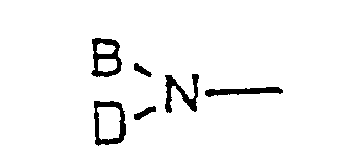 (dans laquelle R2 représente un hydrogène ou un groupe alkyle, aralkyle ou aryle ; X représente un halogène) ou un de ses sels acceptables.
- Procédé de production d'une α-halogénocétone selon la revendication 24 dans lequel le composé de formule générale (5) est le diisopropylamidure de chloromagnésium.
- Procédé de production d'une α-halogénocétone selon la revendication 23 dans lequel l'énolate de magnésium est préparé en faisant réagir un composé réactif de Grignard de formule générale (6) :(dans laquelle R2 représente un hydrogène ou un groupe alkyle, aralkyle ou aryle ; X représente un halogène) ou un de ses sels acceptables.
- Procédé de production d'une α-halogénocétone selon la revendication 26 dans lequel le composé de formule générale (6) est le chlorure de t-butyl-magnésium.
- Procédé de production d'une α-halogénocétone selon la revendication 26 ou 27 dans lequel la réaction est conduite en présence d'une amine.
- Procédé de production d'une α-halogénocétone selon la revendication 28 dans lequel l'amine est une amine secondaire ou une amine tertiaire.
- Procédé de production d'une α-halogénocétone selon la revendication 18, 19, 20, 21, 22, 23, 24, 25, 26, 27, 28 ou 29 dans lequel le sel acceptable d'un acide α-halogénoacétique est le monochloroacétate de sodium.
- Procédé de production d'une α-halogénocétone selon la revendication 18, 19, 20, 21, 22, 23, 24, 25, 26, 27, 28 ou 29 dans lequel le sel acceptable d'un acide α-halogénoacétique est un sel de magnésium d'un acide α-halogénoacétique de formule générale (7) :(dans laquelle R2 est tel que défini précédemment ; W représente un halogène ou
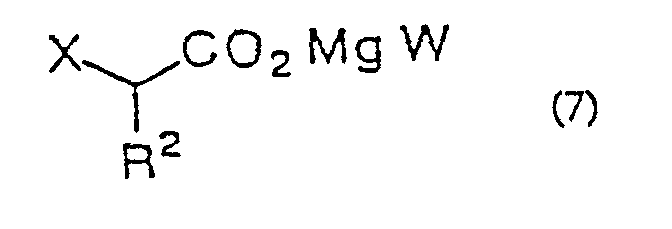

- Procédé de production d'une α-halogénocétone selon la revendication 31 dans lequel le sel de magnésium d'un acide α-halogénoacétique est un sel préparé à partir d'un sel de sodium d'acide α-halogénoacétique et soit d'un halogénure de magnésium soit de sulfate de magnésium.
- Procédé de production d'une α-halogénocétone selon la revendication 31 dans lequel le sel de magnésium d'un acide α-halogénoacétique est un sel préparé à partir d'un acide α-halogénoacétique et de magnésium métallique.
- Procédé de production d'une α-halogénocétone selon la revendication 18, 19, 20, 21, 22, 23, 24, 25, 26, 27, 28, 29, 30, 31, 32 ou 33 dans lequel l'acide α-halogénoacétique est l'acide monochloroacétique.
- Procédé de production d'une α-halogénocétone selon la revendication 18, 19, 20, 21, 22, 23, 24, 25, 26, 27, 28 ou 29 dans lequel le sel acceptable d'un acide α-halogénoacétique est un sel d'ammonium d'un acide α-halogénoacétique.
- Procédé de production d'une α-halogénocétone selon la revendication 18 ou 19 dans lequel l'énolate de métal formé à partir d'un acide α-halogénoacétique ou d'un de ses sels acceptables est un dianion magnésium d'un acide monochloroacétique.
- Procédé de production d'une α-halogénocétone selon la revendication 18 ou 19 dans lequel l'énolate de métal formé à partir d'un acide α-halogénoacétique ou d'un de ses sels acceptables est un dianion lithium d'un acide monochloroacétique.
- Procédé de production d'une α-halogénohydrine de formule générale (11)(dans laquelle R1 représente un groupe alkyle, aralkyle ou aryle, R2 représente un hydrogène ou un groupe alkyle, aralkyle ou aryle ; X représente un halogène) qui comporte la production d'une α-halogénocétone de formule générale (3) :
 (dans laquelle R1, R2 et X sont tels que définis ci-dessus) par réaction d'un dérivé d'acide carboxylique de formule générale (1) :
 (dans laquelle R2 et X sont tels que définis ci-dessus) ou d'un de ses sels acceptables et décarboxylation du produit réactionnel in situ, ou réaction d'un ester d'acide carboxylique de formule générale (4) :
 (dans laquelle R2 et X sont tels que définis ci-dessus) ou d'un de ses sels acceptables et décarboxylation du produit réactionnel in situ, et la réduction de ladite α-halogénocétone.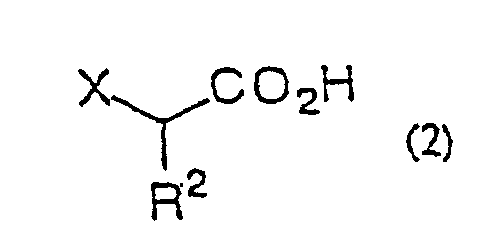
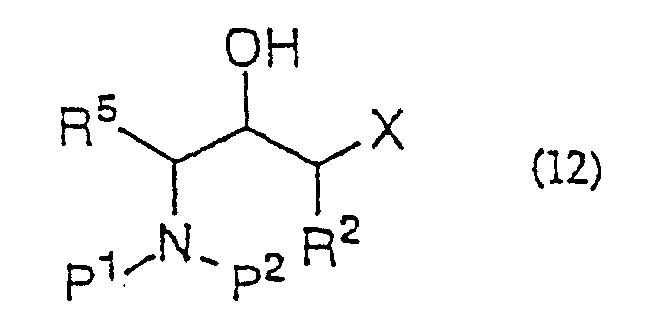
- Procédé de production d'une α-halogénohydrine de formule générale (12):(dans laquelle R2 et R5 représentent indépendamment un hydrogène ou un groupe alkyle, aralkyle ou aryle ; P1 et P2 représentent indépendamment un hydrogène ou un groupe amino-protecteur ou, pris ensemble, représentent un groupe phtaloyle ; X représente un halogène) qui comporte la production d'une α-halogénocétone de formule générale (9) :
 (dans laquelle R2, R5, P1, P2 et X sont tels que définis ci-dessus) par réaction d'un dérivé d'acide aminé de formule générale (8) :
 (dans laquelle R5, P1 et P2 sont tels que définis ci-dessus ; A représente un groupe partant) avec un énolate de métal préparé à partir d'un acide α-halogénoacétique de formule générale (2) :
 (dans laquelle R2 et X sont tels que définis ci-dessus) ou d'un de ses sels acceptables et décarboxylation du produit réactionnel in situ, ou réaction d'un dérivé ester d'acide aminé de formule générale (10) :
 (dans laquelle R3 représente un groupe alkyle, aralkyle ou aryle ; R5, P1 et P2 sont tels que définis ci-dessus) avec un énolate de métal préparé à partir d'un acide α-halogénoacétique de formule générale (2) :
 (dans laquelle R2 et X sont tels que définis ci-dessus) ou d'un de ses sels acceptables et décarboxylation du produit réactionnel in situ, et la réduction de ladite α-halogénocétone.
- Procédé de production d'une α-halogénohydrine selon la revendication 39 dans lequel le dérivé ester d'acide aminé est un dérivé ester d'acide aminé L optiquement actif ou un dérivé ester d'acide aminé D optiquement actif
- Procédé de production d'une α-halogénohydrine selon la revendication 40 dans lequel le dérivé ester d'acide aminé L optiquement actif ou le dérivé ester d'acide aminé D optiquement actif est un dérivé ester de L-phénylalanine optiquement actif ou un dérivé ester de D-phénylalanine optiquement actif.
- Procédé de production d'une α-halogénohydrine selon la revendication 41 dans lequel le dérivé ester d'acide aminé est un dérivé choisi dans le groupe constitué d'un ester de L-phénylalanine protégé par un groupe t-butoxycarbonyle, d'un ester de L-phénylalanine protégé par un groupe benzyloxycarbonyle, d'un ester de L-phénylalanine protégé par un groupe méthoxycarbonyle, d'un ester de L-phénylalanine protégé par un groupe éthoxycarbonyle, d'un ester de D-phénylalanine protégé par un groupe t-butoxycarbonyle, d'un ester de D-phénylalanine protégé par un groupe benzyloxycarbonyle, d'un ester de D-phénylalanine protégé par un groupe méthoxycarbonyle, et d'un ester de D-phénylalanine protégé par un groupe éthoxycarbonyle.
- Procédé de production d'un époxyde de formule générale (13) :(dans laquelle R1 et R2 représentent indépendamment un hydrogène ou un groupe alkyle, aralkyle ou aryle) qui comporte la production d'une α-halogénohydrine de formule générale (11):
 (dans laquelle R1 et R2 sont tels que définis ci-dessus ; X représente un halogène) qui comporte : la production d'une α-halogénocétone de formule générale (3) :
 (dans laquelle R1, R2 et X sont tels que définis ci-dessus) par réaction d'un dérivé d'acide carboxylique de formule générale (1)
 (dans laquelle R2 et X sont tels que définis ci-dessus) ou d'un de ses sels acceptables et décarboxylation du produit réactionnel in situ, ou réaction d'un ester d'acide carboxylique de formule générale (4) :
 (dans laquelle R2 et X sont tels que définis ci-dessus) ou d'un de ses sels acceptables et décarboxylation du produit réactionnel in situ, la réduction de ladite α-halogénocétone, et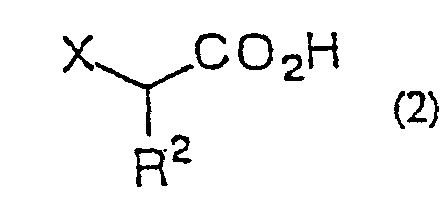
le traitement de l'α-halogénohydrine avec une base. - Procédé de production d'un époxyde de formule générale (14):(dans laquelle R2 et R5 représentent indépendamment un hydrogène ou un groupe alkyle, aralkyle ou aryle ; P1 et P2 représentent indépendamment un hydrogène ou un groupe amino-protecteur ou, pris ensemble, représentent un groupe phtaloyle) qui comporte la production d'une α-halogénohydrine de formule générale (12) :
 (dans laquelle R2, R5, P1 et P2 sont tels que définis ci-dessus ; X représente un halogène) par la production d'une α-halogénocétone de formule générale (9):
 (dans laquelle R2, R5, P1, P2 et X sont tels que définis ci-dessus) par réaction d'un dérivé d'acide aminé de formule générale (8) :
 (dans laquelle R5, P1 et P2 sont tels que définis ci-dessus ; A représente un groupe partant) avec un énolate de métal préparé à partir d'un acide α-halogénoacétique de formule générale (2) :
 (dans laquelle R2 et X sont tels que définis ci-dessus) ou d'un de ses sels acceptables et décarboxylation du produit réactionnel in situ, ou réaction d'un dérivé ester d'acide aminé de formule générale (10):
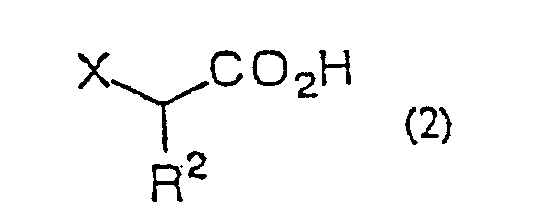 (dans laquelle R3 représente un groupe alkyle, aralkyle ou aryle ; R5, P1 et P2 sont tels que définis ci-dessus) avec un énolate de métal préparé à partir d'un acide α-halogénoacétique de formule générale (2) :
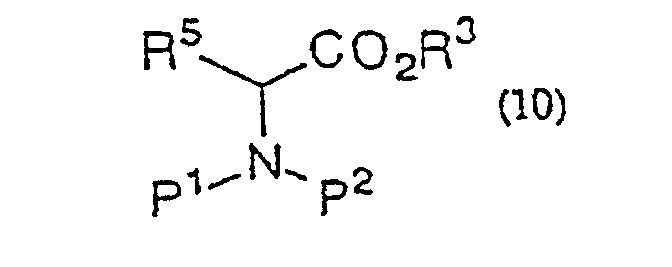 (dans laquelle R2 et X sont tels que définis ci-dessus) ou d'un de ses sels acceptables et décarboxylation du produit réactionnel in situ, la réduction de ladite α-halogénocétone
et le traitement de ladite α-halogénohydrine avec une base. - Procédé de production d'un époxyde selon la revendication 44 dans lequel le dérivé ester d'acide aminé est un dérivé ester d'acide aminé L optiquement actif ou un dérivé ester d'acide aminé D optiquement actif
- Procédé de production d'un époxyde selon la revendication 45 dans lequel le dérivé ester d'acide aminé L optiquement actif ou le dérivé ester d'acide aminé D optiquement actif est un dérivé ester de L-phénylalanine optiquement actif ou un dérivé ester de D-phénylalanine optiquement actif.
- Procédé de production d'un époxyde selon la revendication 45 dans lequel le dérivé ester d'acide aminé est un dérivé choisi dans le groupe constitué d'un ester de L-phénylalanine protégé par un groupe t-butoxycarbonyle, d'un ester de L-phénylalanine protégé par un groupe benzyloxycarbonyle, d'un ester de L-phénylalanine protégé par un groupe méthoxycarbonyle, d'un ester de L-phénylalanine protégé par un groupe éthoxycarbonyle, d'un ester de D-phénylalanine protégé par un groupe t-butoxycarbonyle, d'un ester de D-phénylalanine protégé par un groupe benzyloxycarbonyle, d'un ester de D-phénylalanine protégé par un groupe méthoxycarbonyle, et d'un ester de D-phénylalanine protégé par un groupe éthoxycarbonyle.
- Procédé de production d'une α-halogénocétone selon la revendication 20 dans lequel le dérivé ester d'acide aminé L optiquement actif ou le dérivé ester d'acide aminé D optiquement actif est un dérivé ester de D-phénylthioalanine ou un dérivé ester de L-phénylthioalanine.
- Procédé de production d'une α-halogénocétone selon la revendication 48 dans lequel le dérivé ester de D-phénylthioalanine ou le dérivé ester de L-phénylthioalanine est un ester de D-phénylthioalanine protégé par un groupe benzyloxycarbonyle ou un ester de L-phénylthioalanine protégé par un groupe benzyloxycarbonyle.
- Procédé de production d'une α-halogénohydrine selon la revendication 40 dans lequel le dérivé ester d'acide aminé L optiquement actif ou le dérivé ester d'acide aminé D optiquement actif est un dérivé ester de D-phénylthioalanine ou un dérivé ester de L-phénylthioalanine.
- Procédé de production d'une α-halogénohydrine selon la revendication 50 dans lequel le dérivé ester de D-phénylthioalanine ou le dérivé ester de L-phénylthioalanine est un ester de D-phénylthioalanine protégé par un groupe benzyloxycarbonyle ou un ester de L-phénylthioalanine protégé par un groupe benzyloxycarbonyle.
- Procédé de production d'un époxyde selon la revendication 45 dans lequel le dérivé ester d'acide aminé L optiquement actif ou le dérivé ester d'acide aminé D optiquement actif est un dérivé ester de D-phénylthioalanine ou un dérivé ester de L-phénylthioalanine.
- Procédé de production d'un époxyde selon la revendication 52 dans lequel le dérivé ester de D-phénylthioalanine ou le dérivé ester de L-phénylthioalanine est un ester de D-phénylthioalanine protégé par un groupe benzyloxycarbonyle ou un ester de L-phénylthioalanine protégé par un groupe benzyloxycarbonyle.
- Procédé de production d'un époxyde selon la revendication 44 dans lequel ledit traitement de ladite α-halogénohydrine avec une base comprend le fait d'être réalisé dans un solvant polaire protique ou dans un mélange d'un solvant polaire protique et d'eau, puis la cristallisation dans le solvant.
- Procédé de production d'un époxyde selon la revendication 54 dans lequel ledit solvant polaire protique est l'acétone.
Applications Claiming Priority (7)
| Application Number | Priority Date | Filing Date | Title |
|---|---|---|---|
| JP3926695 | 1995-02-03 | ||
| JP3926695 | 1995-02-03 | ||
| JP39266/95 | 1995-02-03 | ||
| JP27354795 | 1995-09-26 | ||
| JP273547/95 | 1995-09-26 | ||
| JP27354795 | 1995-09-26 | ||
| PCT/JP1996/000212 WO1996023756A1 (fr) | 1995-02-03 | 1996-02-02 | PROCEDES DE PRODUCTION D'α-HALOCETONES, D'α-HALOHYDRINES ET D'EPOXYDES |
Publications (3)
| Publication Number | Publication Date |
|---|---|
| EP0754669A1 EP0754669A1 (fr) | 1997-01-22 |
| EP0754669A4 EP0754669A4 (fr) | 1997-12-03 |
| EP0754669B1 true EP0754669B1 (fr) | 2001-10-31 |
Family
ID=26378596
Family Applications (1)
| Application Number | Title | Priority Date | Filing Date |
|---|---|---|---|
| EP96901520A Expired - Lifetime EP0754669B1 (fr) | 1995-02-03 | 1996-02-02 | Procedes de production d'alpha-halocetones, d'alpha-halohydrines et d'epoxydes |
Country Status (9)
| Country | Link |
|---|---|
| US (2) | US5929284A (fr) |
| EP (1) | EP0754669B1 (fr) |
| JP (1) | JP3665343B2 (fr) |
| KR (1) | KR100411856B1 (fr) |
| CN (1) | CN1091088C (fr) |
| CA (1) | CA2186483A1 (fr) |
| DE (1) | DE69616446T2 (fr) |
| ES (1) | ES2167541T3 (fr) |
| WO (1) | WO1996023756A1 (fr) |
Cited By (3)
| Publication number | Priority date | Publication date | Assignee | Title |
|---|---|---|---|---|
| US7772411B2 (en) | 2003-12-23 | 2010-08-10 | Tibotec Pharmaceuticals Ltd. | Process for the preparation of (3R,3aS,6aR)-hexahydrofuro [2,3-b] furan-3-yl (1S,2R)-3[[(4-aminophenyl) sulfonyl] (isobutyl) amino]-1-benzyl-2-hydroxypropylcarbamate |
| US8076513B2 (en) | 2007-04-27 | 2011-12-13 | Tibotec Pharmaceuticals Ltd. | Methods for the preparation of N-isobutyl-N-(2-hydroxy-3-amino-4-phenylbutyl)-p-nitrobenzenesulfonylamide derivatives |
| US8580981B2 (en) | 2008-09-01 | 2013-11-12 | Janssen R&D Ireland | Process for the preparation of (3R,3aS,6aR)-hexahydrofuro [2,3-b] furan-3-yl (1S,2R)-3-[[(4-aminophenyl) sulfonyl] (isobutyl) amino]-1-benzyl-2-hydroxypropylcarbamate |
Families Citing this family (20)
| Publication number | Priority date | Publication date | Assignee | Title |
|---|---|---|---|---|
| US5767316A (en) | 1995-11-17 | 1998-06-16 | Ajinomoto Co., Inc. | Process for producing 3-amino-2-oxo-1-halogenopropane derivatives |
| ES2275796T3 (es) * | 1996-08-05 | 2007-06-16 | Bayer Cropscience Ag | Fenilcetoenoles 2- y 2,5-substituidos. |
| US6107511A (en) * | 1998-07-29 | 2000-08-22 | Kaneka Corporation | Process for the purification or isolation of (2S,3R)-1-halo-2-hydroxy-3-(protected amino)4-phenylthiobutanes or optical antipodes thereof |
| US6344572B1 (en) * | 1999-01-29 | 2002-02-05 | Kaneka Corporation | Processes for the preparation of threo-1,2-epoxy-3-amino-4-phenylbutane derivatives |
| KR100708221B1 (ko) * | 1999-08-31 | 2007-04-17 | 아지노모토 가부시키가이샤 | 에폭사이드 결정의 제조방법 |
| KR20020046948A (ko) | 2000-12-12 | 2002-06-21 | 에가시라 구니오 | 에폭사이드 결정의 제조방법 |
| WO2002051781A1 (fr) * | 2000-12-25 | 2002-07-04 | Ajinomoto Co., Inc. | Procede permettant de preparer un compose d'halohydrine optiquement actif |
| DE10143742A1 (de) | 2001-09-06 | 2003-03-27 | Consortium Elektrochem Ind | Verfahren zur Herstellung von alpha-Halogenketonen |
| JPWO2003040382A1 (ja) * | 2001-11-09 | 2005-03-03 | 株式会社カネカ | 光学活性クロマン誘導体の製造法および中間体 |
| US20040030199A1 (en) * | 2002-01-29 | 2004-02-12 | Maughon Robert R. | Process for reducing alpha-haloketones to secondary alpha-haloalcohols |
| WO2005063770A1 (fr) | 2003-12-23 | 2005-07-14 | Tibotec Pharmaceuticals Ltd. | Procede pour preparer du (3r,3as,6ar)-hexahydrofuro [2,3-b] furane-3-yle (1s,2r)-3-[[(4-aminophenyle) sulfonyle] (isobutyle) amino]-1-benzyle-2-hydroxypropylcarbamate |
| GB0417824D0 (en) * | 2004-08-11 | 2004-09-15 | Phoenix Chemicals Ltd | Process for asymmetric catalytic hydrogenation |
| WO2006051723A1 (fr) * | 2004-11-09 | 2006-05-18 | Kaneka Corporation | Méthode de synthèse de 1-halogéno-3-aryl-2-propanone |
| MX2009004957A (es) | 2006-11-09 | 2009-05-19 | Tibotec Pharm Ltd | Metodos para la preparacion de hexahidrofuro[2,3-b]furan-3-ol. |
| CA2744985C (fr) | 2008-12-01 | 2014-05-06 | Mitsubishi Tanabe Pharma Corporation | Derive d'acide carboxylique comportant un cycle thiazole utile pour la prevention ou le traitement de l'hyperlipidemie |
| US8921415B2 (en) | 2009-01-29 | 2014-12-30 | Mapi Pharma Ltd. | Polymorphs of darunavir |
| PL2528923T3 (pl) | 2010-01-28 | 2015-01-30 | Mapi Pharma Ltd | Sposób wytwarzania darunawiru i pochodnych darunawiru |
| ITUB20160227A1 (it) | 2016-01-21 | 2017-07-21 | Menarini Int Operations Luxembourg Sa | Processo per la sintesi di intermedi di Nebivololo |
| CN109896942A (zh) * | 2017-12-07 | 2019-06-18 | 孙建 | 一种α-羟基酮光引发剂的制备方法 |
| CN120329218A (zh) * | 2025-06-23 | 2025-07-18 | 富祥(山东)新材料有限公司 | 一种抗hiv病毒类药物中间体的制备方法 |
Family Cites Families (14)
| Publication number | Priority date | Publication date | Assignee | Title |
|---|---|---|---|---|
| DE1793243A1 (de) * | 1968-08-21 | 1971-09-02 | Bayer Ag | Verfahren zur Herstellung von halogenierten sekundaeren Alkoholen |
| US5101068A (en) * | 1990-02-16 | 1992-03-31 | Prototek Inc. | Magnesium fluoromalonates |
| DE4025188A1 (de) * | 1990-08-09 | 1992-02-13 | Bayer Ag | Verfahren zur herstellung von halogenmethylketonen, insbesondere von 1,1,1-trifluoraceton |
| US5482947A (en) * | 1990-11-19 | 1996-01-09 | Talley; John J. | Retroviral protease inhibitors |
| US5559256A (en) * | 1992-07-20 | 1996-09-24 | E. R. Squibb & Sons, Inc. | Aminediol protease inhibitors |
| MX9308016A (es) * | 1992-12-22 | 1994-08-31 | Lilly Co Eli | Compuestos inhibidores de la proteasa del virus de la inmunodeficiencia humana, procedimiento para su preparacion y formulacion farmaceutica que los contiene. |
| US5475136A (en) * | 1992-12-22 | 1995-12-12 | Eli Lilly And Company | Inhibitors of HIV protease useful for the treatment of AIDS |
| DE4321017A1 (de) * | 1993-06-24 | 1995-01-05 | Solvay Fluor & Derivate | Verfahren zur Herstellung von Ketonen unter Umesterung mit Trifluoressigsäure |
| US5495054A (en) * | 1994-05-31 | 1996-02-27 | Sepracor, Inc. | Tetrahydroindeno[1,2-D][1,3,2]oxazaboroles and their use as enantioselective catalysts |
| US5591885A (en) * | 1994-09-23 | 1997-01-07 | Hoffman-La Roche Inc. | Process for the preparation of halogenated α-aminoketone compounds |
| US5523463A (en) * | 1994-09-23 | 1996-06-04 | Hoffmann-La Roche Inc. | Method of producing halogenated and alpha-aminoalchohols |
| CA2137406C (fr) * | 1994-12-06 | 2005-09-13 | Pierre Louis Beaulieu | Procede de synthese d'intermediaires essentiels a la preparation d'inhibiteurs de la protease de vih |
| US5481011A (en) * | 1994-12-13 | 1996-01-02 | Bristol-Myers Squibb Company | Process for preparing N-protected amino acid α-halomethyl ketones and alcohols from N-protected amino acid esters |
| US5693847A (en) * | 1995-04-19 | 1997-12-02 | Vertex Pharmaceuticals Incorporated | Heteroatom functionalized α-methyl ketones |
-
1996
- 1996-02-02 CA CA002186483A patent/CA2186483A1/fr not_active Abandoned
- 1996-02-02 EP EP96901520A patent/EP0754669B1/fr not_active Expired - Lifetime
- 1996-02-02 WO PCT/JP1996/000212 patent/WO1996023756A1/fr not_active Ceased
- 1996-02-02 JP JP52342096A patent/JP3665343B2/ja not_active Expired - Fee Related
- 1996-02-02 DE DE69616446T patent/DE69616446T2/de not_active Expired - Lifetime
- 1996-02-02 ES ES96901520T patent/ES2167541T3/es not_active Expired - Lifetime
- 1996-02-02 US US08/722,102 patent/US5929284A/en not_active Expired - Lifetime
- 1996-02-02 CN CN96190075A patent/CN1091088C/zh not_active Expired - Fee Related
- 1996-02-02 KR KR1019960705529A patent/KR100411856B1/ko not_active Expired - Fee Related
-
1997
- 1997-08-08 US US08/907,461 patent/US5936104A/en not_active Expired - Fee Related
Cited By (3)
| Publication number | Priority date | Publication date | Assignee | Title |
|---|---|---|---|---|
| US7772411B2 (en) | 2003-12-23 | 2010-08-10 | Tibotec Pharmaceuticals Ltd. | Process for the preparation of (3R,3aS,6aR)-hexahydrofuro [2,3-b] furan-3-yl (1S,2R)-3[[(4-aminophenyl) sulfonyl] (isobutyl) amino]-1-benzyl-2-hydroxypropylcarbamate |
| US8076513B2 (en) | 2007-04-27 | 2011-12-13 | Tibotec Pharmaceuticals Ltd. | Methods for the preparation of N-isobutyl-N-(2-hydroxy-3-amino-4-phenylbutyl)-p-nitrobenzenesulfonylamide derivatives |
| US8580981B2 (en) | 2008-09-01 | 2013-11-12 | Janssen R&D Ireland | Process for the preparation of (3R,3aS,6aR)-hexahydrofuro [2,3-b] furan-3-yl (1S,2R)-3-[[(4-aminophenyl) sulfonyl] (isobutyl) amino]-1-benzyl-2-hydroxypropylcarbamate |
Also Published As
| Publication number | Publication date |
|---|---|
| JP3665343B2 (ja) | 2005-06-29 |
| EP0754669A1 (fr) | 1997-01-22 |
| CN1091088C (zh) | 2002-09-18 |
| US5929284A (en) | 1999-07-27 |
| ES2167541T3 (es) | 2002-05-16 |
| DE69616446D1 (de) | 2001-12-06 |
| EP0754669A4 (fr) | 1997-12-03 |
| KR970702234A (ko) | 1997-05-13 |
| CN1146760A (zh) | 1997-04-02 |
| US5936104A (en) | 1999-08-10 |
| CA2186483A1 (fr) | 1996-08-08 |
| KR100411856B1 (ko) | 2004-05-20 |
| WO1996023756A1 (fr) | 1996-08-08 |
| DE69616446T2 (de) | 2002-05-16 |
Similar Documents
| Publication | Publication Date | Title |
|---|---|---|
| EP0754669B1 (fr) | Procedes de production d'alpha-halocetones, d'alpha-halohydrines et d'epoxydes | |
| JPWO1996023756A1 (ja) | α−ハロケトン、α−ハロヒドリン及びエポキシドの製造法 | |
| US4716235A (en) | Process for preparing N-[1(S)-ethoxycarbonyl-3-phenylpropyl]-L-alanyl-L-proline | |
| EP0827943B1 (fr) | Procede de reduction de composes de carbonyle | |
| JPWO1997028105A1 (ja) | カルボニル化合物の還元方法 | |
| US6020518A (en) | Process for preparing β-amino-α-hydroxy acid derivatives | |
| US5426196A (en) | Synthesis of diaryl methanes | |
| US6639094B2 (en) | Process for producing α-aminoketone derivatives | |
| US6500985B2 (en) | Process for producing alpha-aminoketones | |
| EP1599440A2 (fr) | Procede chimique pour la preparation d'intermediaires pour obtenir des composes n-formyl hydroxylamines | |
| US6906224B2 (en) | Process for producing α-aminoketones | |
| US6646150B1 (en) | Processes for producing (aminomethyl)trifluorocarbinol derivatives | |
| US6573399B1 (en) | Synthesis of α-amino-α′, α′-dihaloketones and process for the preparation of β-amino acid derivatives by the use of the same | |
| JPH08259519A (ja) | α−アミノグリコールの製造法及びその中間体 | |
| AU728197B2 (en) | Preparation of alpha-amino carboxylic acid amides | |
| US6281379B1 (en) | Process for producing norstatin derivatives | |
| JP2005298337A (ja) | β−ヒドロキシアミノ酸誘導体の製造方法およびその中間体 | |
| JPWO2000055113A1 (ja) | α−アミノケトン誘導体の製造方法 |
Legal Events
| Date | Code | Title | Description |
|---|---|---|---|
| PUAI | Public reference made under article 153(3) epc to a published international application that has entered the european phase |
Free format text: ORIGINAL CODE: 0009012 |
|
| AK | Designated contracting states |
Kind code of ref document: A1 Designated state(s): BE CH DE ES FR GB IE IT LI NL |
|
| 17P | Request for examination filed |
Effective date: 19970130 |
|
| A4 | Supplementary search report drawn up and despatched |
Effective date: 19971016 |
|
| AK | Designated contracting states |
Kind code of ref document: A4 Designated state(s): BE CH DE ES FR GB IE IT LI NL |
|
| 17Q | First examination report despatched |
Effective date: 19990209 |
|
| GRAG | Despatch of communication of intention to grant |
Free format text: ORIGINAL CODE: EPIDOS AGRA |
|
| GRAG | Despatch of communication of intention to grant |
Free format text: ORIGINAL CODE: EPIDOS AGRA |
|
| GRAG | Despatch of communication of intention to grant |
Free format text: ORIGINAL CODE: EPIDOS AGRA |
|
| GRAH | Despatch of communication of intention to grant a patent |
Free format text: ORIGINAL CODE: EPIDOS IGRA |
|
| GRAH | Despatch of communication of intention to grant a patent |
Free format text: ORIGINAL CODE: EPIDOS IGRA |
|
| GRAA | (expected) grant |
Free format text: ORIGINAL CODE: 0009210 |
|
| AK | Designated contracting states |
Kind code of ref document: B1 Designated state(s): BE CH DE ES FR GB IE IT LI NL |
|
| REG | Reference to a national code |
Ref country code: CH Ref legal event code: EP |
|
| REF | Corresponds to: |
Ref document number: 69616446 Country of ref document: DE Date of ref document: 20011206 |
|
| REG | Reference to a national code |
Ref country code: GB Ref legal event code: IF02 |
|
| REG | Reference to a national code |
Ref country code: CH Ref legal event code: NV Representative=s name: DIETLIN & CIE SA |
|
| ET | Fr: translation filed | ||
| REG | Reference to a national code |
Ref country code: ES Ref legal event code: FG2A Ref document number: 2167541 Country of ref document: ES Kind code of ref document: T3 |
|
| PLBE | No opposition filed within time limit |
Free format text: ORIGINAL CODE: 0009261 |
|
| STAA | Information on the status of an ep patent application or granted ep patent |
Free format text: STATUS: NO OPPOSITION FILED WITHIN TIME LIMIT |
|
| 26N | No opposition filed | ||
| PGFP | Annual fee paid to national office [announced via postgrant information from national office to epo] |
Ref country code: ES Payment date: 20040227 Year of fee payment: 9 |
|
| PG25 | Lapsed in a contracting state [announced via postgrant information from national office to epo] |
Ref country code: IT Free format text: LAPSE BECAUSE OF NON-PAYMENT OF DUE FEES Effective date: 20050202 |
|
| PG25 | Lapsed in a contracting state [announced via postgrant information from national office to epo] |
Ref country code: ES Free format text: LAPSE BECAUSE OF NON-PAYMENT OF DUE FEES Effective date: 20050203 |
|
| REG | Reference to a national code |
Ref country code: ES Ref legal event code: FD2A Effective date: 20050203 |
|
| PGFP | Annual fee paid to national office [announced via postgrant information from national office to epo] |
Ref country code: IE Payment date: 20130219 Year of fee payment: 18 Ref country code: GB Payment date: 20130130 Year of fee payment: 18 Ref country code: DE Payment date: 20130131 Year of fee payment: 18 Ref country code: CH Payment date: 20130212 Year of fee payment: 18 Ref country code: FR Payment date: 20130301 Year of fee payment: 18 |
|
| REG | Reference to a national code |
Ref country code: CH Ref legal event code: PCOW Free format text: NEW ADDRESS: 2-3-18, NAKANOSHIMA, KITA-KU, OSAKA 530-8288 (JP) |
|
| REG | Reference to a national code |
Ref country code: FR Ref legal event code: CA Effective date: 20130416 |
|
| PGFP | Annual fee paid to national office [announced via postgrant information from national office to epo] |
Ref country code: NL Payment date: 20130216 Year of fee payment: 18 Ref country code: BE Payment date: 20130212 Year of fee payment: 18 |
|
| REG | Reference to a national code |
Ref country code: CH Ref legal event code: NV Representative=s name: IPTO AG INTERNATIONAL PATENT AND TRADEMARK OFF, CH |
|
| BERE | Be: lapsed |
Owner name: *KANEKA CORP. Effective date: 20140228 |
|
| REG | Reference to a national code |
Ref country code: DE Ref legal event code: R119 Ref document number: 69616446 Country of ref document: DE |
|
| REG | Reference to a national code |
Ref country code: NL Ref legal event code: V1 Effective date: 20140901 |
|
| REG | Reference to a national code |
Ref country code: CH Ref legal event code: PL |
|
| GBPC | Gb: european patent ceased through non-payment of renewal fee |
Effective date: 20140202 |
|
| PG25 | Lapsed in a contracting state [announced via postgrant information from national office to epo] |
Ref country code: CH Free format text: LAPSE BECAUSE OF NON-PAYMENT OF DUE FEES Effective date: 20140228 Ref country code: NL Free format text: LAPSE BECAUSE OF NON-PAYMENT OF DUE FEES Effective date: 20140901 Ref country code: LI Free format text: LAPSE BECAUSE OF NON-PAYMENT OF DUE FEES Effective date: 20140228 |
|
| REG | Reference to a national code |
Ref country code: FR Ref legal event code: ST Effective date: 20141031 |
|
| REG | Reference to a national code |
Ref country code: DE Ref legal event code: R119 Ref document number: 69616446 Country of ref document: DE Effective date: 20140902 |
|
| REG | Reference to a national code |
Ref country code: IE Ref legal event code: MM4A |
|
| PG25 | Lapsed in a contracting state [announced via postgrant information from national office to epo] |
Ref country code: DE Free format text: LAPSE BECAUSE OF NON-PAYMENT OF DUE FEES Effective date: 20140902 Ref country code: GB Free format text: LAPSE BECAUSE OF NON-PAYMENT OF DUE FEES Effective date: 20140202 Ref country code: BE Free format text: LAPSE BECAUSE OF NON-PAYMENT OF DUE FEES Effective date: 20140228 Ref country code: FR Free format text: LAPSE BECAUSE OF NON-PAYMENT OF DUE FEES Effective date: 20140228 Ref country code: IE Free format text: LAPSE BECAUSE OF NON-PAYMENT OF DUE FEES Effective date: 20140202 |