EP0755952A2 - Acrylatcopolymerelastomer, seine Kautschukzusammensetzungen und Kautschukmischungszusammensetzung - Google Patents
Acrylatcopolymerelastomer, seine Kautschukzusammensetzungen und Kautschukmischungszusammensetzung Download PDFInfo
- Publication number
- EP0755952A2 EP0755952A2 EP96111939A EP96111939A EP0755952A2 EP 0755952 A2 EP0755952 A2 EP 0755952A2 EP 96111939 A EP96111939 A EP 96111939A EP 96111939 A EP96111939 A EP 96111939A EP 0755952 A2 EP0755952 A2 EP 0755952A2
- Authority
- EP
- European Patent Office
- Prior art keywords
- blend rubber
- weight
- rubber composition
- group
- noco
- Prior art date
- Legal status (The legal status is an assumption and is not a legal conclusion. Google has not performed a legal analysis and makes no representation as to the accuracy of the status listed.)
- Granted
Links
Images
Classifications
-
- C—CHEMISTRY; METALLURGY
- C08—ORGANIC MACROMOLECULAR COMPOUNDS; THEIR PREPARATION OR CHEMICAL WORKING-UP; COMPOSITIONS BASED THEREON
- C08F—MACROMOLECULAR COMPOUNDS OBTAINED BY REACTIONS ONLY INVOLVING CARBON-TO-CARBON UNSATURATED BONDS
- C08F216/00—Copolymers of compounds having one or more unsaturated aliphatic radicals, each having only one carbon-to-carbon double bond, and at least one being terminated by an alcohol, ether, aldehydo, ketonic, acetal or ketal radical
- C08F216/12—Copolymers of compounds having one or more unsaturated aliphatic radicals, each having only one carbon-to-carbon double bond, and at least one being terminated by an alcohol, ether, aldehydo, ketonic, acetal or ketal radical by an ether radical
- C08F216/14—Monomers containing only one unsaturated aliphatic radical
-
- C—CHEMISTRY; METALLURGY
- C08—ORGANIC MACROMOLECULAR COMPOUNDS; THEIR PREPARATION OR CHEMICAL WORKING-UP; COMPOSITIONS BASED THEREON
- C08F—MACROMOLECULAR COMPOUNDS OBTAINED BY REACTIONS ONLY INVOLVING CARBON-TO-CARBON UNSATURATED BONDS
- C08F212/00—Copolymers of compounds having one or more unsaturated aliphatic radicals, each having only one carbon-to-carbon double bond, and at least one being terminated by an aromatic carbocyclic ring
- C08F212/02—Monomers containing only one unsaturated aliphatic radical
- C08F212/04—Monomers containing only one unsaturated aliphatic radical containing one ring
- C08F212/14—Monomers containing only one unsaturated aliphatic radical containing one ring substituted by heteroatoms or groups containing heteroatoms
- C08F212/16—Halogens
- C08F212/18—Chlorine
-
- C—CHEMISTRY; METALLURGY
- C08—ORGANIC MACROMOLECULAR COMPOUNDS; THEIR PREPARATION OR CHEMICAL WORKING-UP; COMPOSITIONS BASED THEREON
- C08F—MACROMOLECULAR COMPOUNDS OBTAINED BY REACTIONS ONLY INVOLVING CARBON-TO-CARBON UNSATURATED BONDS
- C08F212/00—Copolymers of compounds having one or more unsaturated aliphatic radicals, each having only one carbon-to-carbon double bond, and at least one being terminated by an aromatic carbocyclic ring
- C08F212/02—Monomers containing only one unsaturated aliphatic radical
- C08F212/04—Monomers containing only one unsaturated aliphatic radical containing one ring
- C08F212/14—Monomers containing only one unsaturated aliphatic radical containing one ring substituted by heteroatoms or groups containing heteroatoms
- C08F212/22—Oxygen
- C08F212/24—Phenols or alcohols
-
- C—CHEMISTRY; METALLURGY
- C08—ORGANIC MACROMOLECULAR COMPOUNDS; THEIR PREPARATION OR CHEMICAL WORKING-UP; COMPOSITIONS BASED THEREON
- C08F—MACROMOLECULAR COMPOUNDS OBTAINED BY REACTIONS ONLY INVOLVING CARBON-TO-CARBON UNSATURATED BONDS
- C08F218/00—Copolymers of compounds having one or more unsaturated aliphatic radicals, each having only one carbon-to-carbon double bond, and at least one being terminated by an acyloxy radical of a saturated carboxylic acid, of carbonic acid or of a haloformic acid
- C08F218/02—Esters of monocarboxylic acids
- C08F218/04—Vinyl esters
- C08F218/10—Vinyl esters of monocarboxylic acids containing three or more carbon atoms
-
- C—CHEMISTRY; METALLURGY
- C08—ORGANIC MACROMOLECULAR COMPOUNDS; THEIR PREPARATION OR CHEMICAL WORKING-UP; COMPOSITIONS BASED THEREON
- C08F—MACROMOLECULAR COMPOUNDS OBTAINED BY REACTIONS ONLY INVOLVING CARBON-TO-CARBON UNSATURATED BONDS
- C08F220/00—Copolymers of compounds having one or more unsaturated aliphatic radicals, each having only one carbon-to-carbon double bond, and only one being terminated by only one carboxyl radical or a salt, anhydride ester, amide, imide or nitrile thereof
- C08F220/02—Monocarboxylic acids having less than ten carbon atoms; Derivatives thereof
- C08F220/10—Esters
- C08F220/12—Esters of monohydric alcohols or phenols
-
- C—CHEMISTRY; METALLURGY
- C08—ORGANIC MACROMOLECULAR COMPOUNDS; THEIR PREPARATION OR CHEMICAL WORKING-UP; COMPOSITIONS BASED THEREON
- C08L—COMPOSITIONS OF MACROMOLECULAR COMPOUNDS
- C08L33/00—Compositions of homopolymers or copolymers of compounds having one or more unsaturated aliphatic radicals, each having only one carbon-to-carbon double bond, and only one being terminated by only one carboxyl radical, or of salts, anhydrides, esters, amides, imides or nitriles thereof; Compositions of derivatives of such polymers
- C08L33/04—Homopolymers or copolymers of esters
- C08L33/06—Homopolymers or copolymers of esters of esters containing only carbon, hydrogen and oxygen, which oxygen atoms are present only as part of the carboxyl radical
- C08L33/08—Homopolymers or copolymers of acrylic acid esters
-
- C—CHEMISTRY; METALLURGY
- C08—ORGANIC MACROMOLECULAR COMPOUNDS; THEIR PREPARATION OR CHEMICAL WORKING-UP; COMPOSITIONS BASED THEREON
- C08F—MACROMOLECULAR COMPOUNDS OBTAINED BY REACTIONS ONLY INVOLVING CARBON-TO-CARBON UNSATURATED BONDS
- C08F220/00—Copolymers of compounds having one or more unsaturated aliphatic radicals, each having only one carbon-to-carbon double bond, and only one being terminated by only one carboxyl radical or a salt, anhydride ester, amide, imide or nitrile thereof
- C08F220/02—Monocarboxylic acids having less than ten carbon atoms; Derivatives thereof
- C08F220/10—Esters
- C08F220/26—Esters containing oxygen in addition to the carboxy oxygen
- C08F220/30—Esters containing oxygen in addition to the carboxy oxygen containing aromatic rings in the alcohol moiety
- C08F220/303—Esters containing oxygen in addition to the carboxy oxygen containing aromatic rings in the alcohol moiety and one or more carboxylic moieties in the chain
-
- C—CHEMISTRY; METALLURGY
- C08—ORGANIC MACROMOLECULAR COMPOUNDS; THEIR PREPARATION OR CHEMICAL WORKING-UP; COMPOSITIONS BASED THEREON
- C08L—COMPOSITIONS OF MACROMOLECULAR COMPOUNDS
- C08L27/00—Compositions of homopolymers or copolymers of compounds having one or more unsaturated aliphatic radicals, each having only one carbon-to-carbon double bond, and at least one being terminated by a halogen; Compositions of derivatives of such polymers
- C08L27/02—Compositions of homopolymers or copolymers of compounds having one or more unsaturated aliphatic radicals, each having only one carbon-to-carbon double bond, and at least one being terminated by a halogen; Compositions of derivatives of such polymers not modified by chemical after-treatment
- C08L27/12—Compositions of homopolymers or copolymers of compounds having one or more unsaturated aliphatic radicals, each having only one carbon-to-carbon double bond, and at least one being terminated by a halogen; Compositions of derivatives of such polymers not modified by chemical after-treatment containing fluorine atoms
Definitions
- the present invention relates to an acrylic copolymer elastomer, its blend rubber and a vulcanizable blend rubber composition, and more particularly to an acrylic copolymer elastomer blendable with a fluorine-containing elastomer, a blend rubber of the acrylic copolymer elastomer and a fluorine-containing elastomer, and a vulcanizable blend rubber composition.
- Acrylic copolymer elastomers (acrylic rubber) have good oil resistance and heat resistance and are cheap, and thus have been widely used as vulcanization-molding materials such as automobile sealing materials, etc. Due to recent higher efficiency of automobile engines and consequent higher temperature in the use circumstances, materials of much higher heat-resistance are in demand.
- Fluorine-containing elastomers are used particularly at positions requiring a higher heat resistance among the automobile engine sealing materials owing to their distinguished heat resistance, but are very expensive. Furthermore, the fluorine rubber has such a disadvantage as a poor amine resistance, as compared with acrylic rubber. Various attempts, for example, formulation change, etc. have been so far made to improve the disadvantage, but no better amine resistance has been obtained yet. In the circumstances using an automobile engine oil containing an amine-based additive, there are fears of functional deterioration in the fluorine rubber product. Thus, the improvement of amine resistance is still keenly desired for the fluorine rubber.
- An object of the present invention is to provide an acrylic copolymer elastomer blendable with a fluorine-containing elastomer, which can give a blend rubber having an intermediate heat resistance between the heat resistance of acrylic copolymer elastomer and that of fluorine-containing elastomer, when blended with the fluorine-containing elastomer, and also having a good amine resistance.
- Another object of the present invention is to provide a blend rubber comprising such a acrylic copolymer elastomer as above and a fluorine-containing elastomer, and also provide its vulcanizable composition.
- an acrylic copolymer elastomer which is a copolymer of an alkyl acrylate having an alkyl group having 1 to 8 carbon atoms with an unsaturated ester compound having a hydroxyphenyl group, an acetoxyphenyl group or a trialkylsilyloxy group as a terminal group.
- the acrylic copolymer elastomer can be formed into a blend rubber by blending with a fluorine-containing elastomer, and the blend rubber can be formed into a vulcanizable composition by adding to the blend rubber (1) a vulcanizing system comprising a quaternary onium salt and an acid acceptor, (2) a vulcanising system comprising a tertiary sulfonium salt and an acid acceptor, or (3) a vulcanising system comprising a tertiary phosphine compound, an epoxy compound and an acid acceptor.
- a vulcanizing system comprising a quaternary onium salt and an acid acceptor
- a vulcanising system comprising a tertiary sulfonium salt and an acid acceptor
- a vulcanising system comprising a tertiary phosphine compound, an epoxy compound and an acid acceptor.
- the acrylic copolymer elastomer for use in the present invention comprises about 60 to about 99.9% by weight, preferably about 80 to about 99% by weight, of alkyl acrylate having an alkyl group having 1 to 8 carbon atoms as the main component.
- the alkyl acrylate includes, for example, alkyl acrylates, whose alkyl group is methyl, ethyl, n-propyl, isopropyl, n-butyl, isobutyl, n-amyl, n-hexyl, 2-ethylhexyl, n-octyl, etc., and alkyl acrylates having a substituted alkyl group, such as 2-cyanoethyl acrylate, etc.
- alkyl acrylates can be used in a mixture of at least two thereof.
- the unsaturated ester compound represented by the foregoing formula (1) includes, for example:
- the unsaturated ester compound represented by the foregoing formula (2) includes, for example:
- the unsaturated ester compound represented by the foregoing formula (3) includes, for example:
- the unsaturated ester compound represented by the foregoing formula (4) includes, for example:
- the unsaturated ester compound represented by the foregoing formula (5) includes, for example:
- This reaction can be carried out as a condensation reaction of (meth)acrylic acid halide with 4-hydroxybenzyl alcohol, 4-hydroxyphenetyl alcohol or the like in the presence of a catalyst such as triethylamine or the like.
- a catalyst such as triethylamine or the like.
- This reaction can be carried out under the reaction conditions for the ordinary acylation reaction or trialkylsilylation reaction by adding to 4-hydroxybenzyl alcohol, 4-hydroxyphenetyl alcohol or the like an acylating agent, for example, an acid anhydride such as acetic anhydride, propionic anhydride, butyric anhydride, etc., or an acid halide such as acetyl halide, propionyl halide, butryl halide, etc., or trialkylhalogenosilane such as trimethylhalogenosilane, triethylhalogenosilane, etc.
- an acylating agent for example, an acid anhydride such as acetic anhydride, propionic anhydride, butyric anhydride, etc., or an acid halide such as acetyl halide, propionyl halide, butryl halide, etc.
- trialkylhalogenosilane such as trimethylhalogenosilane, tri
- This reaction can be carried out as a condensation reaction of ⁇ -hydroxyalkyl (meth)acrylate with 4-hydroxybenzoic acid, 4-hydroxyphenylacetic acid or the like in the presence of a dehydrating agent such as N,N'-cyclohexylcarbodiimide or the like.
- the reaction can be also carried out as a dehydrohalogenation reaction using an acid halide of 4-hydroxybenzoic acid, 4-hydroxyphenylacetic acid or the like in place of these acids.
- the reaction for -PhOH ⁇ -PhOR' can be carried out in the same manner as in (1).
- CH 2 CHOCO(CH 2 )nX + HOCO(CH 2 )mPhOH ⁇
- CH 2 CHOCO(CH 2 )nOCO(CH 2 )mPhOH (X: halogen atom)
- Synthesis can be carried out as a condensation reaction of vinyl monohalogenocarboxylate such as vinyl monochloroacetate with 4-hydroxybenzoic acid, 4-hydroxyphenylacetic acid or the like in the presence of a triethylamine catalyst, etc. Then, the reaction for -PhOH ⁇ -PhOR' can be carried out in the same manner as in (1).
- CH 2 CHO(CH 2 )nX + HOCO(CH 2 )mPhOH ⁇
- CH 2 CHO(CH 2 )nOCO(CH 2 )mPhOH (X: halogen atom)
- Synthesis can be carried out as a condensation reaction of ⁇ -halogenoalkyl vinyl ether such as 2-chloroethyl vinyl ether with 4-hydroxybenzoic acid, 4-hydroxyphenylacetic acid or the like in the presence of an aqueous solution of sodium hydroxide, etc. as a catalyst. Then, the reaction for -PhOH ⁇ -PhOR' can be carried out in the same manner as in (1).
- CH 2 CHPh(CH 2 )nX + HOCO(CH 2 )mPhOH ⁇
- CH 2 CHPh(CH 2 )nOCO(CH 2 )mPhOH (X: halogen atom)
- Synthesis can be carried out as a condensation reaction of halogenoalkylstyrene such as p-chloromethylstyrene with 4-hydroxybenzoic acid, 4-hydroxyphenylacetic acid or the like in the presence of a triethylamine catalyst, etc. Then, the reaction for -PhOH ⁇ -PhOR' can be carried out in the same manner as in (1).
- copolymers can be each further copolymerized with other vinyl monomers, olefin monomers, diene monomers, etc. to such an extent as not to deteriorate characteristics of the resulting copolymers (e.g. not more than about 40% by weight, preferably not more than about 20% by weight, on the basis of the resulting copolymer).
- the other vinyl monomers include, for example, alkoxyalkyl acrylates having an alkoxyalkyl group having 2 to 8 carbon atoms, such as methoxymethyl acrylate, ethoxymethyl acrylate, 2-methoxyethyl acrylate, 2-ethoxyethyl acrylate, 2-butoxyethyl acrylate, etc., cyanoalkyl acrylate, vinyl chloride, vinylidene chloride, acrylonitrile, styrene, vinyl acetate, ethyl vinyl ether, alkyl methacrylate furfuryl acrylate, 2-acetoxyethyl acrylate, 2-propoxyethyl acrylate, 4-acetoxybutyl acrylate 4-propoxybutyl acrylate, ethylene glycol dimethacrylate, etc.
- alkoxyalkyl acrylates having an alkoxyalkyl group having 2 to 8 carbon atoms such as methoxymethyl acrylate, ethoxy
- the copolymers can be each copolymerised with a cross-linkable group-containing vinyl monomer such as vinyl monochloroacetate, glycidyl methacrylate, acrylic acid, vinylsilyl group-containing acrylate, etc.
- a cross-linkable group-containing vinyl monomer such as vinyl monochloroacetate, glycidyl methacrylate, acrylic acid, vinylsilyl group-containing acrylate, etc.
- the olefin monomers include, for example, ethylene, propylene etc.
- the diene monomers include, for example, divinylbenzene, isoprene, pentadiene, ethylidenenorbornene, etc.
- Copolymerization reaction can be carried out in the presence of an ordinary radical polymerization initiator by any one of emulsion polymerization suspension polymerization, solution polymerization, bulk polymerization, etc., preferably by emulsion polymerization.
- a redox polymerization initiator can be also used.
- the resulting acrylic copolymer elastomer about 50 to about 90% by weight of the unsaturated ester compound is copolymerized at a degree of polymerization of, for example, 90%.
- the acrylic copolymer elastomer has a Mooney viscosity (100°C) of generally about 10 to about 100 pts, preferably about 20 to about 60 pts.
- the acrylic copolymer elastomer (acrylic rubber) is blended with a fluorine-containing elastomer (fluorine rubber) in a blend ratio of acrylic rubber to fluorine rubber of about 90 to about 10 : about 10 to about 90% by weight, preferably 80 to 20 : 20 to 80% by weight, the sum total being 100% by weight.
- the blend rubber within the above-mentioned ratio range shows an intermediate heat resistance between the heat resistance of acrylic rubber and that of fluorine rubber, and also has a good amine resistance.
- Blending can be carried out by any of a kneading method using an open roll, a mixer or the like, a method of mixing in a latex state and then coprecipitation by salting-out or the like and a method of mixing in a solution state and solvent removal, etc.
- the fluorine-containing elastomer for use in the blending is vinylidene fluoride copolymer rubbers including, for example, terpolymer rubber of vinylidene fluoride - hexafluoropropene - tetrafluoroethylene copolymer rubber of vinylidene fluoride - hexafluoropropene, terpolymer rubber of vinylidene fluoride - tetrafluoroethylene - chlorotrifluoroethylene copolymer rubber of vinylidene fluoride - chlorotrifluoroethylene, terpolymer rubber of vinylidene fluoride - tetrafluoroethylene - propylene, etc.
- copolymer rubber of tetrafluoroethylene - propylene etc. can be also used.
- fluorine-containing elastomers may be copolymer elastomers obtained by copolymerization in the presence of a saturated or unsaturated compound containing at least one of bromine and iodine.
- blend rubber can be made into a vulcanizable blend rubber composition by adding thereto (1) a vulcanizing system comprising a quaternary onium salt and an acid acceptor, (2) a vulcanising system comprising a tertiary sulfonium salt and an acid acceptor, or (3) a vulcanizing system comprising a tertiary phosphine compound, an epoxy compound and an acid acceptor.
- a vulcanizing system comprising a quaternary onium salt and an acid acceptor
- a vulcanising system comprising a tertiary sulfonium salt and an acid acceptor
- a vulcanizing system comprising a tertiary phosphine compound, an epoxy compound and an acid acceptor.
- quaternary onium salt about 0.1 to about 30 parts by weight, preferably about 1 to about 20 parts by weight, of at least one of an ammonium salt and a phosphonium salt represented by the following general formula can be used per 100 parts by weight of blend rubber.
- the quaternary onium salt includes, for example, quaternary ammonium salts such as tetraethylammonium bromide, tetrabutylammonium chloride, tetrabutylammonium bromide, tetrabutylammonium iodide, n-dodecyltrimethylammonium bromide, cetyldimethylbenzylammonium chloride, methylcetyldibenzylammonium bromide, cetyldimethylethylammonium bromide, octadecyltrimethylammonium bromide, cetylpyridinium chloride, cetylpyridinium bromide, cetylpyridinium iodide, cetylpyridinium sulfate, 1-benzylpyridinium chloride, 1-benzyl-3,5-dimethylpyridinium chloride, 1-benzyl-4-phenyl
- a tertiary sulfonium salt about 0.1 to about 10 parts by weight, preferably about 0.5 to about 5 parts by weight, of at least one of phosphonium salts, represented by the following formula, preferably aromatic sulfonium salts, is used per 100 parts by weight of blend rubber.
- R 1 , R 2 and R 3 are an aryl group having 4 to 20 carbon atoms or an alkyl group having 1 to 20 carbon atoms, and at least one of which is an aryl group;
- n is 0 or 1;
- X - is such an anion as a chloride ion, a bromide ion, a sulfate ion, a bisulfate ion, a nitrate ion, a hydroxy ion, a perchlor
- the aromatic sulfonium salt includes, for example, triphenylsulfonium chloride, methyldiphenylsulfonium tetrafluoroborate, triphenylsulfonium hexafluorophosphate, triphenylsulfonium sulfate, diphenylnaphthylsulfonium trifluoromethane sulfonate, tritolylsulfonium nitrate, anisyldiphenylsulfonium hexafluoroantimonate, 4-butoxyphenyldiphenylsulfonium tetrafluoroborate, 4-chlorophenyldiphenylsulfonium acetate, tris(4-phenoxyphenyl)sulfonium hexafluorophosphate, di(4-ethoxyphenyl)methylsulfonium hexafluoroarsenate, 4-acetoxy-phenyls
- the tertiary phosphine compound for use in the present invention is represented by the following general formula: PR 1 R 2 R 3 , where R 1 , R 2 and R 3 are each a hydrocarbon group, for example, an alkyl group having 1 to 20 carbon atoms, an aryl group such as a phenyl group, etc., an aralkyl group such as a benzyl group, etc., or an alkoxyl group having 1 to 20 carbon atoms.
- the tertiary phosphine compound includes, for example, trimethylphosphine, triethylphosphine, tributylphosphine trioctylphosphine, triphenylphosphine triethyl phosphite, tributyl phosphite, tridecyl phosphite, etc.
- triphenylphosphine is used.
- the epoxy compound for use together with the tertiary phosphine compound includes, for example, various mono-functional or multifunctional epoxy compounds such as styrene oxide, 2-ethylhexylglycidyl ether, phenylglycidyl ether, divinylbenzene diepoxide, 2-(2,3-epoxypropyl)phenylglycidyl ether, 2,6-(2,3-epoxypropyl)phenylglycidyl ether, vinylcyclohexene-3-diepoxide, ethylene glycol diglycidyl ether, phthalic acid diglycidyl ester, epoxide of bisphenol A - epichlorohydrin condensation type, triepoxypropyl cyanurate, etc.
- epoxy compounds given in Examples which follow can be also used.
- 0.1 to about 10 parts by weight, preferably about 0.5 to about 5 parts by weight, of each of the tertiary phosphine compound and the epoxy compound is used per 100 parts by weight of blend rubber. Below about 0.1 parts by weight, no vulcanization products having desired properties can be obtained, whereas above about 10 parts by weight vulcanization products have a smaller stretchability and are less practical.
- the tertiary phosphine compound and the epoxy compound are used in a ratio of the former to the latter of 1 : about 0.5 to about 2 by weight. When the epoxy compound is in a ratio of less than about 0.5, no effective vulcanization can be obtained, whereas, when the epoxy compound is in a ration of higher than about 2, vulcanization products have a smaller stretchability.
- the blend rubber vulcanization system contains an acid acceptor as an essential component to provide a vulcanizable blend rubber composition.
- an acid acceptor about 0.1 to about 30 parts by weight, preferably about 1 to about 20 parts by weight, of at least one of oxides and hydroxides of metals of divalency or higher valency such as calcium hydroxide, magnesium oxide, zinc oxide, titanium oxide, lead oxide, etc. is used per 100 parts by weight of blend rubber.
- the vulcanization system further contains about 0.1 to about 5 parts by weight of aromatic carboxylic acid per 100 parts by weight of blend rubber.
- the aromatic carboxylic acid includes, for example, unsubstituted or substituted monocarboxylic acids or polycarboxylic acids such as benzoic acid, phthalic acid, terephthalic acid, methylbenzoic acid, chlorobenzoic acid, nitrobenzoic acid, hydroxybenzoic acid, etc.
- benzoic acid is used.
- These aromatic carboxylic acids can be also used as equimolar molecule compounds with the quaternary phosphonium salt (see JP-B-59-23577).
- the present blend rubber composition can contain, besides the above-mentioned essential components, other additives, such as a reinforcing agent, a filler, an antioxidant, a stabilizer, a plasticizer a lubricant, etc., if required and can be prepared by kneading with an open roll mixer, a Banbury mixer, a kneader, etc. and vulcanized (cocross-linked) by press vulcanization (press cure) at a temperature of about 150 to about 220°C for about one to about 30 minutes and by gear oven vulcanization (post cure) at a temperature of about 150 to about 220°C for about 2 to about 70 hours.
- other additives such as a reinforcing agent, a filler, an antioxidant, a stabilizer, a plasticizer a lubricant, etc.
- cocross-linked vulcanization products having an intermediate heat resistance between the heat resistance of acrylic rubber and that of fluorine rubber and a good amine resistance can be provided by blending the present acrylic copolymer elastomer (acrylic rubber) with fluorine-containing rubber (fluorine rubber).
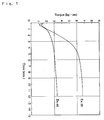
- Fig. 1 is a diagram showing vulcanization curves in Examples 48 and 49.
- Copolymerization reaction was carried out in the same manner as in Example 1, except that 10g of p-chloromethylstyrene was used in place of HBAC of Reference Example 1, whereby acrylic copolymer elastomer L having Mooney viscosity of 45 pts was obtained.
- Copolymerization reaction was carried out in the same manner as in Example 1, except that 15g of p-hydroxystyrene was used in place of HBAC of Reference Example 1. During the reaction yellow precipitates were observed on the latex surface just after the addition of the polymerization initiator mixture, and at the end of copolymerization reaction yellowish brown resinous precipitates were observed.
- the feed gas mixture composition was changed to VdF / HFP / CTFE (chlorotrifluoroethylene) in a ratio of 43 / 55 / 2 by weight and the supplementary gas mixture composition to VdF / HFP / CTFE in a ratio of 73 / 25.5 / 1.5 by weight.
- Acrylic copolymer elastomer A and fluorine-containing elastomer A were mixed in a ratio of 50 : 50 by weight by open roll (roll method), whereby blend rubber A having a Mooney viscosity of 38 pts was obtained.
- Acrylic copolymer elastomer A and copolymer rubber of vinylidene fluoride / propylene (Aflus 200, trademark of a product made by Asahi Glass K. K., Japan) were mixed in a ratio of 50 : 50 by weight by roll method, whereby blend rubber B having a Mooney viscosity of 49 pts was obtained.
- Blend rubbers C to R were prepared by latex method of mixing a copolymer latex at the production stage of acrylic copolymer elastomer (acrylic rubber) and a copolymer latex at the production stage of fluorine-containing elastomer (fluorine rubber) in such ratios as to provide desired ratios of the acrylic rubber to the fluorine rubber by weight, as given in the following Table 2, and stirring the mixture for 30 minutes, followed by coagulated, thorough washing with water and drying.
- acrylic copolymer elastomer acrylic copolymer elastomer
- fluorine rubber fluorine-containing elastomer
- Blend rubbers S to V were prepared by blending acrylic copolymer elastomer L and fluorine-containing elastomer A or B in various ratios by weight by roll method (Comparative Example 3) or by latex method (Comparative Example 4 to 6).
- Blend rubber A 100 parts by weight (Ex. 30)
- Blend rubber B 100 parts by weight (Ex. 31)
- Stearic acid 1 parts by weight Antioxidant *) (Nocrack CD, trademark of a product made by Ouchi-Shinko Kagaku K. K., Japan) 2 parts by weight MT carbon black
- Calcium hydroxide 5 parts by weight
- Magnesium oxide 2 parts by weight Benzyltriphenylphosphonium chloride 0.4 parts by weight *) 4,4'-bis( ⁇ , ⁇ -dimethylbenzyl)diphenylamine
- Example 30 blend rubber C (latex method) was used in place of blend rubber A and the amount of benzyltriphenylphosphonium chloride was changed to 3 parts of weight.
- Example 30 blend rubbers C to R were used in place of blend rubber A.
- Example 48 using blend rubber R in place of blend rubber A of Example 30, a kneaded product further containing one part by weight of benzoic acid was subjected to vulcanization.
- F 52 1.6 6.3 280 +6 0 -29 37
- L 50 1.9 6.4 320 +4 +2 -6 43
- Example 30 Blend rubber R 100 parts by weight Stearic acid 1 parts by weight Antioxidant (Nocrack CD) 2 parts by weight FEF carbon black 25 parts by weight Calcium hydroxide 4 parts by weight Benzoic acid 0.5 parts by weight Triphenylphosphonium chloride (product made by Fulka Co.) 1 parts by weight
- Blend rubber 100 parts by weight Stearic acid 1 parts by weight Antioxidant (Nocrack CD) 2 parts by weight FEF carbon black 25 parts by weight Calcium hydroxide 4 parts by weight Triphenylphosphine (product of Wako Junyaku K.K., Japan) 4 parts by weight (Exs. 51 to 58) Triphenylphosphine (product of Wako Junyaku K.K., Japan) 2 parts by weight (Ex.
- Example 51 Styrene oxide (product of Wako Junyaku K.K., Japan) 2 parts by weight
- Example 52 C 6 H 5 O(CH 2 CH 2 O) 5 Gly (Denacol EX-145, trademark of a product made by Nagase Sangyo K.K., Japan) 2 parts by weight
- Example 53 Dibromophenyl glycidyl ether (Denacol EX-147, trademark of a product made by Nagase Sangyo K.K., Japan) 2 parts by weight
- Example 55 Bisphenol A diglycidyl ether (Epikote 828, trademark of product made by Yuka-
- Acrylic copolymer elastomer L 100 parts by weight Stearic acid 1 parts by weight Antioxidant (Nocrack CD) 2 parts by weight HAF carbon black 60 parts by weight Calcium hydroxide 5 parts by weight Magnesium oxide 2 parts by weight Bisphenol AF 1 parts by weight Benzyltriphenylphosphonium chloride 4 parts by weight
- Acrylic copolymer elastomer L 100 parts by weight Stearic acid 1 parts by weight Antioxidant (Nocrack CD) 2 parts by weight HAF carbon black 60 parts by weight 2,4,6-trimercaptotriazine 0.5 parts by weight Sodium stearate 2 parts by weight
- Acrylic copolymer elastomer M and fluorine-containing elastomer A were blended in a ratio of 50 : 50 by weight by roll method to prepare blend rubber W.
- the thus obtained blend rubber W was subjected to mixing, kneading and vulcanization in the same manner as in Example 30. No cross-linking reaction took place at all.
Landscapes
- Chemical & Material Sciences (AREA)
- Health & Medical Sciences (AREA)
- Chemical Kinetics & Catalysis (AREA)
- Medicinal Chemistry (AREA)
- Polymers & Plastics (AREA)
- Organic Chemistry (AREA)
- Emergency Medicine (AREA)
- Compositions Of Macromolecular Compounds (AREA)
- Addition Polymer Or Copolymer, Post-Treatments, Or Chemical Modifications (AREA)
Applications Claiming Priority (15)
| Application Number | Priority Date | Filing Date | Title |
|---|---|---|---|
| JP20917995 | 1995-07-25 | ||
| JP20917995 | 1995-07-25 | ||
| JP209179/95 | 1995-07-25 | ||
| JP22701895 | 1995-08-11 | ||
| JP22701895 | 1995-08-11 | ||
| JP227018/95 | 1995-08-11 | ||
| JP2984196 | 1996-01-24 | ||
| JP29841/96 | 1996-01-24 | ||
| JP2984196 | 1996-01-24 | ||
| JP9348696 | 1996-03-22 | ||
| JP93486/96 | 1996-03-22 | ||
| JP9348696 | 1996-03-22 | ||
| JP14491796A JP3648846B2 (ja) | 1995-07-25 | 1996-05-15 | アクリル共重合体エラストマー、そのブレンドゴムおよびブレンドゴム組成物 |
| JP144917/96 | 1996-05-15 | ||
| JP14491796 | 1996-05-15 |
Publications (3)
| Publication Number | Publication Date |
|---|---|
| EP0755952A2 true EP0755952A2 (de) | 1997-01-29 |
| EP0755952A3 EP0755952A3 (de) | 1997-07-16 |
| EP0755952B1 EP0755952B1 (de) | 1999-10-20 |
Family
ID=27521180
Family Applications (1)
| Application Number | Title | Priority Date | Filing Date |
|---|---|---|---|
| EP96111939A Expired - Lifetime EP0755952B1 (de) | 1995-07-25 | 1996-07-24 | Acrylatcopolymerelastomer, seine Kautschukzusammensetzungen und Kautschukmischungszusammensetzung |
Country Status (4)
| Country | Link |
|---|---|
| US (1) | US5744562A (de) |
| EP (1) | EP0755952B1 (de) |
| JP (1) | JP3648846B2 (de) |
| DE (1) | DE69604741T2 (de) |
Cited By (3)
| Publication number | Priority date | Publication date | Assignee | Title |
|---|---|---|---|---|
| EP0894810A1 (de) * | 1997-07-31 | 1999-02-03 | Basf Corporation | Beschichtungszusammensetzungen aus modifizierten vernetzten Harzen |
| US20150073074A1 (en) * | 2012-04-12 | 2015-03-12 | Zeon Corporation | Acrylic rubber composition, and crosslinked product thereof |
| US9469941B2 (en) | 2011-07-01 | 2016-10-18 | Empire Technology Development Llc | Paraben derivatives for preserving cellulosic materials |
Families Citing this family (3)
| Publication number | Priority date | Publication date | Assignee | Title |
|---|---|---|---|---|
| JP3601125B2 (ja) * | 1995-08-31 | 2004-12-15 | ユニマテック株式会社 | 新規なアクリル共重合体エラストマー、そのブレンドゴムおよびブレンドゴム組成物 |
| JP2001247572A (ja) * | 2000-03-06 | 2001-09-11 | Central Glass Co Ltd | ピリミジン誘導体塩 |
| US7495061B2 (en) | 2005-05-27 | 2009-02-24 | Bausch + Lomb Incorporated | High refractive-index, hydrophilic monomers and polymers, and ophthalmic devices comprising such polymers |
Family Cites Families (6)
| Publication number | Priority date | Publication date | Assignee | Title |
|---|---|---|---|---|
| FR1456738A (fr) * | 1964-09-02 | 1966-07-08 | Rohm & Haas | Copolymères d'addition de molécules à insaturation éthylénique |
| FR1511011A (fr) * | 1966-12-13 | 1968-01-26 | Electro Chimie Soc D | Nouveaux élastomères acryliques |
| CH540940A (de) * | 1970-09-24 | 1973-08-31 | Ciba Geigy Ag | Verfahren zur Herstellung von Polymeren, die sterisch gehinderte Phenolgruppen enthalten und deren Verwendung als Stabilisatoren |
| SU952855A1 (ru) * | 1980-04-15 | 1982-08-23 | Ордена Трудового Красного Знамени Институт Физической Химии Ан Ссср | Способ получени пленкообразователей |
| JPS6053514A (ja) * | 1983-09-02 | 1985-03-27 | Hitachi Chem Co Ltd | 樹脂組成物 |
| CA2078036A1 (en) * | 1991-09-13 | 1993-03-14 | Masaharu Yamamoto | Polymer, surface modifier for inorganic materials and modified products thereof |
-
1996
- 1996-05-15 JP JP14491796A patent/JP3648846B2/ja not_active Expired - Fee Related
- 1996-07-24 EP EP96111939A patent/EP0755952B1/de not_active Expired - Lifetime
- 1996-07-24 DE DE69604741T patent/DE69604741T2/de not_active Expired - Lifetime
- 1996-07-24 US US08/686,078 patent/US5744562A/en not_active Expired - Lifetime
Cited By (5)
| Publication number | Priority date | Publication date | Assignee | Title |
|---|---|---|---|---|
| EP0894810A1 (de) * | 1997-07-31 | 1999-02-03 | Basf Corporation | Beschichtungszusammensetzungen aus modifizierten vernetzten Harzen |
| US9469941B2 (en) | 2011-07-01 | 2016-10-18 | Empire Technology Development Llc | Paraben derivatives for preserving cellulosic materials |
| US20150073074A1 (en) * | 2012-04-12 | 2015-03-12 | Zeon Corporation | Acrylic rubber composition, and crosslinked product thereof |
| EP2837657A4 (de) * | 2012-04-12 | 2015-11-25 | Zeon Corp | Acrylkautschukzusammensetzung und vernetztes produkt daraus |
| US9441093B2 (en) | 2012-04-12 | 2016-09-13 | Zeon Corporation | Acrylic rubber composition, and crosslinked product thereof |
Also Published As
| Publication number | Publication date |
|---|---|
| JPH09316273A (ja) | 1997-12-09 |
| EP0755952A3 (de) | 1997-07-16 |
| DE69604741D1 (de) | 1999-11-25 |
| JP3648846B2 (ja) | 2005-05-18 |
| EP0755952B1 (de) | 1999-10-20 |
| DE69604741T2 (de) | 2000-03-09 |
| US5744562A (en) | 1998-04-28 |
Similar Documents
| Publication | Publication Date | Title |
|---|---|---|
| RU2152962C1 (ru) | Вулканизуемая фторэластомерная композиция | |
| DE3715210C2 (de) | Fluor enthaltende Polymere und härtbare Zusammensetzungen, welche diese enthalten | |
| EP0518073B1 (de) | Fluoroelastomere auf Basis von Vinylidfluorid mit einer überlegenen Beständigkeit gegen organische Basen | |
| EP1683837A1 (de) | Fluorelastomer und vernetzbare Zusammensetzung daraus | |
| JPH08157539A (ja) | 低温シール性に優れたフッ素ゴム共重合体及びその硬化用組成物 | |
| EP1245635B1 (de) | Fluorelastomer-zusammensetzung zum vernetzen | |
| JP2004526047A (ja) | 硬化性耐塩基性フルオロエラストマー | |
| EP0754721A2 (de) | Fluorhaltige Elastomerzusammensetzung | |
| EP1621557A2 (de) | Fluoroelastomere | |
| EP0761702B1 (de) | Neues Acryl-Copolymer-Elastomer, seine Kautschukmischung und Kautschukzusammensetzung | |
| US5859144A (en) | Process for producing rubber compound | |
| EP0755952B1 (de) | Acrylatcopolymerelastomer, seine Kautschukzusammensetzungen und Kautschukmischungszusammensetzung | |
| EP1973956B1 (de) | Fluorelastomere | |
| EP1808448B1 (de) | Verfahren zur Herstellung von elastischem Fluorcopolymer und vernetztem Fluorkautschuk | |
| JPS6127404B2 (de) | ||
| JP4437954B2 (ja) | 硬化性耐塩基性フルオロエラストマー | |
| US6001932A (en) | Acrylic copolymer elastomer, its blend rubber and blend rubber composition | |
| JP2679729B2 (ja) | 加硫可能な組成物 | |
| US5264509A (en) | Fluoroelastomers based on vinylidene fluoride exhibiting superior resistance to organic bases | |
| US6265494B1 (en) | Curable fluoroelastomeric compositions | |
| JP2711906B2 (ja) | 含フッ素弾性状共重合体 | |
| JPH07173204A (ja) | 含フッ素エラストマーの製造方法 | |
| EP0251285A2 (de) | Härtbare Mischungen auf der Basis von mit Peroxiden vulkanisierbaren Fluorelastomeren | |
| JPH07118349A (ja) | 含フッ素エラストマー | |
| JP3605964B2 (ja) | ゴム複合体の製造方法 |
Legal Events
| Date | Code | Title | Description |
|---|---|---|---|
| PUAI | Public reference made under article 153(3) epc to a published international application that has entered the european phase |
Free format text: ORIGINAL CODE: 0009012 |
|
| AK | Designated contracting states |
Kind code of ref document: A2 Designated state(s): DE FR |
|
| PUAL | Search report despatched |
Free format text: ORIGINAL CODE: 0009013 |
|
| AK | Designated contracting states |
Kind code of ref document: A3 Designated state(s): DE FR |
|
| 17P | Request for examination filed |
Effective date: 19970724 |
|
| 17Q | First examination report despatched |
Effective date: 19971009 |
|
| GRAG | Despatch of communication of intention to grant |
Free format text: ORIGINAL CODE: EPIDOS AGRA |
|
| GRAG | Despatch of communication of intention to grant |
Free format text: ORIGINAL CODE: EPIDOS AGRA |
|
| GRAH | Despatch of communication of intention to grant a patent |
Free format text: ORIGINAL CODE: EPIDOS IGRA |
|
| GRAH | Despatch of communication of intention to grant a patent |
Free format text: ORIGINAL CODE: EPIDOS IGRA |
|
| GRAA | (expected) grant |
Free format text: ORIGINAL CODE: 0009210 |
|
| AK | Designated contracting states |
Kind code of ref document: B1 Designated state(s): DE FR |
|
| REF | Corresponds to: |
Ref document number: 69604741 Country of ref document: DE Date of ref document: 19991125 |
|
| ET | Fr: translation filed | ||
| PLBE | No opposition filed within time limit |
Free format text: ORIGINAL CODE: 0009261 |
|
| STAA | Information on the status of an ep patent application or granted ep patent |
Free format text: STATUS: NO OPPOSITION FILED WITHIN TIME LIMIT |
|
| 26N | No opposition filed | ||
| PGFP | Annual fee paid to national office [announced via postgrant information from national office to epo] |
Ref country code: DE Payment date: 20140716 Year of fee payment: 19 |
|
| PGFP | Annual fee paid to national office [announced via postgrant information from national office to epo] |
Ref country code: FR Payment date: 20140708 Year of fee payment: 19 |
|
| REG | Reference to a national code |
Ref country code: DE Ref legal event code: R119 Ref document number: 69604741 Country of ref document: DE |
|
| PG25 | Lapsed in a contracting state [announced via postgrant information from national office to epo] |
Ref country code: DE Free format text: LAPSE BECAUSE OF NON-PAYMENT OF DUE FEES Effective date: 20160202 |
|
| REG | Reference to a national code |
Ref country code: FR Ref legal event code: ST Effective date: 20160331 |
|
| PG25 | Lapsed in a contracting state [announced via postgrant information from national office to epo] |
Ref country code: FR Free format text: LAPSE BECAUSE OF NON-PAYMENT OF DUE FEES Effective date: 20150731 |